Bird photography on Hokkaido with Remi and Friends…Thursday in Bird World

29 October 2026

Hello Everyone,

It is a refreshing fall day on the Canadian Prairies. We have had rain, wind, and summer temperatures, and sometimes it feels like we are on a roller coaster. The children on my block are gearing up for Halloween, hoping it is nice and they can fill their pumpkins with lots of goodies!

If you are a long-time reader of my blog, you know I don’t include ads, and I rarely promote products and services unless I am truly committed to them and believe they will add something to our lives. Today is a rare exception and, for good reason. If you are travelling and wish to join a small, well-organised photo tour, it can be extremely difficult to separate the extraordinary experience from the mundane. On the other hand, when you get it right, your trip is easy, full of exciting adventures, lots of birds, good food, new friends, and ‘knowledge’ – along with superior photography. You learn so much from good guides.

So, in the spirit of ‘giving’ and helping those planning a photo trip to Europe, Asia or dreaming of one in the future, I want to introduce you to Bird-Photo-Tours.

Remi Potier, a dear Polish reader and part of this wonderful company, compiled outstanding information on two incredible raptors you might see on a tour to Hokkaido. Have a read – the information is thorough, and it is what you would expect if you were there in person with their guides.

Full disclosure: I did not receive any compensation for posting the information about this company and Remi’s excellent guide to the eagles in this part of northern Japan. I am very grateful to small companies like theirs that enrich our travel experiences! When I was much, much younger, I loved the adventure of planning everything on my own, but now I find it much preferable to work with a company familiar with the area that can, if I wish, handle everything. I hope to one day join this group in northern Japan or Indonesia, two places I have enjoyed visiting in the past.

Thanks, Remi, for your great efforts in educating us today!

The Bald Eagle’s Giant Cousins: Following Steller’s Sea Eagles to the Hokkaido Ice

If you have spent a winter watching a Bald Eagle nest cam, you already know the family. The Bald Eagle is one of eight sea and fish eagles in the genus Haliaeetus, and two of its cousins gather every February on the drifting sea ice of eastern Hokkaido, Japan’s northernmost island. One of them, the Steller’s Sea Eagle, is the heaviest eagle on Earth. The other, the White-tailed Eagle, is the bird that Eurasian nest-cam watchers know from Scotland, Poland and the Baltic.

I lead small bird-photography groups in Asia, and the Hokkaido winter is the trip people ask about most. What follows is not a camera guide. It is the story of where these eagles come from, why they end up on the ice, what is quietly killing them inland, and how to watch a roost or a floe full of eagles without being the reason they leave.

A Steller's sea eagle flying over water with its wings spread and distinctive orange beak visible.

Steller’s Sea Eagle, Haliaeetus pelagicus, on the Nemuro Channel ice. © Bird-Photo-Tours ASIA

A bird built for cold water

A large female Steller’s Sea Eagle can weigh close to 9 kg, with a wingspan approaching 2.5 m. Set her next to a Bald Eagle and the difference is obvious: the bill is enormous and deep orange-yellow, the shoulders and tail are brilliant white against black, and the whole bird looks heavier than it should be able to fly. Carrying that weight has a cost. Researchers in Kamchatka estimate a Steller’s burns a full day’s energy in about 45 minutes of flapping flight, which is why the species nests within a short glide of salmon rivers and coasts.

The entire world population breeds along one stretch of the Russian Far East: Kamchatka, the coast of the Sea of Okhotsk, northern Sakhalin and the lower Amur. BirdLife International lists the species as Vulnerable, with a small and regionally declining population; estimates in the scientific literature run from roughly 4,000 to 6,000 birds. For comparison, there are more Bald Eagles in Minnesota alone.

Alongside it on the ice is the White-tailed Eagle, Haliaeetus albicilla. It is the Bald Eagle’s closest relative, the Old World half of a sister pair, and in Hokkaido it is the more numerous of the two. Both are fish eagles first, scavengers second, and that second habit is where the trouble starts.

A soaring eagle with outstretched wings, showcasing its brown plumage against a cloudy sky.

White-tailed Eagle, Haliaeetus albicilla, the Bald Eagle’s closest relative. © Bird-Photo-Tours ASIA

Following the ice south

In November the Russian coast freezes and the eagles move. A few hundred stay in Kamchatka or along the Okhotsk shore; around 2,000 cross to the southern Kuril Islands and Hokkaido. The first birds reach the Shiretoko Peninsula in late November. The spectacle, though, waits for the sea ice.

Each winter pack ice forms in the Sea of Okhotsk and drifts south until it jams against Shiretoko, usually in late January or February. The eagles treat the floes the way Bald Eagles treat a cottonwood over a Prairie river: a safe perch with food underneath. Fish killed or stunned by the ice, discards from the Rausu fishing fleet and the odd dead seal gather both species in numbers you will not see anywhere else. On a good morning in the Nemuro Channel our groups have counted well over a hundred eagles on the ice within sight of the boat, most of them within a few hundred metres of the harbour.

Two places matter. Rausu, a small fishing port on the Shiretoko side, is where the pre-dawn boats go out into the channel between Hokkaido and Kunashiri. Lake Furen, on the Nemuro Peninsula, is the other big wintering area, a frozen lagoon with reedbeds where both eagles share the ice with Whooper Swans. Both sites are designated National Wildlife Protection Areas. We run a Japan winter bird photography tour around these two sites every February, timed for the ice; the same ten days take in the Red-crowned Cranes at Tsurui and the Blakiston’s Fish Owl, the largest owl in the world.

A Steller's sea eagle flying against a cloudy sky, showcasing its impressive wingspan and distinctive orange beak.

Steller’s Sea Eagle over the floes off Rausu, February. © Bird-Photo-Tours ASIA

The window is short. By mid-March the ice retreats, the adults leave first, and the birds that linger into April are mostly immatures. In that sense the Hokkaido eagles behave exactly like the Bald Eagles that stage on open water below hydro dams in Manitoba or Saskatchewan in winter: they are where the fish are, for as long as the fish are there.

The deer, the bullet and the eagle

Readers who follow North American raptor rehab will know what comes next. In the mid-1990s Hokkaido’s fisheries were in decline, and the eagles did what Bald Eagles do when fish are short: they went inland and found carcasses. The carcasses were Sika deer, shot by hunters who took the meat and left the gut piles and heads in the forest. The deer had been killed with lead rifle bullets, and lead bullets fragment.

The first lead-poisoned Steller’s Sea Eagle was recorded at Abashiri in 1996. By the winter of 1997–98, 19 eagles were found dying or dead between December and May. Within a decade the toll stood at 92 Steller’s and 37 White-tailed Eagles confirmed dead of lead poisoning, and the Kushiro Zoo, which took in the sick birds, became an unwilling expert on the condition. A population model published in 2000 predicted that the Hokkaido wintering flock would fall from about 1,500 birds to under 1,000 within a century, driven almost entirely by adult deaths from lead.

Hokkaido moved faster than most jurisdictions. Lead rifle bullets were banned for deer hunting in 2000, lead shot in 2001, and in 2004 all lead ammunition was prohibited for hunting large animals on the island. Japan went further in 2014 and banned possession of lead ammunition in Hokkaido. Deaths fell sharply. They did not stop. A Hokkaido University survey of birds found dead between 2015 and 2018 attributed 26.5% of recorded Steller’s Sea Eagle deaths and 5.9% of White-tailed Eagle deaths to lead, and isotope analysis of the fragments showed the ammunition was being used illegally.

If that sounds familiar, it should. The same mechanism kills Bald and Golden Eagles across the Prairies and the Midwest every hunting season, and the same policy argument is being had over copper bullets. Hokkaido is simply twenty years further down the road, and it offers a lesson in both directions: a ban works, and a ban alone is not enough.

Watching the roost without emptying it

A wintering eagle lives on a tight energy budget. Remember the 45-minute figure: every time a Steller’s lifts off a floe because a person walked too close, it spends calories it gathered from a fish it may not replace that day. Disturbance in February is not a nuisance to these birds, it is a cost. These are the rules our groups work to, and most of them transfer directly to a Bald Eagle roost on a Canadian river.

  1. Let the boat do the approaching. On the Rausu cruises the eagles have habituated to the boats over thirty winters and will land on floes a few metres off the bow. The same bird will flush at 200 m from a person on foot. If you can watch from a vehicle, a blind or a boat, do so.
  2. Never walk onto the ice or the shoreline below a roost. At Lake Furen we stay on the road and the designated viewpoints. Birds that flush from a frozen lake have nowhere closer to land than the next frozen lake.
  3. Dawn and dusk are off limits for close approach. Eagles leave the night roost on the first thermals and return in the last light; both are the moments when a flushed bird loses the most. Photograph the roost from a distance, or not at all.
  4. Do not put out food. The Rausu boats carry fish and the practice is openly debated among photographers and researchers; it concentrates birds and changes their behaviour. On land, baiting a roost with fish or carrion is illegal in the protection areas and, as the lead story shows, feeding eagles carcasses is exactly how the trouble began.
  5. Read the bird, not the distance. A Steller’s that stops feeding, stands tall and stares at you has already told you that you are too close. Head-bobbing and wing-lifting come next. Back off before the third signal, which is take-off.
  6. Watch the supporting cast. Blakiston’s Fish Owls are photographed from heated hides at a handful of sites where the owners manage the fish ponds; we never spotlight, call or approach a wild owl. The crane roosts on the Setsuri River are watched from a bridge at first light and nowhere else.
  7. Leave the inland deer carcasses alone. If you find one with eagles on it, report it to the local Wild Bird Society office rather than approaching it. Sick birds on a carcass are often lead cases, and the Kushiro rehabilitation centre needs the location, not a photograph.
A beautiful white crane with black wing feathers and a red crown takes flight over a snowy landscape.

Red-crowned Cranes, Grus japonensis, at the Tsurui feeding grounds. © Bird-Photo-Tours ASIA

A large owl standing on rocky terrain with a fish at its feet, showcasing its striking yellow eyes and detailed plumage, under a dimly lit environment.

Blakiston’s Fish Owl, Bubo blakistoni, photographed from a managed hide. © Bird-Photo-Tours ASIA

None of this is Japanese etiquette. It is the same field discipline that keeps a Prairie Bald Eagle roost in use year after year, written down for a place where the eagles are rarer and the cold is sharper.

What a nest-cam watcher can take from Hokkaido

The Steller’s Sea Eagle has no nest cam and probably never will; its nests are on cliffs and river bluffs in roadless Russia. What it has instead is a wintering ground that puts a Vulnerable species within reach of a small town’s fishing boats and a few thousand visitors a year. The money those visitors bring is a large part of why Rausu’s fleet now defends the eagles it once competed with.

For anyone who has followed a Bald Eagle family through a season online, the Hokkaido story closes a loop. The lead problem you read about from Iowa and Manitoba has a twenty-year case study on the other side of the Pacific. The disturbance rules at a Prairie roost are the same rules on the ice. And the bird on the floe, with its absurd bill and white shoulders, is recognisably family.

If you are ever tempted to see it for yourself, February is the month, Rausu and Lake Furen are the places, and a boat is the kindest way to get close. We cover Hokkaido and the rest of the region in our bird watching tours across Asia, but the eagles belong to no one, and the cheapest way to meet them is still a rental car, a thermos and a lot of patience on a cold road.

Thank you so much for being with us today! Please check out their website and pass this information along to anyone you know that is wanting to join a photography bird group. They can contact Remi directly for more information:

Remi Potier: bird-photo-tours.com

Remi’s e-mail: remi@uxray.io

Take care!

Thank you to Remi Potier and Bird Photo Tours for their excellent essay and their wonderful adventures!

Good News on Little Bit ND17 and brief news in Bird World

Sunday 3 July 2022

“Camaro with hay bale” by La Chachalaca Fotografía is licensed under CC BY-NC 2.0.

Do you live in an area where farmer’s are baling hay or straw? and using baling twine? It was baling twine mixed in with some other nesting materials that caught on the male Ospreys talon at Osoyoos and pulled the chick off to fall to its death. Dr Erick Greene at the Montana Osprey Project finds literally tonnes of baling twine in the Osprey nests he studies. He also finds dead chicks and others nearly dead and tangled. If you live in a farming area help our Ospreys by spreading the word. Here is an information pamphlet that Dr Greene prepared – it is quick and to the point.

It is surprising that the nest at ND-LEEF is still holding. It looks like bits and pieces of it are falling away each day. Mum and Dad are still bringing fish to the nest for ND15 and 16.

15 was on the nest when the adult arrives with a nice fish. Soon 16 arrives.

I believe 15 kept the fish!

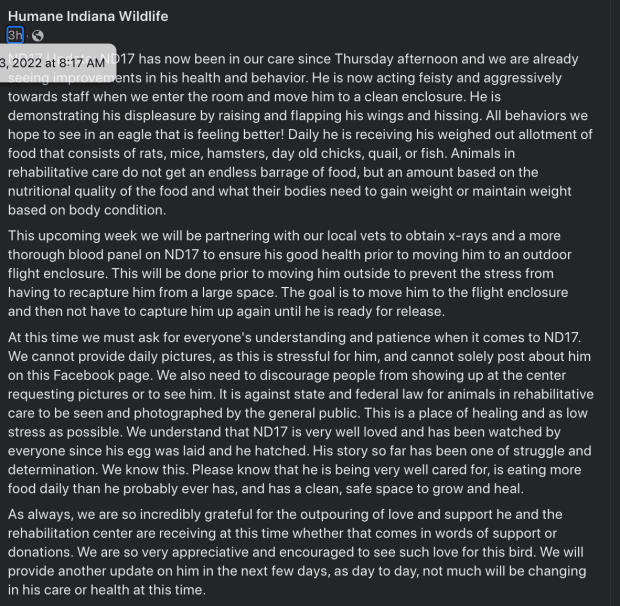
There is an update today on ND17 – and it is a good one. There is that sweet baby. It appears that individuals have been showing up at the clinic wanting to see 17. Please do not go there. The clinic staff has addressed this issue in their posting. ND17 is doing great and it is the clinic’s business to help him so that he can be returned to the wild. Everyone who works at a rehabilitation clinic is overworked and underpaid – it is a very sad situation in many instances where they do not get celebrity birds and good donations. Send them a thank you letter! Tell them you don’t expect a reply. Make a donation! Give to your local rehabber — I keep saying clean old towels but gosh, they are much needed. Give the towel a second life, too.

Isn’t he adorable?

Problems with nests and falling out of nests happens everywhere. It has been awhile since I checked on the two White-tail Eaglets in their nest in the Tucholskie Forest in Poland. Last time I remained somewhat cautious about the second chick surviving. Their names are Uno and Duo. (The third chick was a victim of siblicide). Uno fell off the nest and spent 4 days on the forest floor. He must have glided – as he flew back up to the nest. There are now some concerns that Duo has not been fed since 1 July and Uno is taking all the prey. They are big eaglets – just beautiful. Both will hopefully survive.

Sleeping and waiting for food.

Last year, Karl II and Kaia had three storklets. One of those Pikne who stayed with Karl II for a long time having him bring her food before fledging. She hatched on the 28th of May and fledged 4 August. She has a perfect flight to Ethiopia where she arrives on October 24, 2021. Pikne stayed in Africa and set off for her return flight to Estonia. She was in Israel on 1 June 2022 and everyone was so happy to see her transmitter working. Sadly, on 6 June, she on a power line and was killed in the middle of nowhere in Turkey. Such promise. A day does not go by without adding another one to ‘the list’.

Pikne is the storklet getting ready to stand up at the front.

As ‘S’ reminded me last year, countries can make laws that power companies must make their poles safe for wildlife but the companies must follow through in a timely manner. Last fall we lost Solly in South Australia and the individuals that make up Port Lincoln Osprey were on a mission to get the government to fix the power poles. Must check with them to see how they are doing. It is, sadly, a worldwide issue for our beautiful raptors and storks. In Pikne’s case, it is thought that she was tired and landed to rest as there was no place to feed near that pole — so it is not just poles near feeding areas but all poles that should have a protective cover.

This is the nest of Karl and Kaia this morning. Bonus made no reaction to Karl II which means that he has accepted him as his father, the male on the nest and is home with the three siblings. This is such good news for the success of the intervention by Urmas and Dr Madis V. Actually it is fantastic news.

What can you do to help so that our beautiful birds are not electrocuted? Here is a story of a Bald Eagle and an individual who got their power company to retrofit the power lines – 12 of them – in their neighbourhood. Remember! Each of us can make a difference by seeking solutions for the birds that live where we do.

Most everyone is following the story of Malala, the Red-tail hawklet meant for dinner but adopted by the Gabriola Island Bald Eagle family. This article covers this adventure from the beginning to the present. It is a really good read.

Every once in awhile I feel compelled to give a shout out to the New Zealand government and specifically their Department of Conservation (NZ DOC). I wonder how many of my readers follow the exploits of the Royal Cam chick on Taiaroa Head? There she is – QT (Quarry Track) chick doing her morning stretches. What a beauty.

This year has seen at least 10 supplementary feedings for QT and a few of the other chicks on the peninsula. Her parents are YRK and OGK. Just like Janika could not provide enough food for her storklets alone, neither can YRK. There is little talk on the Royal Cam FB group but the much beloved OGK was last seen on the 19th of May. Some believe he came in on June 10 but that is not confirmed and many believe it was not him but, rather, YRK. OGK doesn’t choose to not return to feed his chicks. He is one of the most devoted Royal Albatross I have ever seen. He is either injured or dead. Two years ago OGK suffered a leg injury and returned limping after 40 days. If the 19 of May date is correct – he is missing for 46 days now. Send all good wishes his way, please.

US Steel Eagle 4 (USS4) is in care from tumbling out of the tree with severe feather injuries but USS5 is doing great – learning how to fly and returning to the nest for prey from the parents. Congratulations 5 – you are doing very well, indeed.

‘H’ reports that Dory has really mastered the art of feeding her three osplets on the Boathouse Osprey nest – making sure that each and everyone has bites. Dory purposefully gave Little Bob several nice mouth fulls this morning. Fantastic. Thank you ‘H’.

Dad was in early with fish for Mum and the two osplets on the Osoyoos Osprey Platform. It was 0554. Fingers crossed!

That is a brief look at some of the news today. Everyone seems to be doing well.

It is not a good image – taken with my phone at a distance. But this is the tiny rabbit that comes to the garden now grown – 4x his size. Grass and birdseed!

In celebration of ND17s progress, I am sending each of you a virtual piece of that Yokohama Orange cake…Sorry to all food designers. Fall plate and spring flowers! But delicious cake…it was worth all the effort.

Thank you for joining me today. Take care everyone. See you soon!

Thank you to the following for their streaming cams and/or FB postings where I took my screen captures: Humane Wildlife Indiana, The Eagle Club of Estonia, Bieliki Online Bory Tucholskie, NZ DOC, ND-LEEF, Explore and Audubon, Pix Cams, Osoyoos Osprey Cam, and GROWLS.

Thursday morning in Bird World

21 April 2022

The snow that was forecast did not materialize in southern Manitoba and Winnipeg. That is wonderful! We needed a break from the last storm to melt the snow and to be outside. The birds needed a break in the weather, too. Sadly, there is another special weather advisory for the southern part of Manitoba starting tomorrow morning through Sunday. Perhaps we will only get the wintery rain. Oh, the poor Wood Ducks. They have just arrived.

IMPORTANT INFORMATION: The Q & A session on Cal Falcons is at noon in Berkeley! When you go to the YouTube site and set the alarm reminder, it will confirm your local time – hence the confusion. Thanks ‘B’ and ‘S’.

You can tell by Big Red’s demeanour that ‘something’ is happening. She does a little wiggle and then you catch her with this focused look as if she can see the eyas advancing in its pecking. Of course, she can hear it cheeping and, apparently, so can the other three. Some believe that this encourages them to hatch faster so they can join their sibling. That would be grand.

Arthur revealed the progress of the hatch when there was a shift change.

Hatching!

The White-tailed eagle nest of Tula and Borek in the Tuchola Forest had three eggs. The eaglets hatched on 8, 12, and 14th of April. There are only two surviving eaglets today. Siblicide is not as widespread in White-tail Eagle populations as it is in Golden Eagles. That said, when the third eaglet hatched the eldest at this nest began immediately to beak it. There was 6 days difference in their age and size. I believe the two surviving are hatches 1 and 2. I will refer to them as Big Bob and Middle Bob to try and keep things straight.

Today, Middle was clever and crawled up leaning half in and half way out of the nest cup so it could get some food. This is a very determined youngster. The eldest had eaten and so the youngest was not tormented. I hope that these two survive just like the two oldest hatches at the Dale Hollow Nest.

The nest is 25 metres above ground on a 140-year-old pine tree. The White-tailed eagles have been using the nest for four years. At another place in the forest, eagles had been nesting since the late 1990s on a 160-year-old pine near to one of the fish lakes. So for 25 years eagles, at some location in Tuchola Forest, WTE have been breeding. There is a year round protection area around the nests extending 200 metres in any direction.

The nest is located in this large, 46 sq kilometres, nature reserve in northern Poland. The two main types of trees are the Pine and the Oak Bartek. It is the oldest oak tree in Poland believed to be 686 years in age.

“Polek i Bartek w jednym lesie stali” by Polek is marked with CC BY-NC-SA 2.0.

The park is full of rabbits, deer, and 80 species of birds. There are also nearby rivers for fish. It is anticipated that there should be plenty of food for the adults and both of the chicks.

There are about 1200-1500 pairs of White-tailed Eagles in Poland. Their conservation status is ‘very scarce breeding bird’. Most of the eagles live in the northern areas of Poland.

Here is a link to this White-tailed Eagle nest in Poland:

Both eaglets were being fed well Thursday morning:

Idris and Telyn were watching the train go past the Dyfi Nest in Wales. Two eggs. We will be watching for the third tomorrow.

Little (or Mini) is still on the nest with Lena and has not fledged yet. Middle (Little) took off this morning about 10:05 for a flight and is perched on some greenery near the nest. He is probably going to watch for when Dad delivers a fish. This morning Lena has also had to chase away an intruder, another Osprey.

It looks like the MN-DNR nest is getting a bit of sun this morning. It will help dry out the nest of Harry and Nancy but will they get some of that snow and rain that is coming?

What is enfluffeling?

Jackie and Shadow’s 2022 eaglet, Spirit, sure loves it when the wind blows hard through the nest. She is working those wings today!

For all us worrying aunties and uncles, the cam operator did Zoom out and there are three eaglets on the West End nest. Relief. When the camera is in the normal position, you might only see two.

This is the view of the Glacier Gardens Nest this morning. Oh, it is beautiful. Liberty and Freedom should be returning soon.

It is a bright sunny day for Chase, Cholyn, and the little one at the Two Harbours nest.

The Redding Eagles are asking for you to vote for your favourite name for Liberty and Guardians 2022 hatches. Here is the announcement:

Friends of the Redding Eagles​ NAMING: Step 2: Vote for your favorite pair of names, just ONCE please. Click here to vote- https://docs.google.com/forms/d/e/1FA…

Jasper and Rocket from Samson and Gabby’s NEFlorida Bald Eagle nest have both fledged. They have also returned to the nest. Yahoo. Today they were perched on a branch of the nest tree looking out. I wonder if they might do some tandem flying?

Mum flew in with a hunk of fish at 09:22 at the UFlorida Osprey nest. Look where where that one osplet is positioned for the feed! I believe this to be either Big or Middle. It is not Little Bit.

That chick got a lots of nice big fish bites while the other two were fighting at the back of Mum. It is difficult to tell who is who and the dark shadow is not helping. I first thought it was Little Bit on the rim of the nest but I believe that Little Bit is getting hammered by Big while it is Middle eating. But that is not a 100% certain ID.

The chicks are really, really hungry. Clever of that one to get up there to be fed. It walked away and fell into food coma. Smiling. Ah, is he playing possum? He looked up to see the other two eating. Wonder if he will return for some more fish?

That osplet would certainly like some more fish.

Sadly it looks like Little Bit is lodged between Big and Middle. This is not good especially with less fish coming on the nest and the hot weather dehydrating the little guys.

Little Bit cannot seem to get around the bigger sibling. He will be getting tired and dehydrated.

At 10:00 the Big sibling was laying on top of Little Bit.

I do not believe Little Bit did get any fish. The feeding was over and Mum went to brood the chicks.

I will monitor the UFlorida nest on and off today. What looked good a few days ago has now turned. Let us all hope that another big chunk of fish gets on that nest quickly so Little Bit can have some food.

This is the latest on the hatch for Big Red and Arthur. The image was shot in a change over from Arthur to Big Red. I am really hoping that is blood from a prey item.

Thank you so much for joining me today. Take care everyone. I will be back with what I hope is good news on Little Bit later today along with hatch news from Cornell. See you soon!

Thank you to the following for their streaming cams where I took my screen captures: Cornell Bird Lab, UFlorida-Gainesville Ospreys, Friends of Big Bear Valley, Explore.org, Tuchoskie Forest Eagle Cam, NEFlorida and the AEF, Redding Eagles, MN-DNR, Captiva Ospreys and Window for Wildlife, Cal Falcons, Glacier Gardens, and Dyfi Osprey Project.

Milda lays first egg of 2022!

17 March 2022

This year it seems that couples who have had difficulties in the last year or two are having success. I hope that this is the case with Milda and her new mate at the White-tailed Eagle nest near Kurzume in Durbe Municipality, Latvia.

On the map below you can see Kurzeme in the western region of Latvia.

Last year Milda lost her long time mate, Raimis, right after she had laid her eggs. Milda and Raimis had successfully bred on the nest in 2018, 2019, and 2020. 2021 would have been their 4th breeding season. It is believed that Raimis was killed or injured in a territorial dispute and did not return to the nest.

Milda tried to incubate those eggs in the cold weather without eating. She did so for eight full days. What an incredibly devoted mother. She had to eat and left the two eggs for approximately 5-6 hours in the cold weather of April. To everyone’s surprise, the two eggs hatched. But Milda was starving and there was little food and an on again off again male who watched the two chicks freeze to death while Milda foraged. It was a horribly sad ending for the breeding year but, much was learned about eggs and outside temperature. We also know that these big nests hold a lot of heat.

So this is a new year and Milda has laid her first egg at 18:09 on Thursday the 17th of March. Congratulations to Milda and her mate who I hope is as devoted to her as she is to her eggs and chicks.

The nest is in a forest area high up on Spruce Tree. The region is so beautiful. It will change from winter into spring before your eyes.

You can join in with all the other fans of Milda by going to the streaming cam below. There are some great chat moderators there to help you, too!

White-tailed Eagles are extremely rare in the Balkan Region. This nest has been used since 2014 and it is hoped that this year it will be successful for this fabulous Mum.

This is exciting. I am so happy for Milda. Thank you for joining me!

Thank you to the Latvian Fund for Nature for their streaming cam where I took my screen captures.