
Sunday 3 July 2022

Do you live in an area where farmer’s are baling hay or straw? and using baling twine? It was baling twine mixed in with some other nesting materials that caught on the male Ospreys talon at Osoyoos and pulled the chick off to fall to its death. Dr Erick Greene at the Montana Osprey Project finds literally tonnes of baling twine in the Osprey nests he studies. He also finds dead chicks and others nearly dead and tangled. If you live in a farming area help our Ospreys by spreading the word. Here is an information pamphlet that Dr Greene prepared – it is quick and to the point.
It is surprising that the nest at ND-LEEF is still holding. It looks like bits and pieces of it are falling away each day. Mum and Dad are still bringing fish to the nest for ND15 and 16.

15 was on the nest when the adult arrives with a nice fish. Soon 16 arrives.

I believe 15 kept the fish!

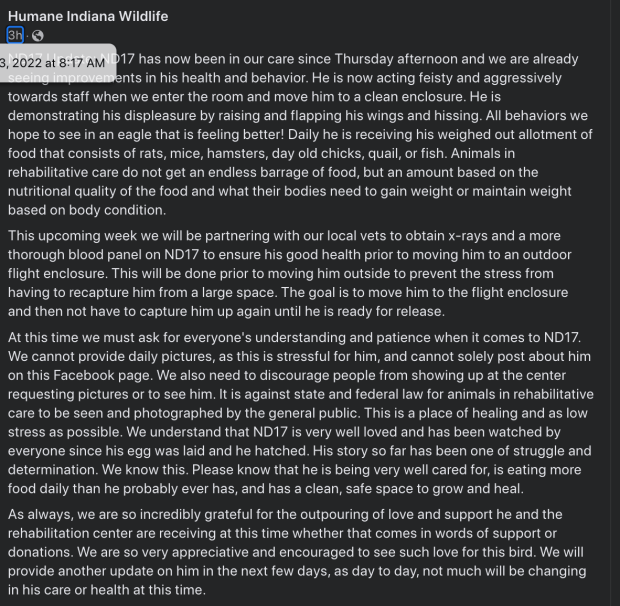
There is an update today on ND17 – and it is a good one. There is that sweet baby. It appears that individuals have been showing up at the clinic wanting to see 17. Please do not go there. The clinic staff has addressed this issue in their posting. ND17 is doing great and it is the clinic’s business to help him so that he can be returned to the wild. Everyone who works at a rehabilitation clinic is overworked and underpaid – it is a very sad situation in many instances where they do not get celebrity birds and good donations. Send them a thank you letter! Tell them you don’t expect a reply. Make a donation! Give to your local rehabber — I keep saying clean old towels but gosh, they are much needed. Give the towel a second life, too.
Isn’t he adorable?

Problems with nests and falling out of nests happens everywhere. It has been awhile since I checked on the two White-tail Eaglets in their nest in the Tucholskie Forest in Poland. Last time I remained somewhat cautious about the second chick surviving. Their names are Uno and Duo. (The third chick was a victim of siblicide). Uno fell off the nest and spent 4 days on the forest floor. He must have glided – as he flew back up to the nest. There are now some concerns that Duo has not been fed since 1 July and Uno is taking all the prey. They are big eaglets – just beautiful. Both will hopefully survive.

Sleeping and waiting for food.

Last year, Karl II and Kaia had three storklets. One of those Pikne who stayed with Karl II for a long time having him bring her food before fledging. She hatched on the 28th of May and fledged 4 August. She has a perfect flight to Ethiopia where she arrives on October 24, 2021. Pikne stayed in Africa and set off for her return flight to Estonia. She was in Israel on 1 June 2022 and everyone was so happy to see her transmitter working. Sadly, on 6 June, she on a power line and was killed in the middle of nowhere in Turkey. Such promise. A day does not go by without adding another one to ‘the list’.

As ‘S’ reminded me last year, countries can make laws that power companies must make their poles safe for wildlife but the companies must follow through in a timely manner. Last fall we lost Solly in South Australia and the individuals that make up Port Lincoln Osprey were on a mission to get the government to fix the power poles. Must check with them to see how they are doing. It is, sadly, a worldwide issue for our beautiful raptors and storks. In Pikne’s case, it is thought that she was tired and landed to rest as there was no place to feed near that pole — so it is not just poles near feeding areas but all poles that should have a protective cover.
This is the nest of Karl and Kaia this morning. Bonus made no reaction to Karl II which means that he has accepted him as his father, the male on the nest and is home with the three siblings. This is such good news for the success of the intervention by Urmas and Dr Madis V. Actually it is fantastic news.
What can you do to help so that our beautiful birds are not electrocuted? Here is a story of a Bald Eagle and an individual who got their power company to retrofit the power lines – 12 of them – in their neighbourhood. Remember! Each of us can make a difference by seeking solutions for the birds that live where we do.
Most everyone is following the story of Malala, the Red-tail hawklet meant for dinner but adopted by the Gabriola Island Bald Eagle family. This article covers this adventure from the beginning to the present. It is a really good read.

Every once in awhile I feel compelled to give a shout out to the New Zealand government and specifically their Department of Conservation (NZ DOC). I wonder how many of my readers follow the exploits of the Royal Cam chick on Taiaroa Head? There she is – QT (Quarry Track) chick doing her morning stretches. What a beauty.
This year has seen at least 10 supplementary feedings for QT and a few of the other chicks on the peninsula. Her parents are YRK and OGK. Just like Janika could not provide enough food for her storklets alone, neither can YRK. There is little talk on the Royal Cam FB group but the much beloved OGK was last seen on the 19th of May. Some believe he came in on June 10 but that is not confirmed and many believe it was not him but, rather, YRK. OGK doesn’t choose to not return to feed his chicks. He is one of the most devoted Royal Albatross I have ever seen. He is either injured or dead. Two years ago OGK suffered a leg injury and returned limping after 40 days. If the 19 of May date is correct – he is missing for 46 days now. Send all good wishes his way, please.

US Steel Eagle 4 (USS4) is in care from tumbling out of the tree with severe feather injuries but USS5 is doing great – learning how to fly and returning to the nest for prey from the parents. Congratulations 5 – you are doing very well, indeed.

‘H’ reports that Dory has really mastered the art of feeding her three osplets on the Boathouse Osprey nest – making sure that each and everyone has bites. Dory purposefully gave Little Bob several nice mouth fulls this morning. Fantastic. Thank you ‘H’.


Dad was in early with fish for Mum and the two osplets on the Osoyoos Osprey Platform. It was 0554. Fingers crossed!

That is a brief look at some of the news today. Everyone seems to be doing well.
It is not a good image – taken with my phone at a distance. But this is the tiny rabbit that comes to the garden now grown – 4x his size. Grass and birdseed!

In celebration of ND17s progress, I am sending each of you a virtual piece of that Yokohama Orange cake…Sorry to all food designers. Fall plate and spring flowers! But delicious cake…it was worth all the effort.

Thank you for joining me today. Take care everyone. See you soon!
Thank you to the following for their streaming cams and/or FB postings where I took my screen captures: Humane Wildlife Indiana, The Eagle Club of Estonia, Bieliki Online Bory Tucholskie, NZ DOC, ND-LEEF, Explore and Audubon, Pix Cams, Osoyoos Osprey Cam, and GROWLS.


