Thursday Morning in Bird World

Living on the Canadian prairies, we know that spring is coming when the Canada Geese return from their winter migration. Indeed, Canada Geese are usually one of the first birds to arrive. You can hear them honking flying overhead in their large ‘V’ shape formations. They arrive in late March and stay with us until late October or November.

Like other bird species, Canada geese bond for life. They also return to the same nesting site year after year. That is the sad part. Our City is growing so fast that to see these beautiful creatures laying their eggs on dirt in the midst of broken up pieces of concrete on a building site is a tragedy.

It is spring and these geese have arrived at one of our nature centres, Fort Whyte.

You can easily tell a Canada Goose from other geese with its long black neck, its white chinny chin chin, its black legs, and light grey-brown underparts and wings.

I had gone to the park near me to put up signs not to feed the birds bread. A group of the geese came over to see what was on offer and, when they saw corn and peas, they grumped at me. These geese are so used to eating bread that they will shun the food that is good for them! That is sad. The bread makes its way into the water and decomposes creating horrible algae.

This guy was particularly offended by an offer of peas! Geese will hiss and if you get close to their nests or goslings they can bite really hard. Be forewarned!

In the fall, there are several places where you can go – including the Fort Whyte Nature Centre – to see them fly in and land on the pond. There are thousands of them. The sky fills up with the silhouettes against the orange and pink at dusk. It is beautiful.

Our nature centre had – until the pandemic – an annual Goose Flight Dinner. It was a charity event with a great meal and an opportunity to see the geese up close flying in. I had my phone. There are geese in the apricot background but they are too difficult to see. So close your eyes and imagine a black blur honking.

Have you been following the love geese? Their names are Arnold and Amelia.

On 13 July the staff at the Cape Wildlife Centre in Barnstable, Massachusetts noticed that one of the geese that lives on a pond behind their centre had a limp. The staff knew the wild bird and wanted to help. The goose was caught and it was determined that he had two open fractures in his leg. The staff explained that an open fracture means that the tissue and skin are pulled away from the bone. You can see this in the top right photo. Their best guess was that a snapping turtle had harmed Arnold. Arnold had surgery and while he was recovering, there was a tap tap at the door. It was Arnold’s mate, Amelia. Amelia waited for the surgery to be complete watching Arnold from the glass window.

@ Cape Wildlife Centre

The couple became instant celebrities. Who doesn’t need a warm fuzzy story these days?

Arnold is healing nicely. His bandages get changed and he is getting stronger. Amelia comes to visit him every day, looking in the glass door of the porch. The staff were so moved by the devotion of the geese to each other that they fixed up a pen so that Arnold and Amelia can share a meal. The good news is that Arnold will be moved to an outdoor pen once he has finished his medications. He will be returned to Amelia and the wild once his foot has completely healed.

Wow. That puts a smile on your face! Everyone loves a love story – especially if it is two birds – ‘love birds’ or is it ‘love geese?’

@ Cape Wildlife Centre

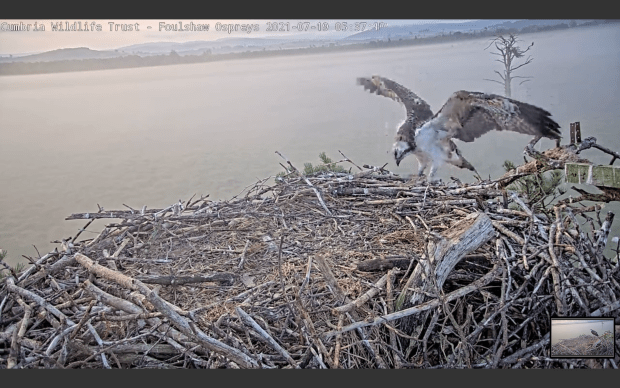
Some quick Osprey news. At the Foulshaw Moss Osprey Nest, Tiny Little slept like an adult on the perch. White YW (dad) brought in three fish so that everyone could have a nice meal during the day. That is fantastic.

After calls for emergency numbers, I received an e-mail from Katherine at the Patuxent Osprey Nest 2. They have now included the park e-mail at the top of the streaming cam. This is fantastic. There is no phone at the park that is operable 24/7.

I still recommend that everyone who watches particular nests make their own list of emergency numbers so that if you see something happening you can act quickly.

Here is a better look at that Patuxent Osprey nest as it sits in the water. Thanks ‘S’ for sending me the time stamp! Gosh, that is a really nice place for a nest.

When I checked the Foulshaw Moss nest last, no one was home! Tiny Little is out working those wings. That is fantastic.

Thank you for stopping in today to check on the birds. Everything appears to be fine on a Thursday morning in Bird World. The Osprey fledges are working their wings and getting stronger in the UK. There are still chicks to fledge there and in the US. No doubt there will be a flurry in the next couple of weeks. Take care everyone. Stay safe. I will be checking on Tiny Little throughout the day!

Thank you to the following for their streaming cams where I grabbed my screen shots: Cumbrian Wildlife Trust and the Foulshaw Moss Osprey Nest and the Patuxent Park Osprey Nest 2. Thank you to the Cape Wildlife Centre where I grabbed the images of Arnold and Amelia from their FB Page.

Good Morning Ospreyland

I have a friend who lives in the Northeastern United States. She has a beautiful garden and loves her songbirds. She also adores Big Red, Arthur, and their chicks. Wicky and I often get really down in the dumps over the direction that environmental policies are going. Then we see something and begin to believe that there is hope that all this heat, drought, flooding, birds falling from the sky, etc will pass. We need one another – for on the day I am down, she is up and vice versa!

Today Wicky sent me a quote from Jane Goodall that I would like to share with you. I am including the interview in the New York Times that she sent as well. I hope you can open it.

“Traveling the world I’d see so many projects of restoration, people tackling what seemed impossible and not giving up.”

I am always impressed with how New Zealand develops positive policies for their wildlife. Another area that is doing that is Scotland. Here is a short early morning BBC programme on the restoring of the landscape at the Cairngorms National Park. I am including some images of the park for you so that you get a glimpse of the type of landscape being restored.

“Cairngorms” by wwarby is licensed under CC BY 2.0
“Cairngorms” by chuckrock123 is licensed under CC BY-ND 2.0

Of course, my interest is the Ospreys and this is the home to the Loch Garten Ospreys. It was the first place that the Ospreys returned to in the UK in the 1950s. It was the home of the Lady of the Loch, that female, often called the Norwegian by Tiger Mozone whose DNA, according to Tiger, is in every UK Osprey except for CJ7. Lady was the foundation stone.

The image below is of that historic Osprey nest that is still used.

Sadly this year there were no Ospreys breeding at the nest. I might be remembering this wrong but it seems to me that two birds arrived at the nest and people in a canoe or kayak got too close trying to take photographs and the birds left not to return. (I hope that I am not remembering another nest – I could be so feel free to correct me, please!). Fingers crossed for next year! Here are some images of the loch. It is freshwater and is full of trout. We know that Ospreys love their trout. Dylan flew 13 km to get trout for the Clywedog Nest with Seren and Only Bob a week or so ago.

What an incredible sunset.

“Sunset at Loch Garten” by chuckrock123 is licensed under CC BY-ND 2.0
“Loch Garten” by Cairngorms National Park is licensed under CC BY 2.0

This is that short programme with Ade Adepitan, MBE on the restoration of the natural environment in the Cairngorms:

It is now approaching 11pm on the Canadian Prairies. The Osprey nests in the United Kingdom are just waking up.

Good Morning Tiny Little! I wonder if you dreamed about flying?

Totally serene image of Loch of the Lowes. No one sleeping on the nest. On occasion NC0 or one of the fledglings will appear on the nest but for the most part the camera remains fantastic because sometimes you can see the Ospreys fishing in the loch.

Aila did not return from her migration. Louis waited and waited refurbishing their nest. When he could wait no longer he paired with a new female. They raised two chicks on another nest off camera. The new Mrs Louis is Dorcha. When the two chicks were ringed on 15 July it was believed that they were 4-5 weeks old and are both are believed to be male.

Beautiful Manton Bay Nest of Blue 33 and Maya. The camera will be shut off soon and we will have to wait til the Ospreys return in March. Normally Blue 33 and Maya arrive within an hour of one another. Just think – they travel 4000 miles and arrive in that close of time. It is unclear if they winter together in the same place.

The beautiful morning turned into a day of defending their nest for Blue 33 and Maya. Poor birds.

What a beautiful morning – just look at that pink sky and the green of the landscape – at the Dyfi Nest of Idris and Telyn. I can’t see a fledgling but it sounds like one of them is scratching on the microphone of the camera!

The cameras have not come on at the nest of Dylan and Seren but, wow. I found an 11 minute video shot by a photographer of Llyn Clywedog. We can get a really good look at the loch where their nest is located. It is like you are going for a walk around the water. Very restful.

It is now a sunny afternoon at Llyn Clywedog and no one is home! It is quite understandable why the owners of these streaming cams will be turning them off in the future!

Tiny Little made a short flight from one side of the nest to the other. She spends a lot of time looking down over the edge. Did someone tell me that birds are afraid of heights? Yes, they did. It was someone at the Cornell Bird Lab years ago. It is one of the reasons the little ones don’t often fall off the edge of the ledge nests.

Tiny has spent a lot of time sitting on the edge of the nest looking down.

It’s tea time at the Foulshaw Moss Nest. 463 has joined Tiny Little who is food begging. His crop is pretty flat. Good luck Tiny!

At 16:32 Dylan flew in with a live fish which 464 promptly mantled. Let’s hope mom is around to feed some of that fish to Tiny Little!

White YW is out of there as 462 flies in for the fish. This is going to get interesting. It is still alive! Good lessons.

Oh, we had a little rain and a thunderstorm during the night. It is still really cloudy and, despite the 27 degree heat, one can imagine it is cooler!

Thank you so much for joining me. It seems that everything is going along as it should with the UK Ospreys – save for our little darling Tiny Little who needs some confidence. It will come. They are all individuals. Have a wonderful start to your week. Take care. See you soon.

Thank you to the following for their streaming cams where I took my screen shots: Cumbrian Wildlife Trust and the Foulshaw Moss Osprey Nest, Scottish Wildlife Trust and Friends of Loch of the Lowes, Scottish Woodland Trust, LRWT, Rutland Water and the Manton Bay Osprey Nest, Carnyx Wild and Llyn Clywedog Osprey Nest, the Dyfi Osprey Project, and Bywyd Gwyllt Glaslyn. A big shout out to Wicky for sending me the Jane Goodall interview!

Saturday 17 July in Bird World

I promised some updates on Big Red, Arthur, and the Ks. Right up front I want to thank Suzanne Arnold Horning for allowing me to share her images of Cornell’s birds with all of you. She lives in Ithaca and once or twice a day she heads out with her family looking for the Ks. Thank you Suzanne!

This first series is from 16 July. Both of the Ks are on the corner of this unidentified building. K1 is on the left and K3 is on the right at the corner of the building.

Isn’ she gorgeous? This is K1, the mini-Big Red.

On the 15th, the Ks were hanging out on Weill.

K1 is doing the hawk walk! So cute.

She stops and looks for her brother, K3, who has just flown away.

K3 flew over to the middle of the hockey rink roof and landed! Good gracious.

Later, K3 rejoins his sister on Weill.

Meanwhile, where are Big Red and Arthur?

Big Red is on top of the Cornell Clock Tower.

Here’s a much closer look at Big Red.

And here is an image showing the position of Arthur and the Ks. The green arrow is where Arthur is on the light stands and the purple arrows points to the corner of the Weill Building where the two Ks are located.

Thanks Suzanne for the arrows and the images. It is reassuring to know that everyone is safe and sound.

There is some other news today. K1 caught her own prey. I know it happened but I do not have an image I can show you. Of course, no one knows if this is the first time or not but this is incredible. She is certainly related to Arthur who is like the stealth bomber of hunting! And Big Red is really good herself.

The Ks will be leaving their parents territory in August. They need to be able to fly well and hunt. As you can see Big Red and Arthur have now moved them around Weill and other areas farther from the nest. Soon they will have them hunting in the fields out by the Holey Cow Barns. Why holey and not holy you ask? The cows have clear tubes inserted in their sides so that the students in the Vet School can see what is happening inside the cow’s body. I have to admit the first time I heard this I was quite happy not to be there seeing it. But then wow – how would these students learn otherwise?

Suzanne Arnold Horning also went out to the Cornell Osprey nests and took some images. She believes that the nestlings are about to fledge!

There is only one Osprey nest on the Cornell Campus. It is located on the university athletic fields on a light tower at the soccer field. The adults there fish in Cayuga Lake, Beebee Lake, and Six Mile Creek. Those are within a few miles of the nest. The adults are Olin and Olive.

Off the Cornell Campus there were 38 Osprey nests around the Cayuga Lake Basin. While it isn’t a steadfast rule, most male Ospreys do return to the area of their natal nest. I am assuming then that when Olin showed up as a bachelor and began building a nest that he had hatched from one of the nests around Cayuga Lake several years earlier.

Olin would fly around the soccer field and people began to wonder if he was going to build a nest on one of the light towers. He made several attempts with sticks at the Game Farm Road soccer field. Olin did attract a female – Olive.

The nest you see in Suzanne Arnold Hornings’s images is the new nest that was built for Olive and Olin.

There are three little ospreys ready to fly in that nest this year.

Don’t you just hold your breath when they are hovering? I do! Wings everywhere. Looks like Olive needs to duck.

The Hornings and the Sedlaceks wrote a lovely article about the first year with Olin and Olive. There are some good images. I will attach it below this. Olin and Olive originally had a nest on a light and it was precarious. This is a wonderful nest that was constructed for this Osprey couple. Just look at it. They figured out the height, the measurements the nest should be and made sure that it was storm proof. Amazing.

Here is the link to the article. Please read it, it is lovely.

https://sites.google.com/site/cornellssurpriseospreys/

On the earlier part of the Ferris Akel Live Tour, there was a lovely juvenile Cooper’s Hawk. I think I have a couple of reasonable good screen shots to show you. What a lovely bird. We have Cooper’s Hawks that come to breed on the Canadian Prairies in the summer. They are protected under the Manitoba Wildlife Act of 1994.

Indeed, when I first encountered the hawk that comes to my garden, it was not clear if it was an adult Cooper’s or a Sharp-shinned. Turned out to be a Sharpie Adult, Northern. Like the Sharp-shinned, the Coopers are a medium sized Accipiter. These are the green-blue-grey (or celadon if you want to describe them like a pottery glaze) of a juvenile. The eyes of the adult male are red and they have a white breast/belly with ochre streaking, blue-grey hood and wings. You can see those red eyes in the image directly below.

“Cooper’s Hawk” by airboy123 is licensed under CC BY-NC-SA 2.0

This juvenile might look like a Red-tail Hawk if you only saw its back. Like my Sharpie and the Red-tails, the length of the wings attributes to the silent stealth manner in which they hunt. They live in forests and even in urban back gardens and they need to be able to turn quickly which they can also do with their wings and their medium size. You can see those celadon eyes of this juvenile in the image below.

Look at the image below. Do not peek at their blue Darvic rings! Which one of those birds is Tiny Little?

It might be a surprise to you. Tiny Little is the bigger chick at the back!

I watched Tiny Little for several hours. He is absolutely hilarious. For awhile I wondered if he had forgotten how to fly. He hovered, he flapped his wings and he really wanted to go but he couldn’t get it in forward gear. But never mind. White YW brought a fish on to the nest and thoughts of flying went right out the window. Tiny Little was up to his old tricks. What you are seeing in the image below is the second sibling that Tiny Little has tormented over the evening fish. BTW. Tiny Little had a huge breakfast! His MOD is to stare at the fish, then do some flapping, go back and stare and make the sibling nervous til they walk away and leave the fish. And guess what? He is really good at it.

Blue 464 gave up the fish! Because of his behaviour you will know which one is Tiny Little below but please look at the size and look at the other bird. This is the female, that big female that tormented Tiny Little, Blue 464. Unfortunately I took about 300 images of this nest today (maybe more). I have one of Tiny Little standing next to Blue 462, the male. 462 has the thinner longer legs of White YW. Tiny Little’s legs are stout like a female and she is a big bird.

Just like she wanted. Tiny Little gets a nice feeding by Blue 35. Indeed, I think the two of them shared almost half a fish after 464 and then 462 tried to self-feed.

Here is an earlier image of the Foulshaw Moss family minus Blue 464. White YW is on the front left. Then Blue 35 is next at the rim of the nest. Then don’t peek, which one is Tiny Little? If you said the one on the far right, you are correct. Now necklaces in themselves do not indicate a female but with those stout legs and her size. Well..

‘Silo’ chick on the Patuxent River Osprey Nest 2, the one who fell out of the nest into the water last evening, was up and moving about in the afternoon so everything seems alright there. Fabulous.

Thank you everyone for stopping in today to find out about the birds. It is great to have you with us.

Thank you to the following for their streaming cams where I took my screen shots or who gave me permission to use their images: Suzanne Arnold Horning for the images of Cornell’s Red tail Hawk family and the Osprey Nest of Olin and Olive, Ferris Akel Live Tour, Cumbrian Wildlife Trust and Foulshaw Moss Osprey Cam, and Patuxent River Osprey Cam 2.

Late Friday and early Saturday in Ospreyland

There is news in Ospreyland, some good and some not so good. I am going to start with all of the good news.

Those who follow and read about Ospreys know that there are certain ‘truths’ that are held dear. These ‘truths’ get passed down through books, Websites, and conversations. One of those is that a male fledgling will ‘always’ return to its natal nest area on its first migration ‘home’. The question is how true is that statement? Is it 90% true or 80% or with all of the unringed birds is it even 50% true? There are always exceptions! It was reported today that Rutland’s Maya and Blue 33’s 2015 male chick S2 has been breeding in the Biesborch National Park in The Netherlands for the past two years. In 2020 S2 and his mate fledged three chicks and in 2021 they have two in the nest. Fabulous news.

Male 022 has been courting CJ7 since he first returned as a two year old from his first migration. Initially, this young male wasn’t quite sure of the ‘process’. What he didn’t know he made up for in enthusiasm. Could he hear everyone shouting “Bring her a fish!” Sometimes he would bring a fish but he would not share. Sometimes he shared. Meanwhile they were mating all over Poole Harbour – seriously, they were. 022 has certainly grown into understanding his role. He has been working on the nest with CJ7 and today he brought her a fish and gave it to her to enjoy – a gift. How sweet. He has done a sky dance for her and now we watch and then we will wait for next spring when everyone hopes that these two will be a couple and raise some chicks. 022’s sky dance was the first seen in 200 years in Poole Harbour. Oh, please let this couple have a nest of healthy chicks next year that fledge! Poole Harbour might announce a holiday in their honour.

The eldest chick has fledged at Foulshaw Moss, Blue 464. The others look surprised! Who will be next? That special moment was caught here on a short video:

Tiny Little has been doing a lot of wingersizing. Will he be next? He is doing a great job and I know that he is going to grow up and be as strong and fierce as Z1, Tegin.

And Tiny Little is clever, like Tiny Tot in the Achieva Nest. Today, he sniffed about and found a piece of leftover fish that the other siblings had forgotten. Tiny Little had a nice little self-feed over in that front corner. He is a survivor.

You can see that he is still Tiny but not as tiny as he once was! What a little cutie. In addition, his eyes are fine. There were some early issues, perhaps from one of the older siblings pecking him about but all seems fine now. Tiny Little is in the clown feet stage!

White YW brought in a nice fish for Blue 35 for breakfast. Guess who was first in line? You got that right – Tiny Little! Go Tiny Little, Go!

Everyone ate and had nice crops and Mom even got the fish tail.

At Loch Arkaig, there appears to be a new couple working on bonding. YP and Blue 152 have been bringing in moss and sticks to add to what Louis did in the early spring while he waited for Aila. It will be grand to have a couple in this nest next year although I have to admit that I wish it were Louis and the new Mrs Louis.

After the heat and the storms the two Osprey nests in Albert, Exshaw at Canmore and the nest at Red Deer appear to be doing well.

This is Exshaw this morning. It is a sunny dry day and the chicks are sleeping after a 5:35 am breakfast.

Legacy is doing fine, growing like a bad garden weed, down in Red Deer:

Good news coming in from Loch of the Lowes is that the first fledgling has returned to the nest and taken its second flight with mom, NC0. The first fledgling at Foulshaw Moss, has also returned to the nest. Well done!

Now for some of the sadness. The concern in Canada’s West is the growing number of wild fires active in the province of British Columbia. Last week 330 were added to a growing list of over 780 fires. The impact on wildlife now and in the future is alarming not counting, of course, the human and property cost. The province desperately needs rain and lots of it.

News has come to me from my friend, ‘T’ that goshawks have taken the lives of two banded Osprey chicks in a single Latvian nest and another chick at a nest in Spain. This is so very, very sad. The chicks were big – already ringed – in earshot of fledging.

“Goshawk” by Andy Morffew is licensed under CC BY 2.0

‘L’ has reported that a fledgling Bald Eagle was killed when it landed on a power line in Dayton, Ohio. This is so very sad because we have known for decades the problems with power lines. There could be a silver lining to this story – the community has spoken to the local power company and they seem willing to do something to their poles so that these tragedies will not happen again. Let us hope that they work fast. There are other fledglings in that nest! Indeed, every power line needs to be ‘bird friendly’. This should be standard practice.

Thank you for joining me on a sunny and going to be crispy hot Sunday on the Canadian Prairies. The news in my garden is curious. After the extreme heat wave, the number of birds at the feeders seems to be less. Strange, however, is the now regular appearance of a dozen or more Blue Jays. We always had 3. Mr Crow and family are not happy about the Blue Jays but they won’t enter the yard to try and escort them away. Perhaps the number of Blue Jays has driven the other birds away — except for Mr Woodpecker and baby. The tiny Downy fledgling was here yesterday! They are always so quick and gone by the time I have grabbed my camera.

Take care everyone. I hope to have news of Big Red, Arthur and the Ks this evening. Stay safe, stay cool. See you soon.

Thank you to the following for their streaming cams where I get my screen shots: Fortis Albert Red Deer Osprey Nest, Fortis Albert Exshaw Osprey Nest, Cumbria Wildlife Trust and Foulshaw Moss Osprey Nest, and the Scottish Wildlife Trust and Friends of Loch of the Lowes.

The weather continues to claim the lives of our beloved Ospreys

The heat wave that hit the Pacific Northwest on the 28th of June continues to claim the lives of Ospreys. It is impossible to know the full extent of the impact because the vast majority of nests are not monitored. We now know for sure that two chicks at Clark PUD in Washington, 1 chick at Cowlitz PUD, 3 chicks at Osyoos, Exshaw lost 1 of 3 chicks, and all three at the Red Deer Nest in Alberta are unwell as I write and are not expected to survive. They are not eating. The little ones survived the heat to be hit with a torrential storm. Sadly I am not holding out much hope. The only raptor rescue in the interior of British Columbia has saved 26 raptors from perishing in a 24 hour period.

In a recent article, “The record-setting day when global heating surpassed COVID-19 as the existential crisis” in The Narwhal, Arno Kopecky came to the conclusion that the record breaking heat was not ready to take a downward curve because there are serious repercussions. The biggest one of those is wildfires. The town of Lytton hit a Canadian record for 47.5 degrees C. Then we watched that town burn to the ground.

There will be more wildfires – fires that rage and kill humans and animals and burn the trees that help cool the planet. Creeks and wells will continue to dry up. No water, no fish.

Kopecky mourns the lack of seriousness and understanding and says that it took this “extreme heat wave to galvanize public concern over climate change”. He believes that it is NOW – not in three months – but NOW when the heat is still killing that we, the people, must talk to our leaders and friends “about what a heat wave like this means, and what we’re willing to do about it.”

It is understood that the heating of the oceans will cause more hurricanes and storms. Right now sitting off the coast of Cuba is Elsa. That storm has its heart set on battering the west coast of Florida where there are many sea birds including our beloved, Tiny Tot.

This is the latest map showing the path that they believe Elsa will take. What happens around Cuba could change this trajectory.

For those of us worrying about Tiny Tot, the good news comes out of Wales at the beginning of June. How many of you watch the UK Osprey Nests? If you don’t, you should!

Wales was hit by a Force 11 wind storm that brought heavy rain. The wind was blowing at 75-78 mph. Mrs G, the oldest Osprey in the United States, was on the nest with her and Aran’s 2021 brood. Chicks were hatching as this storm raged. The chicks died but not because of the storm. Mrs G was soaked but she stayed on that nest! In an earlier storm that hit Wales, Monty, one of the most beloved Osprey males in Welsh history, went fishing during Storm Hector for his family.

So what I am saying is that many birds and nests will weather such a storm just fine. We are fortunate that there are no chicks on the Achieva Nest. Chicks have perished in such storms as evidenced by several weather systems that hit Martha’s Vineyard and region years ago. Imagine if this were the 10th of March?! The nest tower that the Achieva Credit Union built should have been designed to withstand a hurricane. Tiny Tot and Jack will hunker down. They may eat a lot more before the storm arrives to sustain themselves.

And now for some brief news from other nests. Electra has been on and off the nest at Cowlitz PUD. This morning around 6:30 ish, her and Wattsworth were both on the nest.

Mom and Dad both slept on the ropes last night at the Port Lincoln Osprey Nest in Australia. This is giving hope that the 2021 season is about to begin for these rare birds in Australia.

I was also very happy to see the official report on the ringing of the three ospreys on the Foulshaw Moss nest in Cumbria. There is some information to be corrected. The first hatch is a female and she is now Blue 462. Middle Bob is the one that they could not determine the sex. That bird is Blue 463. Tiny Little Bob – oh, bless you – is a male and is Blue 464. He weighed 1.6. I always believed that Tiny Little was a tiny little boy and that Big Bad Bob was a female. Thankfully it turned out that way! Someone had written, incorrectly and I picked up on it, that because Tiny Little was growing so fast it had been decided he was a female. Oh, dear.

Tiny Little is definitely growing! He still prefers not to lean on Big Bad Sister – and she is a big girl. There they are looking at something coming – White YW with a fish perhaps.

The two Rutland chicks, 095 and 096, of Maya and Blue 33 continue to practice their flying skills. They are doing great.

Flying certainly makes the little ones tired. It takes a lot of energy especially when they are learning. Both have had some good power naps.

Blue 33 makes sure that they are all fed. 095 and 096 take turns eating. Neither is out witting the other with the fish and the self-feeding. That is truly refreshing. Maya and Blue 33 rank up there as one of the power couples of UK Ospreys in terms of rearing chicks. There is never a shortage of food and Maya keeps good organization on the nest.

It is raining around the UK Osprey Nests right now. Earlier the two Bobs on the Loch of the Lowes Nest were enjoying a lovely dinner right in the middle of the drops. It is a bit too soggy to think about fledging right now but that day is coming. We will all need our worry beads!

Did you follow Louis and Aila on the Loch Arkaig Osprey Nest? If you did, I know that you are amongst tens of thousands sad because Aila did not return from her migration this year. Louis finally took another mate. They now have chicks on another nest, off camera. One devoted Osprey fan visited the area of the nest and was able to take photographs. I am sorry I cannot share them with you but what I can say is that Louis and Mrs Louis (that is what someone is calling her) have at least two healthy chicks on that nest! They are soooooo cute. There could be three. Mrs Louis would not move from her perch on the railing of the nest for the visitor to see further into the nest. I am so happy for this very devoted Osprey Dad.

Thank you for joining me and thank you to all that send me a note or make a comment. Let us all wish that Elsa gets slowed down before she gets to Florida. Take care everyone.

Thank you to the following for their streaming cams where I grab my screen shots: Achieva Credit Union, Scottish Wildlife Trust and Friends of Loch of the Lowes, Cumbria Wildlife Trust and Foulshaw Moss Osprey Nest, LRWT and Rutland Water Manton Bay Ospreys, and Port Lincoln Osprey.

Nest Hopping News for 1 July

Juvenile Osprey Blue 096 has fledged from the Rutland Manton Bay Nest of Maya and Blue 33 (11). It happened at 12:12:27 pm.

He looks up.

Wings begin flapping. Blue 095 goes, “oh, not this again! This nest is getting too small for flapping. I wish you would just go away!”

He’s on tippy toes and grabs the wind and…

Blue 096, male chick of Maya and Blue 33 (11) fledges on 1 July 2021.

Jack delivers a breakfish to Tiny Tot this morning. Oh, thank goodness! It is 28 degrees C and the weather service says there is a 40% of a thunderstorm around 5pm in St Petersburg, Florida. Thanks, Jack!

By 9:29 Tiny Tot will have that fish out of dad’s talons and she will be saying ‘Yum’.

There were, to my knowledge no fish deliveries to Tiny last evening. She was really waiting and watching for dad. Turns out it is a small headless fish, a bit of a teaser for our gal who chowed down on that whopper the other day, this morning.

Look at those magnificent wings. Tiny, you are such a gorgeous bird!

Well, one of those nests that I suggested you watch when others get stressful just turned up the noise. Lady Hawk posted a video of the Royal Cam chick going to visit her neighbor SSTrig and the neighbour gets into a big territorial dispute. Taiki is very social and meant no harm but we now know there won’t be any afternoon tea parties with these two. Here is that video:

There is great news coming out of New Zealand. Remember I love this country for the way in which it takes care of its wildlife. Well, today, New Zealand announced that it is putting surveillance cameras on all of its fishing boats to make sure that they comply with safe fishing so that no seabirds are caught as bycatch. Way to go New Zealand!

The landscape at the Glaslyn Nest of Mrs G and Aran in Wales is stunningly beautiful. I admit to dreaming of trees and places where you can look out and see birds and not the concrete of the city. Of sitting and smelling the wet grass and hay and not the petrol fumes of cars. Of disappearing into the wilderness.

Aran and Mrs G are spending more and more time together. Aran is able to fish after his injury in early June but he is still healing. There will be no more chicks this year but the couple was seen bonding. That is fantastic!

Aran brought in a big fish earlier that he was eating. I wonder if he shared it with Mrs G who now has a nice chunk and the tail in her talons. He has provided at least one fish to her that was caught on camera which is a great indication of Aran’s continuing progress in healing.

The two Bobs at the Dyfi Osprey Nest in Wales are enjoying a lovely fish that Idris delivered. Telyn is a fantastic mom but that nest is getting a little crowded. She may have to stand on the rails to feed her babies soon. These two are growing like crazy! You might remember that Dysynni, the male, is the largest male Osprey born on this nest ever. Idris has really brought in some of the large fish. It has been determined that many of those fish actually weigh more than Idris – breaking another myth that Ospreys can only carry a % of their actual weight.

It also demonstrates how much food and the quantity of it matter to the health and well being of the chicks. This is the nest of a super dad – as are many of those in Wales and other parts of the UK.

Meanwhile, over in Scotland, the two Bobs on the Loch of the Lowes nest are waiting for NC0 or Laddie to bring them in a tea time fish. Gosh these Bobs are beautiful. The time has flown by and they will soon be hovering and fledging but, in those very first days, I really wondered if Bob 2 would survive the bonking from Bob 1.

And goodness, I woke up this morning and had to look twice to figure out which of the chicks on the Foulshaw Moss Nest of White YW and Blue 35 was Tiny Little Bob! Which one do you think is Tiny Little?

If you said the one closest to the right looking out, you would be right. She or he is watching for one of the parents to arrive with a fish! As noted from the people who ringed the chicks, they could not determine the gender of Tiny Little from the measurements because of its small size at the time. Rumours had gone around that Tiny Little is, in fact, a female.

Today, the Cumbrian Wildlife Trust put out their announcement about the ringing of these three Ospreys. Part of the celebration is that Tiny Little was the 100th osprey chick to be banded in Cumbria since 2001. That is amazing. Here is part of the text that was posted:

“I’m incredibly pleased that we have ringed another three osprey chicks at Foulshaw Moss Nature Reserve this year. For a time we we’re unsure if the smallest chick was going to make it. It was rapidly being outgrown by its bigger siblings but it carried on fighting for its share of the food from mum and dad. Now there’s not much difference in weight – and it was the smallest one that was the 100th osprey chick to be ringed in Cumbria since 2001! Osprey chicks are weighed by the licenced bird ringer and each chick is given a coloured leg ring. This year we have Blue 462, a female weighing 1.6kg, Blue 463 weighing 1.5kg – gender unknown, and Blue 464, a male weighing 1.6kg”.

Paul Waterhouse, Cumbria Wildlife Trust

I wanted to check in on the little Golden Eaglet in Bucovina, Romania. He has changed so much in just a few days. Most of the white feathers are gone and are now replaced with the beautiful dark black kind of espresso coloured ones for the juveniles.

The female has come to the nest to feed the eaglet. There were lots of bones and scraps of meat left on them. It is unclear to me whether or not the mother has brought in new prey or is using what is in the pantry.

You can look and see the remote mountain area where this nest is located. I continue to hope that the parents are able to find enough prey for this little one to thrive and fledge.

Thank you so much for joining me today. I regret I have no images of the Ks for you – maybe later today. They are off exploring the trees and some of the buildings with Big Red and Arthur. Everyone is fine; they are just not around the nest!

Thank you to the following for their streaming cams where I obtained my screen shots: Bywyd Gwyllt Glaslyn, Cumbria Wildlife Trust and Foulshaw Moss Osprey Nest, Scottish Wildlife Trust and Friends of Loch of the Lowes, Achieva Credit Union, Asociatia Wild Bucovina, LRWT and Manton Bay Osprey Nest, Cornell Bird Cam Royal Albatross and NZ DOC, and Dyfi Osprey Projec. I would also like to thank Lady Hawk for her video clip of the territorial dispute between Taiki and SSTrig.