Sunday News in Bird World

20 November 22

Greetings from a wintery wonderland on the Canadian Prairies. We have snow – thankfully not like what has been landing in the Great Lakes area of the US. Just lovely snowy drifting down giving everything a crisp clean Hallmark card ‘look’.

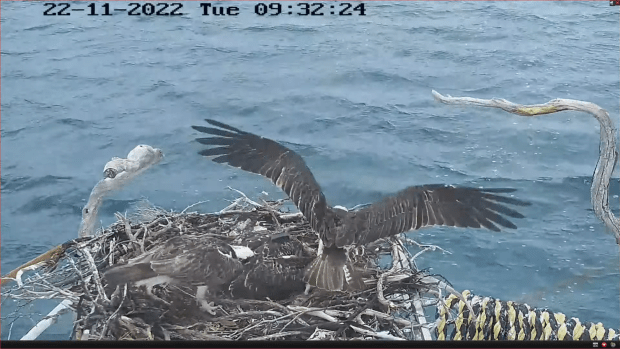
Before I go any further, Rubus and his fludged-fledge has been located in a tree near to Indigo by Shines. Later Indigo flies up to the scrape but has difficulty due to the very strong winds getting the landing perfect. It was like Rubus who had little control with those winds as he exited the scrape but greater control near the ground. Both are safe and sound. We can all breathe a little lighter! Zoe remains on the nest as I write this. So everything is, so far, alright at both of the Australian nests we have been watching. Only one fledge to go, Zoe, the Port Lincoln osplet.

If you missed it, here is Rubus’s start to his great adventure:

Thanks to ‘B’, who sent me this link, we can see Rubus and Indigo perched in trees! Thank you so much ‘B’.

This is the feeding recap for Zoe at the Port Lincoln Osprey barge up until 1500. ​06:14 Dad with partial fish. 06:14:12 Zoe steals fish from Mum.8:24:50 Partial by Dad. Zoe self feeds. 9:10:50 Zoe finishes the tail.

Making News:

Paith, the third hatch at the Dyfi nest of Idris and Telyn of 2022, has been spotted in another country. Emyr Evans needs permissions for all the details, etc. but this is fantastic news. Oh, tears. Need these third hatches to do well!!!!!!

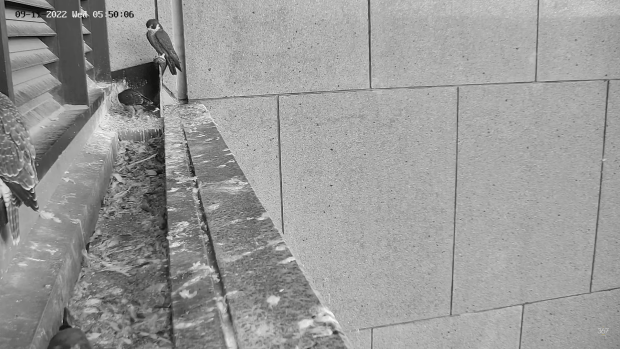
The Melbourne Four make the news again and they are right. Who needs Netflix when we can have Nestflix?

https://www.theage.com.au/lifestyle/life-and-relationships/bird-s-eye-view-who-needs-netflix-when-you-can-tune-into-nestflix-20221116-p5bywe.html?fbclid=IwAR2MHVlDtBYcr46mtwCPkpd9gkSg7bJDEqoFy_7MiTjJu6XQcAoFQbneNiE

There was also just an amazing season tribute to the Melbourne Four that included ‘Old Dad’ (M17). Thank you for this! It came on a day when we needed some really positive news with Rubus fledging/fludging.

The Black-naped Pheasant-Pigeon was thought to be extinct. It was last seen in 1887. It has been found in New Guinea.

The very first egg of the season at the Kistanchie National Forest nest has been laid on Nest E-3. Congratulations!

Big Red was spotted on the Cornell campus along with one of the juveniles. It is always great to see Big Red, the international star of all Red-tailed Hawks! She is all flooded up to keep warm. Big Red had been spotted earlier out hunting – and it was successful. There is great comfort in knowing that she is alright. It seems that L4 is also still around the campus. That is also wonderful news.

No 10 The Red List: The Tree Pipit

Tree Pipit (Anthus trivialis)” by gilgit2 is licensed under CC BY-SA 2.0.

I have never heard of a Tree Pipit. As far as I know, we do not have them in Manitoba. Ed Douglas describes them this way, “Pipits are often regarded as dreary-looking birds, the avocado bathroom of the avian world. That only makes me love them more, but telling these flecked brown birds apart visually is a task of tooth-grinding attention to detail.” The Tree Pipit is a bit bigger than the other Pipets and its beak is thicker. “The Tree Pipit has a touch of swagger, strutting across the ground, tail pumping rhythmically, like a wagtail, as it hunts for insects.” The birds also breed on the ground laying a clutch of approximately six eggs in the grasses beneath the trees. Indeed, the birds like the woodlands and the fringes at the edges for raising their families. They flutter through the air in a way not dissimilar to a Black Capped Chickadee.

Tree Pipit (Anthus trivialis)” by gilgit2 is licensed under CC BY-SA 2.0.

Personally, I do not think they are Avocado Bathroom at all. The colouring is marvellous. Stop for a second and examine the range from a soft silvery white to the creams, the darker ash blonde, moving into the very dark blond and on to that deep 70% chocolate. They are stunning! Notice the white eye ring and the very subtle eye line.Move on to the wing and the teardrop pattern with the dark espresso lined by the white. Incredible. Striations only on the upper breast. This melody of brown and its hues is all topped off by velvety light rose legs and beak. I expect this little one to be wearing a matching light rose velvet hat with feathers carrying a matching handbag!

There are parts of the world where the Tree Pipit is of least concern but in the UK, its song and it are in dramatic decline. They migrate annually to Africa and when in the UK, their diet consists of insects gleaned from the woodland floor and old rotting trees. Declines can also be attributed to the use of insecticides and herbicides both in the UK and in Africa – to kill the insects which are then eaten by these small birds causing them to die. Secondary poisoning.

https://www.theguardian.com/environment/2021/jul/13/country-diary-the-song-of-the-tree-pipit-is-a-rare-pleasure?CMP=share_btn_link

Migration News:

Little Waba is still in the Sudan fishing at the Nile River near Nori. She is obviously doing very well. The temperature in the area today was 26 degrees C.

Bonus is also in the same area in Turkey in Konya Province. It is considerably cooler there at 13 degrees C. Bonus also landed on a transmission tower today and everyone was very, very concerned because of the deaths from electrocution. He left, thankfully!

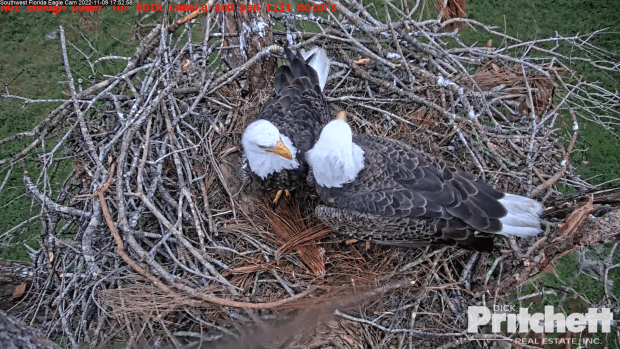
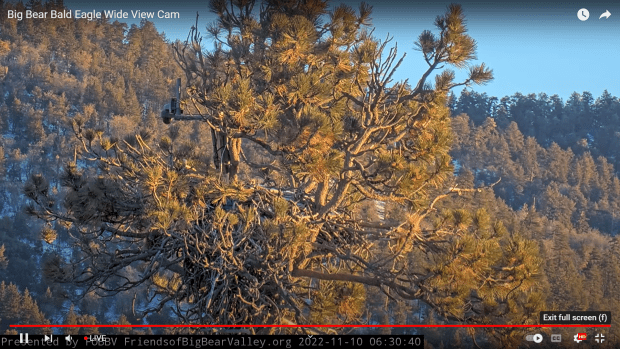
Oh, the time just flies by. It is hard to believe that we have our first Bald Eagle eggs in Florida and in Louisiana now and that we have only one more raptor to fledge in Australia, Zoe. It is a good time of year to take a deep breath, to remember those lovely feathered friends we have lost, and to be ever so grateful for those that survived.

Thank you for being with me today. Please take care of yourselves. Looking forward to having you with me again soon.

Thank you to the following for their posts, their videos, and their streaming cams where I took my screen captures: ‘B’, Charles Sturt Falcon Cam and Cilla Kinross, 367 Collins Street by Mirvac, Looduskalender Forum, OpenVerse, Suzanne Arnold Horning, Cornell Bird Labs, US Forestry Service KNF Bald Eagle Nests, CTV News, 367 Collins Street by Mirvac, The Age, Ospreys. Ringed Birds and Sightings (UK), and 367 Collins Falcon Watchers.

Hovering, Nest building…Saturday in Bird World

19 November 2022

Good Morning Everyone!

I hope that you are well. So nice to have you with us this morning. It is a blue sky cold day, -14 C, on the Canadian Prairies. The kittens are up carrying toys and watching the Crows come for their morning feeding. The Grackles have already been to the suet feeder and the little Sparrows are all puffed up keeping warm in the lilac bushes.

It is a type of soft suet that the Starlings like. They can stand back and poke at it with their long sharp beaks.

The Blue Jays that fledged from the nest across the lane are still here. One was eating peanuts while these two were in the lilacs sunning themselves.

Nest News:

Yesterday Zoe got some really good height in her hovers. Thankfully she remained on the nest and did not fledge into those strong winds as that storm did roll in.

If you missed it, here are those beautiful early morning hovers.

Later, Mum is down in the nest with Zoe taking care of her only ‘baby’. Dad was not out fishing. If you remember, Zoe ate really well on Friday so did Mum. On Saturday morning, Mum took Dad’s fish and returned with the tail portion for Zoe. That has been the only meal so far and if the weather stays, it could be it for the day. Zoe will be fine. She is not going to starve.

Indigo continues to fly out of the scrape and return. This is excellent. Most of you watch the Bald Eagle nests as well as the Ospreys and it is ‘normal’ for fledglings to return to the nest for food, to fly and strengthen their wings being fed by the parents for a period of 4-6 weeks.

Rubus continues to do his wingers and the pair enthusiastically eat all that is brought into the scrape. There are still a few dandelions on Rubus but not many.

The brothers 9 days ago.

Just look at them all covered in down with Indigo revealing some lovely back and tail feathers.

Oh, little Rubus had to get to the front and jump in the beginning to get some prey. Hard to imagine now when both of them are screaming and running all over the scrape. Diamond and Xavier have raised two healthy feisty chicks.

‘A’ reports that it was raining so hard in Melbourne yesterday that the wipers had to be on full speed. Of course, all we can think of are the fledglings from 367 Collins Street. Positive wishes out to them to be safe and fed.

As the season in Australia winds down, everyone is on egg watch at the nest of Harriet and M15 in Fort Myers, Florida. The pair have been working diligently to rebuild their nest after Hurricane Ian. Sadly, that GHOW continues to plague our beloved eagle couple. Oh, I wish their nests were further apart!!!!

Harriet and M15 continue to work on their nest together. They are amazing.

Samson and Gabby have been at their nest, too, working away. They have had a three year old Eagle visiting the nest and I began to wonder if it could be Jules or Romey.

Mum and Dad have been rebuilding the nest in St Patrick’s Park in South Bend, Indiana. You will remember that this is the home nest of Little Bit ND17. They are making good progress and now, some snow has arrived. I sure wonder where Little Bit is! Gosh, we long for them to fledge and then we grieve to see them again hoping they survived that almost insurmountable first year.

Humane Wildlife Indiana sent out a clever fundraiser. They are asking for donations for the strays in their care to have a full fledged Christmas dinner. You can purchase one for one animal or more. I wonder why more animal sanctuaries do not do this? You might mention this to your local care group. It is a marvelous idea.

Making News:

Sadly, for the wrong reasons the adorable Melbourne Four make the news.

https://www.theage.com.au/national/victoria/collins-street-falcon-chick-dies-days-after-taking-wing-20221115-p5byi1.html?fbclid=IwAR22J_pnOqqPaRA8JqL7WcplN8ddPreG3bIpfCVw8kNgpVudjgCKWoSHXgI

Oh, our beloved Canada Geese are making news in the UK.

https://www.theguardian.com/environment/2022/nov/18/country-diary-canada-geese-are-on-the-move-with-a-melancholic-honk-but-why?CMP=share_btn_link

No 9 The Red List: The Nightingale

It is the song of the Nightingale that has attracted writers for thousands of years. Pliny the Elder described its song more than 2000 years ago when animals were denied artistic abilities. He wrote: “the sound is given out with modulations, and now is drawn out into a long note with one continuous breath, now made staccato . . .” Ellen Finkelpearl continues in her short article on Pliny and the Nightingale that he did believe, strongly, that the natural world including our feathered friends can be artistic!

https://classicalstudies.org/plinys-cultured-nightingale

If you are a lover of Shakespeare, you will know that the Nightingale shows up in more of the plays, not just when Juliet educates Romeo on the wonderful song of the Nightingale.

Wilt thou be gone? It is not yet near day.
It was the nightingale, and not the lark,
That pierced the fearful hollow of thine ear.
Nightly she sings on yon pomegranate tree.
Believe me, love, it was the nightingale.

Here is a fantastic blog that captures the portrayal of the Nightingale in all of Shakespeare’s works.

https://blogs.bl.uk/sound-and-vision/2016/04/shakespeare-and-the-nightingale.html#:~:text=The%20morning%20after%20their%20secret,is%20not%20yet%20near%20day.

In his entry in Red Sixty Seven, writer Luke Massey says, “…We should be ashamed that in our quest to clean our landscape, in our acrimonious divorce from nature, we have forgotten this songster and let it suffer. Despite its song we have ignored it ; we have let it fall silent in our copses, our scrub and our hedgerows. We have failed it and with that we have failed nature. Will we really let this be the last song of the Nightingale?”

Its very last space in the UK is under threat.

https://www.nationalgeographic.co.uk/animals/2018/04/last-stronghold-of-nightingale-under-threat

There are problems with the Nightingale’s wings getting shorter due to climate change. That is mentioned in this great report for The Guardian.

https://www.theguardian.com/environment/2020/apr/01/nightingales-at-risk-due-to-shorter-wings-caused-by-climate-crisis

Changes in farming practices, the destruction of hedgerow and copses for more modern farming are all adding to end the life of this most beloved bird who nests are on the ground. There are fewer and fewer sites for this beloved bird to raise their young safely.

As I read more and more of what we have done to halt the lives of so many birds, it is readily apparent that the world needs to return to some of the ‘old ways’ and continue policies or re-wilding if we are to save our precious wildlife.

In the Mailbox:

‘EJ’ was wondering how these transmitters work – like the one put on Zoe at Port Lincoln. She found a great article and you might be wondering how these transmitters work, too. Thank you, ‘EJ’. Here is the link. You should be able just to click on it.

Technology (ospreytrax.com)

Thank you so much for being with me today. Take care everyone. As I look at the weather report there is a severe weather alert for wind in both Orange and Port Lincoln. Maybe Zoe and Rubus – as well as Indigo – will take care today. Send best wishes to them!

Thank you to the following for their posts and their streaming cams that make up my screen captures: RSPB, The Guardian, Osprey Research, Port Lincoln Ospreys, Charles Sturt Falcon Cam and Cilla Kinross, The Age, Lady Hawk and SWFlorida Eagles and D Pritchett, NEFL-AEF, and Notre Dame Eagle Cam.

Early Friday in Bird World

11 November 2022

Good Morning Everyone!

The sky is gradually turning blue and there are 57 European Starlings in the trees and 49 Old World Sparrows. Two Blue Jays have also already been to the feeders. There is so much snow. It was blowing and coming down hard around midnight and in certain places in the garden it is more than a foot deep. Winter has set in.

In the Mailbox:

Oh, I get the most marvelous mail but today ‘A’ reminded me of a very poignant moment last year. The 4th eyas at 367 Collins was dying. The entire family – including the siblings that had fledged – returned to the ledge to spend the night and keep the wee one warm as it passed. So, yes, the Collins Street falcons can fly back up to that ledge! Thanks, ‘A’. I remember that moment well. It is one of the finest examples of caring and grieving in Bird World. Do you remember?

I also received a fantastic letter from ‘K’ that reminds us of just how one single invention from an Ornithologist at Cornell saved the Peregrine Falcon population after its demise because of DDT. Do any of you know what that invention was? Think about it! I will bring it in to tomorrow’s newsletter.

Australian Nests:

Friday has been a very eventful day in the Australian nests and it kicked off with Indigo’s fledge at 0700:34. My goodness what a beautiful flight and it appears that Diamond and Xavier kept a good eye on Indigo and may have just delivered a nice piece of prey to her in the trees – prey that Rubus thought might have been coming to him!

Off she goes. Rubus did not notice – too busy eating his breakfast.

An adult almost immediately comes into the scrape and feeds Rubus. This is a great strategy. Rubus is no where near fledging. Keep him full, keep him in the scrape. No premature fledging.

Oh, Rubus is clearly starting to look like a little falcon. Look at those eyes. Rubus stayed facing the camera when Xavier came in with the prey. Having no screaming Rubus, Xavier immediately departs with food and flies down into the trees where Indigo is.

Sleeping standing up. Notice the beautiful barring coming on Rubus’s chest.

​Moderators RECAP: 06:42:35 X w/prey, Indigo takes; 07:00:33 Indigo fledges; 07:00:38 D follows Indigo; 07:01:33 D feeds leftovers; 07:25:43 juv star, X feeds; 09 26 07 D feeds scrap; 10:10:51 D w/prey, feeds…12:44:00 D with prey, Rubus takes; 15:54:13 X with prey, Rubus takes; 18:48:54 D with prey, Rubus takes.

There is a storm forecast for Orange on Sunday. Let us all keep positive thoughts flowing to Indigo. It will be day 3 after fledge.

When the excitement of the fledge at Orange had settled a wee bit, it was time for Melbourne and, much to the delight of everyone, a gentleman who has a view of the ledge from his bathroom actually filmed one of the eyases fledging this morning! Brilliant. It was quickly removed from the FB page but, the more than 500 viewers who saw it knew that there were no only 3 or, perhaps, 2 left on the ledge of 367 Collins Street. Two could be seen clearly. IF one was in the gutter, flat, loafing, then maybe three were left but, it is probably save to say that two have fledged in Melbourne.

For all the fledges may you always be safe, maybe your crop always be full, and may you feel the wind beneath your wings for decades.

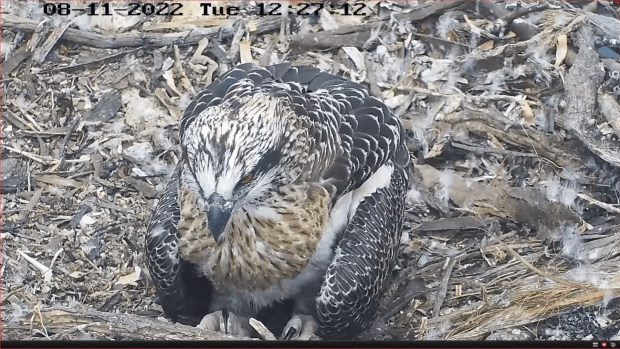
At Port Lincoln it is a question of ‘where is the fish’. The water around the barge is a little choppy. A fish came on the nest at 0835 and Mum, thankfully, ate her fill. She gave some bites to Big. Dad has not been up to his usual standards in terms of delivery numbers. Did the storm stir up the sediment and is the visibility poor for fishing? is it the choppy water? is Dad not feeling well. I noticed the other day when they did a close up of Dad’s talons that he had a lesion on one of them. All of know that he was unwell when eggs were being incubated. Let us hope that this is just passing and that all will be back to normal at Port Lincoln. This family has faced enough challenges this season. Big is not scheduled to fledge for at least another 8-10 days at least.

Ah, a fish has come in. Mum caught it and is eating her good share before taking it over to Big who is fish calling on the nest. Hold your horses Big – the order is: territory protected, parents fed, offspring fed.

And, if you are wondering, yes, this is Mum. She has gone out and caught the fish. Dad left earlier and has not returned. She is sure going to eat her share before she hands it off to Big. Just do a drop and dash – Big needs to self feed! Gosh. It has been 15 minutes. Wonder if Mum will eat the entire fish?

At 1509 Mum flew to the nest with the fish to feed Big. So far she has kept control of the fish and is feeding. Maybe she will eat some more herself.

Gosh, that fish is tough to get the flesh off. Mum is really working at it giving Big a few bites and some that she could eat on her own.

Mum is feeding slowly and she is eating fish, too. At 1546 Dad flies in with a headless fish to the nest. Mum is in the background eating fish as fast as she can. Big and her will have enough fish for today. Let us hope that Dad had a good portion, too. It is so nice to see Dad. He was gone for awhile. I hope he was out fishing with Ervie in those choppy waters.

Mum in the back eating the rest of her fish as fast as she can. Dad’s is not big. He could have just eaten it but, he doesn’t. He leaves his small offering for Big and Mum. Thanks, Dad! I do hope you ate. Big has a crop and is fine.

Port Lincoln has said there will be no banding on Saturday. So, perhaps, the banding will take place on Sunday or Monday.

Mum went over to cover her only surviving osplet when the rain started. What an amazing parent she is! Little Dad is down in the shed. Let us hope that these two are alright. Everyone was so worried about Dad yesterday. He was away for so long.

Right now it is pitching down rain at Port Lincoln. The forecast I am seeing so a high chance of rain all morning at Port Lincoln.

Number 4. The Red List: The Cirl Bunting

Cirl Bunting – Sardinia – Italy_S4E1978” by fveronesi1 is licensed under CC BY-SA 2.0.

In some countries, birds are of least concern while, in others, they are vulnerable and, in the case of the Cirl Bunting, on the Red List in the UK. It is of LC in the United States.

This lovely little bird is a relative of the Yellowhammer. Just pause for a moment and look at the image above. How would you describe it? First, it is difficult to understand the size of the bird without any reference. Normally they are approximately 15 cm or 6 inches in length. During the breeding season, the males have a distinctive black chin. Below is a drawing of a male and female. In this you can get a better feel for how the male should look with its two yellow eye lines, black chin and crown, yellow line at the neck with a grey-olive collar and yellow underbelly. The female is much more striated with a vertically barred chest and a touch of the same olive-grey at the top of the wing. They are lovely little birds.

Cirl Bunting” by Wildreturn is licensed under CC BY 2.0.

So why are the Cirl Buntings under threat of extinction? Farming practices is the main issue. The bird was once common all across the southern half of the United Kingdom. In the 20th century their population numbers began to spiral downwards when farming practices switched from spring sown cereal crops to autumn sown. Habitat intrusion and the use of pesticides also impacted the population numbers.

The RSPB worked with farmers in south Devon to switch back to traditional farming practices. The result was an increase in the numbers of Cirl Bunting along the cost. What had once been only 118 pairs in 1989 became 1000 pairs in 2016. This is fantastic news and all it meant was a return to the traditional sowing practices of farmers, the growth of shrubs and hedges, etc. Here is an excellent article from a farming on line journal that speaks to the challenges and what can be done for the Cirl Bunting to save it. Think rewilding!

There is still cause for concern. Farmers across the rest of the UK and elsewhere need to heed the use of pesticides and they need to pay particular attention to how their cycle impacts wildlife. The decline could lead to extinction just as quickly as the population numbers climbed over the past 30 years.

Other Nests:

I am so grateful to ‘B’ for alerting me to Indigo’s fledge but he also sent me a note telling me that Samson and Gabby were in their nest as Tropical Storm Nicole plummeted the area near Jacksonville. Well done you two. Riding out the storm together like Harriet and M15.

Jackie and Shadow are another power couple. They have really worked on this nest and they sure didn’t want a storm to take it away!

B’ wrote me first thing to say that both Gabby and Samson are fine and so is SWFlorida. Nicole has now passed through them. Fantastic.

Samson and Gabby

Sunrise over Samson and Gabby’s nest near Jacksonville, Florida.

Everything looks intact at the NEFlorida Nest. Maybe we need to get the Eagles to be our designers. These nests are amazingly strong.

Harriet and M15 have both been seen at SWFlorida and this looks like Harriet aerating that nest getting it ready for those precious eggs.

As Nicole moves out of Florida, there is sunshine on the nest of Harriet and M15. It is so good to see that they are fine and so are Samson and Gabby. The camera is still offline at Big Bear. It could have been damaged during the storm but, let’s all hope that it wasn’t.

Thank you so very much for being with me this morning. It is time for me to do some shoveling and fill the feeders! The Starlings are waiting for their Butter Bark. Take care of yourselves. See you soon!

Thank you to the following for their streaming cams and posts that make up the screen captures in my post: Farm Life, Port Lincoln Ospreys, 367 Collins Street by Mirvac, Charles Sturt Falcon Cam, NEFL-AEF, and SWFL and D Pritchett Family.

Harriet and M15 weather Nicole together…and other news in Bird World

10 November 2022

Good Morning Everyone,

I hope that this finds you well. The kittens are very active this morning. The Starlings have discovered the Butter Bark! And the Blue Jays are eating peanuts and what better entertainment for the kittens than watching birds safely behind glass!

Lewis is a charmer.

Oops. Turn your head! Missy is sideways smelling the orchids and moved quickly to see the Blue Jays.

They are adorable and are tied at the hip to one another. It doesn’t matter what they are doing, they must be together – eating, sleeping, and being a poopinator.

Late Wednesday, Nicole was upgraded to a Hurricane. As she went over Florida last night, Nicole was again down graded to a Tropical Storm. These are the latest images.

I will be posting my blog when it is approximately 1000 Thursday the 10th of November. This system will not be moving out of the region of Samson and Gabby’s next until much, much later in the day. Harriet and M15 got a right soaking. Continue to send your good wishes to all in this region.

_________________________________________________________________

The real news of the day is ‘waiting’. Waiting for fledging in Australia and waiting for Hurricane Nicole to pass in Florida. Yes, Nicole is now upgraded to a hurricane from the previous tropical storm. Winds and rain are increasing across the state of Florida.

Before I go any further, we all love Harriet and M15. They are weathering Hurricane Nicole together – in the nest! Talk about love and devotion. They have rebuilt after Hurricane Ian and they are staying together Wednesday night as Nicole approaches. Send them all the love you have! These two are amazing.

It is starting – the winds are swaying the nest. Harriet and M15 are both still in the nest together. Oh, my heart just goes out to them. They need that nest to hold. It will not be long until Harriet is laying eggs.

Early Thursday morning. Together and wet. Oh, did I tell you? Harriet is 28 years old!

In the News:

I am so happy. The wildlife rehabbers who cared for the Pitkin County Osplet did not have staff to deal with messages after the osplet came into care. Pitkin County gave me their name and I wrote to them a couple of days ago and now they have posted the information for the public. This is really important. I want each of you to remember because pre-fledge osplets really do well in care! They survive and they have a second chance at life. The image of the beautiful osplet below is the evidence.

Birds of Prey in Colorado has two waiting for release in the spring. Let us all debunk this urban myth.

Last June, the female at the Pitkin Open Spaces and Trails pulled her two osplets off the nest accidentially. One died, this one went into care and is waiting to be released in the spring.

I have been slowly gathering up evidence of successful treatments for pre-fledge Ospreys or any Osprey that has been taken into care. If you are aware of any ospreys in care or that were in care and released, would you please contact me with any details that you know. It will really help make my case to Port Lincoln that there is good evidence – hard evidence not anecdotal – that pre-fledge ospreys do well in care. By poking a hole right in the middle of the rumour that has spread and established itself as fact, it is possible that ospreys like Middle can survive. For Little and Middle, let’s work to change this to: Pre-fledge Ospreys do as well in care as do Post-fledge Ospreys!

Let’s take another look at Coots. Do you have Coots in the ponds or wetlands where you live? Sometimes called the ‘black duck’, the author of this article fell in love with them when he was a wee child.

https://www.theguardian.com/environment/2022/nov/09/birdwatch-coots-gadwall

Why is Bird Flu so important and, what happens if it mutates causing another pandemic?

https://www.theguardian.com/commentisfree/2022/nov/09/bird-flu-mutation-h5n1-virus-strains-pandemic

The Melbourne Four, those precious babies, made the news!

3 Red List Bird:

Roseate Terns” by MyFWC Florida Fish and Wildlife is licensed under CC BY-ND 2.0.

The Roseate Tern is the most rare of all the sea birds that breed in the UK. There has been a lot of interest in the migration of the Roseate Terns from the UK and from Ireland. Satellite trackers have discovered that they migrate to the West African coast and spend their winter in the Gulf of Guinea. Those Roseate Terns from North America also have an impressive migration. They travel to the eastern part of Brazil. These journeys are more than 15,000 km return made across the open seas.

They are such beautiful sea birds. They are called Roseate because of the pink tint to their gorgeous plumage. Their beak is slender they have a long forked tail, a white cap with grey wings and white under belly. Their legs are longer than other Terns. This means that they can walk through higher and thicker undergrowth and this is where they make their nests so they are not in competition with other terns.

The Roseate Tern is globally threatened. One of the greatest challenges these beautiful birds face is the human disturbance of their nesting sites and the collecting of their eggs. Climate change, flooding, and frequent storms are also major contributing factors in the decline of the species.

The following contains information on the threats to these amazing sea birds.

https://wildlifepreservation.ca/roseate-tern/

http://roseatetern.org/threats.html

Australian Birds:

The camera turned and all of the Melbourne Four were still home! Gosh, if you didn’t know it, at a glance, these look like fine full grown Peregrines.

Hot in Melbourne. Some are looking for shade!

It is raining in Melbourne and ‘A’ tells me that it is not a good day to fledge now and won’t be for a few days more. Hopefully the Melbourne Four will stay put!

According to my eagle-eyed and ears friend ‘A’, the Melbourne Four were on the ledge when Mum brought a prey item in at 181203. They ran down to the other end where the 4th eyas was.

A small fish came on the Port Lincoln Opsrey barge. Mum took control and then gave it over to Big. I think Mum was hoping for the tail but Big took it, too.

Big is as big as Mum now. Look at those legs. Here the pair of them are prey calling Dad who is on his way with breakfast.

Big is not going without food. Dad brought in the small fish this morning and then, seeing Dad over on the ropes, Mum decided she best get out there and bring in the afternoon meal. Big might have thought she would get the whole thing to herself but Mum had other ideas and started out feeding her girl. She managed to get some bites. Big will take the fish and would take all fish if left to her own now.

Dad will bring in another fish. There were three delivered on Thursday in Port Lincoln. Those times were 09:33, 15:01, 19:22.

If the weather is good, Big will be banded, measured, and named sometime between the 12-14th. That is a few days away. I hope to find an announcement with the specific day for you.

Lots of Starlings and other prey coming into the scrape. Both Indigo and Rubus are excellent self-feeders. It is wonderful to see. Indigo continues to look out at the world beyond and poor Rubus, he still has so much flu that it will be a bit of a wait. Don’t worry Rubus, Mum and Dad will feed you – they won’t forget!

Indigo is adorable.

It is just after midnight on Thursday and this is the recap of Thursday up until late afternoon at Orange: RECAP 6 02 26 D w/grebe, Rubus takes; 08 45 13 X w/juv starl, leaves; 10:17:16 X w ER, Indigo takes; 10:24:23 D in, feeds Rubus; 14:50:29 X w/prey, Indigo takes.

At one point, Indigo was running around the scrape flapping her wings and chasing Rubus. Remember. Indigo does not have the room that the Melbourne Four have to run off some of the energy and to really get the wings and legs going.

Rubus had no idea what on earth was going on with Indigo. There was a piece of prey stuck between her talons. Was that the cause of all the restlessness? or is it that Indigo will be fledging soon?

Indigo was able to get the piece of prey out from her talons and she settled. Look at Rubus watching everything that she is doing. He will miss her when she flies. If she does what the others have done, she will fly down to the trees where she sees the parents. They will also lure her with prey items and begin teaching her how to hunt. They will do this for 4-6 weeks until Indigo leaves their territory. Now that I say that we must not forget that Izzi did not leave home until Diamond would no longer let him in the scrape many, many months after she should have left.

Indigo will not fly back to the scrape box. She is not strong enough to undertake that steep upward flight yet but, she will get those muscles really going once she is down chasing after Diamond and Xavier.

Rubus will either love having the prey all to himself or miss Indigo or both.

In other news:

Continue to send your best and most positive wishes to the nests in Florida. Ron and Rita’s human designed nest on the grounds of the Miami Zoo is really beginning to rock and sway. You can see the movement of the palm trees caught in the image below. There are so many, many nests in Florida and it is the wintering grounds for some of the birds from the north.

Gabby and Samson’s nest near Jacksonville is really blowing and rocking. It is in one of the areas that is expecting the highest winds.

The record snow and wind has caused power outages at Big Bear Valley. The cameras for Jackie and Shadow are offline at the moment. We will wait and see if they are up tomorrow. Thursday. The camera is up over the valley but the nest camera remains offline. The storm has passed. Yippee.

Thank you so very much for joining me today. Please take care of yourselves. See you soon.

Thank you to the following for their posts, videos, and streaming cams where I took my screen captures ‘A’ and ‘H’ for their eyes and ears on Collins Street, National Hurricane Centre, SWFlorida Bald Eagles and D Pritchett, Pitkin County Open Spaces and Trails, ABC News, Port Lincoln Ospreys, 367 Collins Street by Mirvac, Charles Sturt Falcon Cam and Cilla Kinross, WRDC, and NEFlorida-AEF.

Puffin…Puffin…and other tales from Bird World

9 November 2022

Good Morning!

I hope that everyone is well.

Oh, it is the gloomiest of days. Wet and cold. The snow was forecast to turn to rain. And it did. The garden birds do not like the damp. They do sooooo much better if it is a dry snow.

Is it possible to lure any of the European Starlings into the lilacs to feed? There are 57 of them roosting in the back trees. The owner of the bird seed shop mentioned that maybe there is still enough food out in the fields for them. I paused and then realised that their big feeding frenzy began in January. Perhaps she is right.

Mr Crow and Junior were very happy when a new bag of peanuts arrived. Did I mention they sort through the peanuts for the heaviest ones? No sense carrying off a shell with nothing in it! So smart. So gorgeous.

The hanging light makes Junior’s feathers look more intense.

Even with their favourite suet they are not budging. The squirrels are happy, the Blue Jays have come for peanuts and corn, and the Crow has been in for peanuts and to yell at me because the water is frozen in the bird bath! He gets right on top of the conservatory glass roof and caws as loud as he can – like he used to do when the cats were in the garden. Speaking of cats, it seems once the weather turned bad their owners are keeping them inside. Of course, it does appear that all of the Hedwigs have met their demise because of the cats according to the neighbour. I am certain that he is right. I have not seen the rabbits since the summer and it is unlike them – all three of them – to be away for so long. With everything at Port Lincoln, I have convinced myself not to think about it.

Day 2. The UK Red List: The Puffin.

Puffin with his catch.” by ohefin is licensed under CC BY-SA 2.0.

Their name means ‘Little Brother of the North’ and they are, by far, one of the most beloved sea birds around the world. Did you know that they can dive up to 60 m in depth? This really helps when they are feeding their young 24 times a day! Yes, seriously, 24 times a day. Think twice an hour if you take 12 hours off to sleep. Do Puffins sleep? But, there is a problem. Changing sea temperatures and pressures from yes, you guessed it – those big trawling fishing boats – is causing a food shortage for the Puffins. As Beccy Speight says in her article on the Puffins in Into the Red, “If the food shortages don’t get them, pollution events and ground predators (Rats, Mink, Cats) will. If we want our Puffins to be more than jolly pencil case illustrations, then sustainable fishing, protection of feeding grounds, considerate placing of offshore wind farms, a reduction in marine pollution and preventing ground predators from reaching nesting colonies are what’s needed” (90).

Saltee Puffins” by JohnFinn is licensed under CC BY-NC-ND 2.0.

How cute and yet, how tragic that these beautiful sea birds are so vulnerable. Here are a couple of articles discussing the challenges that the Puffins face and it is not just in the UK.

This is an article from an academic press discussing the Puffin chicks dying of starvation.

https://besjournals.onlinelibrary.wiley.com/doi/10.1111/1365-2656.13442

Many of the issues facing Puffins can be mitigated. Two serious ones that need immediate attention are over fishing (because if we have the will we can do something about this) and nest predation. It is not too late to help in these areas.

Do you remember this poem about Puffins? Here it is with sound!

In what seems like another life now, I wrote about the work of Montana ceramic artist, Julia Galloway. Ms Galloway made a series of porcelain ginger jars. Each had a motif of an endangered species on it from the New England area of the US. One of those was the Atlantic Puffin. She notes, “The Atlantic Puffin has been listed as globally endangered due to climate change, pollution, overhunting, invasive predators, and gill nets, among other factors. Climate change has caused sea temperatures to rise, and this causes a decrease in the puffin’s abundance of prey and habitat.” Of course a lack of sufficient prey causes all manner of problems with breeding and the sufficient raising of offspring. What I did not know is that motorists are asked to check under their cars during the mating season and young puffins take shelter under the vehicles because they become disoriented by the lights. Galloway does acknowledge some of the efforts in the NE US including hunting bans and conservation efforts to cut back invasive plant species that are harming the Puffin’s nesting area. Decoys have also been placed on good nesting islands to lure these quite social birds to other areas to establish new colonies.

Like so many others, Galloway believes that art and literature might be the most effective means of encouraging people to stop, look at the natural world, and then, get mad and do something to help make our planet a better more biodiverse place for the wildlife.

In the Mailbox:

I have been sent quite a few links to videos on YouTube the past couple of days. I will spread them out. Today, ‘A’ sent me a compilation of events from Middle’s life at the Port Lincoln nest. She warned me to get a tissue and suggested that I turn off the music – which I did. You can also save it and watch later!

Australian Nests:

The scrape box located on the old water tower on the grounds of Charles Sturt University in Orange was full of prey this morning. It looked like the remains of a Starling plus two other birds. At one point, there was even a live bird in that box! Seriously. Apparently Xavier delivered it. Thankfully, Indigo lunged at the poor little thing and it took the opportunity to fly out the window.

Dad brought an early fish to the nest on the barge at Port Lincoln. Mom gave Big bites and took some good sized ones for herself, too.

Mum had a spa moment. I am so glad she is taking some time for herself. It has been a difficult season for this family.

I want you to have the link to the Friends of Osprey website. It is here that you can track our favourite South Australian male Osprey, Ervie! Here is the link and here is a good photo of Ervie with his tracker and some of his latest tracking.

Handsome Ervie.

Is it possible that Ervie is one of the best known Ospreys in the world? It sure seems so!

Is Dad safe from the eyases on the perch?

Off he goes!

Eagle Nests:

Note: Tropical Storm Nicole is set to make landfall in Florida. From the map below you can see that the nest of Samson and Gabby in the NE area near Jacksonville is going to get hit hard as this storm increases in intensity. SW Florida the home of Harriet and M15 will get a lot of rain and, of course all of the other nests such as Super Beaks in central Florida will be impacted (Superbeaks is a private nest). It could get really bad. Please send all our feathered families your most positive wishes as they ride out this storm system.

Samson and Gabby continue to work on their nest near Jacksonville, Florida. What a gorgeous couple! You can tell by their size and also their white head. Gabby is always slightly ruffled while Samson’s is normally slicked down as if he had been to the stylist before arriving on camera.

The winds and some precipitation have started at Samson and Gabby’s nest this morning. It will intensify as Tropical Storm Nicole gets closer. The nest is rocking although you cannot tell it from the still image and the rain has begun.

Thunder was perched over on the cliffs near the West End nest she shares with her mate, Akecheta.

It was raining at the nest site where the couple raised The Three Amigos last breeding season – Kana’kini, Sky, and Ahote -on Tuesday.

This morning it is simply beautiful there. Oh, it would be so nice to see the Three Amigos again. If you need a ‘Three Amigo Fix’ check out the highlights that play often on the West End Bald Eagle nest.

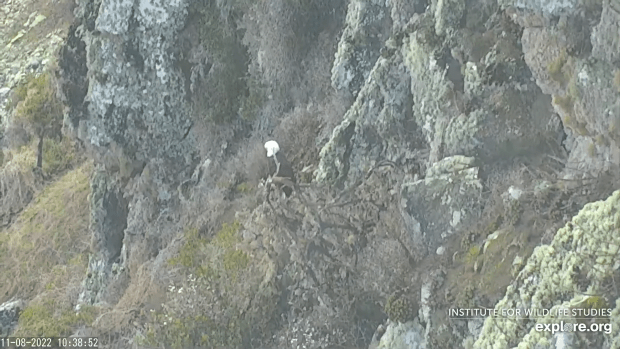
This still does not give you any impression of the wind and the freezing rain pelting down on the nest of Shadow and Jackie in Big Bear Valley, California.

This was the scene at Big Bear last night. The camera seems to be offline now. You still cannot get good sense of the snow coming down.

The Decorah North Eagles are around the nest. Gosh do they ever blend in with the fall look of the Iowa landscape.

Louis and Anna have been working on their nest in the Kisatchie National Forest in Louisiana. There have also been some intruders coming around the nest! If only they would find the vacant E-2 nest. There is another couple Alex and Andria on the E-3 nest. It also has a camera and great sound system.

Ron and Rita have been working on their next in the Miami Zoo and – were having a meal there the last time I checked. It is safe to say that if you go to an eagle streaming cam and rewind you might be able to see the raptors there at some point during the day.

Migration News:

Waba has been feeding on the Sudanese side of the Nile River while Bonus has been feeding in Turkey. Neither have made any effort to leave their area to go further south into the center of Africa. There must be enough food and they must feel safe. We will check back in with them in a few days but, they might have found their winter homes. No news from Karl II or Kaia as is expected. Send good positive wishes for the four members of this family.

Thank you so very much for being with me today. It is so nice to have you with us! Take care everyone. We hope to see you soon.

Special thanks to the following for their posts, videos, and streaming cams that make up my screen captures: earth.org, There Once Was a Puffin YT, Julia Galloway, Port Lincoln Ospreys, Charles Sturt Falcon Cam and Cilla Kinross, Friends of Osprey, 367 Collins Street by Mirvac, NOAA, NEFL-AEF, IWS and Explore.org, FOBBV, Raptor Research Project and Explore.org, KNF Bald Eagle E1 Nest, WRDC, and Looduskalender Forum.

Let’s Talk, Darling Starling

8 November 2022

Good Morning Everyone,

I was a little ahead of myself. The banding at Port Lincoln does not take place until the 12-14th (Australian time).

I have been trying to lure the European Starlings back into the garden. Last January there were 58 eating snow and hard seed cylinders along with butter bark and meal works. Nothing seems to bring them to the garden currently and this is troubling me.

The pictures below were taken in my garden on the 26th of January 2022.

This evening I was thumbing through and reading different entries in the two books – collaborations between writers and artists – that form the fundraiser on the Red Series by the British Trust for Ornithology. How disgusted was I when I found the Starling. So my plan is to introduce you to a different bird every day between now and the end of the year that is vulnerable. Today we are talking Starlings.

“Nowadays you can count them, when at one time they were literally countless.” Scientists think the causes of the decline involve farming practices that have poisoned insect prey with pesticides and chopped down grassland habitat. Other farmland bird populations too are reeling from the impacts.”

This report on the decline of Old World House Sparrows and European Starlings is excellent. It is long and it is thorough, some 244 plus pages divided into sections dealing with each species. It is not for bedtime reading but, even skimming through some sections and pausing to read bits and bobs will underscore the challenges that these two species face. These are two birds that I often hear people complain about at their feeders – there are so many of them. And yet, there aren’t. It is a delusion. If we cannot protect the Sparrows and the Starlings, what birds can we help?

Diamond doesn’t like them but they must be easy prey for the Peregrine Falcons in the rural areas of NSW Australia. Indigo is frightened by them and Rubus just gets down to business and eats them.

Some of you might have seen the recent YouTube video of the Starling that has learned to talk and sing but, did you know that this was common knowledge during the time of Shakespeare? In his entry for the Starling in Into the Red, M.G. Leonard begins with Henry IV and the entry where Hotspur declares that he will teach a Starling to repeat the name ‘Moritimer’ over and over again to drive the King mad since he declared his brother-in-law a traitor. Leonard is fascinated that a Starling would be a proper gift for a King, and that over 400 years ago it was well known how intelligent they were and how they could be taught to speak.

Leonard continues with Mozart who purchased a pet Starling in 1784 and taught it to sing. Mozart trained his pet Starling to sing his concertos. It was well-known that he loved his Starling more than anything in the world. The bird is said to have died a week before Mozart’s father. Mozart did not attend his father’s funeral. Instead he staged an elaborate memorial for his beloved bird.

In order to create a European landscape full of birds and plants, a German brought and released 60 Starlings- along with every other species mentioned by Shakespeare- in New York City in March 1890.

We think of murmurations and we think of Starlings.

Leonard ends blasting humans — “What monsters must we be, that we have reduced it to sit on the Red List.”

I agree. My heart is broken.


Australian Nests:

I have been thinking about the Melbourne Four. Risking getting egg on my face, I am going to come out and say that I think that the ‘Four’ will fledge within close proximity of one another on the same day. They have been very busy today watching the flying demonstrations that Mum and Dad have been doing. And one of them is ‘loafing’ like Alden. ‘A’ says Alden’s stance has gotten all the way to Australia!

Loafing.

Loafing and flapping. There are hardly any dandelions left on these beauties. They have the great DNA of old Dad and the new Mum and the love and care of new Dad. How fortunate.

That must be some aerial display – like 2 Stealth Bombers at an Air Show but for the private viewing of their kids…it is hard to imagine these four a month ago!

‘A’ has alerted me to a storm hitting the Melbourne area causing thunder and steady rain. It is not a good day for the eyases to fledge – and also. Look at the one on the ledge. The size of that crop dictates that bird will probably want to stay put and go into a food coma any moment!

At the nest of Cornell University’s Red-tail Hawk Big Red, she will always fill the eyases up to the brim if she doesn’t want them to fledge.

My goodness, I don’t know how that one eyas can stand she is so full. Gracious. It looks like she swallowed a small beach ball instead of a pigeon. Now, I wonder. Did she eat all of the pigeon leaving only scraps for her siblings??? Sure looks like it!

‘H’ reports that 5 prey items were brought to the Melbourne Four by both Mum and Dad. One of those was eaten almost entirely by Mum who took away the scraps. Thanks, ‘H’.

A super nice fish was delivered to Mum and Big by Dad around 1034. The winds will be gusting up to 30 mph and well, Dad is a great fisher but, he, too, can have difficulties. This is a lot of fish and should keep Big til later in the day. In the real world, a fish this size might be the only prey of the day.

‘A’ sent the observation board from Port Lincoln also. To recap, Big is 52 days old today. Mum and Dad brought in fish – Dad brought in 2 and Mum brought in 1. Those times were: 10:34, 13:15, 19:23. Thanks ‘A’.

I wonder how many more mornings we will wake up to Indigo looking off the ledge to the world beyond? She can fly. Rubus can’t.

Indigo is doing the same exercises that Diamond did in the morning – great stretches.

What a beautiful falcon Indigo is. She is watching carefully as the adults fly around the tower. They will begin to lure her with prey. Many on the chat do not realise that Xavier and Diamond will provide prey for about 4-6 weeks while they teach Indigo to hunt and be independent. Cilla Kinross says she does not monitor them after they fledge but she sees them in the trees about 400 m from the tower.

Rubus is not nearly ready to fledge.

‘A’ sent the days feeding recap for us at Orange: RECAP: 06 56 59 prey, left for chicks; 7:25:02 prey, Rubus takes; 9:17:05 X w/juv starl, leaves with chicks; 9:22:42 D w/GST, feeds; 13:25:17 X w/juv star, leaves with chicks; 16:48:25 pigeon, D feeds. In other notes, one of the prey had a blue leg band and Diamond ate it! Oh, goodness.

Other Nest News:

A major storm, one of the worst to hit the Big Bear Valley, is arriving today. Jackie and Shadow are getting prepared. Please send your positive and warm wishes to them.

Everyone has their favourite species of bird and within that species, most of us have one or two favourite bird families on the streaming cams. I have my own favourites and then I have the nests that I recommend to others to follow. Those nests are steady as you go and reliable and they include Harriet and M15 at SWFlorida, Samson and Gabby at NEFlorida, and Liberty and Guardian at Redding. The Channel Islands Bald Eagle nests have their challenges. The parents are incredibly amazing but, eaglets found themselves clinging to the sides of cliffs last year. It can literally put a hole in your heart while you wait to see if Dr Peter Sharpe will arrive in time to save the baby. So that is why West End and Two Harbour are not in those top 3. Fraser Point is a great nest, only about 2 metres off the ground, and is the home of Mama Cruz and Andor. I do not and will not recommend Dale Hollow which is on the border between Kentucky and Tennessee. The male is currently injured and last year there was siblicide at this nest. There is also a strict no intervention policy by the people that run the cams and that includes if fishing line is on the nest. The Captiva Bald Eagle nest has had its issues and it remains unclear if Connie and Clive will have a successful clutch this year. The last two eaglets to hatch on the nest, Peace and Hope, died from rodenticide poisoning. Glacier Gardens is a great nest but the visibility of the nest is not good. So, if you are starting to make a list and have limited time and want colourful characters and steady as you go then Harriet and M15 along with Samson and Gabby and Liberty and Guardian are your nests. I personally love Shadow and Jackie at Big Bear – talk about characters – and so do about 6000 other people. They did successfully raise one chick last year -Spirit – and that eaglet was amazing. I will be watching them again. Another good nest is the KNF nest 1 of Anna and Louis at the Kisatchie National Forest in Louisiana. Louis is an incredible fisher. One year he had 20 fish on the nest – 20 – for a recently hatched eaglet. They have fledged 1 eaglet for each year of the past two years. There are many, many others but if you want safe and secure for beginning eagle watching head to those three mentioned above.

That storm has hit Big Bear Valley. The winds are horrific and you can hear the rain and/or ice pellets alongside the howling wind. I will continue to check on this nest for today and the next couple of days. The eagles at Big Bear are used to harsh winter weather and, as we saw in Florida, they survived a hurricane. Looking forward to seeing Jackie and Shadow back on the nest when this is over.

Samson and Gabby are making their nest very comfy. Look at the reeds and moss that are coming in for lining. Fantastic. For those of you who do not know this nest, Samson hatched on this very nest. It belonged to his parents Romeo and Juliet. Samson and Gabby have fledged Jules and Romey, Legacy, and last year, Jasper and Rocket – success for the three years they ahve been together. Let’s see what year 4 brings.

Of course, after mentioning Harriet and M15, it would not have been fair to not have included some images. This couple, whose nest was entirely destroyed by Hurricane Ian, have rebuilt and has many of you note and ‘A’ reminds me, Harriet is now giving M15 ‘the foot’ to remind him it is time to fertilise some eggs.

Thank you so much for being with me today. Please take care wherever you are. Looking forward to seeing you soon!

Thank you to the following for their posts, their videos, and their streaming cams and for their notes: ‘A’, ‘H’, BTO, SWFlorida, D Pritchett and Lady Hawk, Port Lincoln Ospreys, 367 Collins Street by Mirvac, Charles Sturt Falcon Cam and Cilla Kinross, NEFL-AEF, and FOBBV.