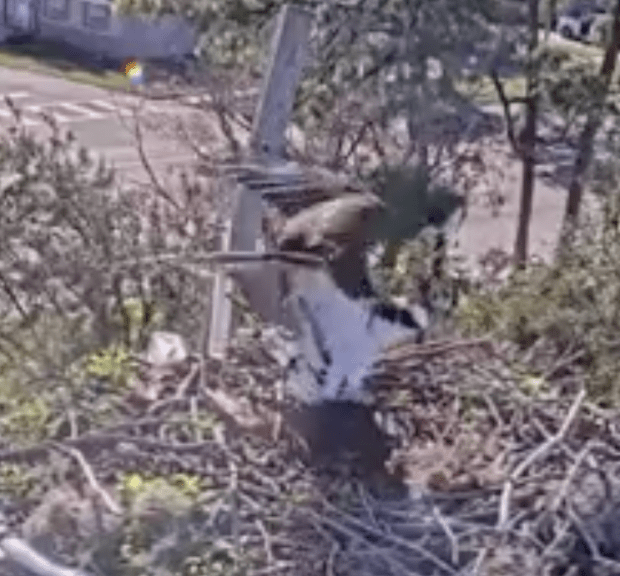
Egg swap at Royal Albatross Cam…Tuesday in Bird World

17 January 2022

Hello Everyone!

The start of the week was rather exciting with the pip of the Royal Cam chick’s egg! The worries about Jackie in the snow and the two eggs at Big Bear. Of course, we shouldn’t worry. Shadow and Jackie have this! Oh, I adore them. My only worry is CJ7 at Captiva which will be explained as this blog unravels today. I have written CROW to find out if there are any circumstances in which they might intervene. I probably will not hear back but, if the chick gets conjunctivitis, they might. They did with E17 and E18 at SWFlorida several years ago.

I found Dyson on top of the neighbour’s house at the corner watching me. Notice how ‘wooly’ she is and those gorgeous little ear tufts. Oh, she is a sweetheart in her winter coat. The squirrels begin growing extra fur in late September here inn Manitoba. Those many layers help them to stay warm in our brutal cold.

Robert Archambeau used to tell us to look ‘to nature’ for colours and patterns to inspire ceramics. I imagine that a lot of textile designers might like to do the same. This is a European Starling in non-breeding plumage. Note the white dots on the chest indicating the ‘non-breeding’. But look at the espresso brown wing feathers lined with that rusty taupe. Then there is that brilliant emerald green sometimes changing to blue and purple depending on the light with its light tips. I mean this is a real beauty. It kept watching me til I was finished…one of the first times I have been able to capture a Starling and see its eye. I love how the camera and this lens cuts through that branch and gives us the detail of the bird with some boke behind.

There were so many Starlings that came to the suet feeders today.

This is not a great photograph but I am including it for a reason. Notice the dark stocky male to the right and then look below. Cornell says that there are white spots all over during the winter but, this is obviously, not evident in these bird’s plumage. The bird at the lower right (not the House Sparrow) is a non-breeding female. Look also at the light marks around the dark eyes. In breeding season, the long beaks of the Starlings will be a bright yellow. You can see a hint of this on the bird to the far left.

One of Dyson’s babies from last summer is enjoying the nuts and sultanas around the small roofed feeder on the deck today. What a little cutie pie.


Making News:

Another unnecessary and painful death on a grouse moor hunting estate! Maybe the only way to get the gamekeepers and the property owners to abide by the law is to take away any licenses that are associated with grouse hunting. There has to be something that will break this endless cycle of raptor deaths that are entirely unnecessary and inhumane.

Did you know?


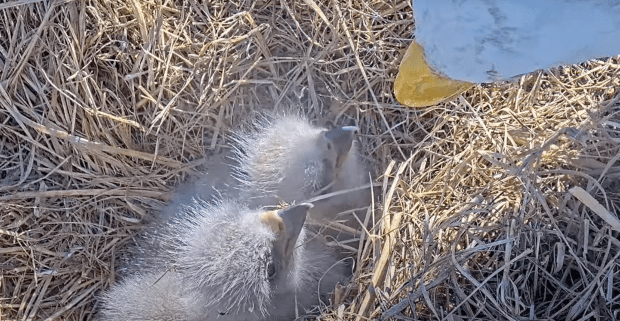
On Monday, I wrote about an incident that occurred on the KNF E3 nest with E01 launching an aggressive attack on E02. I wanted to check and see how old E01 was at the time and the eaglet that hatched on the 26th of December was 20 days old. We note that the blood feathers are just starting to grow in and there remain numerous ‘dandelions’ from the natal down as the layer of thermal down grows in fully.

The eaglets have had their breakfast and everything appears to be fine on Monday morning. E01 is attempting to stand and flap its wings and I caught E02 trying to do the same and walk.

In the top image, the eaglets’ crops are full and E02 is letting its now getting heavy wings flop to the side. Also note that there is plenty of fish on this nest so food insecurity is not an issue with the dust up that happened on Sunday. It is the ‘clown feet’ stage. Notice how much larger E01’s feet are than E02.

E01 is ‘itchy’. This might be a better image to see the size difference in the feet of the eaglets.

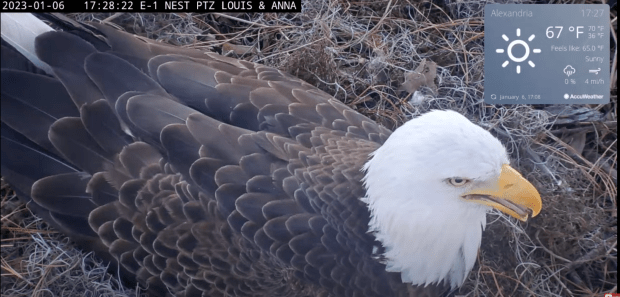
The little one of Anna and Louis is a darling. It just wants some Coot! And Anna loves her Coot, too. Sometimes it appears she gives the eaglet a bite but, she does not. She leans down, then changes her mind! Am I more frustrated than the baby eaglet?

Anna leans over to feed little E03 and changes her mind.

“Wait Mama. Can I have a bite?”

Finally…a half hour later.

There are lots of fish on the nest of Connie and Clive at Captiva. An early feeding at 07:56.

Connie fed the little one and at 08:50, there was a little crop.

At 0900, you can see that little crop better.

Want some more fish? It is 09:39.

A little more fish and lots of fish juice around 10:14. Connie is a messy feeder. Poor baby is just soaked in fish juice. Connie does not feed the eaglet a lot.

By 11:39, the little one is wanting some more fish! Maybe not this time. Mum is really wanting some lunch, too.

By 12:26, the eaglet is really wanting some of that fish. “Hey, I want some fish, too!” Connie has eaten half of it. This little one is going to crawl out of that egg cup one day and start nibbling at those fish. Just wait!

Despite some observations, CJ7 was never stuffed – maybe half. The adults certainly eat and it does get fed but, it is frustrating watching at times. Connie ate half a fish. Yes, I know the adults have to eat, too. But, gosh, golly…stuff the little one and then eat, please. Stuff it full. Don’t stop half way over with a bite and then eat it, Mum.

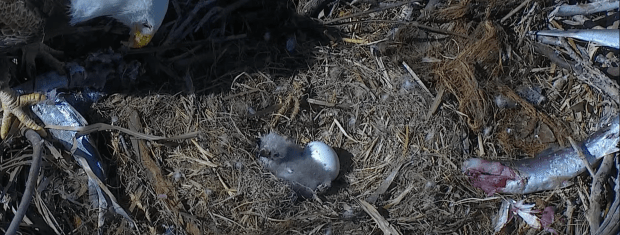
Finally at 13:10:55, some bites but only after Connie moved to the other side – barely missing CJ7 went she stepped over the egg cup.

Sometimes I feel that I am too much of an auntie so I was thrilled when I accidentally found this comment by fellow Canadian, Deb Steyck, writing about Captiva on the 16th.

“Yesterday there were 8 fish visible on the nest so the pantry is full the adults just have to work on the delivery of better feedings. Sometimes i wonder if both adults are new parents; even Connie seems a bit rusty at feeding does make you wonder. By the end of the day yesterday there was a small noteable crop but not full like we would expect especially with frequent feedings and only one eaglet on the nest.”

Seriously I ache for this little babe. I hope that Connie gets her act together. There is so much fish juice. Will this cause an eye infection?

The little one was actually able to hold on to this big piece and eat. it will be the last meal of the day.

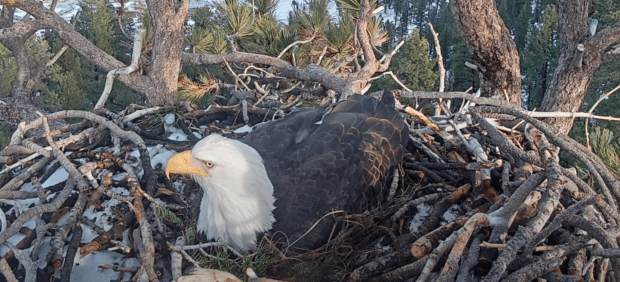
Jackie has had a miserable several days ever since she laid that second egg. That storm in Big Bear appears not to be going anywhere soon – and I do hope that it would so that prey could be brought and Jackie relieved.

Jackie is covered at 0200 on the 16th of January.

At 0727 on the 16th it appears that Jackie has gotten up and removed the snow from her back and head. The weather remains a misery. 2540 persons are watching and worrying for Jackie.

There is a winter storm warning for an area south of BB Lake. The forecast for the BB Lake area is as follows:

By 10:51:55, it is clearing a bit but the wind is still very strong.

Oh, bless his heart. Once everything had cleared, Shadow appears on the nest with prey for Jackie and even gives her a break as he takes over incubation a few minutes after she finishes eating. Jackie was so happy to have the food and the break. 14:04. Thank you, Shadow!

Jackie returns at 15:52 and Shadow is off incubation duty. I love how he sees her coming and begins to call, the high pitched calls and the chortles. So sweet as they greet one another. The equivalent of the Albatross sky call.

Just look at how long and sharp those talons are! I thought trimming Lewis’s nails was bad enough. Imagine!

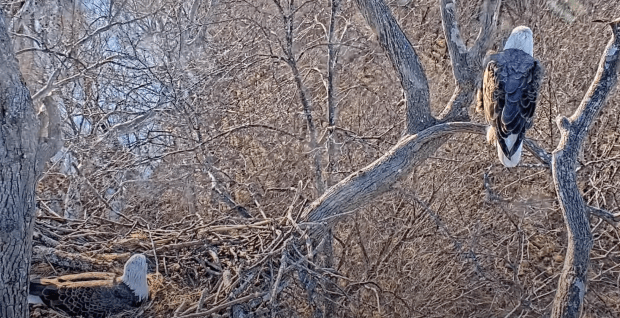
All is well at the Northeast Florida nest of Gabby and V3. V3 will fly in and Gabby will be there seconds later. They have worked on the nest and slept at the nest. While there may or may not be any eggs this season, the pair appear to be a bonded couple and V3 seems to have established himself. There have been no intruders at the nest for some time now. They are a lovely couple. Wishing Gabby the best, the very best.

V3

V3

V3 on the left and Gabby on the right.

Want to see a crop?!!!!!!! Gabby had an amazing dinner!!!!!!! Would love to see CJ7 look like this. :))))). Just saying.

E22 is no worse for wear after having Harriet deliver a huge fish on top of it at the Southwest Florida nest she shares with M15. Later in the day both were looking out of the rails at the world beyond.

As the sun sets over the Central Florida Superbeaks Bald Eagle nest, Tico and Pearl are going to sleep with nice big crops. Nite everyone!

Mum and Dad were both bringing sticks to the ND-LEEF Bald Eagle nest – the natal nest of our own Little Bit ND17.

At the Osprey platform on the grounds of the Achieva Credit Union in St Petersburg, Florida, Jack delivered a fish to Diane at 07:28. After the couple continue to work on the nest periodically.

FO and Mo were both at the Captiva Osprey platform in Florida today.

I was so hoping that the Florida-Gainesville Osprey nest would be up and running this year but, sadly, no. This was the announcement from the University:

Unfortunately, at this time, there will not be an osprey camera for 2023. The nest was located on the lights at the softball ballfield and these lights were changed (to new LED lights) in the fall of 2022. We are not sure if the ospreys will build a new nest with the new light structure. Please stay tuned for updates about whether it is possible to install another osprey camera in 2024. Thanks for your support! And don’t worry, the osprey parents (Stella and Talon) will build another nest somewhere if not at this exact location.

Zoe is 121 days old. On the 16th of January in Australia, Mum delivered a fish and so did Dad. Those deliveries came at 14:10 and 17:29. Zoe appears to have a nice crop from the earlier feeding. Mum will arrive in about five minutes with a fish for her girl.

At 10:44 after fish calling, Zoe flew off the nest and returned a minute later with a fish. She did not catch it. Her feathers are not wet. It was a hand off from one of the parents. Gotta be.

Zoe is certainly vocal!! She is 122 days old today.

Sixteen minutes later and Zoe is still eating her fish.

If you are missing Indigo highlights by Elain, Indigo has been heard outside the scrape box but has not been inside for more than two days now.

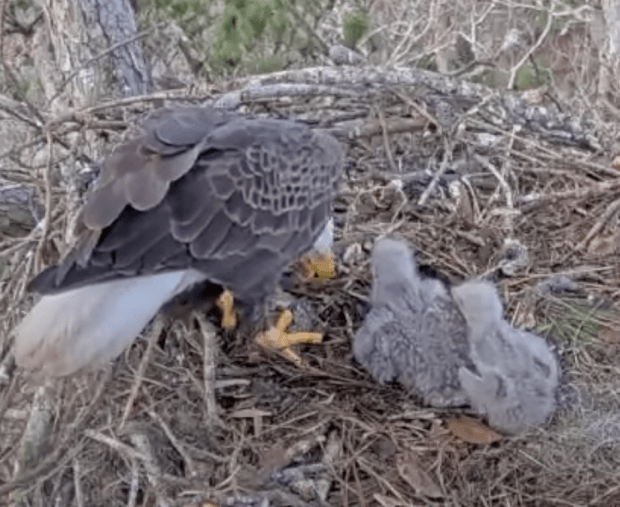
The egg of L and GLY has been swopped out for the dummy egg at 10:08 Australian time Tuesday Jan 17. Everything seemed to go smoothly. Fly spray added to nest to prevent fly strike when the chick is returned from the incubator. It is ‘egg citing’ on Taiaroa Head. Love the NZ DOC that does so much for its beloved birds. I would love to see their misters on some of the osprey nests in the Pacific NW (Canada and US). Or feeding hungry chicks if something happens to their parent/s?

And a pip has been confirmed. There are currently three eggs in the incubator at Taiaroa Head.

Thank you so much for being with me today. Please take care. See you soon!

Thank you to the following for their posts, their announcements, their videos, and their streaming cams that make up my screen captures: Raptor Persecution UK, A Mighty Girl, KNF-E3, KNF-E1, Window to Wildlife, Deb Steyck and Bald Eagles 101, FOBBV, NEFL-AEF, SWFL and D Pritchett, Superbeaks, ND-LEEF, Achieva Credit Union, U-Florida Gainesville, Port Lincoln Ospreys, and NZ DOC.

Eggs, Coots, and more…it is Thursday in Bird World

12 January 2022

Good Morning Everyone,

I hope that the week has been good to you. I think of everyone in the paths of the storms that I am reading about and I hope that all of you are safe.

I am repeating the story of Jackie laying her first egg. 3884 people were watching the nest at the time. It went up to over 4000. Incredible. Jackie and Shadow are much loved. It just made me giddy and all of us wish this couple the very best of luck this year. Let us hope for good weather, no predators and nothing untoward.

From the Bookshelf:

I continue to sing the praises of Slow Birding. It is my pick of all the books I have read so far as being one of the most informative and easy to understand. If you like picture books, it is not for you!!!!! Last night I tackled the chapter on American Coots. They visit us and last summer I had the privilege of seeing several at the ponds around our city on a daily basis. I want to share with you what I learned – it is fascinating.

Coots are not ducks. They are rails but they spend their time in the water – like a duck. Their bodies are a deep espresso brown black, the head a darker shade than the body. Their bill is white with a shield that ranges in colour from a deep red-brown to brick red. You can see this below. They have red eyes. Stunning. Their secondary feathers have a white trim and there is a tiny white line going down the middle of the tail to its tip. Their feet have toes and those toes have evolved over time to have phalanges that help them to swim.

American Coot (Fulica americana)” by Jacob McGinnis is licensed under CC BY-NC 2.0.

In the image below notice the red on the head of the chick.

Mud Hen or American Coot (Fulica americana) feeding her baby” by Peggy2012CREATIVELENZ is licensed under CC BY 2.0.

Some interesting facts about Coot behaviour:

  • Baby Coots have red heads. When predators are about they will stick their heads deep into leaves or into the nest so the predator cannot see them. As they age they can dive and camouflage their head by being under water. There is, on average, a five day spread between the first hatch and the last.
  • Adult Coots can tell the parasitic eggs (eggs laid by another Coot in their nest) from their own eggs due to patterns on the shell.
  • Adult Coot parents divide up the brood – older chicks with fading red heads and younger ones with red feathers. Chicks who kept their red feathers were the favourites of the adults to be fed. Unlike ducklings who can forage themselves, baby Coots are fed by the parents.

Making News:

Did you know that the Kakapo Recovery group check out the Rimu fruit, essential for Kakapo survival, to determine when breeding will begin? I didn’t.

More raptors are arriving in wildlife rehabilitation centres now that they are having to scavenge for food. Often this means that they are eating the innards left from hunters in the fields and woods – those are loaded with lead and it sends them right into care if they don’t die first. Sadly, this Golden Eagle got help but it was too late. This is entirely preventable. Write your representatives and urge them to ban all levels of lead in fishing and hunting equipment! Now. Thank you.

I would give just about anything to see a pile of ducks quacking away in my local park’s pond. They will return in the late spring. For now I have to rely on stories of others. I hate no idea, however, that Wigeons whistled, did you?

https://www.theguardian.com/environment/2023/jan/11/birdwatch-whistling-wigeons-winter-highlight?CMP=share_btn_link

Nest News:

How many of you worried and fretted that Connie had not fed the little eaglet? I sure did! Connie has now fed the eaglet – about 24.5 hours after it hatched! Yippeee. Oh, I bet that first bite of fish tasted good! Little one holding its head up nicely. There is no sign that the second egg is pipping but it could be. Perhaps the egg that hatched was actually the second one laid. We wait. The raptors will teach us patience whether we like it or not!

Connie fed the little one again at 13:39 and at 14:20. I am making an assumption that the feedings will be nearly hourly from this point onwards for a few days during daylight hours. Clive has brought in Mullet and Trout. Good job, Dad.

Thursday>. No obvious pip in the second egg at Captiva.

Oh, that little one at the KNF E1 nest of Anna and Louis is just a cute little butterball. Will that second egg hatch? I cannot see a pip there either. Oh, those little wings. Adorable. Just adorable. No signs of a pip in the other egg.

I do not see a pip on the second egg at KNF-E1 Thursday morning either but it could be there.

One big difference that you might notice is that Andria feeds her eaglets more often than Anna. That is a really good thing for those two eaglets especially the second hatch as it remains much smaller than the first. Both are being civilised and both are well fed and cared for – no worries here.

Jack and Diane were bringing in bark to the nest in St Petersburg Florida. I am sure hoping that they leave it as a liner to cover up that hole. Last year their eggs rolled in there and with the help of Crows, the couple had no osplets. The year prior they fledged three. Diane’s leg appears to be improving daily.

Both PePe and Muhlady have brought in fish to the nest. These eaglets, Pearl and Tico, are so lucky. What a great source for fish their nest has.

Pearl is really getting her juvenile feathers.

Just look at this beautiful eaglet.

Gabby and V3 were both at the nest this morning. V3’s talons have really taken a beating but they appear healing or healed. Then off to secure the territory while Gabby stays home! What a guy.

Gabby lets out a big cry at 09:46.

Both V3 and Gabby are at the nest tonight on their respective perches watching for intruders and probably hoping to get some rest.

We have all noticed the large number of intruders at Gabby’s nest – and, of course, no Samson is what started all of this. The Centre for Conservation Biology has noticed that Bald Eagles spend more time guarding than they did 20 years ago due to the growing number of eagles in the area. Here is an article that arrived in my inbox today. It really sheds some light on what could be happening in The Hamlet.

They continue to work on the nest at Big Bear. With body temperatures of 105 degrees, Jackie and Shadow can melt the snow on the nest very quickly. Keep an eye out for any fluff being brought to the nest bowl. That will signal egg laying.

Well, goodness. I said watch for the eagles to bring in soft nesting material and look what happened late Wednesday afternoon!

That nest bole has been occupied for longer than an hour. I am not ready for this! But it just might be that Jackie is!!!!!!!!!!! She certainly wouldn’t listen to me.

Oh, tears. Jackie just laid her first egg. Beautiful. Between 1557 and 1600. Jackie made it look easy.

There is a fully history of the Big Bear nest under the streaming cam. It is very possible that Jackie is the 2012 hatch of Ricky and Lucy. In 2019, Shadow arrives at the nest and refuses to leave. Eventually, Jackie’s mate Mr BB leaves the area. Jackie and Shadow fledged Cookie and samba in 2019. Tragedy strikes for the pair in 2020 and 2021. Last year Jackie laid eggs on 22 January and 25th. One of those hatched. It was Spirit who stole our hearts and who fledged on 31 May.

Jackie was still keeping that precious egg safe at 1800.

E21 and 22 are really enjoying the fish that was brought in on Wednesday. they are cuties. Both M15 and Harriet fed the little ones fish and both were nicely behaved. Yes.

Indigo loves bringing beetles into the scrape that he has caught. Today there were four that Elain caught in her video! Indigo is so proud of his catch.

Ron and Rose are still working on the nest in Miami-Dade. Today, Ron brought Rose a fish in the nest. How sweet.

I am waiting for the pip watch at Berry College for Pa Berry and Missey. Last year they raised a strong eaglet B15 that stayed in the area and entertained people well into the fall with his flying skills. They are not on YouTube. You must Google Berry College Eagle Cam.

The eagles are working on the nest at Duke Farms.

And the new couple at the Captiva Osprey nest, MO and FO, are working on eating a catfish (or is it a shark?) and mating at the same time. Good luck with that.

Thank you so very much for being with us today. Please take care. See you soon.

Thank you to the following for their posts, videos, tweets, and streaming cams that make up my blog: Openverse, Kakapo Recover, Terry Carman and Bald Eagles Live Nest Cams and News, The Guardian, Window to Wildlife, NF-E1 and E3, Achieva Credit Union, Superbeaks, NEFL-AEF, Centre for Conservation Biology, FOBBV, SWFL Bald Eagles and D Pritchett, Charles Sturt University Falcon Cam and Cilla Kinross, Elain and Charles Sturt Falcon Cam, WRDC, Berry College Bald Eagles, and Duke Farms Bald Eagles.

A hatch for Connie and Clive…Tuesday in Bird World

10 January 2022

Good Morning,

Lots of eagle parents busy feeding eaglets – from those a month old at Superbeaks to newly hatched. It is ‘egg citing’.

Making News: Hopefully all manner of organisations and individuals will keep a very focused light on the gaming estates in the UK. Will the judiciary finally give sentences to gamekeepers that are appropriate for all the laws that they have broken? Will they give sentences and fines long and large enough to deter this horrific behaviour. Sue Belcher wrote a poem about snares. Read it. If you don’t live in the UK but love our raptors and other wildlife, it will help you to understand what the fight is about. I am happy to spread the word on the plight of wildlife caught in these medieval devices. Thank you Sue!

Checking on some of the nests we are watching:

At 11;22, Connie and Clive have their first hatch at the Captiva Bald Eagle cam. It is to be really celebrated. Connie and Joe lost their two beautiful hatches, Peace and Love, to rodenticide secondary poisoning in 2020. No eggs in 2021. Then Hurricane Ian came and tore down Connie and her new mate’s nest, Joe. Congratulations Captiva!

Jackie often lays her eggs in March. Generally egg laying is timed to the availability of prey items. Despite that historic fact, Shadow and Jackie have been mating on the nest today and Jackie continues to check out the nest bowl. Will we have eggs early at Big Bear Valley?

It started off as another f/soggy day at the Kisatchie Forest nest of Alex and Andria. ‘A’ was the first to alert me to the fact that the weather is often very different on one side of the lake from the other. Andria dig a really good job keeping those feisty little eaglets with their clown feet underneath her so they would stay warm and dry. No thermal down yet so this is important. It is coming!

More chair rails, Alex!!!

E3-02 was so full that he could hardly get himself up and over to the dining table for the next meal.

As the sun set Monday night in Alexandria, Louisiana, two very full eaglets tucked in tight under Mum sleeping. Beautiful.

Eaglet E1-03 is a cutie pie! Louis is filling the nest with Coot and fish already. Anna has changed so much since her first hatch, Kisatchie. He didn’t know what to do and Anna didn’t know how to feed an eaglet. Of course, they got it together but, we sat at the edge of our seats. Now Anna is experienced and this little one is simply a cutie who loves its fish and Coot. Look at those precious wings.

Oh, such a chubby little baby. Cute. So cute.

If you have not watched the nest of Louis and Anna, it is a good one to have on your list. Here is the link:

This is the status of the pip for Connie and Clive at 17:41 Monday evening.

Both Gabby and V3 were in the nest at 06:51 Monday morning.

V3 was last seen at the tree at 1531. There had been an adult eagle land on the nest tree with an injured eye and talons but it would not have been V3.

At 18:05, Gabby waits on Wallenda. She is still tucked on Wallenda and waiting for V3at midnight.

At Superbeaks, Pearl appears to be doing some self-feeding.

And, oh, goodness. Every eaglet or osplet should know that you NEVER look your sibling directly in the eye. It is definitely not a good idea.

Big PS before bed.

At the nest of Harriet and M15, the two eaglets, E21 and E22, are doing grand. E21 is 6 days old today and E22 is 3.5 days old. That is actually a big difference. Both are eating well and Harriet is feeding them as much as each needs. E22 does not need as much food as E21 – so don’t panic and count the bites and worry if they are not equal! It is all good in Fort Myers on the Pritchett property.

Harriet gave E22 a private feeding while 21 slept – Harriet is experienced and smart! Lady Hawk put it on video for us.

Martin and Rosa have been doing restorations at the Dulles-Greenway Eagle Cam in W Virginia on Monday. Oh, those talons make me ache. Send some very soothing hand cream to the nest, please!

Indigo had a very interesting day. Check out Elain’s video:

So what is up with Annie and the ‘new guy’? I am not sure. He was till working on his prey deliveries the other day.

Book Review: Loon Lessons. Uncommon Encounters with the Great Northern Diver by James D Paruk (2021, University of Minnesota Press).

Loons. Who doesn’t love a loon? Anyone spending time in the forest and lake areas of Canada or Minnesota – or other places – has memories of their calls -the tremolo, yodel, or wail. I have tried hard to ‘see’ them because I have listened to those calls for years but, did not get sight of the diving waterfowl. I finally did. I will not tell you that I love loons more than big bad raptors – I don’t. But they are iconic for the province that I live in and I want to know more about them so I can appreciate their life, its blessings, and challenges more. This book really helped me on all accounts. The book is full of 30 years of experience by today’s leading expert on loons.

As a former academic, ‘scholarly’ articles can be a bit dry and daunting especially if they are in any of the fields of science (sorry). What I noticed immediately was that Paruk’s friendly and accessible writing style immediately drew me in. What a wonderful way to open a preface by saying, “To appreciate any organism, I am convinced we do not need years of training – all we need to do is watch our children marvel at a deer or a squirrel from a window. A sense of wonder and our innate curiosity can lay the foundation for developing and maintaining an appreciation for the natural world.” Excellent. The volume is divided into 12 chapters moving from biology, courtship and nesting behaviour, migration, conservation threats, and how loons are adapting to a changing world. The book is printed in black and white and at first you might ask, “where are the photographs of this magnificent bird with its black and white plumage”? You will find those images in the middle of the book – and I learned, looking through those images – that some loons have other coloured plumage such as the Red necked Loon!

Besides behaviour, one of the things that I was most interested in reading first were the challenges that loons face and what is being done to help them. You may have seen the artificial floating nests with avian guards (a bit of a camouflage cover over the top) on some loon streaming cams. These help the loons protect their nests and keep them safe from predators. The floating nests also keep the eggs out of harms way in times of flooding. It was very clear to me that the Bald Eagles who nest on the shore near Hecla Island and whose nests were destroyed by the 2022 flood might benefit from some floating platforms of some sort. There are other ways that we can help.

The threats to the loon sound like a broken record for all birds including raptors – mercury affects the central nervous system and it is present at very high levels in many of the ponds and lakes in the northern part of my province. As a natural occurring material, it was released into the water when the land was dredged for the many hydro-electric dams. Lead. Oh, what a culprit lead is – and please tell me why, knowing what it does to all birds and wildlife – has it not been banned? I clearly believe that humans that have the power to stop painful deaths or long term rehabilitation must wear bloody blinders. It is making me angry and I wonder how they would feel dying of lead poisoning? On page 173, Paruk states, “In recent decades, the EPA and USFWS failed to pass further measures to reduce the use of lead in hunting and fishing gear despite mounting evidence of its toxicity in the environment”. He continues by adding that six states took it upon themselves to pass legislation curtailing the use of certain levels of lead in fishing equipment. Those states are New Hampshire (sinkers 1 ounce or less), Massachusetts (lead sinkers on two reservoirs loons use for breeding), Maine, New York, Vermont banned “the sale of lead sinkers of one-half ounce or less and restarted their use as well.” Washington State banned the use of lead tackle on 12 of the 13 lakes used for breeding by loons. Since 2010, no additional state has done anything to ban lead ——–that was 13 years ago. It is time our American friends reading this blog get busy lobbying for the end of lead – the end of it period. Not just certain amounts. All lead. Paruk states, “I am left wondering how many more eagles, loons, condors, cranes, and swans have to die before a change in policy is warranted. The EPA was designed to protect the health of humans and the environment…acknowledges that lead is toxic to wildlife but not enough to warrant a national ban of lead tackle. Despite the mounting evidence that ingested fishing tackle leads to numerous wildlife deaths, the EPA refuses to recognise that there is a serious problem nationally. Because the federal government has failed to act on banning lead tackle, the responsibility shifts to state governments to take action” (174-75). If you want to do something to help the wildlife in the US, then US citizens reading my blog should carefully craft a letter to their state environmental officials copying them to the EPS and the USFWS demanding action now. Mercury and lead but there are also serious environmental threats to loons and other wildlife – including oil and its spillage such as The Deep Water Horizon in the Gulf. The other day I posted a copy of a Tweet indicating that licenses to drill for oil and natural gas off the coast of Alaska – pristine waters – were being accepted and had one application. Are they serious? Of course, monofilament fishing line is a source of painful injury or death. Other polluted waters, habitat loss, etc. The list is endless.

It is a really good read. You can learn so much just about loons, their behaviour and their migration but you can also get in deep with the challenges they face and how these might be rectified. Price in Canadian dollars: $34.95.

(Disclosure: I do not receive free books to review. If I see a new book that interests me, I buy it and am very happy to spread the word on those that will educate us, cause us to be curious, raise our awareness.)

Thank you so much for being with me today. Please take care. Looking forward to seeing you soon!

Thank you to the following for their notes, tweets, posts, announcements, videos, and streaming cams that make up my screen captures: @Belcherspoems, Window to Wildlife, FOBBV, KNF-1, KNF-3, Window to Wildlife, NEFL-AEF, Superbeaks, Lady Hawk and SWFL Bald Eagles and D Pritchett, Dulles-Greenway Bald Eagle Cam, Elain and Charles Sturt Falcon Cam and Cilla Kinross, Cal Falcons, and Amazon.

It’s Love…Saturday in Bird World

Good Morning Everyone! It’s Saturday. We hope that each of you had a good week. For those going back to school, it must have been a bit of a shock after the holiday break. Have a good weekend. Get outside if you can – even if it is only for a few minutes. Makes all the difference in the world smelling the fresh air, feeling the sun on your cheeks, and I hope seeing a bird!

The kittens have a new ‘enrichment’ activity toy.

They have had so much fun and have spent so much time figuring out things. Lewis can now use both paws. It is past midnight and Missey is working on her technique. Cute.

My top story is yet another death by lead. As long time readers will recognise, I am a big fan of all the work that the Ventana Wildlife Society and the LA Zoo do for the California Condors. So, today, when I received the link to this Twitter feed from Geemeff, I was once again saddened beyond belief. Lead in hunting and fishing equipment needs to be banned from being manufactured and used. Pull it off the shelves. There are alternatives – copper and stainless steel. Yes, at the moment because their production numbers are not as high as lead, they are a bit more expensive. About $1.50 US a box of cartridges for shooting I was told (not sure the size). So, the use of lead is not necessary. It is also not necessary by the military. Ban lead! Just do it.

First feathered friend for the 2023 Memorial Wall. So sad. It is so unnecessary that I just want to stand in the middle of the street and scream but that won’t help. So today I am going to write my Member of Parliament, the Honourable Web Kinew. He is Indigenous and has a good chance of being our next Premier in Manitoba. He might just care enough to do something when he has the power and the people. Clearly our current government in Manitoba will do nothing. But it needs to be a federal law here, in the US, everywhere-!!!!!!! So make a resolution to write to your Department of Natural Resources and the Department of the Interior in the US, your Congress member, and your Senator. Their e-mail addresses will be published. Then why not write your President.

BTW. The Ventana Wildlife Society is hiring a lead specialist for outreach to ranchers in the area of Big Sur and Pinnacles. Know anyone that fits the description? Please forward.

I always wonder if the DNR puts up a few bird cams to make us feel soft and fuzzy towards them. They derive huge income from selling hunting licenses. The specific amount is published. Check it out and then get mad. But don’t donate to their cameras until they take a stand against lead. A serious one. For those of you living in other parts of the world, check out the use of lead in your country and let me know what you find out. It would be appreciated.

While you are at it, how do you think about selling licenses to drill for oil and natural gas in pristine waters that could easily impact wildlife? aren’t we, as an international society, telling those folks in power that it is time to invest in renewables? not fossil fuels?

Have a look at this 1:39 minute video on the birds and the land in Alaska – and imagine an oil spill. Please help them by writing to your politicians pressing them to stop licensing for oil and natural gas – anywhere.

Hello Everyone! You cannot have my prey!!!!!!!!! Got that, Mum. I am telling everyone so they know – you cannot have it!

Elain’s great video for 6 January shows us the many visits of Indigo and the interactions in the scrape box at Orange on Charles Sturt University’s water tower! And, of course, it begins with Indigo arriving with prey screaming his head off!!!!!!

Well, it’s love. No other pictures of the sweetie pie E21 and Harriet needed. Just look at the love in a mother’s eye to her recently hatched wee one. Precious. Who says eagles do not have feelings?

Meanwhile, it is after 1700 on Friday and E22 is working away with its tooth visible trying to get out of that shell. Soon!

Oh, goodness. If you were watching, Harriet went to roll the egg and E21 got stuck on her talon and went out of the nest cup. The little ones cannot move to get back under Mum and they cannot regulate their temperature. Thankfully Harriet saw what had happened and within 10 minutes had E21 back under her by rolling it with her beak!!!!!!!!! It was a little tense watching it as Harriet had to stop a couple of times but she managed to get the job done. E21 had its first adventure!

Welcome E22! I saw you for the first time at 07:06.

A little later. You are more dried off and E21 is no worse for his adventure.

At 09:36:03, V3 flies in and meets Gabby on the nest. She sees him coming before he lands and begins calling.

The couple begin working on the nest. — I think that it is time to recognise that V3 is the ‘main man’ now. Whether or not this new pairing will produce eggs and eaglets this year is unknown. Will V3 be around next year if they do not have eaglets now? Who knows. For now, it is time to enjoy the two of them together and be happy for Gabby.

The couple get an entire five minutes together before V3 is off protecting the realm. I am thinking about getting him a Superman suit.

Both appeared back together on camera at 13:47. Give V3 a big hand of applause. He is keeping everyone else away from the natal nest. Bravo.

They are both constantly vigilant. Each one watching from different sides for intruders that could attack the nest. It has to be very stressful.

Gabby flew in with a huge crop and V3 flew in after her with a large crop, too. They dined together it seems.

They are a couple. They are together in the morning, during the day, and at night. No doubt about it. And who says they aren’t mating at their ‘special’ spot off camera??? Or maybe they aren’t. Who knows???

Superbeaks. Pearl is 28 days old today and Tico is 27 days. Let us examine the pair more closely through a few images. That is Pearl closest to the rails and little Tico at the back by Mum.

What do you notice about these two eaglets immediately? There could be several things.

Let’s work on some terms and the one I want is not in the image below!!!!!!!! Their rictus or smile is now yellow. This happens during week 4. Their eyes are the best 90% chocolate you can purchase! When they get older their eyes will lighten to that celadon colour that can be white, lightest of watery blue, or very light grey-green. Their cere is still black. Their Maxilla is black. These will change to chrome-yellow as they age. Now look. Dandelions on the top of the head with thick grey down. Those dandelions will begin to look like ‘Mohawks’ very soon. The blood feathers are growing in. This thick down will remain under them to help the eagles regulate their temperature. Now it covers all of their body.

Pearl is getting much more stable on her legs and was seen flapping her wings.

I thought I had a screen capture. One of the eaglets, Pearl, was flapping her wings building up some muscles. They are both developing just fine. There is so much food! Some chatters noticed a bit of bonking by Pearl to Tico and that Pearl had eaten most of one meal but, they are both fine. The last time I checked Tico was being fed.

Now just imagine. In 28 days time, Little E21 is going to look like the eaglet in the image above. Hard to get around that, isn’t it? They grow so fast.

Jackie and Shadow have been on and off their snowy nest all day.

Thunder and Akecheta were perched on Tor together today. Time 16:02.

Anna and Louis are not giving us any hints. For the past two years, this Louisiana Bald Eagle couple whose natal nest is E1 at the Kisatchie National Forest have had only one hatch. Will it be the same this year? Egg 1 is 38 days old today and egg 2 is 34 days old. The average hatch time in Louisiana is 35-39 days. So things are going to happen shortly. Wish them luck! This is their third breeding year together and both are nicely equipped to raise two healthy eaglets. Louis will just pile more fish on the nest. Can you imagine? He was so excited the first year, 18 fish (Anna brought in some to equal 20) on the nest at once!

The wee ones at the E3 nest of Alex and Andria are ‘lanky teenagers’ now. Not round little cuddly eaglets. They are growing their feathers and getting bigger and bigger. E3-01 was out of the nest cup the other day and E3-02 made that leap today.

Oh, precious. Notice. They do not yet have yellow smiles!!!!! But they do have black specks and those black specks indicate grey wooly down and feathers!!!!!!

Both eagles were at Decorah today. When you look at that image, I want to give a shout out to the Raptor Resource Project and Explore. They have done an amazing job – with the quality of the images – and their ability for close ups and pans. Just beautiful.

The juvenile was back at Decorah North.

Good news for Achieva Osprey fans. Barbara Snyder reports on FB that there was a successful mating attempt today. Diane’s leg must be getting better. Cannot think of more joyful news. Thanks Barbara!

Bird sightings in Dulwich. I could hug the author…they even like to see Sparrows. I wish so much that people who dislike sparrows would stop to think that not only do they need to eat but they are in rapid decline in certain locations. I love my sparrows. Each has a different face and some you come to recognise as they reappear daily.

https://www.theguardian.com/environment/2023/jan/06/country-diary-a-flock-of-seagulls-and-a-lesson-in-resolve?CMP=share_btn_link

Everyone reading my blog knows that habitat loss, climate change and the sheer impact of the human population is killing both wildlife and our planet. An article in The New York Times discusses the impact on various species. Save it and read it when you have time. But read it so that you can talk about this with others. Thank you.

My blog is mostly about raptors. But, I love all birds (and other wildlife) and I am absolutely entranced by Loons. As many of you know, I have wanted to get a good look at them and have travelled throughout my province trying to do so. I did finally see ‘two at a great distance’ in 2022. There is a new book out about loons. Stay tuned!!!!!!!! It has received rave reviews. I hope to have it read in a couple of weeks.

Thank you so much for joining me. I expect we will wake up to E22 with all of us holding our breath and hoping that E21 is a ‘darling’ of a big sib. Tomorrow one story I will be following is the loss of wildlife due to outdated farming and farmland practices in the UK. Don’t ever think it is just the UK. All I have to do is drive to the nature centre for my walk to see all the farmland given over to large housing developments. No birds there. Hardly a tree! There is more bad weather with more record breaking rainfall coming to California from the 9-14th. Jackie and Shadow could see lots of snow while our falcons and eagles in the Channel Islands will have rain. If you live in an area that has the potential for flooding and mudslides, please do take extra precautions. Everyone take care. Winter weather can be very hazardous. See you soon!

Thank you to the following for their notes, their Twitter feeds, their announcements, postings, videos, and streaming cams that make up my screen captures: Geemeff, Ventana Wildlife Society, GoGreen, Cornell Bird Lab, Charles Sturt Falcon Cam and Cilla Kinross, Elain and Charles Sturt Falcon Cam and Cilla Kinross, SWFlorida Eagles and D Pritchett, Birdie Cam, NEFL-AEF, Superbeaks, FOBBV, IWS and Explore.org, KNF-E1, KNF-E3, Raptor Resource Project and Explore.org, Barbara Snyder and Achieva, Achieva Credit Union Osprey Cam, The Guardian and Amazon.ca

Victor, Kisatchie E3, and more in Bird World

31 December 2022

Good Morning Everyone. Wishing each of you a wonderful end to 2022.

Today’s blog is brought to you by Dyson! Not only can Dyson ‘suck up’ birdseed quicker than any other squirrel I have ever met but, today, she figured out how to get the feeder off the hook, drop the seed cylinder onto the ground, and just sit there gobbling up all those fine black oil seeds, millet, peanuts, and cranberries. So clever. It would be impossible to get mad at her – she is curious, intelligent, and a hard worker! She is a survivor in an urban environment that is not always friendly.

Isn’t she adorable?

From Dyson and all her friends in the garden, we wish each of you some tasty treats, good health, and love in the new year!


Now, let us deal with the sadness first. A juvenile Bald Eagle landed on the Delta 2 nest in British Columbia. Immediately it was noticed that the juvie had lost a leg or a foot. The older eagles brought it some food. Sadly, yesterday, the bird was found dead at the foot of the nest in very emaciated condition.

Then on to the good news. Recognise this beautiful juvenile? Hint: Hatched in the Channel Islands. Sister: Lillibet. Was taken into care due to extreme zinc toxicity. It’s handsome, strong, and resilient Victor!!!!!!!

There is even more good news.

Kingpin and Redwood Queen’s offspring, California Condor 1030 Iniko, was caught in her nest during the Dolan Fire of August 2020 in Big Sur. The nest tree burned and so did the streaming cam and no one knew if Iniko survived. But, miracles do happen, and Iniko survived and Redwood Queen came back and took care of her little one. Kingpin is presumed to have died in the fire. Then a male condor came and there was a fight and Iniko fledged too early and was injured. Taken to the Los Angeles Zoo, Iniko was released into the wild a year ago along with two other condors, Rachel Carlson and Dian Fossy at San Simeon. Today photographs of Iniko in the wild were released. Doing well!

Please, always keep in mind that there are so few California Condors. Their lives are precarious and they often die because of lead poisoning from the carrion they eat and are now susceptible to Avian Flu (eating dead diseased birds). Always grateful to the Ventana Wildlife Society for the work they do to protect and rehabilitate these birds and make the wilder safe for them.

Both eagles E3-01 and E3-02 at the Kistachie National Forest nest of Alex and Andria are doing well. That little one (02) got some good bites today and there is so much food on that nest! Still the parents love to eat, too, and the little ones got full, Mum ate, and they wanted some more. They didn’t get any but, it won’t be long before another feeding. Andria is doing fantastic.

Pine has been brought in to help with the flies. I wonder if it works as a deodoriser, too??

Look at those precious little wings. 02 has already learned to balance using its wings! Incredible.

Highlights of the feedings at E3:

The cam operator at Superbeaks did some nice close ups of the nest on Friday afternoon. There are two eaglets. Squint in the image to see the two. Just look at the crop on that one that we can see clearly. Goodness gracious. You can also imagine how big they are compared to the wee ones at Kisatchie.

Gabby and V3 are working on the nest. They fly in and out and he brings prey. Life seems to have settled down at The Hamlet near Jacksonville, Florida for our beautiful girl.

Jackie and Shadow have been working on their nest at Big Bear almost daily and today they had a little help from Fiona.

Elain’s highlights from the scrape of Diamond, Xavier, and Indigo for 30 December. Some bonding and then comes screaming Indigo. You can sure tell that Indigo is related to Izzi!!!!!!!!!!

Before 0700, one of the adults, it looked like Dad’s legs, delivered a breakfast fish to Zoe in the nest. It was a really nice fish and it looks like Zoe still has a crop at 1100 hrs.

At 1415, Mum brought in another portion of a fish, a decent size, to Zoe. There were times in-between these two prey drops to Zoe that she was picking up sticks on the nest, resting, and was off the nest. She did appear to have a crop at noon. Was there another fish? Perhaps. I could not see it in the rewind but that does not mean she did not eat off camera.

Cooper’s Hawk. A female often comes around the garden and in 2019, I was fortunate to be sitting on a bench in The English Garden, a part of our Assiniboine Park, when a pair of fledgling Cooper’s Hawks were hunting for insects.

I have been picking at that book, Slow Birding and came across some interesting facts about Cooper’s Hawks today. I would like to share one of those with you because it will shed some light on the efforts by all the bird parents to feed their young.

Heinz Meng studied the diets of Cooper’s Hawks in Ithaca, New York (Cornell) from 1948 to 1958 before their numbers were decimated by DDT. He discovered that it took 66 birds or mammals to raise a single Cooper’s Hawk chick to fledgling at 6 weeks. As the nestlings grew the number of prey items increased. “On a daily basis, this is four meals a day in the first week, five a day during the second week, then varying between seven and nine prey a day during the remaining weeks.” That is a lot of food for each chick – and this does not count the mother while she is incubating the eggs. Now imagine much larger birds, on the nest for a longer period, like eagles and ospreys. Those males work darn hard!

Did you ever think about a bird’s beak or bill? Next time you are looking at different birds, pay particular attention to the part that makes certain that they can consume their food whether it be seeds, insects, or prey items. In the instance of the Common Crossbill, their beak – look at it – means that they have to live in pine forests. They would starve to death otherwise!

https://www.theguardian.com/environment/2022/dec/30/country-diary-these-stocky-finches-serve-a-life-sentence-confined-to-coniferous-forests?CMP=share_btn_link

Last a call for rodents and frozen fish for Clay the Eagle from my childhood home state of Oklahoma. Smart eagle to go back to where it was rescued the first time! Poor thing. Do you know anyone there who can help?

As we leave 2022 behind, it is natural for most of us to make a list of ways that we would like to change our lives – our New Year’s resolutions. I do not know if we can slow our planet down from climate crisis demise but, I do know that I want to find more ways to be useful. One of the things that Slow Birding taught me is that we should start in our own homes and gardens. Do the best we can with what we have. Remember – the wildlife rehabilitation centres near you need clean old towels just as much as they need donations of money. Know someone who has lost a pet and has lots of food left? Wildlife rehabilitation centres take pet food, too. Clean gently used sheets. Check their websites for they will often have a wish list.

Also remember to be gentle to yourself in 2022. Remember – if you can – that a walk outside. It removes all the pressures of the day. Just 5 minutes can change a bad day into a good one!

Happy New Year Everyone!

Thank you to the following for their posts, their videos, and their streaming cams that make up my screen captures today: Terry Carman and Bald Eagles Live nest Cams and News, Stephanie Ross and the Channel Islands Eagle Lovers, Tim Huntington and Webnectar Photograph, KNF-E3, Superbeaks, NEFL-AEF, FOBBV, Elain and Charles Sturt Falcon Cam and Cilla Kinross, Port Lincoln Ospreys, and The Guardian.

Is it a new couple at the WRDC? has Gabby finally settled on her mate?…and more in Bird World

25 December 2022

Good Morning Everyone,

From all of us on the Canadian Prairies, we wish you good health, joy, some laughter, and much love at this time of the year.

The kittens hope that you have some good tasty treats. Lewis would love some turkey but, sadly, he will only see it coming from a tin! I wonder what he will think of tofu with Tamarind sauce? I will let you know.

Missy hopes that you have a friend to share some time with – she especially is grateful to have Lewis for a little brother to play with and cuddle when it is chilly.

Dyson hopes that you have a lot of nuts and seeds!

The Starlings think a Bark Butter pie would just be the best ending for a special celebration. They would certainly not want it to be a ‘Black Bird’ pie in case anyone mistook them. Did you know that in medieval times they really did put birds in pies? They would fly out of the pies during the vast banquets on the estates and then the men would go and shoot them? It is true! One of the best books on medieval falconry is, Robbin S Oggins’s The Kings and Their Hawks. Falconry in Medieval England. Oh, so many stories.

My Starlings say make it a ‘Vegetarian’ pie!!!!! or a mincemeat one.

Mr Blue Jay reminds us that we need to take care of one another and all the animals. He wishes you a wonderful 2023!

A friend sent me this lovely image and I don’t think ‘S’ would mind if I share it with you. What a beautiful illustration of all the animals and I do love badgers! It is perfect.

So from all of us, good joy and good cheer! We are so glad that you are part of our big family.


M15 is, by far, the most favourite male Bald Eagle according to my readers. Samson was my heart throb but Akecheta comes up a close second and, then, of course, there is Shadow. And, yes, of course. I adore M15. Not only is he a softie when it comes to feeding the eaglets especially one that might get left out a bit but, he also takes great care of Harriet as Lady Hawk shows us in this video:

This version of the Twelve Days of Christmas was posted on the SWFL Eagle cam chat by Marie Chism. It is wonderful and a whole lot of fun.

On the first day of Christmas
My true love gave to me
A nest in a pine tree

On the second day of Christmas
My true love gave to me
Two little eggs
And a nest in a pine tree

On the third day of Christmas
My true love gave to me
Three screamin squee’s
Two little eggs
And a nest in a pine tree

On the fourth day of Christmas
My true love gave to me
Four cameras watching
Three screamin squee’s
Two little eggs
And a nest in a pine tree

On the fifth day of Christmas
My true love gave to me
Five nose bling (five nose bling)
Four cameras watching
Three screamin squee’s
Two little eggs
And a nest in a pine tree

On the sixth day of Christmas
My true love gave to me
Six ducks a playing
Five nose bling (five nose bling)
Four cameras watching
Three screamin squee’s
Two little eggs
And a nest in a pine tree

On the seventh day of Christmas
My true love gave to me
Seven starlings singing
Six ducks a playing
Five nose bling (five nose bling)
Four cameras watching
Three screamin squee’s
Two little eggs
And a nest in a pine tree

On the eighth day of Christmas
My true love gave to me
Eight stalkers stalking
Seven starlings singing
Six ducks a playing
Five nose bling (five nose bling)
Four cameras watching
Three screamin squee’s
Two little eggs
And a nest in a pine tree

On the ninth day of Christmas
My true love gave to me
Nine fish a dancing
Eight stalkers stalking
Seven starlings singing
Six ducks a playing
Five nose bling (five nose bling)
Four cameras watching
Three screamin squee’s
Two little eggs
And a nest in a pine tree

On the tenth day of Christmas
My true love gave to me
Ten horns a blowing
Nine fish a dancing
Eight stalkers stalking
Seven starlings singing
Six ducks a playing
Five nose bling (five nose bling)
Four cameras watching
Three screamin squee’s
Two little eggs
And a nest in a pine tree

On the 11th day of Christmas
My true love gave to me
Eleven crows a crowing
Ten horns a blowing
Nine fish a dancing
Eight stalkers stalking
Seven starlings singing
Six ducks a playing
Five nose bling (five nose bling)
Four cameras watching
Three screamin squee’s
Two little eggs
And a nest in a pine tree

On the 12th day of Christmas
My true love gave to me
12 beak kisses
Eleven crows a crowing
Ten horns a blowing
Nine fish a dancing
Eight stalkers stalking
Seven starlings singing
Six ducks a playing
Five nose bling (five nose bling)
Four cameras watching
Three screamin squee’s
Two little eggs
And a nest in a pine tree


One of the nice things about the end of the year is that very talented people put in a season summary of their favourite nast. My very first love were the hawks and falcons and my heart still melts when I see Big Red on her nest with Arthur. It is remarkable. She will be 20 years old this spring having hatched in Brooktondale, New York (about 7.5 miles away from Ithaca) in the spring of 2003.

Today it is snowing. There is a ‘bomb cyclone’ that caused all manner of disruption for a 2000 mile stretch. It is terribly cold with a strong wind in Ithaca. There is fear for millions because of the storm and the cold. These are caused by “a collision of cold, dry air from the north and warm, moist air from the sout,” according to The Guardian. Hopefully Big Red, Arthur, and L4 are tucked in safe and warm and that all are safe – humans and wildlife as there are power outages just when warmth is required.

Big Red and Arthur working on their nest in the snow in 2022. Big Red laid her first egg on the 14th of March. 9 days later she laid her 4th egg – unprecedented for Big Red. All of the erases fledged.

L4 is in the middle. It is ‘Cutie Pie’ L4 that remains on the Cornell campus with Big Red and Arthur. L3 is in care. L1 was killed striking a window on the campus shortly after fledgling. L2 has dispersed.

L4 was not the first to fledge but that little one, who clamoured over its siblings not afraid of anything, was the first of the four to catch its own prey. It is still doing that and Mum and Dad do not seem to mind sharing the space with L4. And why should they? It is a large plentiful spot and L4 is a very special little one. No one thought there would be four and no one thought that the 4th would be as vivacious as he was…just look at that crop. L4 as the first up to the beak. He reminds me of Ervie, the 2021 hatch at Port Lincoln. Nothing phased Ervie either and he is still living in his parent’s territory, too. Gosh, I will never forget the dustups up Bazza….those three males at PLO were quite the characters.

It is a beautiful winter wonderland at the Deborah Eagle nest in Iowa today. The eagles have been around during the last week. There is, however, no sign of the Deborah North eagles, yet.

The death of the much loved male at the Centreport Bald Eagle nest on Long Island made the news:

I do not want to link the death of Dad at Centreport with Avian Flu but it has to be something that is considered when they do the necropsy. There are dire warnings coming that stress the deaths to our avian world will be akin to those of DDT before it was banned. They are calling it the second Silent Spring. We must prepare ourselves that we will see Avian Flu raise its head with a vengeance as we move into the new year and spring. ““The last time we experienced such large-scale and rapid losses of wild birds in the UK would be the impacts of DDT on birds of prey in the 1950s and 1960s associated with the Silent Spring narrative, or the widespread declines of farmland birds during the 1970s and 80s as a result of agricultural intensification, ” says the author of the article below that appears in The Guardian today.

And, yes, we must do something about it – and that something could mean the closing of the large factory farms that supply poultry around the world. A return to buying local from small farms where the birds are allowed to run freely and have a decent life before they are killed. Or giving up poultry (and meat) altogether. We must be prepared to pay more to help end this vicious cycle of bird flu if we really care about those feathered friends.

https://www.theguardian.com/environment/2022/dec/23/deaths-thousands-wild-birds-avian-flu-new-silent-spring-aoe?CMP=share_btn_link

In Australia, everyone is wishing Zoe a happy 14th week birthday today.

Zoe being her best self – screaming for fish!

In Northeast Florida, everyone is wishing the revolving door of potential mates for Gabby would come to an end. V11, according to the AEF, was in the nest moving sticks around this morning shortly after 0803. (The other day it was Gabby and V9).

At 0823, Gabby was in the nest helping V11. This looks promising. Fingers crossed. Gabby needs a mate that will keep the other intruders out of the territory. Come on V11 – show us your stuff. Can you deliver huge fish? can you feed eaglets til their crops burst? can you bring food for Gabby and protect her? You have big talons to feel since Samson is not here. We need to know you are up to this — but, most of all, Gabby needs a strong male partner.

They were together after 1700.

Good night Gabby.

At the NCTC nest of Bella and Smitty, Smitty has been at the nest today. No sign of Bella today.

Gosh, I don’t know what I would do if Elain stopped posting her daily summaries of the Orange scrape. I certainly look forward to them and seeing what has happened at the scrape of Diamond, Xavier, and Indigo!

Just giggle when you see Indigo with his prey!!!!!!!!!!!!

Well, just about the time you think that you might get a better glimpse at the two eaglets at the Superbeaks nest, the parents, PePe and Muhlady, notice that there is a hole in the side of the nest that a chick could fall from. So what do they do? Stuff it with a pine branch blocking our view. There are two of them, little grey bobbleheads — and there is quite a lot of fish. No one is hungry on this nest.

Oh, just look with its soft feathers on the top of its head all stuck up straight. Adorable.

You can see both heads. Look carefully.

You can see the fish stacked up and look how well they fixed that hole. They must have heard us worrying about the little ones falling out. Well done you two. What great parents you are!

News of Ron and V2 comes to us from Pat Burke. Please note that it is Ron on the right.

V2 and Ron might be dreaming of eggs and eaglets but, Alex and Andria are getting ready any day for them! Now, how many days is it til we will have pip watch for M15 and Harriet….a week? Must check the dates.

Wishing all of you the very best that the season has to offer. Thank you so much for being a part of this great community of bird lovers. It is so reassuring to know that there are so many kind souls working to make the world a whole lot better for our feathered friends. Take care of yourselves. See you soon!

Thank you to the following for their notes, their posts, their videos, and their streaming cams that make up my screen captures: Darleen Hawkins and the Kistachie National Forest Eagle Cam Fans, Pat Burke and Ron and Rita’s Nest Watchers, Superbeaks, Elain and Charles Sturt Falcon Cam and Cilla Kinross, NCTC Bald Eagles, Port Lincoln Osprey, NEFL-AEF, Long Island News, Cornell Bird Lab, Raptor Resource Project and Explore.org, Marie Chism, Lady Hawk and SWFL and D Pritchett, and ‘S’ for that lovely image.

Sparrows, Samson, Rita and more in Bird World

23 December 2022

Oh, good morning to everyone!

What a blistery week it has been. The garden animals are all poofed trying to keep warm in the chill winds and -21 degree C temperatures. It has gotten a little warmer!!! And by next week, it will be absolutely balmy at -2 on Wednesday. Crazy. We can adjust our clothing and footwear. These poor babies.

We have called Dyson the ‘monk’ for a long time. When she comes to the window with her little paws folded, it is a sign that all of the food for her is gone. Time to refill! No pressure, right? Just look at that sweet face.

I continue to be impressed with the book, Slow Birding. The chapter on House Sparrows really opened my eyes. They live where we live and the first sentence of the chapter asks, ‘Who Doesn’t Love House Sparrows’? I surely do and get quite irked at those who try specifically to feed other prettier birds (to them) and thwart the sparrows. Like falcons, they exist on every continent but, Antarctica. There are fossils dating back 400,000 years in the Middle East where the sparrows followed the progress of agriculture. They would eat the seeds left in the plowed fields. Today, the planting seasons have turned topsy turvy and they are on The Red List. They were traditionally planted in the fall not in the spring and that single change would help the birds survive in the UK. To add to that, the cessation of using pesticides and herbicides would benefit the ability of the parents to feed their young. No insects, no food for the little ones. Did you know that once they hatch, the chicks need 3000 to 4000 thousand insects to eat til they fledge. This is approximately 200 to 300 trips a day, in and out of the nest, to feed the wee ones. This will continue for two weeks. Today, in North America we are lucky to have them and their beautiful songs in our gardens. Feed them! And don’t use chemicals on your lawn. Promote insects by leaving your leaves in the fall. Help these wee ones out whenever you can!

I know that many of you will remember that one or the other of Diamond and Xavier have brought in a Green Parrot to the scrape at Orange. Here is an interesting story from The Guardian about them and the numbers that have flown to Tasmania for breeding season.

https://www.theguardian.com/environment/2022/dec/20/record-numbers-of-critically-endangered-orange-bellied-parrots-in-tasmania-for-breeding-season?CMP=share_btn_link

Please do not think that birds are ‘bird brained’! Just trying getting a Rowanberry from one of the lovely and fierce Redwings.

https://www.theguardian.com/environment/2022/dec/22/country-diary-the-redwing-is-bird-brained-but-far-from-stupid?CMP=share_btn_link

Today, Samson would be nine years old ——way too early to be gone ——and a YouTube video honouring his hatch day is making the rounds. Thanks ‘J’ for bringing it to my attention.

It is so difficult to catch a peek of the two little eaglets at Superbeaks but, that said, everything seems to be going just fine. Food is plentiful and both parents, PePe and Muhlady, are extremely attentive.

Glad to have a final and definitive word on the status of Rita. Things get carried away in chats and on FB. Terry Carman gives us the latest:

Always so happy to have one of Elain’s videos of the Orange Peregrine Falcon scrape to share:

A brief look at one of the Audubon Center’s Ambassadors who lived their life in car for 31 years. Incredible. And still going strong. If you ever get near enough to Maitland, Florida – on the west coast near Fort Myers – stop in and visit the Audubon Center for Birds of Prey. You will sadly not see Smedley but you could see Bailey, his long term Osprey mate. You might also see many of the other ambassadors.

So here is Francis from a wee nestling in care to being all grown up. Oh, I miss those little eaglets. Can’t wait for Harriet and M15’s two to hatch. Let the beaking begin!!!!!!! And it will. There is no doubt about it but, it will stop.

Oh, what a delight. Andor and Cruz were on the Fraser Point nest today. You might remember that these are the parents of Victor who went into care and Lillibet from 2022. So good to see you!

They refused to pose nicely but who cares. So lovely to see both of them together at the nest!

With that luck, I thought I would check on Thunder and Akecheta and there they were together! What a great day with our Channel Islands Bald Eagles. There they are, sitting together, looking out over the water into the sunshine on that high cliff to the left. I believe it is called Tor.

I ran out of luck at Two Harbours. No Chase or Cholyn when I checked.

The cams came back up at the Northeast Florida nest. V9 flew in and chortled but no Gabby. He waited for ten minutes and flew off. I wonder if they will both return to the nest tonight? We wait. Lady Hawk caught V9 flying in.

Gabby has been at the nest and she has brought some new greenery in. We wait, watch, and hope for our girl.

‘A’ sends word that there has been a changeover at the Taiaroa Head Royal Albatross nest. These two are doing so well. The sky calls are like nothing else. Oh, how I loved the little ones doing sky calls with OGK. Tears.

Zoe is certainly developing her diving skills and it is only a matter of time before an unlucky fish comes along and she snaps it up. It would be fantastic to see her bring one in to the nest that she caught right from the natal barge. Her love of fish will certainly be a motivator!

Speaking of fish, Dad is doing an amazing job feeding Zoe. Today she had no more than finished one fish than he flew in with another quite nice one. Her crop will pop!

You can see Zoe’s crop. I sure hope that Dad is eating himself!!!!!! He is really taking excellent care of his ‘little’ girl.

Thank you so very much for being with me today. Please take care. See you soon!

Thank you to the following for their notes, their videos, their posts, and their streaming cams that make up my screen captures: ‘J’ and ‘A’, Port Lincoln Osprey, NZ DOC and Cornell Bird Lab, NEFL-AEF, Institute for Wildlife Studies and Explore.org, Audubon Center for Birds of Prey, Elain and Charles Sturt Falcon Cam and Cilla Kinross, Superbeaks, Bald Eagles Live Nest Cam and News and Terry Carman, and The Guardian.

Is V9 the winner? and other news for Thursday in Bird World

22 December 2022

Good Morning Everyone,

It is still freezing. The last time I checked it was -26 degrees C. The furnace is working over time. But I am out of the parking pad and someone is coming to clear all of the snow so I won’t get stuck in there next time there is a blizzard. Tomorrow is the day to make sure that the birdseed and the cat food are topped up so that there is plenty to take all of the garden friends along with Missy and Lewis into the new year. I do not know about you but, I dislike crowds immensely, hate malls even more, and hope to get out and home before many wake up in the morning. Fingers crossed.

It is the day after the Winter solstice. A long time friend sent this to me and I want to share it with you – even if it is a day late.

A Winter Solstice Blessing

May you find peace in the promise of the solstice night, that each day forward is blessed with more light, that the cycle of nature, unbroken and true, brings faith to your soul and well-being to you. Rejoice in the darkness, in the silence find rest and may the days that follow be abundantly blessed. (Source unknown)


Bird World has gotten very quiet for the past few days. The only action that is happening is at the nests of Gabby and Ron where there remains some question as to which of the visitors each of them might choose. SuperBeaks is just steady as you go. This nest will go on my must watch list of eagle nests for next year.

Now at Northeast Florida. Too many visitors to follow. Too many discussions over who is who or if one is old enough to mate, etc. There is plenty of evidence for 4 year olds fathering healthy chicks including Harry at the MN-DNR nest in 2021 and again in 2022 before he disappeared. Is it possible Gabby might not have a mate this year? Of course it is. We should sit back and relax. It is a learning opportunity.

The camera has been down. There is another camera that the AEF have access to while the cameras we use to see the nest are down. Well done Gabby and V9. I gather they are friendly and working on the nest. Great news. Now if he can prove that he can keep intruders away, bring fish, and be truly a grand mate for Gabby — well, there could be little eaglets popping their heads up at this nest in the new year. Hopeful.

There is news of Rita requiring a little more removal of the wing. It is not clear if this is the tip that was removed several days ago or a new surgery. I am trying to clarify. It is certain that she will not fly again and they are looking for a permanent home for her. And this brings me to a problem that we all must consider every time we want a bird to be an ambassador or an educational bird —— they must have a place to go. That place has to have funds to feed and care for the wildlife they have. Many places are just over run with raptors and other birds. So when you consider making donations, please do keep this in mind. The costs involved are high and almost without exception these facilities work on a shoe string through the generosity of volunteers and donations.

Meanwhile Ron seems not to have settled on a new mate yet and appears to not like at least one of the females coming around.

In San Jose at the City Hall, Sequoia, the son of Grinnell and Annie, is calling his mate! This is just so wonderful. While it never makes up for losing birds, it is sure nice to see ones that we have watched from hatch to fledge begin their own families.

For those of you that love Peregrine Falcons and want to know more, here is a hefty book that has come out. Mark Avery wrote a good review in his recent monthly blog and this is part of his report, “This is a monumental book about what is regarded as the fastest animal on the planet (or flying over it). At over 500 pages, and amply and attractively illustrated, this is a tribute to and reference source about a marvellous bird. The brilliance of this bird is well captured in many of the photographs but the text is full of information about Peregrines from everywhere in the world where they occur. Chapters cover falcons in general, an introduction to this species, flight, diet, breeding behaviours and characteristics, movements, friends and foes and population numbers and trends. It feels like an encyclopedic coverage and the book is packed with information, but information delivered in a very palatable form.”

Speaking of falcons, Indigo is still being fed, still hiding food in the scrape and having Mum, Diamond, take it! Indigo has also started something unusual. Bringing grass into the scrape box! Goodness.

The SuperBeaks nest is wonderful. I am so glad that several readers asked me about them. I have had several giggles. While we have been frustrated not being able to see the eaglets, ‘S’ admits that we are getting a reprieve from worrying about them, too. We aren’t sitting and counting the bites this one or that one gets. We just sit and watch PePe bring in large fish and Muhlady feed the bobbleheads. We cannot even seen any beaking! It is actually quite nice. By the time we can see them clearly all of that will have passed!

There is a wee little head showing in the top image.

Both Pepe and Muhlady are on the nest vocalising.

Have not seen Jackie or Shadow at the Big Bear nest today but, there were a couple of Crows (or are they Ravens – difficult to tell) visiting trying to find any leftover bits of fish. Jackie and Shadow were there on Tuesday working away.

Here is a very short compilation for the winter solstice with recent images of the eagles at Big Bear – our adorable Jackie and Shadow.

The GHOs have been after M15 at the SWFlorida nest again – and, of course, since their nest is on the same property, we can expect an increase in this behaviour. Do the Eagles bothered the owls? Probably not. Maybe they should!

Cornell has put out its season highlights from the Royal Cam nest at Tiaroa Head. It opens with OGK doing a sky call – so get the tissue box. What a grand mate and dad he was. Last seen in mid-May (19 May I am told). We will forever miss him as will his long time mate, YRK, who will, perhaps, find another mate and raise more chicks. We will have to wait and see. And it could be a very long wait.

I know that many of you have wondered what happened to Mahlala, the Red tail hawk raised by the eagles on Gabriola Island. Their eaglet Junior, you will remember, was electrocuted on a power pole. I found this announcement today re their FB presence: “UPDATE: 12 20 22 GROWLS Eagle Nest Cam (Gabriola Rescue Of Wildlife Society). This FB Group is temporarily paused for 168 days. An admin paused this group on July 30, 2022. Group activity will resume on January 15, 2023 at 3:00 AM“.

No one knows why the FB was abruptly paused.

As for Mahlala, there are a large number of Red-tail Hawks in the general area. She was not banded so it would be difficult to tell her apart from any other unless you had clear identifying features which we don’t because the camera images were not clear. Did she return to the nest? Maybe GROWLS will tell us when they come back to life!

I posted an image of L4 that was taken during the Ferris Akel Tour last Saturday. Here are other images from this morning’s Cornell Hawks Twitter feed. It is nice to see the juvenile still doing so very well. That is a nice crop – and still in Mum and Dad’s territory without problem.

No. 21 The Red List. The Woodcock

Oh, look at that image. The eyes set way back on their head allow them to see predators when they have their long beak thrust into the ground hunting for food. They have short legs and are rather ’round’ compared to other birds.

Males perform a remarkable ‘sky dance’ on spring and summer nights, in a high, twisting flight, with chippering, twittering, bubbling sounds. These sky dances attract the females who will mate with one of the males. The males – like Daisy the Duck’s mate – take no part in the care of the eggs or the hatchlings!

Audubon Society says, “Downy young leave nest a few hours after hatching. Female tends young and feeds them. After a few days, young may begin probing in soil, learning to search for food. Young can make short flights at age 2 weeks, fly fairly well at 3 weeks, independent at about 5 weeks.” So not like ducklings or goslings that are precocial – able to care for themselves after 24 hours of hatching.

Woodcock vintage drawing” by Free Public Domain Illustrations by rawpixel is licensed under CC BY 2.0.

There are Woodcocks that are resident in the UK and there are others, several hundreds of thousands, that fly from Finland and Russia – a distance of some 3000 km, to over winter in the UK. They arrive during the first week in November. They like damp woodland where they nest in a feathered scrape on the ground. There are stories of the Woodcock carrying their chicks between their legs and body in their feet if danger should arrive. There are also stories of them carrying a stick in their mouth when they fly over the ocean to the UK so if they tire during their flight they have some wood to land on in the ocean.

Many feed at night thrusting their long beak probing around in the soil – their heads go up and down so often they have been compared to ‘sewing machines’. They fine worms and Beatles and suck them up like spaghetti. Can you imagine? I would love to see one.

British writers such as Drayton, Shakespeare, and Milton used them as a metaphor for ‘foolish love’.

Woodcock Scolopax rusticola” by Peregrine’s Bird Photography is marked with Public Domain Mark 1.0.

The threats for the Woodcock vary from geographical location. In the US, fires are burning up habitat, climate change is drying up the wetlands, spring heat waves are driving the chicks from the nest, and heavy rains are endangering the eggs and the nests altogether. In all areas, habitat loss is driving a decline in populations. In the UK, those threats also exist along with the legal hunting of the Woodcock which begins on 1 November despite their being on The Red List. Wild Justice has asked the government to change the date to 1 December to try and help protect during the breeding season!

Two recent short articles from The Guardian are quite good.

https://www.theguardian.com/environment/2008/jun/08/birds.woodcock?CMP=share_btn_link

https://www.theguardian.com/environment/2015/jan/06/country-diary-claxton-norfolk-birds-woodcock-snipe-wigeon?CMP=share_btn_link

Thank you so very much for being with me today. Please take care of yourselves. See you soon!

Thank you to the following for their streaming cams, their notes, their posts, and videos that make up my screen captures: Cornell Hawks Twitter page, Superbeaks Bald Eagle Cam, Charles Sturt Falcon Cam and Cilla Kinross, Mark Avery Book Reviews, San Jose City Hall, Openverse, NZ DOC and Cornell Bird Lab, FOBBV, San Jose City Hall, WRDC, and the NEFL-AEF.

The Rufous hornero wins the World Cup of Birds…more visitors to Gabby’s nest and news in Bird World

19 December 2022

Good Morning!

The fluffy snow is still here – thankfully the sun is going to try and come out today and it has stopped falling. The garden is beautiful – still a wonderland.

Dyson (bottom photo) has been stocking up on Black Oil seed while two of the three babies are going after the peanuts.

Dyson is so clever!!!!!! She sits on that perfect branch and eats for hours!!!!!! Her own automatic vending machine for seed. The sparrows will never bother her.

The Starlings arrive every day around 1330. They will sit on the top branches and if it is sunny you can see them turn their little bodies around warming every side.

Mr Crow has been in a bit of a mood. The wee squirrels are taking ‘HIS’ peanuts!

Of course, the House Sparrows are always around. The way the light was falling made this one look blue in spots. He is quite a handsome male with that little white collar and blue-black bib.

It is now official. The Rufous Hornero has beaten the Gallic Rooster in penalty kicks! What a close pair these two were. Who would have thought?

Note the curve of the beak, the dark eye, and the white throat. The female is much the same as the male while the juvenile’s have lighter plumage.

Rufous Hornero (Furnarius rufus), nesting pair” by Allan Hopkins is licensed under CC BY-NC-ND 2.0.

Rufous Hornero (Furnarius rufus)” by berniedup is licensed under CC BY-SA 2.0.

Wikipedia gives this description, “The rufous hornero is a medium-sized ovenbird in the family Furnariidae. It occurs in eastern South America, and is the national bird of Argentina. Also known as the red ovenbird, it is common in savannas, second-growth scrub, pastures and agricultural land and is synanthropic.”

It not only lives in the countryside. It can be found in urban areas too. It is a rusty red above with buff plumage underneath, a white throat and a tiny little eyebrow. Note the dark rust coloured tail feathers. This bird builds its nest out of mud on trees as well as buildings and any other human structure it can find that is suitable.

It was a pretty quiet Sunday in Bird World – thankfully. We can still use some of these days to recuperate and prepare for all the eagle eggs and hatches that will be coming soon enough.

I was delighted to see Thunder and Akecheta on the West End nest. Checking often with little results or seeing the pair in the distance on those two big outcrops but…today came up gold!

It was a beautiful sunrise on the Northeast Florida nest of Gabby.

It wasn’t even 0700 and there was a suitor waiting to see if he had any chance with our Gabby.

Gabby flew off at one point seemingly tired of the youngsters appearing. She even kicked some off the nest! Some worry that Gabby will leave – this is her nest. She just needs a good mate.

Well, Gabby did return and she is telling this one on the branch to ‘get going’! It is pretty clear she is NOT happy! The looks get more and more stern.

He is not leaving!!!!!!! Notice that they are sitting pretty close together. When Gabby and Samson became a bonded pair, Samson was 4 years old. They had Romey and Jules the following year. Will Gabby pick a younger male? Remember. We have no idea how old Gabby is. Nothing is known about her. She could be nearly as old as Harriet for all we know! This ale is being called V4. Apparently, V5 was a female. Gabby booted her. She hasn’t booted this one, yet. Now if he would bring her a good sized fish.

He is not too young. Looks like a 4 year old like Harry at the MN-DNR nest. There have been other 3 and 4 year old Bald Eagles breed successfully, too.

The Stand Off with some vocals about a minute in:

Oh, dear. It seems Carole’s singing ‘Rudolph the Red Nosed Reindeer’ scared V4 off. Or did he chase an intruder? Will he come back? Will Gabby stay the night? We wait.

Yes! Gabby is roosting and can be seen on cam 1. V4 can be seen on cam 2.

It was the 1.5 year old juvenile that has caused me wonderment. How many times did we look into your eyes, Legacy. I am pretty certain it is you! No one else. You gorgeous girl.

It was this side that gave it away that this visitor is not a suitor but Legacy.

At the nest of Ma and Pa Berry, Pa Berry wound up having to defend the nest and eggs against an intruder!

Otherwise, life in Bird World is very, very quiet.

Elain provided another of her good videos of the Orange scrape as a summary for yesterday. Thank you Elain! Indigo is still home!!!!!!!!

At the Port Lincoln Osprey barge, Zoe was over on the ropes. She made a couple of flights over to the shore. She certainly looks ‘wet’ in the image below like she might have been fishing but, what you should be noticing is that amazing necklace!

No worries. Ervie is still at Port Lincoln. He has been fishing at a place called Greyhound Road, according to Port Lincoln Ospreys.

In the mail, the book Slow Birding. The Art and Science of Enjoying the Birds in Your Own Backyard has arrived! It is going to be my project today – a cup of tea, a nice wool blanket, and this book. Hope to report back tomorrow.

Thank you for being with me today. Take care everyone. See you soon!

Thank you to the following for their posts, videos, and streaming cams that make up my screen captures: NEFL-AEF, Explore.org and IWS, Port Lincoln Ospreys, Berry College, Elain and Charles Sturt Falcon Cam and Cilla Kinross, and OpenVerse.

Fish feast for Zoe…and other news in Bird World

25 November 2022

Good Morning Everyone,

I hope those of you that celebrated Thanksgiving had a lovely celebration. It was another warm day in the garden. Today it will be 6 degrees C. The sky is a beautiful blue and the sun is bright. There should be a lot of activity in the garden. I am quite enjoying watching the Starlings and the Sparrows flit about their lives enjoying the Butter Bark and the soft suet. It is hard to imagine that they are both vulnerable and in decline and on The Red List in the UK but, as I am told by many, their lives are so precarious and the Avian Flu last year could rear its ugly face again this year.

I just think that the Starling below is quite stunning. The so called ‘white’ spots on their bodies during the non-breeding season actually look silver in the sunlight. That coupled with those magnificent rust and rust tipped ebony wing feathers make them stand out and yet, if you don’t know they are there, they blend in quite nicely with the bark on the branches of the Lilacs.

Dyson has been coming for peanuts for several days but, instead of running about storing them, she has stopped and taken the time to eat several before scurrying about. She is really adorable. I notice that her colouring is also changing. Some of the youngsters have great tufts coming out of their ears now. I will see if they will sit still long enough for me to get a photo for you soon.

Junior was about today along with a least one of the three fledglings but Mr Crow and his family were not about. I wonder where they found food. It always scares me if I see road kill as I know they will chance it to get some food. I wish everyone would stop and if they see road kill get out and move it to the side of the road, way off the shoulder, if it is safe for them to do so.

The Australian Nests:

I cannot possibly tell you how quiet it has gone in Bird World now that all of the Australian birds have fledged. You might already guess that Xavier and Diamond are taking good care of Rubus and Indigo and that Zoe is screaming her head off for a fish. Dad went out and came back with nesting material. What in the world is up with the fishing in Port Lincoln?

Cilla posted a prey transfer for Indigo that took place yesterday in Orange.

Dad brought in a fish for Zoe at 09:56. She ate the entire thing. The fish tail went down at 10:21:08. Dad ‘appeared’ to have a crop. Mum was sitting on the ropes as she is above. Will Mum get anything to eat?

With Dad appearing to have a crop and Zoe getting a fish, what is there for Mum? Has Dad decided now that the chick has fledged, his duty is only to feed it and him and Mum can fend for herself? It is certainly common at other nests.

Mum did not sit around. She has proven herself today. She brought in a nice fish for her and Zoe at 13:30:31 and another one at 14:39:40. Indeed, Mum was on the nest with Zoe and flew off quickly as if the fish had skimmed the water near the barge. Isn’t this just excellent! Everyone will have had a good feed today.

Indeed, Mum was just finished feeding Zoe the 1330 fish when she spotted the next one. We will have to start calling her ‘Eagle-eyed Mum’.

Off she goes!

Zoe and Mum are having feasts today while Dad sits on the perch. Good for Mum. She is going to make sure that her and her daughter are well fed.

In his book, After They’re Gone. Extinctions, Past, Present, and Future, author Peter Marren says of the Ospreys, “To survive the Sixth Extinction, it may help to be useful- useful to humankind, that is” (164). Marren continues on the following page, “In Britain, nesting ospreys and sea eagles attract tourists and hence income to places that need it” (165). Every place that has wildlife should heed Marren’s words. They should consider the environment and rush to bring it back to life because those beautiful animals and birds and the landscape that is cared for and respected will help with the economy in the future. Indeed, my granddaughter is looking for a place for a holiday to see birds and animals. It would be truly sad if I had to tell her to go to a zoo!

Making News:

a little change from plants- hen harrier looking for dinner.” by island deborah- New Book ‘Song of the Sparrow’ vig is licensed under CC BY-SA 2.0.

Well, to tackle this entire issue of the vulnerability and extinction of the Hen Harrier, Hen Harriers will be bred in captivity and released in England on the Salisbury Plain. Twelve birds, six males and six females, have been brought from France and Span to establish the breeding pairs. This is a project between Natural England and the International Centre for Birds of Prey. Their goal is to release 100 birds over the next 5 or 6 years.

Fantastic. You can read more about this intervention to increase biodiversity here:

https://www.theguardian.com/environment/2022/nov/23/hen-harriers-to-be-bred-in-captivity-and-released-on-to-salisbury-plain?CMP=share_btn_link

I have become increasingly aware of these magnificent birds over the past year and have devoured as many new books on them that I could. There are a couple that I have quite enjoyed and will mention if you or someone you know is interested in the life and the plight of these magnificent birds of prey. They are Bowland Beth. The Life of an English Hen Harrier by David Cobham, The Hen Harrier’s Year by Ian Carter & Dan Powell

Hen Harrier male (Circus cyaneus) illustrated by the von Wright brothers. Digitally enhanced from our own 1929 folio version of Svenska Fåglar Efter Naturen Och Pa Sten Ritade.” by Free Public Domain Illustrations by rawpixel is licensed under CC BY 2.0.

The problem is the illegal killing and the destruction of the land that supports these beautiful birds. So when will the courts begin to crack down on those who persecute the raptors?

A nauseating story is coming out of County Down, Northern Ireland of a lovely Buzzard found with a plastic bag around its neck hanging on a tree. Unbelievable. Just look at that face and that gorgeous plumage.

Inquisitive Buzzard” by John C Williams is licensed under CC BY-ND 2.0.

Here is that Story.

Dead buzzard found hanging from a tree in County Down – Raptor Persecution UK

Each year the Raptor Persecution UK puts out a report on the killing of raptors and, sadly, this year – 2022 – has been the second highest record in history. What a tragedy and why is this happening?

RSPB’s 2021 Birdcrime report reveals second-highest figure on record – Raptor Persecution UK

Fieldfare on a cherry tree” by hedera.baltica is licensed under CC BY-SA 2.0.

No 15. The Red List. The Fieldfare

FF 031 ~ Fieldfare~” by Mike Hazzledine — British Biodiversity is licensed under CC BY-NC-ND 2.0.

Fieldfares are a large member of the thrush family. The name Fieldfare comes from the Anglo-Saxon meaning ‘traveller of fields’. Look at the image above. They have the most beautiful light steel-blue-gray heads and wings. Their back, which you can see in the image below, is the colour of a beautiful Horse Chestnut. Their tails are black. Their ivory breast is spotted with a deep espresso tinged with chestnut. A peach wash makes a gorgeous collar. Their back end is a grey and they have black legs with touches of black around the eye. The female looks very similar to the male but has slightly more chestnut than the blue-grey and some consider the colouring more ‘dull’ on the female. There is an image of a female feeding her nestlings below. Make up your own mind if she is dull!

The decline of the Fieldfare from a handful of breeding pairs to now only one or two brings much sadness to many British birders. The author of the entry in Red Sixty Seven, Nick Acheson, writes about Joe Harkness another author whose book, Bird Therapy, speaks to the joy that birds bring to all of us. In writing about the Fieldfare, Harkness says that he is elated when two Fieldfares visit his garden during the winter’s snow and ice. Acheson says that Harness’s joy comes “not from the beauty of the birds, though beautiful they certainly are, not from their rarity, for per se they are not rare at all (globally). His joy comes from their shining witness, perceived – this once – in a place of domesticity.” Indeed, Fieldfares are not found in fields despite their name and do not frequent gardens but are mostly seen on the wet hawthorn hedgehops, Buckthorn bushes in the sand dunes along the sea.

Fieldfare” by Linton Snapper is licensed under CC BY 2.0.

The Fieldfare is not a thrush but it can be found spending time with flocks of thrushes during its migration from Northern Europe to spend time in Britain in winter. In the Scandinavian countries, they are known as Birch Thrushes or Bjorktrast. There they feed on berries until they arrive in Britain in mid-September where they roam the country side, the fields, the hedgerows and the gardens looking for food. In particular, they will search for berries from the Rowan, Hawthorn, and Holly. In farmlands, they feed on invertebrates and earthworms.

Fieldfare on a cherry tree” by hedera.baltica is licensed under CC BY-SA 2.0.

The decline of the Fieldfare is due directly to the steep decline in insects. Studies in Europe have shown that the biomass of insects in Germany has declined by 75%. The decline is serious in other countries and this is due directly to the use of pesticides. Climate change is also playing havoc with these lovely little birds. Milder temperatures in the northern countries and then quick freezes have cost the lives of nestlings. Many Fieldfare have also chosen not to migrate which is one reason there is the decline in numbers in the UK. Of course, the Northern European countries are not the only ones that are using pesticides. In the UK, there are similar issues and declines in birds that depend on insects for their food source.

Oh, thank you so much for being with me today. Take care all. See you soon!

Thank you to the following for their posts and streaming cams where I took my screen captures: Charles Sturt Falcon Cam and Cilla Kinross, Port Lincoln Ospreys, Openverse, The Guardian, RSPB, and Raptor Persecution UK.