Saturday in Bird World

8 July 2023

Good Morning Everyone,

Gosh, it is Friday and right now it is a few minutes before Saturday. The day flew by! Too many things to do and not enough hours in the day. I imagine all of you know that feeling. On Wednesday I was given a large basket of freshly picked strawberries and today – finally – they were made into David Leibowitz’s Parisian Strawberry Jam. There is no pectin although you can grate apples with the berries – they thicken it like pectin. I wanted that lovely slightly runny jam that isn’t too sweet that can go on scones, ice cream, or puddings. Tomorrow will be scone making! Need I say that Lewis and Missey both love scones. Bless their hearts. We are also getting ready for kitty birthdays. Missey will be a year the middle of July and Lewis a year the middle of August…wonder what special meal they will want?

Missey always poses.

Dyson is looking very healthy. She is at the feeders several times a day and often suns herself on the deck.

The babies are doing well. This one stayed long enough for me to focus the camera!

My neighbour informed me that there was an ‘explosion’ of Blue Jays this year – yes, there was! Six babies. There are also a similar number of baby Crows. Two Crow families came to get peanuts, cheesy dogs, and eggs again this evening.

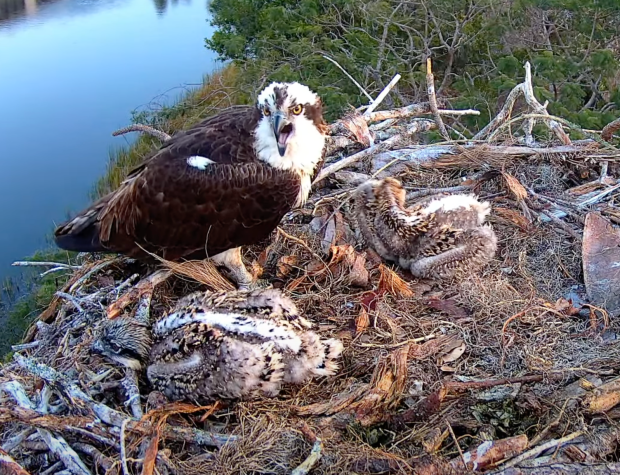
Several years ago I did extensive research on the cost to the environment of the mega-dams that were constructed in the north of my province beginning in 1969. I learned that the lakes, the water, and the land remain toxic from the mercury dredged up by the construction of the Churchill-Nelson project by Manitoba Hydro. Then I began to think about Hope at the Newfoundland Power Osprey nest. Newfoundland Power has also built mega dams. Is it possible that Hope suffers from neurological damage caused by methyl mercury toxicity in the water and fish? Surely we can all agree that the behaviour of this female Osprey is not seen often.

This is a short portion of a book chapter about ceramics that includes mention of my research in Manitoba:

In Manitoba, a Crown-owned public utility produces hydropower for domestic consumption and export. This hydroelectric energy originates with the waters of northern Manitoba.  It is then carried south to markets beyond provincial boundaries via a vast and intricate transmission network.  In the 1960s, the provincial and federal governments built generating stations, powerhouse structures, control dams, and transmission lines on the Churchill and Nelson Rivers and their diversions to produce the electricity we use and sell.  But what was the cost to the people who had lived on the land for generations?  
The damming of the rivers in Treaty 5 Territory caused flooding on an unparalleled scale to the homes, the traditional hunting grounds, and the burial sites of Indigenous people. Extensive documentation details the social ramifications of these actions.  Ramona Neckoway, a member of the Nisichawayasihk Cree nation impacted by the mega-dam states:
Manitoba Hydro’s vast and impressive network, including the labyrinth of transmission lines, affected and continue to impact entire generations of indigenous peoples in Manitoba. My grandparents’ generation, my parents’ generation, my generation, my children’s generation and their children’s generation, have borne witness to and experienced a kind of cultural genocide resulting from Hydro’s generation in Manitoba; these experience to varying degrees and severity are akin, in some ways, to the residential school era that devastated many Aboriginal communities, children, parents and grandparents.  


The impact of these mega-dam projects is not limited to the province of Manitoba.  In November 2019, people from around the world met in Winnipeg, Manitoba, for a conference organised by the Wa Ni Tan, a group trying to stop the building of mega-dams worldwide.  People came from as far away as Brazil and Panama to mobilise against these hydroelectric projects’ social and environmental damage.  Underlying their concern were the pronounced changes to their communities since the construction of the dams.  These include “significant social disorder, the abuse of drugs and alcohol, racial discrimination and the destruction of ancestral hunting, trapping, fishing, and gathering practices. “ The people used to drink the water from the river eat the fish they caught or the game they killed. Today, all of the animals, the fish, and the people have been poisoned by methyl mercury developed in the reservoirs upstream. The result of the mercury poisoning is that many indigenous people living near the mega-dams have had to abandon their fisheries and their traditional diets resulting in an elevated increase of diabetes amongst the population.  

Sadly, despite all of the harm done to the land, the people, nature, and all living creatures, it is also known that these hydro dams are incredibly inefficient.  The effectiveness even of the newest turbines is only around 60%, meaning that 40% of the primary energy is wasted. 

Can Ceramics Ever be a Sustainable Cultural Practice? University of Nantes, 2021.

I intend to research the situation at the Snow Lane nest further. Their nest is far from the Muskrat Falls plant discussed in the article below. I also hope to hear from wildlife specialists in the area I have written to in order to establish if my theory has any weight.

Everyone commented on how tranquil the nest of CJ7 and Blue 022 was at Poole Harbour this season. Well, guess what? They ringed the three osplets on Friday and believe the first two hatches are males and the third is a female. That is a great solution to the beaking that often comes when the female is the first hatch and the wee lad is the third. Well done, CJ7 and 022!

Gosh, I remember when I thought CJ7 might never find a mate and then that you man flew to the perch of her nest two years ago. They made history and continue to do so. So happy for this family.

The two surviving chicks were ringed at Llyn Brenig today as well – two girls. The first hatch is Blue 7B5 weighing 1775 grams, and the second is 7B6 weighing 1730 grams. Aren’t they gorgeous?

Just a quick run through some of the nests:

Alyth: The chicks are loud and getting bigger by the day.

Aran and Elen and their two sons are doing really well at Glaslyn. Elen proved to be a superb mother in her first year raising chicks! Great choice, Aran.

Idris delivered a double-header for the kids at the Dyfi nest that he shares with his mate, Telyn.

The Only Bob of Louis and Dorcha at Loch Arkaig is massive and it has these incredible ‘snake eyes’. Reminds me of Iris and Mrs G sometimes. The ringing should take place shortly and my bet is on a female! Or one of those males that simply breaks all records like Only Bob did at Clywedog a couple of years ago.

The ring number is LY7 but no release of gender yet.

Geemeff writes that the cam is down and the chick is being ringed! Here is some of its big wing flapping early on Saturday. Look at those wings!

There is an expected fledge today coming out of Loch of the Lowes. PF4 is really getting some height to that hovering!

The Only Bob at the Cowlitz PUD appears to be doing well.

Equally everything appears fine at Collins Marsh.

Everyone is preening at Oyster Bay. The nest is good.

The trio at the Pitkin County Open Trails Osprey Nest in Colorado are doing well. Mum was busy shading them from the heat on Friday.

The MNSA Jay Koolpix ospreys in Oceanside, NY are doing great, too.

Things appear to be going smoothly at the Minnesota Landscape Arboretum nest. There is a bit more nesting material and a few more sticks and the wee one is able to eat larger pieces of fish that Mum is feeding. Feeling hopeful.

This new Mum is learning and if the winds would cooperate and not take off all their efforts in getting material to the nest, this could become a very comfy place to brood this chick.

A quick check on the two remaining osplets at the Bridges Golf Osprey platform seem to indicate that this nest is doing alright. Fingers crossed for this family.

Is there is a potential problem brewing at nest #4 in Finland? The first hatch is not allowing the third hatch up to get fish. The third hatch is looking very thin. It has been raining but ‘T’ confirms that the third hatch got some fish. Hoping that this is just a one off.

There is also a potential problem unfolding at the FortisExshaw nest near Canmore, Alberta. Jasper has not been seen for nearly 24 hours. ‘H’ reported Big beaking Little and keeping it from eating. This is the last fish that Jasper delivered around 0930 on Friday. ‘H’ reports that

Feeding 0559 to 0608 –  Louise blocked the view again, lol.  I think Little may have been fed a couple of bites, but at 0601, Little tried to ‘exit stage left’, and s/he ran out of real estate in the nest cup. I believe Little had most likely been bonked.  0924 to 0958 – Ah, a different set-up. . Mom in the centre, Middle and Little on one side, Big on the other side.  Louise fed to her right, exclusively feeding Middle and Little.  Big kept peeking around the corner “hey, what about me?”  Eventually, Big figured it out and moved to the right side of Mom.  The two big kids squeezed Little against the cup wall and at 0934 Little backed out, and moved away.  At 0942 Little tried to return to the feeding, but was beaked by Big.  Big quit the feeding at 0951, and Middle quit shortly thereafter.  At that point Little received a long private feeding.  Little ate at least 81 bites.There were no other fish deliveries on 7/7.”

‘H’s other reports. Thank you:

Severna Park – “Chick #1 may be a large gal, and has yet to fledge at 60 days old.  I wonder if the slightly smaller chick #2 (59 days old) will fledge first.

Kent Island – Tom is such a great provider.  He delivered at least 5 big fish for his family, there may have been an early delivery that I missed, but the lighting was such that it was very difficult to view the nest in the morning.  Tom and Audrey’s chick is 26 days old.

Forsythe – Well, thank heavens, Opal must have shown Oscar where she catches those huge fish!  Opal brought in a big one, and Oscar delivered four very large fish.  The kids are 47 and 46 days old.

Barnegat Light – Other than Daisy being dive bombed by the Red-winged Blackbird, life is good on the bay for Duke, Daisy, and their 38 day old youngster.

Boathouse – Dory and Skiff continue to dote over their cherished offspring.  Little Skipper is 28 days old.

Dahlgren – At 51 and 47 days old, Harriet and Jack’s kids are growing up fast.  They were both taking advantage of a breezy day and working those wings.  And, one of them managed to get quite a bit of lift!

Osoyoos – Soo and Olsen’s 11 and 12 day old kids are simply thriving!

Patuxent Nest 1 – ‘Foster’ decided to take a quick spin around the marsh for her second flight from the nest.  She landed on the nearby perch, just as pretty as you please!

Until the magistrates impose proper fines and penalties, the estates will continue to get away with murder.

The Hobby Falcons are busy feeding their chicks! This family is seriously adorable. Highly recommend you check out the streaming cam on YouTube: Dorset Hobby Falcons.

Before I get on my soap box about people shooting Red Listed birds, there is sad news coming out of Kielder Forest this morning. A chick has been predated. This is nest 5A home to Mr and Mrs UV.

UK Raptor Persecution has released the following information about the recent confirmed shooting of at least two red kites (with a third one suspected) near Westerdale in the North York Moors National Park (see here). The North York Moors Park Authority has issued the following statement:

I am absolutely outraged, along with you in the UK and elsewhere, that the legal system is punishing those responsible in a manner that is fitting and proper…meaning high fines, loss of licenses, custodial sentences. Is that what it takes to stop people having fun shooting birds? The real other enemy is that it is the ultra-wealthy who are doing the shooting. They have ‘friends in high places’. Indeed, some of them are the ‘friends in a high place.’

Murphy’s Eaglet was released today. Here are some images and the press release from World Bird Sanctuary.

Plastic. BirdLife International research is showing the extent to which this deplorable material that we cannot seem to get out of our daily lives is destroying the oceans and harming wildlife. The project has identified the most vulnerable sites and maybe there is something we can do to help.

Always gives us a smile – Annie and Lou – who are enjoying their time without the constant challenge of caring for eyases.

Last but never least, Little Mini. Mini had a nice breakfast this morning and it appears that the larger of the two are more interested in being on the perch!

Thank you so much for being with me today. Have a lovely Saturday! See you soon.

Thank you to the following for their notes, posts, videos, and streaming cams that helped me to write my blog today: ‘A, Geemeff, H, T’, Google Maps, Poole Harbour Ospreys, Llyn Brenig Ospreys, Alyth Ospreys, Bywyd Gwylld Glaslyn, Dyfi Osprey Project, Friends of Loch Arkaig and The Woodland Trust, Geemeff and Friends of Loch Arkaig and The Woodland Trust, Friends of Loch of the Lowes and Scottish Wildlife Trust, Cowlitz PUD, Collins Marsh, PSEG, Pitkin County Open Trails, MNSA Jay Koolpix Osprey Cam, MN Landscape Arboretum, Bridges Golf Club Ospreys, Finnish Osprey Foundation, Jackie Morris and Friends of Dyfi osprey Project, Dorset Hobby Falcons, Fortis Exshaw, Severna Park, Kent Island Ospreys, Forsythe Ospreys, Conserve Wildlife of NJ, Dahlgren Ospreys, Boathouse Ospreys, Osoyoos, Patuxent River Park 1, Kielder Forest, UK Raptor Persecution, World Bird Sanctuary, BirdLife International and SK Hideaways and Cal Falcons, and PSEG.

E22 knocked off by GHO, Mother Goose Knocked off nest…Saturday in Bird World

1 April 2022

Good Morning Everyone!

Remember when I said everything was going to start happening at once? Well, that day is today. I can hardly log in a UK Osprey arrival, and there is another one. The winds must have been perfect. E21 took his second flight with 22 waiting on the branch. Missy and Lewis were certainly counting on 22 going first until that GHO caused 21 to fledge and then fly. Eaglets in nests appear to be doing well.

Missy and Lewis were very busy on Friday helping with the bathroom renovations. Then, just about the time they were tired, a new little scratch post and toy arrived for them. They had a full day. I hope they sleep through the night!

The bonus is they used it as a scratching post, too. Chasing the furry balls around was a big hit! And they didn’t go under the cabinets. Yahoo.

It was a bit of a sad day, also, as I was writing the Saturday newsletter Friday afternoon. It was a year ago today that we lost Grinnell, Annie’s long-time mate at The Campanile, on the grounds of the University of California at Berkeley.

Arlene Beech caught the intrusion at Mother Goose’s nest. 2023 feels like it is the ‘Year of the Intruder’.

Tandem feedings for H19 and H20 at Pittsburgh-Hayes in the damp cool weather.

Blue 22 might have some misgivings about that unringed female on the Poole Harbour nest. They were all cosied up and his mate, CJ7 arrived today. Blue 22 brought in a fish and the unringed female took it. Will she stay away?

CJ7 on her arrival.

CJ7 and the unringed female fish calling together at Blue 22. The unringed female got the fish. I wonder what CJ7 is saying to Blue 22 today?

The resident male at Lyn Brenig, LJ2, has returned from his migration safely back to Wales.

Meanwhile, at Manton Bay Rutland, Maya checks the rails and inspects the egg cup.

She is drop-dead gorgeous.

Blue 33 did an incredible job getting that nest together for her.

Telyn and Idris continue to get reacquainted. Gosh, I am so happy to see them. I am a great fan of Idris. Apologies beforehand. You will get sick of me singing his praises before the end of the season.

Telyn is tired.

Idris ‘Daddy Long Legs’ enjoying a nice fish.

LM6 has returned to Llyn Brenig so both resident Ospreys are home (she lost her ring last year). Nice. She arrived this morning.

E21 took his second flight. 22 looks so lonely in the nest. He will fly soon!

E22 waiting for a prey drop and for its big sib to return to the nest.

E22 spent the night on the nest tree alone. Where is 21? Has anyone seen him since he flew off today? I hope he is at another tree on the property being fed by M15, but if he has not been seen, this is worrisome. Remember Superbeaks. They are a good example this year. The fledglings need to return to the nest.

It was no a peaceful night, E22 got hit twice by the GHO and like his older sibling was knocked from the nest tree. ‘A’ sent the news: ‘E22, spending his first night alone in the attic, was knocked off his perch around 1.14am by a GHO. He was knocked off the branch and fell to the basement, just below the nest. A second strike by the GHO knocked him lower down the tree. I presume that from this position, he will have no choice but to fly away from the tree if he is to attempt a return to the nest, just as E21 did yesterday.’

Lady Hawk got it on video.

 Our Bitty is OK. He is in the tree. Thanks Nancy M Lockwood! M15 has brought a fish Saturday morning and neither eaglet arrived at the nest to eat it. He is trying to get them to come home so he can feed them in the nest. Fingers crossed.

This is why GHOs are not on my most-liked list. There is no reason other than territory that they should be attacking M15 and his eaglets.

The triplets at PA Farm Country seem to be doing awesome.

We were all saddened when Liberty and Guardian’s only egg of the 2023 season did not hatch on the expected date and, instead, exploded. Here is a great explanation about why that might have happened.

Nancy is hanging in there. There is an intense blizzard at the MN-DNR nest and she has her 5 day old eaglet under her. Send her your best and most positive wishes.

The monofilament line has not proven to be a problem in the last few days. All is well at the Moorings Park Osprey nest of Sally, Harry, Abby and Victor. Those are beautiful babies. Just look at those feathers.

Worcester Peregrine Falcons now have four eggs.

There is some good news coming out of the London Zoo today. Congratulations.

Maybe, just maybe the police and other authorities will persecute as they should! Raptor Persecution UK is reporting an arrest has been made in the deliberate shooting of five goshawks.

When the authorities start doing the right thing many people will be arrested for their crimes against raptors. Here is another!

From Raptor Persecution UK: “Police Scotland have arrested a 56-year old man as part of their investigation into the shooting of a red kite on a grouse moor on Lochindorb Estate earlier this week.

A rough estimation of Lochindorb Estate boundary at the edge of the Cairngorms National Park

It’s hard to keep up with all the raptor persecution news this week, but this is the red kite that members of the public witnessed being shot on the grouse moor on Monday 27th March 2023 at around 11.15am. The Scottish SPCA attended the scene along with Police Scotland but unfortunately the kite’s injuries were so devastating that the bird had to be euthanised (see here).

Police Scotland issued a very fast appeal for information on Tuesday, saying they were particularly interested in finding witnesses who might have seen quad bikes or off-road vehicles in the area on Monday morning.

Yesterday afternoon (Friday 31st March 2023) Police Scotland issued the following short statement:

Arrest after bird of prey shot near Grantown-on-Spey

A 56-year-old man has been arrested and released pending further investigation after a bird of prey was shot near Grantown-on-Spey.

Officers received a report of a bird being shot around 11.15am on Monday, 27 March, 2023, at the Lochindorb Estate.

I hope that these arrests and the heaviest fines and sentences will begin to deter this despicable behaviour.

My friend, Claudio, has been asking me about the storm in the Mississippi area. Sadly, numerous trees are downed in the area of the FlyWay. This is one fatality confirmed in terms of an Eagle’s nest. So very sad for them. There will be others. This was a massive storm system.

Karl II and Kaia, the Black Storks from the Karula National Forest, are gradually heading north. Kaia is in Turkey and Karl II is in Moldova north of Chisinau. Waba remains in Sudan.

Karl II is feeding at these ponds.

Looking for a book that will teach children about the wonders of wildlife rehabilitation. Christie Gove-Berg has a beautifully illustrated one about a young peregrine falcon injured when the wind forced her into a building. Suitable for children ages 4-12.

Thank you for being with us today. We hope everyone is having a good start to their weekend. Take care. See you soon!

Thank you to the following for their notes, tweets, videos, posts, websites, and streaming cams that helped to make up my blog today: ‘A’, ‘H’, ‘Claudio’ Cal Falcons, Arlene Beech and the Goose Cam, PIX, Poole Harbour Ospreys, Llyn Brenig, LRWT, Dyfi Ospreys, HeidiMc and SW Florida Eagle Cam and D Pritchett, SW Florida Eagle Cam and D Pritchett, Lady Hawk and SW Florida and D Pritchett, PA Farm Country, FORE, MN-DNR, Peregrine Falcons in Worcester, London Evening Standard, Raptor Persecution UK, the Stewards of the Upper Mississippi River Refuge, Looduskalender Forum, Amazon and Christie Gove-Berg.

E22 branches, DG3 out of the nest for 5 hours, 3rd hatch at Achieva…Wednesday in Bird World

22 March 2022

Good Morning Everyone,

It was simply a gorgeous day in the Canadian Prairies. The temperature worked up to -1; there was a cloudy sky and little wind. It was a perfect day for a walk at the nature centre until….DG3 decided to go walkies in the nest and found itself over by the rim! Needless to say…I didn’t go out but, stayed home, baked cookies, read your lovely letters, and enjoyed the kittens.

We have been shifting furniture. A bit of spring cleaning. Not sure the dried hydrangeas will survive. When the kittens first arrived, they enjoyed tearing them apart and eating the pinecones I had collected on my walks. In the winter, I smear suet over them and put them in the lilac bushes. Let’s see if these hydrangeas last! Not counting on it.

Missy and Lewis used to fit together on top of their climbing tree. No longer.

Dyson was here today eating peanuts. So lovely to see her and the three babies from last year. Little Red was running on the hydro wires on the lane and the lilacs were filled with birds, including Mr and Mrs Woodpecker. Life is good. Each survived the winter including Little Red who had to find another home after the garden shed was torn down to make way for the conservatory.

The woodpeckers love the logs with the drilled holes filled with suet.


Michael St John and I continue to track Blue KW0 and its adventures getting to Barbados from Scotland. Hopefully, Tim at the Roy Dennis Foundation will discover the owner of that mysterious band and where and when this lovely osprey was ringed in Scotland. This morning Geemeff sent me a really good article on birds – all manner of birds – hitching rides on the big ships. Geemeff asks an important question: do they land on the boats out of choice or necessity?

Jackie and Shadow have far worse weather than I do. Glad Jackie isn’t buried under that snow. They continue to visit the nest and are seen mating on the tree.

The wind could not have been more perfect at the Southwest, Florida Eagle nest of M15 and the Es. E21 was on the rim of the nest, letting the breeze blow against its wings. E E22 was in the nest. Then E22 began to flap his enormous wings, and at 17:04:34, he branched. It was magnificent. E22 was 73 days old on Tuesday.

After making it to the spike, E22 explored other branches higher up. Our brave little one. Yahoo….22.

Poor 22 had another first yesterday. It got hit by the GHO while it was sitting on the rim of the nest. Thankfully 22 went into the nest and not over the side! Thanks, Heidi!

All three eggs have now hatched at Achieva Osprey in St Petersburg, Florida. The third was Tuesday, the 21 March around 10:00. The hatch dates for the three are March 18, 19, and 21 so there is only three days difference between one and three. Not bad. Jack and Diane will be particularly busy. Fingers crossed.

Moorings Park Osprey platform. Just look at Victor’s ‘ps’. Looks healthy! And he has a fat little bottom—time 0739, 21 March.

A considerable fish came to the nest at 10:48. It had its head and Sally worked away trying to get the flesh from the bones.

That time Sally took allowed Abby to get herself into a right state.

Victor and Abby are 19 days old today. You can still tell them apart by their heads but Abby is now bigger.

Abby remains aggressive. She demands to eat first. Victor, of course, doesn’t like it.

Victor goes into submission. Good lad. There is lots of fish left. Either Victor needs to wait or he needs to carefully move around to the other side of Sally.

You can see how Ally is working away at the head of that fish.

Victor is very hot. He has moved around the rim but Abby is keeping him at the side. Come on Abby! There is fish left and you have had lots.

Victor got up in the shade and Abby followed him.

At 12:02, Abby is in food coma. Victor is up in the shade of Sally and there is fish left. Come on Victor! Come on Sally. Now is the perfect chance.

Harry’s eyes remind me of Blue 33.

To the relief of all, Victor is eating!

Victor got some fish and Sally finished the tail at 12:34. That means that she fed Abby, Victor, and herself from 10:48-12:34. Remarkable.

Thank you, Sally, for shading the babies!

Of course, Victor does not know when to leave a good thing alone. He went on a ferocious attack on Abby. Victor, everything is fine. Leave Abby be! No revenge is necessary.

In Virginia, Martin and Rosa continue to do well with the three eaglets at Dulles-Greenaway.

I do not know about the weather but these little ones cannot regulate their temperature yet and the oldest has gotten out of the egg cup and over to the rim of the nest. It needs to get back! This happened around 11:00 on Tuesday.

The chick is still moving at 12:37.

The oldest was out of the nest cup for over 5 hours. At one point, Rosa went over to encourage it to get closer to the egg cup. It must be extremely hungry, and I hope it has not gotten a chill. And then, a miracle happened. All three are in the nest! Tears.

The female eagles are at a loss as to when this happens. Most will not help because they could harm the little one. You might remember that one of the Es got out of the nest cup this year, and Harriet did use her beak to roll it back under. That was a brilliant solution.

I cannot see DG3’s head in this image.

Then a few minutes later it is there and seemingly tired.

Now all three are back in the cup. Thank goodness.

DG3 feeling better a few hours later.

At 17:04, the trio were enjoying a meal.

I continue to have mixed feelings about Rose. Thankfully Ron is feeding the eaglets! Rose flew off early on Tuesday morning and Ron flew in and fed the little ones.

Rose returns and does a feeding. Did she bring the fish?

She’s gone again. Ron is looking after the little ones. No worries. Ron is really rather amazing and is having a wonderful time looking after his babies while Rose eases herself into motherhood.

‘H’ has sent me a note. Apparently Rose has done an amazing feeding of the eaglets. She is being patient and offering small pieces. It was 16:16. Thanks, ‘H’. I do hope that Rose gains more confidence. ‘H’ says there was no beaking and both left the meal with nice little crops that you can see in the image below.

Bravo, Rose!

The two eaglets at Duke Farms are older than those at Dulles-Greenway and WRDC. They hatched on the 27-28th of February and are 23 and 24 days old. Their thermal down is coming in and Mum and Dad do not brood them all day long.

They also have enormous crops. It is a wonder they can sit! or move.

The Latvian White-tail Eagles, Milda and Voldis, continue to incubate their eggs. Gosh, these are beautiful eagles.

Arthur and Big Red continue to work on their nest. It seems that Arthur is very much aware of the construction across Tower Road. Let us all hope that this does not cause issues for this Red-tail Hawk couple on the Cornell campus this year.

Meanwhile in Mlade-Buky, The Czech Republic, everyone is awaiting the return of White Storks, Bukachek and Betty.

Checking on Karl II and his family. Waba continues to forage in Sudan. There was a hiccup on the tracker, but it shows that Kaia is on the move north from Chad. Precisely where is unknown. Everyone feels that Karl II should be arriving in Estonia at any time but there is no tracking news. We wait.

How long does a Bald Eagle live when it is cared for? fed? Mrs B was at least 49 years old when she passed. Wow.

Flaco, the escaped Eurasian Owl from the New York City Zoo, thrives in Central Park. Check out the latest on Falco and other NYC urban hawks with Robert at urbanhawks.com

In Canada, especially in some of the most beautiful parts of our country, the developers are taking over land traditionally supporting Bald Eagles. Dave Hancock and his foundation are working diligently to replace nests in trees lost to developments, including parking lots! I have mentioned it before, but it is worth pointing out again in case you missed it, Dave is including a sunscreen because of the rising summer temperature in the lower mainland of British Columbia.

The geese are taking over some unused Bald Eagle nests in Iowa. This one in Decorah had goslings jumping last year to our delight. Now there are eggs again this year! Bravo.

Red Tide has come to the coast of the Barrier Islands in Florida. So what is Red Tide? NOAA says, “Harmful algal blooms, or HABs, occur when colonies of algae—plant-like organisms that live in the sea and freshwater—grow out of control while producing toxic or harmful effects on people, fish, shellfish, marine mammals, and birds. While many people call these blooms ‘red tides,’ scientists prefer the term harmful algal bloom. One of the best known HABs in the nation occurs nearly every summer along Florida’s Gulf Coast. This bloom, like many HABs, is caused by microscopic algae that produce toxins that kill fish and make shellfish dangerous to eat. The toxins may also make the surrounding air difficult to breathe. As the name suggests, the bloom of algae often turns the water red.” In fact, not all of the waters are red but, this can be very deadly as you can see form the Plover below in the care of CROW.

How will this impact our eagles and Ospreys?

If you are watching the Loch of the Lowes nest and are confused because you cannot see the Blue Darvic ring for Blue NC0, it appears it has split and come off. I cannot emphasise how important these rings are in identifying the birds. The recent mystery surrounding Blue KW0 would not even exist without that ring!

Maya and Blue 33 continue to reacquaint themselves after their return to Rutland after their winter migration.

The Scottish Government is trying to come to grips with the illegal killing of the raptors because of the grouse-hunting community. They have now implemented a grouse shooting licensing bill. It is a first step. Still, the legal system must deal with those who defy the laws allowing gamekeepers to get off with little or no penalties for horrible crimes against these amazing birds, such as stomping on five Goshawk chicks in the nest!

I want also to introduce you to a lovely Ukrainian tradition today. One of my former students from Acadia University in Nova Scotia, CD, teaches at a university in northern Manitoba. She posted that March 22 is the Day of the Forty Martyrs. Her baba (grandmother) would make bread (pasta) covered with little dough birds. Of course, I saw the post and thought how interesting. Here is the story from the Ukrainian Cultural Centre:

The importance of this day, which comes immediately after the spring equinox, pre-dates Christianity in Ukraine. According to folklorist Olexa Woropay, on this day the magpie puts forty twigs in its nest and forty larks migrate from south to north. Bird-shaped buns called zhaivoronky were baked – forty of them, of course – and were given to children so that the poultry breed well. Some traditions report the children playing with the forty bird-shaped buns, tossing them into the air to invite all the birds to return from their winter migrations.

What a marvellous tradition! Guess who is baking paska today?

Thank you so much for being with me today. Please take care all. Remember to get outside, even for a few minutes if you can! See you soon.

Thank you to the following for their notes, posts, tweets, announcements, videos, and streaming cams that helped to make up my blog today: Geemeff, ‘H’, ‘CD’, Hakai Magazine, FOBBV, SW Florida Eagle Cam and D Pritchett, Heidi Mc and SW Florida Eagle Cam, Achieva Credit Union, Moorings Park Ospreys, Dulles-Greenaway, WRDC, Duke Farms, Latvian Fund for Nature, Cornell RTH, Blade Buky, Bald Eagle Live Nest Cams and News, Urban Hawks, Hancock Wildlife, L Rose and Decorah Eagles Love Nest, Diane Lambertson Captiva Island Eagles and Ospreys, LOTL, LRWT, Raptor Persecution UK, and the Ukrainian Cultural Centre.

A hatch for Connie and Clive…Tuesday in Bird World

10 January 2022

Good Morning,

Lots of eagle parents busy feeding eaglets – from those a month old at Superbeaks to newly hatched. It is ‘egg citing’.

Making News: Hopefully all manner of organisations and individuals will keep a very focused light on the gaming estates in the UK. Will the judiciary finally give sentences to gamekeepers that are appropriate for all the laws that they have broken? Will they give sentences and fines long and large enough to deter this horrific behaviour. Sue Belcher wrote a poem about snares. Read it. If you don’t live in the UK but love our raptors and other wildlife, it will help you to understand what the fight is about. I am happy to spread the word on the plight of wildlife caught in these medieval devices. Thank you Sue!

Checking on some of the nests we are watching:

At 11;22, Connie and Clive have their first hatch at the Captiva Bald Eagle cam. It is to be really celebrated. Connie and Joe lost their two beautiful hatches, Peace and Love, to rodenticide secondary poisoning in 2020. No eggs in 2021. Then Hurricane Ian came and tore down Connie and her new mate’s nest, Joe. Congratulations Captiva!

Jackie often lays her eggs in March. Generally egg laying is timed to the availability of prey items. Despite that historic fact, Shadow and Jackie have been mating on the nest today and Jackie continues to check out the nest bowl. Will we have eggs early at Big Bear Valley?

It started off as another f/soggy day at the Kisatchie Forest nest of Alex and Andria. ‘A’ was the first to alert me to the fact that the weather is often very different on one side of the lake from the other. Andria dig a really good job keeping those feisty little eaglets with their clown feet underneath her so they would stay warm and dry. No thermal down yet so this is important. It is coming!

More chair rails, Alex!!!

E3-02 was so full that he could hardly get himself up and over to the dining table for the next meal.

As the sun set Monday night in Alexandria, Louisiana, two very full eaglets tucked in tight under Mum sleeping. Beautiful.

Eaglet E1-03 is a cutie pie! Louis is filling the nest with Coot and fish already. Anna has changed so much since her first hatch, Kisatchie. He didn’t know what to do and Anna didn’t know how to feed an eaglet. Of course, they got it together but, we sat at the edge of our seats. Now Anna is experienced and this little one is simply a cutie who loves its fish and Coot. Look at those precious wings.

Oh, such a chubby little baby. Cute. So cute.

If you have not watched the nest of Louis and Anna, it is a good one to have on your list. Here is the link:

This is the status of the pip for Connie and Clive at 17:41 Monday evening.

Both Gabby and V3 were in the nest at 06:51 Monday morning.

V3 was last seen at the tree at 1531. There had been an adult eagle land on the nest tree with an injured eye and talons but it would not have been V3.

At 18:05, Gabby waits on Wallenda. She is still tucked on Wallenda and waiting for V3at midnight.

At Superbeaks, Pearl appears to be doing some self-feeding.

And, oh, goodness. Every eaglet or osplet should know that you NEVER look your sibling directly in the eye. It is definitely not a good idea.

Big PS before bed.

At the nest of Harriet and M15, the two eaglets, E21 and E22, are doing grand. E21 is 6 days old today and E22 is 3.5 days old. That is actually a big difference. Both are eating well and Harriet is feeding them as much as each needs. E22 does not need as much food as E21 – so don’t panic and count the bites and worry if they are not equal! It is all good in Fort Myers on the Pritchett property.

Harriet gave E22 a private feeding while 21 slept – Harriet is experienced and smart! Lady Hawk put it on video for us.

Martin and Rosa have been doing restorations at the Dulles-Greenway Eagle Cam in W Virginia on Monday. Oh, those talons make me ache. Send some very soothing hand cream to the nest, please!

Indigo had a very interesting day. Check out Elain’s video:

So what is up with Annie and the ‘new guy’? I am not sure. He was till working on his prey deliveries the other day.

Book Review: Loon Lessons. Uncommon Encounters with the Great Northern Diver by James D Paruk (2021, University of Minnesota Press).

Loons. Who doesn’t love a loon? Anyone spending time in the forest and lake areas of Canada or Minnesota – or other places – has memories of their calls -the tremolo, yodel, or wail. I have tried hard to ‘see’ them because I have listened to those calls for years but, did not get sight of the diving waterfowl. I finally did. I will not tell you that I love loons more than big bad raptors – I don’t. But they are iconic for the province that I live in and I want to know more about them so I can appreciate their life, its blessings, and challenges more. This book really helped me on all accounts. The book is full of 30 years of experience by today’s leading expert on loons.

As a former academic, ‘scholarly’ articles can be a bit dry and daunting especially if they are in any of the fields of science (sorry). What I noticed immediately was that Paruk’s friendly and accessible writing style immediately drew me in. What a wonderful way to open a preface by saying, “To appreciate any organism, I am convinced we do not need years of training – all we need to do is watch our children marvel at a deer or a squirrel from a window. A sense of wonder and our innate curiosity can lay the foundation for developing and maintaining an appreciation for the natural world.” Excellent. The volume is divided into 12 chapters moving from biology, courtship and nesting behaviour, migration, conservation threats, and how loons are adapting to a changing world. The book is printed in black and white and at first you might ask, “where are the photographs of this magnificent bird with its black and white plumage”? You will find those images in the middle of the book – and I learned, looking through those images – that some loons have other coloured plumage such as the Red necked Loon!

Besides behaviour, one of the things that I was most interested in reading first were the challenges that loons face and what is being done to help them. You may have seen the artificial floating nests with avian guards (a bit of a camouflage cover over the top) on some loon streaming cams. These help the loons protect their nests and keep them safe from predators. The floating nests also keep the eggs out of harms way in times of flooding. It was very clear to me that the Bald Eagles who nest on the shore near Hecla Island and whose nests were destroyed by the 2022 flood might benefit from some floating platforms of some sort. There are other ways that we can help.

The threats to the loon sound like a broken record for all birds including raptors – mercury affects the central nervous system and it is present at very high levels in many of the ponds and lakes in the northern part of my province. As a natural occurring material, it was released into the water when the land was dredged for the many hydro-electric dams. Lead. Oh, what a culprit lead is – and please tell me why, knowing what it does to all birds and wildlife – has it not been banned? I clearly believe that humans that have the power to stop painful deaths or long term rehabilitation must wear bloody blinders. It is making me angry and I wonder how they would feel dying of lead poisoning? On page 173, Paruk states, “In recent decades, the EPA and USFWS failed to pass further measures to reduce the use of lead in hunting and fishing gear despite mounting evidence of its toxicity in the environment”. He continues by adding that six states took it upon themselves to pass legislation curtailing the use of certain levels of lead in fishing equipment. Those states are New Hampshire (sinkers 1 ounce or less), Massachusetts (lead sinkers on two reservoirs loons use for breeding), Maine, New York, Vermont banned “the sale of lead sinkers of one-half ounce or less and restarted their use as well.” Washington State banned the use of lead tackle on 12 of the 13 lakes used for breeding by loons. Since 2010, no additional state has done anything to ban lead ——–that was 13 years ago. It is time our American friends reading this blog get busy lobbying for the end of lead – the end of it period. Not just certain amounts. All lead. Paruk states, “I am left wondering how many more eagles, loons, condors, cranes, and swans have to die before a change in policy is warranted. The EPA was designed to protect the health of humans and the environment…acknowledges that lead is toxic to wildlife but not enough to warrant a national ban of lead tackle. Despite the mounting evidence that ingested fishing tackle leads to numerous wildlife deaths, the EPA refuses to recognise that there is a serious problem nationally. Because the federal government has failed to act on banning lead tackle, the responsibility shifts to state governments to take action” (174-75). If you want to do something to help the wildlife in the US, then US citizens reading my blog should carefully craft a letter to their state environmental officials copying them to the EPS and the USFWS demanding action now. Mercury and lead but there are also serious environmental threats to loons and other wildlife – including oil and its spillage such as The Deep Water Horizon in the Gulf. The other day I posted a copy of a Tweet indicating that licenses to drill for oil and natural gas off the coast of Alaska – pristine waters – were being accepted and had one application. Are they serious? Of course, monofilament fishing line is a source of painful injury or death. Other polluted waters, habitat loss, etc. The list is endless.

It is a really good read. You can learn so much just about loons, their behaviour and their migration but you can also get in deep with the challenges they face and how these might be rectified. Price in Canadian dollars: $34.95.

(Disclosure: I do not receive free books to review. If I see a new book that interests me, I buy it and am very happy to spread the word on those that will educate us, cause us to be curious, raise our awareness.)

Thank you so much for being with me today. Please take care. Looking forward to seeing you soon!

Thank you to the following for their notes, tweets, posts, announcements, videos, and streaming cams that make up my screen captures: @Belcherspoems, Window to Wildlife, FOBBV, KNF-1, KNF-3, Window to Wildlife, NEFL-AEF, Superbeaks, Lady Hawk and SWFL Bald Eagles and D Pritchett, Dulles-Greenway Bald Eagle Cam, Elain and Charles Sturt Falcon Cam and Cilla Kinross, Cal Falcons, and Amazon.