I want to wish all my readers who are celebrating Rosh Hashanah starting tomorrow a very happy New Year’s celebration.
It was hot for September. 27 C today with a gentle breeze now and again. The children are all back to school as of Tuesday, the day after Labour Day. The Blue Jays are currently enjoying a late-day feed on peanuts. I can see Junior at the big table feeder right now, with a grey cat walking around the lilacs. Toby will take care of that. He always allowed Brock once he was trained, but he gets rid of the others. I am always afraid they will attack the birds – all are well-fed pets!!!!!!!
Toby and I were home today. Ann was at the hospital, and Don continues with physiotherapy and occupational therapy. It is a long road ahead before he’s strong enough to come home. I am going up tomorrow and Toby is going to the groomer. Poor little guy. He loves to run outside but he gets burrs in his lovely long feathering. He likes his baths and his feet soaks but he really is due for a clipping.
We lucked out today. One of our neighbours gave us some lemon cucumbers and there is a beautiful bouquet from Oak Knoll Farms. Both put a smile on my face. Have you ever tried a lemon cucumber? If not, you are really missing something delicious.
Oh, we know that the world has turned upside down in terms of raptors when we get to hear from our friend ‘A’ who writes to us out of Melbourne. This news sadly found its way to the Junk Mail folder and I only found it today. We will be looking for more lively commentary as the season progresses.
“The top news is that dad arrived on the ledge at the Collins Street scrape, looking perfectly healthy, just before 6pm Melbourne time (8 September). This is of course a huge relief to everybody.
Not sure whether you caught this piece of news but our albatross chick is on his way to Chile. He was a strong healthy lad and should have a good chance and we wish him godspeed and lots of fish.
Of course, being me, I’ve spent a lot of time watching the Olympic Park nest and counting the bites SE38 is getting. As if I wouldn’t be! SE37 really is a Zoe. I can handle a bit of sibling rivalry, but this is so vicious and occurs even when SE37 can barely reach over her crop to attack her younger brother. Lady is the only reason the little one is still alive.She has been wonderful, taking so much time and effort to try and feed her younger hatch. He is terrified of SE37, and it is sad to watch him cowering as Lady tries to coax him to lift his head and eat.
He has learnt to creep up the nest to mum, where he sometimes arrives in time for some bites but often does not. He has had a few good days followed by two or three bad days and I’m wondering whether things will improve or get worse as SE37 gets more and more gigantic. It really is hard to watch. I find myself skimming over the footage and studying the feedings but it’s a depressing watch most days.
Gimbir is absolutely adorable and is making a wonderful dad in this, his second season. He is devoted to Diamond and very keen to participate in all things paternal, which is so cute.”
Correct me if I am wrong, but I don’t believe Diamond has ever fledged three chicks. This could be a first.
Iris is still at Hellgate Canyon. There is even an Iris coffee shop now run by the students. According to Dr Greene, Iris flew by the window along the river during the opening!
Lucille Powell caught Iris:
Teifi, mate to Elen at Glaslyn, is still home as is Dinas in the Glaslyn Valley.
Jeff Kear carried the latest Dyfi migration report. Note that Idris remains enjoying his fish dinners to himself. No doubt these males get tired and out of shape, just like the females, and need some ‘me time’.
So grateful to Suzanne Arnold Horning for keeping up with the Ps, where at least one is still on the Cornell Campus with Big Red and Arthur.
We still have ospreys in Manitoba. Why would they leave – the water is still open and there are plenty of fish in Lake Winnipeg and various other ponds around the City of Winnipeg – some people even stock places with fish for them!
Hearings are currently underway about the lack of Menhaden. As you know, I am a Canadian, and I am not happy that it is a Canadian company (or any other international company, even one from the US) sucking Menhaden out of the Bay. Let’s hope people finally stand up for wildlife and shut down industrial trawler-based fishing! Save the Ospreys.
This isn’t nice.
Our local wildlife rehabilitation centre has been busy.
A great turn out to Jackie’s Memorial:
Take care, everyone. We will see you again soon!
Thank you to everyone who contributed images and information on FB – and a big shout out to ‘A’ from Melbourne. Lovely to have your commentary back. We, of course, are grateful to the owners of the streaming cams that allow us to watch these bird families!
Latest Update from Cornell: “The final Red-tailed Hawk egg began to show signs of hatching early on the morning on May 7 on day 36 of incubation. Watching closely, movement can be seen from the “pip,” or small hole in the egg, throughout the video. The hatching process can take 12–24 hours to complete, or longer in some cases.”
There is a rescue underway at Dale Hollow Eagle nest (see below).
I have to say that I have never been a ‘Hallmark Person’ – someone who sends cards and celebrates special days just because some company came up with an idea for making more and more money from us. This especially goes to Mother’s and Father’s Days because so many were raised by their Grandmothers who really were their Mums (like me, so mine could work), others had parents who died or abandoned them…sometimes when a day is happy for someone, it is a total sadness day for someone else.
That said, this year we are really going to give a shout out to the most incredible raptor Mum that I have seen in years. If I could send her a bouquet of fish and a card with fish that popped up, I would. They are all heroes who have overcome more challenges than we witness, but this year, a few stand out, and one, in particular.
The top Raptor Mum Award has to go to Jill at the Achieva Osprey Platform. I would love to know if anyone has witnessed a female leave their babies at such a young age when she realised that the little one was doing to die if more fish didn’t get on the nest.
So, let’s look back for a minute. Big hatched on 27 March, with Little following five days later, on 2 April. Yes, look at that spread. There were three eggs – Heidi and I have decided that Big was egg 1 and Little was egg 3.
The first time that Jill left the nest to catch a catfish was on the 15th of April. At the beginning, she only left the chicks around 1700-1800. She would leave and return in 25-30 minutes with a large catfish. As Jack’s deliveries diminished and the chicks’ need for more fish grew, Jill began going out twice a day. She would often wait to see if Jack would bring a morning fish, and if he hadn’t by 1030 or 1100, she would go fishing. Those trips to bring fish to the nest have now increased to three as she often now goes out after 1900.
Jill took a real risk leaving her tiny babies vulnerable. Jack was not there protecting them. He was not bringing food. Jill was starving. What choice did she have? Stay on the nest and watch her babies die? Abandon the chicks? She did neither. With bold determination, both babies appear to be growing and healthy. I wonder how many other osplets would have survived if their Mums would leave the nest and go and fish for them?
‘MP’ took this screen capture commenting what a beautiful wing pattern that it is —- and it is precisely perfect. Not a feather out of place!
‘PB’ keeps a good eye on what Jill is doing – and how Little is growing bigger and bolder.
My runner-up is Mrs T at the Trempealeau Bald Eagle nest, who, seeing her mate feed his chicks and another mate across the lake, was able to keep one of her eaglets alive by going out hunting and fishing.
There are two notable senior females that we could not miss on this Mother’s Day – Iris and Big Red.
Iris is at least thirty years old.
AI overview:
“Iris, the renowned 28-plus-year-old osprey at Hellgate Canyon, is estimated to have successfully fledged over 30 to 40 chicks in her lifetime. As of the 2024 season, she was still actively breeding, and she returned for the 2026 season to her nest at Missoula.
Total Lifetime Estimated Chicks: 30–40+
Recent Activity: In 2024, she successfully raised two chicks with her mate, Finnegan: Sum-eh and Antali.
Status: She is considered one of the oldest known living ospreys, nesting at the Hellgate Canyon site since at least the early 2000s.
Iris has had several mates over her long residency in Montana, including Stanley, Louis, and her more recent mates, consistently returning to the same area to nest”.
There is a published book that I have that show the move from the utility pole to Iris’s current nest that had a good history and images. (I need to find it!)
The other is Big Red, the Red-tailed Hawk whose nest is on the Cornell Campus at Ithaca, New York. She hatched in 2003 and was banded in October of that same year at Brooktondale, New York. Her natal nest is 7 miles from her breeding nest. Her first mate is believed to be Ezra (he was on camera when it began in 2012) but, no one knows for sure. Big Red probably started breeding by 2006.
Two separate AI entries, the first for Ezra and then Arthur:
AI:
“Big Red and her mate Ezra successfully raised 15 chicks together over the five years (2012–2016) they were followed by the Cornell Lab of Ornithology’s Bird Cams.
Key Details on Big Red and Ezra’s Offspring:
Timeframe: They nested together on the Cornell campus from 2012 until Ezra’s death in March 2017.
Consistency: The pair typically raised 3 chicks per year, with successful breeding seasons recorded on camera each year from 2012–2016.
Legacy: Ezra was known for his dedication to his family, often feeding the chicks and protecting them during harsh weather.
After Ezra’s passing in 2017, Big Red paired with a new mate, Arthur, in 2018.”
“As of the end of the 2024 season, Big Red and her mate, Arthur, have successfully raised 20 chicks to fledging at Cornell University since pairing up in 2018. Known for regularly laying 3 eggs in many seasons, she has produced a high volume of chicks, often laying 4 eggs in 2022 and 2024.
Key Details on Big Red’s Broods:
Total Fledged (approx. 2018–2024): 20 chicks.
Recent Seasons (2025–2026): In 2025, she laid 3 eggs. As of early May 2026, she is actively raising a new brood.
High-Volume Years: Big Red laid 4 eggs in 2022 and 2024.
Big Red is a highly successful Red-tailed Hawk monitored by the Cornell Lab of Ornithology’s Bird Cams, and her nesting, egg-laying, and chick-rearing are tracked yearly.
We know that Big Red also laid a clutch of 4 eggs in 2026 as we are watching that nest now. The first hatch died during hatch. It is unclear as of 7 May if the remaining egg is viable. There are two chicks on the nest, cute little bobble heads.
In my memory, only one chick failed to fledge til this year, and that was K3, who had an issue with their jaw. K3 was rescued but did not survive. E3 is an ambassador for Cornell. Several died from window collisions on campus and one from West Nile Virus, last year. They are not ringed so we do not know the dispersal area.
Other brief news:
Johnson City’s eaglets are almost ready to fledge.
Ruth and Oren’s little hawklets at Syracuse University are doing fine.
Rescue Underway!
Geemeff’s Woodland Trust daily summary for Loch Arkaig Wednesday 6th May 2026
Another calm routine day where not a lot happened, just fish deliveries and changeovers of egg-sitters. Garry LV0 brought Aurora 536 two fish, taking his tally to forty eight, and Louis brought one fish for Dorcha, taking the nest total to forty three. The weather was settled but is forecast to change to light rain showers with light winds overnight and through to tomorrow afternoon. Both nests fall under the Inver Mallie weather forecast area: https://www.bbc.co.uk/weather/2646094.
Wish everyone well, that is going to help the near-to-fledge eaglet at Dale Hollow and send positive energy to Big Red’s nest for a successful last hatch! There is lots of food for three!!!!!! Arthur is keeping that nest well stocked, no matter the weather.
Take care everyone…remember to think of those who cared and raised you no matter their gender this coming weekend. See you soon.
Thank you to ‘MP and PB’ for allowing me to use their screen captures of Jill at Achieva and for keeping me in touch with her remarkable journey of motherhood. I am grateful to all the owners of the streaming cams that allow us to witness the lives of these birds and to the AEF for their determination to help eagles when possible. I am always grateful to Geemeff for their summaries and videos of the day’s happening at the two Loch Arkaig nests!
I hope today’s newsletter finds all of you well – and warm. It is -30 C on the Canadian Prairies. Consequently, it is a good day to catch up on my reading and drink nice hot tea all day! As I write late Tuesday evening, the wind will be fierce, just like it is for Jackie and Shadow. It seems that winter has come with a vengeance. Payback for some of those lovely days in January, I suppose.
There continues to be a lot going on at the nests. It is often difficult to hold back and not include every one of them. As far as I am aware, everything is fine at the nests. Things are settling down at the Captiva Osprey platform. All of the eaglets are eating well. The Es did have crops, but their pickings today were slimmer than normal. Perhaps a lesson in what it is like for real eagles in the wild from Dad. The lingering question: Is there a pip at Big Bear? Certainly, many of us have thought so, but no official word has come. So we wait. Waiting can be rather painful. Then there is the question of Annie’s new man’s name. We will know soon. The Ospreys should be thinking about packing up and heading north shortly from their winter homes in Africa. Oh, goodness. Then our heads will be spinning!
In the Nests:
There are eggs on three Osprey nests with streaming cams in Florida currently. Everyone has been waiting to see what will happen at Captiva. It has certainly been a tumultuous year beginning with Hurricane Ian practically destroying everything standing on the island. The brand-new platform and camera were lost within weeks of them being finished. The original couple, Lena and Andy, are no longer in the nest. Andy disappeared during Hurricane Ian, and Lena left after seeing her nest destroyed and no Andy. Then came Mabel and Angus, the new couple. Mabel is now gone, and there is Florence, ‘Flo’ for short. These two are finally sealing a deal that will make them both bonded mates. Angus brought Flo 8 fish on Tuesday! He wants to have her as his mate. Did he have time to eat anything himself? Thanks ‘HMc’ for putting together this excellent compilation and confirming that on the morning of Wednesday, 22 February, Angus and Flo successfully mated twice. There could be eggs at Captiva. Just think. All it took was a basket of fish!
PA Farm County Bald Eagle Nest has done it again – a clutch of four eggs. While it is rare for eagles to lay clutches of 1 or 3 eggs, having a clutch of four is extremely rare. So why is this happening at this nest twice in a row? The factors determining the number of eggs laid depend on the age and health of the mother, the amount of food available in the area, and the population of other birds needing that food in the territory.
Tuesday morning saw E22 mantling a piece of leftover prey on the nest and horking that old food scrap. E22 is getting so good at cleaning the nest and finding food. It was 07:43:55.
M15 is looking better. He flew in with a piece of a rather large fish at 09:47:01. E22 was right there, and then 21 exerted its dominance. But never mind. 22 is figuring out ways to avoid 21. In this case, Dad is in the middle with one eaglet on each side. Brilliant. 22 is up to its old snatch-and-grab. And what does 22 snatch? A nice big piece of fish at the end to eat by himself while 21 merely looks on. Dad flies off at 10:17:37. That was a half-hour feeding!
The eaglets are six weeks old. We have worried about 22 for most of its life because of 21’s aggression. 22 is a survivor, giving each of us hope that he will do well in a world where the competition among eagles and other species is rampant. He steals fish and parts of fish and is unafraid to eat old prey pieces. So, when you get sad about another nest, remember how much SW Florida has changed and for good! Celebrate 22’s victories.
21 shows off its wings.
22 says he can do that, too!
There was a nice breakfast at 0952. At the end of it, at 10:19:22, E22 is self-feeding on a large chunk that he took right out from under Dad and 21’s nose. Will he pay for this later?
22 working away at that big piece of fish he snagged.
At 10:40, 22 is finished tearing at that fish. He goes over to the rim.
21 is going to eat off that piece of fish on and off until it finishes all of it around 12:58. Down goes the tail!
21 did the clean up.
M15 came in with the head on a well-eaten Armoured Catfish carcass for the eaglets at 14:59:42. E22 was up first, then 21 pushed it out of the way. 22 tried to snatch and grab, but 21 winded up with most of this fish. At 15:17:46, E22 is up and wants some fish, but it is gone. Dad leaves the nest.
22 on the left spent a bit of time ‘watching, waiting, and being careful’ when he was not in a good position to snatch-and-grab.
Two smaller pieces of ‘something’ came in at 16:24:48 and again at 18:36. E21 got the lion’s share, meaning 99%. For some reason, 22 was shy, and 21 did peck at it to stay away. We need a couple of big fish in the nest. Tomorrow – by the time you are reading this – 22 should be hungry enough to risk going for it. Fingers crossed.
18:45 and E22 is getting some bites.
Hello there!
Both Es had crops at one time during the day or another. M15 had a couple of dips in the pond. He sure needed it! Good night, Super Dad.
Breakfast arrived on Wednesday the 22nd at 08:24:42. E22 got it right this morning, and he slipped right up to the left side of Dad. It appears that both ate and had something to nibble on after. M15 you get my vote for ‘Super Dad’ of the Year.
There is an interview that sheds some light on which female has been on the branch with M15 the last couple of nights and they say it isn’t the one with the black talon!
I have just, by accident, found this book about Harriet and M15. This 483-page story chronicles the unexplained death of Sassy Pants and a second clutch from which two eaglets fledged. It looks interesting, and a copy has been ordered. I will keep you posted! (Note: Harriet and M15 have never lost an eaglet to siblicide that I am aware)
Just as M15, Anna, Louis, Alex, and Andria are doing, Connie and Clive also leave chunks of prey on the nest for the eaglets to perfect their self-feeding skills. The nest at Captiva is so dark. Peer hard. Connick has a big crop!
Elain’s highlights from a very thundery and rainy day at the Orange scrape of Diamond, Xavier, and Indigo.
The falcons in Manchester, New Hampshire feel spring arriving!
Jackie and Shadow continue incubation and the rolling of the eggs. If it is egg 2, will it pip on day 40? They can go to day 43. Did you also know that this beautiful nest is 7100 ft in elevation, making it one of the highest Bald Eagle nests in the US? It certainly explains the weather, which can go like calm and clear in the image below to blowing ice pellets in the afternoon!
Egg 1 is 42 days old today, and egg 2 is only 39 days. For Jackie and Shadow, I just want to hope that a pip is in that second egg! They deserve it but, it could take a second clutch.
No official pip confirmation yet on the FOBBV recap but…image was taken around 0742 Tuesday nest time (really blown-up image).
Is Jackie listening and rolling?
The weather turned quite windy with the sound of ice pellets (?) flying about. Jackie is tucked in tight over her precious eggs. Jackie’s beautiful white feathers are blowing about on the crown of her head. Jackie and Shadow roll the eggs and shimmy over them to get the brood patch in the right spot to transfer the warmth from the adult body to the egg.
There is an extreme weather warning for the area of the nest. Tuesday night the winds were fierce at the nest.
The wind whipped and blew and even flipped Jackie off the eggs as snow came down during the night. She has rolled the eggs and kept them warm and dry. It is day 39 today for egg 2 and day 42 for egg 1.
Pearl and Tico are learning to fly. They are also returning to the nest for food. There is now an image-within-an-image so that you can follow them as they fly on and off the natal nest in Central Florida.
It seems that Big Red is still making up her mind where to have her nest this year. Time is coming soon for eggs!
Arthur and Big Red are still working on the Fernow Light stand this morning. I hope our darling RTH has changed her mind and will raise her eyases here in 2023.
The pace of killing of raptors in the UK has not decreased. Indeed, it is now making the popular news. Recently, the sentencing of the gamekeeper, Paul Davis, in Dorset who pleaded guilty to multiple crimes, many articulated in earlier blogs this year, was laughable and will do nothing to stop these heinous crimes against raptors.
That is a short summary of the nests that I have been watching a little closer than others.
Thank you so much for being with me today. Please take care of yourself. See you soon!
Thank you to the following for their notes, posts, tweets, videos, and streaming cams where my screen captures originated today: ‘H’, Window to Wildlife, HMc and Window to Wildlife, PA Farm Country Bald Eagles, SWFlorida Eagles and D Pritchett, News-Press, SWFlorida Eagle Cam FB, Amazon, Elain and Charles Sturt Falcon Cam and Cilla Kinross, Manchester NH Falcon Fans, FOBBV, Superbeaks, @Cornell Hawks, The Mirror.
Thank you so much for your good wishes for the holidays. I always do appreciate your notes and the beautiful images of your pets, garden animals, and arrivals in your gardens. It is so very kind of you to think of me. It means the world to me.
We have news from Captiva, V3 returning to Gabby’s nest, little eaglet heads popping up at Superbeaks, and more today including a call for help with moving and temporary accommodation for a person who cares for emotionally abused Cockatoos. Please do not buy a Cockatoo. Tell anyone who is considering it not to as well. They live a long life and well, they can be like badly-behaved toddlers. They require care, attention, training, and the ability of the owner to commit to a lifetime of vet bills (even trimming beaks is very costly), food, enrichment toys, and proper enclosures. Many who have owned parrots for a long time are calling for a ban on the sale of birds. I heartily agree. So many wind up caring for those disposed of by others simply because they did not understand the demands made on them by birds. I would also suggest that many of the ‘cute’ videos on YouTube have driven these sales. As ‘J’ says, it might be cute to hear a parrot swear 10 times but for an entire life time, ‘no’. Parrots that swear are also less likely to be adopted if their owner dies or can no longer keep them. Please pass this along. OK. That is my rant for the day!
It is a warm day here on the Prairies considering what it has been like. -5. That means that I am off for a walk at the nature centre for sure. I wonder if there will be any birds? Will let you know tomorrow! It will be so nice to be outside for an extended period of time in the fresh air. It is one of the most dire things of living where it is cold – being stuck inside. I plan to try the Merlin Sound ID to test it at the winter feeder. Will let you know how it works.
Geemeff sent the link to the final episode in the radio series for Flight of the Osprey this morning. Oh, thank you, Geemeff. Looking forward to the film!
BBC Earth takes us into the jungle, up a tree and into a Harpy Eagle’s nest!
Come back to this one – but try your luck at guessing some of the environment’s top stories from The Guardian (the emphasis is on the UK wildlife and environment but give it a go anyway!).
Things are really going to start to perk up in the US. There is a pip for Connie and Clive at the Captiva Bald Eagle nest! Congratulations. Their first egg was laid on 3 December. We will be watching for M15 and Harriet around the 3rd of January but, tonight there could be a pip at Kistachie National Forest at E3. With the humidity, that strong first hatch took 29 hours, 49 minutes and 07 seconds to hatch. Then, of course there is Missy and Pa Berry…and before we blink, the Florida Osprey season will start.
Thankfully Clive and Connie took a break from incubation so the camera could pick up that pip.
In addition, the Captiva Osprey Cam is now up and streaming. It is unclear who will claim the platform nest for this upcoming year. There is a new female FO and the male MO. There have been three ospreys flying around this platform. Lena is apparently fine. It is my understanding that with Andy not returning, she left the area. It is completely unclear what happened to Andy but he could have been lost during Hurricane Ian. We know Lena was seen after the hurricane so she survived but, of course, her platform nest did not. Might she return? I wonder. Andy will, sadly, be added to the Memorial Wall for the year.
Gorgeous Gabby on the morning of 27 December wondering what her fate will be for this year, possibly. The visitor that has been coming and going flew in with a squirrel today (the 27th). He is confirmed by the AEF to be V3.
V3 flew in with a squirrel to the nest. It looked like he intended to share it with Gabby.
Here is he. Gabby is obviously giving them a second look or three!!!!!! I hope this fellow measures up. He is rather handsome. At the end of the day, I don’t care who she chooses as long as they can try to match up to Samson.
The latest announcement from the AEF:
At the WRDC, Rose has brought in what looks like a gull for lunch. She is beautiful. Let us wish her and Ron a long life together and many successful fledges!
Despite the PS that hit the camera along with the pine branch obscuring our view, we can see the two eaglets at Superbeaks today! They appear to be thriving. What a wonderful sight!
These eaglets are semi-altricial. This means that when they hatch they have a very thin layer of down. They cannot regulate their own temperature. Their eyes are open or partly open but they cannot focus. That is why they are bobble heads. They are entirely dependent on their parents for food, for warmth, and for teaching them how to be eagles. The two eaglets at Superbeaks are getting their second coat of natal down which begins growing in about a week after hatching.
Alex and Andria seem to be doing very well. Alex is really keeping a lot of food and a variety of items on the nest – I cannot identify all the fish species but there are several different ones and the remains of that Coot.
That little eaglet seems to grow right before our eyes! Let us hope that it is a cracker of a big sibling to the one that should be trying to hatch tomorrow. There is lots of food and Andria and Alex are doing an incredible job.
The Bald Eagle nests at Kincaid Lake benefit from a stocked lake right out their doorstep. And the males continue to fish even if there is a pile of fish on the nest. It is wonderful to watch but, oh, can you imagine the smell after awhile??????
The eagles were at the nest at Decorah, Iowa today. One was even having their lunch on one of the main branches to the nest. What a beautiful winter setting on a farm. Like a postcard.
Oh, a correction. It was a Musk Lorikeet that Indigo had for lunch on Boxing Day! It remains unclear if Indigo caught the bird or if it was a prey transfer from the parents. He sure wasn’t going to share it and he found a way to eat the entire bird….nothing left for Mum to snatch.
I have been concerned about Big Red, Arthur, and L4 since the temperature plummeted in the Ithaca region during the big weather bomb. This morning @CornellHawks posted images of L4 hunting. Much relieved. Now for Arthur and Big Red! Maybe tomorrow.
This is a great little clip from Montana about the dangers of lead poisoning. Please pass it along to those you know who hunt or fish (if you feel you can). They need to know that the raptors can be killed by secondary poisoning and toxins and that there are alternatives to lead. Thank you.
Migration News for Karl II’s family. There has been no transmission from Bonus since he crossed the Eastern Desert in Egypt nor from Kaia since she arrived in Chad nor from Karl II since he flew southwest from the Nile. We believe Karl II and Kaia are well in their winter homes and hope that Bonus is, too. We will look forward to transmissions in the spring.
First up, little Udu from 2021 has sent a transmission!!!!!! He has left Italy and is now in Turkey!
Yes, Udu is always late and sometimes does things backwards but, he is alive and for this we are thankful. This is the pond near to where Udu is foraging.
Waba is also alive and well and remains in the Sudan foraging at the Nile River. I suspect he might well just spend the winter here. Why not?
Dan Scott – the Chloe Sanctuary -has put out a call for assistance. This year the 501k charity that looks after traumatised and sick cockatoos lost their home due to flooding and their benefactor to dementia. He is looking for help packing the flock of 11 up for their move as well as temporary accommodation until they can get settled in their new home in Nevada. He is not asking for funds but, if anyone knows anyone that could assist, he would be grateful (directed to persons in California, Arizona, or Nevada).
Thank you so very much for being with me today. Please take care. See you soon!
Thank you to the following for their posts, announcements, videos, and streaming cams where I took my screen captures: The Guardian, BBC Earth, Window to Wildlife, NEFL-AEF, WRDC, Superbeaks, KNF-E#, Raptor Resource Centre and Explore.org, Charles Sturt Falcon Cam and Cilla Kinross, @CornellHawks, Looduskalender, ‘J’ and Dan Scott.
From all of us on the Canadian Prairies, we wish you good health, joy, some laughter, and much love at this time of the year.
The kittens hope that you have some good tasty treats. Lewis would love some turkey but, sadly, he will only see it coming from a tin! I wonder what he will think of tofu with Tamarind sauce? I will let you know.
Missy hopes that you have a friend to share some time with – she especially is grateful to have Lewis for a little brother to play with and cuddle when it is chilly.
Dyson hopes that you have a lot of nuts and seeds!
The Starlings think a Bark Butter pie would just be the best ending for a special celebration. They would certainly not want it to be a ‘Black Bird’ pie in case anyone mistook them. Did you know that in medieval times they really did put birds in pies? They would fly out of the pies during the vast banquets on the estates and then the men would go and shoot them? It is true! One of the best books on medieval falconry is, Robbin S Oggins’s The Kings and Their Hawks. Falconry in Medieval England. Oh, so many stories.
My Starlings say make it a ‘Vegetarian’ pie!!!!! or a mincemeat one.
Mr Blue Jay reminds us that we need to take care of one another and all the animals. He wishes you a wonderful 2023!
A friend sent me this lovely image and I don’t think ‘S’ would mind if I share it with you. What a beautiful illustration of all the animals and I do love badgers! It is perfect.
So from all of us, good joy and good cheer! We are so glad that you are part of our big family.
M15 is, by far, the most favourite male Bald Eagle according to my readers. Samson was my heart throb but Akecheta comes up a close second and, then, of course, there is Shadow. And, yes, of course. I adore M15. Not only is he a softie when it comes to feeding the eaglets especially one that might get left out a bit but, he also takes great care of Harriet as Lady Hawk shows us in this video:
This version of the Twelve Days of Christmas was posted on the SWFL Eagle cam chat by Marie Chism. It is wonderful and a whole lot of fun.
On the first day of Christmas My true love gave to me A nest in a pine tree
On the second day of Christmas My true love gave to me Two little eggs And a nest in a pine tree
On the third day of Christmas My true love gave to me Three screamin squee’s Two little eggs And a nest in a pine tree
On the fourth day of Christmas My true love gave to me Four cameras watching Three screamin squee’s Two little eggs And a nest in a pine tree
On the fifth day of Christmas My true love gave to me Five nose bling (five nose bling) Four cameras watching Three screamin squee’s Two little eggs And a nest in a pine tree
On the sixth day of Christmas My true love gave to me Six ducks a playing Five nose bling (five nose bling) Four cameras watching Three screamin squee’s Two little eggs And a nest in a pine tree
On the seventh day of Christmas My true love gave to me Seven starlings singing Six ducks a playing Five nose bling (five nose bling) Four cameras watching Three screamin squee’s Two little eggs And a nest in a pine tree
On the eighth day of Christmas My true love gave to me Eight stalkers stalking Seven starlings singing Six ducks a playing Five nose bling (five nose bling) Four cameras watching Three screamin squee’s Two little eggs And a nest in a pine tree
On the ninth day of Christmas My true love gave to me Nine fish a dancing Eight stalkers stalking Seven starlings singing Six ducks a playing Five nose bling (five nose bling) Four cameras watching Three screamin squee’s Two little eggs And a nest in a pine tree
On the tenth day of Christmas My true love gave to me Ten horns a blowing Nine fish a dancing Eight stalkers stalking Seven starlings singing Six ducks a playing Five nose bling (five nose bling) Four cameras watching Three screamin squee’s Two little eggs And a nest in a pine tree
On the 11th day of Christmas My true love gave to me Eleven crows a crowing Ten horns a blowing Nine fish a dancing Eight stalkers stalking Seven starlings singing Six ducks a playing Five nose bling (five nose bling) Four cameras watching Three screamin squee’s Two little eggs And a nest in a pine tree
On the 12th day of Christmas My true love gave to me 12 beak kisses Eleven crows a crowing Ten horns a blowing Nine fish a dancing Eight stalkers stalking Seven starlings singing Six ducks a playing Five nose bling (five nose bling) Four cameras watching Three screamin squee’s Two little eggs And a nest in a pine tree
One of the nice things about the end of the year is that very talented people put in a season summary of their favourite nast. My very first love were the hawks and falcons and my heart still melts when I see Big Red on her nest with Arthur. It is remarkable. She will be 20 years old this spring having hatched in Brooktondale, New York (about 7.5 miles away from Ithaca) in the spring of 2003.
Today it is snowing. There is a ‘bomb cyclone’ that caused all manner of disruption for a 2000 mile stretch. It is terribly cold with a strong wind in Ithaca. There is fear for millions because of the storm and the cold. These are caused by “a collision of cold, dry air from the north and warm, moist air from the sout,” according to The Guardian. Hopefully Big Red, Arthur, and L4 are tucked in safe and warm and that all are safe – humans and wildlife as there are power outages just when warmth is required.
Big Red and Arthur working on their nest in the snow in 2022. Big Red laid her first egg on the 14th of March. 9 days later she laid her 4th egg – unprecedented for Big Red. All of the erases fledged.
L4 is in the middle. It is ‘Cutie Pie’ L4 that remains on the Cornell campus with Big Red and Arthur. L3 is in care. L1 was killed striking a window on the campus shortly after fledgling. L2 has dispersed.
L4 was not the first to fledge but that little one, who clamoured over its siblings not afraid of anything, was the first of the four to catch its own prey. It is still doing that and Mum and Dad do not seem to mind sharing the space with L4. And why should they? It is a large plentiful spot and L4 is a very special little one. No one thought there would be four and no one thought that the 4th would be as vivacious as he was…just look at that crop. L4 as the first up to the beak. He reminds me of Ervie, the 2021 hatch at Port Lincoln. Nothing phased Ervie either and he is still living in his parent’s territory, too. Gosh, I will never forget the dustups up Bazza….those three males at PLO were quite the characters.
It is a beautiful winter wonderland at the Deborah Eagle nest in Iowa today. The eagles have been around during the last week. There is, however, no sign of the Deborah North eagles, yet.
The death of the much loved male at the Centreport Bald Eagle nest on Long Island made the news:
I do not want to link the death of Dad at Centreport with Avian Flu but it has to be something that is considered when they do the necropsy. There are dire warnings coming that stress the deaths to our avian world will be akin to those of DDT before it was banned. They are calling it the second Silent Spring. We must prepare ourselves that we will see Avian Flu raise its head with a vengeance as we move into the new year and spring. ““The last time we experienced such large-scale and rapid losses of wild birds in the UK would be the impacts of DDT on birds of prey in the 1950s and 1960s associated with the Silent Spring narrative, or the widespread declines of farmland birds during the 1970s and 80s as a result of agricultural intensification, ” says the author of the article below that appears in The Guardian today.
And, yes, we must do something about it – and that something could mean the closing of the large factory farms that supply poultry around the world. A return to buying local from small farms where the birds are allowed to run freely and have a decent life before they are killed. Or giving up poultry (and meat) altogether. We must be prepared to pay more to help end this vicious cycle of bird flu if we really care about those feathered friends.
In Australia, everyone is wishing Zoe a happy 14th week birthday today.
Zoe being her best self – screaming for fish!
In Northeast Florida, everyone is wishing the revolving door of potential mates for Gabby would come to an end. V11, according to the AEF, was in the nest moving sticks around this morning shortly after 0803. (The other day it was Gabby and V9).
At 0823, Gabby was in the nest helping V11. This looks promising. Fingers crossed. Gabby needs a mate that will keep the other intruders out of the territory. Come on V11 – show us your stuff. Can you deliver huge fish? can you feed eaglets til their crops burst? can you bring food for Gabby and protect her? You have big talons to feel since Samson is not here. We need to know you are up to this — but, most of all, Gabby needs a strong male partner.
They were together after 1700.
Good night Gabby.
At the NCTC nest of Bella and Smitty, Smitty has been at the nest today. No sign of Bella today.
Gosh, I don’t know what I would do if Elain stopped posting her daily summaries of the Orange scrape. I certainly look forward to them and seeing what has happened at the scrape of Diamond, Xavier, and Indigo!
Just giggle when you see Indigo with his prey!!!!!!!!!!!!
Well, just about the time you think that you might get a better glimpse at the two eaglets at the Superbeaks nest, the parents, PePe and Muhlady, notice that there is a hole in the side of the nest that a chick could fall from. So what do they do? Stuff it with a pine branch blocking our view. There are two of them, little grey bobbleheads — and there is quite a lot of fish. No one is hungry on this nest.
Oh, just look with its soft feathers on the top of its head all stuck up straight. Adorable.
You can see both heads. Look carefully.
You can see the fish stacked up and look how well they fixed that hole. They must have heard us worrying about the little ones falling out. Well done you two. What great parents you are!
News of Ron and V2 comes to us from Pat Burke. Please note that it is Ron on the right.
V2 and Ron might be dreaming of eggs and eaglets but, Alex and Andria are getting ready any day for them! Now, how many days is it til we will have pip watch for M15 and Harriet….a week? Must check the dates.
Wishing all of you the very best that the season has to offer. Thank you so much for being a part of this great community of bird lovers. It is so reassuring to know that there are so many kind souls working to make the world a whole lot better for our feathered friends. Take care of yourselves. See you soon!
Thank you to the following for their notes, their posts, their videos, and their streaming cams that make up my screen captures: Darleen Hawkins and the Kistachie National Forest Eagle Cam Fans, Pat Burke and Ron and Rita’s Nest Watchers, Superbeaks, Elain and Charles Sturt Falcon Cam and Cilla Kinross, NCTC Bald Eagles, Port Lincoln Osprey, NEFL-AEF, Long Island News, Cornell Bird Lab, Raptor Resource Project and Explore.org, Marie Chism, Lady Hawk and SWFL and D Pritchett, and ‘S’ for that lovely image.
Thursday was a gloomy day on the Canadian Prairies with delightful periods of sunshine popping in and out – like the squirrels and the Blue Jays gathering peanuts to store for the winter.
One visitor, in particular, managed to let me get her photo – Dyson. It is difficult to tell if she is still nursing babies but, she is in good form. So grateful.
I do not know where her nest is precisely. It used to be in the century old Maple tree in the front of the house until the City cut it down this summer. Now she runs along the back lane to the West. Her tail is beginning to grow out.
Squirrels are like the Blue Jays. They can also let part of their tail break away if they are being attacked in order to survive.
One of the other garden surprises today was the visit by at least two different Blue Jay fledglings and Junior. Everyone is stashing peanuts. It is said that September is the month when the Jays do the most gathering. As a result, the pile is always large. Some Blue Jays over winter while others migrate. Will wait to see what happens.
It’s Junior. How can we tell? As the adult, he is the only one of the Jays moulting as the three youngsters only hatched in the spring. Notice that he is just getting a hint of his new crest and he does not have all of his tail feathers. The feathers that he has are nice and healthy, brightly coloured. Blue Jays can live to be 7 years old. Junior is now about 5. His parents are not longer with us as of this year. He has a mate and they were so lucky to have the 3 fledglings – they outsmarted the Crows and the Cooper’s Hawk!!!!!!! And even the GHOW. Their nest is across the line in a Maple tree. Like Samson, the Bald Eagle, Junior took over his parent’s nest.
The Sparrows find the 17 degree C a little chilly. There is a nip in the breeze and many perch on the ends of the lilac branches to get warm in the sun.
And here it is Friday mid-morning and it continues to rain. The trees and plants are loving it – the birds not so much! I see only two brave souls at the bird bath…oops, no…about 60 now!
Making News:
Ervie was flying close enough to the barge this morning to say ‘hi’ to Mum! Oh, cheeky Ervie. You just wanted Mum to remember that you are a year old now. Oh, and you were thinking she would invite you home for a fish dinner?? Oh, poor Ervie. You almost have brothers and sisters. Mum is busy. Hopefully you can have some fishing time with Dad.
The Ojai Raptor Centre reports that our beloved Victor continues to make progress and his zinc levels are normal. Oh, gosh. Isn’t that wonderful? Look how handsome this Two Harbours fledgling is!
A new subarctic seabird is breeding on the Diego Ramirez Islands. Have a read — oh, and they are using the Grey-headed Albatross’s nests!!!!!!! Thank you to Holly Parsons for posting this on the Albatross Lovers FB Group.
With Idris having departed the evening of the 13th and not seen since, the staff at Dyfi Osprey Centre will turn off the streaming cam in just a few hours. Here is that pastoral view.
The view at Glaslyn
At Loch Arkaig.
At Loch of the Lowes.
One of my friends in the UK said that it is best if we start knitting Osprey toy lookalikes until the end of March or beginning of April when the Ospreys return. That would actually be a great charity idea!
Travel safe and always with full crops our dear UK Ospreys. Full crops over the winter and safe and swift winds home in the spring.
New News:
Well, SE29 has been getting the fish deliveries on the Sydney Sea Eagles nest but, Lady, always keeping a watchful eye makes certain that SE30 gets some! Lady has blossomed over the past four years into a fantastic Mum.
The sea eaglets jumping and flapping at 0644 in anticipation of breakfast arriving.
Look at how clean the eaglets feet and talons are compared to those of Lady.
Attempts at self-feeding will continue until these two will remarkable appear that they have always been able to hold the fish down and pull with their bodies to get the flakes off. Early days of training.
SE30 waits very patiently. Remarkably civil these two. Both females? Both males?
Lady lets SE29 try and then feeds both of her babies so that each gets a good start to the day.
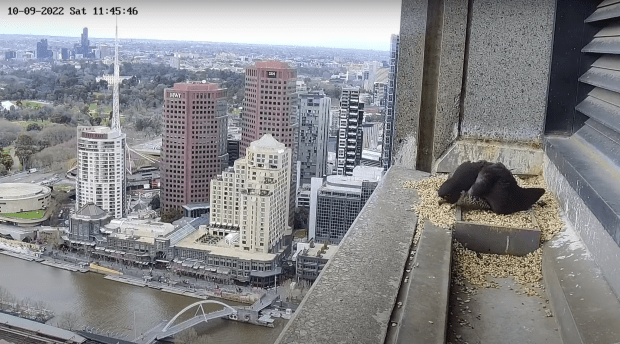
The second male at the 367 Collins Street Peregrine Falcon nest in Melbourne continues to make his presence felt by continuing to land on the ledge but, is he actively wanting to be involved in the raising of these eyases? or is his presence going to harm? It remains unclear as we are now 11 days from hatch watch.
His presence is clearly causing the older male whose scrape box this was to be reluctant to incubate the eggs. So what will happen when prey is needed for the eyases and Mum needs a break in feeding them? Who is actually protecting this Mum and the scrape box?
This is an image posted on 367 Collins Falcon Watchers of the two males. The original male – father of the clutch we believe – and the visitor on the right. Don’t worry! It is the camera angle that makes the one on the right appear larger.
Our cute little dad has very large yellow circles around the eye. The oneon the right does not and has a line on the right of black on white. Note: Most male Peregrine Falcons have a prominent yellow eye line like Dad 1 here and Xavier.
A close up of beautiful Mum has been posted accompanying a link to the tracking data for the nest if you are interested.
Let us all hope this works out well.
It is raining and about 11 degrees C in Port Lincoln. Rain is good but let us all hope it dries up before hatch watch on Monday!
Diamond was busy rolling the eggs before the IR camera came on Friday evening. Less than 2 weeks!
The Bald Eagles in Florida and the SE US are working on their nests – Pa Berry and Missy have been doing so for over a week now, Samson is happy Gabby is home – and those on the Channel Islands are busy, too. Oh, and I thought we would have a break after all the Ospreys migrated. BUT not all the Ospreys have migrated. ‘H’ caught Dory on the Hog Island nest in Maine! So Dory, Skiff, and at least Sloop are all still at home with no hint of starting their flight south!
‘H’ and I both think Sloop is a female from all her behaviour over the year. She can join the club of being kept home and fed well so that she is fully developed like Sarafina, Blue 497, and Padarn.
In the image below, Dory has flown onto the nest in the late afternoon on 15 August. Sloop has also been fishing – seen returning to the nest empty taloned but wet twice. Thanks ‘H’ for keeping us up to date on this nest. Much appreciated.
Migration News:
One of the Finnish Ospreys has spent a week in Ukraine and has safely departed. This is a good sign. Warm thoughts for Karl II and his family who continue to be feeding at various parts of the country.
Bonus remains in Belarus near the Pripyat River. He must really be getting a lot of nice fish and frogs there.
This is an image of the area that Bonus is fishing.
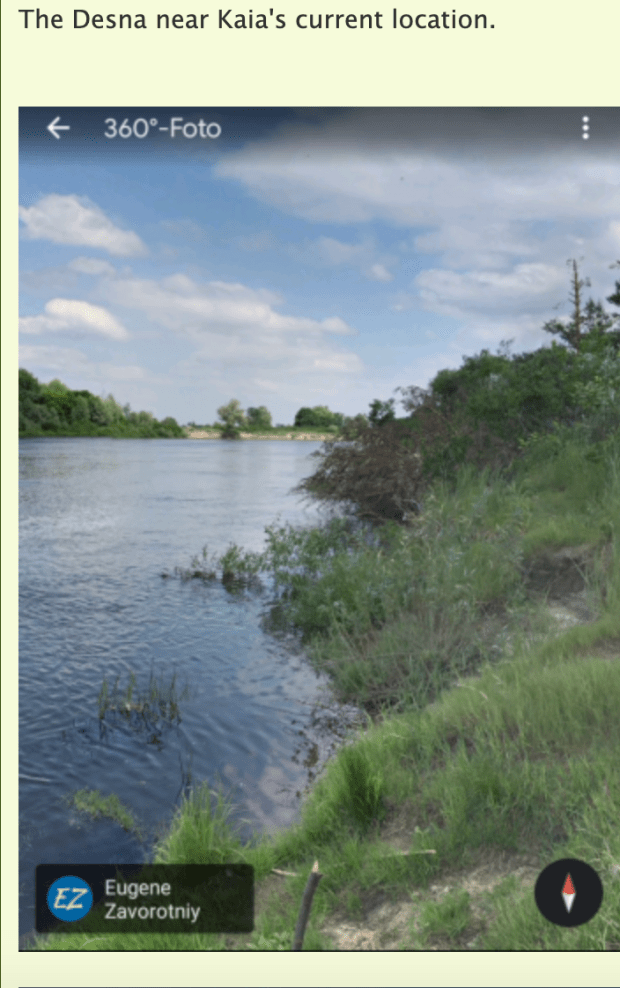
Kaia remains near the Desna River in Ukraine. No word from Karl II.
From the Archive:
I am ‘the most’ famous Red-tail Hawk in the world. Who am I? Where is my nest? Who is my current mate? and do you know how old I will be in 2023?
Thank you so very much for joining me today. I hope that each of you is well. Please take care. Looking forward to seeing you again soon.
Thank you to the following for their posts and streaming cams where I took my screen captures: Port Lincoln Ospreys, Ojai Raptor Centre, Dyfi Ospreys, Bywyd Gwyllt Glaslyn, Friends of Loch Arkaig and the Woodland Trust, People’s Postcode Lottery, Friends of Loch of the Lowes and the Wildlife Trust, Sea Eagles@Birdlife Australia Discovery Centre Sydney Olympic Park, 367 Collins Street Falcon Watchers, Charles Sturt Falcon Cam, Audubon and Explore.org, LAJI-FI, Looduskalender, and Cornell Bird Lab.
I am Big Red. My nest is on the campus of Cornell University in Ithaca, New York. My original mate was Ezra and my current mate is Arthur. I will be 20 years old in 2023. I was banded as a juvenile at Brooktondale, New York only 7.5 miles away form my nest now in the fall of 2003.
Friday morning turned out to be a fantastic day to go and check on the birds in a pond in one of the industrial areas of the city. There had been a Great Blue Heron spotted there according to eBird and I hoped to get a glimpse. That beautiful bird and the Lesser Yellowlegs, the Canada Geese, the Mallards, and the gulls did not disappoint.
Then as I was driving around the other side to leave I looked over and saw something ‘white’. It was a beautiful Great Egret wading in the water fishing.
What a lovely way to start the morning! I feel blessed. It is always good for the mind and soul to get out into nature, however long or short one can, and if, by chance, we get to see these beautiful creatures then it is doubly wonderful.
It is also the full moon. Around the world people will be looking up and hoping for clear skies. It is known as the Harvest Moon and is a time of thanksgiving. Many years ago, I had the wonderful opportunity to be in Kyoto during the Tsukimi or Moon Viewing Festival. Moon Viewing has been practiced in Japan since the Nara Period from 710-794. One did not look at the moon directly but, rather, observed the moon’s reflection normally in a beautiful pond. Many residences of the aristocracy had moon viewing platforms. Poems were written. Auspicious gifts placed on the tokonama while the flowers, the incense, and the hanging were changed to reflect the move to autumn. I recall stacks of mochi and vases with beautiful sheafs of grain. ‘A’ also reminds me that it is a time for eating dumplings – which we will do later this evening while watching the rabbits pound the mochi in the moon!
Making News:
Yesterday I reported that Big Red and Arthur’s youngest hatch for the 2022 breeding season had been released on the Cornell Campus. Here is the YouTube video of this fantastic event! Please note that L2 is still on campus and has not left- as believed- and hopefully these two will hook up. They were always best friends.
L4 was spotted on the Campus this morning. She has made herself right at home! Suzanne Arnold Horning got a shot of her with her phone.
The raptors really need our help to spread the word. Making the news today is an Osprey with a balloon tangled around its legs. Don’t wait to get to the state that I am in – chasing after every loose balloon I see – but help educate. Tell everyone you know and ask them to tell 5 friends and family. Soon, the web of knowledge will grow and the birds will be safer.
If you live in this area, please keep your eyes open for this bird. Thank you.
It is sadly that time of year. The Bald Eagles and other birds of prey that eat carrion get lead poisoning because our governments will not outlaw the use of lead in any hunting and fishing equipment! They need to ban the manufacture, remove the supplies off the shelves, and stop this senseless pain, suffering, and death. We know the solution. Tell your elected officials. There are alternatives. ——— Of course, as you know, my alternative is to end the recreational shooting of animals – it is barbaric.
Nest News:
Idris brings his daughter, Padarn, a flat fish for her evening tea. What a fantastic dad he has been to this healthy and robust female that will soon, should the winds blow in the right direction, head off on her migration leaving Dad some time to recuperate from what has to have been a tiring summer with three girls and Telyn to take care of!
Padarn was on the perch for the night.
She was still there on Saturday!
The sun was setting on Loch Arkaig. We will have to wait until tomorrow to see if Sarafina is still with us! But there has been no activity on the nest today.
On Saturday Louis was seen on the nest. The last time that Sarafina was seen on the nest was at 0634 on the 9th of September. There have been no visits and no nest calls by Sarafina on Saturday.
Who is home at Glaslyn? It looks like it is Aran and 497. The boys and Mrs G are gone!
Aran is over in the Oak Trees.
497 has been in the nest and on the perch. Aran did not seem to be responding! 497 has had a hard time with siblings and Mrs G around to get some of those fish. Perhaps a few days longer will get this little one in shape to fly if Dad obliges with a nice big breakfast tomorrow!
Talk about beautiful. You can sure tell she is Aran’s offspring. She may have the glare of a female Osprey, but that lovely head turned…that is Aran. Until you see the dark necklace – then Mrs G comes in.
Her dark necklace she gets from Mum, Mrs G.
The nest was empty at dusk.
497 was there on Saturday and Aran was busy bringing her fish!
Xavier convincing Diamond that it is time for her to have her breakfast so he can get some eggie time.
You can see a big change in the Sea Eagles at the Sydney Olympic Park nest. They are standing more on their feet and walking about the nest more. SE29 is really flapping its wings and investigating the branches! Yesterday, SE29 got the fish that Dad had brought to the nest but wasn’t sure what to do with it. Lady took it and fed both!!! ‘J’ wrote that she thought this was the cutest part of it – 29 trying to figure out what to do with the fish! I am grateful she mentioned those moments. You might have seen that instance. I am certain SE30 was delighted when Lady fed both of them.
Look at those nice strong legs. Great wings, too! Developing those muscles. These two are simply precious.
It is fascinating – looking at the nest – how the branches help to camouflage the eaglets.
SE29 will be 8 weeks old tomorrow. What to expect for the next couple of weeks in their development? Their wings will begin to get heavy and you will notice that they will begin to sit with them drooping. There will be more hopping and flapping of their wings and by the end of week 9 they should be able to mantle, hold their food and tear off pieces to eat. They will begin sleeping upright with their head tucked into their wing like the adults. Their feathers will continue to develop all over their body. Watch at the end of the two weeks to see them standing on one leg!
Dad on the ropes and Mum on those three eggs at the Port Lincoln Osprey barge. It is the 11th of September in Australia. Do you know what this means? We could be one week from hatch!!!!!!!!!!!
Incubation continues at 367 Collins Street in Melbourne! But there are strange things going on…I wonder how this will turn out.
Mum departed around 0856. Dad came and stayed on the eggs after they had been left for an hour. He stayed about 15 minutes. The eggs were left uncovered for another 43 minutes…and then Mum finally comes and settles down after 2 hours. She then leaves again briefly a little later. This couple appears to have trouble getting their rhythm going…let’s hope it is all worked out by hatch.
Mothering is not always easy, especially the first time!
There are still chicks on one of the Finnish Osprey nests.
CROW provided a really good post today especially with regard to birds and window strike. It is migration season…have a read. Tell your friends and family to turn off their lights and also tell them how to help stunned birds. Thanks so much!
Continuing in our tracking of the Estonian Black Stork family of Karl II, there is no tracking or transmissions for Karl II today.
Bonus remains in Belarus in the same general area of the Priyapat River he has been feeding at. The fish and frogs must be plentiful!
Kaia is still feeding near the Desna River in Ukraine.
Waba is near the Makachinsky Hydrological Reserve which is also in Ukraine like his parents Kaia and Karl II.
Maya and Blue 33’s first hatch of the 2022 season, 1H1, has been seen in Portugal.
From the Archives. Two images today!
First: Can you name this nest? Do you remember the names of the chicks? It was 29 September 2021. Gold stars for anyone who can put the name with the right osplet!
Second: Do you remember the circumstance where these two images were taken?
Thank you so much for being with me today. I hope that you have a wonderful start to your weekend. See you soon!
Thank you to the following for their tweets, posts, and streaming cams that formed my screen captures: Cornell Bird Lab, Suzanne Arnold Horning, A Place Called Hope, Raptor Educational Group, Dyfi Ospreys, Bywyd Gwylld Glaslyn, Friends of Loch Arkaig and the Woodland Trust, Charles Sturt Falcon Cam, Sea Eagles@Birdlife Australia Discovery Centre Sydney Olympic Park, Port Lincoln Ospreys, 367 Collins Street by Mirvac, Ospreys, BirdCast, CROW, Looduskalender, LRWT, and Cape Wildlife Clinic.
Answer to From the Archives:
First. It is the Port Lincoln Osprey barge. Mum is feeding Bazza (top), Ervie (middle), and Falky (bottom). You can see that the osplets have lost their soft down and are in the Reptilian Phase – looking like dark black crude was poured over them.
Second. This is Arnold and Amelia the bonded pair of Canada Geese. Arnold had its foot injured by a snapping turtle and had to have surgery. It shocked the vets when they heard a tapping on the glass door. There was Arnold’s mate. The vets realized that the pair had to be together. Amelia was allowed to share meals and whenever Arnold was moved outside she would break into the pen to be with him. This was a really learning moment if every wildlife rehabber paid attention ——–do not take one Canada Goose into care without its mate. Many times volunteers pick up the injured one and whisk it off tens of miles away. The remaining one of the couple is ‘lost’ and depressed and sometimes does not eat.
Big Red and Arthur’s fourth hatch of the 2022 season, L4, has been released back into the wild after being in care.
Please go to Twitter to see this great event in video and to see the sibling L2 – who was believed to have migrated – join L4 again! They were always best buddies. So happy.
This is wonderful news for this youngster who was the first of the fledglings to catch her own prey. You can see she was released at the Cornell Campus so L4 should be on familiar territory. More information is pending!
Good Morning Everyone. I hope that each of you had a lovely Saturday. Thank you so much for joining me today!
From the Mailbox:
‘A’ asks: What is the average time difference or gap for Peregrine Falcons to lay their eggs? Diamond looks like she is ready today. Thank you, ‘A’. That is a very timely question as we sit staring at Diamond’s bottom for her tail feathers to begin to go up and down when she is in labour. In the nest notes that Cilla Kinross, the researcher at the Orange Falcon cam compiled, it says that the average time difference is 56 hours. As I write this, the time in Orange is 13:21 on Saturday. That egg is due anytime.
‘L’ asks: What is the purpose of molting? The feathers of our bird friends get damaged just like our clothes from normal living. They break and get tears. Moulting is the annual replacement of the feathers. In fact, think about it. Feathers are so important to birds – they keep them warm and dry and, of course, are needed for flying. They should be in tip top shape which is why birds spend so much time preening. Some birds begin to moult in the spring. Others wait until nesting has finished. Moulting is really hard on the birds and it is normally done when there is an unusually high level of prey so they can keep their energy up.
‘C’ writes: “I’m glad I helped with that information about galvanized steel that contains zinc. But in stainless steel, the component is chromium. Is it also bad for the health of birds? I searched very quickly, and in a very superficial search, I didn’t find anything that chromium is also bad for.” The information you provided was very useful. As one of our other readers ‘L’ writes there are some uses for zinc that are also helpful such as in ‘Zinc Ointment’ for baby rashes. I do not know a lot about chromium. It is also used in ceramics to make certain shades of green glazes and is highly toxic in its powdered form. It is not toxic after the pottery has been fired to a specific degree, however. — We assume that the things that we use for cooking are all ‘safe’. Sometimes it is only later we discover that there could be connections to specific ailments. However, if I had a beloved bird that lived in a cage – the cage wires would be stainless. We have a metal shop in our city that made all the SS backings for my kitchen and my island top. I am certain there are similar facilities in other cities where they could make the wires. I am still finding this whole zinc toxicity that impacted Victor very curious. I wish I knew more!
In the News:
The UK is still celebrating the arrival of more than 100 Hen Harriers.
The New York Times published the following article about how climate change will impact the birds we love and which are more likely to go extinct first. The cover shows the Kakapo and my readers know that the Kakapo Recovery Group is working hard to make sure that the flightless parrots survive. Today there are 205 of them on a couple of mall islands of New Zealand.
Nest News:
Chase showed up with a nice big fish and waited and waited on the Two Harbours nest for Lancer on Saturday morning around 10:38. Lancer never showed up. What a change it must be for the parents from nearly getting their talons torn off to sitting quietly to see if anyone will arrive. If you have left the territory, Lancer – soar high, be safe and always have a full crop!
Such dedicated eagle parents. Did you know that Chase & Cholyn have been together for 19 years?
Ferris Akel had a terrific tour on Saturday afternoon around Ithaca, New York. I was listening and doing other things until he got to the Cornell Campus where he caught Big Red, Arthur, and L2 on camera. Oh, it is lovely to continue seeing L2. According to Suzanne Arnold Horning, the latest a juvenile has been seen at the Cornell Campus is 28 August. L2 looks pretty comfortable. I wonder if she will shatter that record?
Arthur was hunting.
L2 could see Big Red in the distance when she was on the pole and was prey crying really, really loud. Since L2 was the second juvenile to catch her own prey in June I am imaging that Big Red’s answer to that is: “Get your own!”
Big Red looks a little ‘rough’. She is moulting. Like other Red-tail Hawks, Big Red undergoes a complete moult once a year. Normally, hawks begin their moult in spring and every feather has been replaced by September or October. Big Red, however, appears to begin her moult after the eyases fledge.
Xavier has been bringing Diamond some extra special treats during Sunday to help Diamond keep her energy up for the egg laying. One was an Eastern Rosella which is a very colourful parrot and the other was a nicely prepared pigeon. Diamond was excited for both!
The arrival of the Rosella meant that cute little Xavier could have some time with ‘eggie’.
Diamond had a very large crop when the pigeon arrived but she certainly wasn’t going to turn her nose up at that special food gift.
It is 13:57 in Orange and Diamond is sitting on the ledge of the scrape box while we wait and watch for an indication that the second egg might be arriving.
Diamond is back on the egg at 1400.
Diamond is very focused and she looks ‘heavy in the rear’. Egg 2 could be coming shortly. Diamond normally lays 3 eggs. For the past two years, only one egg has been viable each year.
Diamond laid egg #2 at 17:27. Yippppppeeee. Why am I so excited? Well, falcon eggs do not always hatch and for the last two years Xavier and Diamond have had only 1 out of 3 eggs hatch so it makes the chances better of having a successful hatch.
Xavier arrives at 17:33 to see the second egg and to bring Diamond her dinner. Notice that Diamond is being very careful. Falcons lay their eggs standing up. She is protecting the egg while the shell hardens in the air. The gap between eggs is 57 hours.
Diamond did not want to eat. She had already had two big meals. She remained in the scrape box. During the night she would sometimes incubate or, alternatively, stand above the eggs protecting them. Remember the Currawong know there are eggs in that scrape and they will eat them if the opportunity arises!
The Melbourne couple seem to be finished with three eggs and each takes turns incubating. Dad was very anxious to demonstrate that he was well seasoned in incubation. The Melbourne crew even made a video of the persuasion.
It is a very short and cute clip. Oh, do you ever wish you could speak falconese?
Friends of Osprey have posted some photographs of Ervie near the Marina where he had dived and caught the lovely fish he is eating. They were taken by Alex Ditton. Oh, goodness. It is always such a joyous occasion when someone shows us that Ervie is doing very well indeed! Check out the Friends of Osprey for more images of Ervie.
Kaia remains in Belarus around the Priypat River. This is what the area looks like where she is resting and fishing.
Bonus, the only surviving storklet of Jan and Janika that was fostered with Kaia and Karl II has begun his migration. His tracker tells us that he traveled 109 km and is now in Latvia near the village of Vietalva.
Travel safe dear Bonus, fly high, stay out of the war zones, always have a stream full of frogs and fish — prosper.
There should be more news but it appears that all might have left for their winter homes from the Karula Forest nest of Kaia and Karl II. I will confirm this tomorrow.
Bonus was always a very special Black Storklet. He would not have survived without the intervention of Urmas and Dr Madis and his team. They would have died on the nest. Urmas’s foresight to provide fish baskets meant that everyone had lots of fish. A special thank you to all who donated towards the food for the nest.
The Dahlgren Osprey nest in the US has announced that the male, Jack, has not been seen for a few days so that now Harriet, the female, and the sole surviving fledgling from the nest in King George County are on their journey south.
No one has been seen at the Loch of the Lowes since yesterday. Laddie LM 12, Blue NC0 and both of the fledglings appear to also be heading south.
It was another successful year for Ospreys in Wales and John Williams gives us the run down in his last blow of the season for Llyn Clywedog. The numbers of Ospreys in Wales are growing. There are now 7 ‘known’ pairs who produced 17 chicks this year. John catches up with all the nest news.
John also produced a chart for all the chicks hatched at Llyn Clywedog – noting that there is simply too much grey. Were those chicks ever seen or not? Sometimes they do get missed.
Handsome Aran on the perch at the Glaslyn nest this morning. He remains bringing fish to the nest for the fledglings. Mrs G was still home as well today.
Handsome, Aran.
Emyr Evans has provided us with the data of the fledges at the Dyfi nest asking the question: what happened to Pedran? Emyr is great with statistics and this is a good read about migration and young fledglings.
Rosie was still on the perch at the SF Bay Osprey nest this morning! Brooks has not been seen at the nest for some time now – this is not alarming. She is out exploring!
Congratulations to Glacier Gardens. Both Love and Peace have fledged. Here is a video of that moment on 25 August when Peace took to the air. Congratulations for another successful year Liberty and Freedom!
Thank you so very much for joining me this beautiful Sunday morning. I hope that you are doing well and I will look forward to having you with us again in Bird World.
Thank you to the following for their streaming cams, their posts, and their videos that form my screen captures: The New York Times, Explore.org and IWS, Ferris Akel Tours, Charles Sturt Orange Falcon Cam, 367 Collins Street by Mirvac, Friends of Ospreys, Looduskalender, Dahlgren Ospreys, Friends of Loch of the Lowes and the Scottish Wildlife Trust, John Williams and The Clywedog Ospreys, Bywyd Gwyllt Glaslyn, Dyfi Ospreys, SF Ospreys and Golden Gate Audubon.
Amidst the joy of Peregrine Falcon eggs in Australia at both Orange and Melbourne, the loss of dear Lindsay, the eldest of the two siblings hatched at The Campanile on the grounds of the University of California-Berkeley, remains heavy – a real heartbreaker. From the news it is apparent that Lindsay died several weeks ago; her body just being found today. She was last seen on the Campanile on 5 August precisely three months after she hatched on 5 May. A life cut way too short.
Lindsay was one of a two-part miracle. Lindsay’s Mum, Annie lost her mate Grinnell when he was killed after chasing an intruder away from The Campanile. There was worry that there would be no chicks this season. Alden arrived in 5 or 6 hours hours (already a friend of Annie and Grinnell’s) and offered to help Annie incubate the eggs and take care of the chicks. We rejoiced at the love the two siblings had for one another, when they played, and when they chased moths. They grew strong and they flew. It is with such deep sadness that we say goodbye to Lindsay today. Fly high, Sweet Girl. Soar to new heights you never imagined.
Here is the full announcement from Cal Falcons. It appears that Lindsay’s death, from the evidence found from her body, was killed by another raptor.
It is heartbreaking. Lindsay had such potential and, of course, it is very possible that she was the last chick our beloved Grinnell fathered. She brought us such joy! I would like to share a few images of this remarkable falcon moving back in time from the last sighting of her on The Campanile on 5 August to the day she hatched.
Lindsay and Grinnell, Jr adopted many of the quirks of Alden including loafing. Annie has perfected it!
Annie and Grinnell, Jr playing together at The Campanile. The two siblings seemed to really enjoy playing with one another, something that I have not seen for a long, long time. It was refreshing.
Lindsay on the roof of the library on 18 June after fledging. Just look at this exceptionally beautiful juvenile. Stunning.
Do you remember banding day 27 May (on the right)? Lindsay was frightened but quiet. Alden would not stop being loud! Lindsay was still sit ting with a not so scared look on her face in early June.
Lindsay was also sitting in that same pose on 22 May.
Hatch day for Lindsay, 5 May. Grinnell wants to come and help. Annie is not sharing – yet – but she will and each of us will rejoice watching this wonderful family.
‘H’ just sent this press release on Lindsay. Thank you, ‘H’. Just made it before I hit send! Grateful.
‘M’ writes: What do you think about this from Dyfi project? I am not sure I would pass off some of that behaviour as just “playing”, at least not based on how the smaller chick reacts. Wondered about your view, based on your study of third hatches.”
For transparency, I posted the information from Dyfi in one of my blogs. Emyr Evans has a long history with the Dyfi Nest in Wales. I have great respect for him but, in this instance, I choose to disagree.
In the UK Osplet deaths are generally attributed to either very poor weather in the early days after hatching or lack of prey, starvation not siblicide. There is little history of siblicide; there are so few breeding pairs and chicks compared to North America. This year, however, we did see it at the Loch of the Lowes Nest. It was rather horrific treatment of the third hatch that was killed by the eldest during a period of low prey delivery.
As you are aware, my research is on siblicide and, in particular, the success of any third hatch osplets vs the other two siblings. Because I track the juveniles long term this is limited to those that are ‘ringed’ and/or ringed with SAT tracking. My findings also rely on the good fortune of someone seeing the juveniles in the future and providing that information to various data bases! In my experience, the aggression shown by older siblings ranges from mild displays of dominance to more serious concerns that seem to taper off around the age of 26-28 days. Serious aggression often ends in the death of the smaller weaker sibling. There is much research to support the fact that it is not always about food. Sometimes it is just dominance.
‘M’ this, in my opinion, is not play. It is establishing the dominant bird on the nest. The dominant bird will eat first and if there is little food it will be the only chick that eats. Had food been scarce the treatment might have escalated but, thankfully, it didn’t. Gender may play significant roles also with the females requiring more food to grow 1/3 larger and feather a larger body. Thus, the females, especially if they are the first hatch, tend to be more aggressive.
Multiple times this year we have seen the third hatch killed by the eldest sibling and sometimes in conjunction with the middle one. As mentioned, this happened at the Loch of the Lowes this year when food was scarce. It also happened at the UFlorida-Gainesville Osprey nest amongst others. It also happens on eagle nests and other species. However, there appears to be a higher rate of siblicide among North American Ospreys than those in the UK. It is likely that these numbers reflect the higher population of Ospreys in North America. In addition, the lochs are full of fish and there are restrictions on many of them to prevent human intrusion during the breeding season.
Loch of the Lowes
In the News:
We are going to start with some fantastic news. When I lived in the UK, I studied in Leicester but lived in Lincolnshire and Belvoir (pronounced Beaver) Castle was a regular haunt for me – so close to where I resided. For the first time in 200 years, we have Ospreys breeding on top of Belvoir Castle! Oh, my goodness. I am delighted. Here is the BBC News report.
Bird Flu is also killing Black Vultures. Deaths from migration, Avian Flu, human disturbance and killings, fires, habitat loss, lack of food…how many of our raptor friends will be left?
There is a lovely documentary on YouTube on the return of the Black Storks to Germany in the 1980s. The cinematography is excellent as is the narration. So much to learn – 53 minutes. Find a nice quiet time to watch!
Nest News:
The 367 Collins Street Falcon Cam in Melbourne is up and running. So far there are 2 eggs!
Here is the link to the camera:
As you will be aware, the first egg of the season for Xavier and Diamond at their scrape in Orange was laid at 0713:48.
Diamond resting in the scrape after her labour and the delivery of the first precious egg for these two.
Diamond incubating the egg. How beautiful.
Xavier comes to the scrape to relieve Diamond. A short bonding ritual takes place before Diamond flies off.
Xavier scraping and trying to turn the egg as he settles down.
Xavier carefully rolls the egg.
Everything is alright with the world. Oh, what a joy to finally see the first egg for Diamond and Xavier. Let us all hope that their year is as successful as it was in 2020 with the hatch of the ever adorable Izzi.
Here is the link to one of three cameras for Xavier and Diamond:
I am so used to the Ospreys in the UK and the Dads bringing in a fish right before or when the sun is rising in the morning. That first fish delivery for SE29 and 30 at the WBSE nest in the Sydney Olympic Forest did not come until 12:31 today. Thankfully the chicks were civil and it was not huge but was a good size.
Images from early morning to feeding.
Early morning preening of those itchy feathers.
Beautiful Lady listening and waiting for Dad to bring food to the nest.
SE29 and 30 watching Mum aerate the nest. Just look at how carefully they are looking at her every move. This will imprint in their mind’s and they will know to aerate their own nests.
Finally, a fish has arrived!
Things appear to be going good at the Port Lincoln barge except for Mum making cries for fish. On occasion Dad has flown in eaten more than his fair share while Mum is fish calling. He then delivers the remainder to her. Come on Dad! Dad is taking his turns incubating.
Oh, it seems so long until 19th of September – may the time pass quickly! There is nothing cuter than nestlings a couple of days old.
Checking on Kaia’s transmission. She remains in Belarus. On the 25th of August she flew 123 km. She is now near the village of Liaskavicy. It is in an area that is part of the wetlands of the Pripjat River. There is a national park and the area is considered to be quite safe for Kaia.
Karl II is looking a little tired. Thanks to Urmas the supply of fish continues so that he can feed the four Black Stork fledglings. Soon they will fly and hopefully Karl II will have some days to recover and gain some weight before he leaves. Of course, when they do depart we shall all be worried for them. I wonder if by some means Karl II and the children will meet with Kaia and decide another route to their winter home???
It appears that all of the White Storks from the nest in Mlade Buky, The Czech Republic have left for their migration. It is raining heavily and both of the nests of Bukacek and Betty appear so lonely. Safe travels dear family.
Suzanne Arnold Horning has caught L2 on the Cornell Campus! So happy she is here with us. In the history of the nest, it seems that the 28th of August is the last day to see fledglings in the past. Enjoy these moments then with our first fledge of the year. Gosh, she is beautiful. We know that she is catching her own food – she was the second of the fledglings to do so more than a month ago. So all is well with L2.
It is Friday. A friend sent this to me to cheer me up because of Lindsay. I did giggle…love those sour worms. Thank you ‘S’.
Thank you so much for joining me today. If you have any questions, you can send them through the comments page or through e-mail. My address is maryannsteggles@icloud.com Have a fabulous Friday! Take care of yourselves. See you soon.
Thank you to the following for their streaming cams, videos, and posts that form my screen captures: Cal Falcons, Berkeley News, Dyfi Osprey Project, Friends of Loch of the Lowes and the Scottish Wildlife Trust, RSPB, The Guardian, BBC, 367 Collins Street Falcons and Mirvac, Charles Sturt Falcon Cam, Sea Eagles@Birdlife Australia Discovery Centre Sydeny Olympic Park, Looduskalender, Eagle Club of Estonia, Mlade Buky, and Suzanne Arnold Horning.