18 September 2024
Hello Everyone,
Ah, the ads continue to appear for some – my sincerest apologies. What a headache. I have done all I can, and WordPress is trying to block the third party. Today, I wanted to forget about them!
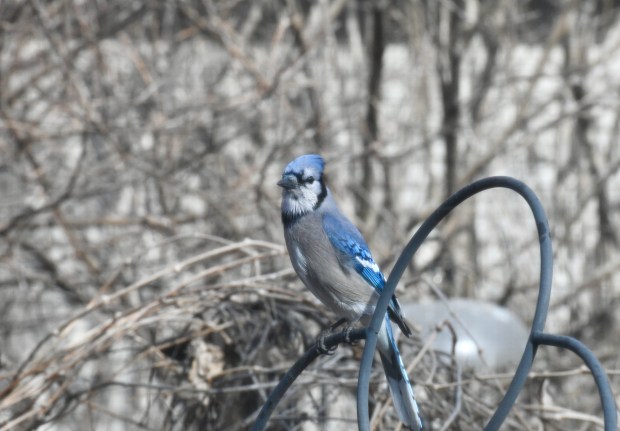
The garden has been a flurry of activity today after the heavy rains yesterday and overnight. Six Crows have been at the nut cylinder along with the squirrels, including Dyson shown below, and a pair of Blue Jays (Mr and Mrs Junior). Numerous species of Sparrows and Wrens are filling up with seed as the days get shorter.

Junior watches Mr Crow cautiously.


Another Crow decides fighting for the nut cylinder is too much bother and goes for the Cheesy Dogs.

Most of the birds in the garden will not migrate. As their habitat in our area of the City dwindles, more and more come to the feeders. I wonder what it will be like in the winter? I am contemplating building a very large covered feeding area so their seed does not get wet from the snow.
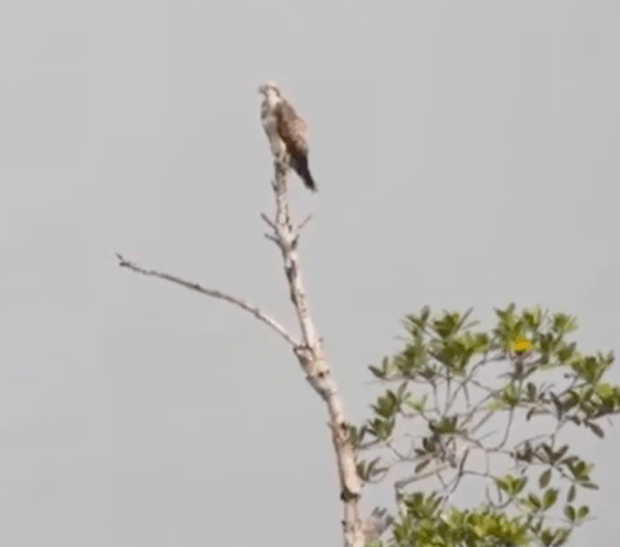
I normally call the Fifteenth of September the end of Osprey season. In the US and Canada, there are, however, still a few Dads hard at work feeding their hungry Juveniles! One of those is not Finnegan. Dr Greene has seen two ospreys in the area that he believes are Iris and Finnegan while he believes that Sum-eh and Antali have departed.


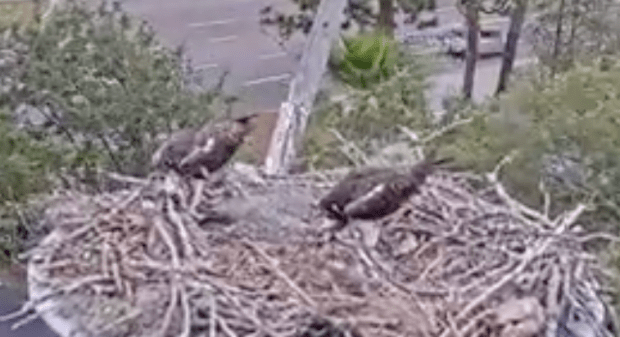
One Dad still feeding osplets is the one at Niagara Bee. There are two survivors. And goodness, gosh, there was some ‘confusion of a sorts’ over the death of the one on the nest. If an eagle had been the predator, it would have swooped down and taken the osplet off the nest and away. Think Cowlitz PUD for a good example. If it had been a GHO, well, they might have flown down and did a grab and go which is what they did at Lake Murray, but then that owl turned around and sat on the nest eating the poor chicks leaving one. So? One keen viewer caught the raccoon attaching the fledgling on the Niagara Bee nest so, it wasn’t an eagle as Niagara Bee had pronounced earlier.
Beaumont is still at Snow Lane with the fledgling? It looks like just one to me. There is no fight over the fish so I am making a presumption that Hope and one juvenile have left the area. Please correct me if I am in error!


Sandpoint is quiet.

Charlo is quiet. Junebug has not been seen since the 15 September.

Hawk Mountains migration count to date:

Of course, there are some lovely chicks and some eggs to hatch ‘down under’. Just look at how much that little White-tail Eaglet has grown in 30 days! It has such a nice crop.


Marrum and Partney at Tumby Island now have two more eggs. The first was predated by a Raven. Let us hope that they can change shifts quickly and never leave the nest alone or those Ravens, who are watching, will be quick to come to the nest. Thanks, PLO, for the image!

In Australia, surprise. Diamond welcomes Xavier’s prey gift! Look carefully. It is not a Starling! https://youtu.be/MbWuvrz2iOo?

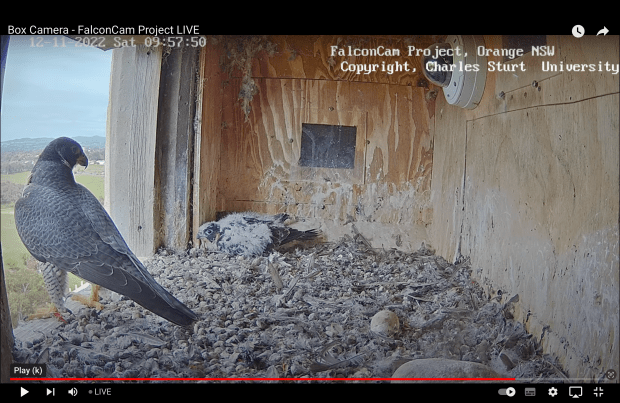
Changeover at Melbourne, too. Don’t you love how these urban falcons have a stash of prey. Mum flies off, Dad comes to the eggs after she has accepted breakie off camera!


Every time you see a raptor. Be kind. As ‘H’ notes, we are losing them at an astonishing rate. This is truly sad.
Looks like it is eel for breakfast for the White-Bellied Sea Eagles at the Olympic Park in Sydney. Thanks cam operator for those great close ups. How many of us would love to have that plumage?!


Fat little bottom on SE34.

It is time to name the chick at Taiaroa Head.


So a question in the mailbox from ‘BHA’ and I just bet that some of you are asking the same question. How do Ospreys Navigate? This is a great question and the Scottish Wildlife Trust supplies us with a great answer that is not lost in scientific jargon.
Numerous theories have been suggested, including the presence of a protein within osprey’s eyes which enables them to visualise the Earth’s magnetic field. This would be followed to warmer climates in the south, whilst hugging the coastline to stay within reach of feeding areas.
A process of ‘vector summation’ is also suggested, as a means of segmenting the journey into achievable distances. These segments are genetically inherent, meaning the knowledge of which direction to travel in during each flight step (and the number of steps) will be present since infanthood. This process is much more greatly relied on by juveniles taking their first migration, as they will not yet have the topographical memory needed to readjust their trajectory towards recognisable landmarks.
External factors such as wind drift can impact the orientation of ospreys, which can be detrimental to their success. Once off course it is not so simple to re-calibrate an internal GPS. Often osprey do not recover well from being blown off course. Depending on the direction of the wind they could end up over deserts – with no opportunities to find food and exposed to unexpected predators – or in vast expanses of ocean where the next land is nearer to South America than the fish abundant deltas of Senegal or The Gambia.
Even staying on course has its perils. For example crossing the Bay of Biscay, the massive gulf between France and Spain represents a great challenge. With favourable winds, this path can be taken in one long stint with the aim to continue down the Spanish coastline. But continuous flight across the Bay also runs the risk of draining energy levels, and being mobbed by seagulls along the way. This increases the risk of drowning before reaching the next resting place, and is an option better left to experienced birds.
We know that youngsters taking their first flight do not have the benefit of an experienced osprey like Iris who is now using landmarks to help her get to her winter home. I like to think that they have 62 million years of DNA and a built in GPS system. We have to use computer systems to help us navigate.
It is Eagle Time (except for the Southern Hemisphere), and I will bring you news on books to give you some insight into these magnificent birds.
At Dulles-Greenway a new couple have been checking out the nest. https://youtu.be/oib7NvIEnmk?s

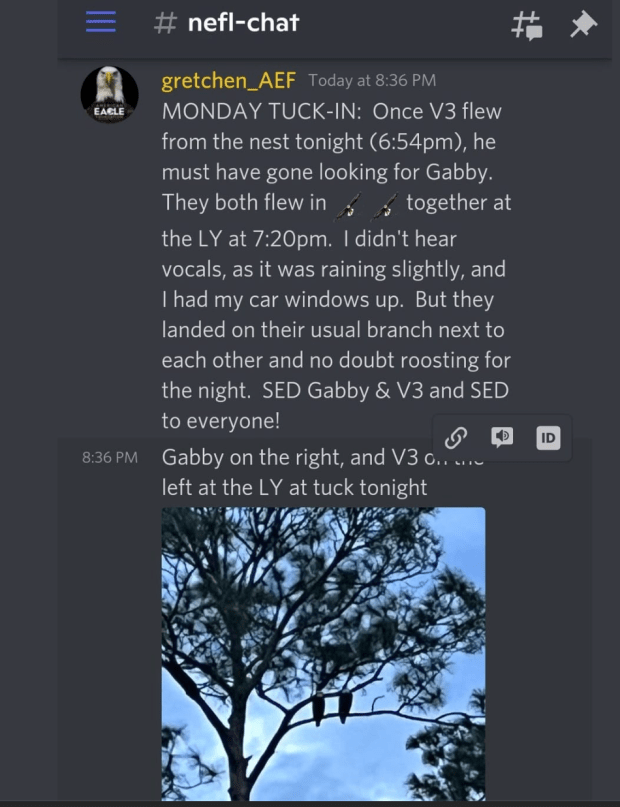
Beau is resting in the NE Florida nest. I had not seen Gabby by 1700. Does Beau have an issue with his left foot? and is he resting on the nest because of it? I wonder.


As the eagles begin returning to their nests, I will post information on some books you might like. There are many books that describe the birds as well as websites, but I am looking for something more for you. The books I mention will be substantially different from those. Jack F Davis’ The Bald Eagle. The Improbably Journey of America’s Bird is full of information about the cultural history of this majestic bird. What strikes me is how many prejudices that have existed for centuries continue. For example, eagles steal children! At the time of the Migratory Bird Treaty Act, “Raptors were excluded…Furthermore, a few out-of-touch ornithologists insisted that H. leucocephalus, the new scientific name given to the Bald Eagle, was a nonmigratory species. This erroneous claim influenced the thinking in government agencies and Congress.” Davis continues, “It was not a marketable good traded across the Canadian border, although it was killed on both sides of it. And it was not a game bird to be protected for the sporting crowd. It was a predator, an animalis non grata, an enemy of civilisation (226).” Davis documents how the eagle became a particularly precarious bird once the US purchased Alaska from Russia in 1867 and commercial fishing industries arrived there. Alaska set up a bounty on the birds! It had been 20 cents in 1806 and was increased to $1 for every pair of talons. People delivered them by the bucket load. It was not until Rosalie Edge bought up the area around Hawk Mountain and began to lobby for changes to the Migratory Bird Act that the eagles received protection. Her task was not easy.
Appearing before a meeting with Audubon, Edge was told that the public loathed the bald eagle and that the Alaska bounty should remain (237)! Edge argued that the symbol that had helped ‘win World War II’ would go extinct if something was not done (238). The argument to protect the Bald Eagle would continue well into the 1940s. Davis continues his book with the restoration of the Bald Eagle into the various states, beginning with an experimental plan at Patuxent. The book was published in 2022 and includes the challenges DDT raised about Bald Eagles, the cultural symbolism with Indigenous people, and the controversies surrounding the eagle. It is a good read, particularly if you love Bald Eagles. Indeed, it would be best if you educated yourself on their history so that you appreciate them even more today.

Why are 90% of Norways seabirds disappearing?
Jeff Kear has published the 2024 UK Season Data if you are interested. Please check it out:
Want a feel good moment? What about a 52 year old parrot? It has been taken into care – palliative care. The caregiver spends their time on the floor with this lovely one! Thanks, ‘J’. Senior animals, whatever their species, need our devotion and love. They have certainly given it to us over the years.
There is a lesson in here. Don’t buy a parrot unless you have excellent DNA and intend to be around for about 80 years to care for them.

Calico’s Tip for the Day: Protect Yourself. Do you have a smoke alarm? a carbon monoxide detector? Then you should be going out and getting yourself one! She wants you to be safe. There are many different kinds from the standard one that uses batteries to ones connected to wifi that can alert you to hazards when you are away from home. In the end, you need one and Calico says you might get a discount on your home owner’s insurance. Best of all, they could save your life!
Calico found some information on hos those carbon monoxide detectors can be useful. Have a read. Calico suggests you read to your kitty!
Thank you so much for being with us today. Take care all. See you soon!
Thank you to the following for their notes, posts, videos, articles, images, and streaming cams that helped me to write my post this morning: ‘BHA, Geemeff, H, J, Jeff Kear, PB’, Montana Osprey Project, Newfoundland Power, Sandpoint, Charlo Montana Ospreys, Hawk Mountain, Port Lincoln Ospreys, Nesting Bird Life & More, 367 Collins Street by Mirvac, ‘H’ and Audubon, Olympic Park Eagles, Scottish Wildlife Trust, Sharon Dunne and the Royal Cam Albatross Group New Zealand, NEFL-AEF, Dulles-Greenway Eagle Cam, Jack F Davis’ The Bald Eagle. The Improbably Journey of America’s Bird, The Guardian, Follow the Feathers, CPSC Documents,