Darling Rubus is dead…and other news in Bird World

Hello Everyone,

What a very sad morning it is.

It was 2100 Monday evening on the Canadian Prairies when I started this blog and the world looked so much better with the idea that our little lad could be flying around with his older brother, Indigo Now that hope has shattered. This morning I know that all of you are feeling the same hole in your life. What a lively character Rubus was — and what immense joy he gave us stretching his little neck to get food and running all over the scrape box screaming and staring into the camera. Oh, little one, you shall be missed.

I am so very glad to have the kittens and the garden animals this morning. The kittens are being as cute as they can be. Both of them spend lots of time looking out to the garden watching the squirrels, the birds, and Hedwig – the rabbit, who came to visit us today.


Our thoughts go out to Diamond and Xavier and to Indigo who must carry on now and to Cilla Kinross and everyone at Orange and to all those around the world who dared love this little bundle of fluff that was Rubus.

Our dear darling little lad. This morning we are all weeping for you.

The speculation as to which fledgling is which has ended at Orange. The body of dear little Rubus was found and it appears he died some time ago. Here is the announcement from Cilla Kinross:

“NEWS 29th November 2022 Bad news about Rubus. His body was found today by one of our medical staff (who also watch the livestream). Cause of death is unknown. I thought at first broken neck because of the angle, but it seemed intact. I have asked the vet for an autopsy, but she said that it is too far gone, so it looks like he died a few days after last seen on 23rd November. That’s a pity as I would like to have known whether it was caused by trichomoniasis (canker) as has been suggested by some watchers. We’ve never had a case here, but the parasite could be present in the local pigeon population and transferred in the prey.”

It is hard to take it all in. Liz M has put together a compilation of Rubus’s life for us.

I will be doing a tribute to Rubus in the coming days and will then add him to our ‘Wall of Remembrance’. So sad today as I know you all are.


I have hoped so much that there would be some good news at the nest of Gabby and Samson, of Annie and Alden, and of Ron and Rita. The only sure thing is that Zoe loves fish and will eat any and all that land on her nest.

Cal Falcons has ‘finally’ issued a statement about what is happening at The Campanile. Thankfully that news is not bad. We just have to wait.

As the sun set over The Hamlet, Gabby looked out over the trees. She has been hunting and has a huge crop. The male intruder appears not to be about but, Gabby has to be wondering where her mate is. What has happened to him?

I am so glad that Gabby has eaten well.

I was reminded, this evening, that Bella was injured. She had extensive injuries and was away from the NCTC nest that she shares with Smitty for three weeks before returning and booting an interested female off. Samson could return. That is my mantra. In fact, I received a note from ‘T’ and the blood on the side of Samson’s face was not an injury but, was from a Coot that he had eaten earlier. Thanks, ‘T’.

In Miami…

Rita, the Bald Eagle mate of Ron, at the Miami Zoo, was a celebrity before she was critically injured with a double compound fracture to her right wing on Sunday. She has been stabilized and operated on and what a lucky eagle she is – had she not been found so quickly and taken to care by the police who found her, she would have died. Maggots had already started growing. So sad.

A round of applause to everyone who helped this injured eagle. The next 48 hours will be crucial – send Rita all your best wishes. The surgery will not happen for another 2 or 3 days and then months and months of rehab before she could released, if she is released. Ron has been on the nest looking for her and just doesn’t understand what has gone on because she was picked up miles away from the nest.

https://www.wfla.com/news/florida/rita-the-bald-eagle-in-critical-condition-at-zoo-miami/

Here is TV coverage of Rita and her injury with more details.

In California, Jackie was caught on camera — yes, the camera is back up and running after the storm thanks to everyone for that. It is so good to see you, Jackie.

In Florida, the GHOWs are striking at Harriet and M15 again.


Port Lincoln Ospreys:

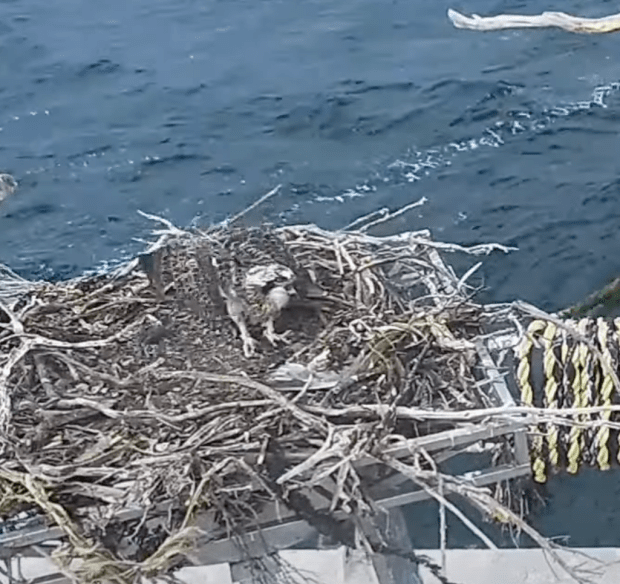
I wonder if Zoe dreams about fish dinners?

Once Zoe spotted Dad away, she flew over by Mum and waited for him to return with ‘her’ breakfast.

Dad did not disappoint. He brought a nice little fish for Zoe.

And our Zoe made quick work of that little fish and was ready for more!!!!!!!!!!!!!

No. 17. The Red List. The Scaup

There are two Scaup. Dominic Couzens in his text for Red Sixty Seven, suggests that the one in the United Kingdom be called the Greater Scaup because there is a Lesser Scaup across the pond in America. The one in the United Kingdom actually resides in both the United Kingdom, Europe and the ‘New World’. That is why, Couzens argues it should be the ‘greater’.

The Scaup breed in the taiga and the Arctic Tundra in the spring. They return to the United Kingdom in the autumn where they will spend the winter. They are medium sized diving ducks – not dabblers. They dive deep searching for aquatic invertebrates and plants. They normally feed during the day but have been seen foraging at night if the water has been disturbed during the day by boats and human activity. Did you know that to catch the invertebrates, the Scaup stick their bill into the mud, snap it closed, and swim forward scooping it up. They have been known to dive to 7 metres!

Greater Scaup LMO 1” by THE Holy Hand Grenade! is licensed under CC BY-ND 2.0.

Look carefully at the Greater Scaup above with its magnificent green head, glowing yellow eye, white bill with the tell-tale black ‘V’ at the base. This marks them out from their American counterpart whose head is an iridescent purple, the black ‘V’ at the base of the bill is missing, and the head is less round. The Greater Scaup has a black neck and breast, white underparts, a dabbled grey and white wing and back, with black tail feathers.

The female is a beauty. Her head is black with that striking yellow eye. She has a white crescent between her bill and her eye. The breast is a lovely chestnut, the back and wings a mottled chestnut and white with a black tail.

Greater Scaup (Female)” by Rick Leche is licensed under CC BY-NC-ND 2.0.

The Scaup make their nests on the ground where the eggs can easily be predated by foxes, dogs, The female lines her nest with the down from her breast. The nests are generally near the edge of the water in areas that are known not to flood. Generally between 8 and 13 eggs are laid.

Their main threat is human development, although they are preyed upon by owls, skunks, raccoons, foxes, coyotes, and humans.  But there are other threats as well including water pollution and climate change. Alarmingly they are also caught up as bycatch when trawlers are out looking for fish.


It has been a difficult last few days in Bird World. As a friend reminded me, “it would not hurt so much if we didn’t care so deeply.” Continue to care. The Birds need all of us and more. Continue to feel. Do not get numb to the challenges they face that cut their lives much more shorter than they should be. Send out your best wishes to Samson for a safe return to Gabby, to Rita so she will stabilize for her surgery, to Alden so he will return to Annie.

I am sorry this letter comes with nothing but sadness save for Zoe who is thriving which is a good thing. Raise a glass of something – juice, water, your favourite adult drink – to our little lad. Soar high little Rubus. Soar high. You were much loved.

Thank you for being with me this morning. Please take care. I hope to see you soon!

Thank you to the following for their posts, their videos, and their streaming cams where I took my screen captures: ‘H’ for the news bites about Rita, Envirobites, Port Lincoln Osprey, Openverse, Lady Hawk and SWFlorida Eagles and D Pritchett, NEFL-AEF, WRDC, Channel 10 News Miami, WFLA News, FOBBV, Cal Falcons, Charles Sturt Falcon Cam Project and Cilla Kinross, and Liz M for her tribute to Rubus.

Alden missing, Samson missing, Rita injured…Monday in Bird World

28 November 2022

Good Morning Everyone,

I am earlier than I thought I would be today because there is more breaking news. We will start off with the kittens because they, so far, are a good thing to wake up to – no injuries, just boundless energy and cuddles.

Missy and Lewis hope that everyone has had a good day so far. They have discovered something! The in-floor heating comes up through the tiles, through the basket, and into their blanket. Talk about cosy.

These two will not be separated. Missy is the leader, the alpha cat and Lewis follows along dutifully. Same basket. Same food dish. Same water dish. Same tent for sleeping. Together. In all my years with cats – and that is a lot!-I have never seen or enjoyed anything so much.

We are still waiting word on Samson at the NEFlorida Bald Eagle nest. As I noted it is not unusual for eagles to take a couple of days off before the incubation period starts or even during. However, at the NE Florida Bald Eagle nest, if memory holds, it is always Gabby who is away and Samson dealing with incubating eggs or eaglets. Oh, let us all hope he is just a bit out of sorts and gets home soon.

For those of you that do not know him, Samson is the eaglet of Romeo and Juliet. The NEFlorida nest that Samson now shares with Gabby was Samson’s natal nest. Samson hatched on 23 December 2013. That means that he is 9 years old. Simon left the area on the 22nd of April 2014 and returned in 2018. Him and Gabby have had 3 seasons of eaglets. In 2019, they fledged Jules and Romey, named after Samson’s parents. In 2020, it was the ever cute Legacy and in 2021, Jasper and Rocket fledged. Samson is an absolutely devoted mate to Gabby and a super dad to his kids.

Samson with Legacy. 2020

Samson remains missing this morning.

The intruder has literally jumped into the nest at NEFL. Gabby was there and was keeping him at a distance.

At the WRDC Bald Eagle nest in the Miami Zoo, the home of Ron and Rita, I have received word from ‘H’ that Rita has been found injured. An announcement just released states that the injury is not as bad as they thought at first. Rita has a broken wing. She is in surgery. Updates will be issued as more is known.

One would think it would be enough with Samson missing and feared that he will not return, Rita’s broken wing and the fact that she could likely miss the 2022 season but, Alden has not been seen for 5 days (not since 23 November) and a male intruder has been at Cal Falcons. Annie has not chased him away. Does this mean we have lost Alden in a territorial dispute, too?

Darling Alden who gave us the loaf, moth chasing, and who saved the 2021 season after Grinnell was killed. Are you really gone?

Cal Falcons has not, it seems, issued any official word other than releasing the videos and the statement of Alden missing for 5 days.


The observation board at Port Lincoln has Mum delivering 2 fish and Dad none but Dad did deliver a fish tail – literally the tail – to Zoe at 18:26. I am not sure she was impressed.

The anticipation of another fish got Zoe quite excited.

It was nice to see Dad with a crop and when the fish tail landed, Zoe has still had a crop from the earlier fish provided by Mum. Zoe is not suffering from a lack of food!

I checked for updates on SE30 and SE29 and could not find any. The last was a couple of weeks ago. I will let you know if there is any news at all.

Need a new Osprey cam to watch? Cottesloe has long wanted one and now it is a reality. Cottesloe is in Western Australia. It will be fantastic to have another cam to go along with Port Lincoln next year.

In New Zealand, the Royal Cam couple for the year has been decided and the camera at Taiaroa Head has been moved. Thanks Ranger Sharyn!

I will be monitoring the situations to see if there is any change with Alden, Samson, or Rita, I will let you know. Please send out your warmest and most positive wishes to Samson and Gabby, Annie and to Alden, and Rita and Ron.

Thank you for joining me this morning. I wish that the news I was bringing was much better. Take care all. See you soon.

Thank you to ‘H’ for alerting me to the situation at Orange and Dade County and for their streaming cams and videos that make up my screen captures: Cal Falcons, NEFL-AEF, WRDC, Cottesloe Streaming Cam, Port Lincoln Ospreys, and NZ DOC.

Samson is missing…Flight of the Osprey and more…

27 November 2022

Good Evening Everyone,

Instead of sending out my blog first thing in the morning, it will be tomorrow evening. This blog will be short but it is packed with three news items near and dear to all of us.

Samson of the Northeast Florida Bald Eagle nest is missing. Indeed, that news has caused my stomach to go down to my toes and back again. All of you know that I adore Samson and Gabby. I cannot even imagine a Gabby without a Samson. Let us all hope that he is just taking a couple of days off – which is more like Gabby than Samson. Gabby is on the nest and is not calling him but she might not know he is missing.

Here is that announcement from the American Eagle Foundation:

At the NEFL nest of Samson and Gabrielle:

“As most of you are aware, Samson has not been seen at the nest since Thursday evening; however, he and Gabrielle were spotted perched together Friday morning on a nearby tree off cams. We are concerned that Samson has not returned to the nest, and can assure you that everything is being done to try to find his whereabouts. When we have any information at all, we will post updates. We appreciate everyone’s concerns and prayers for Samson’s safe return. ❤️

There has been an intruder at the nest. It is not Samson. You can see the dark chocolate bars still in the white head so this birds has just turned 5 years old.

In the Mailbox:

If you have been wondering how you could see BBC 4’s Flight of the Osprey, ‘G’ sent me the YouTube links they have been recording so that we can enjoy. And if you don’t know what Flight of the Osprey is, then here is the promo information from BBC:

Follow Scotland’s ospreys on their epic migration. Over ten weeks, Emily Knight joins a team of conservationists following these beautiful birds of prey from Loch Garten to Ghana.

https://youtu.be/WXb7D3hSTGw Episode One 25/10/2022 https://youtu.be/YJpEcFPUkEc Episode Two 01/11/2022 https://youtu.be/gAU6u4SWrwM Episode Three 08/11/2022 https://youtu.be/_7UTuDhRP2E Episode Four 15/11/2022 https://youtu.be/NMW9EiQiOnY Episode Five 22/11/2022

Australian Nests:

Some of the latest news coming out of Orange. Sharon Pollock writes, “In case you haven’t seen this from Cilla on the YouTube Box Cam Chat: Just had a message from Security Guard Dave. He’s confident he saw both juveniles taking off very noisily from the car park in front of dentistry. I quizzed him about the physical appearance. ​And it does sound hopeful.” Now isn’t that grand news?!

The camera is tilted crazy at Port Lincoln so it is impossible to know what is going on but, Zoe had 1 huge fish to herself yesterday and portions of 2 others. She is fine. Even if she had no food today she would be good.

I knew that you would want to know about Samson and I hope that you enjoy the BBC series, Flight of the Osprey. We are all delighted that Rubus is now believed to be alive – let us all hope that is true. Please send your best wishes out to Gabby and the NE Florida nest and especially to Samson. If he is injured, I hope he is found or he returns to the nest soon.

Thank you so much for being with me. Take care all.

Thanks to the NEFlorida Bald Eagle nest and the AEF, ‘G’ for the links to his YouTube programmes on the Flight of the Osprey, Sharon Pollock and the announcement re Rubus, and to Charles Sturt Falcon Cam and Cilla Kinross.

Zoe flies more, rare Albatross incubate their egg…and more news in Bird World

24 November 2022

Good morning to everyone and the best of Thanksgiving to those celebrating in the US today.

It has been wonderfully warm on the Canadian Prairies. I do not know if it is atypical for this time of year but, it certainly feels like it. The birds in the garden had some of their feeders rearranged and thanks to a lovely friend I swopped out some old feeders for some she gave me yesterday. One of the visitors today was a beautiful Starling. It’s an immature non-breeder. Note all of the white spots on his breast and it has yet to get its oily black head. The males and the female Starlings look alike. Did you know that? One difference is that the beaks of the males are a deep blue while those of the female are a pink colour. This then looks like an immature non-breeding male.

Look closely and you can see their rose coloured legs. It is also a pair of non-breeding adults. They are really loving this soft suet.

The Starlings will not perch on the metal. I do not know why. They want to lean down from the branches to get to the suet. You can see this behaviour in the image above also. So the feeder below was moved so they could more easily reach it! Who says I am a softie?

Junior was grateful for a bowl of corn today.

One of many varieties of the Sparrow family that visit the garden. They are particularly enjoying the Butter Bark Balls on these damp days.

The kittens have had great fun watching the birds and the squirrels. They continue to find places in the house to get into mischief. And they do not always come when they are called setting in a panic that they have miraculously gotten outside in the cold. Of course, they are somewhere laughing (do cats laugh?) while I panic!

Missy has discovered a Rodney Mott sculpture that is just perfect for hiding in. Lewis is in the overturned basket not even showing a whisker.

At the Australian nests, Zoe took off for her first flight of the day at 0901. It was an absolutely perfect take off and her landing at 0907 was spot on, too. She is a very strong osplet. I do hope she gets some nice fish. It has been 24 hours since she last had some food.

While the camera was down for a couple of yours, Dad brought in fish. We are only seeing the tail of the fish but I hope that Dad had some nice fish – the entire head – and that it was big enough for Mum and Zoe to also have a good feed. This family would really enjoy a day with several deliveries but, I am grateful to know that there was a delivery mid-afternoon.

Zoe had a nice crop.

At the scrape in Orange, things were decidedly low key. Xavier and Diamond in and out of the scrape box and Diamond enjoying sleeping in the box all by herself at night. They have busy days chasing after Indigo and Rubus. Little Rubus is, apparently, doing more flying and getting much better.

This was the news from Orange: “Rubus and Indigo both seen within the last hour. Rubus is exploring the campus, going from building roofs to trees etc. He fledged on 20th November. Indigo is way ahead getting flight training from parents, visiting the box etc. He fledged on 11th November at 41 days.”

If you haven’t checked out the FalconCam site in a few days, I urge you to do so. Someone is really adding historical data and you can go back to 2007 to see earlier chicks and read about the big events at the scrape. Here is that link if you lost it.

https://science-health.csu.edu.au/falconcam/home

Oh, it is stormy up near Jacksonville. Samson and Gabby have been on the nest today working despite the wind and the bad weather that looks like it is moving in.

I put this image in not so you could peer at the fluffy bottom of a big Bald Eagle but, rather, for you to see the colour of the legs and feet of Gabby. Then look at their beaks. This is a bright chrome-yellow. This is a very healthy bird.

Harriet and M15 are sleeping at the nest and so far no eggs, just like at NEFL.

At the E-3 nest in the Kistachie National Forest, they have their second egg today. Congratulations Andria and Alex.

There is also news coming out of the Midway Atoll about a very rare pair of Albatross.

As we give thanks for all the birds that bring our lives joy, remember that we are the cause of much of their suffering. Please spread the word to anyone you know – or where you work – that there are solutions other than using rodenticide to get rid of mice and rats. Also teach them about secondary poisoning. It could be their dog or cat but, it is often one of our beautiful raptors.

At small islands in New Zealand, Dr Digby and his team care for the rare non-flying parrot, the Kakapo. In 2016, they hand-raised more than a dozen of these precious little birds. Today they continue to do that work when it is required. The work that Digby and his team do to restore the health of these birds and to keep them safe and try and increase their numbers is remarkable. So thankful.

No 13. The Red List. The Marsh Tit

At first I thought these were out Black capped Chickadees. The Marsh Tit is small, it is mainly shades of a soft grey-brown or taupe with a shiny black cast, a black bib, and a pale ivory underbelly. The bill, eye, and legs are black. They are not plain by any means, look closely at the plumage patterns. Simply lovely.

The woodlands of the United Kingdom – and elsewhere – are changing and that it causing a huge decline in the number of this very small song bird, the Marsh Tit. The woods are more fragmented now, separated by grazing pastures, a growing number of introduced deer. Marsh Tits, according to Mike Toms, “favour woodlands with a complex understory and require surprisingly large patches of suitable habitat in order to breed successfully.” And they’re like their woodlands to be “wet”. Climate change has meant that they are now laying their eggs at least ten days earlier than they were 50 years ago. This change has had a decided impact on available or peak food supplies for the chicks which is also contributing to a decline in population numbers. The Marsh Tit is also known to visit older gardens, copses, and parks, and has sometimes been seen on feeders.

Marsh Tit” by Vine House Farm is marked with Public Domain Mark 1.0.

They feed mostly on insects, seeds and berries, and often cache food over winter if they find a good supply. They nest in existing tree holes, rather than excavating their own, and produce seven to nine eggs.

Their song sounds like a sneeze “pitchoot”.

Here is their range.

Thank you so much for being with me today. I hope that each of you had a wonderful day no matter where you are — or will have a great day if you are just waking up reading this. Take care. See you soon!

Thank you to the following for their posts and streaming cams where I took my screen captures: Port Lincoln Ospreys, Charles Sturt Falcon Cam and Cilla Kinross, NEFL-AEF, SWFL Eagles and D Pritchett, KNF, Friends of Midway Atoll National Wildlife Refuge, A Place Called Hope, Kakapo Recovery and Dr Digby Twitter, Openverse, and RSPB.

Shaded nests for eagles, prey drop for Rubus and other news in Bird World

23 November 2022

Good Morning Everyone!

I hope that you are well. Tomorrow is Thanksgiving in the United States. In Canada, we have already had our harvest festival in October but, as one of the readers reminded me, it is a time to give thanks for all of those in our lives — so to all of you wherever you may be, ‘thank you for being part of this great community’. Your empathy, caring, understanding, and joy are remarkable and this year we have been so much together. And to all of our feathered friends, thank you for the joy and the tears and for reminding us that we are all in this world together, not separate.

Dyson sends greetings from all of us to all of you. She hopes that you have plenty of ‘nuts’ for your celebration while reminding all of us to share with the wildlife.

There is simply not a lot going on in Bird World. Only one thing seems to be on anyone’s mind now that Zoe has fledged. When will Rubus fly up to the scrape?  Rubus has flown. Shines reports that Rubus was on the ground and observed to fly 200 m to his perch. Indigo has been up in the scrape box and so have the adults. And he flew some more later and picked up a prey delivery (see below). Life feels good right now. All are well.

Interesting to note that Xavier was in the scrape box ‘scraping’ – is he already thinking about next year? A scrape is a shallow indentation in the gravel or sand in which the eggs are laid.

It is extremely heart warming to know that all of the staff at Charles Sturt University keep an eye out for the falcons. Rubus was found on the ridge of the Printery Roof. Here is a video showing a prey delivery for Rubus from Xavier. So, we can all relax. Xavier and Diamond are taking good care of both Indigo and Rubus and there are all kinds of caring eyes looking out for them!

Thanks ‘A’ for sending me the link to the video and this comforting news!

If you missed Zoe’s fledge, here is my short video clip. She was really working her wings earlier and her first flight took her right down to Dad’s shed. Perhaps Ervie will come and join them for a good old ‘chin wag’. Zoe is 66 days old.

Mum is in the nest and Dad is on the ropes. Zoe is still down in the shed. She will figure out how to fly back up to the nest. If I recall, this is what Bazza did last year! Please correct me if I am wrong.

There should be no worries. Zoe flew up to the nest at 1451 and booted Mum off. She is now prey-calling and I presume that one of the adults will be out to get their girl a nice fish for her accomplishment!

Zoe later flew back and forth to the perch and around the barge. It appears from all the time tables that Zoe did not get a fish after fledgling. Thanks to ‘A’, here are the major events from the observation board for Port Lincoln for the day: Fish count: Dad: 2, Mum: 0 Fish times: 08:37, 11:49 08:37 dad with headless fish, mum takes it away 08:46 mum returns, Zoe self feeds 9:00:56 Zoe eats the tail.

10:54:45 Zoe fledges from the nest and ends up in the mancave Facebook post on fledge 

11:49:45 Fish tail end by Dad. Zoe was in the mancave 11:55 Mum eats the tail. 14:51:55 Zoe returns to the nest, where mum was, who then leaves

18:40 Zoe from nest to close perch (and back and to the perch) and flying around the barge

‘H’ made a video clip that shows Zoe’s fledge and her subsequent flights which are not included in mine. Thanks so much ‘H’.

————————————————————————————-

Making News:

Dave Hancock of Hancock Wildlife is building shaded nests for the eagles to help them with the increasingly number of heat domes that are part of climate change in British Columbia. Here is an image of one of those nests with the Delta 2 Eagles.

The British Trust for Ornithology is watching with great concern as the migrant birds from parts of Europe arrive in the UK for their winter holidays.

BirdLife’s 2022 Photography Awards are in and there are some stunning images.

https://www.theguardian.com/environment/gallery/2022/nov/23/the-2022-birdlife-australia-photography-awards-in-pictures?CMP=share_btn_link

There are many categories and many birds that will be familiar that are in those winning shots including the Albatross, BooBook Owl, Wood Ducks, Petrels, Wrens, and Lyrebirds. Enjoy!

What you might not know is that you do not have to be Australian to enter. Maybe think about submitting some of your images next year. One section of the Birdlife website that fascinated me was the ‘tips and tricks’ to getting bird photos. Mine would never win any awards but I would love to be able to take better photos of our beautiful feathered friends. To check out on the regulations for the annual awards and to see the tips and tricks, please go to:

birdlifephotoaward.org.au

————————————————————————————

In Senegal, Jean-marie Dupart reports that he counted 331 Ospreys in a stretch of beach measuring 143 km. That is fantastic news!

———————————————————————————–

In the United States, the Osprey breeding season starts after the Bald Eagles. Jack and Diane at the Achieva Osprey nest in St Petersburg, Florida have been visiting their nest. I wonder if they even know where to start with all the weeds that have grown up!

I keep heading over to the West End nest of Thunder and Akecheta to see if I can catch them at the nest but, no luck today!

I didn’t find anyone at home at Fraser Point either and they are playing highlights on the Two Harbours cam.

Harriet and M15 have been on and off the nest today. Many thought that today might be the time for the first egg’s arrival but, it doesn’t appear to be the case. Perhaps tomorrow!

Gabby is looking particularly gorgeous these days. She is keeping her eyes out for any intruders near the nest she shares with Samson at Jacksonville, Florida.

————————————————————————————-

No 12. The Red List: Ring Ouzel

Alpine Ring Ouzel (Turdus torquatus), Karwendel mountains, Austria” by Frank.Vassen is licensed under CC BY 2.0.

In his description of this beautiful Blackbird with its white half moon torque on the male, Nick Baker says, “It’s the thinking person’s Blackbird, the connoisseur’s choice; a passerine, that keeps itself to itself and is somewhat exclusive, hiding away from the cheap (ing) twittering masses of other perching birds, other than the odd curved, Wheatear and pipit.”

Ring Ouzel male” by Rainbirder is licensed under CC BY-NC-SA 2.0.

Baker likes the stunning black birds because they are elusive one has to “invest some kind of effort to find one makes them all the more appealing…” Baker lives in Dartmoor, where a small population of these passerines “hangs on.” He says “the situation is about as delicate as the frosted feather edges on the bird’s breast.”

This lovely print shows the adults and the wee one. Notice the silvery wing panels on both the male and the female. You can see them easily in the photograph by Rainbirder above, also. The male’s crescent moon is pure white while the female’s is ivory barred with a rust brown. Instead of a black chin, the female has vertical barring, dark chocolate on white. Once again, I think that the female is just as stunningly beautiful as the male – her head, back and tail are not the pure deeply saturated black. In fact there is more variety to her plumage. The spots on the chest of the juvenile with its brown head, back and wings remind me of the work of Denmark’s most accomplished ceramic artists, Priscilla Mouritzen.

Ring Ouzel (male left female above young right)” by Wildreturn is licensed under CC BY 2.0.

The ring ouzel is a member of the thrush family. It grows to approximately 24 cm or 18 inches in length. They are smaller than Blackbirds but are often misidentified as being a Blackbird unless you see that stunning half moon panel.

They breed in the drags and gullies of the steep valleys from mid-April through to mid-July normally having two clutches. Their nests are located close to the ground in dense heather or in a crevice. It would be very rate to see them nest in a tree. They feed their young earthworms and beetles and as adults they eat insects and berries.

The threats that these birds face are quite numerous. The predation of eggs is a start because of nesting close to the ground. They are disturbed by humans, their habitat has been destroyed due to deforestation in the areas where they winter in Spain and in Africa. Climate change has had a significant impact on the bird. The authors of the book noted below, possibly the very best study of these birds, notes that the landscape of the North York Moors might become completely unsuitable for them in the future.

One of the best books on this species is this volume, The Ring Ouzel. A New from the North York Moors. The retired duo hiked, observed, and gained considerable knowledge which they have passed on to us in a delightful little book. I keep thinking how wonderful they were to find this specific place now and provide us with insights into a bird that is most elusive.

————————————————————————————-

Migration News:

I am still following two of the four fledglings from Karl II’s Black Stork family from the Karula National Forest in Estonia. Those two are Waba and the foster chick, Bonus. The only surviving strolling from the last brood of Jan and Janikka.

Bonus remains in the area of Turkey (Konya Province) where he has been for what seems like forever. It is an area that can get cold in the winter with snow and everyone is hoping that he will decide to get moving!

Waba remains in the Sudan feeding on the Nile River. He travelled 242 km in the last few days (his tracker was not transmitting for some of that time).

Both of the Black Stork juveniles seem to have found water and lots of food and it appears that each is reluctant to leave their respective locations. It is always a relief to know that they are well but, like everyone else, I hope that Bonus will get an itch to fly and that he will head south to catch up with the remainder of his family in Africa.

Thank you so very much for being with me today. We will be keeping an eye on Zoe as she perfects her flying skills along with dear Rubus and Indigo at Orange. Take care everyone. See you soon!

Thank you to the following for their posts, videos, and streaming cams where I took my screen captures: ‘A’ and ‘H’ as always – so grateful, Charles Sturt Falcon Cam and Cilla Kinross and gang, Port Lincoln Ospreys, British Trust for Ornithology, ave Hancock and Hancock Wildlife, The Guardian, Achieva Ospreys with Jack and Diane, IWS, SWFlorida Bald Eagles and D Pritchett, NEFL-AEF, Openverse, and Looduskalender Forum.

Sunday News in Bird World

20 November 22

Greetings from a wintery wonderland on the Canadian Prairies. We have snow – thankfully not like what has been landing in the Great Lakes area of the US. Just lovely snowy drifting down giving everything a crisp clean Hallmark card ‘look’.

Before I go any further, Rubus and his fludged-fledge has been located in a tree near to Indigo by Shines. Later Indigo flies up to the scrape but has difficulty due to the very strong winds getting the landing perfect. It was like Rubus who had little control with those winds as he exited the scrape but greater control near the ground. Both are safe and sound. We can all breathe a little lighter! Zoe remains on the nest as I write this. So everything is, so far, alright at both of the Australian nests we have been watching. Only one fledge to go, Zoe, the Port Lincoln osplet.

If you missed it, here is Rubus’s start to his great adventure:

Thanks to ‘B’, who sent me this link, we can see Rubus and Indigo perched in trees! Thank you so much ‘B’.

This is the feeding recap for Zoe at the Port Lincoln Osprey barge up until 1500. ​06:14 Dad with partial fish. 06:14:12 Zoe steals fish from Mum.8:24:50 Partial by Dad. Zoe self feeds. 9:10:50 Zoe finishes the tail.

Making News:

Paith, the third hatch at the Dyfi nest of Idris and Telyn of 2022, has been spotted in another country. Emyr Evans needs permissions for all the details, etc. but this is fantastic news. Oh, tears. Need these third hatches to do well!!!!!!

The Melbourne Four make the news again and they are right. Who needs Netflix when we can have Nestflix?

https://www.theage.com.au/lifestyle/life-and-relationships/bird-s-eye-view-who-needs-netflix-when-you-can-tune-into-nestflix-20221116-p5bywe.html?fbclid=IwAR2MHVlDtBYcr46mtwCPkpd9gkSg7bJDEqoFy_7MiTjJu6XQcAoFQbneNiE

There was also just an amazing season tribute to the Melbourne Four that included ‘Old Dad’ (M17). Thank you for this! It came on a day when we needed some really positive news with Rubus fledging/fludging.

The Black-naped Pheasant-Pigeon was thought to be extinct. It was last seen in 1887. It has been found in New Guinea.

The very first egg of the season at the Kistanchie National Forest nest has been laid on Nest E-3. Congratulations!

Big Red was spotted on the Cornell campus along with one of the juveniles. It is always great to see Big Red, the international star of all Red-tailed Hawks! She is all flooded up to keep warm. Big Red had been spotted earlier out hunting – and it was successful. There is great comfort in knowing that she is alright. It seems that L4 is also still around the campus. That is also wonderful news.

No 10 The Red List: The Tree Pipit

Tree Pipit (Anthus trivialis)” by gilgit2 is licensed under CC BY-SA 2.0.

I have never heard of a Tree Pipit. As far as I know, we do not have them in Manitoba. Ed Douglas describes them this way, “Pipits are often regarded as dreary-looking birds, the avocado bathroom of the avian world. That only makes me love them more, but telling these flecked brown birds apart visually is a task of tooth-grinding attention to detail.” The Tree Pipit is a bit bigger than the other Pipets and its beak is thicker. “The Tree Pipit has a touch of swagger, strutting across the ground, tail pumping rhythmically, like a wagtail, as it hunts for insects.” The birds also breed on the ground laying a clutch of approximately six eggs in the grasses beneath the trees. Indeed, the birds like the woodlands and the fringes at the edges for raising their families. They flutter through the air in a way not dissimilar to a Black Capped Chickadee.

Tree Pipit (Anthus trivialis)” by gilgit2 is licensed under CC BY-SA 2.0.

Personally, I do not think they are Avocado Bathroom at all. The colouring is marvellous. Stop for a second and examine the range from a soft silvery white to the creams, the darker ash blonde, moving into the very dark blond and on to that deep 70% chocolate. They are stunning! Notice the white eye ring and the very subtle eye line.Move on to the wing and the teardrop pattern with the dark espresso lined by the white. Incredible. Striations only on the upper breast. This melody of brown and its hues is all topped off by velvety light rose legs and beak. I expect this little one to be wearing a matching light rose velvet hat with feathers carrying a matching handbag!

There are parts of the world where the Tree Pipit is of least concern but in the UK, its song and it are in dramatic decline. They migrate annually to Africa and when in the UK, their diet consists of insects gleaned from the woodland floor and old rotting trees. Declines can also be attributed to the use of insecticides and herbicides both in the UK and in Africa – to kill the insects which are then eaten by these small birds causing them to die. Secondary poisoning.

https://www.theguardian.com/environment/2021/jul/13/country-diary-the-song-of-the-tree-pipit-is-a-rare-pleasure?CMP=share_btn_link

Migration News:

Little Waba is still in the Sudan fishing at the Nile River near Nori. She is obviously doing very well. The temperature in the area today was 26 degrees C.

Bonus is also in the same area in Turkey in Konya Province. It is considerably cooler there at 13 degrees C. Bonus also landed on a transmission tower today and everyone was very, very concerned because of the deaths from electrocution. He left, thankfully!

Oh, the time just flies by. It is hard to believe that we have our first Bald Eagle eggs in Florida and in Louisiana now and that we have only one more raptor to fledge in Australia, Zoe. It is a good time of year to take a deep breath, to remember those lovely feathered friends we have lost, and to be ever so grateful for those that survived.

Thank you for being with me today. Please take care of yourselves. Looking forward to having you with me again soon.

Thank you to the following for their posts, their videos, and their streaming cams where I took my screen captures: ‘B’, Charles Sturt Falcon Cam and Cilla Kinross, 367 Collins Street by Mirvac, Looduskalender Forum, OpenVerse, Suzanne Arnold Horning, Cornell Bird Labs, US Forestry Service KNF Bald Eagle Nests, CTV News, 367 Collins Street by Mirvac, The Age, Ospreys. Ringed Birds and Sightings (UK), and 367 Collins Falcon Watchers.

Hovering, Nest building…Saturday in Bird World

19 November 2022

Good Morning Everyone!

I hope that you are well. So nice to have you with us this morning. It is a blue sky cold day, -14 C, on the Canadian Prairies. The kittens are up carrying toys and watching the Crows come for their morning feeding. The Grackles have already been to the suet feeder and the little Sparrows are all puffed up keeping warm in the lilac bushes.

It is a type of soft suet that the Starlings like. They can stand back and poke at it with their long sharp beaks.

The Blue Jays that fledged from the nest across the lane are still here. One was eating peanuts while these two were in the lilacs sunning themselves.

Nest News:

Yesterday Zoe got some really good height in her hovers. Thankfully she remained on the nest and did not fledge into those strong winds as that storm did roll in.

If you missed it, here are those beautiful early morning hovers.

Later, Mum is down in the nest with Zoe taking care of her only ‘baby’. Dad was not out fishing. If you remember, Zoe ate really well on Friday so did Mum. On Saturday morning, Mum took Dad’s fish and returned with the tail portion for Zoe. That has been the only meal so far and if the weather stays, it could be it for the day. Zoe will be fine. She is not going to starve.

Indigo continues to fly out of the scrape and return. This is excellent. Most of you watch the Bald Eagle nests as well as the Ospreys and it is ‘normal’ for fledglings to return to the nest for food, to fly and strengthen their wings being fed by the parents for a period of 4-6 weeks.

Rubus continues to do his wingers and the pair enthusiastically eat all that is brought into the scrape. There are still a few dandelions on Rubus but not many.

The brothers 9 days ago.

Just look at them all covered in down with Indigo revealing some lovely back and tail feathers.

Oh, little Rubus had to get to the front and jump in the beginning to get some prey. Hard to imagine now when both of them are screaming and running all over the scrape. Diamond and Xavier have raised two healthy feisty chicks.

‘A’ reports that it was raining so hard in Melbourne yesterday that the wipers had to be on full speed. Of course, all we can think of are the fledglings from 367 Collins Street. Positive wishes out to them to be safe and fed.

As the season in Australia winds down, everyone is on egg watch at the nest of Harriet and M15 in Fort Myers, Florida. The pair have been working diligently to rebuild their nest after Hurricane Ian. Sadly, that GHOW continues to plague our beloved eagle couple. Oh, I wish their nests were further apart!!!!

Harriet and M15 continue to work on their nest together. They are amazing.

Samson and Gabby have been at their nest, too, working away. They have had a three year old Eagle visiting the nest and I began to wonder if it could be Jules or Romey.

Mum and Dad have been rebuilding the nest in St Patrick’s Park in South Bend, Indiana. You will remember that this is the home nest of Little Bit ND17. They are making good progress and now, some snow has arrived. I sure wonder where Little Bit is! Gosh, we long for them to fledge and then we grieve to see them again hoping they survived that almost insurmountable first year.

Humane Wildlife Indiana sent out a clever fundraiser. They are asking for donations for the strays in their care to have a full fledged Christmas dinner. You can purchase one for one animal or more. I wonder why more animal sanctuaries do not do this? You might mention this to your local care group. It is a marvelous idea.

Making News:

Sadly, for the wrong reasons the adorable Melbourne Four make the news.

https://www.theage.com.au/national/victoria/collins-street-falcon-chick-dies-days-after-taking-wing-20221115-p5byi1.html?fbclid=IwAR22J_pnOqqPaRA8JqL7WcplN8ddPreG3bIpfCVw8kNgpVudjgCKWoSHXgI

Oh, our beloved Canada Geese are making news in the UK.

https://www.theguardian.com/environment/2022/nov/18/country-diary-canada-geese-are-on-the-move-with-a-melancholic-honk-but-why?CMP=share_btn_link

No 9 The Red List: The Nightingale

It is the song of the Nightingale that has attracted writers for thousands of years. Pliny the Elder described its song more than 2000 years ago when animals were denied artistic abilities. He wrote: “the sound is given out with modulations, and now is drawn out into a long note with one continuous breath, now made staccato . . .” Ellen Finkelpearl continues in her short article on Pliny and the Nightingale that he did believe, strongly, that the natural world including our feathered friends can be artistic!

https://classicalstudies.org/plinys-cultured-nightingale

If you are a lover of Shakespeare, you will know that the Nightingale shows up in more of the plays, not just when Juliet educates Romeo on the wonderful song of the Nightingale.

Wilt thou be gone? It is not yet near day.
It was the nightingale, and not the lark,
That pierced the fearful hollow of thine ear.
Nightly she sings on yon pomegranate tree.
Believe me, love, it was the nightingale.

Here is a fantastic blog that captures the portrayal of the Nightingale in all of Shakespeare’s works.

https://blogs.bl.uk/sound-and-vision/2016/04/shakespeare-and-the-nightingale.html#:~:text=The%20morning%20after%20their%20secret,is%20not%20yet%20near%20day.

In his entry in Red Sixty Seven, writer Luke Massey says, “…We should be ashamed that in our quest to clean our landscape, in our acrimonious divorce from nature, we have forgotten this songster and let it suffer. Despite its song we have ignored it ; we have let it fall silent in our copses, our scrub and our hedgerows. We have failed it and with that we have failed nature. Will we really let this be the last song of the Nightingale?”

Its very last space in the UK is under threat.

https://www.nationalgeographic.co.uk/animals/2018/04/last-stronghold-of-nightingale-under-threat

There are problems with the Nightingale’s wings getting shorter due to climate change. That is mentioned in this great report for The Guardian.

https://www.theguardian.com/environment/2020/apr/01/nightingales-at-risk-due-to-shorter-wings-caused-by-climate-crisis

Changes in farming practices, the destruction of hedgerow and copses for more modern farming are all adding to end the life of this most beloved bird who nests are on the ground. There are fewer and fewer sites for this beloved bird to raise their young safely.

As I read more and more of what we have done to halt the lives of so many birds, it is readily apparent that the world needs to return to some of the ‘old ways’ and continue policies or re-wilding if we are to save our precious wildlife.

In the Mailbox:

‘EJ’ was wondering how these transmitters work – like the one put on Zoe at Port Lincoln. She found a great article and you might be wondering how these transmitters work, too. Thank you, ‘EJ’. Here is the link. You should be able just to click on it.

Technology (ospreytrax.com)

Thank you so much for being with me today. Take care everyone. As I look at the weather report there is a severe weather alert for wind in both Orange and Port Lincoln. Maybe Zoe and Rubus – as well as Indigo – will take care today. Send best wishes to them!

Thank you to the following for their posts and their streaming cams that make up my screen captures: RSPB, The Guardian, Osprey Research, Port Lincoln Ospreys, Charles Sturt Falcon Cam and Cilla Kinross, The Age, Lady Hawk and SWFlorida Eagles and D Pritchett, NEFL-AEF, and Notre Dame Eagle Cam.

Indigo fed on top of tower…and other Early Friday news in Bird World

18 November 2022

Good Morning Everyone,

I hope this newsletter finds all of you well. It is the end of the week. In a fortnight I will be on the island of Grenada in the West Indies visiting my son and looking for birds. He doesn’t know it but I have plotted the spots on the island and I am hoping that we can see at least 25% of the birds on the island – that would be about 40 new species. There are Ospreys right by his office and I am told hummingbirds and hawks in his garden. Can’t wait. With the pandemic, it has been far too long since I have seen him. There are many birds that I do not know or some that have similar names such as the Coot but the one in the Caribbean has a white shield on its head along with its white beak. There are any number of shore birds. So excited. I have a copy of the small book, Birds of the Eastern Caribbean on my desk to help me get acquainted.

In the Mailbox:

An absolutely timely and great question from ‘H’: “Funny you mentioned about the three Stepdads for Peregrine families. I was just thinking about that yesterday. I had wondered if you had ever known any other species where that had occurred. Have you known of any cases where another male had taken over responsibilities of hunting/incubating/parenting duties at the nests of Ospreys or Eagles, for example? (Not including where a chick had intentionally been placed on a different nest) Is this just a Peregrine Falcon thing?”

A bit of background for those not familiar. It is hard to imagine Diamond without Xavier. I recounted in my last blog how Xavier came and helped Diamond with her eyases when Bula disappeared. He was named Xavier because he was a saviour to our dear Diamond and her clutch. The eyases would not have survived having just hatched without Xavier bringing food to Diamond. We all know that Alden stepped in for Grinnell at the University of California at Berkeley scrape belonging to Annie. And we have recently witnessed Male2022 help raise Male2017’s eyases at the ledge scrape of 367 Collins Street in Melbourne. There are a number of instances coming out of the UK where a step dad or extended family members have helped raise clutches including fledglings. But, to get back to the question at hand.

Ospreys go absolutely crazy at the thought the eggs that are in the nest might belong to another male. I posted a couple of video examples a few months back of an osprey kicking the eggs out of the nest that he believed belonged to another male. I have never seen a male Osprey raise another male’s osplets. I have also never seen an eagle of any species take over the role of the male and raise another’s eaglets.

There are, as you seem to have indicated, many instances whereby the fostering of eggs and/or chicks has been successful but that is an entirely different situation to what you are asking. I have tried to find literature on the topic to more fully answer your question and if there is anyone reading this that knows of examples other than Peregrine Falcons becoming active step-dads, please do bring that to my attention.

After reading about ‘J’s’ budgie, Wolpe, Raj writes that they had a very similar incident with their pet birds. ” My pet budgie Daisy was best friends with Blue. Both inseparable. Loving each other always side by side. One day Daisy died. I held Daisy in my palm. Blue was so distressed and loudly screeched when Daisy died. Blue was very quiet not eating or playing.” When a new budget, Sky, came to the family, Blue was not interested. He was only in love with Daisy.” Thank you, Raj. This another beautiful example of the emotions that our feathered friends feel and express.

In the News:

Humans must steer clear of Yew trees as they are very poisonous to us but, not to our charming Nuthatches!

https://www.theguardian.com/environment/2022/nov/16/country-diary-the-nuthatch-takes-a-toxin-that-can-paralyse-our-hearts

Australian Nests:

Zoe is a big girl. We knew that when they weighed and banded her but today, Mum purposefully left a nice fish (sans head) for Zoe to see what she would do. Well, Zoe took the fish and ate every last bite including the tail as watchers cheered her on. The fish tail was horked at 11:11.

Zoe takes pulls the fish over so she can eat it as Mum looks on. This is crucial – Mum is full and knows that Zoe needs to self feed and will be fledging soon.

“Nice talons you have, Zoe.” “All the better to scratch you with!”

At Orange, panic might have set in if you looked at the scrape and did not see any eyases in there. Indigo flew out and was on top of the tower. Look carefully and you will see Rubus sleeping in the corner – bottom left reveals his tail.

A really nice and informative interview with Cilla Kinross about the history of the scrape and the Peregrine Falcons at Orange.

Indigo left the scrape at 101439 and he returned at 121012. Diamond had been in the scrape with prey and flew out with it right when Indigo came back. Rubus was really wondering what was going on and gave some of his very loud prey cries.

After a busy morning with 4 prey deliveries in 5 hours – and one being removed – the two lads, Indigo and Rubus, settled down to a nice sleep on the ledge.

I don’t know about anyone else but, I am really pleased that Indigo is returning to the scrape box, flying off for short periods to strengthen him flying techniques, and then returning again for prey and rest. Surely this will help him to be much more successful!

‘A’ sent a link to a video of Indigo being fed on top of the water tower. Thanks, ‘A’! Great clip.

The Red List. No 8. White-tailed Eagle

White – tailed eagle” by gcalsa is licensed under CC BY-ND 2.0.

At one time there were thought to be at least 1400 pairs of breeding White-tailed Eagles in the United Kingdom. By the beginning of the 20th century, the White-tailed Eagle was almost extinct. Before their recent re-introduction, the birds last bred in England and Wales in the 1830s, in Ireland in 1898 and in Scotland in 1916.   The RSPB reports that the last UK birds was shot in Shetland in 1918.

White-tailed eagle” by Ignacio Ferre is licensed under CC BY-NC-ND 2.0.

Reintroduction efforts began in 1959 and 1968 in Scotland. They were not successful. Then in 1975, juvenile eagles brought to the UK from Norway were released on the Isle of Rum in the Hebrides. The first pair bred successfully a decade later and now there are 130 pairs of White-tail breeding Eagles across the west and north of Scotland.

White-tail Eagles have added much to the economy and at the Isle of Munn where there are so many, the boost to the local coffers from bird tourism was 5 million GBP. Still, humans kill these beautiful birds.

The reintroduction efforts were the hard work of Roy Dennis and the Roy Dennis Wildlife Foundation. Continuing efforts are now overseen by the Sea Eagle Project Team – a joint effort of the RSPB and Scottish Natural Heritage. The biggest threats are predation by illegal killing particularly around the grouse hunting estates and secondary poisoning.  

Thank you so much for being with me today. Please take care of yourselves. See you soon.

Thank you to the following for their posts, videos, and streaming cams that make up my screen captures: ‘A’, OpenVerse, The Guardian, Port Lincoln Ospreys, Charles Sturt Falcon Cam and Cilla Kinross, and OmarGlobal.

Ervie, Indigo…and more news in Bird World on Sunday

13 November 2022

Good Morning Everyone.

Saturday was one of those quiet stay-at-home days. It gave me a chance to think of the ways that those of us who live in wintery climates cope with the weather. As it is, the sow is dancing down right now. The European Starlings are eating suet and Butter Bark and Mr Crow cawed so much that I gave him high protein kitten kibble. Oops. The Starlings have found the kibble!

Inside the house, the candle holders have been cleaned and given new candles. An apple crisp is in the oven. So, instead of starting out birds today, we will begin with something simple to make your house cosy on a crisp day. Put 1 sliced orange and 1 sliced lemon in a 2 litre (qt) pot. Leave the peel on – that is where the lovely oils are. Add a few bay leaves, 2 or 3 cinnamon sticks, a good tablespoon of cloves, and cover the whole with water. Bring to a boil then lower the heat and let it simmer. You can add water as needed. I used to add tea bags to the brew. It is a lovely spiced tea but needs some straining. The other thing you can do is to take the peels of your oranges and lemons and use them. I always have bags in the freezer! It is part of a strategy to have zero waste.

Making News:

Our darling Ernie. Poster child of handsome beginning to do some moulting.

For the very first time successful fledges at Maine’s Hog Island Boathouse Osprey platform. Dory and Skiff are making the news! Congratulations to this Osprey couple who successfully fledged three osplets from the Hog Island Osprey platform this year. What an amazing family this was to watch.

Oh, so very grateful to Cilla Kinross for finding Indigo and showing us how this handsome lad is doing after fledging. Isn’t he a stunner?

Tweed Valley fledged three ospreys this year. Two of them have perished. The other, Glen, found himself on a couple of container ships before finally making it to Spain! Here is the latest on this youngster.

https://www.bbc.com/news/uk-scotland-south-scotland-63584969?fbclid=IwAR1vsE2ErGcB71e711Z9k01Xt4GWUC4PDPCn03KH3yCzRLdl3MECQnPSDz8

In the Mailbox:

‘EJ’ sent me some grand news. It is amazing what we can do when we get together to help benefit the environment and wildlife. A community joined together and raised 2.2 Million GPB to purchase a tract of land to enlarge a nature reserve. Just think – this could be a way of halting development in areas that are needed by the wildlife. Is there land where you live that is adjacent to a nature reserve that could benefit from such an endeavour? Keep this positive action in mind if ever you get a chance to work with your community.

File:The Ewes Water Valley – geograph.org.uk – 1538379.jpg” by James T M Towill is licensed under CC BY-SA 2.0.

You can read about this successful project here:

https://www.scotsman.com/heritage-and-retro/heritage/langholm-moor-ps22-million-raised-to-complete-community-buyout-3793764

Australian Nests:

All eyes are on Port Lincoln. Ian Falkenberg was up at midnight finishing up the permit forms – that myriad of red tape that Port Lincoln has to do in order to ring the osplets on the nests. Fran and Bazza said that he was up again at 0600 getting ready. So, today, Big, whether you like it or not you will be weighed, measured, hopefully a sample of your blood is taken for DNA, and you will be given a sat pak. Big, we all know that you are one big cranky girl that won’t let any bird get in your way. You are now the only hope of Port Lincoln for 2022 – you carry a heavy responsibility. Please do not ever land on a hydro pole no matter how much you might want to.

Ian Falkenberg has made the call to postpone putting the tracker and ringing until later today or tomorrow. This cannot be done in wet weather. In addition, it really is now or never. In the UK, birds are not banded after 45 days because of the great fear of scaring them off the platforms and fledging early.

Mum and her ‘Big’ Girl crying out to Dad.

Dad brought a fish in around 0815. Big kind of rushed Mum once she had the fish. Mum got the catch anchored to her talon and flew around the nest arriving on the other side where she had control of the fish. It was headless so Dad has his share, too. Mum and Big had a nice chunk.

A small headless fish arrived around 1515.

The rain began. Mum and Dad had been perched together. Mum flew over to the nest to Big and Dad joined them at 19:44.

It appears that three of the Melbourne Four have now fledged. One remains at night and some of the others show up on the ledge for prey deliveries.

At Orange, Rubus is shedding many of the dandelions and is watching for Xavier and Diamond to deliver prey. They do not disappoint. Here was yesterdays recap from the moderators: RECAP 10 41 15 D w/ prey, Rubus takes; 11 25 12 X w/prey, D arrives/feeds: 13:31:22 X w/juv star, feeds, X takes: 16:30:10 X w/prey, feeds 18 53 31 Xw/prey, Rubus takes, D arrives , tug o war, D feeds.

There was a tug o war and lots of excitement. Just look at how much of the baby fluff is now gone.

Other Bird News:

One of the things that changes for me – during the winter – is that I do not travel on the roads as much nor do I go to the nature centre 5 days a week for a walk. Saturdays become very quiet and one of the joys is having Ferris Akel in the background doing his live stream around Wildlife Drive, Montezuma, Sapsucker Woods, and Ithaca, New York. We have a few ducks still in the City and a few geese were flying overhead this evening. Someone even has a Baltimore Oriole in their garden today – with the snow! I am, however, having duck withdrawal and Ferris does seem to find them this time of year! I really recommend Ferris Akel’s tours on Saturdays beginning about noon Eastern time. Ferris is humble always saying he doesn’t know this or that but, he does. I have learned so much for him. In fact his tour is often on in the background to whatever else I am doing. You can also check out some of the archived tours of Ferris by going to YouTube and entering Ferris Akel Live.

‘A’ said that she had learned to embrace ‘brown’ never realising that there are so many shades and hues. Fantastic! That brings me great joy. Most of the female birds are considered dull compared to the flamboyant colours of some of the male species. Here is a female Ruddy Duck. Just look at all those wonderful browns and tans, there is a touch of caramel and espresso, and that lovely sort of grey-brown.

All of the birds are at a great distance from where Ferris is streaming. The images are then quite soft. Nonetheless, I hope that you enjoy the few that I am including.

Just a slightly different angle.

A female Shoveler. You can never mistake a Shoveler for a Mallard. Just look at that bill. It is massive in comparison to the size of the head.

There were American Coots and I know that none of us will ever make the mistake of saying a Coot is a duck. It isn’t.

Oh, how I love Sandhill Cranes. They glean the farmer’s fields just after the seed crops have been harvested. There are many in Southern Manitoba in October doing this exact same thing. Gorgeous.

I don’t blame the Canada Geese getting out of Canada. Gosh, golly, it looks like much more fun in the pond at Sapsucker Woods than it is walking around in the snow in Canada and not finding any food.

What shocked me is precisely how much smaller the geese are when compared to the swans.

Just look at that. It makes the Canada Geese look like miniature ducks. Seriously. And I have always thought of them as large.

There was a juvenile Bald Eagle lurking about at Sapsucker Woods also.

Looking for some lunch?

No 6 The Red List: The Hawfinch

Ah, this is another one to pull out those shades and hues of brown. With its head the colour of rust or Corten Steel, its black bib and black eye surround, and heavy beak, this beautiful little bird, the Hawfinch, has a jaw and beak so strong that it can exert pressure of more than 50 kilograms on a seed! The strong triangular beak is black in the winter changing to a blue-black in the summer. Notice the rusty head in comparison to the grey-brown back and that intensive brick-brown eye. Both males and females are similar in appearance.

Hawfinch bill

Hawfinches like to live in woodland where they will feed off various hard seeds. Some, if you are lucky, can be found around gardens eating cherries. The male builds the nest out of dry twigs and grasses lining it with lichen. The female will take over in roughly a fortnight.

Today there are less than 1000 breeding pairs of Hawfinch in the UK. There are a number of causes. Nest predation by Jays and Grey Squirrels is one of these. In Wales, the culprit has been trichomonosis. Trichomonosis is an infectious disease caused by the parasite Trichomonas gallinae. The parasite attacks the upper digestive tract, mainly the crop and esophagus making it difficult for the bird to eat. It can also impact the liver, lungs, and air sacs. The fourth hatch at Melbourne last year died of trichomonosis as did the Mum at the Janakkalan Osprey nest in Finland this past summer.

That’s it for today. I hope that each of you have a wonderful weekend. It looks like it could be dry at Port Lincoln so maybe, at the age of 57 days, Big will be ringed and get that sat pak. We wait to see.

Thank you for being with me. See you soon!

Thank you to the following for their posts and streaming cams which make up my screen captures: Friends of Osprey, Audubon, Cilla Kinross and the Orange, Australia Peregrine Falcon FB, BBC, Tweed Valley Ospreys, Port Lincoln Ospreys, 367 Collins Street by Mirvac, Charles Sturt Falcon Cam and Cilla Kinross, and Ferris Akel Tours.

Early Friday in Bird World

11 November 2022

Good Morning Everyone!

The sky is gradually turning blue and there are 57 European Starlings in the trees and 49 Old World Sparrows. Two Blue Jays have also already been to the feeders. There is so much snow. It was blowing and coming down hard around midnight and in certain places in the garden it is more than a foot deep. Winter has set in.

In the Mailbox:

Oh, I get the most marvelous mail but today ‘A’ reminded me of a very poignant moment last year. The 4th eyas at 367 Collins was dying. The entire family – including the siblings that had fledged – returned to the ledge to spend the night and keep the wee one warm as it passed. So, yes, the Collins Street falcons can fly back up to that ledge! Thanks, ‘A’. I remember that moment well. It is one of the finest examples of caring and grieving in Bird World. Do you remember?

I also received a fantastic letter from ‘K’ that reminds us of just how one single invention from an Ornithologist at Cornell saved the Peregrine Falcon population after its demise because of DDT. Do any of you know what that invention was? Think about it! I will bring it in to tomorrow’s newsletter.

Australian Nests:

Friday has been a very eventful day in the Australian nests and it kicked off with Indigo’s fledge at 0700:34. My goodness what a beautiful flight and it appears that Diamond and Xavier kept a good eye on Indigo and may have just delivered a nice piece of prey to her in the trees – prey that Rubus thought might have been coming to him!

Off she goes. Rubus did not notice – too busy eating his breakfast.

An adult almost immediately comes into the scrape and feeds Rubus. This is a great strategy. Rubus is no where near fledging. Keep him full, keep him in the scrape. No premature fledging.

Oh, Rubus is clearly starting to look like a little falcon. Look at those eyes. Rubus stayed facing the camera when Xavier came in with the prey. Having no screaming Rubus, Xavier immediately departs with food and flies down into the trees where Indigo is.

Sleeping standing up. Notice the beautiful barring coming on Rubus’s chest.

​Moderators RECAP: 06:42:35 X w/prey, Indigo takes; 07:00:33 Indigo fledges; 07:00:38 D follows Indigo; 07:01:33 D feeds leftovers; 07:25:43 juv star, X feeds; 09 26 07 D feeds scrap; 10:10:51 D w/prey, feeds…12:44:00 D with prey, Rubus takes; 15:54:13 X with prey, Rubus takes; 18:48:54 D with prey, Rubus takes.

There is a storm forecast for Orange on Sunday. Let us all keep positive thoughts flowing to Indigo. It will be day 3 after fledge.

When the excitement of the fledge at Orange had settled a wee bit, it was time for Melbourne and, much to the delight of everyone, a gentleman who has a view of the ledge from his bathroom actually filmed one of the eyases fledging this morning! Brilliant. It was quickly removed from the FB page but, the more than 500 viewers who saw it knew that there were no only 3 or, perhaps, 2 left on the ledge of 367 Collins Street. Two could be seen clearly. IF one was in the gutter, flat, loafing, then maybe three were left but, it is probably save to say that two have fledged in Melbourne.

For all the fledges may you always be safe, maybe your crop always be full, and may you feel the wind beneath your wings for decades.

At Port Lincoln it is a question of ‘where is the fish’. The water around the barge is a little choppy. A fish came on the nest at 0835 and Mum, thankfully, ate her fill. She gave some bites to Big. Dad has not been up to his usual standards in terms of delivery numbers. Did the storm stir up the sediment and is the visibility poor for fishing? is it the choppy water? is Dad not feeling well. I noticed the other day when they did a close up of Dad’s talons that he had a lesion on one of them. All of know that he was unwell when eggs were being incubated. Let us hope that this is just passing and that all will be back to normal at Port Lincoln. This family has faced enough challenges this season. Big is not scheduled to fledge for at least another 8-10 days at least.

Ah, a fish has come in. Mum caught it and is eating her good share before taking it over to Big who is fish calling on the nest. Hold your horses Big – the order is: territory protected, parents fed, offspring fed.

And, if you are wondering, yes, this is Mum. She has gone out and caught the fish. Dad left earlier and has not returned. She is sure going to eat her share before she hands it off to Big. Just do a drop and dash – Big needs to self feed! Gosh. It has been 15 minutes. Wonder if Mum will eat the entire fish?

At 1509 Mum flew to the nest with the fish to feed Big. So far she has kept control of the fish and is feeding. Maybe she will eat some more herself.

Gosh, that fish is tough to get the flesh off. Mum is really working at it giving Big a few bites and some that she could eat on her own.

Mum is feeding slowly and she is eating fish, too. At 1546 Dad flies in with a headless fish to the nest. Mum is in the background eating fish as fast as she can. Big and her will have enough fish for today. Let us hope that Dad had a good portion, too. It is so nice to see Dad. He was gone for awhile. I hope he was out fishing with Ervie in those choppy waters.

Mum in the back eating the rest of her fish as fast as she can. Dad’s is not big. He could have just eaten it but, he doesn’t. He leaves his small offering for Big and Mum. Thanks, Dad! I do hope you ate. Big has a crop and is fine.

Port Lincoln has said there will be no banding on Saturday. So, perhaps, the banding will take place on Sunday or Monday.

Mum went over to cover her only surviving osplet when the rain started. What an amazing parent she is! Little Dad is down in the shed. Let us hope that these two are alright. Everyone was so worried about Dad yesterday. He was away for so long.

Right now it is pitching down rain at Port Lincoln. The forecast I am seeing so a high chance of rain all morning at Port Lincoln.

Number 4. The Red List: The Cirl Bunting

Cirl Bunting – Sardinia – Italy_S4E1978” by fveronesi1 is licensed under CC BY-SA 2.0.

In some countries, birds are of least concern while, in others, they are vulnerable and, in the case of the Cirl Bunting, on the Red List in the UK. It is of LC in the United States.

This lovely little bird is a relative of the Yellowhammer. Just pause for a moment and look at the image above. How would you describe it? First, it is difficult to understand the size of the bird without any reference. Normally they are approximately 15 cm or 6 inches in length. During the breeding season, the males have a distinctive black chin. Below is a drawing of a male and female. In this you can get a better feel for how the male should look with its two yellow eye lines, black chin and crown, yellow line at the neck with a grey-olive collar and yellow underbelly. The female is much more striated with a vertically barred chest and a touch of the same olive-grey at the top of the wing. They are lovely little birds.

Cirl Bunting” by Wildreturn is licensed under CC BY 2.0.

So why are the Cirl Buntings under threat of extinction? Farming practices is the main issue. The bird was once common all across the southern half of the United Kingdom. In the 20th century their population numbers began to spiral downwards when farming practices switched from spring sown cereal crops to autumn sown. Habitat intrusion and the use of pesticides also impacted the population numbers.

The RSPB worked with farmers in south Devon to switch back to traditional farming practices. The result was an increase in the numbers of Cirl Bunting along the cost. What had once been only 118 pairs in 1989 became 1000 pairs in 2016. This is fantastic news and all it meant was a return to the traditional sowing practices of farmers, the growth of shrubs and hedges, etc. Here is an excellent article from a farming on line journal that speaks to the challenges and what can be done for the Cirl Bunting to save it. Think rewilding!

There is still cause for concern. Farmers across the rest of the UK and elsewhere need to heed the use of pesticides and they need to pay particular attention to how their cycle impacts wildlife. The decline could lead to extinction just as quickly as the population numbers climbed over the past 30 years.

Other Nests:

I am so grateful to ‘B’ for alerting me to Indigo’s fledge but he also sent me a note telling me that Samson and Gabby were in their nest as Tropical Storm Nicole plummeted the area near Jacksonville. Well done you two. Riding out the storm together like Harriet and M15.

Jackie and Shadow are another power couple. They have really worked on this nest and they sure didn’t want a storm to take it away!

B’ wrote me first thing to say that both Gabby and Samson are fine and so is SWFlorida. Nicole has now passed through them. Fantastic.

Samson and Gabby

Sunrise over Samson and Gabby’s nest near Jacksonville, Florida.

Everything looks intact at the NEFlorida Nest. Maybe we need to get the Eagles to be our designers. These nests are amazingly strong.

Harriet and M15 have both been seen at SWFlorida and this looks like Harriet aerating that nest getting it ready for those precious eggs.

As Nicole moves out of Florida, there is sunshine on the nest of Harriet and M15. It is so good to see that they are fine and so are Samson and Gabby. The camera is still offline at Big Bear. It could have been damaged during the storm but, let’s all hope that it wasn’t.

Thank you so very much for being with me this morning. It is time for me to do some shoveling and fill the feeders! The Starlings are waiting for their Butter Bark. Take care of yourselves. See you soon!

Thank you to the following for their streaming cams and posts that make up the screen captures in my post: Farm Life, Port Lincoln Ospreys, 367 Collins Street by Mirvac, Charles Sturt Falcon Cam, NEFL-AEF, and SWFL and D Pritchett Family.