Early Thursday in Bird World

3 November 2022

Good Morning Everyone,

Thank you for your very kind messages. I am phenomenally lucky to have such empathetic people in my life. The collective mourning of Middle is a way of healing our hearts and our minds. For many it will be some time when we can look at Big and not think of Little or Middle. The circumstances this year were very challenging to this Osprey family and it was not only the osplets that suffered from lack of fish but also, Mum and Dad. It was worrying watching Mum not have fish to eat. The water has calmed today and an enormous fish arrived early. Big and Mum ate for more than an hour and a half. The seas are calm and the weather is better.

You will, of course, notice that I say ‘she’ and I have always referred to Big as a female. Some wonder if it makes a difference on a nest if the first hatch is a big female. So, let me try to explain. If the entire clutch is female – and there were several Osprey nests in the UK this year with just females – Manton Bay at Rutland and Dyfi in Wales – there are no problems. If the clutch is all male such as that at Port Lincoln last year, the lads are angels. Put a big female at the head of a mixed clutch on a nest with problematic fish deliveries and well, you have trouble. The key phrase is ‘problematic fish deliveries.’ It can be as simple as only one fish arriving on a particular day mid-afternoon and immediately, the eldest female, who requires 50% more food (all females require more food to feather than the males) is alert that there might not be enough fish available to feed the entire family. In some instances, there are no problems with mixed clutches because the fish land on the nest, the feeding is extremely democratic, and well, life is good. If there is a problem, the first place to look is gender/birth order and a period of few fish being delivered. Because so few nests band and take DNA tests, it is impossible to say with 100% accuracy that the culprit is a large female first hatch but, overall, it appears that is the case.

It is very true. New kittens are a distraction. These two came on a day when I needed that, a wee break from the ospreys. (I highly recommend taking mental health time from the nests – it is very beneficial). These two are rescues. They were found as newborns along with their siblings and Mum. They went into foster care before they could be adopted. They are not related but, knock on wood, they are getting along splendidly.

This is Lewis. Named after Lewis Hamilton the race car driver because he zips around everywhere too fast.

This is Missey. She is a week older than Lewis, a really tiny fluffy girl. All that fur makes her look bigger than she is and she fooled Lewis right away, establishing her right to dominance. Lewis did not care! He just wants his food and his toys and some loving attention! Lewis enjoys seeing all the birds and squirrels in the garden and Missey could care less. She likes her cat tree and she has taken over the hidey-hole in it.

In the Mailbox:

Many wrote to ask if they were seeing things. ” Were there really fish left after Middle’s body was retrieved?”

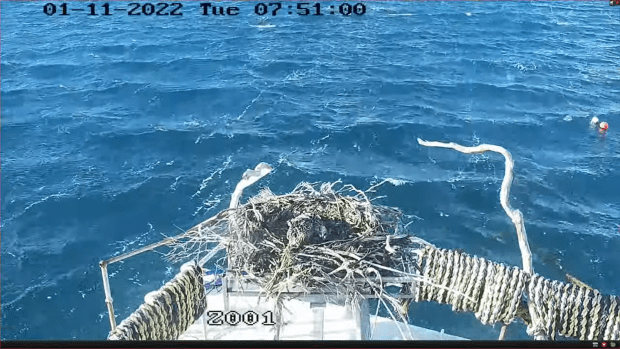
The answer is ‘yes’. There is a standard practice by banders to leave fish on the nest after they remove the chicks from the nest and return them. Additionally, there were fish placed on the Port Lincoln barge nest just around 0906. You could see two hands. It is apparent that Port Lincoln applied for and was given permission to supplement the fish for the nest. Sadly, those fish came late. Hopefully permission can be given to PLO for eventualities, a blanket permission if this situation presents itself in the future.

The Australian Nest and Scrapes:

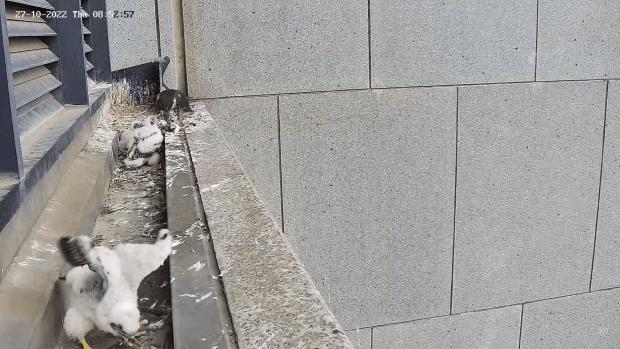
367 Collins Street. The Melbourne Four. Look at that eyas below. There are only a couple of dandelions on the head and wing, reminders of its fluffy youth. What a beautiful falcon. It is the 4th of November in Melbourne. If the scrape at Charles Sturt University in Orange goes on fledge watch around the 12th, this means that we are entering fledge watch at the Melbourne scrape for the eldest tomorrow. I must check that!

‘H’ reports that there were at least two prey drops on camera and one off yesterday. The eyases have also been chewing on all the leftovers in the scrape.

And if you are wondering, no one cleans up the area. The wind and the rain between the end of this season and the beginning of next seem to do a good job. Falcons also like to know that wherever they raise their eyases is a good prey area so if they see a scrape like this one, well, they will know in an instant. That said, you will notice, that when the eyases are quite tiny the Mum will keep the scrape pristine for a bit. It helps to detract predators if there are any.

Wow. Look at those wings!
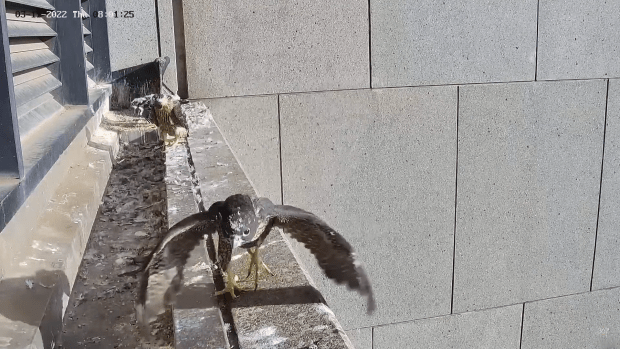
Seriously adorable.

Mum deserves to be proud. Look at her four ‘babies’. They are nearly ready to fly off the ledge and start learning how to hunt their own prey. Soon – if they have not already started – Mum and Dad will do flying lessons, some with and some without prey, to lure the eyases into fledging. There is still some time to go. They need their fluff gone!

Do you remember when we worried so much about this particular scrape? I have almost forgotten Mum leaving these wee ones in the middle of the day in the Melbourne heat before they could stomp down to the other end. They survived. Mum and Dad did well – first time parents.

Rubus and Indigo are precious. Fledge watch will start for Indigo on the 12th of November. I simply hope that Rubus doesn’t do what he always does and copy her immediately. He will not be ready.

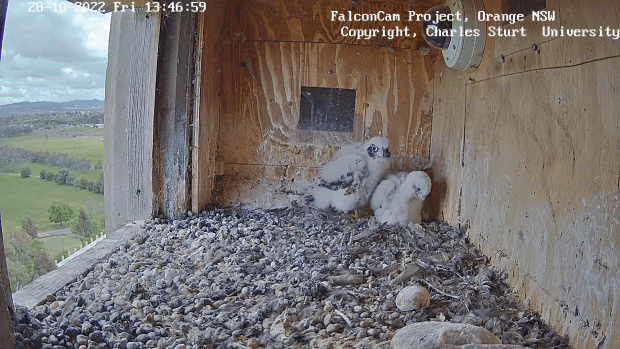
The only prey so far at Orange is the early delivery of that large prey item. It is now 1439. As the chicks get older, the number of feedings drops considerably because the eyases can eat more and more at one sitting. I bet they would love a parent to fly in with a nice fat pigeon right about now.

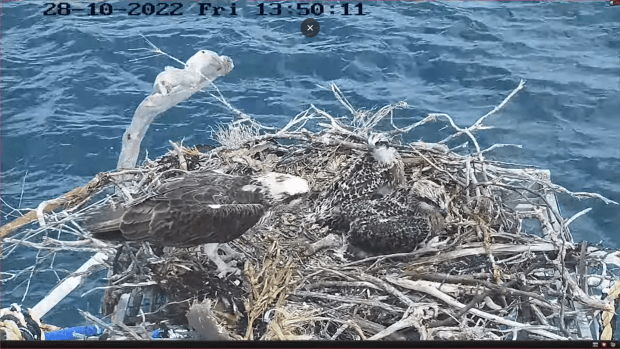
One of the most tender moments on any nest is when one of the adults feeds the other. In this case, this morning Mum fed Dad at Port Lincoln. He brought in a huge fish and Mum and Big had been eating for an hour and a half. What a wonderful way to thank your mate. And it was more than one bite!

We need to pause and imagine just how hungry Mum was. I need to remind myself of this. How many times did we see her feed almost every bite of fish to the osplets? or just to Big without having more than a handful of bites herself. She must stay healthy and the same goes for Dad. I often say it is like flying in the plane, ‘Put the oxygen mask over the adult before the child.’ Mum did not always do that and there were plenty of times that Dad came to the nest and there was no leftover fish.

Both of these parents are mourning the loss of their chick. They don’t have the liberty to take a mental health day like I did, they must be there and carry on, making sure Big fledges.

The arrival of the big fish on the nest this morning.

It was a lot of fish and would keep Big until tomorrow if another does not come on the nest today.

Port Lincoln has expressed some concern that other chicks were lost on unmonitored nests during this period of bad weather where the males were unable to bring in enough fish.

Let us all hope collectively that permissions to assist with fish come in a timely manner or a blanket permission.

Migration News:

Bonus has found a good place to rest and feed now that he has left Greece. He is currently in Konya Province in Turkey just north of Lake Seydisehir.

Waba is feeding along the Nile River in Egypt.

Making News Elsewhere:

I am finishing reading Bowland Beth, the story of an extraordinary Hen Harrier who died way too young. A second book, The Hen Harrier’s Year by Ian Carter and Dan Powell (newly released) arrived today. I am very interested in the topic of the Hen Harrier because they are becoming more rare than they already are because of persecution by grouse hunting community and the games keepers. In the Foreword to the book, Roger Riddington states, ‘In recent years the Hen Harrier has become the de facto flagship species for the birding community in its stance against raptor persecution.’ While the Hen Harriers are, in particular, being shot with their populations on the knife edge, it is also other raptors that we should be concerned with as well – such as the White-tailed Eagle.

A recent report talks about the ghastly people who are these games keepers and how sadistic they are. It is good that the Scottish government has taken a stance and the prison terms will be such that they might deter the practice. The real way is to outlaw hunts. Fox, Red Grouse, you name it…outlaw them.

Convicted Millden Estate gamekeeper Rhys Davies had ‘formed a close bond’ with another animal-fighting sadist – Raptor Persecution UK

Something to feast your eyes on – patterns created by our feathered friends in flight.

https://www.theguardian.com/artanddesign/gallery/2022/oct/29/xavier-bou-ornithographies-birds-patterns-flight-in-pictures

What if there are no birds to create the images the artist depicted above? What if the climate is heating faster and faster and warming the seas quicker? There are many sobering questions for humans who have caused the destruction of our planet and the myriad of challenges for our beloved birds (and all wildlife). The warnings of our planet heating faster than anticipated are beginning to make headlines in certain papers.

https://www.theguardian.com/environment/2022/nov/02/europes-climate-warming-at-twice-rate-of-global-average-says-report

There is also news coming in regarding SE29 from the Sea Eagle Cam. There is no news on SE30.

November 2 : news from the vet caring for SE29 : today SE29 has moved into a slightly larger room that can be monitored with CCTV -doing as well as can be expected , everything is stable at this point.

Harriet and M15 on the branches after working hard on rebuilding their nest destroyed by Hurricane Ian. If they don’t put a smile on your face, I honestly do not know what will!

The first Bald Eagle egg of the year has been laid in Florida. That honour goes to the nest of Superbeaks, Muhlady and Pepe. The first egg of the Royal Albatross season has been laid at Taiaroa Head. Those parents are GK (Green Black) and BKW (Blue Black White).

Remember to send some of the names you came up with for the Alphabet Game by midnight tonight! E-mail is: maryasteggles@outlook.com

Thank you so much for being with me this morning and being the caring community that you are. Please take care as we all collectively heal. See you tomorrow!

Thank you to the following for their posts, their videos and/or their streaming cams where I took my screen captures: ‘H’, Port Lincoln Ospreys, 367 Collins Street by Mirvac, Charles Sturt Falcon Cam and Cilla Kinross, SWFlorida Eagles and D Pritchett, The Guardian, and those great people at the Looduskalender Forum.

Without words…Middle dies at Port Lincoln

2 November 2022

Good Morning Everyone,

When I went to sleep last night, I knew that I would wake up and Middle would no longer be with us. What an absolutely tragedy. He was so dehydrated that he was no able to lift his little head and eat despite the fact that fish after fish came on the nest….and the one time he did, Big attacked him. I apologize for this newsletter being highly disjointed. I do get upset when one dies, it digs at my heart for the days leading up to the death and then after. Somehow Middle is hurting the most. He was 43 days old, fully feathered, and his death did not need to happen.

Middle when he was still alive. Cold and needing comfort.

At this moment in time, I cannot tell you how rare it is in % for two osplets to die of siblicide on the same nest. Yes, siblicide. Textbook siblicide again just as with Little Bob. Port Lincoln is the only osprey nest that I have ever encountered where a double siblicide has now been recorded in three years: 2022, 2016, and 2015.

In 2017, the eldest threw the youngest (only 2 hatched) off the nest at 65 days. Stevie went into rehab and died a few months later. It might well be this single incident 5 years ago that makes the Friends of Osprey believe that Ospreys do not do well in care. I say now – for the future – take a bold step Port Lincoln. Get permission to remove the chicks when it is not too late. Get them to a rehabber that cares – someone like Dr Madis in your area, there must be someone in the whole of Australia! – and let’s try this again! Don’t wait for them to be thrown out of the nest or get so weak they can’t raise their head.

Claudio Eduardo and I are developing the International Data Base for Ospreys. It is to find out this % on streaming cams. No one has ever tracked predation and siblicide internationally. Sadly, Port Lincoln is our first entry for the year.

Despite the anticipation of what seemed the inevitable, I was having a really hard time anticipating the death of Middle so, as usual, I began my blog for today quite early yesterday. Dear Middle wanted to be warm and wanted some fish. And darling you, you got spunky and we just knew you would make it — against the odds of this nest – with a big aggressive female as first hatch. I am so very, very sad that you didn’t.

________________________________________________________________

Good Morning Everyone,

I hope that this finds you well. There were some changes in my house yesterday. Two small rescue kittens, 11 weeks old, have come to stay. One is a soft long hair tabby female and the other is a grey tabby with white runners in front, tall boots in the back, a white bib and tummy and he is Lewis – after Lewis Hamilton, the race car driver from the UK. The reason is simple – Lewis runs around the house so fast from the front of the L to the conservatory barely stopping and heading back the other direction. I fell in love with him for his energy and love of toys. The yet-to-be-named female is sweet but, like the female raptors, she let Lewis know immediately that she is one week older and is ‘the boss’. He agreed and went on playing. They are getting along splendidly.

It was a real delight to watch Lewis sitting under the table peering out of the windows at the birds. I was ever so hopeful that they would enjoy watching them…they will never be outside to bother them. Did you know that, on average, outdoor cats live to be 5-6 years old while indoor cats live to be 17-20? Less vet bills, fewer infections. It is a no brainer — and the birds live. Not killed by an overfed pet to be left lifeless on the grass. Nope. Lewis and his sister can only dream!

It is very, very dark on the Canadian Prairies as the time nears 2100. The temperature is 11 degrees C. Warm for this time of year with clear skies and lots of stars. The temperature will rise overnight until it is an unthinkable 18 degrees C tomorrow. For those used to F, that is 64.4 degrees. In Port Lincoln, it is 14 degrees C at noon; it is 13 degrees in Melbourne. Similar. But for Port Lincoln this is freezing.

There are rumours making the circuit that Middle had a ‘ps’ (poop shoot) at Port Lincoln this morning. If that is the case, then Middle has had some fish. Osplets that have not eaten much in 3 days are dehydrated, no ‘ps’. I find that somewhat promising. And then I don’t. It is extremely cold and windy for Port Lincoln.

Fish arrived. Lots of fish. Big ate and ate. Middle got none.

It is now after 1400 on the nest. Middle has had scant food for more than 3 days. He appears to be slowly drifting away. His energy is gone. He is totally dehydrated. It is a horrible way to die. With winds gusting to sometimes 50 mph, I feel that there is no hope for this little fighter. It is a tragedy. I did not ever think that I would see this when things were looking up last week.

It is 2300 in Winnipeg. I know that Middle will not be here when I wake in the morning. We weep for all the Littles and sometimes a Middle…the people in the area that live and work in Port Lincoln, that care and love these Ospreys needs to have a serious look at the depletion of the fish in that region. More on that shortly.

I cannot even express how sad this is.

In his book, Bowland Beth. The Life of an English Hen Harrier, David Cobham says, ‘These young lives are full of hazards: they need to be able to contend with prolonged periods of bad weather; they run the risk of being shot; in the excitement of chasing prey they may collide with vehicles or overhead wires; ground predators sometimes catch them unawares at their roost sites; and inter-guild predation by buzzards and goshawks may also be responsible for culling weak and unwary juveniles.’ (90) We could change the language slightly for our Ospreys but, right now, the entire family at Port Lincoln is having to contend with a 3 or 4 day period of prolonged stormy and cold weather.

I am almost finished reading Bowland Beth. Cobham is a gifted writer. I know the ending of the story. Most that pick up the book already do but, we are draw into the life of this exceptional raptor that was cut short by the Red Grouse hunts. It is a riveting and moving book and a must read if you want to understand why it is so important to ban the annual shooting hunts on the big estates and why the burning of the heather should be banned, at the same time. It is also about the short live of a very exceptional raptor and that was enough to get me reading. Cobham draws you into the day to day life of this bird trying to survive.

Did you know that the origins of ringing birds is traced to the Reverend Gilbert White? I didn’t. He would tie a cotton ring around the leg of a swallow to see if it would return to the same nest the following year. The metal and coloured rings that we are familiar with today are credited to Harry Witherby and Landsborough Thomas of the British Trust for Ornithology in 1937.

When Bowland Beth was ringed, this was how she was described, ‘Bowland Beth was one of those birds that you come across now and then that are absolutely perfect – her plumage, a rich, glossy chocolate brown, the most wonderful eyes, yellow irises, and vivid chrome-yellow legs with formidable black talons. She’s what I call a ‘super’ hen harrier.’ (74-75) Oh, had she lived!

There are no issues with either the scrape at Orange or at 367 Collins Street. Regular meals, the eyases developing right on schedule as if they read the textbook! Rubus – I almost called the new kitten Rubus because it is so energetic – is being his usual self. Or is it a her? It will be interesting to see what Cilla says. Rubus has certainly had a spurt in growing but its legs seem long and thin to me for a female. But, I am not a falcon expert. Let’s see what Cilla has to say.

Following Diamond’s instructions, Xavier brought a Starling in for Rubus and Indigo. He left it on the scrape despite the prey begging from Rubus. These two will need to learn how to self-feed if they are to survive in the wild.

Rubus is very curious and picks on the feathers and the head under the watchful eye of Dad. Indigo is not dazed or interested.

Xavier leaves. Indigo has joined Rubus staring at the prey wondering what they are supposed to do with it.

In this image you can get a really good look at the difference four days makes in growth. Examine the length of the tail feathers and the amount of down left on the back and wings of each eyas. Rubus still looks like he has been playing in the cotton candy machine.

Rubus goes back and works on the head of the Starling.

Then Diamond arrives to feed these two…look at Rubus almost push Mum over trying to get a bite of food.

Rubus is very aggressive. S/he is very hungry!

What a bunch of characters. Just look at their eyes!

Speaking of adorable…here is a video of selfies from the Orange scrape from yesterday. Rubus and Indigo can put a smile on our face and take away the utter sadness that we feel for Middle and his plight.

There are falcons on the 367 Collins Street nest! Just look at them and look at that mess – poop shots everywhere, feathers all over the place, the messier the healthier. Seriously.

Sharon Pollock put together a good video highlighting the new female – the Mum of the extraordinary Melbourne Four of 2022.

Back in the world of Bald Eagles working on their nests and we find the female at nest E-3 at the Kistachie National Forest not liking the wires that Cody put up for the camera and the sound. Let’s hope she doesn’t decide to do serious damage! The white wire is the sound.

At the Bald Eagle nest on the campus of Berry College in Georgia, Missy and Pa Berry are getting their nest in order. They fledged B15 last year and what a fabulous fledgling he was!

The GHOWs are starting early at the Southwest Florida nest of Harriet and M15. They are already knocking Harriet off the attic branch and her and M15 haven’t even finished rebuilding the nest.

Making News:

This is a great read. One of the things that I want to point out is the thank you at the bottom to all those who voted. 50,000 Euros were at stake and that prize has gone to a place that can really use it to help protect the albatross. Next time you see a chance to vote, look over the possible recipients and make your mark. It can truly make a huge difference.

Dr Sharpe and all the researchers at the Institute for Wildlife Studies have developed a mobile hospital to take on the needs of the raptors. Now, isn’t this a great idea. Something like this might work well in places like South Australia where there are no such services for Ospreys! And if they could get an Urmas and Dr Madis on staff – willing to take on an extraordinary project to try and give birds a chance that are normally written off as not doing well in care — well, everyone would be a winner. I am still sending loud cheers to the team in Estonia who advanced knowledge in the care and rehabilitation of Black Storklings. Bonus is living proof that their theories on how to care for the storklets worked!

https://www.iws.org/mobile-wildlife-research-hospital

Someone asked me once – oh, more than once – how I can deal with siblicide. It tears a piece of your heart out every time. Today is particularly difficult. Keep Middle in your thoughts. May he fly far, never to be hungry, never to be hurt, never to be cold – again.

In the memory of Little and Middle and all the other osplets that died on this nest because of siblicide and the few who did live to fledge, It has to be asked, based on the historical evidence at this Osprey nest in South Australia, WHY is siblicide so prevalent? Is it the lack of fish in the area? the erratic fish deliveries? Are we witnessing in Australia the need to raise fish for our Osprey families because we are depleting the oceans? is climate change impacting the number of fish?

Someone needs to be asking these questions. As I was once told, Australia and New Zealand are on the front line for climate change. Australia do something bold. Show the world that you care for your wildlife. Be proactive like New Zealand is at Taiaroa Head. Feed the chicks! Feed them. Put fish on the nest at Port Lincoln. Stand up and make the argument to the Ministry of the Environment and Water. Raise the fish and place them on the nest openly and with permission. Pull an Urmas and Dr Madis – get so proactive that the world will not stop talking about your kindness and care for your wildlife.

I will be taking a day off in memory of both Little and Middle Bob. I will be back with you on the 4th of November.

Thank you for being with me today. We will collectively grieve for that beautiful second hatch at Port Lincoln who had such potential… a life that we will never witness now. Take care everyone. Be gentle on yourself.

Thank you to the following for their posts, videos, and streaming cams where I took my screen captures: Port Lincoln Ospreys, 367 Collins Street by Mirvac, Charles Sturt Falcon Cam and Cilla Kinross, Albatross Lovers and BirdLife Australia, IWS, KNF, SWFL and the Pritchett Family, and Berry College Eagles.

Worry for Middle at Port Lincoln as fish are few…and other bird world news

1 November 2022

Good Morning Everyone,

I hope that your beginning of the week has been a good one. We are on the third bad weather day at Port Lincoln and Middle has had little food. It is a very somber day. We wait to see if the weather changes and then to see if Big will allow Middle to eat. Things are not looking good. I wish I had great news for you this morning but ever so sadly, I do not.

Some of you are coming in late to the Alphabet-Name Game. It is for fun but, I have also discovered that it is a really good way to remember our feathered friends. Someone wrote that SE26 needed to be remembered and, well, the tap started running. That sea eaglet was such an inspiration to so many. I am so utterly deflated that she is not with us! — But, back to the fun part. Take a digital or physical piece of paper and put down all the letters of the alphabet. See what names of the streaming cam birds you come up with for each one. E is for Ervie. A is for ______________. Who can come up with a name for U? Anyone watching those Finnish Osprey nests? Send me your list by e-mail before midnight the 2nd of November. I will then set about collating them hopefully with some pictures! I hope to have the list complete over the weekend. Thank you to those that have already sent in their names. I saw so many that I knew and had forgotten! And do not feel bad if you come up with a lot for one letter and none for others, just send them in to me and join the challenge! That e-mail is: maryasteggles@maryannsteggles.com

In the Mailbox and Comments:

‘F’ comments: ‘The Port Lincoln nest is the hardest I’ve seen since I started seeing ospreys at the beginning of the year, very hard, the only thing missing is for the mother to be sick.’

You are so right, ‘F’. Yesterday I thought we had lost Mum and my heart just sank watching Dad try to feed the two osplets, Big and Middle, and failing miserably. It is very difficult to watch a nest that does not have enough fish. As I continue to mention, I have huge concerns over the commercial tuna fishing fleets that are based in Port Lincoln. Are they taking all the fish? I hope to find out more about this later.

NOTE: There was only 1 fish yesterday, 1 November, in Port Lincoln. Big attacked Middle many times. Mum is currently sleeping on top of Middle. I am concerned now that Middle will not survive unless there is a massive amount of fish brought to the nest. There will be no intervention. Port Lincoln would not have permission unless as Ian Falkenberg and others have said they deem the bird to be ‘near fledge’. There have been ospreys taken into care who have done well at Audubon’s Centre for Birds of Prey at Mailand, Florida such as Smedley who lived to be 28 and Bailey. I am attempting to find other factual information on Ospreys in care. If you know of any, please let me know.

Smedley and Bailey at the Audubon Birds of Prey Centre in Maitland, Florida. Smedley passed away in the past year at the age of 28. Bailey is still alive at the Centre and I understand there is another osprey in care…perhaps more. I must check with our friend ‘L’ that works with these amazing raptors to find out precisely how many ospreys have gone through the centre. Some have stayed as ambassadors while others are returned to the wild.

Making News:

Just more research findings supporting birds and nature are good for our health and might, in the future, be prescribed by doctors! Have a read and smile.

https://www.theguardian.com/environment/2022/oct/27/bird-birdsong-encounters-improve-mental-health-study

There is a new article on birds and pollution by the British Trust for Ornithology. Have a read when you get a chance. We can all learn something new every day!

https://www.bto.org/understanding-birds/articles/birds-and-pollution-%E2%80%94-masterclass

Australian Nests:

One of the older siblings of the Melbourne Four looks up perhaps seeing the parents flying about. Next to her in the gutter is the wee 4th hatch, a little boy.

Victor Hurley, the head researcher for the Victoria Peregrine Falcon Research Group, has posted what he believes are the genders of the Melbourne Four on FP. Here is that announcement:

Oh, goodness. Ervie’s tracker has been off line for a few days and last night the camera went down on the Port Lincoln Osprey barge just when we were all getting more than concerned for Middle. Ervie has been seen roosting on a tree near the water so he is fine. He had flown away early probably hoping to find some fish.

The waves are really, really choppy at Port Lincoln. Rain and gales have hit the nest and the number of fish deliveries has been dwindling since the start of the stormy weather. There was only one fish delivered on Tuesday.

This is one gorgeous osprey looking at us with their crest up high.

They are hard to differentiate between unless they are standing up and you can compare size and then see both head’s. Middle is missing feathers from the nape and so is this bird with this gorgeous crest. Is this Middle? or is it Big fooling me?

‘A’ tells me that there is even snow predicted for Port Lincoln. I simply cannot believe this is happening. This nest is ‘fragile’.

Everything is fine at the scrape box on the water tower in Orange. Indigo is really flapping those wings and Little Rubus watches and then he does some precious little flaps, too. He copies everything that Indigo does – my goodness what an utter joy it is to watch these two grow up together.

Indigo works her wings all during the day. Little Rubus often watches closely and if you look, he will give a little flap to his wings.

Xavier brings in a European Starling for breakfast. Indigo gets frightened and moves back toward the wall and then scurries to the Cilla Stones.

Just look at that beautiful Dad, our loving Xavier.

Xavier decides to take the prey and prepare it elsewhere. By this time Indigo is curious and hungry and comes down from the stones. Will that Starling return?

Yes, it does. Xavier returns in about 50 minutes and Diamond flies in to take the prey and feed Indigo and Rubus. Oh, dear. Look at that is left on the stones!!! The Starling Head. Indigo is going to be scared out of her wits when she sees it.

Just look at those beautiful tail feathers now revealed. If you look at Rubus, he is now losing the soft down from around his eyes and on his wing tips.

Every time Indigo really gets to flapping more down flies through the scrape.

The eyases had a Starling feeding but the head was left. Diamond comes in to take it and Rubus rushes over to take it. Poor Indigo. Rubus is going to put it right near the wall where she is sleeping. Will she be frightened when she wakes up and there is that beak and eyes staring at her? Rubus has never been frightened and Indigo is so easily scared. It would be a trick a younger sibling would pay on its older one!

Rubus grabs the head.

He carries it over and places it next to Indigo!

Diamond returns in a few minutes and retrieves the head and feeds it to Rubus. I don’t think Indigo even moved. Rubus is an endless pit when it comes to prey. Where does he put it? Definitely not in his skinny long legs.

Indigo and Rubus had a European Starling and a Large Honeyeater (Noisy Miner) for their morning meals. Rain is forecast for Orange, too. You can see some dark clouds looming in the distance.

The Melbourne Four continue to be fed and to find out when you have to listen and watch them scurry down the gutter towards the adult with the prey. Their legs are certainly getting stronger and the oldest is starting to look like a juvenile falcon!

Just checking on some of the Bald Eagle nests in the US as the couples continue to do nestorations or rebuilding.

Jackie and Shadow’s nest at Big Bear in California.

Gabby and Samson’s nest near St Petersburg, Florida.

Ron and Rita’s nest in the Miami Zoo.

Bella and Smitty have been bringing in nesting materials to the NCTC nest.

Lady and Dad were bonding at the WBSE nest in the Sydney Olympic Forest.

My thoughts go out to the Port Lincoln nest this morning as we wait to see if Middle will survive. I am sure that I speak for all of us when I say that it feels like our heart has been pulled out of us. The turn in the weather and the amount of fish at Port Lincoln has put our beautiful Middle’s life in jeopardy.

The other two scrapes we have been watching are doing just fine. Much of the fluff is now off three of the falcons at 367 Collins Street. There is plenty of food available at both scrapes.

Take care everyone. Thank you for being with me. See you soon.

It is freezing in Port Lincoln tonight. Turned really, really cold. Mum is working hard at keeping Middle warm. Beautiful Mum.

Thank you to the following for their posts, videos, and streaming cams where I took the screen captures: ‘A’ and ‘H’, Audubon’s Birds of Prey, The Guardian, Port Lincoln Ospreys, 367 Collins Street by Mirvac, Charles Sturt Falcon Cam and Cilla Kinross, Victor Hurley and 367 Falcon Watchers, FOBBV, NEFL-AEF, WRDC, Sea Eagles@Birdlife Australia Discovery Centre Sydney Olympic Park.

Birds at the Zoo…and breakfast with the Australian nests

28 October 2022

Hello Everyone!

So happy to have you here with me. I set out ‘in my mind’ last evening that I would get up early and head out to find Snowy Owls sitting on large round hay bales near Oak Hammock Marsh. I got a text from a friend – ‘no’ owls seen. So, determined to see a Snowy Owl today, I did something entirely different! I went to the zoo.

How long has it been since you have been to a zoo? With all the criticism against keeping animals in small cages, our Assiniboine Park Zoo set out to try and make the enclosures for the animals considerably larger. At the same time they addressed issues of ‘boredom’ and the environments that the animals would live in if they were out in the wild. It was a much more pleasant place to visit because of those major changes.

One of the zoo volunteers saw me looking at the map and asked me what I wanted to see. The answer was Snowy Owls and Birds. I wonder if they were disappointed that I didn’t say ‘tiger’ or ‘cougar’. As it happened we were very close to the Snow Owls and it was feeding time. Fluffy yellow chicks raised specifically for the purpose were being dished out. For several seconds, it seemed that a woman standing near to me was going to pass out she was so overcome by seeing the owls eat the chicks. I stood in wonderment trying to figure out if she thought that they ate lettuce – our zoo purchases an inordinate amount of Romaine lettuce – or fruit. It is a good thing that she was away from the cougar or the Stellar’s Eagle compounds at that specific moment.

The real character of the entire four hours was the Toucan. He made eye contact immediately. What an incredibly beautiful bird he is.

This is the Toco Toucan. They are the largest of the species at 62 cm long with a bill/beak that is 17 cm long. Their lifespan is approximately 20 years. The Toco Toucan is native to South American rainforests where its numbers are decreasing due to deforestation.

I wish we could have had a conversation. This chap was a real cutie pie.

These little Sun Conures were tiny in comparison to the Toco Toucan. No wonder they have the ‘sun’ as part of their name. Oh, those faces ranging from yellow to orange to red are the colours we painted the sun as children. They are native to northeastern South America. They are approximately 30 cm in length but these certainly did not look that big unless you count that long olive green tail in the measurement! These little cuties were using their bill and their feet to dig around the edge of their enclosure. They have a stubby quite muscular tongue that helps them move their food around in their mouth.

This beautiful Golden Eagle was finishing up its breakfast and not the least bit interested in anyone looking at it. What a beauty. It is one of the largest birds of prey in North America, about the same size as a Bald Eagle. Unlike a Bald Eagle whose legs and talons are bare, the Golden Eagle has feathers on its legs. In Canada, they are ‘at risk’. Their meals consist of small mammals such as rabbits and squirrels.

The Stellar’s Sea Eagle is the largest of the sea eagles. With its striking bright yellow beak and legs and its espresso brown/black and white plumage, it is easy to recognize this raptor. It has a wedge-tail and fine pointed wings. They are rare. In the northern areas they will stand on the ice and fish and love the salmon in the north. It is thought that they almost exclusively breed in the north of Russia. You may recall that there is a Stellar’s Sea Eagle that has come to Newfoundland, Canada travelling south to parts of New England. I believe it is back in Newfoundland.

There were so many little Red Squirrels. This one is eating a ‘helicopter’, the seed of the Maple Tree.

Little Red stuffed these Maple Tree seeds in every part of the old shed. There were boxes full. Never knew if he used them for insulation to stay warm as well as eating. There is a large box full of them in his new home if he ever moves in!

It was great fun. Lovely to see families out with small children running about. Next time you are looking for a place to go – think the zoo!

A very small fish landed on the Port Lincoln Osprey barge at 061847. Middle got some of the tail but Big got most of it at 062652.

Breakfast arrived at 0618 on the ledge of 367 Collins Street for the Melbourne Four. Another plucking lesson, too!

This big one has run off with a nice piece and is self-feeding.

After eating it was running to get those legs strong, finding scraps of prey, and flapping those wings. What a brilliant place for these eyases to get exercise! I wonder how being able to run and flap freely – running a great distance – might give these falcons an edge in terms of physical strength that would help them survive? Just a thought!

This is the Recap for the morning feedings at Orange. Goodness Xavier has been busy hunting!

BirdieCam​ RECAP: 6:07:33 starling, X leaves, 6:20:58 D feeds; 6:38:31 X w/RRP?, he feeds; 09.13.33 X w/Noisy Friarbird, D feeds

Everyone has had breakfast, some more than others. Wish for fish – a big one for Port Lincoln.

Take care all. This is just a quick check and all are doing well at the 3 nests we are watching in Australia.

Thank you to the following for their streaming cams where I took my screen captures: Port Lincoln Ospreys, 367 Collins Street by Mirvac, and Charles Sturt Falcon Cam and Cilla Kinross.

Anything you can do, I can do it, too! and an update on SE29 and other tales in Bird World

28 October 2022

It has simply been an extraordinary day on the Canadian Prairies. Here it is 2113 and the temperature is +10 C. Earlier it was 13 C. There were individuals walking around with their summer flip flops! Fall is such a harbinger of the cold, cold winter that well, it is nice to have a break. I am starting the news for tomorrow because it is happening right now in Australia. Tomorrow I hope to get out early and find some Snowy Owls in the fields north of where I live. Perhaps a Northern Harrier or two and might there be a duck?

Snowy Owls arrive in Manitoba when the temperature begins to drop. You can see Snowy Owls on the utility poles, hay bales, and in the fields of Southern Manitoba. They rarely venture to the center or the north of our province. They blend in perfectly – their beautiful white plumage with its dark flecking – with the snow covering the land. Their eyes are a bright yellow as are their legs. They feed on grouse, lemmings, rabbits, and weasels in the winter. Any that remain here in the summer live off of voles and mice in the fields. We always think of owls as hunting from dusk to dawn but, the Snowy Owls hunt during the daytime. They range in size from 50-70 cm with reverse sex size dimorphism (the female is noticeably larger than the male).

This beautiful image is “Snowy owl (female)” by Marie Hale is licensed under CC BY 2.0.

Making News:

Update on the status of SE29. Oh, my goodness, a broken leg above the talon. Sweet baby. So glad 29 is in good care!

Missing Annie and Alden? They were bonding in the scrape box yesterday!! ‘H’ caught it!

Progress is being made on the Notre-Dame Bald Eagle’s nest that collapsed. This is the natal nest of Little Bit ND17. Parents working very hard to get it ready for the upcoming breeding season.

Australian Nest News:

Friday on the Port Lincoln Osprey barge has simply been ‘interesting’. The day arrived with a small fish and deep breaths as I wondered whether Big would attack Middle. Or would Middle decide to give Big a peck again? ‘H’ calls what Middle got last night as ‘The School of Hard Knocks’ – it certainly was! But, today both have been civil. That said, something else is happening.

If one of the chicks does something, the other immediately does the same thing. Now seriously bear with me. This meant that both of them stuck their little bottoms in the air and did a PS in the window of 1030 and 1031. I kid did you not.

Big was sleeping and Middle was looking out over the water with a really nice crop.

Middle begins flapping his wings.

Then Big stands up and flaps her wings.

Middle raises up its fat little bottom with its head bent down low and gets ready. At the same time Big begins to lower her head and raise her bottom.

Middle goes first. Just look at that incredible ps. This chick has been eating well…if we did not know it we could ascertain that from the volume and the velocity of this incredible perfectly white ps. (There are some sticks there as well, check above or below so that you can tell what is ps. Middle has strong legs and a fat bottom and is growing like an incredibly bad weed.

Nine seconds separate the ps of each osplet.

Then Big decides to do some wing flapping.

Then Middle! The one good thing about their method is that it allows room for both to flap on the nest. I sure wonder what Mum thinks when she watches these two.

Then they both quiet down.

Dad arrives with another fish. It is 1232.

Gosh, I couldn’t see the size of that fish but Mum was still feeding the osplets at 1300. Big appears to have gotten the largest share. In the image above you can already see the crop that is large and — it will continue to grow!

At 1301 Middle had to stop eating and have another ps. Then he went back to the table probably hoping to get some more good bites which he did get. Now will he get that important fish tail?

Then – all of a sudden – the two osplets look up and there is Dad landing with another fish. Can you believe this?

Dad lands with a very small fish. A good practice fish for self-feeding. Mum ignores him and continues to feed Middle. She also gives some bites to Big who seems to always be able to find room for more.

At 1315 Dad takes his unwanted little fish and I presume goes over on the ropes to have his own lunch.

Dad returns empty taloned. He is looking closely at the fish that Mum is still feeding Middle and Big. Mum has been feeding the two and herself for over an hour. That was a BIG fish!

Incredible. At 1350 Mum is just finishing up that fish. Happy to see her eating well today, too.

Middle and Big had another meal at 1945. Wow. Dad is having some excellent fishing days.

Rubus and Indigo are adorable. Indigo ran off the Cilla Stones this afternoon to join Rubus in the corner. Oh, these eyases are so cute! That cuteness comes in part from their behaviour – their facial expressions, their interaction with one another and with Xavier and Diamond and their environment inside the scrape.

Rubus has been playing with the feathers. Is he looking for food scraps?

Indigo is over on the Cilla Stones watching her little brother as he intently stares at a feather.

Wow. That was a bit of a leap. Has Indigo been secretly going to gymnastics classes? I wonder how many points she would get for that landing?

Indigo is so curious as to what Rubus is doing and finding in those stones in his corner of the scrape.

Ah, two little sweeties! ‘A’ tells me that Cilla is certain that Indigo is a female as she is already as large as Xavier and still growing but, will not declare gender of Rubus for a bit. Four days younger and he is growing and growing. I have always called Rubus a ‘he’ and said ‘little brother’ but, in fact, Rubus could be a little sister for Indigo.

‘A’ notes that Indigo is losing all of her cotton fluff and will be looking much more like a falcon as Rubus continues to copy everything she does and remains a ball of cotton. From the time stamps that ‘A’ sent me, these two had a few good meals yesterday. Looks like there were five – that is appearing to be the daily average for the scrape at Orange.

The Melbourne Four seem to have relocated – for part of the afternoon – to the other end of the ledge.

The eyases are running up and down and then resting. All is well. No need to panic! ‘H’ caught them doing their famous gutter stomp heading to the other end for prey!

The weather report from ‘A’ for the eastern coast of Australia is rain and more rain. Storms put out power and pumps were working over time. This could inpact hunting for the Melbourne adults. We wait to see.

Thank you so much for being with me today. Take care of yourself. See you soon! (Please be advised if the weather is grand, I could well be out birding until late Friday. There might not be a late evening newsletter going out after this one. If that is the case, I will see you Saturday morning!).

Thank you to the following for their posts and streaming cams that make up my screen captures: ‘H’ for her video clips of Cal Falcons and the Melbourne Four, ‘A’ for her over view of the nests, the Eagle Cam, Window to Wildlife, Port Lincoln Ospreys, 367 Collins Street by Mirvac, and Charles Sturt Falcon Cam.

Middle takes the Fish Tail…and more news in Bird World

26 October 2022

Hi Everyone,

I hope that you had a really lovely afternoon.

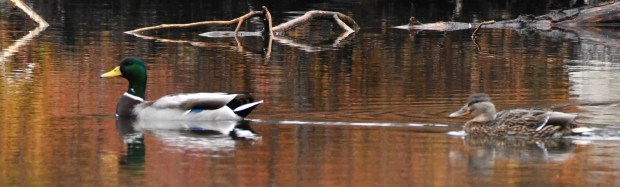
It was not a particularly beautiful mid-afternoon on the Canadian Prairie. The forecast is for the temperatures to climb tomorrow and last for 3 or 4 days. Good days to go out and see the local wildlife. Still, today was not a disappointment. While waiting for three Canada Geese to cross a road, in front of them, down about 5 metres were three fauns crossing over, too. What a beautiful sight and, how nice it was that everyone slowed down to let them move at their own pace! At the local pond, there were about 200 Canada Geese on the soccer pitch with only a few in the water along with a lone male Wood Duck and a pair of Mallards.

Nearer to home, more than 35 Crows gathered in a nearby tree. It was only 1500, too early to be having a communal roost. Was there any Owl in the neighborhood that was bothering them?

This is a small corner of the tree. There were so many that flew in. Normally this time of year the Great Horned Owl comes by and all the Crows gather to usher it out of their territory.

The first of the Australian raptor families to have breakfast this morning appears to be the scrape box on the water tower at Charles Sturt University. Xavier came in with a nice bit of prey at 0726. The eyases were sound asleep until his arrival. Indigo ate first with Rubus joining in. Indigo then moved to the corner and Rubus continued eating. Where does he put it all? Then Diamond arrives. Xavier moves and eats some prey on the ledge. Diamond searches for leftovers. Meanwhile, Indigo is on the Cilla Stones wondering what in the world is going on?

It is a wet morning in Port Lincoln. Middle and Big are waiting for their breakfast fish to arrive.

A nice fish arrived and if you were watching that feeding, you might have been wishing that Big would get a few more bites! Now isn’t that a switch? Middle dominated the feeding from the onset to the ending. At one time, Middle turned away – possibly thinking Big would get grumpy if she didn’t get any fish! Then after Big got a couple of bites, Middle leaned back in and ate some more! Goodness. There was no beaking although I noticed Middle eyeing Big and wondering and one time Middle raised its neck up and looked directly at Big as if to dare her but…nothing happened. Big is docile. Meanwhile, Middle still does a lot of snatch and grab even if the feeding is directed at him. Still a little nervous. That is a good thing. It will bode him well for his future.

I love how Middle opens his beak wide letting Mum know he is ready!

Middle just keeps getting bites of fish and more fish and all the while he is sitting right next to Big. Cautious but never as fearful anymore.

Big gets the lion’s share of that fish. Big doesn’t seem to care.

Want to know what really showed how much this nest has changed? Big got the tail and was playing with it. Everyone thought it would keep Big busy for a bit but, no. Mum had other ideas. She took the tail, gave a bite of the fish flesh to Middle and then Middle took and horked the tail — right in front of Big. Oh, hos this nest has changed!!!!!!!!!!!!!!!!!!

Here is Big playing with the fish tail. Look. Middle is actually leaning down wanting to take it.

Mum took it from Big. She is pulling out the last of the fish flakes from it.

Middle has just gotten this fish tail and is beginning to hork it down. Ironically, Big didn’t even attempt to do that. Quite interesting.

Oh, how this nest is turned around. My money is on Middle. A true survivor. Maybe both Big and Middle will each get a sat-pak since Turnby Island will have no chicks. I think it would be very interesting to compare these two after they leave the nest.

At 0822 a freshly caught pigeon is brought to the 367 Collins Street scrape. What a chore Dad has trying to pluck with those four ravenous eyases waiting in line for food. I sure wouldn’t want that job. Does anyone remember how in 2020 little Dad was almost pushed off the ledge trying to feed those three big girls?!

Some eyases would rather run up and down and flap their wings than eat!

Oh, gosh. It sure was a good start to the day at all of the Australian nests. I am especially delighted because Middle is really coming into his own. What a joy to see that osplet hork down that fish tail today. Just little tears of happiness. The trauma is over on that nest. Please join us now and watch these two grow and fledge!

Thank you so much for being with me to check on the breakfast meals in Australia. Take care. See you soon!

Thank you to Port Lincoln Ospreys, 367 Collins Street by Mirvac, and Charles Sturt Falcon Cam and Cilla Kinross for their streaming cams where I took my screen capture.

Peace at the Port Lincoln Osprey Barge and other news in Bird World

26 October 2022

Good Morning to Everyone!

Oh, gosh, golly. Tomorrow I will be telling you what a wonderful day it is but today, it is another grey, cloudy, and miserable day. The joy is seeing all of the birds in the garden this morning. There is a row of lilac bushes about 13 metres long. Every branch is moving a little. If you look long enough, you can see the birds. (There are still leaves on those bushes). So happy that you could be with me and the birds.

Little Red and I hope that you have a fantastic day today!

Making News:

Lori Covert posted an image of the new Osprey platform for Lena and Andy. Oh, my goodness. Isn’t this wonderful! Thank you Lori and Connor at Windows to Wildlife.

There she goes!

It is always nice to have a really good news story and this is one of those. Thinking back on the eaglets from last spring, you might well remember the eaglet from the US Steel Nest, that ‘fludged’. Rosie was taken into care and on the 21st of October, after being in care for 5 months, this beautiful eaglet was released into the wild. Read the full story here:

https://triblive.com/local/shes-a-big-girl-now-rehabbed-steel-mill-eagle-rosie-released-with-a-7-foot-wingspan/?fbclid=IwAR1_oN5Jh-Lolusjh8w3fT–bsAPgl597KbzTHy5OGx_NdH-x63SkqtEhCI

https://www.observertoday.com/news/latest-news/2022/10/audubons-bald-eagle-liberty-dies/?fbclid=IwAR0mVfXhkw59mBB1xiw3a68JL63yA40RVVTbDcK431cB95pMfa4d9qBDvRA

The Audubon Centre’s beautiful Bald Eagle ambassador, Liberty, has died. She is going to be sadly missed by all the visitors and the staff she has delighted for decades.

Here is her story:

Liberty, Audubon’s Bald Eagle has passed

One of the things that I am looking forward to, when I next visit the UK, is a murmuration. There are many places to travel to see these amazing images of Starlings (and others) – hundreds if not thousands – flying and changing direction is a distinct coordination. A murmuration will take your breath away the first time you see one. Check to see if there are any local happenings near you!

https://www.theguardian.com/environment/2022/oct/22/country-diary-a-vast-murmuration-of-lapwings-and-starlings

If you are unfamiliar or just want a refresher on murmurations, here is a very good to the point short article by The Woodland Trust.

https://www.woodlandtrust.org.uk/blog/2018/11/starling-murmurations/

I would add Gretna to that listing.

Australian Nest News:

Checking on the Australian nests later in the day, another nice fish landed on the Port Lincoln barge at 12:04:11. Oh, I thought Big was going to be a bit grumpy but, she wasn’t. She always demands to be fed first and Middle began his snatch and grab and eating – he is behind Mum – about half way through the fish. Oh, Middle is getting so smart! He is now eating very well in part because Big has calmed, there are big fish arriving on the nest, the pair eat more at a sitting but require less feedings…and also Middle being clever. He can really read the environment and he watches and listens and knows when to stay out of Big’s way!

Middle is behind Mum enjoying the last half of that fish. Big will, like usual, want some late fish but there is lots.

Big decides she wants another bite!

Mum gives Middle some fish scrapes but she also gets to eat a few bites herself.

There is absolutely no discord. All is going well. Dad brought in a bedtime snack late in the day. It was 1953.

The cam operator took some lovely close ups of Big and Middle earlier.

If you have been avoiding Port Lincoln for fear of further beaking, now is the time to return. The nest is very harmonious. These two are getting their beautiful juvenile plumage and they are beginning to be much steadier on their walking. They will be measured, weighed, banded, given names and their genders will be revealed at a time to be determined from the 12-14th of November. Here is the link to their streaming cam:

At Orange, Diamond picked around through the scrape finding tidbits of scraps to feed to Indigo and Rubus around 1050. At 10:54:36, Xavier arrives with what looks like a well prepped parrot. Indigo got the first of many good bites but, then, all of a sudden, Rubus, who had been standing on the Cilla stones, decided he was famished. My goodness is Rubus aggressive when there is food around!!!!!!!!!!!

Here is a cute video of the 1530 feeding at Orange yesterday. There are some great images of Rubus! It is nice to hear the sounds and see the eyases moving and wanting food!

This video was shot from the side cam but ‘A’ is telling me to make sure we look at the ledge cam often as it covers the corner that Indigo and Rubus are liking for sleeping.

Melbourne’s pigeon population is dwindling — OK. I doubt if the number of pigeons will even be noticed but, normally, on an Osprey nest with three chicks, anywhere from 450-500 food items are eaten. I wonder how many on a Falcon nest? Five feedings a day?? Yesterday was an interesting one. At 0834, there was a tug of war and a small prey item was taken and the eyases were self feeding.
After breakfast, there was another pigeon delivery at 1013:07 and then another one at 13:51. The 1013 feeding lasted 10 minutes with Mum and Dad feeding the eyases. The 1351 lasted 18 minutes.

Food is such a great motivator. The eyases will, eventually, get themselves up out of the gutter where they have been running and sleeping for that lovely pigeon.

The Melbourne Four will have another two meals before the day is over. At 1437 there is a terrifically short feeding of two minutes with the longer evening meal lasting seventeen minutes at 1849. Thank you to ‘H’ for providing those feeding lengths and confirming my times.

Just look at those wings!!!!!!!!!!!!!!!!! This image is from that self-feeding frenzied moment earlier in the day.

Thank you so very much for being with me this morning. Take care everyone. See you soon!

Thank you to the following for their streaming cams, posts, and videos that make up my screen captures: Liz M and Charles Sturt Falcon Cam, Charles Sturt Falcon Cam and Cilla Kinross, Lori Covert Instagram Post, Observer Today News, Tribilive, Port Lincoln Ospreys and 367 Collins Street by Mirvac.