Skydancing…the plight of the Hen Harrier and Mini is adapting…Friday in Bird World

18 August 2023

Good Morning,

It is Thursday afternoon and it is nearly 1400. A Cooper’s Hawk has just landed above my head on the Conservatory. A summer fledgling who has found the garden and its hundreds and hundreds of Sparrows, the snack of choice for this raptor. You have to look in their eyes – just once – directly and you will melt. It was a long time ago now that I ran into the garden through deep snow for fear that a very large female Shark-shinned Hawk was eating Hedwig, the resident rabbit. She wasn’t but, in an instant, our eyes met one another. There was a meeting of spirits. I understand fully the Circle of Life and for this beautiful raptor she needed food. I love raptors – some people don’t. They see them as big mean birds.

Today, there will be little news from nests but I want you to understand, by listening, what all the fuss is about the hunting estates, and the extinction of the Hen Harrier.

So please listen! You also get an explanation of the Inglorious 12th of August. I hope you understand why stomping on a nest of innocent Hen Harrier chicks makes me ill and causes my anxiety to rise. The wealthy pay 1000s of GBP per day to shoot grouse but they also stay in hotels, eat at restaurants, and spend money in the villages. The fines and punishments mean nothing because killing birds is big business with the Driven Grouse Moors seen to be a ‘part of traditional Britain’ – which they are. We live in the 21st century and our attitudes towards killing have changed since medieval times.

There are three episodes. Educate yourself and listen to all of them. Imagine the vast expanse of Scotland because this is where this happens.

Part One. Susie’s Chicks

https://www.theguardian.com/environment/audio/2023/aug/15/killing-the-skydancer-episode-one-susies-chicks?CMP=share_btn_link

Part Two. The Perfect Crime.

https://www.theguardian.com/science/audio/2023/aug/16/killing-the-skydancer-episode-2-the-perfect-podcast?CMP=share_btn_link

Part Three. An Open Secret

https://www.theguardian.com/science/audio/2023/aug/17/killing-the-skydancer-episode-three-an-open-secret-podcast?CMP=share_btn_link

There are so many good books out there on Hen Harriers. They are such beautiful raptors. These are two of my favourites:

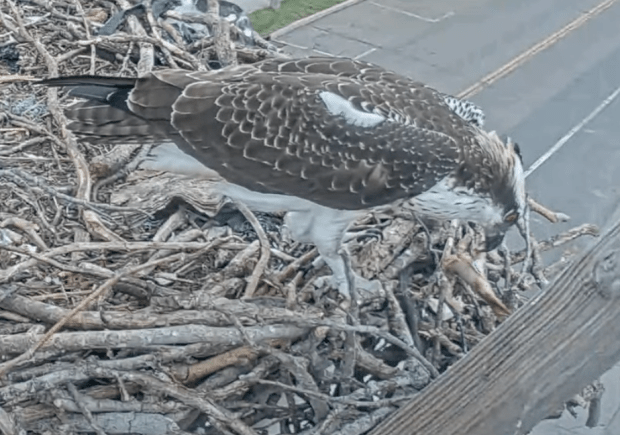
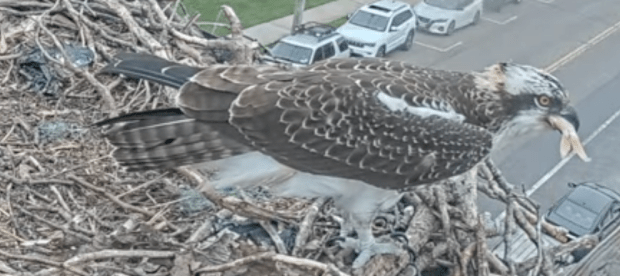
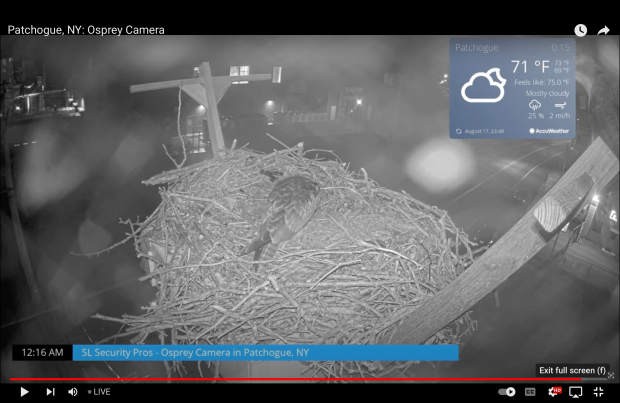
At Patchogue, Mini had four fish on Thursday. She ate the majority of each of them proving that she is adapting to her situation. It has been over a week now that she appeared on the nest with her injury.

When there is not much of the fish left – or if they are small, to begin with – Mini has difficulties because she still cannot put weight on that left leg. She can’t hold down the fish and pull. Today, she was persistent in working on the tail of one of those deliveries. Tried to work on a tiny piece! Dad brought the fourth fish in, a small one, late in the day. Mini worked and worked, and she succeeded – this fish, not a bite of it, went overboard.

Gosh, she is beautiful.

Mini is desperately trying to get every morsel of that fish tail.

Mini worked and worked an she horked all of that fish tail!

All gone.

We have to watch Mini’s progress. She appears more steady on her legs, less wobbly – although at the end of the day – around 1952 when she flew off the perch she appeared to have trouble -, uses her wings to help her, and is enthusiastic in her fish calling. She is flying. Dad continues to feed his youngest. What we know about Mini’s personality is this – she survived against great odds – one of only a few (I have to find those stats) fourth hatches to live this season. She is intelligent, tenacious, and she does not give up. She works hard. If all of my university students had those qualities, teaching would have been a breeze!

Good Night, Mini.

There is good news about Ervie who is enjoying Turnby Bay!

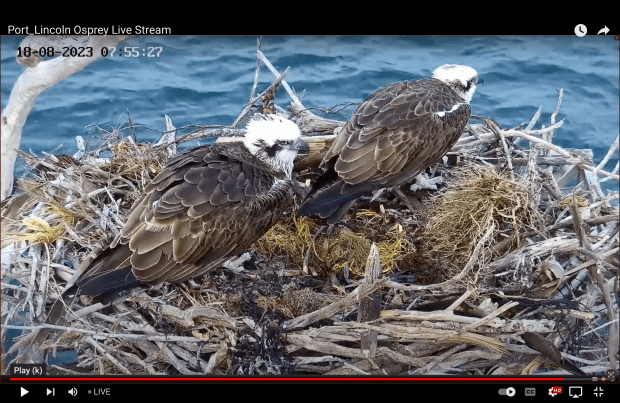
Waiting and watching as Dad continues to deliver fish to Mum at Port Lincoln.

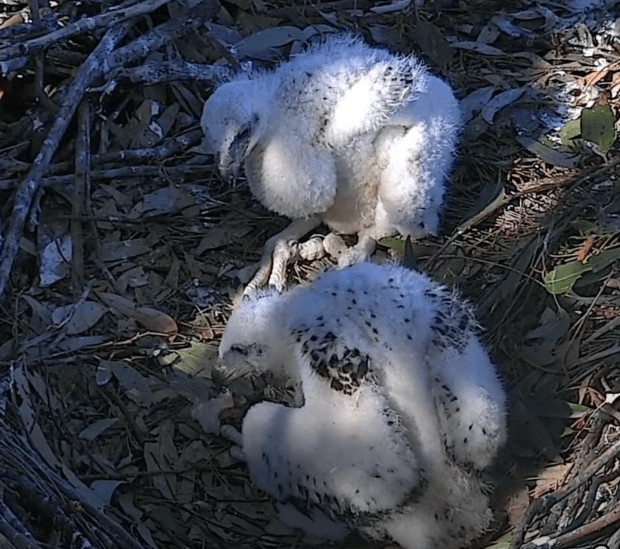
At Sydney Sea Eagles, little 32 (noticeably smaller now than 32) still waits submissively while 31 eats. The fish was very large, and 31 was full, and the baby ate. The pattern of domination was set early. We can still see some of the feathers missing from 32.

“A’ gives us the rundown: “Dad came to the nest shortly after 9.35 and asked Lady whether it was okay for him to have some of the leftover fish. Surprisingly, she actually agreed! She stood up from brooding the chicks and flew off, leaving him to have a snack and then feed the remainder of the fish to SE31 (well, SE32 got about half a dozen or perhaps eight mouthfuls at the beginning of the feed, but as soon as SE31 beaked him, pulled out another beakful of feathers (she can’t shake SE32 any more – he’s too big now – but still grabs a beakful of feathers somewhere on SE32’s head or neck and twists back and forth till he pulls out the feathers, leaving herself spitting out fluff), he went into submission. Late in the feed, Dad tried to offer him a bite but SE32 shrank away, which confused Dad, who didn’t try again. SE32 still has a huge crop from breakfast, so if he doesn’t eat again for the rest of the day, he will be fine… As long as SE31 has had enough, she is perfectly happy to watch her little brother stuffing himself to the brim. On other occasions, though, she continues to return to the table, and as long as she is that close, SE32 is fearful, with good reason, as SE31 will often react to any food given to SE32 by beaking him.”

Friday morning Xavier had stashed a fresh European Starling in the corner of the scrape. We know that this is not Diamond’s favourite breakfast but…she was hungry. Went over and accepted the food gift and out she went. Still waiting for eggs.

Three healthy and happy fledglings at Boulder County hoping that they will be the lucky one to get the fish delivery.

At the time of my writing, Maya was still at Rutland.

Only four so far reported crossing over the Straits of Gibraltar.

This is Thursday’s chart from Hawk Mountain in PA, USA.

Migration is on everyone’s mind and Tiger Mozone posted an older chart showing the relationship between fledge dates and migration from Loch Garten.

A note came to me today stating that the Middle hatch at Achieva is doing very well and is flying around. He needs to gain some weight before release. This is all good. You might recall that he was falling off the nest – dehydration/starvation – and was monitored and picked up for rehab.

Voldis and Milda continue to provide prey items for their two fledglings at the Durbe County White-tail Eagle nest in Latvia. LizM catches one of those deliveries on video.

LizM catches Karl II coming in with a load of fish for his three fledglings in the Karula National Forest nest in Estonia.

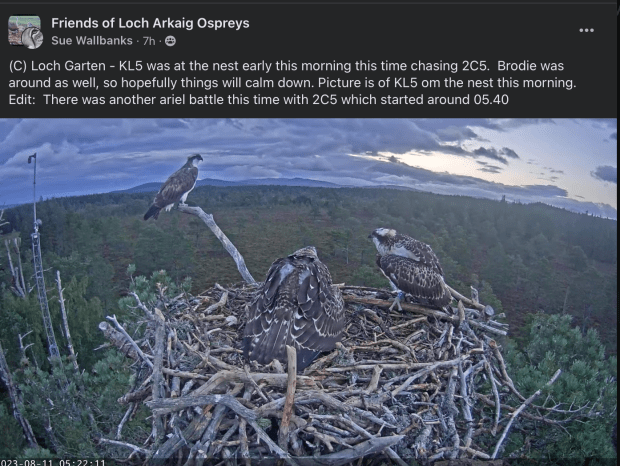
Ludo has not had anything to eat as of 0900 Thursday morning due to intruders at Loch Arkaig. Has Dorcha left for migration? Geemeff reminds us that she departed on the 18th last year. Louis is probably fighting intruders. Certainly Ludo is having to deal with them. Poor thing. What is up with these intruders this year?

‘H’ reports that it was a good day at Fortis Exshaw: “All things considered, it was a good day.  I think the cam viewers are in agreement that any day where Banff has a couple of fish to eat and she is not snatched from the nest by an intruder, it is a good day!  Louise delivered one of her signature ‘whale’ fish at 0619.  Banff would eat from that monster fish on and off until 1551.  At 0626 Louise flew off the nest with one of the nearly-whole leftover fish that she had delivered in the evening on 8/16.  At 0630 and 0631 Banff was buzzed by an intruder.  Louise quickly flew to the nest holding what appeared to be the same fish she had just removed.  Then, when Louise flew off to chase the intruder, she left that fish in the nest.  Banff picked up the 0632 fish and deftly laid it right beside her ‘whale’ fish.  That was so cute.  So, the 0632 fish brought to the nest seemed to have been a recycled leftover fish from 8/16.  Louise brought a big gob of fluff to the nest at 0720.  We thought that she may have intended to cover JJ’s body with it, but she did not.  Louise flew out at 0742 chasing an intruder.  At 0907 O’Hara landed on the nest and was scanning the skies, then he flew off quickly in pursuit of something a few minutes later.  At 1442 O’Hara was back again and stood on the nest as a sentry until 1502.  Starting at 1618, Banff had been intermittently nibbling on the recycled leftover fish, when an intruder started buzzing and dive bombing her.  She was buzzed at least seven times until 1621.  At 162130 there was an adult that flew higher over the nest, but we weren’t sure if it was the intruder, Louise or O’Hara.  Banff’s response to the attack was to ‘pancake’ as flat as she could until the threat subsided.  Then, cool, calm and collected, Banff finished eating the recycled leftover fish.  She was also dive bombed twice at 1649.   At 1819 Louise delivered the last fish of the day.  Banff was buzzed twice by an intruder at 2004, and she pancaked again.  Then an intruder (or ‘friendly’?) hovered over the nest briefly at 2005.  After all her flying and being chased by intruders the previous few days, and the stress of twice being snatched off the nest, Banff decided to rest and refuel today.  She took no flights, she was a total homebody.”

‘H’ also reports:

Osoyoos – There were five fish brought to the nest at 0604, 1039, 1243, 1357, and 1742.  Despite the ongoing heat wave, this family is doing great.  The young osplet is 53 days old.

Forsythe – Dear Ollie is spending much more time away from the nest, but she did have three fish delivered to the nest for her by Oscar.

Severna Park – At least one of the juvies is still coming to the nest and eating fish provided by Oscar.

Thank you for being with me today. Please take care. Look forward to seeing you tomorrow with a look at what is happening on the European nests.

Thank you to everyone for their notes, videos, posts, and streaming cams that helped me to write my blog today: ‘A, Geemeff, H, PB, R’, The Guardian, PSEG, Port Lincoln Osprey, Sydney Sea Eagle Cam, Charles Sturt Falcon Cam, Bart M and LRWT, Jane D and Ospreys, Hawk Mountain, Boulder County Fair Grounds Osprey Cam, Tiger Mozone, Liz M and the LDF, LizM and the Eagle Club of Estonia, Geemeff and The Woodland Trust, FortisExshaw, Osoyoos, Severna Park, and Forsythe Ospreys.

Monster Fish, Mini and more…Friday in Bird World

11 August 2023

We are supposed to have rain over the next week. Everyone knows this and was in a bit of a panic to get outside and be in the nature centre today before it rains for 6 or 7 days. Of course, it never rains all day long. It is like Asia when it looks like the forecast is 100% for all day, but the rains begin, on time, at 1600 and are downpours and then stop. That said, it has been raining for the past four hours…Little Red, the Blue Jays, and all the sparrows continue to eat regardless. I am putting a bit of food out every hour so that it does not get wet for them. They also have seed cylinders, the solid ones inside the lilac bushes.

Calico has a covered area where she can eat (along with a few of her friends if they stop by). She comes on the dot just about every 3 hours. Her fur looks better since the worm and flea/tick treatment. I was reminded by ‘RP’ today that often kittens will follow their mother to find food. Maybe a kitten or two or three will show up! I live in hope because Calico surely has them hidden well.

The new wetlands area begins at the lake. The water is pumped to another pond where it flows downwards, filling all of the pool areas in the park. (All photos taken with iPhone).

I went to count goslings. There were only 14 visible but mostly there were mature Mallards, a few American Goldfinches, Red-breasted Nuthatches, and Black-capped Chickadees. The animals and birds were quiet. Humans were loud. It was nice to have the nature centre garden market open – lots of freshly picked veggies, the profits going to a good cause.

The day continues to be consumed with Mini and her left leg. There are visible two puncture wounds above the ankle and before the knee of the left leg. Did Mini injure her leg stretching it and having someone’s talons caught in hers? A fish fight? We don’t know.

Indeed, any observer knows very little. We can deduce that she is keeping her balance with her wings. She appears to be in some pain. She is still flying and she is hungry. She is not – and I want to repeat this – she is not lethargic. She is not grounded. My friend ‘R’ and I know that if it is a sprain it will heal. If it is a break, it will heal – maybe not the precise way that it would if set in a cast but there is no guarantee that a wildlife rehabber would —- OK and this is harsh — put Mini’s leg in a cast and keep her in residence til late next spring when she could be released. She would not be ready for this year’s migration. This is something that has to be considered. I know that it is hard to watch her but she is alive, eating, flying, screaming for fish.

My reaction to Mini comes out of remembering many others, like Mini, that did not get a second chance. The first one that comes to mind is WBSE 26. We need to take a deep breath, send positive wishes, and not panic but observe.

1530: Fighting with one of those hard to eat fish unless the head has been taken off…it is good practice for our girl to try and open up these fish, though. No matter how frustrating it is to watch. She will have to do it soon enough in the real world without parents.

The two puncture marks above the left ankle before the knee. Two spaced black dots the distance of talons. We do not want these to get infected. (Mini could we ask that you go and stand in some salt water and soak that leg? Salt water aids healing).

You can see the punctures better here.

Mini has been on and off the nest. She has been fish-calling. Flying down from the perch. It was not a bad landing.

Our beautiful survivor.

Gone.

Bobby Horvath has a practice on Long Island. He rescued Pale Male (the 31-year-old celebrity Red-tail Hawk with its nest on one of the most expensive properties in Central Park) and held him as Pale Male was dying. Horvath is willing to come out to help Mini if she is lethargic. Here is the note that he sent ‘L’ and the phone number. Write it down! Bobby might be our best hope that she would get good care instead of being euthanised. But he is busy – like everyone, and please note that he is stressing weak or lethargic – low or on the ground – not on the nest. Please don’t call him otherwise. All the rehabbers are busy. There are strict laws – and we don’t want anyone to get tired of hearing about Mini. We want them to respond when it is necessary. At least one local individual is making trips to check around the nesting area if Mini were to get grounded.

One diagnosis from a trained reader ‘MP’ suggests that this could be a lunated patella (a dislocation). I found an academic paper on this orthopaedic problem.

Steelscape: The third hatch has a huge crop today. And wait…more news. The third hatch had 3 fish today…and one of the older siblings had a huge crop. All is fine. We can relax. Thanks so much for the images and the report ‘PB’.

Fortis: ‘PB gave me the head’s up early that we would be getting a very good report from ‘H’. There were two whoppers brought on to the nest!

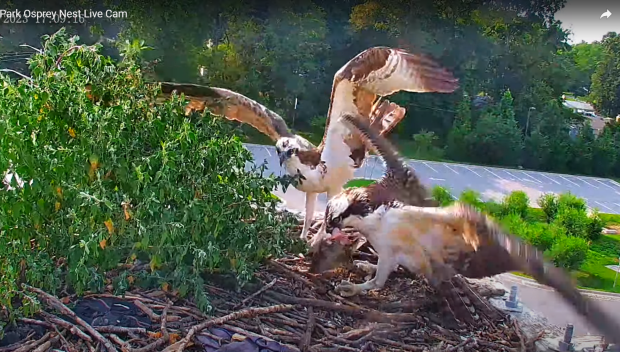
‘H’ writes: “It turned out to be a very good day.  The youngest osplet, JJ, had not had very much to eat for the previous three days.  The viewers were all extremely worried for him.  The day started out with Louise delivering a headless fish, which JJ initially acquired.  JJ had the fish for a couple of minutes and managed to pull off a few bites before big sis, Banff, took it away.  Banff ate that entire fish, but JJ managed to grab the tail.  For JJ’s sake, we knew there had to be another fish delivered soon while Banff was still full, but the next fish did not arrive for four hours.  At 1215, Louise delivered the largest fish to date this season.  It was massive.  Louise initially wanted to hold on to the fish to feed, but Banff took it.  It was a tough fish and Banff had not made much headway, when JJ managed to drag the huge fish from Banff at 1242.  They traded possession of the fish a couple more times before Louise returned to the nest at 1355.  She confiscated the fish and fed JJ!  That’s what we were all hoping she would do.  JJ was fed for 10 minutes before he got the boot from Banff, and then Louise fed Banff.  By 1422 Louise was clearly distracted by something and she stopped feeding.  She was on alert.  At least 1/2 of that huge fish was left, and JJ tried to pull off a few more bites.  Louise flew off the nest at 1456 taking the rest of the fish with her!  She returned at 1535, with the same fish.  There was still about 1/2 of the fish remaining, it did not appear as though Louise had eaten any of it.  Banff claimed the fish at that point and ate until 1608.  JJ then fed for an hour before Banff reclaimed the fish at 1707.  When Banff quit eating again, JJ ate from 1730 to 1808.  Then Banff ate some more, and finally downed the tail of that massive fish at 1821.  That had been a 6-hour fish!  So, there were only two fish delivered to the nest, but the monster fish had provided at least six or seven meals each for JJ and Banff.  JJ had his largest crop in days.  The siblings are 54 days old.  Banff has managed to increase her lift off the nest during her wingers, but has not hovered as yet.  JJ has only achieved a few inches of lift off the nest while wingercising.  During the night of 8/11, the siblings both slept upright and tucked for the very first time.”  

Those are two North American nests I have been concerned about in addition to Mini. The other nest is PSPB Loch Garten and the attacks on the two male juveniles by a male fledgling from that same nest in 2020. Remember the males return to their natal nest area and things are getting crowded in parts of Scotland.

There remain intruders including an unringed female at Loch Garten. The injured chick 2C4’s wing has stopped bleeding. Hopeful he will be fine.

Sadly, the 2020 fledgling KL5 is back again this morning at the nest.

Thankfully all is well at the nest of Louis and Dorcha at Loch Arkaig – and Ludo is as noisy as ever.

Suzanne Arnold Horning found all of the hawks on the Cornell Campus Thursday. So grateful for her diligence and kindness in sharing her images of Big Red and Arthur’s family.

‘A’ reports on the Australian and NZ nests:

Sydney Sea Eaglets: “This morning’s breakfast had to wait for Dad to bring in a fish. Eventually, just before 09:20, he came in with a whole fresh small-medium fish, which Lady fed to the chicks and ate herself. After the breakfish was consumed, Lady headed off. Dad brought in part of a fish (slightly less than half – he had eaten the head and then kept going for a bit longer). He stood there for some time, waiting for Lady to arrive and feed the eaglets, but she never came and the chicks were obviously begging him for food, sitting up at the table and trying to move closer to him and the fish. Eventually, he decided to feed them, and both got quite a few bites before Dad downed the tail, fed the kids a few more bites, then took the remaining morsel to the perch branch to eat himself. So now the nest is again devoid of food and we do need a good feeding day today. I was happy to see that both chicks waking up hungry and waiting for a later-than-usual breakfast did not precipitate bonking behaviour. Both were peaceful while they waited for food to arrive and once it did, there was negligible bonking. SE32 has taken to pushing itself forward, in front of SE31, to ensure it gets fed, and SE31 is allowing it to eat without interference most of the time. SE32 is still wary, and ducks for cover if SE31 does beak it, but the shaking by the back of the neck has largely ceased.”

Royal Cam Albatross: “We are hoping that Manaaki gets his supplementary feeding today – he looks literally flattened as he lies in his nest and seems to be low on energy (or just conserving it). He had built up significant reserves, according to the rangers, and is not on the high priority list but is still scheduled to be fed by today. As every day passes, I worry more and more about his parents.”

I just noted before I closed the blog this morning that the supplementary feeding was given to the Royal Cam chick. This is a great relief to everyone who sat and worried about this little bundle of joy.

Collins Street: “Cameras won’t be back up at Collins Street until the first egg is laid (last year, that was 25 August, so some time in the next two weeks is likely).”

Port Lincoln: “At Port Lincoln, they are on egg watch. To be honest, every time I watch and see mum sitting on the nest, I wonder whether she is laying that first egg. She is in that position now and I am wondering if this is the big moment. Surely, there will be at least one egg on that barge before the weekend is over.”

Orange Falcons: “Orange is as it always is – Diamond with a full crop, Xavier dancing about looking handsome. It’s just after 1pm in eastern Australia. A lovely day in Sydney, Orange and Melbourne, though they are expecting rain in Port Lincoln.”

Wondering about Dmitri and his stork? Excellent post on Thursday from Karla Pilz!

At the nest of Karl II, the three fledglings slept on the nest and then were there for the morning and flew off.

‘H’s other reports!

Kent Island – This Chesapeake osprey family is doing very well, and dear Mollie seems to be very close to fledging.  She hovered high out of sight for several seconds, and for a while we didn’t know if she had fledged.  Audrey and Tom’s youngster is 60 days old.

Barnegat Light – Life is grand for the fledgling, Dorsett.  And, she has shown a definite preference for eating her meals on the utility pole.  Dorsett is 72 days old, and fledged 12 days ago.

The Osoyoos osprey cam was offline for the second straight day.  We miss the ‘O’s and we are anxious to see how they are doing.  The young nestling is 46 days old.

Thanks ‘H’.

Skipping to a couple of other nests before I close for the morning.

Boulder County: All three fledglings were perched for the night and off the nest in the morning. They are being fed off cam it appears and all is well for this family as it prepares to migrate.

At the Dyfi Osprey Centre, they are remembering Monty. Monty was the male at Dyfi from 2011-19. He had three mates – Nora, Glesni, and Telyn. Of their children, 8 have returned as two year olds. A remarkable number and his DNA continues throughout the area….his perch is inside the new Centre.

The Dyfi website adds: “Monty was the breeding male at the Dyfi from 2011 to 2019 and he is arguably the most famous, and loved, osprey in the world!
Monty was unringed so we never knew exactly how old he was or where he came from. We know that he has been around on the Dyfi since at least 2008 and probably 2007, so his year of birth has to be 2005 or earlier…Monty was a fantastic fisherman whose fishing habits have been closely studied.  Two separate scientific studies conducted in 2013 and 2015 have concluded that there is no correlation between the fish species that Monty catches and environmental factors such as tidal phase, temperature, time of day etc. It seemed he was able to catch a fish whenever he (or his family) was hungry and did not need to link his fishing trips to any other factor. Monty’s typical catch was grey mullet but he has been known to bring home some more unusual fish including a long eel-like garfish, a poisonous greater weaver fish and the occasional twait shad!”

The other nest I want to mention is Iris. She is still with us in Missoula and she has not been visited by Louis as much this year (it seems) as in years past. Pe chaps it is the weather and the challenge of feeding the trio and Starr. Iris has had a persistent visitor, a ringed male and here is some information posted on him this morning. Iris is, by the way, not chasing him off.

Thank you for being with me today…please send good wishes to Mini. Take care. See you soon!

I am so grateful to the following for their notes, posts, videos, and streaming cams that helped me to write my blog this morning: “A, H, L, MP, PB, RM, RP’, PSEG, Steelscape, Veterinary Quarterly, Fortis Exshaw, RSPB Loch Garten, Sue Wallbanks and Friends of Loch Arkaig Ospreys, Geemeff and The Woodland Trust, Suzanne Arnold Horning, SK Hideaways and Sydney Sea Eagles, NZ DOC, Lady Hawk and NZ DOC, PLO, Charles Sturt Falcon Cam, Karla Pilz and Stork 40, Eagle Club of Estonia, Kent Island, Conserve Wildlife of NJ, Dyfi Osprey Project, and Mary Anne Miller and Montana Ospreys at Hellgate.

SE32 gets a great meal…Monday in Bird World

7 August 2023

Hello Everyone!

The weekend is over for many and in Canada and those having Bank Holidays there is one more day before the week officially begins. Oh, retirement is wonderful! Sometimes I do not even know what day it is!

Before I move any further, one of my favourite authors, David Gessner, hs some appearances in Cape. Do you live close enough to attend? If so, lucky you! And if you have not read Soaring with Fidel – please do. Often for sale at heavily discounted prices, it is the tracking of an Osprey to its winter home in South America through Cuba. It can inspire you to follow the birds too just like individuals follow the falling cherry blossoms in Japan.

We had an ‘explosion’ of Blue Jays this year, according to my neighbour. The only ones that I could tell apart were that little rather round one and Junior, the Dad, because he was moulting. But now, I have stared at them so much there is a way to tell them apart and tomorrow I plan to have a chart and I can tell which ones are coming and going. With an Osprey, it is the pattern on their head that never changes from when they are ready to fledge til they die. Take images of the front, back, sides, and top – stare. Make a file. you can recognise those ospreys! This does not readily work with Blue Jays but there is something about their tails and it is the lateral white band. Some have a very delicate scalloped white lateral band, some have a white dot on the outermost feathers on either side, one had a single white dot on the very middle tail feather. Each appears to be unique. — I am not a Blue Jay expert. Someone who is might tell me that I am totally wrong but right now, that seems to be a good start for this family.

I have learned from my friends and readers living in Germany that I am blessed to have Blue Jays because they do not see them! So a little factual information for those who live where Blue Jays do not:

The Blue Jay Cyanocitta cristata is a little larger than an American Robin, about 30 cm in length from the tip of its bill to the tip of its tail. A white-faced bird with a blue crest, back, wings, and tail, it is strongly marked with black and white. Male and female Blue Jays are very similar in appearance. The crest, an elongated crown of feathers found in many jays, is raised or lowered according to the bird’s mood. In moments of high excitement and aggression the crest may be fully erected, forming a prominent peak. When the Blue Jay is greatly surprised or excited, the crest points forward. If the bird is frightened, the crest bristles out like a bottle brush. The Blue Jay’s crest position, when erected, is emphasized by a black band that crosses over the back of the head, a continuation of the broad band or necklace across the chest. However, when the bird is feeding among other jays, when it is ready to flee, or when it is quietly resting, the crest is laid flat on top of the head, giving the bird a quite different and somewhat untidy appearance. 

Hinterland Who’s Who – Blue Jay

This is one of the babies. Notice the deep white lateral band on the tail feathers and that gorgeous scallop. So what is this chap doing? Sibley says that he is sunning himself BUT, is this behaviour something else? Sunning is when a bird spreads its wings and fluffs its body feathers to take advantage of the airflow between the feathers. In this instance, while this might look like sunning, we have to consider other factors. First, the lad has its crest raised. Those wings are beating a bit in alarm, and the Jay appears to be mantling precious peanuts. What you cannot see is that Little Red is sitting on a tree branch wanting those nuts!!!!!!!!!

Blue Jays do not grow their feathers simultaneously. When they moult, they drop one or two feathers at a time. This fellow appears to be missing one feather on the left and a central one coming in. If the feathers come out completely, I was told they will grow back. n immediately. Fantastic. You might recall that I had an earlier little one that lost its tail feathers due to a fright moult. He is quick and stays in the lilacs out of the sight of my camera, but it appears those feathers are coming in.

This one is quite different in its patterning.

This little one did not want me to see its tail! It was hot and all it wanted to do was drink – remember, water!

He finally turned but I had a bad sight line. A single white on the far left feather.

Another variation! This is the youngest of all the babies in the garden. Will the patterns on this tail change during August? I will keep an eye and report back. Isn’t this little one just precious?

And another. There should be 14 different patterns for the 14 different birds. If you have several Blue Jays in your garden or if you see Blue Jays, let me know what you discover – does each have a different pattern with the white on the tail?

For those who do have Blue Jays, just a tip. They need calcium. sometimes there are not natural sources. What you can do for the Jays and all the other birds, especially during egg laying season, is to provide them with crushed egg shells. Please wash the shells out and allow them to dry before crushing them and placing them on a feeder.

Today was planned to be the day that Calico’s kitten or kittens would be found, and they would begin their integration into the family by staying in the luxury suite – the Conservatory. Geemeff gave me some fantastic tips to help this happen. Sunday morning Calico decided that she wanted to come into the house. I wasn’t quite ready. There was a new litter box and some ‘high value’ treats to get along with kitten milk in case, for some crazy reason, something happened) and toys. The plan was to follow her after her afternoon meal. (She comes approximately every 3 hours). She ate 4 small tins of cat food (yes, that is not a typo) and drank 1/3 of a tin of kitten milk. She loves the stuff, and it is so good to help her replenish her lost calcium and give her protein. She was not anxious to come into the house. We were ready to follow her and had a blanket, a cat carrier, a tin of salmon and another of sardines to try and lure the kitten/s out so we could get them. At some point, she spotted us and darted under a gate and down a sidewalk in a person’s yard. By the time we had retraced our steps and were in the back lane, Calico was nowhere to be seen.

Like birdwatching, this is going to require patience. Everything is in order. We wait. Either the kitten/s will follow Calico to our house, or she will bring them if she feels that level of trust. Or once weaned, she will return full-time to the garden and I will bring her into the house. She has been dewormed and has had her flea and tick treatment. She has standing appointments with two vets and the clinic at the Humane Society. My grandmother always said that things work out how they should. Patience, dear one, patience!

Just hoping these two are welcoming!

A wonderful intervention that took less than half an hour and saved a chick’s life. Please read. It is a heart warming story of a huge storm, Monty and Nora, and their two babies.

For those who opposed the intervention, Emyr Evans wrote, “The bottom line is that Montgomeryshire Wildlife Trust is one of the 46 Wildlife Trust charities working hard for Conservation in the UK. It took 500 years for Man to completely, and artificially, wipe out the osprey in this country. Even today they are still shot and their eggs stolen illegally, year after year after year. To my knowledge, at least six adults have been shot in just the last three years alone. Illegal osprey persecution and killing is intervention no matter how you look at it. A half an hour intervention yesterday doesn’t even begin to re-address the balance.”

With the storms in the US and the overfishing in the NE of the vital fish for the Ospreys, I know that you can think of at least one nest that would have benefitted from an intervention such as that above. As a society, we must consider what we have done to the planet and how these beautiful birds might be living if we had not intervened and destroyed their habitat, the air they breathe, depleted the fish and then caused all manner of poisonings, harming them with debris. The list is endless, never mind the dramatic impacts of climate change that we have caused. Of course, this statement applies to all of North America, Canada included!

With all the discussions about the Cornell Bird Lab, and window strike and M2’s death, my friend ‘R’ sent me an article to read and share with everyone. Just imagine, “This is a huge problem,” the author writes. “They estimate that somewhere between 300 million and 1 billion birds a year die in the United States from window collisions.”

They are simple solutions for our homes, but I think the tiny pink squares would work on the office windows at Cornell as they would elsewhere…we have the strips on the Conservatory, and the other windows look like a team of youngsters were turned loose with white markers. We have not lost a bird to a window strike.

The real question is this: We know the problem, and we know the solutions, so why aren’t big companies and institutions that have buildings with large amounts of glass doing something about this? I find it very frustrating – just like the simplest solution to not decapitating albatross is to set the lines of the long-haul trawlers at night. Like, do it! Don’t be complacent.

Checking on our nests:

Let’s start with ‘H’s report first because there is great news coming out of Fortis Exshaw: “Any day that the nestlings have a couple of crop-filling meals is a good day.  Both JJ and Banff woke up very early and were delighted to find large leftover pieces of fish on the nest.  They both ate, and had crops.  At 0632 O’Hara touched down on the nest, looked around a bit, and then left.  He was almost immediately followed to the nest by Louise who brought a large fish.  Louise fed both siblings.  Again, both had nice crops.  O’Hara had returned to the nest at the beginning of the feeding and he stayed for 24 minutes, simply standing guard while Louise fed the kids.  At 0709 there was an intruder issue, Louise and the kids were all alarming, and O’Hara immediately flew to the nest to assist with nest defense.  After five minutes he bolted off the nest in pursuit of the intruder. Louise is known for the large fish she catches, but at 0909 she delivered the smallest fish I’ve ever seen her catch.  Banff ate that one.  The last fish of the day was delivered by Louise at 1422.  It was a large headless fish, and Banff claimed it.  We noticed that Banff was having a little difficulty pulling off pieces.  Banff ate for 75 minutes before walking away, and JJ took over.  There was still 3/4 of the fish remaining.  JJ had even more difficulty pulling off pieces of fish.  JJ ate for nearly an hour, and only managed a slight crop.  The siblings continued to take turns eating from that fish for six hours.  At least 1/4 of the fish remained as darkness fell.  That was one tough fish!  The siblings are both 50 days old, and Banff has been achieving a little lift-off from the nest during her wing exercises.”

Osoyoos – “There were at least five fish brought to the nest that I saw.  Soo and Olsen’s youngster ate well.  It is emotionally difficult for the livestream viewers when a chick dies, and when the body remains in the nest it is a persistent reminder of the sadness.  There have been a few attempts to cover the body with new nesting material the past couple of days.  On 8/6, Soo tried to remove the body of #2, but it was heavy, and unfortunately it got hung up on some sticks at the rail.”

Forsythe – It was a better day for Ollie.  Oscar delivered three fish to the nest for her.  Older sibling, Owen, was not seen for the third straight day.  Opal was last seen a couple of times on 7/25, and once on 7/29.  Ollie is in charge of the nest and has been taking on the intruders, quite effectively I might add. 

Kent Island – Oh my goodness, 55-day-old  Molly has been doing some brief hovers!

Barnegat Light – Daisy caught a false albacore and treated beach-loving Dorsett to some ‘little tunny’.

Dahlgren – D12 hangs out at the nest more than D11 does, but usually when Jack delivers a fish, D11 appears out of nowhere to make a claim.  This has resulted in some epic battles and tug-o-fish between the two siblings.  Mom, Harriet, has not been seen for three days.

Thanks so very much ‘H’. That is great news at Fortis Exshaw and Osoyoos.

Dorset Hobby Falcons: We have the first fledge!

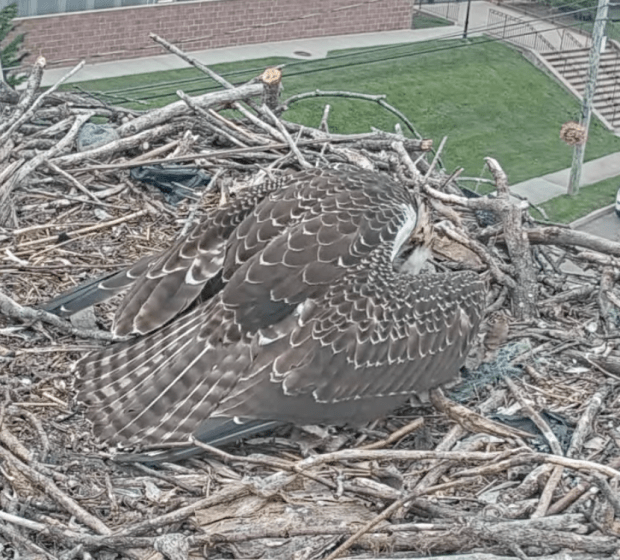
Patchogue: Every time we get a glimpse of Mini, it could be the last one. She has grown into such a beautiful bird with those short stout legs and big wings, the hearts on her chest, and her dirty knees. How fortunate we were to have her in our lives this year – this bird gives me hope!

When I look at those hearts, I think they represent each of us that loved her dearly and sent her warm wishes for survival. Her cheering squad. Just look at how many there are! She carries us with her wherever she goes.

Collins Marsh: Both osplets have successfully fledged. Mum is till content to feed them on the nest and they return to have a nice rest once in awhile, too. Flying is hard work!

Clark PUD: Both osplets have fledged. They, too, are returning to the nest. Beautiful!

MN Landscape: Everything is a little damp but the fish are coming in and this chick is looking good.

Sandpoint: This nest was needing fish and two arrived on Sunday. We need more!

Loch Arkaig: Luco gets some fish from Dad – there were 5 fish delivered on the 6th. Ludo was so full he could have popped.

Poole Harbour: Another nest with lots of good fish for the trio.

Llyn Brenig:

Dyfi Ospreys: I am always so entranced about their comings and goings. Wish all the nests safe travels, full crops, and a return next year.

Finnish Ilomantain: Some nice fish on the nest for the chicks.

Charles Sturt Falcon Cam: Xavier wants eggies!

Port Lincoln: Last year Mum laid Zoe’s egg on 9 August. Just sayin’. we are getting close!

Sydney Sea Eagles: WBSE 32 got a good feed. ‘A’ remarks, “It seems little SE32 has become much more confident today. SE31 is still getting the best of the feedings, but not because SE32 is being intimidated or bonked but just because SE32 is not accepting all the mouthfuls it is being offered. It seems both chicks are being well fed and SE32 is not instantly cowed by sudden movements. Rather, it is sitting beside its sibling, watching the feeding and waiting its turn, without being intimidated. This is a wonderful development, as this situation has always been more about SE32’s attitude than SE31’s bonking. Now the younger one seems far less scared and is much more confident sitting up at the table. We will see how the rest of the day goes, but it is 3pm currently and another feed has just ended. Both chicks have been well fed today and I have not seen SE32 bonked at all today. It is sometimes slow to join in the feeding, but that is its own choice, not the result of being intimidated.”

Thank you so much for being with me today. Please take care. See you soon!

Thank you to the following for their notes, their posts, videos, articles, and streaming cams that helped me to write my blog today: ‘A, Geemeff, H, R’, David Gessner, Osprey Watch, NY Times, CBS News, Fortis Exshaw, Osoyoos, Kent Island, Forsythe, Wildlife Conserve of NJ, Dahlgren, Sk Hideaways and Dorset Hobby Falcons, PSEG, Collins Marsh, Clark PUD, Sandpoint, Geemeff and the Woodland Trust, Poole Harbour, Sue Wallbank’s and Friends of Loch Arkaig Ospreys, Dyfi Osprey Project, Finnish Osprey Foundation, Charles Sturt Falcon Cam, Port Lincoln Ospreys, Sydney Sea Eagles, and SK Hideaways and Sydney Sea Eagles.

Names for the chicks and saviour male at Fortis Exshaw…Friday in Bird World

4 August 2023

Good Morning Everyone!

Things are starting to quiet down a bit. There are a few more birds left to fledge. We have to imagine that in 2-4 weeks, all of them will be on their way to their winter homes. For the juvies, what an adventure will be in store for them. Let us all hope that those who lived to fledge this year will make it and return in 2 years to try and find a mate and raise their own families.

The images are not good as these two are moving about, but even at a year old (Missey was found in July 2022 and Lewis in August 2022) and not siblings, these two could not be closer. They play together constantly and wash one another, sleep beside one another, and hold paws. I am continually amazed at their remarkable bond.

These two will shortly have a ‘new sister’. I hope that they learn to love her. Since last fall, I have cared for a feral cat, a Calico. This late spring, I began to call her and move the food dish closer and closer to the garden door. At the beginning of July, I accelerated the feedings and attention. The goal (at first) was to trap her and take her to be vaccinated, dewormed, and fixed. Then release her back into the wild. That shifted when she allowed me to stroke her and scratch her head. Now I sit beside her while she eats. We have a trap and release programme in our City for feral cats, and because of Lewis and Missey, I also have a wonderful vet who has offered a significant discount since Calico is a feral. So…the race is on to see who is first. The vet can see her on the 14th for all the health checks, vaccines, deworming, etc but not the surgery. The waiting list for the operation is currently at the end of November. I am unclear about the trap and release programme openings. They will call.

Our neighbourhood has two other feral cats, but this petite female has won our hearts and minds. Her spending another winter in -35 C temperatures doesn’t sit right. It is incomprehensible. (We hope to trap the other two and get them to the Humane Society to be fostered for socialisation and adoption). So, it could be the 14th when Calico joins us. Wish us luck as we integrate her into the family.

Lewis watching Calico eat.

My father loved animals – and could not stand to see one go hungry. He was the one that took care of all the strays in our neighbourhood when I was young, and that practice continued until he died in his 90s. People knew, and they would ‘dump’ their cats at our house, knowing he would care for them until he could find good homes. It feels good to carry on his legacy.


There is a lot of news about rescues, unusual bird sightings, and near tragedies. I am going to share a little more with you than usual today. It is all very interesting and should motivate us to get out and help – including stopping people from cutting down trees where there are active nests. More birds are getting caught in fishing lines, not just our raptors. This is a massive problem in North America.

We can help by committing to cleaning up a specific area once or twice a year. You can do this alone or organise a group. Wear latex gloves and have a container that will not allow you to be pricked by the hooks. The problem, then, is how to dispose of this mess. Every lake area should place containers for people to leave their broken lines and hooks or dispose of found debris. If not, contact your local wildlife rehabber to ask how to dispose of the items safely so they do not return to the environment.

Is it really possible not to see one of those huge Bald Eagle nests in a tree?

It has been three years since the Dolan fire swept through Big Sur. The new release pen for the condors is now open.

How are the birds adapting to survive in the heat? This is a great article by Bay Nature. Please have a read…I learned so much. Tactical pooping?

It isn’t about raptors but it is about the growing threats to wetlands which are essential for our birds and other wildlife. So what did happen to Grace? and her wetlands?

Lots of bird counts going on right now. Many are coming up with some surprises. These are Red-Billed Cloughs – pronounced ‘Chuff’. They live along the western shores of the UK and Ireland.

In 2002 a pair of Cloughs was noticed in Cornwall. It was later discovered that they had arrived from Ireland. The population has grown. These birds eat insects and larvae and are often mistaken for Crows. Aren’t they gorgeous with their shiny scarlet bills and legs? Even those yellow Darvin Bands look perfectly selected, but the deep ebony plumage with that hint of blue-green on the wings is also so dramatic. Notice the curve of the long beak. It is perfect for going after the insects and larvae that the Cloughs eat.

Big Red and Arthur’s 2022 fledgling L3 was released on Wednesday. A bittersweet moment. So happy to see her with her beautiful red tail flying in the wild but so sad for her sibling M2 who died of a collision on the Cornell Campus the same day.

It is relatively quiet in the nests. There are a few more birds to fledge, some raptors thinking about eggs in Australia, and now beaking at the Sea Eagle nest. Quiet is nice for a change.

Around the nests:

WRDC: I have not watched this nest for some time since R4 and R5 fledged, but goodness – today, R5 grabbed a fish right out of Rose’s talons as she flew by. Way to go, R5 – didn’t even drop it. But this was only the beginning. Rose tried to steal the fish, but R5 held strong and then R4 appeared in the nest. These two are getting really good training for when they are out living independent lives.

Hellgate Canyon: Marlene Harris got a great screen capture of Iris. She is still here – and should be for the rest of August! Gosh, isn’t she looking good?

Let’s go to some good news coming out of Fortis Exshaw from ‘H’: “

First, the news: they have names!  Names for the 47-day-old osplets: Chick #1, believed to be a female, has been named Banff, after the nearby Banff National Park in Alberta.  Chick #2, believed to be male, has been aptly named Jasper Junior, or ‘JJ’ for short.  In addition, Mr. O, the family’s savior who came on the scene to help Louise shortly after Louise’s long-time mate Jasper disappeared, has been named O’Hara, after Lake O’Hara in Yoho National Park, British Columbia.  Lake O’Hara is located about six miles from Lake Louise in Alberta.There were no fish delivered until the afternoon.  Banff and JJ had eaten well on 8/2, so we weren’t  worried.  Intruders may have been the reason for Louise and O’Hara not bringing in fish.  Both Louise and O’Hara had flown to the nest a few times to ward off intruders.  Then, as if it had been choreographed, two fish were delivered eight minutes apart.  (Conversation between Louise and O’Hara: “OK, O’Hara, it looks like the intruders have vacated the area, so let’s feed the kids.”  O’Hara replied, “Yes, Louise, let’s do this!”).  O’Hara delivered a nice size fish at 1405, and it was claimed by Banff.  Then, Louise delivered an even larger fish at 1413.  Banff abandoned her fish in an attempt to grab the new fish.  So Louise said, “Okay, kiddo, then I’m going to take the fish you had,” and she jumped over Banff and picked up the first fish.  But, Banff said, “No, wait Mom, that’s mine,” and reclaimed it.  That made it easy for JJ who was able to claim the second fish.  Perfect!  Each sibling ate their entire fish and had huge crops.  (the quality of the images is poor, as parts of the video screen remain severely pixelated)”

Patchogue: I could stare at Mini all day long. Soon she will be gone and these moments are very precious. What a beautiful bird she is.

Three fledglings were at the nest Friday. (I do not know the two older siblings well enough to tell if both have been coming to the nest or only one of them.) Mini was wanting a fish, and so were they.

Steelscape: Still on highlights.

MN Landscape: Hot. Chick is trying to stay cool and hoping for fish.

Boulder County: Only cam #2 is operating.

Finland #1: No one on the net and then they see Dad flying in with breakfast. Dad really stretches to try and protect his legs.

Finland #4. Wet and hungry and fish crying – very loud!

Ilomantsin: Wet and hungry, too. Dad leaves after bringing in a breakfast fish. The other sibling is hoping he returns soon with one for it.

Kuopio: Oh, the winds are powerful. One chick has a nice crop, and another digs into a fish. Three is hoping more will arrive.

Port Lincoln: Dad continues to bring Mum fish as she stays on the nest. When will we have that first egg?

Time to return to ‘H’s other reports:

Forsythe: Ollie is very hungry.  Oscar delivered one fish to the nest on 8/3, at 0724.  Both Owen and Ollie vied for the fish, with Owen the victor.  Owen took her fish off the nest, and to the best of my knowledge was not seen on camera the rest of the day.  The last time Ollie had a fish to eat (that we know of) was at 0920 on 8/1 (Ollie did acquire one fish on 8/2, but lost it).  Is Owen being fed off-nest?  If so, it wouldn’t make sense for Oscar not to bring fish to the nest for his other fledgling.  Perhaps Owen has learned to catch her own fish.  There are two ‘ponds’ near the nest, and basically they are simply holes in the marsh that trap water, and perhaps small fish as the tide goes out.  Ollie was seen diving into those ponds three or four times on 8/3.  She apparently did not catch a fish.  Ollie knows that she has to try to feed herself at this point to survive.  This is a sad situation.  I hope Oscar will bring Ollie an early breakfish today.

And great news just coming in from ‘H’: “Oscar delivered a small whole fish to Ollie at the nest at 0926.”

Osoyoos – Olsen delivered 6 fish for his family, and Soo also fed a meal from a leftover fish.  Junior has been starting to exercise his wings a bit.

Barnegat Light – Lol, Dorsett is a real beach kid.  She simply loves spending time along the shore of the Bay.  Dorsett worked up a voracious appetite, and made sure she was on the nest at supper time when Daisy served up her daily bluefish!

Thanks so much ‘H’ for all your reports today!

Let’s continue to send out most positive wishes to all those nests that continue to struggle.

Despite it being nearly the end of Osprey season in the Northern Hemisphere, I want to recommend one of the best Osprey books on the market. In Canada, it is $20 plus $3.99 shipping. This is an amazing price.

Tim Mackrill graduated from my old alma mater in the UK, the University of Leicester. He managed the Rutland Water Project and wrote the incredible history of their Ospreys for ten years before moving over to the Roy Dennis Wildlife Foundation. His speciality is Osprey migration. The images are excellent; thorough information covers everything from the different sub-species of ospreys and their plumage to their habits, breeding, migration, translocations, building nests, and everything to know about the chicks from breeding, development, and fledging. Tim did not miss a beat when writing this easy-to-understand book on our favourite raptor. If you only have one reference book for ospreys on your shelf – this is the one I recommend.

Thank you so very much for being with me today. Take care. See you soon!

Thank you to the following for their notes, posts, videos, and streaming cams that helped me to write my blog today: ‘H’ – for your great reports and the cover image, CBC New Brunswick, Joan Dice and the Trio and Other Eagle Nest News, Ventana Wildlife Society, The Narwhal, BirdGuide.Com, Cornell Bird Lab, WRDC, Marlene Harris and Cornell Hawk Chatters, Fortis Exshaw, PSEG, MN Landscape, Boulder County, Finnish Osprey Foundation, Port Lincoln Ospreys, Forsythe, Osoyoos, NJ Wildlife Conserve Foundation, and Tim Mackrill and the RSPB.