Fledges at Dyfi…Monday in Bird World

15 July 2024

Good Morning Everyone,

Latest updates: Eagle took the oldest osplet at Cowlitz Sunday evening while Mum was feeding. Third osplet at Dyfi in Wales has fledged! Eight Omega ships out catching Menhaden in the Bay this morning – fish our ospreys, whales, dolphins and other fish could eat. Talk about sad. This has to stop.

It was another hot day in Winnipeg. It’s not as hot as it has been. Just 26 C. The boulevard needed mowing, and that is now done. More mulch around the path. I finished but need more. Birds fed and watered many times. They still feel the heat but are more active later in the afternoon and evening when the shade covers the entire garden area. Thank you to everyone who wrote a note and said they enjoyed the baby Blue Jay having its bath. Every season, there is one that loves that bird bath. They are a delight. I made another video. It is 5 minutes long. The birds disappeared while I was sitting on the deck. Still, Dyson comes to the tray feeder along with two Blue Jays and a host of sparrows, old and young. Dyson makes two appearances. You can see the tree branch behind the feeder move. The second time, she goes to another feeder to the left inside the lilacs). I love the Blue Jay pounding away at the seed cylinder at the end. Enjoy. (I will figure out how to edit this!

It is 2033, and the thunderstorm has arrived. The wind is causing the trees to blow around like a tornado. The rain is so heavy I cannot see my neighbour’s roof. It is pounding on top of the conservatory, and all ‘The Girls’ are here for security. I can see a clear sky to the west, so this will be short-lived but furious. I hope we do not lose a tree at the back. Hydro and cable, along with wifi, have just gone out. There is a vast black churning cloud moving south of me. Someone is going to have worse conditions. It’s also reminiscent of my younger years living in Oklahoma, which has all its storms and tornadoes. Did I say we have no power or wifi?

On Wednesday, I will review Connie Dennis’s book about Pickles. So please catch the blog on that day. I will also add a listing of adult Osprey books at the end. This year, the chats on some of the streaming cams were ripe with so much disinformation that many of you wrote and said you would never participate in them again. Take the ‘off-season’ once the ospreys that survive migrate and before the eagles have their eggs hatching to educate yourself. We can have a question section and a fact a day about Ospreys to prepare us. Mind you, we will have the ospreys at Port Lincoln, the falcons at Orange and the CBD, and the WBSE to keep our eyes on. So get your questions ready! I know you have a list of really intriguing ones.

Late news: You know I love Karl II and his kids. Waba, the son of the late Karl II and Kaia from the Black Stork Nest in Karula Forest, Estonia has left RU and is now in northern Estonia! Great news. Thanks ‘TU’. I want Waba to establish a nest in Estonia – maybe even his old natal nest – but only if the fish baskets will be replenished so the storklets don’t starve. We know the food supply is low at times. Speaking of low. Waba’s battery is at 1%. I am hoping he will get some sun and it will charge. This is the area where he is foraging.

The heat wave that hit the Pacific NW and caused such grief at our osprey nests is now moving East. ‘PB’ tells me that the Central area of the US where they live will hit 100 F tomorrow. It will continue to be hot at the osprey nests, and Heidi has just advised that Little at Osoyoos had a one-drop ‘ps’. Dehydrated and weak. Poor thing. Wishing for cool weather, a big fish, or a quick death- since no one is prepared to intervene in the lives of these beautiful feathered osplets (not just at Osoyoos). As you know, my position is that humans have ruined their habitat, destroyed the small quantities of fish the birds require (485-525 per nest of 3 chicks and 2 adults per season), and warmed our planet so quickly that the birds that have been here for 61.5 million years cannot adapt fast enough. We owe it to them to care. Where are the folks as brave as the fish fairies at Port Lincoln? Where are they!

In Macedonia, people save the storks by taking out their watering hoses and giving them this great gift of life.

This is the translation: “Humanitarian actions in Macedonia.
The situation with the storks in Gevgelisk is alarming at 50+ degrees. They fall to the ground and dehydrate. The human savior is Miki Stanojkovic from Bogorodica Gevgelisk. An appeal to everyone to leave buckets of water everywhere where there is no river, spring or tap.”

At the nest of the Golden Eagle in Estonia (nest 2), Kristel had prey deliveries from Dad late on Saturday! The eagle also finished the remains of the Raccoon Dog and also fed on leg of sibling. The eaglet is doing some great hovering and working their wings. Appears to be strong.

Note: To this eaglet and to the one at Boundary Bay, their dead sibling is no longer alive and a sibling but potential food. These eaglets are hungry. Eagles are carrion eaters (dead animals). Eagles eat practically anything.

On Sunday, Gwenlais and Senni, took to the skies at the Dyfi Osprey Project. Both returned safely to the nest. Now we are wondering if the third chick will fly on the same day!

Iris at Hellgate Canyon tells us it is still hot there just by her posture! Her and Finn are hanging in there. Iris is amazing. She might not have had a chick since 2018 but she hasn’t forgotten all the tricks on feeding them and keeping them cool and alive. She is my heroine.

Those babies of Iris are so cute. Wonder when we are going to get some names for them.

I feel for the Mum at McEuan Park. Her mate disappeared at the end of June and she had four babies to care for and a heat dome. She has one chick left. She cannot shade it all day because she has to try and catch fish to keep them alive. Where are the fish fairies?

There are two osplets at Allins Cove East. They look good. They are approximately 21 days old.

One gorgeous chick on the Allins Cove West nest the middle of June. It has fledged.

Mum at Bridge Golf Course trying to keep her only surviving Bob cool.

All appears alright at Pitkin County in Colorado.

It will be getting even hotter in Charlo Montana. Charlie is delivering huge fish to Lola and the two survivors (the little one sadly fell off the nest doing a ps). Let’s hope they all make it.

Four big ole babies at Field Farm. That nest is really crowded. Really crowded. Jumping and flapping are going to be a challenge and the crib rails are – well, gone on one side. Stay in the nest kiddos!

Only Bob at Dunrovin appears to be doing well. Enjoying a nice fish dinner compliments of Dad Swoop and mum Winnie. (One egg DNH and the other osplet fell off the nest and died).

‘PB’ noticed that some osprey mums do not shade their chicks like Iris. She is absolutely right. Minnesota Landscape Arboretum.

At the Snow Lane nest of Beaumont and Hope, the oldest has been doing a wee bit of bonking on the second. We hope it is short-lived. There have been intruders. Hope has done some fishing in past days. Both chicks appear to be doing well. I use that word a lot: ‘appear’. It is challenging to tell from streaming cam images how emaciated the birds can be. I got back to the eaglets Meadow, Sol, and Luna, who appeared to be doing fine but weren’t.

The pair of White Storklets on the Loburg nest were saved and taken to the local stork rescue and rehabilitation centre after their parents, Frieda and Emil, were missing. The storklets were nearing fledge and were ‘very’ hungry and would have perished if help had not arrived. Thank you, Storchenhof Loburg in Mockhem, Germany.

The only storklet of Bety and Bukacek at the Mlade Buky nest in The Czech Republic has fledged.

Storks. Migration. Routes. A study shows that older storks get to their migration destinations faster than youngsters. Migratory behavior of storks changes over the course of their lives.

“Over a period of seven years, the scientists collected and analyzed the flight data of storks on their journeys to North Africa. This allowed them to analyze how migratory behavior changes over the course of an animal’s life. According to the scientists, they found that young storks take their time to explore new places during migration. With increasing age, however, their flights become faster and more efficient. Young storks therefore take routes that take longer, but also cost less energy. Older storks, on the other hand, optimize their migration routes in order to reach their destination more directly. According to the scientists, they consume more energy. However, the total time of their flight is shorter. Storks’ routes are also based on a wealth of experience. The results suggest that the birds use their spatial memory to find shortcuts. The researchers from Lake Constance therefore assume that individual experience is also a key factor in animal migration.”

https://www.swr.de/swraktuell/baden-wuerttemberg/friedrichshafen/studie-vom-bodensee-stoerche-im-alter-schneller-am-ziel-100.html

The osplets in the Tweed Valley nests in the UK were ringed.

Another Osprey Rescue and some gifts for the rehab centre. Do you have some extra gravel sitting around? Call your local wildlife centre and see if they could use it!

Want another good story? I have posted this one previously, but it is a good reminder to us – again – that our feathered friends care about their families, will help them, and have feelings.

Inside the aviary where the chicks of Louis and Dorcha are waiting to take their first flight into the Spanish skies.

At the time of this writing, two of CJ7 and Blue 022’s chicks have fledged – Blue 5R0 and Blue 5R1. Both returned to the nest safely and hungry.

Nest #4 in Finland is doing well.

Issues surrounding food and rivalry are surfacing at the Latvian Osprey nest. This will pass as there are giant fish coming to this nest – we hope that continues and we have two fledges. Look at the size of those babies. Bells will toll across Latvia – surely – when these two take to the skies.

‘A’ reports on what is happening at the WBSE nest:

At WBSE, all is going well. Here is yesterday’s ranger report: 

July 13: Another lovely day and the 16th day since the first egg was laid. An early duet and then Lady had a short break when Dad came in at 6:42. Later, a couple of short breaks with Lady calling from Ironbark Roost. Dad brought in a spray of casuarina at 8:02. Around 9am, he came in for a change-over, Lady very reluctant to get up, even as he circled her. She was even a little slow rising when he brought a mullet at 11:11 – but then she got up and fed as Dad sat. There were the usual changes during the day. Late afternoon, with Lady incubating, Dad was not seen at the river – fishing maybe? He returned at 17:17 – empty-taloned. He moved nearby, and both then settled for the night.

What is going on with the New Jersey Osprey? Don’t tell the Omega ships that there is a lot of Menhaden! They might find a way to fish those shores.

A rescue and return to the nest!

Eagle Owls in old castle ruins. Do you know this streaming cam?

Geemeff’s daily report on Loch Arkaig and The Woodland Trust:

Daily summary Sunday 14th July 2024

A very interesting day today! We were given photos taken by LizB of the Bunarkaig chick during ringing yesterday, footage of the translocated chicks in Valencia, including ours, wingercising getting ready for lift off, and Louis brought Dorcha a fish on Nest Two. The first fish he’s brought since 5th July, and only the fifth fish delivery since the official fish count* stopped at 10am on the day the chicks were removed to join the translocation programme on 1st July. Are things getting back to normal? Difficult to say, but he and Dorcha have been spending time together and carrying out courtship rituals including coy-mantling and attempted mating, and today they had what looked like a proper tail-up mating attempt. No action on Nest One except for the busy little spider with its web visible in today’s sunshine. The forecast for tonight is misty with light winds, and dry with sunny intervals tomorrow.

Night cam switches on (day cam): Nest One 00.14.09 (03.45.20); Nest Two 00.17.11 (03.54.45) 

Today’s videos:

https://youtu.be/F2O6Qu9bv2E N2 Dorcha arrives early, Louis arrives a little later but without fish 04.30.14

https://youtu.be/-w9xcZQB1ZA N2 Was that a successful mating attempt by Louis? 05.26.51 (zoom)

https://youtu.be/map5PyIWzDs  Wingercising ready for lift-off: Arkaig chicks in Spain 13 July and WTS tweet 14th July

https://youtu.be/f3L7h59FXrQ  Bunarkaig chick photos from LizB 13 July and WTS tweet 14th July

https://youtu.be/D2j9GKFPeTs  N2 Finally! Louis brings a headless trout 15.31.07

https://youtu.be/dH2QtdR1ffY  N2 Louis & Dorcha spend time together as the sun sets 21.21.29

https://youtu.be/w_VHNBuj340  N2 Louis returns unexpectedly with a stick 22.09.00)

Watch the Loch Arkaig Osprey livestream 24/7 and join in the conversation here:

https://www.woodlandtrust.org.uk/trees-woods-and-wildlife/osprey-cam

People have been wondering about Giliath. Here he is!

‘H’ reports: 7/14 Osoyoos osprey nest:  The osplets are 34, 36, and 37 days old.  Olsen knows where to find fish early in the morning, and they are usually small ones.  At 0602 he dropped off a tiny fish.  Middle got a few bites, but Big was the primary recipient of fish during the 3-minute meal.  At 0651 Olsen brought a slightly larger fish.  Middle beaked Little.  Big and Middle were eating, and each time Little reached for a bite, s/he was beaked by Middle, and at one point was nearly pushed off the nest.  Little did not eat at this 9-minute feeding.  

Middle was once again beaked Little at 1035.  Little was so close to the edge, I thought Little was going to get pushed off the nest.  As Little struggled to grab a hold of sticks and climb back up to regain solid footing, he got a stick caught under his left wing, and could not get free of it.  Little had that stick stuck under his wing for quite some time, and Middle took further advantage of Little in that compromised state by beaking him even more.  Soo eventually seemed to help remove the stick from under Little’s wing.  That whole episode was so heartbreaking to watch.  

Another tiny fish was brought to the nest at 1106.  It was a 3-minute meal, and Little did not eat.  At 1332 Olsen delivered a large whole fish.  I thought for sure that Little would be able to eat at some point during this feeding.  Little was beaked several times by Middle, and was nearly pushed off the nest again.  At one point, Big beaked both Middle and Little.  They are all hungry.  This was a 27-minute feeding…and Little did not eat a single bite of fish.  Olsen double-backed with another large fish at 1422.  Great!  Back-to-back large fish…just what was needed so Little could eat.  Middle beaked Little again.  Big and Middle were set up on opposite sides of Soo, and Little ended up next to Big.  We only had a partial view of Little near the top of the screen.  But, it was apparent that Little was occasionally reaching in front of Big and getting bites from Soo.  Little received at least 14 bites of fish that I was sure of, but possibly ate a few more.  Big soon tired of that arrangement with Little, and started beaking Little intermittently.  This meal lasted 28-minutes, and Little only ate about 14 bites of fish.  The last fish of the day arrived at 1917, and it was a medium sized whole fish.  Little was the first one at the table, and got some bites right away.  Little had eaten 20 bites by 1919, but was then pushed from behind by Big.  Little was able to eat another 4 bites by 1920, but then Soo moved the fish, and fed Big and Middle.  It was a 6-minute feeding, Little ate 24 bites of fish, and he did seem to have a small crop.  Little ate a total of approximately 38 fish bites today.  Weather for Monday: Sunny, light winds, high temp 99F/37C.

7/14 Patuxent osprey nest:  Little slept standing up last night for the first time…Oh, Little is a Big Man!  Little was not able to eat on Saturday because his aggressive older sisters grabbed all the fish.  This morning from 0520 to 0523 Mom fed Little from a leftover goldfish.  That fish was then taken from Mom by one of the sibs.  At 0651 Dad delivered a large headless fish and distracted the sibs, so Mom resumed eating the leftover goldfish.  Little took the goldfish from Mom at 0655, and self-fed until 0731, at which time he abandoned the goldfish, and went over to Mom who now had possession of the new fish.  Mom fed Little until 0802.  Little had a large crop!   There were other fish brought in throughout the day, but Little was not able to eat anything from those fish.  There were some good wingers with leaps by Little today.

7/14 Fortis Exshaw osprey nest:  We are so happy for Louise after the sad season last year.  Harvie is such a wonderful mate and provider for their three offspring, ages 28, 30, and 32 days.  The kids are getting so big!

Thank you, ‘H’. Sadly unless there is a miracle, we are not expecting the third hatch at Osoyoos to make it because of the extreme heat. Send them good wishes. Soo and Olsen are trying — and no one is helping.

‘V’ sent in some images of the Cowlitz baby that was taken. She says, “Look at its wingspan. I wish there was someway to save the other baby”. I know that we all feel the same and wish those grates had held. They are so near fledge.

Thank you for being with me today. Please take care. Send out nests all your good energy. The heat continues, the predators remain, too. See you soon!

Thank you to the following for their notes, comments, posts, videos, articles, and streaming cams that helped me to write my post today: Geemeff, H, J, PB, TU, V,’ Loodusklender, Cowlitz PUD, The Guardian Humanitarian Macedonia, Eagle Club of Estonia, Dyfi Osprey Project, Montana Osprey Project, McEuan Park, Allin’s Cove East and West, Bridge Golf, Pitkin County, Charlo Montana, Field Farm, Dunrovin Ranch, MN-LA, Newfoundland Power, Lindsay Wildlife, Eagle Owl Cam, Geemeff and The Woodland Trust, PLO, Osoyoos, Patuxent River Park, Fortis Exshaw, Storchenneste, Mlade Buky, swr.de, Tweed Valley Osprey Project, Raptor Centre of Tampa Bay, Good News Network, Woodland Trust Scotland, BoPH, Finnish Osprey Foundation, LDF, BSE, and New Jersey Conservation.

Ringing, lots of ringing…Wednesday in Bird World

3 July 2024

Good Morning,

It’s the middle of the week. I thought we would have a wonderful Tuesday. It looked like a great day for a long walk at the nature centre and then the rains came – pouring rain you could hardly see 3 metres in front of you. And then finally the grey skies left and the blue skies and fluffy clouds arrived. The birds are singing for joy. The squirrels are running around looking for peanuts and Mr Crow is yelling that his cheesy-dogs are gone. The Starlings ate them! Life is back to normal. ‘The Girls’ survived the July birthday part and the horrific thunder and lighting of Monday night. We are all hoping that the rain will stop and we can have a few days of sunshine and warmth.

It is now July and I am hoping, beyond hope, that fledgling and osplet deaths are over. Many of the osprey chicks are now past the 3 week mark – a few aren’t. I am hopeful that without any major storms all will survive but, we continue to watch a few nests closely such as Captiva, Cowlitz, Forsythe, and Steelscape.

The latest for Steelscape comes in late Tuesday from Pam Breci:

I have still been feeling a bit low after the removal of the chicks at Loch Arkaig, even though I support interventions in such cases of great need. It just makes me sad seeing Louis and Dorcha without their babies. So, I want to start with a story that will amaze you. I added some quotes, but please read the entire article. You will be amazed.

Geemeff sent me the link:

“A pair of White-tailed Eagles on the Isle of Mull have amazed experts by continuing to care for their injured offspring into its second year of life, going so far as to skip breeding this year to focus on tending to the youngster. 

The chick injured its left wing in July last year after its nest fell to the ground during unseasonably wild weather. Despite its sibling surviving unscathed and fledging not long afterwards, the injured youngster’s story has been a little less smooth.

As the parents continued to support the chick its wing continued to heal and it finally took to the skies in the autumn, in rather wobbly fashion, with little hope from locals that it would survive the long, harsh winter ahead.

Here is the full story!

Ringing took place at Glaslyn late on 2 July 2024. Heather Corfield reports “We have two females and one male. 6M8, 6M7 and 6M9 in age order. The youngest is the male. No surprises there.”

I continue to call for a boycott on eating tuna and salmon and this is one reason not to eat farmed salmon! They have destroyed the stocks of fish in the Chesapeake Bay and are now moving to the coasts. Multitudes are concerned and the regulating authorities are not listening. This is one of the main reasons that osprey chicks are starving – the fish they need is being taken to feed fish! Please tell your friends and find a viable alternative if you eat salmon or tuna.

Bad storms in Croatia are having an impact on our feathered friends. Many storks are being found dead.

‘H’ wondered if I had been checking the ND-LEEF nest lately. I haven’t and I am sorry that I have been occupied by the ospreys. Dad went missing on the 8th of May. The two eaglets were just a month old (like Harriet’s at SWFlorida in 2023). Gigi raised them alone. They fledged on June 26 and June 30. Isn’t that wonderful? Dad would be proud of Gigi and his babies. Phillipe Josse posted this photo of Gigi and her fledglings. Aren’t they lovely?

Iris’s youngest chick has a closed left eye. We are hoping for improvements. The chick is eating and moving well and the eye apperared to open a little Tuesday afternoon. Send good energy.

Meanwhile, Finn is being security guard!

‘A’ comments: “Darling Finn was in early with a nice fresh fish for the osplets’ breakfast. He arrived at 05:49 and Iris got straight into feeding the kids. He stays less than a minute before moving to the perch to dry off. As always, Little Bob is at the front for the feeding and the chicks are perfectly behaved. There is not a hint of aggression between them. This has to be the most laid-back osprey nest I think I’ve ever seen. It’s like watching a pair of RTH chicks or a couple of peregrine eyases. Just lovely. 

By 6am, Finn is getting a little impatient. He returned to the nest about 05:58 and picked at some dropped bites and random pieces, but Iris has not finished stuffing her osplets, with Big Bob still managing to find some space in that massive crop. By 06:02 Finn is stalking the fish but Iris moves away from him, not yet ready to give it up. Big Bob has eaten very well but Iris hasn’t and Little Bob could definitely eat some more. So she continues feeding Little Bob, with Big Bob having finally left the table, full as a tick. Finn already has a very respectable crop. 

At 06:03, with Little Bob turning away, Iris lets Finn take the half fish from her. He begins eating on the nest. Or is he preparing to feed the chicks? Within ten seconds, Iris has retrieved her fish and returns to feeding Little Bob and eating herself. Finn gives up and returns to the perch at 06:03:50. Iris keeps eating. She needs to have her own breakfast. But she still keeps trying to give bites to both osplets, but especially Big Bob, who has come back for seconds (or is it thirds?). Eventually she eats, and eventually, Finn gets his share. “

“When our darling Finn brought the lunchtime fish in at around 11:50, it was another humongous whole very floppy (well, more thrashy) fish, so Iris waited for Finn to disable it before she took it from him. Probably teaching him that large floppy fish and small osplets should not mix. She is a thinking woman’s mum, is Iris. 

Both chicks are hungry but they behave perfectly while they wait for mum to get the fish bites ready. Finn is arranging sticks, periodically bonking Little Bob on the head with his tail. Little Bob gets confused about which direction he should be facing. 

At this point, I’m going to raise something I’ve been worried about from the beginning really. But yesterday I watched something that again worried me a great deal – could you keep a close eye on Little Bob and see whether you think his sight is compromised in some way. Yesterday, he was grabbing at the bites and missing them to the right-hand side each time, as if one of his eyes was not focusing properly. I have noticed this before, but not to that extent. Mind you, it was 10pm and he may not see well in the dark. (We of course have the IR lights.) But I would like your considered opinion on it over the next few days or so, if you have a chance. 

Obviously, he is still managing to stuff his face but it would not be a great way to live as a fledgling, so I am a bit worried, which is why I am finally asking your opinion. (The fact that nobody else has questioned it reassured me until that feeding last night around 10pm when it really was very noticeable. And how does he still end up facing the wrong way at his age? I wonder and I worry. Let’s hope I’m just totally mistaken. 

Anyway, spoiler alert: although it was a wet morning, the chicks dried out in the afternoon and ate well all day. The midday fish was almost the size of Big Bob and, obviously, significantly larger than Little. Iris had some trouble (and had to use her wings) to even move it around the nest, and I cannot imagine her being able to rip it out of the water. That would take a very strong bird, which says something about our hero, Finn. He surely is a diamond and Iris SO deserves him. And wow, is he a looker. Such a handsome osprey. He is glorious. 

At the noon feeding, Little was closest to mum and was fed first. His older sibling simply watched and patiently waited for his turn. Finn obscures our view as the feeding proceeds, but it appears that at noon, ten minutes after the arrival of the fish, Big Bob is still waiting. When Finn finally moves, at 12:04, we can see that Little Bob is still at mum’s beak but Big Bob does have a small crop so may have had some bites. 

Finn decides he will start feeding himself from the tail end of this monstrous fish while Iris continues feeding Little Bob from the head end. I’m hoping Finn will feed Big Bob, who has turned to face dad and is obviously hopeful. Just before 12:07 Finn, who has come around to the head end of the fish, attempts to pull the fish from Iris’s grasp. She pulls back. She continues feeding Little. Big Bob is still hungry, and Iris turns her head to reach him, deciding Little Bob has had enough for now and her other chick needs his turn. So she feeds Big Bob bite after bite. Little turns away from the table. Finn plots his next attack on the fish. 

Around 12:09 Finn gives up and heads for the perch. Mum keeps feeding BIg Bob. Just before 12:10 he begins alerting, looking upwards. That chirp of his is incredibly melodic for an osprey. Quite beautiful. Little, who has face-planted, sat up for a short while, then face-planted again, is not turning back to the table yet – I’m sure he will manage some seconds shortly. Just before 12:12 Iris joins Finn in alerting at something above. Finn is tracking it across the sky. He is concerned. At 12:12 the chicks both pancake. 

At 12:12:28, another osprey attempts to land on the nest! Iris immediately rears up, flapping her wings with menace, and the bird flies off, with Finn in pursuit. Iris soon returns to the fish, but the chicks stay pancaked. Iris returns to eating herself, then feeds Big Bob again when he lifts his head. Little stands up but then decides his eyes are bigger than his stomach (well, not literally, obviously) and lies back down. 

At 12:20 Iris is again looking upwards, and soon resumes alerting. Twenty seconds later, Finn lands back on the nest, much to our relief. This boy is strong and young and determined to protect his family. He is doing a wonderful job at it. Here is a big statement: this is a male with what it takes to become an M15. He is not quite there yet – I cannot see him raising two month-old osplets single-taloned as M15 did with his eaglets. But with another season or two of paternal experience, I can certainly see him becoming a dad of that calibre. I adore Finnegan. I cannot say enough good things about him. “

The nest is a mess but the chicks are fantastic at Niagara Bee.

Things continue to go well at Blackbush for the trio.

Concerns for the two osplets at Newfoundland Snow Lane nest of Beaumonth and Hope as bad weather continues. Prior to the rain a large fish was on the nest and Hope was feeding the chicks.

Big fish and four big osplets at Field Farm.

There are so many big osplets just eating, growing, and waiting for their day to fly. That is Great Bay, too.

The trio at Charlo Montana are changing from cute little bobbleheads and into Reptiles!!!!!!

So, it is too close to call for three of the Poole Harbour four. The little one is believed to be a male but the three older ones are either small females or large well fed males. Can’t sex. I am going to go with four males because of their behaviour – too sweet and nice.

Louis has been consistent in bringing in a morning and evening fish. Dorcha was on the nest around 2000 and Louis came in with her dinner. You could hear him returning her calls.

The video of that fish delivery:

The two chicks of Louis and Dorcha are believed to be two males! Here is Geemeff’s report:

Daily summary Tuesday 2nd July 2024

Today was the first day waking up to the reality of an empty nest. However, Woodland Trust Scotland spokesman George tells us the chicks are reported to be doing well after a warm, dry, peaceful night with plenty of fish. They have been initially assessed as two males, although a more thorough assessment will take place in due course when they are ringed and satellite tagged. Questions were raised on the forum as to the feasibility of continuing to feed the chicks on the nest rather than placing them in the translocation programme – WTS gives the reasons why that’s not possible, details here: https://www.woodlandtrust.org.uk/trees-woods-and-wildlife/osprey-cam/?ht-comment-id=15244841. It might have been thought that activity on the nest would tail off now but Garry LV0 stepped up to provide plenty of interest by intruding not once but several times on Nest Two. He even brought nest furnishings. If he does fancy Dorcha as a potential mate, both Dorcha and Louis have other ideas, and there was much flying on and off, alarm-chipping and hasty exits. Once Garry had left for the night, Louis turned up with a good size late night supper which was eagerly seized by Dorcha. No improvement in the weather, it’s deteriorating if anything, with a forecast of heavy rain and light winds tonight, and rain all day tomorrow.

Night cam switches on (day cam): Nest One 23.44.17 (02.50.32); Nest Two 23.34.00 (03.23.23)

Today’s videos:

https://youtu.be/xLYMFTjW5IQ  N1 Incy Wincy spider’s midnight visit 00.42.41 (quicktime)

https://youtu.be/PcbM4KE7w-I  N2 Hooded Crow intrudes on Dorcha 11.13.28

https://youtu.be/W32p5HJcb5A  N2 Garry LV0 intrudes 13.07.20 (zoom)

https://youtu.be/Q9R-mWtaQiw  N2 Action N2 involving Dorcha, Louis & Garry LV0 13.37.03

https://youtu.be/lgNojG-NglE  N1 & N2 Garry LV0 brings a stick to N2 then takes it to N1 14.59.25

https://youtu.be/qghrnyyuS00  N2 Louis brings Dorcha a late fish supper 20.11.11

Bonus read – visiting Loch Arkaig and the Dark mile that gave Dorcha her name:

https://www.undiscoveredscotland.co.uk/speanbridge/locharkaig/index.html
Watch the Loch Arkaig Osprey livestream 24/7 and join in the conversation here:

https://www.woodlandtrust.org.uk/trees-woods-and-wildlife/osprey-cam

This is a video showing where the chicks of Dorcha and Louis will be translocated. Thanks, Mary Cheadle for posting this. We are all curious.

We have had more osplet deaths and the Memorial Page is now up to 90. The only surviving chick on nest 4 at Kielder Forest in the UK became lethargic and was not growing properly and died at 39 days right before ringing. It is believed to have been a lung infection due to all the cold rainy weather.

Nest 7 at Kielder had three healthy chicks that were ringed on Tuesday. Two females and a male. Very interesing names. Have a read:

All is well at the Minnesota Landscape Arboretum. Please be careful if you are looking for this nest. There is a lot of archived footage on YT that might cause you to not be seeing the current time/day.

Lots of feedings. Mum is very attentive. Chick is doing well. The colouring is off – everything appears darker than it is. The chick is normal osplet plummage. On my screen, it looks very dark.

Here is the link:

The lens is all fogged up at the nest of Dylan and Seren in Llyn Clywedog. The chicks are feathered and doing great. Fledging shortly.

The little one at Cowlitz does wait for the other two and then, if there is fish, it gets a few bites before it is moved away. There was not a lot of fish coming in on Tuesday. It was 69 F with 10 mph winds.

Here are Heidi’s reports for the day!

7/2 Osoyoos osprey nest:  After the live stream was offline for 2.5 days, it went live at 0938 this morning.  The chicks looked good.  The first delivery we saw was a tiny fish at 1006.  What struck me was that Little immediately shuffled away and tucked as Soo prepared to feed.  That was a new behavior that Little had acquired since the last time we watched.  This indicated that there had been some dominance and aggression at meals.  It was only a four minute feeding, and Little got 3 bites.  The next fish at 1146 was also tiny, for a 5 minute feeding, and after some initial intimidation, Little ate.  At 1212, Olsen delivered a Whopper!  As Soo was dragging the large fish into position, Middle beaked Little into submission, but then Big beaked Middle!  So there it was…yes there has been aggression at meals.  By 1218 Middle was able to start eating beside Big.  By 1222 Little had worked his way around to the other side of Soo and was getting a few bites…but, don’t ya’ know Soo moved the fish, so Little had no protection.  After several more minutes passed, Little was eating right up beside the other two osplets, and all were having a good meal.  At 1242 the cam went down for more than an hour, so we don’t know how long the meal was, or if Olsen removed some leftover fish.  The next (and last) fish of the day was at 1553, a large whole fish, for a meal that lasted 13 minutes.  Everyone ate peacefully.

7/2 Fenwick Island osprey nest (Captain Mac’s Fish House):  Things are going well for Johnny, June, and their 18-day-old youngster.

7/2 Audubon Boathouse osprey nest: The oldest osplet, Harbor, seems to be calming down a bit, and is less aggressive toward Gray.  I was able to observe a few meals and they were peaceful.  Good news.  The nestlings are 18 and 14-days-old.

7/2 Mispillion Harbor osprey nest:  Della, Warren and their two 35 and 36-day-old osplets are doing great.  There is never a shortage of fish from Warren.

7/2 Forsythe osprey nest:  This has been a very sad season for this nest.  Only the oldest osplet (named Larry) remains out of the original four chicks.  It seems that there’s not enough fish in this area.  There were six fish delivered to the nest, including two from Opal.  Larry is 42 days old, and should be able to make it to fledge.

7/2 Patuxent River Park osprey nest:  Everything is going well for this bunch.  There may be a fledge in a day or two…and I am predicting that Middle will be first to take flight.  Middle is a bit smaller than Big, so has less body mass to get into the air.  Middle has been getting some nice lift while flapping/leaping across the nest.  (Ages of the osplets: 56, 55, 52)

7/2 Captiva osprey nest: Darling dominated the nest all day.  Ding was prevented from landing on the nest many times.  Edie delivered the only fish of the day at 1114.  Ding flew in, there was a scramble with Darling over the fish, and it appeared as though Ding left in possession of the fish, or she may have dropped it.  It was obviously not a good day for fishing.  You may recall that Edie took a 6-day break, and returned on 6/29.  In Edie’s absence, Jack worked his tail feathers off fishing for his kids during that period of time.  It seems as though Jack may now be resting and taking a well deserved break.  He was last seen on cam on 6/29.

Oh, those San Jose siblings!!!!!!!!

And more from this adorable family who continue to visit their scrape for us!

Ventana Wildlife continues to vaccinate the California Condor population against HPAI.

Plastics are everywhere. They are not good for our birds – not good in the sea, in nets, in human garbage, mesh bags, etc. As humans we need to try and minimise the number of plastic items that we purchase. I know that it is difficult. I made a vow several years ago to sever ties with plastic – they are everywhere. If you are heading to the lake or the beach, The Guardian ran a good article on how to avoid plastic. Even if you live elsewhere, there are good ideas here for everyone everywhere. We can help our wildlife.

Want to adopt a very important Kakapo?

I have a number of nests to report in Canada during the coming week. At least one of them has four healthy chicks! Stay tuned.

Thank you for being with us today. Take care everyone. See you soon.

Thank you to the following for their notes, questions, posts, announcements, videos, articles, and streaming cams that helped me to write my post today: ‘A, Geemeff, H, PB’, Pam Breci, Scottish Field, Bywyd Gwylld Glaslyn, Menhaden – Little Fish, Big Deal FB, Menhaden Defenders, Phillipe Josee and the ND-LEEF Eagle Cam, Montana Osprey Project, Cornell Bird Lab, Niagara Bee, Blackbush, Newfoundland Power, Field Farm, Great Bay, Charlo Montana, BoPH, The Woodland Trust, Geemeff, Mary Cheadle, Kielders ospreys, Minnesota Landscape Arboretum, Llyn Clywedog Ospreys, Cowlitz PUD, Osoyoos, Fenwick Island, Forsythe, Mispillion Harbour, Audubon Boathouse, Patuxent River Park, Window to Wildlife, SK Hideaways, Ventana Wildlife Society, and Kakapo Recovery.

While I was away…

Hello Everyone,

I did not go anywhere exotic. I rarely left my home and garden, and it was a joyful week – full of time with Hope trying to socialise this bundle of joy, calming and reassuring Lewis, petting and reading to Calico and Missey, and writing two articles. There was also time to do what was intended – begin writing up the report on the 2023 Osprey breeding season data forms, focusing on the deaths and why they occurred. I needed the cats to balance off the sadness. Sometimes, you can see the birds waiting for their mate to return, and they don’t. Or the babies starving on the nests because society has yet to understand our need to care for them. If we are to survive, the birds, the animals, and the insects need to as well. As I mentioned before the break, the cats have taught me to live in the moment, enjoy, be thankful, and not dwell on the past or the future so that it wrecks ‘the now’. Still, there is an obligation to do what can be done to make the lives of those around me – the neighbourhood community cats, the garden animals, or the birds – as good as possible. Having travelled the world many times, missing what is right at one’s doorstep is easy. For me – now – ‘there is no place like Home’. I am as joyful watching the Blue Jays flit into the little covered feeder for peanuts as I would be walking along the waterfront in Kuching or Penang.

There was also another cat tree to put together. Poor Missey has been looking out a small window with bins full of birdseed stacked one on the other and a wicker basket with a blanket at the top. But this cat tree is nothing like the solid one I have had for two decades. It was obnoxious to assemble with the holes and screws not always lining up easily. Tip: If you have the funds and know someone handy with wood, get them to build you a solid one out of good plywood. You can take it to a local upholster to get it covered. At the end of the day, Missey prefers the wicker basket on the bins. Of course. My house looks like I have opened a cat daycare centre at times. Too funny, but it is driving me a little nuts, so there will be some consolidation this week!

Before checking what happened while I was away, Geemeff sent me a link to the BBC1 programme on Birds of Prey. Ospreys are about halfway through the 57 minutes, and the couple is Brodie and Asha from Loch Garten. But don’t just skip ahead because you will miss the most beautiful landscapes, and the images of the raptors are extraordinary. Enjoy.

Ranger Sharon confirms Manaaki fledged. Thanks, ‘R’.

Mum L came to feed Manaaki. She looked for him twice. Bittersweet moments for these dear parents.

Upcoming announcement:

Sunday: It seems that a nest of Ospreys is causing trouble for some organisers of a Green Man Festival in Wales. Let us hope that this does not result in any harm to the platform or any birds.

Ervie travelled and might have met his sister, Calypso.

Ron and Rose began making changes to their refurbished and refortified nest in Miami-Dade County.

PG&E put up a new pole and nest for ospreys in the SF Bay Area. We need more of this!

Many Ospreys are still in Canada and have not started their migration. Lucky is well known in the Newfoundland Virginia Lake area.

Sea Eaglets enjoyed another ‘eel meal’.

Monday:

Mini visited the nest again Sunday evening at 2018 (17 September). It was already dark. Her leg looked to be bothering her. I wonder if the water has been rough and fishing hard? Mini will be 4 months old, 123 days.

My Mini mug arrived. She and I will have morning coffee together. The screen capture images work well for digital printing on items. The company I used said it was not a high enough resolution, but I told them to print it anyway. The image turned out lovely.

This will be the last sighting of our dear girl. She has come to the nest to say goodbye. Soar high for decades, dear one. May your crop always be full, may your leg heal, and may you thrive. You gave us such joy and showed us what determination can do.

Thunder and Akecheta were together at the West End.

Gabby arrived at the NE-Florida Nest early. She looks out on her territory and its uncertain future. V3 was last seen on the 16th of September. He has been missing for two days now.

Tuesday: Black Storks flying over the Straits of Gibraltar.

Hope is growing and changing. She is no longer ’round’.

Calico loves her cuddles and still wants a story whenever I am with them. It is such a great way to get them used to your voice.

Cuddle time with Mamma and Baby Hope.

How did Avian Flu or HPAI impact the breeding season? News from the BTO gives us insight.

Has HPAI impacted breeding raptors?

Highly Pathogenic Avian Influenza (HPAI) has been in the news because of its all too obvious impacts on our breeding seabird colonies and wintering goose populations. However, the disease has affected a wide range of bird species, including birds of prey. Because raptors tend to be more dispersed and often inhabit remote locations, there has been concern that the impact of HPAI on these species could have been underestimated.

BTO Scotland staff Mark Wilson, Anthony Wetherhill and Chris Wernham were commissioned by NatureScot to examine Scottish Raptor Monitoring Scheme (SRMS) data for any evidence of an impact. The team compared SRMS data from the 2022 breeding season with equivalent data from previous years, assessing whether there had been significant changes in reported numbers or breeding success of raptor pairs, and whether any of the changes detected were likely to be caused by the HPAI outbreak.

The analyses provided strong evidence for declines in breeding success consistent with impacts of HPAI on the productivity of Golden Eagle and White-tailed Eagle in 2022. These impacts were evident in most of the Scottish regions where these eagles breed but, for both species, they appear to have been greater in areas where pairs had access to coastal and marine habitats, indicating a possible link to predation and scavenging of infected seabirds and waterfowl.

Other factors that could explain the differences observed between 2022 and other years, particularly in breeding success, include variation in weather, prey availability and survey effort. Of these, the weather recorded in 2022 may have contributed to the observed differences but seems unlikely to entirely account for all of them.

The work, which has been published as a NatureScot report, highlights the valuable role played by coordinated monitoring of our raptor populations.

BTO, e-mail of 19 September 2023

And in Melbourne…

At Patchogue, a local enthusiast and lover of Mini, Isac, said on Tuesday when he went checking, “just saw an osprey crossing from the creek to the lake and have a fish in her talons. I think this our lil 4”.

Do you live in Alabama?

M15 and F1 are getting serious. Androcat brings us the action.

It is a beautiful poem to the Welsh Ospreys…completely written by AI.

Black Storks on the move. No data from Bonus and no new data from Karl II.

One of Atlantic Canada’s favourite male Ospreys, Lucky, is still providing fish to his chicks.

The fledgling from the Minnesota Landscape Arboretum nest was still home.

CORRECTION TO INFORMATION I WAS GIVEN: The male at the Arboretum nest is not 21 years old. Here is the correct information: “This male is G/B MS….a five year old that was hatched in 2018 on a nest in Carver Park.”

RUTLAND WATER, home to many ospreys but my fav male Blue 33 and Maya fledged their 250th Osprey chick in 2023. Congratulations. The event is being celebrated widely and there is even a BBC Radio Programme on the 22nd of September.

Mini has not returned to the nest since Sunday the 17th. That was three days ago. A local believes they saw Mini fishing.

SE 31 and 32 are getting more steady on their feet.

It’s scandalously hot on F22 at the 367 Collins Street nest. Question: Last year, we witnessed the effects of the hot sun and heat on the eyases. So why was the scrape not taken down in that area or, instead, why wasn’t a shade put on it like at the other end?

Thursday: Mark Avery gives us a brief update on Bird Flu in the UK.

“In 2023, up until 17 September, 46 species have tested positive. The last month has seen just one addition – 4 Pheasants in Moray.  Here’s the list: Gannet, Cormorant, Shag, FulmarMute Swan, Whooper Swan, Pink-footed Goose, Greylag Goose, Barnacle Goose, Canada Goose, Mallard, Teal, Moorhen, Coot, Black-headed Gull, Mediterranean Gull, Herring Gull, Common Gull, Lesser Black-backed Gull, Great Black-backed Gull, Kittiwake, Roseate Tern, Common Tern, Arctic Tern, Sandwich Tern, Little Tern, Razorbill, Guillemot, Puffin, Curlew, Ringed Plover, unspecified heron (!), Grey Heron, dove/pigeon, Wood Pigeon, Pheasant, Red Grouse, Sparrowhawk, Goshawk, Buzzard, Kestrel, Peregrine, Tawny Owl, Barn Owl, Reed Warbler and Carrion Crow.” 

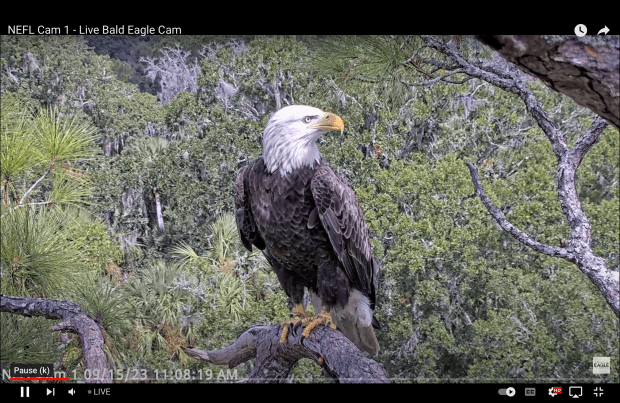
What is happening at the NEFlorida Bald Eagle nest of Gabby? V3 has not been seen in some days and I fear that the tragedy of Samson has beset a potential mate for Gabby. Will there be a clear partner before breeding season in 2023? or will all be lost due to territorial disputes?

Friday: New studies on migration with relation to Black-tailed Godwits and Red Knots reveals much about how young birds travel to their winter homes.

There has been chaos at the scrape of Diamond and Xavier due to the persistent presence of a young female falcon. Diamond has engaged with the female, and as of today, Friday, the nest is calm and back to normal. We need Diamond safe. She is not a youngster and she is incubating eggs.

Here is the video of that moment! This must be very unsettling for Diamond and Xavier.

Lotus and Mr President have been photographed together at the Washington Arboretum Bald Eagle nest.

Ervie is exploring more territory.

The Pritchetts are getting ready for a new season with M15 and his young and beautiful new mate. I hope that they have many successful years – even a decade – together raising little eaglets that spend time at the pond.

Saturday: Ervie is flying inland.

Gabby has been working on the nest with the new visitor. There has been no sightings of V3 and the AEF says they have not seen any fights on camera. There now could be two suitors. ‘As the Nest Turns’ has begun. Poor Gabby. The AEF is labelling them A1, A2, etc. Gabby prefers the smaller A1 and not A2. Hoping that V3 was just run out of the territory but, what a way to start the year.

Now Anna has been injured. She returned to the KNF E-1 nest – limping with a head injury. None of this is good…. but let us hope it is all minor with Anna.

Jackie and Shadow have been seen together in the tree on cam 2. I still love the diamonds that appear on the nest when the sun is just rising at Big Bear.

SE31 and 32 have changed significantly over the past week. Just look at that plumage. My friend, the late Toni Castelli-Rosen, loved the plumage of the White-Bellied Sea Eaglets. The two are much more steady on their feet and they are flapping their wings. Beautiful eaglets.

Dad has been working on the ND-LEEF nest. The new female has also been present. (Home of ND17, that wonderful third hatch survivor that went into care at Humane Wildlife Indiana – finally!).

Eagles at Duke Farms.

Calico has come out of her operation in fine form. She has been playing like a kitten for the past 3 days, and Hope loves it. They both seem to have springs on the pads of their feet. What joy it is to see Mamma and Hope play together. After, they can often be found sleeping side by side on the top of their makeshift tent where they can look out at the garden animals.

The bells will be ringing in New Zealand as the first two Royal Albatross have returned for the 2023-24 breeding season!

This short article explains this much-anticipated event.

‘A’ is very excited and provides more details and a video explanation of the ringing. ” Meanwhile, the official ringing of the bells in nearby Dunedin to welcome the returning toroa will occur this Monday, 25 September, at 13:00 local time (in the US on Sunday 24 September at 3pm Hawaii time/6pm PST/9pm EST). Here is a brief explanation of this beautiful tradition: https://www.youtube.com/watch?v=uanfnBN6OPI&t=36s. How adorable is the little girl?”

Sunday: Lady and Dad reinforce the side rails as SE31 and 32 become more active in the nest!

Ervie got home safely!

Speaking of getting home safely, V3 has returned to the NEFlorida Bald Eagle nest of Gabby. He is a little worse for wear in places. Will Gabby show up? Will V3 take the prize? We wait.

Pepe and Muhlady are working on their nest in Central Florida as are many other eagle couples throughout North America.

Akecheta was visiting the West End nest.

This is disgraceful! You can look no further than the driven grouse estates. This is precisely what Hamza was referring to when discussing the persecution of the Hen Harriers in Scotland!

Thank you so much for being with me this morning as I ate back into Bird World. I hope each of you had a good week and are enjoying the crisp autumn air. Take care. See you soon!

Thank you to the following for their notes, posts, videos, and streaming cams that helped me to write my newsletter over the past week: ‘A, H, Geemeff, L’, Geemeff and BBC1, PSEG, Sharyn Broni, Conservation Without Borders, The Sunday Times, PLO, WRDC Pam Kruse and SF Osprey Cam with Rosie and Richmond, Ian Winter and Ospreys of Newfoundland and Labrado, Sydney Sea Eagles, IWS/Explore.com, NEFL-AEF, Birdlife, BTO, Karen Lang and Orange, Australia Peregrine Falcon, 367 Collins Street by Mirvac Alabama Coastal Briefest. Androcat and SW Florida Eagle Cam, Dyfi Osprey Project, SK Hideaways, Looduskalendar, Twin Cities Metro Osprey Watch, Mark Avery, Inatra Veidemane and Bald Eagles in the USA, Hakai Magazine, MI McGreer, Karen Long, Gracie Shepherd and Raptors of the World, Katie Phillips Conners, Tonya Irwin and KNF-E1, FOBBV, ND-LEEF, Duke Farms, The Royal Albatross Centre, Superbeaks, Sharon Dunne and Royal Cam Albatross Group NZ, and Raptor Persecution UK.

Has Manaaki fledged? Saturday in Bird World

16 September 2023

Good Morning Everyone,

This is our last blog until we return on Monday 25 September. We hope that you have a great week while we are away!

Today it was cold and rainy. Not a great day for the annual open house at Wildlife Haven, our wildlife rescue hospital, in Ile des Chenes, Manitoba. Normally the grounds outside would be filled with people listening to speakers and visiting with the raptor ambassadors. Today, most huddled inside.

It was good to see so many parents with children aged 5 and up asking questions and being ever so curious about the animals.

One of the highlights of the tour was seeing the new home for Majestic. Majestic is a Bald Eagle that came to Wildlife Haven from Rainy River, Ontario ten years ago. She arrived as a juvenile and is believed to be between 10 and 12 years old. She was starving, dehydrated, and was suffering from an old fracture in her left wing at intake. She cannot live in the wild as she does not have control over her flight feathers but – now – she can fly about landing on various perches within her new enclosure safely.

Meet Una, a Great Horned Owl. Una had problems in the nest, according to the presenter. She was born with a missing right eye and a beak that was not aligned – he is small for the species. As a nestling, Una was neglected by her parents. Today, she is living the good life as an ambassador.

It felt ‘very odd’ holding the tail of an Osprey that was once very much alive.

Or a Red-tail Hawk.

There were tours throughout the surgical wing, the food preparation area, the big flight chambers, and special areas for clients such as otters and fox cubs.

Every wildlife rehab centre relies on donations and volunteers. It is amazing what they do with so little. You can normally find a ‘wish list’ at your local centre of items that are urgently needed and, of course, I will continually remind you about clean used towels and sheets, bleach, washing up liquid, laundry detergent, stainless steel bowls, small hand tools that work, pet food, vegetables from your garden, and items of enrichment such as toys. Clean kennels are particularly helpful in transporting animals or isolating them while they await intake or treatment. So before you bin it, think again. There is some wildlife rehab centre near you that might find those things useful – and they would be very grateful. Thank you!

Meanwhile – the kittens. I am guilty of taking way too many images of Hope. She is growing so fast and every day I can see subtle changes in her appearance.

Calico is getting very restless to get out of the conservatory and back into the house’s main part. The vet says ten days. Meanwhile, Hope is nothing short of energy in a small packet. She wants to play and runs from chair to table to tent and couch and then scurries under the covered area over the dining table and out again. Mamma is tired and, I think, growing weary of this big kid of hers. LOL.

Hope gets excited when anyone enters the conservatory – she wants to play with her favourite feather-dangling toy. She was introduced to healthy cat treats full of flax, cranberries, chicken, and other goodies. Her treats look healthy, like homemade human granola bars with extra protein. I made a line, and sure enough, she followed it to my lap. She is still very nervous, and I try not to breathe or move when this happens. She remains reluctant for me to hold her, so we are going every so slowly.

Lewis wants everyone to know that he is cuddly, adorable and a goof.

Lewis and Missey found a way to look out the window in the old office where Calico first stayed. Little birds were flitting about the apple tree. I am so glad that their closeness has not been jeopardised by the arrival of the two new siblings.

Looks like one of the things that we will be doing next week is building some insulated cat shelters. Winter will arrive on the Canadian Prairies before we know it. The Dark-eyed Juncos showed up in the garden today looking for Millet and Robins are passing through. There are still some hummingbirds being photographed along with Pine Siskins. Geese are everywhere, filling up on grass and grain left on the farmers’ fields before going south.

There is still concern over Hurricane Lee. There are reports that one beloved male Osprey adult, Swoop, is still near the nest at Hog Island in Maine. As I write this, the defined eye of the hurricane appears to have broken up, but this could still bring high winds and heavy rains to NE USA and Atlantic Canada.

Keep all of the wildlife in your thoughts as this system moves. We still have many fledglings and adult Ospreys in Atlantic Canada that have not left for migration.

Annie and Lou are bonding! How sweet. These are rare occurrences this time of year, but what is so good about this behaviour is that we can confirm that both are healthy and doing well.

In South Australia, Ervie is back fishing at Delamere, where he used to join Dad when he was just a youngster. Ervie is now two years old. Happy Birthday, Ervie!

It is always good to see Osprey platforms being replaced or installed for new couples. There are not enough old dead trees in situ for them near good fishing spots. This is a good solution and far superior to them building nests on power poles where they could be electrocuted.

Remember the two Royal Albatross chicks that failed in their first flight? Here is the story of their rescue. Thanks, Holly!

‘H’ brings us up to date on Barnegat Light and Date County:

Barnegat Light – “Duke is enjoying a few days of well-earned rest and relaxation since Dorsett left the area on 9/11.  Duke can often be seen in one of his trees at the north tree line, and Thursday he was wading at the shoreline with some gulls.  Friday Duke enjoyed a nice breakfish on his perch.  Later in the afternoon, he was seen on his perch shaking his tail and drying out his wings.  We love ya’, Duke.”

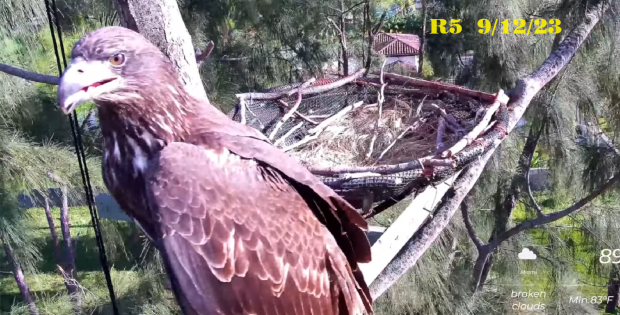
Dade County – “The juvie, R5, was back at the nest again on 9/15, and this time he was looking for food scraps.  Ah, he is so mature looking!  R5 has been at the nest 5 out of the last 6 days.  There is still some time before nesting season begins for Ron and Rose, but as much as we love R5, some of us are hoping that he will be bitten by the wanderlust bug soon, lol.  R5 is six months old on 9/16.  Happy Birthday, R5 !!”

Flaco, the Eurasian Owl that escaped the Central Park Zoo is doing well despite initial worries some months ago! You can check out more of Flake’s adventures by going to Bruce Yolton’s website urban hawks.com

‘A’ reports: “At Collins Street, F22 had a large crop today when she left the nest at 10:36, and little M22 arrived by 10:41 to take over the incubating until the shadow covered the scrape. He was panting a lot, and both parents this morning were using the technique of standing over the eggs with wings outstretched to shade them, rather than settling down on the clutch. Little dad looks so cute when he does it! He works so hard at enfluffling the eggs. It’s hard work for him to cover them all. He’s going to have major problems when it’s four eyases aged, say, a week to 10 days, without thermal down and exposed to the rain and the direct sunlight.—Yes, I’m going to say it again. WHY OH WHY could they not have strategically placed two small squares of wood to shelter from above and to extend the shelter of the building on the far side!??? What will happen on the first wet day?”

‘A’ continues: “I am genuinely concerned that there is the real possibility of a tragedy at Collins Street this season. Last year was the third consecutive La Nina year. That is not a normal Australian summer. We are about to get back to our usual summers, which include days reaching as high as 43C and I shudder to imagine what that scrape will look like by the time the chicks are, say, 10 days old. There is going to be a period of up to a month when the chicks are very vulnerable to that heat and are unable to escape it along that gutter. Not only that, but dehydration is going to be a potential problem even if they are getting enough food.”

SE31 and 32 were very hot on Friday, too. They were panting to help cool their bodies.

‘A’ reports about breakfast: “Breakfast was something that had been feathered (it looked young, but its feathers may just have been wet – it lacked a head so identifying it was not easy), which Lady brought in at 06:40:35. SE31 was in the right place at the right time, so was already in perfect position for food when it arrived, and shortly after 06:41 tried to help herself to the prey. Lady waited a while for some reason, and SE32 joined SE31 waiting for food. Because he came up on his big sister’s inside, SE32 was in primary position when mum did begin feeding, so was fed first rather than his sister. But Lady is relatively even-handed and is feeding both. The blood appears to be nearly gone from her head. so it must have come from her talons,. perhaps while scratching herself, and there is no apparent sign of what yesterday looked like a wound on her left foot. This is really lovely juicy nutritious red meat, and a decent-sized piece of prey as well. Both eaglets are eagerly grabbing bites, some of them very large. Their manners are impeccable. Neither is being at all aggressive and each is happy to watch the other eat. When they lose a competition for a bite, they just wait for the next one. It is lovely to watch. Lady is doing her best to feed both, and it seems they will end up having roughly equal amounts of this meal.”

‘J’ brings news that there is a new camera at the Centrepoint Bald Eagle Nest.

Gabby and V3 have been very alert at the NEFlorida Bald Eagle nest on Friday.

The cameras will return to SWFlorida on the 30th of September.

At the Royal Albatross colony, ‘A’ reports: “Manaaki is hovering so high, he is out of camera shot. Twice, I have thought he has fledged, but he has landed far down the hill and walked back up. He may well go today, but he shouldn’t. He is still not in control of his flying and he still has too much fluff. Another three days is my guess, as he is still not tucking his feet and legs up confidently and is unable to surf the thermals with any real control. Still, he is getting great height on his hovers and staying airborne for increasing lengths of time. He is very serious about his practising, and cast another bolus at 01:40 this morning. So he is preparing to leave and it could be at any moment now. Literally.”

‘A’ returns later with what is ‘sad’ news: “Manaaki has not returned to his nest. UQ is waiting for him, in his new spot near Manaaki’s nest. The general consensus on the chat is that Manaaki has fledged, although we need to wait until the rangers do their walkaround and head count tomorrow to know whether he is elsewhere on the headland. Unless of course he returns to his nest during the night. It is agreed that he was last seen on camera at 16:39:45 and has not been seen since. Other sightings thought to be of Manaaki were in fact of UQ chick (whose hovering skills are way better than Manaaki’s). I am still sceptical because he really did not seem to be sufficiently balanced in the air and still looked very uncertain. Not to mention the fluff he still had. If he has fledged and landed on the water in the bay, he will be spotted and if necessary rescued.  If he has fledged successfully, he has done so at 238 days of age. We wish him godspeed and all the luck in the world out there. We pray we (and he) will live long enough to see him return to his birthplace (some return as early as age three, others not until they are five or even older). One or probably both of his parents will visit the nest over the next few days to make sure their baby has fledged and is not hanging around nearby, needing to be fed. It is so bittersweet watching them wait. If their chick does not return to the nest to be fed, then all their devotion and hard work has paid off. They have done their job for the season, successfully raising a chick to fledge. But somehow, there is a pang as they wait. Sometimes, they come back more than once, just to be sure.  

So now, a year after we watched QT fledge, we are waiting for her parents to return for the new season. Mum YRK and dad OGK. Of course, our hope that OKG will return is very slim indeed, but it does remain a possibility. They ring the bells at the colony when the first returnees arrive home, and then the bells ring out all over the area. They love the toroa.” 

There is good news. While I do not know the number of butterflies in Canada this year, we have noticed a considerable number in the garden and the local parks. Others have mentioned this as well. In the UK, the record of butterflies has grown this summer – excellent news. This does not mean that there has been an increase in the number of insects – so vital to the lives of our songbirds.

Indeed, a group of residents at one of the condominiums in Winnipeg has noticed that the songbirds have disappeared from their property after the management had the grass treated by a firm claiming to be ‘Eco’. If it kills weeds, it will kill insects that the birds eat and often kills the birds. If you know of any well-researched articles on the issue of lawn treatments and songbirds, please send them to me. I hope to help some of my former students prepare a united front and argue against this practice in the future.

Do you know the Island of Mull on the west coast of Scotland? It is notorious for its wildlife, and the White-tail Eagles are no exception. There are also dolphins and whales to be seen.

While the Ospreys are away, want to watch a different table feeder in Scotland? Check out the one at RSPB Loch Garten. Here is the link. You might see some of those adorable red squirrels.

Thank you so much for being with us today. Please take care. We look forward to seeing you on the 25th of September when we return from a brief break.

Thank you to the following for their notes, posts, videos, articles, and streaming cams that helped me to compose my blog this morning: ‘A, H, J’, Geemeff’, Wildlife Haven, NOAA Hurricane Centre, SK Hideaways and Cal Falcons, PLO, Jeff Kear and UK Osprey Info, Holly Parsons and Albatross Lovers, Wildlife Conserve F of NJ, WRDC, Bruce Yolton, 367 Collins Street by Mirvac, Sydney sea Eagle Cam, NEFL-AEF, The Guardian, and Hakai Magazine.