Laysan Albatross, Eaglets Growing…Thursday in Bird World

2 February 2022

Good Morning Everyone!

Today some in North America will be checking out to see if there are shadows that scare the groundhogs back into their hole. It is Ground Hog Day! Did you know that this particular belief comes to us from a very old Pennsylvania Dutch notion that if a groundhog comes out of his burrow and sees its shadow, it will be frightened and go back in for another more six weeks. If, however, the groundhog does not see its shadow – spring will be early!

It has sort of ‘warmed up’ on the Canadian Prairies. It is now 2345 on Wednesday and it is -18 C outside with winds gusting to 26 km/h. That translates into an extreme cold warning with ‘Dangerous wind chill values below -40 C tonight’. In other words, the skin on your face could get wind burn if it was exposed for 30 seconds. Frost bite. Death from the cold. It is not good to be outside. Next Monday, things will be much nicer – with temperatures around -7 C. The Polar Vortex will have moved elsewhere. So wherever you are, stay warm, stay inside, prepare ahead. Do not go out if it is not necessary. And for those of you having extreme heat, you must stay hydrated and cool.


In the News:

The second Kakapo to hatch in 2022 has been named.

It feels so good to read about an eagle being released from rehab! Soar high!

Looking at ways to prevent bycatch can vary from area to area. BirdLife is examining the area around the Mediterranean Sea and, specifically Malta in this article. It is a good read and helps us to understand that everything has to be balanced. You cannot just remove all the turtles and hope that the eco system will survive.

Tori lines have proven to be helpful if the right line is used.

More eagles being admitted with lead poisoning. I wonder how many there are in a day across the US?

At the Nests:

Are you missing Mr President and Lotus? like me you haven’t seen them at the National Arboretum nest? There is an explanation. It looks like they might be moving house – er’ nest – just like Akecheta and Thunder.

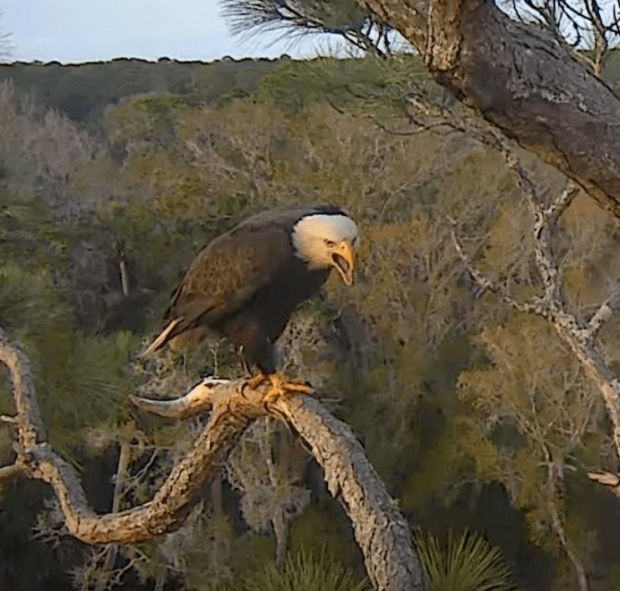
No worries. Zoe and Indigo are still around. Indigo has not been seen in the scrape but …here he is! Screaming up a storm.

Indigo, you sure are handsome! Hi there. Nice to have you back in the scrape…we missed you.

Gabby and V3 were said to have a ‘dust up’ over a squirrel around 0730 on the morning of Wednesday, 1 February. Gabby got her talon stuck in the squirrel and could not get it out and V3 wasn’t letting go either. They are definitely back to loving one another!

They were back working on the nest afterwards. These images are from 0850.

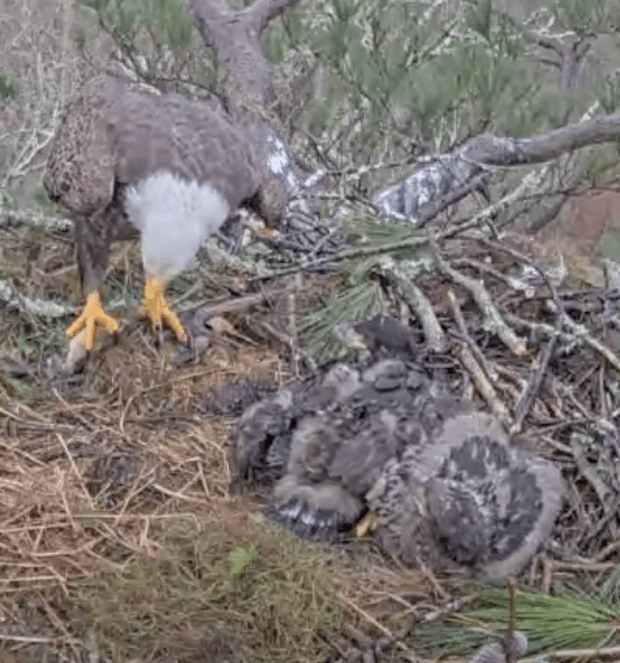
In other areas, Wednesday was a soggy day. The eaglets in Louisiana have been fed but word is coming from Paul White that neither Ringo or Boots have been fed earlier today because of the hard rain. It has stopped and at 1055 there was a feeding. Ringo ate. Even got out of the egg cup to stretch its neck. Boots made no effort to eat but, as you will see from a later posting, Boots had already eaten. He did, however, have only one meal yesterday. It is amazing how well eaglets can cope on so little.

People reacted to the feeding and also to the possibility that Boots cannot free its right leg – it is stuck in the nest. Let us please hope that this little one can get free. Send all of your positive energy. In order to bed fed, this mother is wanting those chicks up at the table and out of the bowl so Boots has to engage. He has had some food as you can see in the image below he has a bit of a crop.

It has been cold in and around the Houston area just like it has been in Louisiana with rain. hanks, ‘J’ for drawing that to my attention. It will not begin warming up until Thursday but it isn’t going to be hot, hot then. So no issues with dehydration from the heat, just lack of food because it appears Boots has been stuck in the nest for some days. There are certainly discussions about getting someone to the nest to release little Boots because that is possibly fishing line around its leg. Send good energy.

Anna, sensing the weather, was up feeding E03 several times before the storms hit including first light.

It is also cold – 36 degrees F – and rain.

Alex brought in a fish to go with the Coot and Valentine and 02 were fed early, just like E03.

Little E03 can still fit under Anna but, Valentine and 02 are having issues trying to get under Andria.

Either Tico or Pearl sent off a ‘ps’ that has caused the camera to be coated again at Superbeaks. Oh, goodness. Let us collectively wish for rain to clean that lens so we can see these two fledge…it is awhile but…Thankfully the ps is at the side!

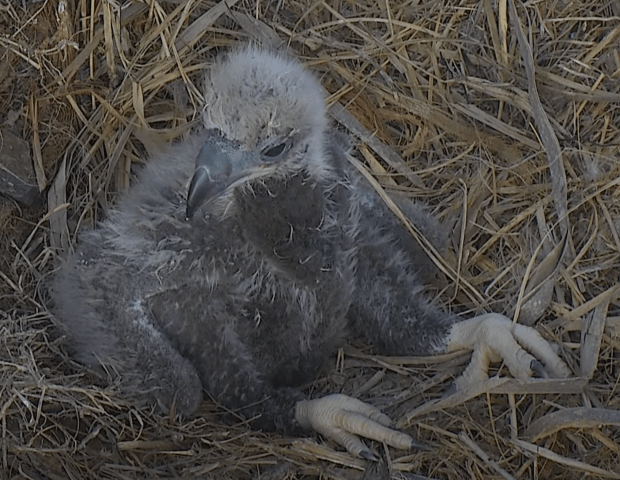
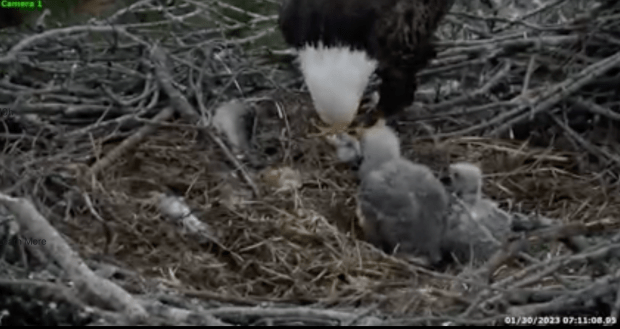
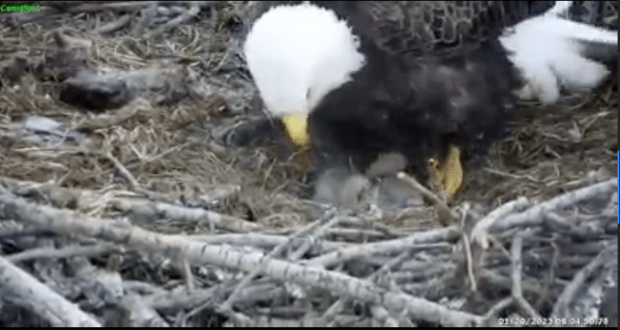
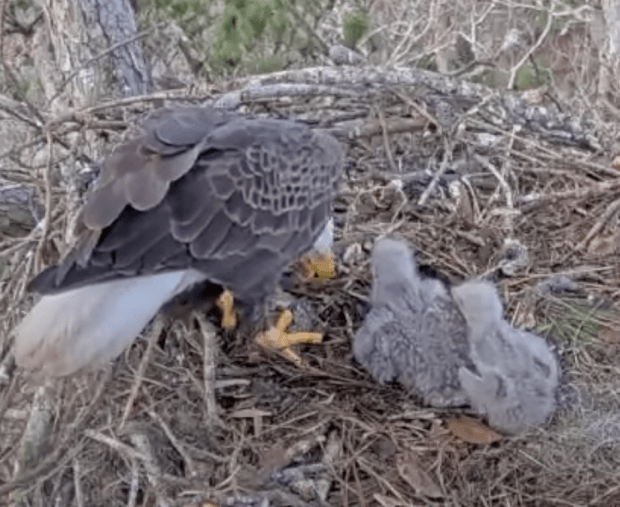
Connick is adorable. There was a time when I wondered if this little eaglet was going to make it to this stage…we can see his ears! Connick has a mohawk, his beak is shiny ebony at the tip, his eyes are clear, and he is eating well and moving too much on the nest for comfort.

The birds seem to be doing fine. There are eggs being laid, birds incubating, raptors thinking about eggs, the temperature of the South getting warmer as we move through February.

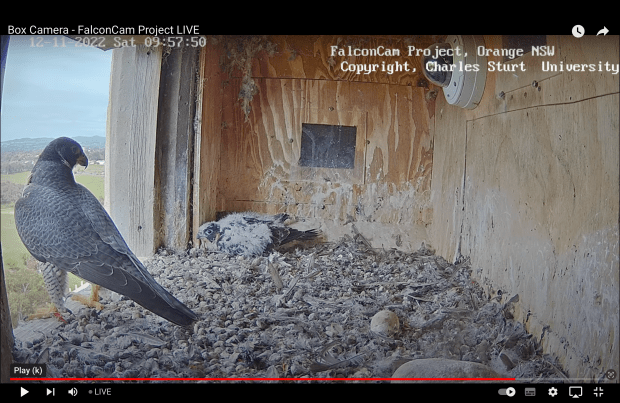
Holly Parsons is long associated with the Peregrine Falcons at Orange. She runs the FB group there and also runs the Albatross Lovers FB Group. I admire Holly. Look her up and read her bio. A film that she posted a link to today in her Albatross Lovers Group is one of the most beautiful documentaries on the Laysan Albatross. The images are amazing – so close up. The story is detailed and thought provoking. It is inspiring and bittersweet. The film is about an hour and a half long. You might want to watch it with your popcorn on a Friday night or watch it in sections or just sit quietly and see the whole thing. It is difficult seeing what all the plastic that we use does…but, we need to watch this. It is a beautiful wake up call. We will all thank Holly collectively. It is a really good look at the life of these amazing sea birds on the Midway Atoll —-and the challenges these birds face because of us.

http://www.albatrossthefilm.com

There is the trailer but on the right a tab says, Albatross the Film. That is what you are looking for.

Zoe is on the move again. She has been to an isolated bay where Osprey have been seen catching fish. Go girl! I hope our girl has turned out to be a good fisher.

Bonnie looks so pretty in that nest on the Kansas farm of Farmer Derek. After observing the GHOs run off the Bald Eagle couple, I found myself completely fascinated watching Clyde bring in rats and mice and other critters for Bonnie at dusk and dawn. And then the two owlets…so cute. So we will keep an eye on this GHO. (I have to admit that after causing such pain to Harriet and M15, I am not too thrilled about the relationship between the GHOs and the other raptors).

Thank you so much for being with me today. It is so nice to have you with us. This was a bit of a round up with some nests that are doing splendidly not mentioned. We will wait to see what will be the next Florida Osprey nest to have eggs – will it be Achieva or Captiva? Take care everyone! See you soon.

Thank you to the following for their notes, their posts, announcements, videos, and streaming cams where I took my screen captures: Kakapo Recover, Tamarack Wildlife Centre, Birdlife Malta, Audubon Centre for Birds of Prey, AEF, Charles Sturt Falcon Cam and Cilla Kinross, Elain and Charles Sturt Falcon Cam and Cilla Kinross, NEFl-AEF, Paul White and the Webster Texas Eagle Watchers, KNF-E3, KNF-E1, Superbeaks, Window to Wildlife, Port Lincoln Osprey, Farmer Derek, Holly Parsons and the Albatross Lovers Group plus The Midway Project film, The Albatross, by Chris Jordan.

Tuesday Morning in Bird World

31 January 2022

If my father was alive today, it would be his birthday. So grateful for his love of the animals and birds that frequented our garden as a child and all the things he taught me.

It is still cold in Manitoba. We are still in the extreme cold warning but…it is only -21 C. Because of the strong winds it will be nearly -40 if you count in the chill factor and they are asking people to stay inside if it is possible. Cars do not like to start in cold weather like this. Some people have ‘plugs’ that heat the oil. The maker of my car will not install those nor the automatic starters so that you can let your car run and get warm before you go and jump in. And many of us, myself included, do not have garages having opted for larger garden spaces. So…it is cold out there. We bundle up in coats that are mid-calf and rated to -40. Boots are lined as well and there are all new materials to help keep people warm that are light weight. We manage. In fact, I function much better in the colder temperatures, like the eagles, than in the extreme heat that I loved as a younger person.


Making News:

It looks like Glen Blue 708 got tired of travelling and has decided it is beach life in Morocco for him!

The names of 2022’s year old Kakapo are coming in.

There appears to be ‘some hope’ for Annie and Grinnell’s Sequoia and Sasha.

Most of us outside of the UK don’t understand the ‘power’ behind the shooting estates that allow their gamekeepers to stomp on Goshawk chicks or shoot the Hen Harriers. Here is a good read.

Checking on Our Nests:

The new guy is definitely not a Grinnell and hardly an Alden. Not sure….

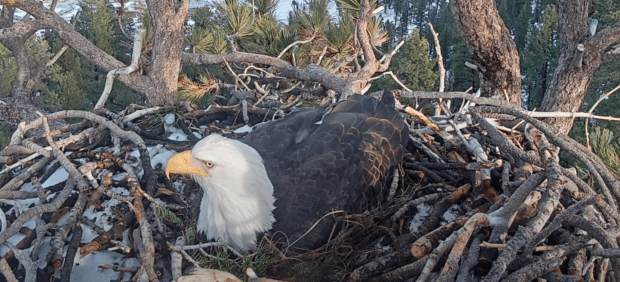
It is quite the snowy day for Jackie and Shadow at Big Bear. On occasion you can hear one or more of those cantankerous Crows/Ravens that have been coming to the nest and trying to distract the adults so that they can get to those precious eggs.

It has been hot in Florida. All of the eaglets have been panting today. Poor Connick when it got out of Connie’s shade, the wee one was huffing and puffing keeping cool. It was mid-afternoon and the little one with its clown feet and soft thermal down was panting really hard.

At 15:37 Connie gets Connick up to have some fish to hydrate itself.

As the sun sets on the barrier islands of Florida, it is a good thing to remember that the eagles actually ‘do better’ physically in the colder weather than in the extreme heat.

Teeny weeny Boots at the Webster Texas Bald Eagle nest is getting some fish. Ringo always eats first and then little Boots.

Most everyone watches and many report on Harriet and M15 so I don’t always – unless there is a big change and there was last evening. E21 and E22 slept alone in the nest together after having a tandem feeding by Mum and Dad.

In Louisiana, it was drizzling again on Monday with a 45% chance of rain, again.

Anna keeps little E03 dry. It is rather hard to imagine but E03 fit into that size of egg only 23 days ago.

Anna has found a new way to keep her baby dry.

At the E3 nest of Alex and Andria, Valentine is walking and getting steadier by the day.

Then little siblings say, ‘Hey, I can do that walking thing, too!’

Pa Berry and Missy could not be more proud. B16 is doing so well – the cutie pie Rollie Mollie is getting to that sort of ‘lanky’ stage. Still adorable. There are at least 3 rabbits on that nest if not 4 today.

As the sun sets in St Petersburg, there are no eggs yet at the Achieva Osprey nest of Jack and Diane.

No eggs at Captiva for Mabel and Angus. They have been working on the rails today and keeping alert as there appear to be intruders in the area.

I still see only two eggs at the Moorings Park Osprey Platform in Naples, Florida this evening and around 2100. Will there be three when we wake up tomorrow morning? Believe me, I hope not.

The award for the most romantic of the birds today goes to L and GLY, the Royal Albatrosses! Goodness. Ranger Sharyn says that we might expect more frequent turn overs as it becomes difficult for the adults to find enough food for them and the chick so they are in and out, in and out. That little one is like doubling its weigh. Did anyone say ‘big boy’? Of course, I thought Lillibet was a big boy, too. So don’t trust me about genders of albatross!!!!!!!! That is a fact.

Thank you so very much for being with me this last day of January. February is short. Richmond’s Rosie should be returning from her migration around Valentine’s Day. Something to look forward to and then…5-6 weeks for UK Osprey arrivals…4 weeks til Big Red lays her first egg. Oh, lots to look forward to. Take care all. See you soon.

Thank you to the following for their tweets, posts, announcements, videos, and streaming cams that make up my screen captures and blog: Conservation without Borders, Kakapo Recover, HIT, San Jose City Hall, SK Hideaways and Cal Falcons, FOBBV, Window to Wildlife, Paul White and the Webster TX Eagle Cam Watchers, SWFlorida Eagles and D Pritchett, KNF-E1, KNF-E3, Berry College Eagle Cam, Superbeaks, Moorings Park Ospreys, NZ-DOC and Cornell, Elain and NZ DOC and Cornell.

First egg for Duke Farms, Ringo stops beaking, Royal cam chick hatches…life in Bird World for Saturday

21 January 2022

Good Morning to Everyone,

To all of our readers celebrating The New Year, The Year of the Water Rabbit or for those celebrating Tet, the Year of the Cat, in Vietnam, we wish you joy, good health, prosperity, and a long life. Have a wonderful holiday. I hope that you were able to spend it with your family, friends, or loved ones.

So what is entertaining the kittens! The Dove was as fascinated with them as they were with it. Tomorrow we are putting up a high table feeder for this Dove so that it might be able to eat without fear of the neighbourhood cats killing it! It spent part of the afternoon in the tree that you can see. That is a ‘female’ Maple. It has those helicopter seeds. I do wonder if the dove was able to eat some of those.

Making News:

Oh, my goodness, tears of joy. Redwood and Phoenix’s chick is now a fully grown juvenile and seen for the first time at Big Sur.

A little history for those that do not know the California Condor community. Prior to the Dolan Fire that began 18 August 2020 and destroyed much of Big Sur, the top male condor in the Big Sur Colony was Kingpin 167. Redwood Queen was known as ‘Slope Slug’. She spent all her time down the slope of the hill because the other condors harassed her so much. She was the one at the bottom of the hierarchy (just like all new ones are). THEN something magical happened. Kingpin 167 paired with Redwood Queen 190 and she instantly rose to the top of the ranks. Their most famous chick was Iniko 1031 who survived the Dolan fire as a nestling in a large Redwood Tree. Iniko was famous. Images of the young condor with the fire crackling around the tree went viral. Iniko survived the fire only to be injured when a male condor came into the nest. Redwood Queen arrived to save her chick. Iniko was injured when it was shoved out and down the nest. Iniko was taken to the Los Angeles Zoo for medical care and rehabilitation. Kingpin 167 is presumed not to have survived the fire and died. He has not been seen since. Redwood Queen pairs with 477 Phoenix, aptly named because he also survived a horrific wildlife, earlier. Their first egg laid in the old tree where Iniko hatched was not viable. The pair moved to a tree in Pinnacles National Park that Phoenix had shared with his former mate. There they raised 1174 in 2022. How lovely for both of them – both survivors of wildfires.

The VENTANA WILDLIFE SOCIETY has all the information about all of their condors and their programme to protect and improve their lives on their website. Today, however, there are many celebrations because the chick of Redwood Queen and Phoenix has been seen at the feeding station at Big Sur. This is a place, high in the hills, where the VENTANA WILDLIFE SOCIETY brings carcasses (without lead or any other toxins) for the Condors to feed on. We all know about the dominance issues with the little eaglets and ospreys, so you can well imagine what it is like in this pecking order!

In the UK, fury is growing over the most recent killing of raptors. Hopefully the voices of the people will become so loud that those politicians and police that are to protect the birds and obey the laws will change and do what is right.

I love Goshawks despite their raids on Osprey nests. Just like I love Red Kites – all raptors. Geemeff reposted this Tweet. It is so difficult to explain how people feel when day after day and week after week, the illegal killing of raptors in the UK continues in or on those estates where grouse are hunted and killed. The entire country should rise up against the privileged — and it is the privileged that own these estates and have hunting weekends on them. A small group that have loyal ties (both figuratively and literally) that allow this to keep happening.

I would also like to say the it takes skill to kill one goshawk but five??? So many of the bird community offering rewards to find the culprits which will be individuals associated with the hunting estates. Mark Avery says “Both RSPB and Wild Justice have each offered rewards of £5,000 for evidence leading to a conviction and Rare Bird Alert has started a crowdfunder to add to that sum. Let’s see the British Association for Shooting and Conservation and the Game and Wildlife ConservationTrust do something similar if they are serious about rooting out wildlife crime, but it would take a lot more than that to persuade me that they are. By the way, I haven’t heard or seen any comment from the local MP –  a guy called Matt Hancock.” The collusion needs to be stopped…and people need to do the right thing.

For those of us worried that something might have happened to Richmond, the resident male Osprey mated with Rosie, at the Richmond Whirley Crane in SF Bay, Richmond is fine. There he is in the streaming cam below! Oh, wonderful. Rosie migrates and she normally returns to her Richmond right around Valentine’s Day. The couple raised Brooks and Molate in 2022. Sadly, we lost Molate when he died on the nest. As far as I know the precise cause of death is not known.

Kakapo Recovery have positions open. If you or anyone you know might qualify to work for them for the next year, please check this out. I wish I were younger! What a privilege to help this species thrive and grow in numbers.

A Check on the Nests:

So happy to announce that there was a peaceful feeding at the Webster TX Bald Eagle nest. Yes!!!!!!! No beaking at all. Thanks Paul White for letting us know. The pleasantness has continued all day. The real question is why did it start and excel to such viciousness…but, the great news is that it is over for a day, so let’s add another day, and another one and see two fledge. Yes.

There is only one day separating them in age. Ringo is the oldest – hatched on the 12th of January – so 9 days old today.  Ringo stopped beaking on his 8th day. Boots is the youngest and hatched on the 13th.  There is only a day’s difference.  8 days old.

I have been checking Duke Farms now and again but, not often. Thanks Paul for posting these images on Bald Eagles 101 for us. Congratulations to Duke Farms.

Beautiful Jackie first light. 20 January 2023.

This is a video to go with Shadow flying in and wanting a turn at incubation on the 15th. What a great guy. I love these two…they are so funny. Shadow with his big sticks and wanting time with the eggs. Precious.

Elain’s highlights from the 20th at the scrape of Diamond and Xavier. No worries. Indigo is there in full volume. Gosh, we will miss him when he leaves the territory!

All is well at the Captiva Bald Eagle nest.

CE9 and the parents really have this feeding thing down…the little one is going to get stronger and stronger. Isn’t this just such a relief? Just look at the fish on that side of the nest!!!!!! This baby should never be hungry.

Nice crop after the first feeding of the morning. Little one is stronger, is using its wing tips to balance – and is eating well. Bravo.

CE9 snatched that big piece of fish out of Connie’s beak before she could change her mind. Way to go CE9!!!!!!!!!!

Here comes another biggie!!!!!!!!! Never fear. CE9 is on top of this. He has figured it out. Mum gets a big bite, then wants to think about whether she should feed it or eat it. CE9 says ‘feed it!’ and he grabs. Gets it.

CE9 is getting fluffier and fluffier, too and you can see this cute little eaglet with its little tail. So thankful that all that fish juice did not cause any problem to its eyes.

Fish everywhere! This nest has really turned around. Thanks, Clive for all the fish and giving the little guy a boost the other evening. It sure helped.

Life is good at Superbeaks. Seriously. These eaglets are huge!!!!!!!! They will absolutely be the size of their parents in about 10 days. Like all other raptors, their wings will be longer than their parents to help them fly at the beginning. Think of a very large turkey!

Pearl.

Tico is panting to regulate his temperature in the hot Florida sun.

Working those wings.

The Royal cam chick has hatched. Congratulations to L and GLY and to all the NZ DOC rangers and everyone at Taiaroa Head.

I did not watch the KNF E3 nest today but, ‘A’ filled me in. Her description of what happened is detailed and wonderful and I want to share it with you (with her permission). This flowing record is a precise recount of how the dominant eaglet often gets fed and the others down the line might not. Were the parents preoccupied with something? We do not know. It is, however, a relief that E02 was full to the brim. A week ago I was giving Adrian the Mum of the Week award. Things change quickly and E01 did quite a bit of beaking and shaking – enough to give E02 pause to be cautious. Survival. Survival out of the eyes of both eaglets.

Alex brought a new breakfast fish in to the KNF3 nest at about 06:48. Mum flew up to a perch branch and left things to dad, who looked a little confused. The eaglets were ready for breakfast! At 06:51:20 mum flies off. Dad is still unsure, and eventually he flies up to a perch branch, then away. The chicks are surprised and disappointed and go back to sleep. Mum reappears at 07:03:51 and starts feeding 01, who is first to the table. Little 02 waits a few  moments for 01 to have some food, then edges up to mum’s beak but at 07:12 it still has not had a mouthful. 01 considers turning away from the table, full already, but sees 02 getting close so considers changing its mind and going back for more fish. In the end, it decides not to bother, Finally, at 07:12:38, 02 reaches the beak but by now, Andria is eating her own breakfast. The little one waits patiently, while 01 waddles away and collapses in the middle of the nest, in a food coma.  The little one moves even closer to mum, reminding her that it still has had no breakfast. At 07:13:18 it gets its first (and only) mouthful. It tries to nibble at the fish. Mum flies off at 07:14:14, having fed 02 a single mouthful of breakfast and nothing more!! The little one continues to attempt to self-feed. The headless, largely uneaten fish is a much easier proposition for 02 than yesterday’s ancient coot, and it is getting some bites from the fish but soon gives up. The pair settle in for a snuggle. 

When mum returns at 07:28:04 she is empty-taloned. She does not attempt to feed the chicks, instead aerating the nest, moving some sticks around, and then brooding the eaglets! She flies off the nest at 07:37:36, having still not fed 02 more than one mouthful of breakfast. There is a hardly touched, decent-sized fish sitting on the nest. Just before 08:08 a parent (Alex?) arrives, surveys the scene, and aerates the nest. He goes to the fish and little 02, having just had a reasonable PS, rushes up to his beak to be fed, as 01 watches but doesn’t get up. Finally, 02 is getting some breakfast. But not much, as Alex feeds it only a mouthful, at m two,08:09:56. before flying off at 08:09:56. Little 02 resumes nibbling at the fish (try the headless end, sweetie, not the tail) but eventually gives up. Dad returns a few minutes later with a stick, which he positions carefully. He then flies off again, without feeding either eaglet. By now, 02 is getting really hungry. It falls asleep in a cuddle puddle with 01. 

Dad is back with another stick at 08:32. As he moves around the nest to place his stick, dad is followed by 02, who is desperately hoping for food. But dad flies off the nest at 08:40:15. Mum is back at 08:53:42 but sits on the nest for a full 20 minutes. It is after 09:13 before she finally moves to the fish. Little 02 is up to the beak in a flash and finally gets some bites of fish. It is soon joined by 01, who takes over front position. Little 02 remains patient and finally gets fed breakfast. Afterwards, both eaglets have massive crops. 

‘A’, 20 January 2023

There were many other feedings during the day. Both eaglets ate well and there is no cause for alarm.

11:00:53

12:22:20. E02 getting fed. E01 in food comma from the earlier feeding at 11:00.

4:56:44. E02 eating again.

By 15:10, E01 is up at the table getting the bites. Good thing little one was up there first!

Zoe is quite the character. She is 126 days old today. And yesterday, Dad brought her 2 fish. She had to wait on Saturday until 15:23:40 for a fish delivery and oh, wow. She was so excited to see that fish coming in. What is interesting is that Zoe had been away from the nest for approximately an hour. She flew in to the nest, did the toe dance, and the fish arrived. What I am suggesting is she was where the parents were fishing and saw them heading to the barge with the fish OR was somewhere near enough to see them flying in with her dinner.

If you are wondering when Zoe might leave the nest, Calypso the 2019 female fledgling left on 9 February; Solly left the nest area for good on 2 February. Zoe has some time yet before parents begin to think about eviction. Of course, Ervie was there a way longer!!!!!!!!!!!!

Gabby and her ‘man’.

E22’s eye is fine. Is there a pip at Berry College – will find out in the morning! So much going on but, for right now, it is all good.

Thank you so very much for joining me today. Take care. See you soon!

Thank you to the following for their notes, their posts, their announcements, videos, and streaming cams that make up my screen captures for my blog: Ventana Wildlife Society, Raptor Persecution UK, Geemeff, SF Ospreys and Golden Gate Audubon, Kakapo Recovery, Webster Texas Eagle Cam Watchers, Paul Kolnik Bald Eagles 101 and Duke Farms, FOBBV, Elain and Charles Sturt Falcon Cam and Cilla Kinross, Window to Wildlife, Superbeaks, Sharon Dunne and the Royal Cam Albatross Group NZ and the NZ DOC, KNF-E3, Port Lincoln Ospreys and NEFL-AEF.

Would you like to subscribe to this blog? We would love to have you as part of our daily mailings. You can unsubscribe at any time! There is normally only one posting a day unless something ‘big’ happens in Bird World.

Eggs, Coots, and more…it is Thursday in Bird World

12 January 2022

Good Morning Everyone,

I hope that the week has been good to you. I think of everyone in the paths of the storms that I am reading about and I hope that all of you are safe.

I am repeating the story of Jackie laying her first egg. 3884 people were watching the nest at the time. It went up to over 4000. Incredible. Jackie and Shadow are much loved. It just made me giddy and all of us wish this couple the very best of luck this year. Let us hope for good weather, no predators and nothing untoward.

From the Bookshelf:

I continue to sing the praises of Slow Birding. It is my pick of all the books I have read so far as being one of the most informative and easy to understand. If you like picture books, it is not for you!!!!! Last night I tackled the chapter on American Coots. They visit us and last summer I had the privilege of seeing several at the ponds around our city on a daily basis. I want to share with you what I learned – it is fascinating.

Coots are not ducks. They are rails but they spend their time in the water – like a duck. Their bodies are a deep espresso brown black, the head a darker shade than the body. Their bill is white with a shield that ranges in colour from a deep red-brown to brick red. You can see this below. They have red eyes. Stunning. Their secondary feathers have a white trim and there is a tiny white line going down the middle of the tail to its tip. Their feet have toes and those toes have evolved over time to have phalanges that help them to swim.

American Coot (Fulica americana)” by Jacob McGinnis is licensed under CC BY-NC 2.0.

In the image below notice the red on the head of the chick.

Mud Hen or American Coot (Fulica americana) feeding her baby” by Peggy2012CREATIVELENZ is licensed under CC BY 2.0.

Some interesting facts about Coot behaviour:

  • Baby Coots have red heads. When predators are about they will stick their heads deep into leaves or into the nest so the predator cannot see them. As they age they can dive and camouflage their head by being under water. There is, on average, a five day spread between the first hatch and the last.
  • Adult Coots can tell the parasitic eggs (eggs laid by another Coot in their nest) from their own eggs due to patterns on the shell.
  • Adult Coot parents divide up the brood – older chicks with fading red heads and younger ones with red feathers. Chicks who kept their red feathers were the favourites of the adults to be fed. Unlike ducklings who can forage themselves, baby Coots are fed by the parents.

Making News:

Did you know that the Kakapo Recovery group check out the Rimu fruit, essential for Kakapo survival, to determine when breeding will begin? I didn’t.

More raptors are arriving in wildlife rehabilitation centres now that they are having to scavenge for food. Often this means that they are eating the innards left from hunters in the fields and woods – those are loaded with lead and it sends them right into care if they don’t die first. Sadly, this Golden Eagle got help but it was too late. This is entirely preventable. Write your representatives and urge them to ban all levels of lead in fishing and hunting equipment! Now. Thank you.

I would give just about anything to see a pile of ducks quacking away in my local park’s pond. They will return in the late spring. For now I have to rely on stories of others. I hate no idea, however, that Wigeons whistled, did you?

https://www.theguardian.com/environment/2023/jan/11/birdwatch-whistling-wigeons-winter-highlight?CMP=share_btn_link

Nest News:

How many of you worried and fretted that Connie had not fed the little eaglet? I sure did! Connie has now fed the eaglet – about 24.5 hours after it hatched! Yippeee. Oh, I bet that first bite of fish tasted good! Little one holding its head up nicely. There is no sign that the second egg is pipping but it could be. Perhaps the egg that hatched was actually the second one laid. We wait. The raptors will teach us patience whether we like it or not!

Connie fed the little one again at 13:39 and at 14:20. I am making an assumption that the feedings will be nearly hourly from this point onwards for a few days during daylight hours. Clive has brought in Mullet and Trout. Good job, Dad.

Thursday>. No obvious pip in the second egg at Captiva.

Oh, that little one at the KNF E1 nest of Anna and Louis is just a cute little butterball. Will that second egg hatch? I cannot see a pip there either. Oh, those little wings. Adorable. Just adorable. No signs of a pip in the other egg.

I do not see a pip on the second egg at KNF-E1 Thursday morning either but it could be there.

One big difference that you might notice is that Andria feeds her eaglets more often than Anna. That is a really good thing for those two eaglets especially the second hatch as it remains much smaller than the first. Both are being civilised and both are well fed and cared for – no worries here.

Jack and Diane were bringing in bark to the nest in St Petersburg Florida. I am sure hoping that they leave it as a liner to cover up that hole. Last year their eggs rolled in there and with the help of Crows, the couple had no osplets. The year prior they fledged three. Diane’s leg appears to be improving daily.

Both PePe and Muhlady have brought in fish to the nest. These eaglets, Pearl and Tico, are so lucky. What a great source for fish their nest has.

Pearl is really getting her juvenile feathers.

Just look at this beautiful eaglet.

Gabby and V3 were both at the nest this morning. V3’s talons have really taken a beating but they appear healing or healed. Then off to secure the territory while Gabby stays home! What a guy.

Gabby lets out a big cry at 09:46.

Both V3 and Gabby are at the nest tonight on their respective perches watching for intruders and probably hoping to get some rest.

We have all noticed the large number of intruders at Gabby’s nest – and, of course, no Samson is what started all of this. The Centre for Conservation Biology has noticed that Bald Eagles spend more time guarding than they did 20 years ago due to the growing number of eagles in the area. Here is an article that arrived in my inbox today. It really sheds some light on what could be happening in The Hamlet.

They continue to work on the nest at Big Bear. With body temperatures of 105 degrees, Jackie and Shadow can melt the snow on the nest very quickly. Keep an eye out for any fluff being brought to the nest bowl. That will signal egg laying.

Well, goodness. I said watch for the eagles to bring in soft nesting material and look what happened late Wednesday afternoon!

That nest bole has been occupied for longer than an hour. I am not ready for this! But it just might be that Jackie is!!!!!!!!!!! She certainly wouldn’t listen to me.

Oh, tears. Jackie just laid her first egg. Beautiful. Between 1557 and 1600. Jackie made it look easy.

There is a fully history of the Big Bear nest under the streaming cam. It is very possible that Jackie is the 2012 hatch of Ricky and Lucy. In 2019, Shadow arrives at the nest and refuses to leave. Eventually, Jackie’s mate Mr BB leaves the area. Jackie and Shadow fledged Cookie and samba in 2019. Tragedy strikes for the pair in 2020 and 2021. Last year Jackie laid eggs on 22 January and 25th. One of those hatched. It was Spirit who stole our hearts and who fledged on 31 May.

Jackie was still keeping that precious egg safe at 1800.

E21 and 22 are really enjoying the fish that was brought in on Wednesday. they are cuties. Both M15 and Harriet fed the little ones fish and both were nicely behaved. Yes.

Indigo loves bringing beetles into the scrape that he has caught. Today there were four that Elain caught in her video! Indigo is so proud of his catch.

Ron and Rose are still working on the nest in Miami-Dade. Today, Ron brought Rose a fish in the nest. How sweet.

I am waiting for the pip watch at Berry College for Pa Berry and Missey. Last year they raised a strong eaglet B15 that stayed in the area and entertained people well into the fall with his flying skills. They are not on YouTube. You must Google Berry College Eagle Cam.

The eagles are working on the nest at Duke Farms.

And the new couple at the Captiva Osprey nest, MO and FO, are working on eating a catfish (or is it a shark?) and mating at the same time. Good luck with that.

Thank you so very much for being with us today. Please take care. See you soon.

Thank you to the following for their posts, videos, tweets, and streaming cams that make up my blog: Openverse, Kakapo Recover, Terry Carman and Bald Eagles Live Nest Cams and News, The Guardian, Window to Wildlife, NF-E1 and E3, Achieva Credit Union, Superbeaks, NEFL-AEF, Centre for Conservation Biology, FOBBV, SWFL Bald Eagles and D Pritchett, Charles Sturt University Falcon Cam and Cilla Kinross, Elain and Charles Sturt Falcon Cam, WRDC, Berry College Bald Eagles, and Duke Farms Bald Eagles.

Pip for Anna and Louis, hatching at SWFlorida…Wednesday in Bird World

4 January 2022

Good Morning Everyone!

The excitement has been growing with more than 2528 persons watching Harriet and M15 at the SWFlorida Nest as their first hatch of the 2022-23 season is trying to make its way into the world. It is now 1000 Wednesday morning. The little one has been working away for 26 hours and there could be much time to go. It is hard trying to get through those hard shells and often the wee babes are exhausted when they have finished hammering away with their egg tooth. It can take from 24-72 hours. Jackie is not giving away any peeks. There is a pip for Anna and Louis in Louisiana also. Things are beginning to happen….and they will begin to happen fast it seems.

On Everyone’s Mind:

At just after 0800 on Tuesday 3 January, SWFlorida announced that the pip on one of Harriet and M15’s eggs was official.

From pip to hatch can be 24-72 hours.

By mid-afternoon, the little beak could be seen moving inside the small hole. There are now cracks appearing that will radiate out from the pip hole.

Gracie Shepherd caught that little beak working on that shell.

No announcement of a hatch yet this morning.

Making News:

There is a pip for Anna and Louis at the Kistanchie National Forest E-1 nest this morning.

What does politics, friendships, old school ties, and hush ups have to do with the persecution of raptors and the use of illegal poisons in the UK to kill Corvids and other birds and wildlife? It would appear a lot! Despicable.

Check out the latest blog at raptor persecution.uk.org

To counter these horrific deaths in the UK, there is good news coming out of Minnesota. Remember the 10 eagles that survived (3 died) that had eaten euthanised pets at a landfill? Well, they are well enough to be released back into the wild. Well done Raptor Centre! What a great story for the new year.

Another good news story of a sub-adult eagle being rescued and then found to be suffering from some rodenticide poisoning. Thank goodness for the wildlife rehabbers that spotted the thinness and took blood tests and treated this beautiful boy.

No news on any charges being laid for those that dumped the dead euthanised pets.

The raptors have such a difficult time because of humans. Two of the leading causes of their misery can be eliminated easily: ban the use and use of rodenticides with heavy prosecution for any found using these designer poisons and ban the sale and use of lead ammunition and fishing equipment. Every wildlife rehabber in the world will be grateful.

Loving the Kakapo? and thrilled that there more living than ever before they were almost made extinct? The new ones are going to get names! Congratulations everyone. It has been a good year – a real indication of the efforts being made to keep the islands disease and pest free.

Let’s educate ourselves. The Audubon Society has put out a really informative article about feeding birds. It is not just about the food but how our actions can actually harm our feathered friends. Many of you wrote to tell me that you had Scrub Jays in your area but, have never seen a Blue Jay like Junior and Mr Blue Jay. Scrub Jays are a species under threat; they are on the IUCN Red List for endangered birds. How do you help?

Bird lovers quickly realized that Florida Scrub-Jays will come readily to the hand for peanuts. Unfortunately, studies have shown that jays fed by humans reproduce earlier in the year than those that are not. As a result, their fledglings hatch before the caterpillars they rely on for nutrition are available, leading to malnourishment and starvation. People also feed jays near roads, and collision with vehicles is a major cause of their death. Thus, it’s now illegal to feed Florida Scrub-Jays unless you have a permit from the U.S. Fish and Wildlife Service.  

The Audubon Society, ‘When It’s Okay (or Not) to Feed Birds

Here is the entire article. It isn’t long but it is packed with good information.

https://www.audubon.org/news/when-its-okay-or-not-feed-birds

Nest News:

It was soggy in Louisiana as that weather system moved through the area. Andria was wet. The winds are quiet but there is a 95% chance of continued rain the area. It is 77 degrees F.

Andria took advantage of a dry moment to feed the two eaglets.

The eagles at Kincaid Lake are so lucky – a huge stocked area for them to get their prey. The eagles at Decorah, Iowa are lucky, too. A trout farm right across the road!

Images of Gabby at NEFlorida’s Bald Eagle nest at The Hamlet on 3 January. She is beautiful. Where is V3? At 1745 V3 is on the branch, he jumps into the nest alerting and flies off to the right alerting.

V3 is a very good defender of the realm. Some think he has new battle scars on his talons. Probably. He is wet but has a big crop. Been fishing?

V3 does have some cuts on his talons but the blood could also be from the prey that he ate. It does not have to be a battle wound with blood.

Before he takes off, we get a really good look at his crop. This eagle is a good hunter. He is quick to protect the territory keeping all intruders away. Just what Gabby needs.

Those darn mosquitoes and other bugs are not bothering Gabby and V3 as much tonight and both are on the nest. Probably guarding it, too.

Rose and Ron were working on their nest today. Gee, I wonder if we will have eggs there this year?? Apparently Ron and Rose had a visitor to the nest – V1, the first female to try and win Ron’s affections. And who says Eagles do not hold grudges and do silly things in revenge??? Apparently V1 did a ‘ps’ right in the nest bowl where Ron rests today!

Ron and Rose are a beautiful couple. They posed for the camera after the restorations.

Things are still going well at the Superbeaks Eagle nest in Central Florida. It is frustrating trying to get to see the eagles. Without a time stamp I cannot tell you when to rewind but, if you do rewind, you can catch glimpses as the sunlight on the camera lens changes throughout the day. A worrisome hole or a nest collapse where the rim meets the branch on the left has appeared. I hope PePe or Muhlady will bring in sticks to close it up!

It is wet in Louisiana and snow fell on the MN-DNR nest of Nancy and her new mate but, it is unclear how the weather forecasts for ice and snow played out (or will) in the US.

It is snowing and the wind is blowing hard at the nest of Jackie and Samson in Big Bear.

Guess who shows up even with the snow? Time 0644 for Jackie!

Baiba did a winter wonderland video of the visit of the Big Bear eagles today.

The camera operator found Thunder looking out over the water from her perch near her West End nest in the Channel Islands. Time 1518.

It’s raining in Pittsburg. At the US Steel nest, one of the eagles is perched watching the traffic below.

One of the hardest nests to watch in 2020 was the Achieva Osprey nest. The third hatch, called Tumbles by the chatters, was much loved and so very, very tiny. That little one had a will to live like no other osplet I have ever seen – before or after. Everyone counted the bites it got, sat up thinking tonight was the night Tumbles would die (at least 3 times). Adding up all the time in 6 weeks that Tumbles did not get any food equalled 12 days. 72 hours in one stretch was the most.

Well, Mum started catching her famous catfish and she realised that that this third hatch wanted to live and she fed it – sometimes in the dark after the others were full. Tiny Tot Tumbles began to thrive. Tiny Tot became dominant and stayed on the nest after fledge defending it against even adult ospreys. Sadly, today, Tiny Tot’s Mum is injured. It is possible that her leg is fractured. She still comes to the nest. Dad tried to mate but she cannot carry his weight. What will happen to her? Can she be retrieved (the nest is in St Petersburgh, Florida)? and taken into rehab? In the image below, she is calling when she sees Dad arriving with fish for her. He is taking care of her. Anyone reading this know a wildlife rehab in the area that can be asked what might be done? or should be?

The average for Bald Eagles is 35 days. Harriet and M15 are right on the dot. Is the first egg at Metro Aviation not viable? 39 days today. We know that eggs in the southern states where it is warmer generally hatch earlier than those laid in the north.

Everything you wanted to know about Bald Eagles and their eggs is in this simple one page read by AvianReport:

Elain provides a great video of Indigo bringing his prey into the scrape. Always turn the sound up to get the full effect of this darling falcon!

This image came up on a feed. It is such an incredible photograph that it caught my eye. I want to send it out to all our friends in Japan who know there are osprey there but, might not have seen any. Isn’t this a gorgeous image? To get a shot like this you would be in a hide level with the water. There are actually sites that will sell you time to try and get your perfect image!

We are going to close today with an article in The Guardian on the dangers of fireworks to animals. Those reading my blog know this – but, now you have information that you can use to try and get others to cancel any loud fireworks displays.

https://www.theguardian.com/lifeandstyle/2022/dec/30/do-fireworks-harm-animals-we-ask-an-expert?CMP=share_btn_link

Thank you so much for being with me today. We could have a couple of hatchings the next time we meet! Take care. See you soon.

Thank you to the following for their posts, videos, and streaming cams where I took my screen captures: Gracie Shepard and SWFLorida Eagle Cam, SWFL and the D Pritchett Family, KNF-E1, Raptor Persecution UK, Lolo Williams Twitter Feed, The Raptor Centre, Terry Carman and Bald Eagles live Nest and Cams, Kakapo Recovery, KNF-E3, Raptor Resource Project and Explore.org, NEFL-AEF, WRDC, Superbeaks, MN-DNR, FOBBV, IWS and Explore.org, US Steel Eagle Cam, Achieva ospreys, Metro Aviation, Avian Report, Elain and Charles Sturt Falcon Cam and Cilla Kinross, Birds of Prey, and The Guardian.

Zoe flies more, rare Albatross incubate their egg…and more news in Bird World

24 November 2022

Good morning to everyone and the best of Thanksgiving to those celebrating in the US today.

It has been wonderfully warm on the Canadian Prairies. I do not know if it is atypical for this time of year but, it certainly feels like it. The birds in the garden had some of their feeders rearranged and thanks to a lovely friend I swopped out some old feeders for some she gave me yesterday. One of the visitors today was a beautiful Starling. It’s an immature non-breeder. Note all of the white spots on his breast and it has yet to get its oily black head. The males and the female Starlings look alike. Did you know that? One difference is that the beaks of the males are a deep blue while those of the female are a pink colour. This then looks like an immature non-breeding male.

Look closely and you can see their rose coloured legs. It is also a pair of non-breeding adults. They are really loving this soft suet.

The Starlings will not perch on the metal. I do not know why. They want to lean down from the branches to get to the suet. You can see this behaviour in the image above also. So the feeder below was moved so they could more easily reach it! Who says I am a softie?

Junior was grateful for a bowl of corn today.

One of many varieties of the Sparrow family that visit the garden. They are particularly enjoying the Butter Bark Balls on these damp days.

The kittens have had great fun watching the birds and the squirrels. They continue to find places in the house to get into mischief. And they do not always come when they are called setting in a panic that they have miraculously gotten outside in the cold. Of course, they are somewhere laughing (do cats laugh?) while I panic!

Missy has discovered a Rodney Mott sculpture that is just perfect for hiding in. Lewis is in the overturned basket not even showing a whisker.

At the Australian nests, Zoe took off for her first flight of the day at 0901. It was an absolutely perfect take off and her landing at 0907 was spot on, too. She is a very strong osplet. I do hope she gets some nice fish. It has been 24 hours since she last had some food.

While the camera was down for a couple of yours, Dad brought in fish. We are only seeing the tail of the fish but I hope that Dad had some nice fish – the entire head – and that it was big enough for Mum and Zoe to also have a good feed. This family would really enjoy a day with several deliveries but, I am grateful to know that there was a delivery mid-afternoon.

Zoe had a nice crop.

At the scrape in Orange, things were decidedly low key. Xavier and Diamond in and out of the scrape box and Diamond enjoying sleeping in the box all by herself at night. They have busy days chasing after Indigo and Rubus. Little Rubus is, apparently, doing more flying and getting much better.

This was the news from Orange: “Rubus and Indigo both seen within the last hour. Rubus is exploring the campus, going from building roofs to trees etc. He fledged on 20th November. Indigo is way ahead getting flight training from parents, visiting the box etc. He fledged on 11th November at 41 days.”

If you haven’t checked out the FalconCam site in a few days, I urge you to do so. Someone is really adding historical data and you can go back to 2007 to see earlier chicks and read about the big events at the scrape. Here is that link if you lost it.

https://science-health.csu.edu.au/falconcam/home

Oh, it is stormy up near Jacksonville. Samson and Gabby have been on the nest today working despite the wind and the bad weather that looks like it is moving in.

I put this image in not so you could peer at the fluffy bottom of a big Bald Eagle but, rather, for you to see the colour of the legs and feet of Gabby. Then look at their beaks. This is a bright chrome-yellow. This is a very healthy bird.

Harriet and M15 are sleeping at the nest and so far no eggs, just like at NEFL.

At the E-3 nest in the Kistachie National Forest, they have their second egg today. Congratulations Andria and Alex.

There is also news coming out of the Midway Atoll about a very rare pair of Albatross.

As we give thanks for all the birds that bring our lives joy, remember that we are the cause of much of their suffering. Please spread the word to anyone you know – or where you work – that there are solutions other than using rodenticide to get rid of mice and rats. Also teach them about secondary poisoning. It could be their dog or cat but, it is often one of our beautiful raptors.

At small islands in New Zealand, Dr Digby and his team care for the rare non-flying parrot, the Kakapo. In 2016, they hand-raised more than a dozen of these precious little birds. Today they continue to do that work when it is required. The work that Digby and his team do to restore the health of these birds and to keep them safe and try and increase their numbers is remarkable. So thankful.

No 13. The Red List. The Marsh Tit

At first I thought these were out Black capped Chickadees. The Marsh Tit is small, it is mainly shades of a soft grey-brown or taupe with a shiny black cast, a black bib, and a pale ivory underbelly. The bill, eye, and legs are black. They are not plain by any means, look closely at the plumage patterns. Simply lovely.

The woodlands of the United Kingdom – and elsewhere – are changing and that it causing a huge decline in the number of this very small song bird, the Marsh Tit. The woods are more fragmented now, separated by grazing pastures, a growing number of introduced deer. Marsh Tits, according to Mike Toms, “favour woodlands with a complex understory and require surprisingly large patches of suitable habitat in order to breed successfully.” And they’re like their woodlands to be “wet”. Climate change has meant that they are now laying their eggs at least ten days earlier than they were 50 years ago. This change has had a decided impact on available or peak food supplies for the chicks which is also contributing to a decline in population numbers. The Marsh Tit is also known to visit older gardens, copses, and parks, and has sometimes been seen on feeders.

Marsh Tit” by Vine House Farm is marked with Public Domain Mark 1.0.

They feed mostly on insects, seeds and berries, and often cache food over winter if they find a good supply. They nest in existing tree holes, rather than excavating their own, and produce seven to nine eggs.

Their song sounds like a sneeze “pitchoot”.

Here is their range.

Thank you so much for being with me today. I hope that each of you had a wonderful day no matter where you are — or will have a great day if you are just waking up reading this. Take care. See you soon!

Thank you to the following for their posts and streaming cams where I took my screen captures: Port Lincoln Ospreys, Charles Sturt Falcon Cam and Cilla Kinross, NEFL-AEF, SWFL Eagles and D Pritchett, KNF, Friends of Midway Atoll National Wildlife Refuge, A Place Called Hope, Kakapo Recovery and Dr Digby Twitter, Openverse, and RSPB.

Sex hats for Birds?…and other stories from Bird World

12 November 2022

Good Morning!

I hope that everyone has had a wonderful start to their Saturday. It is -8 degrees in Winnipeg, heavily overcast with some flakes of snow drifting down. The Blue Jays have been scurrying back and forth for peanuts since dawn.

The following quote is from an article that ‘K’ sent me and I wanted to share it with you. I do so treasure these feathered friends of ours. They have brought me so much love and joy. I cannot imagine – for a single instant – life without them. When I park my car on the street and walk to my house, I can hear them. Singing. What happiness that brings!

“All is an Ocean. All flows and connects so powerfully that if, in this life, you manage to become more gracious by even a drop, it is better for every bird, child, and animal your life touches than you will ever know.” (Dostoyevsky’s, The Brothers Karamazov)

The pictures are from the day before the snow. Mr Crow is here, Junior and one of the three siblings, a White-breasted Nuthatch came to visit, too.

This is Junior. He is the Dad of the three fledglings this year. Junior normally stays all winter. How do I know it is Junior? His feathers are a little duller but it is the thin eye line that extends further back. You can compare them. Junior is sitting on the edge of the bird bath while one of the fledglings is down getting a peanut.

Black isn’t just Black but depending on the light it is a green black or an iridescent purple blue with green as in the second image. Mr Crow is beautiful. My heart warms every day that he comes as it does for all the others.

It was the first time ever I have seen a White-breasted Nuthatch at the feeders in a long time. The last was on the 13th of October in 2019. A little over three years. According to the recent bird surveys, the Nuthatch population is on the rise in Canada and the rest of North America. We normally recognise the Nuthatch because it moves along the tree branches with its head facing downwards.

The squirrels have all been here, too. They have not cooperated for photos! Most of the time they are trying to get as many nuts off the solid seed cylinders as they can!

Making News:

Oh, we all love those shy flightless parrots who are more than vulnerable. There is new research that might help in caring for these marvellous characters. Adorable. Simply adorable.

Halfway around the world, a much anticipated California Condor release took place a week ago. The Condor is as vulnerable as the Kakapo is. These releases are always great moments, full of emotion and excitement. I missed this event and am so grateful that the release of these four birds back into the wild has been archived so that we can see it at our leisure.

In the Mailbox:

‘N’ writes: Today this was posted by one of the moderators at one of the streaming cams: “We’ve been trying to discourage anthropomorphic stuff for years, I’m afraid. It’s a losing battle. people project human emotions on the birds all the time.” You have mentioned this subject several times. Is it possible for you to repeat what you have said?

I would be happy to, ‘N’. First I would like to introduce Dr Marc Bekoff who is the international authority on animal emotions. He is Professor Emeritus of Ecology and Evolutionary Biology at the University of Colorado in Boulder. I am extremely impressed with the work that Dr Bekoff and other Cognitive Ethologists are conducting. Cognitive Ethology is the comparative, evolutionary, and ecological study of animal minds. This includes their emotions, their beliefs, their reasoning and processing, their consciousness, and self-expression. The keen interest, ‘N’ in animal cognition is not new and it is extremely important for animal welfare and protection. Bekoff sees the field as all encompassing in terms of understanding the subjective, emotional, empathic, and moral lives of animals.

In his research, Dr Bekoff has consistently said that as humans the only language we have is our own and it is the only thing we have to describe animal emotions. If we do not look at them and use the words joyful, grieving, then what words would we use to describe what we are seeing? We have nothing more than what we have. Dr Bekoff continues in his book, The Emotional Lives of Animals, by saying that he knows no researcher who, when working with their animals, “DOES NOT FREELY ANTHROPOMORPHIZE. THIS ANTHROPOMORPHIZING IS NOTHING TO BE ASHAMED OF, BY THE WAY; AS ALEXANDRA HOROWITZ AND I HAVE ARGUED…THESE SCIENTISTS ARE SIMPLY DOING WHAT COMES NATURALLY. ANTHROPOMORPHIZING IS AN EVOLVED PERCEPTUAL STRATEGY…IT IS NOW LARGELY ACCEPTED AS FACT, THAT ANIMALS, SHARE THE PRIMARY EMOTIONS, THOSE INSTINCTUAL REACATIONS TO THE WORLD WE CALL FEAR, SURPRISE, SADNESS, DISGUST, AND JOY.” (10). The capital bold letters are mine.

I could continue on for pages ‘N’ but, it is upsetting when someone makes the statement that you have written. I am sorry but they are not informed by the current science. There are many who believe that animals do not feel pain or fear. It makes it easier to kill them! We know animals feel pain. I have seen eagles and other raptors grieving along with the Corvids in my own neighbourhood. I have seen Grackles celebrate the fledge of one of the chicks in my garden (they invite the extended family) and we have all heard and some have been blessed to witness the rituals associated with Crows when one of their group dies. I hope this answers your question and provides you with a beginning from someone expert in the field, Dr Bekoff, to rebuff those statements. I also urge everyone who is interested in this topic to get a copy of this amazing book. It is paperback and can be ordered through library loan as well. It will provide you with a clear foundation on this subject backed up by clear examples, not anecdotes.

In other mail, ‘K’ sent me a wonderful letter and an article, “Cherish This Ecstasy” by David James Duncan from The Sun written in July 2008. I want to share the topic of that article with you – bringing back the Peregrine Falcons from extinction. It seems so appropriate as we just watched Indigo and 2 or is it now 3 of the Melbourne Four fly and await Rubus’s triumphal departure.

Now do you know what the invention was that brought the Peregrine Falcons back from sure extinction? It was the Peregrine Mating Hat invented by one of Cornell’s Ornithologists. The ornithologist would put on the hat. He would sing Chee-up! while, at the same time, bowing Buddhist style. You have seen our falcons do this in their bonding rituals. The male falcon copulates with the hat. The scientists remove the sperm and inject it in the few females they had at the time. The hatchlings were raised in a DDT free environment – and that is how we now have Peregrine Falcons living almost everywhere.

Here is an example of the hat and the process. Turn your sound down a wee bit.

While we are talking and thinking about everything falcon, it is a good time to mention some of the really good books that are out there. They are in no particular order but each is loved and well worn and I pull them off the bookshelf often.

Falcon by Helen MacDonald. I love MacDonald’s books. That is not a secret. This little paperback volume is the social history of falcons from the gods of the Ancient Near East and Egypt to the hunting falcons of Europe and the Middle East. Everything you wanted to know about falcons and more including their use in the military. It really is a good read particularly if you want to known more about falcons than just scientific data – their entire cultural history of falcons in a wonderful narrative. My first pick always for a book on the subject of falcons (not just peregrines) other than a guidebook.

On the Wing. To the Edge of the Earth with the Peregrine Falcon by Alan Tennant. Ever wanted to fly? to understand how falcons migrate? This is the view from Tennant’s flying and tracking of the falcons as they migrate. Tennant narrates the voyages tracking the birds with the tiny little transmitters on their tails. I like it because the science is woven in with the narrative.

Queen of the Sky by Jackie Morris is a beautiful little book. It not only includes the stunning watercolours of Morris and gorgeous photographs of Hiss and her friend, Ffion Rees, who rescued this dying falcon from the sea and nurtured it back to health. This is a profoundly personal and moving book. There is a deep connection between Ffion Rees and Hiss that develops over time but which began the minute Rees looked into the eyes of that raptor. They looked into the souls of one another. Highly recommended for the art work alone but the story will certainly move you.

The Peregrine by JA Baker. Baker tracks a pair of peregrine falcons during their daily lives. He is transfixed by them. You get to know their habits – everything about them – through the eyes of Baker. Many consider this a ‘must have book’ for the shelf.

There are more but these would get you started – but, as I said, out of all the MacDonald is first. Since I love the paintings of Morris and the positive story of a falcon rescue and release the Morris is second.

And one last falcon bit. Dr Cilla Kinross (the researcher at Orange) went out looking for Indigo today. Xavier and Diamond saw her. I imagine they did not want her to get too close to their beautiful fledgling. The video will not win any awards but it does give you a fantastic idea of the sounds the adults can make if they are anxious about someone being near their offspring.

Before we check on any of the other nests, let’s see how Rubus is doing in the scrape alone. It would appear that some of those dandelions are shedding but there are lots to go. Rubus also appears to be only interested in the visits by parents if they have prey! My goodness Rubus is ferocious when there is prey about. Diamond has been flying up and checking on Rubus quite a bit this morning.

The beautiful golden glow of dawn falls over our dear little one, Rubus, who now looks out to the wide world of Indigo and the parents. Rubus, you will fly too but…it is going to be awhile. You need to get rid of most of that fluffy down. Flap those wings and shake, shake, shake.

Dare I say that Rubus is missing Indigo?

Rubus would love another prey delivery.

Diamond goes over to check on Rubus.

At 367 Collins Street, it is anyone’s guess as to how many of the eases are now fledglings. We know from a video clip from ‘Bathroom Guy’ that at least one has fledged. It is now believed that there are two. This morning very early there were three erases on the ledge waiting for a prey delivery – or at least hoping for a prey delivery! Did one return for breakfast? We know that the eyases can easily reach this height.

Here is a group of photos of the erases on camera this morning. Looking, listening, eating, and loafing.

Loafing has spread around the world…starting with Alden at UC-Berkeley. What an influencer he is!

It seems as if two have fledged and two remain to fledge – but, in truth, we have no idea! That is the nice thing about the scrape at Orange. You can be absolutely certain when the eyas flies for the first time!

The streaming cam remains off at Port Lincoln. This morning when it was back on there was a note that Big had two fish meals both of them brought in by Mum. Thank goodness Big is older and Mum is a good fisher. It is difficult to determine what is going on with Dad but, whatever it is could be linked to his two seizures seen on camera during the early incubation stage.

5 Red Listed Bird: The Mistle Thrush

Mistle Thrush (Turdus viscivorus) captured at Borit, Gojal, Gilgit-Baltistan, Pakistan with Canon EOS 7D Mark II

I first saw an image of this lovely bird after the ospreys had started their migration to Africa. For the life of me I cannot remember if it was the Glaslyn or the Dyfi nest in Wales but, on one of them was this stunning little bird, the Missile Thrush. The scientific name Turdus viscivorus means ‘devourer of Mistletoe’. It is a large songbird with a grey-brown head, back, and wings. Its breast is spotted with the same grey-brown on ivory. Piercing deep espresso eyes with an ever so slight eye ring. The pop of colour comes in the pinky-peach legs. One can only imagine that this combination in haute couture would land it on the Paris runways. In its behaviour, this Thrush is powerful and aggressive. It eats insects, invertebrates, and loves berries. They do love mistletoe but will also eat hawthorn or holly berries. The largest of the warblers in the UK, their son is loud and is carried for a distance from their perch high in trees. Actually, it isn’t a song but a rattle.

These lovely birds are globally threatened. Their numbers have declined dramatically, as much or more than 50%. The cause is a lack of habitat. Hedgerows where the find food and wet ditches because of the drainage of farmland has led to a lack of earthworms and other invertebrate that the Missile Thrush relies on for its food. Cow pastures and woodland have also been lost or degraded.

Research conducted by the RSPB suggests that ‘Farming measures likely to help song thrushes include sympathetic hedgerow management (with tall, thick hedges), planting new woodlands on farmland, and planting wild bird seed mixtures including leafy cover.’ In addition, the RSPB found that preventing the soil from drying out during the summer would be of great benefit to the thrushes. Hotter summers have brought more rain so perhaps, there is some hope here.

Migration News:

Bonus remains in close proximity to the area he has been in Turkey for the last little while. Waba is still in the Sudan feeding at the Nile but has moved slightly south.

It is so wonderful to have you with us. Thank you so much for being part of this marvellous international family of bird lovers. Take care of yourselves. See you soon!

Special thanks go to the following for their posts, videos, and streaming cams that make up my screen captures: Kakapo Recovery, Ventana Wildlife Society, Charles Sturt Falcon Cam and Cilla Kinross, and 367 Collins Street by Mirvac.

Kittens, Ospreys, falcons… and more…

5 November 2022

Good Morning Everyone,

I hope that each and everyone of you has had a wonderful start to this first weekend in November. Here on the Canadian Prairies we are really saying goodbye to autumn as the days get colder and colder. It is now time to put away any light to medium weight jackets and pull out the scarves, toques, boots, gloves and all other paraphernalia such as snow scrapers and shovels. The forecast is for a 70% chance of snow on Sunday!!!!!!!!!!!! Then a further possibility next Wednesday and Thursday. Of course, it is going to rain in between which means icy roads. I dislike winter until we are right in the middle of it and life has settled down to something resembling a hibernating bear with a mug of hot chocolate.

Are there days in your calendar where events coincide? The 5th of November is one of those for me. It is Guy Fawkes Day in the UK. Fawkes was part of a Catholic group that tried to burn down Parliament in 1605. It is now better known as Bonfire Night when effigies of Fawkes are burned on bonfires along with the traditional eating of the ‘jacket’ potato. There are many fond memories of the smell of the leaves, the smoke and the fires, the potatoes with all their fillings, and just the camaraderie of friends gathering on a fall evening. 5 November is also the birthday of my late mother-in-law Vi (she was a real sweetheart), the birthday of my late friend Joanne (who died in a fire), and very much the birthday of my BFF here in Winnipeg who is celebrating her birthday today in Dublin. Happy Birthday, ‘S’.

There are many good things in life – ‘good’ friends, ‘close and loving family’, sunshine warming our face, a soaking forest walk, watching birds, warm cookies from the oven, warm bread from the oven, a smile from a stranger, our wonderful feathered friends with their large beaks and huge talons, and our pets, if we are able to share our lives. Many can’t. Of course, that is not an all inclusive list and everyone will have their own and I can add each of you to that list also. A community of empathetic, caring, concerned individuals. I am so lucky.

My Dad loved all animals. He hand fed the Cardinals and Blue Jays in our garden, took in and found homes for all the stray dogs and cats that mysteriously wound up in our yard and tended a gorgeous rose garden…I am so very grateful to him for opening up the beauty of the natural world to me before I could walk. That is where I turn – the birds, the trees, the animals – when life is at what seems its bleakest.

Lewis and Missy really helped me ‘adjust’ (I never get over) the death of Middle. They could not have come into my life at a better time.

Forget factory made toys, roll up a piece of aluminum foil! Everyone will want to play with it.

Missy likes the in floor heating.

It is not always the little brother that starts all the dust ups.

Lewis just loves toys —————- and food! I don’t know where he puts it.

In the News:

Want to understand more about climate change and its impact on the seabirds of the UK, here is an excellent article from the British Trust for Ornithology. The implications could be applied to other areas as well. It is a good read and it will help us to better understand the challenges that seabirds have and will continue to have only multiplied.

https://www.bto.org/our-science/case-studies/understanding-impacts-climate-change-seabirds

It seems that we need to be careful with our toques (knit caps) in Canada. An owl might just swoop down and take it right off your head! I wonder if it had a pom-pom? or what colour the toque was? do owls prefer cool or warm colours?

Owl swoops runner three times and steals hat in Vancouver’s Stanley Park

This article talks about the prowess of Crows getting carrion off the highway. Want to help them? It wasn’t mentioned but, seriously consider stopping and putting the dead animal off to the side of the road – as far as you are able – to keep the Crows, Eagles, Vultures, etc – birds of prey- from getting killed trying to get food.

https://www.theguardian.com/environment/2022/nov/04/country-diary-a-peckish-crow-appears-to-observe-the-green-cross-code

At Port Lincoln, the camera will sometimes find Mum along the opposite shore having a bath but I have never seen one close up. Here is a wonderful opportunity to see an Osprey enjoying a bath close up!

There are so many places to adopt birds. Our local wildlife rehabilitation centre will announce their holiday fundraiser shortly – you can adopt one raptor or the whole lot of them. Many of the nature centres connected with Osprey streaming cams in the UK also have fundraising programmes including adoptions. Many rely on calendar sales for 2023 – lovely images of the raptor families from this year to brighten your day and remind you of their bigger than life personalities. If you are looking for a gift that will have a huge impact and not wind up in a landfill, think about these fundraisers.

I have mentioned the Kakapo Recovery last week and I promise this is the last time…but, they do such a fantastic job monitoring, finding, assessing, and caring for this rare flightless parrot. They have limited adoptions available. Every cent goes to the welfare of the birds! (And I promise I do not get a single cent for mentioning them!)

Here is the announcement from the Kakapo Recovery: In case you missed our announcement last week, adoptions are once again open! If you’re ordering for delivery outside of New Zealand by Christmas you have until Monday the 7th to get these in. Kiwis, you have until the end of the month. Please note that if you log in to PayPal to make the purchase it automatically takes the shipping address from your PayPal account details – if your order is a gift then select ‘pay with card’ in order to be able to enter different shipping details!

https://www.doc.govt.nz/…/get-involved/adopt-a-kakapo/

If you live in the UK, the British Trust for Ornithology has a programme for youth to stimulate learning about birds. They provide binoculars and guidebooks to youth. It is part of their Equipment Donation Scheme. If you live in the UK and have a pair of binoculars to donate, please get in touch with the BTO. You can check out the programme at http://www.bto.org/equipment

If you live elsewhere and are wondering how to help youth get involved with nature and learn to appreciate our feathered friends, why not get in touch with your local wildlife rehabilitation centre or birding groups to see if they would like to start an equipment donation programme for youth. It is a win-win.

Nest News:

Jackie and Shadow, one of the most popular American Bald Eagle couples flew into their nest in Big Bear Valley this morning to find snow. The pair are used to it. Indeed, they could be lucky. Raptors do better in cooler weather! They are working on their nest. You might remember that they fledged Spirit last year – she stole our heart! And theirs. A successful hatch following several years of no chicks. Let us wish them the best of luck again this breeding season.

It is so good to see you, Jackie and Shadow!

Dad came in with a big fish for Mum and Big at Port Lincoln this morning. There wasn’t much time to sit on the nest and get hungry! Look at that time stamp.

I miss Middle. He was like a gentle soul on that nest. But, now, I need to live in the present with the birds, not wishing what could have been. We need to see Big grow and get ready to fledge. Banding and the name giving will take place between the 12th and 14th of November. That is one week away.

It took about 24 minutes for that large fish to be consumed. Wow. I sure hope Mum got enough. She was very careful in the delivery to make sure that she had control of the delivery, not Big. Good for Mum. Once Big starts taking the prey and self- feeding Mum will need fish, too. Wonder if she will just fly out and get them?

Big and Mum saw Dad come in with the fish. He was eating it on the ropes. Everyone had dinner before it was light’s out.

It was a bit of a change this morning at the scrape on the grounds of the Charles Sturt University. It seems that Indigo got a lot of the prey delivery. Goodness. Rubus was a little pouty. Still, they both had plenty. Diamond and Xavier will not let either eyas go hungry.

Rubus decides that if he isn’t going to be fed, he will just eat the prey himself! Remember Rubus has already successfully plucked and eaten a Starling’s head.

Thanks to ‘C’ who sent me this great screen capture of Xavier and Diamond putting on flying demonstrations yesterday. This will be to lure Indigo into joining the fastest raptor on the planet club. There is still fluff and Indigo is about a week behind Collins Street – and the older eyases could fledge there any time! They have their plumage – it is fully developed.

At 131730 Indigo has decided to pull Rubus across the scrape by its toe. Poor thing. You could hear Rubus crying.

A meal came in and all was well. No damage done! It was one of the most pleasant feedings I have seen in a long time at this scrape…equal shares.

When I last checked there were still four eyases living – running, flapping, eating – on the ledge at 367 Collins Street in Melbourne. Just beautiful beautiful eyases. I wonder when we will have our first fledge? It will be soon!

I had to watch and wait for all four heads.

Sometimes we get a tip of a wing showing and we know someone is still home.

There was some confusion surrounding a falcon that flew off the ledge at 0956. It was Mum, not one of the eyases fledging.

There goes Mum. There are 2 eyases in the scrape, one in the gutter, and another on the ledge. It will not be long but it did not happen at 0956. And it is an easy thing to assume until you begin to count bodies. We are all on pins and needles waiting for the first fledge – and it could happen while I sleep tonight!

All four were still present at 1730. Mum and Dad have done a fantastic job raising four healthy – very healthy eyases – for the first time. Just look at the place – what a mess.

Migration News:

There has been no news from either Kaia or Karl II for some time. They had each arrived in Africa and it is assumed that they are in their winter grounds without satellite service. This happens every year. We lose contact until the spring. As always, extremely grateful to the wonderful folks at Looduskalender that report on the transmissions and create the maps and landscape views. It is terrific.

Waba is now in Sudan. He is still feeding along the Nile River – just in Sudan now and not in Egypt.

Bonus is near Baskaraoren in the Turkish Province of Konya. He seems to have found good feeding spots.

Thank you so very much for being with me. It is always a pleasure to have you here. Please take care of yourselves. See you soon!

Thank you to the following for their posts, videos, and streaming cams where I took my screen captures: British Trust for Ornithology, The Guardian, Sprotborough Flash, Kakapo Recovery, FOBBV, Port Lincoln Ospreys, Charles Sturt Falcon Cam and Cilla Kinross, 367 Collins Street by Mirvac, and Looduskalender Forum.

Godwits, owls, fireworks, and Aussie raptors…early Saturday in Bird World

29 October 2022

Good Morning Everyone,

It was so nice to hear from so many of you. I am glad you enjoyed seeing some of the feathered friends at my local zoo. I have not been there for years and it was simply a delight to see how zoo management has changed. One of the big features is our Polar Bear Conservation Project. Children love them. The place was packed – that made me happy but, I wish more people would sit and watch the birds and not be so attracted to what they are told is exotic – aka, ‘the tiger’.

Making News:

Alaska to Tasmania in one 13,000 km epic journey?! It seems a Godwit has set a new record!

https://www.cbc.ca/news/science/godwit-migration-alaska-tasmania-record-1.6632658?fbclid=IwAR2Sq0cOfXqg3aJDFCdwk02a4ZkWRKpMZ9_tHLeMxImoeezDPpPXmrKjc5s

A wee owl being attacked by seagulls 100 miles out to see in Scotland was saved! This is a make you feel good read.

https://www.bbc.com/news/uk-scotland-north-east-orkney-shetland-63425826?fbclid=IwAR0vCiStXvVZWRNQl8sHjNA4faCQIeJ2Uob9VjW7gXlChlEWS95wSej_ZZU

Please don’t put all your leaves into bags. If you must, rake them and put them in a pile, Lovely Greens made this great poster to remind us that it is better for the birds if you just leave the leaves! Look at all the wonderous creates that will thank you.

The Kakapo Recovery Group – those great people that monitor, care for, assess, and generally make sure that as many of these critically endangered non-flying parrots live – have opened up adoptions for the next year. I can say as someone who waited too long – if you are intending to make a donation to the Kakapo by adopting one of the birds, do it now! Don’t wait. My Kakapo lives in one of my huge plants, often hiding, just like the real ones.

If you are looking to help out other wildlife groups or nature centres, many are busy making money selling their annual calendars now. Check out the individual websites.

Checking on the Australian Nests:

The takings at the Port Lincoln Osprey nest would not win any awards today. It is now 2100 on the Canadian Prairies on Friday night and it is 12:17 in Port Lincoln. There have been two deliveries: 061847 and 093829. Both were small! And I do mean small. The first appeared to be a chunk of fish and the second was simply a teaser. Let us hope something bigger comes on the nest soon. Still, it has been pleasant and that is fantastic.

Another fish, a little larger, came in at 131223. Big got the lion’s share of this fish. Middle is hungry and was doing a bit of snatch and grab but at 1315, Middle pulled away as if he was afraid Big would attack. Big continued to eat and at 1324, Big took the tail and ate it. This nest needs 2 big fish to come on it. Middle will be fine but both Middle and Mum need to eat, too.

Middle pulls away. He has had some bites but Big had domineered the feeding.

Middle watches Big eat the fish tail.

I don’t know if anything could get cuter than the antics of Rubus and Indigo. Particularly when prey is delivered. The pair of them seem to go after Xavier much more than Diamond – jumping, and pulling, and trying to take the prey out of Dad’s beak. I wonder if Xavier and Diamond have noticed that it is double the work taking care of these two than it was when they had only Yurruga last year or Izzi in 2020? Mind you those two were a little like energetic Rubus!

This scrape is the real winner in terms of prey deliveries. They had six deliveries yesterday of which 5 were Starlings. Today, there have been three deliveries already – a Starling at 060733, a parrot at 063831, and a Noisy Friar at 091333.

Here is a video of the earlier feeding:

It is getting much more difficult to tell when the Melbourne Four have been fed. They had a whole pigeon early and if you rewind you will not see any feedings. Still it is 1300 and, based on past performance, we know that the adults would have been in with prey. The sun is shining and so far there is no rain falling.

There is some serious concern over the Mum at 367 Collins Street. She was abruptly woken last evening and flew off the perch at 213426 and has not returned. It sounded to me like it was people partying in the CBD. Were there fireworks set off? Was it the Spring Carnival Fireworks? If that is truly the case, this is a very good reason not to have fireworks! It definitely disturbs the wildlife! I hope that Mum is perched somewhere safe. If you live in Melbourne and know what was happening around this time in the CBD, please send me a comment. Thank you!

‘H’ caught it all on video. Thank you ‘H’ for alerting me to this happening and creating this video for us. It is much appreciated. There are falcon sounds coming from the ledge above a few minutes later.

Continuing with the loud noises that happen when there are big gatherings, dozens of people were treated for cardiac arrest in Halloween celebrations last night. Perhaps it is time for civic leaders to recognize the harm to all by loud surprising noises bouncing off of tall buildings in urban spaces.

All of the Bald Eagles in the US are building their nests or renovating their old nests. Sometimes hearing that Xavier brought in another Starling can be like fingernails on a chalkboard. So ‘A’ and I have come up with something that we hope is fun and helps oil everyone’s brain! ‘A’ began making a list of the names of streaming cam birds that correspond to the alphabet. Then she sent it to me. Oh, it was fun trying to remember all the names and clear up the few missing bits. So, we both thought you might enjoy it, too. So, get a sheet of digital or real paper, get out your pen or your keyboard and put down all the letters of the alphabet. Then start adding the names of the birds next to them. Let’s give ourselves until Midnight Wednesday 2 November -CDT. I will give you a count down so you remember. I will post the results as soon as I can collate all of them. You can send them to me via e-mail: maryasteggles@outlook.com

To get you started. Can you think of a female Peregrine Falcon living at The Campanile whose name starts with an A. It is ____________________!!!!!!!!!!!!!!! Enjoy!

Take care everyone. Thank you so much for being here with me. See you soon!

Thank you to the following for their posts and/or their streaming cams where my screen captures came from: ‘H’ for her alert and video of 367 Collins, ‘A’ for her fun game idea, Lovely Gardens, CBC Canada, BBC, Port Lincoln Ospreys, 367 Collins Street by Mirvac, Kakapo Recovery, and Charles Sturt Falcon Cam and Cilla Kinross.