Annie and Alden, a whopper for Zoe and some serious hovering…early Monday in Bird World

21 November 2022

Oh, the best of the morning to all of you! I hope this newsletter finds you well and happy and taking some time to de-stress out of doors if you need it — or watching our marvellous birds from inside your home or on the streaming cams. It is so nice to have you hear with us.

The weather continues to be wintery with no break now until spring, late spring normally here in Canada. The garden animals have been all flooded up keeping warm. Me, too! It is, however, very hard to imagine that in 40 days it will be a brand new year.

Dyson never disappoints in her ability to find and get food efficiently. She has a perfect spot on a branch where she sits and can eat right out of the bird feeder!

The Starlings really are lovely. This one flew down to check out what the Blue Jay was interested in on the deck but, normally they always stay in the lilacs or the back trees.

The Starlings and Sparrows share the Butter Bark.

In the Mailbox:

‘J’ sent a link to a blog that some of you might find interesting. It goes to the heart of our earlier discussions about birds and emotions. Thank you ‘J’!

Website of Gaby Schulemann-Maier: https://nam12.safelinks.protection.outlook.com/?url=https%3A%2F%2Fwww.birds-online.de%2Fwp%2Fen%2Fbirds-online-english%2F&data=05%7C01%7C%7C49ef41f33eef4818ef3508dacb2dc009%7C84df9e7fe9f640afb435aaaaaaaaaaaa%7C1%7C0%7C638045694605754558%7CUnknown%7CTWFpbGZsb3d8eyJWIjoiMC4wLjAwMDAiLCJQIjoiV2luMzIiLCJBTiI6Ik1haWwiLCJXVCI6Mn0%3D%7C3000%7C%7C%7C&sdata=v%2Fr%2BhO5flt0reUFvtxw5W3DyZoKqhMrl8uH5CodWB7E%3D&reserved=0

‘BG’ and I both agree that we neither fans of soccer or Twitter but, a World Cup of Birds – yes! Each team in the World Cup has been assigned a bird. Let’s follow and see who wins. Thanks ‘BG’ for sending me this!

Jer Thorp: “We’ve got 4 days until the World Cup. 4 days to decide the MOST important question: Which country in the tournament has the best national bird? 16 birds have already flown home. 16 are ready for glory. Welcome to the knockout stages of the #WorldCupOfBirds!!!”

Making News:

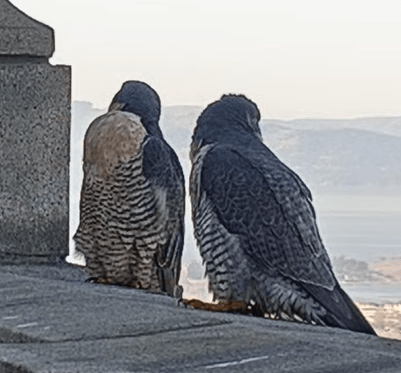
‘B’ sent me a note. Annie and Alden were on camera at The Campanile on the grounds of UC-Berkeley on Sunday. I admit to shedding a couple of little tears – tears of joy – to see them together and with such a nice crop. Looking forward to screaming eyases. Can’t wait. Thank you ‘B’. I know that everyone has been wondering about this lovely couple – Alden another one of those amazing males that stepped in and saved the season.

Emyr Evans of the Dyfi Osprey Project in Wales has permission to post all the information about Paith. Faith was the youngest of the three osplets (2 females, 1 male) of Idris and Telly at the Dyfi nest. The information that Evans has comes from early September – so awhile ago but he just received it. Faith was in Brittany, one of the northern most areas off France and due south as straight as a crow could fly from her nest in Wales. Is she on her way to Africa? or will she overwinter in France?

To get the full story and see the maps, and migration ages of the osplets from Dyfi, please go to dfyispreyproject.com

Tiger Mozone has also posted some information that indicates there are Ospreys that do over winter in this area of France. I think this is really interesting because it is always presumed that the birds go all the way to Africa. It appears not and we do know that many are now over wintering in Portugal and Spain. It may help with the decline in populations due to migration incidents and it might also speak to the changing landscape in Africa in terms of fish availability.

Congratulations goes out to Dave Anderson who has won the prestigious prize – the RSPB Species Award. Anderson is well known in the UK raptor world for his work with White-tailed Eagles and, in particular, promoting research on them by using satellite tracking. I cannot think of a more deserving person. You can read all about him and his extensive work with raptors – a life dedicated to bettering theirs – by clicking on the link in the announcement below.

Australian Nests:

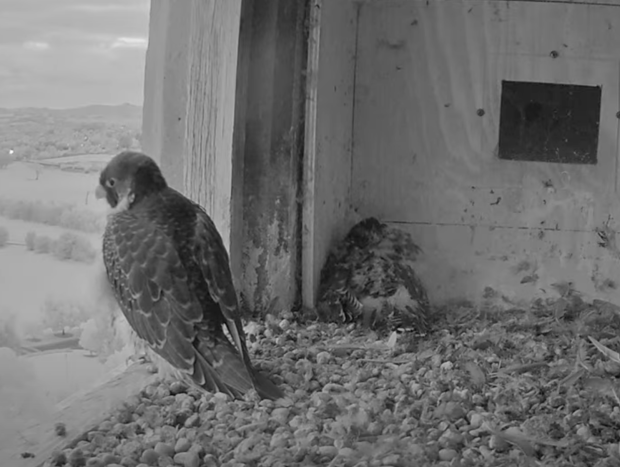
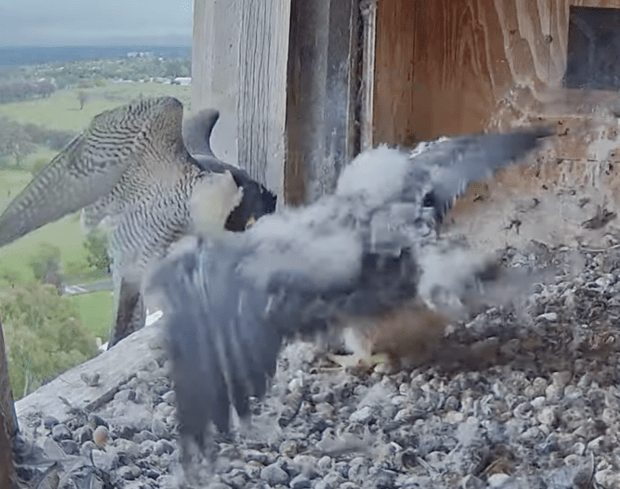
Early Monday morning in Australia, Xavier went to the scrape box with a nice prey item for breakfast. Was he trying to lure Rubus and Indigo to the box?

Indigo will arrive in the box and will be seen on the top of the tower but, Rubus did not fly up to join Indigo. They have been seen in the trees and it would appear that all is well. Xavier was there with them for some time and Diamond was photographed flying around the trees keeping guards on her precious fledglings.

News has come in regarding Rubus today: “Rubus fledged yesterday at 0818 h and has been found alive and well in a pine shelterbelt a few hundred metres from the tower. He was in a tree (so can fly at least a bit). He was still in the same area this morning, but a bit closer to the tower, He was found on the ground and placed in a tree in the woodland.”

Shines found Rubus and wrapped him in a blanket and placed him on the tree branch. Thank you, Shines!

Xavier and Diamond have both been in and out of the scrape. It is entirely possible that they are trying to lure Rubus back into the box so that he can rest and they can feed him there.

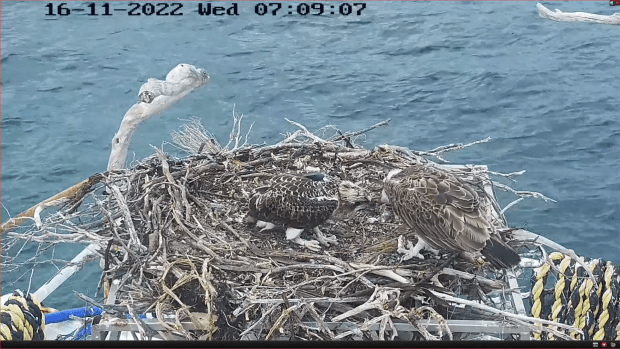
In Port Lincoln, Dad flew in with a whopper for Zoe at 1015. Port Lincoln has a severe wind alert for gusts up to 34 kph. Mum and Dad are very smart. This is one way to keep Zoe on the nest – a big fish!

Mum flies in while Zoe mantles the fish.

Just look. Dad had a good feed and Mum is looking down knowing there should be some left for her, too. I wonder if Zoe will want all of this fish to herself?

Zoe is trying. She has her talons in the fish holding it down and is doing a pretty good job eating away.

That is a big fish!

Mum would really like to have some of that nice fish but Zoe isn’t quite ready to give up.

At 11:56 Mum takes control of the fish. Zoe looks like she wants Mum to feed her. She has not made much progress on it herself.

Mum had different ideas. She wants some fish, too and it looks like Zoe ate enough to have a nice crop. Mum flies away with that fish so she can enjoy it all to herself. I wonder if she will bring any of it back to Zoe?

Zoe was not happy!

Of course, the answer is ‘yes’. Mum ate her fill and returned to the next some time later to feed Zoe.

That fish was sooooooooo large that the entire family had a nice big meal. How grand. Thanks Dad!
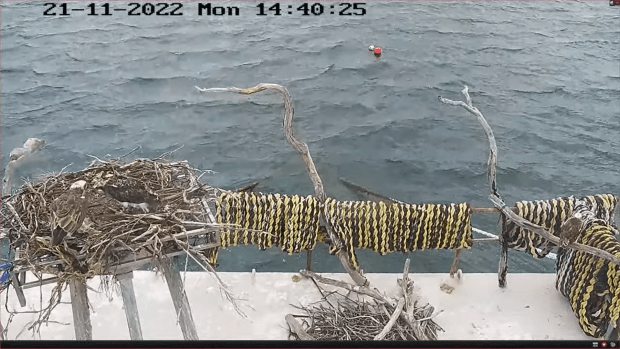
Zoe did some serious helicoptering. She is ready to fly! It will be soon.

No 11 The Red List: Montagu’s Harrier

“Montagu’s Harrier (Circus pygargus” by Ian N. White is licensed under CC BY-NC-SA 2.0.

Montagu’s Harrier is the most rare of any of the birds of prey in the UK. This incredible raptor was not in any nest records in the UK in 2020 nor in 2021. Their numbers began to decline in 2015. That year there were only 5 nests in the UK. It is feared that they might already be extinct, not just vulnerable.

These are magnificent raptors that fly low, like the Hen Harrier, in search of rabbits, small birds, lizards, insects, and shrews. They also soar high above the fields in the thermals and their flying and hunting has been described as ‘spectacular’.

Just look at that stunning plumage. Again, it is anything but a drab grey. How about a light blue steel grey on the wings with a light cream around the eye, a very slight dark blue grey eye line and band around the cream. How else would you describe this magnificent species?

“Montagu’s Harrier – Circus pygargus (male)” by Tarique Saniis licensed under CC BY-NC-SA 2.0.

They are a medium sized raptor, 43-47 cm long, that is slim with very long pointed wings like a Hen Harrier. They have a long tail. The upper body of the male is grey. The primaries are black and the secondaries have a black stripe or band across them. They are white underneath. The female is a gorgeous dark brown. The bills are hooked and black with a bright chrome-yellow cere. Their legs and feet are also chrome-yellow. Notice the striking yellow eyes.

The demise of the Montagu’s Harrier is due to the over and expanding use of pesticides, the expansion of fields into modern agriculture, the destruction of their nests which are on the ground in the fields during harvesting. In addition, their food sources have declined dramatically due to the use of pesticides! These raptors need protected areas for nesting and an end to the use of contemporary pesticides that kill the birds by secondary poisoning or by killing their food source. The Montagu’s Harrier migrates to Africa and so, in both of their respective homes, they are subject to ever expanding agricultural practices and the use of deadly poisons. Those poisons should be banned internationally. They are also quite dangerous to humans. Ask anyone who has lived around a farm in Canada who has developed asthma and breathing issues early in their life.

This is an immature. Notice that gorgeous rust brown above the yellow legs, the barred tail with the grey and espresso brown, the light grey around those chrome-yellow eyes…what a beauty.

“Montagu’s Harrier immature” by Rainbirder is licensed under CC BY-NC-SA 2.0.

I couldn’t leave without posting an image of a mature female Montagu’s Harrier. These females are stunning in their own right. Look closely. Their plumage is anything but a drab brown. Starting with the head and around the eyes, that bright chrome-yellow cere stands out amongst that deep chocolate brown. The white around the eyes with the espresso eyeliner and eye liner inside of the dark espresso band on a camel coloured head and breast are brilliant. It took a lot of the crayons out of the box to come up with this outstanding colour palette. That camel mixes with the deep chelate again on the back, and the wings while holding its own on the breast, chest and underparts. She is gorgeous.

“File:Montagu’s Harrier, juvenile, Bangalore, India (edit).jpg” by Cks3976 is licensed under CC BY-SA 3.0.

Oh, thank you so much for being with me today. It is always my pleasure to carry on and on and on about the beautiful feathered friends that bring us so much joy – and most often, tranquility. Take dare of yourselves. See you soon!

Thank you to the following for their posts and streaming cams where I took my screen captures: ‘BG’ for the World Cup of Birds, ‘B’ for letting me know about Annie and Alden, ‘J’ for her great link in the mail re birds and emotions, Cal Faldons, Dyfi Osprey Project, Gregarious J Toonen for Ospreys Pandion Haliaetus FB and Tiger Mozone, Port Lincoln Ospreys, Charles Sturt Falcon Cam and Cilla Kinross, and Open Verse.

Sunday News in Bird World

20 November 22

Greetings from a wintery wonderland on the Canadian Prairies. We have snow – thankfully not like what has been landing in the Great Lakes area of the US. Just lovely snowy drifting down giving everything a crisp clean Hallmark card ‘look’.

Before I go any further, Rubus and his fludged-fledge has been located in a tree near to Indigo by Shines. Later Indigo flies up to the scrape but has difficulty due to the very strong winds getting the landing perfect. It was like Rubus who had little control with those winds as he exited the scrape but greater control near the ground. Both are safe and sound. We can all breathe a little lighter! Zoe remains on the nest as I write this. So everything is, so far, alright at both of the Australian nests we have been watching. Only one fledge to go, Zoe, the Port Lincoln osplet.

If you missed it, here is Rubus’s start to his great adventure:

Thanks to ‘B’, who sent me this link, we can see Rubus and Indigo perched in trees! Thank you so much ‘B’.

This is the feeding recap for Zoe at the Port Lincoln Osprey barge up until 1500. ​06:14 Dad with partial fish. 06:14:12 Zoe steals fish from Mum.8:24:50 Partial by Dad. Zoe self feeds. 9:10:50 Zoe finishes the tail.

Making News:

Paith, the third hatch at the Dyfi nest of Idris and Telyn of 2022, has been spotted in another country. Emyr Evans needs permissions for all the details, etc. but this is fantastic news. Oh, tears. Need these third hatches to do well!!!!!!

The Melbourne Four make the news again and they are right. Who needs Netflix when we can have Nestflix?

https://www.theage.com.au/lifestyle/life-and-relationships/bird-s-eye-view-who-needs-netflix-when-you-can-tune-into-nestflix-20221116-p5bywe.html?fbclid=IwAR2MHVlDtBYcr46mtwCPkpd9gkSg7bJDEqoFy_7MiTjJu6XQcAoFQbneNiE

There was also just an amazing season tribute to the Melbourne Four that included ‘Old Dad’ (M17). Thank you for this! It came on a day when we needed some really positive news with Rubus fledging/fludging.

The Black-naped Pheasant-Pigeon was thought to be extinct. It was last seen in 1887. It has been found in New Guinea.

The very first egg of the season at the Kistanchie National Forest nest has been laid on Nest E-3. Congratulations!

Big Red was spotted on the Cornell campus along with one of the juveniles. It is always great to see Big Red, the international star of all Red-tailed Hawks! She is all flooded up to keep warm. Big Red had been spotted earlier out hunting – and it was successful. There is great comfort in knowing that she is alright. It seems that L4 is also still around the campus. That is also wonderful news.

No 10 The Red List: The Tree Pipit

“Tree Pipit (Anthus trivialis)” by gilgit2 is licensed under CC BY-SA 2.0.

I have never heard of a Tree Pipit. As far as I know, we do not have them in Manitoba. Ed Douglas describes them this way, “Pipits are often regarded as dreary-looking birds, the avocado bathroom of the avian world. That only makes me love them more, but telling these flecked brown birds apart visually is a task of tooth-grinding attention to detail.” The Tree Pipit is a bit bigger than the other Pipets and its beak is thicker. “The Tree Pipit has a touch of swagger, strutting across the ground, tail pumping rhythmically, like a wagtail, as it hunts for insects.” The birds also breed on the ground laying a clutch of approximately six eggs in the grasses beneath the trees. Indeed, the birds like the woodlands and the fringes at the edges for raising their families. They flutter through the air in a way not dissimilar to a Black Capped Chickadee.

“Tree Pipit (Anthus trivialis)” by gilgit2 is licensed under CC BY-SA 2.0.

Personally, I do not think they are Avocado Bathroom at all. The colouring is marvellous. Stop for a second and examine the range from a soft silvery white to the creams, the darker ash blonde, moving into the very dark blond and on to that deep 70% chocolate. They are stunning! Notice the white eye ring and the very subtle eye line.Move on to the wing and the teardrop pattern with the dark espresso lined by the white. Incredible. Striations only on the upper breast. This melody of brown and its hues is all topped off by velvety light rose legs and beak. I expect this little one to be wearing a matching light rose velvet hat with feathers carrying a matching handbag!

There are parts of the world where the Tree Pipit is of least concern but in the UK, its song and it are in dramatic decline. They migrate annually to Africa and when in the UK, their diet consists of insects gleaned from the woodland floor and old rotting trees. Declines can also be attributed to the use of insecticides and herbicides both in the UK and in Africa – to kill the insects which are then eaten by these small birds causing them to die. Secondary poisoning.

https://www.theguardian.com/environment/2021/jul/13/country-diary-the-song-of-the-tree-pipit-is-a-rare-pleasure?CMP=share_btn_link

Migration News:

Little Waba is still in the Sudan fishing at the Nile River near Nori. She is obviously doing very well. The temperature in the area today was 26 degrees C.

Bonus is also in the same area in Turkey in Konya Province. It is considerably cooler there at 13 degrees C. Bonus also landed on a transmission tower today and everyone was very, very concerned because of the deaths from electrocution. He left, thankfully!

Oh, the time just flies by. It is hard to believe that we have our first Bald Eagle eggs in Florida and in Louisiana now and that we have only one more raptor to fledge in Australia, Zoe. It is a good time of year to take a deep breath, to remember those lovely feathered friends we have lost, and to be ever so grateful for those that survived.

Thank you for being with me today. Please take care of yourselves. Looking forward to having you with me again soon.

Thank you to the following for their posts, their videos, and their streaming cams where I took my screen captures: ‘B’, Charles Sturt Falcon Cam and Cilla Kinross, 367 Collins Street by Mirvac, Looduskalender Forum, OpenVerse, Suzanne Arnold Horning, Cornell Bird Labs, US Forestry Service KNF Bald Eagle Nests, CTV News, 367 Collins Street by Mirvac, The Age, Ospreys. Ringed Birds and Sightings (UK), and 367 Collins Falcon Watchers.

Hovering, Nest building…Saturday in Bird World

19 November 2022

Good Morning Everyone!

I hope that you are well. So nice to have you with us this morning. It is a blue sky cold day, -14 C, on the Canadian Prairies. The kittens are up carrying toys and watching the Crows come for their morning feeding. The Grackles have already been to the suet feeder and the little Sparrows are all puffed up keeping warm in the lilac bushes.

It is a type of soft suet that the Starlings like. They can stand back and poke at it with their long sharp beaks.

The Blue Jays that fledged from the nest across the lane are still here. One was eating peanuts while these two were in the lilacs sunning themselves.

Nest News:

Yesterday Zoe got some really good height in her hovers. Thankfully she remained on the nest and did not fledge into those strong winds as that storm did roll in.

If you missed it, here are those beautiful early morning hovers.

Later, Mum is down in the nest with Zoe taking care of her only ‘baby’. Dad was not out fishing. If you remember, Zoe ate really well on Friday so did Mum. On Saturday morning, Mum took Dad’s fish and returned with the tail portion for Zoe. That has been the only meal so far and if the weather stays, it could be it for the day. Zoe will be fine. She is not going to starve.

Indigo continues to fly out of the scrape and return. This is excellent. Most of you watch the Bald Eagle nests as well as the Ospreys and it is ‘normal’ for fledglings to return to the nest for food, to fly and strengthen their wings being fed by the parents for a period of 4-6 weeks.

Rubus continues to do his wingers and the pair enthusiastically eat all that is brought into the scrape. There are still a few dandelions on Rubus but not many.

The brothers 9 days ago.

Just look at them all covered in down with Indigo revealing some lovely back and tail feathers.

Oh, little Rubus had to get to the front and jump in the beginning to get some prey. Hard to imagine now when both of them are screaming and running all over the scrape. Diamond and Xavier have raised two healthy feisty chicks.

‘A’ reports that it was raining so hard in Melbourne yesterday that the wipers had to be on full speed. Of course, all we can think of are the fledglings from 367 Collins Street. Positive wishes out to them to be safe and fed.

As the season in Australia winds down, everyone is on egg watch at the nest of Harriet and M15 in Fort Myers, Florida. The pair have been working diligently to rebuild their nest after Hurricane Ian. Sadly, that GHOW continues to plague our beloved eagle couple. Oh, I wish their nests were further apart!!!!

Harriet and M15 continue to work on their nest together. They are amazing.

Samson and Gabby have been at their nest, too, working away. They have had a three year old Eagle visiting the nest and I began to wonder if it could be Jules or Romey.

Mum and Dad have been rebuilding the nest in St Patrick’s Park in South Bend, Indiana. You will remember that this is the home nest of Little Bit ND17. They are making good progress and now, some snow has arrived. I sure wonder where Little Bit is! Gosh, we long for them to fledge and then we grieve to see them again hoping they survived that almost insurmountable first year.

Humane Wildlife Indiana sent out a clever fundraiser. They are asking for donations for the strays in their care to have a full fledged Christmas dinner. You can purchase one for one animal or more. I wonder why more animal sanctuaries do not do this? You might mention this to your local care group. It is a marvelous idea.

Making News:

Sadly, for the wrong reasons the adorable Melbourne Four make the news.

https://www.theage.com.au/national/victoria/collins-street-falcon-chick-dies-days-after-taking-wing-20221115-p5byi1.html?fbclid=IwAR22J_pnOqqPaRA8JqL7WcplN8ddPreG3bIpfCVw8kNgpVudjgCKWoSHXgI

Oh, our beloved Canada Geese are making news in the UK.

https://www.theguardian.com/environment/2022/nov/18/country-diary-canada-geese-are-on-the-move-with-a-melancholic-honk-but-why?CMP=share_btn_link

No 9 The Red List: The Nightingale

It is the song of the Nightingale that has attracted writers for thousands of years. Pliny the Elder described its song more than 2000 years ago when animals were denied artistic abilities. He wrote: “the sound is given out with modulations, and now is drawn out into a long note with one continuous breath, now made staccato . . .” Ellen Finkelpearl continues in her short article on Pliny and the Nightingale that he did believe, strongly, that the natural world including our feathered friends can be artistic!

https://classicalstudies.org/plinys-cultured-nightingale

If you are a lover of Shakespeare, you will know that the Nightingale shows up in more of the plays, not just when Juliet educates Romeo on the wonderful song of the Nightingale.

Wilt thou be gone? It is not yet near day.
It was the nightingale, and not the lark,
That pierced the fearful hollow of thine ear.
Nightly she sings on yon pomegranate tree.
Believe me, love, it was the nightingale.

Here is a fantastic blog that captures the portrayal of the Nightingale in all of Shakespeare’s works.

https://blogs.bl.uk/sound-and-vision/2016/04/shakespeare-and-the-nightingale.html#:~:text=The%20morning%20after%20their%20secret,is%20not%20yet%20near%20day.

In his entry in Red Sixty Seven, writer Luke Massey says, “…We should be ashamed that in our quest to clean our landscape, in our acrimonious divorce from nature, we have forgotten this songster and let it suffer. Despite its song we have ignored it ; we have let it fall silent in our copses, our scrub and our hedgerows. We have failed it and with that we have failed nature. Will we really let this be the last song of the Nightingale?”

Its very last space in the UK is under threat.

https://www.nationalgeographic.co.uk/animals/2018/04/last-stronghold-of-nightingale-under-threat

There are problems with the Nightingale’s wings getting shorter due to climate change. That is mentioned in this great report for The Guardian.

https://www.theguardian.com/environment/2020/apr/01/nightingales-at-risk-due-to-shorter-wings-caused-by-climate-crisis

Changes in farming practices, the destruction of hedgerow and copses for more modern farming are all adding to end the life of this most beloved bird who nests are on the ground. There are fewer and fewer sites for this beloved bird to raise their young safely.

As I read more and more of what we have done to halt the lives of so many birds, it is readily apparent that the world needs to return to some of the ‘old ways’ and continue policies or re-wilding if we are to save our precious wildlife.

In the Mailbox:

‘EJ’ was wondering how these transmitters work – like the one put on Zoe at Port Lincoln. She found a great article and you might be wondering how these transmitters work, too. Thank you, ‘EJ’. Here is the link. You should be able just to click on it.

Technology (ospreytrax.com)

Thank you so much for being with me today. Take care everyone. As I look at the weather report there is a severe weather alert for wind in both Orange and Port Lincoln. Maybe Zoe and Rubus – as well as Indigo – will take care today. Send best wishes to them!

Thank you to the following for their posts and their streaming cams that make up my screen captures: RSPB, The Guardian, Osprey Research, Port Lincoln Ospreys, Charles Sturt Falcon Cam and Cilla Kinross, The Age, Lady Hawk and SWFlorida Eagles and D Pritchett, NEFL-AEF, and Notre Dame Eagle Cam.

Hovering with Zoe!

18 November 2022

The eyes are all on Port Lincoln where it is the morning of the 19th of November. Zoe is all wound up just like Indigo was before she fledged. Oh, she wants to fly and she is getting some really good wind under those wings. We are so close to that first flight – the fledge!

I took a video clip for you to enjoy.

The problem is the weather. I am seeing overcast skies, chopping water, wind, and 100% chance of rain starting in less than six hours. Not a good day for a fledge unless Zoe is going to fly and return to the nest. We have come this far. I would hate for anything to happen to this super osplet.

Take care everyone. See you tomorrow!

Thanks Port Lincoln for your streaming cam where I took my video clip.

Indigo fed on top of tower…and other Early Friday news in Bird World

18 November 2022

Good Morning Everyone,

I hope this newsletter finds all of you well. It is the end of the week. In a fortnight I will be on the island of Grenada in the West Indies visiting my son and looking for birds. He doesn’t know it but I have plotted the spots on the island and I am hoping that we can see at least 25% of the birds on the island – that would be about 40 new species. There are Ospreys right by his office and I am told hummingbirds and hawks in his garden. Can’t wait. With the pandemic, it has been far too long since I have seen him. There are many birds that I do not know or some that have similar names such as the Coot but the one in the Caribbean has a white shield on its head along with its white beak. There are any number of shore birds. So excited. I have a copy of the small book, Birds of the Eastern Caribbean on my desk to help me get acquainted.

In the Mailbox:

An absolutely timely and great question from ‘H’: “Funny you mentioned about the three Stepdads for Peregrine families. I was just thinking about that yesterday. I had wondered if you had ever known any other species where that had occurred. Have you known of any cases where another male had taken over responsibilities of hunting/incubating/parenting duties at the nests of Ospreys or Eagles, for example? (Not including where a chick had intentionally been placed on a different nest) Is this just a Peregrine Falcon thing?”

A bit of background for those not familiar. It is hard to imagine Diamond without Xavier. I recounted in my last blog how Xavier came and helped Diamond with her eyases when Bula disappeared. He was named Xavier because he was a saviour to our dear Diamond and her clutch. The eyases would not have survived having just hatched without Xavier bringing food to Diamond. We all know that Alden stepped in for Grinnell at the University of California at Berkeley scrape belonging to Annie. And we have recently witnessed Male2022 help raise Male2017’s eyases at the ledge scrape of 367 Collins Street in Melbourne. There are a number of instances coming out of the UK where a step dad or extended family members have helped raise clutches including fledglings. But, to get back to the question at hand.

Ospreys go absolutely crazy at the thought the eggs that are in the nest might belong to another male. I posted a couple of video examples a few months back of an osprey kicking the eggs out of the nest that he believed belonged to another male. I have never seen a male Osprey raise another male’s osplets. I have also never seen an eagle of any species take over the role of the male and raise another’s eaglets.

There are, as you seem to have indicated, many instances whereby the fostering of eggs and/or chicks has been successful but that is an entirely different situation to what you are asking. I have tried to find literature on the topic to more fully answer your question and if there is anyone reading this that knows of examples other than Peregrine Falcons becoming active step-dads, please do bring that to my attention.

After reading about ‘J’s’ budgie, Wolpe, Raj writes that they had a very similar incident with their pet birds. ” My pet budgie Daisy was best friends with Blue. Both inseparable. Loving each other always side by side. One day Daisy died. I held Daisy in my palm. Blue was so distressed and loudly screeched when Daisy died. Blue was very quiet not eating or playing.” When a new budget, Sky, came to the family, Blue was not interested. He was only in love with Daisy.” Thank you, Raj. This another beautiful example of the emotions that our feathered friends feel and express.

In the News:

Humans must steer clear of Yew trees as they are very poisonous to us but, not to our charming Nuthatches!

https://www.theguardian.com/environment/2022/nov/16/country-diary-the-nuthatch-takes-a-toxin-that-can-paralyse-our-hearts

Australian Nests:

Zoe is a big girl. We knew that when they weighed and banded her but today, Mum purposefully left a nice fish (sans head) for Zoe to see what she would do. Well, Zoe took the fish and ate every last bite including the tail as watchers cheered her on. The fish tail was horked at 11:11.

Zoe takes pulls the fish over so she can eat it as Mum looks on. This is crucial – Mum is full and knows that Zoe needs to self feed and will be fledging soon.

“Nice talons you have, Zoe.” “All the better to scratch you with!”

At Orange, panic might have set in if you looked at the scrape and did not see any eyases in there. Indigo flew out and was on top of the tower. Look carefully and you will see Rubus sleeping in the corner – bottom left reveals his tail.

A really nice and informative interview with Cilla Kinross about the history of the scrape and the Peregrine Falcons at Orange.

Indigo left the scrape at 101439 and he returned at 121012. Diamond had been in the scrape with prey and flew out with it right when Indigo came back. Rubus was really wondering what was going on and gave some of his very loud prey cries.

After a busy morning with 4 prey deliveries in 5 hours – and one being removed – the two lads, Indigo and Rubus, settled down to a nice sleep on the ledge.

I don’t know about anyone else but, I am really pleased that Indigo is returning to the scrape box, flying off for short periods to strengthen him flying techniques, and then returning again for prey and rest. Surely this will help him to be much more successful!

‘A’ sent a link to a video of Indigo being fed on top of the water tower. Thanks, ‘A’! Great clip.

The Red List. No 8. White-tailed Eagle

“White – tailed eagle” by gcalsa is licensed under CC BY-ND 2.0.

At one time there were thought to be at least 1400 pairs of breeding White-tailed Eagles in the United Kingdom. By the beginning of the 20th century, the White-tailed Eagle was almost extinct. Before their recent re-introduction, the birds last bred in England and Wales in the 1830s, in Ireland in 1898 and in Scotland in 1916.   The RSPB reports that the last UK birds was shot in Shetland in 1918.

“White-tailed eagle” by Ignacio Ferre is licensed under CC BY-NC-ND 2.0.

Reintroduction efforts began in 1959 and 1968 in Scotland. They were not successful. Then in 1975, juvenile eagles brought to the UK from Norway were released on the Isle of Rum in the Hebrides. The first pair bred successfully a decade later and now there are 130 pairs of White-tail breeding Eagles across the west and north of Scotland.

White-tail Eagles have added much to the economy and at the Isle of Munn where there are so many, the boost to the local coffers from bird tourism was 5 million GBP. Still, humans kill these beautiful birds.

The reintroduction efforts were the hard work of Roy Dennis and the Roy Dennis Wildlife Foundation. Continuing efforts are now overseen by the Sea Eagle Project Team – a joint effort of the RSPB and Scottish Natural Heritage. The biggest threats are predation by illegal killing particularly around the grouse hunting estates and secondary poisoning.  

Thank you so much for being with me today. Please take care of yourselves. See you soon.

Thank you to the following for their posts, videos, and streaming cams that make up my screen captures: ‘A’, OpenVerse, The Guardian, Port Lincoln Ospreys, Charles Sturt Falcon Cam and Cilla Kinross, and OmarGlobal.

Prey fights between siblings and more…it’s Wednesday in Bird World

16 November 2022

Oh, good morning to everyone! I hope that you are all well. If you have not been watching the scrape of Diamond and Xavier you are really missing something. First, there is the adorable Indigo and Rubus. They are ‘not sweet’ when it comes to prey items as the following two videos will demonstrate! But, they will be ‘out there’ defending their own prey and these little dust ups help them prepare for that. In the first video Rubus really does a good job at snatching that small prey item. He doesn’t prevail in the end but watch closely what he does. Quite the character.

Rest assured that at the end of the day, both eyases had quite enough to eat and at times were even sharing prey items.

So this is the first prey delivery, a small piece.

The second is a much more substantial bird, a Galah (pink and grey). There was more than enough for both eyases.

The fish deliveries continue to be rather scarce at Port Lincoln. It is difficult to determine if there has been an actual drop in the prey delivered or a slow down due to the imminent fledgling of Zoe and not three rapidly growing osplets. There are too many factors – the weight of the fish delivery, the portions that each family member ate, etc. It appears that at the current delivery rate, Mum, Dad, and Zoe are each getting the equivalent to one small fish per day. Is this enough?

Hoping for another fish but nothing has arrived. Mum appears to be reluctant to get too far away from the nest. Did the intrusion of the humans to band and put the sat pak on Zoe cause her stress? Is she afraid to leave Zoe? Quite possibly. Perhaps she will go fishing tomorrow but, for now it seems that she is relying on Dad.

The ospreys are not moving about much, not exerting much energy. Today, however, Zoe is doing a lot of wingersizing. Her wings are gorgeous. Just look at how big they are! It will be those big wings that will pull Zoe up out of the water when she catches her fish.

This shows what those strong wings will be doing. Just imagine. Zoe will have to catch her own fish until such time as she has a mate and has eggs in the nest.

AND THEN…a whopper of a fish arrived. Mum ate her fill and then took the fish to Zoe. Everyone will go to bed with a full crop at Port Lincoln. Relief.

Mum did not part with the fish when Dad arrived more than an hour later to see if there was any left. This whopper should take care of the hunger that she was experiencing – and Zoe. (I do hope that Dad had a fish, too).

Making News:

Even in Manitoba we are experiencing some birds that are late to migrate or who have decided to check it out and see what it is like in the winter for food. Some of those are Cardinals. This is an osprey in Idaho though! They need water and fish as we all know. Why so late?

Project Eagle will be the new home of the American Eagle Foundation The facility is located in Kodak, Tennessee and is set on 57 acres. Challenger the Eagle will be in residence there.

https://www.wate.com/news/positively-tennessee/project-eagle-in-the-home-stretch-of-building-new-facility/?fbclid=IwAR2P8t-e9ZiNLkwKCky0dQZJZokdILCmXE1HOdfooe2hb1hYt2wlr4QuYzs

In the Mailbox:

‘M’ introduced me to an Australian photographer, Georgina Steeler. All of this relates again to how we perceive our wonderful feathered friends and other wildlife. We have been having this discussion about anthropomorphising birds. We need people to care, to help all of us, to add to the numbers so that we build a huge network. At the same time, we need to recognise and educate ourselves about the emotions that wildlife have so we can try and have an intelligent conversation with the non-believers.

I urge you to Goggle Georgina Steytler and go and see her website, read her blog, look at her photographs, and ponder all the ways that you can make a difference. Oh, I like this woman and the way she thinks!

Here is one of the quotes on her site today from one of my heroines, Jane Goodall who knows that wildlife have and show emotion, pain, anger, fear, grief, and joy.

‘D’ sent me the link to this story to share with all of you. After reading about Wolke, this is another story of how much our feathered friends enrich our lives as told through budgies:

https://www.theglobeandmail.com/life/first-person/article-feathered-friends-are-the-best-friends-of-all/

When I wrote about the Red Listed Bird, The European Starling, I had no idea Starlings were so intelligent and could mimic anything including Mozart’s concerto. Birds and their intelligence fascinate me more and more. ‘F and M’ sent me a note telling me about an incident at the Taronga Zoo in Sydney. They wrote, “A week or so ago Tooronga Zoo in Sydney Australia had a breakout from the lion’s enclosure causing an alarm and the instruction “EVACUATE NOW” to sound. The lyrebird is now mimicking this alarm and instruction. It is causing quite a problem at the zoo. !!” Enjoy!

https://www.adelaidenow.com.au/news/victoria/a-lyrebird-mimicking-the-evacuate-now-alarm-at-taronga-zoo/video/47d9e5b56f9139880f0dfc5b302eaaed

No 7 The Red List: The Dotterel

The top image is of the male Dotterel. Notice that beautiful white eye line and belly with the grey brown and espresso feathers mingled with white on the head, wings and back.

“Northern NZ dotterel.” by Bernard Spragg is marked with CC0 1.0.

This is the female. In this instance the female Dotterel has the brighter plumage than the male. The female has the same grey-brown plumage on the back of the head, wings, and back but look at that magnificent chestnut apron! With the espresso necklace and line between the eyes forming a brown and the espresso line running from the beak under the eye. What a beauty.

“Banded dotterel” by Andrej Chudy is licensed under CC BY-NC-SA 2.0.

The Dotterel is a medium sized member of the Plover family measuring approximately 20-22 cm in length. The birds are unusual in that it is the female that has the brighter plumage rather than the male. They live on insects and worms. Their eggs take 28-32 days to incubate and during this entire time the female does not leave the nest to feed. She is fed by her mate.

Dotterel face a number of threats from predators that have been introduced into their environment particularly during the nesting and breeding season. These include dogs, hedgehogs, cats, rats, stoats as well as other larger birds, and humans.

Thank you so very much for being with me today. Do stop in and watch Indigo and Rubus. You will not be disappointed! Take care. See you soon.

Thank you to the following for their postings and streaming cams where I took my screen shots: Port Lincoln Ospreys, Openverse, Charles Sturt Falcon Cam and Cilla Kinross, American Eagle Foundation, Montana Ospreys at Hellgate, Georgina Steytler. I would also like to thank those that sent in news items today: ‘M, D, F and M’. Much appreciated! It is always lovely to get mail to share with everyone.

Mourning Budgie, hungry eyases, and more in Bird World

15 November 2022

Good Morning Everyone.

It is Tuesday on the Canadian Prairies. It seems like the days have passed by so quickly – just a blur. One day it is Friday and in a blink, we find ourselves waking up to Tuesday. In part, I attribute this to the time difference between North America and Australia where all of the streaming cam action has been taking place these past three months. At any rate, I hope that you are well and I am so glad that you are here with me on this sunny day. It is only -6. Glorious! The Starlings are eating the suet and the lilacs are full of sparrows. Three grey squirrels have been running about this morning hoping that I will put out peanuts or a new seed cylinder for them. Soon!

Last week I received a letter from someone who had commented on one of the streaming cams and who had been admonished for putting human feelings on the birds. As you might recall, I am an ardent supporter of the research of scientists such as Dr Marc Bekoff at the University of Colorado and others such as Jane Goodall. I reassured my reader that, according to Dr Bekoff, it is currently acceptable within the science community, to anthropomorphise wildlife. Indeed, him and his colleagues do this all the time. I received so many letters in response to this question. It is reassuring that so many people, from every corner of our planet, understand that animals have emotions, that they feel pain, they experience joy and grief and fear. One reader shared the story of one member of her flock and how they grieved following the death of their mate. ‘J’ has given me permission to share the story of her budgie, Wolpe, with you. Thank you ‘J’. Here is a brief recount of how Wolpe mourned and how the death of her first mate changed her attitude towards life and love.

As a child, ‘J’ had a pet budgie that would sit on her shoulder when she was reading. It was her dream to have her own aviary ‘when she grew up’ and to share her life with these amazing birds.

The beautiful budgie below is Wolpe, one of 15 budgies that make up ‘J’s bird family. Each is a rescue that shares ‘J’s flat with her in Europe. In my City, we do not have budgies that look like Wolpe; they are all one colour. I find the colour patterns of Wolpe fascination but, I am disgressing from our story.

Wolpe and Peppi were long term mates. Peppi would preen Wolpe and give her all the love and care that he could. He also showed his affection by feeding his mate. Wolpe loved Peppi but did not reciprocate in showing her affection. She never preened Peppi – never ever – and she never fed him.

When Peppi died, Wolpe physically and mentally went into mourning. She “stood still on a branch for 10 days straight after her mate died last year. It was horrible to see.” She was not her usual self. She did not interact with any of the flock, or the enrichment toys nor was she actively engaged in shredding things – her favourite activity. It was totally clear that she was grieving her lost mate.

At the same time that Wolpe was morning so was ‘J’. One of the hardest things that ‘J’ had to deal with was the fact that most people did not understand her grief. A common response was, “it’s only a bird.” For ‘J’ each time one of her family passes, it “takes away a little piece of my heart.”

This is Wolpe with her mate, Peppi, before he died in 2021.

When Wolpe chose a new mate, it was Kobito. Kobito is also green just like Peppi. It was a huge surprise to ‘J’ that these two began their relationship as a couple. It mean huge changes in each of their behaviours.

For Wolpe, this meant that she became more physically caring for her mate. She now carefully goes through Kobitos head feathers, running each one through her beak cleaning it. She organizes the feathers on his head, something that a bird cannot do for themselves. Wolpe also feeds Kobito. It is as if she realized that she needed to be more tender and more caring. Kobito, on the other hand, always sat in front of the window looking ‘out’ He was isolated and distant as if he wanted to be somewhere else. Once he courted and won Wolpe, it seemed that he “actually turned in Peppi II!” Kobito began to socialize with the other birds; he became part of the flock and even became closer to ‘J’. It was like a 180 degree turn. He also spent much time preening and feeding Wolpe.

It seems as if Wolpe realized what she had lost when Peppi died. She missed that closeness of having a mate, of being able to show her love. She is making up for that now. Grieving can lead to introspection and changes and I hope that Wolpe and Kobito live long and happy lives together with ‘J’.

If you have an example of grieving feathered friend or raptor that you remember and would like to share or remind me, please send me an e-mail!


Indigo and Rubus learned how to sort out who was going to eat. Indigo was famished when she arrived back at the scrape on the 13th. Indigo spent Monday evening in the scrape.

As he calmed down, glad to be back in the scrape, and was fed, the frenzy to eat calmed. At one point Rubus and Indigo had a bit of a tussle over a prey item. They wound up sharing it! One ate off one end while the other was at the other.

Diamond flew in and fed both Indigo and Rubus.

Later, Xavier arrived with more prey and Xavier and Diamond each fed their youngsters.

Indigo was still working on the last prey delivery at 1824.

As the IR lighting was preparing to turn off, Rubus was in her favourite corner of the scrape while Indigo was sleeping on the ledge. It is so nice to have Indigo back in the scrape. We are always so anxious for the birds to fledge but it has to be difficult for them. Indigo is eating and resting. Rubus continues to lose dandelions. Soon they will look alike!

This morning it is only 4 degrees C in Orange.

‘A’ sent me a thorough recap of the happenings at Orange. Thanks, ‘A’.

RECAP: prey at: 5.43.29 Xavier with prey, Indigo takes; 6.03.43 Xavier with prey, Indigo takes; 6.05.25 D w/StubQuail, feeds Rubus; 9.41.51 X w/?juv BFCS (black-faced cuckoo shrike), Rubus takes; 12 57 55 X with star, leaves it, Indigo claims; 13.06.50 X w/star, Rubus takes; 13 12 07 D w/prey, Indigo takes; 14:19:22 X w/pardalote; 16:46:15 prey, 18.06.46 X prey; 19:42:29 D retrieves nestovers from near Cilla Stones and takes them into the centre of the scrape and starts eating herself; 19:43:33 Diamond feeds Indigo. 

The lack of fish continues to plague Port Lincoln. Two fish came in yesterday both brought by Dad. The times were 0836 and 1707. In both occasions, Mum took the fish and flew off to eat a portion. She returned and Zoe got the tail in the morning but nothing in the evening. Mum is obviously desperately hungry. We know that she often fed the osplets to her own detriment. I am glad that she has some food but, what is really going on at Port Lincoln. Is Dad unwell? is there a lack of fish? Dad is notorious for bringing in a historic average of 7 fish per day.

It is 11 degrees this morning at Port Lincoln.

I really hope that more fish arrive on the nest today. We have one big healthy osplet getting near to fledge and a Mum who was desperate for food yesterday. Send this nest your good wishes, please.

‘A’ reminded me that we now also have a true name for the ‘Z’ in our list of birds: Zoe will now take that spot.

As you are probably aware, the camera at 367 Collins Street is no longer streaming. ‘H’ reports that the camera had a technical issue and then with the death of the fledgling, Victor Hurley asked Mirvac to leave the camera off until next season.

‘H’ reports that the injured fledgling was euthanized on 15 November, yesterday. Having hit a window or a wall, the beautiful fledgling suffered a broken spinal column. The clinic determined that the injured bird was a female. Oh, how sad. It is a reminder that live for urban raptors is very challenging. Thanks, ‘H’.

‘A’ sent the following description, comparing Orange and Melbourne. I hope she does not mind that I share it with you as I thought it was particularly appropriate after the death of that healthy eyas. The parents can provide them with prey, teach them to hunt but they cannot protect them in the environment into which they fledge. I wish they could! ‘A” writes: The Orange eyases fledge into a relatively sheltered, semi-private area, a bit like the eaglets at SWFL eagles, whereas the poor Collins Street chicks fledge into an urban jungle filled with concrete and glass and difficult wind currents and gusts (for example, at every cross street, the bird flying down a city street would be hit by a strong wind gust from one side or the other, rushing down the cross street). I am sure you know what I mean about the wind tunnel effect through those walls of massive skyscrapers in modern-day CBDs. It may be a safe scrape but the environment into which they fledge is very dangerous. 

The last to fledge, dubbed Peanut by ‘H’ – and a very fitting name at that – fledged at approximately 0712 on the 15th, yesterday morning.

Send your very best wishes out to this family – may they all soar high, have full crops, remain safe in an area full of prey but also high buildings with deadly wind currents. We will look forward to seeing Mum and Dad 2022 again next year! Thank you to Mirvac and Victor Hurley for allowing us the privilege to watch these incredible falcons. There is rain in the forecast today in Melbourne and it is cool, 7 degrees C.

Making News:

Cornell reports that it was one of their best Bird Count Octobers ever! Excellent news. So many people participated around the world.

Migration:

There will be no news of Kaia and Karl II til spring it seems.

Bonus remains “near Başkaraören, in the Seydişehir district, Konya province in Turkey. He stayed mainly on the north side of the Beysehir Channel.”

There must be really good fishing there for our fledgling Black Stork.

Waba is still in the Sudan. He has also found a very good area to fish.

The Looduskalender Forum indicates with the rainy season this area would be much greener now than in the satellite view that they have of the region.

It is wonderful to know that these two fledglings will do well. Remember that migration is driven by food availability and these two, Bonus and Waba, seem to have found good feeding grounds for now. I wonder if they will try to stay where they are for the winter?

Thank you so much for being with me today. I will resume The Red List of vulnerable birds tomorrow! Take care everyone. See you soon.

Thank you to the following for their pictures, posts, and streaming cams that make up my screen captures: thanks ‘A’ and ‘H’ for the Australian reports, thanks ‘J’ for sharing Wolpe’s story with us, Port Lincoln Ospreys, Charles Sturt Falcon Cam and Cilla Kinross, Cornell Bird Labs, Google Maps, and Looduskalender Forum.

Stolen eggs, fledgling in care, Ervie and more in Bird World on Monday

14 November 2022

Good Morning Everyone!

Oh, goodness, Sunday was a day full of surprises! Two of them welcome and the other two, just shattering.

I had not anticipated sending out the newsletter this morning. The news coming out of NZ and Melbourne today would overwhelm this wonderful story of birds and emotions that I am working on. So tomorrow I will introduce you to Wolke so that you can enjoy reading about her incredible journey through grief to find love.

I don’t think anyone was shocked to discover that Big Bob at the Port Lincoln Osprey barge was a girl. I am not sure that anyone was surprised that she was the largest osprey ever hatched and ready to fledge either. Big is a BIG girl. The pink band is fantastic and what a super tribute to Janet Forster’s granddaughter to have the 2022 osplet named after her, Zoe. What was surprising was the determination of the local gulls to steal the fish right off the nest on the barge as Zoe was pancaked!

This really opened my eyes to what Dad might have to go through when he is fishing. We have seen the gulls steal a fish right out of his talons but, imagine them swarming him when he is fishing. That makes me sad.

Dad came in with a fish at 132824. He brought an earlier fish at 064935.

Mum prevailed and fed herself and her big Zoe.

It was a good fishing day for Dad who flew in with another fish at 1900. We have all been worried about Dad. Is the lack of fish due to weather? sediment so he could not see clearly? or him just feeling unwell? We probably will never know but, he did manage 3 fish and Mum and Zoe had the fish that were left after banding that the gulls did not get. (I think the gulls only took 1 of the 3 fish).

Zoe screaming loud with Mum as they see Dad approaching with the fish.

The shock of all shocks was Indigo being physically strong enough to fly into the scrape box and scare the wits end out of Rubus and Diamond who were enjoying a nice meal!

What great form! She landed in that scrape safely and took control of that prey. The in climate weather for the past day must have meant she had not had food and was famished.

Indigo stayed in the scrape with Rubus. He was there when they turned the IR off. (Cilla has done this to keep the numbers of mosquitoes down).

Dusk is coming.

Two specific incidents come to mind. One was Legacy, the 2021 fledgling of Samson and Gabby at NEFL. Legacy flew off the nest. I would have to check but, she was gone about a week. Everyone presumed she was being fed by the adults. She was seen flying into other eagle’s nests and it appeared to birders on the ground she was looking for her natal nest. She was caught on camera flying close by and then one day, she landed on the nest. She was famished and she did not fly off that nest for another month! Samson and Gabby were so glad to see her they provided so much fish! The second was WBSE 26. 26 was in the forest for about a week being harassed by the Currawongs and Magpies after fledging. She made it back to the natal nest, exhausted and hungry. Again the parents happily took care of 26 – you could almost see Lady’s delight that her baby was home. 26 stayed, ate, and got her strength up for about a week before being chased out of the forest. That was 2 years ago today that the Magpie helped 26 fight off the Currawongs.

I was also thinking about Izzy who returned to the scrape at Orange for so long. Diamond had to block the door finally for Izzy to get the message to move on. I suspect that Indigo is tired. Flying is a lot of work and the birds have to build up those muscles. Indeed, Indigo did go to sleep eating! Indigo might have been flying around the campus not connecting with the parents for a prey drop during the stormy weather the day prior. It will be interesting to see what happens when Rubus fledges. For now, isn’t it a delight to see Indigo safe and back in the scrape knowing he has had a meal?

The third surprising event was just a shattering. Four eggs from the Royal Albatross that are now breeding at Taiaroa Head have been stolen! There is no evidence to suggest that predators took the eggs and the NZ DOC is working with the police and going over footage to try and determine what has happened. Unbelievable.

Hearts are breaking.

Whenever something really terrible happens, I think of Ervie and today, thank you Friends of Osprey for posting more pictures of our beloved lad. Now notice Ernie’s lovely necklace. We know he is a male so, let this image guide us. Males do have necklaces. Blue 022 has a stunning one. It is not a foolproof method of determining gender in Ospreys.

Just look at Ernie’s nice crop. I wonder how his talon is coming along. I could not tell from the images but, he certainly is a most handsome osprey.

Speaking of Ervie, Friends of Osprey posted another image of Ervie with his satellite tracker and an explanation about trackers and why they are important.

Sad news is coming out of Melbourne. This is the fourth event – another shattering one. One of the fledglings has been found on a footpath near 367 Collins Street. Send all your positive wishes, please.

Just about the time we think things are going quiet, events that we might not have imagined take place. Our thoughts go out to the fledgling from Collins Street so that it will improve quickly and be able to be released. Life is very challenging for the urban birds. While there is generally a lot of prey – pigeons – there are also lots of buildings with glass that are difficult to manoeuvre when one is just learning to fly.

Thank you so much for joining me today. Take care all. If you get a chance stop in and check on Indigo, she might just stay at the scrape today. See you soon!

Thank you to the following for their posts and streaming cams that made up my screen captures: Friends of Osprey FB, Port Lincoln Ospreys, 367 Collins Falcon Watchers FB, Royal Cam Albatross Group NZ FB, Port Lincoln Ospreys and Charles Sturt Falcon Cam and Cilla Kinross.

Big is……a BIG girl named Zoe!

13 November 2022

It is the 14th of November in Australia.

Port Lincoln Ospreys says that a decision about banding and putting a satellite tracker on Big will be made at 0900 Port Lincoln time. That is about two hours away from now and it is 1442 on the Canadian Prairies. The forecast that I am seeing for Port Lincoln is calling for wind but no rain. Fingers crossed that Ian Falkenberg can get the job done! I wonder what Big’s name will be???

An early chunk of fish came on the nest at Port Lincoln. Mum is so hungry. She did not give Big all of the food! Thankfully. It was either one bite for you and one for me or two bites for Mum and one for Big. She was just ‘wolfing’ down that fish, she was so hungry.

Mum and daughter.

What a welcome sight. Dad arrives with a fish first thing in the morning.

Mum is famished. I have not seen her so hungry. We all worry about the chicks having enough food but the adults have to eat too in order for them to fish and care for the young.

At the end of the day, it appears that there simply was not enough food to feed a family of 5 this year. I don’t even like saying that but, right now, we have a seemingly healthy chick who is hungry and a Mum who is hungry and I suspect a Dad that is hungry. They are doing the best they can with what they have. We need to send the most positive wishes this family’s way. We might not ever know the reason but, it would be very informative if someone was doing a study on fish stocks in the area along with toxins, the impact of weather on the fishing capabilities of osprey, weather system changes, etc. Maybe someone is!

The banding began around 0900 or a little earlier. Mum stayed on the barge and watched everything that was going on inside the boat.

Big – you aren’t surprised are you? Has a pink band and is a girl. What we didn’t know is that she is the biggest girl yet at 1700 grams or 3.75 lbs. Incredible. We also all knew she was a fish eating machine.

One healthy girl named Zoe after Janet Forster’s granddaughter.

Thank you Port Lincoln.

NOTE: The newsletter for 14th of November will be posted around 1600 Canadian time.

Ervie, Indigo…and more news in Bird World on Sunday

13 November 2022

Good Morning Everyone.

Saturday was one of those quiet stay-at-home days. It gave me a chance to think of the ways that those of us who live in wintery climates cope with the weather. As it is, the sow is dancing down right now. The European Starlings are eating suet and Butter Bark and Mr Crow cawed so much that I gave him high protein kitten kibble. Oops. The Starlings have found the kibble!

Inside the house, the candle holders have been cleaned and given new candles. An apple crisp is in the oven. So, instead of starting out birds today, we will begin with something simple to make your house cosy on a crisp day. Put 1 sliced orange and 1 sliced lemon in a 2 litre (qt) pot. Leave the peel on – that is where the lovely oils are. Add a few bay leaves, 2 or 3 cinnamon sticks, a good tablespoon of cloves, and cover the whole with water. Bring to a boil then lower the heat and let it simmer. You can add water as needed. I used to add tea bags to the brew. It is a lovely spiced tea but needs some straining. The other thing you can do is to take the peels of your oranges and lemons and use them. I always have bags in the freezer! It is part of a strategy to have zero waste.

Making News:

Our darling Ernie. Poster child of handsome beginning to do some moulting.

For the very first time successful fledges at Maine’s Hog Island Boathouse Osprey platform. Dory and Skiff are making the news! Congratulations to this Osprey couple who successfully fledged three osplets from the Hog Island Osprey platform this year. What an amazing family this was to watch.

Oh, so very grateful to Cilla Kinross for finding Indigo and showing us how this handsome lad is doing after fledging. Isn’t he a stunner?

Tweed Valley fledged three ospreys this year. Two of them have perished. The other, Glen, found himself on a couple of container ships before finally making it to Spain! Here is the latest on this youngster.

https://www.bbc.com/news/uk-scotland-south-scotland-63584969?fbclid=IwAR1vsE2ErGcB71e711Z9k01Xt4GWUC4PDPCn03KH3yCzRLdl3MECQnPSDz8

In the Mailbox:

‘EJ’ sent me some grand news. It is amazing what we can do when we get together to help benefit the environment and wildlife. A community joined together and raised 2.2 Million GPB to purchase a tract of land to enlarge a nature reserve. Just think – this could be a way of halting development in areas that are needed by the wildlife. Is there land where you live that is adjacent to a nature reserve that could benefit from such an endeavour? Keep this positive action in mind if ever you get a chance to work with your community.

“File:The Ewes Water Valley – geograph.org.uk – 1538379.jpg” by James T M Towill is licensed under CC BY-SA 2.0.

You can read about this successful project here:

https://www.scotsman.com/heritage-and-retro/heritage/langholm-moor-ps22-million-raised-to-complete-community-buyout-3793764

Australian Nests:

All eyes are on Port Lincoln. Ian Falkenberg was up at midnight finishing up the permit forms – that myriad of red tape that Port Lincoln has to do in order to ring the osplets on the nests. Fran and Bazza said that he was up again at 0600 getting ready. So, today, Big, whether you like it or not you will be weighed, measured, hopefully a sample of your blood is taken for DNA, and you will be given a sat pak. Big, we all know that you are one big cranky girl that won’t let any bird get in your way. You are now the only hope of Port Lincoln for 2022 – you carry a heavy responsibility. Please do not ever land on a hydro pole no matter how much you might want to.

Ian Falkenberg has made the call to postpone putting the tracker and ringing until later today or tomorrow. This cannot be done in wet weather. In addition, it really is now or never. In the UK, birds are not banded after 45 days because of the great fear of scaring them off the platforms and fledging early.

Mum and her ‘Big’ Girl crying out to Dad.

Dad brought a fish in around 0815. Big kind of rushed Mum once she had the fish. Mum got the catch anchored to her talon and flew around the nest arriving on the other side where she had control of the fish. It was headless so Dad has his share, too. Mum and Big had a nice chunk.

A small headless fish arrived around 1515.

The rain began. Mum and Dad had been perched together. Mum flew over to the nest to Big and Dad joined them at 19:44.

It appears that three of the Melbourne Four have now fledged. One remains at night and some of the others show up on the ledge for prey deliveries.

At Orange, Rubus is shedding many of the dandelions and is watching for Xavier and Diamond to deliver prey. They do not disappoint. Here was yesterdays recap from the moderators: RECAP 10 41 15 D w/ prey, Rubus takes; 11 25 12 X w/prey, D arrives/feeds: 13:31:22 X w/juv star, feeds, X takes: 16:30:10 X w/prey, feeds 18 53 31 Xw/prey, Rubus takes, D arrives , tug o war, D feeds.

There was a tug o war and lots of excitement. Just look at how much of the baby fluff is now gone.

Other Bird News:

One of the things that changes for me – during the winter – is that I do not travel on the roads as much nor do I go to the nature centre 5 days a week for a walk. Saturdays become very quiet and one of the joys is having Ferris Akel in the background doing his live stream around Wildlife Drive, Montezuma, Sapsucker Woods, and Ithaca, New York. We have a few ducks still in the City and a few geese were flying overhead this evening. Someone even has a Baltimore Oriole in their garden today – with the snow! I am, however, having duck withdrawal and Ferris does seem to find them this time of year! I really recommend Ferris Akel’s tours on Saturdays beginning about noon Eastern time. Ferris is humble always saying he doesn’t know this or that but, he does. I have learned so much for him. In fact his tour is often on in the background to whatever else I am doing. You can also check out some of the archived tours of Ferris by going to YouTube and entering Ferris Akel Live.

‘A’ said that she had learned to embrace ‘brown’ never realising that there are so many shades and hues. Fantastic! That brings me great joy. Most of the female birds are considered dull compared to the flamboyant colours of some of the male species. Here is a female Ruddy Duck. Just look at all those wonderful browns and tans, there is a touch of caramel and espresso, and that lovely sort of grey-brown.

All of the birds are at a great distance from where Ferris is streaming. The images are then quite soft. Nonetheless, I hope that you enjoy the few that I am including.

Just a slightly different angle.

A female Shoveler. You can never mistake a Shoveler for a Mallard. Just look at that bill. It is massive in comparison to the size of the head.

There were American Coots and I know that none of us will ever make the mistake of saying a Coot is a duck. It isn’t.

Oh, how I love Sandhill Cranes. They glean the farmer’s fields just after the seed crops have been harvested. There are many in Southern Manitoba in October doing this exact same thing. Gorgeous.

I don’t blame the Canada Geese getting out of Canada. Gosh, golly, it looks like much more fun in the pond at Sapsucker Woods than it is walking around in the snow in Canada and not finding any food.

What shocked me is precisely how much smaller the geese are when compared to the swans.

Just look at that. It makes the Canada Geese look like miniature ducks. Seriously. And I have always thought of them as large.

There was a juvenile Bald Eagle lurking about at Sapsucker Woods also.

Looking for some lunch?

No 6 The Red List: The Hawfinch

Ah, this is another one to pull out those shades and hues of brown. With its head the colour of rust or Corten Steel, its black bib and black eye surround, and heavy beak, this beautiful little bird, the Hawfinch, has a jaw and beak so strong that it can exert pressure of more than 50 kilograms on a seed! The strong triangular beak is black in the winter changing to a blue-black in the summer. Notice the rusty head in comparison to the grey-brown back and that intensive brick-brown eye. Both males and females are similar in appearance.

Hawfinch bill

Hawfinches like to live in woodland where they will feed off various hard seeds. Some, if you are lucky, can be found around gardens eating cherries. The male builds the nest out of dry twigs and grasses lining it with lichen. The female will take over in roughly a fortnight.

Today there are less than 1000 breeding pairs of Hawfinch in the UK. There are a number of causes. Nest predation by Jays and Grey Squirrels is one of these. In Wales, the culprit has been trichomonosis. Trichomonosis is an infectious disease caused by the parasite Trichomonas gallinae. The parasite attacks the upper digestive tract, mainly the crop and esophagus making it difficult for the bird to eat. It can also impact the liver, lungs, and air sacs. The fourth hatch at Melbourne last year died of trichomonosis as did the Mum at the Janakkalan Osprey nest in Finland this past summer.

That’s it for today. I hope that each of you have a wonderful weekend. It looks like it could be dry at Port Lincoln so maybe, at the age of 57 days, Big will be ringed and get that sat pak. We wait to see.

Thank you for being with me. See you soon!

Thank you to the following for their posts and streaming cams which make up my screen captures: Friends of Osprey, Audubon, Cilla Kinross and the Orange, Australia Peregrine Falcon FB, BBC, Tweed Valley Ospreys, Port Lincoln Ospreys, 367 Collins Street by Mirvac, Charles Sturt Falcon Cam and Cilla Kinross, and Ferris Akel Tours.