Anna and Louis have a hatch, pip for Connie and Clive…Monday in Bird World

9 January 2022

Good Morning Everyone,

I hope that you had a lovely weekend. Maybe some time to watch some birds? or did you stay glued to the screen over the Es at Southwest Florida? It was beautiful here on the Canadian Prairies with a reasonable temperature but, the wind remained such that being outside had you gasping for breath. I am hoping to get out this coming week! Til then I am still working on all my new year’s cleaning! How can two kittens, not big cats yet, leave behind so many furry balls every day? It is like they invite friends over and party all night! Quietly.


I love the Starlings that come to my garden. I would not want them to ever stop coming. They are on the Red List in the UK – they were one of the first birds I posted when I began listing the 20 or so out of the 160 odd that are vulnerable to extinction. Here they are in murmuration.

Have a read. The decline in winter birds that migrate to the UK and their empty nests has many worried. Once there would have been 2 million Starlings murmuring in Somerset at dusk, now there is only 25% of that number. What is the cause?

https://www.theguardian.com/environment/2023/jan/08/uk-wintering-birds-sharp-decline?CMP=share_btn_link

HeidiMc has a lovely video of a day in the life of Ron and Rose..greetings, working on the nest, lots of chortling and a fish delivery. A nice celebration of a new relationship! Thanks H.

And another video by Golden Gate Audubon. Peregrine Falcons have been spending time on Richmond and Rosie’s Whirly Crane Osprey nest in SF Bay. I wondered if they were any of the fledged CalFalcon chicks but they answered this in the description – no. If they find out where the falcon was banded, they will let us know. Until then…he or she is a cutie.

There is news of WBSE27: On the 14th of December, WBSE 27 was at Swan Bay on the Karuah River. You can see Sydney and then the red pin. It is a distance of 188 km.

Isn’t she beautiful? I wish Lady and Dad knew their baby was safe and doing well.

WBSE27 is 17 months old and is going through her first moult. As a result she has shed her tracker which was attached to her tail. WBSE 27 is banded so any future sightings will be from the band and not the tracker. “Now SE27 starts the new year afresh – while we can no longer follow her adventures, we have a wealth of information to analyse and share! We are happy that she has found her way in the world after such a rocky start. She is familiar with a wide expanse of the Hunter Region of NSW, and has established travel corridors, roosting and feeding areas. We hope that in the next few years she’ll be able to find a territory, mate and nesting site, and one day produce chicks of her own to continue the journey.” Tears. After watching these beautiful babies thrive on the nest, it is a tragedy that they are so attacked by the smaller birds to the point of near death or death unless someone finds them and takes them so they can have the care they require. WBSE30 will get a sat pak tracker when she is released and we will be able to watch another baby.

My wish for the new year is that all of the sea eagle fledglings go and sit in front of the Discovery Centre – right away after fledging – and are taken into care so they will be able to thrive in the wild knowing how to hunt prey and fly well like 27. OR that someone comes up with a solution to the Currawongs, Boobook Owls, and Magpies that harass them til they are no longer in their parents territory, are injured, or stave to death.

Suzanne Arnold Horning caught Big Red and Arthur out in the sunshine on Sunday. Big Red first and Arthur the second image. Thanks SAH.

There are birds that instantly will draw me to tears – tears of joy and relief. In Ferris Akel’s tour of 7 January, we saw Big Red and L4 hunting. Cornell has posted a tweet showing L2 on Sunday morning. Also Karel Sedlacek had Arthur on his iPhone presentation on Sunday. So why am I so happy? All of Big Red and Arthur’s kids from 2022 are accounted for: L3 is in care but preparing for release in the spring (we believe). L2 and L4 are hunting in their parent’s territory. Sadly, we lost L1 when she hit a glass corridor at Cornell (shame on them for having no bird proofing on that!). This is the very first year that I can remember fledglings being present in January! There is obviously plenty of food and Mum and Dad are not anxious for them to go anywhere. Tears of joy.

Finally a good look at both of the eaglets on the Superbeaks cam at once and look at those crops. Goodness these eaglets are being well fed and nicely cared for by Pepe and Muhlady. Notice also that a big stick has been placed across that opening to the left! Yes.

Big crops for both E3-01 and E3-02 at 1302 on Sunday! And it looks like there are still about nine fish on that nest. Alex is a great provider.

Alex came in yesterday and diffused a bonking event. E3-01 was 12 days old. Bonking seems to start with the growth of the thermal down (or at the age of about 8 days in Ospreys). It is hard to watch and entirely not understandable with a nest with so much fish but, in fact, food sometimes has nothing to do with it. Just a dominance issue. Thanks, Alex, for stepping in. Not worried about them…the eldest just making sure the little one knows who is boss!

Sunday. Look at the fish on the nest of Alex and Andria. Both babies eating well.

The key is to let the older sibling eat til it is about to pop and then feed the younger. This is only a problem if there is not enough food. On this nest there is tonnes of fish. No shortage here and both parents are willing to feed til they each have a crop as in the image above and below. The eldest can be a stinker.

Anna is listening to the eggs as she has a fish lunch at the E1 nest in the Kisatchie National Forest. There is a pip in one of the eggs.

And there is a hatch!!!!! Welcome to the world, E1-03.

Oh, precious. Louis will start hauling in the fish now. Can’t wait to see what he brings in – last year he was so excited he brought in 11 and Anna brought in 9 for a total of 20 fish on the nest in a single day. These eagles in Louisiana hatched at Kincaid Lake eat well!

MO and FO are still there. Reports are coming in from the SW coast of Florida that a lot of Ospreys are now returning to the area. I hope there are not too many nest fights. Will Lena return? Is Andy still out there?

MO and FO are working on technique.

E21 and 22 are fed well. There is some beaking at times. Still, they are adorable. How many eaglets has Harriet raised? Everyone to fledge as far as I know. I do not worry about these two at all.

Gabby and V3 on alert today.

Both Gabby and V3 were sleeping at the nest tonight. You could see Gabby on cam 1 and V3 on cam 2.

It is nearing 0700 and Zoe is awake wishing for a breakfast fish. Mum and Dad appear to be trying to get their girl to go out and fish for her own breakfast. Yesterday Dad brought a fish and Mum brought a fish but the times for the deliveries were late in the day: 16:42 and 17:50. So our girl went to sleep full to the brim. Today she is 113 days old.

A screaming Indigo!!!!!!!

I wanted to stop and check on Karl II’s family – the Black Storks from the Karula National Forest in Estonia. There has been no transmission from Karl or Kaia since they were in Africa and this is expected. There has been no transmission from Bonus since he was crossing the Eastern Desert in Egypt and I do not know yet what to think about that. Urdu (2021) remains in Turkey near the Aegean Sea although he flew west and not south. Perhaps Udu will stay in Turkey??

Little Waba (2022) seems to have really settled in to staying in Sudan on their side of the Nile. He is actively fishing.

A few bobble heads to watch and keep you yelling at the screen when they are beaking. It does end! It is often not nice to watch. If it drives you crazy, take a few days off. It looks like Diane at Achieva has a problem. She flipped in the nest into that hole in the centre. Last year that ‘hole’ at their eggs. No sense laying them this year if that hole that the squirrels made is not patched!!!! It appears that the eggs at Metro Aviation are not viable. The female is new replacing a long term mate of the male this year. The new female is very restless on the eggs tonight. Maybe a miracle late hatch? It would be nice as that nest has a history of successful fledges.

Last, congratulations to Connie and Clive on the pip of their first egg at Captiva. Last year their eggs were not viable. Wonderful news after the tragedy of Hurricane Ian, too.

Thanks for being with me today. Take care all. See you soon!

Thanks to the following for their notes, posts, videos, announcements, tweets, and photos, and streaming cams that make up my screen captures: The Guardian, Heidi Mc and WRDC, Golden Gate Audubon, Raptor Recovery Australia, Suzanne Arnold Horning, @CornellHawks, Superbeaks, KNF-E3, KNF-E1, Window to Wildlife, SWFlorida Eagle Cam and D Pritchett, NEFL-AEF, PLO, Elain and Charles Sturt Falcon Cam and Cilla Kinross, and Looduskalender.

Bobbleheads, pips…Sunday Morning in Bird World

Good Morning Everyone!

Oh, Saturday looked promising for a nice walk in the forest. No! It was only -12 C but the winds were gusting more than 16 kph which means wind burn. I ‘decided’ reluctantly that it would be a good morning to clean house while listening to Ferris Akel’s tour. At the same time, I was very much aware of the European Starlings – all 40 of them – that had descended on the garden. Out went two new cylinders -a plain butter bark one and a seed cylinder. The images are poor because of the light. The Starlings came not just to eat but to ‘sun’ themselves on the tips of the lilac branches rotating their bodies to get warm. Brilliant.

These Starlings are nothing short of gorgeous. They live in harmony with the many sparrows that show up at the feeders. It is the squirrels that cause most of the havoc claiming the entire 10 metres of lilac bushes as their own.

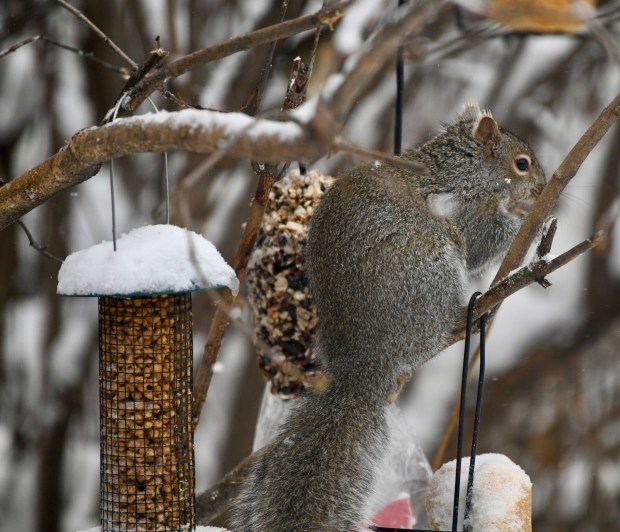
All four of the squirrels were out and about – Dyson and two summer babies and Little Red. The images of them could not be lightened any more. It is unfortunate as this little summer offspring of Dyson is so cute. My offering is one meagre image. This little male was finding peanuts in the snow and eating them. So sweet.


My top story is a shout out to the wildlife rehabbers and the vets in Prince Edward Island for undertaking only the second spinal cord compression injury and the eagle surviving! When I was a professor, one of the things I valued was curiosity above almost everything else. ‘What if I did this?’ ‘How can we improve that?’ ‘Could something like this work?’ Questions that often result in our wildlife having a second chance at life. I wish more vets and rehabbers were as curious as some who make milestones in our understanding of raptor injuries and the potential with groundbreaking surgeries. Congratulations to everyone.

More good news. Another six of the Bald Eagles who suffered in Minnesota from phenobarbital poisoning (and some with high lead levels) were recently released. The staff at the wildlife rehab centre had to physically remove the poisoned/euthanized pets from the stomach of these beautiful birds before they could be treated. There were thirteen in total. One had Avian Flu along with the poisoning and died. Another two died leaving ten that were nursed back to health.

‘A’ has reminded me that pip watch will begin in one week at the Royal Albatross Colony on Taiaroa Head. The Royal Cam parents are GLY and L. What is so fascinating to me is how the NZ DOC recognises the impacts on Climate change and is trying to do something about it! ‘A’ included this quote from Ranger Sharyn Broni when she wrote, “

Virtually all the eggs will be hatched in the incubators as the increasingly hot summers make the risk of fly strike too great. We see the effects of climate change on these large birds quite markedly. During the 1950s for example, this type of work would have been unnecessary. By the 1990s conditions were more frequently hot enough to cause fly strike at some nests some of the time. It was during the 1990s that methods to repel flies and also to keep toroa cooler on the nest began. By 2018 fly strike is almost a certainty if the egg is left at the nest to hatch.

The dummy egg holds the parents on the nest while the egg hatches in the incubator over several days. The nest will be sprayed with AIL (Avian Insect Liquidator) to clear out any flies that may be living in the nest. The newly hatched chick has AIL applied to it prior to it being returned to the nest.“

It is a whole lot better cleaning out kitchen cupboards and little ‘kitten’ things all over the house while listening to Ferris Akel’s Saturday Morning Bird tour of the Montezeuma/Ithaca area of the Finger Lakes area of upstate NY. I can stop and look if I hear something of interest or just listen. Ferris is a great advocate for being outside and for birdwatching as a way to let the stress of the world go! I will keep reminding all of us this winter as it is far too easy to stay inside on bad weather days. And sometimes advisable to do so!

There were Snowy Owls, swans of various species, gulls of various types including a Black-backed gull, Canada geese, Red-tail Hawks (a young adult with a red tail and light eyes), Northern Mockingbird, and Bald Eagles on the morning’s tour.

The images were chosen for very specific reasons.

Snowy Owls like ‘snowy, northern climates’. There are always a few around a small airport that Ferris frequents. They are commonly seen in the fields of the province where I live, and one, as you know, is in Southern California this winter!!!!!

A juvenile Tundra Swan with the grey head. Strangely, we have one still living in Winnipeg in an area that has some open water. It should not be here. Will it survive? So far our temperatures have not been constant -32 to -38 C. So, I am hopeful. Our climate is changing so it will be interesting if more stay in the future.

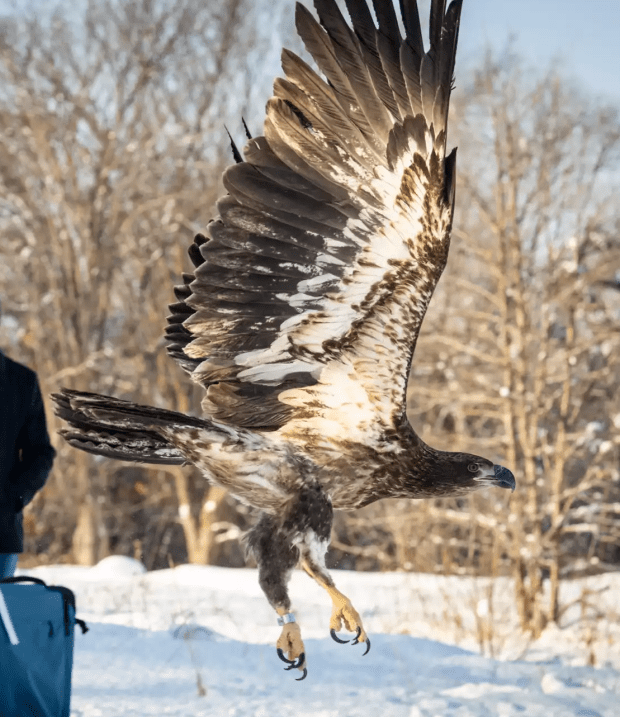
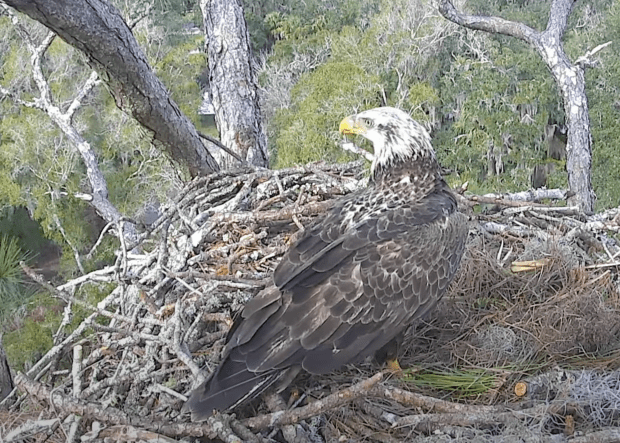
It is Bald Eagle hatch season in the US and while we all get giddy over little pink tootsies, it is good to know how the little eaglets change in their appearance until they become the iconic bird with it sure white head. The image below – look closely, has the yellow smile I spoke about yesterday in the eaglets on the Superbeaks nest. Its eyes are still dark but not as dark as the month olds at Superbeaks. They will continue to lighten. The cere, mandible, and beak are all espresso brown. The head is brown and the body has scattered white and brown striations on the chest. The eagle at the top fits nicely into being a year and a half old according to Avian Reports picture chart on eagle development (below this image). If it were a year old it would have prominent white streaks in its head.

The two eagles below are an adult pair. The beak and the head are definitive means of attributing age. Look at the chart often. It will not take you long to single out the age. But, always remember, eagles can get ‘stains’ on their feathers, especially the tail feathers and sometimes the head. So then look at the beak!

This is a gorgeous Red-tail Hawk. We know that it is at least a year old because it has its red tail. But the eyes remain light so it is not a full adult yet. What a beautiful hawk. My goodness you would think that it was a copy of a young Big Red with its extraordinary apron.

Those eyes are part way between a juvenile (blue/green) and an adult (dark chocolate).

Ferris spotted Big Red when he entered the Cornell Campus. For some reason, the sighting was very emotional. Big Red will be 20 years old this year. What she has gone through to survive that long is beyond imagination. As far as we know, she has only ever had one chick not fledge and that was K2 who had to be taken into care because of a beak/jaw infection/deformity and who had to be euthanised. She is the most famous Red-tail Hawk in the world and rightly so. She will be laying eggs in mid-March.

Ferris caught up with Big Red on one of the light stands as the light was really going late in the day. You can see the wind is really blowing. She is holding on tight to the bars of the stand. Every sighting of her is a joy. It is 1 degree C and the wind is blowing at 14 kph on the ground so it is really windy on the top of the tower. Evan the tower is moving a lot.

Ferris also found L4, the 2022 fledgling of Big Red and Arthur. It was the first year that Big Red had four eggs and had four fledglings. No one believed a 19 year old hawk could do that – Big Red is changing everything we know about Red-tail Hawks in the wild.

In this side view, you can clearly see that the eyes are still light. Not yet a year old.

L4 looking up as some Canada Geese fly overhead.

Little E22 is already such a cutie. Harriet and M15 are a dynamic duo. The DNA running through those two eagles gives us very strong eaglets right out of the broken egg shell. E22 is standing up pretty good…only a few hours after hatching.

Want some fish, E22?

By late afternoon, it was apparent that 21 and 22 had several feedings. There was fish juice all over them. Any bearing came accidentally from 22 whose eyes are not yet focusing. Harriet and M15 must be the most patient feeders!

At 1757, they both had juice and matted feathers everywhere especially 22. The following image gives you a terrific look at that egg tooth and how it extends so much below the mandible. Imagine the eagle on its back hammering away.

Harriet and M15 are great partners. It was only a matter of time before 21 bonked 22. So Harriet, who had been feeding the pair alone, called in M15 to help. Lady Hawk caught the tandem feeding in the following video.

At Anna and Louis’s KNF E-1 nest there have been plenty of opportunities Saturday morning to see the eggs but, no obvious pip. Eggs are 39 days old and 34 days. Average hatch time in Louisiana is 35-39 days so folks are sitting on the edge of their seats to see if this young couple will have a hatch (or two) this year.

Both Anna and Louis have been incubating and rolling the eggs. Louis is a great provider and Anna has proven to be a really good eagle Mum. I was so hopeful they would have two chicks this year as the food resources are there but, it might well be that they, again, have only one. One is fine!

Oh goodness. There is a pip seen after 1300 Saturday. Jumping up and down! Tomorrow there will be a wee one for Anna and Louis. (could be later in the day on Sunday depending on its progress)

At 1652, you can really see the progress that little eaglet is making. Well done!

It is raining in Louisiana this morning. Louis covered the eggs with nesting material not giving us any hint as to how the hatching is going!

At the E3, nest of Alex and Andria, the two eaglets are growing like bad weeds in the garden plot.

Look at the bottom of E3-01!!!!!!! Well fed eaglets, both of them.

Eggs are being rolled at Metro Aviation. It is unclear if there is a pip. I saw a black spot but I think it is nesting material. Will these eggs hatch? The first egg is 42 days old today. The second egg is 39 days. Remember the average is 35-39 for Louisiana Bald Eagle eggs. It is possible that neither egg is viable. But we wait and hope for this couple.

At Berry College, Pa Berry was on the nest. We have some time before pip watch for these two Georgia Bald Eagles. Egg 1 is 26 days old today and egg 2 is 23 days old.

All is well at Superbeaks! Both are on the nest and I haven’t had to scream yet today about the lack of chair rails…but, oh, I wish these eagles would strengthen the sides of this nest.

Rolling eggs at Captiva. Next week is pip watch for Connie and Clive at the Captiva Bald Eagle nest. That is a very clear camera image!!

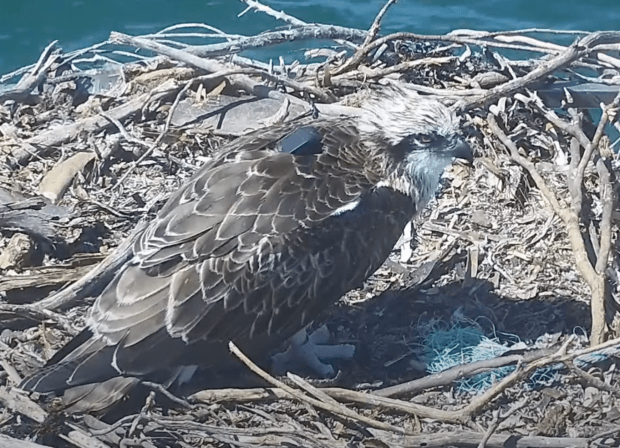
At the Captiva Osprey nest, Andy and Lena are now replaced by FO and MO. They need to bring more nesting material and everyone would love to see some fish gifts. There is still time! Rumours have it that the pair mated on the nest for the first time on Saturday. I did not see it and I screamed at the rewind on the camera! I can neither confirm nor deny.

Elain continues to keep us up to date with her daily video summaries from Orange. Indigo made only one appearance on the 7th of January! Much more quiet, yes.

Geemeff posted an article on Twitter that is really informative about tracking devices and how they are so useful to our understanding of the movements, behaviour, and challenges our wildlife face. It is a really good read!

So where does a disappearing elusive Australian Painted-Snipe go if no one has hardly ever seen one? Just look at how lovely it is in the image above. I love that white eye line.

https://www.theguardian.com/environment/2023/jan/08/vanishing-bird-the-mystery-of-the-near-mythical-australian-painted-snipe?CMP=share_btn_link

Keeping closer to home and keeping in mind that lovely book, Slow Birding (I think it is the favourite of 2022), I want to remind all of us that we can do things at home now or next year to enrich the lives of the visitors to our own gardens.

  • Provide shelter. No, it doesn’t need to be some elaborate structure. It could mean leaving some of those tall perennials in place to provide a place away from the wind or rain. If like me you have had to cut trees down (yes, sadly), place the limbs and branches around the garden preferably stacking them. Great shelter. In addition, the rotting wood will provide great feasts for birds that feed on insect life. I have several different 60 cm tree trunks that are now about 20 years old. The birds peck away at them in the spring and summer as they are slowing breaking down into a kind of mulch.
  • Looking at the seed and garden catalogues and wishing. Consider – and you must consider your own planting zone – climbers for shelter in the fall and winter but also plants that are bird, bee, and butterfly friendly in your area. I am looking for quick growing berry bushes and a couple of trees with berries right now to plant in the spring. The birds will all thank you.
  • If you have the space, the finances, and the physical ability, why not set up a couple of bird feeders? Feeding the birds really gives them a boost and a better chance at winter survival. Also consider seeds with shells and no shells. All of my garden birds love the Black Oil Sunflower Seeds but the empty shells make a huge mess. You can purchase already hulled seeds. (I rake mind and push them to the back of the mini-forest where they break down and help the soil). If you do put up feeders or bird feeding tables, you have to be able to clean them. Feeding birds is also about responsibility to them so they do not get disease. “The National Wildlife Health Center recommends cleaning bird baths and feeders with a solution of nine parts water to one part bleach. (If there is visible debris, scrub it off before soaking in the bleach solution.) Dry out the feeder before hanging it back up”.
  • Want to give the birds some treats? These ideas I originally found on the RSPB website. You can blend birdseed with unsalted nuts, raisins, and lard and press it into moulds or over pinecones and hang outside. Do you have some old hard cheese that could be grated? (no Blue apparently). Birds love it. My Starlings are loving pieces of apple and pear as well as raisins, sultanas, and currants. It is a good way to use up some bruised fruit. I put chunks into a tray feeder.

It is always my pleasure to bring you some of the recent news about our feathered friends. I did not cover Zoe today but rest assured, the girl is eating! Dad brought her a fish yesterday and it is believed Mum added one to that as well. Most days she has 3 fish delivered by Daddy and Mummy Door Dash. Oh, they must be wishing she would move out of the house?? But, they will dutifully continue to feed their girl. No fear. They are dedicated. It is nearing noon in Australia as I write this and Zoe is 112 days old and she is yelling at Mum who is on the ropes for a fish. Time to become independent dear girl. Or are we set to break other records? She is exploring the area but is she exploring places where she could catch fish? And Ervie! Oh, I wish someone would submit some images of Ervie. Missing that beautiful boy.

Oh, thank you so much for being with me today. It is wonderful to know that there is such a supportive community ‘out there’ for our feathered friends. Please take care! See you soon.

Thank you to the following for their tweets, announcements, articles, posts, videos, and streaming cams where I took my screen captures: ‘A’ and NZ DOC, Ferris Akel Tours, Avian Reports, SWFL Eagle Cam and D Pritchett, Lady Haw, and SWEagle Cam and D Pritchett, KNF 1, KNF 3, Metro Aviation, Berry College Eagle Cam, Superbeaks, Window to Wildlife, Elain and Charles Sturt Falcon Cam and Cilla Kinross, Geemeff, The Guardian, and Port Lincoln Ospreys and Friends of Osprey.

Waiting for E22, wildlife protection laws in Northern Ireland and more…Friday in Bird World

6 January 2022

Good Morning Everyone!

It was -12 degrees C with no wind Thursday. The sky was a bright blue and there was hoar frost on the trees and shrubs. My photographs do not do the frost justice – it is like a fairy wonderland out there.

Today was my first walk at the nature centre this year. The lake is frozen and it is gorgeous. Simply gorgeous.

According to the Woodland Trust, “Hoar frost is a type of feathery frost that forms as a result of specific climatic conditions. The word ‘hoar’ comes from old English and refers to the old age appearance of the frost: the way the ice crystals form makes it look like white hair or a beard. It forms when the water vapour in the air comes into contact with solid surfaces that are already below freezing point. Ice crystals form immediately, and the ice continues to grow as more water vapour is frozen. On a still night, it can grow well on tree branches, where the surface temperature is unlikely to rise above zero for several hours.”

It was a bit of a fairy tale day. I had not expected to see any birds but, right off, there was a pair of Downy Woodpeckers – a male and a female – as I entered the forest. It felt like a really nice greeting.

When I went to submit the three Downy Woodpeckers to eBird, Cornell thought that was absolutely too many for this date. Thankfully I had images of the three of them. (The third was at a feeder).

There were only two Red Squirrels that I could see. One was eating out of this feeder and the other one was finding seed on the ground.

The Chickadees are so sweet. They will follow you through the forest.

There had been five deer feeding I was told but, this was the only one left when I got to the hide. It was about 3 metres away from me.

It was a good day to get outside for other reasons, too. E21 hatched! E22 is on its way and will be here by tomorrow morning. E21 is so cute and adorable and in a few days everyone will be yelling at that eaglet to stop beaking its sibling. It just happens. So, today was a good day just to be somewhere else.

And it starts. Those lovely soft feathers are going to be just coated and matted together with fish juice and pieces of prey! M15 had the honours of dropping this big piece of prey on E21’s little beak.

Oh, I hope E21 isn’t a little stinker. Looks like an eaglet with attitude.

Harriet is a pro of an Eagle Mother. How old is she now? 26? 28? The fact that the second egg is already pipping is a testament to her experience. The closer they are in hatch times, the better for them – more evenly matched in their dust ups.

Harriet was feeding E21 when the camera zoomed in and caught the precise moment that E22 broke through the membrane and the shell. Lady Hawk has it on video:

The progress at 0736 Florida time Friday morning for E22.

I am so glad that I did not get to see inside the Superbeaks nest. If you think the age and size difference is a lot at KNF-E3 with Alex and Andria, it has to be even a little more at Superbeaks. That first hatch is monster size compared to the little second one. We are now at the stage where they both have thermal down, there is plenty of food, and both are being fed well. My only worry – that will cause some minutes of loss of sleep – is that one area of the nest without a rail. One of the eaglets was hanging its head over that end today! By the way, jump for joy. The rain cleared off the camera (mostly).

Pepe is an amazing fisher and Muhlady has managed to raise two very different aged eaglets. Remarkable. Now I wish they would get their carpentry skills out and get with adding some chair rails before I have a heart attack!

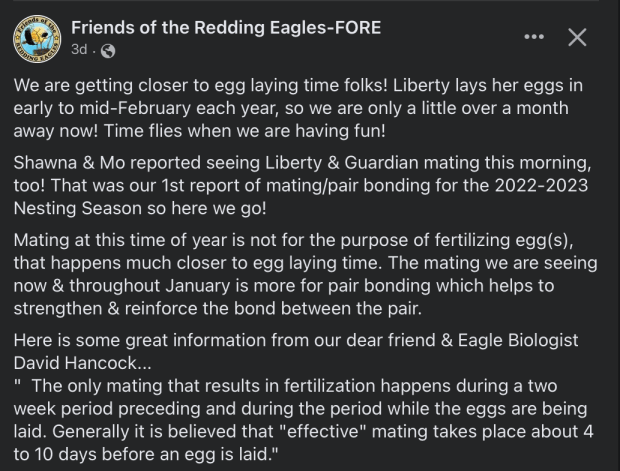
Our very own Dave Hancock answers some questions that have come up about Bald Eagles and mating.

There they are. The beautiful Liberty and Guardian.

Thunder and Akecheta were at their West End nest in the Channel Islands. There has been rain and storms in the area but, it sure is beautiful around 1630 when the pair were spotted on the streaming cam.

The other Channel Islands nests – Fraser Point and Two Harbours – continue to show highlights from last season.

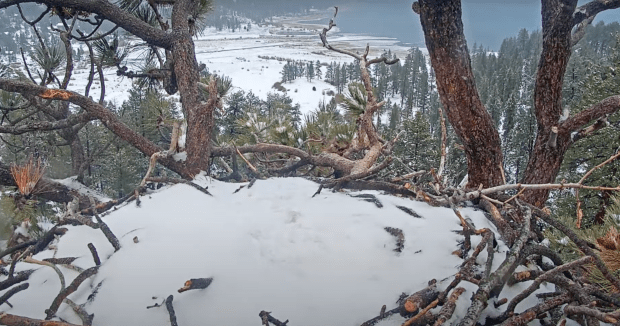
There was rain and pelting hail and show today at Big Bear. It did not stop Jackie from coming to the nest to eat her late lunch at 1344!

Nancy came to the MN-DNR to do a nest check today after the snowy weather yesterday.

The two eaglets at the KNF-E3 nest are doing fantastic. Prey items are continually brought to the nest and if the angle is right you can see the feathers coming in on the wing tips of 01.

They are both getting longer and more slender looking as they move towards losing that natal down and getting their wooly coat.

They still seem to have fat little bottoms with tails coming in.

Gosh, Andria is huge. She sure loves her fish!

The continuing saga of Gabby and V3! Thanks ‘J’. I didn’t see this but saw them sitting together. These two seem to have communication problems over prey deliveries and now Gabby’s signals to want to mate. Goodness.

Lots of eyes trying to get a glimpse of the eggs at the KNF-E1 nest of Louis and Anna. Is there a pip? It is not clear.

My memory – of the first eaglets to die in 2022 of Avian Flu – was the Hilton Head Eagle nest. At the time it was unclear if the parents had gotten sick or died from eating the virus laden prey. This announcement was posted in December. We will wait to see if the eagles return to the nest? Perhaps, sadly, they also passed away later. The GHOWs are still at the nest today, 5 January.

It appears that Diane – of Jack and Diane – at the Achieva Osprey Cam in St Petersburg, Florida is doing better today with her injured leg. That is excellent news!

I am continually surprised at how adaptable wildlife her to the challenges thrown at them. At the same time, I wonder why we do not give them that change to prove themselves? Why not a one legged eagle? Dennis Brecht has photographed one. Just asking. Check out this fox! Only 2 legs.

One reason that I continually peck at this issue is that when I was born, my dad had a three-legged dog that guarded my basket and enjoyed life like any other four-legged animal. I do not recall her having issues but, I do know that she lived to be more than 20 years old.

Before I went to the nature centre, I had a couple of things to pick up. Without naming the store, I noticed a woman fumbling around with a lot of things in aisle 6 – this aisle was fully of products to get rid of ants, mice, etc. I decided to ‘be nosey’. The woman told me she had mice and she had successfully used the traps with the cubes of rodenticide poisoning and also just to be sure, she puts glue traps on the floor around the traps.

I am so aware of the harmful effects of secondary rodenticide poisoning because of Missy and Lewis and losing a cat years ago to these designer toxins. Of course, we read about secondary poisoning for our eagles and other raptors every day. Every day. So I asked the woman some questions. How do you dispose of the glue pads once you have caught your mouse who has died a horrifically painful death? Did she imagine that the garbage bag could get ripped open by wildlife at the landfill and then it would also ‘trap’ them? Did she know that the mice eating the solid blocks of poison go outside, get sludgy and a local cat or hawk can eat them and die? I recounted the horrible death of Duncan – nothing the vets could do. This woman had no idea. She also had no idea that our City outlawed the use and sale of both products. So why are they still on the store’s shelf? My rant had zero impact as I saw her loading the items in her cart. She is more troubled by having the mice around and doesn’t care what happens to the pets of others or the wildlife. Sad.

All of this brings me to a very sad story. Remember the eagle floating on the ice? the one who was saved? and went into rehab?

More eagles in a different state – this time Montana – poisoned from euthanised pets being dumped. It sounds like this practice is more wide spread than anyone would have thought. Isn’t it time for someone to investigate and get in touch with every Vet society there is to stop this inhumane dumping practice that is causing widespread suffering in the Eagles. Cremation is the only way. Just do it.

Keeping in the thread of rodenticide and all manner of illegal killing of raptors – their persecution, we know that there are people working very hard to change laws in every country. Once on the books to try and get those laws enforced and then strengthen them when need be. It is not easy as you have seen by the postings from Raptor Persecution UK. I want to be hopeful that ‘finally’ people at all levels – including the highest in governments – will notice that there is a sea change and the population wants our wildlife, our water, and our land protected. We know the importance of this – help spread the word. Finally for today and certainly not least, Northern Ireland passed its own laws similar to those in the UK. Well done, Wild Justice. You can follow their progress and that in the UK by following Wild Justice and Raptor Persecution UK. Here is the announcement. Thanks, Geemeff for reminding me to post this important information!

Northern Ireland: new general licences which permit killing of a variety of birds are now published (link 1 below) The new licences are much improved: fewer species are listed and the lists make a lot more biological sense. For a bit more detail see our blog (link 2 below) 

These licences are now much closer in line with those in England (where we have taken successful legal challenges), Wales (where we took the former licences to court and although we lost the case, the changes that followed were what we had asked for) and Scotland (where changes have happened in response to those elsewhere in the UK and without us having to intervene, as yet). In particular, the slimmed down version of the ‘conservation’ licence, TPG3, only applies during the breeding season and only includes a couple of corvid species.  In addition, the licences are much better and more tightly worded than before.  

It has taken a long time, and quite a lot of effort, and quite a lot of money spent on legal fees, to get these changes but they wouldn’t have happened without Wild Justice. And by Wild Justice we mean you, our supporters too because many of you responded to the consultations (one aborted and one completed) that the Northern Ireland authorities launched.  And, of course, you funded all the legal challenges across the UK. You helped get this change – thank you.

Thank you so much for joining me today. Please take care of yourself as we await the hatch of E22. See you soon.

Thank you to the following for their notes, announcements, postings, Twitter feeds, videos, and streaming cams that make up my screen captures: SWFL Eagles and D Pritchett, Lady Hawk and SWFL Eagles and D Pritchett, Superbeaks, FORE, IWS and Explore.org, FOBBV, MN-DNR, KNF-E3, NEFL-AEF , NEFL-AEF and Lady Hawk, KNF-E1, Hilton Head Island Trust, Achieva Ospreys, The Telegraph, Terry Carman and Bald Eagle Live Nest Cams, Geemeff and Wild Justice, and Wild Skies Raptor Centre.

Sparrows, Samson, Rita and more in Bird World

23 December 2022

Oh, good morning to everyone!

What a blistery week it has been. The garden animals are all poofed trying to keep warm in the chill winds and -21 degree C temperatures. It has gotten a little warmer!!! And by next week, it will be absolutely balmy at -2 on Wednesday. Crazy. We can adjust our clothing and footwear. These poor babies.

We have called Dyson the ‘monk’ for a long time. When she comes to the window with her little paws folded, it is a sign that all of the food for her is gone. Time to refill! No pressure, right? Just look at that sweet face.

I continue to be impressed with the book, Slow Birding. The chapter on House Sparrows really opened my eyes. They live where we live and the first sentence of the chapter asks, ‘Who Doesn’t Love House Sparrows’? I surely do and get quite irked at those who try specifically to feed other prettier birds (to them) and thwart the sparrows. Like falcons, they exist on every continent but, Antarctica. There are fossils dating back 400,000 years in the Middle East where the sparrows followed the progress of agriculture. They would eat the seeds left in the plowed fields. Today, the planting seasons have turned topsy turvy and they are on The Red List. They were traditionally planted in the fall not in the spring and that single change would help the birds survive in the UK. To add to that, the cessation of using pesticides and herbicides would benefit the ability of the parents to feed their young. No insects, no food for the little ones. Did you know that once they hatch, the chicks need 3000 to 4000 thousand insects to eat til they fledge. This is approximately 200 to 300 trips a day, in and out of the nest, to feed the wee ones. This will continue for two weeks. Today, in North America we are lucky to have them and their beautiful songs in our gardens. Feed them! And don’t use chemicals on your lawn. Promote insects by leaving your leaves in the fall. Help these wee ones out whenever you can!

I know that many of you will remember that one or the other of Diamond and Xavier have brought in a Green Parrot to the scrape at Orange. Here is an interesting story from The Guardian about them and the numbers that have flown to Tasmania for breeding season.

https://www.theguardian.com/environment/2022/dec/20/record-numbers-of-critically-endangered-orange-bellied-parrots-in-tasmania-for-breeding-season?CMP=share_btn_link

Please do not think that birds are ‘bird brained’! Just trying getting a Rowanberry from one of the lovely and fierce Redwings.

https://www.theguardian.com/environment/2022/dec/22/country-diary-the-redwing-is-bird-brained-but-far-from-stupid?CMP=share_btn_link

Today, Samson would be nine years old ——way too early to be gone ——and a YouTube video honouring his hatch day is making the rounds. Thanks ‘J’ for bringing it to my attention.

It is so difficult to catch a peek of the two little eaglets at Superbeaks but, that said, everything seems to be going just fine. Food is plentiful and both parents, PePe and Muhlady, are extremely attentive.

Glad to have a final and definitive word on the status of Rita. Things get carried away in chats and on FB. Terry Carman gives us the latest:

Always so happy to have one of Elain’s videos of the Orange Peregrine Falcon scrape to share:

A brief look at one of the Audubon Center’s Ambassadors who lived their life in car for 31 years. Incredible. And still going strong. If you ever get near enough to Maitland, Florida – on the west coast near Fort Myers – stop in and visit the Audubon Center for Birds of Prey. You will sadly not see Smedley but you could see Bailey, his long term Osprey mate. You might also see many of the other ambassadors.

So here is Francis from a wee nestling in care to being all grown up. Oh, I miss those little eaglets. Can’t wait for Harriet and M15’s two to hatch. Let the beaking begin!!!!!!! And it will. There is no doubt about it but, it will stop.

Oh, what a delight. Andor and Cruz were on the Fraser Point nest today. You might remember that these are the parents of Victor who went into care and Lillibet from 2022. So good to see you!

They refused to pose nicely but who cares. So lovely to see both of them together at the nest!

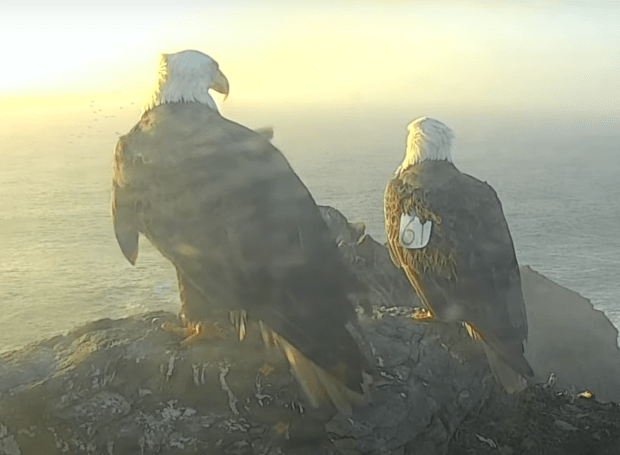
With that luck, I thought I would check on Thunder and Akecheta and there they were together! What a great day with our Channel Islands Bald Eagles. There they are, sitting together, looking out over the water into the sunshine on that high cliff to the left. I believe it is called Tor.

I ran out of luck at Two Harbours. No Chase or Cholyn when I checked.

The cams came back up at the Northeast Florida nest. V9 flew in and chortled but no Gabby. He waited for ten minutes and flew off. I wonder if they will both return to the nest tonight? We wait. Lady Hawk caught V9 flying in.

Gabby has been at the nest and she has brought some new greenery in. We wait, watch, and hope for our girl.

‘A’ sends word that there has been a changeover at the Taiaroa Head Royal Albatross nest. These two are doing so well. The sky calls are like nothing else. Oh, how I loved the little ones doing sky calls with OGK. Tears.

Zoe is certainly developing her diving skills and it is only a matter of time before an unlucky fish comes along and she snaps it up. It would be fantastic to see her bring one in to the nest that she caught right from the natal barge. Her love of fish will certainly be a motivator!

Speaking of fish, Dad is doing an amazing job feeding Zoe. Today she had no more than finished one fish than he flew in with another quite nice one. Her crop will pop!

You can see Zoe’s crop. I sure hope that Dad is eating himself!!!!!! He is really taking excellent care of his ‘little’ girl.

Thank you so very much for being with me today. Please take care. See you soon!

Thank you to the following for their notes, their videos, their posts, and their streaming cams that make up my screen captures: ‘J’ and ‘A’, Port Lincoln Osprey, NZ DOC and Cornell Bird Lab, NEFL-AEF, Institute for Wildlife Studies and Explore.org, Audubon Center for Birds of Prey, Elain and Charles Sturt Falcon Cam and Cilla Kinross, Superbeaks, Bald Eagles Live Nest Cam and News and Terry Carman, and The Guardian.

Is V9 the winner? and other news for Thursday in Bird World

22 December 2022

Good Morning Everyone,

It is still freezing. The last time I checked it was -26 degrees C. The furnace is working over time. But I am out of the parking pad and someone is coming to clear all of the snow so I won’t get stuck in there next time there is a blizzard. Tomorrow is the day to make sure that the birdseed and the cat food are topped up so that there is plenty to take all of the garden friends along with Missy and Lewis into the new year. I do not know about you but, I dislike crowds immensely, hate malls even more, and hope to get out and home before many wake up in the morning. Fingers crossed.

It is the day after the Winter solstice. A long time friend sent this to me and I want to share it with you – even if it is a day late.

A Winter Solstice Blessing

May you find peace in the promise of the solstice night, that each day forward is blessed with more light, that the cycle of nature, unbroken and true, brings faith to your soul and well-being to you. Rejoice in the darkness, in the silence find rest and may the days that follow be abundantly blessed. (Source unknown)


Bird World has gotten very quiet for the past few days. The only action that is happening is at the nests of Gabby and Ron where there remains some question as to which of the visitors each of them might choose. SuperBeaks is just steady as you go. This nest will go on my must watch list of eagle nests for next year.

Now at Northeast Florida. Too many visitors to follow. Too many discussions over who is who or if one is old enough to mate, etc. There is plenty of evidence for 4 year olds fathering healthy chicks including Harry at the MN-DNR nest in 2021 and again in 2022 before he disappeared. Is it possible Gabby might not have a mate this year? Of course it is. We should sit back and relax. It is a learning opportunity.

The camera has been down. There is another camera that the AEF have access to while the cameras we use to see the nest are down. Well done Gabby and V9. I gather they are friendly and working on the nest. Great news. Now if he can prove that he can keep intruders away, bring fish, and be truly a grand mate for Gabby — well, there could be little eaglets popping their heads up at this nest in the new year. Hopeful.

There is news of Rita requiring a little more removal of the wing. It is not clear if this is the tip that was removed several days ago or a new surgery. I am trying to clarify. It is certain that she will not fly again and they are looking for a permanent home for her. And this brings me to a problem that we all must consider every time we want a bird to be an ambassador or an educational bird —— they must have a place to go. That place has to have funds to feed and care for the wildlife they have. Many places are just over run with raptors and other birds. So when you consider making donations, please do keep this in mind. The costs involved are high and almost without exception these facilities work on a shoe string through the generosity of volunteers and donations.

Meanwhile Ron seems not to have settled on a new mate yet and appears to not like at least one of the females coming around.

In San Jose at the City Hall, Sequoia, the son of Grinnell and Annie, is calling his mate! This is just so wonderful. While it never makes up for losing birds, it is sure nice to see ones that we have watched from hatch to fledge begin their own families.

For those of you that love Peregrine Falcons and want to know more, here is a hefty book that has come out. Mark Avery wrote a good review in his recent monthly blog and this is part of his report, “This is a monumental book about what is regarded as the fastest animal on the planet (or flying over it). At over 500 pages, and amply and attractively illustrated, this is a tribute to and reference source about a marvellous bird. The brilliance of this bird is well captured in many of the photographs but the text is full of information about Peregrines from everywhere in the world where they occur. Chapters cover falcons in general, an introduction to this species, flight, diet, breeding behaviours and characteristics, movements, friends and foes and population numbers and trends. It feels like an encyclopedic coverage and the book is packed with information, but information delivered in a very palatable form.”

Speaking of falcons, Indigo is still being fed, still hiding food in the scrape and having Mum, Diamond, take it! Indigo has also started something unusual. Bringing grass into the scrape box! Goodness.

The SuperBeaks nest is wonderful. I am so glad that several readers asked me about them. I have had several giggles. While we have been frustrated not being able to see the eaglets, ‘S’ admits that we are getting a reprieve from worrying about them, too. We aren’t sitting and counting the bites this one or that one gets. We just sit and watch PePe bring in large fish and Muhlady feed the bobbleheads. We cannot even seen any beaking! It is actually quite nice. By the time we can see them clearly all of that will have passed!

There is a wee little head showing in the top image.

Both Pepe and Muhlady are on the nest vocalising.

Have not seen Jackie or Shadow at the Big Bear nest today but, there were a couple of Crows (or are they Ravens – difficult to tell) visiting trying to find any leftover bits of fish. Jackie and Shadow were there on Tuesday working away.

Here is a very short compilation for the winter solstice with recent images of the eagles at Big Bear – our adorable Jackie and Shadow.

The GHOs have been after M15 at the SWFlorida nest again – and, of course, since their nest is on the same property, we can expect an increase in this behaviour. Do the Eagles bothered the owls? Probably not. Maybe they should!

Cornell has put out its season highlights from the Royal Cam nest at Tiaroa Head. It opens with OGK doing a sky call – so get the tissue box. What a grand mate and dad he was. Last seen in mid-May (19 May I am told). We will forever miss him as will his long time mate, YRK, who will, perhaps, find another mate and raise more chicks. We will have to wait and see. And it could be a very long wait.

I know that many of you have wondered what happened to Mahlala, the Red tail hawk raised by the eagles on Gabriola Island. Their eaglet Junior, you will remember, was electrocuted on a power pole. I found this announcement today re their FB presence: “UPDATE: 12 20 22 GROWLS Eagle Nest Cam (Gabriola Rescue Of Wildlife Society). This FB Group is temporarily paused for 168 days. An admin paused this group on July 30, 2022. Group activity will resume on January 15, 2023 at 3:00 AM“.

No one knows why the FB was abruptly paused.

As for Mahlala, there are a large number of Red-tail Hawks in the general area. She was not banded so it would be difficult to tell her apart from any other unless you had clear identifying features which we don’t because the camera images were not clear. Did she return to the nest? Maybe GROWLS will tell us when they come back to life!

I posted an image of L4 that was taken during the Ferris Akel Tour last Saturday. Here are other images from this morning’s Cornell Hawks Twitter feed. It is nice to see the juvenile still doing so very well. That is a nice crop – and still in Mum and Dad’s territory without problem.

No. 21 The Red List. The Woodcock

Oh, look at that image. The eyes set way back on their head allow them to see predators when they have their long beak thrust into the ground hunting for food. They have short legs and are rather ’round’ compared to other birds.

Males perform a remarkable ‘sky dance’ on spring and summer nights, in a high, twisting flight, with chippering, twittering, bubbling sounds. These sky dances attract the females who will mate with one of the males. The males – like Daisy the Duck’s mate – take no part in the care of the eggs or the hatchlings!

Audubon Society says, “Downy young leave nest a few hours after hatching. Female tends young and feeds them. After a few days, young may begin probing in soil, learning to search for food. Young can make short flights at age 2 weeks, fly fairly well at 3 weeks, independent at about 5 weeks.” So not like ducklings or goslings that are precocial – able to care for themselves after 24 hours of hatching.

“Woodcock vintage drawing” by Free Public Domain Illustrations by rawpixel is licensed under CC BY 2.0.

There are Woodcocks that are resident in the UK and there are others, several hundreds of thousands, that fly from Finland and Russia – a distance of some 3000 km, to over winter in the UK. They arrive during the first week in November. They like damp woodland where they nest in a feathered scrape on the ground. There are stories of the Woodcock carrying their chicks between their legs and body in their feet if danger should arrive. There are also stories of them carrying a stick in their mouth when they fly over the ocean to the UK so if they tire during their flight they have some wood to land on in the ocean.

Many feed at night thrusting their long beak probing around in the soil – their heads go up and down so often they have been compared to ‘sewing machines’. They fine worms and Beatles and suck them up like spaghetti. Can you imagine? I would love to see one.

British writers such as Drayton, Shakespeare, and Milton used them as a metaphor for ‘foolish love’.

“Woodcock Scolopax rusticola” by Peregrine’s Bird Photography is marked with Public Domain Mark 1.0.

The threats for the Woodcock vary from geographical location. In the US, fires are burning up habitat, climate change is drying up the wetlands, spring heat waves are driving the chicks from the nest, and heavy rains are endangering the eggs and the nests altogether. In all areas, habitat loss is driving a decline in populations. In the UK, those threats also exist along with the legal hunting of the Woodcock which begins on 1 November despite their being on The Red List. Wild Justice has asked the government to change the date to 1 December to try and help protect during the breeding season!

Two recent short articles from The Guardian are quite good.

https://www.theguardian.com/environment/2008/jun/08/birds.woodcock?CMP=share_btn_link

https://www.theguardian.com/environment/2015/jan/06/country-diary-claxton-norfolk-birds-woodcock-snipe-wigeon?CMP=share_btn_link

Thank you so very much for being with me today. Please take care of yourselves. See you soon!

Thank you to the following for their streaming cams, their notes, their posts, and videos that make up my screen captures: Cornell Hawks Twitter page, Superbeaks Bald Eagle Cam, Charles Sturt Falcon Cam and Cilla Kinross, Mark Avery Book Reviews, San Jose City Hall, Openverse, NZ DOC and Cornell Bird Lab, FOBBV, San Jose City Hall, WRDC, and the NEFL-AEF.

Pepe brings in an evening snack, more visitors to Gabby’s nest…it is Sunday in Bird World

18 December 2022

Good Morning Everyone from a very snowy Manitoba! It has been a long time since we have seen so much snow dumped on the Canadian Prairies at one time. It is beautiful and a good way to slow down.

The Starlings showed up at their usual time for some of the suet.

The House Sparrows were here – mostly on the ground eating seed that Dyson & Company had dumped on the ground. You see the squirrels have found a way to empty one of the feeders entirely by shining on it!

Dyson is in her favourite spot. I always know where to find her. The other three – her babies from the summer – are doing well. She has taken good care of them.

It is a different story in the house. Lewis and Missey want to help with everything including the new images of Aran that have arrived from Glaslyn or the squirrel cards from DaniConnorWild.

Are they so innocent?

One or the other loves to get in this little basket. When they first arrived, both of them could fit in it. No longer! I am now calling them cats instead of kittens!

Lewis pretending he is an angel. I will not take my eyes off him or these candles while they are on. It is way too easy for a cat to burn their fur or start a fire. In fact, after sitting nervously for a few minutes, I have decided to only use candles if they are covered by a glass globe.

With the help of ‘J’, the memorial listing of the birds that we have lost is getting filled in much better. I have now returned to it with her help – while at the same time preparing a summary of Port Lincoln’s season for Claudio and the incredible International Osprey Data Bank he has created for me to track the Ospreys on the streaming cams. By the end of the first week in January, there will be a separate page with the Memorial Wall for 2021-22. If you have any additions (or corrections), please do not hesitate to get in touch with me. Let us all hope that 2023’s listing is much shorter.

I don’t always get to sit and watch Ferris Akel’s Saturday Tour but, it is often playing in the background. Whenever he is talking about an interesting bird – instead of just searching for them – I jump up. Today, there was a Belted Kingfisher. Isn’t it lovely? I have never seen one and they look like such unique characters with that long pointed beak and that ‘bed head’. Love the colour palette of the plumage, too. Lovely birds.

Several Bald Eagles were out in the fields near Montezuma. Ferris has a way of spotting them and I have no idea how he does it.

One of the most exciting moments for me was a Northern Harrier hunting in the fields and catching some prey!

It is hard to see but they have a face like an owl with plumage that captures the sounds. They fly low to the surface of the land to catch their prey unlike other hawks that might hover or sit on poles and wait.

I cannot imagine, for a single moment, not wanting to allow them to have a bird or a vole for their dinner. Beautiful creatures.

There were also Tundra and Trumpeter Swans. You could see areas with some open water while others were covered with ice or were slushy.

A Horned Lark had found some food and was eating it on the side of the highway. Silly one!

There were Snow Geese and Canada Geese, too.

They had been feeding on the fields of corn that had been harvested and then all of a sudden, they flew away. Ferris was happy. Last year at this very site someone shot a Snow Goose while he was broadcasting.

Ferris spotted Arthur and a juvenile Red-tail Hawk on the grounds of Cornell University. I would like to think that the juvie that was hunting is L4 who has decided to stay in its parents territory. Certainly Arthur and Big Red are not running it off!

Arthur is all poofed up. It is 0 degrees C and they are due for some more snow. Notice the very deep brown/black eyes of the adult Red-tail. Arthur does not have the majestic apron of Big Red on his chest so it is easy to tell them apart. Such a little cutie, Arthur is. Big Red was seen recently by Karel Sedlacek so I am not worried that Ferris did not see her. It is hard to imagine but in three months time we will be watching for Big Red to lay her eggs. She will be 20 years old this spring! Wow.

This is the juvenile that I believe to be L4. If you look carefully you can see the light celadon of the juvie’s eyes.

Ferris Akel is a wealth of knowledge who gives his time and shares the birds around the area of Ithaca with us almost every Saturday of the year. He has been doing this for more than ten years now. He is humble but, I learn something every time I stop to listen to his programme. You can subscribe to his channel on YouTube and there is a chat moderated by a fellow Canadian, Dolphin. I often lurk – but, everyone is grand and they will welcome you to chat if you say ‘hi’.

As night began to fall, Pepe flew into the Superbeaks nest with a huge prey for Muhlady and the eaglets. I am trying to figure out what it is – a Black duck with red? Anyone know what this might be? Is it a Red-legged Black Duck?

Muhlady certainly seemed pleased and what a nice time to bring the prey. A snack for everyone before bed and some breakfast in the morning. Lovely. This is my first time watching this nest – in fact, it is a new nest on streaming cams. One never knows what to expect but this eagle family seems to have a good source of prey and they are very smart – having their eaglets before it gets too hot! Can’t wait til we can see those wee ones a little more. You certainly can hear them if you tune in.

I had a giggle today. Lady Hawk called Gabby’s nest ‘As the Nest Turns’, too. And it certainly is a revolving door. Today there was a 4 year old and a juvenile less than 2 years which led me to want to think it was Legacy!

Legacy, I don’t know if this is you but, if it is, you are still as gorgeous as ever. It is those piercing eyes…I have looked several times at images of Legacy and it sure could be her. I sure wish someone would band these eaglets! And here is my reasoning. For the past several days, we have been receiving images of Siren 5F who is the mate of Dylan at Llyn Clywedog. She is perched in her regular roost in The Gambia where she winters. Easily recognisable. No guesses. That is how banding can help – amongst other things.

That 4 year old eagle sure has Samson’s legs!

A short video of V4 flying into the nest with V5. Someone mentioned Gabby abandoning this nest. The Bald Eagles are attached to the nest. I cannot see a reason for her to leave it unless she were ‘run out’ of the territory by a bonded couple intent on taking over the territory and the nest.

One of the resident Ospreys at the Audubon Centre for Birds of Prey is Bailey. She was the companion of Smedley who sadly died last year. Yes, Ospreys do well in care!!!!!

Wow. Look at this image from the scrape at Charles Sturt University in Orange today. The expression on Diamond and Indigo’s faces are amazing.

At the same time, Indigo can be just a darling.

Elain’s highlights of the day at the Orange scrape. Always welcome, Elain. You do a wonderful compilation! Thank you.

Ron is quite the catch. I sure hope some deserving female flies into his nest! He is doing a super job of working on it. Someone today wished that Ron and Gabby could get together. That would be one super couple.

Jackie and Shadow working on their nest. They were caught mating on the other camera today!

As we wait for eggs to be laid or hatch, for Gabby to get a new mate or not, there is not a lot going on in Bird World and for that, I am truly grateful.

Good news has come to us from the rehabilitation centre that has cared for WBSE27 and who is now training WBSE30. We know that 27 is flying free. We have seen her tracking. They did a marvellous job teaching her to fly and to hunt and they are now doing the same for 30. Let us hope that she, too, will be equipped with a tracker so that we can follow her movements.

The top image is 27 leaping off a perch while she was being trained before she was released. The bottom image is 30 being trained now. Warm wishes for her life to be as successful as her older sister’s.

30 is on the perch on the right.

I have not been able to find a recent update on WBSE 29. Lady and Dad have, however, visited the nest tree the other evening. So nice to see them!

And a quick check on Zoe at the Port Lincoln Osprey barge. I caught Dad delivering either a small fish or a piece of a fish to Zoe at 1402. She spots him coming. My goodness, Zoe, you are loud! They could hear you across the lagoon.

So, with the lull, let us turn back to our Red List of Vulnerable Birds published in the UK.

No. 20 The Red List: The Smew

“Smew” by hmclin is licensed under CC BY-NC-ND 2.0.

The author, Ben Watt, calls this darling black and white diving duck, the ‘Karl Lagerfeld’ of the divers. Watt uses such terms as ‘vivid white crest, jet black shades, white tux, …moving elegantly’. What a grand description. Quite fitting.

The top image is of a male Smew. The bottom is of the female adult. Just look at that magnificent rusty head on the female. Quite striking and gorgeous.

“Smew – male” by Len Blumin is licensed under CC BY-NC-ND 2.0.

“Zoo Smew” by hmclin is licensed under CC BY-NC-ND 2.0.

There are fossils of Smew going back 1.5 million years ago and yet this gorgeous little waterfowl is at risk of going extinct in our life time. Watt is on a crusade to save this bird that inhabited the wetlands near to his home. In 1956, there were 144 recorded wintering at the Brent Reservoir (Welsh Harp). It was a record! Today, there are 10. I did not keystroke that wrong – ten. So what is the problem? Climate change caused by humans. Milder winters, the increase of water sports and the pollution of waters. Watt says, ‘These days, the two inflowing rivers at the Welsh Harp are badly oxygen-depleted, and high in urban run-off, contaminated with silt, phosphates and micro plastics. Feeding grounds are suffering and the numbers of regular species are on the decline.’

We could of course say this for most of our waterfowl. Indeed, ‘A’ and I have been wondering about the silt flowing into the water at Port Lincoln due to flooding slightly north. Luckily, for the Smew, they can stay year round in various bodies of water near Amsterdam where they number close to 200 at a single count.

Last today, ‘J’ has been helping me with the memorial wall asks that we keep Victoria Cockatoo in our thoughts and prayers. Victoria is a 50 year old Cockatoo that had a very hard life before she was taken in by a kind owner, April. As a result of the treatment she received earlier in life, Victoria is battling significant health problems and is in hospice.  Yesterday she was eating April’s breakfast so there is some hope on improvement. Here is that link:

https://www.facebook.com/ParrotPlayhouse

Please also keep Alden, Samson, and Rita in your positive thoughts as well.

From somewhere in Australia, a tree full of Rainbow Lorikeets that used to come and wish our lovely little Black Pacific Duck Daisy nesting on the big WBSE tree ‘good morning’.

Thank you so much for being with me today. It is lovely to have you here with us. Take care of yourselves. See you soon!

Thank you to the following for their posts, their videos, and their streaming cams that make up my screen captures: OpenVerse, Port Lincoln Osprey, Charles Sturt Falcon Cam and Cilla Kinross, Elain and Charles Sturt Falcon Cam, FOBBV, Raptor Recovery Australia and Judy Harrington and Sea Eagle Cam, WRDC, NEFL-AEF, Audubon Centre for Birds of Prey, Superbeaks, and Ferris Akel’s Live Tours.

Another male at Gabby’s nest? Pa and Missy Berry have 2nd egg…and more in Bird World

17 December 2022

It is a bit like a winter fairyland outside if you can stay in and not have to drive. The main City streets are clear but in the country cars have been sliding into the ditch all of Friday. Hopefully no one was injured and…everyone can stay home until the weather improves.

I am having a hard time getting over the fact that someone stomped four beautiful Hen Harrier chicks to their death. It is simply unimaginable. And, yet, cruelty to animals appears to be on the rise. What has happened to us? We pollute our planet til it is gasping for breath and then treat the wildlife that we share it with in disdain. I say ‘we’. Anyone who reads my blog does not harm anything but, how can we cause a sea change in the rest of humanity? Of course, those four chicks are only the tip of the iceberg as evidenced by the listing of 77 Hen Harriers killed or missing (those known) since 2018 when the persecution of the birds was to end. Humans can be very disgusting. One of the latest below. If you wish to follow Dr Ruth Tingay’s blog, Raptor Persecution UK, go to raptorpersecutionuk.org

While the UK is battling this intentional killing, there are serious persecutions of raptors happening throughout the world. No country is immune it seems. What a sadness.

This morning, we need something uplifting and I cannot think of a sweeter sound that little eaglets wanting more bites of prey and being fed by their mum. In this case, it is Muhlady at the Superbeaks nest. You can hear them and see them, finally. That nest bowl is deep! And a good thing. We will not worry about them falling over!

The soap opera continues at the Northeast Florida Bald Eagle nest. It is surely a good thing that Gabby has not laid her eggs yet because it is a revolving door of suitors. Just when we think V3 is the winner – ‘behind door number 3’- he disappears and is missing for 24 hours and then V1 shows up! My question is: will V2 return?

According to ‘J’ who is watching this nest closely, Gabby was not too happy when V1 showed up instead of V2. (Rollin’ Rag is calling this one new but some have identified him as V1). ‘H’ says we need to buy more popcorn!!!!!! Yes, ‘H’, it is the best soap opera in Bird World at the moment. Indeed, I have not ever seen anything like it. Have you?

Here is another announcement – with another sub-adult visitor.

Gabby waits, looking off in the distance. Oh, I would give anything if Samson would fly in!

As Ron waits for Rita to return in the WRDC nest at the Miami Zoo, Rita is busy getting well in the clinic. Here is the latest news form Ron Magill:

The WRDC welcomes any and all donations to help with Rita’s care.

At the Bald Eagle nest on the grounds of Berry College in Georgia, Pa and Missey welcomed their second egg on Friday. Let hard incubation commence. Oh, I hope the snow and ice are not bad this year. Poor Missey is often buried, just like some of the other Mums.

Jackie and Shadow are used to snow and, as we all know, eagles prefer it cooler than hotter. The couple were caught working on their nest in Big Bear Valley today. Lovely to see you Jackie and Shadow.

This is the view of the MN-DNR Bald Eagle nest of Nancy and her new mate today.

There is also snow at our favourite US Osprey nest – of Iris in Missoula, Montana. She is the oldest living Osprey that we know of…And we can look forward to her return the first week of April. While it is doubtful there will ever be osplets fledged off this nest again, it is always good to see Iris. Reassuring that everything is right with the world.

Good news coming out of San Jose City Hall. Annie and Grinnell’s 2020 hatch Sequoia is bonding with her mate! on camera!!!!!!!! It doesn’t bring sweet Grinnell back but his amazing personality will hopefully live on in his children and grandchildren!

Grandmother Annie’s ‘new guy’ sure does like to scrape! He’s hoping she will choose him. Let’s wait and see!

In Port Lincoln, Zoe remains on the natal nest and Dad continues to feed his big girl. She flew off the nest to get that fish! Look at that plumage. Zoe is rather magnificent.

A short but very precious video of Indigo lekking.

In the UK, the banning of certain fishing might help to keep some birds from extinction~including the darling Puffin. This is very good news. Now let us just hope that there will be oversight. Perhaps more and more governments will begin to take seriously the needs of our wildlife for food and habitat and begin restricting other fishing and building permits to help protect the sea birds.

https://www.theguardian.com/environment/2022/dec/16/uk-may-ban-sandeel-fishing-in-move-to-save-threatened-seabirds?CMP=share_btn_link

There is, however, other disturbing news and that is the decline in the number of insects – vital to the health of many birds – and humans, too!

https://www.theguardian.com/environment/2022/dec/15/flying-insect-numbers-plunge-64-since-2004-uk-survey-finds?CMP=share_btn_link

Ever wonder what Ospreys do after they fly from their spring and summer breeding grounds to their winter homes? Well, apparently they don’t do much! I became particularly interested in 4K because of Belvoir Castle (pronounced ‘Beaver’ Castle). When I was studying at Leicester University, Belvoir Castle and the Benton Estate were frequent haunts of mine when I needed to clear my head. There were no Ospreys back then so this is very exciting!

Tim Mackrill is giving a free talk on Ospreys. Here is the information:

When I was a student of Dr Klaus Klostermaier, I visited Germany for the first time. It was eons ago. I returned commenting on being able to open the windows and have no ‘bugs’. Manitoba is always awash with mosquitoes. Well, my tutor set me down and gave me a good talking to – you see he grew up in Germany before heading to Rome to become a priest and then to India where he was disavowed. It seems I was quite ‘wet behind the ears’. Germany’s industrial pollution had killed the insects so vital to life. That said, Germany spent considerable effort cleaning up its rivers and I wonder today about the insect population. So a world without insects biting us is not a good world at all!

It is now a week until the Christmas holiday celebrations for some of my readers. Others are celebrating Hanukah which ends on 26 December – right when Kwanza beings. It is a busy time of year.

I have been overwhelmed by the urge – the sheer panic – I see in so many when I go out. They are scampering about like starved mice to buy and buy. In keeping with the notion that the world has too much stuff, we are cancelling presents this year and from now forward. Instead ,we are opting for a simple Vegan pot luck. Today, I also got a fantastic idea to make that potluck even more fun from my friend, Sassa Bird. She is going to teach her friends and family to make bird seed ornaments. What a delightful idea. She is happy for all of us to join in the fun! It is a win-win.

Here is an easy recipe for that very expensive Bark Butter that my garden birds love: 1 1/2 cups of cornmeal, 1/2 cup of oatmeal (either quick or original, it doesn’t matter), 1/2 cup of lard (you need real lard not shortening and you can ask your butcher if you cannot find it), and the last ingredient is 1/2 cup of peanut butter (either smooth or chunky). It should be a wee bit sticky so it doesn’t crumble. I add more peanut butter if I need to. You can smear this on the trunks of trees, you can dip the tops of pine cones in it. One clever way I saw was to roll it in a log and chill it. Then roll it in cranberries. Cut in shapes and place in suet holders. I promise your guests will learn something and all the birds will be grateful. There is not a visitor to my garden that doesn’t love this mixture.

Thank you so very much for being with me today. I hope that all of you are well. I wish you good friendships, some good food, and lots of smiles and laughs as we bring 2022 closer to an end. We are all hoping in Bird World that it will be a better year. Take care. See you soon!

Thank you to the following for their notes, their videos, their posts, and their streaming cams that make up my screen captures: ‘H’ and ‘J’ for all the news on NEFL and the giggles, Sassa Bird for the great holiday idea, The Guardian, Tim Mackrill Twitter feed, Charles Sturt Falcon Cam and Cilla Kinross, Port Lincoln Ospreys, San Jose City Hall, Cal Falcons, Montana Osprey Project and Cornell Bird Lab, MN-DNR Bald Eagle Cam, FOBBV, Berry College Eagles, Ron Magill and the WRDC, NEFL-AEF, Rollin Rag, and Superbeaks.

Ron waits for Rita, Gabby thwarts V3’s advances for now…and more in Bird World

12 December 2022

Good Morning Everyone,

Oh, I sure could use some blue skies right now. It is grey…everything is grey and brown. The temperature is hovering right at 0 degrees C. Even the birds are damp to the core. I will have to remember the beautiful blue sky of Grenada, those gorgeous hibiscus, and the birds filling the air with song. Thankfully all of the garden animals are doing well and happy to have me back along with the kittens. The Starlings are still here. There are 31. A host of House Sparrows and a Robin somewhere. The squirrels are here and Dyson was enjoying one of the new hard seed cylinders the last I checked this afternoon. The Crows are about and one Blue Jay has been for a visit. Life is good. I have no complaints save that it would be so nice to see some sun. On the Canadian prairies, that means it is cold. So bring it on! The cold and blue skies.


In the Mailbox: A question came in from ‘V’ wondering if there was a reason I was not mentioning Superbeaks.

This is a great question and I wanted to share it with everyone!

I briefly mentioned Superbeaks when the nest in Central Florida came on line, when there were eggs, and the hatches including the second one in my blog this morning, 11 December. It is not a nest that I consistently follow. Indeed, there are far too many nests to follow. It looks like there is good fishing around for Dad, Pepe. He brought a huge fish to the nest this morning.

I am an Osprey and hawk/falcon person. That said between the end of the UK Osprey season and the beginning again in spring, I watch other nests including the Bald Eagles in the US. There are ‘good’ Bald Eagle nests and some whose track record is not so good. There are nests where help is sought and others where it is thwarted, even if the on going potential tragedy is human caused. I know nothing about the Superbeaks nest but, will quietly watch them this year and see.

I highly recommend for Bald Eagles: the steady as you go team of Harriet and M15 at SWFlorida. They raise competitive eaglets so you just have to hold your breath at the early bopping but, normally, the eaglets grow up to be feisty besties. The relationship between M15 and Harriet is worth watching on its own.

Liberty and Guardian at the Redding Nest are fantastic. With the Redding Nest, you get commentary and videos by Gary and here is the chart for dates at the Redding nest that has been posted recently by Gary.

The Channel Islands nests of Thunder and Akecheta (West End), Chase and Cholyn (Two Harbours) and Andor and Cruz (Fraser Point) are excellent. Glacier Gardens comes on later. They are in Juneau. Alaska. How about Martin and Rosa at Dullas-Fairway? Clive and Connie at Captiva have 2 eggs.

Rolling the two eggs at Captiva. There is no confirmation yet of when they were laid.

Fingers crossed for a good season after rodenticide deaths in 2020, no eaglets last year, and the hurricane this year. There are others such as US Steel, the nests in Decorah but last year, they were hit with Avian Flu like Hilton Head. The National Arboretum Nest of Mr President and Lotus, both of the nests in the Kisatchie National Forest, E1 and E3, as well as the Metro Aviation Bald Eagle nest in Louisiana, Berry College with Pa Berry and Missey – the list is long!

Pa Berry and Missy working on their nest in Georgia.

There is no reason to believe that Avian Flu will not rear its ugly head this year also. We must remember that. It will impact birds eating birds or carrior (dead animals).

There are far too many nests to follow and everyone has their favourites. If you have recommendations – or nests not to watch recommendations – send me a comment. I would love to hear from you.

One of my favourites is Jackie and Shadow at Big Bear. They have had some problems in the past but we are always cheering them on and last year the amazing Spirit kept our hearts glowing.

The snow is really coming down at the nest of Jackie and Shadow in Big Bear Valley!

It is now Sunday afternoon and V2, the suitor trying to charm Gabby with the smokey head, has not been seen since Friday. V3 seems to be making a strong case but so far, – well, at least until now – Gabby is being aloof as to whether or not she will choose him as a mate.

There was a fly by at 11:37 at the West End nest of Thunder and Akecheta on Sunday. No telling which of the Bald Eagles it was. But, look at the nest! Thunder and Akecheta will be bringing in lots of materials for this coming season.

Quite a different view than we are used to at Two Harbours.

Dr Peter Sharpe of the Institute for Wildlife Studies takes good care of the Channel Islands Eagles and their babies. If they fall down the cliff, he will figure out a way to get them back up to the nest, if he possibly can. He is our hero!


Checking on the two Australian nests still active, let’s head to Orange first where Indigo has had a nice breakfast delivery from Xavier and has been eating it in the scrape.

Xavier and Diamond are teaching Indigo valuable life lessons. If you leave your prey, someone will come and steal it!

Elain’s latest video on the Orange scrape. Such a wonderful falcon family.

At the Osprey nest in Port Lincoln, Zoe was eyeing a fish in the water. She seems to have flown to the left and then turned around and flew past the barge. Did she see a fish? or was this just a quick wet talon tried to catch a fish story?

Watching the water at 09:41:19.

Zoe flies off the nest to the left.

Later Dad flies in with a fish. Mum flies over but Zoe had that fish while Dad was still in the air. It seems that Mum just makes sure that her beautiful daughter gets her fill. It looks like she knows that there will never be anything left. You did well Mum in a year that had a lack of fish. You did well.

Zoe will do well.

There is news on WBSE27 and it is excellent. So happy for this amazing eagle who did so well in rehab!

It would appear that Gabby is rejecting the advances of V3.

Lady Hawk caught it on video for us.

In Miami, Ron continues to perfect the nest that he shared with Rita in the Miami Zoo not knowing what has happened to his mate.

Yesterday I posted the autopsy results regarding the two year old male Hesgyn, the last chick that Monty raised at Dyfi with Telyn.

K3 did not die of poisoning or by being shot – thankfully. It is possible he had a slight injury that prevented him from fishing causing his death which could have been compounded by the high temperatures in Wales at the time. It was 35-38 degrees C in Wales. He was hungry and died of starvation according to the autopsy. It put a smile on my face when one reader, DT, of the posting said, ” “Sad news. Feeding them shouldn’t be seen as feeding other types of birds. When it helps them survive we should never hesitate to feed any wild birds”

I could not have said this better. We must be prepared to set up artificial pools with fish just like the Great Egret had in the Caribbean. We have caused this dire situation and we must be prepared to rally and fix it. Ospreys have successfully been fed when it was necessary. They do not like frozen fish but, please, if possible no more deaths when the weather turns how. Let’s help them out – and this call for action includes those nests in the Pacific NW of the US and Canada, too. Where it is possible.

Tragic news coming in from the US this morning as more and more eagles are being found ill or dead because people are not cremating their pets and their euthanised bodies are killing birds that eat carrion. This is easily prevented!

For all of my parrot loving readers, here is another streaming cam in South Africa you might really enjoy. How wonderful – the third time was a charm. Aren’t those babies adorable?

Thank you so very much for being with me today as I jumped around some of the nests that we have been watching. Gosh, those little Galahs are soooooo cute. Take care everyone. See you soon.

Thank you to the following for their posts, videos, and streaming cams that make up my screen captures: SWFL Eagles and D Pritchett, Redding Eagles and Gary, Window to Wildlife, Berry college, FOBBV, NEFL-AEF Explore.org and the IWS, Charles Sturt Falcon Cam and Cilla Kinross, Dyfi Osprey Project, Elain and Charles Sturt Falcon Cam, Port Lincoln Ospreys, Bald Eagles Live Nests and News, Australian Raptor Care and Conservation Inc.

Gabby’s new man, wind farms in Tasmania and more…in Bird World

8 December 2022

Good Morning Everyone!

Thank you for all your comments and mail. I am very behind in responding and I apologise but, I will before the middle of next week! Keep them coming!

Oh, it is another beautiful day in the Caribbean. Hot. There was little wind and the water was as smooth as glass. It is hard to imagine huge traffic jams and security guards everywhere, that was what happened here today. The Cuban Diplomatic delegation is here to discuss all manner of things with the new Prime Minister of Grenada. There is also a medical conference with a lot of Cuban doctors. So, we spent the day away from the main area of St George’s at the ‘family friendly marina’, Le Share Bleau. The couple that run the restaurant are excellent chefs and they are from Manitoba! The young man grew up in the area of the city where I live.

At the same time I got to check on that Great Egret that has his own private pond!

Everything is cared for here and is beautiful to the eye as well as to the soul.

Christmas decorations began going up last weekend.

There is no reason for this Great Egret to ever leave. It has an entire pond with fish to itself!

An incredibly beautiful bird.

A Coconut Tree. One of the best ice creams on the island is Coconut. The second really good one is Nutmeg.

The Tropic Mockingbirds love to eat the fruit of the palm tree.

This Tropical Mockingbird sat still long enough for me to get a good photo!

It is a gorgeous island that is trying to be good stewards. Plastic bags were outlawed awhile ago but you can still see them. Plastic drinks bottles are a problem – what do you do in an area where the water is not always good to drink and there is a growing number of tourists? Do you put up water stations and everyone has their own recyclable bottle included in their ticket price? Plastic imports carry a higher import duty than other materials that can be recycled. The upmarket shops have lovely jute bags for their customers. Many groups work on shore clean ups. They are trying – there remains a lot to do like there is everywhere.

One of the biggest pollutants does not occur in Grenada but in Brazil where the fertilisers used in the fields runs off the land and into the ocean where it mixes with the seaweed. That seaweed finds its way to the Grenadian coast and then rots giving off noxious gases.

Coming out of the COP 15 Biodiversity Conference in Montreal is the statement: “Humans are instruments of mass extinction”. There has been nearly a 70% decrease in wildlife since 1970. What will be the next Dodo bird? And why aren’t we ready to tackle this and start b being good stewards?

Here is that story:

https://www.theguardian.com/environment/2022/dec/06/canada-leads-calls-to-reverse-nature-loss-as-cop15-opens-in-montreal?CMP=share_btn_link

And another one on two birds that are now thought to be added to the extinct list – the Rook and the Swift. The number of birds added to the Red List – which I was including in all my blogs before the holiday – has doubled. This is just so sad. As a world population we need to stop what we are doing and have a reckoning with ourselves on what is really important to us – what is essential. Not a want but a need.

https://www.theguardian.com/environment/2022/dec/07/rook-and-swift-added-to-threatened-bird-species-list-in-wales?CMP=share_btn_link

One of the good things that the hotels in Grenada do for the birds is maintaining beautiful gardens. The fruit from the trees and the nectar from the flowers feeds multitudes of birds. The ponds – if stocked – attract the herons. Off the beach this morning were a pair of Frigatebirds. The tourists like the birds and the flowers. While I was taking photos of the hummingbirds last evening, a big crowd stopped. They had not see the little one flitting around. Everyone had a smile. Now to spread this love elsewhere!

So tomorrow is my last day here. I will not be back in the cold of the Canadian Prairies until Friday afternoon. Oh, the cold. I am not looking forward to that but, having a week away was a gift.

So, let us see what is happening in Bird World.


Just look at that face. How incredibly cute! Just know that the only time you could cuddle with this little one is when it is not feeling well or is under anaesthesia. After you look at the eyes, move down to that killer beak and well, we can’t see the talons but Victor Hurley calls falls ‘all blood beaks and bloody talons’. The fastest flying predators in the world.

Oh, if they could only market a plush toy as cute as this guy. Hi sweetie.

First up is a question from ‘O’: ‘What is happening at the Melbourne Scrape?’

Well, nothing. The Melbourne Four all fledged. One was lost early in a flying accident and had to be euthanised. The little male was recently taken into care and released with a comment that he was really healthy. The parents lay the eggs and raise the eases to fledge at the scrape box on the ledge of 367 Collins Street. They will teach them to fly and hunt prey around the CBD area. The camera is normally turned off until the following breeding year. Whether or not the parents return with the chicks to the scrape is unknown because of this.

Here is the announcement from Wildlife Victoria:

Annie and Grinnell’s 2020 fledgling, Sequoia, is making news with his meetings with a female at San Jose City Hall, BA24. There is a streaming cam and all are hoping that the pair will form a bond and raise eases. But, will they?

News on Glen, the last surviving Osprey fledgling from Tweed Valley made the news:

Sharon Dunne aka Lady Hawk gives a look at Harriet and M15’s eggs for this year and some of the daily activity at their nest in Fort Myers, Florida.

‘D’ sent me this screen capture making the rounds. This is V2, the visiting male at the NEFlorida nest, who has mated with Gabby. Yes, he does have the most gorgeous soft blue eyes. ‘Celadon eyes’. Celadon was a 9th and 10th century glaze perfected in China for use on porcelain. Celadon glazes ranged in colour but one was like water…that is like the eyes of this eagle.

Some are wondering if there is any possibility that he could be another offspring of Romeo and Juliet and thus, Samson’s full brother. Samson hatched in 2013. The tragedy at the nest occurred in 2018. So, is there a possibility? Perhaps. Like males do, Samson returned to his natal nest so, could this be a 2017 fledgling?

V2 got introduced to the problems with owls.

Jackie and Shadow are working on their nest. They were there today. The California Big Bear Valley could do not normally lay their eggs until January and as late as March.

There have been many times that Indigo has not been able to finish his prey so, like a good little falcon, Indigo stashed it in the corner as he had seen his parent’s do. Well, Diamond has been snatching that prey! So Indigo has been staying in the scrape much longer keeping an eye on his lunch.

Zoe has been diving and flying. Dad delivered his beautiful girl a nice little fish this morning.

At last some intelligence about wind farms and how they impact birds — and a compromise in Tasmania.

For all the eagle lovers, ‘N’ sent me this image…it is perfect for all of us. Smile!

Thank you so much for being with me. My next blog will come out Saturday morning so there is a break on Friday. Please take care. See you soon!

Thank you to the following for their letters, questions, photos, videos, postings, and streaming cams included in my screen captures: Friends of Big Bear Valley, Port Lincoln Ospreys, Elain and the Charles Sturt Falcon Cam and Cilla Kinross, NEFL-AEF, Sharon Dunne/Lady Hawk and SWFL-Bald Eagles and D Pritchett, San Jose City Hall, STV News, Wildlife Victoria, ABC News, The Guardian, and ‘N’, D’ and ‘O’.

Egrets, Herons, Mangroves and more in Bird World

4 December 2022

Good Morning Everyone,

I hope that this finds you well wherever you are.

The plan was for today, Saturday in Grenada, to be a full day of birding. Up at 0400 and off for the drive north getting there right before sunrise at 0600. If it rained, we would not go. So packed and ready to go — and the rain starts! We look at one another and decide to take a chance that the rain would stop and, it did! It was a glorious day. Cloudy initially which helped to see some birds and then hot and clear blue skies later. The best real estate on the island are those properties that have not only a beautiful view but also, lots of windows to open and wind to go with them!

The stairs down to the boardwalk at Levere National Park were slippery with the sticky clay. Some of the places between the wooden stairs had washed away. By the time we got to the bottom, the boardwalk was flooded. Those gum boots really came in handy. However, the water was higher than they were tall!!!!!! Still we made it to the little dock and the look out tower for birds.

Imagine silence. Not a human sound at all save for us. Just birds.

Mangroves. To me, these are very special places that I only see in the tropical areas where I have visited or lived. The trees – there are 80 varieties -that grow there only need low-oxygen soil and slow moving water. The soil will accumulate around their tangled roots. In fact, these enormous tangled roots make the trees look like they are being pushed out of the water. These wild looking trees stabilise the land and are home to fish, birds, and other aquatic life.  

This is an aerial photo of Laverne National Forest where I spent the morning. The pond and surrounding mangrove area is ‘landlocked’. This is the very north of Grenada looking out to the Atlantic Ocean as opposed to the Caribbean Sea which is in the South.

St George’s is at the very tip of the island close to True Blue and The Lime. Because Grenada is an island created by a volcano, there is hardly a flat spot anywhere. The roads are narrow, windy, often with a straight drop into the sea and lots of pot holes. It takes about an hour, depending on traffic, to go from the southern tip to the most northern.

I am not an expert on bird vocalisations but, I am getting better with the help of Merlin ID. The ‘Sound ID’ function works much better than the ‘Photo ID’ and it helped me to pin point the first sounds at Leverne National Park. It was a Green Heron. The Green Herons actually flew back and forth in front of me, too close and too quick and unannounced to capture their image. But, what a marvellous quiet place – the only sound was birds!!!!!! Just think about it. Noise cancelling headphones with only sounds from a mangrove would take you to this place.

It has rained a lot. The images below are looking back to a small wooden boardwalk. The top photo is when it was dry last spring. The bottom one, covered with leaves, is from yesterday. In the distance the boardwalk was under water — the reason that I brought my gum boots. It was deeper than the boots were high. That was rather interesting. Have you ever been in a mangrove? They smell – lots of decomposition and sulphur.

The lake and mangrove are absolutely still. Not a ripple in the water except for when the Tarpons come up for air. I sat and watched the Green Herons fly into this area. The foliage is so thick you cannot see them once they are perched.

I missed the opportunity to record the vocalisations of the birds from the mangrove when we first arrived. A huge mistake because they became mostly silent as the hours progressed. You would catch glimpses of them flitting about. There is one flying across the grove.

This is a Great Blue Heron. There were several of them flying across the water. In the spring they made their nests about 1 metre or 36 inches above the water in the mangrove thickets. They lay from 4-6 very light blue-green eggs from March to July. Despite it being a well known area, my son tells me that the herons hatched their eggs near to the boardwalk without any problem – no human interference with their nests and their habitat is protected. It is a lovely safe spot for them.

Great Blue Herons are the largest of the ‘dark’ heron family in Grenada. They are approximately 106-132 cm or 42-52 inches in length

They have such beautiful form and are absolutely silent when they are flying.

There were Great Egrets, Green Herons, Great Blue Herons, Little Blue Herons, a Black crowned Night Heron, an American Woodcock, and a Smooth Billed Ani.

About 10 minutes away, there was a small pond at Mt Hartman. It has not been levelled and the area is so beautiful. The Chinese own the land and are saying they are turning it into a luxury resort, I hope it takes a zillion years. There is something so wonderful about places just being left!

Cows was tethered along the road. There is where you see the Cattle Egret. They get their name because they hang around the cows waiting for the insects and grasshoppers to be kicked up.

Notice how small these egrets are.

Did you know that until the 1930s Cattle Egrets were only seen on the continent of Africa?

They have a very stout yellow beak with beautiful white plumage, and yellow-green eggs.

There were a pair of Common Moorhens or Gallinules swimming in the pond near to the Cattle Egrets.

A Great Egret flew in and landed on the other side of the pond.

This is a Great Egret. We know this because of its size but, more clearly, its distinctive yellow bill and black legs. And the pure white plumage.

Talk about graceful.

The Great Egrets are large, measuring 85-107 cm or 34 to 42 inches. The Cattle Egret is only 48-64 cm or 19-25 inches. You can see the size difference in the image below.

On the off chance there were some shore birds around, we headed to the most northern tip of the island. No birds but fascinating flowers growing up out of the sandy soil.

The sea is very rough and it is not safe to swim here like it is in the South in the Caribbean Sea.

At the end of the day, a Broad Shouldered Hawk circled my son’s property. A perfect ending to a perfect day!

Tomorrow is a break – a wee one – from the birds. To kick off the Christmas Season, there is a huge event featuring carolling, a walk through light show, food and drinks. One of the things that I like best is that in December there is sorrel and you can make your own sorrel juice. In addition, following the idea of ‘no waste’, the simmer flowers of the plant are then used in Christmas cakes. They are delicious. I hope there are some tomorrow to take home!

A Quick Check at a ‘few’ of the nests we are watching.

Elain made a lovely compilation video of events of 3 December 2022 at the Orange scrape of Diamond and Xavier. Some bonding, some family time. Quite enjoyable. Thanks Elain!

These are the Day 3 highlights from the nest of Royal Albatross GLY. The rangers are keeping a close eye on all the albatross, especially GLY as he is waiting for L to re-appear and let him go and feed. Did I say that the albatross are easy to watch? Not when their mate does not return like it did to the Royal Cam family last year, YRK and OGK. OGK went missing in May after hatch. The Rangers will help – and that is what you need to know. They supplemental feed every chick and parent if necessary. How kind, how forward thinking. I really support their efforts!

This is the most recent announcement on Rita that I could find. Continue to send your positive wishes. Rita did so well with the surgery. Now let’s see if a miracle will happen and she will get some circulation in that wing.

Samson and Alden have not returned. I am starting to accept that Samson may not be with us. It is sad but, it is a reality that we might have to accept.

‘J’ sent me the most recent posting from the AEF on Gabby at he nest she shares with Samson who has now been missing 9 cays. Thank you ‘J’.

“Today at 12:19 AM
AEF~NEFL Nest Cam~Gabby was perched on Sunset and V2 came to the nest, Gabby went to the nest to join.  I didn’t edit much as I wanted to show the entire interaction between Gabby and V2. At first she seemed very tolerant.  But after about 3 mins Gabby seemed less tolerant and there was a short tussle.  V2 didn’t push it with Gabby.  Gabby seemed to have enough and went off to roost. V2 stayed in the nest  awhile and went to LOP where V2 is perched (not in video). I suspect they will both spend the night.”

V2 has extremely light eyes and a tint to his white head.

Meanwhile, Harriet and M15 are tending to their two previous eggs while continuing to work on their nest on the Pritchett Property in Fort Myers, Florida.

Jackie and Shadow were back in their nest at Big Bear Lake in California today. They are really getting those side rails nice and strong and high!

Jackie is gorgeous. And formidable. I would not want to be a person trying to get too close to her nest with an eaglet in it. No, not ever.

Anna and Louis have their second egg at the E-1 Bald Eagle nest in the Kisatchie National Park. Congratulations to everyone at KNF! This is fantastic news. For the past two years, Anna and Louis have fledged one eaglet each year. In 2020, it was the first time that a Bald Eagle family had used this nest and raised a fantastic eaglet – Kisatchie!

Our beautiful feathered friends, no matter what species, understand, care deeply, and grieve. The latest on a Moli Mum who has been ever so faithful to her chick that died in 2020. Hob Osterlund writes that she has chosen for a second time to lay her egg on top of that of her dead little one. Oh, how I hope that this year she is successful in raising a family.

Zoe had fish yesterday – Dad brought in 3 and Mum 1. thanks, ‘A’. You can check on Zoe’s day under the streaming cam. Click on the observation board. She has been flying about exploring her territory.

Both of the Australian fledglings, Indigo and Zoe, are doing well. We can relax!

Thank you so much for joining me today. It is always a pleasure to have you hear and to receive your comments and letters via e-mail. Always. I am a little late in responding but, please, do not hesitate to write. Take care of yourselves. See you soon!

Thank you to the following for their streaming cam, videos, and postings which make up my screen captures: Hob Osterlund, Tonya Irwin and KNF Bald Eagle Nest, FOBBV, NEFL-AEF, Ron and Rita’s Nest Watchers, NZ-DOC and Cornell Bird Lab, and Charles Sturt Falcon Cam and Cilla Kinross, Elain. Thank you to ‘J’ who reached out to me with the latest announcement on Rita! And to ‘A’ who sent me all the time stamps and a review of what was happening. Much appreciated.