Ms back in their nest at Cornell, Hatch at Boathouse…Sunday in Bird World

11 June 2023

Good Morning Everyone,

On Saturday, I checked on Mini at Patchogue the first thing and then went off to count goslings and ducklings. I do not even know what to say. The numbers are dismal for hatches this year. Last year, we had floods that ruined the eggs. Some couples laid replacement clutches. But this year, there were simply not the number of geese in the parks to start and even fewer now. We know that the heat has driven all those without little ones north to find food and cooler weather. But what happened to their eggs in the first place? I am hoping that some of our goose specialists will have some answers later in the summer.

I have been following this goose couple all season. Like the other couple, below, they used the nesting baskets provided for their eggs. If there were predators about, this is why their eggs were safe. Why only one hatched for these two is not known. They have always had one little one tagging between them. They are very protective and with reason. This gosling is precious!

There was one other goose couple. They started out with nine youngsters and are now down to five. How adorable is this? A train in the water – Mum and Dad at either end keeping track so no one gets lost or left behind.

Looked and looked. Came across a pair of Hooded Mergansers and some turtles sunning themselves.

And a pair of Mallards with six ducklings.

At the nature centre, the geese and ducks generally remain in the confines of the wetlands, not venturing out as some of the others in our City might. There is a considerable absence of young this year. I then went to another site that I check regularly – where the Osprey flew over head the other evening. There were 38 Canada Geese and 16 goslings of varying ages.

The American White Pelicans were swimming around the edge of the pond and then decided to cross. They are lovely.

When I got home, it was a relief to see Junior enjoying the water in the bird bath and Scraggles on the fence eating a peanut. The garden is sooooo very quiet. (taken through window screens so not so clear)

Scraggles sees me and is frozen…he is living in a tree just down the lane. Wish I could find where Dyson is! The City cut down her original tree as it did Scraggles and she has relocated…

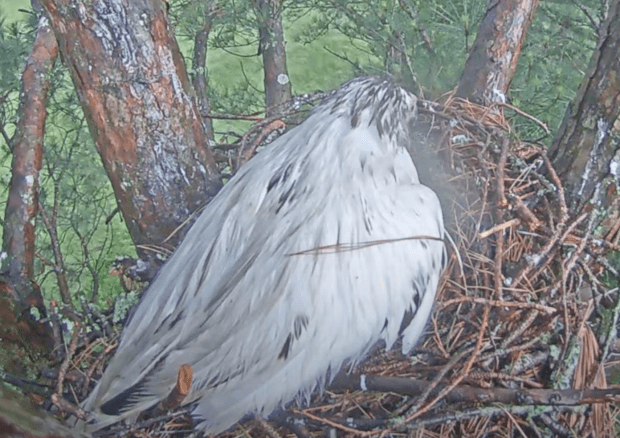
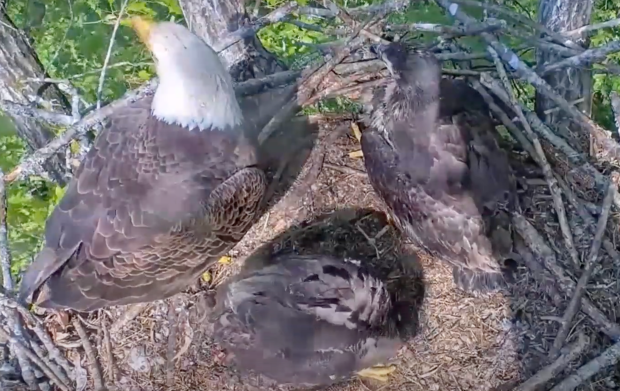
But, first up, there was an intervention at the Cornell Red-tail Hawk nest of Big Red and Arthur. Thanks to streaming cam watchers and volunteers, there was ‘movement’ noted in the ears of two of the Ms. Veterinarians from the Janet Swanson Wildlife Hospital observed and identified the problem as being maggots. They also noted that M3 was keeping its 3rd eyelid over its eye, indicating pain. Arrangements were made to intervene as leaving the infestations could cause pain, infection or damage to the ear and nerves. The intervention was successful and the Ms are now back in the nest with Big Red and Arthur. Thank you! Cause of the maggots: an abundance of prey!

Mini might get shut out of some meals, but, more often than not, Mini leaves with a big crop. On Saturday, there was a moment when the Third tried to intimidate Mini. It went away but was back at the table within a few minutes. Many of Saturday’s fish were very large. Everyone at the Patchogue Nest ate. One thing is for sure – Mini is growing! Those wings are getting bigger. Oh, I hope we are on the stretch to knowing that Mini will survive and fledge!

Mini waiting at noon for the next fish and it arrives. A nice big one.

Mini decides to sleep on the fish but is still in a bad spot for feeding.

Mini moves out of the way.

Oh, but Mini watches and waits and then just look at all that fish that is left and who is up there for a feeding.

After…a nice crop.

Just look at our Little Mini. Clown feet, the red copper feathers at the nape of the head. This osplet is changing and in the nest few days will look very different! Little Mini is going to have some nice feathers growing from that wooly charcoal coloured thermal down. Look carefully at the size of Little Mini’s wings. Not so ‘Little Mini’ anymore. Thankfully.

Throughout the day, Little Mini had a good crop. Dad always brings in at least one nice fish at the end of the day if not two. Mini was too full to eat! All is well.

It appears that Mini might have been shut out of all the early morning feeds at Patchogue. A fish has been left in the middle of the nest to encourage self-feeding and while Mini can sit at the open end and pull some flakes, he really is not yet able to hold it down and pull to get enough food. I am hopeful Mum will feed the little one. Big is now hoping and wing flapping.

‘H’ has been watching the Boathouse Osprey platform of Skiff and Dory closely for the first sign of a pip and it came Saturday morning! Day 39 for egg 1. ‘H’ reports that it was a quick hatch. Dory was not giving any secrets away but the first full view of the chick came at 1338. Thanks, ‘H’. Already wanting fish!

While there is jubilation at the Boathouse, there is growing concern at the Forsythe Nest that ‘H’ has been monitoring. Here are Saturday’s observations. “The aggression seems to be getting worse.  There were 9 fish deliveries, but they were all small or small partials. Feeding 0750 to 0808 -Mini did not start out next to Little, and managed to get some bites, but when Middle slid back a little bit, Little attacked Mini.  By 0757 Mini was back in a pretty good place [4,2,3,1].  Mini got some bites until Middle dropped back, and at 0806 Little again attacked Mini. Mini didn’t make it back.  Total bites for Mini = 35. Feeding 0835 to 0900 – Mini started out eating beside Little and got many bites before Little even started to eat.  Little already had a big crop. By 0840 Little wanted to eat, and beaked Mini (Mini never retaliates, simply goes into submission).  At 0856 Mini was back at the table eating beside Middle.  Big and Little had dropped out.  Total bites for Mini = 45. Feeding 1030 to 1045 – Positioned [4,1,2,3].  Positioning stayed the same.  There was no aggression.  Total bites for Mini = 30.nFeeding 1158 to 1206.  Positioned [1,4,3,2].  At 1159 Little beaked Mini, but shortly thereafter, Little dropped out.  Mini soon came back and ate.  Middle dropped out at 1204.  Total bites for Mini = 29. Feeding 1603 to 1610 -Positioned [4,1,3,2], Mini should be good right?  At 1606, Little lunged at Mini right across the front of Big, Mini dropped back.  Then, Little beaked Big and Middle.  Big attacked Little.  Little then attacked Mini who was already in submission.  Big attacked Little again.  At 1607 Big and Middle ate.  At 1609 Little tried to get back to eat, and was beaked by Big.  Big wouldn’t allow Little to return.  Then for some reason, Big beaked Middle.  Mom, Opal, finished the fish.  Total bites for Mini = 6. Feeding 1645 to 1654 – Positioned [3,4,1,2]  Mini stayed tucked in submission from the start. So I went back to see what had transpired before the fish arrived.  Well, for some reason at 1644 Mini beaked Big a couple of times.  So Big punished Mini.  Mini tucked and stayed tucked.  They lined up to feed right around where Mini was.  Little beaked big up at the food line, so Big beaked back and Little was out.  So, Little had just a few bites, Middle and Big finished the fish.  Bites for Mini – 0. Feeding 1735 to 1745 – Positioned [1,2,4,3} Mini had 2 bites and then was beaked by Little, then Big beaked Little.  At 1736 Mini tried to stand up and was beaked by Big!!!  So Mini stayed in the back.  At 1743 Mom reached over and gave Mini one bite.  At 1744 Little turned around and beaked Mini.  Bites for Mini = 3. Feeding 1803 to 1812 – Mini tucked when the fish arrived.  The other three ate.  At 1805 Mini tried to approach the feeding line next to Little and is beaked.  Ditto at 1807 and 1810.  Bites for Mini = 0. Feeding 1855 – 1908 – Mini tucked when the fish arrived. But Mini did approach the line, positioned [1,2,3,4}, got one bite of fish then was beaked by Little.  At 1857 and 1859 Mini tried to approach and was beaked by Little.  At 1903 Mom reached out and gave Mini 4 quick bites, but as soon as Little realized it, she beaked Mini.  Total bites for Mini = 5.

Sunday morning saw improvements for Mini at Forsythe. ‘H’ reports: “Feeding 0539 to 0606 – Huge live fish,From the start, Little beaked Mini pretty badly, Mini out.  Ditto at 0545, 0546, 0552 0604.  At 0553 Big beaked Little.  Each time Mini tried to engage, s/he was beaked by Little.  Now, I was encouraged by the size of this fish, because the large fish tend to increase Mini’s chances of getting a private feeding at the end.  Well, inexplicably, with 75% of the fish remaining, Oscar took it off the nest!!  Cringe. Really Dad?  Bites for Mini = 0. Feeding 0650 to 0716 – Oscar had taken the previous fish to the perch to eat, and he brought back 1/2 of the large fish. Mini got bites early, Little was late to the table, but by 0652 Little beaked Mini.  Again 0655 Little attacked Mini when Mini raised up; that time Big beaked Little very aggressively and Little was out.  Big laid down beside Little, between Little and the feed line, so Little couldn’t get back!  One time Little tried, and Big raised up and gave her ‘the look.’  So, Middle and Mini ate.  By 0706 Middle dropped out.  At 070648 Mini walked away with a large crop, but Mini returned at 070830; and walked away again at 071030; and Mini returned to feed at 071315.  Both Middle and Big returned for a few bites later on, but Little never did make it back to the front.  Total bites for Mini = 102      YES!!!

‘H’ reports that the Dahlgren cam was down all day. She notes reports of two good feedings at Severna. Her observations of both nests at Patuxent revealed that all is well.

Kathryn reports on the Carova Osprey nest. She observes, “The dad has delivered 8 fish so far today. And it is only 3:30pm! They are averaging one fish per hour.  It seems like the chicks are rotating feedings and one usually naps while the other two eat and then the one eats at the next feeding.  Here they are all amazed because the dad brought two fish at once and one was flopping around! A commenter suggested this may have been done purposely by the dad to get them used to an alive fish! So cool.”

The fish are not always plentiful at the Cowlitz PUD nest. Most days, they might be said to be ‘pitiful’ compared to the size and number being brought to Patchogue. One nice sized fish did get on the nest on Saturday after Kathryn observed only a couple of tiny ones and the Only Bob got a feed.

The wee one had a nice crop and Electra had a good meal, too.

Imagine raising these little osplets from eggs found in a chimney. Sunnie Day posts a heartwarming story from MSN.COM:

Syndication: Cape Cod Times

ORLEANS 06/10/23 Wild Care’s Stephanie Ellis feeds just days old hungry osprey chicks their breakfast of ground quail She raised the birds from eggs that were removed from nests built on chimneys in Osterville and Falmouth by wild life officials The mission next, get the chicks placed into surrogate nests soon along with chicks their same age to be raised by a new set of parents Cape Cod Times/Steve Heasli in ORLEANS 06/10/23 Wild Care’s Stephanie Ellis feeds just days old hungry osprey chicks their breakfast of ground quail. She raised the birds from eggs that were removed from nests built on chimneys in Osterville and Falmouth by wild life officials. The mission next on ORLEANS 06/10/23 Wild Care’s Stephanie Ellis feeds just days old hungry osprey chicks their breakfast of ground quail. She raised the birds from eggs that were removed from nests built on chimneys in Osterville and Falmouth by wild life officials. The mission next, get the chicks placed into surrogate nests soon along with chicks their same age to be raised by a new set of parents. Cape Cod Times/Steve Heasli.

‘A’ has been pondering the nest of Angel and Tom and the upcoming fledge of Deyani.

“Can I nominate Angel as mother of the year? She only raised one, I know, but the sheer horror of watching her mate kill their first-born shook her to the core, and her ability to raise the second hatchling as she did, smothering it with love and protection, hunting for it alongside Tom to make sure it was properly fed until he got his act together, putting up with constant bombardments from the blue jays and their extended family, literally bouncing off her at the rate of up to a dozen hits per minute, was nothing short of inspirational. Even when Deyani was nearly as big as mum, Angel was on the nest during rain, sheltering her baby to the best of her considerable ability (she is a fantastic mumbrella, with those warm and cosy underfluffies looking very safe and appealing), spreading her wings to cover a huge area. She has been absolutely devoted.” “Meanwhile, it just occurred to me that rarely has a chick been so lucky to be born second on a nest. (Yes, I know, it’s a bizarre thought, but true.) I do miss that first hawklet, even though we only knew the little one for a day. It was such a sweet little cutie, and I will never forget its adorable face as it looked up at its dad and yawned. It was our final view of the chick alive. At least its death was quick – hawks are obviously relatively efficient in that regard. But I think a lot about what Deyani has missed out in without her sibling and Angel’s grief was truly something awful to watch. She was heartbroken. And very very angry. She knew she still needed Tom but she didn’t have to like that fact! I hope she has forgiven him for his error – he has done his best to do his best, as it were, and as I mentioned, he even fed Deyani the other day (or, rather, Deyani took food from his beak in a manner reminiscent of feeding). I hope they stay together now and build on what they have done this season. It is such a lovely, peaceful, prey-rich area to raise chicks.”

I did not, as mentioned earlier, check on many nests on Saturday. I am so grateful to those who monitor Osprey nests for me and those who send me news of nests I have been monitoring for one reason or another but did not on Saturday. ‘SP’ sends me new screen captures of the eyas from the Evergy Topeka Peregrine Falcon scrape. Oh, goodness. The wee one looks much better now that those feathers are breaking out of those quills. Now this really is a relief.

Dmitri’s storklet is certainly growing and eating – thriving under the care of this generous and compassionate man.

Dmitri has his storklet outside on the ground in this short video.

Ervie looking good! I kept the comment so you could see it is Ervie. Hard to locate that tracker the way he is situated.

Don’t these Osprey Mums know that we want to see that every chick gets fed?! Barnegat Light 1815 Saturday.

On Sunday, ‘H’ was able to get sight of some feedings, “Feeding from 0644 – 065230. Little was in the back, kind of clueless as to how best to get fed.  After several minutes Little  started to move around Big and got two bites from Daisy.  But, clumsy Big inadvertently knocked Little into the back row again.  It was a long time until Little finally got beside Big and began to consistently get bites.  Soon Big and Middle dropped out.  They are clumsy and awkward, but, there was no intentional bonking between any of them.  Total bites for Little = 17.

Crossing the Pond and look at those healthy chicks of Idris and Telyn at the Dyfi Osprey nest in Wales.

What a beautiful Osprey family – CJ7 and Blue 022 – and their trio at Poole Harbour.

Lady

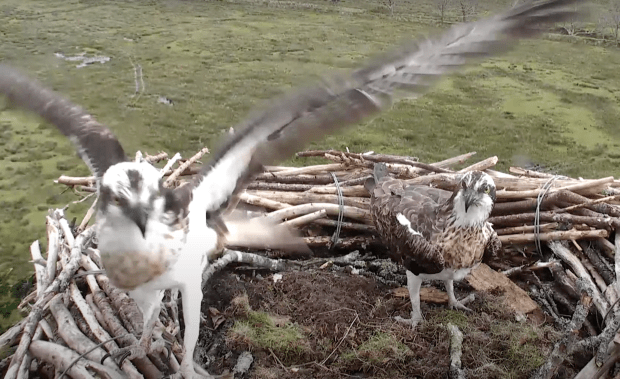
Laddie has had to spend too much time guarding the territory and needs more time being able to fish for the family. There were no less than six intruders seen. Laddie delivered a fish in the morning and one around 1330. Blue NC0 was fish crying for her and the kids Sunday morning.

At Loch Arkaig, we have the ‘bobbing’ Bob. The Only Bob seems to like to beak Dorcha’s talons. It reminds me of a nicknack my grandmother’s had – a bird that would bob its head and pick up a toothpick. The Only Bob is 11 days old today, and you can see it is entering the Reptile phase. See that oily black head. Louis delivered at least five fish on Friday and is known for being diligent…the chick is definitely not hungry!

It is also time to begin checking on Dad and Lady at the WBSE nest in the Sydney Olympic Park. It is now time that eggs could be laid! ‘A’ is going to keep tabs on this couple for us. She reports, “Shortly after 2pm, both Lady and Dad were back on the nest in Olympic Park. Dad arrives first, around 14:02, and arranges a stick before just standing in the middle of the nest for a couple of minutes, looking around as if surveying the area. Checking it for potential threats perhaps? Lady joins him just before 14:07. Dad does some aerating in the centre of the nest as Lady watches. They then stand in the middle of the nest for a moment.  Their visits to the nest are becoming increasingly frequent. These two are definitely trying for an egg (or two). Lady is not only ‘receptive’ but appears to be actively encouraging mating, which would lead one to presume her ‘window of hormonal opportunity’ is open.”

I know that many of you are interested in bird feeders and their cameras and this particular video caught my eye. There is a Cooper’s Hawk that visits!

Thank you for being with me today in Bird world. Take care everyone. See you soon!

Thank you to the following for their notes, videos, posts, and streaming cams that helped to create my blog today: ‘A’, ‘H’, Kathryn, ‘SP’, Cornell RTH Cam, PSEG, Audubon/Explore, Forstythe Ospreys, Outerbanks 247, Cowlitz PUD, Sunnie Day and MSN.com, Window to Wildlife, Evergy Topeka, Storks on line, Janice Love and Friends of Osprey Sth Ads, Barnegat Light and Conservation Conservancy of NJ, Dyfi Osprey Project, Poole Harbour ospreys, LOTL, Friends of Lock Arkaig and the Woodland Trust, Sydney Sea Eagle Cam, and Gettysburg Live Cam.

Pale Male dies…Wednesday in Bird World

17 May 2023

Hello Everyone,

It was gorgeous weather on the Canadian Prairies yesterday, Tuesday, the 16th of May. That meant it was neither rainy, windy, or too hot. That called for a trip to Oak Hammock Marsh, the wetlands jointly managed by the Province of Manitoba and Ducks Unlimited. I have my qualms with DU – guns and shooting ducks, but they have played a considerable role in creating a network of wetlands that are home to so many migrating geese and ducks with trails surrounded by shrubs that are home to all manner of songbirds. Yesterday was no exception.

Just before arriving at the site, there was water still standing in the fields from the spring flooding. Talk about ducks – I had to take photos to remember all of them!

A male Northern Shoveler taking off in the centre. Below a Red-winged Blackbird. The water was full of Shovelers! Along with Pintails, a few Mallards, some Gadwalls. It was a surprise to see so many ducks on this one field. Grateful for spring flooding!

It is an enormous area.

The great stand off. The Red-winged Blackbird taunted the Canada Goose who was protecting its mate and their nest all afternoon.

Tree Swallows are the most common of the North American Swallows. They have this stunning iridescent blue-green upper parts – head, neck, wings, back with a spotless white underbelly, throat, etc. Two-toned! The lack of trees and woodpecker holes means that these birds are entirely dependent on nesting boxes for their breeding.

Oh, what damage we have done to the habitat of so many birds.

Purple Martins are the largest swallow found in North America. They used to build their nests and live in abandoned woodpecker holes but now, in the wetlands, and across the Prairies, they rely entirely on the goodness of humans to build them birdhouses so they can breed.

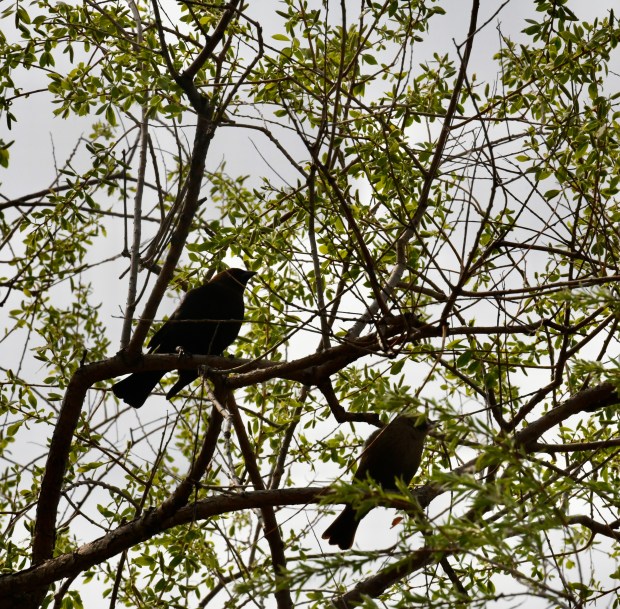
A pair of Brown-headed Cowbirds. Oh, I wish the light was better. They have a beautiful sepia-coloured head on an iridescent-green black body. These two had a nest in this tree and they were diligently keeping four Grackles at a distance.

A male Redhead. Easy to spot with that gorgeous and rather trendy brick-red upper neck and head! They are diving ducks and you will only find them in North America. Redheads like to lay their eggs in other ducks nests, more than any other duck, according to The Pocket Birds of Canada, 2nd edition (23).

Then when I walked the trails, it was a blessing that there were benches every 10 metres or so. Not because I was tired but overwhelmed and trying to identify all of the birds. Thank goodness for Merlin Sound ID and the Notes app on my phone!

It was a lovely time. Nothing was rushed…the stopping all around the trails allowed me to simply savour all those beautiful sounds and the smell of the marsh. There were children in the distance getting ready to go out in canoes and kayaks..they were laughing. Priceless.

As I write, Dyson and Scraggles are on the deck after peanuts, Little Red is going after the table feeder, Mr Crow is flying in and out, telling them the peanuts are his! What a blessed life. I cannot imagine, for a second, not having the sound of birds around me.

The big news of the morning is that Pale Male, the legendary Red-tail Hawk of Central Park has died. What a way to wake up! Thanks, ‘H’. He was called ‘Pale’ Male because of his light plumage. He was notorious for having his nest on one of the most expensive buildings around the Park and was the focus of the movie, The Legend of Pale Male. It is free online and if you haven’t seen it – or if you have – and want to honour this amazing raptor, have another look-

https://www.thelegendofpalemale.net

He was rescued by Bobby Horvath of WINORR.

At the WRDC Bald Eagle nest in Miami-Dade, Ron and Rita’s R5 fell out of the nest and has been taken for evaluation. He appears to be fine but whether or not he will be returned to the nest is another story since R4 could bolt.

‘T’ reports that the rescue of getting the nylon wrapped around one of the storkelets in Lindheim, Germany was a success.

The Loch of the Lowes nest is not strictly out of the ‘woods’ yet. The fish are not coming on the nest like they are at Rutland but, fish is coming. Continue to send your warmest and most positive wishes. Just look at those two sweet little babies.

Laddie brings a flapping fit to the nest at 1330 on the 16th.

These will be the only two hatches for Laddie and Blue NC0 this year. The first hatch was the second egg….and, as my grandmother always reminded me, things do work out. We might not always know the reason but, they do. In this instance, Blue NC0 has always struck me as a female osprey who can deal with, at most, two in the nest unlike Maya who has easily handled four three times. It has been a rough start and two healthy little ones is better than three sick and starving.

The Woodland Trust has put out a statement about the nest and the events of the last week.

These two are seriously cute…let us hope that Laddie can keep up the fishing.

Laddie had only delivered on fish on Tuesday and then, right before 2100, he came in with a nice big one. Everyone went to bed with full tummies.

The wildfires in Canada are having a huge impact on the air quality not only for humans but for wildlife. This is the Fortis Exshaw osprey platform near Canmore, Alberta. The smoke is coming from fires at a distance. There are currently at least 81 fires burning in that province of Canada.

Oh, it would be nice if the pouring rain in Tennessee was in Alberta getting rid of the smoke. As I am writing Angel is keeping RTH5 snug and dry as the drops come down through the leaves and branches of the nest tree. There was snake on the menu today along with some of the usuals. RTH5 is growing, getting feathers, and is nothing short of adorable.

Tom’s deliveries to Angel and RTH5 caught on video by Arlene Beech.

Continued positive wishes for Lake Murray Ospreys. All their efforts on the night of Monday the 15th paid off – the GHO did not get C2 Monday night and let us all jointly send energy that it never does. Wish them well.

Thankfully C2 is cleverly camouflaged on that nest! Still, the GHO knows that it is there.

Lake Murray Osprey has put in more strobe lights, moved the mannequins around, put out some more bicycles – all in an effort to deter the GHO.

Big Red in all her glory! The Ms are growing and Arthur simply cannot stop hunting.

The little baby at Decorah hatchery is anything but a baby. It is walking stronger and flapping those beautiful wings as more and more juvenile feathers come in.

There are many advantages to being the only baby in the nest. Look at those legs and that fat bottom. Incredible.

All is well at Achieva Credit Union in St Petersburg. A really nice big fish came late in the afternoon. I am not sure about prior deliveries. Big is so busy working those wings while Middle is enjoying that fish.

Oh, and then another big whopper came on the nest! Everyone at Achieva had a good fish day.

My goodness Blue 33 is a good provider! I lost count and couldn’t even go back before noon…fish after fish. Big ones for Maya and the kids – not little twiddlers. I cannot see a pip in either of the other two eggs. That does not mean it isn’t there, though.

These two have been together and raised so many osplets. They are like a very expensive Swiss watch in terms of their coordination and timing.

Oh, my goodness. The eyases are outside screaming when Lou lands on the ledge with lunch! They are so loud.

E22 is still on the nest and might have caught its first fish on Tuesday. It is, however, unclear if the fish was provided and brought to the nest by M15 or, after all the work that E22 has been doing trying to catch a fish at the pond, she finally got one. What is good is that E22 is still at home, still learning, gaining new skills, and of course, growing in confidence and strength. All of that will help ensure a long and prosperous life. Oh, don’t you wonder what has happened to E21?

Vija caught the event on video. Oh, that squeeeeee of 22’s.

For those watching the Golden Eaglet in Japan, Nina, she is growing fast and the parents have been delivering pheasant and deer for their little one! These are such beautiful eagles!

This is very worrisome. Only two more mutations required before it spreads quickly through humans. If you can help prevent bird flu by funding clean up activities, by volunteering, or even cleaning your bird feeders, please do. We have no concerns in Manitoba and no one is telling us to take down feeders. H5N1 has been moving to the West in North America but it is still spreading amongst waterfowl in the UK where this article was written.

https://www.theguardian.com/commentisfree/2023/may/16/research-bird-flu-humans-prepare-now?CMP=share_btn_link

That is a quick check on some news and events we have been following. Thank you so much for being with me today. Take care, everyone. See you soon!

Thank you to the following for their notes, updates, posts, videos, and streaming cams that helped to make up my blog today: ‘A’, ‘H’, ‘T’, WINORR, Storch Lindheim, LOTL, Scottish Woodland Trust, Fortis Exshaw, Window to Wildlife, Arlene Beech and Window to Wildlife, LMO, Cornell RTH, Raptor Resource Project/Explore, Achieva Credit Union, LRWT, Cal Falcons, SK Hideaways and Cal Falcons, Vija and SW Florida Eagle Cam, and The Guardian.

3rd egg for Dahlgren, Lou feeds chicks…Wednesday in Bird World

19 April 2023

Good Morning to Everyone (or evening depending on where you live!),

It is Tuesday evening, as I write this, and the temperature is dropping on the Canadian Prairies. There was to be a drizzle, and the forecast is for three-day snow. I hope they are wrong! As a result, I did not stay inside. My motto is: do not put things off! If you feel good today, get up and go out if it works! There were two surprises at the nature centre. One was a fast-running Muskrat, and the other was a Wild Turkey. I do not have pictures of either. There were geese, ducks, and the usual feathered friends – the Goldfinches, the charming Chickadees, the Dark-eyed Juncos, and myriads of squirrels running everywhere. Even the frogs and garter snakes are waking up. It is, after all, supposed to be spring.

Jack and Harriet have their third egg at Dahlgren. ‘H’ clocked it at 02:00:43. Does it look like some of the garbage is off the nest? Oh, let’s hope! Thanks, ‘H’.

Just look at those beautiful eyes, wide open and round, of Annie and Lou’s little eyases. Precious. Everyone is eating!

Lou finally gets a chance to feed the chicks. ‘A’ notes, “By the time Annie comes in and takes over, the youngest (as usual, front and centre) has a crop! I just knew Lou would find the baby. What a sweetie. Annie, you can relax – he knows what he is doing and even removes the feathers properly instead of stuffing them into the chicks’ beaks. Good on you, dad. And he is certainly keeping the prey deliveries coming. Things will obviously get harder for him as these three grow but so far, he is keeping the pantry well stocked with fresh and well-prepared prey. Annie may have stumbled on a real keeper here. 

Annie and Lou made the Berkeley News.

Sweet little Eaglet at Decorah survived that snowstorm. It was a gorgeous Tuesday morning in Iowa for the hatchery family to awaken to.

Laundry baskets are becoming a must want item for many wildlife rehabbers. Have any good extra ones? Call and see if your local clinic could use them!

World Bird Sanctuary just posted a time line for Murphy, the Rock Baby, and the Eaglet.

Gabby and V3 were at The Hamlet working on the nest and just hanging out together today. They are a gorgeous couple. I sure hope M15 gets himself a ‘Gabby’!

Confirmation of the second egg at Foulshaw Moss comes on Tuesday from Polly Turner for White YW and Blue 35.

About once a year I remind all my readers about a conversation that I had with Tiger Mozone a number of years ago. I wanted to know what made a ‘good’ Osprey. I kid you not that was my question. How do you determine if the Osprey parents are what it takes to raise really good, healthy chicks. Our conversation ended with Tiger telling me to think about race horses, their breeding, and the winners they sired. It is the genetics not ‘the physical’ look of the bird. One of those incredible male birds was Monty at the Dyfi Nest in Wales. His return rate for children and grandchildren is huge…he is a winning breeder. Monty bred with Glesni from 2013-2017. In the chart below, you can see that of the 12 chicks Monty and Gleans had that fledged, five of them have been positively sighted and have returned. Of those, all but one are male (according to Emyr Evans’ records). Monty bred with Telyn (she is currently the mate of Idris and one of my favourite couples) from 2018-2019. Of their six chicks, three have returned. Sadly Hesgyn was found dead last year but he did return! That is a 50% return rate. Fantastic. Of all those returnees, all are males but 2 – hence the reason that you will often see the term, ‘Monty’s Boys’.

I am particularly fond of 2016 hatch Tegid Z1 that was the chick of Monty and Gleans. One of Z1’s chicks, Z5 is back. She is Monty’s granddaughter. She needs a great mate and a nest. Tegid’s brother, Z2 Aeron, has just had his first egg laid with mate Blue 014 at Port Cresor.

You might recall that it was Z1 Tegid on Aran’s nest at Glaslyn the other day telling his mate to get home! LOL.

Karl II continues to wait for Kaia. Oh, this makes me so sad. She was so close behind when she entered Ukraine. Has something happened?

In Webster, Texas, Ringo is still returning to the nest for food and rest.

Sure do miss Thunder and Akecheta! Glad they had two eaglets hatch this year. So wish we could watch them!

Both on the West End cam on Tuesday.

Gorgeous Thunder.

15 and the Es are still going strong in Fort Myers. The female intruder has visited the nest to steal prey from the babies and the Es continue to enjoy one another’s company and to make milestones. Thanks EJ for this link.

Beautiful Bety incubating the four eggs at Mlade Buky nest of Bukacek. You might recall that two years ago Bukachek’s mate was electrocuted on a hydro pole and he took care of the nestling storks with the help of the community. They fledged! Great Dad.

Gosh, Harry continues to deliver a lot of fish. It seems like every time I check Abby and Victor are being fed. That is, of course, fantastic. These two are busy flapping their wings and getting those legs strong.

Iris had another one of her whopper trout on the owl pole but it was really windy and then the raining snow came. Iris stayed for a few minutes and off she went to find a better place to enjoy her lunch. Oh, if you are wondering…Louis and Iris have connected, literally, several times. There will be eggs, no one to look after them, the Crows will get them, and then Iris will spend her summers being a lady of leisure eating lovely Montana trout and getting healthy. Love you, Iris.

Only on really slow speed could I begin to capture the pounding rain-snow pelting our Iris.

Mother Goose was eating snow. It has all melted and hopefully she got time to go and find some food for herself. The male geese will guard the area but do not bring food. She needs to go and forage in and around the water.

Both chicks ate well at the Achieva Osprey nest on Tuesday. They are flapping their wings and attempting to walk on those sticks.

River brought in three fish for DH17 and 18 on Tuesday. They are 47 and 48 days old today. It is looking good.

River looking out over the Obey River – hence the names of her and her mate, Obey, who has now been missing for far too long to be classified as missing.

This memory came up on FB. This year we watched M15 raise E21 and 22 while grieving for his mate Harriet, contending with intruders – both human and raptor. Several years ago, Decorah Mum cried for her mate until she could not vocalise anymore she was so hoarse. She raised her three eaglets in Iowa by herself. She was amazing. Three of them!

Charlie arrived at Charlo Montana Osprey Platform Tuesday at 1825. Both are home!

‘H’ reports that both Rs have been eating at the WRDC nest. “At the Dade county nest –  R4 ate well for a total of about 35 minutes in two feedings yesterday.  Prey was reduced at the nest, not as many feedings.  R4 was not interested in eating when offered fish at 1855, but wouldn’t let R5 eat either, so Rose ate.”

Two great big eaglets at Duke Farms hopping and flapping those huge wings.

Those little bobbleheads melt your heart. The single eaglet at US Steel, USS6 is no exception!

‘A’ has reminded me to tell everyone that pip watch for Angel and Tom at the Leucistic Red-tail Hawk nest begins on Thursday!

Good Night, Big Red. It won’t be long til we are announcing your pip watch!

Another article on the importance of wetlands in the east of England but…it is not just there. The world needs a wetland system for our wildlife and our feathered friends. Wetlands need official protection. It ensures that they will survive despite changes in the mood of local politicians.

https://www.theguardian.com/commentisfree/2023/apr/18/the-guardian-view-on-englands-east-wetlands-wild-beautiful-and-vital?CMP=share_btn_link

You might recall that Missy was reviewing a book, Water Babies. She loved the pictures but suggested that I would get upset by some of the text, including the part about Canada Geese. She asked me to pass on it! Too funny.

I have on the desk a couple of books – one that is a study of the use of birds during World War I and the other is about geese, The Meaning of Geese. Since spring has arrived, it might take me longer but I will get a good review out for you of the two.

Thank you so very much for being with me today. There are lots and lots of stories happening around the world. We are waiting for Ella to lay her second falcon egg in Winnipeg—poor thing. Hopefully, the winter weather will be gone when those babies hatch! Take care. We hope to have you with us soon!

Thank you so much to the following for their notes, observations, posts, videos, and streaming cams that helped make up my blog today: ‘A’, ‘H’, ‘EJ’, Cal Falcons, Berkeley News, Raptor Resource Project and Explore.org, The Raptor Rescue Society, World Bird Sanctuary, NEFL-AEF, Polly Turner and Friends of Loch Arkaig Ospreys, Dyfi Osprey Project, Welsh osprey and Loch Garden and Other Ospreys, Eagle Club of Estonia, Paul White and Webster TX Eagle Cam, IWS and Explore.org, SW Florida Eagle Cam, Mlade Buky, Moorings Park Ospreys, Decorah Goose Cam, Achieva Credit Union, Dale Hollow Eagle Cam, Sydney Wells and Bald Eagle Live Nest and Cams, Owl Research Institute, WRDC, Duke Farms, Cornell RTH, and The Guardian.

Sunday in Bird World

16 April 2023

Good Morning Everyone,

On Saturday, a grey day in Manitoba started drizzly and cold. The birds were at the garden feeders an hour early. It was pretty interesting. There were more Black-capped chickadees and woodpeckers today than in previous days. The conservatory has genuinely been a blessing. It is like sitting with them in the middle of the garden but separate, not bothering them. They seem unaware of my presence, looking out the windows, often with my camera. Thankfully, the sun is up, and it is a bright day in Manitoba this morning.

Missy has taken to enjoying looking out the window from inside a large ceramic platter that has become a new sleeping spot!

Lewis is such an ‘angel’ when he is sleeping.

Our continuing good news story comes from the World Bird Sanctuary. Murphy and his Eaglet are doing well. The folks at World Bird Sanctuary are working hard to get some images out. These are screen captures from a short FB video they posted. Things look good. Just look at Murphy, 31 years old, wanting to be a Dad, sitting by his eaglet. Does it get any better?

In the images below, Murphy is teaching the eaglet what to do.

Murphy and his eaglet made the news – well, they are making the news around the world. We are so in need of joyful happenings and this is certainly one of those.

Other happiness comes from the Achieva Osprey nest and San Jose City Hall. I received word from ‘H’ of the two big celebratory occasions. First up, there was fear for Middle Bob at Achieva. He has not eaten much for at least two days. On Saturday at 16:44, a big fish landed on the nest, and Middle Bob was fed for 25 minutes. Today, Middle managed to get to a place where he could get fed and be protected from the aggressive older sibling. It was a relief to all watching. It is one day at a time on this nest. It is an extremely difficult Osprey platform to watch – and it isn’t any easier this year than it was in 2021.

At Dale Hollow, DH18 stole the fish and had a good feed. Again, River is doing her best with all the intruders in dire circumstances. She has been feeding them every day. Perhaps not nearly as much as she would like or they need but, they are being fed. We have to remember that River also needs to eat. It is extremely difficult for single-parent raptor nests. We send her and DH17 and DH18 our most positive wishes.

Do you recall the year-old falcon, the San Jose City Hall male who tried to feed his first egg? Well, as of Saturday, he has four eggs that he will have to feed in a little over a month! They will need a full pantry!

‘H’ also sent me a link to a tribute to Connie-Clive-Connick. Nice one! Connick is healing. His blood is coagulating and CROW is attempting to find out what impacted his primaries.

Anna and Louis are taking very good care of Trey as her leg injury heals. Mum Raptors love to fill those babies up to the top of their crop to keep them on the nest. Trey, you need to rest your leg not be flying all over the tree!

In Latvia, Milda and Voldis now have two little White-tail eaglets. It is so hard to see them in that deep nest bowl.

Saturday is the day for Ferris Akel’s tour and there was plenty of waterfowl today including a Wilson’s Snipe. Oh, I love shore birds and am so looking forward to seeing some ‘live’ here in Manitoba this summer. I did not know that the female Wilson Snipe tends the eggs and nestlings. Once the chicks are ready to fledge, the adults split them up. The male takes the two oldest and the female takes the two youngest.” Separate training!

Ferris checked on one of the Bald Eagle nests and to everyone’s surprise there were eaglets – at least two – their heads poking above the rim. Adorable.

The highlight of the tour today was the Great Blue Heron Rookery at Montezuma.

Sunset at Montezuma.

Iris brought in a whopper to the owl pole and had a really good feed. Then she spent time sitting in her nest watching the activities in the parking lot. I have not noticed Louis being over yet and my friend, ‘T’ says he will wait until Star has eggs under her and she can’t check on him! Too funny. Ospreys have such interesting behaviours.

Iris is great at catching whoppers.

Just look at the size of that fish. She could easily take first prize in the local fishing contests.

There are now three eggs at the Patuxent River Park Osprey platform #1.

The Glaslyn Valley is waiting for a new Queen. It looks like Aran might have one!

The unringed female is a natural beauty. Those intense eyes remind me of Mrs G.

Aran preparing a fish for his beautiful female.

She is waiting in the nest when Aran brings it to the rim.

She accepts!

Good night, Aran. You might have a formidable new mate who will protect your chicks against anything!

There is no rewind on the Foulshaw Moss camera in Cumbria. Polly Turner caught Blue 35 laying the season’s first egg for her and White YW. I am incredibly fond of this female and how she was able to ‘trick’ her two much larger by a long shot osplets so that she could feed the tiny third, Blue 464 two years ago.

The first egg was laid at the Dahlgren Osprey Platform in Virginia on 11 April. Jack has been filing the nest with plastic objects, not toys, but, junk. There was concern for the egg. ‘H’ notes that it is now four days since the first egg and no second one. We wait.

‘H’ reports this morning that 4 days and 16 hours after the first egg, Harriet at Dahlgren laid her second egg.

M15 continues to be rather amazing, as are his two fledglings. The female intruder wanted a fish M had brought to 21 and 22. She landed in the nest, trying to take in. E21 flew in to help dad – he was fearless. Then 22 came in to assist. What a team they made. The female still made off with the fish, but seeing those three work together cooperatively was remarkable.

A must watch. M15 defends the nest from the female intruder! Fish goes over board.

It is just so much calmer within the scrape at Cal Falcons. Lou really wants to feed his trio.

More of Lou – and Annie – and the trio from SK Hideaways.

It seems that each of us has, at one time or another, yelled – loudly or silently – at the GHOs on the Pritchett property that continually hit and harassed M15 and the Es. At the same time, we look at Bonnie and Clyde’s two owlets and want to ‘cuddle’ with them. They really are quite adorable.

The three eaglets at Dulles-Greenway had big crops throughout the day. The plastic bags on the nest have multiplied. There are now two. Hopefully, the wind will blow them from the nest before any eaglet gets tangled. You might remember that nests have been cleaned when too much human debris could endanger the nestlings.

‘A’ notes that it was Rosa that brought in the squirrel that has been feeding the little ones. Martin arrived in the nest empty taloned yesterday to Rosa’s dismay. So far this nest has done well with the three. We do not need any intermittent lags in prey delivery right at this stage!

Wet little munchkins.

I have lost track of when the goslings are due to hatch in Decorah. Do you know? It will be grand to see them all take that leap of faith again this year.

Just down the road is the Decorah Hatchery nest with its cute little eaglet. It started raining late in the day and HM is keeping baby warm and dry.

Abby and Victor are 44 days old today. Stunning. Their juvenile plumage is nothing short of gorgeous.

A portion of England’s wetlands seek UNESCO heritage status. Wetlands. How often do you think about them? They are critical during migration, and they are essential for the ducks and waterfowl or the raptors that hunt them. We need more wetlands across the globe. Many regions are working to increase theirs. What is happening where you live?

https://www.theguardian.com/environment/2023/apr/15/avian-super-highway-uks-pitstop-for-migrating-birds-seeks-unesco-status-aoe?CMP=share_btn_link

Thank you so much for being with me today. Take care everyone. Hope to see you soon!

Thank you to the following for their notes, observations, videos, posts, and streaming cams that helped make up my blog today: ‘A’, ‘H’, Australia Raptor Care and Conservation, World Bird Sanctuary, Achieva Credit Union, Heidi McGru and Achieva Ospreys with Jack and Diane, Dale Hollow Eagle Cam, San Jose City Hall, Onabebe and Captiva Eagle Cam, Tonya Irwin and KNF Eagle Cam Fans, Looduskalender Forum and Latvian Fund for Nature, Ferris Akel, Montana Osprey Project, Ashley Wilson and Patuxent River Park Osprey Nest, Bywyd Gwylld Glaslyn, Polly Turner and Friends of Loch Arkaig Ospreys, Dahlgren Ospreys, Sw Florida Eagle Cam, Cal Falcons, SK Hideways and Cal Falcons, Farmer Derek, Dulles Greenaway, Decorah Goose Cam, Moorings Park Ospreys, and The Guardian.

Mrs G Remembered, eggs for Seren and Telyn…Friday in Bird World

14 April 2023

Good Morning,

It was overcast and coolish, 1 C, in the early morning of Thursday. It felt like rain; we could use it, but the drops never came. The Dark-eyed Juncos are eating the Millet spread over the deck, the little woodpecker has been at the feeder, and 18 European Starlings showed up at about 1000. It is now noon. They should be happy. There is Bark Butter with Mealworms along with their favourite suet. Hoping they come back. Last year’s numbers were high for Starlings. Hoping it is the same this migration. People take them for granted, like Sparrows, but what happens when they are gone? They are under threat. So, this garden embraces them and the Sparrows; believe it or not, they all co-exist nicely for the most part. Right now, they all need food. Those long journeys and habitat loss in my area over the winter due to the ever-expanding need for humans to have more extensive houses means that we should all pitch in and feed them – if we can.

Snail mail. We don’t get so much of it anymore; it is always a welcome treat. Today the publications from Birdlife International and Living Bird were in the post. I realise that having them sent costs the environment. I hope they will be helpful in the future to others as they are going in dedicated binders.

Lots to learn. The National Whitebark Pine Restoration Plan members have worked for 14 years to get a plan to restore this tree species. They hope to have a tree with genetic resistance to white pine blister rust and they are really expecting the Clark’s Nutcracker to spread those seeds. It could help to restore many lost forests for the future. The Smithsonian now has a bird friendly chocolate certification programme to go along with their Birds and Beans coffee and Caffe Ibis Coffee. You can normally order from the Smithsonian. In Canada, coffee can be ordered directly from the roaster in Toronto. Some specialty bird feed providers also have one lb bags of coffee beans such as Preferred Perch in Winnipeg. What else did. learn? That both the Sharp-shinned and Cooper’s hawks that visit my garden like Dark-eyed Juncos as prey items along with lots of House Sparrows, Mourning Doves, and Starlings. Cornell did a great study on what birds should actually be the State birds and only two states kept the ones that they celebrate: Louisiana with the Brown Pelican and Oklahoma with the Scissor-tailed Flycatcher. In Manitoba, where I live our provincial bird would be the Connecticut Warbler. 33% of the entire population breeds here. Our provincial animal is currently the Great Grey Owl.

Heather Corfield at Bywyd Gwyllt Glaslyn has written a lovely blog dedicated to the memory of Mrs G, the formidable female Osprey that has populated the area. She laid 60 eggs and fledged 52 chicks. She has at least 130 grand-chicks along with countless great-grand chicks. She had only two mates, Ochre 11 (98) to 2015 and then our dear Aran since then. She bred at Glaslyn for 19 years and was the oldest UK Osprey. It is a good read about a very remarkable bird. As Heather says, we knew the day would come. She was at least 23-24 years old – but it doesn’t make it any easier. Mrs G did not return from migration and it is unknown when and where she died.

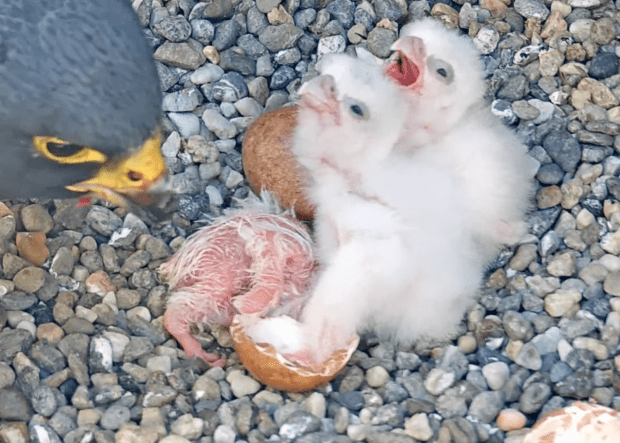
Does get much cuter than fluffy little Peregrine Falcon eyases! OK. Big Red, yes, I do love Red-tail Hawk eyases the most!!!!!! Annie giving the two nestlings at Cal Falcons their first feeding at 0720 on Thursday morning.

There were two adorable little white white fluff balls with no egg shell present.

No shell but a visible crack in the one shell to the left.

Now Annie looking rather mischievous…and there is a half shell on the scrape. Looks like we have hatch 3.

Annie turned around at 11:53 and moved the shell and you can see a tiny wet pink eyas.

The reveal and Lou gets to see that his family has just grown some more. Best be out there hunting, Lou!

Later…the new hatch will be ready for some prey tomorrow! It is less than five hours old in the following images.

These eyases will grow dramatically from their hatch to fledging. Think 40 days. At first, their eyes are closed except when food begging; the eyes open like slits. By the fifth day, their eyes will be fully open all the time except when they are sleeping and they can focus and see clearly.

At that time their weight will have doubled from when they hatched! I am such a fan of falcons and hawks…you will be overwhelmed with ‘baby pictures’.

‘A’ says, “Little Lou is enjoying being a dad. As soon as Annie decides to take a prey gift for herself, he’s onto those chicks and the remaining egg. I wonder if he is counting. Does he notice that these well-behaved eggs are progressively being swapped out for these small fluffy wriggling things. He’s doing such a good job of covering everything and everyone he needs to, at least so far… That won’t last long, especially if that last egg hatches.”

Do you know how Peregrine Falcons get such amazing colours to their eggs? Here is the answer from the Chicago Peregrine Program:

“As an egg moves down the female’s oviduct it presses against glands that produce colored pigments. Peregrine egg colors range from pale creamy to a dark rusty brown. Marking patterns develop by if the eggs are in motion or not when they reach the glands with pigment. If the Peregrine egg is stationary at the time when it comes in contact with the glands, it’ll become spotted. If the egg was in motion, it would have streaks. Because the egg can continue to gain color down the oviduct, and as the egg can rotate slightly while it moves, you can have color laid over where color was already added.The pigments in the glands become depleted with each successive egg laid. Looking at this egg set from The Field Museum, we would estimate the egg on the far right was laid first, while the one on the far left came last.”

For more information about egg color in birds – check out this link from Cornell –https://www.allaboutbirds.org/…/the-beauty-and…/…#

Falcons are either laying eggs or have hatches…it is so much fun. Seriously if you have never watched a falcon scrape you need to start! Everyone eats! The incidence of sibling rivalry/siblicide is so diminished compared to ospreys and eagles. You will be astonished.

The Michigan Spartan scrape box has four eggs!

Oh, and then there are the most gorgeous osplets with their juvenile feathers at Moorings Park eating breakfast. Gosh, they are all beautiful.

Oh, and Idris preparing a fish for Telyn Blue 3J at the Dyfi Osprey platform in Wales. The anticipation of the first egg is growing.

And….

we have two first eggs – at Dyfi and at Llyn Clywedog! Telyn laid her egg at 17:40 with Seren coming in twelve minutes later at 17:53. Congratulations!

Telyn – congratulations to one of my most favourite couples, Idris and Telyn!

Idris sees their egg!

Beautiful Seren Blue 5F. 17:53:20.

Dylan had been up on the perch since 0615 expecting an egg today so he was there when the big event happened.

Just look at that beautiful pristine landscape. What wonderful places these Welsh ospreys have for their platforms!

Several have wondered why there are not more osprey platforms in the Glaslyn Valley. Well, there was Aran and Mrs G’s platform. Then another platform was placed just at the boundary of Port Cresor which is now occupied by Aeron Z2 (2017 Monty and Gleans) and Blue 014. At the time, some believed the placement was to ‘steal’ Mrs G from Glaslyn. There has certainly been a lot of interest in the Glaslyn nest from Monty and Glesni’s boys that hatched at Dyfi including Z1, Aeron’s full brother, Tegid (2016, Monty and Gleans). He briefly appeared on the nest. Did he steal the female’s fish? His nest is ON4 on private property. Is there a move to consolidate Monty’s family holdings in Glaslyn now that Aran is trying to establish himself with a new mate? Aran got Tegid moving!

Tegid is the 2016 hatch of Monty and Gleans and was known as ‘The White Egg’. He was harassed by Blue 24 (female) if I recall. Good to see you Tegid. Now go home to Snowdonia!!!!!

Aran flapping after sending off Tegid. Sadly, the whole event sent the nice female off and she hasn’t been seen on the nest on Friday. Aran was sky dancing to another female, a more aggressive one to him.

Ringo fledged at the Webter, Texas Bald Eagle nest near Houston but, s/he has continued to return to the nest for food lured by parents. Thursday was no exception. This is fantastic. These parents are teaching Ringo exactly the sane way that M15 is teaching the Es to survive independently. Great mantle, Ringo! Looks like a big girl to me.

There are two eggs at the Golden Eagle nest in Romania. Siblicide is common in Golden Eagle nests so watch this nest with that warning.

The cam operator at Cornell Bird Lab gave us some incredible close up images of Big Red today. It will not be long until hatch watch for her and Arthur.

She is incredibly beautiful, our 20 year old Red-tail Hawk ‘Queen’.

Achieva and Dale Hollow: River brought in a nice fish at 10:22 Thursday morning. Despite the intruder close by, River fed both eaglets well. Yes!

DH18 decided to do some self-feeding on the last of the fish bone. Way to go little one.

DH17’s wing span!

A view of the Obey River.

Both osplets at Achieva had crops during the 0800 fish feed! Good news.

The three eaglets at PA Farm Country are growing and doing very well, indeed. No issues at this nest to report.

Gabby and V3 might not have had a nest of eaglets this year but they are positively delighted being with one another and I am looking forward to November next year when, hopefully, they will lay a clutch of eggs for the first time together.

I have been watching the Dulles-Greenway nest reasonably close. On Thursday by late afternoon, all I could see were two short feedings with the third hatch not getting anything at the second. Are there intruders about? or am I missing feedings?

All looks well at the Pittsburgh-Hayes Bald Eagle nest.

The eaglet at US Steel is 8 days old.

Cholyn and Chase’s single hatch this season is not going to go hungry. The nest is loaded with a variety of prey items for this chubby little fluff ball.

In Estonia, Karl II waits for the arrival of his mate, Kaia, at their Black Stork nest in the Karula National Forest. Karl II arrived yesterday from migration. Kaia is close behind.

There are some dates that you should mark on your calendar. The first one is a day that many of you will not recognise – National Curlew Day which is the 21st of April on the feast day of St Brueno, the patron saint of Curlews. The species is critically-endangered in many places around the world because of modern agricultural politics, climate change, habitat encroachment. Instead of me telling you about Curlews, read about them. Find ou what their status is where you live. These lovely shore birds migrate and they need wetlands, they need not to be shot! See what you can do to help in your area.

The other two days are about bird counts. 13 May. Mark it on your calendar. It is Global Big Day that helps us celebrate the birds that are in our environment. The second event is World Migratory Bird Day which is held twice a year to celebrate the marvellous journeys our birds make in the spring and fall. Please sign up to eBird to help track the birds and to see where help is needed. Last year 51,455 birds worldwide entered their statistics from 201 countries for 7,673 bird species.

Many of you have pets or have had in the past. Did you take them to the crematorium? Did you leave them with the Vet if they had to be euthanised? Last year we saw dumped pets euthanised in several landfills around the Minneapolis area.

This could not have been an isolated incident, but it came to light only because of the Bald Eagles eating the carrion found at the dump and having to go into rehab. Reports have come that a similar incident happened in the Pacific-Northwest in the Cowlitz district in Washington from one of our readers. Why are we hearing about this? Has there been a change in human behaviour during and after the pandemic? Did pet crematoriums close so that vets are left dealing with animals left in their charge? What can be done? If your pet is sick, you should learn how your vet clinic disposes of the body. That should be a priority. Are they assigning these animals to another business that should be disposing of them correctly but is dumping them? It is entirely possible that these contractors are not following laws or protocols. Ask. The vets’ drugs can cause our carrion eaters – Crows, Vultures, Bald Eagles, etc. – to get ill and die. This is not a good situation. Talk to your local wildlife rehab clinic and veterinary surgeon if you want to help and do not have pets. They might not be aware!

A sad story coming from Arkansas in the US. What’s with the need to kill other living beings? I do not get it.

Thank you so much for being with me. Take care all. See you soon!

Thank you to the following for their notes, posts, videos, news, and streaming cams that helped inform my blog today: ‘A’, ‘B’, Heather Corfield and Bywyd Gwyllt Glaslyn, Chicago Peregrine Program, Olga Kysil and Orange, Australia Peregrine Falcons, Moorings Osprey, Dyfi Osprey, CarnyXWild, Paul White and the Webster TX Eagles, Associate Wild Bucovina, Cornell RTH Cam, Dale Hollow Eagle Cam, Achieva Credit Union, PA Game Commission, NEFL-AEF, Dulles-Greenway, PIX Cam, IWS and Explore.org, Eagle Club of Estonia, and CBS News.

Annie and Lou have the 2nd egg…Monday in Bird World

Good Morning Everyone,

In the Mailbox:

‘J’ asks: “I was just wondering if you could talk about R23-3’s damaged talon. Do they heal? Will the actual nail fall off? Will it grow back?”

These are great questions; they have been on everyone’s mind since we first saw R23-3’s injured feet. First, let’s get to some facts in case some do not know. Those talons (and beaks) carry the eagle’s prey and nesting materials to the nest. They are also used to fight their enemies. Talons are essential for the eagle’s survival. Each foot has four talons, three in the front and one in the back, the hallux. The talons are made out of keratin. It is a protein. Human hair and nails are also made out of keratin.

So have a good look at the image below. Do you remember where the main injuries were on R23-3’s feet and talons? She appeared to have multiple marks and gouges, with one main injury on DIGIT IV, the Outer Talon. We saw it early as black, and I even called her ‘black taloned’. I feared that the injury was necrotic and would eventually kill her. There was no soft tissue swelling, just a deep gouge with a dark, dry scab. That scab eventually came off. The female adult appears to be eating and in good health. She enjoys her baths with M15 and socialising with him in the pond and on the branch. In other words, she is not lethargic.

That hallux is important because it digs into the prey items and allows the raptors to carry their food to where they will eat it or feed their young. The talons are grey in colour when the eaglets are in the nest and turn a shiny black as they age and fledge. They will remain that shiny black throughout their lives..

Now back to the question. The injuries on the female R23-3 appear to be healing. She has yet to lose her talon. If the entire talon were to be pulled out, growing a new one would be a very slow process. You might recall that Ervie, the third hatch Osprey at Port Lincoln in 2022, lost a talon. It was believed to be pulled out when he was fishing, but we do not know. It took nearly 8 months to see any growth in that talon.

We know that the female can bring carrion to the nest tree. We have seen her. She is also eating, arriving with a crop when she has yet to take a fish from the nest. We have yet to see the female actively hunting and carrying a large, heavy prey item to the nest tree. We, therefore, cannot make any observations on her ability or lack of ability to transport prey with that right foot.

If the foot continues to heal as it appears to, this female will be fine. Some eagles are flying and living with only one leg, as we have witnessed this year or managing with a leg with an old injury that did not heal properly, as Ma Berry did for years at Berry College. Feet get damaged regularly. V3’s feet are rough at the NEFl nest (with Gabby). Let us wait and watch to see how she does!

Hard to see the full extent of the injuries in the image below. We can, however, determine which is the most injured toe on the right foot.

We can also see some damage on the left foot.

It must be noted that Peregrine Falcons have been observed with talons with broken ends, which do not appear to grow back. In other words, the entire black talon needs to be pulled out and it is possible that it will regrow slowly.


In the News:

How might climate change impact the Northern Hemisphere’s sea birds? This is a great article coming out of Birdlife International on this topic. Have a read!

https://www.birdlife.org/news/2023/03/02/what-climate-change-looks-like-for-north-east-atlantic-seabirds/


Nest News:

Have you been missing Indigo? wondering if he was still around the scrape on the campus of Charles Sturt University in Orange, Australia? thinking that Diamond and Xavier might be having some peace and quiet? No. Indigo is still there! Elain caught him on video!

Jackie and Shadow are so loved. They get more visitors to their streaming cam in the Big Bear Valley east of Los Angeles than any other eagle family in the US. We are saddened by the non-viability of their first clutch of eggs in 2023. It is not clear whether or not they will lay more eggs. The couple has left these two and the wind and ice are pelting down. Love you, Jackie and Shadow! Today, they made the USToday News. Thanks, ‘B’, for letting me know!

https://www.usatoday.com/story/life/animalkind/2023/03/05/big-bear-bald-eagle-live-nest-cam/11377425002/

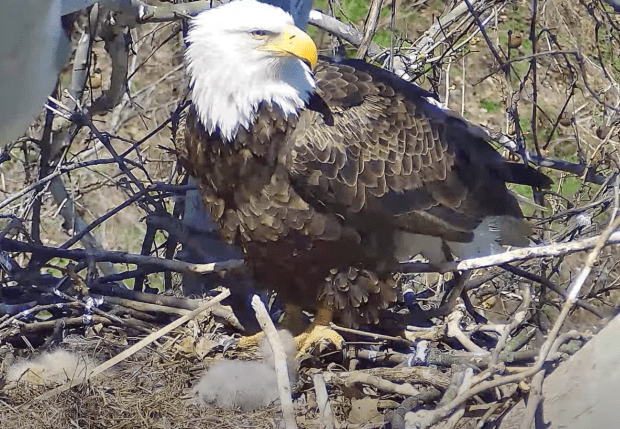
M15 is on top of his game. On Sunday, the single parent delivered 3 fish to the nest of E21 and 22 before noon! Way to go, Dad! There were a total of five for the entire day.

Gosh, these eaglets are gorgeous.

The tails indicate the difference. E22 on the left and E21 on the right. Otherwise it is really difficult to tell them apart.

Such beautiful and precious babies. E21 below panting to keep cool.

The end of the day posting from SW Florida Eagles:

I mentioned that Duke Farms’s male will be 23 this year. That hatch date is 11 March. He was taken in as a foster eaglet at Duke Farms when he was a fortnight old. His two recently hatched eaglets are growing and are ever so strong! Just fluffy little snow people…adorable.

The osplets at Moorings Park in Naples, Florida are doing great. No worries at this nest so far.

Monday morning there was some frustration on the osprey nest by the osplets. Sally was hungry and there was a lot of fish. Harry finally gave her a break so that she could eat. The little osplets sure wanted some fish! They were up and waiting as Mum ate. There is nothing to worry about. At this stage of their development, they will eat a little fish many times a day not a lot of fish a few times.

At the Achieva Osprey nest, Jack and Diane have been doing incubation rotations. There are still some days til pip watch for these two.

Big Red and Arthur continue to work on the nest and mate on the light stands. Eggs soon, please!

Big Red and Arthur’s 2022 hatch, L4, remains on the Cornell Campus. Bravo! They are paying her no mind and she is going on about her business hunting in a very prey rich territory.

Happy Hatch Day!

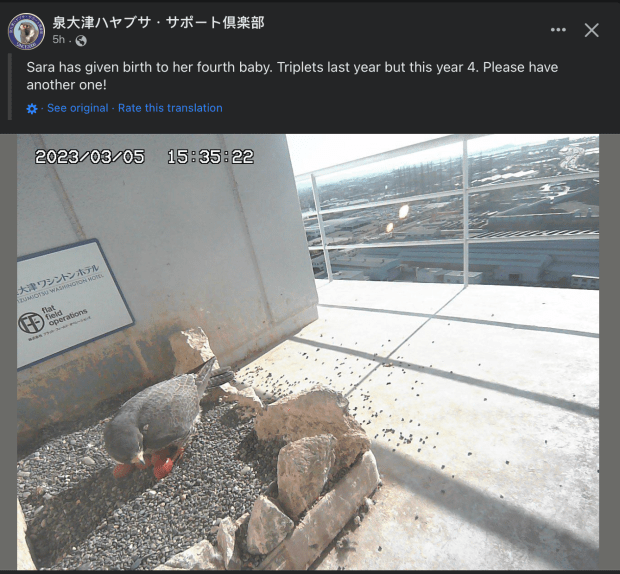
There are now four eggs at the Peregrine Falcon nest in Japan. Will there be a 5th?

Watching for the second egg to be laid at Cal Falcons. Annie has been in the scrape box most of the day.

At 14:51 there was still just one egg. Soon!

At 15:09, Lou is on incubation duties.

‘H’ sent me news that the second egg arrived around 0430 Monday 6 March. Thanks, ‘H’.

Lou is getting the hang of ‘enfluffeling’!

Connie and Clive’s only eaglet, Connick, is looking for roles in more superhero movies. Looks at those legs!!!!! Wow. This eaglet is big and strong.

Connick is a huge, beautiful, well-nourished eaglet! Sometimes there is no place to go when the sun is hot on the nest. Connick can regulate his temperature now.

Gabby and V3 are both at the nest tree today. V3 provided for Gabby the security she needed with so many intruders and hopeful suitors. This nest is pleasantly peaceful now. Have you noticed that it is the same at SW Florida except for the GHOs?

Thanks, ‘T’ for the head’s up. The West End streaming cam was panning around, and guess who the camera caught? Akecheta!!!!!! Oh, it would be grand if they could figure out how to get this camera to focus on the new nest of Thunder and Akecheta. The time is 13:13 Sunday, 5 March. Nice to see you, Dad.

We may not be able to get everyone to stop using rodenticide but each of us can start by remembering that ‘Raptors are the Solution.’ If you know of someone with rodent problems, discuss with them why you do not use these highly designed poisons. If they have domestic pets, it might help save their lives, too. My cat Duncan would still be alive if a neighbour had not used this terrible poison and if Duncan had not caught the mouse that ate it. We will simply not be able to convince everyone but it is worth a try.

I want to thank Dave Hancock and all the folks in British Columbia who work tirelessly to support the well-being of Bald Eagles. There are more Bald Eagles in British Columbia than anywhere in the world. Due to climate change and rising temperatures during breeding and nesting season, Dave Hancock has also been working on eagle nest shades. He is an amazing man who has spent his entire life trying to improve their lives. Some of you will be familiar with the nest cams in British Columbia. They also have a web site with lots of information on eagles.

At the Corona, California GHO nest, the four owlets appear to be very healthy. The fourth is tiny, but size does not mean it is not well. Owlvira seems to be able to manage to feed all of them quite well. Potential names have been posted on chat, and now those are being put into a list for voting.

You can see the size difference in the image below as all are snuggled upright to stay warm.

Thanks so much for being with me today. Take care of yourselves! See you soon.

Thank you to the following for their notes, their posts, tweets, videos, and streaming cams that help make up my blog today: ‘B’, ‘H’, ‘A’, ‘J’, Superbeaks, Lady Deeagle55 and Superbeaks, Avianreport.com, SWFlorida Eagle Cam and D Pritchett, Birdlife.org, Elain and Charles Sturt Falcon Cam and Cilla Kinross, SWEagleCam.com, Duke Farms, Moorings Park Ospreys, HeidiMc and Achieva Credit Union, Cornell RTH, @Cornellhawks, Kakapo Recovery, JPFalcon Cam, Cal Falcons, SKHideaways and Cal Falcons, Window to Wildlife, NEFL-AEF, IWS and Explore.org, Raptors are the Solution, Hancock Wildlife Foundation, and California Corona Owls.

Rose and Ron bonding…Friday in Bird World

13 January 2022

Good Morning Everyone,

Here it is, Friday the 13th. I wonder how many people reading this are superstitious?

On Thursday afternoon, I put on the heavy coat and took out the camera and battery, warmest boots, scarf, toque and headed out to the nature centre. It was -12 degrees C with only a 4 kph wind and 84% humidity. Damp. It was a lovely day in the forest and a few friends were around the feeders.

Several Red Squirrels were running about enjoying the peanuts knocked down from the feeders by the birds or another squirrel ‘friend’.

‘Squirrel Friend’ in action!

A sweet little female Downy Woodpecker enjoying the suet. I love feeding suet in the winter because, unlike peanuts and Black Oil seed, have to be cleared up regularly.

The Black-capped Chickadees are simply precious. They flit about taking one seed, fly to a branch, open and eat it and fly back to get another – all day long.

What a treat it was to see a White-breasted Nuthatch.

Merlin Sound ID alerted me to a Yellow Flicker in the area but I did not see it. The deer were not around today near the hide.

Making News:

It is easy to worry about our favourite feathered families with the heavy rains and floods that have been happening in California (and at other places in the US and around the world). That makes it so much of a relief to see that Annie and her new male friend are at The Campanile and are safe.

They are putting sat pads on Ospreys in Senegal! It seems that the people in Africa are as curious about where their ospreys go to breed as we are to find out where they winter. This is just grand.

Creating new wetlands is a good thing.

If you missed The Flight of the Osprey presentations/shows/talks, Geemeff has reposted the links so that you can watch/hear:

The expectations are that Avian Flu will continue to kill domestic and wild birds. Are you noticing any shortage of eggs? Tests are going on now as duck hunting season is in full swing in places like California. The researcher in this article ” will deliver her samples to UC Davis, where lab personnel will test them first for avian flu in general and ultimately for the specific strain known as Goose/Guangdong (Gs/GD) lineage highly pathogenic avian influenza (HPAI). Gs/GD HPAI is the deadliest and most infectious bird flu ever to strike Europe or North America, according to wildlife epidemiologists. The strain ravages domestic poultry flocks and can sicken and kill more species of wild birds across a greater geographic area than any previous outbreak, leaving an unprecedented trail of death. So far, the virus has affected more than 52 million domestic poultry birds in the U.S. and has been tested for and confirmed in 4,362 wild birds across the country.” 

The first eagle in SW Virgina confirmed to have bird flu. This year there could be some very serious hardships.

I was interviewed last week about the impact of war on wildlife. Today there is an article appearing in The Guardian about Hooded Crows around Babyn Yar near Kyiv. Keeping in mind that there has been so much destruction in Ukraine, it is a very interesting article to read.

https://www.theguardian.com/environment/2023/jan/12/country-diary-the-silently-screaming-ravine-is-now-filled-with-bird-chatter?CMP=share_btn_link

In the mailbox:

‘L’ send me the latest Audubon news that shows their lobbying of the federal government has included many of their concerns about the environment and wildlife. Thanks, ‘L’. Have a read:

https://www.audubon.org/news/recently-passed-federal-funding-package-makes-investments-natural-climate

‘A’ has noticed that Clive is bringing a lot of trout to Connie and CJ7. Where is the trout coming from? That is such an interesting question. Thank you for asking it, ‘A’. I am reminded of when Dylan has brought Brown Trout into the nest at Llyn Clywedog that he shares with Serena Blue 5F. Dylan could get them from the local Reservoir but often humans are there fishing. I was so impressed with John Williams who tracked Dylan in a round about way and discovered that Dylan will escort intruders up to 25 miles away from the nest and it seems he stops along the way back home to fish! So now, where does Clive get those trout? Believe it or not, Captiva is well known for its winter fishing which includes Trout. Fresh Water Fishing Advice said this, “Spotted seatrout fishing is good in Captiva year-round. The season to fish for spotted seatrout in the region is high between January and October. The best time of the year to catch spotted seatrout in the area is between April and June.”

Checking the Nests:

The two eaglets at Superbeaks are growing and growing and then growing some more. It is difficult to get a screen capture of both of them together so I was pleased about the first image. It is early morning and Pearl and Tico are waiting for a fish delivery and breakfast. Their crops are empty!

Tico is 34 days old and Pearl is 35 days old today.

It is not long until fish arrive on the nest and these two get fed til they are full to the brim.

It is a wonder they can bend over. I am very impressed with these parents, PePe and Muhlady.

The two eaglets at the Kistachie National Forest E-2 nest of Alex and Andria are nothing short of precious. So civil to one another.

It is possible that KNF-E1-03 will be an only eaglet this year. In fact, this chick could be from the second egg. No matter. It will thrive under the watchful eye of Louis and Anna.

17:42. Probably the last meal of the day for the wee eaglet. Some people love the little pink feet but I love those little wings and the peek at the tail appearing.

Tonya Irwin gives us a short video of Louis taking care of E1-03 Thursday morning. Louis is such a proud daddy.

Shadow saw the precious egg that Jackie laid at 1600 on Wednesday early Thursday morning. Tine 07:06:22. After this, he flew out and returned with a nice fish for Jackie.

Jackie does not want to begin hard incubation until she is sure the second egg is in the nest. Otherwise the eaglets would be too different in birth times and this could cause severe rivalry. But, Jackie also knows that she cannot leave the egg alone or the Crows will get it. Little Fiona came to the nest but Fiona will not bother the egg.

One good way is for Jackie to perch near the egg – or Shadow – protecting the nest should a predator arrive.

What a sweet look – a marvel. Jackie looking at that egg she has laid. Oh, let us all hope that this is a good year for our Big Bear Valley couple. They deserve it. What fantastic parents they were to Spirit.

Notice how Jackie is sleeping over the egg to protect it from any predators but it is not yet hard incubating so if there is a second egg, the eaglets will hatch closer together. What a brilliant idea to keep the Crows at bay.

The California news is already celebrating Jackie and Shadow’s first egg! Oh, how wonderful.

https://www.nbclosangeles.com/the-scene/the-first-egg-of-2023-arrives-for-big-bears-beloved-bald-eagles/3071805/?_osource=db_npd_nbc_knbc_eml_shr

Connie and Clive’s little one had a nice big crop today. There are lots of fish on that nest! Some of them are hidden. The little one looks fine despite some concerns over Connie eating more than she is feeding the chick. It does not look like the second egg will hatch. Like the KNF-E1 nest, it is possible that this chick was actually from the second egg.

Gabby and V3 were working on the nest this morning. He is rather handsome. I know he is not Samson but there are things about him that remind me of Samson – like his tight ‘jeans’.

HeidiMc caught Ron and Rose bonding in the WRDC nest in Miami yesterday. They are such a funny eagle couple! I love how Rose nibbles on Ron’s feathers. Oh, so sweet.

The beaking at the Southwest Florida nest of E21 and E22, kidlets of Harriet and M15, is not that bad. The problem is E22 who does seem to stare E21 right in the eye and then aim at him/her with its beak and then E21 shows 22 who is boss.

Look carefully. You are going to see black dots. Those are not bugs. The plumage is beginning to change. Yes, already. You will see the thermal down but you will also begin to see tiny black dots where the shafts of the feathers are emerging. You will also notice that the egg tooth is disappearing.

E22 you should never look 21 in the eye. Never!

For now, 21 is the oldest and is the boss. Just leave things alone.

A short clip from SK Hideaways showing E21 and 22 eating a meal and rather behaving. They do not always. E22 can still get rough.

It is raining in Fort Myers and Harriet is keeping the two wiggle worms underneath her!!!!!! M15 has a big rabbit on deck for dinner when it stops.

Indigo the beetle-slayer! and Diamond chaser. Indigo is so proud of his beetles. Just imagine what it will be like when he gets his first ‘real’ prey!!!!!!!!!!!!

There is lots of news and things happening in the world. It is hard to keep track of everything and report on all the birds. All of the hatched eagles at every nest appear to be doing just fine. That is wonderful news. Diane at the Achieva Osprey nest appears to be so much better on her her injured leg. She even flew off with a fish in that leg’s talon today. I do not think we will see any more chicks at Captiva or KNF-01. Keep watching as we have Berry College Eagles coming up and for all of the Royal Albatross fans, the pip on the Royal cam chick is about a fortnight away?

Thank you so very much for being with me. Please take care of yourselves. See you soon.

Thank you to the following for their questions, their tweets, their posts, videos, and streaming cams that make up my screen captures: ‘A’, ‘L’, Cal Falcons, SKHideaways and Cal Falcons, Project Tougoupeu FB, BBC Dorset, Geemeff, Bay Nature, L Doyle and Bald Eagles Live Nests and Cams, Audubon News, Superbeaks, KNF E3, KNF E1, Tonya Irwin and KNF-E1, FOBBV, NEFL-AEF, HeidiMc and SWFlorida Bald Eagles and D Pritchett, SWFlorida Bald Eagles and D Pritchett, SK Hideaway and SWFL Eagles and D Pritchett, and Elain and Charles Sturt Falcon Cam and Cilla Kinross.