Rose and Ron bonding…Friday in Bird World

13 January 2022

Good Morning Everyone,

Here it is, Friday the 13th. I wonder how many people reading this are superstitious?

On Thursday afternoon, I put on the heavy coat and took out the camera and battery, warmest boots, scarf, toque and headed out to the nature centre. It was -12 degrees C with only a 4 kph wind and 84% humidity. Damp. It was a lovely day in the forest and a few friends were around the feeders.

Several Red Squirrels were running about enjoying the peanuts knocked down from the feeders by the birds or another squirrel ‘friend’.

‘Squirrel Friend’ in action!

A sweet little female Downy Woodpecker enjoying the suet. I love feeding suet in the winter because, unlike peanuts and Black Oil seed, have to be cleared up regularly.

The Black-capped Chickadees are simply precious. They flit about taking one seed, fly to a branch, open and eat it and fly back to get another – all day long.

What a treat it was to see a White-breasted Nuthatch.

Merlin Sound ID alerted me to a Yellow Flicker in the area but I did not see it. The deer were not around today near the hide.

Making News:

It is easy to worry about our favourite feathered families with the heavy rains and floods that have been happening in California (and at other places in the US and around the world). That makes it so much of a relief to see that Annie and her new male friend are at The Campanile and are safe.

They are putting sat pads on Ospreys in Senegal! It seems that the people in Africa are as curious about where their ospreys go to breed as we are to find out where they winter. This is just grand.

Creating new wetlands is a good thing.

If you missed The Flight of the Osprey presentations/shows/talks, Geemeff has reposted the links so that you can watch/hear:

The expectations are that Avian Flu will continue to kill domestic and wild birds. Are you noticing any shortage of eggs? Tests are going on now as duck hunting season is in full swing in places like California. The researcher in this article ” will deliver her samples to UC Davis, where lab personnel will test them first for avian flu in general and ultimately for the specific strain known as Goose/Guangdong (Gs/GD) lineage highly pathogenic avian influenza (HPAI). Gs/GD HPAI is the deadliest and most infectious bird flu ever to strike Europe or North America, according to wildlife epidemiologists. The strain ravages domestic poultry flocks and can sicken and kill more species of wild birds across a greater geographic area than any previous outbreak, leaving an unprecedented trail of death. So far, the virus has affected more than 52 million domestic poultry birds in the U.S. and has been tested for and confirmed in 4,362 wild birds across the country.” 

The first eagle in SW Virgina confirmed to have bird flu. This year there could be some very serious hardships.

I was interviewed last week about the impact of war on wildlife. Today there is an article appearing in The Guardian about Hooded Crows around Babyn Yar near Kyiv. Keeping in mind that there has been so much destruction in Ukraine, it is a very interesting article to read.

https://www.theguardian.com/environment/2023/jan/12/country-diary-the-silently-screaming-ravine-is-now-filled-with-bird-chatter?CMP=share_btn_link

In the mailbox:

‘L’ send me the latest Audubon news that shows their lobbying of the federal government has included many of their concerns about the environment and wildlife. Thanks, ‘L’. Have a read:

https://www.audubon.org/news/recently-passed-federal-funding-package-makes-investments-natural-climate

‘A’ has noticed that Clive is bringing a lot of trout to Connie and CJ7. Where is the trout coming from? That is such an interesting question. Thank you for asking it, ‘A’. I am reminded of when Dylan has brought Brown Trout into the nest at Llyn Clywedog that he shares with Serena Blue 5F. Dylan could get them from the local Reservoir but often humans are there fishing. I was so impressed with John Williams who tracked Dylan in a round about way and discovered that Dylan will escort intruders up to 25 miles away from the nest and it seems he stops along the way back home to fish! So now, where does Clive get those trout? Believe it or not, Captiva is well known for its winter fishing which includes Trout. Fresh Water Fishing Advice said this, “Spotted seatrout fishing is good in Captiva year-round. The season to fish for spotted seatrout in the region is high between January and October. The best time of the year to catch spotted seatrout in the area is between April and June.”

Checking the Nests:

The two eaglets at Superbeaks are growing and growing and then growing some more. It is difficult to get a screen capture of both of them together so I was pleased about the first image. It is early morning and Pearl and Tico are waiting for a fish delivery and breakfast. Their crops are empty!

Tico is 34 days old and Pearl is 35 days old today.

It is not long until fish arrive on the nest and these two get fed til they are full to the brim.

It is a wonder they can bend over. I am very impressed with these parents, PePe and Muhlady.

The two eaglets at the Kistachie National Forest E-2 nest of Alex and Andria are nothing short of precious. So civil to one another.

It is possible that KNF-E1-03 will be an only eaglet this year. In fact, this chick could be from the second egg. No matter. It will thrive under the watchful eye of Louis and Anna.

17:42. Probably the last meal of the day for the wee eaglet. Some people love the little pink feet but I love those little wings and the peek at the tail appearing.

Tonya Irwin gives us a short video of Louis taking care of E1-03 Thursday morning. Louis is such a proud daddy.

Shadow saw the precious egg that Jackie laid at 1600 on Wednesday early Thursday morning. Tine 07:06:22. After this, he flew out and returned with a nice fish for Jackie.

Jackie does not want to begin hard incubation until she is sure the second egg is in the nest. Otherwise the eaglets would be too different in birth times and this could cause severe rivalry. But, Jackie also knows that she cannot leave the egg alone or the Crows will get it. Little Fiona came to the nest but Fiona will not bother the egg.

One good way is for Jackie to perch near the egg – or Shadow – protecting the nest should a predator arrive.

What a sweet look – a marvel. Jackie looking at that egg she has laid. Oh, let us all hope that this is a good year for our Big Bear Valley couple. They deserve it. What fantastic parents they were to Spirit.

Notice how Jackie is sleeping over the egg to protect it from any predators but it is not yet hard incubating so if there is a second egg, the eaglets will hatch closer together. What a brilliant idea to keep the Crows at bay.

The California news is already celebrating Jackie and Shadow’s first egg! Oh, how wonderful.

https://www.nbclosangeles.com/the-scene/the-first-egg-of-2023-arrives-for-big-bears-beloved-bald-eagles/3071805/?_osource=db_npd_nbc_knbc_eml_shr

Connie and Clive’s little one had a nice big crop today. There are lots of fish on that nest! Some of them are hidden. The little one looks fine despite some concerns over Connie eating more than she is feeding the chick. It does not look like the second egg will hatch. Like the KNF-E1 nest, it is possible that this chick was actually from the second egg.

Gabby and V3 were working on the nest this morning. He is rather handsome. I know he is not Samson but there are things about him that remind me of Samson – like his tight ‘jeans’.

HeidiMc caught Ron and Rose bonding in the WRDC nest in Miami yesterday. They are such a funny eagle couple! I love how Rose nibbles on Ron’s feathers. Oh, so sweet.

The beaking at the Southwest Florida nest of E21 and E22, kidlets of Harriet and M15, is not that bad. The problem is E22 who does seem to stare E21 right in the eye and then aim at him/her with its beak and then E21 shows 22 who is boss.

Look carefully. You are going to see black dots. Those are not bugs. The plumage is beginning to change. Yes, already. You will see the thermal down but you will also begin to see tiny black dots where the shafts of the feathers are emerging. You will also notice that the egg tooth is disappearing.

E22 you should never look 21 in the eye. Never!

For now, 21 is the oldest and is the boss. Just leave things alone.

A short clip from SK Hideaways showing E21 and 22 eating a meal and rather behaving. They do not always. E22 can still get rough.

It is raining in Fort Myers and Harriet is keeping the two wiggle worms underneath her!!!!!! M15 has a big rabbit on deck for dinner when it stops.

Indigo the beetle-slayer! and Diamond chaser. Indigo is so proud of his beetles. Just imagine what it will be like when he gets his first ‘real’ prey!!!!!!!!!!!!

There is lots of news and things happening in the world. It is hard to keep track of everything and report on all the birds. All of the hatched eagles at every nest appear to be doing just fine. That is wonderful news. Diane at the Achieva Osprey nest appears to be so much better on her her injured leg. She even flew off with a fish in that leg’s talon today. I do not think we will see any more chicks at Captiva or KNF-01. Keep watching as we have Berry College Eagles coming up and for all of the Royal Albatross fans, the pip on the Royal cam chick is about a fortnight away?

Thank you so very much for being with me. Please take care of yourselves. See you soon.

Thank you to the following for their questions, their tweets, their posts, videos, and streaming cams that make up my screen captures: ‘A’, ‘L’, Cal Falcons, SKHideaways and Cal Falcons, Project Tougoupeu FB, BBC Dorset, Geemeff, Bay Nature, L Doyle and Bald Eagles Live Nests and Cams, Audubon News, Superbeaks, KNF E3, KNF E1, Tonya Irwin and KNF-E1, FOBBV, NEFL-AEF, HeidiMc and SWFlorida Bald Eagles and D Pritchett, SWFlorida Bald Eagles and D Pritchett, SK Hideaway and SWFL Eagles and D Pritchett, and Elain and Charles Sturt Falcon Cam and Cilla Kinross.

For the love of Raptors

8 July 2022

Good Morning Everyone!

For a couple of months now I have been hoping to give a brief shout out to the amazing wildlife rehabilitation centres that provide the raptors (and other species) with a second chance at life. One recent patient was our beloved Little Bit ND17 that was taken for care at Humane Wildlife Indiana. Each of us knows how important the individuals are that pick up, transport, and care for our raptors.

Today, however, I want to focus a moment on the Audubon Centre for Birds of Prey in Maitland, Florida. A quote used yesterday by Margaret Mead that came from the book Malena and Klepetan. A Love Story on Wings is once again appropriate.

“Never doubt that a small group of thoughtful, committed citizens can change the world. Indeed, it is the only thing that ever has.”

Before there was a Centre for Birds of Prey in Florida, there was the Audubon Society. The year was 1886 -136 years ago. George Bird Grinnell, editor of Field and Stream, decided it was time to try and unite all people interested in protecting birds. He made an appeal in the magazine and by 1887, he had received positive responses from 39,000 people who joined the new Audubon Society. Unfortunately, the adventure was so successful that he magazine staff could not keep up with the demand! In 1896, Mrs Augustus Hemenway from Boston founded the Massachusetts Audubon Society. What was it that made Mrs Hemenway so angry that she set about trying to fine ways to protect the birds? The wholesale slaughter of birds of prey for their plumage used in hats. Florida was the state that supplied the overwhelming majority of hat plumes and, as a result, the beautiful raptors became very scarce. The Audubon Society worked tirelessly to get state laws passed that would outlaw the killing of birds for plumage. Hand in hand with the lobbying for legislation to protect birds was education. It was deemed important to educate the public – young and old – on the value of birds to our lives and the need to do as much as we can to protect them.

A full history of the early decades of the Audubon Society can be found hre:

https://fl.audubon.org/about-us/history

In 1900, fifteen wealthy and influential individuals met at the Maitland estate of Clara Dommerich to discuss how they could stop the wanton death Florida’s raptors. The fact that the killing of the birds so that their feathers could adorn hats of the rich and famous drove the small group to form the Florida Audubon Society. The Audubon Centre for Birds of Prey would evolve and become a driving force in the care and rehabilitation of injured raptors. Here is a wonderful article – and I would ask you to note that the portrait of Marie Antoinette shows her wearing a hat with plumes. The plumes also appeared on military hats and clothing.

The Rt. Reverend Henry B. Whipple, the first President of the Florida Audubon Society said, “Many of these beautiful creatures are no longer to be found, unless in the Everglades. The murderous work of extermination has been carried on by vandals, incited by the cupidity of traders who minister to the pride of thoughtless people.” The feather industry in 1900 employed 83,000 people with an income of 17 million US dollars. Taking into account 2.95 % inflation, “…$17000000 in 1900 is equivalent to $591551428.57 today.” That is hard to grapple with – 599 billion dollars. That is a huge industry and the fifteen people meeting to form the Florida Audubon Society must have known they had their work cut out for them if they were to succeed. People were murdered. The killing of all birds but game birds was outlawed in 1901 in Florida. It was a meagre beginning as so many birds were left off the list including “hawks, crows, owls, shorebirds, ducks, pigeons, butcherbirds, meadowlarks and robins.”

In 1903, US President Theodore (Teddy) Roosevelt stated, “I do not understand how any man or woman who really loves nature can fail to try to exert all influence in support of such objects as those of the Audubon Society.” Roosevelt was active in trying to create areas where the wildlife could be protected. This includes Pelican Island along with 230 million acres for wildlife refuges, forests, and parks.

The subject of this blog is the Audubon Centre for Birds of Prey that opened on the 19th of October 1979. Their mission is “the rescue, medical treatment, rehabilitation and release of Florida’s raptors.” Their statistics are enviable. Since their founding they have rehabilitated more than 600 Bald Eagles who were successfully released into the wild. they are also active in education and research.

Here is more information on the Centre and what they do to enrich, protect, and preserve birds of prey in Florida: https://cbop.audubon.org/

How many reading my blog today recognize the name ‘Smedley’? On 7 June 1998, Smedley, an Osprey nestling, was admitted to the Audubon Centre for Birds of Prey. Smedley had fallen out of his nest. As a result, his right wing was broken. The Audubon Centre gave Smedley a second chance by keeping him as one of the raptor ambassadors.

For those who love Ospreys you have probably heard that Ospreys do not do well in care. Smedley spent 24 years at the Audubon Centre from the time he was a nestling. He could not fly and the slumping of his right wing needed attention. In addition, he had imprinted on humans and could not live in the wild.

In May, Smedley’s wing began to droop more. The staff at the Audubon Centre for Birds of Prey designed and made a harness for him. The wing continued to get worse with the harness and then a sling working for awhile. Then Smedley began flipping on his back and he was not able to right himself without human help. His mouth and eyes would get full of sand (the material you can see in Smedley’s enclosure. The issues continued to worsen and the staff at the centre “decided as a group that we need to let Smedley go so he can fly free in a different life and end the hardship this life has become.” They did not, of course, take that decision lightly. It was also decided that the week prior, Smedley would enjoy the most delicious fish meals. On 24 May 2022, Smedley was released from his suffering so that his spirit could soar. I want to thank ‘L’ for this information and for the picture of Smedley above – the last image of this beautiful Osprey, Smedley.

Since 2017, Smedley had a companion named Bailey sharing his enclosure and being his friend. Bailey arrived at the Centre from Hog Island, Maine, where she had sustained a broken right wing due to a Great Horned Owl Attack (GHOW). She was then attacked by wasps and eagles. Poor thing. She is the only surviving osplet of Rachel and Steve at Hog Island in 2017. Her other siblings were taken by a GHOW. Bailey thwarted the attack of the owl only to be stung so badly by wasps that she leapt out of her nest prematurely. A platform was built for Bailey and then she was attacked by Bald Eagles. She did eventually fledge on her own but she sustained wounds and did her own migration in style (via jet airplane) to Florida to the Audubon Centre in November 2017.

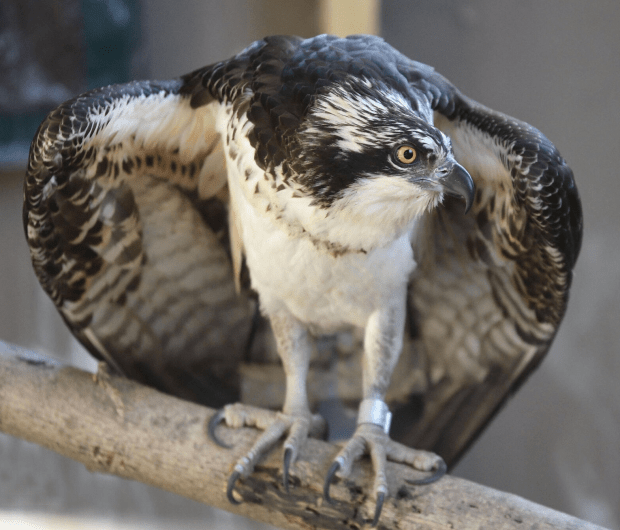
Hank is a ‘glove trained’ Osprey at the Centre. Oh, isn’t he gorgeous. Hank came to the Centre from Biscayne Bay as a nestling in 2017. Several attempts were made to return him to his nest but, they always failed because the adults did not return to care for their chick.

The goal of every wildlife rehabilitation centre is to release the birds back into the wild so they can live their lives. If for any reason they cannot be released, then the focus is to provide the best life the Centre can provide or at another place around the country – full of quality care, interaction, and enrichment.

Other ambassadors include Frank (Francis), the Bald Eagle, named after St Francis of Assisi, the Patron Saint and Protector of all Animals. Frank came to the Centre for Birds of Prey in 1991. He has continual issues with his eyes and his respiration. As a glove trained eagle, Francis is a great ambassador for the centre and his species.

A beautiful hawk mantling its food. ‘L’ says that this Cooper’s Hawk has a svelte body until he puffs up to protect his food.” The army of people that help the raptors at the Centre for Birds of prey work very hard making sure that the birds get the food and calories required so that they stay in top form even though they cannot be released. Such a cutie. Check out their website for the stories of the other 37 ambassador birds.

The staff and volunteers also observe the non-releasable birds, the ambassadors, closely making sure that they have the type of enclosure that is best for them. Here is a great short article on how they do this:

https://fl.audubon.org/news/new-enclosure-project-helps-ambassador-birds-while-fostering-next-generation-avian-scientists

The Centre and the staff educate people on the damage that humans have done to the environment of the raptors. ‘L’ said, “We irrigate/drain land for cultivation and crops which is the death knoll for black storks and other wildlife that relay on the water flooded areas in Europe.  Living in Florida, I am so fortunate to see Swallow Tailed Kites as they migrate here for breeding….but we’ve removed their nesting sites for development too. You used to be able to see them as far north as North Carolina. Not anymore….they struggle in Florida for nesting sites.” As ‘L’ mentioned I am well-versed on the destruction and outright extinction of birds of prey in the United Kingdom and the great effort now made to restore those species.

The clinics rely on the love and hard work of an army of volunteers along with donations for vital supplies, medicines, and buildings to teach the raptors how to fly and hunt prey. No one is getting rich! It is, indeed, done for the love of raptors.

I want to thank ‘L’ who provided me with the last image of Smedley and some of the other raptors that she cares for at the Audubon Centre for Birds of Prey. ‘L’ is dedicated to making their lives enriched and to helping us understand how important raptors are – how we are destroying their environment by the hour and what we might do to mitigate that destruction. Thank you ‘L’ for all you and the team do at the Audubon Centre for Birds of Prey do for our beautiful birds.

Thank you so much for joining me today. I will have a round up of nest activity this evening. Take care. See you soon!

Thanksgiving Thursday in Bird World

Our wildlife rehabilitation clinic has seen a 21% increase in patients in the last week. If you live in Manitoba and have the finances, send them a donation, however small or large. They receive no government funding. Everything is done on a donation basis – as is the case with most wildlife rehabilitation clinics. They have a long list of items they need on their website and all monetary donations are tax deductible.

I know that many of my readers live elsewhere but if this is happening here then perhaps it is happening all over.

There was a very sobering article on that cute little Korora (Tiny Blue Penguin) that is doing well in NZ. Its sibling died because the parents have to go so far to feed. For those that love those New Zealand birds such as the Royal Albatross at Taiaroa Head and wildlife that depend on the oceans to survive, what they are seeing is warming waters which mean the fish move or even die (like the trout did in Montana when the Clark Fork River got too water). It is time we demand that governments get serious and take radical steps to try and stop the situation from getting worse.

I want to remind everyone of Ferris Akel’s tours. You can go to YouTube, search for Ferris Akel, and hit the subscribe button to the live stream. He has lots of archived video tours as well. They normally take place on Saturdays at noon, Ithaca NY time. Ferris is out at Sapsucker Woods today for Thanksgiving and he has just found a beautiful juvenile Red-tail hawk that is hunting.

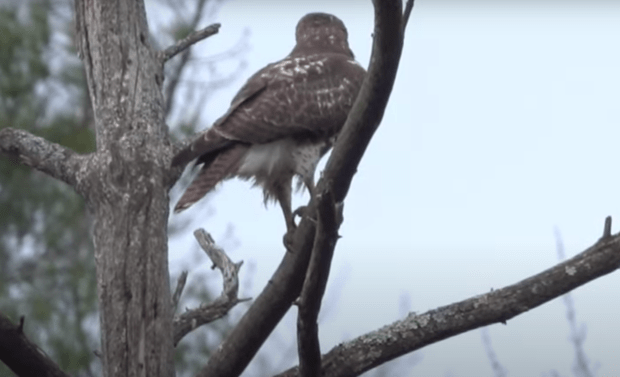
Notice the ‘eyebrow’ that helps to keep the glare away from its eyes when hunting. Oh, isn’t this a beautiful raptor?

Ferris just caught a Belted Kingfisher close to the RTH. There have been other birds this morning included Canada Geese and maybe another Kingfisher.

In the summer and fall, Ferris finds lots of shore birds and in the winter there will be owls! You can leave Ferris on like a radio if you are busy or you can watch as little or as much as you like. There is also a chat function with great people who can answer questions.

I am so thankful for Ferris Akel and his tours and his generosity in allowing us to share his images. I have learned so much from him over the years just wish I had a better ear to know which birds are out there by their beautiful voices.

Little Yurruga, the Peregrine Falcon fledgling at Orange, has been seen on top of a building so it is flying alright. Xavier and Diamond have been seen taking food in and out so she/he ? is being provided for. Isn’t this wonderful?!!!!!!

Below is the image that Dr Cilla Kinross took the day Yurruga fledged. She placed it in a tree. What a lovely little falcon you are, Yurruga.

This appeared on the FB Page of the Orange Peregrine Falcons today.

Have you ever wondered about the colour morphing of birds? The Audubon Society has a nice ‘Ask Ken’ article on that very topic! Thanks BM for letting me know!

The NZ DOC rangers at Taiaroa Head are deciding which Royal Albatross couple will be the Royal Cam family this year. There are 36 eggs and they believe that is all for this year. The favourite couple, WYL and BOK, who have made us so happy with their cuddles have not laid an egg – maybe next year! Will keep you posted!

It is a quiet day in Bird World and that is something to be very thankful for – no drama, nothing horrible happening.

Take care everyone. Have a marvellous day. To those having Thanksgiving, enjoy. See you soon.

Thank you to the following for their streaming cams where I took my screen captures or their FB pages: Cornell Bird Lab and NZ DOC, Ferris Akel Tours, Orange Peregrine Falcons FB page and the Cornell RTH FB Page.

Wednesday in Bird World

Lady Hawk has posted some close ups of the Royal Albatross cam chick, Tiaki, doing some wing exercises. Tiaki is all grown up, a beautiful juvenile, the daughter of LGL and LGK. She will fledge soon beginning her five or six year journey at sea – never touching land – til she returns to the headland to begin finding a mate. Perhaps one day Tiaki’s chick will be the Royal cam chick. I do hope so. It will mean that the seas are safer places for our beautiful squid eating birds.

“Masked Bobwhite (female ) (subspecies of Northern Bobwhite) | BANWR | AZ | 2016-04-15at07-43-413” by Bettina Arrigoni is licensed under CC BY 2.0

The Audubon Society has posted some really good news. The Masked Bobwhites are once again seen in southern Arizona. They were believed to be on extinct or on the edge of extinction because of cattle grazing in the Arizona deserts. Today they are listed as ‘critically endangered’.

They are a small round quail. When I was a child, we would travel to visit relatives in Arizona every summer. Oh, was it hot! But there were always Bobwhites. It is nice to hear that they are now returning.

This photo was taken on the 10th of September. I wrote about it at the time because in migration news, this is great. The son of Aeron Z2 and Blue 014 at the Pont Cresor nest in the Glaslyn Valley – and the grandson of Monty and Glesni – had reached Brittany. That was 12 days ago. He would now be further on his migration, perhaps stopping in Spain. The photo of Blue 494 was taken by Colette Leclerq.

Photo by Colette Leclerq, Brittany France

Speaking of migration and waiting and wanting news of Blue 464, it is more than time to check on the Black Storks from Latvia and Estonia.

First up, Karl II, his daughter Pikne, and his son Udu. They are from the Black Stork nest in the Karula Forest in Estonia. This map is taken from the Karl II migration pages of the Forum.

Udu is now in Hungary near the fishponds at Banhalma. Karl II remains around Kherson Oblata in the Ukraine. Pikne has doubled back and remains in Moldova. What I think is interesting about this map is that Udu has turned and is heading towards the Asia Minor route. There was a question as to whether he might go the western route to Africa but it seems he will be flying over Greece.

This is the data from BirdMap. You can access the BirdMap here:

http://birdmap.5dvision.ee/EN

I was wanting to see about the Black stork Julge. He is Jan and Janika’s only surviving chick this year. He is now in france. You can see him still heading over the westerly routing.

The birds that are in the centre of Africa are two Ospreys!

So far everything looks in order and everyone is still safe.

I cannot bring you a late afternoon update on the Port Lincoln Ospreys. The camera was frozen for most of the day and has just returned to normal. Mom has the kids covered tight. It is only 8 degrees at 16:00 with winds blowing over the water at 11 kph.

I can show you a bit of what a beautiful day it was on the Canadian prairies. I really need to practice with my camera and my tripod. These are some images today taken at a distance of about 68 metres. I found the tripod tricky to use – I need a counterbalance for it – so these are all hand held. The set up was heavy. But there were a few passable images.

A female Mallard. This species is very common in Manitoba. They have, on occasion, fooled me so I have had to go to our local eBird expert. This is a real beauty.

The Canada Geese would like the entire pond to themselves. They swim after and honk as they pursue the ducks.

There is your dabbling duck. She knows that goose is there but is trying to ignore it.

The park was just beautiful. It was 25 degrees today. One of the fountains was not working and that end of the pond had men working. Still the geese on the other side were a bit curious.

All of the Wood Ducks were either up on the islands or down by the fountain that was working. This is a female and she is such a cutie. I sat and watched her swim in and out of the water droplets for quite awhile.

Thank you so much for joining me today. Tomorrow is a day away chasing shore birds. I hope to have a posting tomorrow evening (Thursday). Take care everyone. Stay safe. Stay Positive!

Thank you to the following for their streaming cams or FB pages where I took my screen shots: Port Lincoln Osprey Project, Friends of Ospreys, and to the Eagle Club of Estonia, BirdMap, and the Latvian Fund for Nature.