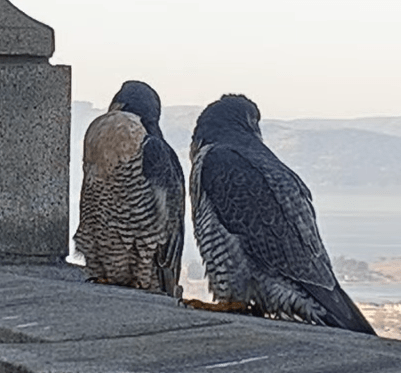
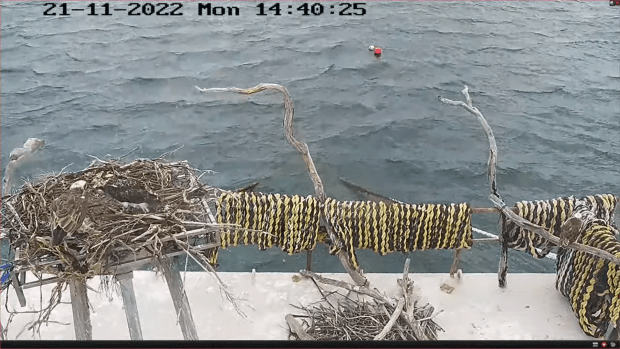
Mrs G Remembered, eggs for Seren and Telyn…Friday in Bird World

14 April 2023

Good Morning,

It was overcast and coolish, 1 C, in the early morning of Thursday. It felt like rain; we could use it, but the drops never came. The Dark-eyed Juncos are eating the Millet spread over the deck, the little woodpecker has been at the feeder, and 18 European Starlings showed up at about 1000. It is now noon. They should be happy. There is Bark Butter with Mealworms along with their favourite suet. Hoping they come back. Last year’s numbers were high for Starlings. Hoping it is the same this migration. People take them for granted, like Sparrows, but what happens when they are gone? They are under threat. So, this garden embraces them and the Sparrows; believe it or not, they all co-exist nicely for the most part. Right now, they all need food. Those long journeys and habitat loss in my area over the winter due to the ever-expanding need for humans to have more extensive houses means that we should all pitch in and feed them – if we can.

Snail mail. We don’t get so much of it anymore; it is always a welcome treat. Today the publications from Birdlife International and Living Bird were in the post. I realise that having them sent costs the environment. I hope they will be helpful in the future to others as they are going in dedicated binders.

Lots to learn. The National Whitebark Pine Restoration Plan members have worked for 14 years to get a plan to restore this tree species. They hope to have a tree with genetic resistance to white pine blister rust and they are really expecting the Clark’s Nutcracker to spread those seeds. It could help to restore many lost forests for the future. The Smithsonian now has a bird friendly chocolate certification programme to go along with their Birds and Beans coffee and Caffe Ibis Coffee. You can normally order from the Smithsonian. In Canada, coffee can be ordered directly from the roaster in Toronto. Some specialty bird feed providers also have one lb bags of coffee beans such as Preferred Perch in Winnipeg. What else did. learn? That both the Sharp-shinned and Cooper’s hawks that visit my garden like Dark-eyed Juncos as prey items along with lots of House Sparrows, Mourning Doves, and Starlings. Cornell did a great study on what birds should actually be the State birds and only two states kept the ones that they celebrate: Louisiana with the Brown Pelican and Oklahoma with the Scissor-tailed Flycatcher. In Manitoba, where I live our provincial bird would be the Connecticut Warbler. 33% of the entire population breeds here. Our provincial animal is currently the Great Grey Owl.

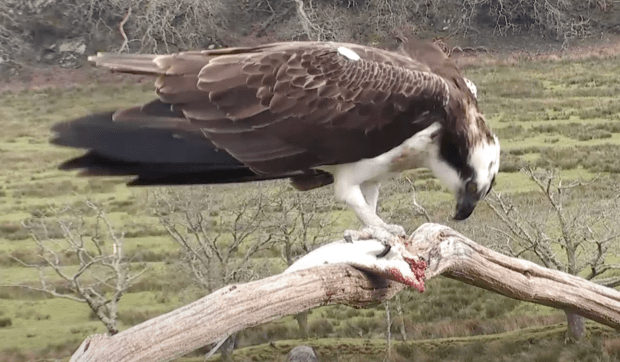
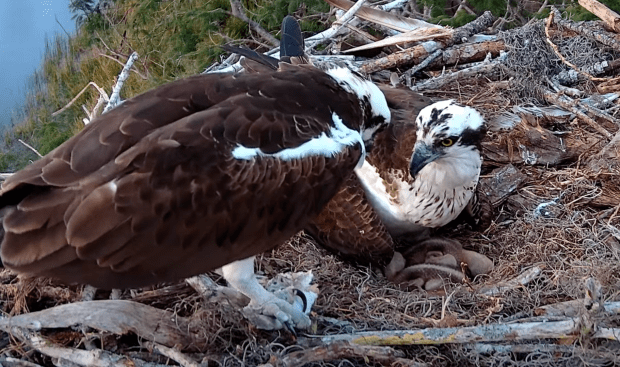
Heather Corfield at Bywyd Gwyllt Glaslyn has written a lovely blog dedicated to the memory of Mrs G, the formidable female Osprey that has populated the area. She laid 60 eggs and fledged 52 chicks. She has at least 130 grand-chicks along with countless great-grand chicks. She had only two mates, Ochre 11 (98) to 2015 and then our dear Aran since then. She bred at Glaslyn for 19 years and was the oldest UK Osprey. It is a good read about a very remarkable bird. As Heather says, we knew the day would come. She was at least 23-24 years old – but it doesn’t make it any easier. Mrs G did not return from migration and it is unknown when and where she died.

Does get much cuter than fluffy little Peregrine Falcon eyases! OK. Big Red, yes, I do love Red-tail Hawk eyases the most!!!!!! Annie giving the two nestlings at Cal Falcons their first feeding at 0720 on Thursday morning.

There were two adorable little white white fluff balls with no egg shell present.

No shell but a visible crack in the one shell to the left.

Now Annie looking rather mischievous…and there is a half shell on the scrape. Looks like we have hatch 3.

Annie turned around at 11:53 and moved the shell and you can see a tiny wet pink eyas.

The reveal and Lou gets to see that his family has just grown some more. Best be out there hunting, Lou!

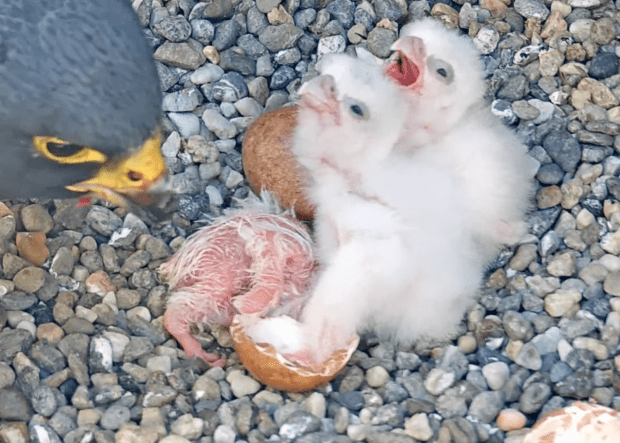
Later…the new hatch will be ready for some prey tomorrow! It is less than five hours old in the following images.

These eyases will grow dramatically from their hatch to fledging. Think 40 days. At first, their eyes are closed except when food begging; the eyes open like slits. By the fifth day, their eyes will be fully open all the time except when they are sleeping and they can focus and see clearly.

At that time their weight will have doubled from when they hatched! I am such a fan of falcons and hawks…you will be overwhelmed with ‘baby pictures’.

‘A’ says, “Little Lou is enjoying being a dad. As soon as Annie decides to take a prey gift for herself, he’s onto those chicks and the remaining egg. I wonder if he is counting. Does he notice that these well-behaved eggs are progressively being swapped out for these small fluffy wriggling things. He’s doing such a good job of covering everything and everyone he needs to, at least so far… That won’t last long, especially if that last egg hatches.”

Do you know how Peregrine Falcons get such amazing colours to their eggs? Here is the answer from the Chicago Peregrine Program:

“As an egg moves down the female’s oviduct it presses against glands that produce colored pigments. Peregrine egg colors range from pale creamy to a dark rusty brown. Marking patterns develop by if the eggs are in motion or not when they reach the glands with pigment. If the Peregrine egg is stationary at the time when it comes in contact with the glands, it’ll become spotted. If the egg was in motion, it would have streaks. Because the egg can continue to gain color down the oviduct, and as the egg can rotate slightly while it moves, you can have color laid over where color was already added.The pigments in the glands become depleted with each successive egg laid. Looking at this egg set from The Field Museum, we would estimate the egg on the far right was laid first, while the one on the far left came last.”

For more information about egg color in birds – check out this link from Cornell –https://www.allaboutbirds.org/…/the-beauty-and…/…#

Falcons are either laying eggs or have hatches…it is so much fun. Seriously if you have never watched a falcon scrape you need to start! Everyone eats! The incidence of sibling rivalry/siblicide is so diminished compared to ospreys and eagles. You will be astonished.

The Michigan Spartan scrape box has four eggs!

Oh, and then there are the most gorgeous osplets with their juvenile feathers at Moorings Park eating breakfast. Gosh, they are all beautiful.

Oh, and Idris preparing a fish for Telyn Blue 3J at the Dyfi Osprey platform in Wales. The anticipation of the first egg is growing.

And….

we have two first eggs – at Dyfi and at Llyn Clywedog! Telyn laid her egg at 17:40 with Seren coming in twelve minutes later at 17:53. Congratulations!

Telyn – congratulations to one of my most favourite couples, Idris and Telyn!

Idris sees their egg!

Beautiful Seren Blue 5F. 17:53:20.

Dylan had been up on the perch since 0615 expecting an egg today so he was there when the big event happened.

Just look at that beautiful pristine landscape. What wonderful places these Welsh ospreys have for their platforms!

Several have wondered why there are not more osprey platforms in the Glaslyn Valley. Well, there was Aran and Mrs G’s platform. Then another platform was placed just at the boundary of Port Cresor which is now occupied by Aeron Z2 (2017 Monty and Gleans) and Blue 014. At the time, some believed the placement was to ‘steal’ Mrs G from Glaslyn. There has certainly been a lot of interest in the Glaslyn nest from Monty and Glesni’s boys that hatched at Dyfi including Z1, Aeron’s full brother, Tegid (2016, Monty and Gleans). He briefly appeared on the nest. Did he steal the female’s fish? His nest is ON4 on private property. Is there a move to consolidate Monty’s family holdings in Glaslyn now that Aran is trying to establish himself with a new mate? Aran got Tegid moving!

Tegid is the 2016 hatch of Monty and Gleans and was known as ‘The White Egg’. He was harassed by Blue 24 (female) if I recall. Good to see you Tegid. Now go home to Snowdonia!!!!!

Aran flapping after sending off Tegid. Sadly, the whole event sent the nice female off and she hasn’t been seen on the nest on Friday. Aran was sky dancing to another female, a more aggressive one to him.
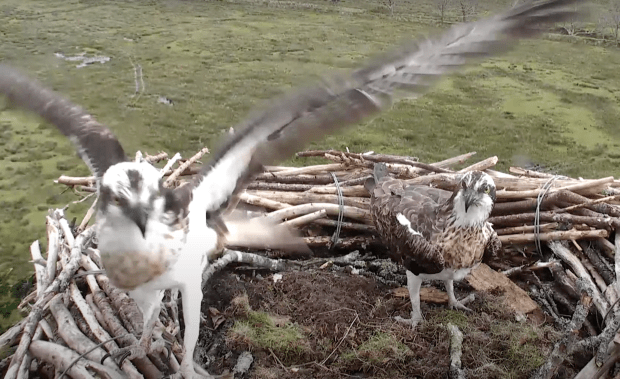
Ringo fledged at the Webter, Texas Bald Eagle nest near Houston but, s/he has continued to return to the nest for food lured by parents. Thursday was no exception. This is fantastic. These parents are teaching Ringo exactly the sane way that M15 is teaching the Es to survive independently. Great mantle, Ringo! Looks like a big girl to me.

There are two eggs at the Golden Eagle nest in Romania. Siblicide is common in Golden Eagle nests so watch this nest with that warning.

The cam operator at Cornell Bird Lab gave us some incredible close up images of Big Red today. It will not be long until hatch watch for her and Arthur.

She is incredibly beautiful, our 20 year old Red-tail Hawk ‘Queen’.

Achieva and Dale Hollow: River brought in a nice fish at 10:22 Thursday morning. Despite the intruder close by, River fed both eaglets well. Yes!

DH18 decided to do some self-feeding on the last of the fish bone. Way to go little one.

DH17’s wing span!

A view of the Obey River.

Both osplets at Achieva had crops during the 0800 fish feed! Good news.

The three eaglets at PA Farm Country are growing and doing very well, indeed. No issues at this nest to report.

Gabby and V3 might not have had a nest of eaglets this year but they are positively delighted being with one another and I am looking forward to November next year when, hopefully, they will lay a clutch of eggs for the first time together.

I have been watching the Dulles-Greenway nest reasonably close. On Thursday by late afternoon, all I could see were two short feedings with the third hatch not getting anything at the second. Are there intruders about? or am I missing feedings?

All looks well at the Pittsburgh-Hayes Bald Eagle nest.

The eaglet at US Steel is 8 days old.
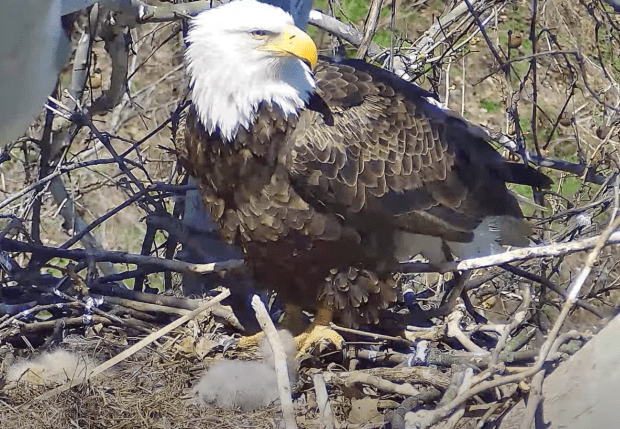
Cholyn and Chase’s single hatch this season is not going to go hungry. The nest is loaded with a variety of prey items for this chubby little fluff ball.

In Estonia, Karl II waits for the arrival of his mate, Kaia, at their Black Stork nest in the Karula National Forest. Karl II arrived yesterday from migration. Kaia is close behind.

There are some dates that you should mark on your calendar. The first one is a day that many of you will not recognise – National Curlew Day which is the 21st of April on the feast day of St Brueno, the patron saint of Curlews. The species is critically-endangered in many places around the world because of modern agricultural politics, climate change, habitat encroachment. Instead of me telling you about Curlews, read about them. Find ou what their status is where you live. These lovely shore birds migrate and they need wetlands, they need not to be shot! See what you can do to help in your area.

The other two days are about bird counts. 13 May. Mark it on your calendar. It is Global Big Day that helps us celebrate the birds that are in our environment. The second event is World Migratory Bird Day which is held twice a year to celebrate the marvellous journeys our birds make in the spring and fall. Please sign up to eBird to help track the birds and to see where help is needed. Last year 51,455 birds worldwide entered their statistics from 201 countries for 7,673 bird species.

Many of you have pets or have had in the past. Did you take them to the crematorium? Did you leave them with the Vet if they had to be euthanised? Last year we saw dumped pets euthanised in several landfills around the Minneapolis area.

This could not have been an isolated incident, but it came to light only because of the Bald Eagles eating the carrion found at the dump and having to go into rehab. Reports have come that a similar incident happened in the Pacific-Northwest in the Cowlitz district in Washington from one of our readers. Why are we hearing about this? Has there been a change in human behaviour during and after the pandemic? Did pet crematoriums close so that vets are left dealing with animals left in their charge? What can be done? If your pet is sick, you should learn how your vet clinic disposes of the body. That should be a priority. Are they assigning these animals to another business that should be disposing of them correctly but is dumping them? It is entirely possible that these contractors are not following laws or protocols. Ask. The vets’ drugs can cause our carrion eaters – Crows, Vultures, Bald Eagles, etc. – to get ill and die. This is not a good situation. Talk to your local wildlife rehab clinic and veterinary surgeon if you want to help and do not have pets. They might not be aware!

A sad story coming from Arkansas in the US. What’s with the need to kill other living beings? I do not get it.

Thank you so much for being with me. Take care all. See you soon!

Thank you to the following for their notes, posts, videos, news, and streaming cams that helped inform my blog today: ‘A’, ‘B’, Heather Corfield and Bywyd Gwyllt Glaslyn, Chicago Peregrine Program, Olga Kysil and Orange, Australia Peregrine Falcons, Moorings Osprey, Dyfi Osprey, CarnyXWild, Paul White and the Webster TX Eagles, Associate Wild Bucovina, Cornell RTH Cam, Dale Hollow Eagle Cam, Achieva Credit Union, PA Game Commission, NEFL-AEF, Dulles-Greenway, PIX Cam, IWS and Explore.org, Eagle Club of Estonia, and CBS News.

Murphy fed the baby eaglet, Maya lays historic 4th egg…Thursday in Bird World

13 April 2023

Good Morning Everyone!

It is a balmy ‘summer day’ on the Canadian Prairies. The temperature was 12 C with a blue sky and winds of 19 kph. It was a perfect day to go to the park and check on the arrival of the Canada Geese.

Several Ring-billed Gulls were enjoying the water. Ring-billed Gulls have white markings on their outer wing feathers. You can see these in the image below. They also have pale eyes with a red eye-ring. I like to think of them as celadon eyes, that coveted green-grey glaze from China. There is also a black band on the end of the yellow bill.

There were geese everywhere…at least 75 in a small area around the pond.

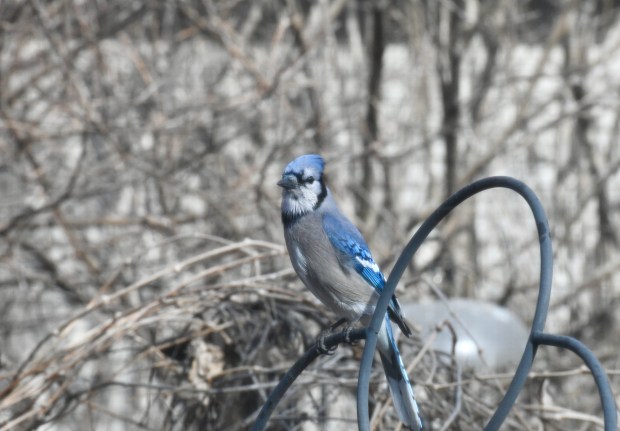
In the garden, there has been much joy with the arrival of the first European Starling around 1700. Also, there were three Blue Jays today. Last year, we had Junior and the three babies. Will there be another arrival tomorrow? We wait to see if four return from migration to join the Dark-eyed Juncos and the arrival of the Starlings.

This is the older Blue Jay, Junior.

Blue Jays are incredibly picky over peanuts. They test and shake each one for its weight. No sense in using all that energy for an old dried-up nut. Smart. About 1/3 of the peanuts in the ‘new’ bag appear not good enough to make the cut.

A blurry photo of the first European Starling for the year.

This woodpecker prefers this type of feeder while his friend is at the log suet feeder.

Migration counts continue across southern Manitoba where I live. At one site in part of an afternoon, 825 Red-tail Hawks, 130 Bald Eagles, and 3 Golden Eagles flew over. Fantastic.

The giggle for the day comes from Sharon Pollock!

The two little falcons are adorable. Lou doesn’t quite seem to know what to do but he is bringing in prey items, thankfully. Things work out. Maybe there will only be two!

‘A’ notes “Lou is a bit nervous of the little ones – as I mentioned, he trampled through the scrape and trod on one of the chicks’ heads today when retrieving prey from the back corner! He may have a bit to learn on that front. But Annie has it covered, and as long as he keeps the pantry full (which it seems he is doing so far), he will be doing his job. After all, he will be way too tiny to brood chicks for very long! What a cutie. And those little white fluffy babies with their tiny beaks open wide whenever they hear mum e-chup. Oh how gorgeous are they? Don’t you just want to snuggle them up? Well, no, that would upset Annie greatly, but you know what I mean. Such darling little creatures.”

SK Hideaways gives a good video of these two darlings!


Well, it doesn’t get much better. Murphy abandoned his ‘rock baby’ to care for a little eaglet that needed a parent. It was an experiment and it looks like it has worked.

The little eaglet gets a parent and Murphy gets to share his love. Win-win.

Wild Bird Sanctuary has just done a late posting. It is fantastic. Looking for a place for a donation, however small or large. Think of donating specifically for Murphy and the eaglet at Wild Bird Sanctuary!

Bella and Smitty’s little only eaglet is doing very well indeed. Check out the crop and it is going to have a second meal right away. There are so many advantages to eagle parents having only one to care for.

Meanwhile, at the Manton Bay nest of Blue 33 and Maya, the couple now have their third clutch of four eggs! The couple previously fledged two clutches of four eggs. They are heading for a record. These two are not going to let anyone else get the Super Couple award! Better put some more stock in Rutland water! Thanks, Geemeff!

Our beautiful couple need all the rest they can get during incubation!

At Glaslyn, it appears that Aran and the unringed unidentified female osprey have also come to an understanding. Aran has been sky dancing and bringing fish and she is at the nest. She is a beauty, too. Like Murphy and the eaglet, Aran is lucky that this young lady chose him when Mrs G did not return from migration.

Oh, it was wet from all the wind and storms but as the day progressed, things began to dry out a little in Wales.

Telyn and Idris have been having some discussions. It was believed Telyn laid an egg but I see no evidence of this. It was storming badly and both ospreys took to the ground so they would not be blown about. I hope Telyn did not lose her first egg of the season.

It has been a bit miserable for Dorcha and Louis up in Scotland at Loch Arkaig, too.

Gracie Shepherd posted a sweet screen capture of E21 and 22 sitting together near the pond. Oh, how we are going to miss these two. M15 has done an amazing job teaching them and they have certainly experienced more than most. Each knows how to defend a nest!

I have received word from Sassa Bird that my favourite white-tailed Eagle, Milda, whose nest is near Durbe in Latvia, has a pip in her egg! Milda is gorgeous and she has had a very tragic two years after losing her long-time mate, Ramos, just when she had laid her eggs in March 2021. We are hoping for a wonderful year for her and her new mate, Voldis.

Wondering what happened at Centreport, New York with Mum? Well, she is incubating two eggs with D3.

Cape Henlopen had a tragic 2022 season. There is a new platform this year and hopefully a new couple. Heidi McGrue brings us news of a visiting osprey. Fingers crossed.

One of the reasons that we love Jackie and Shadow so much is the fact that they love each other sooooooo much. Today Shadow brought in a massive fish just for Jackie in the nest. We know both of them would have liked to have had a replacement clutch. Might they still? We wait. Regardless, they are adorable and every day brings another giggle and smile.

Things continue to go well at the Moorings Park Osprey platform in Naples, Florida. Yes, Abby can eat a lot of fish but, we can assume that because she is a female she needs that for her extra growth in body mass and feathers.

It seems that Indigo has left to find his own way in the world. Diamond blocked him from the scrape on Saturday and he could be heard or it was thought. May he have a long and productive life full of adventure and prey.

A good way to end a great day is an update from Dr Sharpe and his team at the Channel Islands. He goes through all the nests and, of course, gives an update on Thunder and Akecheta. You get to see the most beautiful landscape – and yes, there are at least two eaglets in Thunder and Akecheta’s nest. You can see them!

Dale Hollow and Achieva, brief report: River brought in a small fish to the nest on Wednesday around 0900 despite being chased by intruders. One of those intruders sadly ate part of DH19’s body that had been left on the nest. It was a male. Many hope that River will accept him as her new mate – he did not harm 18 and 19. Then he could help raise the eaglets. That would be wonderful!

Harriet, Jack and the two surviving osplets at Achieva have eaten well. A visitor landed on the nest while the adults were away. I presume Harriet is out fishing!

The Ventana Wildlife Society is being so pro-active in the battle of HPAI with the goal of it not wiping out the Big Sur and Pinnacle Condors. Our hearts break for the Arizona condors losing a battle against this deadly disease.

Dear Mary,Today, the U.S. Fish and Wildlife Service provided an update on HPAI infection in the Arizona condor flock stating that as of April 12, 2023, eighteen condors have succumbed to this terrible disease (6 of which were confirmed to be HPAI and 12 are suspected). In addition to these deaths, five condors are currently in treatment. Our thoughts continue to be with our partners in Arizona and The Peregrine Fund

In addition to the measures taken since 2022 to prevent the spread of HPAI, we are now working closely with partners to develop even more contingency plans. This week, we raised $80,000 in support of the purchase of 10 quarantine pens which will arrive in two weeks. SPCA for Monterey County has approved the temporary use of their land on which to setup these pens. Once placed, these pens can be used for treatment, vaccination (when available) and even safeguarding healthy condors from HPAI. We are especially thankful to our partners at SPCA for Monterey County for their collaboration.

These new quarantine pens will be crucial in the fight against this disease, but we still need support for our staff to care for the flock. We will be sure to keep you updated as we know more.

Kelly Sorenson

Ventana Wildlife Society, 12 April 2023

Here is a story that shows you that hard work and persistence – and believing – can pay good dividends when it comes to our raptors.

While the UK is gleeful over the success of the restoration projects for the Ospreys in North America, citizen scientists are needed to help understand the impact of climate change on birds. You can be one of those that help. Read the article and please do a daily count and send to eBird. Thanks to my eagle-eyed daughter for this one!

https://www.cbc.ca/news/canada/windsor/bird-migration-timing-climate-1.6800129

Thank you so much for being with me today. I am checking on Milda but no word of a hatch for our Latvian WTE yet. She is rolling eggs and being coy. Take care, everyone. See you soon.

Thank you to the following for their notes, posts, videos, and streaming cams where I took my screen captures that helped make up my blog today: ‘Geemeff’, ‘T’, ‘J’, ‘A’, Sassa Bird, SK Hideaways and Cal Falcons, Sharon Pollock and Orange Australia Peregrine Falcons, World Bird Sanctuary, Deb Stecyk and NCTC, Bywyd Gwyllt Glaslyn, Dyfi Osprey Project, Friends of Lock Arkaig and the Woodland Trust, Gracie Shepherd and Raptors of the World, Latvian Fund for Nature, Rob Schwartz and Bald Eagles of Centreport, NY, Heidi McGrue and Raptors of the World, FOBBV, Moorings Park Ospreys, IWS, Dale Hollow Eagle Cam, Achieva Credit Union, and Ventana Wildlife Society.

First-time falcon dad wants to feed his egg, Louis at home with Dorcha…Monday in Bird World

10 April 2023

Good Morning Everyone,

Thank you for all your letters and holiday wishes. Each was very much appreciated. It is so kind of you to think of me!

It is 1800 Sunday evening, and my garden is teeming with Dark-eyed Juncos and House Sparrows. Mr Blue Jay has been for a visit, as has Little Red and Dyson & Gang. I can hear the Crows in the distance as gulls fly overhead. It is remarkable how spending time in the light or stepping away from a nest for 24 hours can refresh your mind and body. Missy and Lewis have voted that I write the blog in the conservatory where there is light! It was not that long ago that 1800 would have meant darkness. Twenty-six Ring Billed Gulls flew over like they do every dusk from spring through to fall when they depart. On the Red River Flyway, more than 400 American White Pelicans flew north. Spring is wonderful!

Both Mr and Mrs Downy came to the garden several times today. They always come right before dusk, no matter how many visits they have made earlier. I am a wee bit sloppy about getting the suet into the holes, but, hey, they seem not to be annoyed.

e-Bird reports from Saturday said that the Dark-eyed Juncos were arriving in our province. On Sunday, more than two dozen were in the garden flitting about. Oh, how grand. Just love these little ones.

The first Hibiscus blossom of the year arrived yesterday! So far, Lewis and Missy have left it alone. They often like to sleep in this pot after I water them. I never knew cats loved the water so much!

Correction: The GHO strike on the Es took place NOT during the day. Lady Hawk’s time fooled me and ‘A’. Thanks, ‘H’ for the head’s up! It seemed so unlikely but, there have been battles with eagles and owls during the day time. The first that comes to mind is Bonnie and Clyde taking the nest from the young eagle couple at Farmer Derek’s three years ago.

We are one day away from hatch watch at Cal Falcons and only Annie and Lou know if they can hear those little eyases chirping away getting ready to burst out of those shells. Mark your calendar! While we have been told that the 11th is probably hatch day here are some figures from Cal Falcons based on past hatch times.

Annie and Lou have made the LA Times! Well done.

Remember! There will be the annual Q & A session and celebration on YouTube with Cal Falcons on the 11th. Here is the information.

Wonder what it feels like to lay that first egg? A very young male still has his juvenile plumage and probably a first-time young female falcon at San Jose City Hall. SK Hideaways caught their reaction to their first egg! Please watch this super-edited video. It gives us some insight!

The female appears to later ‘shade’ the egg.

The young couple bond in their scrape. We wait to see how all this plays out.

Our young dad is ready to feed his baby – even in the shell! This is going to be very interesting!

There were two fledges on Sunday. B16 from Berry College and Ringo from the Webster Texas nest. Congratulations!

There are five eggs at the Manchester, New Hampshire, scrape! The couple has been together for 9 years, and last year they hatched and fledged five. ‘SP’ says the chicks are banded but the male and female are simply known as Mum and Dad. Here is the link to their camera and there are the five from last season. Adorable.

There is nothing more adorable than little pink beaks reaching up from white fluffy bodies to be fed.

Ringo flew strong and in the video on FB by Paul White, you could see her fly way out into the background near the water feature. Brilliant.

‘JL’ asked: “I was wondering if you could comment on aggressive/submissive behaviour sometime. On the SWFL nest, I’ve watched E22 become the aggressor, and E21 turn submissive. It was almost an overnight change (even before E21 left). I suppose the question is, why did 21 allow the change to occur? I noticed the same with the Sea Eagles (29 and 30), with 30 becoming more assertive before 29 left.”

We have all witnessed various levels of aggression on the nests. This ranges from the bobbleheads fighting it out in those first few days to the extreme aggression where a sibling is killed. Dominance ‘play’ is often seen but is not dangerous to any of the nestlings. It is when there is fear for survival that really aggressive behaviour comes in. Research reveals that deadly aggressive behaviour can happen on a nest that is full of prey. Just what causes one bird to turn against another in that situation is a matter of conjecture. Is it DNA? is it toxins that drive aggressive behaviour? is it a particular growth stage that spurs the attacks?

A sibling has never died of siblicide on Harriet and M15’s nest. Never. They have beaked each other, making chatters concerned, but that was dominance play. Both eaglets, E21 and E22, are now similar in size and have fledged. 22 gained confidence and, if I am correct, grew a little while 21 was away. We do not know their genders, although I thought they were the same sex because the fighting and dominance/submission has not been extreme. 22 had control of the nest when 21 returned and wanted to keep that position. ‘E21, you are not going to boss me around anymore!’ In the end, we know that they became beak and branch buddies. All is fine. M15 took good care of them; amazing. You will begin to see how remarkable his parenting was as the saga at Dale Hollow unfolds.

WBSE 29 and 30 were both females. Females are much more aggressive towards little males. So again, it could have been a confidence matter, testing the ‘waters’ of who is dominant at WBSE like it was when 21 returned. In neither case, there was never cause for any concern over the health and welfare of the other eaglet in these two instances.

Concern continues to grow for Mrs G as she is ten days late from her normal arrival time to Glaslyn.

Meanwhile, Aran has been sky-dancing for an unringed female that came to the Glaslyn nest. He has fed her a fish in the nest and he must be understanding that Mrs G is not returning. A new era at Glaslyn could be starting.

Meanwhile, Dorcha has returned to Loch Arkaig and is waiting for Louis to return from his adventure around the loch so they can begin their 2023 breeding season.

Dorcha begins work on the nest just like Louis did last week. Hey, Louis, come home!

Louis home. Both arrive at the nest with a fish as the wind blows strong. And do I hear ice pellets?

In Latvia, a Mallard attempted to land on the nest while Voldis is incubating his and Milda’s eggs. That duck didn’t even get a chance to land! Hatch watch coming soon. Hoping this will be a good year after two tragic ones for our beautiful WTE Milda whose nest is near Durbe in Latvia.

In Decorah, precious DH2 gets a feeding.

Martin and Rosa’s three eaglets continue to do very well at Dulles-Greenway.

There are three eaglets at Bald Canyon. I have noticed a tiny bit of beaking between 1 and 2. 3 was out of the way and did get fed. Relief.

One much adored eaglet at Two Harbours that will be well fed and loved by parents, Chase and Cholyn. For those that do not know, Cholyn is Thunder’s Mum. (Thunder is the mate of Akecheta at the West End).

Everything looks A-OK with Big Red and Arthur!

‘T’ sent her vote for photo of the day…Bluff City eaglet with a crop the size of a tennis ball!

Maya has laid her third egg of the 2023 season at Manton Bay! Blue 33 has been by her side. What a couple!

Yesterday Iris arrived home to her nest at Hellgate Canyon, Missoula, Montana. She is the matriarch of American ospreys and is believed to be the oldest living osprey in the world.

Her first mate there was Stanley and they raised multiple chicks to fledge. Then Stanley passed and Louis came on the scene. Louis has always had another nest at the baseball park. It has been nothing but sadness for Iris and Louis. Lin Lawson gives us the history, in case you did not know it. This will provide some background as to why people get upset when Louis comes to the nest with Iris. Things will not change so do not get upset. They will mate, Iris will lay eggs, the eggs will get eaten by the Crows, and then Iris will spend her summer eating fish and growing strong. There will be no starving osplets on the nest to worry about. And that is a good thing.

DH17 and DH18 ate well and went to bed with full crops. River is trying the best she can. She is followed to the nest by intruders that land and stay there. DH17 is 38 days old, and 18 is 39 days old. DH19 was 32 days old when it died of starvation. We send good positive wishes to River. This situation is tough, and there is no guarantee that any of the eaglets will survive. Diane and Jack were both at the Achieva Nest. Diane fed Big Bob and left Middle Bob in submission without any fish. Later Diane went fishing and brought in one of her nice catfish, and Middle ate for at least 30 minutes. There is a drought in the St Petersburgh area, and all of the water is very low, causing fishing to be difficult. Send your best wishes to this nest.

Reports are coming in that the much loved Finnish Osprey, Salli, has been electrocuted in Iraq on her way home from her winter grounds.

Thank you so very much for joining me today. Take care, everyone. Have a great beginning of the week. See you soon!

Thank you to the following for their notes, videos, posts, and streaming cams that helped make up my blog today: ‘A’, ‘H’, ‘T’, ‘SP’, ‘JL’, Geemeff, Cal Falcon Cam, LA Times, SK Hideaways and San Jose City Hall Falcons, San Jose City Hall Falcons, Peregrine Networks Live, Colleen Hayman Orange Australia Peregrine Falcons, Paul White and Webster TX Eagles, Jackie Morris and Friends of Dyfi Osprey Project, Dailypost.co.uk, Bywyd Gwyllt Glaslyn, Geemeff and Friends of Loch Arkaig and the Woodland Trust, Latvian Fund for Nature, Raptor Resource Project, Dulles Freeway, IWS and Explore.org, Cornell RTH Cam, Bluff City Eagle Cam, LRWT, Montana Osprey Project, Lin Lawson and Osprey Friends, and Dale Hollow Eagle Cam.

Ervie, Jackie and Shadow at nest, Milda lays an egg…Friday in Bird World

10 March 2022

Good Morning Everyone!

The end of the week is here! It is rarely of little consequence to me unless something is happening. There are some wonderful things about retirement!

Two new to me ‘previously owned’ books arrived in the post this morning. I have been waiting some time, and what a joy to receive them. One is by Roy Dennis. It is The Loch. A Year in the Life of a Scottish Loch. It was an accompaniment to a television series in the 1990s. The images are beautiful and would have you booking a ticket to Scotland immediately. The other is a study of Peregrine Falcons in New York City by Saul Frank. It is titled City Peregrines. A Ten-Year Saga New York City Falcons. Will keep you posted!

Meanwhile, the kittens have taken over the house. They love nothing more than going in and out of a box and all the wrappings, large paper bags are fair game for an entire afternoon of jumping in and out, and anything that is light enough to be transported can and will be picked up and moved by Lewis.

Lewis decided to take over the large dog bed today with all of the blankets!

Missy fell asleep in the small basket while she was playing.

They bring joy! And they love watching the animals in the garden.


There is news of Ervie and he is still in Port Lincoln!

Lou did a marvellous job yesterday. There was a huge storm in San Francisco and Lou incubated for almost six hours was Annie was missing.

Wondering about Jackie and Shadow? They showed up together on cam 2 on Thursday. In fact, they were on the snag tree and in the nest and Shadow stayed around for some time! There is also a sub-adult hanging about.

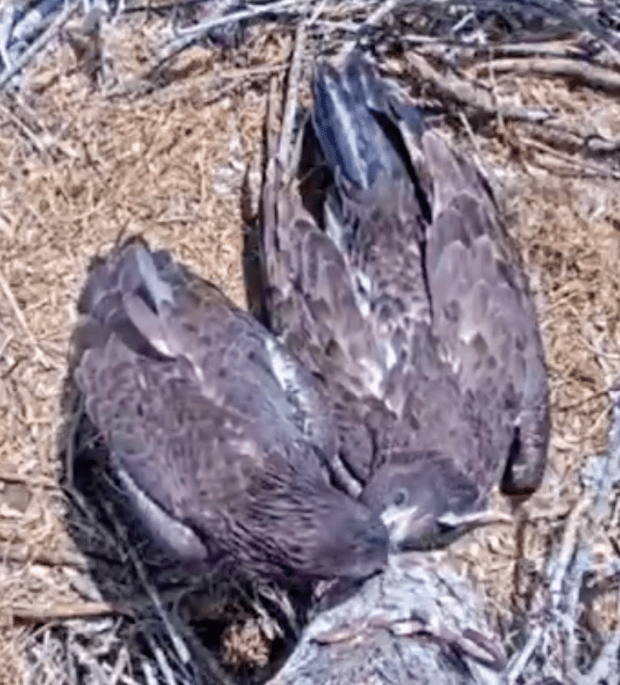
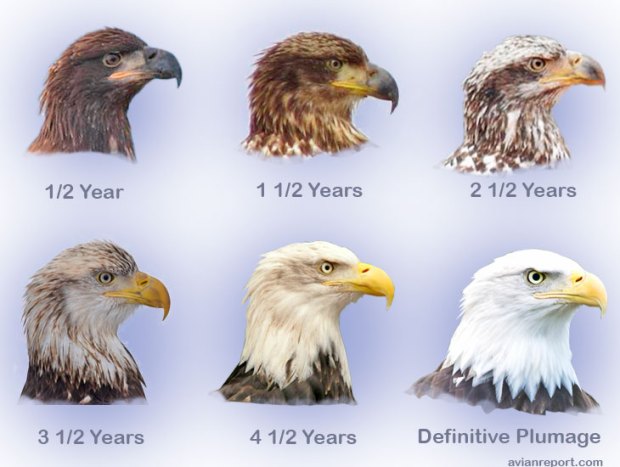
Looking at the image above and the chart below, how old do you think this eagle is?

Jackie and Shadow were also in the nest doing some cleaning. The time was 13:38 on Thursday. Getting anxious to see if we will have a replacement clutch.

M15 was extremely busy flushing those female intruders from the territory on Wednesday, which might account for the few prey deliveries to the Es. Lady Hawk posted all the action! We might begin to imagine that M15 wishes he was less popular.

On Thursday morning, a prey drop came at 12:47. E22 got it and ate it but not before 21 had some and then 22. It went back and forth. Both ate.

I love these little chats that C F Marshburn creates for the eagles.

Wonder why there has not been a lot of prey deliveries? D Morningstar posted a very informative video of M15 and one of the female intruders. He cannot risk getting injured. Better the eaglets be a bit hungry than to have their only provider, Dad, disabled or killed.

You can hear 22 in the background calling for fish! I don’t think we will ever forget him!

Ron and Rose are approaching pip watch and now they are having to defend both their nest and those precious eggs!

I cannot think of an Osprey nest I have enjoyed more than Moorings Park. One of the reasons is Harry. Not only is he such a great provider, but he loves being in the nest with Sally and the two kids, and he is getting more involved in feeding the little ones every day.

Unlike eagles, ospreys will remove the fish from the nest to not attract insects and intruders wanting food.

The osplets eyes are open wide, as is their beak. That open beak will get the fish! The eyes of the osprey are large. Poole tells us that they can resolve the details of an object at 3-5 times the distance a human can (11).

The pair hatched on the 3rd of March. They are a week old today. These two have already tripled their body weight since hatch. This weight will double in the nest four days. Their fastest growth is between 15-30 days.

In North America, Western Ospreys, according to Cornell Bird Lab, remain in the nest for 50-55 days before their first flight (the fledge). They will return to the nest to be fed by their parents while they develop their flying skills. While the fledglings may accompany and observe the adult fishing, they are not taught to hunt/catch prey like Bald Eagles do with their fledglings. Ospreys have developed a clear instinct for knowing how to fish after 60 million years of existence.

Notice the white at the tip of the osprey looking at you in the image below. This is what remains of the egg tooth that this little one used to break up that egg shell. Also notice the black line that extends under the eye towards the nape. This helps them to ward off glare so they can see fish in the water when there is bright sun. Yes, football players picked up on this trick from the Ospreys!

These two are beginning to develop. See the cream stripe down the centre top of the back. Notice the little ‘prickles’ on either side. This pair will keep their light woolly down (feathers) for 10-12 days, and then dark charcoal thick down will replace it. This is called the ‘reptilian period’. Their heads will look like black oil has been poured on them. Some copper-red feathers will appear at the back of the head and nape. It is often during this period that osplets get ‘cranky’ and they may begin beaking one another.

There was some concern that Indigo had left the territory of his parents, Diamond and Xavier. That is not the case. He was MIA for about 24 hours, then showed up and spent an entire in the scrape. Wonder what he was up to that tired him out so much? In the Wizard of Oz we are reminded, ‘There is no place like home!’

In Latvia, Milda, the White-tailed Eagle, has laid her first egg of the 2023 season. Sending positive wishes to her and Voids. Milda deserves it. She lost her long-time mate, Ramis, two years ago. She has yet to raise chicks to fledge since then successfully. 2022 was particularly difficult. After almost starving, Milda, who had been incubating here eggs for 8 days with no food for herself, left to eat. The fear was the eggs would not hatch. But, they did. The wee things eventually froze/starved to death. So, yes, please, lots of positive wishes for this much loved WTE.

Milda will likely lay two eggs three days apart. They will be incubated for approximately 35 days.

Voldis and Milda were working on their nest and mating late in February. Arlene Beech shares some of this with us in her video.

Watching raptors incubate eggs is boring. We are almost to the stage where Ron and Rose will stop incubating and feed little eaglets! The same applies to the Venice Golf and Country Club, where osprey eggs await their pip date. There are lots of others. Meanwhile, the Kistatchie Forest eaglets are branching, and soon SW Florida will be branching also. So enjoy a few days of incubation with Annie and Lou and watching Sally and Harry feed their little ones and the two eaglets at Duke Farms. Soon you will be scrambling to find time to check in on everyone. Oh, and then Jackie and shadow could surprise us with more eggs!

It is pip watch for Martin and Rosa at Dullas-Greenaway on the 11th! – yes, tomorrow.

Watching Karl II’s Black Stork family for migration movement. Waba headed north to Eritrea, then turned around and returned to Sudan. Gosh, this little one surprises us all the time. No transmissions from Bonus, Kaia, or Karl II yet.

There has also been no transmission from Zoe from the Port Lincoln Osprey barge. We wait in hope that she will turn up somewhere and someone will see and photograph her.

I wonder how many raptors actually land on ships and travel around. We certainly saw this with Glen, the Osprey, who was on two ships. Now a Burrowing Owl has gone on a cruise.

Gosh, I hope that Zoe didn’t get on a cruise ship!

Thank you so much for joining me today. I am heading off for a wee bit of a break and to catch sight of some waterfowl, I hope. It is not clear if there will be a blog on Saturday morning. It could be an abbreviated one. I will, for sure, be back on Sunday. Take care of yourselves. See you soon.

Thank you to the following for their notes, announcements, videos, and streaming cams that helped make up my blog this morning: ‘H’, Port Lincoln Osprey, Cal Falcons, FOBBV, Avianreport.com, SWFlorida Eagles and D Pritchett, Lady Hawk and SW Florida Eagles, Carol F Marshburn and SWFlorida Eagles, D Morningstar and SW Florida Eagles, Patti Lawless Sirbola and Ron and Roses Eagle nest Watchers, Dulles-Greenaway Eagle Nest, Moorings Park Osprey Cam, Charles Sturt Falcon Cam and Cilla Kinross, Elain and Charles Sturt Falcon Cam and Cilla Kinross, Amanda lake and the Latvian Fund for Nature, Arlene Beech and the Latvian Fund for Nature, Looduskalender Forum, and ABC7 Southwest Florida.

Is it an egg for Cholyn! Sad news from San Jose, 2nd hatch at Duke Farms…Wednesday in Bird World

1 March 2022

Good Morning Everyone,

It is so lovely to have you with us today! It is the middle of the week, the first day of March. Spring is officially three weeks away. Can’t you hear the geese honking and the songbirds in the trees? or see the birds pulling worms from the soft, moist earth?

It is -18 Tuesday morning on the Canadian Prairies. The sun is shining, and the wind is brisk at 11 kph, but only at times. It promises to be a beautiful bright day.

Looking out at the duck pond, now frozen, there is a promise of their return in a few months. Oh, what joy!

Remember. Being outside in nature, even for a few minutes, benefits our physical and mental health. Even sitting by the pond, anticipating the arrival of geese and ducks, was uplifting, no matter how cold it was this morning. So, please, think about it, put your coat on and get moving if possible.

Everyone is looking forward to the arrival of the waterfowl. It is a mark that spring is arriving.

https://www.theguardian.com/environment/2023/feb/27/country-diary-grebes-in-the-harbour-a-curlew-in-the-rushes?CMP=share_btn_link

As I get ready to turn the computer off, it looks like Cholyn might be ready to lay the first egg of the 2023 breeding season on the nest she shares with Chase, Two Harbours, in the Channel Islands. It is 18:32 nest time in California.

And, yes, it is egg one for Chase and Cholyn! Chase gets a look. Remember that Cholyn is Thunder’s Mum. (Thunder and Akecheta on West End)

There is sad news from San Jose, California. You might recall that Annie and Grinnell’s 2019 hatch Sequoia had bonded with mate Shasta at the San Jose City Hall scrape. We were so looking forward to their eggs this spring. Shasta has sadly died from injuries obtained from a collision. Here is the last image of Shasta and the announcement.

At the scrape of Sequoia’s Mum, Annie, at The Campanile, Mum was scraping in the box and waiting to see if Lou would deliver prey there today.

The falcon cams are starting to come on line around the world. So much is happening!

There is always a worry when a big strong eaglet comes bursting out of the shell, and that was what happened when the first hatch entered the world at Duke Farms in Hillsborough, New Jersey. Well, swift on the heels of that hatch came number two! This should be a good year. Dad has loaded up the nest with fish. I have already counted at least four large ones ready to be eaten! Of course, they are gifts for Mum, too!

0719 Tuesday morning. Hatch 1 is ready for breakfish.

1418. The second hatch is completely out of the shell.

1421. Dad has come to see the new baby.

Mum wants to keep the pair warm and dry.

Wednesday breakfast and both little cuddles are up and eating at Duke Farms.

M15 brought in a squirrel and what appeared to be two fish to the SW Florida eagle nest. Both ate. How much is difficult to tell but 22 was doing his best snatch and grab!

At 17:53:09, a small fish was dropped into the nest by M15. E22 got it and it was gone in a flash! Way to go 22.

Vija catches 22 doing a great snatch and grab!

M15 and R23-3 had spa time at the pond.

And, last night, the GHO knocked the female off the branch of the nest tree.

Audacity laid a 7th egg at the Santa Cruz Sauces Canyon Bald Eagle nest. Fingers crossed! Will seven be their lucky number? At the same time, one cannot help but wonder what toll all this egg-laying is taking on Audacity’s body.

US Steel has its first egg. It was laid at 18:56:50. The reveal was at 1901. Congratulations, Claire and Irvin.

Pittsburgh-Hayes has two eggs. The first was laid on 17 February, with the second arriving on the 20th.

Meanwhile, The Majestics Mom and new mate, Beau, at the Denton Home Bald Eagle nest in Iowa are incubating three eggs.

Take a look at Connick. Did anyone say female lately?

Another gorgeous only eaglet, KNF-E1-03 (Trey) looks like it could also be a female.

At the Decorah Eagle nest in Iowa, a squirrel climbed into the nest cup and started chewing on the egg while the eagles were away. Observers believe the egg is in tact, thankfully.

Gabby and V3 might not have eggs this year, but they are spending a lot of time together at the nest tree. Yesterday there was a beautiful visitor to the nest. Have a look! What a gorgeous bird; believed to be about 2.5 years old from the plumage development. They do some looking for scraps and even lay down in the nest. You can hear Gabby warning them from the Wallenda branch.

It is still winter in Minnesota – just like here, 8 hours north. Nancy and Beau have two eggs that they are incubating. It is their first year as a couple. Fingers crossed.

In Poland, the White-tailed eagles are in the nest in the Tucholskie Forest today. She is the female named Tule, and the male is Borek.

One week ago the couple came and began working on nestorations.

The information below one of the streaming videos of the nest gives the following information. Additional information at another site indicates that the couple are now incubating at least one egg.

The nest of white-tailed eagles in the Woziwoda Forest District has grown significantly this year and is over 2 meters high and in diameter. It is a powerful structure that weighs probably around 200-300 kg. Eagles appear at the nest in the afternoons and from mid-January on warmer days they report new material. Both male Borek and female Tula participate in all works. Soon the first egg will appear in the nest, because both birds are kneading the nest hole with their bodies and legs. The female is still not sleeping in the nest yet. Only when she stays in it for the first time for the night will it be a sign that she has laid an egg.

Changing incubation duties.

For those watching the Osprey nests in Florida, the first pip should come at Moorings Park in Naples this Thursday or Friday, the 2nd or 3rd of March. The next nest would be the Venice Golf and Country Club on the 13th and 14th of March. Achieva would follow them.

The adults at Moorings Park are Sally and Harry.

Florence and Angus are still bonding at the Captiva Osprey nest. Still no eggs. Hopeful.

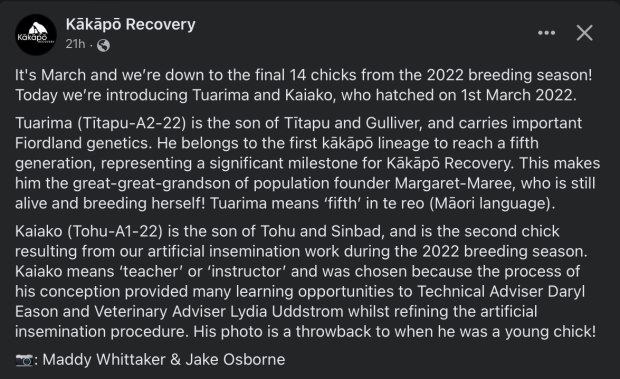
Two more Kakapo named!

In England, there have been calls to end or substantially shorten the Woodcock hunting season. Congratulations Nature England for getting a review! That is positive news.

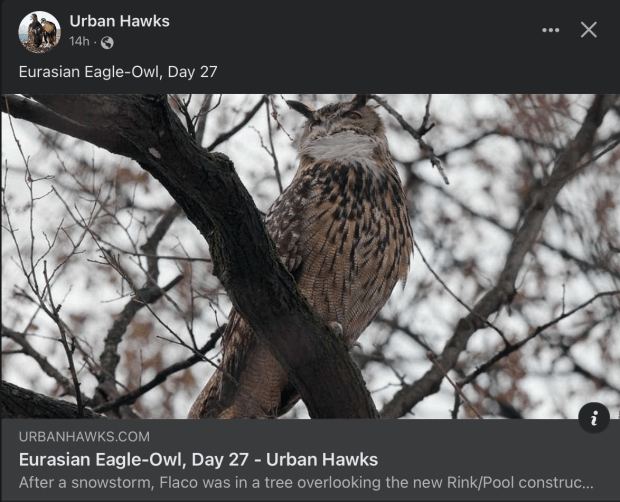
Flaco is still doing well in New York City’s Central Park. There are no current plans to try and bait the little Eurasian Owl and return it to its cage at the Zoo. If you want to keep up with what is happening with Flaco, the best news comes out of urbanhawks.com You can also find the latest news there on Pale Male and other raptors and concerns who live in the Central Park area.

I wanted to check on Karl II and his family – to see if any had started moving north. No. Waba is still in Sudan, and to the surprise of everyone, Udu has spent the winter in Turkey. No signal transmissions from Bonus, Karl II, or Kaia yet.

There is so much beginning to happen. You can feel the energy; before long, eaglets will be fledging at SW Florida, Ospreys hatching, and more eggs in the Channel Islands. We will not be able to keep up! Oh, and the UK Ospreys will return to their spring and summer breeding grounds.

Thank you so very much for being with me today. Please take care. See you soon!

If you want to join our Bird World family, please subscribe. It is always free. You can unsubscribe at any time.

Thank you to the following for their notes, their streaming cams, their videos, and posts that help make up my newsletter today: The Guardian, IWS, Sharon Pollock and Raptors of the World, Cal Falcons, Duke Farms, SW Florida Eagle Cam and D Pritchett, Vija and SW Florida Eagle Cam and D Pritchett, Lady Hawk and SW Florida Eagle Cam and D Pritchett, Sherry Morris and CIEL, Pix Cams, Denton Homes, Window to Wildlife, Raptor Resource Project and Explore.org, Bird Cam Network, Tucholskie Eagle Cam, Kakapo Recovery, @Jeff Knott, Urban Hawks, and Looduskalender English Forum, Following Karl II’s Family.

WTE spends a year living in wild with only one foot, Bonnie and Clyde are back…Wednesday in Bird World

1 February 2022

It is a new month and the shortest one of the year! It is -28 C in Winnipeg. The kittens spent some time enjoying the sunshine in the conservatory watching the birds today. Oh, what joy they bring — and of course, the birds and the squirrels.

Missy is the alpha cat – the boss. She gets the little house on the cat tree.

Lewis thinks he is ‘Kingpin’ on the top. Too funny. Missy looks sweet. She could make mincemeat out of Lewis at any time of day — if her gentle nature got stressed. So far, so good. She has even taken over his drawer in the console cabinet once or twice this week.

Lots of things starting to happen…the GHO couple that stole the Bald Eagle nest in 2021, skipped 2022, and are back this year with their first egg laid on Tuesday 31 January. A White-tail eagle lives a year successfully with only one along…wow.

In the Mailbox and Making News:

Geemeff sent me the link to this amazing story. Thank you, Geemeff! Before you go to the blog of Tim Mackrill and I do recommend reading it for the full story – stop for a moment and consider that this White-tailed Eagle has been living for at least a year without a foot.

If you work at a wildlife rehab facility, I urge you to print this up or send the link to the vets. Maybe it is time – in memory of our dear WBSE 26 – and all the others – that life can be full with one talon and the birds should be given a chance! Not a needle.

Copy and paste the link into your browser to read the blog if it doesn’t open up for you.

Birding. Often if you want to see birds, you wind up going to places you never dreamed…sewage treatment plants, industrial estates, garbage dumps and landfills. You may recall the stories and my blog about the Adjutant General in Assam or tales of the storks in Portugal or Spain. Well, here in Winnipeg, the Bald Eagles that have their nest at our nature centre frequent ‘the dump’ just a mile away.

EJ sent this link if you live around Boston’s Logan landfill:

https://www.kbzk.com/news/local-news/bald-eagles-flock-to-logan-landfill

I was very interested in a local mail out from our wildlife rehabber. For the first time, they have included ‘dogs’ in the pie chart of the causes of injuries to wildlife. It is more than cats! Indeed, dogs are the highest for our local wildlife. Wonder what it is where you live?

A bird charity in the UK has been locked out of its accounts. The bird is the Woodcock. Go figure.

The use of AI is causing problems on numerous social media outlets. Everyone is complaining. Isn’t that just the cutest little bird?

https://www.bbc.com/news/uk-england-norfolk-64451977?fbclid=IwAR2DGee2pUMFSSTnp2RnlUgH0nNw0lvchlHNDjIPja9BjLHFhu07u2MSw_g

The US EPA has vetoed the proposed Pebble mine in Bristol Bay Alaska that would have the potential of polluting the pristine waters that the Alaskan salmon enjoy. Ironically, I do not connect – in my head – the Alaskan Salmon with people’s meals but, with the Bald Eagles who thrive on it.

That said, if all of the agencies, around the world, were to enforce all clean air and water laws the world would be a better place for all of us – our feathered friends included. Today, for example, you cannot go and see wildlife at the Barbados Wildlife Reserve because raw sewage has been allowed to be dumped by neighbours to the sanctuary and it has created a biohazard area in the Mangroves.

Reports of raw sewage being poured into the water around the world is, sadly, becoming more and more of an occurrence. Band together with local groups and have a win like they did in Alaska — there will be no Pebble Mine!

https://www.hcn.org/articles/north-mining-the-epa-vetoed-alaskas-proposed-pebble-mine?utm_source=wcn1&utm_medium=email&utm_campaign=2023-01-31-Newsletter

‘L’ sent a link to a wonderful article about the decorative birdhouses in Turkey. She has seen them on her travels. Perhaps you have, too. The rest of us can enjoy the beautiful images in the following article. Thanks, ‘L’.

BIrdNote.org. https://www.amusingplanet.com/…/the-decorative…

Audubon has launched its bird migration explorer so you can follow species as they begin their trips from their winter homes to their spring and summer breeding grounds.

https://explorer.audubon.org/home?ms=digital-eng-email-ea-x-engagement_20230201_eng-email_bme-mobile-update&utm_source=ea&utm_medium=email&utm_campaign=engagement_20230201_eng-email&utm_content=bme-mobile-update&legend=collapse&zoom=3&x=1306099.1620122588&y=2810864.562197212

At the Nests:

First up. Remember the GHO pair that fought for and won the Bald Eagle nest on Farmer Derek’s property in Kansas? Well, guess who is back incubating the egg she laid this morning? Oh, yes, none other than Bonnie!

https://www.youtube.com/live/MRMzzjyumHs?feature=share

Oh, Sally and Harry have only two eggs at the Moorings Osprey nest. Can you see me jumping up and down for joy? Can you imagine if every nest only had 2 eggs??????? I would have nothing to do and that would be just fine.

Want to have a nervous breakdown quickly? because of a raptor? Just go over to visit Connick at the Captiva Bald Eagle nest! Connick had more of his body over the edge than inside. Sound asleep. Not a care in the world.

Adults working away on the nest burying that egg.

Connie managed to lure Connick back into the nest with some fish! Thank goodness. If that eaglet had wiggled the wrong way… OK. Everything is fine. Let’s not go there.

Connick is shaded by Mum Connie. By 1400 it is really hot on the nest.

It was a beautiful morning over at Superbeaks. The eagles were up early doing some self-feeding and then the adults begin to come in with some fresh prey. They still love feeding their babies…ha, ha. Babies. Big turkeys now. Pearl is 54 days old and Tico is 53.

The Superbeaks kids have been hot, little Connick was just panting and panting to stay cool and then getting cool with the aid of Mum. Imagine then what would it be like in Miami if Ron and Rose had chicks this late. Well, they have to lay the eggs first and then it is 35 days… I wonder? They are still working on that nest.

It is certainly a nice nest..my goodness, one of the nicest I have seen. Not many thought Ron Magill’s Papadum Chair nest would be accepted and ‘work’ for an eagle family but it proved itself last year. And, of course, there are three 2 week fertile periods so there is still a chance for eggs. Surely the eagles know better than I do whether to have eggs or not. Just seems like it would be awfully hot.

It is certainly not clear about the two eaglets at Webster Texas – Ringo, the eldest, and Boots, the tiny second hatch. Yesterday, Ringo got all the food til later in the day and finally, when I thought little Boots was too weak (it has been hot there) to eat, it got a full feeding and a full crop. Relief of sorts. It is hot. Did I say that several times. Boots has to be hydrated. Should be getting food every couple of hours he is so tiny, not once a day. But he ate. Send positive wishes to our little one.

Ringo with a huge crop. Mum reaches down to start feeding Boots.

Rhonda A caught the two eaglets of Alex and Andria working those wings yesterday after the rain and during the drizzle. Go Valentine! Go 02!

More flapping by Valentine!

Jackie and Shadow are really having to be careful during Tuesday. The Ravens are about. Shadow stays on the nest for some time while they each get a turn to eat some of the fish that Shadow brought in earlier on Monday.

At the nest of Gabby and V3 near St Petersburg, V3 was at the nest but as of 1600 Tuesday, Gabby has not been there today. Don’t think these two will be raising eaglets this year. Gabby might decide it is a good time to head on vacation when it starts getting really hot! Will V3 be the male of choice next year? We simply have to wait and see.

Gracie Shepherd caught E21, Harriet and M15’s oldest eagle this year standing up and walking – and using its wings for balance. Gosh, lots of eaglets working those legs these days (Alex and Andria’s, too and, of course, Tico and Pearl).

Zoe. I have to admit that I am quite nervous about our girl. This was the posting the 31st in Australia and they were hoping for a 2100 check in last night. Nothing so far. There is always the possibility of being out of phone range or the transmitter not working which would be a real issue if you want to track your recent fledgling. I wonder if anyone has gone to check the last transmission point? It is now after 1500 on 1 February in Port Lincoln and still no posting of a transmission for Zoe. I hope there are boots on the ground searching for our girl.

Thank you so much for being with me today. This has been a spin around the nests with a few twists. Take care everyone. See you soon.

Thank you to the following for their notes, their posts, their videos, announcements, tweets, and streaming cams where I took my screen captures for this blog: Geemeff, ‘EJ’, Roy Dennis Wildlife Foundation, KBZK, Wildlife Haven, BBC, HCN, Amusing Planet, Audubon, Farmer Derek, Moorings Park Ospreys, Window to Wildlife, Superbeaks, WRDC, Paul White and the Wester Eagle Watchers, Rhonda A and KNF-E3, FOBBV, NEFL-AEF, Gracie Shepherd and SWFL Eagles and D Pritchett, and the Port Lincoln Ospreys and Friends of Osprey.

Pipping at SW Florida? Sad news coming out of Sydney… Monday in Bird World

2 January 2022

Good Morning Everyone!

I hope that the first day of the new year started off in the right direction for everyone. At my house, it meant eating black-eyed peas for luck that I learned as a child growing up in Oklahoma. Today was also a day spent with my daughter and her family – a real treat with everyone together but the son and daughter in law who live in the Caribbean. That said, we did connect with them through the wonderful world of technology so, we were all in ‘the glass room’ together. Laughing. Smiling. Everyone is so busy that it was splendid just to stop, share a meal, and catch up on all the news.


In the mailbox: Geemeff sends us news from Yorkshire in the UK.There are some places that are taking bold moves and are forward thinking that have cancelled New Year’s Eve fireworks. If you know of other Councils or Cities, let me know! This is a good way to start the new year.
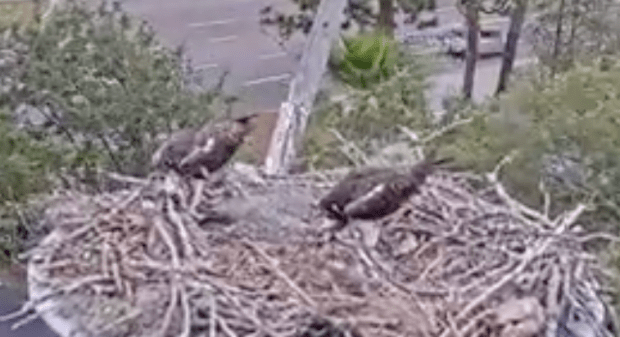
https://www.bbc.co.uk/news/uk-england-york-north-yorkshire-64139048.amp

And ‘C’ writes that they have named their squirrel visitor Dyson, too! I think this is marvellous. It is a perfect name for these smart squirrels all around the world who can outwit any bird feeder manufacturer!!!!!!!! (at least the ones in my garden, anyway)


Top story for this morning. At 1027 when Harriet got up, it appeared that there could be a beak pecking its way through the shell of the narrow end of one of the eggs. But, it is now unclear about that mark. It appears to have been some nesting material that caused all the excitement. Harriet is restless. But only a tiny little peck visible in one egg.

There is disturbing weather news coming for the US for the next couple of days and it could have a huge impact on the birds. In San Francisco on Sunday, they received 5.65 inches of rain. That is the most rain ever recorded since 1849 when records began. So what happens to the falcons when it rains like this? Do their prey hide? That area needs water. The reserves are filling but, in some places, there are floods that are going to be problematic and the rain is set to continue with another system moving in.

https://www.theguardian.com/environment/2023/jan/02/weather-tracker-san-francisco-hit-by-second-rainiest-day-on-record?CMP=share_btn_link

The system that brought all the rain to California is going to move into the central US where it will meet up with warm area from the Gulf region. It is going to bring snow and ice to the nests in Iowa. Tornadoes for the area around Alexandria, Louisiana could happen today hitting the nests of Anna and Louis and Andria and Alex and Andria are going to be right in the middle of it, according to one of the current forecasts. I do not watch the weather that much but, I do check on anything that will impact our raptors!

That pink is ice and I am thinking about all of the eagles and other wildlife and birds in that region including Decorah (the system will move through Iowa).

This is a band of tornadoes potentially and Alexandria, Louisiana is right in the middle of it along with our Kistachie National Forest eagle families. You send out all the positive wishes you can to those little eaglets and their parents in E3.

Gabby and V3 were at the nest making restorations today together. I think that it is safe to say that V3 is the ‘chosen’ one to become Gabby’s mate. While we might have had another favourite out of the many suitors that came to the nest, only Gabby knows ‘the why’ of choosing V3 over anyone else. Seeing them together, working on their future, was certainly a wonderful way to spend part of the first day of the new year.

I like his eyes, he brought food, and he seemingly keeps the rest of the intruders away – a real good security guard for the nest and for Gabby. May their lives be long, healthy, and productive – as in cute little eaglets! They sure are a striking couple. But, V3 needs a name. Wonder what it will be?

He is a good provider. Just look at the crop on V3!!!!!! Sadly, Gabby isn’t always there to receive the food gifts.

Another raptor family, Big Red and Arthur, were spotted today on the Cornell Campus by Suzanne Arnold Horning. It is always a gift to see them when it is not nesting time and it is thanks to the BOGS that we are assured of their well-being. Thank you Suzanne!

Arthur sitting on top of a post looking for a vole to move in the grass. If you think about it, raptors hunt so differently. The Red-tail Hawks sit, sometimes for 45 minutes to an hour, elevated – waiting and watching and then they swoop down. Hen Harriers on the other hand fly low over the landscape once they have identified where their dinner might be. Ospreys hover focusing when they find a fish and then making that dramatic dive. They are as different in their behaviours as they are in their plumage. And Red-tail Hawks are gorgeous. My friend Toni died this year. Her and I used to banter back and forth over the most beautiful plumage. I can say that she certainly got me to appreciating that of the White-bellied sea eagle juveniles. In the end, though, they are all gorgeous in their unique ways.

Big Red. She is looking really good for a 20 year old Red-tail Hawk!

Cornell posted other images of Big Red from the 31st on their Twitter feed today.

It was raining at Orange and Elain caught some good images of one wet falcon in her daily summary of life with Diamond, Xavier, and Indigo.

There was lots of action on New Year’s Day and Deb Steyck caught Bella and Smitty arriving at the NCTC Bald Eagle nest. It is good to see them together. Last year Bella was injured in a territorial battle. She did not return to the nest for some three weeks while Smitty took up with another female. Bella kicked her off the nest and out of the area and, well, it is good to see the two together this year. Hopefully there will be little eaglets this year to make up for last!

So let’s have a conversation about one legged eagles. But before I begin, there are deer in my community that live a normal life in our urban forests and have only three legs. When I grew up, my parents had a three legged dog. They were able to adapt. While one might want to argue that an eagle with just a single leg could not possibly fish or feed itself and would starve to death, please read further down. And if you know of an eagle in the wild living with a handicap, send me a note.

There has been a bit of discussion about Clay, the one legged eagle that was in rehab at Wild Heart Ranch near Tulsa was euthanised. I have not followed this case closely but, it was a second trip for the bird who went back to the first place where it was rescued. Clay arrived with a badly infected foot that was later determined to be dead along other injuries. It is not clear to me how he was injured. It is, however, my understanding that the regulations of the USFWS do not allow wildlife rehabbers to keep one-legged Bald Eagles. Please correct me if I am wrong. I also came to understand today that it was that policy that drove the euthanasia. Again, please correct me if I am wrong. No one wants an eagle to suffer, let us be clear. This decision has prompted some to ask about the policy in light of animals living in the wild with less that the normal number of legs.

Today, an individual who has spent years around the Mississippi taking images of the Love Trio, Dennis Brecht, posted a photo he took of a Bald Eagle with one leg flying around the Mississippi at the location in the posting. Just saying. That eagle looks pretty healthy. — I have seen Dennis’s images for several years now and do not believe him to be a person who would deliberately manipulate an image.

So this brings me to another eaglet, WBSE 29 – who we all grew to love at the White-Bellied Sea Eagle nest in the Sydney Olympic Park has been euthanised. I just received a note from a very trusted individual who taught me much about eagles and kept my focus straight and not off in fantasy land. Tonight there are plenty of people whose emotions range from disappointment to fury. Here is the announcement:

As you know SE29 was rescued in early October, after some sort of severe trauma (we are not sure if he flew into a window or was hit by a car).

When he arrived he was bleeding from inside the beak indicating a bleed in the lung following the trauma. He also suffered a particularly nasty fracture just above the foot, which you can see in the radiograph attached to this post. The challenge about this fracture is firstly, that it is quite oblique, and secondly, that it is very far down in the bone, making the orthopaedic repair required quite difficult.

While stabilising and after consultation with many other raptor veterinarians around the world, we initially tried to stabilise the foot in a special cast. But it became apparent quite soon that due to the oblique nature of the fracture the fragments just could not be immobilised properly and there was still some sliding.

Normally these fractures in birds are repaired with an external fixation device. This involves crossbars through the bone which are connected and held in position by external rods. The goal is to have two crossbars in each fragment of the bone. We knew that trying to repair this fracture would be a push, because of the little room left for us in the fragment closer to the foot.

But SE29 was a young bird (this helps with healing) and he was dealing well with the process of being in care, having a generally gentle demeanour, so repair was attempted) and we placed a type 2 external fixation device. You can see on the picture what this structure looks like.

We then had to wait for the bone to mend until we could remove the pins. During this whole process SE29 has been a gentle, strong bird and has allowed us to take him through the rehabilitation process.

However, we have promised ourselves, we would only persevere with his rehabilitation if there was a reasonable chance for SE29 to return into the wild. This is where he came from, and the life of freedom is what he should have if we could make it so.

Two months into the rehabilitation process, the external fixation device was removed and it became clear that some of the tendons making the digits move did not work normally any more, and possibly there was some joint damage at the tarsometatarsal – phalanx 1 joint.

The foot is a structure a raptor just cannot live without, and we had to accept that our attempts had not worked out as we hoped. We knew it was a push from the start (again, this was a very unfavourable fracture), but SE29 had just been doing so well until then and he made us hope even more it would work out in the end. Unfortunately at this point it became clear, SE29 would not be able to be released and he was euthanased for the reasons described above.

Much like all of you, who fell in love with this little bird from since he was an egg, working with him and getting to know him also allowed him to take a very special place in our hearts and sharing these news fills us with sadness. But we are glad that we did give this bird a chance, because otherwise we would have never known.

Raptor Recovery Australia FB

WBSE29 was a beautiful vibrant bird.

There are tears flowing in so many places.

The sad truth about all of this is that the situation in the Sydney Olympic Forest is untenable. The population of Pied Currawongs, Magpies, BooBook Owls, and Ravens has grown unchecked. The sea eagles do not eat them. The energy it would take to catch them would not warrant the amount of meat on their carcass. The small birds, however, attack the sea eaglets and the adults at the nest relentlessly and chase the eaglets out of the forest the minute they fledge. That means that the parents are not able to feed them, to teach them to hunt and the fledglings cannot improve their flying in peace like we see at so many other nests. Then smaller birds attack the sea eaglets when they are grounded. They were even attacking 29 when it was wrapped in a blanket being rescued! The only way that the eaglets that we grow to love so much can survive is if they are picked up the minute they are grounded and taken into a facility that will go the extra mile to ensure that they are given every opportunity to live and be released. One very good thing is that the folks on the ground- and there is a growing number of caring individuals – are dedicated to watching out for the eaglets. They make sure that care is sought the minute they see them in danger – it is the only way that they will have a chance of survival.

Maybe that nest tree should be cut down, too! Believe me I never advocate cutting down trees but, what will it take for the menacing small birds to leave the WBSE in peace?

There is some really welcome good news coming out of New Zealand today. Dr Andrew Rigby has tweeted the following announcement about the flightless green parrots that we love so much – the Kakapo.

Spend a little time with Alex and Andria – Alex working on the chair rails and those cute little eagles, 01 and 02.

Gosh, it is going to get really busy soon. Those eagle nests that are not on pip watch right now or taking care of eaglets, are really getting restorations. Nancy and her new mate arrived early at the MN-DNR nest to work on their nest.

Zoe is 107 days old today. Yesterday Dad brought in one fish for Zoe and Mum brought in two! The times were late in the day: 1606, 1759, and 1816. I wonder if they are waiting to see if their girl will go out on her own before bringing in fish for her????? Is Zoe fishing yet?

Zoe and her parents are Eastern Ospreys. Unlike the Ospreys in Europe and North America and Canada, they do not migrate. In trying to search for recent research on post-fledge independence, I came across a study about Western nests that clearly indicate that the birds become independent a month to six weeks (some stay for ten weeks) after fledgling. The timing, of course, is related to their need to be ready for migration. But what about the Eastern Ospreys at Port Lincoln? Ervie was being fed much longer last year. We attributed it to his missing talon but, what is the average age for Eastern ospreys to become independent, fully independent of their parents? According to information from Susan Close, MP, Minister for the Environment and Water in South Australia, “Young were found to fledge at 9-10 weeks of age in a study on Kangaroo Island (Dennis 2007a), and are sometimes provided with fish for a further 5-6 weeks by the male.”

If we take the extreme dates, the number of days for the non-migratory Eastern Osprey to become fully independent of their parents, is 112 days. Zoe is now 107 so she is well within that range. Interesting to note is that Mum is also providing fish for her daughter. It is normally the male – in all of the Osprey species. Is Mum providing more food for Zoe because, as we fear, there is ‘something wrong’ with Dad. He had two seizures on camera and was seen at times not to fish to his usual standard. That could have been for many reasons but, is he unwell? We do not know the answer to this and might not find out for some time but, clearly, let’s watch those fish deliveries and also, let us watch how long Zoe stays on the nest getting food.

Here is the report by the Minister of the Environment and Water on the status of the White-Bellied Sea Eagles and the Ospreys and the government’s plan for them as they are endangered. It is a worthwhile report to read – to help us understand how the South Australian government sees the recovery of these magnificent raptors. It is recent – July 2022.

Thank you so very much for being with me today. Take care of yourselves. See you soon.

Thank you to the following for their videos, letters, posts, announcements, and streaming cams where I took my screen captures: Geemeff, ‘C’, The Weather Guy, SWFlorida Eagles and D Pritchett, NEFL-AEF, Suzanne Arnold Horning, @CornellHawks, Elain and Charles Sturt Falcon Cam and Cilla Kinross, Deb Stick and the NTCT, Wild Heart Rescue FB, Dennis Brecht, Raptor Recovery Australia, @takapo, KNF-E3, MN-DNR, Port Lincoln Ospreys, and the South Australia Government.

Annie and Alden, a whopper for Zoe and some serious hovering…early Monday in Bird World

21 November 2022

Oh, the best of the morning to all of you! I hope this newsletter finds you well and happy and taking some time to de-stress out of doors if you need it — or watching our marvellous birds from inside your home or on the streaming cams. It is so nice to have you hear with us.

The weather continues to be wintery with no break now until spring, late spring normally here in Canada. The garden animals have been all flooded up keeping warm. Me, too! It is, however, very hard to imagine that in 40 days it will be a brand new year.

Dyson never disappoints in her ability to find and get food efficiently. She has a perfect spot on a branch where she sits and can eat right out of the bird feeder!

The Starlings really are lovely. This one flew down to check out what the Blue Jay was interested in on the deck but, normally they always stay in the lilacs or the back trees.

The Starlings and Sparrows share the Butter Bark.

In the Mailbox:

‘J’ sent a link to a blog that some of you might find interesting. It goes to the heart of our earlier discussions about birds and emotions. Thank you ‘J’!

Website of Gaby Schulemann-Maier: https://nam12.safelinks.protection.outlook.com/?url=https%3A%2F%2Fwww.birds-online.de%2Fwp%2Fen%2Fbirds-online-english%2F&data=05%7C01%7C%7C49ef41f33eef4818ef3508dacb2dc009%7C84df9e7fe9f640afb435aaaaaaaaaaaa%7C1%7C0%7C638045694605754558%7CUnknown%7CTWFpbGZsb3d8eyJWIjoiMC4wLjAwMDAiLCJQIjoiV2luMzIiLCJBTiI6Ik1haWwiLCJXVCI6Mn0%3D%7C3000%7C%7C%7C&sdata=v%2Fr%2BhO5flt0reUFvtxw5W3DyZoKqhMrl8uH5CodWB7E%3D&reserved=0

‘BG’ and I both agree that we neither fans of soccer or Twitter but, a World Cup of Birds – yes! Each team in the World Cup has been assigned a bird. Let’s follow and see who wins. Thanks ‘BG’ for sending me this!

Jer Thorp: “We’ve got 4 days until the World Cup. 4 days to decide the MOST important question: Which country in the tournament has the best national bird? 16 birds have already flown home. 16 are ready for glory. Welcome to the knockout stages of the #WorldCupOfBirds!!!”

Making News:

‘B’ sent me a note. Annie and Alden were on camera at The Campanile on the grounds of UC-Berkeley on Sunday. I admit to shedding a couple of little tears – tears of joy – to see them together and with such a nice crop. Looking forward to screaming eyases. Can’t wait. Thank you ‘B’. I know that everyone has been wondering about this lovely couple – Alden another one of those amazing males that stepped in and saved the season.

Emyr Evans of the Dyfi Osprey Project in Wales has permission to post all the information about Paith. Faith was the youngest of the three osplets (2 females, 1 male) of Idris and Telly at the Dyfi nest. The information that Evans has comes from early September – so awhile ago but he just received it. Faith was in Brittany, one of the northern most areas off France and due south as straight as a crow could fly from her nest in Wales. Is she on her way to Africa? or will she overwinter in France?

To get the full story and see the maps, and migration ages of the osplets from Dyfi, please go to dfyispreyproject.com

Tiger Mozone has also posted some information that indicates there are Ospreys that do over winter in this area of France. I think this is really interesting because it is always presumed that the birds go all the way to Africa. It appears not and we do know that many are now over wintering in Portugal and Spain. It may help with the decline in populations due to migration incidents and it might also speak to the changing landscape in Africa in terms of fish availability.

Congratulations goes out to Dave Anderson who has won the prestigious prize – the RSPB Species Award. Anderson is well known in the UK raptor world for his work with White-tailed Eagles and, in particular, promoting research on them by using satellite tracking. I cannot think of a more deserving person. You can read all about him and his extensive work with raptors – a life dedicated to bettering theirs – by clicking on the link in the announcement below.

Australian Nests:

Early Monday morning in Australia, Xavier went to the scrape box with a nice prey item for breakfast. Was he trying to lure Rubus and Indigo to the box?

Indigo will arrive in the box and will be seen on the top of the tower but, Rubus did not fly up to join Indigo. They have been seen in the trees and it would appear that all is well. Xavier was there with them for some time and Diamond was photographed flying around the trees keeping guards on her precious fledglings.

News has come in regarding Rubus today: “Rubus fledged yesterday at 0818 h and has been found alive and well in a pine shelterbelt a few hundred metres from the tower. He was in a tree (so can fly at least a bit). He was still in the same area this morning, but a bit closer to the tower, He was found on the ground and placed in a tree in the woodland.”

Shines found Rubus and wrapped him in a blanket and placed him on the tree branch. Thank you, Shines!

Xavier and Diamond have both been in and out of the scrape. It is entirely possible that they are trying to lure Rubus back into the box so that he can rest and they can feed him there.

In Port Lincoln, Dad flew in with a whopper for Zoe at 1015. Port Lincoln has a severe wind alert for gusts up to 34 kph. Mum and Dad are very smart. This is one way to keep Zoe on the nest – a big fish!

Mum flies in while Zoe mantles the fish.

Just look. Dad had a good feed and Mum is looking down knowing there should be some left for her, too. I wonder if Zoe will want all of this fish to herself?

Zoe is trying. She has her talons in the fish holding it down and is doing a pretty good job eating away.

That is a big fish!

Mum would really like to have some of that nice fish but Zoe isn’t quite ready to give up.

At 11:56 Mum takes control of the fish. Zoe looks like she wants Mum to feed her. She has not made much progress on it herself.

Mum had different ideas. She wants some fish, too and it looks like Zoe ate enough to have a nice crop. Mum flies away with that fish so she can enjoy it all to herself. I wonder if she will bring any of it back to Zoe?

Zoe was not happy!

Of course, the answer is ‘yes’. Mum ate her fill and returned to the next some time later to feed Zoe.

That fish was sooooooooo large that the entire family had a nice big meal. How grand. Thanks Dad!

Zoe did some serious helicoptering. She is ready to fly! It will be soon.

No 11 The Red List: Montagu’s Harrier

Montagu’s Harrier (Circus pygargus” by Ian N. White is licensed under CC BY-NC-SA 2.0.

Montagu’s Harrier is the most rare of any of the birds of prey in the UK. This incredible raptor was not in any nest records in the UK in 2020 nor in 2021. Their numbers began to decline in 2015. That year there were only 5 nests in the UK. It is feared that they might already be extinct, not just vulnerable.

These are magnificent raptors that fly low, like the Hen Harrier, in search of rabbits, small birds, lizards, insects, and shrews. They also soar high above the fields in the thermals and their flying and hunting has been described as ‘spectacular’.

Just look at that stunning plumage. Again, it is anything but a drab grey. How about a light blue steel grey on the wings with a light cream around the eye, a very slight dark blue grey eye line and band around the cream. How else would you describe this magnificent species?

Montagu’s Harrier – Circus pygargus (male)” by Tarique Saniis licensed under CC BY-NC-SA 2.0.

They are a medium sized raptor, 43-47 cm long, that is slim with very long pointed wings like a Hen Harrier. They have a long tail. The upper body of the male is grey. The primaries are black and the secondaries have a black stripe or band across them. They are white underneath. The female is a gorgeous dark brown. The bills are hooked and black with a bright chrome-yellow cere. Their legs and feet are also chrome-yellow. Notice the striking yellow eyes.

The demise of the Montagu’s Harrier is due to the over and expanding use of pesticides, the expansion of fields into modern agriculture, the destruction of their nests which are on the ground in the fields during harvesting. In addition, their food sources have declined dramatically due to the use of pesticides! These raptors need protected areas for nesting and an end to the use of contemporary pesticides that kill the birds by secondary poisoning or by killing their food source. The Montagu’s Harrier migrates to Africa and so, in both of their respective homes, they are subject to ever expanding agricultural practices and the use of deadly poisons. Those poisons should be banned internationally. They are also quite dangerous to humans. Ask anyone who has lived around a farm in Canada who has developed asthma and breathing issues early in their life.

This is an immature. Notice that gorgeous rust brown above the yellow legs, the barred tail with the grey and espresso brown, the light grey around those chrome-yellow eyes…what a beauty.

Montagu’s Harrier immature” by Rainbirder is licensed under CC BY-NC-SA 2.0.

I couldn’t leave without posting an image of a mature female Montagu’s Harrier. These females are stunning in their own right. Look closely. Their plumage is anything but a drab brown. Starting with the head and around the eyes, that bright chrome-yellow cere stands out amongst that deep chocolate brown. The white around the eyes with the espresso eyeliner and eye liner inside of the dark espresso band on a camel coloured head and breast are brilliant. It took a lot of the crayons out of the box to come up with this outstanding colour palette. That camel mixes with the deep chelate again on the back, and the wings while holding its own on the breast, chest and underparts. She is gorgeous.

File:Montagu’s Harrier, juvenile, Bangalore, India (edit).jpg” by Cks3976 is licensed under CC BY-SA 3.0.

Oh, thank you so much for being with me today. It is always my pleasure to carry on and on and on about the beautiful feathered friends that bring us so much joy – and most often, tranquility. Take dare of yourselves. See you soon!

Thank you to the following for their posts and streaming cams where I took my screen captures: ‘BG’ for the World Cup of Birds, ‘B’ for letting me know about Annie and Alden, ‘J’ for her great link in the mail re birds and emotions, Cal Faldons, Dyfi Osprey Project, Gregarious J Toonen for Ospreys Pandion Haliaetus FB and Tiger Mozone, Port Lincoln Ospreys, Charles Sturt Falcon Cam and Cilla Kinross, and Open Verse.

Indigo fed on top of tower…and other Early Friday news in Bird World

18 November 2022

Good Morning Everyone,

I hope this newsletter finds all of you well. It is the end of the week. In a fortnight I will be on the island of Grenada in the West Indies visiting my son and looking for birds. He doesn’t know it but I have plotted the spots on the island and I am hoping that we can see at least 25% of the birds on the island – that would be about 40 new species. There are Ospreys right by his office and I am told hummingbirds and hawks in his garden. Can’t wait. With the pandemic, it has been far too long since I have seen him. There are many birds that I do not know or some that have similar names such as the Coot but the one in the Caribbean has a white shield on its head along with its white beak. There are any number of shore birds. So excited. I have a copy of the small book, Birds of the Eastern Caribbean on my desk to help me get acquainted.

In the Mailbox:

An absolutely timely and great question from ‘H’: “Funny you mentioned about the three Stepdads for Peregrine families. I was just thinking about that yesterday. I had wondered if you had ever known any other species where that had occurred. Have you known of any cases where another male had taken over responsibilities of hunting/incubating/parenting duties at the nests of Ospreys or Eagles, for example? (Not including where a chick had intentionally been placed on a different nest) Is this just a Peregrine Falcon thing?”

A bit of background for those not familiar. It is hard to imagine Diamond without Xavier. I recounted in my last blog how Xavier came and helped Diamond with her eyases when Bula disappeared. He was named Xavier because he was a saviour to our dear Diamond and her clutch. The eyases would not have survived having just hatched without Xavier bringing food to Diamond. We all know that Alden stepped in for Grinnell at the University of California at Berkeley scrape belonging to Annie. And we have recently witnessed Male2022 help raise Male2017’s eyases at the ledge scrape of 367 Collins Street in Melbourne. There are a number of instances coming out of the UK where a step dad or extended family members have helped raise clutches including fledglings. But, to get back to the question at hand.

Ospreys go absolutely crazy at the thought the eggs that are in the nest might belong to another male. I posted a couple of video examples a few months back of an osprey kicking the eggs out of the nest that he believed belonged to another male. I have never seen a male Osprey raise another male’s osplets. I have also never seen an eagle of any species take over the role of the male and raise another’s eaglets.

There are, as you seem to have indicated, many instances whereby the fostering of eggs and/or chicks has been successful but that is an entirely different situation to what you are asking. I have tried to find literature on the topic to more fully answer your question and if there is anyone reading this that knows of examples other than Peregrine Falcons becoming active step-dads, please do bring that to my attention.

After reading about ‘J’s’ budgie, Wolpe, Raj writes that they had a very similar incident with their pet birds. ” My pet budgie Daisy was best friends with Blue. Both inseparable. Loving each other always side by side. One day Daisy died. I held Daisy in my palm. Blue was so distressed and loudly screeched when Daisy died. Blue was very quiet not eating or playing.” When a new budget, Sky, came to the family, Blue was not interested. He was only in love with Daisy.” Thank you, Raj. This another beautiful example of the emotions that our feathered friends feel and express.

In the News:

Humans must steer clear of Yew trees as they are very poisonous to us but, not to our charming Nuthatches!

https://www.theguardian.com/environment/2022/nov/16/country-diary-the-nuthatch-takes-a-toxin-that-can-paralyse-our-hearts

Australian Nests:

Zoe is a big girl. We knew that when they weighed and banded her but today, Mum purposefully left a nice fish (sans head) for Zoe to see what she would do. Well, Zoe took the fish and ate every last bite including the tail as watchers cheered her on. The fish tail was horked at 11:11.

Zoe takes pulls the fish over so she can eat it as Mum looks on. This is crucial – Mum is full and knows that Zoe needs to self feed and will be fledging soon.

“Nice talons you have, Zoe.” “All the better to scratch you with!”

At Orange, panic might have set in if you looked at the scrape and did not see any eyases in there. Indigo flew out and was on top of the tower. Look carefully and you will see Rubus sleeping in the corner – bottom left reveals his tail.

A really nice and informative interview with Cilla Kinross about the history of the scrape and the Peregrine Falcons at Orange.

Indigo left the scrape at 101439 and he returned at 121012. Diamond had been in the scrape with prey and flew out with it right when Indigo came back. Rubus was really wondering what was going on and gave some of his very loud prey cries.

After a busy morning with 4 prey deliveries in 5 hours – and one being removed – the two lads, Indigo and Rubus, settled down to a nice sleep on the ledge.

I don’t know about anyone else but, I am really pleased that Indigo is returning to the scrape box, flying off for short periods to strengthen him flying techniques, and then returning again for prey and rest. Surely this will help him to be much more successful!

‘A’ sent a link to a video of Indigo being fed on top of the water tower. Thanks, ‘A’! Great clip.

The Red List. No 8. White-tailed Eagle

White – tailed eagle” by gcalsa is licensed under CC BY-ND 2.0.

At one time there were thought to be at least 1400 pairs of breeding White-tailed Eagles in the United Kingdom. By the beginning of the 20th century, the White-tailed Eagle was almost extinct. Before their recent re-introduction, the birds last bred in England and Wales in the 1830s, in Ireland in 1898 and in Scotland in 1916.   The RSPB reports that the last UK birds was shot in Shetland in 1918.

White-tailed eagle” by Ignacio Ferre is licensed under CC BY-NC-ND 2.0.

Reintroduction efforts began in 1959 and 1968 in Scotland. They were not successful. Then in 1975, juvenile eagles brought to the UK from Norway were released on the Isle of Rum in the Hebrides. The first pair bred successfully a decade later and now there are 130 pairs of White-tail breeding Eagles across the west and north of Scotland.

White-tail Eagles have added much to the economy and at the Isle of Munn where there are so many, the boost to the local coffers from bird tourism was 5 million GBP. Still, humans kill these beautiful birds.

The reintroduction efforts were the hard work of Roy Dennis and the Roy Dennis Wildlife Foundation. Continuing efforts are now overseen by the Sea Eagle Project Team – a joint effort of the RSPB and Scottish Natural Heritage. The biggest threats are predation by illegal killing particularly around the grouse hunting estates and secondary poisoning.  

Thank you so much for being with me today. Please take care of yourselves. See you soon.

Thank you to the following for their posts, videos, and streaming cams that make up my screen captures: ‘A’, OpenVerse, The Guardian, Port Lincoln Ospreys, Charles Sturt Falcon Cam and Cilla Kinross, and OmarGlobal.