Tuesday in Bird World

It is a grey and windy day. As the weather channel promised, our summer heat wave in October seems to have come to an end (for the moment) with the arrival of single digit temperatures. The recent rains have caused the ground and old tree stumps to come alive and the sparrows and thrashers are thumping the ground having a good old time. It reminds me – continues to remind me – why we should not be raking our leaves or mowing the grass. Gently rake them into a corner if you have to. The birds really will thank you!

It is also nearing Halloween and all around me I can see the windows and doors decorated – many have elaborate displays outside.

I believe Halloween was the favourite holiday of my children – you got to dress up, get candy, and have parties at School. I recall pulling the two oldest in a sled one year as the snowflakes fell faster and faster. We did not need to go more than a block. Their pillowcases were full because they were the only ones out on such an incredible wintery night. The grandchildren enjoyed decorating the trees and, sadly, I remember using some of that web material with little black plastic spiders. That was a long time ago when I did not know better – but I do now. As a reminder to everyone, please be careful if you decorate. It will be a tragedy if animals get caught and have to be euthanized just for a bit of fun.

Oh, gosh, golly. Xavier and Diamond’s little chick just took its first steps!

Meanwhile, the Collins Street Four – which are a week older – are now standing up. They are also getting curious about the outside world and one nearly gave several streaming cam viewers a heart attack when it walked up to the edge of the ledge.

The Collins Four having some fun. Look at the size of the wings!

In case you are wondering why the scrape box is so messy this year, it is because the wind does not blow through it like it did at the other end. On a positive note, the chicks have been supplied with some shade and neither them or Mum have been as hot and panting as much as last year.

At the Port Lincoln Osprey Nest, the osplets had, at least, five fish yesterday – probably a couple more. I could not rewind the camera prior to 16:00 and all had big crops at that time. One of the most interesting interactions was between Little Bob and Mum. They had a tug-o-war with the fish tail. Mum won!!! It was very cute. that fish tail was from the 18:02:17 fish Dad brought in.

The osplets are doing really well walking around in that twig lined nest, too. They are covered more and more with feathers each day. Those feathers seem to be pushing out of those quills right before our eyes.

Dad brought in a bedtime fish for the family at 19:39:16. It is difficult to tell one from the other but there is Little Bob in its usual spot, right up by Mum’s beak.

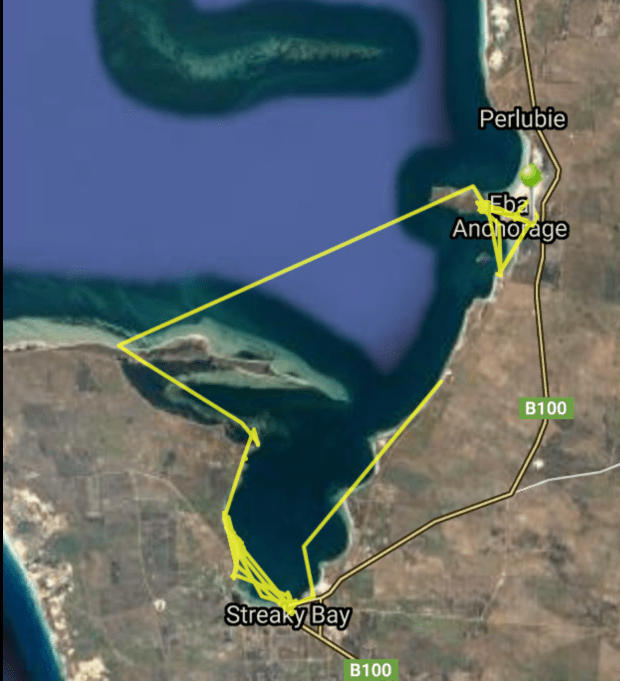
Where is Solly, the first hatch of the Port Lincoln Osprey Barge in 2020? She seems to have decided to take a quick trip to Streaky Bay before heading back to her special tree in Eba Anchorage. It is such a relief to see the movements of the birds – to know they are safe, living their lives well.

If you were following some of the Montana Ospreys, a map of their locations has been released on the Montana Osprey FB page this morning. It shows that all of the Ospreys arrived in Mexico or Central America. Such good news. Their satellite trackers are working splendidly.

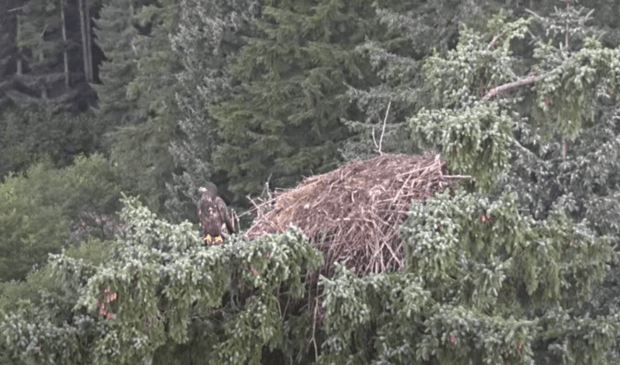
Both of the little sea eagles, WBSE 27 and 28, were still on the nest early this morning. That doesn’t mean that they will be there in a couple of hours.

I am a huge fan of Gabby and Samson’s at the Northeast Florida Bald Eagle nest near Jacksonville. The morning was just starting. The couple spent the night on the branches and as the sun came up, Gabby could be seen working on the nest.

At various times during the day, Samson, Gabby, or both, can be seen preparing their nest for the new breeding season. Here is a link to the streaming cams (there are several but this one looks directly into the nest), so you can check on them.

Tiaki, the 2021 Royal Albatross Cam Chick, is making really good time on her way to Chile. She was well beyond the International Date Line this morning. So, with that news, everyone in Bird World is doing well today. Smile. It is all good!

The sun is out and the Slate-grey Juncos are on the deck and the sparrows are having a drink out of the bowls. I wonder what other garden critters will show up? No Halloween candy for them! But they are getting extra dry corn cobs.

Thank you for joining me. Take care each and every one of you. See you soon.

Thank you to the following for their streaming cams where I took my screen captures: Port Lincoln Osprey Project, NEFlorida Bald Eagle Cam and the AEF, Sea Eagle Cam@ Birdlife Australia Discovery Centre, and the Montana Osprey Project and the Port Lincoln Osprey Project FB Pages for the sat-pak maps showing the location of the migrating Montana Ospreys and Solly.

Late Wednesday Bird World check in

The streaming cam is now back on line at the Port Lincoln Osprey Barge. Instead of being late Wednesday it is Thursday. It is a wet miserable day there, too. The osplets are waiting for their breakfast fish to arrive. It is currently 10:30.

The stark contrast between that gorgeous blue of the Port Lincoln waters and the white of the talons makes it almost appear as if Mum and the chicks had gone shopping for those vinyl ‘mod’ boots of the Twiggy era.

Mum is amazing. She tries absolutely everything to try and crowd the chicks under here so they will not get wet. Of course, their feathering will not keep them dry but there is nothing so nice to keep a chill off as being toasty warm under Mum.

The chicks are standing a bit more. Isn’t that one cute? You can really see the development of the tail. Their pantaloons are showing, too. The term has been adopted for decades when talking about the upper leg feathers of the raptors. Originally, the casual name for them was ‘britches’. They are actually the crural feathers and they cover the tibial area of the leg. They continue up to the chest.

Look at those wing and tail feathers! Wow. Growing before our eyes they are.

The skies open again around 9:37 and Mum works hard to crowd in next to the chicks.

Once the rain stops she is off to try and catch a fish for everyone’s breakfast. She has been fishing more and it is certainly keeping the wee babes happy – and full.

It is really beginning to be difficult to tell which chick is which. Each had some type of a mark on their head. Little Bob had a big circle and he had the white webbing pattern on his cere with a huge white swipe with a wide paint brush under his eye. If that him in the middle?

Big ‘sometimes-not-so-nice’ sibling is in the very front. Her eye is much darker with a wider eye stripe. She has always appeared much darker than the other chicks. Did you know that professional ball players adopted adding a black line under their eyes to keep off the glare?

You can really see the very dark wooly down on the chick standing up. You can also see how the crural feathers continue on to the chest area easier, too.

Now look. Is that our Little Bob at the back? I think so. The circle and the white are there as is the white on the cere. Oh, but they could be fooling us. Even their sizes are coming together so that it is difficult to recognize one from the other.

Let us hope that a nice fish for their breakfast arrives soon!

Ah. There is Little Bob turned around facing Mum in case a fish lands right there.

Awwww. Xavier. What a sweetie. He has arrived with the third item of prey for the baby at 10:14 but Diamond is ignoring him. The chick is full having had two feedings already. Maybe Xavier will get a chance to enjoy that Starling himself.

Remember to go and vote on the names for Xavier and Diamond’s baby. Cilla Kinross selected Maori names for weather. You can find the form here:

https://forms.gle/iPQhxDCLtEh19jp38

As the sun sets in central Louisiana, Anna and Louis are still on the nest making adjustments for the upcoming eggs. They have now flown off and are roosting elsewhere.

Wish for a fish! The trio at Port Lincoln will be very hungry when it arrives.

Take care. Thank you so much for joining me this evening.

Thanks to the following for their streaming cams where I took my screen shots: the KNF Bald Eagle Cam, Charles Sturt University Falcon Cam at Orange and Cilla Kinross, and the Port Lincoln Osprey Project.

Bird World Happenings

For those of you hoping for a second hatch at Diamond and Xavier’s scrape box, it is not to be. Either the eggs were not viable or the second chick died trying to hatch. What we have, however, is one really healthy eyas whose eyes will open in the next few days and what a delight that will be. One healthy baby is just fine!

A video was made of one of the chick’s feedings. I cannot wait til it can see its parents! How wonderful.

It is pitching down rain in Port Lincoln. Mum and the three osplets are absolutely soaked to the core.

Mum is the best. She is trying as hard as she can to keep her three babies from catching a chill. Sadly, Melbourne’s weather says it is to have rainy periods through Saturday. I do hope the nest gets a chance to dry out for this incredible Osprey family.

To my knowledge no breakfast has come in yet. Mum is really tired and would appreciate the sleep. She has a smelly wet pillow!

It is an hour later and Mum is beginning to dry out just a little. Hopefully Dad will be in with a fish soon.

The Melbourne Four have already had three meals today – before 8:30! These parents are working overtime. It has to be exhausting. Look how big that little one is and how big its crop is. These four are also healthy and strong. Well done Mum and Dad.

Skipping over to the US, those who fell in love with Anna and Louis during their first year as Bald Eagle parents will be excited to know that the streaming cam is up and running. Here is the link to that nest at Lake Kincaid in the Kisatachie National Forest. Last year, Anna and Louis had one eaglet fledge, Kisatachie. It was wonderful to watch the parents grow into their roles as parents. One time Louis was so eager to provide food early on that he had 18 fish in a pile. I can sure imagine quite a few nests that would have liked some of that! Kisatchie grew big and strong and honoured this old Bald Eagle nest that had not had an eaglet hatch or fledge in 13 years. Incredible.

Cody, Steve and the gang are handling the chat to answer any of your questions.

I have not checked on the Black Storks from Latvia and Estonia for some time. There is some troubling news, perhaps. regarding Julge. This latest report is on Birdmap.

“In the morning September 8, Julge crossed border between Germany and Belgium and from next overnight there was not long distance up to France border, anymore. 20-30 km, depends in what direction Julge continues migration. But perhaps, there is time to improve energy sources? Interesting, if quarry is good place to find food for stork…. Anyway, Julge flew south in September 12. That means France is next country Julge visits. And stayed in a village called Saint-Hilaire-le-Petit. Nor dare not fear the closeness of people. He could be seen picking up insects from the lawn in the parking lot of the nearby Pontfaverger supermarket … But on the afternoon of September 21, Julge flew some 30 km in direction of Paris. On 22 September, Julge reached a stopover between Paris and Reims, where the latest data were received on the morning of 25 September. Next behaviour of Julge is unknown. A local newspaper is also involved in the searches of Julge.”

You can check the migration status of the Ospreys, Black Storks, White-tailed Eagles, Eurasian Cranes, and the Lesser Spotted Eagles here:

http://birdmap.5dvision.ee/EN

I also wanted to check on Karl II and his three children and on their migration status.

First is Udu. This is from the Forum: “It is now becoming unlikely that Udu will find/follow the ‘usual’ eastern migration route, I fear. All other options to cross the Mediterranean Sea are far more complicated, difficult and dangerous. Unless Udu will winter in southern Italy, or in Greece?” Udu is now in Kosovo.

Here is the map showing the three members of the family: Karl II, his daughter, Pikne, and son, Udu . They are making wonderful progress!

You can follow the Black Stork family whose nest was in the Karula National Forest in Estonia here:

This was just a quick check on the developments at the Orange Australian scrape box of Xavier and Diamond. I am certain that chatters and followers would loved to have seen two eyases hatch but, it was not to be. We can, however, wait with wonder to see the little one open its eyes and see its parents for the first time – and grow, thrive, and fledge. Send positive wishes for a fish to arrive at the PLO and for the rain to let up so the nest can dry.

Thank you for joining me. It will get chilly on the Canadian Prairies tonight – down to 4 C. It will certainly feel more seasonal. Take care everyone. See you soon.

Thank you to the following for their streaming cams or Forums where I took my screen shots: the Port Lincoln Osprey Project, 367 Collins Street Falcons by Mirvac, Charles Sturt University at Orange Falcon Cam and Cilla Kinross, the KNF Bald Eagle Cam, the Latvian Fund for Nature, the Estonian Eagle Club, and BirdMap.

Eagle Season is coming!

It is almost Bald Eagle breeding season in some parts of the United States. as more and more people and governmental agencies focus on the environment, there are studies from around the world trying to make wind farms more safe for our beautiful raptors.

The University of Minnesota has been doing just that. They discovered some interesting things when trying to use sound —– Bald Eagles just have normal hearing, nothing special. So as many begin talking about floating platforms in the ocean to generate renewable power, what can help the birds?

https://www.startribune.com/university-of-minnesota-researchers-protect-eagles-wind-farms-airspace/600100175/?fbclid=IwAR1ctzmnP07P3o5wb8IKkL0j35KkO33jluna8B38ge4CnZm2J-DTiqvhpeI

The sun is just rising over the Northeast Florida Bald Eagle nest near Jacksonville, Florida. It is the home of Samson and Gabrielle (Gabby). This is their third season together. They have hatched Romy and Jules (2020) and Legacy (2021).

If you have forgotten, this is the nest that Samson hatched at. It belonged to his parents, Romeo and Juliet. Tragedy struck the pair in 2019. The story and video of it is here:

This is the beginning of the 2021-22 season. It is a new day with wonderful prospects for the fall and spring! I so look forward to their little ones. Legacy pulled at all my heart strings as she did thousands of others. What a grand juvenile she grew into. So, lots to look forward to.

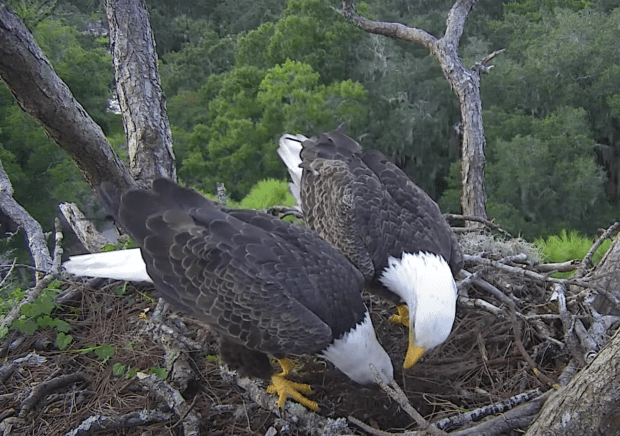
Samson and Gabby had spent the night on the branches of the natal tree. It is just turning 07:00 and Samson is fishing. Gabby is down working on the walls of the nest getting it ready.

She looks all over trying to decide what to move and where the new branches should go. Typically, the male brings in the branches and the female positions them.

It will not be long til Gabby has this nest worked into her liking. It is high up on a pine tree and everything has to be perfect to protect the eggs and the eaglets.

She waits for Samson to arrive. You will notice that he has brought a big stick onto the nest. Now he has left again.

Now he is back! They are having a conversation about what to do during the day.

I have to admit that I really enjoy this Bald Eagle nest near Jacksonville. Legacy was just a joy last year as she navigated life with ‘Eggie’ and ‘Pinecone’ as an only child. Here is the link to their streaming cam 1 (they have 3):

There are two other streaming cams to watch and both couples have arrived. One of the most famous is the nest of Harriet and M15 on the land of the Pritchett Family in Fort Myers. Both eagles have returned to the nest and have been seen working on it.

The third is the Captiva Eagle Nest on Santibel Island. It is the home of Connie and her new mate, Martin. Both have arrived at the nest this afternoon. One was seen earlier in the day.

Last year, the two eaglets named Peace and Hope died of rodenticide poisoning. The male Joe – well, I would argue that he reacted the same way that Romeo did when he could not care for the eaglets in 2018-19 – and well, Joe is gone.

Let us hope that Connie and her new mate have a fabulous year and that the folks using these designer poisons have stopped and cleaned up the area for these beautiful birds.

There are so many Bald Eagle nests it is hard to keep up with them. At the same time, there are the beautiful White-tailed and Golden Eagles in Europe. The Latvian Fund for Nature runs a host of eagle cams and I will be bringing you information as it becomes relevant. I am hoping that Matilde will have a new mate and that this will be successful! Spring is going to be busy!

The female at the Port Lincoln Osprey Nest is yelling to Dad to get a fish on the deck for the osplets!

Last year he seemed to ignore her but this year Dad has been, for the most part, on the ball. Sometimes he has to come to the nest to get his earful orders but then he goes fishing. Let us keep our fingers crossed for a very large fish like the one delivered yesterday. These kids are growing and they need more bigger fish. Less feedings but a lot of fish.

It is now 08:30 at the White-Bellied Sea Eagle Nest in Sydney’s Olympic Forest and WBSE 27 and 28 are waiting for a breakfast delivery, too.

This pair have done well this year. WBSE 27 has the darker head at the back with 28 here at the front. Both are healthy and there are no obvious physical difficulties like 26 had last year.

The problem that they do have are feathers and the two are constantly preening.

Both can stand and walk well.

Here they are watching for the parents to make a delivery! Waiting must be very hard when you are hungry. How dependent these birds are on the good health of their parents, too.

Food deliveries will be coming. The nestlings wait at both Port Lincoln and Sydney.

Thanks for joining me. I will bring you an update on the PLO nest first thing tomorrow. Take care everyone.

Thank you to the following for their streaming cams where I took my screen shots: The NE Florida Cam and the AEF, Captiva and the AEF, Port Lincoln Osprey Project, Sea Eagles @ Birdlife Australia Discovery Centre.

Gabby is home!

Gabrielle or Gabby flew into the NE Florida Bald Eagle nest near Jacksonville today, 12 September. She might well have been on the branches or around earlier but I have her at 19:33:12. What a wonderful sight – to have this fabulous couple back safe and sound on their nest. Samson doesn’t migrate and he was seen several times during the summer and, in particular, when the camera maintenance was taking place. Both eagles got busy inspecting the nest. They were digging around and I wondered if they were looking for ‘Eggie’ that Samson had buried last year after Legacy spent so much time taking care of it, incubating and rolling. Oh, Legacy, what an amazing character you turned out to be!

They seem to have a discussion. Samson is on the left in his Levi Black Stretch ‘Slim Fit’ jeans and Gabby is on the right.

I wonder why they are so preoccupied with this one spot. Is this really where ‘Eggie’ could be buried?

More discussions!

All is right in The Hamlet. How comforting seeing them both roosting on their branches of the nest tree. In 2020, Gabby returned on 12 September, too.

This is their third season. In 2019 they fledged Jules and Romey named after Samson’s parents, Romeo and Juliette. This was their nest – indeed, it is the nest where Samson hatched. Last year, they fledged Legacy. What a sweetheart. She sure stole a few hearts!

After all the excitement in NE Florida, I decided just to check on the other nests. No hatch, yet, at the Port Lincoln Osprey Nest. For those of you watching the Royal Cam chick, it has been confirmed that her neighbour chick, SSTrig, fledged late afternoon 12 August nest time. SSTrig is the first chick to hatch and fledge of adults, Green Lime Green and Red Lime Black. Tiaki and SSTrig did not always get along very well. You might remember their little altercations.

At the White Bellied Sea Eagle nest in Sydney, Australia, a bird arrived around 13:35 13 August. WBSE 28 was more or less in a submissive pose during the entire feeding. WBSE 27 ate 98% of the gull. I wondered what had happened earlier but the camera feed would not let me rewind that far back – which seemed odd since you can always go back at least 8-12 hours. But, not today.

The adults at the 367 Collins Street Osprey Nest in Melbourne continue to make their well rehearsed handover of incubation duties. These two are really quite incredible.

I know that some of you have been wondering why dad isn’t bringing mom food at the nest. Prey will not be brought until the eyases hatch. There is a place up above the nest where the male leaves prey for the female so she can eat.

Here is cute little dad.

And beautiful mom. A couple more weeks. These two better rest as much now as they can! Four eyases. Oh, my goodness. I cannot wait.

Xavier has come in to see if he can have a turn to incubate their eggs. Diamond doesn’t get off and hand over the duties as easily as the mom at Collins Street. Poor Xavier. Xavier will often bring prey to the ledge and Diamond will take it and fly out of the scrape to eat it.

Why do the two falcon couples do this? keep prey out of the scrape when there are eggs? For cleanliness and not to bring in any parasites or insects. That is also the reason that falcons do not use twig nests.

It is now the wee hours of the morning on the Canadian Prairies. I didn’t intend to write another blog but, oh how I wanted to let you know about Gabby. This is wonderful news. Harriet and M15 are back at the SW Florida Bald Eagle nest. And that reminds me that I need to check and see what is happening at Captiva.

Thank you for joining me for this quick alert. Have a great Monday everyone.

Thank you to the following for their streaming cams where I took my screen shots: The Falcon Cam at Charles Sturt University in Orange and Cilla Kinross, The 367 Collins Street Falcons by Mirvac, NE Florida Eagle Cam and the AEF, and Sea Eagles Cam@ Birdlife Australia Discovery Centre.

Bird World 9 September 2021

WBSE 27 and 28, the two little sea eaglets in the old Ironbark Nest in Sydney’s Olympic Park, had an early morning breakfast of bird.

Ah, just guess who was the first one up at the breakfast table? If you said, 28 you are absolutely right.

The little bird filled up their empty tummies but it wasn’t big enough -like a grand fish -to fill their crops, too. After breakfast the pair did some wing flapping, standing, and attempts at walking. They still need their wing tips to help with their balance.

Look at the tail that is growing on WBSE27! 27 is the one flapping its wings below.

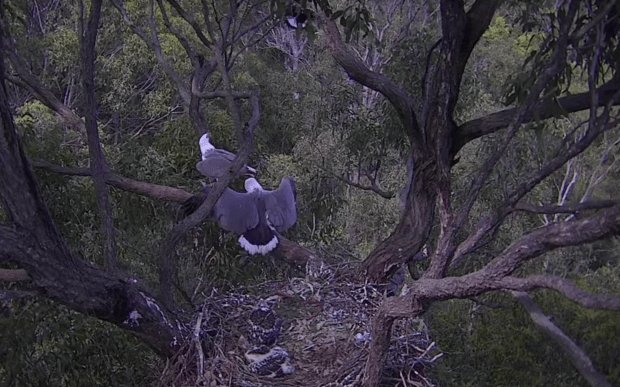
Well, the Australian Magpie was not giving the White-bellied Sea Eagles a break today. For a couple of hours after feeding the eaglets, Lady defended the nest ducking and honking as the Magpie swooped down trying to hit her.

In the image below, Lady is honking at the Magpie.

Here is a good image of the bird as it goes to land on a branch of the nest tree. This bird is cheeky – they must taste terrible or Lady could have that Magpie for lunch! I would not blame her.

In this image you can see the Magpie caught in flight right above Lady’s head.

Here the Magpie is flying around Lady. It is right over her head.

Dad came to help Lady. All of the big raptors – at the top of the food chain – attract all the small birds and owls. It is surprising how much physical damage these small feathered creatures can do. Last year, BooBook Owl injured Lady’s eye. They can, of course, knock the eaglets out of the nest.

Tiaki looks out to the world that awaits her. Her name means protector of the land and the seas. I hope that they also protect her.

As Albies fly around her in the strong winds, Tiaki raises her wings. She will be off on her big adventure soon.

The chicks are all hovering in the strong winds. In a blink they will be gone. I think I put down 12 September on the guessing game but it could just be any time. Quarry Chick fledged 3 days ago.

Tiaki received her GPS tracker today. Ranger Sharyn Bronte said, “A wider study of the entire Northern Royal Albatross is being conducted this year. And in a first for a Royalcam chick Tiaki as received a tracker. Trackers have deployed on northern royals on the Chathams where 99% of the world population of this species breeds.We are extremely lucky to have 20g devices are available to track LGK, LGL and Tiaki. Although LGL’s device failed it has provided valuable data. Devices are extremely light compared to the weight of the bird and attached to back feathers. These feathers molt within a year and the device will fall off. The device is solar powered and will remotely send data until molting.”

If you read my column regularly, you will know that I am a big supporter of GPS trackers. I also support Darvic bands. Much new information on the migrations, winter and summer breeding grounds – and yes, deaths, are revealed amongst other things. Studying birds or watching them in their nests is never for the faint of heart. Their lives are full of challenges, most placed on them by humans.

Last year, a lovely Polish woman wrote to me to tell me she didn’t know how I could be so calm when ‘bad things’ happened to the birds. Those were not her exact words but that is what she meant. I was not the least bit offended. The truth is I feel for each and every one of them. That caring is inside a bigger box that is now labelled ‘ avian activist’. I want to help stop those things that cause the birds injury or death when it can be avoided. Rodenticides, sticky paper traps, lead shot, lead bullets, lead in fishing equipment, fishing line, fishing nets, windows, garbage dumped on the roads, habitat loss, wild fires caused by arson, electrocution, bread fed to the birds —— and simple neglect or oversight. Like having emergency contact numbers for the streaming cams where there is no 24/7 chat with knowledgable moderators.

I am working on a way to remember Malin, the Osprey nestling at the Collins Marsh Nature Centre, whose life was needlessly cut short. The Malin Code. Osprey streaming cams that follow The Malin Code would have either 24/7 moderators who can access emergency help immediately or emergency numbers at the top of the historical information on the nests. Individuals who are in charge of parks or areas with nests would be trained to recognize the physical signs (11 of them) from food begging to alerting and the 8 vocalizations. It is the least requirement. The other is that they pay attention to what is happening on the nest. They need to know the difference between a juvenile and an adult. Etc. Whew. Yes, I get worked up. If you can think of anything else that these organizations should be doing, let me know. Don’t be shy! At the end of the year, the streaming cam that best implemented The Malin Code would get a donation, big enough to motivate them to do what is right for the birds.

OK. On to what is happening in some of the scrape boxes:

Diamond and Xavier spent some time in the scrape box together today. There was a bit of a conversation between Diamond and Xavier. I need to learn to speak falcon.

There is a real soft spot in my heart for the little male Peregrine Falcon in Melbourne. Maybe it is the ledge where he comes scurrying in to take his turn incubating the eggs or when he brings prey to the eyases.

He is the cutest thing and makes the biggest messes plucking pigeons right in the nest with the eyases. But, last year, I noticed that those three girls really knew what to do with a feathered bird. They were not shy. By the time they fledged, they were professional pigeon pluckers. Can you say that fast 10x?

What a cutie! Our stealth raptor.

Have you ever wondered about the black faces of the Peregrine Falcons? Did you know that the size and intensity of the black varies by region? Have a read.

Cody and the lads down in Kisatchie National Forest have done a great job with the camera for the Bald Eagle Nest of Anna and Louis. Cody says that the sound is going to be fantastic.

Isn’t that a gorgeous sunset over Lake Kincaid? Such a lovely spot for a Bald Eagle nest —- and, of course, there is the lake that is stocked with some really nice fish. Couldn’t get much better. Everyone is just waiting for the Eagles to return.

Speaking of Bald Eagles returning, both Samson and Gabby are at home in Jacksonville and Harriet and M15 are in Fort Myers. All that reminds me I have to check and see what is happening at Captiva.

I want to leave you with an image of Tiny Little. She is one of the fledgling Ospreys in my long time study of third hatch survivors. She has a Darvic ring-Blue 463. Here she is as a wee one.

Blue 35 is feeding Tiny Little by herself. Look at ‘big nasty sister’ in the middle. It really is thanks to excellent parenting that Tiny survived – and became the dominant bird. Gosh, I wish she had a tracker. Is she at Poole Harbour? has she made it to Brittany? will she go to The Gambia? or Senegal? or Southern Spain? My ‘wish list’ includes getting someone to look for her if I can’t be there myself during the winter of 2022.

That’s it for me tonight. Tomorrow I am off in search of a Green Heron. Take care everyone. Stay safe. Be kind. Remember: Life is for living.

Thank you to the following for their streaming cams where I take my screen shots: 367 Collins Street Falcons, Sea Eagles @ Birdlife Australia Discovery Centre, The Kisatchie National Forest Bald Eagle Cam, The Falcon Cam Project Charles Sturt University at Orange and Cilla Kinross, Cornell Bird Lab and NZ Doc Royal Albatross Cam and FB Page and The Cumbrian Wildlife Trust and the Foulshaw Moss Osprey Nest.

Thursday in Bird World, 2 September

It is pretty quiet at the nests these days – that lull if you like between the Ospreys leaving for their migrations in Europe and the US, the Bald Eagles slowly returning to their breeding areas, and the falcons and Ospreys incubating eggs in Australia. The biggest news in Bird World is that Diamond laid her second egg at 20:55 September 2nd.

Xavier taking a turn incubating and rolling the eggs for a bit this morning. Gosh, those are big eggs!

The Osprey was officially adopted in 1994 as the is the provincial bird of Nova Scotia, one of Canada’s ten provinces. Nova Scotia is a peninsula surrounded by the Atlantic Ocean, the Bay of Fundy, the Northhumberland Strait, and the Gulf of Maine. It is one of Canada’s Atlantic or Maritime Provinces. At its widest, 128 km, it is easy to reach any body of water easily. It is said that Nova Scotia has more Ospreys than the United Kingdom in its entirety. Many live on McNab’s Island at the mouth of Halifax Harbour.

@Wikimedia Commons

The lighthouse was built in 1809. In 1852, Dr. Abraham Gesner was given control of the lighthouse. In December, Gester used a fuel that he had just discovered – kerosene – to operate the light.

“McNabs Island” by KellyMercer is licensed under CC BY 2.0
“Maugher Beach Lighthouse (McNabs Island, Nova Scotia) – (Adventure of the Seas – August 1st, 2018)” by cseeman is licensed under CC BY-NC-SA 2.0
“Wharf at McNabs Island” by wdrwilson is licensed under CC BY-NC-ND 2.0
[[File:Osprey Bird.jpg|Osprey_Bird]]
[[File:Osprey on Sandy Hook (70318).jpg|Osprey_on_Sandy_Hook_(70318)]

Ironically, there were hardly any Ospreys in Nova Scotia two decades ago. The use of DDT had weakened the eggs to the point that the birds were virtually going extinct. Since 1979, the Osprey Management Program, operated jointly between Nova Scotia Power and the environmentalists at the Department of Lands and Forestry to relocate nests that are on top of live utility poles to safer unused poles nearby. Each year they partner with the Museum of Natural History to live stream an osprey nest. The Osprey are in Nova Scotia from April to September. At the end of the summer, when the juveniles are old enough, they leave for their winter grounds in the Caribbean and South America.

The first little video is from 2014. Seven years ago, when streaming cams were not so HD. Here is a typical Osprey family of five in Nova Scotia on top of one of the partnership nests.

Here is another short video of 2020 showing the improvement in cameras. It shows the hatch of the second chick at this nest on 9 June.

Speaking of Osprey, Sharon Leigh Miles took this image today of an Osprey at Mt Sentinel in Missoula, Montana. It is Iris’s favourite tree and it is presumed to be Iris, the grand dame of North American Ospreys. Hopefully she will visit her nest before she leaves. She is the oldest Osprey in the world.

In other news, White YW, the male at the Foulshaw Moss Nest, dad of our one and only Tiny Little, Blue 463, is still in Cumbria. He was photographed there today. White YW hatched at Bassenthwaite in 2008. Gosh, he is a great dad. One of the unsung heroes. Chris Wood has received word that the estuaries that the UK Ospreys travel to for their winter season are filling up with water. Wonderful! Yesterday, I saw Cormorants here in Manitoba and today a couple seem to have taken over Maya and Blue 33’s nest at Rutland (at least for part of the day). The two little sea eagles are getting along fine. Food remains plentiful and they are growing, flapping, and learning to walk. Those clown feet are really growing. Just look, with food, 28’s feet are getting huge. Wow.

I am attaching the progress map of the Ospreys and Black Storks:

Pikne, in orange, is really travelling well. She has gone straight south almost beating Karl II in royal blue. You can follow them, too. Here is the link:

http://birdmap.5dvision.ee/EN

Thank you so much for joining me. Take care. Stay well. Look for egg number 3 on 4 September down in Orange.

Thank you to the following for their streaming cams where I took my screen shots: The Falcon Cam Project at Charles Sturt University in Orange, The Montana Osprey Project FB Page, Sea Eagle Cam @Birdlife Australia Discovery Centre, and BirdMap.

Wednesday Happenings in Bird World

Gosh, it was just a gorgeous ‘fall’ day. No, it isn’t officially fall but the leaves appear to be changing and there is a ‘nip’ in the air. The birds are flying south and others are arriving home from their summer forays. One of those returning to her breeding area and nest is Gabrielle, Gabby for short, the mate of Samson at the Northeast Florida Bald Eagle nest near Jacksonville. It was right around 14:48.

She looks good. Oh, Samson is going to be so excited!!!!!!!!!

Samson you are such a cutie. As my friend ‘T’ said when she heard the good news, ‘Love is in the air.’ She is absolutely right.

It was a gorgeous day to go and find some pelicans and I was hoping for a cormorant or two. The waters of the Red River near St. Andrews did not disappoint.

Pelicans are the longest native bird in North America measuring in at 2 metres or 6.56 feet. The California Condor is the only bird in North America with a longer wingspan. The pelican’s wings measure 2.7 metres or 9 feet from tip to tip. In other words, these are large birds!

This is a small hydroelectric dam. These American white Pelicans often work together to get the fish ’rounded up’. Here they wait for them to come over the dam. There were six fishing together.

The pelicans dip and scoop for fish. They are able to hold as much as 12 litres of water which goes out the sides of their mouths before they can eat the fish. They spent a lot of time bobbing up and down.

Manitoba is the summer home of the largest number of American White Pelicans. They spend their winters in California or areas around the Gulf of Mexico. In late April to early June, they return to their summer breeding grounds here in Canada.

With the changing climate, it is believed that the American White Pelican will gain areas in Canada while losing them in the US.

Some were fishing while others slept and preened.

There were a few Double-Crested Cormorants with the pelicans today.

I just loved the silhouette of their wings against the water.

Manitoba is also home to a huge number of Double-Crested Cormorants in the summer. Did you know that Cormorants lack the ability to waterproof their feathers? Because of this they can dive deep because they are less buoyant but it also means that they can become water-logged and have a struggle reaching shore.

There were lots of gulls flying above the water. This lonely Ring-Billed Gull caught my eye. In the city they are constants around the garbage dumps. I did not know that they eat the eggs of other birds as well as little goslings, carrion, insets, rodents, etc. They are real scavengers.

Look carefully and you will see the black ring near the tip of its bill. That is what gives this gull its name.

This is the mystery duck. It was all alone. There have been several discussions as to whether it is a female Ruddy Duck, a female Northern Pintail, or a female American Wigeon. Or is it an anomaly? A Black Duck? If you have any idea, I would love to hear from you! I know that it is not a Mallard, not a Wood Duck, and not a member of the Merganser family but it is alluding all of the Manitoba and Canadian bird books. Maybe you are a juvenile. Someone really does need to do a more comprehensive book of Manitoba birds with excellent images.

The sun, fresh air, and climbing up and down gravel banks to the water has sure made me tired. If you have trouble sleeping, I highly recommend it as a remedy. One of my birding friends wrote just now to say that they had seen ‘my Ospreys’ today – so if it doesn’t rain tomorrow, I am heading north to check it out. They will be migrating soon!

There is little news in Bird World. Diamond has yet to lay another egg. The two little sea eaglets are eating well and behaving themselves. The majority of the Ospreys in the UK have begun migration. Aran was still at the Glaslyn nest this morning. The Black Storks from Latvia and Estonia seem to be making their way without hiccups now to their winter homes. It is just a nice calm Wednesday save for the arrival of Gabby back at The Hamlet. That caused great cheers.

Take care everyone. Thanks so much for joining me.

Thank you to the NW Florida Bald Eagle cam and the AEF streaming cam where I took my screen shots.

Tracking…birds and hurricanes

Hurricane Ida has made landfall on the sixteenth anniversary of Hurricane Katrina that wrecked havoc and caused so much destruction to Louisiana. Throughout the day I have been checking on the Kisatchie National Forest, the home of Bald Eagles, Anna and Louis. The Bald Eagles are likely north of the storm area as they do not spend the hot summer, as far as is known, at Lake Kincaid (although they could).

The winds were getting stronger and the waves more choppy as the morning broke into the afternoon. That camera quit working at 15:39:19. You just get a circle. The KNF is in parishes that are northwest of New Orleans. They include Grant, Natchitoches, Winn, Rapides, and Vernon.

Isn’t that just the most beautiful area to raise a Bald Eagle family?

Cody and Steve did a great job running the camera, answering all of the chatters questions, and even held a contest to name the eaglet. Please send them warm wishes to stay safe.

At 18:00, Hurricane Ida just went through Mathews, Louisiana.

There are several other maps that I am also watching today. One of those is just fantastic. If you want to follow the Black Storks on their migration, you need to know this link.

http://birdmap.5dvision.ee/EN

The ‘Birdmap’ has several Ospreys along with the Black Storks who have satellite trackers. They are first sorted into species and then by name of the bird. Click on the name of the bird and you can see where the birds are located. It is magnificent.

I clicked on Karl II’s name. Then I clicked on the player at the bottom and I could see the precise route that Karl II has taken since he left the nest in the Karula National Forest. He is heading to the Black Sea. I wonder if Karl has a favourite spot there?

I owe Karl a big apology, too. I know that Pikne and Udu are ‘his’ storklings and brain keeps telling my fingers to type Grafs. Big apology, Karl!

Oh, how I wish Tiny Little had a tracker. It would be so much fun (well, if everything went well) to watch her journey rather than hoping by mere chance that someone would see her blue Darvic Ring and record the number. Perhaps it would be too much to ask them to take a photo, too?

There is not a lot of news in Bird World. Maya was photographed at Rutland Water today so she has not left for her migration. The Collins Street Falcons have started the hard incubation now that the 4th egg has been laid.

This is mom. She always has a bit of grumpy face and she takes up most of the scrape box.

This is cute little dad. He is much smaller as you can see – he doesn’t take up so much room in that scrape box. If in doubt, he has really neat bright yellow “goggles” around his eyes.

I know that it is hard to see what is going on and you are afraid that you will miss all of the action. There is another scrape box at the other end of the ledge with a camera and these parents have a tendency to move the chicks about. There is nothing funnier than seeing 3 large juvenile females chase after poor little dad with his pigeon. This year it will be 4! I hope the pigeon population in Melbourne is robust!

Diamond is keeping everyone guessing. The latest that she has ever laid an egg is the 31st of August and that is tomorrow, Australia time! At this point I am not even going to guess. Diamond has been fooling me for days on end.

When in Australia, I have to remind myself to check on Solly. She is 344 days old – my goodness, almost a year since she hatched on the PLO barge. Look at this map of her travels. She is so confident now that she is taking the short cut back to Eba Anchorage from the coast near Streaky Bay instead of going the land route. Well done, Solly! So proud of you.

The nest of Mom and Dad looks so much more together than it did after Solly and DEW fledged last year! Oh, I hope that there is lots of food and all three of those eggs hatch and fledge. Wouldn’t that be wonderful? I have to admit that I did not feel so kind towards Solly last year but, in the end, I was glad to see two strong birds fly off that old boat. The satellite tracker put on Solly opened up everyone’s eyes to how far the Eastern Ospreys travel from their natal nest. I do hope they will do this again this year. At the same time, I would like to see trackers on all the birds from this nest. Everyone wants to also know where DEW is. If it is the cost, do some crowd funding up front – there will be people from around the world willing to chip in and help with the costs.

‘S’ sent me some images of the Osprey juveniles in Alberta this morning. My goodness did I ever feel guilty. I checked in on them for the first time yesterday in ever so long – and that was because I had heard of an unmonitored nest fledging two from the interior of British Columbia this morning.

There were three eggs that hatched at the Red Deer Osprey nest in June. Two of the three died on 3 July during the wretched heat and then rainy/stormy weather.

This beautiful juvenile fledged sometime the first two weeks of August when the cameras were down. This is a strong bird, a real survivor. It has been given the name, Little Braveheart, by her fans.

The two juveniles at the Fortis Exshaw nest up at Canmore are doing really well, too. Both fledged and they are waiting, just like the juvenile in Red Deer, for the call to fly south. That is such an incredibly beautiful spot to have an Osprey platform with the Canadian Rockies in the background.

Thank you so much for joining me. Do check the Birdmap and see how it works. Satellite trackers are wonderful tools. And please send your warm wishes and positive thoughts to those in the path of Hurricane Ida. Take care and stay safe. See you soon.

Thank you to the following for their streaming cams where I took my screen shots: Fortis Alberta Red Deer, Fortis Alberta Exshaw, 367 Collins Street by Mirvac, The Falcon Cam Project at Charles Sturt University in Orange and Cilla Kinross, the KNF Bald Eagle Cam, and the Port Lincoln Osprey Project.

The Biggest Adventure of their Lives

Chris Wood from Rutland described what he believes is Maya and Blue 33 (11)’s 2021 fledglings leaving home and starting their own journey. It was so poignant that I thought I would include it in its entirety here today.
No one home. Manton Bay, Rutland Water, UK

For those of you who do not know, Blue 33 (11) and Maya are the resident couple on Rutland Water’s Manton Bay Osprey Nest. They are normally the first to arrive back from migration and often within a half hour of one another. Imagine – 4000 miles and landing that close. Do they spend the winter together? No one seems to know. They are a Super Osprey couple, hatching and fledging 19 chicks as of today. This year the couple had 2 fledglings but they have had nests of four and it has not been a problem for either of them.

A video from a month ago. Maya is not ringed. The two fledglings are. In the image for the video, Blue 33 (11) is on the front left. Maya is looking at the fish and one of the chicks, now a fledgling, is in the back. Blue 33 always made sure that there was a fish on the nest first thing in the morning – right at dawn! Which is why his behaviour Yesterday was so unusual.

Chris Wood says:

“Yesterday at Manton Bay an extra shift proved to be quite eventful very early on. 095 had been very active early on in the morning, we get there for 6am, ok I was late yesterday, 6.45. She was flying around the bay, diving from the camera perch and from the air, skimming across the water as if to wash her feet and as usual plenty of food begging. But 33 wasn’t present, in fact we didn’t see him until midday, had he planned this? Around 9.10am, ten minutes into the extra shift 095 suddenly took to the air and started to fly across the bay, she started circling, round and round, gaining height slowly and gradually she passed over Waderscrape hide continuing on over the trees to the rear of the hide until we could see her no more, was she gone? Only 3 minutes later, 096, who had been sat on the far left perch all the time suddenly took flight and headed very purposely across the bay. He too headed towards the hide circling to the right and headed on past over the trees, he was gone. Had he seen his sister in the distance circling higher and higher heading away, south from the bay. Was he following, had they both left or was it just coincidence. Had 33 stayed away yesterday morning to encourage the youngsters to leave? All in all it was a spectacular sight if they had left, one tinged with sadness another with how fantastic to see two young Ospreys make it to migration and start the biggest adventure of their short lives, another great success for the Manton bay pair of Maya and 33(11).” Another person watching this, added, “Just before 095 left she also flew across to 096 on his perch – chipping at him – and Maya took to the air for the first time that morning as they left and circled upwards as if watching events.”

095 as she begins migration.
096 as he begins his migration 3 minutes after his big sister.

Oh, I wish those two had satellite transmitters.

Blue 33 is already doing some bonding with Maya before she leaves now that the kids are gone.

There has been no one home on the Foulshaw Moss Osprey Nest of Tiny Little at the times when the kiddos would normally have been there screaming for food.

Does this mean that they caught that same wind that draws our juveniles to start their own independent lives?

Someone who is home is Kindness, the fledgling Bald Eagle at the Glacier Bay Park in Juneau, Alaska. Kindness fledged on 21 August. Since then she has been enjoying short trips around her beautiful natal tree. So far she has slept on the nest but soon she will move to roosting on a branch.

Where Kindness is standing is called the ‘Bouncy Branch’. Oh, she looks so tiny next to those huge Pine Siskin Trees!

Kindness bounces and flies.

Liberty and Freedom always lure her back with a meal! And it works – Kindness has learned that if you leave food someone else will eat it. She is normally back on the nest within 3-5 minutes of a delivery.

This is precisely how fledging should go. Remember that and if you watched E17 and E18, Harriet and M15’s two fledglings from 2020 – that is a perfect example of a normal raptor fledge, the fledglings flying and playing with parents providing food.

When I last checked, the female peregrine falcon on the Collins Street nest was sure bulking up like she was going to lay that second egg today. Let me check!

Mom needed a break. Still only one egg at 4am 24 August. Sometime on the 24th for sure.

Another Australian bird, the Galah. Here is a very short video of an exchange between this fabulous pink and grey bird and some kangaroos. Try cutting and pasting. So cute! We need cute today. It is from the Kangaroo Sanctuary at Alice Springs.

https://fb.watch/7zJYVKBHM5/

Today there were some visitors to the garden in addition to the hundreds of various sparrows. The rain is coming down and it seems that they prefer the cylinder suet – fantastic. Even with domes the bird seed seems to still get wet. What a mess. Rain doesn’t stop the birds and squirrels from being hungry! The light was terrible and my laptop didn’t want to recognize the new card in the camera so I am attaching these even tho they are not the best images.

The image below is ‘Little Red” who has a life-lease for the garden shed penthouse.

Merlin identifies the bird image below as a Juvenile Male Ruby-throated hummingbird. If this is the case, the hummers are moving south on their way to winter vacations.

One of the resident Blue Jays who would love Little Red to get off the suet — or for me to go out and hang a new cylinder up in another place. He looks like he is doing a little moulting.

There is no word on Malin. Again, ‘no news is good news’. I am practicing patience or at least pretending that I am trying! We are all anxious for Malin and the youngsters of Grafs and Jan. Yesterday Grafs was in once and Jan twice. Better than nothing! And those storklings are starting to fledge. That feels like a miracle. I hope that they find the feeders.

I hope to have news soon on Malin. I am guessing that there are difficulties with the identification of the two birds – maybe neither is Malin. We wait.

Thank you for joining me today. Take care everyone, see you soon.

Thank you to the following for their streaming cams where I took my screen shots or found photographs: The Kangaroo Sanctuary in Alice Springs, Glacier Gardens Park in Juneau, Alaska, The Cumbrian Wildlife Trust and the Foulshaw Moss Osprey Nest, Chris Wood and the Rutland Osprey Project FB Page, and the Collins Street Falcon Cam by Mirvac.