Pip at Dyfi…Late, late Friday in Bird World

22 May 2026

Hello Everyone,

Update: Egg pipping at Dyfi.

A close-up view of an osprey in its nest, incubating eggs among sticks and grasses.

I was not feeling well today, and everything that could go sideways just seemed to do so! It was ‘cake day’ – a celebration that I have mentioned before, of having survived another week. But there was still a lingering ‘greyness’ that should not have been there. We ate outside, the weather was glorious, Toby is doing so well with his walking training, Ann was with us – is there anything else I could want? And yet, what is happening to our wildlife around the world outrages me. It simmers and then comes to a head. Today was that day. I grew up believing that people had the power to change things if they worked together. We made a lot of progress – and I know many of you grew up in that era too. And now to see it all torn apart. If you turn your head, get distracted for a second, someone is doing something to destroy vast swaths of our planet. I sat and contemplated that if those who cared about the land formed a group – a vast group – and each contributed a small amount, to buy the land. Stop the destruction. Is it possible? It would take a keen organiser.

At the same time, vote – and make sure you know what you are voting for. We have some of the most dismal candidates for mayor I have ever seen. I want to know where the young people who are driven by ideas are????

OK. Off the bandstand.

Many people have posted a video of the encounter of Iris with the little European Starling, and if this cannot raise our spirits to new heights, nothing will. It should make the national news – maybe it has!

Thirty-year-old Iris goes ballistic!!!!!!!! She calls NG2 and he comes to save the day!

Dr Green is going to post a selection of names for viewers to pick the name for NG2 soon.

Trudi Kron: https://youtu.be/svch5WHq-bM?

An osprey sitting in a nest with twigs and pine needles, alongside a chick visible in the nest.

Geemeff’s Woodland Trust daily summary for Loch Arkaig Friday 22nd May 2026

Another perfectly routine day, calm and reassuringly normal. Garry LV0 delivered two fish for Aurora 536, and his personal tally, which is also the Nest One tally, rises to seventy six. Over on Nest Two, Louis delivered three fish for Dorcha, taking his personal tally to seventy seven and the nest tally to seventy nine. Garry seems to enjoy incubating duty as much as Louis does which is a very important characteristic as hatching day comes closer. The weather forecast for Inver Mallie, which covers the nest areas, is for light rain and gentle breezes throughout the night and continuing tomorrow, with an overnight low of 10°C and a high tomorrow of 16°C.

Today’s videos:

https://youtu.be/g8Pr8Vq3ECc N2 Louis is in charge when Dorcha leaves with breakfast 06.37.26

https://youtu.be/QdmR05mieMs N1 Garry’s first fish is a very small trout 14.58.22

https://youtu.be/jSnhOEHml6s N2 Teatime for Dorcha when Louis brings a nice fresh trout 15.49.25

https://youtu.be/5jBE8io4qIE N1 Aurora’s second fish is much bigger than the first 19.51.17

https://youtu.be/VLeYKaNMB2c N2 Louis arrives with Dorcha’s dinner 20.36.18Bonus history – how much do you know about the remarkable Kenneth Watkins who founded Woodland Trust in 1972?

https://www.woodlandtrust.org.uk/about-us/working-with-us/our-people/our-founder/
https://www.woodlandtrust.org.uk/media/43909/ken-watkins-timeline-only.pdf

Blast from the past, this day in previous years: 

https://youtu.be/NpuyQyh8iZE  N1 Garry circles round before landing and giving the fish to Aurora 2025

Thank you!

Golden Eaglet being fed!

A golden eagle is seen interacting with its fluffy white chick in a nest, surrounded by trees and greenery.

Kaljukotkas 2 :: https://www.youtube.com/live/EBRGoS6U…

Are you a keen observer? Read below how you can take part in this research project:

“The Golden Eagle nest camera is situated near military training ground. Therefore military training noise is possible to hear quite often. The purpose of this camera is to detect the reaction of breeding eagles to the noise disturbance heard. We invite volunteers to participate in virtual Golden Eagle observations and record them in the appropriate forum (link above). The forum has instructions on how to become a member of the forum and how to post your observations there. This is also possible with pictures or videos proving the event. At the end of the season, we summarize all observations and analyze to what extent the particular Golden Eagle pair is affected by noise disturbances in the breeding area. If necessary, it is also possible to review the recorded video material. Expenses of this webcam are covered by Centre for Defence Investments of Estonian Republic. There in the same nest was one chick fledged in 2024, 2023 and 2022. 2025 the nest was in other place, but not successful. Female is currently without of rings. Male has one ring and transmitter on back. Often these are covered with feathers. Kotkaklubi Link –    / @kotkaklubi   The Eagle Club (est. 1999) is a non-governmental organization whose mission is to protect, study and introduce the eagles and the black stork in Estonia. Since 2007, the Eagle Club has been running live web-cameras on the nests of protected bird species – black stork, white-tailed eagle, greater and lesser spotted eagles, osprey and golden eagle. Find out more here: https://www.kotkas.ee

CJ7 looks tenderly at her recently hatched chick. Three more to go!

A bird sitting on a nest with three eggs and a newly hatched chick, captured in black and white.
Two baby birds sitting among eggs in a nest made of twigs and straw.

Big Red often seems to just stand and smile overlooking her little nest of hawklets.

A red-tailed hawk standing over its fluffy chicks in a nest, surrounded by twigs and greenery in the background.
A nest of red-tailed hawk chicks resting together, surrounded by twigs and branches. The scene is outdoors on a rooftop, showcasing the nest's natural setting.

Dylan comes in with a late fish for Seren Blue 5F to feed the two hatches.

An osprey interacting with its chick in a nest, surrounded by greenery.
An osprey with a blue leg band stands on its nest, surrounded by sticks and moss, with two eggs visible in the nest.
An osprey is seen caring for its chick in a nest, with the chick appearing next to an unhatched egg.

Little started slow, hatching five days after Big. The wings are getting quite long. Big is not as big as Jill, and most who have watched believe Big is a male; I think Little survived because she is a female. Of course, no one will know unless a DNA test is done (and it won’t be, but it sure would be nice to have them ringed.)

A bird sitting in a nest made of sticks, with a view of a residential area and trees in the background.
A close-up view of an osprey nest filled with twigs and a young osprey chick, with an adult osprey perched nearby on a pole, surrounded by trees and a road in the background.

Harry continues to deliver fish to Winken at the Moorings Park nest throughout the day. There was at least one other delivery after 7pm.

A pair of ospreys feeding in their nest, with one osprey holding a fish, surrounded by greenery and a lake in the background.
A close-up view of two osprey birds standing on their nest, overlooking a lake and golf course in the background with vibrant red flowers nearby.

Another way that wildlife are losing their habitat. I want to be very clear – it would not matter to me which political party or person was in power – in my City, my Province, or another country – the ability to damage our planet and the living souls that share it with us – needs to be protected. So please see these posts as pro-wildlife/nature/biodiversity/environment. We need balance not destruction.

A landscape featuring a wetland with dead trees, surrounded by grassy areas, highlighting the environmental impact of livestock grazing.

What a difference. Knepp Wilding’s newsletter celebrations their breakthroughs in rewilding.

Thank you so much for being with us today. Please do take care of yourself. I hope to see you again tomorrow night.

Thank you to Geemeff for her Loch Arkaig summary, to all those who posted information on FB and elsewhere, to the owners of the streaming cams and everyone who loves wildlife.

Port Lincoln’s Middle Bob is getting some confidence…and other tales in Bird World

22 October 2022

Oh, good morning to everyone,

I hope that you are already having a wonderful weekend by the time you read this update on our feathered friends. Things are really beginning to look up at Port Lincoln. I am cautiously optimistic that Big is moving out of her aggressive stage.

My friend “S’ and I were talking about books – holding books, feeling the paper, turning the pages – a few weeks ago. She is encouraging her graduate students at university to read real books, to go to the library, to feel the pages. Of course, she was talking to a ‘member of the choir’, so to speak, when we had our chat. I love books, good quality books with beautiful images. Today, it wasn’t a book that arrived in the post but Cornell Lab of Ornithology’s Living Bird magazine that arrived. The cover featured a beautiful goshawk. Inside was a treasure trove of information for every species lover. There was a lot of information on migration, loss of biodiversity and what this means alongside reports on projects aimed at mitigating loss. The core of every article is how each of us can help mitigate the issues- sparking action to bend the curve.

As researchers and citizen scientists discovered with the great bird counts, the number of songbirds increased dramatically when ordinary people, just like you and me, began putting out bird feeders. Today, one of the most pressing issues is biodiversity. It is the word of the moment. One of the articles in this edition of Living Bird, ‘The Most Distinct Birds are at Greatest Risk of Going Extinct’ goes straight to the heart of the loss of entire species. On that list of Red Species, to my surprise, was the House Sparrow and the European Starling. The lead researcher, Emma Hughes from the University of Sheffield, said that birds with unusually long or short beaks, long or short legs were more likely to go extinct than others. Climate change and habitat loss is at the heart of the loss of these others such as the Red-headed Vulture, Giant Ibis, Seychelles Scops-Owl, the White-headed Duck, the Bee Hummingbird to name only a few on her list. They are going extinct because of their weirdness and the particular ecosystems that support them are being lost. For Hughes, the only way to stop the extinction is to increase efforts at biodiversity (21). This is precisely what they are trying to do with two species that depend on one another for survival – the White-barked Pine and the Clark’s Nutcracker. As the author of the article in Living Bird states, ‘Some pairings are so iconic that one is not complete without the other: Macaroni and cheese, Abbott and Costello. Peanut Butter and Jelly. In the northern Rockies and Sierra Nevadas, that duo is the white bark pine and Clark’s Nutcracker.’ (28)

To read the latest addition of Living Bird magazine, go to this URL: https://www.allaboutbirds.org/news/living-bird-latest-issue

There is a lovely video of the work being done on the Clark’s Nutcracker in this latest edition. Be sure to check it out.

I used the term ‘Red List’. Do you know what this means? It is the full name is the International Union for Conservation of Nature’s Red List of Threatened Species. It just so happens that there are two wonderful and exquisitely produced books on these threatened birds. They are Red Sixty Seven and the most recent edition, Into the Red, by Kit Jewitt. Both editions are collaborations between authors and artists whose goals are to call attention to at-risk-birds as well as to raise funds to support conservation work to halt their extinction. The books were published by the British Trust for Ornithology. Go to bto.org for more information, to view some pages and read about the artists, and to purchase. The purchase will go directly to helping. I urge against buying through on line book sellers as the prices on their sites are way too high or they say not in stock.

———————————————————————————————————————————

It is nearly 2300 on the Canadian prairies. There are no stars out tonight but there is one brave little Osprey in Port Lincoln, Australia who needs a round of applause. That ospreys name is Middle.

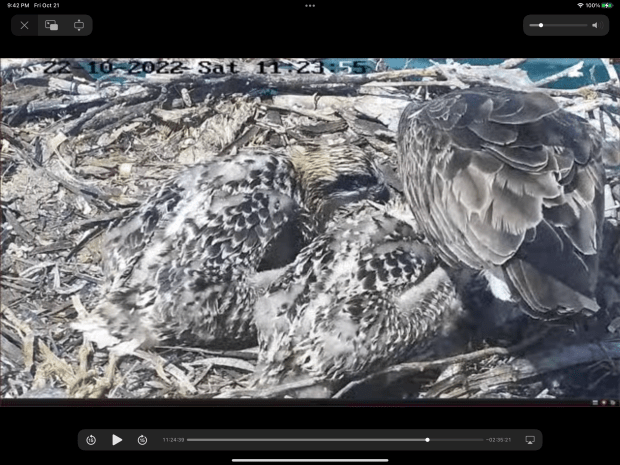
At 111232 a whole large live fish landed on the nest. Middle is being overly cautious not trying to grab any bites. Letting Big get those precious first bites and get her crop a little full. Meanwhile, Middle is pecking away at the tail of the fish. This is very interesting. You have probably seen, as I have, siblings eating from the tail while the breaking sibling is fed up at Mum’s beak. It is a good strategy once Middle figures out how to unzip that tail. By 112218 Middle is up by Big and is doing the snatch and grab. Sometimes Middle pulls back – he is very cautious. Mum gets to eat some fish. In fact, she is feeding the ospreys a little slower than usual. Big moves away from the fish feeding a couple of times. The first is at 112506. Big has been eating for 13 minutes and is getting full. Mum begins to feed Middle. At 112951 Big moves away. Middle remains cautious and then, at 114139, Middle pecks Big before he moves up to begin getting fish. So to summarize, even thought Middle is afraid and displays this as we watch, he is hungry and he is getting braver in order to get fed. Eating is essential to his survival. Middle is doing well. He will end the feeding with a nice crop.

I also noticed that Big is not as grumpy as yesterday despite there being 5 hours between fish deliveries. Perhaps she is slowing down, hitting that plateau. That would really bring peace to this nest.

By the time the 1637 Zebra fish arrives on the barge, Middle is feeling much better, more confident, and Big is being nicer. That feeding went well and even at 1817 when Mum and the two ospreys saw Dad and were feverishly calling for another fish, Middle (and Big) had enormous crops from the day’s takings. I have spent much time watching this nest as opposed to the two falcon scrapes because the fate of Middle was not quite clear. I will have said it twice today, at least, but, it appears that Port Lincoln has turned a corner.

Look carefully at the bottom image. That is Middle, full to the brim. Just sit and smile. Cry. Life appears to be good at Port Lincoln. Still, send all your best and warmest wishes to this family for continued supplies of fish.

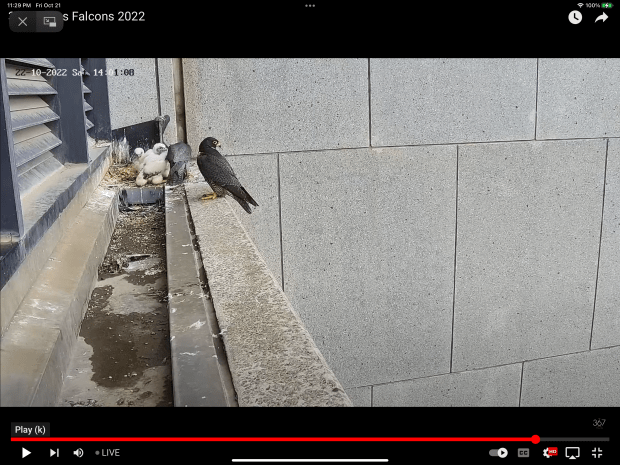
It is getting more difficult to tell the female Peregrine Falcons from the males. You must look closely. Diamond just about fooled me yesterday. They lose weight. All of the females lose approximately 30% of their body mass during incubation and raising their chicks. Diamond now has the look of a male with his tight little striped pants.

The same is true for Melbourne where the camera is now positioned so we can see the happenings at the far end. Mum seems to be enjoying it. She has a nice perch above the chicks so that she can watch them but not have any one or all of the Melbourne Four rumbling around underneath her all night. Like human parents, she can get some sleep now!!!!! Thank you to ‘H’ who watched and clocked the feedings at 367 Collins Street yesterday. Much appreciated. There were 5 of them. At 0650 a large unprepared prey arrived on the ledge. The erases were fed for 22 minutes. Leftovers came at 1153 and that was an extremely short feeding of 4 minutes. At 1358 D arrives with a big prey item and feeds the eyases and then Mum arrives and takes over. That lasted 16 minutes. The final two feedings at 1657 and 1836, were large prey items fed for 24 and 18 minutes, respectively. Four active growing eyases can eat a large unprepared bird in such a short time!

This is just a short catch up. Everything is absolutely fine at the two scrapes in Australia – at the 367 Collins Street location and at Orange. I am cautiously delighted about the happenings at Port Lincoln and extremely proud of Middle Bob who is getting ever so clever. Middle Bob is a ‘survivor’.

Thank you so much for joining me. I hope that you are all well. I am back to normal. it was the flu shot that caused me to feel like I had been hit by a big truck. It is cloudy this morning but it appears to be a reasonable day to go and check on ducks. Take care everyone. See you soon!

Thank you to the following for their streaming cams where I took my screen captures: Port Lincoln Ospreys, Charles Stuart Falcon scrape, and ‘H’ and ‘A’ and 367 Collins Street by Mirvac.