Glacier Gardens, Ervie on the nest, and other news in Bird World

19 May 2022

It has been a rather dreary damp day. The garden has been full of Orioles, Chipping Sparrows, European Starlings, and Harris Sparrows. They sure bring a lot of joy. At the same time, they let you know that your place is to fill the feeders and then get inside and do not disturb them. They can be rather loud about that. Little Red was about a metre from his new home. I do not know if he found it. Will continue to watch on and off. Fingers crossed!

Glacier Gardens Bald Eagle streaming cam is now live at the new nest of Liberty and Freedom! It is also a brand new camera.

Here is the link to the Glacier Gardens camera:

Big and Middle (known as Warrior by some) were both on the Dale Hollow nest this morning. Then Big left and Middle has been flapping his wings. Our time with them could be limited. So nice to see these two beautiful juveniles.

Yesterday it seemed that Big was up on a high branch. Middle kept looking up. If there is a fledge the camera might not catch it if they are up on those high branches.

Look how big Warrior is. After Big killed Little Bit, we did not know if Middle would make it. We can now rejoice that all is well and we can hope that he or she has an amazing and long life.

I have not seen a prey delivery today at the MN-DNR nest of Nancy. The weather is not great and it is unclear if there are any intruders about. Nancy has been up on the branch watching over the territory.

Nesting material is being delivered to the Barnegat Light Osprey nest in New Jersey today by both Duke and Daisy.

Lady and Dad both spent the night on the old Ironbark nest in the Sydney Olympic Forest where they raise their little White-Bellied Sea Eagles. Sea Eagles are the second largest raptor in Australia with the Wedge-tail Eagle being the largest. Lady and Dad normally have two eggs and fledge both chicks. That said there are birds in the forest that chase them far away so they cannot map the route to and from the nest in their GPS systems. This means the fledglings do not learn from the parents how to fish or have the opportunity to be fed on the nest and get their flying stronger. Last year WBSE 27 went into care twice and was finally trained to hunt and get their flying strong before release the last time. 28 is believed to have returned to the nest recently – to everyone’s surprise – but it was very gaunt. There can be some food competition.

If you have never heard the ‘Dawn Duet’ by the White-Bellied Sea Eagles you are in for a real treat. I taped it last year on 22 June – have a listen. The couple do this every morning at dawn to wake the forest. The chicks also join in!

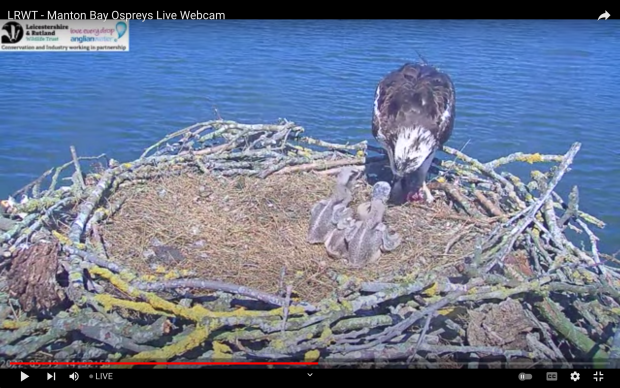
Many have commented that it looks like the Manton Bay trio of Blue 33 and Maya grow right before our eyes. They are certainly moving from the soft fluffy new born nestling phase and will soon enter the dark wooly period. As the plumage changes the osplets do tend to get a little edgy. Those feathers must be really itchy and irritating. No worries – it is just ‘feather stress’ (that is what I call it). There will be no problems with siblicide on this nest!!!!!! Blue 33 has spent a lot of time on the nest with Maya and he has been feeding the chicks every once in awhile.

They are considered to be a Power Couple in the Osprey World. They are certainly very strong together.

Maya was first seen at Rutland in the summer of 2009. She is the only Rutland osprey to have a name. The letters for Maya come from Manton Bay (first and last two letters to form Maya). The Greek word ‘Maia’ means ‘coming of spring’. Maya successfully bred with 5R (04) from 2010 to 2013. They raised 11 chicks! At least five of those have returned to Rutland – if not more. I have not checked the last two year’s stats. Sadly, Maya’s mate did not return in 2014. She waited and then finally paired with 28 (10). She laid three eggs. But Blue 33 (11) wasn’t having it. He wanted both the nest and Maya as his mate and he persisted – finally kicking the other males eggs out of the nest!!!!! Blue 33 and Maya have been together ever since. They are utterly devoted to one another and with the exception of this year, have often arrived from their winter migration within minutes of one another. They first raised successful chicks in 2015.

So why are they considered a power couple within the Osprey world? In addition to the 3 chicks in 2015, there were 17 chicks from 2016-2020 including two years of clutches of 4 chicks raised to fledge!!!!!!!!!!! Two years of four chicks. Think about that. 2019 and 2020. In 2021, they fledged 2 making a grand total of 22 chicks fledged with three now in the nest. In total, Maya has fledged 33 chicks. Incredible. I love this nest. This year will make that 36 chicks.

Here is a video of Blue feeding the chicks. I should mention that Blue is quite different to other male ospreys; he likes to be involved in every process, spends a lot of time on the nest, sometimes feeds Maya and brings in a heck of a lot of fish!

I am a great fan of the California condors and have followed the trials, tribulations, and the victories of both Redwood Queen 190 and Iniko 1031. Everyone was waiting for Iniko to be reunited with her mother after they were separated because of the Dolan Fire. Indeed, if you do not know the story of Iniko – it is beautiful and it should give us hope that things do work out. Iniko was in the Redwood nest that her father, Kingpin and Redwood Queen shared, when the Dolan fire ripped through Big Sur in 2020. The fire raged around the nest tree. Iniko survived but was knocked out of the tree by Ninja 729. Redwood Queen came to the rescue! Iniko was taken into care at the Los Angeles Zoo supported by the Ventana Wildlife Society. Redwood Queen has a new mate, Phoenix, and they had an egg this year that was believed to be non-viable. Iniko was released on 4 December and this is the first time Mum and daughter have been seen together. Both females dive into the pack and get close to the carcass!

@Ventana Wildlife Society

The only surviving chick on the Dahlgren Osprey nest of Jack and Harriet has a nice crop at 1800 today. The heavy storms and rain caused the waters to rise and be murky. Not good if you are an osprey trying to catch a fish. The water is now clearing and let us hope everything stays on track with this one Bob.

It was nice to see Louis cuddled up with Dorcha at the Loch Arkaig Osprey nest in Scotland. The weather has been terrible – that along with a mess of intruders have really not made it a good start to the year for these two.

I can hear rain falling on Theo’s nest in Latvia and see that some work continues to be made on the nest but no Theo and no mate. Beautiful birds singing in the distance.

Black Storks are very, very rare in Latvia and Estonia. Because of this conservation status, they are much loved by the people – and many of us. Karl II and Kaia have four eggs on their Black Stork nest in the Karula National Forest in Estonia. The first egg was laid on 24 April with the last on 1 May. We should be looking for a pip in what? Incubation is normally 32-38 days (varies by author). So we are at 25 days with the oldest egg.

Here is the link to Karl and Kaia’s streaming cam:

The Black Stork nest of Jan and Janika is also in Estonia in Jogeva County. There are five eggs. The couple are, according to the chat moderator, on day 34, 31, 31 and 30 (counted from laying). Here is the link to their streaming cam:

There was one Black Stork nest that was monitored in Latvia. It was the nest of Grafs and Grafiene. I have not been able to confirm any activity for this couple this season.

There was a scary moment on the nest of Big Red and Arthur when Big Red brought in greenery at 11:47 and L3 looked as if she would fall backwards off the nest.

There is tug-o-war with some prey and the inklings of self-feeding with bits of prey left on the nest. Too cute. L4 looks on and wants to join in the fun.

I checked on Ervie a few minutes ago and he was not on the Port Lincoln Osprey barge. Then ‘B’ checked after me and Ervie flew onto the nest and is now sitting in Dad’s cave!!!!!!! Oh, we are truly blessed. Thank you ‘B’. Now anyone can go to the Port Lincoln streaming cam and see our beautiful boy!

Seeing Ervie brings tears of joy! So happy for this third hatch. He is much loved and adored by so many. Thank you ‘B’ for taking the time to send me a note! It is much appreciated. Ervie might well bring a puffer back. He seems to find them around the barge.

Thank you for joining me today. It was a whirlwind around the nests. Too many. Too much going on. It is hard to keep up with them. Take care all. If you want to see Ervie, here is the link to his camera:

Thank you to the following for their streaming cams and/or their FB pages: Ventana Wildlife Society, Port Lincoln Osprey Project, Glacier Gardens, Cornell RTH, Eagle Club of Estonia, Latvian Fund for Nature, Friends of Loch Arkaig and People’s Post Code Lottery, Barnegat Light Ospreys, Sea Eagles @BirdLife Australia Discovery Centre, MN-DNR, Dahlgren Ospreys, DHEC, and LRWT.

Happenings in Bird World 2 August 2021

It is a gorgeous day on the Canadian Prairies. The extreme heat of the past has dissipated and the sun is shining. There is no wind, every leaf is still. The only thing moving in the garden are the little songbirds waiting for the feeders to be filled. No wind means there is no smoke from the wildfires farther north. It is a nice change. We are all hoping for big downpours and, if the weather report is correct, that will come at the weekend.

A serious lump came in my throat this morning when I went to check on Tiny Little at the Foulshaw Moss Osprey Nest. No one was there this morning (nest time) and now the crows are picking at the nest. Normally, at this time of day, Tiny Little would be on the nest waiting for a fish drop. There appear to be no birds in the parent tree in the background. The Crows are a reminder that the days of seeing our Ospreys are precious ones.

I returned to the Foulshaw Moss nest several times. The last visit revealed Blue 464 – the first of White YW and Blue 35’s chicks to fledge – on the nest food calling. You could see the shadow of another bird on the camera at times.

There are some ‘late’ nests and some just starting in case you are having empty nest syndrome.

One of those nests is at the Collins Marsh Nature Centre in Wisconsin. So as not to confuse everyone, the constant watchers got together. Each felt the chick needed a name, even if it was just for us. ‘S’ from Hawaii suggested Malin which means ‘strong little warrior.’ It fit perfectly for this small chick. Voted for unanimously amongst our small but caring group! So from now on I will refer to him or her as Malin, just so you know.

The female was not on the Collins Marsh nest when I checked. She is absent for long periods of time. I want to think she is fishing and will be back to feed Malin or she is just resting. The male has made a fish delivery. This time it is headless. Malin is confused because Dad will not ever do any feeding. Malin is standing and walking much better than last week but he still wants to be fed by the adult.

Malin continues to try and get the male to feed him the fish but it is not happening!

Once Malin realized that he was being left to fiend for himself, he started self-feeding on the fish. Because this one is headless, Malin is making much better progress. This little one is trying very hard.

There is a concern about the feather growth of Malin. Unfortunately, the camera is not clear. Yesterday, ‘S’ took some screen shots that indicated some wing feathers near the tips could be missing. If you look carefully at the image below, you can see the green grass through both wings clearly. This could be a serious concern for this young bird.

Thinking about Malin’s development, a search through the FB pages of the nature centre indicates that three chicks hatched on this nest on 16, 18, and 20 of June. Historically, the smallest – the third – has died on this nest with the exception of one year. This year Malin is the only one to survive leaving us to believe that he was either the first or second hatch. That would mean that he is either 46 or 44 days old. From Osprey development charts, it appears that Malin is about two weeks behind the average in growth. This is most likely due to the low food deliveries.

Maris Strazds, from the Institute of Biology at the University of Latvia states that the availability of food determines the dates of fledging and also that the survival rate of chicks is better if they spend more time on the nest after fledging. Strazds is speaking specifically about storks but this is also known to be true in hawks and falcons and I would like to think that it also extends to Ospreys and Bald Eagles.

While the feather growth is being monitored by the Wisconsin DNR Biologist and a concerned Wildlife Rehabber of the area, access to the nest is a problem. The nest is situated on top of a wildlife tower that was moved to this site so that people could climb the stairs and view the countryside. Here is a close up view. It appears that a metal roof with a peak was fabricated to fit on top of the flat roofed water tower.

In this image the nest looks quite deep. This image was taken several years ago and it seems that the nest has been reduced in size – perhaps by strong winds. Photographic comparison of the nest cup now with the chick and a couple of years ago also indicates a loss of nesting material, perhaps substantial amounts, missing.

It is difficult to determine if there is a wooden support under the twigs. If you look at the images of the nest with Malik (above) it appears that there is something ‘square’ underneath a couple of layers of twigs.

My concern is that if the feather development on Malin is problematic, there is no emergency access to the nest from the observation box. In other newsletters I have indicated that there should be a means to access the nest without compromising the safety of the individuals trying to help the birds.

There is only one operational White-Bellied Sea Eagle cam in the world. It is at the WBSE nest in the Sydney Olympic Park and the excitement there is just beginning. These two little ones, 27 and 28, appear to be getting along without food competition. Of course that can change but there has been plenty of Catfish Eels (or is it Eel Catfish?) on the nest.

Right now the sea eagles are sleeping. One little babe can be seen sleeping on Lady’s leg.

You can access this streaming cam here:

Tomorrow I will give you some information on other nests in Australia including two Peregrine Falcon streaming cams.

If it is Bald Eagles you love then the Glacier Gardens Bald Eagle Nest in Juneau, Alaska is not to be missed. Kindness is such a little sweetheart. Liberty and Freedom are helping her by trying to get her self-feeding skills honed. The eagles fledge later in Alaska because they are bigger in size than the ones hatching in the Southern US who are already off the nest. At Glacier Gardens, the average fledge is 89 days after hatch while the rest of Alaska is 80 days on average.

‘L’ also sent me the link to an Osprey nest that she has just discovered. The chick hatched on 23 June. It is a real little sweetheart ——- and the camera definition is excellent!

It is the Minnesota Landscape Arboretum Osprey Nest. There is only one surviving chick. The other perished on 26 June; the cause is not clear. This chick looks extremely healthy. The nest is on top of a platform at the University of Minnesota. Enjoy!

Because so many of you love storks, I want to mention two that my friend, ‘S’ in Latvia says are very special. One nest is in Latvia and the other is in Estonia.

The Black Stork nest in Latvia is very special. The birds are listed as critically endangered and it is rare to see them in Latvia even though the White Stork population is healthy. The male is Grafs. ‘S’ explains to me that the nest is late because Grafs was a bachelor and waited a very long time for his mate, Grafiene, to arrive. The three storklings hatched on 12, 14, and 15 of June. There are many challenges for this couple and their trio. The first is the late hatching date and the worry about whether or not the parents will remain with the storklings until they are developed and strong enough for migration. The storklings will be ready for fledging in 20 or more days. That puts it at the third week of August. As we know, storks are already gathering for their migration so watchers can only wait and hope and take the beauty of this nest a day at a time – as we always do with other nests. The second concern has been the dangerous heat that has hit nests all around the world causing a drop in prey delivery. The third is the nest itself. It appears to be unsafe despite the fact that other stork couples have fledged chicks in previous years.

I want to add that the chicks are very healthy – they are doing so well so I want all of us to be optimistic. This year I have seen miracles happen on nests – I only have to look at Tiny Tot on the Achieva Osprey Nest and Tiny Little on Foulshaw Moss to know that positive things can happen if we all send warm wishes. Even the turning of the deadly storm cells away from the nest at Collins Marsh was another of those miracles or the safe return of the male at the Barnegat Light Osprey Nest in NJ after being missing for a day due to that same weather system. So, we wait, watch, and hope.

You can watch this beautiful nest here:

It is raining today on the nest. Oh, how I wish the beautiful storklings could send some of that moisture to Canada!

There is also a forum in English for this nest where you can go back and see the long history and discuss the nest. You can access it at

The second Black Stork nest is actually in Estonia. As in Latvia, Black Storks are loved in Estonia and are rare.

It is also raining at this nest today, too.

The parents are Jan and Janika. The nest is very stable so there are no worries with the structure. But because of the horrific heat that has impacted all nests, food deliveries have sometimes been problematic. Janika, like the mother on the Collins Marsh Osprey nest also disappears for long periods. These storklings will also have a challenge to be flight ready for when the migration begins. Again, we can watch with wonder at these extraordinary birds but we must be aware of some of the challenges that birds encounter. Life is not easy.

There is also a forum for this nest. It is here:

I really want to thank ‘S’ for bringing these two Black Stork nests to my attention plus sending me all of the information about them. They are such beautiful and rare birds and it is a real privilege to see them hatch, grow and learn, and then begin their journeys. In addition, I want to thank ‘L’ for sending the information on the Minnesota Landscape Arboretum Ospreys and ‘S’ for finding all the images of the tower at Collins Marsh and the Nest and the great name for the Collins Marsh chick – Malin.

And I want to thank you for joining me today. It is always a pleasure to have you here with all the other bird lovers around the world. Stay safe everyone. See you soon.

Thank you to the following for their streaming cams where I took my screen shots: Eagle Club of Estonia, Latvian Fund for Nature, Collins Marsh Nature Center, Cumbrian Wildlife Trust and the Foulshaw Moss Osprey Nest, Sea Eagle Cam, Birdlife Australia, and the Discovery Centre, Glacier Gardens Bald Eagle Nest, and the Minnesota Landscape Arboretum Osprey Cam.