Bird World 15 November 2021

In the first chapter of her book, Field Notes from an Unintentional Birder, Julia Zarankin talks about the rather spartan apartment she had as a graduate student. She talked about the compromises with her husband’s collection of 300 stone elephants only to realize what happened when she discovered birds. She said: “Within a year, the barometric pressure in my apartment shifted. Stuffed-animal squeaky hooded warblers learned to coexist with tigers; bird-shaped vases stood next to the elephant-shaped salt shaker; sculpted owls flirted with the faux-malachite elephant’s plastic tusks…more frightening: a pile of bird-themed stationary of every persuasion and a shelf dedicated to field guides…Not to mention the nondescript felt bird, the two paintings of birds, and the stained glass owl..” Later she adds the parrot notebooks, bird-themed t-shirts and all the bird magazine subscriptions. How many of us see ourselves in those same words?

I was, despite all of the warnings by Zarankin, delighted to see Emry Evans’s book, Monty, in the post along with some pins. The Dyfi online shop is now open. All of the nature centres will ship overseas. Roy Dennis’s Wildlife Fund has his three books and shipping internationally is calculated at check out. Lots of good things at all the on line shops for Osprey fans.

Emyr Evans writing is exceptional as are the images in Monty. Written with a deep, abiding love and respect for a bird – 50 stories from the pen of Emyr Evans.

It is a horribly grey day on the Canadian prairies. Will it snow or will it rain? Do birds get arthritis? Would they like a heated area to warm their little feet? Those are the silly thoughts that have gone through my head today.

Dyson decided it was best to just be off the snow altogether and sit in the tray feeder filling his cute little face.

Dyson doesn’t share. He is like Ervie, the Port Lincoln super star fledgling who grabbed the first fish of the morning from dad at 6:50:24. Oh, I love this image of Ervie in front of Dad grabbing that fish with his leg just like Mum does. Ervie watched and learned. Sorry, Bazza.

Falky just loves to fly and he was much more interested in checking out the area than the first fish. He flew in just a little too late.

Falky’s landings are actually really good. Ervie did a few spins yesterday and wound up landing on Bazza – Ervie needs landing training. That is great form that Falky has on this landing. Ah, the lads will all improve. This flying thing is just new. What fun it must be to whip around the bay!

Now Bazza – it is your turn!

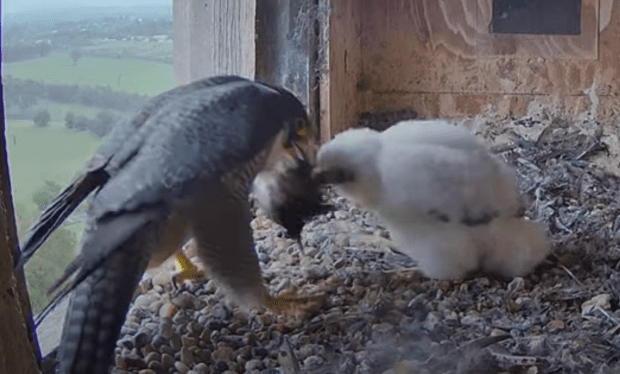
Diamond brought prey in for Yurruga at 07:09. Yurruga was ready!

I thought Diamond would drop the prey and leave like Xavier but she had a different idea.

Diamond who incubated the two eggs during the night decided she was also going to feed her nestling.

Look carefully. Yurruga is changing. The white down is really coming off those wings and the head. She looks like a bird, not a fluffy column with a sort of bird head. Even, the fur boa is disappearing.

You can see the pin stripes on Yurruga’s chest and her head now looks like that of a falcon. Amazing. Equally impressive is the length of Yurruga’s tail. What a gorgeous Peregrine Falcon she is going to be.

Ah, and if you are watching the dates, Izzi fludged a year ago today. Izzi is the 2020 hatch of Diamond and Xavier and quite the character.

Oh, such delight. There is no news – at least not yet today – on Grinnell. I hope he is ready to be released shortly. And no news on WBSE 27 but there was a gorgeous Galah in the nest this morning poking about.

One of the Aussie chatters always said that if someone called you a ‘galah’ it meant that you were rather ‘slow, dim witted’. Ah, terrible. They are such incredibly beautiful pink and grey cockatoos. A few minutes of a cute bird that loves to have ‘tickle tickle’.

Bazza still has plenty of time to fly today but I don’t. Thank you for joining me — and if you loved Monty, you seriously need to get to the Dyfi store and get a signed copy of Emry’s book. I promise you will not be sorry but you will need a box of tissues. Take care. See you soon.

Thank you to the following for their streaming cams where I took my screen captures: the Port Lincoln Osprey Project, Sea Eagles @Birdlife Australia Discovery Centre, and Charles Sturt University Falcon Cam and Cilla Kinross.

Late Saturday in Bird World

It is difficult to try and describe the weather we have been having to someone who might never have experienced it. Someone took a video of the blowing snow on the highway, a huge buck, and some of the issues people face trying to drive on the road in a storm. When you cannot see the road for the blowing snow, we call it a ‘white out’. This is the time of year we also call ‘the rut’. The bucks dig and spray marking their territory. We are seeing many in the fields around the city and in larger treed forests within the City.

Ah, but I am not here to talk about the horrible winter weather we are having.

My last blog focused on Ervie, the third hatch at the Port Lincoln Osprey barge in South Australia. Ervie managed to get the first fish of the day. He only left the tail for Falky. To show how congenial these three are, Ervie did not even try to get the 10:48:28 delivery from Dad. Instead, Bazza (Big Bob) snatched it.

There he is enjoying his fish.

The camera is zoomed out in case one of the lads decides to fledge. Oh, I do hope they stay a little longer – another week, maybe.

Little Yurruga at the Charles Sturt University falcon scrape had 5 prey items for breakfast today. Yesterday was not a good day for feedings but, Diamond and Xavier have made up for it today. I am thinking that the parents might be teaching Yurruga that there are days with little food and some days with a lot.

Yurruga was really hungry when Xavier came with breakfast! Really hungry.

Yurruga has just finished that breakfast. Another prey item sits on the scrape, a Starling, and Xavier has brought more food. Notice that Yurruga is not running up and tackling Xavier to get the prey. Yurruga is probably wondering why there is so much food today.

Diamond came in to help Yurruga finish up that delivery. The Starling is still where it has been all morning. Diamond really dislikes Starlings!

Yurruga has an enormous crop. It isn’t her crop that interests me, however, but, the change in her plumage. Much of the fluff has disappeared. Peregrine Falcon juveniles have beautiful banded chests. Their bars are vertical. When Yurruga is an adult, the bars will be horizontal. Notice also the beautiful dark head and the tip of the wing. Oh, she is morphing right before our eyes into a very beautiful juvie.

She does not seem to be interested in the Starling that she pulled over to the rocks earlier. Oh, wait…maybe she is!

The feathers are almost off the left side of Yurruga’s head. Notice her beak. We get a chance to see how it has developed in this profile image. Yurruga is becoming very ‘falcon like’. Those chest feathers – that coppery brown – are just lovely. She looks like she has a feather boa around her neck – something she might need where I live today.

Oh, Yurruga means business. She is going to do something with that Starling.

She is showing us how strong she is! There are still some soft pantaloons but the down is coming off with every flap of those wings. Is there anything cuter than a little peregrine falcon at this stage in their development?

She is dragging that old bird back into the centre of the scrape.

There is our Peregrine Falcon with her large beak standing victorious on her prey. This pose really reveals how much Yurruga has grown. All of the feathers necessary for flight are growing in. Amazing.

Awww. Yurruga gave up on that old bird. No one seems to really want it. Wonder if Starlings have ‘Best Before’ dates on them?

WBSE 27 @Chris Bruce

If you missed it, here is the latest update on White Bellied Sea Eagle Fledgling 27, three days ago:

I wanted to bring you an update and some good news. The Port Lincoln Osplets are doing fine and I am certain that Falky will have a fish before the end of the day. Yurruga has already eaten enough to last her well into tomorrow. It also appears that WBSE27 is doing extremely well in care. The last update on Grinnell was on 10 November. He was getting to go into foster care for a few days before being released. All of the Kakapo are alive and the NZ DOC Rangers at Taiaroa Head will not decide which Royal Albatross couple will be on the Royal Cam until all eggs are laid.

Thank you. It is really nice that you are joining me. Take care wherever you are. Stay safe.

Thank you to the following for their streaming cams or FB news where I took my screen captures: the Port Lincoln Osprey Project, Sea Eagle Cam, Charles Sturt University Falcon Cam and Cilla Kinross.

Three lads and a Puffer Fish

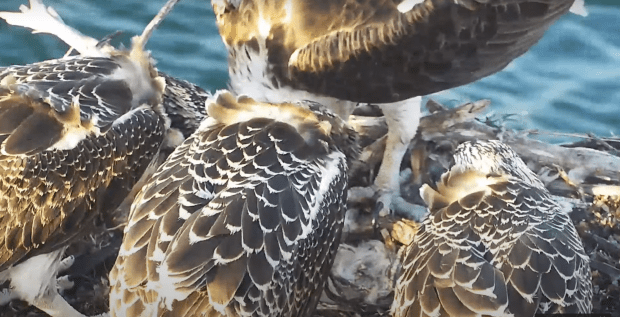
It is time to check on what is happening at Port Lincoln. Too soon these three fabulous males will fledge and oh, how we will miss their antics! Friendly banter amongst brothers.

Mum brought her boys a bit of a puzzle at 12:51:46. It was a Puffer Fish and she just let them go at it while she stood and watched each of the deal with this strange object.

“Puffer Fish” by ciamabue is licensed under CC BY 2.0

Puffer fish belong to the Tetraodontidae family. They are known by various names including blowfish, balloon fish, toadfish, globefish, bubble fish, and puffers. They carry a toxic poison – tetrodotoxin. It is one of the deadliest poisons found in the natural world. They are considered to be the second most poisonous creature in the world. These fish can live up to ten years and are found in tropical and subtropical oceans. Some species (there are 120) also live in fresh water. The puffers inhale air. This turns them into sphere. They also have poisonous spikes to try and keep from being eaten by larger fish. You can see those clearly in the image above. Their skin is also said to be extremely thick making it difficult for any predator to eat them. So why did the Mum bring the three boys a puffer fish? Was it a lesson?

I broke the event into two segments for you:

In the end, the lads left the ‘white football’ on the nest. You can see it on the left.

Ervie aka Little Bob could not stand to see the fish just go bad on the nest. The two other siblings didn’t seem to want anything to do with it so at 13:34:31, Ervie goes over and pulls the now mostly deflated fish over to the rim of the nest.

Ervie tries hard to eat that thick skinned fish.

Ten minutes later, Ervie has caught the attention of one of his siblings. In the end, Ervie lets his brother have a ‘go’ at the impossible fish. That is very unlike Little Bob. It must have been a struggle.

A half hour later the fish was abandoned again. It is lying on its side in the image below.

And it remains there. Possible lesson: Don’t ever waste your time catching a puffer fish, sons!

Thank you so much for joining me. I hope that the three lads at Port Lincoln bring a smile to your face. They do mine. But before I close, we can all use some sunshine – Yurruga style. Oh, my. She reminds me of her brother, Izzi, so much. She is soooooo loud!

Take care everyone. See you soon!

Thank you to the streaming cam of the Port Lincoln Osprey Project where I took my video captures and screen shots.

Sadness and Joy

Everyone has been very saddened by the fact that there will not be four fledges from the 367 Collins Street Peregrine Falcon scrape in Melbourne. Everyone was both shocked and happy when Mum laid that fourth egg. It would have been a historic moment if all four had fledged. It is hard to lose a little one that we have come so close to – watching all of its antics.

Trichomonosis is caused by a parasite. In urban raptors, it is normally by the eating of an infected prey item. The neck and throat can swell and sores or cankers can appear. The birds cannot swallow and it is difficult to eat and breath. That is certainly not something we would wish on any bird. No one will ever know which of the prey deliveries carried this deadly parasite.

As one person said today – putting this loss in perspective – “we are lucky that we did not lose all of the birds.” They are absolutely correct. We have seen how prey items are shared and we now must hope and send warm wishes that none of the other family members succumb to this parasite. You can see in the image below how swollen the neck is of the little male in this image taken last evening. He is the one with the floof on his wings and back still. It is so sad.

Two of the siblings stayed with their little brother in the scrape box last night. The parents had been in earlier. I will disagree with anyone that says the parents and the siblings do not know what is happening with their family member. They do. They are just not afforded the luxury of having several days to mourn. They have to get on with their lives so that they survive.

In her book, The Genius of Birds, Jennifer Ackerman addresses (briefly) issues related to death and mourning in Corvids. The Peregrine Lady (Kate St John) who writes about the falcons in Pittsburg in her blog Outside My Window, has often commented that whenever one of the fledglings would die, the Mum falcon would go to her “mourning corner”. While she could not stay there for long because she had survivors to look after, it was a noticeable change in her behaviour when one of her own died and it was the only time she goes to that particular place. Kate St John’s blog is excellent and can be accessed at: birdsoutsidemywindow.org

Here is another article on mourning.

As Jennifer Ackerman states, “The jury is still out on whether birds grieve their own. But more and more scientists seem willing to admit the possibility.”

There is not a lot happening on the other Australian nests today, thankfully. The water is still a little choppy at Port Lincoln. Certainly not like it was yesterday when one of the nearby boats sunk. The three will no doubt be working on their hovering after getting some energy once that breakfast fish has arrived. And, yes, they could fledge anytime but I am counting on another week with these guys.

Yurruga is also waiting for her breakfast. She will be ready to fledge in a week but will she fly then? That is hard to imagine with all the floof still on her body! At that time the parents will continue to provide her with food and train her so that she can live a successful life as a falcon. Once she reaches that stage, they will invite her to leave their territory and find her own space.

Yurruga is adorable. Her name means ‘Sunny’ in Maori and she does certainly brighten up everyone’s day. Notice that she is standing on the rocks in the corner. She slept next to her Mum, Diamond, on Diamond’s rocks last night. Those rocks were put there on purpose so that Diamond would not be able to lay her eggs where they could not be seen by the camera. Yurruga only knows that Mum stands there and we get the benefit of seeing her beautiful face up close. What a darling.

Please do watch this beautiful family. Diamond and Xavier are fabulous parents! Yurruga is very vocal and right at this moment she is screaming for the parents to bring breakfast! I promise that Yurruga will delight you just as her brother Izzi did last year. Here is the link:

It is a very snowy day on the Canadian Prairies. A wonderful day to hunker down and read and drink lots of tea. If you have good weather and are heading out for a walk, enjoy it for me, too. This snow is like walking in a 15 cm or 6 inch Slurpee it is so heavy and wet. The birds are hiding in the wood boxes today, some of them.

Take care everyone. I so wish I had been able to have brought you good news about the little fellow. See you soon.

Thank you to the following for their streaming cams where I took my screen shots: The Port Lincoln Osprey Project, and 367 Collins Street Falcons by Mirvac.

Fall to winter

The beautiful weather that we had on the Canadian Prairies yesterday was due to dramatically change over night.

Footpath linking Portage Avenue with Assiniboine Park over the Assiniboine River

Our weather will go from nice blue skies and unseasonably warm temperatures to snow and then snow mixed with rain. It is currently 0 degrees C and will warm up to a balmy 2 degrees C in the morning when the precipitation begins. My daughter messaged me to tell me there were still some Canada Geese and ducks in the Assiniboine River. It seemed like a good time to get out and go for one last nice walk.

The little Red Squirrel at Assiniboine Park knows that the warmth is not going to last. It was busy pulling off the seeds from a Maple tree and cramming them into holes and in the grooves in the bark of a tree. He was so busy he did not even notice the people standing and watching him.

The geese were looking for any blade of grass to eat they could find.

Some were in the duck pond flapping their wings trying to stir up the plants from the bottom of the pond.

Others were simply enjoying a beautiful afternoon in the warm sunshine.

It gets dark around 17:00 and as I was leaving some of the geese were flying away. Are they heading south for the winter?

I really hope that the geese and ducks got out of the City last night like the ones above taking flight. As promised, we have snow. Mr Blue Jay has come to visit and the sparrows are trying to find seed under the snow.

There are many feeders filled with sunflower chips, suet, black oil sunflower seeds, and then that wonderful ‘trail’ mix which looks better than what I make.

The sparrows in the snow on the deck know there are goodies underneath. Why they are not back at the feeders I cannot tell you. There is room for everyone there.

What a handsome little House Sparrow this fellow is. You can always tell them by their grey caps!

So how do birds cope with winter? This article was published by Daisy Yuhas in 2013 but it is still accurate now. Have a read – it is really interesting:

“Each autumn as many birds begin epic journeys to warmer climates, there are always some species that stay put for the winter. These winter birds have a better chance of maintaining their territory year-round, and they avoid the hazards of migration. But in exchange they have to endure the cold.Like us, birds are warm blooded, which means their bodies maintain a constant temperature, often around 106 degrees Fahrenheit. To make enough heat, and maintain it, they’ve evolved many different strategies–some similar to our own.Sparrows, for example, seek out shelter in dense foliage or cavities to avoid the elements. They also huddle, bunching together to share warmth, and try to minimize their total surface area by tucking in their head and feet and sticking up their feathers. Cardinals, impossible to miss against the snow, and other smaller birds puff up into the shape of a little round beach ball to minimize heat loss.”Big birds, like geese and grouse, do what we do,” says physiologist David Swanson at the University of South Dakota. “They put on insulation.” Their insulation often involves growing an extra set of insulating downy feathers.Birds can also put on fat as both an insulator and energy source: More than 10 percent of winter body weight may be fat in certain species, including chickadees and finches. As a result, some birds spend the vast majority of their daylight hours seeking fatty food sources, making feeder food even more precious for surviving a frosty night.When asked which birds are toughest winter survivors, Swanson points to little ones like chickadees. These small creatures can’t put on too much bulk for aerodynamic reasons. Instead, explains Swanson, they are experts in shivering. This isn’t the familiar tremble that mammals use to generate heat. Birds shiver by activating opposing muscle groups, creating muscle contractions without all of the jiggling typical when humans shiver. This form of shaking is better at retaining the bird’s heat.Another adaptation shared by many species is the ability to keep warm blood circulating near vital organs while allowing extremities to cool down. Take gulls. They can stand on ice with feet at near-freezing temperatures while keeping their body’s core nice and toasty.Keeping warm when the sun is up is one thing, but few winter challenges are more daunting than nightfall, when temperatures drop and birds must rely on every adaptation they have to survive their sleep. Some birds save energy by allowing their internal thermostat to drop. Hummingbirds are a famous example of this, undergoing torpor nightly as their body temperature drops close to outside temperatures. But torpor is not too common in winter birds, because the morning warm up would take too much extra energy. Instead, black-capped chickadees and other species undergo a more moderate version of this, reducing their body temperature as much as 22 degrees Fahrenheit from their daytime level in a process called regulated hypothermia.One simple way to help birds when the weather outside is frightful is to hang feeders. To attract a diversity of birds, select different feeder designs and a variety of foods. A tube feeder filled with black oil sunflower or mixed seeds, for example, will attract chickadees and finches. Woodpeckers devour suet feeders. And a safflower or sunflower-filled hopper feeder entices the usual visitors plus larger birds like cardinals and red-winged blackbirds. The birds benefit from the backyard buffet, and you’ll have a front-row seat to numerous species flocking to your plants and feeders.” Some raptor species, lower their body temperatures. More on that another day as we shift from fall to winter.

It is not clear how many birds are on the ledge at 367 Collins Street. The Mum was there overnight with one – the one with some floof still on its back and wings in the scrape box below. There were two. Where is the other one? at the other end? flown off? difficult to tell. The one on the scrape box has just vocalized and headed down the gutter. I suspect it could be breakfast.

It is almost flying along the gutter now.

Fledging will be happening soon down in Port Lincoln and if you want to see how a hungry falcon acts just go over to the scrape in Orange. Yurruga is a week younger than the eyases in Melbourne. It is really foggy in Orange this morning so breakfast could be delayed. That link is:

Look for a lot of wing exercises and hovering from the trio at Port Lincoln. Ervie was doing a fabulous job yesterday.

Oh, I am really going to miss these lads when they fly to find their own way. Last year it was this Osprey nest that almost put me off my interest in third hatch ospreys. Siblicide is horrific. And it is this same nest (along with Achieva and Foulshaw Moss) that gives me hope that things can turn around for the good for the chicks. It has been incredible this season.

It is time for some hot tea. Thank you so much for joining me. Take care everyone. See you soon.

Thank you to the following for their streaming cams where I took my screen captures: 367 Collins Street Falcons by Mirvac and Port Lincoln Osprey Project.

Monday in Bird World

On the Canadian Prairies, it is 8 November and it is 11 degrees C. There are some birds still around the southern part of our province including a large number of Great Horned Owls (GHOW) and Barred Owls (BADO). Several hours from where I live there are some hawks and Bald Eagles still making their way south. In celebration of such a gorgeous day with the promise of snow and plummeting temperatures on Wednesday, we decided to make one last check at Oak Hammock Marsh.

It was simply grand. You could see for miles.

The walk was great. It was sooooo quiet, a wonderful change from the noise of the city. If you were intent on counting tonnes of birds and seeing lots of species, then it was a bust! There were about 60 Canada Geese scattered about and a couple of Mallards, a male and a female.

They were all feeding on the tender marsh grasses below the surface.

Even the geese were quiet, no honking, nothing. Just working hard on those plants.

The two Mallards were quite interesting. They were sort of breaking down the grasses as they moved through forcing them under the water with their paddles and then eating them.

Beautiful little female Mallard.

The ducks were not bothered by the geese – everyone seemed intent on eating and enjoying the warm sunshine. The farmers in the area have finished harvesting their crops and the fields are bare. In several hours only six or seven Canada Geese flew into the wetlands.

It might have been quiet in rural Manitoba but there was a lot of things happening elsewhere. First up, for all of you that watch the Royal Albatross, OGK’s mate since 2006 has been YRK. OGK was first in on the peninsula excited to see her and build a nest but…she didn’t arrive. Time passed and she didn’t arrive. Today, 9 November YRK landed on Taiaroa Head. If people could have rung bells they would have. Instead many of us sat and shed tears. The fear is always there. OGK and YRK were the parents of very popular Royal Cam chick, Atawhai (aka Pippa) in 2020. This year will be their 8th breeding attempt.

In other Royal Albatross news, the new couple – Red and BOK (Blue-Orange-Black) have really been entertaining us. They are so sweet. Well, today, Red got some new bling. As one of a mated pair, he is now WYL (Whit-Yellow- Lime).

The image below shows the Ranger giving Red his new bling and identity. BOK is walking off the nest. She will return once everything is over.

Could this new couple with their first attempt at breeding turn out to be the Royal Family of the year? We wait.

The Port Lincoln Osprey Mum decided it was time to go to the spa. She flew off the barge and went over and had a lovely bath in the warm Australian waters of the cove yesterday. It is well deserved. Her and her mate have raised three healthy boys this year.

Isn’t Mum just beautiful?

It is hard to keep up with the 367 Melbourne Peregrine Falcons. I ‘believe’ that there are two (probably female) still on the ledge.

Yes, still there. There is a lot of noise and it could well be the parents trying to lure these two off with prey.

There are theories about gender and fledging times in falcons and hawks. Because the females are substantially larger, it takes longer for their bodies to feather. Therefore, they generally fledge after the males. I do not know how accurate it is but I hear this often.

In Orange, Diamond’s foot is doing much better. At 8:11 Xavier, the male Peregrine Falcon of the scrape on the water tower of Charles Stuart University, delivers a Starling to Yurruga. Xavier does not wait. He drops the breakfast prey and gets out. I don’t blame him. It could definitely save his talons.

Notice how big Yurruga is compared to Xavier. Think Yurruga is a female like her mum, Diamond?

Yurruga is a very good plucker!

Cilla Kinross just posted a video clip of Yurruga. It is really short. Have a peek. I do not think those eggs are going to last much longer.

Everything is as it is expected at Port Lincoln. Dad flew in with a really nice fish but instead of letting the chicks do a grab, Mum got over quickly, mantled the breakfast, and proceeded to take control of the feeding.

It should, by now, not surprise anyone to the identity of the chick right up at Mum’s beak. Now the chick can be identified quite quickly – it’s Ervie! aka Little Bob.

The rule of thumb is that the males return to make their own nests near their natal nest. I hope there are three or four more barges available.

One last nest. NEFlorida with Samson and Gabby. They are both very busy working on that nest. They have been bringing in a lot of big twigs. Here is Gabby moving some of those around.

Cute little Samson looks like he is standing very still in his tight black jeans waiting for orders. What a sweetie.

Samson is a very good listener and Gabby is giving precise instructions. Looks like they are already thinking they need high rails this year.

Thank you so much for joining me today as we check in on some of ‘my’ favourites. Take care everyone.

Thank you to the following for their streaming cam where I took my screen captures: Cornell Bird Lab and NZ DOC, Port Lincoln Osprey Project, NEFlorida Eagle Cam and the AEF, Charles Sturt University Falcon Cam and Cilla Kinross, and 367 Collins Street Falcons by Mirvac.

Soap Opera at the Campanile and other nest news

The soap opera playing out with the Peregrine Falcons at tThe Campanile on the grounds of UC-Berkeley made the Los Angeles Times this morning:

Annie only knows Grinnell is not there and it appears she might be taking up with the interloper that caused Grinnell’s injuries. My goodness!

The birds are stirring at Port Lincoln this morning. Before 6am there was calling from the nest. There were only 3 birds but it was Mum calling Dad with the breakfast order. No. It was the chicks calling Dad wanting their fish! They are so big. Ready to begin flying.

Just look at those three birds. I sure hope they stay in the nest and pancake when they are to be ringed today but I am worried the sound of the motor boat is going to make them bolt off the nest early. I so want to be proven wrong, for the sake of the birds, and foolish for even thinking such a thing.

Janet Forster says they will come in a boat and dingy when the boat gets back from the Sea Lion Tour. Fingers crossed. We will not be able to see this live but I am hoping either pictures or a video will be shared later. The trio were fed six times yesterday. It should have been seven but dad lost a fish and he found it and decided he would eat the entire thing!

Is this to be the day that at least one of the 367 Collins Street Four fledges? They slept on the ledge last night. Will they fly off together?

Yurruga had a lot of prey items yesterday. She sported a nice crop and is doing really well with her self-feeding. What a lovely independent eyas. In one instance, Xavier came in with a Rosella. Even with a crop Yurruga seemed to want to have some of it – they must be very tasty. Someone told me they are the equivalent to the pigeons in the city – parrots everywhere – but I have no idea if that is true. In the end, watch and see what happens. Oh, and before I forget. Diamond’s limp is still there but it is improving every day.

There is an updating on WBSE 27 by Judy Harrington. This is what she posted: “SE27 is doing well, gaining strength and is feeding by itself. It has moved to a larger raptor cage to allow it to exercise and recover.
The treating vets have advised that SE27 will be in care for a few weeks while it recovers and will be released back into the wild as soon as it’s well enough. Healing takes time so please be patient. Updates will follow when possible. BTW, we hear fish and mice have been on the menu!
It is unlikely any photos will be issued while in captivity.
There are no reported sightings of SE28.” That is good news for this beautiful sea eaglet, WBSE 27.

It is really windy down in Ft Myers, Florida. M15 has been bringing his mate, Harriet, some nice treats in the last few days. The other day it was a Cattle Egret. She was delighted. The pair continue to work on their nest. Wonder when the first egg will appear?

Harriet being blown a bit by the wind. 6 November 2021

It is stormy over in Jacksonville, Florida. Still Samson and Gabby were both on the nest in the wind and rain preparing it for this season. Oh, goodness, this couple just warms my heart! (Yes, we all have our favourites. I admit it).

The weather out in Colorado is perfect and the Bald Eagle couple on the Fort St. Vrain Bald Eagle Nest are busy working, too. Last year they raised one chick. Wonder if they will make it two this year?

There is one eagle, at this very moment, working on the nest in the Kisatchie National Forest. I do not know if it is Anna or Louis. This is their second season together. So glad to see the couple returned. Last year was the first since 2013 that an eaglet had hatched and fledged in this nest. Nice to see the young family here. That is a great image on the two cameras and the sound is excellent this year. Cody and Steve have really been working on the set up. (Thank you!)

I am afraid that I could go on checking Bald Eagle nests and we would see the same image – one or both adults working on the nest. The eagles have really come back from nearly being wiped out. I hope there are enough big trees for them for nests!

It is going to be awhile til the PLO chicks are ringed and, believe it or not, it is 14 degrees C on the Canadian Prairies. Summer weather. Well, this is what our summers used to be like: 14-17 degrees C. Now you can double that. The sun is shining, the sky is blue, and so far, Dyson is leaving Mr Blue Jay’s corn cob alone. It is a great day for a walk. See you later. Take care everyone.

Thank you to the following for their streaming cams where I took my screen shots: X-Cel Energy, Port Lincoln Osprey Project, 367 Collins Street Falcons by Mirvac, SWFlorida Eagle Cam and the Pritchett Family, NEFlorida Eagle Cam and the AEF, the KNF Bald Eagle Nest, and Charles Sturt University Falcon Cam and Cilla Kinross.

Whew!

I know that some of you have watched birds fall out of nests including Silo Chick at Patuxent River Park last summer. Remember that feeling when you saw that little osplet fall into the water, heard the splash, and saw the others looking down? Felt helpless? Of course. Thankfully that story ended well. I have no idea how many called but the osprey was located and literally tossed back into the nest. It was an enormous relief. Others are not so lucky.

I posted a new owl box streaming cam in Joburg, South Africa just the other day. An orphaned Spotted Eagle owl was put in the box with two other owlets. The mother accepted it! Fantastic. The adopted owl is 5 days older than the other two and it got curious about the outside world today and fell out of the nest box!

What no one knew, at the time, was that the owl landed on a huge platform under the box. If it doesn’t get back into the box on its own, it will be placed back inside the box. Relief.

Yarruga was starving this morning. There were two prey deliveries at the scrape box and there was not a scrap left of either meal.

Yarruga was so excited when the second meal appeared that she could not stand still to eat. She literally ran around the scrape box as in the images below.

Xavier was certainly glad when that feeding was over! There is not a drop left for either of the adults. Yarruga was soooooo hungry after having only 2 feedings yesterday. She does love her food! And she is certainly growing. Look how big she is next to Xavier!

In fact, Yarruga should have had a nice tasty little duckling yesterday but Diamond saw it and quickly took it from Zavier and flew out of the scrape! One has to imagine that this is quite the delicacy (as opposed to the dreaded Starling!). After her injury, I am actually glad that she got it.

Port Lincoln did a nice close up of the juvenile feathering of the three osplets this morning. Just look at the variations in the depth of the white juvenile feather banding. Little bob is in the middle.

As the dominant bird, Little Bob often gets the first bite. She is full and letting the other two have their turns as she looks out to the water in the image below. Of course, I am saying ‘she’ because of her thick legs. Wait til Monday when the banders declare she is a he. How funny! Whatever gender, that bird is gorgeous and I will continue to celebrate the times that she put Big Bob in his place.

There she is below.

Victor Hurley, the main researcher for the Peregrine Falcons in Victoria has been posting information on the 367 Collins Street FB Page. The last posting was on ‘Dispersal’ because, as we know, the falcons will be fledging shortly. I imagine that there are many things in this column that would be of interest to many of you. This is what he wrote:

First Flight Normally, this is not such a serious undertaking as that from an inner city high rise ledge. Normally pre-fledgling Peregrine Falcons will scramble around across their natal cliff for quite some time before taking their first flight. Mostly this is successful and they land high on another ledge or small perch. In a city location they will land on the roof top of another building nearby. If the winds are tricky then things can go south pretty quickly. Once they have mastered their first flight then they will spend increasing time “on the wing” and following and learning from the parents how to hunt. As soon as each youngster achieves their first kill the adults (parents) will stop providing any more food and that youngster is on their own to find food. Once all young are successfully hunting then depending upon the experience and ruthlessness of the adults they will all be chased with serious determination out of the territory altogether. In some cases this may occur in December or even early the nest year. Either way the young tend not to return again to the nest ledge that we have been observing. Maybe occasionally, but then only briefly.

Plumage differencesLeading up to this first flight the adults restrict the level of food resources they bring to the nest. This explains the weight loss of the nestlings. The wings of the nestlings are still growing but they are also losing weight. This makes them lighter with larger wings which provides for a “lower wing loading” which makes their first flight easier. Neat, huh! The other point I thought I would raise here is that of the plumage differences. Peregrine Falcons as with most raptors and many other bird species have a juvenile plumage phase and an adult plumage phase. The juveniles are in essence a brownish colour with vertical splotchy stripes over a “dark milk tea” fawn base colour on the front and dark brown wing, back and head. Whereas the adults have a near black hood for the head, slatey grey wings and back with a soft cream bib and base colour overlayed with fine dark grey-black horizontal stripes. The tail and main wing flight feathers are also longer in the juveniles and they moult shorter feathers with each year as they get older.

Natal dispersal This is the ultimate question. Where and how far do Peregrines disperse to find a place of their own in which to breed. Natal dispersal is the distance (and direction for those interested) in how far fledgling Peregrine Falcons ultimately move to find and establish (read take over for the most part) their own breeding site. Amongst Peregrine Falcons in Victoria, as with most bird species the world over, the females disperse further from their fledging site to breeding site then do males. Based on observing 127 breeding adults with leg bands (placed on them as nestlings) the females dispersed on average 64km (range 6-280km) and males average 25km (rang 1.6-90km). This differing dispersal distance minimises the likelihood of siblings interbreeding. The average age at first breeding is as follows: females 2.6 years (average) and for males 3.3 years (average). Another way of presenting this same data includes presenting the direction as well as the distance males and females disperse. No bias in dispersal direction was recorded.Victoria is a relatively flat area of the planet, its highest point above sea level is Mt Bogong (1,979m) and~80% of Victoria is <200m ASL. So for a predatory species like the Peregrine Falcon that doesn’t migrate annually due to milder winters and having the highest wing loading of any Peregrine sub-species globally, in a state (Victoria) with limited high altitude cliff faces with an abundance of low lying wetlands and associated birdlife and a very diverse range of parrot species what is a cliff nesting raptor to do? A look at all (256) of the Peregrine Falcon nests ever described in Victoria provides the answer to this question. The Peregrine Falcon in Victoria has overcome these obstacles by adopting a range of novel nesting situations (by nesting in stick nests of other birds, tree hollows and of course buildings (a growing trend globally). So this leads to another interesting question. Do those birds raised in one type of nest only adopt others of the same “nest type”? or will they readily disperse to a different type? That is to say, do they become behaviourally “imprinted” on the nest type they are raised on? Again thanks to the long term banding of nestlings and resighting of adults (with telescopes) by volunteers with the Victorian Peregrine Project the natal dispersal patterns of 127 Peregrine Falcons have been identified so far showing that 30.2% have adopted a different (novel) nest type from the one they were hatched and raised in. Between the sexes dispersal patterns are similar with 26% of females and 23% of males adopting different or “novel” nests in which to breed. Combined 30.2% of Peregrines undertake novel natal dispersals to find a place to breed. So the myth of nest type imprinting has been pretty thoroughly exploded with these bird banding results.Further to this, slightly counter-intuitively, novel dispersal events (dispersing from one nest ‘type’ to another) were less dispersive with no sex bias. That is those individuals who adopted a ‘novel’ nest type did so by dispersing a shorter distance on average than those undertaking a typical natal dispersal. Presumably they are doing this in order to exploit a familiar (geographically closer) food/prey resource by adopting a novel nest type in order to remain close by to that prey resource.So back in 1991 when Peregrine Falcons were first identified breeding at 367 Collins Street, Melbourne it was one of only two or three nest sites on built structures that were known. Since then over 20 new sites have been discovered and the number continues to grow. Nest site selection is driven by its proximity to food resources as well as the security (from predators and human disturbance) and how protected the nest is from rainfall and water runoff.Surviving the first two years…The third question (although not chronologically) is what is the survivorship of young Peregrine Falcons in their first two years prior to breeding. Generally, it is accepted that there is a ~a 66% die-off of Peregrine Falcons within their first year. Given the youngest breeding is at two years post hatching I have trawled the VPP database again to investigate causes of mortality of ~240 banded Peregrine Falcons in their first two years post banding. Most banding occurred at or around 24 days post hatching. When considering the various incidents there was no sex bias. That is neither sex is more prone to any cause of death compared to the other. Rock falls, cliff collapses or storms bringing down trees or stick nests have been a surprisingly regular threat to young of this species. The constant and ever present shooting of Peregrine Falcons continues to this day. The first ever band recovery of a Peregrine Falcon in Australia was in 1958 in Victoria. Disease of course is Trichomoniasis and predators varies from Red Foxes, Brown Falcons and even Peregrine Falcons in limited circumstances. Secondary poisoning has generally been a result of pigeon control campaigns.”

This information would, in general, apply to all falcon populations. And if you read all that – it is a ‘Double Whew’ for today. I have been reminded that Victoria Hurley is doing a Q & A tomorrow. I cannot find the link to it. If I do I will send it out later.

Thank you for joining me. Everyone has been fed at least once if not twice already. Diamond is looking much better. No news on WBSE 27 yet and nothing on Grinnell. Take care!

Thank you to the following for their streaming cams where I took my screen captures: Port Lincoln Osprey Project and Charles Sturt University Falcon Cam and Cilla Kinross.

Checking on the birds

Oh, how they have entertained us. How we waited to see if that fourth egg would hatch. How we watched as Dad was incubating during the earthquake. It has been quite the season with the Melbourne Peregrine falcons. Today, there is another nice article on the 367 Collins Street Falcons today. I have attached it in case you missed it!

We are so lucky that the four of them have decided to come out so that we can see them. Those downy feathers are disappearing quickly and they look like grown up falcons capable of taking on the skies of Melbourne -for awhile – til Mom and Dad boot them out. Certainly Mom and Dad have been doing flying demonstrations trying to lure them into thinking about taking the leap! They are a little over 5 weeks old today. Forty days and onward is approximate for fledging.

https://www.theage.com.au/national/victoria/for-melbourne-s-falcons-and-their-fans-a-new-domestic-drama-20211001-p58who.html?fbclid=IwAR1bgeKR4w2H622TETCdcJ0r0bgzLtVEE9BoK_35wrlcuWA4b0BzJ9VC0JI

Over in Orange, or should I say ‘up’ in Orange, Yarruga was one hungry chick waiting for supper that did not arrive. S/he had two feedings yesterday so she is going to be ravenous when breakfast arrives. There is no need to worry, though. She had a nice crop, larger than Diamond’s and Yarruga will not starve. In the world of raptors there are days of plenty and days of naught. Little ones need to learn that, too. Yarruga is 28 days old today. Four weeks.

Diamond was seen putting her entire weight on her right leg in the middle of the night to clean her talons. This is very good news. She has moved over to the ledge to grab some sleep before dawn and Diamond seems to be doing much better. How grand.

The Port Lincoln osplets are sound asleep. Little Bob is 50 days old today – while the two big siblings are 52 days old. We will be keeping an eye on those numbers because last year Solly fledged at 65 days (in the Northern Hemisphere it is 49 days onward). Solly was banded at 47 days and DEW at 46. On Monday, 8 November, these three will be banded, named, measured, and at least one will get a tracker. They are just wonderful – the three of them. I am surely going to miss this nest – perhaps the most civilized brood I have ever seen.

There is sadly some commotion going on at Taiaroa Head. Our beloved OGK may have realized that his mate, YRK, is not returning. He tried to mate – rather vigorously – with BOK who is also waiting for her mate to return. Being the gentleman that he is, OGK, returned to apologize in the Albatross way by doing a sky call with BOK later.

If it happens that YRK, Pippa Atawhai’s mum, does not return, it will not be from old age but from being caught in the lines of the fishing trawlers. I hope that you will think about our beloved Pippa and what a horrible death that would be – and it is entirely preventable! I feel rather gutted because these are all useless deaths that never have to happen. An albatross does not need to be decapitated every 5 minutes! The fixes are really easy. They include setting the lines at night, line weighting, and bird scaring lines. Some organizations are supplying these measures for free to the boats. The deaths are preventable. There needs to be international laws. Every country needs to stand up and demand that the fishing factories take these simple steps or not be able to fish. Write letters, phone your political representative – do it for Pippa. Then check out what the RSPB is doing. They are working alongside the Albatross Task Force to help end bycatch. Check out their website, ask who to contact. And remember – writing e-mails does help. Public pressure helps.

https://www.rspb.org.uk/our-work/policy-insight/marine-and-coastal/saving-seabirds-globally/the-albatross-task-force/

The Bald Eagles are really busy working on their nests in the US while the ones who came to Manitoba for their summer breeding are very slowly making their migration. Images of 30 or 40 along the river in my City have been posted locally the last few days but are not available to share beyond the Manitoba Birding and Photography FB page. I still have a few Slate Grey Juncos and today that meant a trip to the seed seller to get some more Husked Millet for them. The day is just starting in Australia and New Zealand so no telling what will happen. I long for YRK to fly in and just land on OGK’s head! That would be a rather dramatic entrance fitting for this very patient male who has been working on a nest for about six weeks now. No doubt Yarruga is going to be screaming for breakfast! I will post the updates on Grinnell tomorrow afternoon. In the meantime, thank you for joining me and take care everyone.

Thanks to the following for their streaming cams where I took my screen shots: Port Lincoln Osprey Project, 367 Collins Street Falcons by Mirvac, Charles Sturt University Falcon Cam and Cilla Kinross, and Cornell Bird Lab and NZ DOC.

Updates on Diamond and Grinnell

Diamond slept in the scrape box last night. She continues to limp and her wing feather was drooping a bit this morning when she was feeding Yarruga. That said, the fact that she fed Yarruga instead of having Xavier undertake it seems, in my untrained eyes, to indicate that she is feeling a wee bit better.

It is a bit foggy in Orange. Diamond and Yarruga are waiting for Xavier to deliver breakfast.

Here comes Xavier! Yarruga is 28 days old. She knows when the parents make certain sounds that a prey delivery is coming. Look, she is calling with Diamond.

Xavier has arrived.

Sweet Xavier. Diamond is pulling the breakfast over. Yarruga doesn’t think she is going fast enough and wants to help! Diamond did not stumble nearly as much as she did yesterday. That is so good to see.

Bye Dad. In the image below you can see that the right wing is a bit droopy.

However, in the image below, taken 5 seconds later, the wing tips are crossing as they should. This is very good.

Breakfast is over. Both need to clean their beaks.

Ah, Yarruga has found some scraps on the gravel. It will not be long until she is wanting to self-feed all the time. She is really growing fast.

Is there another word for cute? Maybe it is Yarruga.

At this stage she reminds me of a Christmas ornament I have that is a fluffy sheep.

The Mercury News reported on Grinnell:

//www.mercurynews.com/2021/11/03/uc-berkeleys-beloved-peregrine-falcon-injured-in-turf-war/

The Daily California is reporting on Grinnell as well.

Grinnell who is 8 years old and has been the mate with Annie for 5 years on University of California at Berkley’s Campanile had to undergo minor surgery and is being treated with antibiotics. One of the spokespeople said, ““Raptors heal relatively quickly … so Grinnell might be fit enough to start working on moving and flights so that he can be released,” Schofield said. “He will need to put on some extra weight to make sure he can fly strong enough to be released.”  The clinic at Walnut Creek will release Grinnell back on the UC-Berkeley Campus but not at the Campanile as the intruders are there.

I have quoted ‘intruders’ as indicated in the news bulletin. This morning UC Cal Falcon cam is only stating one male falcon and that it went into the scrape and is wanting to court Annie.

UC Cal Falcons will hold a Q & A session giving updates on Grinnell’s condition and the territory issue on Friday at 2pm. If you are interested, you can set a reminder on the link below.

I will be reporting on the announcement as soon as the session is over if you cannot attend on line.

Send good positive energy out to these two amazing birds. Swift recovery and back home with Annie, Grinnell.

It is sunny and just a lovely cool day on the Canadian Prairies. All of the Slate Eyed Juncos are gone from the garden but 3. Junior got to enjoy the corn cob this morning without Dysons’s interference, and there are still some Canada Geese on the golf course nearby. Most of the migrating birds have now left despite the fact that it will be 10 degrees C on Friday.

Take care everyone. Thanks for joining me.

Thank you to Charles Sturt Falcon Cam and Cilla Kinross for their streaming cam where I took my screen shots.