M15 is still the ‘Man of the Hour’…Saturday in Bird World

25 February 2022

Good Morning Everyone,

Well, gosh, golly. I am going to bed feeling better than when the day began. The mantra, ‘Trust the Eagles,’ should be printed and put on the bulletin board before me. Yesterday, I worried that the intruding female had caused M15 to reconsider feeding the eaglets for fear of his and their safety. Thankfully, that was not the case. He was trying to figure out how to discourage that female and get on with being the great dad that he is.

On Friday, M15 hatched a plan that worked. He brought 3 prey items for the Es, and eventually, the pair had crops. I worried he might abandon them if the black-taloned eagle kept up her attack if he brought whole fish to the nest. So no whole fish. Some would consider those scraps, but the eaglets ate. The prey item times were: 1300, 1353, an 1515.

M15 flew to the nest and quickly dropped a fishtail off. E21 got it. Maybe this is the way to keep the female away…make tiny drops to the eaglets. They will need a lot of them, but they can self-feed now. Thank goodness. E22 will get some of that fish, too. No worries.

22 still eating. 1339. M15 more food! 21 watches how well 22 is doing at self-feeding.

The other fish part came in at 13:53. It was a really niced size piece that fed both eaglets.

They see Dad flying in with more food.

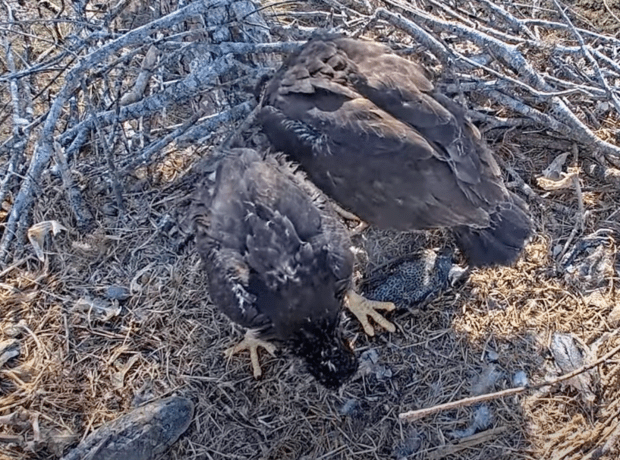
At 15:15, M15 flew in with a carcass of ‘something’ with feathers and long yellow legs. Perhaps carrion/road kill he found on the way home. Or did he raid a nest. He dropped to the nest with it and was rushed by two extremely hungry eaglets. It is difficult to say how much meat was on that piece or who benefited. E22 was self-feeding at the end. Is this M15’s plan – to bring scraps to the nest for the eaglets, small pieces and get out so as not to attract that female?

My friend ‘A’ has nothing but praise for 22 doing this feeding. She says,

‘The feeding at 15:15 saw E22 get brave. He snatched and grabbed some big bits of that feed and he swallowed one giant bit of bone with flesh attached to it that even I doubted he could manage – but only for a moment. For a few mouthfuls there, he still had about ten inches of that hanging out the left side of his beak while he grabbed another three good-sized mouthfuls from dad, then returned to swallowing, and repeat. So he did well. He has had enough food to get through to another day. He mantled that food too when he grabbed it – and when E21 tried to intimidate him out of the position right next to M15’s beak, E22 fought for his spot and refused to be driven away from it.’

22 is in there first.

22 is doing some snatch-and-grab as 21 gets to the beak of M15. The intruder did not bother M15 today.

At 16:18:53, E22 is full for the first time in 48 hours or more. He cannot hold up his crop or keep his eyes open. The three prey items came in a flurry of deliveries from 1300-1515, 2 hours and 15 minutes. That interests me because not only did It fill up the eaglets, but coming in such rapid succession meant that both ate without intimidation. The female intruder did not come around. Good job, Dad.

M15. Thank you! You are so loved and admired. It has taken some time to figure out how to manage all that you have on your plate – eaglets to be fed, your own needs for prey and keeping healthy, sleep, security, and keeping intruders away from the eaglets. You have worked that out. I am so sorry if I ever doubted you!

Good night Dad! Good night Es. SEDs.

If you are wondering, ‘she’ is not on the same branch or cuddled up to M15 tonight, as I write. She is, however, on the nest tree. She could be as formidable as Harriet and make a great mate, protecting future eaglets, but right now, M15 doesn’t need her attention, nor does he need her in the nest stealing food. As we know, male Bald Eagles do not normally fight larger, more aggressive female eagles. I am glad he has figured out how to deal with all that has been ‘thrown’ at him. The Es are seven weeks old. They are going to branch and fledge before we know it.

Around 0835, M15 dropped off an Armoured Catfish to the eaglets and did some aeration on the nest. He did not stay to feed the eaglets at that time. It appears that they have broken through the head and are self-feeding. This is a great start to Saturday!

E21 seems to have given up and 22 has been working on the tail..smart. It is 0903.
In other news, the Peregrine Falcons are back in the scrape box and have been for some days. Elain caught all of them -Diamond, Xavier, and Indigo – yesterday in her scrape highlights.

Do you remember the fireworks that caused Diamond so much distress? The discussion over what happened continues.

You can still hear the ice pellets at the nest of Bald Eagles Jackie and Shadow. Shadow did bring in a very nice fish to Jackie! Oh, how I wish she would stand up and we would see a huge crack in one of those eggs.

I so admire how Californians love Jackie and Shadow. They are making the news with their endurance during this terrible winter storm that has hit Southern California.

There is something about Angus. Is it his youth? or the funny expressions he makes? Looking forward to eggs for Angus and Florence at Captiva!

Other Osprey nests are now coming into play. At the Lake Murray platform, Lucy has returned on the 17th of February and Ricky was back on Thursday the 23rd.

‘H’ writes to tell me that there is a possible first pip at the Moorings Park Osprey Platform in Naples, Florida!

And speaking of Ospreys, how would you like to help protect the Glaslyn Ospreys? Do you live in Wales near the Glaslyn Valley? Geemeff writes that this is a great opportunity – and it is. I wish I lived there!

https://www.cambrian-news.co.uk/news/volunteers-needed-to-protect-glaslyn-ospreys-597028

As so many of you know, the Royal Cam chick is a delight to watch. Yes, it is difficult to see them alone on those nests! It is rather amazing that they stay so close to home. My kittens would never be so disciplined. Sweet Pea is gardening already. Sharon Dunne caught it on video:

The Steller’s Sea Eagle was first seen more than a year ago along Canada’s Atlantic coast. Then it went to Maine, returned to Canada, and is now back in Maine. It appears that a large raptor that should be spending its winters in Ussuriland, Japan, or Korea is finding life rather pleasant in Maine. Obviously, there are no food worries. The Stellar’s Sea Eagle breeds in areas of Russia and in particular, the Bering Sea. As far as I know, there is no mate.

One of the nature centres about an hour from where I live is getting ready for the ducks and geese to begin arriving. So lovely to involve students from one of the local universities to get their hands in there and help them with their duck tunnels!

Elsewhere in Canada, old-growth forests are continually under threat in British Columbia. This past year numerous Bald Eagle nests have been cut down. There is a move for legislation to save the very last of these lovely spotted owls before they are completely extinct.

https://www.theguardian.com/world/2023/feb/24/environment-minister-calls-for-emergency-order-to-save-last-of-canadas-spotted-owls?CMP=share_btn_link

I promised I would check on the GHO nest in Corona, California. There are four owlets in that nest! On Thursday night, Hoots brought Owlvira the following: 1 RODENT, 1 MOUSE, 1 RABBIT / Tonight: NO deliveries as of yet on Friday as I am writing this. The weather is a little frigid and mice might be tucked in tight.

This is the link to this streaming cam. Best action is during the night when food deliveries and feeding occurs.

https://www.youtube.com/live/xqvrR6dkWeg?feature=share

In Kansas, on Farmer Derek’s land, Bonnie and Clyde are incubating eggs. You might recall that in 2021 they took over the nest of a young Bald Eagle couple. They raised two owlets to fledge. They were adorable, and seeing them climbing around on this giant nest was a treat. It will be a good comparison to that deep nest in California. Highly recommended.

Here is the link to their streaming cam:

https://www.youtube.com/live/MRMzzjyumHs?feature=share

I wish I could tell you that Jackie and Shadow have a pip or a hatch or that Zoe has checked in, but I can’t. We wait until the eggs are unviable, and with Zoe, we hope her transmitter begins working. CROW does not need to intervene in SW Florida. M15 has this under control! Relief.

Thank you so much for being with me today. Please take care. Looking forward to seeing you soon.

Thank you to the following for their notes, their posts, videos, and streaming cams where I took my screen captures: ‘A’, ‘H’, ‘Geemeff’, SW Florida Eagle Cam and D Pritchett, Susan Starck Romano and Bald Eagles Live Nest Cams and News, Elain and Charles Sturt Falcon Cam Project and Cilla Kinross, Cilla Kinross and Orange Australia Falcons, FOBBV, Jason Robertson and FOBBV, Window to Wildlife, Moorings Park Osprey Nest, Shela Staley and Osprey Friends, Cambrian News, Sharon Dunne and NZ DOC, Matt Felperin and Maine Birds, Oak Hammock Marsh, The Guardian, Carona California Owl Cam, and Farmer Derek.

Monday in Bird World

On the Canadian Prairies, it is 8 November and it is 11 degrees C. There are some birds still around the southern part of our province including a large number of Great Horned Owls (GHOW) and Barred Owls (BADO). Several hours from where I live there are some hawks and Bald Eagles still making their way south. In celebration of such a gorgeous day with the promise of snow and plummeting temperatures on Wednesday, we decided to make one last check at Oak Hammock Marsh.

It was simply grand. You could see for miles.

The walk was great. It was sooooo quiet, a wonderful change from the noise of the city. If you were intent on counting tonnes of birds and seeing lots of species, then it was a bust! There were about 60 Canada Geese scattered about and a couple of Mallards, a male and a female.

They were all feeding on the tender marsh grasses below the surface.

Even the geese were quiet, no honking, nothing. Just working hard on those plants.

The two Mallards were quite interesting. They were sort of breaking down the grasses as they moved through forcing them under the water with their paddles and then eating them.

Beautiful little female Mallard.

The ducks were not bothered by the geese – everyone seemed intent on eating and enjoying the warm sunshine. The farmers in the area have finished harvesting their crops and the fields are bare. In several hours only six or seven Canada Geese flew into the wetlands.

It might have been quiet in rural Manitoba but there was a lot of things happening elsewhere. First up, for all of you that watch the Royal Albatross, OGK’s mate since 2006 has been YRK. OGK was first in on the peninsula excited to see her and build a nest but…she didn’t arrive. Time passed and she didn’t arrive. Today, 9 November YRK landed on Taiaroa Head. If people could have rung bells they would have. Instead many of us sat and shed tears. The fear is always there. OGK and YRK were the parents of very popular Royal Cam chick, Atawhai (aka Pippa) in 2020. This year will be their 8th breeding attempt.

In other Royal Albatross news, the new couple – Red and BOK (Blue-Orange-Black) have really been entertaining us. They are so sweet. Well, today, Red got some new bling. As one of a mated pair, he is now WYL (Whit-Yellow- Lime).

The image below shows the Ranger giving Red his new bling and identity. BOK is walking off the nest. She will return once everything is over.

Could this new couple with their first attempt at breeding turn out to be the Royal Family of the year? We wait.

The Port Lincoln Osprey Mum decided it was time to go to the spa. She flew off the barge and went over and had a lovely bath in the warm Australian waters of the cove yesterday. It is well deserved. Her and her mate have raised three healthy boys this year.

Isn’t Mum just beautiful?

It is hard to keep up with the 367 Melbourne Peregrine Falcons. I ‘believe’ that there are two (probably female) still on the ledge.

Yes, still there. There is a lot of noise and it could well be the parents trying to lure these two off with prey.

There are theories about gender and fledging times in falcons and hawks. Because the females are substantially larger, it takes longer for their bodies to feather. Therefore, they generally fledge after the males. I do not know how accurate it is but I hear this often.

In Orange, Diamond’s foot is doing much better. At 8:11 Xavier, the male Peregrine Falcon of the scrape on the water tower of Charles Stuart University, delivers a Starling to Yurruga. Xavier does not wait. He drops the breakfast prey and gets out. I don’t blame him. It could definitely save his talons.

Notice how big Yurruga is compared to Xavier. Think Yurruga is a female like her mum, Diamond?

Yurruga is a very good plucker!

Cilla Kinross just posted a video clip of Yurruga. It is really short. Have a peek. I do not think those eggs are going to last much longer.

Everything is as it is expected at Port Lincoln. Dad flew in with a really nice fish but instead of letting the chicks do a grab, Mum got over quickly, mantled the breakfast, and proceeded to take control of the feeding.

It should, by now, not surprise anyone to the identity of the chick right up at Mum’s beak. Now the chick can be identified quite quickly – it’s Ervie! aka Little Bob.

The rule of thumb is that the males return to make their own nests near their natal nest. I hope there are three or four more barges available.

One last nest. NEFlorida with Samson and Gabby. They are both very busy working on that nest. They have been bringing in a lot of big twigs. Here is Gabby moving some of those around.

Cute little Samson looks like he is standing very still in his tight black jeans waiting for orders. What a sweetie.

Samson is a very good listener and Gabby is giving precise instructions. Looks like they are already thinking they need high rails this year.

Thank you so much for joining me today as we check in on some of ‘my’ favourites. Take care everyone.

Thank you to the following for their streaming cam where I took my screen captures: Cornell Bird Lab and NZ DOC, Port Lincoln Osprey Project, NEFlorida Eagle Cam and the AEF, Charles Sturt University Falcon Cam and Cilla Kinross, and 367 Collins Street Falcons by Mirvac.

Gorgeous fall day at Oak Hammock Marsh

If the weather is good, I really encourage you to go to your local nature centre to check out their programmes, look at the displays, sit and watch the birds, or walk on the trails.

As I walked through the Interpretative Centre, one of the staff was asking anyone if they wanted to watch a feeding. There were lots of pre-school children yelling ‘yes’ or ‘me, me’ and running ahead of their parents and grandparents. I thought they were going to feed the ducks. Silly me. It was salamanders. There are, however, many activities at the nature centres for all ages. In the fall, both of ours have birdseed sales with good discounts for members and much better seed. Then there are pumpkin carving adventures as well as astronomy evenings.

The grasses lining the ponds of Oak Hammock Marsh are quickly changing colour. Last week they were much more green and there was a lot more water. The staff are draining the water from the wetlands as it would happen naturally during a time of drought.

Closer to the Interpretative Centre is a series of board walks talking you out into the marsh.

Along the way there are pavilions. It is here that some of the walking tours stop to listen to information. They are also good places just to sit and catch your breath in the heat.

Whenever I look at these pavilions I am reminded of the gardens of the Chinese literati (learned individual, well educated, often writers and poets) who created gardens with ponds and pavilions like these for admiring nature, to find inspiration, or to sit and write or paint.

There were definitely not as many waterfowl at the marsh today as there was last week.

This is a good view of one of the pavilions and the adjacent ponds and marshlands.

It was really hot out on the trails around the marsh. Even the ducks were paddling so fast that they were often a blur.

These two Canada Geese were paddling quite slowly along the shore. They were not in a rush!

The dabbling ducks were looking for food.

Sometimes you had to look very closely to see them up against the reeds.

The reflection of the reeds with the blue sky was quite beautiful.

One of the things that I did today was purchase a book. It is The Crossley ID Guide to Waterfowl.

My interest has always been raptors. I can easily identify them although a Cooper will sometimes confuse me with a Sharp-shinned. I do not know my ducks and I am just now getting a handle on sparrows. We have two big rivers, two large lakes, Hudson’s Bay and a host of other smaller lakes and water features in a growing number of new housing estates. These are the birds in the parks near me or in my garden. It would help for me to recognize them. It would also help the e-Bird consultant for our area because then I would not be bugging him all the tim! Wish me luck.

These are Green-winged Teals preening themselves.

There is a look out point near the end of the trail. There you could see the ducks and geese arriving. It was 16:00.

Common on the Canadian Prairies are rose hips. The roses appear in the spring while the rose hips, the fruit of the rose, is in the fall. They generally grow after the petals have bloomed and have fallen off. They are rich in nutrients including vitamin C. People collect them and make tea or rose hip syrup or jelly. It is delicious.

The Dark-eyed Juncos have even appeared at Oak Hammock Marsh. You can hardly go anywhere without seeing several.

This is a Thirteen-lined Prairie Dog. They are diurnal and are most active during the day where they can be seen looking for food and going in and out of their tunnels.

There were a couple of these sparrows that were in my garden so I know this one’s ID. It is a juvenile Harris’s Sparrow. So cute. Eventually its entire crown will be black.

As we were leaving the Canada Geese were flying in to feed on the recently harvested farmer’s fields. Here they come in a beautiful ‘V’ formation.

While I did not see very many birds, it was simply a gorgeous day to be outside. The trails are so much nicer to walk on than the concrete of the city. There is such joy just closing your eyes in the sun and listening to the geese. It is the sound of fall. I am also very grateful to the individuals who have established this beautiful nature centre and have purchased the marsh and are being good stewards. There is absolutely no hunting permitted on any of the land – and the area is huge. Bravo! These ducks will not be fattened up, tagged, and then wind up in a count as to whether they were shot in state or out of state like some nature centres do. Rosalie Edge, the individual who purchased Hawk Mountain and lobbied against killing raptors, has certainly rubbed off on me!

All of the other nests were doing just fine when I checked on them. Meals had arrived at both 367 Collins Street and the Port Lincoln Barge. In fact, Dad brought in a really nice fish that still had its head. It was flapping and I am so glad that Mum out it out of its misery before it went flying over the edge or knocked one of the chicks off. Hatch watch will begin for the falcons at Charles Sturt University in a couple of days and the big fall e-Bird count is 9 October. More details to follow in a couple of days.

Take care all. I hope you had a wonderful day, too.

A Visit to Oak Hammock Marsh

My Hibiscus and the Vermillionaires for the hummingbirds continue to think it is summer. And why wouldn’t they with blue skies, sun, and 24 degrees C. The only things that seem to be on track for autumn are the trees and Virginia Creepers that are changing colour daily.

Today was a bit of an outing. Located about 20 km north of Winnipeg, the Oak Hammock Marsh is home to an Interpretative Centre, third floor viewing area, a marsh boardwalk and several trails through the marshes. Oak Hammock Marsh is a joint project between the Province of Manitoba and Ducks Unlimited Canada. The marsh covers a 3600 hectare restored wetland area in the Interlake (between Lake Winnipeg and Lake Manitoba) area of our province. The marsh supports 300 species of birds as well as a myriad of mammals, reptiles, amphibians, fish, and insects. My interest is, of course, in the birds.

There are daily tours of the grounds, special education programmes for schools, early bird breakfast and migration fests, and a Goose Flight dinner which is completely sold out.

It was a wonderful day – short sleeve weather with plenty of birds and lots of places to stop and catch your breath along the trails.

Tip: If you were going to visit Oak Hammock Marsh and you just want to walk the trails and not go inside the building, you do not pay the entrance fee.

One of the things that I like about Oak Hammock is that at each trail there is information on the wildlife that you ‘might’ see there. Of course, there are no promises that the Yellow-headed or Red Winged Blackbirds will be there when you are but, in general, these are areas where certain birds congregate if at the marsh.

These are a great help to me – I am a raptor person who is just beginning to learn about waterfowl and shorebirds! I would have loved having Ferris Akel with me telling me which was the Greater Yellow Legs and which was the Spotted Sandpiper. There are a stack of books open surrounding me right now and the images are disappointing. That said, let’s give it a try and see if some of these bird identifications work – and if you spot an error, tell me! Do not be shy about it.

The images are not great. This beautiful raptor soared for so long in the warm thermals coming off the prairie landscape. She was obviously hunting. She would come down and bank and then go so high she was like a speck of dirt. You wanted to rub the lens of your camera to see if she was real. This is an adult female Northern Harrier. Notice how slim the body is with the long tapered wings and tail.

In the image below she is gliding – holding her wing tips higher than the body. Northern Harriers is one of the easiest members of the hawk family to identify because they glide so close to the ground. They have excellent vision but are known to also hunt by sound

She has soared above the marsh and glided down for a closer look for her prey. In the image below she was banking but also pulling up. You can see that distinct white upper covert.

It was simply mesmerizing watching her hunt and then go back to soaring in the thermals of a beautiful fall day.

Did you know that Northern Harriers were once called Marsh Hawks? In Europe they are often called Hen Hawks. This marsh is a perfect place for our Northern Harrier female to have her nest. She will build it on the ground usually in long grasses or cattails. These hawks line their nest with cattails – and all over the marsh were cattails and other soft prairie grass.

It was quite difficult to actually hear any of the other bird voices (or calls). The Canada Geese were flying overhead, landing on the ponds, and in the fields surround the marsh.

This adult male Yellow Headed Blackbird paid no attention to me. He was foraging for insects, seeds, beetles, on the ground. They apparently also eat dragonflies and there were a lot of those on my walk today. Here he is with his distinctive yellow head and chest with white patches on his black wings. He has a black bill.

There is an understanding that if Yellow-headed Blackbirds are in the same area as Red-winged Blackbirds then the Yellow-heads will be dominant. I do not know if that is the case at Oak Hammock Marsh because the numbers of Red-winged Blackbirds seem to really outnumber the Yellows.

It’s a male Red-winged Blackbird, below. I think it is a juvenile male because the red patch above the yellow is faint. They are covered by thousands of the most beautiful ebony feathers. Their black eye and beak disappear in all the dark plumage.

The Red-winged Blackbirds also have their nests on the ground which they line with dried cattail leaves, reeds, and grasses. The marsh is a perfect place for them to nest, too, with all those cattails!

This Greater Yellowlegs was quite busy foraging in the mud. Because of its streaked neck, this should be a juvenile. The Greater Yellowlegs is larger than the Lesser and has a longer bill with longer legs and noticeable knees. These birds also nest on the ground near water making Oak Hammock Marsh a perfect nesting area.

It looked so small walking along the soft mud of the marsh.

Two female Blue-winged Teals. We have Blue-winged teals throughout our province but they prefer, like so many of these birds, the marshes. Sadly, many marshes have been drained for farming over the past 60 years and then turned into housing estates leaving the Teals to have to adapt to living in ditches and dugout ponds. Their dark beaks are quite wide and flat. The females are a mottled brown.

Aren’t they gorgeous?

A pair of American coots diving and dabbling like ducks in the waters of the marsh today. American Coots can forage for food on land as well. Some people call them ‘Mud Hens.’ They eat insects, worms, tadpoles and fish as well as land and water plants. Their white bill with the black plumage helps to identify them.

As I was leaving, more and more Canada Geese were arriving in their typical ‘V’ formation. The fields were filling up and so were the ponds. It was 15:00. Must go back out closer to dusk! There is something energizing about seeing all of those geese flying in – and the only sound being heard was not the noise of the city but the honk of the goose. Just lovely.

Thank you so much for joining me today. I know that most of my readers live in places around the world far away from Manitoba. Please do check out your local nature centres. There are wonderful surprises awaiting you. Take care everyone. See you soon.