We were all excited when we learned that Uno would be provided with fish so that he could survive to fledge. Without parents and no food, he would have perished.
Sadly, after eating three fish yesterday, Uno was found dangling by a talon from the nesting material, dead this morning. I am so very sad to bring this devastating news to you. It seems like all I have done is cry this year. I wish each one of those tears had been a fish to feed a little one.
My heart – and I know yours, too – is very heavy right now.
Thank you to the New Jersey Wildlife Conservation and Nature Conservancy for trying. The South Cape May Nest had its adults disappear, leaving this only surviving osplet on its own with no food and no hope for any – and then the fairies came.
I will not speculate if the fish came too late. I am glad that they reached out with fish and tried to save this little innocent.
Thank you to Pam Breci – for the note and for loving this baby so much.
I wanted you to have SK Hideaways videos for the week. They are cute and special and please watch them. I am so grateful that they are sent as a list each week to share with you.
SK Hideaways Videos Week of 7 June 2026
FOBBVCAM Eagles Big Bear, CA ~ Jackie, Shadow, Sandy (hatched 4/4/26), Luna (hatched 4/5/26)
Luna Gets Big Lift ~ Fledge Fever Nears (2026 Jun 11 )
Luna got a burst of energy that triggered some big wingers, creating a lot of wind and lifting him quite high. He gave us a really good show! Sandy seemed impressed with her brother’s performance, but really just wanted to chill out for the night.
Sasha Fledges ~ Waiting and Watching for Her Return (2026 Jun 9)
It appears that the eldest eaglet, Sasha, has fledged, having branched two days ago. While we don’t get a clear view of the flight, we do see the launch, which does look convincing. Sooo, we wait, watch, and wish Sasha all the best in this new adventure.
UPDATE: Sasha returned to the nest at 18:10:03! No question about this successful fledge. Congrats, Sasha!
Cruz Lunches on Nest Till Eaglets Squee for Theirs ~ Family Time on the Zen Nest (2026 Jun 8)
Cruz and Andor spent their lunch hour with the 3 eaglets. Between allopreening the eaglets, Cruz enjoyed some fish while also answering to the loud squees of eaglets who still enjoy being fed. A multi-tasker extraordinaire. Sasha has branched and enjoyed her perch till that juicy Blacksmith fish lured her back to the nest. Very special to see the whole family together for an extended time. (2026 Jun 8)
Clark Answers Iris’s Fish Calls ~ Chick #1 Gets Its First Meal (2026 Jun 11)
Iris and Clark’s first chick hatched today, but Iris waited some 48 hours for Clark to bring fish. No one knows why he was delayed, but he certainly made up for it with 4 fish deliveries (as of this video). Once Iris refueled, she fed chick #1. Congratulations, Iris and Clark, and welcome to the world #1.
Cholyn&Chase Bond at Dusk & Dawn ~Perfect Pairing for 23+ Years(2026 Jun 9-10)
As the Queen and King of the Channel Islands approach their 29th birthdays and 24th anniversary, Cholyn and Chase continue to bond year-round. In addition to bonding, they are ensuring a continuous presence in their seaside territorial paradise. Here we saw them bonding at dusk and dawn at their Two Harbors nest, then transitioning to the salt-water “jacuzzi” and bunker to enjoy a roiling Pacific Ocean.
Where the Boys Are ~ Eyes on Jet, Scout, Stewart & Walton (2026 Jun 12)
Thanks to the work of our tireless cam ops team, we are able to see all four rascals in the morning, in the evening (ain’t we got fun?). Here we’re treated to morning shenanigans, including some wild and wonderful aerobatics. Bonus sighting of Hartley and Monty with lightning quick bonding.
Jet Flies Home with Prey! Everyone Else Follows (2026 Jun 8)
We see 3 juvies fly west, then east ~ in normal and slo-motion. Ultimately, Jet arrives on the nest ledge with prey in his talons. A major accomplishment as Hartley and Monty teach the boys to hunt. Eventually all four chicks visit the ledge, but only Walton seriously challenges Jet for the food. Jet emerges victorious. While I cheer on their accomplishments, I know that each one inches them closer to dispersing to their new life adventures. Grateful for the remaining days we have to watch them.
Where Are the Chicks? Where There’s Food!PLUS Hartley & Monty Are Chased Away (2026 Jun 7)
The chicks have been zooming around the skies of downtown San Jose for over a week. Their days consist of eating, sleeping, chasing their parents, and eating and sleeping some more. We are so fortunate to be able to watch this formative time in their lives.
Woodland Trust daily summary for Loch Arkaig Saturday 13th June 2026
Today was fairly quiet, an intruder or intruders were about but didn’t come close enough to get caught on nest cam. What was caught by the camera was the two chicks taking lumps out of each other when Dorcha left them alone, and not even her return stopped them, she eventually broke up the fairly evenly matched fight by sitting on one of them. Louis delivered two fish taking the Nest Two tally to one hundred and thirty four, and Garry delivered one fish during cam up-time taking his tally to one hundred and fifteen. Sadly the deadline appears to have passed for Aurora’s egg to hatch and it’s almost certainly time to wish them better luck next year – meantime it will be interesting to see what happens to the egg, and for how long the pair will continue to brood it. Steve Quinn produced his usual thorough fishing stats analysis but while Nest One deliveries will continue to be recorded, they will not be included in future analyses as without chicks and with the cam going down in the morning they aren’t meaningful. Info on where to find his reports in the bonus section. After days of rain, there’s a break in the weather for the next couple of days – it’s be cloudy and dry overnight with a low of 9°C followed by sunshine with gentle breezes and a high of 20°C tomorrow. Today’s videos:https://youtu.be/e4Uuq-3RPV0 N2 Louis brings breakfast – fish one is a big trout 08.56.44https://youtu.be/66YKfKgWRxc
N2 Bonkers! The chicks fight viciously 17.52.09https://youtu.be/qy4rmt6y99E N2 Louis brings a second trout for an early supper 18.28.53https://youtu.be/5ziBMr9mqEw N1 Aurora departs with fish one as soon as Garry brings it 18.30.34
Bonus info – Steve Quinn’s excellent analysis of Louis’ fish deliveries to date: copy & paste Nest 2 fish summary to week 8into the search field (click on the magnifying glass symbol on the right directly above George WTS’ featured comment).
You’re invited to join the lively community at Woodland Trust’s Osprey forum, it’s friendly, free and everyone’s welcome:
Jill and Jack each brought in a Spadefish this evening for Big and Little!
About two months ago, I realised that my life now is very similar to what all our lives were like during Covid. I am mostly at home, or we walk Toby in the parks and go to a couple of outdoor markets. Mostly we enjoy the garden. It is easier for Don (and thus me), and a few places are dog-friendly, as they are in many parts of Europe. Oh, how I wish! So I have started making little tweaks inside and out to make our lives more beautiful and our spaces safer and more useful to all of us, especially Don.
I purchased our little Bistro set at a shop called Pier 1 approximately 22 or 23 years ago. It is nice for a quick coffee or tea, but uncomfortable for long periods, and there is no way for Don to raise his legs. The picnic table is perfect for a huge group, but not for a leisurely evening. So I found a little teak loveseat with two chairs and a coffee table that can easily double as a footstool! The young man came to assemble it this evening. We just need a few outdoor toss cushions.
Toby approved.
Inside, I have been decluttering for a good year. One of my long-term readers cum friend in Berlin has joined me in the quest to donate and clean out. It has been fun to see how each of us is progressing. Inside the goal is to create a calm, easy-to-navigate space if and when Don ever needs a walker or a wheelchair. At the same time, I want it to be a beautiful space with things that mean something to me, not just ornaments picked up at the shop. It is coming!
I am just smiling. Clark has had some whoppers come on the nest. There is fish and fish. Oh, please let it continue.
At Coeur d’Alene, Idaho, there are at least two osplets on the South nest. One appears to be much larger than the other with the small one in the Reptile phase and the other getting some juvenile feathering. I wish Mum would move for a second so I could verify this!
Mum is anxiously looking around for her mate for their evening meal and maybe a break. If there are only two and there is such a huge size difference, were there three eggs? Did one not hatch? Did all three hatch, and the middle one died? Or are there three under there??? I wonder.
Anyone know about this nest? Shoot me a note!
As the sun fully sets, Toby and I want to wish each of you a wonderful end of the weekend. We are so thankful for your notes and comments, and the news and images that you send. Take good care. We will see you soon!
Thank you to ‘PB’, SK Hideaways, for their great videos and Geemeff for their daily summary with videos. To all the owners of the streaming cams, we are so appreciative of being able to see these amazing birds and their families. We could not do that without you!
I don’t know about you but I am so overjoyed that if my house blew away today it would probably not have even phased me.
Clark arrived. Saw the shell, listened to Iris, saw his first baby and went fishing. Within three hours, he had brought in three fish. It is 1827 nest time and it might have even brought in more. It seems his protective instincts along with paternal ones kicked in right at the time of hatch and right when the Clarke Fork River had descended and slowed. Dr Green noted that it was now good for osprey fishing.
Did you shed any tears as you watched Iris gently feed that wee babe the tiniest little pieces of fish? Despite not having had chicks every year, Iris knows how to feed them so they get the fish.
As you know, I was extremely worried, even going so far as to wish those eggs would not hatch. That was when the first egg was hatching!!!!!!! I worried Iris’s babies would starve to death. This has happened with Louis. Or worried she would be so hungry she would have to leave them. Well, thank goodness for miracles! And today felt like a miracle.
Proud parents.
Happy Mum! The oldest breeding osprey in the world – at least thirty years. Imagine.
Oh, another fish. 1747.
Iris plays with her stick while Clark prepares to brood his baby and incubate the other two eggs.
It sure sounded like Iris was ordering more fish when they exchanged places and Clark flew off.
First fish: 1242. Second fish: 1414. Third fish: 1512. Fourth fish: 1747.
I might have missed one between 1512 and 1747 but if you look that is five hours and four fish. I would say Clark is doing so well as a new dad. I am without words.
RP sent the following video links for us to enjoy:
15:22, 6/11 Less than 5 hours old, and Iris gives the Chick his first feeding. Iris is amazing to watch. She is an experienced Osprey Mom. #HellgateOspreypic.twitter.com/HmzG7M6hry
Little Dewey got fed well today, too. Three fish by the time this image was taken. Little Dewey looks like the Hulk. Thanks ‘PB’ for the image:
That’s it for today….let’s all walk around smiling. Two nests doing fantastic. With Little Dewey not so little anymore. Notice the feathers coming in. What a character.
Take care, everyone. Hugo Yugo and Toby wish you a great end of the week.
Thank you to PB and RP for their images and video links. Much appreciated. Thank you to the Montana Osprey Project and Cornell Bird Lab for their streaming cam so that we can watch this miracle unfold at Hellgate Canyon.
If you have read my blog for the past three years, you will be very familiar with the word ‘Menhaden’, a species of fish that is crucial for ospreys in certain regions of the world. In fact, it is the basis of the ecosystem of The Chesapeake Bay where many species depend on it. But with Omega Protein taking all of the schools of fish through trawling with huge industrial ships and spotter planes, there is nothing left for the birds and marine life. A new study puts the problem squarely on over fishing while many over the years have tried to find other reasons. Politicians in Virginia – which are really holding up the changes since Omega is stationed at Reedsville – even blamed the Bald Eagles for taking all the fish!!!!!!!!! Do they think we are that stupid?
Justin Hawkins wrote on Menhaden – Little Fish, Big Deal a good analysis of what is happening and why Menhaden are so important.
“The Localized Depletion Debate: Can a Healthy Menhaden Stock Still Leave Predators Hungry?
For years, one of the most common responses to concerns about industrial menhaden harvest has been straightforward:
“The stock isn’t overfished.”
According to Atlantic menhaden stock assessments, the species is not currently classified as overfished, and overfishing is not considered to be occurring on a coastwide basis.
To many people, that sounds like the end of the discussion.
But for a growing number of fisheries scientists, conservation groups, and recreational anglers, it may actually be the beginning.
The reason is a concept known as localized depletion.
It is a simple idea that asks a surprisingly complicated question:
Can a fish population be healthy overall while becoming less available in the specific places where predators need it most?
Looking at the Coast From 30,000 Feet
Stock assessments are designed to evaluate fish populations across enormous geographic areas.
For Atlantic menhaden, that means examining the entire Atlantic coast.
Scientists estimate population size, fishing mortality, recruitment, spawning success, and long-term sustainability across a range stretching from New England to Florida.
From that perspective, the species may appear healthy.
But critics argue that broad-scale assessments can sometimes miss what is happening at smaller scales.
After all, predators do not live on a coastwide scale.
A striped bass feeding in the Chesapeake Bay is not utilizing forage fish off Rhode Island.
An osprey nesting on a tributary of the Bay is not hunting schools of menhaden hundreds of miles away.
Predators live locally.
They feed locally.
And they respond to local prey availability.
That distinction lies at the heart of the localized depletion debate.
A Grocery Store Analogy
Imagine a city with one hundred grocery stores.
Ninety-five are fully stocked.
Five are nearly empty.
Looking only at the citywide inventory data, food supplies appear abundant.
But for the residents living near those five stores, availability is a very different story.
Supporters of the localized depletion theory argue that forage fish may function in a similar way.
A coastwide stock assessment can show healthy overall abundance while predators in specific estuaries, bays, or feeding areas experience reduced access to forage.
The fish exist.
The question is whether they exist where they are needed.
Why Chesapeake Bay Became Ground Zero
No area illustrates this debate more clearly than Chesapeake Bay.
The Bay serves as one of the most important nursery and feeding habitats for Atlantic menhaden.
It is also home to striped bass, bluefish, weakfish, dolphins, ospreys, pelicans, and countless other predators that depend directly or indirectly on menhaden.
Historically, the Bay also hosted much of the Atlantic reduction fishery.
For decades, hundreds of millions of pounds of menhaden were harvested annually from this single ecosystem.
Conservation organizations began asking a straightforward question:
If such large quantities of forage are removed from one of the most important feeding areas on the East Coast, can local predators remain unaffected?
That question remains largely unresolved.
What the Osprey Studies Suggest
One reason localized depletion has attracted scientific attention is because of osprey research.
Biologists studying portions of Chesapeake Bay documented declining reproductive success in some nesting populations.
Researchers observed that adult birds were bringing different prey species back to nests and, in some cases, appeared to be delivering fewer energy-rich menhaden than historically observed.
The concern was not simply about osprey numbers.
It was about what the birds might be indicating.
Osprey are highly efficient fish predators.
If they struggle to locate preferred forage in specific areas, researchers naturally wonder whether other predators may be experiencing similar challenges.
While alternative explanations certainly exist, including habitat changes, climate factors, and environmental stressors, the findings fueled further interest in localized prey availability.
Predators Don’t Read Stock Assessments
One criticism often voiced by anglers is that predators respond to conditions in real time.
A redfish cannot eat a coastwide biomass estimate.
A striped bass cannot feed on statistical abundance.
Predators require actual prey in actual locations.
This is why many fisheries scientists have become increasingly interested in ecosystem-based management.
Rather than focusing solely on whether a forage species remains abundant overall, ecosystem approaches attempt to understand whether enough forage remains available to support predator populations.
It represents a subtle but important shift in thinking.
The question is no longer only:
“How many menhaden exist?”
The question becomes:
“How many menhaden are available to predators when and where they need them?”
The Challenge of Measuring Local Impacts
One reason the localized depletion debate remains unsettled is that it is extremely difficult to measure.
Fish move.
Predators move.
Environmental conditions change.
Water temperatures fluctuate.
Weather patterns influence distribution.
Separating the effects of fishing from natural variability is one of the most difficult tasks in fisheries science.
As a result, definitive proof can be elusive.
But many researchers argue that uncertainty should not be mistaken for evidence that local effects do not exist.
In fact, some contend that localized depletion may be one of the most important unanswered questions in forage fish management.
Why the Debate Matters
At its core, the localized depletion debate is not really about menhaden.
It is about ecosystems.
If forage fish become less available in key feeding areas, the effects may extend far beyond a single species.
Striped bass may have to work harder to locate food.
Osprey may experience lower nesting success.
Marine mammals may alter feeding behavior.
Entire predator communities may be affected in ways that are difficult to detect through traditional stock assessments.
Whether those effects are large, small, temporary, or significant remains the subject of ongoing research.
But the question itself has become impossible to ignore.
A Different Way to Think About Fisheries
For decades, fisheries management focused on whether harvested species could sustain fishing pressure.
Today, scientists are increasingly asking whether ecosystems can sustain it as well.
Localized depletion sits at the center of that transition.
It challenges the assumption that a healthy stock automatically means a healthy ecosystem.
And it raises a possibility that many anglers intuitively understand:
A fish can be abundant somewhere and still be scarce where it matters most.
That possibility is why the localized depletion debate continues to shape discussions about menhaden management, predator conservation, and the future of ecosystem-based fisheries management along the Atlantic coast.”
But…this is happening now.
I continue to check in on Iris with tears in my eyes. Babies hatching and no fish for her or them. Where in the world is Clark? How far does he have to go and get fish?
This just might be the nest that breaks me this year.
Please send Iris and Clark your good wishes. We need fish!
The river’s levels are low, but it appears to be still flowing fast. The forecast is for cooler temperatures, thank goodness. Will Iris leave the nest with the babies to go fishing? This is the question of the day, along with the problem of Clark’s presence. He was so good til he got into that altercation with the Bald Eagle. Oh, I am worried.
Thank you for being with us again this morning.
Thank you to the Montana Raptor Project and Cornell Bird Lab for their streaming cam and the FB group Menhaden – Little Fish, Big Deal for covering the disaster that began several years ago in the NE. Thank you also to River Reports.
Thank you so much for your lovely comments and notes. I am so glad you enjoyed the post about those amazing female raptors! They are truly incredible.
Jill was up early Saturday morning catching a breakfast fish for her and the kids. It is hard for her – Big and Little are growing leaps and bounds and eating more and more and she still must maintain her own strength in order to go and fish for all of them. The nest cannot count on Jack who has an odd pattern of fish deliveries.
‘PB’ caught this great screen capture of Jill coming in with that early fish. She really is quite amazing.
I don’t recall worrying so much about a hatch at Big Red’s nest. It must surely be because we lost the first one and the nest has been so soggy this year with all the rain. The little one did make it! Thank goodness. There is so much prey. No one ever goes hungry on Big Red’s nest and never will unless there is a physical reason they cannot eat!
Saturday was always Ferris Akel Day. We watched and often chatted every Saturday during or was it after? the pandemic. I miss being able to sit and go on a bird tour with Ferris who is incredibly knowledgable. Today, I stepped in for a few moments. He was at the Blue Heron rookery and they had babies!
Ferris is a great distance away, which makes these images just that more special. Check him out on YouTube.
A work of art ‘Ghost Sky Dance’ that documents the illegal killing of the Hen Harriers in the Yorkshire Moors.
Some good news and some bad from Knepp Wilding about Turtle Doves.
Turtle doves are back!
This year our most longed-for winter migrants have been bang on time. Our first turtle dove was recorded at Knepp on 24 April. Already we’re hearing several male ‘turtle’s doing their territorial ‘turr-offs’ from dead trees in the Southern Block.
Once common in the 1960s, the UK now has fewer than 3,000 turtle doves, thanks mostly to the loss of protective habitat and the wildflowers which provide them with tiny, protein-rich seeds to eat. Numbers at Knepp remain around 20 singing males every year – that’s a quarter of the population in Sussex. Last year, however, just as their numbers were beginning to recover, the European Commission overturned a ban on hunting turtle doves in parts of Western Europe. Every turtle dove arriving in the UK is a tiny miracle.
The parents have returned to the nest and brought fish to the Dale Hollow Eaglets. One had fishing line and the AEF team was able to remove it.
The Sandy Steers Celebration of Life will be on 13 June 2026. It will be live streamed. Check their FB page for details.
Forestry England has another nest that has a streaming cam.
Olivia was not getting fish deliveries at the Severna Park Osprey platform in Maryland. She, like so many others last year, has abandoned her eggs, which have been eaten by crows. This is the first nest on a streaming cam in 2026 that the adults have had to abandon due to a lack of food. Please if you live in Virginia, please help those rally to stop the commercial fishing of Menhaden which is vital to the ecosystem for that entire area – including Maryland!
I want to give a shout-out to all those folks who are designing ingenious ways to feed the ospreys that live near or on their property. I won’t ever tell who you are, but I hope that what you try works and that those adults and babies thrive. You are my heroes.
Geemeff’s Woodland Trust daily summary for Loch Arkaig Saturday 9th May 2026
Today was pretty much a repeat of yesterday, a calm routine of fish deliveries and incubation changeovers. Exactly what’s needed as life develops inside those beautiful speckled eggshells, moving slowly towards hatching day sometime in the first half of June. Louis delivered three fish for Dorcha taking the Nest Two tally to fifty, and Garry LV0 delivered two fish to Aurora 536 taking the Nest One tally to fifty three. Ospreys are migratory birds and this weekend celebrates International Migratory Bird Day, therefore tonight’s bonus item is a programme on bird migration.
The osplets at Lake Murray are doing great according to Heidi – and the little one has just the cutest bottom. Nice, round, and fat. This is all thanks to the new male at the nest!
The American Bird Conservancy (ABC)’s bird of the week, The Yellow-breasted Chat. Have a good read – see how much you can learn about this special feathered friend.
One of the things that I love about my tiny urban plot is that it is home to so many species of wildlife. Every year, we try to plant more shrubs and flowers to attract more bees and butterflies while making certain there are always decaying logs scattered about the property, providing a home for insects and a feast for so many of the birds. I can’t fight the big commercial enterprises that are destroying our planet, but I can make a difference right where I live – and so can you! It only takes one plant, specifically designed for your region and the bees or butterflies that live there, to make a difference. Why don’t you find a spot to plant something this year so that you can sit and watch the visitors come? And remember – please leave out water. It is the gift of life.
In London, the Queen Elizabeth II garden is attracting all manner of creatures! Enjoy the images.
A new haven for wildlife: London’s Queen Elizabeth II garden opens to the public – in pictures
It has been a week of ups and downs at our house. The weather is not helping. I find that warm days when we can be outside, even if it’s just sitting on a chair on the deck, are so beneficial to one’s mental health. As I have mentioned many times in recent years, Don is now in his fifth year of being diagnosed with Lewy Body Dementia. For those that are unfamiliar, it is different than Alzheimer’s. This AI overview is rather good:
Lewy Body Dementia (LBD) and Alzheimer’s differ primarily in their initial symptoms and progression: LBD features early hallucinations, significant cognitive fluctuations, and Parkinson-like movement issues, whereas Alzheimer’s typically begins with memory loss. LBD often progresses faster and includes REM sleep disorders, whereas Alzheimer’s is generally slower and affects memory first.
Key Differences at a Glance
Initial Symptoms: LBD often starts with attention, executive function, and visual-spatial issues, while Alzheimer’s starts with short-term memory loss.
Fluctuations: LBD patients experience drastic, daily, or hourly changes in alertness and attention; Alzheimer’s symptoms are usually more consistent.
Movement: Parkinsonism (rigid muscles, slow movement, tremors) appears early in LBD, often within one year of cognitive decline. Movement issues appear in late-stage Alzheimer’s.
Hallucinations: Early, detailed visual hallucinations are common in LBD, while they typically occur in later stages of Alzheimer’s.
Sleep: REM sleep behavior disorder (acting out dreams) is a common early indicator of LBD, not Alzheimer’s. Alzheimer’s Association +4
Brain Pathology and Progression
LBD: Caused by abnormal deposits of alpha-synuclein proteins (Lewy bodies) that deplete brain chemical messengers.
Alzheimer’s: Caused by Amyloid plaques and tau tangles.
Progression: LBD tends to progress faster than Alzheimer’s, with a survival rate often averaging 5 to 7 years.
Why Diagnosis Matters An accurate diagnosis is critical because LBD patients may have severe adverse reactions to certain antipsychotic medications commonly used to treat behavioral symptoms in Alzheimer’s.
Many of you have written to me about a family member or partner that is suffering from memory loss. Please, please get them to a doctor for a diagnosis. The earlier, the better. It is incredible what treatments and medications they have now that they didn’t have five years ago!
Don’s disease is beginning to progress rapidly now. We enjoy every good moment as his apathy and hallucinations grow. I always remind everyone to also enjoy life as much as you can. Don’t sit and cry over what happened a year or ten years ago or more or worry about next year. Enjoy your life right now. You never know what is coming around the corner.
I will end there. Thank you for being with us today. Please take care. I am going to take tomorrow off. See you Monday evening.
Thank you to all of the contributors today – those great people with their daily summaries, videos, articles, and investigative reporting. Thank you to ‘PB’ and Heidi for keeping track of the US ospreys and to the owners of the streaming cams and UK Osprey Information FB.
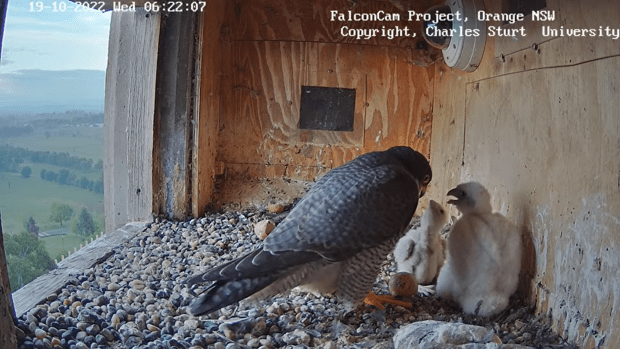
It is entirely possible that the most entertaining and educational streaming raptor cam of the year will be the Falcon Cam on the water tower at Charles Sturt University in Orange. It is the home of Xavier and Diamond, seasoned parents, and this year’s eyases, Indigo and Rubus.
How do you spell adorable? Indigo and Rubus! When Indigo was walking today, Rubus was very concentrated in watching his big sister.
Today, Indigo continued her quest to walk while, at the same time, she is practicing hitting the camera with her ps every day. The last one resulted in Dr Cilla Kinross, the lead researcher on the Peregrine Falcon Project, having to climb 170 steps inside the old water tower to clean the camera.
Watch Diamond’s reaction and then, don’t stop. Listen to how little Rubus is. Then, watch as Cilla finishes going down the ladder, Indigo has a near hit again!
Of all the streaming cams, this one with its three cameras gives you a view of the tower so you can see the peregrine falcons arrive and leave, and two views of the scrape. The closeness lets us catch the details that can be missed elsewhere including the incredible facial expressions and eye popping moments.
Indigo and Rubus have already had two feedings today. At 055209, Xavier arrives with the breakfast pigeon. That breakfast is over at 060314. At 074959, a bird with long red legs arrives. What is special about this feeding is that little Rubus is in front and gets some of the best and biggest mouthfuls yet. How splendid. He did not have to stretch his neck all the way to Sydney to eat! Cilla Kinross thinks it could have been a Red waddle bird.
Proud mama Diamond.
Indigo wants to walk and flap at the same time. She is just not quite coordinated yet!
This morning Indigo played, ‘Ring around the Rubus’.
That second prey item was very popular!
Look at that neck on Rubus!
The Melbourne Four had an even earlier breakfast. Dad arrives with the pigeon before Melbourne is even waking up. It was 055209. At 060314 Mum flies off, breakie is over. At 074959 there is another pigeon feeding! These parents are working hard to take care of the pigeon population in the CBD.
Port Lincoln was still waiting as the golden glow of the sun spread down on the nest with beautiful Mum and Big and Middle. It is the first time we will see Big stand.
Dad brought in a late fish last night but the osplets and Mum are starting to get a little peckish as 0800 gets closer. Big has pecked Middle a couple of times – late yesterday – but, in general the nest has entirely settled down. Middle is a beautiful bird. Look at the images of her/him next to Mum at the end.
We all miss Little. It is impossible not to grief that we have loved. What we need to learn is the ‘why’. But, now it is time to turn our attention to wishing well for Mum and Dad, for the nest to have a lot of fish, for these to fledge, and have productive lives building up the population of Ospreys in South Australia.
At the same time, take care of your garden birds, the birds at the park, and do whatever you can, how little or small, to make the world a better place for our feathered friends. A place where there is so much fish that all of the birds and animals depend on the oceans, the seas, the lakes, and rivers can thrive. We will talk about how you can do that later this week but, if you have good ideas or know projects, send them to me. I would be very grateful.
Middle is very smart. He tries not to make eye contact with Big yet. Instead, he moves over by Mum to look out over the water waiting for Dad’s arrival.
As Port Lincoln waits for breakfast, I will sign off. It is a sunny blue skied day in Manitoba. The temperature is 4 degrees C with the promise of a much warmer day coming on Thursday.
Thank you for being with me on our breakfast check up in Australia. Take care everyone. See you soon!
Thank you to 367 Collins Street by Mirvac, Port Lincoln Ospreys and Charles Sturt Falcon Cam for their streaming cams where I took my screen captures.