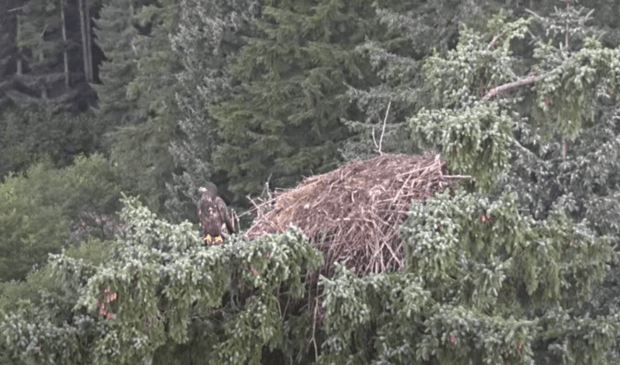
Ron waits for Rita, Gabby thwarts V3’s advances for now…and more in Bird World

12 December 2022

Good Morning Everyone,

Oh, I sure could use some blue skies right now. It is grey…everything is grey and brown. The temperature is hovering right at 0 degrees C. Even the birds are damp to the core. I will have to remember the beautiful blue sky of Grenada, those gorgeous hibiscus, and the birds filling the air with song. Thankfully all of the garden animals are doing well and happy to have me back along with the kittens. The Starlings are still here. There are 31. A host of House Sparrows and a Robin somewhere. The squirrels are here and Dyson was enjoying one of the new hard seed cylinders the last I checked this afternoon. The Crows are about and one Blue Jay has been for a visit. Life is good. I have no complaints save that it would be so nice to see some sun. On the Canadian prairies, that means it is cold. So bring it on! The cold and blue skies.


In the Mailbox: A question came in from ‘V’ wondering if there was a reason I was not mentioning Superbeaks.

This is a great question and I wanted to share it with everyone!

I briefly mentioned Superbeaks when the nest in Central Florida came on line, when there were eggs, and the hatches including the second one in my blog this morning, 11 December. It is not a nest that I consistently follow. Indeed, there are far too many nests to follow. It looks like there is good fishing around for Dad, Pepe. He brought a huge fish to the nest this morning.

I am an Osprey and hawk/falcon person. That said between the end of the UK Osprey season and the beginning again in spring, I watch other nests including the Bald Eagles in the US. There are ‘good’ Bald Eagle nests and some whose track record is not so good. There are nests where help is sought and others where it is thwarted, even if the on going potential tragedy is human caused. I know nothing about the Superbeaks nest but, will quietly watch them this year and see.

I highly recommend for Bald Eagles: the steady as you go team of Harriet and M15 at SWFlorida. They raise competitive eaglets so you just have to hold your breath at the early bopping but, normally, the eaglets grow up to be feisty besties. The relationship between M15 and Harriet is worth watching on its own.

Liberty and Guardian at the Redding Nest are fantastic. With the Redding Nest, you get commentary and videos by Gary and here is the chart for dates at the Redding nest that has been posted recently by Gary.

The Channel Islands nests of Thunder and Akecheta (West End), Chase and Cholyn (Two Harbours) and Andor and Cruz (Fraser Point) are excellent. Glacier Gardens comes on later. They are in Juneau. Alaska. How about Martin and Rosa at Dullas-Fairway? Clive and Connie at Captiva have 2 eggs.

Rolling the two eggs at Captiva. There is no confirmation yet of when they were laid.

Fingers crossed for a good season after rodenticide deaths in 2020, no eaglets last year, and the hurricane this year. There are others such as US Steel, the nests in Decorah but last year, they were hit with Avian Flu like Hilton Head. The National Arboretum Nest of Mr President and Lotus, both of the nests in the Kisatchie National Forest, E1 and E3, as well as the Metro Aviation Bald Eagle nest in Louisiana, Berry College with Pa Berry and Missey – the list is long!

Pa Berry and Missy working on their nest in Georgia.

There is no reason to believe that Avian Flu will not rear its ugly head this year also. We must remember that. It will impact birds eating birds or carrior (dead animals).

There are far too many nests to follow and everyone has their favourites. If you have recommendations – or nests not to watch recommendations – send me a comment. I would love to hear from you.

One of my favourites is Jackie and Shadow at Big Bear. They have had some problems in the past but we are always cheering them on and last year the amazing Spirit kept our hearts glowing.

The snow is really coming down at the nest of Jackie and Shadow in Big Bear Valley!

It is now Sunday afternoon and V2, the suitor trying to charm Gabby with the smokey head, has not been seen since Friday. V3 seems to be making a strong case but so far, – well, at least until now – Gabby is being aloof as to whether or not she will choose him as a mate.

There was a fly by at 11:37 at the West End nest of Thunder and Akecheta on Sunday. No telling which of the Bald Eagles it was. But, look at the nest! Thunder and Akecheta will be bringing in lots of materials for this coming season.

Quite a different view than we are used to at Two Harbours.

Dr Peter Sharpe of the Institute for Wildlife Studies takes good care of the Channel Islands Eagles and their babies. If they fall down the cliff, he will figure out a way to get them back up to the nest, if he possibly can. He is our hero!


Checking on the two Australian nests still active, let’s head to Orange first where Indigo has had a nice breakfast delivery from Xavier and has been eating it in the scrape.

Xavier and Diamond are teaching Indigo valuable life lessons. If you leave your prey, someone will come and steal it!

Elain’s latest video on the Orange scrape. Such a wonderful falcon family.

At the Osprey nest in Port Lincoln, Zoe was eyeing a fish in the water. She seems to have flown to the left and then turned around and flew past the barge. Did she see a fish? or was this just a quick wet talon tried to catch a fish story?

Watching the water at 09:41:19.

Zoe flies off the nest to the left.

Later Dad flies in with a fish. Mum flies over but Zoe had that fish while Dad was still in the air. It seems that Mum just makes sure that her beautiful daughter gets her fill. It looks like she knows that there will never be anything left. You did well Mum in a year that had a lack of fish. You did well.

Zoe will do well.

There is news on WBSE27 and it is excellent. So happy for this amazing eagle who did so well in rehab!
It would appear that Gabby is rejecting the advances of V3.

Lady Hawk caught it on video for us.

In Miami, Ron continues to perfect the nest that he shared with Rita in the Miami Zoo not knowing what has happened to his mate.

Yesterday I posted the autopsy results regarding the two year old male Hesgyn, the last chick that Monty raised at Dyfi with Telyn.

K3 did not die of poisoning or by being shot – thankfully. It is possible he had a slight injury that prevented him from fishing causing his death which could have been compounded by the high temperatures in Wales at the time. It was 35-38 degrees C in Wales. He was hungry and died of starvation according to the autopsy. It put a smile on my face when one reader, DT, of the posting said, ” “Sad news. Feeding them shouldn’t be seen as feeding other types of birds. When it helps them survive we should never hesitate to feed any wild birds”

I could not have said this better. We must be prepared to set up artificial pools with fish just like the Great Egret had in the Caribbean. We have caused this dire situation and we must be prepared to rally and fix it. Ospreys have successfully been fed when it was necessary. They do not like frozen fish but, please, if possible no more deaths when the weather turns how. Let’s help them out – and this call for action includes those nests in the Pacific NW of the US and Canada, too. Where it is possible.

Tragic news coming in from the US this morning as more and more eagles are being found ill or dead because people are not cremating their pets and their euthanised bodies are killing birds that eat carrion. This is easily prevented!

For all of my parrot loving readers, here is another streaming cam in South Africa you might really enjoy. How wonderful – the third time was a charm. Aren’t those babies adorable?

Thank you so very much for being with me today as I jumped around some of the nests that we have been watching. Gosh, those little Galahs are soooooo cute. Take care everyone. See you soon.

Thank you to the following for their posts, videos, and streaming cams that make up my screen captures: SWFL Eagles and D Pritchett, Redding Eagles and Gary, Window to Wildlife, Berry college, FOBBV, NEFL-AEF Explore.org and the IWS, Charles Sturt Falcon Cam and Cilla Kinross, Dyfi Osprey Project, Elain and Charles Sturt Falcon Cam, Port Lincoln Ospreys, Bald Eagles Live Nests and News, Australian Raptor Care and Conservation Inc.

The Daisy Chronicles, Day 12

Daisy has not taken a break since Day 12 began at midnight on 14 December in Australia. She had a short break after sunset on Day 11.

This morning Daisy did have a number of visitors. The first was a Galah and then some Rainbow Lorikeets arrived. At one time the Galah screeched and it woke up the Ringtail Possum who came out of its nest.

The Galah flew away and the Lorikeets stopped chattering.

The Ravens flew around the tree making noise checking on whether anyone was sitting on those eggs. Daisy was there and they left – just stirring up a little anxiety. It is interesting that they have not landed on the nest the last few days. Maybe that little duck scared them enough that they will never come if she is there.

Once the Ravens left, the Lorikeets came back up on the nest.

It is nearing noon. It has been so quiet that it is almost eerie.

The cam operator must have left as we have had a wide shot most of the day. I scrolled back through the footage and found a few close ups for us to enjoy.

Look at all that lovely down!

Don’t you love how the golden light of the sun falls on our beautiful duck?

Daisy must be very tired and hungry.

Daisy is going to have to take a break. Let us all hope that she can wait until sunset.

It has been so quiet on Daisy’s nest the past couple of days. I would love for it to stay this way but anything can happen in a second. There is rain forecast for tomorrow. If Daisy goes out foraging at sunset – which she has to do (or go before) and if she does the same before sunrise, she might be on those eggs to protect that down when the rain comes. That down is precious because it is making up for a lack of leaves.

It is after lunch on the nest and everything is so quiet. It is like all of the other birds were boxed up and sent out of the forest. I can hear the hum of the streaming cam and about every half hour a bird. So strange. Maybe it is siesta time.

Can you see Daisy?

That said…I do wish it would be his way til about the 6th of January when those ducklings leap off that nest. If Daisy does manage to get those eggs to hatch – against every obstacle she could have – I think we should each toast her with whatever your favourite beverage is when Daisy and her babies leap. My goodness I cannot think of a better way to enter into 2022.

I have the sound turned up way too loud. If anything happens on this nest I will be alerted. For now, I am going to go and look through a book on raptors and have some nice green tea.

Take care everyone. Thank you so much for joining me and Daisy. She is so hidden in the shade of that big tree – she blends in perfectly with the nest. See you soon!

Thank you to the Sea Eagles@ BirdLife Australia Discovery Centre for their streaming cam where I took my screen captures.

Bird World 15 November 2021

In the first chapter of her book, Field Notes from an Unintentional Birder, Julia Zarankin talks about the rather spartan apartment she had as a graduate student. She talked about the compromises with her husband’s collection of 300 stone elephants only to realize what happened when she discovered birds. She said: “Within a year, the barometric pressure in my apartment shifted. Stuffed-animal squeaky hooded warblers learned to coexist with tigers; bird-shaped vases stood next to the elephant-shaped salt shaker; sculpted owls flirted with the faux-malachite elephant’s plastic tusks…more frightening: a pile of bird-themed stationary of every persuasion and a shelf dedicated to field guides…Not to mention the nondescript felt bird, the two paintings of birds, and the stained glass owl..” Later she adds the parrot notebooks, bird-themed t-shirts and all the bird magazine subscriptions. How many of us see ourselves in those same words?

I was, despite all of the warnings by Zarankin, delighted to see Emry Evans’s book, Monty, in the post along with some pins. The Dyfi online shop is now open. All of the nature centres will ship overseas. Roy Dennis’s Wildlife Fund has his three books and shipping internationally is calculated at check out. Lots of good things at all the on line shops for Osprey fans.

Emyr Evans writing is exceptional as are the images in Monty. Written with a deep, abiding love and respect for a bird – 50 stories from the pen of Emyr Evans.

It is a horribly grey day on the Canadian prairies. Will it snow or will it rain? Do birds get arthritis? Would they like a heated area to warm their little feet? Those are the silly thoughts that have gone through my head today.

Dyson decided it was best to just be off the snow altogether and sit in the tray feeder filling his cute little face.

Dyson doesn’t share. He is like Ervie, the Port Lincoln super star fledgling who grabbed the first fish of the morning from dad at 6:50:24. Oh, I love this image of Ervie in front of Dad grabbing that fish with his leg just like Mum does. Ervie watched and learned. Sorry, Bazza.

Falky just loves to fly and he was much more interested in checking out the area than the first fish. He flew in just a little too late.

Falky’s landings are actually really good. Ervie did a few spins yesterday and wound up landing on Bazza – Ervie needs landing training. That is great form that Falky has on this landing. Ah, the lads will all improve. This flying thing is just new. What fun it must be to whip around the bay!

Now Bazza – it is your turn!

Diamond brought prey in for Yurruga at 07:09. Yurruga was ready!

I thought Diamond would drop the prey and leave like Xavier but she had a different idea.

Diamond who incubated the two eggs during the night decided she was also going to feed her nestling.

Look carefully. Yurruga is changing. The white down is really coming off those wings and the head. She looks like a bird, not a fluffy column with a sort of bird head. Even, the fur boa is disappearing.

You can see the pin stripes on Yurruga’s chest and her head now looks like that of a falcon. Amazing. Equally impressive is the length of Yurruga’s tail. What a gorgeous Peregrine Falcon she is going to be.

Ah, and if you are watching the dates, Izzi fludged a year ago today. Izzi is the 2020 hatch of Diamond and Xavier and quite the character.

Oh, such delight. There is no news – at least not yet today – on Grinnell. I hope he is ready to be released shortly. And no news on WBSE 27 but there was a gorgeous Galah in the nest this morning poking about.

One of the Aussie chatters always said that if someone called you a ‘galah’ it meant that you were rather ‘slow, dim witted’. Ah, terrible. They are such incredibly beautiful pink and grey cockatoos. A few minutes of a cute bird that loves to have ‘tickle tickle’.

Bazza still has plenty of time to fly today but I don’t. Thank you for joining me — and if you loved Monty, you seriously need to get to the Dyfi store and get a signed copy of Emry’s book. I promise you will not be sorry but you will need a box of tissues. Take care. See you soon.

Thank you to the following for their streaming cams where I took my screen captures: the Port Lincoln Osprey Project, Sea Eagles @Birdlife Australia Discovery Centre, and Charles Sturt University Falcon Cam and Cilla Kinross.

The Biggest Adventure of their Lives

Chris Wood from Rutland described what he believes is Maya and Blue 33 (11)’s 2021 fledglings leaving home and starting their own journey. It was so poignant that I thought I would include it in its entirety here today.

No one home. Manton Bay, Rutland Water, UK

For those of you who do not know, Blue 33 (11) and Maya are the resident couple on Rutland Water’s Manton Bay Osprey Nest. They are normally the first to arrive back from migration and often within a half hour of one another. Imagine – 4000 miles and landing that close. Do they spend the winter together? No one seems to know. They are a Super Osprey couple, hatching and fledging 19 chicks as of today. This year the couple had 2 fledglings but they have had nests of four and it has not been a problem for either of them.

A video from a month ago. Maya is not ringed. The two fledglings are. In the image for the video, Blue 33 (11) is on the front left. Maya is looking at the fish and one of the chicks, now a fledgling, is in the back. Blue 33 always made sure that there was a fish on the nest first thing in the morning – right at dawn! Which is why his behaviour Yesterday was so unusual.

Chris Wood says:

“Yesterday at Manton Bay an extra shift proved to be quite eventful very early on. 095 had been very active early on in the morning, we get there for 6am, ok I was late yesterday, 6.45. She was flying around the bay, diving from the camera perch and from the air, skimming across the water as if to wash her feet and as usual plenty of food begging. But 33 wasn’t present, in fact we didn’t see him until midday, had he planned this? Around 9.10am, ten minutes into the extra shift 095 suddenly took to the air and started to fly across the bay, she started circling, round and round, gaining height slowly and gradually she passed over Waderscrape hide continuing on over the trees to the rear of the hide until we could see her no more, was she gone? Only 3 minutes later, 096, who had been sat on the far left perch all the time suddenly took flight and headed very purposely across the bay. He too headed towards the hide circling to the right and headed on past over the trees, he was gone. Had he seen his sister in the distance circling higher and higher heading away, south from the bay. Was he following, had they both left or was it just coincidence. Had 33 stayed away yesterday morning to encourage the youngsters to leave? All in all it was a spectacular sight if they had left, one tinged with sadness another with how fantastic to see two young Ospreys make it to migration and start the biggest adventure of their short lives, another great success for the Manton bay pair of Maya and 33(11).” Another person watching this, added, “Just before 095 left she also flew across to 096 on his perch – chipping at him – and Maya took to the air for the first time that morning as they left and circled upwards as if watching events.”

095 as she begins migration.
096 as he begins his migration 3 minutes after his big sister.

Oh, I wish those two had satellite transmitters.

Blue 33 is already doing some bonding with Maya before she leaves now that the kids are gone.

There has been no one home on the Foulshaw Moss Osprey Nest of Tiny Little at the times when the kiddos would normally have been there screaming for food.

Does this mean that they caught that same wind that draws our juveniles to start their own independent lives?

Someone who is home is Kindness, the fledgling Bald Eagle at the Glacier Bay Park in Juneau, Alaska. Kindness fledged on 21 August. Since then she has been enjoying short trips around her beautiful natal tree. So far she has slept on the nest but soon she will move to roosting on a branch.

Where Kindness is standing is called the ‘Bouncy Branch’. Oh, she looks so tiny next to those huge Pine Siskin Trees!

Kindness bounces and flies.

Liberty and Freedom always lure her back with a meal! And it works – Kindness has learned that if you leave food someone else will eat it. She is normally back on the nest within 3-5 minutes of a delivery.

This is precisely how fledging should go. Remember that and if you watched E17 and E18, Harriet and M15’s two fledglings from 2020 – that is a perfect example of a normal raptor fledge, the fledglings flying and playing with parents providing food.

When I last checked, the female peregrine falcon on the Collins Street nest was sure bulking up like she was going to lay that second egg today. Let me check!

Mom needed a break. Still only one egg at 4am 24 August. Sometime on the 24th for sure.

Another Australian bird, the Galah. Here is a very short video of an exchange between this fabulous pink and grey bird and some kangaroos. Try cutting and pasting. So cute! We need cute today. It is from the Kangaroo Sanctuary at Alice Springs.

https://fb.watch/7zJYVKBHM5/

Today there were some visitors to the garden in addition to the hundreds of various sparrows. The rain is coming down and it seems that they prefer the cylinder suet – fantastic. Even with domes the bird seed seems to still get wet. What a mess. Rain doesn’t stop the birds and squirrels from being hungry! The light was terrible and my laptop didn’t want to recognize the new card in the camera so I am attaching these even tho they are not the best images.

The image below is ‘Little Red” who has a life-lease for the garden shed penthouse.

Merlin identifies the bird image below as a Juvenile Male Ruby-throated hummingbird. If this is the case, the hummers are moving south on their way to winter vacations.

One of the resident Blue Jays who would love Little Red to get off the suet — or for me to go out and hang a new cylinder up in another place. He looks like he is doing a little moulting.

There is no word on Malin. Again, ‘no news is good news’. I am practicing patience or at least pretending that I am trying! We are all anxious for Malin and the youngsters of Grafs and Jan. Yesterday Grafs was in once and Jan twice. Better than nothing! And those storklings are starting to fledge. That feels like a miracle. I hope that they find the feeders.

I hope to have news soon on Malin. I am guessing that there are difficulties with the identification of the two birds – maybe neither is Malin. We wait.

Thank you for joining me today. Take care everyone, see you soon.

Thank you to the following for their streaming cams where I took my screen shots or found photographs: The Kangaroo Sanctuary in Alice Springs, Glacier Gardens Park in Juneau, Alaska, The Cumbrian Wildlife Trust and the Foulshaw Moss Osprey Nest, Chris Wood and the Rutland Osprey Project FB Page, and the Collins Street Falcon Cam by Mirvac.

White-Bellied Sea Eagles and the birds that visit their nest

In a 2014 article in The Smithsonian Magazine, Rachel Neuwer asks why there is a Sulphur Crested Cockatoo in a Renaissance image of the Virgin and child, Madonna della Vittoria. Rebecca Mead examines the image by Andrea Mantegna, painted in 1496. You can see the painting of the Madonna and child with saints in the article below (sorry, it has a copyright so I can’t show it). The Sulphur Crested Cockatoo is above the Virgin’s part in her hair a little to the left.

https://www.smithsonianmag.com/smart-news/why-there-australian-cockatoo-italian-renaissance-painting-180950227/

As I drank my morning coffee several days ago, I flipped through the latest New Yorker. In that 5 July edition, there is an article, Invasive Species.

https://www.newyorker.com/magazine/2021/07/05/where-did-that-cockatoo-come-from

Each writer considers how the Sulphur-Crested Cockatoo made its way from AustralAsia all the way to Italy focusing on the initial discovery of the bird in the painting by Heather Dalton, a British historian living in Australia.

The Mantegna is not, however, the first time that a parrot is included in a picture. Parrots show up in the murals of Pompeii, the Italian city buried by ash when Mt Vesuvius erupted in 79 CE. They are also the subject of floor mosaics in the region. Indeed, exotic birds (not just parrots) appear as subjects in many mosaics and frescoes in the Roman domus.

Alexander the Great’s army went as far as parts of India before stopping on their eastern expansion of his empire. Their presence on what is today the Indian subcontinent heavily influenced the art of the Gandharan region. In turn, Alexander acquired a parrot from the Punjab in 327 BCE. If parrots were in Italy 1700 years before the Mantegna, one might begin to ask what is all the fuss? The Barber Institute of Fine Art in Birmingham, England hosted an exhibition solely on parrots in art in 2007. They were exotic, they were status symbols, and it appears that they were present in the art of the Italian Peninsula for some 2400 years to today. Of course, they were not all Sulphur-headed Cockatoos and that could well be the reason for the continuing discussion about the Mantegna. Other species of parrots came from the southeastern coast of Africa and from the region of the Indian subcontinent and Southeast Asia. Sulphur-Crested Cockatoos originate in Australia and the islands of Indonesia and it was surely the trade through the islands of Indonesia that spirited the bird all the way to the port of Venice along with black peppercorns and other spices.

“20121210 Sulphur-crested Cockatoo (Cacatua galerita) – a first-time visitor” by Degilbo on flickr is licensed under CC BY-NC-ND 2.0

Sulphur-Crested Cockatoos are extraordinarily beautiful and are the largest of the white parrots. I have never seen them in the wild. Indeed, it was not until I watched the White-Bellied Sea Eagle streaming cam in the Sydney Olympic Park that I heard them before I saw them. It sounded like someone being murdered in the forest! Seriously. One of the moderators answered the question, “What is that?” Later, these lovelies were seen climbing all over the old Ironbark Tree.

Sulphur-crested cockatoos are nut, root, and fruit eaters and live for up to eighty years. They make their nests in tree hollows where the female lays one to three eggs. Those eggs are incubated for thirty days. The little ones remain in the nest being fed by the parents for a period of approximately sixty-five days after hatch. The breeding season for these parrots is August to January in the Southern Hemisphere.

Why am I talking about these parrots today? It is because of the White-Bellied Sea Eagles (WBSE), Lady and Dad. The two eggs that Lady has been incubating will be hatching in approximately two weeks. There is a live streaming cam that is on day and night, 24/7 year round except for maintenance. If you like birds of Australia, you can often see them coming and going around the Sea Eagles nest. The birds are either curious as to what is going on in the nest or they would like the Sea Eagles to leave! The streaming cam in the Sydney Olympic Park is the only one in the world that observes the second largest eagles in Australia.

It is in the middle of the night. This is the WBSE nest in the Ironbark Tree in the forest of the Sydney Olympic Park.

The Rainbow Lorikeets are curious. They come as a group climbing all over the branches of the tree. They are easy to spot!

“rainbow lorikeets” by cskk is licensed under CC BY-NC-ND 2.0

Every once in awhile the Galahs come to the Ironbark Tree. I think they are adorable. One of the WBSE chatters from Australia said that if anyone visits Australia and someone calls them a ‘Galah’, it is an insult meaning the person is not very smart. I have no idea how the Galah got that reputation except that I have seen several in the talons of Peregrine falcons in Australia.

“Galahs in Love” by David Cook Wildlife Photography is licensed under CC BY-NC 2.0

The Noisy Miners are definitely heard before they are seen. They are a constant in the forest around the WBSE Nest.

“Noisy miner (Manorina melanocephala) (24 – 27 centimetres)” by Geoff Whalan is licensed under CC BY-NC-ND 2.0

The Pied Currawong flits around the WBSE nest all the time. I do not like them! Once the nestlings have fledged the Currawongs gather and try to chase them out of the forest. They did this on the first try with WBSE 25 last year and during the re-fledging of WBSE 26.

“Pied Currawong” by Tatters ✾ is licensed under CC BY-SA 2.0

Then there is the smallest owl in Australia, the BooBook. Isn’t it cute? This owl, like all others, flies silently and it can see very well in the dark. It comes in the night hitting the WBSE has they roost for the night. They fly low over the nestlings trying to hit them and make them leave. One attack injured Lady’s eye last year. Despite their size they are to be taken very seriously. The BooBook often has a nest in the forest the same time as the WBSE so it is very protective and wants the eagles gone for fear they will eat its young.

“Boobook owl” by jeans_Photos is licensed under CC BY 2.0

Here is a compilation video of Lady and Dad after the first egg was laid through the 23rd of June. It shows the actual labour of the second egg and a changing of the incubation shift from Lady to Dad.

Here is the link to watch the WBSE in the Sydney Olympic Park:

https://www.twitch.tv/seaeaglecam

Be sure to check out the time difference. One of the most beautiful moments of the day is when the adults do a duet at sunrise. It is an amazing way to start the day. It wakes up the forest but it is also a continuous bonding method between the birds. The nestlings will join in with their parents when they are older. It will warm your heart. Here3 is a video clip I made after Lady laid the first egg. She leaves the nest and joins Dad on the branch for the singing.

Thank you for joining me today. It is now three days since Tiny Tot was at the nest. We are all having Tiny withdrawal. Take care everyone.

Thank you to the WBSE Streaming Cam, BirdLife Australia, and the Discovery Centre and Twitch TV where I took my screen shots and video clips.