Name the chicks! Late Thursday in Bird World

9 July 2026

Hello,

We hope that each of you had a good Thursday and that the end of the week will be kind

Please make sure that you suggest names for Dorcha and Louis’s two daughters! See below. The deadline is noon Monday – Loch Arkaig time.

First, I wanted to tell you who had been visiting the feeder for the homeless cats. It is a fantastic camera that has been running for more than two days and still has 97% of its power left. The image is fantastic, and it will take video clips if movement is detected. In this instance, we set it to ‘pets’. The first visit was Mr Crow who loves to dump the cat kibble out of the stainless steel bowl. Then Mr and Mrs Blue Jay along with all the other Jays. A red Squirrel and some grey squirrels, an orange cat named Samson, a tabby cat named Kiwi (no Brock), and, hold on, a skunk. I will keep the camera running except when I know it is going to rain which might happen tonight.

Geemeff’s Woodland Trust daily summary for Loch Arkaig Thursday 9th July 2026

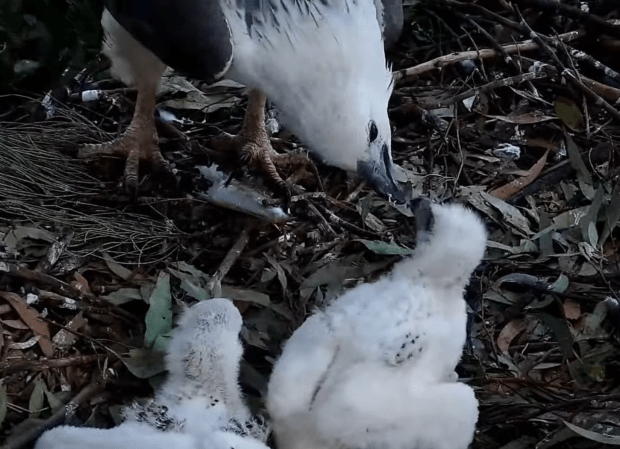
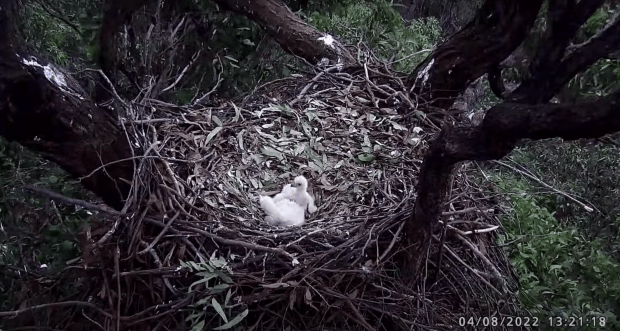
It’s a girl! Two of them, to be precise – Louis & Dorcha have produced two female chicks this year, continuing their tradition of same-sex clutches. The exception being 2023 which had a solo male chick – would the egg lost overboard also have hatched out male? We’ll never know. However, in not very good news, ringer Lewis Pate found the nest to be festooned with fishing twine, and one of the chicks entangled. He was able to remove it all, thank goodness, otherwise the chick probably would not have been able to fledge. George WTS has opened the name game – suggestions must be in by noon on Monday, don’t forget to use hashtag #2026NAME otherwise your suggestion might not be included. A panel will short list the suggestions and make their decision on Monday evening, which George will announce on Tuesday. In regular business, Garry LV0 brought two fish for Aurora, taking the Nest One tally to one hundred and fifty eight, and Louis brought five fish for Dorcha and the chicks, taking the Nest Two tally to two hundred and fifty seven. No disturbances today, the chicks were settled, the weather was settled but is due to change to overnight drizzle and a low of 15°C, and thundery showers, sunny intervals and a high of 23°C tomorrow.

Today’s videos:

https://youtu.be/-pm7UfxK_n4 N2 Name those chicks! Name Game open now until noon Monday 13th https://youtu.be/dzeVEwfADQQ N2 Are the chicks still full from last night? Neither’s interested in fish one 04.28.03https://youtu.be/Btb8Cm0MpR0 N2 Fish two gets hidden then the chicks try self feeding 05.03.07https://youtu.be/zy5OhBs5nk4 N2 Dorcha’s causing havoc with sticks 12.18.56https://youtu.be/OIHui3ptAqk N1 Aurora takes the fish and departs, Garry settles on the egg 14.12.37https://youtu.be/-0eCsSKqnDE N2 Fish three gets a 20-second handover 17.17.59https://youtu.be/QM-dPgIy0es N2 Tiny tiddler fish four is gone in 2 minutes 20.39.59https://youtu.be/UoIr0cwnAZk N1 Garry delivers fish two then both depart – empty nest 22.05.00https://youtu.be/4RzQT_DMpS4 N2 Dorcha almost barges Louis off the nest to get to fish five 22.51.17

You’re invited to join the friendly and knowledgeable community at Woodland Trust’s Osprey forum – it’s fun and free, everybody’s welcome:

https://www.woodlandtrust.org.uk/trees-woods-and-wildlife/osprey-cam

==========================================================

Kelly Sorenson has sent out the following e-mail regarding the search for Iniko:

Some good news coming out of Wales.

SK Hideaways has a new video of Sandy and Luna protecting their territory. https://youtu.be/voxNZ7CTeDM?

For those of you intending to donate again to Save Moon Camp, please do so before the end of the month. SaveMoonCamp.org

Little Dewey is not so little and she is standing on the rails looking out at the world beyond. Good fish count today – thanks Pam and Heidi: Dewey fish count 7/9…8 Total…Mom 6 Menhaden, Dad 2 (1 bluefish, 1 Menhaden)

Osprey are dying all over the US and in Canada. What is the precise reason for those that are not part of the industrial trawling of Omega Protein? Is it heat stress on the fish? Those that depend on trout as their primary food are having trouble in Long Island Sound and other adjacent areas where the temperature in the water where the trout live exceeded 65 F. We saw this a couple of years ago in Montana.

Still, Menhaden are a huge issue in the NE or rather, the lack of them.

For those of you who might have missed it, I encourage you to read Viki Volk’s diary over her two decades of watching ospreys from her front porch on St. George’s Island, Indian Creek, Maryland. The ospreys thrived, and now, there is one little one struggling to survive. This is a tragedy unfolding before Viki’s eyes and all those who are watching the ospreys closely in this region. That diary is here: IslandCreekOspreys.com. It is free. You will learn something from an individual who loved/s our fish hawks.

I found entry 2020-3 interesting. There is a mention of supplementary fishing in that entry.

Something that is troubling me is that we are now finding more fishing equipment in the nests of the UK Ospreys – something unheard of in years past. This happened on the nest of Louis and Dorcha when the ringer found one of the chicks tangled in line. We know that Telyn swallowed a line and lure – and I am certain there was mention of at least one other nest with issues. What is going on? why now?

I wish that the female at Blackbush would feed the big siblings slower and then when she feeds Tiny she is focused and feeds fast. She drives me crazy.

The little one at Cowlitz PUD is moving about but I still have serious concerns about its survival. Let me be wrong!

I continue to have concerns about the only surviving chick at Osoyoos also. One day at a time.

Things look good for the pair at Coeur d’Alene Idaho.

The video of the ringing of the chicks at Fru Rauer in Norway is now available: https://youtu.be/xeMiYYPGVg8?

We continue to put wildlife in harm’s way with our activities including the mining of the ocean floor.

Species’ ingenious survival strategies no match for human destruction, red list revealshttps://www.theguardian.com/environment/2026/jul/09/species-ingenious-survival-strategies-no-match-human-destruction-red-list?CMP=share_btn_url

If you have travelled to Spain and Portugal recently you will, no doubt, have seen the multitude of storks that live there. Where do they eat? The dump. In fact, Bald Eagles in my City frequent the dump for food because road kill and small mammals are ot plentiful. They used to be but expanding housing developments and rodenticides to kill mice and rats have caused their food sources to dwindle. Now, we endanger their lives with all our junk food loaded with chemicals in those landfills!

Health risk fears for storks in Europe over ‘junk food’ from landfillhttps://www.theguardian.com/environment/2026/jul/08/health-risk-fears-for-storks-in-europe-over-junk-food-from-landfill?CMP=share_btn_url

Thank you so much for being with us. It has been a bit of a long day, but a very productive one. I have been decluttering, and there is an energy in setting a simple goal, such as a single drawer, and seeing it only holding what is essential. Like a rental property on holiday! We wound up cleaning three drawers and taking a good look at the basement, which is going to get cleared. Tomorrow it will be Toby’s clothes. He has certainly grown from that little puppy that arrived 15 months ago. Someone is going to love those cute sweaters – hopefully some of them will go to Ann’s sweet little Australian Shepherd, Lucy.

Take care. See you soon!

Thank you to Geemeff for her daily summary and videos, SK Hideaways for their videos of Luna and Sandy, to PB for keeping me informed, to those who posted information and images on FB, to Kelly Sorenson and his team for their dedication to the California Condors, and to the owners of the streaming cams that allow us to witness these amazing creatures. Thank you to the Guardian for their continuing reporting on wildlife and the environment.

Compassionate humans help wildlife, Cornell hawklets anxious to fly…late Tuesday in Bird World

16 June 2026

Good Afternoon Everyone,

We woke up to blue skies and sunshine! And, while sipping our tea and munching on croissants, we counted two Blue Jays at the feeder! Did I tell you about the Cooper’s Hawk hiding in the lilacs that Mr Blue Jay flushed out on Sunday? It was a frightening moment. Mr Blue Jay was screeching at the top of his little lungs. I thought the hawk had his mate or one of their newly hatched chicks BUT maybe Mr Blue Jay just say the hawk loitering in ‘his lilacs’ and wanted him gone. He sure chased him out of the neighbourhood. Imagine.

Ann is taking Don to his annual appointment today and I am going to sit on the deck with Toby and relax. We had an accident yesterday. I know each of us has spilled a cup of water and marvelled at how much there is when you go to clean it up. Well, imagine an extra large mug of hot chocolate. My goodness. Poor Don just couldn’t hold it (early Parkinson’s). The key is like training dogs – nothing negative. Our little Bissell worked overtime after I had scrubbed with a brush. The space is dry but there is still a dark stain in one spot and hopefully after a couple more bouts of cleaning, we can get that out. I bought this big old carpet years ago when wool and silk carpets didn’t cost the price of a car. I love it but, is it time to give it up?

From our monitor, ‘V’, who is writing a book on her twenty-year experience with ospreys living right in front of her. Sadly, life has changed for the birds, but today VV sends us some good news. Please note that I am protecting the location for obvious reasons and the individual.

“Most of my observed nests are a bust again this year. But one of the two nests in front of my house still has at least one chick still alive (bad early bullying, haven’t seen bobble heads in a few days, but someone is still getting fed)— but in the oldest nest, THREE chicks have reached dinosaur stage — first time parents, male an excellent fisher. We’re rigging up a pulley to that nest so we can start adding fish if times get too lean for them. 🤞🏻”

More good news from ‘V’: “It seemed one of the nests up the road also had feeding going on as I drove by. So perhaps there will be a couple fledges from here this year. I can’t imagine we’d be so fortunate.

The fish- pulley apparatus has been “rigged” — waterman vernacular — and we’re going to try to attach it in the morning when the tide is lower. That’s what someone needs to video, the 74 year old woman wading out to the piling for the 83 year old man to haul and attach a bird feeder.   Dodo birds to say the least. Ha!”

V is my hero. Not afraid to save their babies. There are others – I’m like a geisha – I never tell, but there are a number this year that have decided to establish fish ponds to help their ospreys.

There has been questions about Iris’s other two eggs. Egg 2 is 40 days today. Not going to hatch. It is possible that Egg 3 might hatch. Personally, if every osprey nest fledged one very healthy chick, we should feel blessed. I keep thinking about Dewey Beach in the same way. One healthy – not four with 2 or 3 dying of starvation and battering.

Baby One is doing just fine. One nice, strong chick. Yesterday, it disappeared into that bark that was brought in, and many of you became concerned that something had happened. You had to look closely to find its little head.

A close-up of a baby osprey chick interacting with a parent, surrounded by nesting materials.

Another human is helping some storks, with one of the adults in trouble. There are so many compassionate people throughout the world. Sometimes we have to pull away from the news – and just look at the good or we can easily drop ourselves into despair.

Here is the video: https://youtu.be/fp6ZQJJmDbE?

A nest with young storks and an adult stork feeding them, with a view of a village in the background.
Two young storks are being fed in their nest, with a view of a rural area in the background.

“One of the storks with a leg ring has both legs wrapped in long pieces of metal bands. It can’t free itself from the tether. The parent with the ring was in the nest this morning and again this afternoon, and you can see that its legs are still tied. One parent is feeding the young, the other is charred with soot, but it’s not enough food. Yesterday, the storks received a large portion of meat food from a human, and today, the human also threw a large amount of fresh meat into the nest. Storks are afraid of people; it will be difficult to remove the metal band (because it’s not a string) from its tangled legs. Perhaps this stork will be caught on the ground and its legs will be freed.”

‘J’ sends us the latest installment of Kakapo news.

Kakapo Files podcast episode 18:
15 Jun 2026

Six months after this record-breaking kākāpō breeding season began, all 91 living chicks have fledged and left the nest. The chicks remain with their kākāpō mums and are still being fed by them, as well as eating a range of plant material, and as cold wet midwinter weather sets in the chicks are learning to find dry roost sites. The Kākāpō Team’s Daryl Eason and Andrew Digby answer listener questions, including why did Kākāpō cam star Rakiura spend so much time in the nest digging, what can you learn from a piece of egg shell, and could old museum specimens be a source of lost kākāpō genes?

In this episode:
02:06 – Island news with ranger Daniella Whitaker
06:21 – Update on Kākāpō Cam star Rakiura
11:43 – Sick kākāpō
15:19 – Are kākāpō smart?
18:19 – Previous nest cams
20:05 – Why did Rakiura dig so much in her nest?
24:00 – Do kākāpō compete with other species?
25:30 – Kākāpō on Coal Island and at Sanctuary Mountain Mangatautari
30:57 – Museum specimens and lost genes

Learn more:
Follow the Kākāpō Files podcast to keep up to date
Listen to the Voice of the Kākāpō series for a recap of the 2019 breeding season. Also listen to the episodes covering the interim 2022 breeding season, and about how a few male kākāpō have fared in the North Island, in the fenced Sanctuary Mountain Maungatautari
For more New Zealand science and nature find and follow the Our Changing World podcast, and subscribe to the show’s monthly newsletter

Guests:
Kākāpō ranger, Daniella Whitaker, Kākāpō Recovery Programme
Kākāpō technical advisor, Daryl Eason, Kākāpō Recovery Programme
Kākāpō science advisor, Andrew Digby

Kakapo Files season II:
https://podcasts.apple.com/nz/podcast/k%C4%81k%C4%81p%C5%8D-island-diary/id1447593081?i=1000762432199 
https://www.youtube.com/live/UL6P1TdsRXc?list=PLB06qFjAt4VBoq1t-spjkxq6IB5WcEexS 
https://www.rnz.co.nz/podcast/wild-sounds

Dewey Beach. This must be a female – and continue to send positive wishes to her so that she fledges!

An osprey adult stands near a nest with two chicks, one visible and looking up. The nest is surrounded by sticks and located near a body of water with buildings in the background.

The trio are so fully feathered at Manton Bay and the nest of Blue 33 and Maya.

A closely grouped family of ospreys in a nest made of twigs and sticks, with one adult bird observing the chicks. The background shows a body of water.

‘PB’ reports that Cowlitz has its first hatch today.

A pair of images showing bird eggs in a nest, with one egg hatching and a chick visible next to the eggs.

The reality of not enough fish is spreading through the nests – Forstythe, Field Museum, Farm Field amongst others.

Heidi reports on the loss at Field Farm:

An osprey feeding its chicks in a large nest made of twigs and branches, surrounded by green grass.

Heidi also reports on The Bridge Club osprey nest in NY.

An osprey taking off from its nest with young chicks visible inside the nest, surrounded by a natural landscape during dawn.

‘PB’ reports on Achieva:

Facebook post detailing a fishing report with timestamps and observations of interactions between birds and fish.
A collage of images depicting an osprey nesting area, showing the bird with its wings spread, sitting on a nest made of sticks, and interacting with nestlings or prey.

Charlie and the New Female together on the nest at Charlo Montana feeding their two babies.

Two adult ospreys in a nest with several chicks and remnants of food.

Look at those beautiful juvenile feathers on the Pitkin County Trails Osprey nest in Colorado!

An osprey stands over its chicks in a large nest made of sticks, set against a green landscape with shrubs in the background.

It can be very dangerous being an osprey chick during fish deliveries. We have seen chicks killed, almost smashed…today it was Louis turn at Lock Arkaig 2 to flip a chick. Geemeff has it on video: https://youtu.be/boMblyAoBC4?

A very successful nest is Wolf Bay in Alabama! One of the three chicks has fledged and the live feed has now returned. Aren’t they gorgeous?

Three young ospreys in a nest, surrounded by branches and overlooking a body of water.

At Osoyoos in British Columbia, Canada, the three osplets are still alive. Please send this nest good wishes. They have had trouble with heat and getting fish to the nest for many years.

Two ospreys sitting in their nest surrounded by twigs and branches, with some chicks visible beneath them.

So far it looks like we still have four osplets alive at the Blackbush nest in Prince Edward Island, Canada.

Two ospreys in their nest with several chicks at Blackburn Beach Resort.

Two big osplets at the Havre de Grace Maritime Museum osprey nest.

An adult osprey feeding two chick osprey in a nest made of sticks and foliage.
A nest with four young ospreys, sitting on sticks and leaves, while one adult osprey is feeding them.

The Fortis Exshaw streaming cams in Alberta appear not to be working.

We still have two osplets at the Minnesota Landscape Arboretum. I will try to find any news I can about the woman who was caring for three osplets alone in Minnesota and post it tomorrow. If you happen to know, send me a note!

An aerial view of an osprey nest made of sticks and straw, with two adult ospreys visible near the edge of the nest and a chick resting inside the nest.

At the Red-tail Hawk nest of Big Red and Arthur (one of my favourites) the two older chicks P1 and P2 are preparing to fledge. Cornell did a video of their anxious moments: https://youtu.be/vS44rBVDG_U?

They are so cute. Big Red and Arthur will be showing them where to fly to – and you can count on Arthur for making sure that his babies are well fed after they fly.

A group of red-tailed hawk chicks standing on their nest, preparing to fledge, with greenery and a road visible in the background.

Thank you so much for being with us today. Please take care. There is so much happening – it is very difficult to keep up.

It is so nice to have you with us, and I appreciate all your notes, your e-mails, comments, and good wishes. Everyone is so kind, and it means so much to me. I want to add that there is something odd going on with my e-mail at times. Several letters from one of my friends in SF, who supplies us with those wonderful videos, SK Hideaways, were a week late in arriving in my ‘Inbox’, and they all came at once. I could be missing yours, or they might not have arrived – so if you sent me something and I did not respond, please resend. I do try to reply within 48 hours, and normally the same day if things at home are going smoothly.

Thank you to everyone who sent me news, posted information or images on FB, created videos – I am so very, very grateful. To the owners of the streaming cams, we are all so very thankful that you allow us to watch these incredible families.

Early Tuesday in Bird World

23 August 2022

Today turned out to be a very special day (22 August). OK. It is always special when I can go out to the nature centre and do my long walk. It is also a good way to check every nook and cranny for the geese and ducklings. A few had moved from where they were yesterday but many stayed in or close to their normal pond area. I continue to be fascinated that there simply are no Wood Ducks at the nature centre. It is like the two species – Mallards and Wood Ducks – sat down and signed a truce and decided who would go where! There were a lot of birds at the ‘winter’ feeding stations — they must fill the feeders year round. There were several Downy Woodpeckers, two American Goldfinches, a number of Black-capped Chickadees and then a bird sitting in the squirrel feeder that I did not recognize. After going through the birding book, it appears that the little lovely below is an immature female Rose-breasted Grosbeak. I certainly welcome any help with this ID.

The most excitement came this evening, however. It is hard to imagine sitting next to a pond which is about 6 metres away from, perhaps, the busiest highway in our City and seeing a Great Egret fly to a tree to join two others. They are part of the heron family but they are very large. In North America they have black legs and a yellow bill. They gather in groups near ponds and wetlands if there is plenty of food. Otherwise, if food is relatively scarce, you will see them alone.

What a magnificent creature.

In the mailbox. Following up with the question about Titi and Boris and the reason for the Janakkalan nest cam in Finland to go offline. We have answers. Thank you ‘S’ for getting back so quickly to us. Boris was seen on the nest two days after Titi’s fledge. It was the morning of 12 August. Titi did not return to the nest while the camera was still operating.

There is a video of Boris’s nest visit.

There were difficulties with the camera and it completely broke down. It will be fixed and will be up and running again next year. ‘N’ did receive a response from the Finnish Osprey Foundation stating that there were a number of Osprey fledglings in the Muonio in Northern Finland. Thank you ‘N’.

Can you help? There is a new book on Peregrine Falcons being written by Richard Sale in the UK. Susan Sale writes with the following information and a question. “My husband is self-publishing a book on the Peregrine Falcon and I am trying to source the following Peregrinus Casini, Japonensis and Pealei. Do you have any photographs of them or perhaps give me some contacts who may and if you or they would be willing to allow use in the book.” If you have any images of any of the three sub-species of Peregrines or you know someone who might be able to help, please contact Richard and Susan at this e-mail address: Richard@snowfinch.co.uk

Several have been wondering about Big Red and Arthur’s L3 and L4 that are currently in care. They ask “Will they, if ever released, be placed near their family so BR and Arthur can find them? If not, Who and How will they learn to hunt after all these WEEKS in the clinic???” L3 and L4 are in very good hands. Just like they would if they were patients in my local wildlife rehabilitation centre, they will learn to fly and they will also be taught how to hunt and catch their own prey. I do not know where they will be released.

‘B’ sent a note and wondered if I had seen Thunder and Akecheta on the West End nest together. I had not and went quickly to rewind and there they were. Thanks ‘B’. We are always happy to see the parents on the nest as well as the fledglings!

‘L’ wrote: “When I grew up in the north of England, along the Pennines…near the Lake District….I never saw an Osprey, Kite, Goshawk, Golden Eagle that were native to our islands as we had eradicated them… I thought all was lost .it wasn’t and these efforts wipe away the despair that can overwhelm you when you ask how can we make a difference. WE make a difference.”

‘L’ you will then be thrilled to learn that the National Trust, RSPB, and the Peak District RaptorGroup just announced two successful Hen Harrier nests this year! And, as you know, the Ospreys are thriving and so are the Goshawks. Isabelle Tree’s re-wilding at Knepp is taking off…there will be more raptors.


Nest News. It is hard to imagine sitting in the heat of summer in the Northern hemisphere but, the forecast is for snow in Orange, Australia. Holly Parsons who heads up the FB group was posting an image of Xavier and Kelli HissiFit Walker, one of the new mods on the streaming cam chat, dressed Xavier for the occasion. I chuckled so loud – I hope you enjoy it. If I were Diamond I would not want to lay eggs in that cold!

Thanks Holly and Kelli for letting me share!

Like Titi at the Janakkalan Osprey nest, LC at the Osoyoos nest doesn’t seem that much interested in fledging — yet. LC is 66 days old today.

As of the 22nd, Telyn was still at the Dyfi Osprey nest. She has not begun her migration yet. There is no rush and the females need to be in top form before they depart. Taking care of three big female chicks really has to be draining because they require much more food.

I went to check on the Sydney Sea Eagles and Lady was feeding SE29 and 30. It was very civil. SE30 did a few quick grabs and kinda looked to make sure 29 wasn’t going to do anything. Lady had it all in hand – a bite for you and then one for you. Back and forth. How lovely.

Sometimes 29 did seem to get more bites than 30.

and then 30 would get a few more…

There is plenty of fish. Both will be full. Just look at the ‘blood feathers growing in on SE29’s back and wings. Oh, they are changing so quickly — and the are simply adorable.

It rained later in the day and Lady spread her big wings and covered those babes who do not, as you can see above have their feather covering.

Dad was in the nest and on alert to any intruders that might be around,

Migrating tracking. Kaia flew in a big loop today staying in the same area that she flew to after she flew north out of the Ukraine.

There is considerable worry for Kaia’s mate, Karl II, and migration has not begun. He normally spends much time at a nature reserve on the Black Sea near Odessa. The area is currently a war zone.

A lovely image of Little Bit 17 was posted by S Basly on the Notre-Dame FB page. It was taken on the 28th of July.

What a wonderful way to end today’s blog with a look at Little Bit 17. He is, of course, a prime example of what an intervention and wildlife rehabilitation can do to give a raptor a second chance at life. Little Bit deserved it and he is living it. Such a beautiful juvenile.

Thank you so much for joining me today. Please take care. See you soon!

Thank you to the following for their streaming cams and/or posts that made up my screen captures: Notre-Dame Eagles, Looduskalender, The Eagle Club of Estonia, Sea Eagles@Birdlife Australia Discovery Centre Sydney Olympic Park, Osoyoos Ospreys, Dyfi Osprey Project, Raptor Persecution UK, Explore.org and the IWS, Finnish Osprey Foundation, and the Orange Australia Falcon Cam FB.

Featured image is Thunder and Akecheta on the West End Bald Eagle nest in the Channel Islands. 22 June 2022

Bird World News – Early Tuesday

16 August 2022

Good Morning Everyone!

Everyone has survived the torrential rain from last night but all the plants were pelted down by the heavy rain and I wonder if that is the same for the crops in the farmer’s fields?

I am reasonably sure that everyone reading my blog this year is aware of the ‘rain’. We had a 4-5 year drought and then the skies opened in the spring and never closed for any extended period of time. The dehumidifier cannot keep up and tonight the skies opened again! It is raining so hard you cannot see and the sky is charcoal-gray.

This is an image shot on the highway and sent to me about 30 minutes before the system hit Winnipeg last evening.

This image has an empty alt attribute; its file name is screen-shot-2022-08-15-at-7.59.16-pm.png

There it is on radar.

This image has an empty alt attribute; its file name is screen-shot-2022-08-15-at-7.58.11-pm.png

What does this have to do with raptors? or wildlife? Well, in Manitoba it has a lot to do with them. It means that the rangers at Hecla Island/Grindstone Provincial Park will not be able to check the shore line where the eagles used to make their nests. It means that the lake will rise even higher. It will be good for some of the shorebirds! For others they might have difficulty finding food.

Thankfully the new baby Hedwig came to eat under the bird feeders at his usual time and beat the storm. I try to not let him see or hear me which means the images are always compromised. He is really growing. Sometime between the 20th and 30th the new fence will be going up. Then the bird and pollinator friendly area will be planted. The fence builder already knows that the fence has to be raised so that the rabbits can come in. Sadly it also lets the feline domestics in the garden, too. (Just like the reintroduction of Goshawks in the UK means that there will always be predators for the Ospreys now). The floor of the sunroom will be tiled on Wednesday, cure until Friday night and finally on Saturday if all is well, I can move back in. I need to figure out how to remove one of the screens as it really stops me from being able to take photos of the garden friends without disturbing them. It also means that the juvenile Crows will see me and stand on the roof screaming and pecking when their cheesy dogs need replenishing. It is interesting – no one can ‘see’ into the sunroom but if the birds get close enough they can – and, of course, their hearing is top notch. Still, I try to be invisible.

I am very fortunate and honoured to be able to take care of them, this little enclave of nature in the middle of a big and growing city. While I cannot turn back the heating of our planet, I can make the lives of the animals that bring me such joy easier. It is the least I can do. They used to burrow and fly in this area – free. As my City grows out instead of building up in the interior, their habitat gets more and more compromised by large housing developments with no trees and the houses so close together. It is easy for humans to become estranged from nature and that is the opposite of what we want.

This image has an empty alt attribute; its file name is 1steke7grlesuxe0myt3vw_thumb_117cc.jpg
Little Hedwig III

My goal this summer was to not only take care of the animals and birds but to coddle the old roses that were on this property in 1902. They are climbers and had been neglected when I arrived and well…I am guilty of also neglecting them. This year the area was cleared and supports were put in place. With all of the rain they have flourished. This is just one tiny cluster. They have been blooming since June and there are new buds every day as long as I pick off the old ones — which I need to do on this bunch. I wish I could put the scent on this page for each of you. If it could be bottled you could pull it out and smell the roses of summer at any time. They bring such joy.

This image has an empty alt attribute; its file name is dftj3rmkr1c369ziarqfog_thumb_117ca.jpg

I am shocked every time I go to the park because there are new ducklings. It is August – the middle of August! There should not be ducklings!

My camera is ‘smarter’ than I am and reacts badly if I happen to not check all the bells and whistles. I did not set it for ‘Movement’. This little duckling was moving. It was so tiny and still fuzzy. I have really cropped and blown up the image. What will happen to this little one? Will it grow fast enough to migrate in October? Why are so many ducklings hatching during the last week? They are all, by the way, Wood Ducks save for a couple of Mallards. The numbers have shifted this year. The Wood Ducks arrived late and are bountiful. At one time in early June I could not find a single Wood Duck!

These images are not great. Thankfully I am not trying out for wildlife photographer of the year — they would send me out of the room quickly!!!!!!!

This image has an empty alt attribute; its file name is unadjustednonraw_thumb_116a7.jpg

If you haven’t guessed by now, I love Wood Ducks!!!!!!! I think they are my favourite duck ever.

This image has an empty alt attribute; its file name is uswta97vqtoocjb5vvk4lq_thumb_11664.jpg
This image has an empty alt attribute; its file name is 10wq2wfatosfkdkvldydeq_thumb_1176c.jpg
This image has an empty alt attribute; its file name is tnxutqlkrpspmgy9zbozw_thumb_1179c.jpg

There were a few older Mallards. I could see no Mallard ducklings at this particular pond.

This image has an empty alt attribute; its file name is unadjustednonraw_thumb_116bd.jpg

I was, however, shocked/annoyed/angry that there was a party at a duck pond with balloons. On the drive out of the park there were more balloons attacked to trees! Signs can be used instead of balloons. They need to be banned from the park and the public needs to be educated as to what the reasons are.

This one had broken lose and had blown over to the edge of the island in the pond where the ducks and geese rest and lay their eggs. Will it pop and will one of them consume it?

I seem to be venting but clearly notices against balloons must go up at the parks just like the feeding signs.

This image has an empty alt attribute; its file name is unadjustednonraw_thumb_116ba.jpg

There they were – piles and piles of them. Celebrations should be fun and safe ——–for everyone and everything – including our dear ducks.

This image has an empty alt attribute; its file name is unadjustednonraw_thumb_116d4.jpg

Our City banned the use of glue strips as of 1 July 2022. So why are our big box DIY stores still selling them???????!!!!!!!!!!!! (Screaming at the computer!)

This image has an empty alt attribute; its file name is screen-shot-2022-08-15-at-7.32.43-pm.png
This image has an empty alt attribute; its file name is screen-shot-2022-08-15-at-8.18.02-pm.png

This will be a long term stay at the centre – feathers must moult and regrow. The wee one will need to learn everything in order to live in the wild. Wildlife rehab clinics, their vets, their student vets, their volunteers are the angels behind in the scenes in helping give our raptors a second chance at life from the harm that we do to them. Remember that you can help, too. That help comes in as many different forms as each of us is different – clean old towels and sheets, a bottle or two of Dawn dishwashing liquid, bleach, items for enrichment, volunteering time, holding a garage sale and giving some or all of the proceeds to the rehabber of your choice – the list is endless.

BirdCast has an active map showing migration in the US. Here is how to access it:

https://birdcast.info/migration-tools/live-migration-maps/embed/#?secret=jEQFPNj636

Kaia, the mate of Karl II, who is now migrating towards Africa turned back from the Ukraine yesterday and flew back into Belarus. Kaia has remained in Belarus today in a forested area. Some reported that she is in the Ukraine – this is not correct.

Many articles on how the war in the Ukraine is impacting wildlife, both residents and migrants, will be part of Wednesday morning’s blog on migration challenges.

This image has an empty alt attribute; its file name is screen-shot-2022-08-15-at-11.35.52-pm.png
This image has an empty alt attribute; its file name is screen-shot-2022-08-15-at-11.35.36-pm.png

At the White Stork nests of Bukacek and Betty in The Czech Republic, the adults are enjoying some quiet time together – bonding and working on the two nests. The fledglings seem now to have left the area to join other groups of other fledglings as they begin their mass migration together.

Stephen Basly who posts photos and videos of the Notre Dame fledgling eagles watched Little Bit 17 successfully defend his perch against 16. Isn’t that wonderful news?! The kid has confidence and we know he is tenacious and resourceful. Sounds like a great beginning to independent living for this survivor. If the images come out, SB will be posting them on the Notre Dame Eagles FB page.

This image has an empty alt attribute; its file name is screen-shot-2022-08-15-at-11.28.22-pm.png

In Senegal News, Jean Marie duPart reports that there are 31 young Ospreys in good form and finding large fish counted in Langue de Barbarie Park. Jean-Marie and his team keep us updated on Osprey counts from the beginning of migration period (yesterday) to their departure in the spring.

Young raptors can get trapped in trees. They still cannot land very well and often the twigs and the thicker of the thin branches stick through their wings and they are trapped….waiting to die. If you should see a raptor in precisely the same place, they probably need help. Check with your local wildlife rehab rescue. This Red-tail hawk is very happy that someone stopped to care for it!

https://fox8.com/news/see-red-tailed-hawk-trapped-in-dead-medina-tree/?fbclid=IwAR0QXV7cLEeMR0cBXpCbfGe3bTs0Sf1KXy-YUKc8w6EFNp-nBM-uTX4AoNk

The osplet on the nest at the National Arboretum platform in Minnesota has been scared off the nest at least three times this season by human activity. It is time that the institution put a fence around the area during breeding season like Montana Osprey Project does for Iris in Missoula. Sadly the chick is missing this time.

Are you missing Thunder and Akecheta? I sure am! Thunder was calling to Akecheta from the nest last evening as he flew around. He listened and joined her. So nice to see the two of you.

This image has an empty alt attribute; its file name is screen-shot-2022-08-16-at-8.58.25-am.png

Missy and Pa Berry were working on their nest yesterday also…and remember, Samson is waiting for Gabby to return. We have not even seen the fledglings off and the adults are starting to think about ‘spring’! With the changes in temperature, it will be interesting to see how many nests maintain their traditional egg laying schedule or who, like the Ospreys at Captiva, begin a month early.

This image has an empty alt attribute; its file name is screen-shot-2022-08-16-at-8.59.55-am.png

CJ7 and Blue 022 are making sure that their sole surviving fledgling, 5H1, is truly ready for migration. Look at the good condition this bird is in! 5H1 is a very important Osprey in the history of the reintroduction programme in the UK. He is the first osprey to hatch in more than 200 years and he has survived! (Let us hope that the goshawk that caught 5H2 off guard does not come around).

5H1 is really telling Blue 022 that it is time for the afternoon tea to be delivered!!!!!!!

This image has an empty alt attribute; its file name is screen-shot-2022-08-16-at-9.04.25-am.png
This image has an empty alt attribute; its file name is screen-shot-2022-08-16-at-9.07.46-am.png
This image has an empty alt attribute; its file name is screen-shot-2022-08-16-at-9.08.01-am.png

The youngest of the three osplets at the Boathouse platform in Maine is Sloop. ‘H’ tracked this bird all day yesterday and the days prior. Sloop is yet to fledge. The other two are 58 and 59 days old. Thanks ‘H’. So it is fledge watch for this third hatch of Dory and Skiff.

This image has an empty alt attribute; its file name is screen-shot-2022-08-16-at-9.09.47-am.png

There is still one osplet to fledge at the Osoyoos Osprey platform in British Columbia.

This image has an empty alt attribute; its file name is screen-shot-2022-08-16-at-9.17.22-am.png

Fledgling BC still comes to the nest for fish. So happy for Soo and Olsen. Despite losing one chick who fell off the nest, they managed to raise two in remarkably difficult conditions.

This image has an empty alt attribute; its file name is screen-shot-2022-08-16-at-9.17.44-am.png

Everything looks OK with Dad for yesterday at the Port Lincoln Osprey barge. He is really wanting to do some incubating so there are lots of changing shifts. He even came in the late evening, 2202, but Mum sent him packing.

This image has an empty alt attribute; its file name is screen-shot-2022-08-16-at-9.21.43-am.png

Everyone is sound asleep in the Sydney Olympic Forest. SE29 and 30 are too big to tuck under Lady so they have made a little cuddle puddle.

This image has an empty alt attribute; its file name is screen-shot-2022-08-16-at-9.23.35-am.png

That is it for early Tuesday in Bird World. Thank you so much for joining me today. Please take care. See you soon!

Thank you to the following for their posts and/or streaming cams where I took my screen captures: Sea Eagles@Birdlife Australia Discovery Centre Sydney Olympic Park, Port Lincoln Ospreys, Osoyoos Ospreys, Audubon Explore, Poole Harbour, Berry College, Explore and the IWS, Arboretum Ospreys, Notre Dame Eagles FB, Capi Mlade Buky, Looduskalender, Bird Cast, and Bald Eagles 101.

Early Monday in Bird World

15 August 2022

Good Morning Everyone,

The hoped for blog on migration will be written tonight and appear Wednesday morning. Lots of good information has come in! Thanks to all. If you are still thinking about migration challenges – even in your own area – send them to me before 1800 CDT Tuesday the 16th.


When will Diamond lay her first egg of the season with Xavier at Charles Sturt University in Orange, Australia? That seems to be the question on everyone’s mind. Xavier continues to bring in lovely prey items – some not so welcome like the Starlings but, it would seem that Diamond is in really good shape for this breeding season. Many of you might have noticed that Diamond appeared to be in less that stellar form last year and there was some concern that little Yurruga did not have good feather development. We are wishing Xavier and Diamond a successful season – meaning lots of prey items for the hatchlings, good weather for fledge, and success.

Here is the data on previous years:

Surviving Poole Harbour fledgling, 5H1, immediately flies away when it hears a predator approaching. Everyone learned fast after 5H2’s death by Goshawk. Today it was a Buzzard – a friendly. The little one is taking no chances though. Well done. You even took your fish dinner with you!

There was a question: Do goshawks eat fish? Goshawks are carnivores. They eat mammals and large sized birds found near the edge of the forest. They also eat amphibians, insects – and, yes, fish!

I had a comment in more the form of a question from my good friend, ‘T’. She noted that for years people have loved looking at the Osprey nests in the UK. The only things that were of concern were the weather and enough fish. They brought a lot of solace. Now Goshawks? ‘T’ wonders when the UK is so active in reintroducing the Ospreys to their country that there are now goshawks – long time enemy in the forests.

‘T’ here is your answer. A reintroduction project began in 2018 with Goshawks taken from Norway and Sweden to the UK.

Watching our raptors lay their eggs can emit all kinds of empathy especially if the eggs are big and more hard than soft when laid. At the Port Lincoln Osprey nest, Mum laid her third egg of the 2022 breeding season right on time. She looks tired. Watching birds incubate eggs is like watching water boil when the heat on the stove is ‘off’. But, Mum will get a rest and then in about 38-43 days she is going to be really busy. Should I wish for a clutch of all males or all females so life is civil again this year?

Sadly, it appears that Dad might have had another issue like he did a number of days ago. ‘H’ caught it! Is Dad having some kind of a seizure? or is the wind whipping him and his beak gets caught in nest material? It really is not clear but please send warm wishes to this amazing male – Ervie’s best buddy. Here is the video:

What a treat it is to check on a steaming cam and have a fledgling sitting right there as the sun sets. That is what happened when I went to see if Lancer had visited Two Harbours today. She is probably hoping for food! Chase & Cholyn haven’t delivered anything on camera for a few days. Not to worry. Lancer is not going to starve to death. They are seasoned parents. Cholyn is 24 years ‘young’.

Remember we talked about the things that wildlife rehabilitation centres need – besides cash donations. We talked about old clean towels – well, add old clean sheets and egg cartons to your list. Collect them from neighbours, friends, and family. Create a box. Everything helps! Most centres offer enrichment to the animals in their care. This comes in many forms from using toys to crumbled up paper to egg cartons!

The very latest on our Little Bit ND17. What a fantastic image. We can all be assured that Little Bit has been eating and that his flying is getting stronger. He has been back in St Patrick’s Park for many weeks now! So grateful to those on the ground who continue to track Little Bit and send us images. Thank you Stephen Basly!

The Sydney Sea Eaglets are fine. They ate and ate yesterday. Both had enormous crops – and yes, they do still get a little scrappy but I will venture to say that there is nothing to worry about unless there is an absolute food shortage. SE29 is the dominant bird. 30 knows it but sometimes doesn’t like it!

I continue to track Kaia, Karl II’s mate as she migrates towards Africa. She did a round turn and left the Ukraine and went back to Belarus! Dates on second image below.

What caused Kaia to flee the area and return to a safe spot she knew? Will she be resting and trying to figure out a different route? will she feed up so that she does not have to stop in the Ukraine? This is an extremely worrisome situation for both Kaia and Karl II but also for the four Black Stork fledglings – they represent the only storklets to survive this year.

War is a very terrible thing no matter where it is happening. We read about the costs to people and infrastructure but never to the wildlife that are suffering. Most of the birds from Estonia will be flying through the Ukraine – or have traditionally. Send them your most positive wishes.

While Kaia tries to work her way around a war zone, Karl II is keeping the four fledglings full — they will need to fatten up and so will Karl II for their long journeys.

There is a rumour that all of the chicks on the Boathouse Osprey platform have now fledged.

Chicks are doing fine on the Osoyoos Osprey Platform. BC was self-feeding and LC was enjoying being fed by Soo. Hats off to them. They have survived the two heat domes and it continues to look good for this nest in Canada!

That’s it for today in Bird World. Thank you so much for joining me. I will be keeping my eyes on Kaia’s movements and, at the same time, I will be trying to find out what is happening in the area of The Ukraine where she had landed that sent her back to Belarus.

Thank you to the following for their streaming cams and/or postings where I took my screen captures: Osoyoos Ospreys, Audubon Explore, Eagle Club of Estonia, Looduskalender, Sea Eagles@Birdlife Australia Discovery Centre Sydney Olympic Park, Notre Dame Eagles FB, Explore and the IWS, Port Lincoln Ospreys, Poole Harbour ospreys, Charles Sturt University Falcon Cam.

Fledge at Osoyoos!

13 August 2022

I saw it but didn’t know what I was seeing since I had been away. ‘A-M’ confirmed that Big Chick – chick #2 – fledged this morning at 0821. The chick returned to the nest at 0918.

Here is that moment. I could not wait to share it with you. We have all worried about these babies and hats off to Soo and Olsen. They pulled off what appears to be two fledges this year – LC will soon follow! What a triumph. So happy for this Osprey family who has battled heat dome after heat dome this summer with all three of their chicks perishing last year. Congratulations Soo and Olsen!

LC and Soo wait for BC’s return.

Thank you to Osoyoos Ospreys for their streaming cam and to ‘A-M’ for confirming that fledge this morning and the successful return to the nest by BC. Well done!

Fledges, poisoned rivers, migration and more – early Saturday in Bird World

13 August 2022

It is a gorgeous day. A perfect 21 degrees C or 69.8 F with blue skies and sun. Rain is to come on Monday. It must be a good day to go and check on the ducks and ducklings! Dyson would not cooperate so I could not get his photo as he clung, swaying back and forth, on the tallest sunflower eating seeds. Hopefully he will do it again and I will be ready! This year Dyson and his friends planted those seeds. Next year we are going to have a big plot of them for everyone! Mr Crow and the juveniles have refused to ‘visit’ since I returned. It only happened a few moments ago once cheesy hotdogs were put out. Are they on strike against peanuts!!!!!!!!!

News came in from ‘H’ this morning. The second osplet at the Boathouse Osprey platform has fledged! Thanks, ‘H’ for keeping us informed. It is so sad that the camera is down and we cannot see this great transition in their lives. Happy to hear they are flying!

While I was away – or this morning – there was a fledge at the Osoyoos. BC has flown! Both chicks are looking good. They have survived some of the worst temperatures. So grateful.

Nest is empty except for LC at 0835.

Waiting for a delivery.

LC is really working those wings. On fledge watch for this one.

The wind is really helping us get a good look at Love and Peace on the Glacier Gardens nest in Alaska this morning. Oh, beautiful birds. Love has branched. Waiting for Peace. Enjoy these lovely eaglets while you can.

Stephen Basly continues to keep us informed about the comings and goings of our dear Little Bit ND17. Here he is fishing over the St Joseph River. Way to go Little Bit!

SE29 on left with a small crop. SE30 on right. It had not had food earlier.

The food deliveries at the Sea Eagles nest were few and small yesterday. SE30 did get some – eventually – but not before it had been beaked enough to cause it fear from SE29. Let us hope that this was a one off and not a pattern for several days.

SE30 withdraws -frightened – when there is a feeding.

SE 30 got some food but not enough to even make a dent on its crop.

Wish for fish! This was a nest that was calming down. It was 10 degrees C yesterday in the Sydney Forest. Fishing should be good?

Suzanne Arnold Horning captured some images of Arthur and L2 yesterday. L2 was on the Bradfield Building perches at Big Red and Arthur use at night. SAH got the shot and whee….L2 was off heading towards another favourite hunting spot, Beebe Lake.

Oh, it would be so grand if Arthur was to look up and L4 was back near the natal nest. I have not seen any recent updates on either L3 or L4 as they heal from their injuries.

Every moment with the fledglings is precious. Any day L2 could take to the skies to find his own territory.

It could be any day that the Black Storks on Karl II and Kaia’s nest in the Karula National Forest in Estonia depart the forest for that long and arduous flight to the centre of Africa where they will winter. Urmas has given trackers to the strongest of the four so that we can follow their flights. (I wish little Ilks had gotten a tracker!) Bonus is 83 days old today, Waba and Voog are 77 and little Ilks is 74. He missed the nest flying in and everyone was worried but he is OK. Each of the four are there around noon wishing for a food delivery from Karl II.

Karl II arrives with a pouch full of frogs for the storklets.

Everyone is hungry!

We have not seen Kaia. She has begun her migration on 10 August, one day earlier than last year. In that first day she flew 325 k and is in a forest in Belarus.

She rested and flew 314 km on 12 August. She is at the edge of another forest in Belarus.

There is very real concern for an area in Poland called the Oder. Thousands and thousands of fish and birds have died. The Storks and White-tail Eagles are also dying along with beavers. It is a popular place for the Storks to feed. Let us hope that Kaia and all her family will avoid this gathering place.

Chemical waste has been dumped into the river! It is all over the European newspapers and is of concern to everyone.

The Prime Minister Mateusz Morawiecki said, “Huge amounts of chemical waste were probably dumped in the Oder River with full awareness of the risks and consequences,” he said in a video on Facebook. “We will not let this matter go. We will not rest until the guilty are severely punished.”

Punishing the guilty after the fact does not help the birds, the animals, and the humans in the wake of this catastrophe. The German authorities are saying that the poison is mercury. Sadly, industry and governments dump unseen toxins and waste into rivers and oceans daily. Humans need to get a moral compass so that they will stop these practices immediately. Pollutants like human waste and toxins join with warming seas. What life will there be for our birds in a decade?

https://thehill.com/homenews/ap/ap-international/poland-investigates-ecological-catastrophe-of-fish-die-off/

https://www.rfi.fr/en/science-environment/20220813-dead-fish-everywhere-in-germany-poland-after-feared-chemical-waste-dump

https://www.dw.com/en/mysterious-mass-fish-kill-in-oder-river-climate-change-or-poison/a-62784099

Kaia’s transmitter has sent no further updates. We wait with worry. Please follow the travels of Karl II and Kaia and the storklets with transmitters here:

Of course, the migrating wildlife are caught in many dangerous situations. Poisoned waters in Poland and maybe other parts of Europe and an unrelenting war where the practice of the birds was to stop and stay for a period resting and eating to help them make it across the long deserts of Africa. This migration is fraught with obstacles that are highly dangerous to our beloved birds.

Poole Harbour has put together a short tribute to CJ7 and Blue 022’s second hatch that was predated by the goshawk.

If you missed it, Lady Hawk finished her tribute to Junior, the Bald eaglet that accepted Malala, the Red-tail Hawk as its sibling on Gabriola Island. Junior was killed when it landed on an unprotected hydro pole near the nest. Warning: Any tribute by Lady Hawk requires a stack of tissues!

Plucky, one of Nova Scotia’s juvenile ospreys, survived a Bald Eagle attack. Thanks to the quick reactions of everyone, Plucky is safely back on its nest!

Checking in at Port Lincoln. Mum and Dad have 2 eggs for the 2022 season. Ervie continues to fly by the barge to check on things but he is avoiding Mum’s wrath. Hopefully we will get some new images of Ervie and Dad fishing soon.

That’s a wrap in Bird World for this Saturday. I hope each of you is having a super day. Looking forward to having you with us again soon.

Thank you to the following for their postings and streaming cams where I took my screen captures: Port Lincoln Ospreys, Cobequid Wildlife Rehabilitation, Notre Dame Eagles, Lady Hawk and GROWLS, Poole Harbour Ospreys, Eagle Club of Estonia and Looduskalender, Suzanne Arnold Horning and Cornell Hawk Chatters, Osoyoos Ospreys, Glacier Gardens, and Sea Eagles@Birdlife Australia Discovery Centre Sydney Olympic Park.

When feather loss is nothing short of beautiful!

6 August 2022

I am up writing this short blog after midnight. The weather has turned agreeable in a place where I desperately want to go and check out the shorebirds. I am not an early morning person like so many of my birding friends who rejoice in getting out to see the latest arrivals before 0600. Tomorrow, however, I plan to leave early for me which means…I need to check on our feathered friends on line sooner! I am also awake because of the worry over Poole Harbour and the attack. How is the family?

First of all ——– let’s have a shout out and a drum, roll. Stephen Basly understands that we will not be 100% certain that the fledgling photographs contain Little Bit ND17 without a clear view of THE BALD PATCH. It is only now that I want to thank ND16 because this is complete proof that our Little Bit is flying and is doing well. It is nearly three weeks since Little Bit was released. He is definitely eating – whether or not he is catching some of his prey or having it delivered is not clear and — is now utterly irrelevant. What a relief…Thank you Stephen Basly for keeping an eye out for this amazing juvenile for all of us.

I had a question and it refers to Finnish Osprey nest #4 but, in fact, it applies to all Osprey nests post-fledge. The reader was worried that neither parent had shown up on the nest with UNA.

We are going to begin to see the nests being empty for a lot more time than when they are occupied now. It is always worrisome. We do not know if something has happened to the parents and/or the chicks. More often than not everything is good. It is a natural progression. The adults initially feed their fledglings on the nest. Sometimes both parents bring food to the nest for the chicks…we have also seen this at the stork nests with Karl II and Kaia both feeding their four and also with Bukacek and Betty. At some point, the adults might begin feeding the fledglings ‘off nest’. Big Red prefers, after the eyases fledge, to only feed them off the nest. She first feeds them on a flat roofed building called Rice directly across Tower Road from the nest. Sometimes she gives in to feeding on the nest and Arthur likes to sneak food there! At some point the female disengages from feeding the fledglings. Dad takes over completely allowing the female to bulk up her weight and add some fat before she begins her migration. The chicks will continue to be fed by Dad. Then they will feel the call to fly and they will start a journey to a place they have never seen which will become their forever winter home. The males leave last – only once they are assured the fledglings have all departed.

The #4 nest is mostly empty now. I have caught UNA there a few times but no prey deliveries. The chick appears fine and can fly quite well. It does not appear that there is any cause for worry.

The absence from the nest might also lie with the fact that a Goshawk attacked it. Just as you will see that the Ospreys at Poole Harbour are stressed about returning to the nest – and have not so far.

Daylight is just coming to the Poole Harbour nest.

No one slept on the nest last night. None of the family members have been seen on camera since the attack including Dad, Blue 022, and the other fledgling, 5H1.

Here are two stills from the attack on the Poole Harbour fledgling who is eating a fish on the nest. In the first one you will see CJ7’s head and her talons extending in front of her from the top left. The fledgling kind of melts into CJ7’s image. You can see the intruder (dark shape) also on the left – at 0900 on the nest.

In the image below, from left to right: the fledgling 5H2, the goshawk staring at the throat of the fledgling. The goshawk appears to have at least one leg and talons in the side of the nest. Some people have thought that it had its right talon in the wing of the fledgling. That is not really clear from the image. That right foot might also be caught in the rim of the nest pushing the primary feathers of the fledgling outward. CJ7 is on the far right. It is possible that she has one of the talons on the left food catching the goshawk’s wing. The talons of CJ7’s right foot seem to be embedded in tip of the goshawk’s wing – but this could just be the camera angle. This attack takes place in a couple of seconds – not even a minute. Was the goshawk successful? That really is unclear. Everyone went tumbling from the nest. It is very hard to wait to find out what has happened.

MORNING UPDATE FROM POOLE HARBOUR: The fledgling 5H2 was located alive with an injury to its flank. It has been taken into care. Blue 022 and CJ7 were located and they are alright. They are monitoring for 5H1. Here are the announcements:

The latest news.

Camera glitches when the chicks are near fledgling cause a lot of stress. Thankfully the camera on the Boathouse Osprey platform is once again working. The change in the three osplets is remarkable. Dory looks so tiny next to Schooner, Slapjack, and Sloop. ‘H’ has reminded me that they are 49, 48, and 46 days old today. We are nearing fledge watch.

Soo and the chicks at the Osoyoos nest have weathered another day – thankfully not such a hot one but others are coming. The chicks have been fed and also practiced some self-feeding. We are some days away from fledge.

Fish deliveries continue on a nice pace at the Fortis Exshaw nest. The parents have been going on and off the perch today. If you watch eagles, you will know that ‘branching’ is the first step to fledging. I wonder if the adults are showing the osplets the perch for the same reason?

While Mrs G is both a grandmother and a great-grandmother, Glaslyn was so happy to announce that Mrs G current mate is now a grandfather. His female chick of the 2018 season KS1 (middle chick) has fledged two chicks this year at the Bolton Estate in Yorkshire with her unringed mate. Well done! Here is the official announcement:

What the announcement does not tell you is that this is the first time since 1800 that osprey chicks have hatched at Bolton! 222 years. Incredible. They made the news with photos of the two grand chicks.

https://www.yorkshirepost.co.uk/news/environment/first-osprey-chicks-recorded-in-yorkshire-since-1800-hatch-at-wensleydales-bolton-castle-estate-in-landowners-dream-come-true-3795431?fbclid=IwAR2AJF2zV0GGoz3xTLz8-TwEqV77gAznHdTfS7sdCz8ehFRoPeV3EoWSzOQ

If you are waiting for the banding of QT chick on Taiaroa Head, it will now take place Tuesday August 9 – Australian dates.

The Mispillion Harbour Ospreys have been given names. The adult female is Della and the adult male is Warren working its way into the state where the Osprey nest is located, Delaware. The two chicks are Bay (eldest) and River (youngest) representing the Bay and the inlet where the two chicks were raised this year. Super meaningful names. Thank you ‘H’ for always going the extra mile to get this nest noticed – and the family loved.

Next year, ‘H’ is going to start a Facebook group for this wonderful Osprey family. So everyone remembers this nest – the Mum loves yellow! ‘H’ has dressed them up.

While Lindsay was resting on the ledge of The Campanile she had a visitor – Alden! Oh, how precious. Be sure to also check out moon_rabbit-rising Instagram’s account for recent photos of Annie hunting in the area.

Thank you for joining me this morning. Like so many of You I stayed up waiting for news of Poole Harbour. Wishing 5H2 a quick recovery! I am heading off to areas west to check on shore birds. I hope to have my regular report on Sunday. Take care. See you soon!

Thank you to the following for their streaming cam, Tweets, or FB postings where I took my screen captures: Mispillion Harbour Ospreys and ‘H’, Bywyd Gwyllt Glaslyn, Notre Dame Eagles, Fortis Exshaw, Osoyoos Ospreys, Audubon Explore, Birds of Poole Harbour, Finnish Osprey Foundation, and Cal Falcons.

Early Thursday in Bird World

4 August 2022

Good Morning Everyone! I was not going to write my newsletter until the end of the day but some of you might wish to know about the banding of the Royal Cam chick. There is a bit of other news as well. Both chicks at the Loch Garten Osprey platform fledged today – so every osprey chick in the UK has now fledged. Fantastic. I am getting notices that the cameras at the SWFlorida Bald Eagle nest of Harriet and M15 and the NEFlorida Bald Eagle nest of Gabby and Samson will go live in two weeks. Wow. Time is speeding by. Those cameras will turn on just about the time we have Osprey and falcon eggs in Australia.

The little fledgling Blue Jay has decided that it is time that I get some more peanuts outside for the three of them! Too funny. These wee ones can be quite loud when they want to be. They are getting their beautiful blue crests. I believe this is the smaller of the three – a little female -. She has that developing crest raised up high because she is excited! They are so cute and so animated.

The NZ DOC rangers will be banding the chicks on Taiaroa Head today. Here is the announcement by Ranger Sharyn Broni posted by Sharon Dunne on the Royal Cam FB page. There is no mention of the time. There will be an archived video of the banding of QT if you miss it!

I know many of you are anxious to also find out about the naming of QT. They may mention how this will be done this year. On line voting took place during the pandemic but this might change now.

Here is the link to the camera:

An Osprey rescue in Scotland that warms our hearts. You might have to keyboard the URL if it doesn’t give you an automatic link. It is the story of the collapse of the Balgavies Osprey nest mentioned a few weeks ago in my blog – this one has pictures!

scottishwildlifetrust.org.uk

The youngest chick on the Janakkalan Nest has yet to fledge. Titi often remains on the nest now that Boris is flying about for longer periods of time. With intruders and goshawks in the area, it is dangerous for Titi not to be flying.

Boris arrives in the bottom image to protect the nest. Hopefully s/he will take care of its sibling.

This brings me back to the mystery of why a normally wonderful Mum on a Finnish Osprey nest would attack her children. Nuppu on nest #4 attacked her youngest who had not fledged and the eldest who had fledged (much less) last week. Humans wondered how this loving mother could turn on her children. One of my readers ‘L’ suggested that it might have been to get the youngest to fly. Nuppu, knowing that a goshawk was in the area, wanted both of her chicks off the nest and flying free to lessen the threat of predation. I spent some time asking several osprey experts if this could be the case and they said, ‘absolutely’. The youngest did not fly and was predated when the intruder came to the nest. The eldest flew. So, there we are – the mystery of the physical attacks was to get the second chick off the nest and flying. Nuppu wanted to save her chicks, not harm them.

The only surviving fledgling on nest #4.

I do not understand why Titi on the Janakkalan nest has not flown yet. S/he has been doing some exercising of the wings. Hopefully soon!!!!! This is the nest without a female so Boris has taken on the job of security when Dad is not around.

The Sydney Sea Eaglets are doing fantastic. The tips of the wing feathers are beginning to show. You can see them coming in on both chicks – look carefully at the wings.

You will notice that the time between feedings is a little longer. That is because the eaglets can eat much more at a sitting than when they had just hatched and needed a few morsels of fish every 45-60 minutes from dawn to dusk.

SE30 even did a little beaking of 29 yesterday. Nothing major but it was cute when it sat up and gave it a bop.

Both had nice crops! Fish will not be stacked on the nest so much now because it could cause predators to become interested in the nest and the eaglets. They are not big enough yet to be out of danger. They need to be 28-30 days old.

It is raining in Orange and Diamond arrives at the scrape box on the water tower soaking wet! But with a full crop. Looking for eggs in a couple of weeks.

The high temperature for the day will be 23 C at the Osoyoos nest. What a change! A nice fish arrived early on the nest and Soo fed both of the chicks. They made it! Olsen and Soo you should receive a reward – you did fantastic in your strategies to protect the two osplets. Just look at them.

Right now the camera is fairly clear at the Fortis Exshaw Osprey nest in Canmore, Alberta. We can get a good look at those three good looking osplets! We are on fledge watch for this nest. At least two are flapping and starting to hover. It will not be long.

Karl II delivered a number of fishes just a few minutes ago to the four Black storklets in the Karula National Forest in Estonia. So far all is well. The storklets are hovering and jumping and practising their perching to prepare for fledge.

A portrait of the three females at the Loch Arkaig nest this year. From left to right: Willow, Sarafina, and Mum Dorcha (unringed). When we talk about the females having beautiful necklaces have a look at these three! Gorgeous.

I am not sure I have ever seen three females with such elaborate necklaces. Dorcha is really influencing the genetics at this nest. Bravo!

A blast from the past. The four Peregrine Falcon eyases being fed at the CBD-367 Collins Street scrape in Melbourne. Time is ticking away. The camera will be up and running in September. Just in case you forgot how incredibly cute little falcons are!!!!

Thank you for joining me this morning. Things look pretty good in Bird World. Take care. See you soon!!!!!!!!!

Thank you to the following for their posts and their streaming cams where I took my screen captures: Friends of Loch Arkaig and the Woodland Trust, Eagle Club of Estonia, Fortis Exshaw, Sea Eagles@Birdlife Australia Discovery Centre Sydney Olympic Park, Osoyoos Ospreys, Charles Sturt Falcon Cam, Finnish Osprey Foundation, CBD-367 Collins Street Falcon Cam, and Royal Cam Albatross NZ.

Super Good News in Bird World

4 August 2022

It is a very early good morning to everyone- just past midnight. I am posting this newsletter early so that everyone will get to read the great news that is coming in – in case you do not already know. In the case of Victor and Little Bit, continued thanks to the wildlife rehabilitation staff that intervened and gave them a second chance on life.

My goodness, it is such a wonderful feeling as if you are floating on a cotton candy cloud when there is great news in Bird World. If you get emotional, I suggest you get the tissues out before reading further.

I want to thank ‘B’ and ‘L’ for alerting me to the special news about Victor in my inbox.

The Ojai Raptor Centre posted this announcement about Victor. When all of us were worrying he might not get well or he might not be able to feed himself ——– well, he is self-feeding and doing a grand job of it, too. He is in an outside enclosure not inside the clinic. Oh,, Victor, you have worked so hard to get well and all the staff at ORC have just being doing the best for you. Tears of joy, tears of joy.

Video of Victor self-feeding:

Video of Victor’s outdoor enclosure:

The other good news is, of course, Little Bit ND17. Images were taken and studied by several who go to the park on a daily basis to watch and photograph the Notre-Dame eagle family – Mum, Dad, ND15, ND16, and ND17 Little Bit. They have longed to get a good clear picture of 17 but wanted to be sure it was him. Here is the announcement in the Notre-Dame FB postings for today:

I was so skeptical when Little Bit was returned to the park without the ability to hunt his own prey. I am joyful to have been proven wrong! Notice the top right image. See how the hair kind of goes around in a partial donut shape. It reminds me of my late father-in-law who was bald but that circular band. It appears that some of the top is flat like strands of longer feathers covering up the places where feathers are missing. At the onset, I did not think he had a crop but, yes, that top right image appears to show that he has recently eaten. What a wonderful relief to see him looking and doing well. Thanks to everyone who worked hard to ensure Little Bit got a second chance on life and those birders on the ground who tried desperately to get images to reassure all of us. Thank you.

The Sea Eaglets are doing just fine, too. The crops of both of them are simply about to pop!!!!!!!

An hour later, Lady is urging them to have ‘just one more bite’! They are growing and will have a rapid growth spurt. Full crops will be the order of the day. Look at how the wings are forming and each has a cute little tail.

The two osplets on the Osoyoos Nest are looking good this evening. The forecast was correct and it has cooled down some – of course, it is still hot, just not as blistery. The chat for the streaming cams appears to be down. Not sure why unless it is all the spam.

Soo had a big crop at 10:46.

Another delivery.

Looks like one of the chicks got the last delivery and is self-feeding.

One crop fuller than the other chick who is fish crying.

I cannot give you a fish count but it appears that both chicks ate today and so did Soo. Fantastic.

Ervie is out flying about and finding nice fish for dinner. He must miss hanging out with Dad on the barge and going to the nest to eat his fish. I wonder if he will try to return to the barge after this breeding season?

It is good to know he is safe – GPS trackers certainly help with that.

In the case of each of these nests or particular fledglings, it is so good to know that they are either improving in care or are doing splendidly on their own. There has been no word on L3 or L4. We wait.

I want to mention a book called Beauty and the Beak. How Science, Technology, and a 3D-printed Beak rescued a Bald Eagle. It is by a pair of talented women – writer Deborah Rose and wildlife rehabilitator, Jane Veltkamp. I first heard of the efforts to save this particular Bald Eagle when I was looking for information about the McEuen Park eagles in Idaho. The intended audience would be children ages 8-12 (I think) but I also enjoyed the gorgeous photos and learning about how science and new technology saved Beauty’s life. It is another fantastic book about positive interventions. If you teach science or know someone who does, I would highly recommend this book. (Cost in Canada is $11.46 for the glossy paperback).

It is a beautiful story of compassion and the commitment of Jane Veltkamp to help Beauty the Bald Eagle.

My regular newsletter that normally appears around noon CDT during the month of August will appear in the early evening on 4 August.

Thank you so much for joining me with all these good news stories. Take care everyone. See you soon.

Thank you to the following for their postings and/or streaming cams where I took my screen captures: Notre Dame Eagles, Ojai Raptor Centre, Port Lincoln Ospreys and Sea Eagles@Birdlife Australia Discovery Centre Sydney Olympic Park.