Harassing Currawongs, Fish meals, and Early Saturday in Bird World

8 October 2022

Good Morning Everyone,

I hope that you woke up to or will wake up to a beautiful sunny morning. Before I go any further, I missed a feeding at Port Lincoln yesterday – so there was an early feeding and a second right before noon. Apologies all around for any anxious moments that might have caused!

I have mentioned my walks and some of the birds that are out and about in our city. The death of my old computer has me now using two different machines – one for photos and another for writing to you. Sadly, in the process of learning I deleted the latest duck pictures – all the male Wood ducks that suddenly appeared at the local park. I hope to go back today or tomorrow to check and see if they are still residents of that pond or if they have fled with our temperatures dropping.

This little Red Squirrel lives in a forest of Oak trees. Talk about silence. It was so quiet. S/he would just look at me, find an acorn and run off, returning for another in a blink. There is a saying on the Canadian Prairies to watch and see how high the squirrels take the acorns and that will tell us how much snow we will have in the winter. The trees were so thick it was impossible to tell where he took his pantry supplies. Dyson’s children are burying their peanuts in the grass! Silly things.

The other evening a wind came up. The trees began a twirling dance. Crows from every direction flew over the house, and then, all of a sudden, 11 European Starlings appeared in a tree on the opposite side of the lane. They left as quickly as they arrived. Normally they would stay to eat in the garden but, no. They were taking advantage of the strong winds.

The Dark-eyed Juncos have arrived in great numbers all over our city. They only want to eat Millet off the deck carpet or the boards. No feeders for them it seems – at least not here.

Junior and his three fledglings are still here. Their nest is in a tree close to the large tree with the Starlings. When they hear me open the garden door, they appear on the wires coming into the house and wait patiently for their peanuts or a new cob of corn. They do not seem to mind the Juncos.

Mr Crow and his three fledglings from this summer are still here. The babies are now the size of their dad. What a mix there is on that old deck. Still, no one is really bothering anyone else except for the natural fear that small birds have of big ones. Everyone is too busy eating as much as they can.

Have you ever looked at the feathers of a Crow? The layering is stunning.

There are many places on the Internet to find out about Crows but, Audubon has put out 10 Fun Facts about them. I can confirm that they hold grudges. Four years ago, I yelled at Mr Crow after he had eaten all of the Grackles fluffy babies. It was 2 years until he would have anything to do with me again.

https://www.audubon.org/news/10-fun-facts-about-american-crow

The Greater Yellow Legs are still at one of the local ponds looking for food.

The ‘Find of the Week’ was this family of Tundra Swans in the wetlands. You can just see one of the adults. The grey is an adolescent and to the left of the adult, hidden in the marsh, is another juvenile. There are, in fact, both adults and three juveniles in residence. I have been wondering if they are waiting for the youngsters to get stronger for their migration. While they spend their spring and summer in the Arctic and sub-Arctic, they will winter just south of us in North Dakota, Minnesota, or Wisconsin. So, they do not have far to go now.

Making the News:

I have an on again, off again relationship with The Guardian’s Country Diary. I should read it more often as, I too, have come to love the sound of the Corvids – not in the wilds of the country – but, in the middle of a city.

https://www.theguardian.com/environment/2022/oct/05/country-diary-the-mountain-silence-is-interrupted-by-ravens

This is why we thank our wildlife rehabbers every day – their dedication to improving the lives of our beloved birds that fledge and find themselves injured out in the wild.

This was one lucky Caribbean Osprey. It didn’t die from being electrocuted but, its feathers were sure burnt to a crisp. Thankfully helpers rushed to get it to the wildlife rehab centre where it is recovering.

Australian Nest News:

The osplets at Port Lincoln did have, as noted above, more feedings than I recorded yesterday. They ate well. At the late feeding, you can see all of their huge crops. This is the feeding after 1500. Little Bob is between the big siblings but he is not having any trouble opening his beak and getting food from Mum. Oh, he is right at the sweet spot. This is when Little Bob reminds me so much of Ervie.

Everyone went to bed with a very full tummy at Port Lincoln!

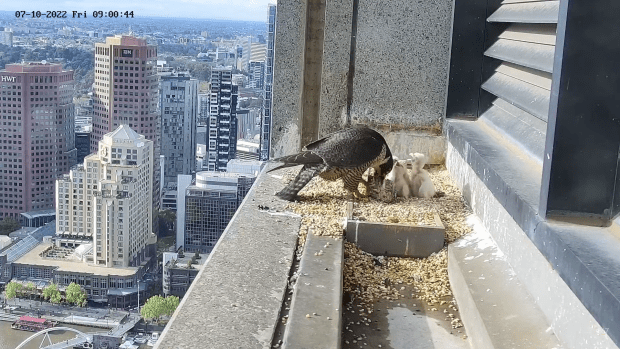
The eyases at Melbourne are well fed. I will begin to sound like a broken record but, this new couple really has it together. Prey deliveries are announced. Mum can run and retrieve the pigeons then or she can go to the pantry later. What is absolutely evident is the patience both parents have when feeding the four youngsters. No one gets left out. All four appear to be thriving, even the little snow person.
At Orange, it is a slightly different story. The wee one has missed out on several feedings or has received one or two bites, sometimes eight. Notice has been taken that people are now counting the number of bites that it gets which, to me, implies that there is some concern. As many of you will have noticed, including me and ‘A’, Diamond sometimes considers feeding the wee one who is calling loudly for food, beak wide open, only to wind up eating the prey herself. ‘A’ notes that the wee one ate better at the 17:17 feeding with Xavier coming in and wanting to feed the chicks but, Diamond eventually horking down the prey that he has brought into the scrape. Xavier is an excellent hunter, and he is really good at feeding. You might recall when Diamond hurt her leg last year and Xavier took care of Yurruga.

SE30 sure looked like it might fledge yesterday. Thankfully, the youngest eaglet of Lady and Dad was wise to stay on the nest. The Currawongs and Magpies were everywhere. They would have surely chased 30 out of the forest.

In my mind, I am imagining a corridor created for SE30 by 29 and the parents so that it is protected on its first flight. Of course, I am being a bit silly but, it is very possible that the close bond that 29 and 30 have with one another might have 29 there helping 30 fly to the camera, back to the nest, and then to the spots that it has found. SE29 has been very impressive. No wing tears, nothing.

Aren’t they beautiful?

Thank you so much for being with me this morning. I hope that you have some time today to spend peering into your garden, going for a walk, or just sitting on a bench somewhere listening to nature. Take care of yourselves. See you soon.

Thank you to the following for their posts and streaming cams which make up my screen captures: Sea Eagles@Birdlife Australia Discovery Centre Sydney Olympic Park, Charles Sturt Falcon Cam and Cilla Kinross, Port Lincoln Ospreys, 367 Collins Street by Mirvac, and ECWC.

Thursday Morning in Bird World

15 September 2022

It was the perfect day to go out to the industrial area looking for ducks – and shorebirds. And then it wasn’t. Things to remember: empty the memory card in the camera after downloading all of the images to your computer or to an external hard drive and – take an extra battery, one that is fully charged! As a result of not following such advice, it became a great morning to just relax and watch the shorebirds!!!!!!!!

I am becoming quite attached to these Greater Yellow Legs (or are they Lesser?). Their movements are quick and they bob their heads up and down like falcons and hawks getting their prey into focus. So cute.

The geese have certainly been making a ruckus everywhere for a couple of days. Because there are so many of them, it is like they are taking over all the ponds and vacant fields.

Once the geese had left the area, the two Greater Yellow Legs rushed to the other end of the pond where there was a nice muddy shore. Don’t let anyone ever tell you ducks and shorebirds are ‘slow’ – they are decidedly not!

Once home, it was a real treat to see Junior. Last time we saw the Dad of the three Blue Jay fledglings, he was moulting and had lost his beautiful crest. Junior is not longer bald on the top of his head. The bright blue is coming in and it is easy to imagine what he will look like once that crest grows longer! Like the Greater Yellow Legs staying away from the geese, Junior seems not to like coming around when the Crows are about. Those three fledglings have really grown and they can be quite intimidating. Junior has also decided that he likes the Black oil seed and the White Millet that is on the ground. If you look you can see two brown legs. they are four legs to a little feeder with a roof but, this morning our dear friend Dyson & Co decided to make the feeder go sideways and everything dumped all over the place. It will not take them long to clean it up.

Look at Junior’s tail. He has kept enough to fly and has moulted the others which will grow in and replace any damaged feathers.

Have you ever heard of the term ‘fright moult’? A fright moult is when a bird’s tail feathers all fall out at once. This normally happens when a predator grabs the bird’s tail feathers. In order to save its life, the bird being attacked moults all of its tail feathers at once!

Another interesting and strange fact about Blue Jays. Their feathers are actually brown but appear to us as being the blue colour we identify with the birds because of light interference from the feather structure. If the feather is crushed, the blue colour disappears (https://www.thoughtco.com/blue-jay-birds-4692850.

I am so grateful being back in the sunroom where I can watch the birds go about their daily lives without causing them any stress. Hopefully our dear Dyson will slow down and let me get a picture of her soon. She is sooooo beautiful. Her fur is all back to normal and is bright and shiny. Did I tell you that Little Red is around, too? He loves the new fence because he can now run from his new home in the neighbour’s tree along the top of their fence to the new one here and then with a single jump he can land in the square hanging feeder and dump every seed everywhere!

In the Mailbox:

‘A’ has been watching the Sea Eagles carefully and believes that SE30 is a female. “SE30 has always been a feisty eaglet, except for a short period about three weeks ago where she seemed fearful of SE29 at feedings. Since then, she often seems to have been getting most of the food and nearly always grabs any fish tails, mantling if necessary to keep them! Size and temperament point to female. What do you think?”

Alison, I totally agree with you. SE30, at 8 weeks plus a few days, is showing every sign of being a dynamic female. She takes charge of the food and is really growing and no longer ‘takes grief’ from 29. It is unfortunate that the eaglets are not tested and ringed!

Making News:

Holly Parsons posted one of those great intervention stories of an Albatross who had had hook caught in its beak. Always happy to have a success story – and that hook just makes me ache. Poor baby.

Here is the announcement:

Thank you, Holly, for also making everyone in Australia aware of the petition for banning the release of helium balloons. This should be a world-wide effort but, it should be to ban all balloons other than those required for weather research. This is, however, a start!!!!!!!!!!

It is an ad for a camera but, for us, what is interesting are the beautiful images of the Peregrine Falcons!

Nest News:

The California Condor chick in Tom’s Canyon is 4 months old today!!!!!!!!!! Fantastic.

Ron and Rita continue to work on their artificial Bald Eagle nest in the Miami Zoo designed by Ron McGill. Gosh, the eagles seem to be busy making nestorations everywhere. Is it going to be an early season? We haven’t even said goodbye to the last UK ospreys yet!!!!!

The cameras will be coming on soon at the Southwest Florida Bald Eagle nest in Fort Myers. Harriet and M15 have been diligently working to get their nest into shape after E19 and 20! In the meantime, here is a video of M15 and Harriet working on the nest yesterday.

Shadow is at the Big Bear Valley nest starting to bring in those whoopers of sticks that only Shadow seems to find.

In Australia, the ‘little’ (not really sure that term is applicable anymore) Sea Eaglets 29 and 30 are continuing to practice their self-feeding. They are standing so much more and at least one of them is standing on the very rim of the nest. This always makes me nervous! Both Dad and Lady are also stepping in and feeding both of them. All is well in the Sydney Olympic Forest.

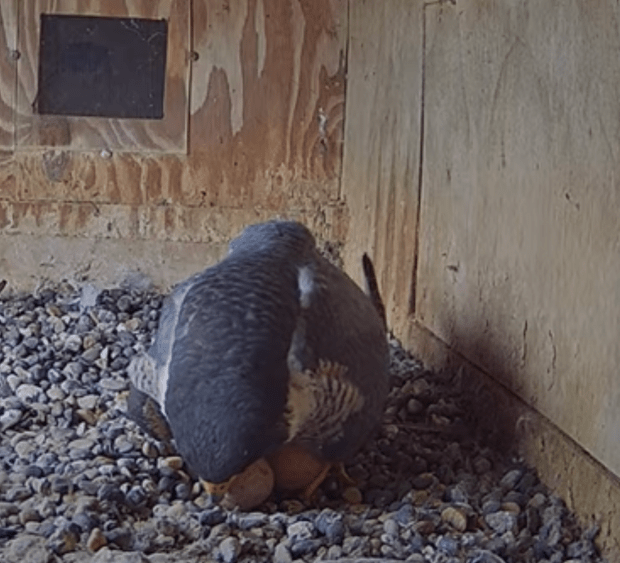
Diamond and Xavier continue to take turns incubating the eggs. There are a couple of weeks to go til we have hatch watch at Orange. Sadly, Diamond is also having to deal with an intruder female at Orange this year. Neither Diamond or Xavier are ‘young’ falcons but rather, slightly older.

I adore little Xavier and here he is bringing Diamond a yummy lunch.

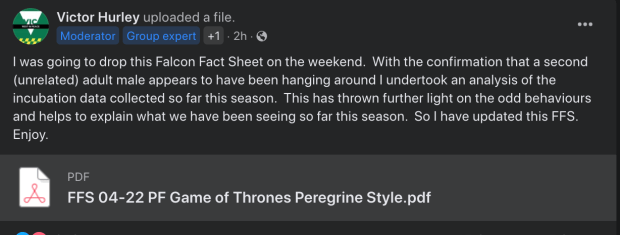
Thank you, ‘H’ for letting me know about Victor Hurley’s posting on the 367 Collins Falcon Watchers FB Page. Hurley is the key researcher for the Victoria Peregrine Falcon Project that includes the Melbourne falcons. He has now stepped in to comment on what is happening at Melbourne. Please read carefully to the end…

The new female arriving to incubate the eggs after a meal.

Victor Hurley has also included another fact sheet on the 367 Collins Falcon Watchers FB and has changed some of the data based on this new knowledge. (It is formatted so I cannot just post it here so you can read it, you must go there). A great article!

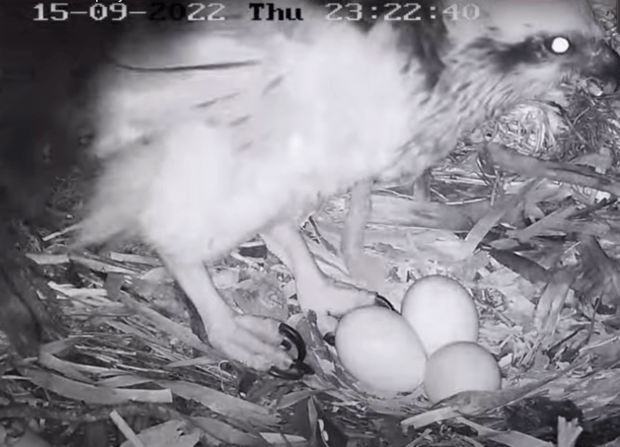
At Port Lincoln, the eggs are 38, 35, and 33 days old. On the 19th, egg 1 will be 41 days. Time is going to pass quickly. Hatch watch should begin on Monday.

Migration:

Things are just going quiet with the Ospreys in the UK. The last two lingering nests seem to be empty. No one appears to be home at the Glaslyn nest – Aran and Blue 497 both seem to have started their journey south. Padarn was last seen on the 12th of September at 19:20 with Idris last seen on the Dyfi Osprey nest 24 hours later on the 13th of September at 19:41. Safe travels, full crops. See you in the spring!

‘H’reports that there are still family members at the Boat House Osprey platform in Bremen, Maine. Sloop, the third hatch and reluctant fledge, is eating well having had at least 3 deliveries yesterday! She has sent a photo of Sloop excited for a delivery! She has not seen Schooner or Skipjack on the nest for 5-6 days but other osprey calls have been heard so it is unclear who remains as of today.

I am finding this very interesting. This nest is one of the most northern of all the US nests. It is migration season and we continue to have ospreys on the nest. Let’s watch and see when they depart.

Karl II and family:

All of the family members transmissions show them in the same areas that they were previously. There is no transmission for Karl II. He is believed to be at his favourite nature reserve in the Kherson Oblast region of Ukraine. I found several active reports on the current activity in the region yesterday.

Stay safe Karl II!

If you are following the new Osprey family at Belvoir Castle in Lincolnshire (my old haunt), Tim Mackrill has posted news!

From the Archives:

Do you remember: who are the storklets? what is their story?

Thank you so very much for joining me this morning. Please take care! See you soon.

Thank you to the following for their streaming cams, posts, tweets, etc that make up my screen captures: Holly Parsons and Albatross Lovers, Orange,Australia, Peregrine Falcons, Sony A1, WRDC, Condor Cam, SWFL Eagles, FOBBV, Sea Eagles@Birdlife Australia Discovery Centre Sydney Olympic Park, Charles Sturt Falcon Cam, Victory Hurly and the 367 Collins Street by Mirvac, Port Lincoln Ospreys, Tim Mackrill, ‘H’ and Audubon and Explore.org, Ukinform.net, and Dr Madis and the EMC plus the Eagle Club of Estonia.


The Black Storks of Estonia are rare and treasured. When Jan did not return and was deemed injured or dead, Janika had to try and feed her storklets. She could not manage even with the fish basket she found that Urmas, the Ornithologist for Estonia, provided. It was decided that the three surviving storklets would be taken into care at the Vet School in a stunning attempt to keep them alive by feeding with a decoy male and having a decoy female. In the image, Bonus is the largest of the three. The stotklets thrived. Two were placed with Eedie and Bonus was placed to be fostered with Karl II and Kaia. A goshawk attacked Eedie’s nest killing all the storklets. Bonus is now on migration and in Ukraine where he appears safe. Bonus is the only one of Jan and Janika’s six storklets of 2022 to survive.