
29 June 2022
Everyone that watches the ND-LEEF nest loves Little Bit 17. They also like 15 and 16. Everyone associated with the park where the nest is located is trying to deal with the situation of ND17 as they can. It is best to keep in mind that no one yet – as far as I can determine from the public correspondence on the chat and FB – who has the expertise to determine if 17 is alright has examined him. The operative word is examined – not observed. If I fell 60 feet and pretty much stayed in the same spot and hadn’t moved for 3 days and had not had a good meal for at least 4 days – well, I would hope that they would get medical help not just observe me to be healthy and say it is best to leave me alone.
That is the issue at hand. 17 has not moved from where he was Monday morning and he has not eaten for at least 4 full days. If he was vigorous and lively he would be all over the place not sitting in the same place. He cannot fly. 16 and 15 returned to the nest where the parents wanted them to be to be fed. That nest is falling apart and 17 cannot get up there. Will someone just step back and get a wildlife rehabber – a licensed one – or a volunteer of the rehabbers to pick up 17 and take him to a clinic to be x-rayed and assessed? He can be brought back if he is well. The parents will not abandon him. I pick up wildlife for a clinic and transport the birds (mostly ducks where I have to muck in a pond but often songbirds) to their site as they are busy treating other animals. All clinics have volunteers that do this and we/they are trained in taking great care in picking up and transporting the patients.
Enough. I wish the world was full of individuals like Dr Sharpe and his team at the Institute for Wildlife Studies. Gosh…I bet he would even do a phone consult!!!!!!!!!
The nest continues to deteriorate. Those parents will have it back up and in fine shape for next season once these season’s three have left the territory. It is surprising how fast a nest can be built! I was amazed at how quickly Richmond and Rosie rebuild their nest on the Whirley Crane in the Richmond Shipping Yards even while the Crows kept taking the sticks that they would bring in. Eagles can do that too.

There are holes popping up on the nest everywhere! What is doing that?

I wonder what the ratio of female osprey chicks to male will be in the UK in 2022? They endeavour to get every osprey chick ringed. I am so impressed.
Foulshaw Moss released the information on the banding of the three chicks of White YW and Blue 35 in their blog this morning. One large female – 1.8 kg or 1800 grams (only 30 grams less than the largest ever female at Dyfi) and two males.
In the blog they mention the 100th chick ringed – that was Tiny Tot, Blue 463. So small that no one thought she would survive but with the great care by her Mum and the tricks she played to get Tiny fed (removing the fish on the nest, letting the big ones fall into food coma and returning it to feed Tiny Tot).

The three chicks on the Glaslyn nest of Aran and Mrs G were ringed today. Mrs G kept guard and she is still watching and waiting for every human to get far away from the nest. Here is the information from the individual that ringed the chicks:


Yesterday the three chicks of Idris and Telyn were ringed at the Dyfi Nest. There are three girls. Their names are after Welsh rivers and lakes. A vote was taken and it was agreed that the names should all use the same first letter. The letter ‘P’ was chosen to honour a long time Dyfi supporter, Posh Pete. The chicks are: Pedran (7B0), weight 1695g. Padarn (7B1), weight 1790g and. Paith (7B2), weight 1830g. Paith sets the record for weight at ringing on this nest but ironically she has the shortest wing span.
Chloe Baker put together this chart to compare.

It is really a good thing that Idris is a good fisher with three large girls to feed plus Telyn and himself!
‘H’ mentioned her frustration at trying to find information on the streaming cam sites. Many have nothing and the FB groups often do not have the history either. I have often addressed the need for an emergency phone number if something happens at the nest but few places will post phone numbers for fear of getting inundated with worrisome calls. Many of the nests are on sites where there is no continuity of staff. I have found, however, that the UK sites have excellent websites. Many – if not all of the nests – are associated with a nature centre that does have dedicated staff and volunteers who try to keep information up to date and accurate.
I want to take this opportunity to give a shout out to the Dyfi Osprey Project – they have all kinds of information under the streaming camera plus a very informative website with a family tree that I have placed on my blog in the past. Here is that information under the streaming cam image:

Out of all that information I am particularly pleased to see Intruder no 7, Blue KCB. This is why information and ringing is important. You can track and establish a history of the birds and their success. Tegid is one of my third hatches of 2020. It was not his sibling that beaked and harassed him but an adult female, Blue 024, an intruder. No one thought he would make it. Well, he did return and this is his third year to have chicks. The fact that he had a chick in his first clutch return as a juvenile at 2 years is fantastic. There is something about this fighting to survive that makes these birds fierce. There is also good DNA. Tegid is Monty’s son and KCB is Monty’s grandson. The dynasty continues.
Do you watch the Theave Osprey nest in the UK? Those chicks were ringed and there is one female, one male, and the other can’t be determined. Nice healthy osplets.
Today is the anniversary of the Osoyoos Osprey nest sadness of 2021 when all chicks died due to the heat wave in the Pacific Northwest. The three this year are doing so well and Olsen has been bringing in some nice big fish. Please send positive blessings to this family that this continues.

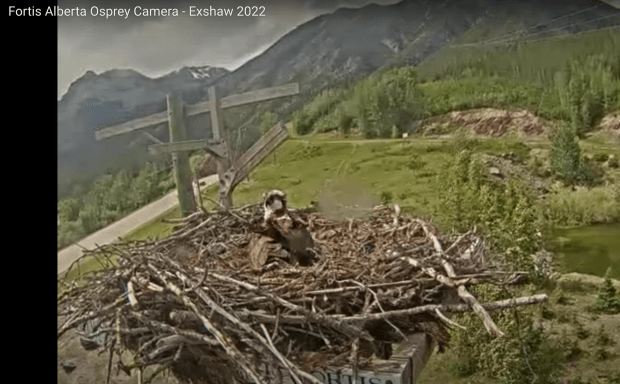
It is blowing like crazy in Canmore, Alberta. I wish those three chicks would pancake in that nest but it seems they like it! Mom returns and broods them so all is going to be well.

A reminder now that outdoor picnics are around, parties, weddings, anniversaries and celebrations of all kinds – make the confetti out of leaves (seriously awesome) and leave the balloons out. The raptors will thank you.

Ferris Akel had Arthur and the three Ls on camera tonight and he had seen Big Red but could not get to her. Arthur caught a bird or birds and one of them was delivered to an L. The other two really would have loved that bird delivered to the coop.


Mantling to protect its prey. Look at the tail. How many dark bands can you count? That is a tail that is long enough to help this hawk fly very well, indeed.

Two cutie pies. Big Red and Arthur have the most gorgeous chicks.

The chicks went over to the Fernow railing and they are hunting.


It was a breezy cool day here in Manitoba. Today it was nearly a 5k walk around all the trails and a discovery of a very quiet duck and some growing ducklings.
I took the longer path around the entire nature area and found this beautiful male Blue-winged Teal in a very quiet pond hidden by lots of reeds. These ducks arrive in Manitoba in April and will be migrating south in October. They are here to breed and sadly, it was a bad year because of the flooding for the eggs of the ducks and geese. They eat pondweeds and aquatic invertebrates as well as grass seeds on the top of the water.

American White Pelicans were flying overhead.

The Canada geese and goslings were preening after a nice swim.


It was a lovely day. When I got home Mr Crow was waiting for his tea time snack. Looks like Tandoori Chicken was a big hit.


I see no word on the Pitkin Osplet that fell off with its sibling and was in guarded condition.
Thank you to everyone who wrote in with additions to the memorial list. Please, if you know of birds that are on streaming cams and have perished this year please let me know.
Thank you to the following for their streaming cams and/or web pages or FB groups where I took my screen captures: ND-LEEF, Chloe Baker, Cumbrian Wildlife Trust, Bywyd Gwyllt Glaslyn, Dyfi Osprey Project, Osoyoos Ospreys, Fortis ExShaw, and Ferris Akel Tours.


