Iris, the Grand Dame of Ospreys

As the days of summer give way to thoughts of falling leaves and back to school, our beautiful Ospreys think of migration. Those in the United Kingdom have already already headed to the area around Poole Harbour to have a last good feed and sleep on land before heading south to Brittany and on to Africa. Those in the United States and Canada will take various routes. The male is still in Manitoba with one chick at the nest I watch.Some head to southern Texas and places in Mexico while those in the northeast fly over the cost, over the length of Cuba heading to South America. One of those leaving her summer breeding grounds in Missoula, Montana will be Iris.

Iris is not ringed. No one knows where she goes for the winter but, she turns up in tip top shape to her nest at Hellgate Canyon every spring.

Typically Iris spends more time at her nest before her departure. Last year she said goodbye on 8 September. Because of her age, many worry that she will not return. It is always an anxious wait until spring and she arrives again full of hope and hormones.

Sharon Leigh Miles shared this image of Iris taken on her favourite tree on Mt Sentinel on 6 September at 09:22.

She is there. Just squint.

Iris is the oldest osprey in the world – the grand dame of all of them. In her lifetime it is estimated that she has fledged between 30 and 40 chicks but no one knows for sure. It is possibly more. Iris is known around the world. Her arrival on 7 April 2021 to her Hellsgate nest made print and television news. Dr Ericke Green of the University of Montana believes Iris is at least 25 years old, perhaps more.

In the image below, Iris just landing from her winter migration. All the worrying about whether or not she survived another winter is put to rest.

Welcome home, Iris. 7 April 2021
Landing with a nice big breakfast. 10:36 am. 11 April 2021

Iris’s nest, prior to the one she uses now, was on a hydro pole about 68 metres or 200 feet from this one. This artificial nest was built for Iris because of the high rate of electrocutions on power lines – all birds, not just Osprey. The power lines are high enough and have a clear view that they appear to be desirable. The new nest, erected in 2007, is all set up with a high resolution camera. Iris took to the new nest right away, thankfully. Iris mate, at the time was Stanley. Stanley did not return from migration in 2016. Her current mate, Louis, and her have had a very chequered relationship. Louis also has another nest with Star, his primary nest, near the baseball park. Iris and Louis fledged one chick, Le Le, in 2018.

Many of us are glad that Iris has been spending the summer of 2021 taking care of herself. Raising chicks is not an easy job – and everyone loves Iris and wants her to return year in and year out from her migration.

I have included some images taken at the nest this year.

Iris worked on building the best nest that she could. Every day she brought in more material. She eventually will lay three eggs – that we and she – seem to know are destined not to hatch. These were bittersweet moments for everyone.

She was fierce in her fishing and the protecting of her nest. Indeed, her and Louis protected the nest together several times. The video below is from 22 August.

Sharon Leigh Miles provided a chart of the departure dates for Iris for her migration. Today is 6 September so we are definitely in the range. These are the previous dates of her departure:

  • 2012: 6 September
  • 2013: 6 September
  • 2014: 11 September
  • 2015: 4 September
  • 2016: 8 September
  • 2017: 9 September
  • 2018: 10 September
  • 2019: ?
  • 2020: 8 September

There is no one on the Hellgate Canyon nest this morning. Everyone is hoping that Iris will make several long appearances on the nest before she departs. This has been her MOD in the past. Fingers crossed!
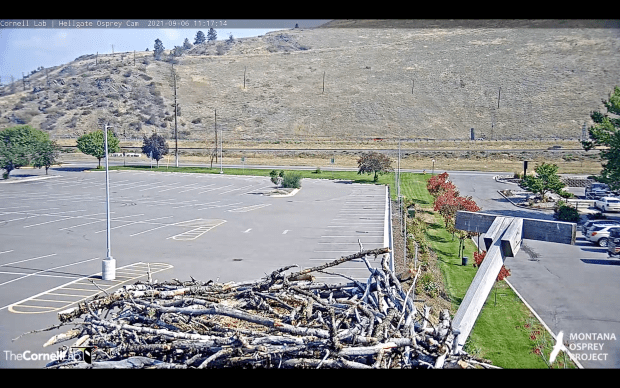
If you would like to periodically check on the nest, here is the link to the streaming cam:

The Montana Osprey Project has had one fundraiser – the Iris pens – this year. If you would like information on how to order one of these, send me an e-mail and I will provide the details. They are lovely. There are also plans to commemorate Iris by a woodblock print. As information comes through I will post it.

Keep Iris in your heart. Migration is challenging. We wish her a safe journey, good winds, lots of fish, and a safe return to Montana in the spring.

Thanks for joining me. Take care everyone.

Thank you to the Montana Osprey Project for their streaming cam where I took my screen shots and their FB page. Thank you Sharon Leigh Miles for allowing me to use your images posted on the FB page.

Iris and Louis defend nest

In my last post, Tiny Little Bob or Blue 463 from the Foulshaw Moss Osprey Nest was screaming at White YW (aka dad) for a fish. He could have flown to Wales and he would have still heard her.

What is that about the squeaky wheel always gets the oil first? Perhaps screaming daughters do, too. It is the last fish of the evening probably and Tiny Little is eating it. Blue 462, the other female on the nest, would like Tiny Little to share. Somehow I don’t think so ——- it was, after all, Blue 462 who was such a meanie to Tiny Little when she hatched. Birds have good memories.

These are the areas adjacent to Iris’s nest in Hellgate, Missoula, Montana. It is very beautiful. We always see the nest in the parking lot but just on the other side are trees, grass, and water.

Iris is the oldest living Osprey in the world. Her nest is at Hellgate in Missoula, Montana. After her mate Stanley died, she bonded with Louis. They had one chick survive, Lele, in 2018. Louis has another nest at the baseball park with Starr. They fledged two chicks this summer. When Stanley died, Louis also took over the territory that includes the two nests. Every year Iris returns, goes through the rituals of breeding, lays her eggs, and everything falls apart. People get upset. They think very little of Louis. I am of a divided mind. Right now I prefer Iris taking care of herself, eating well, and bulking up for migration than running around with a nest full of juvenile fledglings. She has done her bit for the DNA of the species. But that is just my opinion. Everyone is entitled to theirs, for sure. But the one solid thing that binds all of us together is our love for this most amazing of Ospreys.

Iris tends to spend more time at her nest before she leaves on migration. Last year she departed on 8 September. Everyone gets a little teary eyed right about now because there is no promise that Iris will return but, we live in hope that this strongest of female Ospreys graces the screens next spring. Along with that hope is that the rains come and there is plenty of food for all.

There have been a number of intruders, both male and female, this summer. Do they want to usurp Louis? take Iris for a mate? Certainly when Dunrovin’s Congo came on the scene everyone was hopeful! or are they just curious and checking out what nests are available? Perhaps all of those things. Today, Louis flew to the nest alarming and Iris flew in and joined him – showing off her big crop!

Erick Greene and his team in Montana are considering many ways in which to commemorate Iris. Stay tuned or check out the Montana Osprey FB page. If you wanted to order an Iris pen and forgot, if you will send me a note I will send you the details. They are gorgeous and made from those sticks she brought to the nest.

In the image below, Rosie, the female adult on the San Francisco Bay Osprey cam at the Richmond Yards, is bringing Poppy, one of two female hatches, a beautiful trout. Poppy is 110 days old today.

The average age for Richmond and Rosie’s female chicks to stop feeding at the nest is 105 days. The longest a female stayed was in 2018 and that was Kiskasit who was 124 days old. Lupine was last seen on Monday. She was 103 days old. Sage, the only male, was last seen on 28 July at the age of 86 days. The average for the males to stop feeding on this nest is 93 days so Sage left a little early. There is no reason to believe that Sage and Lupine have begun any type of migration. Richmond stays in the SF Bay area year round. Mom Rosie will migrate and the female adults normally leave before the fledglings. And whose to say they will migrate! If there is plenty of food and the weather is fine – well, it certainly agrees with Richmond – may be they will stay!

And, of course, just thinking about fledglings returning to the nest to be fed until they are 90-100 days old just makes me think about Malin. Susan, the wildlife rehabber that is over the area where Collins Marsh is located, was to get in touch me later today. She wrote me a long note yesterday and she is also firm in her knowledge that Malin was a forced fledge. As we have learned, normal fledges do not require our attention. The chicks return to the nest, take short flights, and are fed by the parents. Malin was not ready despite his age. He had suffered a lack of food. His forced fledge meant that he was in jeopardy and boots on the ground were needed immediately. This did not happen. As noted earlier, she found two chicks – one dead, one alive. I am hoping that ‘no news is good news’.

Suzanne Arnold Horning was on the Cornell Campus and she found the two Ks. No sightings of Big Red and Arthur but, guess what? Getting to see K1 and K3 on the 22nd of August is a bonus. Here they are hunting. That is K1 on the top. She looks so much like Big Red and has turned out to be such a fantastic hunter. Suzanne said they were not food calling – just being quiet and hunting. These two seem so much more independent this year.

Ah, the little cutie, K3 looking down and hoping to find a chippie.

What a nice treat to get to see the Ks. And, of course, theirs could be a migration dilemma. Big Red and Arthur stay in the area year round. Perhaps with the changes in weather so will the Ks. If someone could put the average date that birds leave for migration this year against last and create a global directory (surely someone does this already), tracking of changes related to climate could be measured. We have seen Poppy stay longer as are many others and now perhaps the Ks.

Thank you for joining me today. I will let you know as soon as I hear about Malin – it is heartwarming to hear from so many around the world who came to love that little nestling. If you are in line with any of the storms hitting the coast of the US, going over Hawaii, or elsewhere, take care of yourselves. Stay safe.

UPDATE: Aug 23 at 17:35:35 No2 (7182) fledged at the Estonian nest of Jan and Janika. Slept as an adult off nest.

Thank you to the following for their streaming cam where I took my screen shots and video clips: Montana Osprey Project, Cumbrian Wildlife Trust and the Foulshaw Moss Osprey Nest, SF Bay Ospreys and Golden Gate Audubon. I would also like to thank Suzanne Arnold Horning who allows me to download her images to share with you.

Kindness Branched

Kindness, the daughter of Liberty and Freedom, in the Glacier Gardens Bald Eagle nest branched at 9:39 am nest time in Juneau, Alaska.

Kindness spent quite a bit of time off the nest – playing with the nest and dismantling it a bit. She was rewarded with a really big fish by Mom on her return!

Kindness is 82 days old today. The average age for fledging at the Glacier Gardens nest is 89 days. It is an average of 80 days in Alaska.

Oh, Kindness really likes the feel of the air under her wings! GG4 left the nest 14 days after branching. GG5 left the nest 8 days after branching.

Kindness is GG6. Let us hope we have a little more time to spend with her. She is so sweet!

You can still catch a lot of action as Kindness works those wings. Here is the link to the streaming cam:

Oh, I love that picture on the streaming cam. Look how little Kindness was up against Mom Liberty!

It’s 4:42 nest time in Collins Marsh. The last time I peeked at Malin he was eating another fish delivery. That was at 2:16. There will most likely be another one before dusk. Gosh, Malin is growing. He has six clear bands on his tail and before long, he is going to be hovering around that nest.

Here are some cute Malin pictures to put a smile on your face.

Here is that 2:17 delivery.

Malin ate it all and laid down on the nest duckling style.

It’s been a great day for these two – Kindness and Malin. Congratulations to Kindness, Liberty, Freedom and all the folks at Glacier Gardens.

For those looking to get an Iris pen, I checked. Dr Greene has picked up another box of twigs that have been turned into pens. There are a few left. If you don’t remember how to order, send me a comment and I will give you the instructions Dr Greene left.

Thank you for joining me. We needed a good news story today and we have two of them. That is wonderful. I am hoping to wake up tomorrow and read that Grafs has found that gorgeous Grafiene 2 and is filling his kids with fish!

Thank you to the following for their streaming cams: Glacier Gardens Park in Juneau, Alaska and Collins Marsh Nature Cam in Wisconsin.

They Don’t Look like Ospreys!

Maybe it is better not to make plans! We have so hoped for rain and this morning the forecast said – ‘70% chance of rain’. My heart skipped a beat. If it would just pour. As I write this I can hear thunder.

One of my readers wrote to ask about the fires we are experiencing. First, just so everyone knows the area where are talking about you need to know where Manitoba is. Our province is on the Canadian prairies between Saskatchewan and Ontario. We are directly north of Dallas, Texas. If you drove without stopping, it would take you 24 hours to reach Manitoba if you started in Dallas.

There are two very large lakes, Lake Winnipeg on the east and Lake Manitoba in the West. Both are north of Winnipeg; it is about a 90 minute n drive to the southern tip of each. Many of the migrating shore birds and large raptors, Ospreys and Bald Eagles, have their summer breeding areas around these lakes.

Our provincial Department of Conservation and Climate reports that there are currently 159 wildfires in our province today. 17 of those started in the last 48 hours. They also reported that the yearly total of acres lost to wildfires is 904,111. That impacts wildlife. There can be no question. Here is the current fire map:

The purple areas are fires that are being monitored; the red areas are fires that are out of control; the green areas are fires under control while the yellow ones are fires being held. We are fortunate that fire crews from other provinces have come to help. The smoke from the fires impacts everyone but the city of Winnipeg is not under any threat. My concern is the area around the Osprey nests and that is in a monitored area.

That is the state of our wildfires. Of course, our thoughts are also with those people in California where the Dixie Fire is raging and has already scorched 275,000 acres.

With the promise of rain, we head to one of the most beautiful areas in our City: Assiniboine Park. It is named after one of the two rivers that meet here; the other is the Red River. The park has our zoo, an area known as the English Gardens and the Leo Mol Sculpture Garden (Mol is a noted local sculptor who worked in bronze) as well as the Duck Pond.

“Leo Mol Sculpture Garden” by D-Stanley is licensed under CC BY 2.0

Turns out this was a great decision. We managed to get lost and when we asked directions, a wonderful woman offered to show us the way. Then she stopped. “You know we have a family of Cooper’s Hawks right in that tree”. If it was not for pandemic restrictions, I would have thrown my arms around her in thanks. As it was, I quietly stood jumping up and down in my mind. It was simply magical.

The couple have three fledglings this year. They are all about the grounds catching bugs. The tripod proves cumbersome. Remember I have only practiced with this lens at home. This is the test to see if I can manage it.

A squirrel has the attention of the hawk in the back.
This hawk is looking up at a chipmunk.

Cooper’s hawks are about the size of crows. The Cooper’s are constantly confused with the Sharp-shinned Hawk. In flight, the Sharp-shinned has a squared-off tail and the Cooper’s is rounded. The prey for both are small birds, chipmunks, small squirrels and the books say small hares but Sharpie, who visits my garden) has never bothered the garden rabbit, Hedwig. The Cooper’s were busy eating bugs but also keeping their hawk eyes on a squirrel and a chipmunk! The eating of ‘bugs’ is not mentioned in any of the bird books. These hawks are adorable. It was fun to stop photographing and sit and watch the adults teaching the fledglings to hunt. They were having so much fun!

Next stop – Canada Geese! They are not Canada’s national bird. That is the Canada Jay – a grey version of a Blue-Jay (OK that is simplistic but it is a good description). The Canada Geese were in the pond but also seemed to be everywhere eating grass. Sadly, it looks rather dead in places from the lack of rain. Speaking of rain, we did get some. Probably not enough to even measure but it might help the grass!

And we have an update on your favourite goose – Arnold! The veterinary team at the Cape Wildlife Centre decided to remove Arnold’s bandage and boot today. Their assessment is that Arnold is doing great. He will not need any more bandages and will get to spend some time in the outdoor enclosure with a pool. Amelia comes every day and they get to spend time together having meals in the playpen. It will not be long until Arnold will be able to be in the wild with Amelia again. Isn’t that positive news?! What a great team.

@ Cape Wildlife Centre

Before I close, here is a reminder of a great fundraiser going on right now. I do not normally mention fundraisers unless I know that the funds really go to help the project – so I am delighted to mention this one again. I realize it is only August and everyone who has children or is a student is thinking about getting ready for ‘back to school’. I would like for you to think about birthdays and holiday gifts, too! If you are looking for something unique associated with the matriarch of Ospreys, Iris, whose nest is in Missoula, Montana – well, this is for you!

Dr Erick Greene of the University of Montana and the Montana Osprey Project gathers up the twigs that have dropped from Iris’s nest. These are twigs that Iris has broken off of trees and bushes in the area. The type of wood varies. Dr Greene then sends off a box of twigs to South Carolina to the workshop of master wood workers, Richard and Sharon Leigh Miles. They turn those twigs into beautiful pens. The patterns and colour depend on the type of wood. Iris goes out and gets Black Cottonwood, Douglas Fir and, sometimes, Choke cherry. Everything is sustainable and no one interferes with Iris when she is on the nest. Those sticks get knocked off and Iris will not go down on the ground and pick them up just like she won’t pick up fish that falls off the nest. This is such a unique fundraising even for the Ospreys but the number of pens are very limited.

I think they are gorgeous and can’t wait for mine to arrive. It is on its way. The cost is $45 USD. That includes postage within the United States and maybe parts of Canada.

@ Montana Osprey Project

This time I want to include the directions for you. Sometimes it is hard to find things on FB.
1) Send an email to montanaospreyproject@gmail.com
2) If your mailing address is in the US, on the subject line of your email, type your full name followed by Pen Order
For example To: montanaospreyproject@gmail.com
Subject: Your Name – Pen Order
3) If your mailing address is outside the US, on the subject line of your email, type your full name followed by International Pen Order
For example To: montanaospreyproject@gmail.com
Subject: Your Name – International Pen Order
If yours is an international order we will get back to you with a few additional instructions.
4) The email’s body should include the following information:
a) Your name
b) Your email
c) Number of pens you would like to order.
d) Total amount ($45.00 per pen). Shipping is included in this price.
e) Your mailing address just as it should be on the envelope.
f) Send the email to MontanaOspreyProject@gmail.com
5) For those of you who live in the United States, make out a check out to:
Montana Osprey Project – Erick Greene
(We are not set up to take credit card or Pay Pal orders. Sorry – has to be a personal check or money order)
6) Mail your check to:
Dr. Erick Greene – Montana Osprey Project
Division of Biological Sciences
32 Campus Drive
University of Montana
Missoula, Montana
USA 59812
7) For those of you who live outside of the US, send us the email with all of your information, but hold off on sending a check. We will get back to you with a few more instructions.

Thank you so much for joining me today. It is always great to hear from everyone. I have received a few letters this morning and there is some excellent information in those that I will share with everyone tomorrow! For those wondering about Malin, her feathers seem to be improving. We hope that her fish deliveries do the same. Take care. Stay Safe.

Thank you to the Montana Osprey Project FB page and the Cape Wildlife Clinic FB where I took my screen shots of the Iris pens and Arnold.

An Osprey blew off a nest! and other Bird World News

We were so concerned about the big storm that went through Wisconsin and the Collins Marsh Osprey Nest that nothing else mattered in the wee hours of the night the other day. In our mind’s eye, we could see that wee chick flying off that 120 ft retired fire watchtower.

Well, over in New Jersey, the mother on the Barnegat Light Osprey Nest did get blow off! The Conserve Wildlife Foundation wrote:

“On the evening of July 29, 2021 a line of severe storms moved across New Jersey. Many of these storms held the potential to produce damaging winds, hail and possible tornados. One such storm went straight for Barnegat Light, where our osprey cam is located. Watch as the wind shifts from east to west and the adult female was blown from the nest. Luckily she and her nestlings all survived unharmed, but there are many osprey who were right in the path of what looked to be a tornado, which hit High Bar Bar — just to the north of the osprey cam nest. Hopefully that the damage is not too severe to both people and ospreys.”

Here is that video of Daisy, the mother on the perch, and her two chicks on the nest.

The male, Duke, went missing in the storm. He showed up around 4pm today delivering a fish on that nest. Yippee.

Daisy and the chicks are sleeping well tonight. The family is back together again!

Fledge is over but the chicks are still actively coming to the nest for fish drops. Here is the link to that camera.

I will add a note. There were originally three chicks on this nest. The vast age and size difference meant that the third hatch became a victim of siblicide.

The Montana Osprey Project is having a fundraiser and it is really neat. Dr Ericke Green collects the twigs that fall off Iris’s nest at Hellgate, Montana. I know that almost everyone knows who ‘Iris’ is but, in case you do not, she is the oldest Osprey in the world. She has her nest in Missoula, Montana. She has spent the days since arrival and until recently adding twigs. Well, some of the twigs she adds fall off. Those that Dr Green picks up are sent to Richard and Sharon Leigh Miles in South Carolina who turn those twigs that Iris touched into pens. They cost $45 and that includes postage. I understand they sell out quickly if you are interested please go to the Montana Osprey Project FB Page. Scroll through their threads and you will find the information.

I was so excited to find this fundraiser. Can’t wait til my pen arrives!

WBSE 28 is working steady to get out of that shell! This was the progress around 10 am Saturday nest time. This sweet babe should be joining its ‘snowman’ looking sibling 27 late Saturday in the Sydney Olympic Ironbark Nest.

My first introduction to the White-Bellied Sea Eagle was last year. I am a ‘hawk and falcon’ person – smaller raptors – more than the eagles. I came across the WBSE streaming cam purely by accident. I have learned a lot about eagle behaviour over the past year.

This cute little bundle of fur is destined to be one of the largest eagles in the world. Look at its cute little wings. One of the worst things about eagle nests is the sibling rivalry – although I can say that this also happens on Osprey nests and to a much lesser extend the smaller raptors. Last year the sibling rivalry only lasted a few days. It seemed that WBSE 25 sensed that ’26’ was injured and I have said many times helped the little sibling. That said, one of the old timers told me that the second egg is the ‘insurance’ egg – there only if the first chick does not survive. When I heard that I shook my head. There can be siblicide on this nest. It is the only White-Bellied Sea Eagle Nest with a live stream that I am aware of.

I am including the link to the camera. If you are concerned about what appears to siblicide happening on this nest, this year, I urge you to stop watching especially if you have younger children. I will provide simple updates on the nest without graphic content. Hopefully there will be plenty of fish brought in at all the right times so that nothing triggers food insecurity behaviour. That said, siblicide has occurred on nests where food is plentiful.

Here is the link to Cam 4 for the Sydney Sea Eagles:

Ferris made it to the Cornell Campus tonight. He was able to spot Arthur fairly quickly but the Ks and Big Red were in hiding. He will probably return to the campus tomorrow on his regular Saturday tour. I know he will be stopping to see about the Roseate Spoonbill. Like all of us, it is a joy to see a bird outside of its territory but it is also a worry and as Ferris said, he would like this bird to get back to where it belongs.

Here is Arthur on the ‘throne’:

The chick on the Collins Marsh Osprey Nest in Wisconsin was left alone as dark was coming. It had been fed reasonably well today with fish caught by Mom and brought in and at least one delivery by Dad.

I went back and checked again and Mom was on the nest with the babe. Whew!

The last check in for today is at the Loch of the Lowes where NC0, the female, landed a whopper and brought it to the nest. That fish was so large it would feed both fledglings and mom. There might have been some leftover for Laddie! NC0 is really turning into a super mom. She doesn’t sit around and wait for Laddie. Once the chicks were old enough, she joined in the fishing for the family!

It’s late Friday evening on the Canadian Prairies. My blog on Saturday will be in the late afternoon or early evening. I want to do a lot of nest checks.

Thank you so much for joining me. It is nice to hear from you – always – and it is so wonderful to know that there are so many people who care for our birds. Take care. Stay safe.

Thanks to the following for their streaming cams where I take my screen shots: Scottish Wildlife Trust and the Friends of the Loch of the Lowes, Barnegat Osprey Light Cam and the Conserve Wildlife Foundation of New Jersey, Collins Marsh Nature Centre Osprey Cam, the Ferris Akel Live Stream and the Sea Eagle, Birdlife Australia, and Discovery Centre Sydney for the WBSE captures.