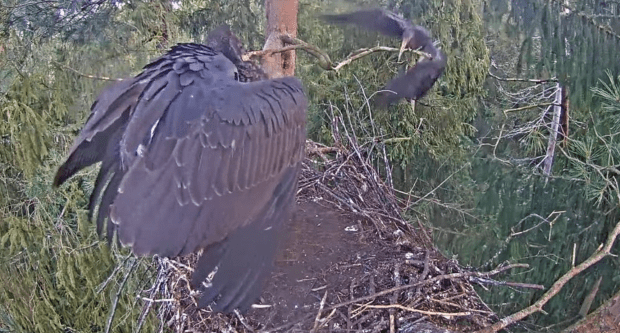
Tiny Little or Blue 463 and her siblings are giving you a visual answer below!
They return to the nest where the father will deliver a fish.
Sometimes the birds eat the fish on the nest and sometimes they carry the fish in their talons to a perch to eat it.
Blue 464, the male and the first to fledge, has this fish. Tiny Little is the bird on the right. Notice how she has started looking at that nice Flounder. Blue 462, the other female, is at the back on the left. It is drizzling on their nest today. This won’t be the last fish probably. Fingers crossed for another delivery or two.
Blue 462 and Tiny Little, 463, see dad and are food calling to him. White YW knows they want more fish! And this is what Osprey fledglings typically do after their first flight. They get better at flying and the parent feeds them. Most do not catch their first fish until they are on migration.
Here is Tiny Little food calling to White YW, the dad:
Roy Dennis, the UK Osprey expert who has worked with the birds for sixty years, puts it this way in his book, A Life of Ospreys:
“The first flight may take only a few minutes, with the bird landing back on the nest or in a nearby tree, but other flights are more adventurous and can last for ten minutes or more.” (77)
“The young birds now start to spend more time away from the nest but still remain within a few hundred metres of it, using the eyrie as a meeting place where they receive food.” “While they wait for their father, the young are often dispersed within two or three hundred metres of the nest tree, quite often to be found perching low down on fallen trees, stumps or rocks. The young birds keep a good look out on the horizon for their father and, as soon as he flies in with the next fish, they rush to the eyrie to meet him, while the male leaves immediately to catch a fish for the next chick in line” (78).
The American Osprey expert, Alan Poole puts it this way, “For at least a month after fledging, the nest remains the center of a young Osprey’s life, for it is there that it continues to receive food from the male parent – consider this an allowance of sorts” (Ospreys. The Revival of the Global Raptor, 104).
The young birds will disperse after spending this post-fledge period on the nest. Not all migrate; it depends on where they live.
If anyone tries to tell you that Osprey fledglings do not return to the nest after fledging, you have your answer! Of course, there are other examples: the two fledglings, LR 1 and 2 on the Loch of the Lowes Nest, Only Bob, Blue 496 on the Llyn Clywedog Nest, Dysynni and Ystwyth on the Dyfi Osprey Nest, Blue 095 and 096 at Rutland Water Manton Bay. Of course, there are lists of those in the US including Tiny Little and its siblings at the Achieva Osprey Nest. What about Dunrovin? I dislike making long lists to reveal a truth. They are boring to read but the evidence is there.
Susan Theys, owner of Wildlife of Wisconsin and a wildlife rehabber, will go to Collins Marsh Nature Centre and look for Malin today. She has the key to open the door to the tower so she can look over the landscape. There have been no visits to the nest by the parents so far today. It is now 1pm nest time. If there is any news, I will let you know.
Malin and his mother were frightened. Malin had been pancaking and he flew not from a position of standing up and flapping his wings – the norm for fledging -but from laying down. He was scared of the intruder. Because of this he might not have imprinted the way back to the nest in his brain – this is what the birds do with their short flights off the nest after fledging. We continue to hope he is alright and I am grateful to Susan for returning to check on him. Here is the video of that flight. I regret that I cannot upload the entire sequence of Marsha alerting and looking around the nest but you should have some idea watching this short video:
Thank you so much for joining me today. It is still raining!!!!!!!! It is so wonderful. Take care, see you soon.
Thank you to the Cumbrian Wildlife Trust and the Foulshaw Osprey Nest for their streaming cam where I took the images of the fledglings of White YW and Blue 35.
I want to thank everyone that took the time to write to me and tell me how much Malin meant to them. My inbox was overflowing with letters expressing love and concern for Malin. Everyone wanted to know if there had been any word. Mom and Dad have both been on the nest with fish and today Marsha (mum) was there around 13:00. She did not have any fish that visit. During her morning visit she called out for Malin. So far there has been no sighting of Malin.
After going through the FB postings of the Nature Center, we were able to determine that Malin was the middle hatch. The youngest just disappeared from the nest and the eldest died in the middle of June leaving Malin, the chick that hatched on 18 June, alive. Malin was then the middle hatch of 18 June. Malin then was 63 days old at fledge. The average age for ospreys to fledge in Wisconsin appears to be 55 days. That would make Malin’s timing within range. Most ospreys spend at least 2 weeks flying and letting their parents feed them. Many stay much longer. Two examples that I give are Tiny Tot and Tiny Little because they were both hatches that suffered from lack of food. Tiny Tot stayed on the nest for a total of four months or 120 days. That is more than twice as long as Malin. Tiny Little remains on the nest in Cumbria. She will probably fledge before Tiny Tot’s 120 days – but she could be on the nest for 90 days.
There is disagreement over whether Malin simply flew or whether or not Malin was frightened off the nest by an intruder. Experts on both sides see that exit differently. It is unfortunate. The result is the same – Malin has not returned to the nest. The reactions to looking for Malin are different depending on which you believe. If Malin just flew because he wanted to then no one would go and really look for him. If one believed that Malin was frightened off the nest, they might worry that he was injured and look harder. Something that has to be kept in mind is that Osprey feed their fledglings on the nest – it is preferable. They do sometimes feed on a branch but I haven’t found an Osprey expert that has ever seen an Osprey parent feed their fledgling on the ground. In fact, if a fish falls off a nest they will not go and retrieve it. Have you ever seen an Osprey eat or feed its chick on the ground?
The research continues to stress that the more food and the longer fledglings stay on the nest the higher the success rate. That is the reality. This nest is really empty. Malin defied the odds – he survived and thrived. We hope that the name we gave him carries him on into his life and that he is somewhere safe eating a fish.
Collins is looking down like he might be seeing Malin.
One of the last times the entire family was together on the nest. It was a real privilege to watch little Malin survive and then – thrive. Let us all continue to send this family positive energy.
19 August 2021. Malin, Marsha, and Collins.
It is about 7am in Latvia and Estonia as I write this. The Black Storklings are waking up and like all birds are a little more energetic than they are at mid-day.
The two images below are from Grafs and Grafiene’s nest near Sigulda, Latvia. At least one of the storklets has fledged. Perhaps today they will all fledge and find the feeder area with the beautiful Grafiene decoy.
It is now just after 9am in Latvia and there is only one storkling on Graf’s nest near Sigulda. This means two have fledged just like my source had indicated. The second fledge is the oldest at 7:43 am. He is 70 days old today. The youngest fledged at day 66 after hatch.
This was not the smooth flight of the youngest. The oldest hit the branch on the other side of the tree. There is concern about the condition of that wing. I will update you as soon as there is any information. Send your strong and positive wishes. I hope it looks worse than it was. How terrifying for this young bird to have that happen.
Even so, I hope that both of the storklings are at the feeder filling themselves with fish – just like we hope Malin is doing the same.
There is now only the middle hatch. Perhaps it will go today. They are 68 days old.
When I checked on Jan and Janika’s storklings in Estonia’s Jogeva County, no more fish have been delivered to the nest. It looks to me like every scrap of the old fish has been eaten – I thought that yesterday. Perhaps one really packed down in the nest is there, the one the storkling on the left is pecking at. All of the birds need food.
Hopefully all of them will fledge and find the feeder set up for them, too.
They are so beautiful with the sunlight filtering through the trees. The storks are 67 and 68 days old today. The average for fledging is 68-72 days. I wonder if Urmas will deliver some more fish?????
Do you watch the peregrine falcons, Xavier and Diamond? If you do, then you will know that part of the pair bonding ritual is Xavier presenting a prey item to Diamond. Diamond is not that particular but, she does not like Starlings. She cannot stand them. She has turned Xavier away when he had a Starling for her. They must taste terrible!
Well, today, Xavier hit the jackpot. Diamond was completely excited about her lunch – although some of you might not be. Xavier had a Superb Parrot for his beautiful Diamond. Make sure your sound is turned up.
Superb Parrots are also known as Green Leek Parrots or the Barraband’s Parakeet. These little beauties are native to southeast Australia living in the dry woodlands of New South Wales and Victoria. They were once considered vulnerable in terms of conservation and have been listed as Least Concern since 2012. Loss of habitation due to timber logging might well see this bird back as being vulnerable.
They are medium sized, growing up to a little over 15 cm or 16 inches in length. The bird in the image below is a juvenile. How do I know that? It has brown eyes while the adults have yellow-orange eyes. The adult male has a bright yellow face and throat while the female looks like the plumage that the juvenile has below. They eat fruits, berries, insects, as well as grains and nuts.
WBSE 27 and 28 continue to charm the socks off of everyone. That beautiful fluffy white down is in transition. They look a little like old terry cloth towels sleeping in their nest this morning in Sydney.
Look closely along the edge of the wing of WBSE 28 on the left. You will see the little pin feathers coming.
The pantaloons are growing too.
Just look at that sweet baby, WBSE 28, looking up at its parent. How adorable.
They are so young and yet, both of them know to pancake when there is an intruder near the nest. They hear their parents alarming and down they go. Look at the concern shown in the eye of WBSE 27 on the left. You can also see the black pin feathers coming in on both in this image better than the other one. But look – their cute little tails are growing!
You cam almost see them growing right before your very eyes.
Tiny Little still makes my heart skip a beat. Oh, what a wonderful bird you have turned out to be. You were so very tiny with that big older siblings but just look at you waiting for your breakfast to arrive.
Oh, you have that ferocious look like Mrs G. I have said that a couple of times but you do, Tiny Little. I hope you live as long as Mrs G and have lots of successful hatches. You really are quite amazing, Tiny Little.
Tomorrow is Saturday but there is no Ferris Akel tour this week. I was hoping to catch up with what is happening with Big Red and her family. It was raining yesterday but the Hornings were able to spot all four of them so we know that K1 and K3 are still with us – how grand, the 21st of August.
I am researching ‘Climate Driven Evolutionary Change’. If you know of bird arrivals or departures that are earlier than normal or later than what has been the norm, please let me know. It is much appreciated.
It is so nice to have you here with me. The rain is still falling – and that is a good thing. Please continue to send your positive wishes to Malin and all the bird families. Take care of yourselves. See you soon.
Thank you to the following for their streaming cams where I took my screen shots and video clip: The Falconcam Project at Charles Sturt University and Cilla Kinross. Collins Marsh Osprey Nest, Cumbrian Wildlife Trust and the Foulshaw Moss Osprey Cam, The Eagle Club of Estonia, The Latvian Fund for Nature, and the Sea Eagles Cam, Birdlife Australia, and The Discovery Centre.
I reported earlier today that Malin, the Osprey chick on the Collins Marsh Nature Centre’s nest, had fledged. Malin flew off the nest at 3:42 pm.
We use the term ‘fludge’ when a bird accidentally falls out of the nest and flies. But what do you call it when a nestling is scared off their nest and flies?
For several minutes before Malin flew, his mother, Marsha, had been on the nest. She was watching and alerting. There was an intruder. Marsha even ducked on occasion. When Mom flew off the nest something happened to spook Malin. He had been pancaked. Malin had done this before. But this time, the intruder must have come near enough to the nest that it spooked Malin. Without thinking and scared out of his wits, Malin flew.
Here is a video clip. You can see the shadow of a bird flying at 10 o’clock – it is impossible to know who it was – at the end.
Malin was not prepared to leave the nest. He had been exercising his wings but he had never hovered. He really needed another couple of weeks to work his wings. His feathers were continuing to grow and he was catching up for his age but he was still behind. Today, Malin was 2 months old and a day – we think. He is the only one of three hatches to survive and it is not clear which hatch he was.
Mom immediately returned to the nest looking for Malin.
Collins, the dad, came in later with a nice piece of fish hoping to entice his son to the top of the tower. Collins did look over in the area of the trees and I am hoping he knew that Malin was there.
The nest is 120 feet up and I am told that flying up is much more difficult for a bird than down. Malin is not a sophisticated flier – could he make it to the top of the tower? Collins seems to think so. I hope he is right. Indeed, I hope that Malin is unharmed and makes his way home so that he can benefit from more food and more wing exercises.
This situation has heightened my call for all streaming cams to have emergency contact numbers immediately after the name of the site and before any historical or current information about the nest. That is so the numbers can be found quickly and easily. The minute this situation happened, the office at the Nature Centre was called. The message went to voice mail. At that instant a flurry of e-mails went out from the US and Canada to try and find someone who could go and look for Malin on the ground. FB Messages were sent. Luckily ‘S’ found the wildlife rehabber for the area, living 25 minutes away. By this time more than thirty minutes had passed, possibly 45. This individual listened to what had happened and got in their car and went to check on Malin. By the time they arrived it was getting dark. They reported that it was quiet around the marsh. Tomorrow this person will return and is hoping that Malin will be close by or food crying. Of course, it would be even better if Malin were sitting up on the nest or sleeping duckling style from all the activity. The three of us that named Malin are hoping that he lives up to the name he was given, ‘Mighty Little Warrior.’ Tonight we are anxious and fearful – all we can do is hope and wait. It will be a very long night.
For the past year I have been requesting that individuals responsible for streaming cams ensure that there is emergency information so that the community of birders watching these nests can contact someone – a responsible person who will provide assistance to the bird or animal – immediately. I realize that individuals do not wish to give out their private phone numbers. The park or nature centre with the streaming cam could have two dedicated cell phones only for emergency calls. Those could be provided to those in charge. Then they would not have to have their own numbers or phones used. The person at the end of that phone line would have their own list of specialists to contact for the specific emergency. It really is that simple.
The alternative is to have a 24/7 chat room with moderators who have emergency numbers. Moderators are volunteers. They do it because they love the birds. That is actually the simplest and cheapest way to handle emergencies.
The vast majority of individuals who watch the nests are bird lovers. If they see a tiny leg tangled in fishing line they want that bird to get help. If they hear a chick fall off a nest into water, they want to help. If they notice nestlings behaving strange, having tremors, refusing to eat, they want to fine someone who will listen and help. This year all of these things have happened, some many times, and it was thanks to the community birders that help came. Sometimes people did not listen to the alarms set off by fifty or more persons watching two eaglets on a nest in Florida. They were behaving poorly. One died. Then the second. The person who set off the first alarm said ‘rodenticide’ – and they were correct. Community birders are not quacks. Many have watched nests for more than a decade. They are informed and they want to help. They do not want to waste anyone’s time.
Thank you for sending your prayers and your warm wishes to Malin and to the boots on the ground who are trying to find him and care for him. Thank you for listening to my call for a solution so that help can come to the birds immediately when something happens. If you are in charge of a streaming cam or know someone who is, please talk to them about having emergency numbers or 24/7 moderators on the chat who can get in touch with the right person if something comes up. It is really important. Thank you!
Thank you to the Collins Marsh Nature Centre and the Cumbrian Wildlife Trust and the Foulshaw Moss Osprey Nest for their streaming cams where I took my screen shotsand my video clip.
I plan to bring an updated report on the Black Storks in Latvia and Estonia later tomorrow. There is still someone who can pull at my heart strings even when I am so worried about Malin and that is Tiny Little! It is 6:30 on her nest in Cumbria and there she is having her breakfast fish compliments of White YW. Thank you, dad. Thank you, Tiny Little. You give me hope for Malin tonight.