You need to know about the presentation and we have all been waiting for an update on Little Bit 17. Of course, we do not need any more bad news in Bird World.
First. I have just been notified that Alan Poole’s excellent discussion about North American Ospreys will be taken off YouTube in 8 days. This is extremely informative – if you want to learn about Ospreys, please have a listen. Lots to learn! The original programme aired last year. You can start and stop…
Humane Indiana Wildlife posted this announcement today. You will see mention of Little Bit 17 at the bottom. — I am going to assume that Little Bit’s fan club have tried to see him. Please don’t. Every wildlife clinic is underfunded and overwhelmed especially in the middle of summer. We do not want the staff to get to the point that they cannot get Little Bit out the door quick enough. He needs to stay there as long as he can learning how to fly and being taught to hunt. If you know people who say they are going,, please have a gentle talk with them. It is in Little Bit’s best interest.
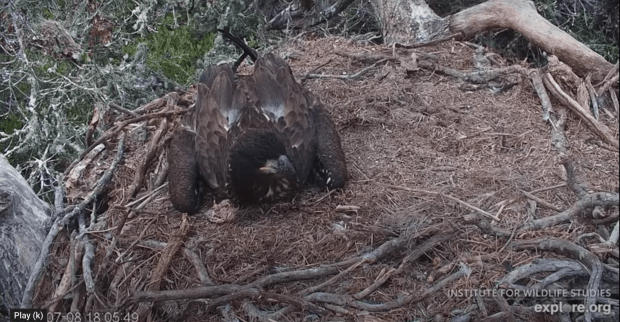
At the Fraser’s Point Eagle nest, Victor and Lillibet fledged on 30 June. Here is a short video – notice that Victor tried to land on a bush but it would not support him so he fell to the ground. Lillibet had a good flight.
Victor returned to the nest this morning around 1030. He cannot stand. Mama Cruz doesn’t understand what is wrong with him. She has tried to feed him. This is tragic.
The Fraser Point nest is part of Dr Sharpe’s research area – the Channel Islands eaglets. You can be sure that he is aware of the problem and will determine whether or not it is safe to intervene and extract Victor so that it can be determined what happened and what is the best help for this recent fledgling.
This is the link to the Fraser Point streaming cam:
Send all the positive wishes that you can to this wonderful Fraser Point nest! Rest assured that if anything can be done, Dr Sharpe will do it. It is one of his great missions – to give these eagles a chance at life.
Thank you for joining me for this very quick post. Take care. See you soon.
Thank you to Humane Wildlife Indiana for their FB post, and to Explore.org and The Institute for Wildlife Studies for their streaming cam where I took my screen captures.
The Cowlitz PUD nest losing all of its chicks just like the Cape Henlopen State Park Osprey nest is ‘catastrophic’. A reader ‘C’ wrote to me and said ‘not tragic but catastrophic’. I agree totally.
One reader wrote and thanked me for covering these events. You are all welcome. But, like you, I feel gutted and especially so with so many birds from this generation being lost in just a few weeks. It is numbing,.
We are left with adults grieving. Electra has a fish on her nest wanting to feed her babies and appearing in shock – not knowing what happened to them and where they are.
A discussion with Alan Poole and Poole Harbour about ospreys – New England population, mid-Atlantic Chesapeake Bay, and Florida Ospreys. I know that all of you will be interested when he compares the US birds with the UK Ospreys. It will be available for one month archived on YouTube.
There are some great images and if you want to learn about Ospreys – or be reminded about all things that are magnificent about our beautiful birds – you should watch this even if you have to do it in shifts. Very informative.
Just a note: Both males and females bring twigs to build the nest! I am thinking of Rosie at the SF Osprey Bay nest. She worked tirelessly helping Richmond rebuilt that destroyed nest – to human surprise they did it quickly!
Did you know that 20% of the world’s population of Ospreys live in Chesapeake Bay? There are 10,000 pairs on the channel markers in the water. Indeed, nests above water are quite safe for Ospreys (except for Bald Eagles and GHOW, if around). Did you know that fresh water fish is more nutritious than the salt fish? Do have a listen to Poole’s talk!
The Bald Eagle raising the hawklet in its nest on Gabriola Island has caught the interest of the world. Christian Sasse and David Hancock are at the nest site and are just giddy. It is considered a rare event and now twice in 5 years they have been able to witness an eagle family raising a hawklet. The first was Sydney in 2017. So here is the archived talk from yesterday and they will be live today, also. What a lucky little hawklet.
Things look better at the Loch of the Lowes. Both of the Osplets have big crops and it looks like Blue NC0 has had some fish, too. I sure hope so. Whatever was the issue at this nest with Laddie delivering food – weather, intruders, or an old eye problem or injury to the male – appears today, at least, to not be a problem. Fabulous.
The nest that is continuing to have weather difficulties is Loch Arkaig. If you check the local weather you will think that the nest should be fine but Loch Arkaig is its own microclimate and it can be terribly different from other areas close by. My heart goes out to Dorcha and Louis who have already lost their Little Bob. Louis – despite it all – gets the fish on the nest regardless. It is evening at Loch Arkaig. There are strong winds but no rain. Thankfully. Louis has brought the tea time meal for the kids. They are in the Reptilian Phase with those oily heads and beautiful coppery feathers at the back along the neck down to the shoulders. Send positive thoughts that we have two nestlings that are going to fledge here! Chase that bad weather away.
Aran brought in a lovely Sea Bass for Mrs G and the kids. He had the head for his tea – Sea Bass always welcome at the nests! Along with trout. All three Bobs at Glaslyn are fine. That is Little Bob coming up at the end getting a private feeding. Well done, Mrs G.
It looks like Idris might have brought in a trout to Telyn to feed their three Bobs at Dyfi. Again, another very happy nest.
Did you know that Telyn is the daughter of Rutland’s Maya and Green 5R (Maya’s partner before Blue 33 ousted him)? Both are fantastic females who really care for those chicks and have bonded with males that are inspirational providers.
I am becoming ever more interested in the way in which genetics plays out in the behaviour of Ospreys. The link between these two Super Moms, thus, becomes more compelling.
Dr Madis Levitis are moving the three Black Storklets to a forest nest and out of the clinic. They are doing exceptional and we have a huge thanks to this team who are working so hard to raise these three.
The smallest storklet is now standing like the older two. Great progress in its development.
The storklets hatched on the 22nd of May. They will be four weeks old on the 19th of June. You will no longer be able to see them in this clinic setting as they have been moved to an artificial nest in the forest where they will continue to be fed and can begin to climatize to the world where they will fledge in August and then make that very long trip to Africa on their first migration. This is a wonderful ending now – and we will check to see if a camera is installed in the forest so that we can watch their continued progress. Thank you Dr Leivits and staff!
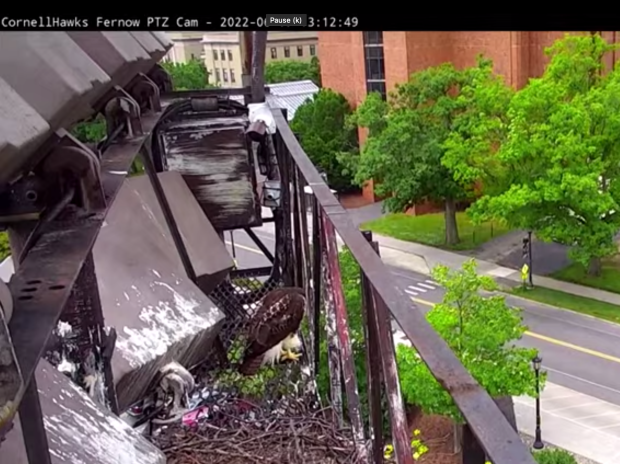
Eyes are watching several nests today. One of those is Big Red and Arthur’s Redtail Hawk nest at Cornell where L4, the youngest, is ready to fledge.
Three are on the nest at 1300. It is L1 in the nest bowl, then L3, and L4. L1 is really prey calling! So loud. No fledge from L4 and I understand that there could be bad weather again so maybe they will stay on the nest.
L4 wants to go! It is windy and he is really feisty.
Star sits in the Redding Bald Eagle nest tree thinking about fledging.
Star sure is a beautiful eaglet.
L4 really wants to fly and I am going to watch him with my lunch. ND-LEEF Little Bit 17 waiting for food along with the others. He ate well yesterday so not worried.
Take care everyone. Thank you for joining me this morning. See you soon!
Thank you to: Cornell RTH Cam, Friends of Redding Eagles, Friends of Loch Arkaig, People’s Post Code Lottery and the Woodland Trust, Eagle Club of Estonia, Bywyd Gwyllt Glaslyn, Dfyi Osprey Project, Friends of Loch of the Lowes and Scottish Wildlife Trust, and Cowlitz PUD.
Tiny Little or Blue 463 and her siblings are giving you a visual answer below!
They return to the nest where the father will deliver a fish.
Sometimes the birds eat the fish on the nest and sometimes they carry the fish in their talons to a perch to eat it.
Blue 464, the male and the first to fledge, has this fish. Tiny Little is the bird on the right. Notice how she has started looking at that nice Flounder. Blue 462, the other female, is at the back on the left. It is drizzling on their nest today. This won’t be the last fish probably. Fingers crossed for another delivery or two.
Blue 462 and Tiny Little, 463, see dad and are food calling to him. White YW knows they want more fish! And this is what Osprey fledglings typically do after their first flight. They get better at flying and the parent feeds them. Most do not catch their first fish until they are on migration.
Here is Tiny Little food calling to White YW, the dad:
Roy Dennis, the UK Osprey expert who has worked with the birds for sixty years, puts it this way in his book, A Life of Ospreys:
“The first flight may take only a few minutes, with the bird landing back on the nest or in a nearby tree, but other flights are more adventurous and can last for ten minutes or more.” (77)
“The young birds now start to spend more time away from the nest but still remain within a few hundred metres of it, using the eyrie as a meeting place where they receive food.” “While they wait for their father, the young are often dispersed within two or three hundred metres of the nest tree, quite often to be found perching low down on fallen trees, stumps or rocks. The young birds keep a good look out on the horizon for their father and, as soon as he flies in with the next fish, they rush to the eyrie to meet him, while the male leaves immediately to catch a fish for the next chick in line” (78).
The American Osprey expert, Alan Poole puts it this way, “For at least a month after fledging, the nest remains the center of a young Osprey’s life, for it is there that it continues to receive food from the male parent – consider this an allowance of sorts” (Ospreys. The Revival of the Global Raptor, 104).
The young birds will disperse after spending this post-fledge period on the nest. Not all migrate; it depends on where they live.
If anyone tries to tell you that Osprey fledglings do not return to the nest after fledging, you have your answer! Of course, there are other examples: the two fledglings, LR 1 and 2 on the Loch of the Lowes Nest, Only Bob, Blue 496 on the Llyn Clywedog Nest, Dysynni and Ystwyth on the Dyfi Osprey Nest, Blue 095 and 096 at Rutland Water Manton Bay. Of course, there are lists of those in the US including Tiny Little and its siblings at the Achieva Osprey Nest. What about Dunrovin? I dislike making long lists to reveal a truth. They are boring to read but the evidence is there.
Susan Theys, owner of Wildlife of Wisconsin and a wildlife rehabber, will go to Collins Marsh Nature Centre and look for Malin today. She has the key to open the door to the tower so she can look over the landscape. There have been no visits to the nest by the parents so far today. It is now 1pm nest time. If there is any news, I will let you know.
Malin and his mother were frightened. Malin had been pancaking and he flew not from a position of standing up and flapping his wings – the norm for fledging -but from laying down. He was scared of the intruder. Because of this he might not have imprinted the way back to the nest in his brain – this is what the birds do with their short flights off the nest after fledging. We continue to hope he is alright and I am grateful to Susan for returning to check on him. Here is the video of that flight. I regret that I cannot upload the entire sequence of Marsha alerting and looking around the nest but you should have some idea watching this short video:
Thank you so much for joining me today. It is still raining!!!!!!!! It is so wonderful. Take care, see you soon.
Thank you to the Cumbrian Wildlife Trust and the Foulshaw Osprey Nest for their streaming cam where I took the images of the fledglings of White YW and Blue 35.