GHO at Eagle Country…Monday in Bird World

12 January 2025

Hello Everyone,

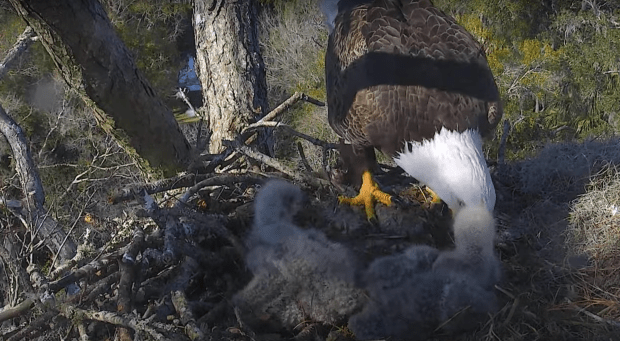
Gabby and the babies are on the big screen this morning. Gosh, they are big! It is windy and looks like rain coming to their nest.

Late note: Colonial Beach osprey cam is now live. We have lost a condor. Ventana Wildlife reports: “We recently found condor Vincent (892) deceased in Big Sur. He was just starting to come into his own as a breeding adult condor, and we are heartbroken to lose him so early in his life and when it was looking like he and condor Kodama (646) were about to nest.”

Thank you for all your lovely notes and supportive comments. We have had a good weekend. The weather has not always cooperated, especially on Sunday when we had pounding sleet during our walk with Toby (yes, we do get out no matter the weather). Today it is warm and the lads are in for a long walk – at least 3.6 km. We need it! And I cannot tell you how uplifting it is to go outside, even if it is for five minutes!

We hope that you had a lovely weekend. Did you watch that little sweetheart at the Winter Park, Florida Bald Eagle nest? And did you remember to put in a name for C14 at the Captiva nest of Connie and Clive?

The Winter Park eaglet is so cute!

The Winter Park female spent most of Sunday protecting her eaglet and 35-day-old egg from an intruder that was rather persistent.

It has been a gorgeous weekend. On Sunday, it will be 0 °C. We woke up to a fresh blanket of snow Saturday morning, and temperatures of -7 C. Toby was more than eager to get outside and go for a walk, and he was really excited when Miyoung arrived for haircut day. She is heading home to Korea for the New Year’s celebrations and to spend a month with her family. We are so very happy for her. It has been a true blessing to be able to count on her to come to our house, cut and style our hair in the conservatory, with Toby and the Girls looking on in awe. There should be more mobile units of all sorts – including dog grooming – for our ageing population. I have managed to figure out grocery delivery. Some people told me that they ordered too much because of the delivery charges – don’t do that. We want to cut down all waste, right? Just order what you need. The charges are a % of that, and you might be able to get free delivery by signing up for a service. Obviously, these conveniences are different wherever one lives! We have lucked out with the groceries, the snow removal, haircuts, and Ann. My next task is to try and organise friends and family to commit to coming one weekend afternoon a month. Those little breaks and Don’s ability to socialise with many different people make a huge difference. Keep that in mind if you or someone you know is in a similar situation.

Toby really enjoys his ‘Bully Sticks’ from Iceland. They help clean his teeth and are good at helping with the anxiety he is having. At the moment, he is wearing a sweater. The four days in the vet hospital matted his beautiful, long fur on his tummy. Poor Guy. He will go for a shave on the 17th.

Hugo Yugo got caught in Toby’s new car seat! You might recall that Hugo Yugo and Calico were quite interested in Toby’s stroller when he was a tiny pup. Well this very soft velvet carseat has caused a lot of commotion – no interest from Toby, however.

Missey has discovered a new spot to hide. I created a pile of wicker baskets – Toby chews on their handles – behind one of the sofas. Missey has taken it over. Toby can’t get back there and there is a nice window.

Baby Hope always sleeps on Don’s bed during the daytime. No one bothers her there and she does enjoy getting away from Calico once in awhile.

I might have missed it but I saw E26 getting fed ‘something’ dug up in the nest. I did not see a prey delivery on Saturday happen prior to 1600- but, please correct me. I want to be wrong. I know that road kill had been delivered and this looks like left over bones from it.

It was hot in Fort Myers.

M15 is OK. Flew in but nothing in his talons. Eaglets can go without food. E26 does not look like it is ‘starving’ – do not get me wrong but in the heat they depend on hydration from the prey. Fingers crossed for a nice whopping meal before bedtime.

Fish was on the menu for C14 at the Captiva nest of Connie and Clive! Oh, how I love it when those eaglets get to eat fish.

It is so good seeing those two healthy eaglets at the Dade County Bald Eagle nest of Ron and Rose. There is also news that R5 has been photographed at a golf course at Palm Beach, Florida. —–Imagine if they had not received their bands we would never know. So happy about the survival of these eaglets!

These two are so big.

I had the loveliest note from ‘N’ and I wanted to share the Eagle Country news with all of you that they sent me: “Wanted to update you on the latest journey we are blessed with at Eagle Country. We have a pair of Great Horned Owls (Willow & Gus-EC announced names yesterday). We miss the eagles being at the nest of course but am embracing this opportunity to learn about more about GHOW with the incredible cams there. Skye has been seen on the river cams (we see eagles daily there) and was last seen Dec 16th maybe the 31st at the nest. She has failed to bond this season with one of many suitors that have been about. Blaze has not been seen in months this season

Video from Androcat  of egg lay, prey delivery.  https://youtu.be/GtF6pTvDiDM?si=VMwa-NOa2Ub5io4S

Facebook post from Eagle Country (we are also getting a replacement cam for River 2, on it’s way) https://www.facebook.com/share/v/17esUgTbXj/

Love what Eagle Country has said “It’s been a beautiful reminder of why this place we call home is named Eagle Country. Country means the whole wild story, not just one chapter. Nature is wild. And we wouldn’t have it any other way.”

SK Hideaways videos, week of 4 January 2026

AEF-NEFL Eagles:  Gabby, Beau, NE32 & NE33
Courtesy American Eagle Foundation/NEFL Eagle CamOps https://nefleaglecam.org/
Nest Cam 1 https://www.youtube.com/watch?v=ouWBQoVFegI
Nest Cam 2 https://www.youtube.com/watch?v=hQrJv_Dt4tY
Cam 3 (Approach view) https://www.youtube.com/watch?v=ImHK7o8UHXE
Nest Cam 4 https://www.youtube.com/watch?v=t2KxnZtnI6Q

NE32 & NE33’s Food Comas and Hay Blanket Escapes
 (2026 Jan 10)
NE32 is 11 days old; NE33 10 days. They’ve got their second down and are beginning to sprout pin feathers. All that growing requires lots of food and all that food results in food comas. Here are some of those food comas as well as a look at their keen ability to escape the hay blankets that Gabby and Beau sometimes pull up over them.
Videohttps://youtu.be/mQKieXGtd0M

NE32 & NE33 Crawl to the Pantry + Gabby & Beau’s Seamless Changeovers (2026 Jan 6)
NE32 is 6 days old; NE33 is 5 days old. They’re seeing more and moving more, including galumphing over to the pantry for snacks. Gabby and Beau are providing ample nourishment for these adorable, growing eaglets. 
Videohttps://youtu.be/13nHkRpPt2Y


FOBBVCAM Eagles: Jackie & Shadow
Fluffed Up Nest Ready for Pancakes & Chick-Proof Rails
 (2026 Jan 5)
Jackie and Shadow have added fluff to the egg cup and built-up the rails around their nest. With Jackie’s fertile time occurring from January to April, we wait with giddy anticipation and hope for another successful breeding season. (5 Jan 2026)
Videohttps://youtu.be/E6xPBIEXv9k
Courtesy FOBBVCAM | Friends of Big Bear Valley
Nest Cam: https://www.youtube.com/watch?v=B4-L2nfGcuE
Wide View Cam (Cam 2): https://youtube.com/live/LCGYWfbyBWc
LIVE Recap & Observations https://bit.ly/3Md8TSz


Two Harbors Eagles: Nest of Cholyn & Chase
Cholyn Brings Lunch ~ Ravens Want It ~ Chase Shoos Peregrine Away 
(2026 Jan 8)After a brief morning chat at the nest, Cholyn and Chase departed to a secret hideaway. Cholyn later returned with a tasty fish, but had to defend it against a raven before consuming it in peace. Chase arrived as sunset approached to defend the nest again ~ this time a swooping peregrine falcon was the culprit. Both Cholyn and Chase made quick work of their respective unwanted intruders to get on with the next eagle task at talon. (2026 Jan 8)
Videohttps://youtu.be/2bUHUX55g-0
Courtesy Institute for Wildlife Studies, explore.org, Two Harbors Eagles Cam Ops
Eagle Cam: https://www.youtube.com/watch?v=E5T2eHM8tcI
Overlook Cam: https://www.youtube.com/watch?v=2yx7RKxpyzQ


West End Eagles: Nest Residents in Flux ~ Catalina Island, CA
Courtesy Institute for Wildlife Studies, explore.org
Nest Low Cam: https://www.youtube.com/watch?v=wfuqjSNXZ14
Other Nest Cam: https://www.youtube.com/watch?v=RmmAzrAkKqI
Overlook Cam: https://www.youtube.com/watch?v=kad6O4nF6bg

Plot Twist ~ New Female and Male Tinker, Beak on Nest
 (2026 Jan 9)
The new female and male met on the nest for the first time. We watch and wait as this ever-changing story unfolds for the West End eagles. (2026 Jan 9)
Videohttps://youtu.be/8Q7FQ9AcTOU

Masked Eagle Takes to Nest ~ Visitor Perches On Hillside (2026 Jan 9)
There was an eagle on the nest for the first time since 1 January. There is some discrepancy about whether it is Haku. I personally don’t think it is. What do you think? There was another eagle perched on the hillside as well. There have been no confirmed sightings of Haku since 1 January and none of Akecheta since 30 December.)
Videohttps://youtu.be/T3i1xbltjPU

Speaking of hanging around, how blessed are we that Girri continues to chase her parents, Diamond and Gimbir, for food, and that she’s such a strong flyer? Seeing reports on Girri just makes my heart beat bigger and warmer. Good weather and a big strong fledgling – what a difference.

The theft of the peregrine falcons in the UK:

“In the 90s, the UK trade in peregrine falcons was domestic, but it is now almost exclusively geared towards serving the market in the Gulf states. The UK exports more live raptors than any other country, and the UAE is the largest importer. “Over the past 10 years there has been significant growth in the falcon breeding industry,” said DC Steven Irvine, who has been investigating this trade.

Trading captive falcons is entirely legal, but what is not legal is the trafficking of wild birds into the captive trade. It is not known how many of those exported birds are wild caught, but police have identified at least some that are.” Read more…

https://www.theguardian.com/environment/2026/jan/08/wildlife-matters-and-it-may-be-causing-untold-harm-upon-nature-in-the-uk?CMP=share_btn_url

Then we have the ‘meanies’ around the world – not just in the UK – that shoot our beloved feathered friends. Unbelievable.

There is a new couple at the West End nest that once belonged to Akecheta and Thunder. No sightings of Akecheta for nearly a fortnight.

Ferris Akel caught images of both Big Red and Arthur during his tour of the Cornell Campus on Saturday the 10th.

For your enjoyment, some beautiful slo-motion video of backyard birds from Cornell: https://youtu.be/oZvA2eL_Sho?

It is now less than 60 days til we expect the first osprey to land in the UK. Who will it be? Seren Blue 5F at Clywedog? Blue 33 or Maya at Rutland? Blue 28 at Rutland?

Of you can’t wait that long, Moorings Park thinks they might have an egg this week – Harry and Sally are home.

‘A’ sends us a long commentary from Melbourne – thank you! “I was a huge fan of Beau when he was V3, as you might recall, and was thrilled when Gabby warmed to him (in her own time) and decided he was worth training. Beau was young and totally inexperienced at being a mate (and of course Gabby is one very demanding female). But he got there and look at who he is now. The most devoted of mates and a perfect dad. I adore watching the tandem feedings (where Beau usually feeds NE33 while Gabby feeds NE32, I have noticed, although occasionally it is the other way around), especially when he is feeding bites to Gabby that she in turn feeds to NE32, or vice versa.

What I do notice is that when Beau is doing a feeding on his own, he always makes sure that the food is shared between the pair, with a bite for NE32 and then a bite for NE33. These nestlings do have impeccable table manners, which helps a lot, but then I suspect the angelic behaviour at meal times is probably the result of knowing that they will each be given enough to eat so there’s no need for bonking. It just slows down their eating!! 

I am so glad that Gabby found such a wonderful mate after losing Samson. She deserved Beau, and as I keep saying, I loved that he was patient with her and not pushy, allowing her to move on at her own pace. I think they did have a special bond. Something made Gabby chose V3 rather than V9 or V13 or even V14. 

Suffice it to say that Gabby (and her nest) represented prime eagle real estate and there was much competition for both. It is interesting that a very young, inexperienced male should be the ultimate victor – it surely has to represent a choice on her part because otherwise, it would be most unlikely that V3 should successfully see off so many older, more worldly competitors to ultimately win her talon, so to speak. A true bald eagle love story. 

And now look at the results. Super parents in a relaxed, happy, mutually supportive partnership. What a truly adorable family they are.

Meanwhile, the pair at WRDC are also adorable, I agree with you about siblings. I think they are a major plus on a nest, and was really amused to re-read the story of Bodie and Juvie at this nest. I truly believe that was a huge plus for Bodie, and it was so typical of this particular family that they adopted Juvie as their own. I wonder what the motivation was for that on the part of Gabby and Beau. Did they understand the bonuses in the situation for Bodie? Or were they simply reacting instinctively to a young bird begging for food, in pretty much the same way as the parents of Junior did when they brought in Malala, the red-tailed hawklet, to feed to their own chick as lunch but then adopted?

But I’m rambling. It’s a lovely sunny 18C day today with a cool breeze and a blue sky. There are still fires in parts of the state but some rain overnight and the halving of temperatures have helped the situation immensely. Everyone In the family is safe. 

At Tataroa Head, the Royal Cam egg (laid on 6 November) is 66 days old today. The egg has been candled and we know that it contains a living creature that we presume to be a miniature northern royal albatross. That means we are less than a fortnight from pip watch. TOO exciting. I’m wondering whether the incubating parent is aware of the impending hatch – I’m presuming they can hear that a hatch is underway – and be reluctant to leave the nest during the hatch. Or whether the foraging parent has some way of knowing that a hatch is due and so hurries home for the hatch. 

Of course it is possible that they are remarkably unconcerned about the whole process, given the fact that the rangers remove the egg as soon as a pip is detected and take it to hatch in a supervised incubator, leaving the proud parent carefully incubating a dummy egg that suddenly ceases to emit any sound whatsoever. I do have to wonder whether that distresses them in any manner (it doesn’t appear to do so and fortunately, but somewhat strangely to me, there is no information to indicate any of the bamboozled incubating parents abandoning the suddenly silent egg. Maybe they just accept the happy ending and/or have learned to trust the intervention of the rangers, whatever form it takes. 

But to return to my point, the Royal Cam egg is due to hatch in 13 days (which is 24 January by my estimate). The egg takes many days to hatch, so I’m not sure what stage the 79 days takes us to. The pip? The hatch itself? I will have to look it up, but based on my memory of previous years, I think it means we should have a small damp fluffy person on 24 January. I will look it up to be sure but the timing of a hatch on day 79 is perfect – it’s two days before Australia Day. 

I’m so excited. I do adore the early weeks of a baby albatross, and this nest is such an easy watch because of its isolated setting and the rangers’ dedication. Intervention? These birds get squid smoothies when they need nutrition, electrolytes when they need hydration, sprinklers when it’s too hot, supervised hatching of the eggs in incubators, and regular general health monitoring throughout, and of course all nests have one chick only and the albatross is the most gentle of birds, so a bit of posturing and bill clacking is about as aggressive a watch as it gets. The birds are just exquisitely serene, as you would be if you planned to spend more than half a century drifting around the world on air currents. Their entire life is a meditation.” 

Thank you so much for being with us today. We will see you next Monday.

Thank you to those who post news on the various FB groups – what would we do without them?! And to the owners of the streaming cams who allow us to look into the lives of the Raptors, as well as news agencies and blogs that report on the atrocities that happen to our beloved feathered friends, such as The Guardian and Raptor Persecution UK. I am grateful to ‘A’ for her long commentary, to ‘N’ for writing in about Eagle Country, and to SK Hideaways and their amazing videos. Thank you all!

Late Wednesday in Bird World

30 March 2022

I definitely needed a diversion today – away from the problem of monofilament line – and, in this instance, the line on the foot of Little Middle at Dale Hollow. Little Middle is only one. How many birds ranging from the largest eagles to the smallest duck – wind up in rehabilitation or dead because of fishing line! Every day there are reports of how deadly that thin fishing line is. It is horrible. Of course, the other elephants in the closet are lead in hunting and fishing equipment. Indeed, the biggest cause of fatalities in Bald Eagles could be from lead, according to most of the wildlife rehabbers that post on FB. Lead can be replaced with stainless steel or copper. Rodenticide is another. Soccer nets are another – ones left out over night. Mesh fruit bags. Imagine trying to remove the tiniest leg of a songbird caught in one of those openings in the bag? I suspect that every person reading this knows all of that. I suspect that many of you use your scissors to cut those plastic tabs on bread bags in half so that a bird doesn’t get one over its bill. There are so many, many things we can do to help them.

The three eaglets at the Pittsburgh-Hayes Bald Eagle nest are corkers. My dad used that term to mean ‘getting into mischief’. One is already out of the nest bowl, another is beaking its sibling, and everyone of them has way too much energy — and they are decidedly full of cuteness.

Cute moments at the National Arboretum Nest of Mr President and Lotus. How do you measure cute? These little fur balls at PH and here are so adorable.

If you haven’t watched this nest, you might want to give it a try. This is the first chick in four years for Mr President. One of my readers observed Mr President wanting Lotus to show him the new baby. She wasn’t budging. This is what ‘L’ wrote, “Last night, when DC9 had just hatched and Lotus was barely giving anyone a peak, Mr. P showed up on the nest. It must have been around 2am. He wanted so much to see the chick, but Lotus wasn’t moving, so hilariously he started aerating the nest right next to her, I mean literally next to her and moving all around her as close as he could get. She kept trying to tuck and then was awakened by his persistence of trying to get her to move. Eventually he gave up but I laughed and even shed a tear because this wonderful eagle, who hasn’t had a Little on his nest in 4 seasons, so wanted to see his chick. Warms my heart. Love Mr. P.” ——- How sweet! If the number and size of fish on that nest are any indication of how Mr President intends to stock the pantry from now until fledge, this little one is going to need help getting lift off!!!!!! It is a precious little one. This is the nest that had the intervention when the eaglet’s foot got stuck. I don’t think we have to worry about not being able to get help if needed!

Gosh, there is something wonderful about the colour green. On the Canadian prairies we look for the snow to melt, the trees in the distance to get that hint of green, and the Crocuses to push up from under the snow. The other marker for the return of spring are the Canadian Geese…but it is the colour green. The nest of Liberty and Guardian in Redding, California is just bursting with the most beautiful green leaves! Gorgeous.

Harry and Nancy at the MN-DNR nest might some of that California sunshine. Their two little ones are doing great and Harry is proving himself, once again, to be a fabulous hunter. There is so much prey piled up at the end of the nest this couple could easily feed 3 or 4 – although I would not wish that on them!

Nancy is working really hard to keep the nestlings warm and dry. The weather has been miserable there – rain and snow and then more.

Eagles do not mind the cold but it is not good for little hatchlings.

Cute!

Look at the little one above and then look at the trio at the West End nest of Thunder and Akecheta. Blink. Those wee ones above will be as big as those at WE.

Each of the nests above are doing fabulous! What a wonderful relief. Just look at the three at the West End. The triplets at Pittsburgh Hayes will grow big and strong like these!

One last giggle. Everyone thought that Mother Goose on the old unused Decorah Eagle nest was finished laying eggs with the 4th. No! She laid her 5th today.

Father Goose is up there helping protect the nest. Gosh, golly. I sure wish Daisy the Duck who laid her eggs on the White-Bellied Sea Eagle nest had a mate that incubated and stood guard! We might have seen some little Pacific Black ducks – this is a nice change for an unused nest and for each of us. A bit of fun.

Like all of the raptors you can sometimes tell when the egg is coming. The female will puff up and her tail will go up and down as she pushes the egg out. The egg will be wet and soft and will need to be allowed to air dry before the female covers it.

It is night and Little Middle is asleep on the nest. He has eaten really well today. Someone might even want to ask what is wrong with Big? Hopefully it is just their ages and all of that is passed. Keep sending good wishes. There could well be no intervention so let us hope that the piece of monofilament line comes loose and gets buried in the nest never to harm anyone again.

Thank you for joining me and for all of your notes. Take care!

Thank you to the following for their streaming cams where I took my screen captures: Pix Cams, Redding Bald Eagles, NADC-AEF, West End Eagles, MN-DNR, and Explore.org

A Good Day at the Hamlet

The day started off with a beautiful morning sunrise at the NEFlorida Bald Eagle nest of Samson and Gabby, NE26 and 27, commonly known as ‘Little Bit’. This nest was and is often called ‘The Hamlet’.

It is going to be partially cloudy in Jackssonville, Florida with none of the horrid rain the eagles had the other week. It is 22 C. The wind is blowing at just 8 kmh.

NE 26 hatched on 26 January with 27 hatching on the 25th. Tomorrow, NE26 will be two weeks old!

Nice siblings making a cuddle puddle.

They are a couple of wiggle worms eating and sleeping and moving all over their big nest.

The little nestlings are becoming curious about the environment outside the nest.

Samson and Gabby make sure that both eaglets are full. No one is left out. There are no worries at this nest about Little Bit not getting his share.

In fact, Little Bit hogged most of a feeding today. Meanwhile, 26 sat and watched. 26 still has a crop from an earlier feeding!

Even so, both were fed as much as they could hold.

These little cuties know where the food is but they are not curious like some of the older eaglets on other nests – yet. Notice the clown feet stage is upon us! These two are right on time in terms of development. Those footpads and talons are growing. They are turning yellow and if I could get a close up of their talons we would see that they are now black, not pink.

You can also see the dandelions from the natal down slowly being replaced by their thermal down.

These two are well fed and very healthy. Their eyes are clear. There is no hint of the Avian Pox that Legacy had last year and just look at those fat legs and bottoms!

More feedings! That is Little Bit up front. This is some kind of bird that Samson has brought to the nest.

The feedings are averaging 30 minutes a session – that is a far cry from when these two were ‘wee ones’ and could only eat a couple of flakes of fish at a time.

The eaglets spend between 75-80 days, typically, in the nest before fledging. The first 35 or 40 days are spent eating and growing. We sure see that. The second half their flight feathers come in and they work on skills, such as wingersizing, to help them after they fledge and playing pinecone which helps them learn to grip with their talons.

We are entering week 3 (days 14-21) for both of these eaglets. You will see some changes. The natal down will disappear from their heads last. It might look like they have mohawk hair cuts. Pin feathers will begin to grow in. You will also notice that Gabby and Samson fill up the eaglets even more so that their crops often look so big they can hardly move. It is an exciting time for these babies. At the end of week 3 they will look less like little fuzzy babies and more like eagles.

The feathers will grow and cover their ears, too. It is so exciting – and, at the same time, a little sad. They are so cute when they are wee.

If you haven’t been watching Samson, Gabby, 26 and 27, these wee ones are growing fast. Here is a link to the streaming cam:

Thank you for joining me today. Take care everyone. See you soon.

Thank you to the NEBald Eagles and the AEF for their streaming cam where I took my screen captures today.

How often does an eaglet eat?

Ever wondered how often an eaglet eats? At lots of the streaming cams there are individuals who are conducting research or others, for their own interest, are collecting data. This could include the times of day the nestlings eat and what they are fed. It could be the times when the parents change shifts, the weather, the wind, and anything else of interest.

After doing a quick scroll to see how the KNF eaglet had fared today and where the Razor-backed Musk Turtle had moved, I began to note the feedings of the eaglet. It seemed if I blinked Anna or Louis were filling its crop. This really does account for the fact that you rarely hear this little one crying for food despite the excellent sounds system!

I only have times after 11:00am. There would have been several feeds before then extending back to right before dawn.

The times I noted were: 11:12, 12:52, 13:52, 14:58, 15:29, 15:57, 16:35, and 17:27. Those are time stamps when the eaglet is being fed, not the start or the end times. So the 8 day old baby is being fed approximately every hour and perhaps more as bedtime approaches. Anna and Louis are excellent parents. While it is true that this nest could have fed two other eaglets, it is very satisfying to have one super healthy and strong nestling. These frequent feedings will begin to change when the eaglet can consume more food at a sitting.

Anna looks over at the pantry. Note where the turtle is. Anna has just moved it there. The turtle is still alive. It will make its way to the edge of the nest and get under some moss. Last year there was also a turtle that escaped from this nest!

For the first day or two, Anna and the eaglet worked out their system of eating and feeding. It was a little bumpy but not now. The little eaglet, hungry or not, promptly steps up to the edge of the egg cup by the pantry and waits to be fed. It knows precisely where to stand. Louis knows where to lave the fish, and Anna has the feeding all sorted.

Some of these images may look like duplicates but they aren’t. I just snapped a single image during each of the feedings.

At 10:18 the eaglet is not being fed but it already has a nice crop so it was fed prior. The images just won’t go back so I can’t see it actually eating but it would have been close to this time from the other time stamps.

Notice that Anna is moving the turtle with her beak. The eaglet is going into a food coma. Another indication of a recent feeding.

Apparently the eagles prefer these Razor-backed turtles because they are easier to pick up than the domed-shaped ones.

The turtle gets busy and moves while Anna is occupied feeding the baby.

You can just see it now off the side of Anna’s left shoulder.

Open wide!

The eaglet just sits. It often doesn’t even open its beak til Mum gets the food down near it. What an amazing system they have worked out. A perfectly contented nestling. I am impressed.

Can you see the eaglet’s crop?

At Anna’s table it is always, ‘just have one more bite!’

This baby is full to the brim. It will sleep nice and snug under Mum as she keeps it warm from the cold. Yes, it is cold in Louisiana today!

Have you submitted a potential name for this cutie? If not, you have until the 30th of Jan. Name suggestions should be sent to nameknfeagle@gmail.com Please enter! Show the rangers down in the Kisatchie National Park how much we appreciate their efforts with the camera, the sound, and the great informed chat. Show them your love! Pick a great name for this eagle.

Oh, at 17:42, the turtle is out of sight. It might also hope it is out of the minds of the eagles and finds a way to get itself down to the ground!

It is a bit silly but I wanted to share this with you. There is a reason this eaglet doesn’t cry for food – it is always full!!!!!!! Simply a sweetheart! Thank you for joining me. Take care.

Thank you to Cody and Steve and the KNF Bald Eagle streaming cam where I took my screen captures.

Seeing Double?

If you are starting to wonder what is going on with the 367 Collins Street Peregrine Falcons in Melbourne, you are not alone! Early this morning there was only one falcon (I believe a female) left on the ledge of the building to fledge. She was pretty frantic early in the morning looking up and acting like there was a bird – maybe on the next ledge. She ran back and forth excited stopping to look. Then an adult brought in prey, she ran down to the other end of the ledge away from the camera to eat.

She was quite excited seeing the other bird.

Something really interesting happens after 11am. It has started to rain and the eyas on the ledge is quite dry. She is not agitated like she was a few hours earlier leading me now to believe that it was an adult with prey trying to lure her off the ledge as opposed to a sibling. Without another camera, we will never know for certain.

What we do know is that around 11:00, the lone eyas on the ledge began to look around. It is raining in Melbourne. You can see it on the ledge of the building and in the distance.

It is fairly dry – this ledge is a good place to be on a rainy day.

Something has her curiosity.

Ah, maybe it is just time to see if there is any leftover prey in the gutter.

After exploring, she gets very close to where the camera is and acts like she is going to run to the other end.

She does a pivot and runs back.

She finds an old piece of bone with some feathers in the scrape box and begins playing with it.

Then she stops and just looks out over the horizon very calmly.

Our girl cannot believe her eyes. Look at who is running down the ledge – a sibling!

People wondered if she might be lonely. It would certainly be different going from four to being the only one left and seeing the others flying about.

She turns her head really funny to see the sibling in the scrape.

Within a couple of minutes they are both sitting on the ledge, trying to stay dry. Whether or not they are enjoying one another’s company is anyones guess.

Yes, you are seeing double. People always wonder whether or not the falcons will fly back to the location of the scrape box. You now have an answer: yes, they will.

With hawks, the fledglings might continue to come back to the nest to be fed, sometimes they sleep on the nest or perch, and in other years, they never come back to the nest preferring to roost in trees or buildings. So, the answer is it varies from year to year and nest to nest. It sure is nice to see another one though, isn’t it? It just confirms that at least two of them are safe and sound. One fledgling, one nestling.

Maybe this returnee will encourage the nestling to fledge – after it stops raining. Falcons know that it is much easier flying with dry feathers than wet ones!

For those of you that might have been wondering what is going on, I thought I should let you know that there are two on the ledge. It could become more. Funny. The one that fledged has more fluffy down still stuck to its juvenile feathers. There is a tiny little mohawk on the crown.

Take care all. See you soon. Thank you so much for joining me and thanks again to 367 Collins Street Falcons by Mirvac for their streaming cam where I took my screen captures and video clip.

Teaching nestlings the value of food

By the time the three Red-tail hawks have fledged off the light stand at Cornell University, many of you might well be tired of listening to my natterings about the good parenting of these amazing raptors. Every day there are new lessons or repeated ones for the eyasses so that they can live a full and healthy life without relying on their parents. Isn’t that what all of us really want for our children? To sit back and smile knowing that they can take care of themselves if we are not there?

Today’s lesson involved a pigeon.

Just before the nestlings bedtime (around sunset), Arthur, the tercel (male/father) delivered a pigeon right in the middle of the nest and fledge area.

Arthur delivering the plucked pigeon.

Food to the nest has been dispersed sparingly as the nestlings approach the time they will fly off the natal nest. From morning til about 6pm, each had something to eat. And now it is right before bedtime. This is an easy snack! Their dad even plucked it for them. But the nestlings go about playing and picking up sticks and dreaming of flying and ignore the prey.

One of the nestlings near the prey but it shows no indication of being hungry or ready to eat.

Big Red (the mother/formel) comes to check on the state of the pigeon about ten minutes after it has been delivered. Ten minutes after this she comes with a branch and does some nest reconstruction. The youngest chick starts chirping wanting to be fed and the other two approach her as if she will fed them. Big Red has other ideas.

In the real world of hawks off the nest, prey can be scarce and young fledglings have to learn to eat when food is available, not ignore it. That was the lesson for today. Big Red looked around for a bit, picked up the pigeon with her talon and with nestlings chirping, she left with it. She does not bring it back even if they beg. It is gone. Too late. Too bad. Adios.