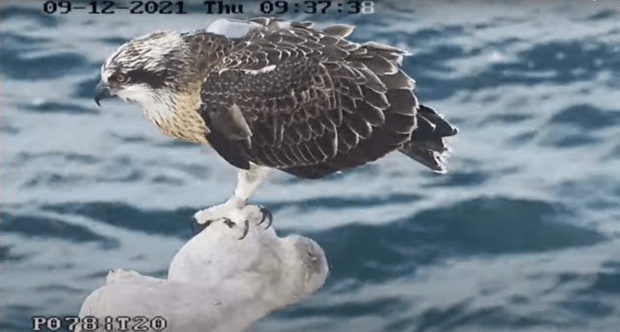
Catching up with Ervie

I have spent so much time watching Daisy, recording the happenings on the nest, and sleeping at odd hours that many of the other nests have been neglected. One of those is the Port Lincoln Osprey nest in Australia. I stopped in today to check on Ervie’s movements by the Sat-Pak and there were some gorgeous images of this juvenile male Osprey by Take 2 Photography, Fran Solly.

Ervie has been all over the place. Many are expecting him to leave the area of the barge. I wonder how far Ervie will go?

These were Ervie’s movements yesterday. Oh, he does love to fly.

Fran Solly went out and took these images of Ervie flying around the coast. Isn’t he just such a handsome bird?! My goodness, Ervie. You are doing Mum and Dad proud.

Male Ospreys tend to return to where they hatched to make their nests. I wonder if all three lads will show up at the same time? And I learned a new word today ‘Dust Up.’ Do you know this word? Remember when Ervie and Bazza were knocking one another about the nest – or off it – that is apparently a ‘Dust Up.’ Love it. Sounds so much better than saying Bazza just knocked Ervie off the edge of the nest! or Vice Versa.

Other Bird News: Gabby and Samson continue to have a sub-adult intruder coming around. No eggs on that nest yet. Aren’t they gorgeous?

Samson on the left and Gabby on the right.

We could be less than 2 weeks away from the first hatch at the Southwest Florida nest of Harriet and M15.

I have seen no weather warnings for Florida – like the disturbances going through the Midwest and the winds up in the Finger Lakes area of upstate New York.

Harriet is alerting. There is a predator around. Is it the Great Horned Owl (GHOW)?

Anna is incubating two eggs at the Kistachie National Forest Bald Eagle Nest in Central Louisiana. Louis continues to be so exciting. He is great for bringing in the fish but he is also softening up that nest with tonnes of Spanish Moss.

Connie is incubating two eggs over at Captiva, too. Her new mate is Clive. Hopefully this nest will have some luck. That said, local pelicans are being brought into care for red algae.

All of the Bald Eagle nests outside of the tornado and storm areas in the US are fine. More Ospreys are being spotted on the Iberian Peninsula and in Africa which is a grand sign. Ferris Akel was thrilled to see three Snowy Owls today on his tour. One even flew for him. I should invite him to Manitoba for the winter. One of our birders spotted 25 Snowy Owls in a short drive around the agricultural fields. — And a reminder. The owls in the Central US have been found to be thin and dehydrated. They are blaming this on photographers trying to get images and scaring away their prey. As you know I am a raptor lover – they often do not eat for several days so when you see one hunting or eating – leave it alone, please. Stay way, way back. Invest in a long lens!

It is very quiet morning at Daisy’s nest. A couple of times I have heard the cawing of the Ravens but Daisy has been peaceful, unfluttered would be a good word. There will be a late night catch up on her nesting activities.

This is not a Raptor Time: Watch this Titmouse modify its nest, bring in nesting materials, and hatch and fledge 11 chicks in Japan. Seriously it will put a smile on your face. I wish I could transport Daisy and her eggs into a box like this! Oh, she even wiggles her little bottom like Daisy. Here is the link:

Happy Saturday everyone. Take care. Thank you so much for joining me.

Thank you to the following for their streaming cams, their photos, or their FB Pages where I took my screen captures: Port Lincoln Osprey, Port Lincoln Osprey FB Page, Fran Solly, SWFlorida Eagle Cam and D Pritchett Family, NEFlorida Eagle Cam and the AEF, KNF Bald Eagle Cam, Captiva Bald Eagle Cam.

Thursday in Bird World

The camera for Daisy’s nest is offline. This is the last image and it was raining at the time. Daisy will come to the nest just as she has done for the first 7 days to lay egg 8 today. It will become increasingly difficult for Daisy to cover the eggs as the number increases unless there is a miracle on the nest and a bunch of leaves fall for her to gather. As I pointed out in an earlier blog, Daisy had much more down last year and this was helpful but – it is not helpful in the rain as it shrinks and is for naught. We can only hope that Daisy’s luck continues but we must be prepared that it is a long slog for our little duck until these eggs hatch. Anything and everything can happen.

I will bring a brief update on Daisy later this evening if the camera starts streaming. Just wish our little duck all the luck you can.

There are wonderful reports coming from Jean-Marie Dupart in Senegal. The Osprey count is more than he would have imagined and he is having to report early. Dupart believes, by the end of the month, that he might have counted 1000 individual Ospreys!

At the Kalissaye Reserve, there were 127 for the entire month of November. Already in December for one week, the count is 160. Saloum Park had 64 birds for all of November and now already there are 90. Dupart is overjoyed.

The Kalissaye Reserve is a small nature centre or reserve near the Casamance River. The Casamance Region is know as ‘The Green Garden of Senegal’.

Wet lands and the Casamance River in the background. This is the area of the Ospreys. Wikimedia Commons.

This is Saloum Park or Delta in Sengegal. These look like perfect places for our Osprey to over winter.

Wikimedia Commons
Wikimedia Commons

The Port Lincoln Lads had plenty of fish yesterday. Ervie had the first two fish at 06:19 and 08:39. Bazza had the next four deliveries! At 14:22, 15:58, 17:33, and 20:40. Falky did steal one of Bazza’s fish so he did get something to eat yesterday. Mum delivered the 14:22 fish to Bazza – she even looked like she might have even fed her big boy! I think Bazza is indeed Mum’s ‘baby’ despite the fact that he was the first hatch.

The Captiva Osprey Pair, Andy and Lena, arrived back at their nest early.

I will give you this link to watch this nest but there is a word of caution. Andy and Lena have had many successful hatchlings but have never fledged any Osprey. The reason is that the Crows come and eat the chicks. That is so sad. Maybe this year Andy and Lena will have good luck like Port Lincoln.

The Kakapo Recovery has announced that 2021 adoptions are closing today – that is the 10th of December in New Zealand. If you are a supporter of the Kakapo Recovery, you might wish to adopt one of the non-flying parrots as a holiday gift to all your family.

There are two eggs at the Captiva Bald Eagle nest with Connie and Clive and two eggs with Anna and Louis at the KNF nest in central Louisiana.

Connie’s new mate, Clive, looks at the two eggs.

You can watch Connie and Clive here:

Louis is just a great dad down at the KNF Bald Eagle nest. Last year he was so excited when Kisatchie hatched that there were 18 fish on the nest for the eaglet and Mum. There was no way they could eat all of them. This year he is really helping to build up a really cosy nest!

This is Anna and Louis’s second breeding attempt. Last year they fledged Kisatchie. They are in a very old nest in the Kisatchie National Forest. It had belonged to another Bald Eagle couple who had fledglings up to 2013. Kisatchie, last spring, was the first eaglet to fledge from the nest in 8 years. It was a wonderful event.

Here is the link to Anna and Louis’s nest. I promise they are a fun couple.

Thank you for joining me today. It is so nice to have you stopping in to check on the birds. Isn’t that a great count of Ospreys in Senegal? Wow. I am hoping that Blue 463 might be spotted — our very own Tiny Little Bob from the Foulshaw Moss nest in Cumbria. Take care everyone.

Thank you to the following for their streaming cams or their FB Pages where I took my screen shots: the Kakapo Recovery, the KNF Bald Eagle Cam, the Captiva Bald Eagle Cam, Port Lincoln Osprey Project, Sea Eagles @Birdlife Australia Discovery Centre, Wikimedia Commons, Captiva Osprey Cam, and Jean-Marie Dupart for his report on the Ospreys in Senegal.

Wednesday in Bird World

Daisy has laid her 7th egg in the nest of the White-Bellied Sea Eagles in Sydney’s Olympic Forest. She has spent the morning trying to get more down from her breasts and sides – without a lot of luck – and looking for more natural materials to cover her nest. She may have to dig around on the other side of the nest. She seems reluctant this year to cover the eggs and leave them to go over and root around.

So much down last year so little this year.

Here is a video of Dad, the WBSE that owns the nest, flying in at night. Oh, so lucky none of Daisy’s eggs were not broken.

The Port Lincoln Osprey fledglings have been neglected. It was so fantastic to go and check on them and have some great close-ups of Ervie! Oh, he is a handsome young man.

That is a gorgeous crest. That white V that we looked for when he was small is so prominent. He has a nice crop.

Janet Forster says that the trio have been flying circles around the barge. They have also been seen chasing the parents screaming for fish! Good lads.

Here is Janet waving to everyone on camera. She is on the shore with her long lens. You can just make her out about 3/4 of the way over in the background. Thanks Janet for all you do so we can enjoy the Ospreys!

So far everyone is doing fine including Daisy. It is a long haul for our little Duck compounded with the predators and the lack of material on the nest. Still, we hope. The three Osprey lads are magnificent. I am so proud of this nest. Bald Eagles continue to lay eggs and work on nests. And, of course, the Great Horned Owls are looking for nests. There is a pair on the Savannah Osprey nest thinking pretty hard about using it for their breeding season.

There are a lot of people waiting to see if the GHOWs will also use Farmer Derek’s Bald Eagle nest. Will keep you posted!

Take care. It is nearing noon on Daisy’s nest and so far all is well. Thank you for dropping by.

Thank you to the following for their streaming cams where I took my screen shots: Port Lincoln Osprey Project, Sea Eagles@ Birdlife Australia Discovery Centre, and Cornell Bird Lab and Savannah Ospreys.

Tuesday in Bird World

Daisy arrived at her eggs in the Sydney Olympic Forest at 04:47:25. She is a little earlier than yesterday. There will be a full report on Daisy later today. She is alert and perhaps slightly nervous with what happened yesterday with the Ravens.

Ventana Wildlife Society have posted the release video of Iniko. Here it is:

The Port Lincoln Lads continue to fly around the cove and their parents continue to provide them with lots of fish to keep them in fit shape. Deliveries after noon include: 12:32 for Ervie, 14:45 for Bazza (a huge fish), 16:29 for Falky, and Ervie picks up the 16:34 delivery.

Ervie is on the left and Falky is on the right eating their fish. Look at how good those feathers are. These three are just doing fantastic!

I have to admit that I really miss the little Ospreys. Jack and Diane have been working on their nest at Achieva and the Osprey couple at Captiva were trying to mate yesterday.

My friend ‘S’ has sent me a great video showing Osprey fishing. It gives you some good insight into how physically fit these birds have to be to fish. Think about it. The male fishes all day long when there are eggs and chicks on the nest. Incredible.

Ken Phung is from Taiwan.

In Bald Eagle world, everyone is waiting for Anna at the KNF Bald Eagle Nest in Central Louisiana and Connie at the Captiva nest in Florida to lay their second egg today. Indeed, all of the Bald Eagle nests are busy – one way or the other. Gabby escorted the sub-adult female off her nest yesterday.

This is a short report. Daisy seems to have taken over my life – and I am happy but the other nests sure don’t get much attention. In our garden are 27 European Starlings and several hundred sparrows. It is cold today, -16 C. Feeders are full and everyone is depleting them!

Take care everyone. Full report on Daisy later today but for now the eggs were safe over night. Rain and storms predicted again which might help our little Duck. See you soon!

Thanks to the following for their streaming cams where I took my screen shots: Port Lincoln Osprey Project. A big shout out to ‘S’ for the Osprey video. That is fantastic.

Watch Iniko live – and other Bird World news

For those of you excited about the release of California Condor #1031 Iniko, you can watch her and all the other condors up by the sanctuary live! Remember that Iniko and those released with her wear an Orange tag with black numbers!

The camera moves around the sanctuary. Here are a couple of screen captures of the site for you.

For those who love the Royal Albatross, OGK arrived home at 18:40:19 to relieve YRK so she could go and feed. There was a lot of allopreening (preening of another not yourself), sky calling, and cuddling. YRK let OGK on to incubate but stayed close to the nest for awhile. What a lovely couple.

Ranger Sharyn checks OGK’s egg and gives the thumbs up.
OGK admiring his egg and talking to it. So sweet!
OGK allopreening YRK on arrival.

Sharon Dunne posted a video of the exchange. Enjoy!

Last year was a very sad year for many bird nests. I recall the great sadness when both Peace and Hope died on the Captiva Island Bald Eagle nest. Those were two very unnecessary deaths. Someone near Lori’s property where the nest is located used rodenticide! Just crazy. The two beautiful chicks died. The parents, Joe and Connie, were overcome with grief. Indeed, it was that grief that Joe suffered that – well, caused him to leave or not defend his area well. It reminds me so much of Samson’s father Romeo’s grief. Connie is now with another male, Clive. Connie laid her first egg sat 05:55:37 this morning. We wish them well – and I certainly wish that people would remember and recommend RATS: Raptors are the Solution!

Good luck this year, Captiva!

Here is the link so that you can watch Connie and Clive. There is also a side camera. I just prefer the overhead to see all the action.

It has been a really busy day. Daisy did, as she has done the past two days. She stayed with her three eggs now until the newly laid one was dry and hard. She stretched to try and find leaves. This seems to be an issue – fewer leaves on the nest this year. One of my friends told me that there is also something different this year than last – a pair of Ring-tailed Possums has a nest in that same tree. That could be the reason that Daisy has not pulled out any down yet. Lady and Dad, the White-Bellied Sea Eagles that are unwittingly leasing their nest to Daisy were at Goat Island. It is hoped that they will remain there for the full month! My friend also noticed that the egg cup is very small this year. She hopes Daisy does not lay very many eggs so they can be covered properly allowing us the hope and Daisy that we will see ducklings jump. Anyone have any ideas on how to dump several huge baskets of leaves on that nest? The Port Lincoln lads continue to do well.

Thank you for joining me today. Take care all. See you tomorrow for Day 4 of the Daisy Chronicles.

Thank you to the following for their streaming cams where I took my screen shots: Sea Eagles @ Birdlife Australia Discovery Center, Captiva Bald Eagles, Ventana Wildlife and Explore.org, Cornell Bird Lab and the NZ DOC.

Happenings in Bird World

Holly Parsons, the administrator for the Orange Peregrine Falcon FB group, has posted the following from Cilla Kinross regarding Yurruga:

I took some images of beautiful Diamond throughout the day.

We would expect the parents to visibly be supplying prey to Yurruga. Many of you will have seen the adults at 367 Collins Street bringing in prey. You might recall how the Dad tried so hard to feed the little male when he was too sick and could not eat or swallow anything. Just pause and remember the healthy chicks at that nest and the noise they made even prior to fledging when food was around. Then remember Yurruga and how he behaved when prey came to the scrape. The falcons are loud in their food begging just like the four lads at Port Lincoln. The little ones simply cannot go without eating and while they are learning to fly they are also being taught how to hunt. It is unclear how instinctive hunting is. For example, the adult Ospreys do not teach their fledglings how to fish. They simply are hardwired to do it. Peregrine Falcon parents spend much time passing prey around, dropping it for the wee one to catch, etc. Certainly Yurruga had at least a days training because he was seen flying around with the parents prior to the big storm. There would be several prey drops during a day. No one has anything confirmed after last Thursday in Australia, 9 days ago now. I know that each of us wants this outcome to be different and I would like nothing better than for someone a mile away to phone Cilla and tell her that Yurruga is on their roof or in their garden. The long sessions in the scrape together may be Xavier and Diamond bonding in grief. There is also the additional issue of the absence of the eggs. Diamond has spent an inordinate amount of time scraping where the eggs were. My heart really goes out to her.

Sad news is also coming out of California. The California Condor chick #1075 died at the Los Angeles Zoo on 12 November. He had sustained injuries from adult male condor #247 during a territorial dispute. I know that many of you watched that streaming cam. Their lives are so very very fragile and to have a death of a promising chick due to fights is extremely difficult to process. There seems to be a lot of territorial disputes. You might remember that California Condor #1031 Iniko who survived the Dolan Fire was actually injured when an adult male came to the nest tree. —— Which reminds me! Iniko will be released back into the community of condors where he hatched on Saturday along with two others. This is great news coming on the heels of grief.

We really need some good news in Bird World. Iniko’s release is, of course, one of those. I really hope it is OK to cut and paste this amazing story from that Valerie Webber posted on the Loch Garten and Other Ospreys FB page. It is a marvellous tale of German Osprey Black 1FO seen in Portugal in Dec 2005/Jan 2006 and again in September 2021. So the question that is being asked is where has this bird been? It is more than 16 years old and this is truly remarkable – 3 sightings only in all those years. He really is a very handsome bird.

More good news come in the form of a Pacific Black Duck named Daisy who has now laid her first egg in the Sydney White-bellied Sea Eagle nest. An earlier blog today gave more images and some details. So nice to have her back! I am so excited about Daisy’s return that I can’t sleep! You can catch her on the Sydney Sea Eagle Cam. She laid her first egg today. She must have rushed to get to the nest OR she had made a nest elsewhere and predators came. We might not know. She will begin lining the nest with the down from her breast. That down will not only make it soft for her and the eggs but also will help cover the eggs when she has to go forage. She will also mix the down with leaves on the nest and cover the nest with those leaves. I hope there are lots of them!

Every one of the lads on the Port Lincoln Osprey Nest has had a fish today. Port Lincoln also says that the three have been seen at the shore going for a bit of a swim or a bath. Fantastic.

The three are over on the perches and ropes near Mum. What a beautiful image. I wish that Dad was there, too. The fledglings are gradually spending more time on the perches and ropes and flying around. They are growing up and shortly might be off on their own. I need to check and find out when Solly permanently left the barge. That might give us some clue.

I know that many of you are familiar with the Welsh Ospreys, Aran and Mrs G at the Glaslyn Nest. You might also know that one of Monty and Glesni’s sons, Aeron Z2, and his mate Blue 14 have their nest close by at Pont Croesor. Glaslyn has announced that the new hide is finished and visitors will be able to observe the nest of Z2 and Blue 14. That is great news.

That is it for me. I am sufficiently exhausted from the excitement of Daisy that I might be able to sleep. This is my Friday newsletter. I will bring updates later tomorrow (Friday the 3rd) evening.

Take care everyone. Thanks for joining me.

Thank you to the following for their streaming cams or FB pages where I took my screen captures: Loch Garten and Other Ospreys FB, Orange Peregrine Falcon FB, Port Lincoln Osprey Project, Sydney Sea Eagles @Birdlife Australia Discovery Centre, and Charles Sturt University and Cilla Kinross.

Falcon and Red-Tail Hawk Cams

I had a lovely note form ‘M’ asking about other peregrine falcon cams. Thank you for your letter, ‘M’.

Each one of us feels a little ’empty’ when the eyases fledge. Without trackers, we have no idea what happens to them. We just wish them well and I know that everyone is working hard to make their environment better. The only birds on the nest who have fledged and not left permanently are the PLO Lads – Ervie, Bazza, and Falky. It is winter in the Northern Hemisphere and the birds have migrated to warmer climates. I will, however, be checking on nests in Asia to see if there are any for you to watch.

This is not an exhaustive listing but it is a beginning and I will be adding to it for all of you as the camera streams return. We have streaming cams on the falcons in Winnipeg as part of the Manitoba Peregrine Falcon Recovery. I will post those at the beginning of the summer. Most of our birds are in southern Texas or Mexico right now.

So here goes – and if you have a favourite falcon or hawk cam, let me know!

One of my favourites are the Peregrine Falcons in Melbourne. They are known as the CBD or 367 Collins Street Falcons. The cam is currently not live. Will come back on line September 2022

Cornell Red-tail Hawks (Big Red and Arthur), Ithaca, New York. The construction work at Bradfield has caused a power outage on the Athletic Fields. Those building works are winding down and this camera should be live shortly. Big Red and Arthur will be very busy once late February and March roll around. There are only two Red-tail hawk streaming cams in the world and this is the best. Big Red is 19 this year. Arthur is 5 or 6 years old. They are a fantastic couple that normally fledge three eyases a year. There are birders on the ground that keep track of the fledglings so you get to see the parents do team training in hunting, etc. Highly Recommended.

Charles Sturt University Falcon Cam in Orange, Australia. Yurruga has fledged. Look for egg laying in the fall of 2022. This is the scrape box of Diamond and Xavier. They are a well established couple. For the past two years three eggs laid but only one fledgling each year which is fine. It is a nice comparison with the Melbourne falcons who fledge 3 consistently. Orange is more rural and, of course, Melbourne is urban. The camera is left on and the falcons come and go regularly.

The Campanile Falcons on UC-Berkeley. This is the scrape box and cams for the Peregrine Falcon Couple, Annie and Grinnell. Grinnell was injured by a male interloper on 29 October. He was in care, as a result, and has been returned to his territory. The male interloper is still at The Campanile. It is unclear which of the males Annie will choose. Nesting activity late March, 2022. Annie and Grinnell are incredible parents who traditionally fledge three adorable babies.

The following are falcon cams that I have watched ‘on and off’ and that have come highly recommended to me from viewers:

Illkirch, France:

Great Spirit Bluff, Minnesota

Anacapa Island, California. There are current a large number of Pelicans to watch.

I will definitely be posting more including a couple of streaming cams from the UK. All of that action will begin when spring arrives. I also want to post some sites in Asia which I will do over the weekend. There will also be the Northern Hemisphere Ospreys, White-tailed Eagles, Golden Eagles, as well as the returning storks to Latvia and Estonia.

For now, things are really pretty quiet except for the Port Lincoln Ospreys, Diamond and Xavier coming in and out of the scrape box in Orange, and the Bald Eagles laying eggs in the US. There are two nests that you might wish to consider and if you have never watched a Royal Albatross nest then you definitely need to check out the Royal Cam Family in New Zealand who are incubating an egg laid on 9 November. They are very experienced and adorable parents, OGK (Orange Green Black) and YRK (Yellow Red Black). They are already grandparents. I often suggest this site to individuals who have a difficult time watching any nest if there is sibling rivalry. The Albatross lay one egg every two years. Parents rotate all of the duties. Last year the Royal Cam chick, Tiaki, had a sat-pak attached to her. We are currently watching her fish off the coast of Chile.

It is a bit wet in NZ this morning. This is YRK’s 6th day on the nest. OGK will be flying in soon and they will switch. Should something happen, the NZ DOC rangers are there to step in and intervene. No one goes hungry, injuries are taken care of, etc. It is a great site and in the process you will bear witness to a country that really protects its wildlife!

There are way too many Bald Eagle streaming cams to list them all. For now, I am only going to recommend one. These are experienced parents Harriet and M15 at the SWFlorida Bald Eagle nest on the property of the Pritchett Family. Their eggs are due to hatch soon – December 25-28. Once Gabby lays her egg in NE Florida I will post that information. For now, you can have fun watching Harriet and M15 change places. The only un-fun thing is the GHOW that attacks the eagles regularly.

There is no word on Yurruga. Cilla says she will look for a few more days. Just so you know the building that Yurruga was last seen on is a gabled (triangle) pointed roof, a bit steep. It is a single story building with clay tiles. Yurruga is not there – not alive, not dead. He was there on Thursday – seen twice during a big storm. I would expect to hear this fledgling screaming for food. Falcons are loud! Is it at a distance from the tower? is Yurruga injured? is Yurruga somewhere else? There are no answers I am afraid. If I hear anything you will be the first to know. Now, it is time for me to go and take care of all my feeders. The gang will be here soon!

Thank you so much for joining me. Take care everyone. See you soon.

Oh, for the love of Ervie

It is no secret that my long-term research project on third hatch Ospreys that survive can cause a whole lot of heart ache. The opposite side of that is the sheer joy in watching these ‘thirds’ come into their own. Some suffer much more than others. In 2021, one of the worst was Tiny Tot Tumbles on the Achieva Osprey nest in Florida.

There is Tiny Tot Tumbles beside sibling 1. I often called her ‘Big Nasty Sister’. She is the reason that many people do not like to watch the Osprey nests. That said, sibling 1 stopped a lot of the beating on Tiny Tot because sibling 2 started. That nestling would purposefully eat and eat and eat so that Tiny Tot had no food.

Beaten and starved. It was hard for anyone to imagine Tiny Tot Tumbles surviving. There she is all submissive, literally starving, while the others eat.

What a beautiful bird Tiny Tot Tumbles became.

Elegant. Tiny Tot Tumbles is one of the most striking juvenile ospreys I have ever seen. Before she left the nest, her plumage was super espresso with only the thinest of white scallop revealing she was not an adult. She was smart. She remained on the nest honing her flying skills, getting stronger, learning how to fight off intruders. It is a shame she is not banded but she has a very distinctive pattern on her crown.

At Foulshaw Moss in Cumbria, no one expected Tiny Little Bob to survive more than a couple of days. The weather was miserable and the two older siblings were 4x her size.

The size difference increased. That is how she got the name ‘Tiny Little Bob’ because she was just so small.

I love this image. Tiny Little Bob really wants some of the flounder that Mum, Blue 35 has. She has watched and waited til the older siblings are full. Then she will make her move. She exhibits all of the hallmarks of a third hatch survivor – patience, fortitude, and ‘focused watching’. They can read the nest.

I wish I had this video recorder earlier so that I could have captures Tiny Tot Tumbles ousting the intruders from the nest! Or more of Tiny Little Bob. I did get it in time to show you Blue 463 in the nest. It is the third week in August. All three of the Foulshaw Moss chicks have fledged. White YW is an incredible provider and he will stay until Tiny Little Bob migrates before he leaves. She will be the last one to leave. Smart girl. She really fattened up for that migratory trip. I only hope that she survived. Few British Ospreys have been spotted in The Gambia and Senegal. There are lots without bands along the coast of West Africa but not the ringed British. Where are they?

Tiny Little Bob is banded as Blue 463. She is the bird on the back of the nest on the right. She is food calling. I want you simply to notice how big she is. Tiny Little Bob became the dominant bird on the Foulshaw Moss nest for 2021. She could fight for the fish with the best of them. Most of the time she used her patience and ‘snake eye’ to get the siblings off their lunch!

At Port Lincoln, Bazza aka Big Bob, tried several times to dominate but, Ervie aka Little Bob wasn’t having it. If you have been following me most of the time you will know that when the three males were banded, Little Bob got the sat-pak because he was the biggest of the three. Unlike Tiny Tot Tumbles who missed 12 full days of meals in the first five weeks of her life, Tiny Little Bob made sure he was right up front by Mum’s beak. I don’t think he ever missed a meal and he would certainly stay til he was full. On the morning of the banding, Little Bob had landed the breakfast fish. That probably helped a lot with that weight in!

There is Little Bob in front with his beak wide open. Just look at those little wings. Oh, my goodness is there anything cuter than a recently hatched osplet?

The thing about the third hatch survivors is that they have lived out of sheer willpower and cleverness. I can almost hear Ervie say, ‘I am not taking anything from you, Bazza!’ They become kinda’ street wise. They watch, assess, and attack. Does anyone remember Tiny Little Bob staring down both of her big siblings? They were not going to get anything by her. You might also remember that Tiny Tot Tumbles took on any intruder protecting the nest. She was fierce. That is how they survive — and I believe that they are actually better able to cope out in the world of Ospreys far away from the nest than their siblings.

Ervie sure showed us what he is made of today.

Bazza had the fish and had been eating. Ervie really likes the back portion and the tail. So he is watching Bazza. I could have made this into a video but what I want you to do is focus on the ‘look’ on Ervie’s face and his actions.

Ervie is the bird on the right. Bazza is in the middle with the fish tail. Falky is on the left and is not interested.

Look at Ervie’s eyes and his open beak as he lands on the nest. He is telling Bazza he wants that fish tail now. Ervie means business.

Ervie is twisting his body. He is not looking at Bazza’s face. He is looking at the fish tail.

Ervie moves up and over pushing Bazza’s head. Ervie raises his wings.

Ervie is totally in front of Bazza. Notice that Bazza is not looking at the fish.

Ervie turns his head around. You can draw a line from his eye and beak to the fish. Ervie is completely focused.

He goes for it.

Ervie dives down to get the fish tail.

He has it. He turns his body and raises his wings. Bazza is being pushed out of the way so Ervie can turn.

He’s got it. Wow. Just look at the impressive wings of Ervie.

Ervie moves over to the other edge of the nest where he finishes the fish tail. The entire take over bid took 19 seconds.

Bazza does not seemed phased and Falky probably wishes he were somewhere else!

These three have just been a joy to watch. I wish each of them had been given a sat-pak so that we could watch their lives unfold. I hope that the hydro poles in South Australia have their protective covers placed on them just as quickly as it can happen. The loss of Solly was a tragedy in terms of understanding the dispersal and long term survival of these Eastern Osprey.

I hope that I have not bored you too much with these third hatches. Each is really a miracle and for me, remembering them helps honour the pain and suffering that they went through to live.

Thank you for joining me. Take care everyone. See you soon.,

Thank you to the following for their streaming cams where I took my screen shots or my video clips: Achieva Credit Union, Port Lincoln Osprey Project, and Cumbrian Wildlife Trust and Foulshaw Moss Osprey Nest.

Wednesday in Bird World

Let’s start off with what is on everyone’s mind: Has there been a confirmed sighting of Yurruga? Yesterday, Dr Cilla Kinross was inspired by a very quick prey drop at the scrape. Diamond flew into the trees. Cilla was in the trees looking half an hour later – she only saw Diamond. Diamond returned to the scrape with quite a large crop also. Some believed they had heard Yurruga calling but, Cilla is unable to confirm that. So the answer is – we simply do not know. Yurruga has not been seen since last Thursday when he was on a building during a storm. We can only wait.

My goodness that little one was such a cutie.

October 20. Yurruga and Diamond

Diamond was really beautiful this morning as the soft glow of the sun worked its way through the fog.

Both parents, Xavier and Diamond, have been inside the scrape – scraping. They also had some bonding moments this morning at sunrise.

My heart aches for them.

The second question of the day is what is going on with Grinnell, the male Peregrine Falcon of the Campanile, mate to Annie, that was injured by a male intruder that is trying to cosy up with Annie? Here is the latest news.

The New Zealand Department of Conservation rangers on Taiaroa Head are shutting down the streaming cam so that they can move it to the site of the Royal Albatross family for 2021-22. There are lots of guesses as to who the couple might be. The announcement is due tomorrow.

One of my favourite Bald Eagle couples, Samson and Gabby, at the NE Florida Bald Eagle nest near Jacksonville have been putting the finishing touches on their nest. They are perfecting the Spanish moss lining the nest cup. Now all we need are some eggs!

Gabby doing some final inspections this morning.

The three lads at the Port Lincoln all had fish yesterday. Falky had more than Ervie or Bazza. Falky has become a master at slipping the fish out of Dad or Mum’s talons. A magician.

There is a lovely shot of the PLO Mum. She has done an extraordinary job raising these three boys to fledge this year (with Dad’s good help). Yesterday she even spent some time feeding Bazza. He is definitely a Mum’s boy!

Bazza can be a bit naughty. I know that the banders were certain that there were three males. Someone looking at Bazza’s legs and that beautiful necklace in the image below might mistake him for a lovely female.

Bazza and Falky sleep with their heads tucked under their wings – adult style – standing on the nest. Ervie is sleeping over on the perch or the ropes. They are all doing well. I continue to pinch myself. This Osprey nest really turned itself around this year to fledge all three hatchlings.

There are many articles coming out in international newspapers and academic journals on the effect of warming oceans on the seabirds including the beloved Osprey. I picked one of those for you as some are frustrating. They allow me to embed the article but then want you to subscribe to read it! That is a major irritant to me – like Subarus are to Ferris Akel!

https://www.downtoearth.org.in/news/climate-change/climate-change-threatens-survival-of-albatross-60906

It is a grey damp day, 3 degrees C. The snow is melting. There are lots of birds at the feeders. A large European Starling is sharing the peanut and bark butter feeder with some cute little House Sparrows.

The tiny suet balls called Bark Butter by our supplier are a really big hit since winter has set in. Junior has been around to get the corn while Dyson was busy elsewhere. Nice to see all of them.

One of my former students posted this today on FB. It is a perfect little giggle for all of us!

Thank you so much for joining me today. Take care everyone. Stay safe.

Thank you to the Port Lincoln Osprey Project, Charles Sturt University Falcon Cam and Cilla Kinross, and NE Florida Eagle and the AEF for their streaming cams where I took my screen captures.

Was it Yurruga?

My goodness. It is just past 09:00 on the Port Lincoln Osprey barge and already there have been three fish delivered – one of those was really quite a bit one!

Ervie got the first fish that arrived at 06:16.

There was another delivery at 07:22 and Falky takes that fish. Falky is still eating when Mum flies in with a bit of a whopper. At the time of this delivery, Ervie is on the perch and Bazza is on the nest rail. Falky quits eating the old fish (not much left) and starts eating the big fish.

In the image below you can see Falky with that prize fish. That is a nice one.

Falky is still eating at 8:56! Bazza has given up and has gone down near the mancave to put in a personal request to the parents for breakfast. Ervie has found some leftover fish around the rim of the nest – remember he is really good at that. But I am also thinking that Ervie knows Falky is going to get full and stop eating that fish! He wants to be on hand when that happens.

The only time I have seen a sibling eat and eat so that a sibling could not get food – eating beyond the norm of comprehension – was sibling #2 at the Achieva Osprey Nest in Florida last year. #2 would eat and eat so that Tiny Tot Tumbles did not get anything or there was only a little left.

Ervie is smart. The third hatch survivor. Falky did finally get full and Ervie is now eating that Mullet. Bazza is still on the deck below by Dad’s cave.

It has been snowing in Northern Europe. In Durbe County, Latvia, snow is covering the nest of Milda. Still, her and Mr L have come home to the nest to check on it today. Liz caught it in a video:

There are some concerns about a thin red line on the right ankle of Mr L which you can see directly below the arrow to start the video. Here is another view. Milda needs for this to heal so that Mr L can provide for her this year and their chicks will thrive. Observers say that Mr L appears to be moving fine. Thank goodness.

Oh, it looks so dreadfully cold for the White-tailed Eagles. I hope there is plenty of prey for them that is not sleeping. There should be no worries about any egg laying until spring. It is normally timed so that when the chicks hatch the little animals are coming out of hibernation.

If you research the floods that are happening in Canada’s province of British Columbia or some of the flooding in the eastern provinces recently, there are many causes. In British Columbia the logging of old growth forests has proven to be tragic. In their discussions, Christian Sasse and Dave Hancock talked about the impact to the wildlife of these events. They also mentioned that some of the birds caught in the horrific heat during the summer of 2021 that survived and had trackers put on them —- those birds flew straight to Alaska. As the climate warms, the birds, including my beloved Osprey, will be looking for cooler temperatures where fish and their eggs are not dying from the heat nor are the larvae that the fish eat dying. Look north to Alaska and parts of Canada. These areas need protection.

An article has just appeared that discusses the Tongass National Park in Alaska and the changes in some laws that are coming in to place to make certain that the old growth forests are not logged. If you are interested, here is that article.

Last there is some confusing information coming out of Orange, Australia, about Yurruga. I had received an e-mail this morning from Cilla Kinross where she expressed her concern at not seeing Yurruga since Thursday, her worry and also her love for the wee one. This morning Xavier delivered prey to Diamond in the scrape and she flew out of the box quickly and into the trees. I have personally never seen Diamond eat prey in the scrape unless she was feeding a chick. While we all remember Izzi coming to the scrape, normally the prey deliveries and feeding would take place away from the scrape for the fledglings.

In the chat room, Cilla Kinross said of the delivery and departure, “The prey transfer looked hopeful; I couldn’t hear the calls. I need to get a new speaker.” Individuals have said that at 8:32:55-56 they believed they could hear Yurruga prey calling.

Here is the sequence of images related to that prey drop to Diamond. You can see the time stamp in the corner to understand why Cilla could be thinking that this is very quick and hopeful.

Diamond gets the prey.

In the image above that white spot between the trees right above the ‘s’ in the word ‘trees’ that I typed, is Diamond. Cilla has indicated that she knows the tree Diamond landed in and she is going to check in at work and then go and search that area.

I will bring you any news as I hear it. If you want, you can watch the camera and at least see the chat, if you go to this link. To access the ledge cam – for a better overall view – go to the link below this cam once you get on Youtube.

At 10: 33:55 you can make out a person walking among the trees. It could be Cilla or a helper. Chatters and mods are hoping that they walk further back as that is where they saw Diamond go. We hold our breath. It has been a sheer roller coaster.

In the image below you can see them – that bright white spot. You can see how tiny she is compared to the trees. If Diamond is like the hawk that visits our garden, they can be almost invisible sitting ever so still so as not to be seen.

The person is still looking at 10:49. She is in the whitish coat to the right of the green tree in the centre. Again, look at the height. If Yurruga is in a hole in the tree or somewhere on those trees with leaves it could be difficult to see him. I wonder if Diamond is still there?

We wait for word. That is all we can do. Wait, hope, send warm wishes and prayers. My friend, ‘T in Strasbourg’ reminds me that miracles do happen. Yes, they do. I hope this is one of them.

Thank you for joining me. It is a been a day full of up and down emotions. That is the only thing for certain about this Tuesday – or Wednesday – depending where you live. Take care everyone. If I hear anything at all, I will let you know. Pardon any serious grammatical or spelling mistakes. I am writing this quickly so you will know what is happening on the ground in Orange.

Thank you to the following for their streaming cams where I took my screen shots: Port Lincoln Osprey Project, the Latvian Fund for Nature, and Charles Sturt University Falcon Cam and Cilla Kinross.