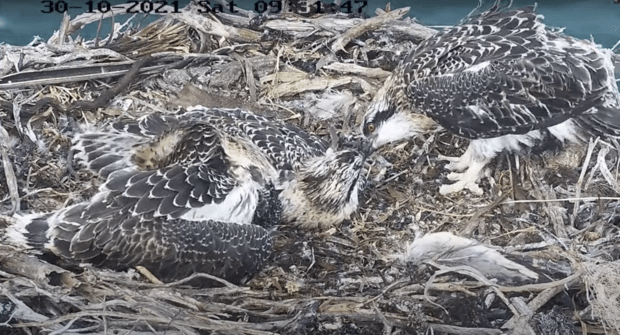
If you read my blog regularly, you will know that I am nothing but praises for this Osprey nest on the barge at Port Lincoln, Australia. The nest has a history of siblicide and this year, for the very first time (knock on wood), the parents are going to fledge three! There will be many ideas on why this might be the case but, it seems that it could be down to the simple fact that there is only 51 hours difference between Big Bob hatching and Little Bob. Today, they are 47 and 45 days old. (Middle Bob hatched 4 hours after Big Bob).
Dad has really kept up the fish deliveries even in the worst weather with strong winds. Yesterday there were six feedings: 6:41, 8:24, 10:11, 11:19, 15:02, and the last to fill them up for night came at 19:34.
Mum has also really kept tight reigns on the trio. Despite the fact that they are capable of self-feeding and have, on a few occasions tried to snag the fish, she has maintained order. They all line up and leave one another alone. Everyone gets fed. That is food security at its best.
Little Bob is at the top right. You can see that s/he still has a crop from the feeding four hours earlier. This is a nice fish to top them up for the night. Typically, Little Bob will not take its eyes off that fish!
They are really growing. None of the trio have started hovering but they certainly are flapping their wings.
Awww. The little sweeties. They also still sleep duckling style.
They are wide awake as dawn approaches. Each taking turns stretching and wing flapping. Everyone seems to be anticipating the arrival of breakfast. Still, you can see that at least one of the birds has a crop from the late night feeding.
If you have shied away from this nest because of previous years, I urge you to take a peek. These three will fledge in about two weeks. They will then fly back and forth with the parents still feeding them until they finally leave the area. During the week of 8 November, they will be ringed, given names, and measured. One (or all – I am still trying to confirm this) will receive a satellite transmitter. So there is still excitement to come – join in.
It is a beautiful family. Here is the link:
We have had several snow showers on the Canadian prairies today. a few of the birds have ventured out to the feeders. Of course, Dyson is here vacuuming up all the seeds. No sign of Mr Blue Jay and family. I don’t blame them for not coming out. No one is really ready to think about winter!
Thank you for joining me. I will be checking on Diamond and to see if there are any updates on WBSE 27. If there are, I will let you know. Otherwise, I will see you tomorrow. Take care everyone.
Thank you to the Port Lincoln Osprey Project for their streaming cam where I took my screen captures.
There are some rumours going around that during the week of 8 November the three osplets at the Port Lincoln Osprey barge will be ringed. At the same time, they will be measured and given names. There is also a rumour that only one sat-pak will be used again this year. At one time, I had heard that PLO had been given approval for three. There is also a rumour that Middle Bob will be getting that sat-pak.
Picking Middle Bob for the sat pak, if true, is an interesting choice. At the beginning, Big Bob tried to be the dominant bird. Her beakings were thwarted by Little Bob who became the dominant bird on the nest. Big and Middle Bob typically hangout together. Little Bob is a bit of a loner. Normally two females will not pair up. (Big and Middle could both be males or a male and a female). So is the thinking that they want to put a pak on a male? It would seem that Big and Little are the females but we will have this confirmed when they are ringed. Solly was the Big Bob last year – a large, aggressive female. Middle Bob often melts into the back of this nest. Are they wanting to see how far a male will go from the barge compared to Solly? I wonder. Of course, I would like to see how Little Bob lives out its life! I admit quickly to the prejudice of wanting that sat-pak on that bird’s back!!
At any rate, this nest has produced some of the darkest plumaged osplets – some of the most beautiful and civil nestlings I have ever seen. If the credit goes to having the birds hatching closer together, I wonder if this will happen again? Guess we will have to wait until another nest hatches its chicks to see!
Here are some images from yesterday of the PLO nest. These chicks are just stunning.
That is Little Bob in the foreground looking to the right.
One of many feedings during the day. Despite the fact that they are now wanting to grab the fish, Mum is keeping a firm handle on that and feeding them herself.
The chick at the far end is looking at the piece of fish that is left. Mum will eventually fly away with it – the chicks all had large crops. She needs to eat, too! I wonder what is so special about the fish tail??
So mild mannered. When one gets full, it leaves and lets the others eat.
Beautiful Little Bob.
Little Bob is captivated with the gulls flying over head.
There is Little Bob in the middle of the pack saying ‘ohhhhh’. Another chick has noticed. These three will be wanting to fly like the gulls very soon.
Little Bob does ‘kissy-kissy’ with Middle Bob. I suspect that Middle Bob has a bit of fish on its beak that Little would like to eat. LOL.
The photo below is a really good image of Little Bob’s strong, short stubby legs – the hallmark of a female.
This has been such an incredible nest to watch – no drama. What a change from last year or some of the nests of the Western Ospreys during the spring of 2021. The parents have done an amazing job. The cam operator has been grand in keeping the focus on what is happening on the nest. I cannot wait to find out whose male and who is female. My prediction is Little Bob is definitely a female. But is Big a female and Middle a male? or are they both males? Can’t wait for the measurements!
It is a beautiful 8 degree C sunny day on the Canadian Prairies. The birds have been fed and I am wondering what drama will happen around today’s corn cob? Thank you so much, BTW, for the notes telling me how much you are enjoying the stories about Mr Blue Jay. He is quite the character!
Junior was on the deck after yesterday’s shells were all swept away this morning waiting for the corn!
Take care everyone. Thank you for joining me. Take care!
Thank you to the Port Lincoln Osprey Project for their streaming cam where I took today’s screen captures.
My intention had been to go to the nature centre to check on the geese and ducks but that didn’t happen. First, a note came in my mail about a new book by Ron Dennis and second, I spent way too much time talking about bird feeders, seed, and trays at my local seed store.
First up is Roy Dennis’s latest book, Mistletoe Winter.
The description on the web site says:
Times of darkness offer opportunities to reflect. In Mistletoe Winter, Roy Dennis offers his reflections on the natural world from the past year – from the welcome signs of change to the ongoing problems we are posing for nature, and what humankind must do about them.
roydennis.org
Signed copies can be purchased through roydennis.org I have ordered a copy and will tell you all about it when it arrives.
We feed several hundred birds a day. I am not Kathleening!!!!!! One of the biggest problems is the seed or shells falling on the ground and accumulating, particularly in winter. It is not difficult to clear in the summer and early fall except when it rains. In the winter it is a real chore. We have tried various types of seed and feeders. Today’s experiment is a feeder with a tray that can be screwed on the bottom, covered by a dome, and filled with chipped sunflower seeds. Fingers crossed!
There are definitely changes with the Australian birds. The three osplets at Port Lincoln are looking more and more like juveniles. That is Little Bob there in the very middle looking towards Mum.
I did not see it but it was reported to me that one of the trio mantled a prey delivery at 16:12 yesterday.
Little Bob has turned around and is calling to Dad – helping Mum. How cute. The other two are completely oblivious to what is going on. Maybe Little Bob is in training for its role as the female????
There is a bit of a flurry when Dad arrives.
Little Bob has a nice crest from the blowing wind. It doesn’t look like anyone is mantling at this feeding.
All lined up nicely for the last meal of the day.
The Collins Street Four are one month and one day old. The fluffy down on their backs covering their juvenile feathers is falling off fast! This was early morning. I imagine that there will be more juvenile plumage revealed as the day goes on. It is hard to imagine but in a fortnight these four could fledge.
Yurruga is trying to stand and walk. That cannot be an easy feat in the scrape box. She seems to like to sleep tucked into the corner. Meanwhile, Diamond will move the eggs close together trying to keep them warm. I feel so sad for her.
Little Yarruga face planted in the corner!
Cilla Kinross posted a very short video of Yarruga trying to stand up and walk two days ago.
I want to give you a giggle. Richmond and Rosie are the Ospreys on the Whirly Crane in the Richmond Shipping Yards. Richmond is known for bringing interesting items to the nest. Rosie doesn’t particularly like all of this stuff! This video was posted yesterday on their Throwback Thursday videos. It is very short. Be sure to watch until the very end.
The incident took place in 2017. Thank goodness. If this were live we would all be worried that Richmond is going to get his head caught in that back opening of the cap!!!!!!! That is actually very dangerous for birds.
Thank you for joining me. It is a nice day in the garden. Mr Blue Jay is eating his corn on the cob and Dyson is busy at one of the feeders! Take care everyone.
Thank you to the following for their streaming cams where I took my screenshots: the Port Lincoln Osprey Barge, 367 Collins Street Falcons by Mirvac, Charles Sturt University Falcon Cam and Cilla Kinross.
One of the saddest things is seeing a parent bird look for their fledglings to feed them. That is precisely what WBSE Lady was doing yesterday. She flew around the salt marshes, around the river, and in the area where WBSE 27 (and maybe 28) were looking for them. She had a fish in her talon. With no luck she flew into the forest and left the fish on the natal nest in the old Ironbark Tree. Lady spent the night on that tree.
You can see the fish in the image below.
There is Lady sleeping in the tree on the parent branch. Is she sleeping there hoping that at dawn one of the fledglings will arrive for breakfast like they did before they flew off the nest?
Last year, Lady and Dad would come to the tree with fish trying to lure 25 and 26 back. Once 25 was chased out of the forest by the Currawong there was never another sighting of it. 26 did return to the nest after thrashing about the forest. She was exhausted, and, well, starving. She slept! I do not think that 26 planned to leave the nest the day she did. She flew over to the camera branch. A Magpie helped 26 keep the Currawong away but then, finally, they chased her out of the forest. There was a big storm that night with very strong winds and in the morning 26 was located on a 22nd floor condo balcony about a kilometre away from the nest. 26 was taken into care. There was great hope that she could be ‘repaired’ and become an ambassador bird but that was not to be.
Hopefully 27 will have a much better fate than 26. I hope that they will be able to give it fluids and antibiotics to heal the talons that have been injured. Maybe they will be able to release 27 near to the parent nest but not before it can fly strong. Send your positive wishes its way!
The chicks at the PLO Osprey nest had lots of feedings yesterday – six! They were at 6:39, 7:45, 13:42 (Mum brought it in), 15:01, 19:10, and 20:30. Wow.
I love the image below because of the crest on the chick on the right. Just gorgeous.
Here comes dad! Tiny Little is on the far left looking towards dad.
I do not think the chicks were expecting another meal but here comes the fish at 20:30.
Needless to say, these osplets are really well fed. All that fish is turning into feathers and the bulking up! Within the next 7-10 days they will be banded, measured, and fitted with satellite navigation systems. I understand there are three devices and since there are no other osprey chicks on the other nest (the eggs taken by the crows), then all three should have its very own little backpack.
Yesterday in Melbourne Mum had a terrible time trying to convince the four eyases that it was for their own good that they stayed in the shade of the scrape box. It will be 27 degrees today and no doubt she will be trying to corral them again into the shade. She tried hard to spread her wings to cover them from the glaring rays of the sun but with four it is really difficult.
They are very obedient. One cam running and you can see it pushing under Mum’s wing on the right to get to the shade.
It wasn’t long before the shade covered the entire scrape box area and Mum was not needed. I have often wondered if this is the reason she chose to lay her eggs at that end. Last year it was so hot – trying to keep cool herself as well as the trio was difficult. They were all panting trying to regulate their heat.
In the scrape box in Orange, little Yarruga cast a pellet at 5:55:30. Oh, this chick will be hungry and ready for more food. Wonder if the Starling’s leg was in that cast?? So what does this mean? A pellet is the indigestible material from the crop or proventriculus. Birds of prey or raptors regurgitate this material. Then they will begin to collect more as they eat. The casting of the pellet also cleans out the crop (the proventriculus or granular stomach).
It looks like the chicks are choking when they cast the pellet. It must scare them til they get used to this happening.
Yarruga feels so much better! Now if breakfast would only arrive!!!
It is early morning in Australia and Thursday is just starting for our bird families. I cannot think of anything more grand than having WBSE 28 land on the nest and let Lady feed it! That is really wishful thinking on my part. WBSE 27 will be eating well and by now should be really well hydrated. Warm wishes for a full recovery and return to the wild!
I have been alerted that the satellite tracking for Karl II’s family has not been updated since the 24th. I will be checking on that. It seems highly unlikely that all three of the birds have perished. I simply cannot imagine it. Udu was on Crete, Pikne was in Egypt, and Karl II had not transmitted since the 21st. Pikne’s battery % was quite low. If the GPS works on satellite transmission and it is overcast then the battery cannot function. As well, the birds can get in areas where transmitter signals cannot be picked up. I am so hoping that this is all one big malfunction! I will keep you posted.
It is pitching rain today on the Canadian prairies where I live and it is really, really welcome. The birds are still coming and going from the feeders despite the heavy drops. I noticed when I was picking up all the birdseed, peanuts, and corn cobs that the pet store version of a birdseed story had something interesting. It was a lovely metal holder filled with natural alpaca wool. The idea is that there are no toxins and the birds would pull out small skeins to help with their nest building in the spring. What a lovely idea as a gift for a birder friend! Bags of seed and suet blocks/cylinders would be welcome, too. Gosh. I cannot believe people are starting to get ready for the holidays. Ahhhh…by then Little Bob will have fledged and we will be watching him or her with the satellite tracking.
Take care everyone. Thank you so much for joining me today. See you soon.
Thank you to the following for their streaming cams where I took my screen captures: the Port Lincoln Osprey Project, 367 Collins Street Falcons by Mirvac, Sea Eagle @Birdlife Australia Discovery Centre, and Charles Sturt University Falcon Cam and Cilla Kinross.
The birds in my garden are always aware when I am watching them especially Mr Blue Jay and family. Sometimes he will stop and look right in the window and fly up into the lilacs and down to the corn as if he is teasing me. Other days he might sit on top of the deck chair calling to remind me that the corn cob has disappeared. Or maybe he is saying hello! Today, it was the youngest of the trio staring at me as he flew in and out to get kernels off the cob. Dad, Mr Blue Jay, was observing from the lilacs.
How do I know this is the youngest? He is a bit thinner and his legs are a charcoal grey, not black. I can also identify them by their facial markings and I still don’t know, after several years, where they roost or which is the male or the female. All I do know is that in exchange for a corncob, some peanuts, and some seeds, this family of three brings me year round joy.
Of course, the birds on the live streaming cams have no idea there are hundreds of people, sometimes thousands, watching them. Many have caught their reflection in the camera’s dome. I recall Izzi, the peregrine falcon eyas at Orange, and the little Golden Eagle in Romania liking to look at themselves. It is very cute.
Today, Little Bob was having some fun. It is a good thing he is not conscious or caring of anything to have to do with humans!
Yes, that is Little Bob. He is fanning out his tail like a peacock. While we are not able to see it clearly yet, Little Bob’s tail will have stripes, alternating white and espresso. This same type of barring will also be seen on the secondary feathers. The secondary feathers are those after the primary or wing tip feathers.
In studying other birds of prey, those dark stripes are often counted with the understanding that on a Red-tailed Hawk, for example, the nestling needs at least 5 dark bands to fledge. It is simply a way of gauging the length of the tail because tail length is one of the elements necessary for flight.
In the image below, Little Bob has lowered his tail a bit and is stretching his wings in what is known as the ‘W’ pattern. It will be familiar to you as it is the shape that gets tightened up when ospreys dive head long into the water.
The nest on the barge at Port Lincoln is getting crowded as these young ospreys grow. There is Little Bob looking out standing in front of Mum. You can clearly see that dark espresso line (it is neither brown or black) that runs from the beak, across the eye and down to the nape of the neck. This dark strip is your word for the day, it is the auricular. Many believe that this helps to stop the glare of the sun so the birds can see better.
There is a lot of speculation on the streaming cam chat as to the gender of Little Bob. Ospreys need strong legs and feet in order to fish and pull their prey out of the water. They grip their prey with their long black talons using those ‘scratchy pads’ – specialized barbs -on the bottom of the feet to hold the fish secure. They also are the only raptor to have a reversible outer toe which helps them secure their prey. They will, most often, position the fish so that the head is facing in front which is a help with wind resistance.
Ah, but back to telling the males from the females. Measurements will be taken when the three get their Darvic rings. Females tend to have thicker leg bones than males. A good example were the measurements taken of Laddie and NC0’s two fledglings, LR1 and LR2. With females being at least 20% larger than males (normally), the first to hatch and the largest was ringed LR1. The wing measurement of 337mm and weight of 1.51kg led the bander to state that LR1 was a female. The second chick was three days younger and had a wing measurement of 276mm. It weighed 1.4kg and was said to be a male. The differences are slight and the only real way to determine gender is through a DNA test or by seeing an egg laid.
Note: LR2, the male, is the fledgling that has been seen several times over the last week in Spain. Fabulous news!
That said there are a lot of people who believe that Little Bob is really Little Bobbette.
One of the other ways that people believe females are different is through their darker and wider ‘necklace’. Unfortunately, I believe this idea to be unreliable as there are a number of known males with very elaborate and dark necklaces. One good example is Blue 022 the ‘maybe’ mate of CJ7 at Poole Harbour.
It is often difficult to establish which chick is which on the nest. As my concern is in the third hatch, I have paid particular attention to Little Bob. Look at the top of his head. Whether you say Little Bob has a white V or a round circle on its head doesn’t matter – both apply. Look carefully at his head in the image below. One of the things that will not change over Little Bob’s lifetime will be the pattern on its head.
Oops… there Little Bob goes again!
Oh, my. This time he is going to spread his wings, too. Somehow I do not think Big Bob is going to be happy about that. Did I say this nest was getting crowded? Just wait til they all start flapping and hovering at once.
Just like Mr Blue Jay and family, Little Bob continues to delight me. I am so glad that he doesn’t know how many of us are watching his every move.
Take care and thank you for joining me. My newsletter will be late tomorrow. It is time to pick up a large order of birdseed and corn cobs for the garden animals for the winter.
Thank you to the Port Lincoln Osprey Project for their streaming cam where I took my screen shots.
At 07:47:24 the Dad of the 367 Collins Street Four flew in with a small bird. He begins to pluck it waiting to see if Mum or one of the chicks will come down to the scrape box. Mum did not show up but one of the four eyases did. I could not possibly tell you which one. Dad continues to pluck the little bird as the chick watches. Dad gets closer to the eyas that is standing in the gutter and the chick takes the bird. Dad looks in the gutter and is assured enough that the eyas is self-feeding that he flies away to find more breakfast for his kids. This is a great moment. The chicks are developing so fast!
Here it is in sequence:
This chick is hungry.
Dad gets in the scrape box to feed his baby. That baby looks like it is bigger than Dad! We will know better once that fluffy white down is gone.
Dad feeds the chick a few bites. Look at the eyas standing so strong. The soft fluffy down is falling off revealing the juvenile plumage beneath.
Little Dad walks over to the chick leaning in the gutter with the bird.
Dad leans down and the chick takes the bird. This is wonderful – a first that I have seen. It is 07:50:18.
Little Dad is making sure that the chick has the prey.
The eyas is mantling the prey!
Dad rockets down the side of the building!
Wow.
At the Port Lincoln Osprey Nest, everyone stood up for breakfast. Chatters were shocked! It is, as far as I know, the first time that all three stood up to be fed. We are quickly approaching the self-feeding phase at the PLO Barge.
Mum is feeding Big Bob as Middle Bob (centre) and Little Bob (left of centre) look on.
That is Little Bob getting the bites. Look at its strong legs.
Little Bob gets full and goes to stretch its wings and do a ‘ps’. I love the look – like beautiful white mod style boots. Middle Bob has opted to scrunch down to eat its breakfast while Big Bob in the background is standing. I cannot say enough how civilized this nest is. There is food security. No one is fighting or rushing another to eat or beaking them. When the chick gets full it moves away and let’s someone else eat. This is what happens on the falcon nests. It is great to see it here.
Names and ringing will come soon!
It was a morning of firsts. Self-feeding with the falcons at 367 Collins (or at least one of them) and the chicks now standing to be fed at Port Lincoln.
I have also discovered that if you wish to pre-order the DVD, Season of the Osprey, premiering on PBS tomorrow night, it is $24.99. Go to the PBS shop on line. They are charging 9.99 for shipping within the US only. I telephoned them and they will not ship the DVD out of the country due to copyright issues and laws. The woman suggested I order a copy and have it sent to someone in the US to mail to me. That is precisely what I did. So if you enjoy the programme and want a DVD they are available for pre-order. Shipping is 14 December.
Thank you for stopping in for this quick update on the progress of the falcons and the osplets. Take care!
Thank you to the following for their streaming cam where I took my screen shots: the Port Lincoln Osprey Barge and the 367 Collins Street Falcons by Mirvac.
As Bald Eagle season quickly approaches, I am reminded that everyone has a few favourite eagle nests. Some like to cheer Jackie and Shadow at Big Bear while others like Harriet and M15 at the Southwest Florida nest or Samson and Gabby at the Northeast Florida nest. Others love Mr and Mrs North at the Decorah Eagles, the Pittsburg-Hayes or the new couple, Anna and Louis, who had the first eagle fledge from a nest in Kisatchie National Forest since 2013, last year. I could list so many because there are so many streaming cams on Bald Eagle nests in the United States. It is their National Bird and there is a lot of patriotism surrounding some of the nests! Some individuals do not like to watch birds eating birds and mammals but, did you know that the diet of the Alaskan Bald Eagles is almost exclusively salmon? the same will apply to many of the Bald Eagles out in British Columbia. Bald Eagles eat what is in front of them; they are opportunists. So the diet will vary regionally. Sadly, they also eat carrion, dead animals, many of which are on the highways and the eagles get hurt or killed flying down to get the food or the remains left from hunters full of lead shot.
I caught up with a few of the Bald Eagle couples recently. Anna and Louis have returned to the nest they used in the Kisatchie National Forest. Cody and Steve have really worked on the camera situation and there is now sound, too. You have a broken screen showing the landscape and then another view looking directly down into the nest. Cody and Steve are part of the forestry staff. They also ‘man’ the chat. I am terribly grateful for their active involvement in the nest. They have worked hard to make it a fabulous viewing and learning experience for all of us. It was a real joy to watch the first time parents figure out how to parent a growing eaglet last year!
Samson and Gabby have been working on their nest for quite some time. It is comforting to wake up in the mornings and see them roosting on the branch together.
I use that word ‘comforting’ because at any moment something could happen to one or both of the adults. That is certainly the history of Samson’s parents, Romeo and Juliet, who raised their young in this nest. So for both of them to show up every morning and every evening is simply – well, it takes a lot of weight off the mind. Of course, the same applies to all birds on all nests.
Here is a very short slide show that someone posted showing various stages of Legacy’s development last year. Legacy was such a sweetheart. Samson and Gabby did not hold back on the teaching. They had to be parents and siblings, too, so that Legacy would learn how to live in the world beyond the nest.
You may also remember all of the worries over Legacy’s survival when she got Avian Pox. It was a mild case and she not only survived but, also thrived. Legacy became a gorgeous strong fledgling.
Harriet and M15 are getting ready for another season. Harriet has been bringing in monstrous size sticks (someone referred to them as logs) to the nest in Fort Myers. I am so excited.
E17 and E18 were riots last year. I originally thought 17 was going to kill 18. You might recall they were sent to CROW for their eye infection and 17 had ‘time out’. I think the two of them in care for those five days melted everyone’s hearts. Harriet and M15 are old hands at raising chicks and when the pair got into too much bonking, both parents stepped in and fed one or the other. By the time the pair fledged, they were inseparable, best buddies.
Lady Hawk catches one of their first ‘rock’em sock’ems’.
Here they are as fledglings battling over a prey drop. There was not a dry eye in the house when these two finally flew away to find their own territory.
Harriet and M15 have been at the nest since September working on it for another year. What a beautiful couple!
If you have been watching the territorial battles going on at the Captiva Nest on Santibel Island in Florida, word has come that the former male adult, Joe, has reclaimed his nest. I cannot confirm this as none of the eagles have leg bands. That is what someone posted on the Bald Eagle 101 FB page.
I will have lots more Bald Eagle news in the days to come. There are also other birds beginning to get their nests ready for breeding season. Jack and Diane have been at the Captiva Osprey Nest in St Petersburg, Florida and the Royal Albatross are arriving at Taiaroa Head, NZ. There are now 80 adults there. One of the founders of the colony was Grandma and this is a lovely video on the importance of her to the present and future of the colony.
A quick check on the Australian falcon nests show that all are doing fine. The Collins Street Four run up and down the gutter. As a result their legs are getting really strong. Diamond continues to get Yurruga to stretch for food so that she will strengthen her neck. At the 12:23:40 fish drop on the Port Lincoln Osprey Barge, Little Bob didn’t think he wanted any food at first. Then he changed his mind and went barreling in between Middle and Big so he could get to Mum’s beak. Neither of them blinked. This nest is so civil! Ringing will take place sometime during the first week of November and one or all three will be fitted with a GPS satellite tracker. (I was told all three awhile ago).
For those who want to see the Season of the Osprey, this is a reminder that it is showing in the US tomorrow. Please check your local stations for the correct time in your region.
Take care everyone. Thank you so much for joining me. Have a great day wherever you are.
Thank you to the following for their streaming cams where I took my screen shots: the KNF Bald Eagle Cam, NEFlorida and the AEF, SWFlorida and the Pritchett family, and the Port Lincoln Osprey Project.
One task I take very seriously is alerting readers to the importance of banding and monitoring the birds, reporting sightings, and examining ways to stop human induced injury or death to our lovely feathered creatures. A few days ago I reported the tragic death of Blue 2AA, a Rutland 2015 hatch, who had killed when it landed on a high voltage wire in Spain where he had wintered for the past six years. Here is a well-written article from Rutland that covers many of my concerns with special regard to Duracell, 2AA:
For those of you waiting word about this fabulous documentary, Season of the Osprey, here is the news for viewers in the US:
This is just two days away!!!!!! Please watch and make sure you check your local stations for any change to the time. I also understand that a DVD will be sold at a later date. That is great for folks like me that don’t have cable television. Thank you PBS!
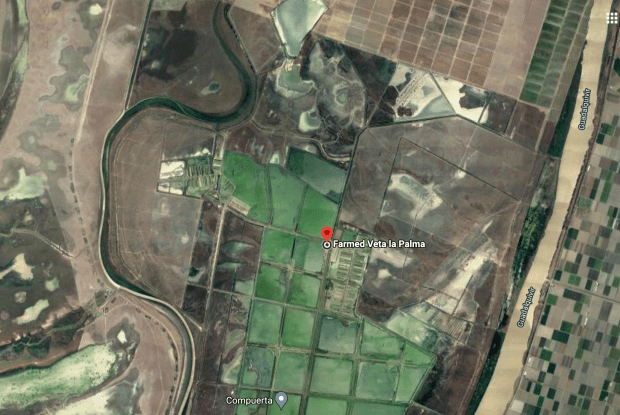
Spotters in Africa and the Iberian Peninsula continue to report Osprey sightings. There are now more than 600 in Senegal alone. I know that each of you will be thrilled to hear that Loch of the Lowes couple Laddie and NC0’s 2021 female fledgling, LR2, has been repeatedly spotted in Spain. She is at the Veta la Palma Espacio Natural Donana, La Puebla del Rio.
This is one of the largest nature reserves in all of Europe. She could not have picked a safer and more appropriate spot for her very first winter. Here are the map images and here is a link to the website so you can see all of the birds and wildlife at this ecological site. I am also posting this in case some of you want to travel at some time to see the birds – all kinds – this time of year – but do not wish to go all the way to Africa.
It is always good news when the first year fledges find a safe place with abundant resources. It is even better when we know about it and can celebrate with them. As you know only about a third of the fledglings succeed so big smiles all around. Laddie and NC0 would be thrilled! Another Rutland bird, Blue 081, a male fledgling of Maya and Blue 33 spent his first year, 2020, and has been seen this year, at Veta la Palma, Cota Donara, Spain. I continue to wait with great hope for news of Blue 463, Tiny Little Bob from the Foulshaw Moss Nest.
It is early morning in Australia. Mirvac has changed the zoom on the camera for the 367 Collins Four but you might find that the eyases are still out of view. I understand that it will not be changed again. You can hear the little ones running around on the metal.
Diamond and Yarruga are awaiting a breakfast delivery.
The trio at Port Lincoln Osprey Barge are still snoozing.
There has been no further word about WBSE 28. WBSE 27 has been seen by several people and photographed near to the Discovery Centre across the river from Lady and Dad’s roost. They will surely know where 27 is and be providing food for it. The eagles first get their flying and landing skills down before fishing and hunting (normally). The parents help them by providing them with food. I sure hope that Lady and Dad also know where 28 is! Ranger Judy reported she has done a walk through the forest adding she did not hear or see anything but that it is a large area.
That is it for today. It is a cool sunny day on the Canadian prairies and it is time to clean up bird seed. The goose flight images were not good last night because of where people had to stand due to pandemic restrictions. I hope to go out to the other nature centre before the end of the month to see if I can catch some of the thousands of Canada Geese making their way south.
Take care everyone. Thank you so much for joining me today.
Thank you to the following for their streaming cams where I took my screen shots: the Port Lincoln Osprey Project, the 367 Collins Street Falcons by Mirvac, and Charles Sturt University at Orange Falcon Cam and Cilla Kinross.
The following was posted on the Sea Eagle FB Page. I took a screen shot of the entire entry to share the good news with you. Thanks so much to Rohan Geddes for getting those great images.
Lady and Dad roost on the Parramatta River near to the Discovery Centre. I have put the red pushpin at the location of the Discovery Centre. You can see the Parramatta River just at the end of the walk. Many who visit the area have coffee along the river (see Orange Cafe sign) and watch the sea eagles if they are roosting.
This is just great news. Such a relief.
These are such challenging times for these juveniles. They have to get their flying – and as the poster says – their landing – under control while still navigating to get food from the parents. The fact that 27 is so close to the river shows great promise.
There has been only a glimpse of 28 and it is unclear if that was the one on the afternoon of the fludge or later. Send them both lots of positive wishes.
Just a couple of other mentions. The Collins Street Four are on the move. They were out of sight of the camera yesterday. Do not worry! They are running along the gutter to the other end exploring. Yesterday one started and all the others followed!
Yarruga continues to eat and grow stronger. Yesterday it was almost standing upright!
The Port Lincoln osplets had fish at 06:25, 12:56, 14:16 (Mum brought fish in), 17:32 was a fish tail, and 19:24. Here is a peek at that last feeding of the day:
Thank you for joining me this morning for this update on the WBSE fledglings. It is sunny and cold, 2 degrees C, on the Canadian Prairies. There are a few Slate-grey Juncos hanging on but the garden is fairly quiet this morning. I wonder if there will be any Canada Geese landing this evening? If so, I hope to get some good images for you. Take care all. Stay safe.
Thank you to the Sea Eagle FB where I took a screen capture of the posting of WBSE 27 and to the Port Lincoln Osprey Project and the 367 Collins Street Falcons by Mirvac for their streaming cams where I took my screen shots.
I thought that it was going to be hectic for Mum and Dad to keep the Collins Street Four supplied with pigeons. I never thought about the parents chasing them all over the gutter to make sure that each one gets fed! I don’t think any of us ever have to worry about the dedication and focus of these Peregrine Falcon adults. This feeding was quite extraordinary!
Did little Yurruga spend the night sleeping in the corner of the scrape box while Diamond tried to incubate her unviable eggs?
The feeding of Yurruga at Orange is so different than that of the Collins Street Four. However, looking ahead one week we should anticipate that Yurruga will be excited and nipping at the prey as the Melbourne falcons.
Yurruga makes some of the cutest faces and gestures.
There was a peanut size fish delivery at the Port Lincoln Osprey barge earlier but the three osplets and Mum are still waiting for Dad to bring in something substantial.
Dad brought the tiniest fish to the nest this morning in the Sydney Olympic Forest. He waited for about half an hour but no eaglet appeared. The Pied Currawongs were a menace to Lady, too, and eventually they ran him off the nest.
I remember Lady and Dad coming to the nest last year trying to lure 26 back so they could feed her. I wonder if one of the eaglets is still in the forest? There have been no reports since 15:30 on the day 28 fludged and 27 had its forced fledge.
OGK continues to wait for the arrival of YRK at the Taiaroa Head Royal Albatross Colony in New Zealand. Send every speck of positive energy his way. I so hope she flies in this week!
Here on the Canadian Prairies the weather has turned quite coolish. The number of birds in my garden have dwindled. Today there were only six Slate-grey Juncos and the House Sparrows. Grey Squirrel loved it because he had more than enough seed to fill him and four others to the brim! Tomorrow I will be at the nature centre to watch the thousands of Canada Geese land at dusk. It is eerie – the garden being quiet. I cannot imagine a world without the sound of the birds.
Thank you for joining me. Do take care. Stay safe and be happy.
Thank you to the following for their streaming cams where I took my screen shots: the Port Lincoln Osprey Project, 367 Collins Street by Mirvac, Sea Eagle @Birdlife Australia Discovery Centre, Charles Sturt University at Orange FalconCam and Cilla Kinross.