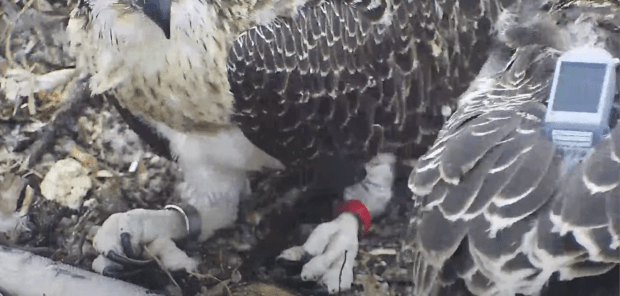
Grinnell update!

The plumage on a Peregrine Falcon is incredibly cute. Those beautiful slate grey heads, the horizontal striped pantaloons, the white chest, the gorgeous yellow legs and talons and cere.

One of the cutest is the little 8 year old lad below, Grinnell. Grinnell was, until the 29th of October, the resident male along with his mate, Annie, at The Campanile on the grounds of UC-Berkeley in San Francisco. On that day, Grinnell had an altercation with two falcon interlopers. He was found grounded on a garbage can about a mile and a half from The Campanile. Was he driving the interlopers out? was he fleeing? We will never know. Fortunately, he was found and taken into care at the Lindsay Wildlife Centre. There he had surgery on his wing and received antibiotics, anti-parasites, and anti-inflammatory drugs. He was doing well enough when he arrived at the clinic that he could feed himself. Apparently he quite loved the quail!

As you can see from the FB posting below, Grinnell is doing well.

Decisions will be made as to where he will be released by a couple of agencies. It is not known if Grinnell will return and fight for his territory and Annie, his mate of 6 years. Only time will tell. The good news is that Grinnell is recovering from his injuries.

Meanwhile, Annie has been getting friendly with the intruder. Oh, I wish it would go away! Annie does not know where Grinnell is and she has been scraping in the box, etc indicating that she is receptive to the new male. Falcon experts have stated that Annie will not enter into the battle if the two males rival for the territory – prime real estate! She will want to protect herself so that she will be healthy during breeding season.

Keep sending positive thoughts Grinnell’s way.

I know that some have been worried about the falcon left on the ledge at 367 Collins Street. At 11:12, Dad brought a huge prey item onto the ledge. You can see the eyas beginning to mantle, very excited. The bird was not prepped and Dad worked on it but the chick was not eating. I am not a vet but it appears that something is causing the chick to not be able to open its beak wide enough to eat. The chick appears not to be preening despite the floof (this normally causes them to itch and preen constantly) and I am concerned that there is ‘something’ not right.

I am not that familiar with the birds in Australia but it looks like it could be a Sulphur-Crested Cockatoo or a Gull.

I feel really sorry. The Dad is working hard to feed and get the little one to eat and well, it appears that it can’t. It is only a guess as to what is wrong with the chick. Will anyone do anything to get it into care, I do not know. Every country and even every state is different in their laws and attitudes. All we can do is hope that the wee bird will improve on its own.

The weather in Port Lincoln is dire. One of the boats near the barge has gone under the water in the rough waves. No one was on board. It is a cold front moving through the area. It is 13 degees C with 32 kph winds. It is not a good day for fishing with the choppy water but the osplets have been doing some hovering. I hope they don’t get blown off the nest prematurely! So far they are all safe and secure!

I wish I had better news about the little falcon on Collins Street. Send lots of love and positive wishes for there to be a turn around or — for a miracle and someone approve it going into care.

Take care everyone. See you soon.

Thank you to the following for their streaming cams where I took my screen shots: 367 Collins Street Falcons by Mirvac and the Port Lincoln Osprey Project. I would also like to thank the individuals who have shared the FB posting about Grinnell.

Fall to winter

The beautiful weather that we had on the Canadian Prairies yesterday was due to dramatically change over night.

Footpath linking Portage Avenue with Assiniboine Park over the Assiniboine River

Our weather will go from nice blue skies and unseasonably warm temperatures to snow and then snow mixed with rain. It is currently 0 degrees C and will warm up to a balmy 2 degrees C in the morning when the precipitation begins. My daughter messaged me to tell me there were still some Canada Geese and ducks in the Assiniboine River. It seemed like a good time to get out and go for one last nice walk.

The little Red Squirrel at Assiniboine Park knows that the warmth is not going to last. It was busy pulling off the seeds from a Maple tree and cramming them into holes and in the grooves in the bark of a tree. He was so busy he did not even notice the people standing and watching him.

The geese were looking for any blade of grass to eat they could find.

Some were in the duck pond flapping their wings trying to stir up the plants from the bottom of the pond.

Others were simply enjoying a beautiful afternoon in the warm sunshine.

It gets dark around 17:00 and as I was leaving some of the geese were flying away. Are they heading south for the winter?

I really hope that the geese and ducks got out of the City last night like the ones above taking flight. As promised, we have snow. Mr Blue Jay has come to visit and the sparrows are trying to find seed under the snow.

There are many feeders filled with sunflower chips, suet, black oil sunflower seeds, and then that wonderful ‘trail’ mix which looks better than what I make.

The sparrows in the snow on the deck know there are goodies underneath. Why they are not back at the feeders I cannot tell you. There is room for everyone there.

What a handsome little House Sparrow this fellow is. You can always tell them by their grey caps!

So how do birds cope with winter? This article was published by Daisy Yuhas in 2013 but it is still accurate now. Have a read – it is really interesting:

“Each autumn as many birds begin epic journeys to warmer climates, there are always some species that stay put for the winter. These winter birds have a better chance of maintaining their territory year-round, and they avoid the hazards of migration. But in exchange they have to endure the cold.Like us, birds are warm blooded, which means their bodies maintain a constant temperature, often around 106 degrees Fahrenheit. To make enough heat, and maintain it, they’ve evolved many different strategies–some similar to our own.Sparrows, for example, seek out shelter in dense foliage or cavities to avoid the elements. They also huddle, bunching together to share warmth, and try to minimize their total surface area by tucking in their head and feet and sticking up their feathers. Cardinals, impossible to miss against the snow, and other smaller birds puff up into the shape of a little round beach ball to minimize heat loss.”Big birds, like geese and grouse, do what we do,” says physiologist David Swanson at the University of South Dakota. “They put on insulation.” Their insulation often involves growing an extra set of insulating downy feathers.Birds can also put on fat as both an insulator and energy source: More than 10 percent of winter body weight may be fat in certain species, including chickadees and finches. As a result, some birds spend the vast majority of their daylight hours seeking fatty food sources, making feeder food even more precious for surviving a frosty night.When asked which birds are toughest winter survivors, Swanson points to little ones like chickadees. These small creatures can’t put on too much bulk for aerodynamic reasons. Instead, explains Swanson, they are experts in shivering. This isn’t the familiar tremble that mammals use to generate heat. Birds shiver by activating opposing muscle groups, creating muscle contractions without all of the jiggling typical when humans shiver. This form of shaking is better at retaining the bird’s heat.Another adaptation shared by many species is the ability to keep warm blood circulating near vital organs while allowing extremities to cool down. Take gulls. They can stand on ice with feet at near-freezing temperatures while keeping their body’s core nice and toasty.Keeping warm when the sun is up is one thing, but few winter challenges are more daunting than nightfall, when temperatures drop and birds must rely on every adaptation they have to survive their sleep. Some birds save energy by allowing their internal thermostat to drop. Hummingbirds are a famous example of this, undergoing torpor nightly as their body temperature drops close to outside temperatures. But torpor is not too common in winter birds, because the morning warm up would take too much extra energy. Instead, black-capped chickadees and other species undergo a more moderate version of this, reducing their body temperature as much as 22 degrees Fahrenheit from their daytime level in a process called regulated hypothermia.One simple way to help birds when the weather outside is frightful is to hang feeders. To attract a diversity of birds, select different feeder designs and a variety of foods. A tube feeder filled with black oil sunflower or mixed seeds, for example, will attract chickadees and finches. Woodpeckers devour suet feeders. And a safflower or sunflower-filled hopper feeder entices the usual visitors plus larger birds like cardinals and red-winged blackbirds. The birds benefit from the backyard buffet, and you’ll have a front-row seat to numerous species flocking to your plants and feeders.” Some raptor species, lower their body temperatures. More on that another day as we shift from fall to winter.

It is not clear how many birds are on the ledge at 367 Collins Street. The Mum was there overnight with one – the one with some floof still on its back and wings in the scrape box below. There were two. Where is the other one? at the other end? flown off? difficult to tell. The one on the scrape box has just vocalized and headed down the gutter. I suspect it could be breakfast.

It is almost flying along the gutter now.

Fledging will be happening soon down in Port Lincoln and if you want to see how a hungry falcon acts just go over to the scrape in Orange. Yurruga is a week younger than the eyases in Melbourne. It is really foggy in Orange this morning so breakfast could be delayed. That link is:

Look for a lot of wing exercises and hovering from the trio at Port Lincoln. Ervie was doing a fabulous job yesterday.

Oh, I am really going to miss these lads when they fly to find their own way. Last year it was this Osprey nest that almost put me off my interest in third hatch ospreys. Siblicide is horrific. And it is this same nest (along with Achieva and Foulshaw Moss) that gives me hope that things can turn around for the good for the chicks. It has been incredible this season.

It is time for some hot tea. Thank you so much for joining me. Take care everyone. See you soon.

Thank you to the following for their streaming cams where I took my screen captures: 367 Collins Street Falcons by Mirvac and Port Lincoln Osprey Project.

Collins Street Commotion

This morning at 5:59 one of the eyases at 367 Collins Street started ‘carrying on’. She was quite worked up.

She is calling and running back and forth on the ledge. In fact, she has been doing this and looking up for the past fifteen minutes. She is the last one on the ledge and there is someone on a higher ledge edging her on. You can certainly hear her! Is it a sibling? is it Mum or Dad?

Around 07:59, there was a prey delivery at the other end of the ledge. Our lonely little ‘last one on the ledge’ ran, very hungry. All went quiet! Maybe she got the entire pigeon to herself.

Breakfast has arrived.

Oh, she sure can run when food is involved! Amazing parents.

The last chick on the scrape hatched three days later than the others. This could, of course, be the reason. But it could also be that she is a large female. One year there was a large female left on the nest, the last to fledge. She was Big Red and Arthur’s J1 from 2020. She really did not want to leave the light stand. She didn’t seem to have the confidence to fly but she did once that Little J3, the third hatch, flew. Sadly, J1 flew into a window a week or so later. J2 and J3 survived and left the area for their own territory many weeks later but, I always wondered if J1 had just waited a little longer would it have made a difference? Perhaps not.

Three ringed osplets in nest, Mum on perch, Dad in his man cave. 10 November 2021

Yesterday, the Mum at the Port Lincoln Osprey barge fed the three ringed nestlings for over two hours, from 14:05-16:32. Someone felt sorry for her. I would like to take a different view. Yes, it was a long feeding but she knows that these three wonderful chicks will not be on the nest much longer. Yes, this might appear to be anthropomorphizing but she knows that they are about ready to fly. Just like keeping control of the food so everyone eats, she knows.

There are a lot of people thinking that Ervie is going to be the first to fledge. Here he is winging it right as the sun is coming up on the peninsula.

Mum has just flown off the nest. Ervie is watching her.

She returns with a fish. Mum has control and everyone has eaten. You will notice that Ervie is still up at her beak.

Oh, and Ervie is still getting fed 9 minutes later! What a guy. I really hope he is a good fisher and he remembers all these nice fish that Dad brought to the nest because that is going to be his ‘job’ as a male Osprey. He is the supplier of fish.

There is some very good news coming out of Port Lincoln. The osplets on Thistle Island were ringed, weighed, measured, and named yesterday. Guess what? Two healthy females. The largest came in at 1630 grams – 250 grams or nearly half a pound – large than Ervie on the PLO nest. That female was named Meg and carries a Maroon band. The other female is named Lucy and she has an Orange band. I began to imagine these lads at the PLO nest pairing up with them in a couple of years. Buy some more barges PLO!

There was more excitement on Thistle Island. Two other Osprey nests with chicks were found! Incredible. So happy for the success of the Ospreys in the region. If you want to read more about this or see the images please go to FB and search for Port Lincoln Osprey.

It is a beautiful day on the Canadian prairies. Tomorrow they are promising – 100% rain or snow. The squirrels are busy finding nuts and there are fewer and fewer geese about. It has been so nice for so long that I began to doubt if we were going to have winter. Silly me.

Take care everyone. Thanks for joining me. See you soon.

Thank you to the 367 Collins Street Falcons by Mirvac, and the Port Lincoln Osprey Project for their streaming cams where I took my screen shots and video clip.

YRK lays her egg at Taiaroa

It is still the middle of the night in Australia and New Zealand so not a lot is happening in Bird World.

The rangers at Taiaroa Head in NZ shocked everyone when they announced that OGK’s mate, YRK, laid her egg yesterday. She obviously snuck in and visited with OGK and no one saw her. Chris McCormack shared an image of OGK and YRK at the nest OGK prepared down the hill from where Atawhai hatched. This was on the Royal Cam Albatross FB Page. Thanks, Chris. This will be the couple’s 8th breeding attempt. As most of you know, they were the parents of the Royal Cam chick in 2020.

For all Royal Albatross fans, the rangers also announced that 111 birds are on the island and 15 eggs have been laid. Eggs take approximately two months to hatch.

There are still two Peregrine Falcon chicks to fledge at 367 Collins Street in Melbourne. The first fledged at 06:34 on 8 November and the second at 07:46 on 9 November. Take note that those are early morning times. Falcons typically fledge in the early morning or early evening but not normally during mid-day.

The adults have brought prey onto the ledge for these two. In fact, the parents will continue to provide food to all four of their chicks until the chick makes its ‘first kill’. These two could fledge at any moment.

What you are looking at below, is an image of Bazza (Red band) looking enviously at the empty talons of Ervie (Dk Green band). Ervie managed to take the fish tale from Falky (yellow band) and didn’t share a scrap. Bazza was hoping there would be some left. No. Never. Fish tails must be very special – everyone wants them!

There’s Ervie eating that precious tail. Awwww. It is nice to know that having that sat-pak has not changed Little Bob at all!

I am a raptor person but so many enjoy watching the feeders for the Boreal birds. There is one that is just up and running, sponsored by Cornell. It is located in Northwestern Ontario. Here is the link if you would like to check it out.

Last but not least, those pesky Spotted Eagle owlets in Joburg. Yesterday there was only one owlet left in the nesting box. The adoptee and one of the resident owlets are both wandering around in the garden of the owner. Mum, in the meantime, is having to feed the one inside the box and then go and feed the other two. She is busy! Here is a short video of the one in the box. It is really watching its siblings and well, who knows, it could be down there any minute!

It is 17:35, still day light, and the little one is still in the box.

This is just a quick check. There have been no updates on the satellite trackers of Karl II, Udu, and Pikne, the Black Stork family from the Karula Forest in Estonia. It is hoped that they are out of range and enjoying their winter vacation. If so, we will have to wait until next spring to find out if they are alright. There is also no update on WBSE 27. The last one was 5 November. There is, however, going to be a webinar where Ranger Judy talks about her work with the WBSE as well as other guests. It is later in November. If you are interested in joining in, check out this link and follow the instructions.

Thanks so much for joining me. Take care everyone. See you soon.

Thank you to the following for their streaming cams where I took my screen shots: EcoSolutions, Port Lincoln Osprey Project, 367 Collins Street Falcons by Mirvac and to Royal Cam Albatross FB Page and Chris McCormack for the image of OGK and YRK.

Monday in Bird World

On the Canadian Prairies, it is 8 November and it is 11 degrees C. There are some birds still around the southern part of our province including a large number of Great Horned Owls (GHOW) and Barred Owls (BADO). Several hours from where I live there are some hawks and Bald Eagles still making their way south. In celebration of such a gorgeous day with the promise of snow and plummeting temperatures on Wednesday, we decided to make one last check at Oak Hammock Marsh.

It was simply grand. You could see for miles.

The walk was great. It was sooooo quiet, a wonderful change from the noise of the city. If you were intent on counting tonnes of birds and seeing lots of species, then it was a bust! There were about 60 Canada Geese scattered about and a couple of Mallards, a male and a female.

They were all feeding on the tender marsh grasses below the surface.

Even the geese were quiet, no honking, nothing. Just working hard on those plants.

The two Mallards were quite interesting. They were sort of breaking down the grasses as they moved through forcing them under the water with their paddles and then eating them.

Beautiful little female Mallard.

The ducks were not bothered by the geese – everyone seemed intent on eating and enjoying the warm sunshine. The farmers in the area have finished harvesting their crops and the fields are bare. In several hours only six or seven Canada Geese flew into the wetlands.

It might have been quiet in rural Manitoba but there was a lot of things happening elsewhere. First up, for all of you that watch the Royal Albatross, OGK’s mate since 2006 has been YRK. OGK was first in on the peninsula excited to see her and build a nest but…she didn’t arrive. Time passed and she didn’t arrive. Today, 9 November YRK landed on Taiaroa Head. If people could have rung bells they would have. Instead many of us sat and shed tears. The fear is always there. OGK and YRK were the parents of very popular Royal Cam chick, Atawhai (aka Pippa) in 2020. This year will be their 8th breeding attempt.

In other Royal Albatross news, the new couple – Red and BOK (Blue-Orange-Black) have really been entertaining us. They are so sweet. Well, today, Red got some new bling. As one of a mated pair, he is now WYL (Whit-Yellow- Lime).

The image below shows the Ranger giving Red his new bling and identity. BOK is walking off the nest. She will return once everything is over.

Could this new couple with their first attempt at breeding turn out to be the Royal Family of the year? We wait.

The Port Lincoln Osprey Mum decided it was time to go to the spa. She flew off the barge and went over and had a lovely bath in the warm Australian waters of the cove yesterday. It is well deserved. Her and her mate have raised three healthy boys this year.

Isn’t Mum just beautiful?

It is hard to keep up with the 367 Melbourne Peregrine Falcons. I ‘believe’ that there are two (probably female) still on the ledge.

Yes, still there. There is a lot of noise and it could well be the parents trying to lure these two off with prey.

There are theories about gender and fledging times in falcons and hawks. Because the females are substantially larger, it takes longer for their bodies to feather. Therefore, they generally fledge after the males. I do not know how accurate it is but I hear this often.

In Orange, Diamond’s foot is doing much better. At 8:11 Xavier, the male Peregrine Falcon of the scrape on the water tower of Charles Stuart University, delivers a Starling to Yurruga. Xavier does not wait. He drops the breakfast prey and gets out. I don’t blame him. It could definitely save his talons.

Notice how big Yurruga is compared to Xavier. Think Yurruga is a female like her mum, Diamond?

Yurruga is a very good plucker!

Cilla Kinross just posted a video clip of Yurruga. It is really short. Have a peek. I do not think those eggs are going to last much longer.

Everything is as it is expected at Port Lincoln. Dad flew in with a really nice fish but instead of letting the chicks do a grab, Mum got over quickly, mantled the breakfast, and proceeded to take control of the feeding.

It should, by now, not surprise anyone to the identity of the chick right up at Mum’s beak. Now the chick can be identified quite quickly – it’s Ervie! aka Little Bob.

The rule of thumb is that the males return to make their own nests near their natal nest. I hope there are three or four more barges available.

One last nest. NEFlorida with Samson and Gabby. They are both very busy working on that nest. They have been bringing in a lot of big twigs. Here is Gabby moving some of those around.

Cute little Samson looks like he is standing very still in his tight black jeans waiting for orders. What a sweetie.

Samson is a very good listener and Gabby is giving precise instructions. Looks like they are already thinking they need high rails this year.

Thank you so much for joining me today as we check in on some of ‘my’ favourites. Take care everyone.

Thank you to the following for their streaming cam where I took my screen captures: Cornell Bird Lab and NZ DOC, Port Lincoln Osprey Project, NEFlorida Eagle Cam and the AEF, Charles Sturt University Falcon Cam and Cilla Kinross, and 367 Collins Street Falcons by Mirvac.

Port Lincoln Osplets have names

Oh, there was such excitement yesterday. The Port Lincoln chicks were banded and, in addition, there were rumours that 3 or 4 of the Melbourne eyases had fledged. Let’s put that rumour to bed. Mum is sleeping on the weather protector above the four. So everyone is still home. That is fantastic. Maybe they will all fledge from this end so we can see!!! Ironically, Victor Hurley said they would turn the camera around to face the other direction after his Q & A session so there was a better chance to see them fledge. With two ends and one camera, it is very difficult to predict which end will prove to be ‘the one’.

Port Lincoln wanted to band a male chick because they wanted to compare his dispersal to that of the female, Solly, who fledged last year from the PL nest and has a tracker. Solly has taught osprey researchers much including the distances that female osprey will disperse. In Solly’s case, she traveled 311 km to Eba Anchorage. There were rumours that osplet 2, Middle Bob, was to get the tracker because it was thought he was the only male. In the end, Port Lincoln had three males to choose from and they went with the one who weighed the most – Little Bob – who turns out to be the ‘biggest’ Bob.

Here are the names and weights:

  • Big Bob, first hatch, has a red band, weighed the least at 1280 grams and is named Bazza. The name celebrates Take 2 Photography’s husband, Barry Hockaday, who did so much to bring the Osprey Barge to a reality.
  • Middle Bob, second hatch, has a yellow band, weighed 1330 grams and is named Falky after Ian Falkenberg, the bander.
  • Little Bob, third hatch, has a dark green almost black band, weighed 1380 grams and is named Ervie. It is the name of the Scottish town where Australia’s current Minister of the Environment grew up. This choice focused on the fact that the growth in the Eastern Osprey population and this project would not be possible without the Minister’s support.

And that is how ‘never miss a meal Little Bob’ became the biggest Bob! And got the sat-pak! Well done, Ervie.

The chicks behaved as expected. When the boat came close they pancaked so much you could not see them above the nest. Each was removed and put in a small sack. There was no stress at all. A gift of fish was put in the nest. The parents returned within minutes of the chicks being put back in the nest. It was a beautiful process and so much will be learned through the monitoring of Ervie’s travels including dispersal and threats. I will not deny that I am a huge supporter of banding and tracking. It is the only way to learn where the birds go, where they breed, what dangers there are in the environment, what happens to them, etc.

I admit to being very tired this morning. I could not stay awake long enough to find out the names last night or, should I say I stopped waiting at 2 am in Canada. It was so nice to run to the computer and see all the information this morning.

Many wondered how they could donate to keep the cam running at Port Lincoln. It is complicated and it is my understanding that they cannot accept donations. That said, if you or someone you know is going to the area why not take one of Calypso Star’s nature tours? Go out to see the sea lions or get in a cage and watch sharks. That would be a great way to thank them.

Update on WBSE 27 on 5 November (in case you missed it): “SE27 is doing well, gaining in strength and is feeding by itself. It has moved to a larger raptor cage to allow it to exercise and recover. The treating vets have advised that SE27 will be in care for a few weeks while it recovers and will be released back into the wild as soon as it’s well enough. Healing takes time so please be patient. Updates will follow when possible.”

It is another gorgeous day on the Canadian prairies. 13 degrees C. The sun is bright and I can see the squirrels already hoping that their breakfast will be taken out to the deck. They are a little early.

Take care everyone. Thank you so much for joining me today. See you soon.

Thank you to the following for their streaming cams where I took my screen captures: the Port Lincoln Osprey Project and the 367 Collins Street Falcons by Mirvac.

Everyone is a ‘Bob’

Oh, what a day!

The banding and measuring of the Port Lincoln osplets began well after lunch once the boat – the Calypso Star (above) – that took tourists out to see the sea lions returned. The entire process took approximately two hours. Mum positioned herself on the boat anchored next to the barge with the nest on it. At various times she expressed her growing dissatisfaction. She wanted her chicks back on the nest. There she is in the image below on top of the mast.

When Mum got tired of waiting, she flew up to the barge pole and began yelling at the banders to hurry up!

There they are in the nest before the banding took place. All nice and calm.

First off, I was wrong! Little Bob is Little Bob. Big Bob is also Big Bob. Middle Bob is also Middle Bob. All three are judged to be male.

It was only after Janet Forster said they were all males on the chat that things began to fall into place. There is only 51 hours separating the oldest from the youngest. That is incredible in itself. I cannot comment on prey deliveries in former years but the fish were consistent this season leading to food stability. To me, this was possibly the calmest, most civil osprey nest with three chicks I have ever seen. Does gender play into that? Is a nest with three males much less prone to aggressive rivalry? than if there is a female on the nest? or two females?

It is almost 4pm in Port Lincoln. We are still awaiting the names and to see who got the tracker. PLO wanted the tracker to go on a male. This was because the tracker was put on Solly, the first hatch and a female, last year. Now they have a choice of three! Oh, I am hoping for Little Bob.

Chicks returned to the nest at 15:41:33 with some fish treats.

The chick on the right has a yellow band and has found a fish and is really doing well at the self-feeding. Some of the images are a little blurry. Everyone loves that Middle Bob got the yellow band – ‘Mellow Yellow’ they are calling him.

One chick is looking out to sea and not quite ready to have fish. And then there is the one right up front, right under Mum’s beak wanting fish. That chick has a black band and there is a sat-pak on its back. Can you guess who loves to be fed by Mum? and who is decidedly the ‘Big Cheese’ on the nest now – for certain? and who is always at the table first? I know you know who that is!

Little Bob got the satellite tracker! Tears are flowing down my cheeks.

The nest started off with seven fish. There are only three left now. Ah, now two. Dad came and took one and joined in the celebration.

Here are a series of close up images. You can clearly see the red band and look, there is also a metal band. It is the Australian Bird and Bat Banding Scheme. Each bird (or bat) has a distinct number. If found, the number is called in to identify it for tracking purposes. There is a similar scheme in North America.

The sat-pak, if it is like the one that Solly has, should last for up to four years. It is going to be fantastic to see how far a male fledgling goes from the natal nest. You might remember that Solly broke all expectations when she moved more than 300 kilometres away from Port Lincoln to Eba Anchorage. No one realized the females would disperse that far. It brought a new understanding to the movements of the Eastern Ospreys.

So typical. Little Bob decided to come back for seconds.

The chicks have had a stressful day. They are doing fine and so are the parents. All that nice fish left by PLO surely helps.

Little Bob is looking through the nest for any leftovers! Typical. He stole a lot of hearts from the time he karate kicked his way out of his shell to putting a big sibling in its place a couple of times when they thought they might push him around a bit. It did not work. If he was hungry, he was always up at the table and ready to eat. No one would stop him. He is a great choice for this tracker.

We are just waiting for the names to come in. It is now in the wee hours of the morning in Canada. Someone just commented that while they will have official names, they think #3 will always be Little Bob. Could be. Someone else suggested Big Bobbie. I hope he lives long – I hope all of them do – and father many healthy chicks to help bring the population numbers of Eastern Osprey up.

This is a momentous occasion. So very happy for the Port Lincoln Osprey Project, all the people behind the scenes, and this amazing osprey family.

Thank you so much for joining me. Next stop at this nest: fledge. Perhaps in 7-9 days. That will come too fast. Names have not been released yet. I will post those tomorrow. It is nearly 2 am and I am zonked. Want to bet they will post the names the minute I publish this blog? Most likely. Take care everyone.

Thank you to the Port Lincoln Osprey Project for supplying the streaming cam where I took my screen captures.

Soap Opera at the Campanile and other nest news

The soap opera playing out with the Peregrine Falcons at tThe Campanile on the grounds of UC-Berkeley made the Los Angeles Times this morning:

Annie only knows Grinnell is not there and it appears she might be taking up with the interloper that caused Grinnell’s injuries. My goodness!

The birds are stirring at Port Lincoln this morning. Before 6am there was calling from the nest. There were only 3 birds but it was Mum calling Dad with the breakfast order. No. It was the chicks calling Dad wanting their fish! They are so big. Ready to begin flying.

Just look at those three birds. I sure hope they stay in the nest and pancake when they are to be ringed today but I am worried the sound of the motor boat is going to make them bolt off the nest early. I so want to be proven wrong, for the sake of the birds, and foolish for even thinking such a thing.

Janet Forster says they will come in a boat and dingy when the boat gets back from the Sea Lion Tour. Fingers crossed. We will not be able to see this live but I am hoping either pictures or a video will be shared later. The trio were fed six times yesterday. It should have been seven but dad lost a fish and he found it and decided he would eat the entire thing!

Is this to be the day that at least one of the 367 Collins Street Four fledges? They slept on the ledge last night. Will they fly off together?

Yurruga had a lot of prey items yesterday. She sported a nice crop and is doing really well with her self-feeding. What a lovely independent eyas. In one instance, Xavier came in with a Rosella. Even with a crop Yurruga seemed to want to have some of it – they must be very tasty. Someone told me they are the equivalent to the pigeons in the city – parrots everywhere – but I have no idea if that is true. In the end, watch and see what happens. Oh, and before I forget. Diamond’s limp is still there but it is improving every day.

There is an updating on WBSE 27 by Judy Harrington. This is what she posted: “SE27 is doing well, gaining strength and is feeding by itself. It has moved to a larger raptor cage to allow it to exercise and recover.
The treating vets have advised that SE27 will be in care for a few weeks while it recovers and will be released back into the wild as soon as it’s well enough. Healing takes time so please be patient. Updates will follow when possible. BTW, we hear fish and mice have been on the menu!
It is unlikely any photos will be issued while in captivity.
There are no reported sightings of SE28.” That is good news for this beautiful sea eaglet, WBSE 27.

It is really windy down in Ft Myers, Florida. M15 has been bringing his mate, Harriet, some nice treats in the last few days. The other day it was a Cattle Egret. She was delighted. The pair continue to work on their nest. Wonder when the first egg will appear?

Harriet being blown a bit by the wind. 6 November 2021

It is stormy over in Jacksonville, Florida. Still Samson and Gabby were both on the nest in the wind and rain preparing it for this season. Oh, goodness, this couple just warms my heart! (Yes, we all have our favourites. I admit it).

The weather out in Colorado is perfect and the Bald Eagle couple on the Fort St. Vrain Bald Eagle Nest are busy working, too. Last year they raised one chick. Wonder if they will make it two this year?

There is one eagle, at this very moment, working on the nest in the Kisatchie National Forest. I do not know if it is Anna or Louis. This is their second season together. So glad to see the couple returned. Last year was the first since 2013 that an eaglet had hatched and fledged in this nest. Nice to see the young family here. That is a great image on the two cameras and the sound is excellent this year. Cody and Steve have really been working on the set up. (Thank you!)

I am afraid that I could go on checking Bald Eagle nests and we would see the same image – one or both adults working on the nest. The eagles have really come back from nearly being wiped out. I hope there are enough big trees for them for nests!

It is going to be awhile til the PLO chicks are ringed and, believe it or not, it is 14 degrees C on the Canadian Prairies. Summer weather. Well, this is what our summers used to be like: 14-17 degrees C. Now you can double that. The sun is shining, the sky is blue, and so far, Dyson is leaving Mr Blue Jay’s corn cob alone. It is a great day for a walk. See you later. Take care everyone.

Thank you to the following for their streaming cams where I took my screen shots: X-Cel Energy, Port Lincoln Osprey Project, 367 Collins Street Falcons by Mirvac, SWFlorida Eagle Cam and the Pritchett Family, NEFlorida Eagle Cam and the AEF, the KNF Bald Eagle Nest, and Charles Sturt University Falcon Cam and Cilla Kinross.

Port Lincoln Osprey, update

It is currently late afternoon in Port Lincoln, Australia. The osplets have been flapping their wings steady all day. At one point, I felt that one or more of them might take flight.

The original timing of the ringing, measuring, naming, and attaching at least one sat-pak to one of the trio was to be Monday 8 November. That timing has been brought forward. It will now take place in the morning Sunday 7 November Port Lincoln time.

It is unclear to me if you will be able to see the process or not. Please check your local time with that of Australia if you wish to check to see what is happening live. The link to the streaming cam is here:

On Monday, the Thistle Island chicks will be banded and one will get a sat-pak.

Oh, I can’t wait! Time to set the alarm.

Take care all. Thanks to Port Lincoln Osprey Project for their streaming cam where I took my screen shot.

Excitement in Bird World

It has been quite the day in Bird World. It started out with gorgeous weather on the Canadian Prairies and my hunt for Wood Ducks. Were they still here? Yes, they were! There was only a pair at Kildonan Park but what cuties they were. I almost didn’t see them at first. They were both standing on a log back in a hollow with an overhang. I have so fallen in love with Wood Ducks the last six months.

The last time I visited the duck area of Kildonan Park, there had to be three dozen in the stream near the Witch’s Hut but, not today. I walked up and down the shore, down close to the water, and well, they had to be hidden really well if they were there.

This time it was also easy to count the Mallards. 25 in total. Each of the Mallards were busy either preening or dabbling for food. I thought I would give you a view different perspectives for a couple of the males. Their plumage is simply gorgeous.

In the image below, I love the soft feathers on the chest in contrast with the two white borders of that deep navy. Look at the curls on the tail and the horizontals on the chest. Stunning.

This is a great example of how waterproof their feathers actually are.

There were about 350 Canada Geese at various locations. Some were feeding on the grass, others were in the water. None of them liked the people walking their dogs.

Today was a problem because I wanted to get back and hear the updates and discussion about Grinnell, the injured falcon from UC-Berkeley. Sadly, I did not have as much patience with a little Red Squirrel that seemed to not like my taking photos of the ducks. It chattered away the whole time. Perhaps it wanted its picture taken? I decided that it didn’t because it would not give me one of those cute squirrel poses everyone else seems to capture. This little one was determined to hide behind that branch!

Oh, it screeched at me til I got out of sight! My phone told me that I had a little over an hour. Would it be possible to check on the duck pond closer to where I live? Were there any Wood Ducks there?

I scoured Duck Island at St Vital Park, walked the entire perimeter of the pond, and could only find three Wood Ducks – 2 females and a male in Eclipse plumage (the one in the middle). All of the others were gone.

There were not nearly the number of Mallards or Canada Geese despite the wide open soccer and cricket areas where they can feed.

It seems that the cooler weather a few days ago really did get many to head South. It will be nice when April comes and we can hear them honking overhead. I can’t wait.

I have reported on the update on Grinnell earlier today. You can read about it here and there is a link to the live event in my blog:

https://wordpress.com/post/maryannsteggles.com/27983

At this point it felt like the day was almost over and I had yet to check on the ‘regulars’ – the PLO osplets set to be banded on 8 November, the 367 Collins Street Four, and Yurruga, the Peregrine Falcon nestling at Orange.

The first was little Yurruga. I think I will stop using the adjective ‘little’. Yurruga is growing and changing. She is really beginning to loose that fluffy down revealing her juvenile feathers. Despite the fact that Yurruga has had short bouts of self-feeding, today was a bit of a surprise. I captured it for you in a short video.

Several hours later, Diamond came into the scrape and fed Yurruga the remaining portion of the Starling.

What wonderful training. Yurruga worked and worked on that prey item until she was tired. She did well. Mum knew to give her time and then come in and feed her little one. These are incredible parents. I also want to add that Diamond is walking much better! Her injury is healing.

Wow. Could it get any better? Well, I don’t know if it is better or not but I can say that the three osplets at Port Lincoln are even civil when wing flapping. They take turns! That said, I just about fell out of my chair watching them. Little Bob is flapping first. The trio are to be ringed on Monday, measured, given names, and at least one will have a sat-pak attached to its back. I just hope they are still on the nest! Can you imagine planning for that and they have literally flown the nest? It could happen!

Little Bob really wants to fly.

I am not certain which of the other siblings is featured in this clip testing out its wings. Mum is feeding – it sure doesn’t take long now to consume an entire fish! What a change from six weeks ago. Little Bob is on the right and unknown sibling on the left eating.

They take turns.

All three are getting some air. Oh, my. I was almost afraid to check on the 367 Collins Street Four for fear they had all fledged while I was away or doing other things. Relief. All four were on the ledge a few hours ago.

These are bittersweet moments. Fledge can happen at any time. At least one of them is more than ready. In an interview today, Victor Hurley, the lead researcher of Peregrine Falcons in Victoria, says he believes that there are 2 females and 2 males this year. How lovely!

It has been an exciting day with more to come in the next week. There will be fledges in Melbourne and Port Lincoln for sure.

Thank you for joining me today. Take care everyone.

Thank you to the following for their streaming cams where I took my screen shots and video clips: the Port Lincoln Osprey Project, 367 Collins Street Falcons by Mirvac, Charles Sturt University Falcon Cam and Cilla Kinross.