Everyone loves a new hatch and the two little Osplets at PLO continue to just make me go “awwwwwwwwwww.”
Look at that nice fish Dad has brought in for Mom and the Little Bobs. They are both lined up, mouths open, watching with their eyes which aren’t focusing 100% yet. Oh, so sweet.
There is a pip in the third egg. It was seen about nine or ten hours ago. There is not much progress. Will it be a successful hatch? We wait.
The feedings seem to come often, sometimes an hour apart. That will do much to instil food security to these two – of course, along with those good catches of dad’s.
Around 08:07, viewers might have thought there was bonking going on but it is the lack of clear focus and just seeing a ‘beak’ that they try to aim for. Not intentional. You will know for sure when the pecking is meant to be harmful.
You get a glimpse of the crack in the third egg at 07:15.
The cam operator at Port Lincoln gave everyone a tour of the area. I want to share it with you in case you did not see these beautiful images.
It is a lovely area for an Osprey nest.
This is a great image. It shows you Mum and the nest on the left. You can see how it is raised up. Then look down on the deck. That is Dad’s man-cave. Looks pretty good. He has a nice perch there or there are perches on the ropes that eventually the juveniles might use.
The Port Lincoln Osprey Project has permission for three satellite trackers for this year. This is due to the success of Solly! Yes, you can close your eyes and see me jumping up and down. It is often difficult to demonstrate the merit of using technology but I think the data coming from Solly’s transmitter turned some heads. Now PLO just needs to get the funds to purchase them. With no eggs on Turnby Island, this means that all three of these chicks, if there are to be three, ‘might’ get one.
There have been a few visitors to the Achieva Osprey Nest since Jack and Tiny Little vacated in August. One of those came today – a very hungry young male, I think.
There was a posting on Twitter this morning showing an image of an Osprey eating a fish on the Mt Sentinel tree. It is presumed to be Iris. If so, she is still in Montana and has not come to say goodbye to her nest yet.
I ‘think’ Aran is still in the Glaslyn Valley. I caught sight of an Osprey as the trees were blowing. The Osprey is in the tree behind the pine branch.
Ring-Bill Gulls on the dock. They do not seem to mind the more choppy weather.
The leaves are turning and the landscape is simply stunning.
The Cormorants were very clever. The choppy waves were driving the little fish into the edge of Clear Lake. They waited and were catching their lunch. Very impressive.
Thank you so much for joining me. It is definitely fall in Northern Manitoba and there are few birds about. I was told about a possible sighting of a Blue Heron but I am holding out for some loons! Fingers crossed. Take care everyone.
Thank you to the following for their streaming cam where I took my screen shots: Achieva Credit Union, Port Lincoln Ospreys, and Bywyd Gwyllt Glaslyn.
Ospreys quite similar to the ones we know today were well established in much of their current breeding range at about the same time our earliest ape-like ancestors left forests and began to walk upright across the plains of Africa.
Alan Poole quoted in D. Gessner, Return of the Osprey, 158.
I could not wait to wake up this morning to check and see how the little Osplets are doing at the Port Lincoln Barge. Yesterday I wondered how you say cute in Osplet – but how do you say double cute? These kids are healthy and strong and by 18:00 necks were held high. No teaching these two what to do when mom gets up and dad delivers a fish, 50 million years of genetics have seen to that!
These images are in reverse order. They go from what I believe is the last feeding in the evening to when the little one was figuring out how to turn around to get some fish. Sorry about that. My mind must be operating in reverse!!! As you go back in time you will notice that the chicks have, in six hours, figured out how to line up for mom so they get some fish. It is nice they are almost the same size. Mom is so patient with these two.
I have left the time stamps on the the top ones, the most recent. Enjoy.
Mom trying to get some rest.
That is a nice fish that dad has brought in.
There were two close feedings together towards the end of the day.
Born with their mouths open like little tiny song birds.
Waiting for Dad.
A much needed rest. Mom will have to sleep as much as she can when those little Bobs are quiet.
This is the 11:54 feeding.
The ‘little’ one got himself straightened up and got some fish but, initially, his head went the opposite direction.
Oh, little one, you need to turn around!
More cuteness. I had so forgotten how incredibly quick these Bobs learn. In a week we will not recognize them from the size and the way they look today with their seemingly black face goggles.
It is now 01:04 in Australia and Mom is having a sleep. Can’t wait to check in on how the two are doing in about six hours. Thank you for joining me. Stay safe everyone.
Thank you to the PLO Project for their streaming cam where I took my screen shots.
The Port Lincoln Ospreys welcomed two osplets born so close together that it has made a record for the barge. No hatches at dusk and two hatches by dawn! And they are soooooooo cute.
Do you think they are born with their mouths open wanting fish?
First one.
First feeding for both was at 07:02.
Just look at that natural reflex to open their mouths. In fact, every time mom gets up to check on them they open their mouths.
Absolutely adorable with their light grey down and that distinctive dark eye mask.
Look at those fat little arms. Oh, these are two healthy new hatches. Simply adorable. I hope that their hatching times, so close together, brings this nest much luck. Hopefully the next egg will hatch really soon or not at all. Two healthy fledglings would be grand.
Mom is taking a much needed nap! Can you imagine having two hatching bumping little osplets under you all night????
While everyone was celebrating the good news at Port Lincoln, sadly, a fox took the two eggs from the Turnby Island nest. They were due to hatch any time. So sad for those parents.
I am toasting Port Lincoln with a much needed strong cup of coffee. Dad, we need fish! Lots of fish.
You can watch them here:
Thank you for stopping in. This is just a brief update on the news from earlier this morning. Take care everyone.
Thank you to the PLO for their streaming cam where I took my screen shots.
Oh, just look. Welcome to the world #1 Osplet at Port Lincoln.
A few hours later and the little one is all dried off sporting its soft light grey down with its distinctive charcoal stripe.
Close observers during the night note that another egg has started cracking. This image was taken at 09:21:13 on the 13th. You can see the bump in the front right egg and Mom has just turned the back egg with the prominent brown splotches very carefully with her talons. It is the second egg that is pipping. Oh, how grand. If two could hatch in 24 hours.
Here is mom turning the egg with her talons – very, very gently.
Congratulations to everyone at Port Lincoln.
Thank you for joining me. So many people stayed up or checked in on mom during the night. Will there be another hatch today? We wait! I am now off to check on some birds. Perhaps by the time I return we will have the second hatch. Stay safe.
Thank you to the Port Lincoln Osprey Project for their streaming cam where Itook my screen shots.
The poor mum at the Port Lincoln Osprey Barge nest has certainly been stared at! Chatters want a stick moved and Dad seems to continue, on occasion, to bring in some more nest materials.
At 02:06, many were certain there was a bump. By 05:33:13 there was a definite pip. The bump expanding for three hours certainly seems logical.
You can see it here – the back egg! The first egg was laid on 3 August. I think it makes it 40 days on the dot – but don’t trust me, do your own math, please. It looks like there will be a little Osprey by morning tomorrow. Lovely. I hope the weather is good for mum and chick.
Thanks to the two ‘Ss’ for alerting me. It seems that Iris was enjoying a fish yesterday on her favourite tree at Mt Sentinel. You will read later in this newsletter that Ospreys prefer trees without branches. This one is certainly perfect. She can see all around her. Oh, the survival skills the Ospreys have developed over millions of years.
Oh, these birds are so smart. If the weather is bad, maybe they know it. Certainly they anticipate local weather and act accordingly!
Hurricane season officially lasts from 1 June to the end of November. Last year several of us worried about Tiny Tot and we became curious about the impact of hurricanes on the Ospreys and other birds.
In his book, Soaring with Fidel, David Gessner talks about visiting Sanibel Island after Hurricane Charley hit the area in August of 2004. Santibel took a direct hit and it is home to many sea birds including lots of Ospreys. Some of you might have watched the Captiva Bald Eagle nest last year – Joe and Connie. That nest is on Santibel Island.
According to Gessner’s friend, Tim Gardner who lives on Santibel, the hurricane hit with 140 mph winds, a category 4. “The Ospreys, according to Tim, moved lower and lower in the trees, until they hunkered down near the ground in the brush.” “But no amount of hunkering could protect them.” Gardner revealed to Gessner that all of the nests were gone after the hurricane. Blown away. Gardner also added, “The remarkable thing was the birds’ resilience: those that had lived through the hurricane had come back to rebuild on the same spots”. He noted that the few trees that remained looked just like sticks pushed up out of the ground with no branches —– well, lo and behold, our Ospreys love trees without branches. Perfect. They can see all around them. As hurricane season continues for 2021, let us wish all the wildlife resilience and strength.
I have so enjoyed Gessner’s writing that I was able to find his first book at a used book shop. It is Return of the Osprey. A Season of Flight and Wonder. I hope that it is as informative as it is a good read. Certainly Soaring with Fidel fit that. I continue to return to that book. It is a delight.
After posting the article, “The Tears of the Albatross,” my friend, ‘L’ send me a link to this wonderful video, Albatross – A Love Story! It is excellent. Have a look. Thank you, ‘L’!
So many of you have sent me the most beautiful images of your the birds. Thank you! The care, love, and concern that each of you have for the wildlife visiting your gardens is so endearing. I wish we could spread that love and care like an aerosol.
Oh, the joy and laughter the birds and animals bring with their antics! This evening as the sun was setting, the three Blue Jays that visit my garden and two of the large grey squirrels had noticed the ears of dried corn that had been put in a bowl for them. My view was mostly blocked but oh, you could see the crest of the Blue Jay pop up and down and, on occasion, the cob would roll and you could see the Jays getting a kernel and eating it. One decided to have a bath. Of course, he will never use the bird bath. This fellow, the male, prefers the old gold water bowl.
I am also certain that he can hear when I take the cap off the lens since he absolutely refuses to pose! Seriously, he had been looking straight at me prior to this.
The Blue Jay couple are year round residents in the back garden. They always come out in the morning and late afternoon to almost sunset. They often arrive with a single juvenile every summer. To my amazement, they get along with the other regulars – the little Downy male woodpecker (and his juvenile in the summer), the lone Black-Capped chickadee, the three Grey Squirrels, Sharpie the Sharp-shinned Hawk, Hedwig the Rabbit, and ‘Little Red’, the Red Squirrel. OK. Red and the Grays dislike each other completely.
These characters that give us so many giggles are really a part of the family. It is always comforting, at the end of the day, to check off that each has been seen.
The link to the Port Lincoln Osprey cam is here:
My newsletter will be late tomorrow, very late. I am hopping to get a glimpse of some birds during the day if the weather cooperates. On the list are Sandhill Cranes. In fact, it might not arrive until Tuesday late morning so don’t worry.
Thank you so much for stopping by to check on our friends in Bird World. No doubt everything will happen at once – the chick at PLO will hatch the moment that Tiaki fledges and Iris arrives at her nest! The birds certainly keep us on our toes. Stay safe everyone.
Thank you to the following for their streaming cams or their FB pages where I took my images: Montana Osprey Project and Cornell Bird Lab, Sharon Leigh Miles from the Montana Osprey Project who allows me to use images from their FB Page she posts, and the Port Lincoln Ospreys.
Dr Tim Mackrill, the Osprey specialist that worked with Glaslyn on how to set up the fish table for Aran and Mrs G this past late spring and early summer when Aran injured his wing, gave a wonderful Webinar on Osprey migration. He has taped the entire talk and you can watch it on YouTube. It is free – and worth every minute. You can, of course, start and stop the presentation as needed. Here is that link to everything you wanted to learn about Osprey migration and more!
The wait continues for the female adult at Port Lincoln’s first hatch. Any time! It’s 12 August in Australia and that was the day I guessed on the FB page. Come on hatch!!!!!!
The nest at Port Lincoln is known for its siblicide. There will be no intervention of any kind – other than putting on the Darvic rings and maybe another satellite tracker this year (if they choose to do this). If you take the number of days different from the day egg 1 was laid and egg 3 and then add the number of days between when they hatched, you will get a real number that tells you the difference in age between 1 and 3 – sometimes ten days. Some of these little ones survive. Tiny Little Bob at the Foulshaw Moss had extraordinary parents. Tiny Tot at the Achieva Nest was simply an extraordinary bird. Many aren’t. So please keep this in mind. Here is the link to the streaming cam.
There is news coming out of Loch Arkaig. Louis might still be at the lake along with one of the juveniles. Louis is very devoted to his chicks and he will wait til one of them leaves – for certain – before he does. Stay tuned. People will be checking this to make sure.
There has been no confirmation about Iris, the grand dame of all Ospreys, having left for her migration. The last certain sighting was by Sharon Leigh Miles on 6 September.
Put a bookmark on the Osprey migration video if you can’t watch it soon. On one of those rainy days when you are wanting something to watch, it is a great resource.
Thank you for joining me this morning. Take care everyone. Stay safe.
The featured image is Iris. Iris is believed to be the oldest Osprey in the world. She summers in Montana but no one knows where she stays for the winter.
Thank you to the following for their streaming cams where I took my screen shots: Port Lincoln Osprey Project and Montana Osprey Project and the Cornell Bird Lab.
Do all the successful birders get up before 5am and head out to find that rare bird that landed near to where they live? Even if I were an Osprey and had Rutland’s Blue 33 delivering me breakfast, I would surely be out of sorts. That is precisely why that Juvenile Green Heron that has been near Winnipeg will never grace my eyes! Still, we gave it another try. Perhaps the heron would be back at its fishing spot a few hours before sunset?
I wish you could hear my big sigh. We arrived and right before our eyes was the largest group of kayakers I have ever seen! Even so, there was a man sitting in the rocks in the middle of the river with his long lens focused on the shore on the other side. Was it the heron? After examining the shore, the trees, the water, nothing. Maybe he was hoping that the heron would fly in and he would have the ideal position for the best shot?
Or was he watching this pair of Hairy Woodpeckers? They were chasing one another around a tree. (Or are these a pair of Downy Woodpeckers?) They looked quite large compared to the little Downy that comes to our suet.
One of the most interesting events came at our third stop. This was one of the many ponds located in a residential area – the same one where the Cormorants were yesterday. We sat down and observed nothing short of ‘Canada Goose Airlines’ taking off. Let me explain.
When we arrived there were approximately 300 Canada Geese on the water or foraging around the shore.
This scene looks pretty chaotic, right?
Then in a blink a flock gets orderly. They group together and swim to the shore seemingly ignoring everything around them.
The geese then follow one another up the incline. Then very quickly they turn and face the water.
In a split second they are off! Heading South on their way to the Southern US for winter.
This was repeated until the water was almost emptied of Canada Geese.
As they get organized in the sky, the Canada Geese will get into their standard ‘V’ formation. Did you know that the leader is actually the lowest in the sky? It is. Moving from front to back, the geese get higher. The front goose is the one really flapping its wings. All of the others benefit from its wing power and the swirling air. Aerodynamic engineers have studied this method and have determined that flying in a ‘V’ formation with the front goose doing most of the work adds 71% more distance than if a goose travels alone.
But who gets to be the leader? Do they have an election? The geese actually take turns. When the front goose gets tired it drops back for some rest. Working together like this, Canada Geese can travel up to 2414 kilometres or 1500 miles in a single day! Wow.
Geese like to fly at night for various reasons. One is the turbulence. Geese do not soar like eagles, hawks, and falcons. Those raptors rely on thermals to help them. Because they do not soar, geese do not need the thermals during the daytime. In fact, those thermals can actually disturb the wind turbulence that the geese need to fly. Secondly, it is cooler flying at night especially for birds that travel by flapping. This means the geese do not overheat like they might do on a hot sunny day. Because raptors sleep during the night, it is so much safer to fly then. Raptors often attack by hitting their prey in the air. Peregrine falcons are masters at this and yes, they can take out a goose. But the falcons are diurnal hunter meaning they hunt during the day and sleep at night! The geese are safe from them when they travel at night.
One thing our beloved Canada Geese are threatened by at night are cities where the buildings have their lights on. They fly toward them and die. This is why there are ongoing campaigns to have cities ‘brown out’ during spring and fall migration. Does your city have a policy of shutting out the lights for all the birds – not just our geese? Find out. Those skyscrapers with their all glass windows are a tragedy in the making. You might want to get together with your local bird group and approach the Mayor’s office. It certainly doesn’t hurt to inform them of the issue and ask for their cooperation.
I will leave you with some shots from our second stop. Oh, the little Wood Ducks are growing and the adults in moult are getting all their feathers back. It won’t be long until they are flying South also.
Oh, isn’t he gorgeous? He has finished his moult and now has all of those amazing coloured feathers back. For several weeks this fella looked like he had mange. I felt so sorry for him.
Male Wood Duck
Some of the female Wood Ducks are so tiny. They are very shy especially around the geese.
This is an American Black Duck. I poured over my guide books to make sure. The question remains: is the bill a dull yellow or is it olive? If it is dull yellow then it is a male but if it is olive, it is a female.
American Black Ducks are fairly rare in Manitoba. They are not even mentioned in the Manitoba Birds book. We are in the centre of Canada and American Black Ducks mostly locate in eastern Canada for their spring and summer breeding grounds. This is because they like remote wooded swamps – areas that one of their biggest threats doesn’t like, the Mallard. The birds are highly protected in Canada and there are hunting restrictions to help with those protections.
Another tiny little female Wood Duck. She looked like she was lost around the Mallards and the American Black Duck. She kept looking around like she was looking for her family. Am I anthropomorphizing too much?
It has been fantastic to go exploring in my own neighbourhood this summer. What a delight to see how organized Canada Geese really are. Those organized flights were nothing short of amazing.
If you are having a problem with empty Osprey nests, the female on the eggs at Port Lincoln looks increasingly uncomfortable today. We are in the pip and hatch zone. So check it out:
Thank you so much for joining me today. Take care all. See you soon.
Thanks to Port Lincoln Osprey Project for their streaming cam where I took my screen capture.
WBSE 27 and 28, the two little sea eaglets in the old Ironbark Nest in Sydney’s Olympic Park, had an early morning breakfast of bird.
Ah, just guess who was the first one up at the breakfast table? If you said, 28 you are absolutely right.
The little bird filled up their empty tummies but it wasn’t big enough -like a grand fish -to fill their crops, too. After breakfast the pair did some wing flapping, standing, and attempts at walking. They still need their wing tips to help with their balance.
Look at the tail that is growing on WBSE27! 27 is the one flapping its wings below.
Well, the Australian Magpie was not giving the White-bellied Sea Eagles a break today. For a couple of hours after feeding the eaglets, Lady defended the nest ducking and honking as the Magpie swooped down trying to hit her.
In the image below, Lady is honking at the Magpie.
Here is a good image of the bird as it goes to land on a branch of the nest tree. This bird is cheeky – they must taste terrible or Lady could have that Magpie for lunch! I would not blame her.
In this image you can see the Magpie caught in flight right above Lady’s head.
Here the Magpie is flying around Lady. It is right over her head.
Dad came to help Lady. All of the big raptors – at the top of the food chain – attract all the small birds and owls. It is surprising how much physical damage these small feathered creatures can do. Last year, BooBook Owl injured Lady’s eye. They can, of course, knock the eaglets out of the nest.
Tiaki looks out to the world that awaits her. Her name means protector of the land and the seas. I hope that they also protect her.
As Albies fly around her in the strong winds, Tiaki raises her wings. She will be off on her big adventure soon.
The chicks are all hovering in the strong winds. In a blink they will be gone. I think I put down 12 September on the guessing game but it could just be any time. Quarry Chick fledged 3 days ago.
Tiaki received her GPS tracker today. Ranger Sharyn Bronte said, “A wider study of the entire Northern Royal Albatross is being conducted this year. And in a first for a Royalcam chick Tiaki as received a tracker. Trackers have deployed on northern royals on the Chathams where 99% of the world population of this species breeds.We are extremely lucky to have 20g devices are available to track LGK, LGL and Tiaki. Although LGL’s device failed it has provided valuable data. Devices are extremely light compared to the weight of the bird and attached to back feathers. These feathers molt within a year and the device will fall off. The device is solar powered and will remotely send data until molting.”
If you read my column regularly, you will know that I am a big supporter of GPS trackers. I also support Darvic bands. Much new information on the migrations, winter and summer breeding grounds – and yes, deaths, are revealed amongst other things. Studying birds or watching them in their nests is never for the faint of heart. Their lives are full of challenges, most placed on them by humans.
Last year, a lovely Polish woman wrote to me to tell me she didn’t know how I could be so calm when ‘bad things’ happened to the birds. Those were not her exact words but that is what she meant. I was not the least bit offended. The truth is I feel for each and every one of them. That caring is inside a bigger box that is now labelled ‘ avian activist’. I want to help stop those things that cause the birds injury or death when it can be avoided. Rodenticides, sticky paper traps, lead shot, lead bullets, lead in fishing equipment, fishing line, fishing nets, windows, garbage dumped on the roads, habitat loss, wild fires caused by arson, electrocution, bread fed to the birds —— and simple neglect or oversight. Like having emergency contact numbers for the streaming cams where there is no 24/7 chat with knowledgable moderators.
I am working on a way to remember Malin, the Osprey nestling at the Collins Marsh Nature Centre, whose life was needlessly cut short. The Malin Code. Osprey streaming cams that follow The Malin Code would have either 24/7 moderators who can access emergency help immediately or emergency numbers at the top of the historical information on the nests. Individuals who are in charge of parks or areas with nests would be trained to recognize the physical signs (11 of them) from food begging to alerting and the 8 vocalizations. It is the least requirement. The other is that they pay attention to what is happening on the nest. They need to know the difference between a juvenile and an adult. Etc. Whew. Yes, I get worked up. If you can think of anything else that these organizations should be doing, let me know. Don’t be shy! At the end of the year, the streaming cam that best implemented The Malin Code would get a donation, big enough to motivate them to do what is right for the birds.
OK. On to what is happening in some of the scrape boxes:
Diamond and Xavier spent some time in the scrape box together today. There was a bit of a conversation between Diamond and Xavier. I need to learn to speak falcon.
There is a real soft spot in my heart for the little male Peregrine Falcon in Melbourne. Maybe it is the ledge where he comes scurrying in to take his turn incubating the eggs or when he brings prey to the eyases.
He is the cutest thing and makes the biggest messes plucking pigeons right in the nest with the eyases. But, last year, I noticed that those three girls really knew what to do with a feathered bird. They were not shy. By the time they fledged, they were professional pigeon pluckers. Can you say that fast 10x?
What a cutie! Our stealth raptor.
Have you ever wondered about the black faces of the Peregrine Falcons? Did you know that the size and intensity of the black varies by region? Have a read.
Cody and the lads down in Kisatchie National Forest have done a great job with the camera for the Bald Eagle Nest of Anna and Louis. Cody says that the sound is going to be fantastic.
Isn’t that a gorgeous sunset over Lake Kincaid? Such a lovely spot for a Bald Eagle nest —- and, of course, there is the lake that is stocked with some really nice fish. Couldn’t get much better. Everyone is just waiting for the Eagles to return.
Speaking of Bald Eagles returning, both Samson and Gabby are at home in Jacksonville and Harriet and M15 are in Fort Myers. All that reminds me I have to check and see what is happening at Captiva.
I want to leave you with an image of Tiny Little. She is one of the fledgling Ospreys in my long time study of third hatch survivors. She has a Darvic ring-Blue 463. Here she is as a wee one.
Blue 35 is feeding Tiny Little by herself. Look at ‘big nasty sister’ in the middle. It really is thanks to excellent parenting that Tiny survived – and became the dominant bird. Gosh, I wish she had a tracker. Is she at Poole Harbour? has she made it to Brittany? will she go to The Gambia? or Senegal? or Southern Spain? My ‘wish list’ includes getting someone to look for her if I can’t be there myself during the winter of 2022.
That’s it for me tonight. Tomorrow I am off in search of a Green Heron. Take care everyone. Stay safe. Be kind. Remember: Life is for living.
Thank you to the following for their streaming cams where I take my screen shots: 367 Collins Street Falcons, Sea Eagles @ Birdlife Australia Discovery Centre, The Kisatchie National Forest Bald Eagle Cam, The Falcon Cam Project Charles Sturt University at Orange and Cilla Kinross, Cornell Bird Lab and NZ Doc Royal Albatross Cam and FB Page and The Cumbrian Wildlife Trust and the Foulshaw Moss Osprey Nest.
As people in North America wait for the Bald Eagles to begin preparing their nest and breeding, much of the ‘bird’ action is in Australia. I pulled up a map so that we can locate the nests that are on streaming cams in Australia – fondly known as ‘Down Under’ here in Canada.
I made the map a little larger just so it is easier to see. Or is it just me that is having trouble reading all that small print?!
The White-Bellied Sea Eagle Nest is in Sydney. On the map it is in bold letters on the lower right hand side. The Peregrine Falcon Nest of Xavier and Diamond is in Orange. Orange is just outside of Sydney. Trace your finger to 10 o’clock from Sydney and you should see Orange in grey letters. The 367 Collins Street Falcons are in Melbourne. It is at the very bottom in black letters. The Port Lincoln Osprey Barge is in Port Lincoln. This is a small place. Locate Adelaide which is up the coast from Melbourne on the left. Take your finger and move it over in a straight line to the left from Adelaide to the bottom of the second peninsula. There is Port Lincoln. I am also going to include Solly’s Location so you can see where she is relative to where she hatched and fledged at Port Lincoln. Solly is currently staying the majority of the time at Eba Anchorage. Solly is 311 km from the place she fledged. Prior to Solly, the general understanding was that Eastern Ospreys stayed much closer to their natal nest. The evidence from the satellite tracking is changing the understanding of how far these fledglings might travel upon fledging.
Time flies. It was only a blink and Pippa Atawhai, the 2020 Royal Cam chick, had fledged — BUT, that was a year ago. Now we are waiting for Tiaki to fledge soon. It seemed like the month of August just melted. It was on the 3rd, the 6th, and the 9th that Mum at the Port Lincoln Osprey Barge laid her eggs for the 2021 season. At this very moment, the PLO FB Page is taking guesses on when the eggs will hatch. Yes, we will be moving into hatch watch within a week. Baby Ospreys are coming. Oh, those lovely little reptiles!
Dad continues to bring in materials for the nest. They are all over the place – big strips of bark and moss – even some more rope. He is a bit of a pack rat. Thank goodness he hasn’t been bringing in toys like Richmond and Jack in the US. It would be awfully crowded if that were to happen.
Watching this nest is not for the faint of heart. Siblicide is a regular occurrence.
The dominant hatch of 2021 was Solly. She is 352 days old on 7 August, Australian time. Solly was considered, out of the two surviving chicks, to be the one that would succeed. We have no news of DEW and unlike Solly, DEW was not equipped with a satellite transmitter. Solly has, however, demonstrated that she can survive and today she flew rom her normal home tree in Eba Anchorage to Perlubie to check out the fish. This is the graph from the satellite transmission.
The Port Lincoln Osprey Project is taking guesses as to the date of the first hatch on their FB page. You don’t need to be a member to pick a day – go and have some fun!
The White Bellied Sea Eaglets are doing fine. They are well fed and protected and they are growing so fast. Those beautiful juvenile feathers are coming in changing their appearance almost daily. They had a good fish feast the morning of the 6th and the wee ones slept and then woke up and began picking up sticks and leaves on the nest moving them about with their beak. They are not yet steady on their feet but they are standing more and 27 was attempting to walk today.
Both still had big crops after the fish breakfast. 28 got the majority.
Just look at those beautiful colours coming in. 27 is on the left and 28 is on the right.
Here 27 is standing watching 28 play with some sticks with its beak and talons. The sea eaglets are developing at a normal pace. It is all good.
The golden glow of morning fills the scrape box of the Peregrine Falcons, Xavier and Diamond, in Orange.
Each parent takes turns incubating the eggs so that the other can have a break. Diamond will do the overnight incubation and Xavier will be the security guard.
Here is a short video of the hand over of incubating duties from Diamond to Xavier:
Remember that the males are about 30% smaller than the females. Xavier works with his feet and wings to get those three large eggs under him so they can all be warm.
It is even harder for the tiny male at the 367 Collins Street nest who has four eggs to warm!
Mom arrives for her turn.
She is working her wings too to get those four eggs under her.
Looked at how poofed out all those feathers are. Wow.
Here is Dad. His feathers are all poofed, too. He is so tiny compared to mom. My goodness – he really does have to work to get all four under him properly.
After wiggling about he gets everything settled. We will be looking for hatch towards the end of September.
Thank you so much for joining me. All of the birds in Australia seem to be doing just fine. We will watch the sea eagles change colour before our eyes and anticipate the arrival of the Ospreys. It’s a few weeks before falcons start hatching. Take care everyone.
Thank you to the following for their streaming cams where I took my screen shots and video clips: The 367 Collins Street Falcons, The Falcon Cam at Charles Sturt University and Cilla Kinross, Sea Eagle Cam @ Birdlife Australia Discovery Centre, and the Port Lincoln Osprey Project and FB Page.
PLEASE NOTE: I am taking my computer in for servicing. I hope to have it returned to me sometimes on Thursday so I will be back with another newsletter Thursday or Friday.
As the days of summer give way to thoughts of falling leaves and back to school, our beautiful Ospreys think of migration. Those in the United Kingdom have already already headed to the area around Poole Harbour to have a last good feed and sleep on land before heading south to Brittany and on to Africa. Those in the United States and Canada will take various routes. The male is still in Manitoba with one chick at the nest I watch.Some head to southern Texas and places in Mexico while those in the northeast fly over the cost, over the length of Cuba heading to South America. One of those leaving her summer breeding grounds in Missoula, Montana will be Iris.
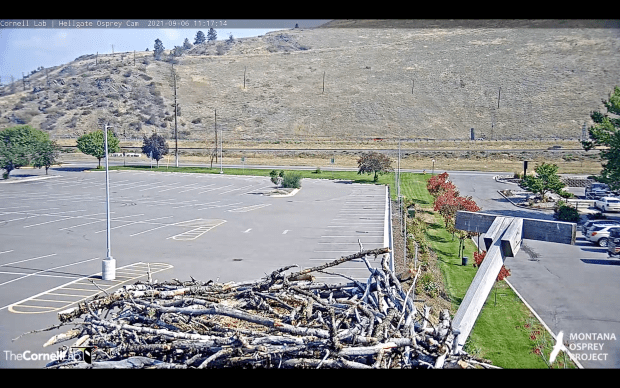
Iris is not ringed. No one knows where she goes for the winter but, she turns up in tip top shape to her nest at Hellgate Canyon every spring.
Typically Iris spends more time at her nest before her departure. Last year she said goodbye on 8 September. Because of her age, many worry that she will not return. It is always an anxious wait until spring and she arrives again full of hope and hormones.
Sharon Leigh Miles shared this image of Iris taken on her favourite tree on Mt Sentinel on 6 September at 09:22.
She is there. Just squint.
Iris is the oldest osprey in the world – the grand dame of all of them. In her lifetime it is estimated that she has fledged between 30 and 40 chicks but no one knows for sure. It is possibly more. Iris is known around the world. Her arrival on 7 April 2021 to her Hellsgate nest made print and television news. Dr Ericke Green of the University of Montana believes Iris is at least 25 years old, perhaps more.
In the image below, Iris just landing from her winter migration. All the worrying about whether or not she survived another winter is put to rest.
Welcome home, Iris. 7 April 2021Landing with a nice big breakfast. 10:36 am. 11 April 2021
Iris’s nest, prior to the one she uses now, was on a hydro pole about 68 metres or 200 feet from this one. This artificial nest was built for Iris because of the high rate of electrocutions on power lines – all birds, not just Osprey. The power lines are high enough and have a clear view that they appear to be desirable. The new nest, erected in 2007, is all set up with a high resolution camera. Iris took to the new nest right away, thankfully. Iris mate, at the time was Stanley. Stanley did not return from migration in 2016. Her current mate, Louis, and her have had a very chequered relationship. Louis also has another nest with Star, his primary nest, near the baseball park. Iris and Louis fledged one chick, Le Le, in 2018.
Many of us are glad that Iris has been spending the summer of 2021 taking care of herself. Raising chicks is not an easy job – and everyone loves Iris and wants her to return year in and year out from her migration.
I have included some images taken at the nest this year.
Iris worked on building the best nest that she could. Every day she brought in more material. She eventually will lay three eggs – that we and she – seem to know are destined not to hatch. These were bittersweet moments for everyone.
She was fierce in her fishing and the protecting of her nest. Indeed, her and Louis protected the nest together several times. The video below is from 22 August.
Sharon Leigh Miles provided a chart of the departure dates for Iris for her migration. Today is 6 September so we are definitely in the range. These are the previous dates of her departure:
2012: 6 September
2013: 6 September
2014: 11 September
2015: 4 September
2016: 8 September
2017: 9 September
2018: 10 September
2019: ?
2020: 8 September
There is no one on the Hellgate Canyon nest this morning. Everyone is hoping that Iris will make several long appearances on the nest before she departs. This has been her MOD in the past. Fingers crossed!
If you would like to periodically check on the nest, here is the link to the streaming cam:
The Montana Osprey Project has had one fundraiser – the Iris pens – this year. If you would like information on how to order one of these, send me an e-mail and I will provide the details. They are lovely. There are also plans to commemorate Iris by a woodblock print. As information comes through I will post it.
Keep Iris in your heart. Migration is challenging. We wish her a safe journey, good winds, lots of fish, and a safe return to Montana in the spring.
Thanks for joining me. Take care everyone.
Thank you to the Montana Osprey Project for their streaming cam where I took my screen shots and their FB page. Thank you Sharon Leigh Miles for allowing me to use your images posted on the FB page.