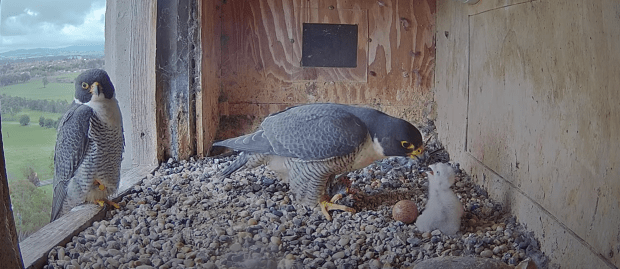
Ervie gets the breakfast fish!

The fish arrived on the nest at Port Lincoln at 6:35:01 and immediately Ervie was mantling it.

Needless to say, Ervie really is the boss of this nest and for good reason. He has fabulous survival instincts.

As you know, my interest is in third hatches and how well they do on nest and off. It will be very informative on how well Ervie does when he leaves the area of the nest seeking out his own fishing spots.

Bazza and Falky might wish that Ervie would fly off and not return.

I only commented once but watchers were calling Falky ‘Mellow Yellow’. It is time that Falky was not so laid back. Yesterday, Bazza took the second fish while Falky had the fish tail from Ervie’s earlier breakfast. If I missed Falky getting a fish, I apologize. It would be good if each had one fish per day. They are all well-feathered and Bazza and Falky will fledge when they are good and ready. e

Oh, wouldn’t it be wonderful to watch Ervie learn how to fish?

At 7:43, Ervie is still eating but his two siblings are hanging close hoping to get some leftovers.

Ah, and Falky got it. Well done, Falky.

If you missed Ervie’s fledge, here it is again. It is quite beautiful on the take off and fly by but the landing was not impressive! Still, I applaud our third hatch lad. Ervie, you are amazing. You are definitely the leader of the pack, so to speak.

If you missed Victor Hurley’s Q & A discussion, it was really really super. I posted that link in my blog, Ervie Flies! early this morning. Very informative and you can start and stop it as you like. If you are interested in falcons or Australian birds of prey – it really is a talk not to miss.

Since the shut down of the 367 Collins Street camera, I hope that many of you are filling that gap with Yurruga in the water tower scrape of Charles Sturt University at Orange. As a former academic, we do not like to comment on others’ research. There were a couple of questions to Victor Hurley about the scrape at Orange and he answered in general terms. Someone asked about the low hatch rate and the eggs. VH said that if the eggs are too large (and he does not know that is the case at Orange) it is hard for the chick to kick them to create a crack all around the egg. He also noted that sometimes eggs get turned when a beak is protruding and the chick cannot right itself if the egg is turned around. Of course, VH said that those are general statements and not specific to Orange. He did comment that Yurruga gets all the food while the four at Collins Street had less bites per chick. He also noted that the Collins Street Four developed quite fast this year and that Yurruga appears to be developing normally. So, she is 8 days younger and the amount of floof she has is normal for this stage.

One of the things that I took away from VH’s discussion was how adaptable Peregrine Falcons are. If there is a drop in numbers of a prey item, they will move to something else. For example, some Alaskan Peregrines have been known to eat trout. The image below was shown as an example.

This year I noted a drop in the amount of pigeon delivered to the scrape at Collins Street. This could, according to VH, be a result of the several lockdowns they have had due to the pandemic. Less people eating their lunch and feeding the pigeons. He did note that the male did bring in Quail and Rail. The falcons normally have a 5 km hunting range but are known to go farther. The are for Collins Street is prey rich. The red dot indicates the site of the nest box.

The falcons do not spend a lot of time on the ledge after the eyases fledge. There is a good reason for this – parasites.

As we learned with Grinnell, the male at the University of California – Berkeley Campanile scrape, birds can become loaded with parasites and they might not be able to protect themselves as well as if they were healthy. Grinnell was taking anti-parasite medication to overcome this. We know he is improving and will be released shortly.

One of the most interesting things to come out of this talk had to do with how the females are attracted to a mate. VH said that there are ‘stunning’ Peregrine males. You and I have seen them. They have an almost orange cere and legs. Dark black, really black, hoods with cream chests and very fine pinstripe chests. Those are the extremely healthy males and the females want healthy. Pale yellow indicates unhealthy. So now when you look at a falcon you can tell healthier vs not so much.

Also falcons divorce. If the female hooks up with a male and he does not share incubation duties or bring in prey, she will move on the next year. The male stays with the nest but it could be in a prey deficit area. At any rate, it was a real good discussion! It is nice to listen to the expert in the area – even talk about rodenticide.

Little Yurruga is doing well. She was working on her breakfast the last I checked.

My daughter went to the Assiniboine River for a walk and discovered about thirty-five ducks still on the river. She sent some photos for us. She noted that there was at least one other group this size down the river.

There are a lot of signs on our park ponds not to feed the ducks and geese or they will not migrate. My daughter ran into a neighbour that says the ducks stay at that part of the river year round and people feed them. They added that parts of the river in that location have been open – not frozen over. I sure hope that is the case this year! There is also an American Bittern hanging around one of the creeks. Maybe they know that this big snow is just to scare us into thinking it is going to be a horrible winter and it will be mild. We wait to see.

The garden birds have found the seed left on the deck and Dyson has, of course, been helping himself. I missed getting him hanging upside down on a suet cylinder. The migrating birds are all gone from this area. Thankfully.

Dyson always knows when the food comes out!!!!!!!!!!!!!!!

The feeders – and there are many different kinds – are all full. It was interesting to me that the sparrows did not mind standing on the snow. According to my daughter, the ducks really like being in the water and not having their paddles on the cold ice.

It is a good day to be inside!

Thank you for joining me today. There could be another fledge at Port Lincoln and we know there will be lots of prey for Yurruga. Take care everyone. See you soon.

Thank you to the following for their streaming cams where I took my screen shots: Port Lincoln Osprey Project and Charles Sturt Falcon Cam and Cilla Kinross. I also want to thank the 367 Collins Street FB group for posting the link for Victor Hurley’s talk and my daughter for those great duck images.

Checking on the birds

Oh, how they have entertained us. How we waited to see if that fourth egg would hatch. How we watched as Dad was incubating during the earthquake. It has been quite the season with the Melbourne Peregrine falcons. Today, there is another nice article on the 367 Collins Street Falcons today. I have attached it in case you missed it!

We are so lucky that the four of them have decided to come out so that we can see them. Those downy feathers are disappearing quickly and they look like grown up falcons capable of taking on the skies of Melbourne -for awhile – til Mom and Dad boot them out. Certainly Mom and Dad have been doing flying demonstrations trying to lure them into thinking about taking the leap! They are a little over 5 weeks old today. Forty days and onward is approximate for fledging.

https://www.theage.com.au/national/victoria/for-melbourne-s-falcons-and-their-fans-a-new-domestic-drama-20211001-p58who.html?fbclid=IwAR1bgeKR4w2H622TETCdcJ0r0bgzLtVEE9BoK_35wrlcuWA4b0BzJ9VC0JI

Over in Orange, or should I say ‘up’ in Orange, Yarruga was one hungry chick waiting for supper that did not arrive. S/he had two feedings yesterday so she is going to be ravenous when breakfast arrives. There is no need to worry, though. She had a nice crop, larger than Diamond’s and Yarruga will not starve. In the world of raptors there are days of plenty and days of naught. Little ones need to learn that, too. Yarruga is 28 days old today. Four weeks.

Diamond was seen putting her entire weight on her right leg in the middle of the night to clean her talons. This is very good news. She has moved over to the ledge to grab some sleep before dawn and Diamond seems to be doing much better. How grand.

The Port Lincoln osplets are sound asleep. Little Bob is 50 days old today – while the two big siblings are 52 days old. We will be keeping an eye on those numbers because last year Solly fledged at 65 days (in the Northern Hemisphere it is 49 days onward). Solly was banded at 47 days and DEW at 46. On Monday, 8 November, these three will be banded, named, measured, and at least one will get a tracker. They are just wonderful – the three of them. I am surely going to miss this nest – perhaps the most civilized brood I have ever seen.

There is sadly some commotion going on at Taiaroa Head. Our beloved OGK may have realized that his mate, YRK, is not returning. He tried to mate – rather vigorously – with BOK who is also waiting for her mate to return. Being the gentleman that he is, OGK, returned to apologize in the Albatross way by doing a sky call with BOK later.

If it happens that YRK, Pippa Atawhai’s mum, does not return, it will not be from old age but from being caught in the lines of the fishing trawlers. I hope that you will think about our beloved Pippa and what a horrible death that would be – and it is entirely preventable! I feel rather gutted because these are all useless deaths that never have to happen. An albatross does not need to be decapitated every 5 minutes! The fixes are really easy. They include setting the lines at night, line weighting, and bird scaring lines. Some organizations are supplying these measures for free to the boats. The deaths are preventable. There needs to be international laws. Every country needs to stand up and demand that the fishing factories take these simple steps or not be able to fish. Write letters, phone your political representative – do it for Pippa. Then check out what the RSPB is doing. They are working alongside the Albatross Task Force to help end bycatch. Check out their website, ask who to contact. And remember – writing e-mails does help. Public pressure helps.

https://www.rspb.org.uk/our-work/policy-insight/marine-and-coastal/saving-seabirds-globally/the-albatross-task-force/

The Bald Eagles are really busy working on their nests in the US while the ones who came to Manitoba for their summer breeding are very slowly making their migration. Images of 30 or 40 along the river in my City have been posted locally the last few days but are not available to share beyond the Manitoba Birding and Photography FB page. I still have a few Slate Grey Juncos and today that meant a trip to the seed seller to get some more Husked Millet for them. The day is just starting in Australia and New Zealand so no telling what will happen. I long for YRK to fly in and just land on OGK’s head! That would be a rather dramatic entrance fitting for this very patient male who has been working on a nest for about six weeks now. No doubt Yarruga is going to be screaming for breakfast! I will post the updates on Grinnell tomorrow afternoon. In the meantime, thank you for joining me and take care everyone.

Thanks to the following for their streaming cams where I took my screen shots: Port Lincoln Osprey Project, 367 Collins Street Falcons by Mirvac, Charles Sturt University Falcon Cam and Cilla Kinross, and Cornell Bird Lab and NZ DOC.

Send your warm wishes to Diamond

Diamond, the female at the Charles Stuart University scrape box in Orange, Australia, was away from the scrape for ten hours a few days ago. When she returned her right wing was droopy and she was limping slightly. Xavier, the male, has been doing the hunting and feeding little Yarruga, their three week old plus 2 day chick, its meals. Xavier is getting more proficient with each feeding!

Diamond slept in the scrape box last night with little Yarruga. She was standing on ‘her’ rocks in the corner.

When she went to go to the ledge to fly out for a break, she could not put weight on her right foot and stumbled.

She fell down, got up and stumbled some more.

Just watching her trying to make it to the ledge to fly off made you realize how difficult it is for her to heal. It will be a long process. She doesn’t have the ability to put a lounge chair in a tree or in the scrape box and elevate that leg. Anyone who has sprained an ankle or hurt their foot can have great sympathy with this devoted Mum. Of course, Yarruga had no idea what was going on.

Xavier arrived at 07:03:06 with a very prepared fat pigeon for little Yarruga. He might have been expecting Diamond to be in the scrape and feed their baby. He hesitated.

All Yarruga wanted was breakfast and she began to make her way over to Dad.

At that point, Xavier realizes he is on feeding duty and dragged the carcass into the middle of the scrape, away from the ledge so the baby wouldn’t accidentally fall out.

Yarruga was delighted. Dad is getting very good at this!

Little Yarruga is so cute. She will go into the corner when she is full to the brim. Xavier always has to check to make sure she doesn’t want anymore!

Xavier makes his way over to the ledge. I am hoping that he shares that lovely breakfast with Diamond.

Send Diamond your warmest wishes.

Port Lincoln has confirmed that the trio will be banded Monday, 8 November – Australian time. The bander is arriving from Adelaide. I do not know the time.

Thanks for joining me. I knew that you would want to know how Diamond is doing. We all hope that she is well soon but, in reality, it will take some time. There is no need to panic. Xavier is doing a wonderful job. No worries for little Yarruga. Dad is definitely up to the job.

Take care everyone.

Thank you to Charles Sturt University Falcon Cam and Cilla Kinross and the Port Lincoln Osprey Project streaming cams where I took my screen captures.

Oh, Little Bob!

The birds in my garden are always aware when I am watching them especially Mr Blue Jay and family. Sometimes he will stop and look right in the window and fly up into the lilacs and down to the corn as if he is teasing me. Other days he might sit on top of the deck chair calling to remind me that the corn cob has disappeared. Or maybe he is saying hello! Today, it was the youngest of the trio staring at me as he flew in and out to get kernels off the cob. Dad, Mr Blue Jay, was observing from the lilacs.

How do I know this is the youngest? He is a bit thinner and his legs are a charcoal grey, not black. I can also identify them by their facial markings and I still don’t know, after several years, where they roost or which is the male or the female. All I do know is that in exchange for a corncob, some peanuts, and some seeds, this family of three brings me year round joy.

Of course, the birds on the live streaming cams have no idea there are hundreds of people, sometimes thousands, watching them. Many have caught their reflection in the camera’s dome. I recall Izzi, the peregrine falcon eyas at Orange, and the little Golden Eagle in Romania liking to look at themselves. It is very cute.

Today, Little Bob was having some fun. It is a good thing he is not conscious or caring of anything to have to do with humans!

Yes, that is Little Bob. He is fanning out his tail like a peacock. While we are not able to see it clearly yet, Little Bob’s tail will have stripes, alternating white and espresso. This same type of barring will also be seen on the secondary feathers. The secondary feathers are those after the primary or wing tip feathers.

In studying other birds of prey, those dark stripes are often counted with the understanding that on a Red-tailed Hawk, for example, the nestling needs at least 5 dark bands to fledge. It is simply a way of gauging the length of the tail because tail length is one of the elements necessary for flight.

In the image below, Little Bob has lowered his tail a bit and is stretching his wings in what is known as the ‘W’ pattern. It will be familiar to you as it is the shape that gets tightened up when ospreys dive head long into the water.

The nest on the barge at Port Lincoln is getting crowded as these young ospreys grow. There is Little Bob looking out standing in front of Mum. You can clearly see that dark espresso line (it is neither brown or black) that runs from the beak, across the eye and down to the nape of the neck. This dark strip is your word for the day, it is the auricular. Many believe that this helps to stop the glare of the sun so the birds can see better.

There is a lot of speculation on the streaming cam chat as to the gender of Little Bob. Ospreys need strong legs and feet in order to fish and pull their prey out of the water. They grip their prey with their long black talons using those ‘scratchy pads’ – specialized barbs -on the bottom of the feet to hold the fish secure. They also are the only raptor to have a reversible outer toe which helps them secure their prey. They will, most often, position the fish so that the head is facing in front which is a help with wind resistance.

Ah, but back to telling the males from the females. Measurements will be taken when the three get their Darvic rings. Females tend to have thicker leg bones than males. A good example were the measurements taken of Laddie and NC0’s two fledglings, LR1 and LR2. With females being at least 20% larger than males (normally), the first to hatch and the largest was ringed LR1. The wing measurement of 337mm and weight of 1.51kg led the bander to state that LR1 was a female. The second chick was three days younger and had a wing measurement of 276mm. It weighed 1.4kg and was said to be a male. The differences are slight and the only real way to determine gender is through a DNA test or by seeing an egg laid.

Note: LR2, the male, is the fledgling that has been seen several times over the last week in Spain. Fabulous news!

That said there are a lot of people who believe that Little Bob is really Little Bobbette.

One of the other ways that people believe females are different is through their darker and wider ‘necklace’. Unfortunately, I believe this idea to be unreliable as there are a number of known males with very elaborate and dark necklaces. One good example is Blue 022 the ‘maybe’ mate of CJ7 at Poole Harbour.

It is often difficult to establish which chick is which on the nest. As my concern is in the third hatch, I have paid particular attention to Little Bob. Look at the top of his head. Whether you say Little Bob has a white V or a round circle on its head doesn’t matter – both apply. Look carefully at his head in the image below. One of the things that will not change over Little Bob’s lifetime will be the pattern on its head.

Oops… there Little Bob goes again!

Oh, my. This time he is going to spread his wings, too. Somehow I do not think Big Bob is going to be happy about that. Did I say this nest was getting crowded? Just wait til they all start flapping and hovering at once.

Just like Mr Blue Jay and family, Little Bob continues to delight me. I am so glad that he doesn’t know how many of us are watching his every move.

Take care and thank you for joining me. My newsletter will be late tomorrow. It is time to pick up a large order of birdseed and corn cobs for the garden animals for the winter.

Thank you to the Port Lincoln Osprey Project for their streaming cam where I took my screen shots.

Saturday Cuteness in Bird World

I thought that it was going to be hectic for Mum and Dad to keep the Collins Street Four supplied with pigeons. I never thought about the parents chasing them all over the gutter to make sure that each one gets fed! I don’t think any of us ever have to worry about the dedication and focus of these Peregrine Falcon adults. This feeding was quite extraordinary!

Did little Yurruga spend the night sleeping in the corner of the scrape box while Diamond tried to incubate her unviable eggs?

The feeding of Yurruga at Orange is so different than that of the Collins Street Four. However, looking ahead one week we should anticipate that Yurruga will be excited and nipping at the prey as the Melbourne falcons.

Yurruga makes some of the cutest faces and gestures.

There was a peanut size fish delivery at the Port Lincoln Osprey barge earlier but the three osplets and Mum are still waiting for Dad to bring in something substantial.

Dad brought the tiniest fish to the nest this morning in the Sydney Olympic Forest. He waited for about half an hour but no eaglet appeared. The Pied Currawongs were a menace to Lady, too, and eventually they ran him off the nest.

I remember Lady and Dad coming to the nest last year trying to lure 26 back so they could feed her. I wonder if one of the eaglets is still in the forest? There have been no reports since 15:30 on the day 28 fludged and 27 had its forced fledge.

OGK continues to wait for the arrival of YRK at the Taiaroa Head Royal Albatross Colony in New Zealand. Send every speck of positive energy his way. I so hope she flies in this week!

Here on the Canadian Prairies the weather has turned quite coolish. The number of birds in my garden have dwindled. Today there were only six Slate-grey Juncos and the House Sparrows. Grey Squirrel loved it because he had more than enough seed to fill him and four others to the brim! Tomorrow I will be at the nature centre to watch the thousands of Canada Geese land at dusk. It is eerie – the garden being quiet. I cannot imagine a world without the sound of the birds.

Thank you for joining me. Do take care. Stay safe and be happy.

Thank you to the following for their streaming cams where I took my screen shots: the Port Lincoln Osprey Project, 367 Collins Street by Mirvac, Sea Eagle @Birdlife Australia Discovery Centre, Charles Sturt University at Orange Falcon Cam and Cilla Kinross.

Less can be more

Hopefully today’s ramblings will make a point on how to help our birds. Bear with me. I love to tell stories and revisit memorable moments.

More than a decade and a half ago, I was in Beijing teaching some special workshops at the International School and also giving lectures on the history of Chinese ceramics. Yes, you read that correctly. A Canadian was in China talking about Chinese pottery! I had been there several times before and always enjoyed myself and treasured the friendships that I made. This particular visit I was staying in a hutong that had been converted into a small guest house. Hutongs are the traditional courtyard houses, many torn down now. During breakfast I met a very interesting lady whose name was Fanny Farkles. She had retired from owing a restaurant, catering, and cooking school in New York City. I asked her, being terribly curious, what she was going to purchase and take with her as a reminder of her time in Beijing. What she told me has stuck with me. She said, ‘I spent the first 50 years of my life acquiring stuff and I will spend the last 50 getting rid of it’. Instead of ‘something’ she was going for an experience – a 17 course Ming-Dynasty meal fit for the emperor.

It wasn’t until later that I fully grasped the wisdom of what Farkles was saying but when I did, it hit me hard and, like all great insights, you wish you could turn back the clock and start again sometimes. Stuff. This coming year I will be spending much time finding new homes for ‘the stuff’. Thankfully, my resolution for 2021 was not to buy any new books. I almost made it had it not been for Chris Packham’s Back to Nature or Emyr Evans, Monty. Almost any book can be purchased used from a myriad of international sellers but not those two when I checked.

Speaking of Emyr Evans’s book on Monty, the DFYI on line shop is now open. If you are interested, here is the link to their on line shop:*

https://www.dyfiospreyproject.com/

A signed copy is 15 GBP. If you live in the UK, the postage is a very low flat rate. The round the world flat rate is 11.99 GBP. If you are a fan of the Dyfi’s Monty, the super star of the male Osprey world (by some), it is a great book or gift. It is also a fundraiser for the Dyfi Osprey Project.

One other year a young woman asked women around the world not to buy any new clothes. To wear one thing and switch it up with what was in the closet. It was the year of my black sheath dress. The money saved was given to young women in India to purchase school uniforms because we all know that education is important but you cannot go to school without a uniform in India. It was a brilliant idea.

An article in the environmental section of The Guardian today talks about ‘stuff’ and how to save the environment by not buying. Several months ago, an economist suggested that if everyone in the world cut their spending of non-essential goods by 15% it would have a major impact on climate change. If it is good for the environment then it is good for the birds. Have a read.

https://www.theguardian.com/environment/2021/oct/20/we-need-to-stop-buying-stuff-and-i-know-just-the-people-to-persuade-us

A quick check on those adorable feathered creatures that inspire us to leave the world a better place reveals that Middle Bob and Little Bob on the Port Lincoln Osprey Barge had a tug o war over the fish tail this morning. I think Middle Bob won but, that’s OK. Little Bob won when he pulled with Mum!

Despite their amazing growth and those awesome curved juvenile feathers, you can still tell Little Bob from the circle on top of its head. You can also count on Little Bob being as near to where Mum is handing out the food as anyone. They line up and he is there, right at the beak with gleeful anticipation in his eyes.

Mum is happy to oblige!

The feeding is over and Little and Middle are tugging for the tail. The osplet behind Mum is Big Bob. It looks like a circle on its head but it isn’t. It has lines radiating out when you can see the full design.

Middle Bob is eating the tail and Little Bob is checking to see if Mum finds any more food on the nest. Oh, he loves leftovers, too. First up to the table and normally the last to leave. Sounds like Little Bob is a female to me. They need about 25% more food than the males.

Yurruga is currently sleeping off that entire Starling that Xavier fed it for breakfast. It is a wonder the baby didn’t pop but, like a good falcon, when Xavier suggested it eat more and made that chumping sound, Yurruga ate. It is learning to eat when food is available. You don’t always have the luxury of a stash in the corner of a scrape box in the real falcon world.

At least one of the Collins Street Four looks like it wants to try out for one of the local rugby teams. My goodness these chicks are enormous. Look at those feathers coming in. One day we will wake up and they are going to look like their Dad and Mum – it will happen in a blink I am afraid.

No other news from the little sea eaglets that flew off the nest yesterday. Keep them in your positive thoughts.

Thank you for joining me today. Everything at the nests is just fine. What a lovely relief. You take care. See you soon.

Thank you to the following for their streaming cams where I take my screen shots: the Port Lincoln Osprey Project, Charles Sturt University at Orange Falcon Cam and Cilla Kinross, and 367 Collins Street Falcons by Mirvac.

* I might mention books or other things in my blog. I do not make any money if you purchase the items and never will. My purpose is to simply bring news of the birds as they add so much joy to our lives and to alert you to ways that you can help make the world a better place for those birds.

“We need to protect all species while they are common so that they do not become rare.”  

Rosalie Edge urged everyone, in the quote above, to appreciate all of the birds (and other species) that are part of our daily lives. Edge knew that what is once common can go extinct quickly if we do not begin conserving the species when it is abundant. That is precisely why she purchased Hawk Mountain and why the continuing migration counts matter. If you count then you can plot a decline or a rise. If you don’t count, you never know. I will add that if you do not put a sat-pak on an Osprey chick in Port Lincoln, you will not know how far the fledglings travel from the natal nest. Solly’s tracking information confirmed that they venture much farther than ever imagined! Tiaki is more than half way to Chile today. She is making excellent progress. It is also comforting to see those GPS monitors moving on all the migratory birds including the Black Storks from Latvia and Estonia. We learn, we appreciate, we treasure what we have in front of us and take care of it.

This is the article I was reading from the online Audubon Magazine. It is a Canadian who has gone to look for Snow Geese and, instead, gets fields of Canada Geese.

http://www.audubon.org/news/an-ode-common-birds-and-cherishing-what-weve-got?ms=digital-eng-social-facebook-x-20211000-nas_eng&utm_source=facebook&utm_medium=social&utm_campaign=20211000_nas_eng&fbclid=IwAR1IgW1HN7CnFVTuog07daZxKTAyrr_n5CSuRACCHXMVyz2B1H-QhzxFDzE

It is a good read. I love my sparrows and the regulars to the garden and rejoice in the seasonal visitors but it is the sparrows, the 3 Blue Jays, the 1 Black Capped Chickadee, and Mr and Mrs Woodpecker that are my regulars. And, then, of course, there is Mr Crow and the Squirrels. They keep me busy and happy when all the other exotics are gone to their winter homes. So have a read, it is short and really has a couple of good ‘hitting home’ messages.

If you did not see, boots on the ground in the Sydney Olympic Park around the Parramatta River report that WBSE 27 and 28 have been seen and heard them. This is excellent news. I hope that someone will get some good photos of these two. Wouldn’t it be grand if they did survive against the odds? Oh, I hope so.

This is one of the best video clips I have seen of the Collins Four. Dad, that little cutie, arrives with the pigeon meal. Two of the eyases are out of the scrape and into the gutter. The largest one – has to be a really big female – is ready to eat. Notice how she stands up erect and walks with her feet! Getting out of the scrape box, for the other two, is a little easier than getting back. Dad just seems to get smaller every day! Enjoy.

Yurruga is just waking up with a big yawn in the scrape box on the water tower of Charles Sturt University in Orange.

Xavier brings a completely unprepped bird into the scrape box for Yurruga. This might make a mess and the little one might be urging Xavier to hurry and finish but that chick is watching and it will be learning how to do this plucking itself.

Yurruga has a really loud screaming voice when it wants food. My goodness they can probably hear the little one clear across the campus.

The screaming for breakfast has stopped. Yurruga will be very full if it eats all of that Starling!

Yurruga ate all of the Starling except for the head and is stuffed!

Oh, wait! Xavier wants the chick to eat all of the bird. So here goes all of that Starling!

Xavier, that was an excellent feeding!

The trio at Port Lincoln are still sleeping. No doubt Dad will have a fish on the nest soon.

It looks like everyone is doing very well, indeed. That is fantastic. If you have been waiting for the Dyfi on line Shop to open in Wales, it is now functional. Emyr Evans’s book on Monty is for sale.

Thank you so much for joining me. Take care everyone. See you soon.

Thank you to Charles Sturt University Falcon Cam at Orange and Cilla Kinross and 367 Collins Street Falcons by Mirvac for their streaming cam where I took my screen shots.

Tuesday in Bird World

It is a grey and windy day. As the weather channel promised, our summer heat wave in October seems to have come to an end (for the moment) with the arrival of single digit temperatures. The recent rains have caused the ground and old tree stumps to come alive and the sparrows and thrashers are thumping the ground having a good old time. It reminds me – continues to remind me – why we should not be raking our leaves or mowing the grass. Gently rake them into a corner if you have to. The birds really will thank you!

It is also nearing Halloween and all around me I can see the windows and doors decorated – many have elaborate displays outside.

I believe Halloween was the favourite holiday of my children – you got to dress up, get candy, and have parties at School. I recall pulling the two oldest in a sled one year as the snowflakes fell faster and faster. We did not need to go more than a block. Their pillowcases were full because they were the only ones out on such an incredible wintery night. The grandchildren enjoyed decorating the trees and, sadly, I remember using some of that web material with little black plastic spiders. That was a long time ago when I did not know better – but I do now. As a reminder to everyone, please be careful if you decorate. It will be a tragedy if animals get caught and have to be euthanized just for a bit of fun.

Oh, gosh, golly. Xavier and Diamond’s little chick just took its first steps!

Meanwhile, the Collins Street Four – which are a week older – are now standing up. They are also getting curious about the outside world and one nearly gave several streaming cam viewers a heart attack when it walked up to the edge of the ledge.

The Collins Four having some fun. Look at the size of the wings!

In case you are wondering why the scrape box is so messy this year, it is because the wind does not blow through it like it did at the other end. On a positive note, the chicks have been supplied with some shade and neither them or Mum have been as hot and panting as much as last year.

At the Port Lincoln Osprey Nest, the osplets had, at least, five fish yesterday – probably a couple more. I could not rewind the camera prior to 16:00 and all had big crops at that time. One of the most interesting interactions was between Little Bob and Mum. They had a tug-o-war with the fish tail. Mum won!!! It was very cute. that fish tail was from the 18:02:17 fish Dad brought in.

The osplets are doing really well walking around in that twig lined nest, too. They are covered more and more with feathers each day. Those feathers seem to be pushing out of those quills right before our eyes.

Dad brought in a bedtime fish for the family at 19:39:16. It is difficult to tell one from the other but there is Little Bob in its usual spot, right up by Mum’s beak.

Where is Solly, the first hatch of the Port Lincoln Osprey Barge in 2020? She seems to have decided to take a quick trip to Streaky Bay before heading back to her special tree in Eba Anchorage. It is such a relief to see the movements of the birds – to know they are safe, living their lives well.

If you were following some of the Montana Ospreys, a map of their locations has been released on the Montana Osprey FB page this morning. It shows that all of the Ospreys arrived in Mexico or Central America. Such good news. Their satellite trackers are working splendidly.

Both of the little sea eagles, WBSE 27 and 28, were still on the nest early this morning. That doesn’t mean that they will be there in a couple of hours.

I am a huge fan of Gabby and Samson’s at the Northeast Florida Bald Eagle nest near Jacksonville. The morning was just starting. The couple spent the night on the branches and as the sun came up, Gabby could be seen working on the nest.

At various times during the day, Samson, Gabby, or both, can be seen preparing their nest for the new breeding season. Here is a link to the streaming cams (there are several but this one looks directly into the nest), so you can check on them.

Tiaki, the 2021 Royal Albatross Cam Chick, is making really good time on her way to Chile. She was well beyond the International Date Line this morning. So, with that news, everyone in Bird World is doing well today. Smile. It is all good!

The sun is out and the Slate-grey Juncos are on the deck and the sparrows are having a drink out of the bowls. I wonder what other garden critters will show up? No Halloween candy for them! But they are getting extra dry corn cobs.

Thank you for joining me. Take care each and every one of you. See you soon.

Thank you to the following for their streaming cams where I took my screen captures: Port Lincoln Osprey Project, NEFlorida Bald Eagle Cam and the AEF, Sea Eagle Cam@ Birdlife Australia Discovery Centre, and the Montana Osprey Project and the Port Lincoln Osprey Project FB Pages for the sat-pak maps showing the location of the migrating Montana Ospreys and Solly.

Port Lincoln chicks ate well!

The streaming cam has been down at the Port Lincoln Osprey barge most of the morning. It was also a dreadfully wet and miserable start to the day. Mum tried as she might to snuggle up with her three babies (can we call them babies anymore?). At 10:30 they were wet, cold, and probably hungry.

The first fish arrived at 11:09:12. Even the sun came out for the occasion. Mum was still feeding the trio at noon.

In the image below, Dad is eating his share and making certain the fish is dead before he delivers it to Mum and the chicks.

Mum has the fish and she is getting ready to feed the three hungry chicks. It is late for the breakfast fish.

There is Little Bob at the end. What is he looking at so intently?

I wonder if it is Dad flying away. Look at the expression on his little face.

Whatever it is, Little Bob is more interested in what is happening off the nest than eating his first fish of the day. That is pretty incredible. Little Bob is always the one who wants to be fed first!

Oh, two of the chicks are watching instead of eating. Is Dad giving a flying demonstration? These chicks are developing just as they should. They are becoming much more interested in things happening outside of the world of the nest. They are standing more and beginning to flap their wings. Think they are dreaming of flying? Little Bob is 29 days old today. The two older siblings are 31 days.

For those that are worried, Little Bob has stood up to ‘sometimes nasty’ Big Bob. Little has done that twice that I am aware. This nest is really calm and the chicks are so big that we should all expect them to fledge with their satellite packs. I understand they will be ringed, get their sat paks, and get their names in early November. Oh, I cannot wait to find out what the names will be this year.

When the three fledge, this will be a historic moment for this nest. Perhaps with the first fledgling of all three hatches, the curse of this nest will be lifted. These two adults have demonstrated clearly that they are highly capable parents and can easily raise a nest of three chicks from hatch to fledge.

Oh, look at Little Bob and look carefully – there is another chick looking up in awe, too. What an expression!

Now down to the business of breakfish!

After eating for 40 minutes, the chicks are beginning to get nice filled crops.

By noon, the fish is finished. Everyone is full and ready for a bit of a snooze.

The three osplets had no more than settled down when the second fish arrived on the nest at 12:35:28. Little Bob is on the right. He is turning around and probably cannot quite believe what he is seeing – another fish!

The role of the crop is to grind up the food before it enters the stomach. It also serves as a storage tank. The chicks can ‘drop their crop’ when they need nourishment. The reality of a raptors life is that they might eat well one day but not have any food for another two days. They need to eat as much as they can when they have the opportunity.

There they are lined up very politely for Mum again. I do not believe I have ever seen such a civil nest of growing ospreys. They might have their spats but not at the table. They line up and Mum feeds them. She is very fair. I have not noticed her favouring one over another. She does, in fact, often feed them as they appear in the line – one bite each and then back to the beginning. The other thing that is noticeable is the chicks do stop eating when they are full allowing the line to close so the other two are only being fed.

Is this behaviour down to the simple fact that they are so close in age? There is only 51 hours separating Big Bob from the time Little Bob hatched.

Just look at how close they are in size.

One of the chicks has left the table. Little Bob (see the roundish spot on the top of his head?) is still hungry. Of course, he is.

The second fish was done and dusted by 13:02. Little Bob is still looking. Maybe he sees some fish skin? or is there a piece of tail? He has a very nice crop.

In terms of size, I can no longer tell Little Bob from the other two. If the roundish spot disappears I will no longer be able to identify him as easy. He is growing so much. Wonder if Little Bob is a female?

Ah, it is silly to try and guess the genders but we all do it. They will measure the chicks when they are ringed. Of course, the measurements are not foolproof. Only DNA or an egg or mating can confirm.

Once the three are fed and all is well, it is much easier for me to sleep. The wee eyas of Xavier and Diamond’s have also had several meals today. You can clearly see that it has more than doubled in size from hatch.

Xavier is on the ledge while Diamond feeds the chick the prey he delivered. Look at the size of the wee one’s wing. Is it looking over to Xavier?

When Xavier turned around, I thought it was last year’s chick, Izzi.

Only Bob is looking directly at the beak and eyes of Diamond. Diamond is so delicate with the tiny little bites she feeds her baby.

The chick’s neck is now so much stronger. It can hold its head still for longer so that Diamond can feed it. The bobbling days are pretty much over. Notice, at times, that the chick instinctively keeps its balances by placing its wing tip on the gravel.

I absolutely love this image of Xavier looking so tenderly at his baby.

All full. The little one has now had four meals. Unlike the Ospreys, Only Bob needs many meals and fewer bites. Her crop is tiny. She is now collapsing into a food coma.

Awww. I wonder if Xavier wishes that Diamond would let him brood the chick? Perhaps she will in a few days but the falcon mothers are extremely protective in the beginning.

The Collins Street Four have been eating, sleeping, growing, and decorating the walls around the scrape. Their world is that of the scrape box. They are not as interested – yet – in what is happening outside of their world. They will become more interested, just like the Osplets at Port Lincoln, in a couple of weeks.

As the days pass, we will begin to notice a difference in size. This is not due to the amount of food the eyases eat individually. It will be because some of them are males and some are females. The females will be approximately 30% larger than the males and they will consume about 25% more food (nothing staggering). When fledge time comes, it is normally the males that fledge first. Their feathers will have covered them quicker because they are smaller! It is that simple.

Last year we did not notice a difference in size in the triplets. That is because they were all females. I do hope Dad gets a break this year and has a couple of males. I cannot even imagine what it would be like to try and feed four large females!

They are beginning to look slightly different in their faces. Notice the one facing the back who looks more ‘hawk’ like.

These eyases are more than full. Look at that shiny big crop. My gracious.

If you missed the live streaming of Iniko 1031 arriving at the pre-release containment area at Big Sur, here is the video of that moment. The condors are so endangered and there is no telling how many more wildfires will rage. Fingers crossed!

It is late on the Canadian Prairies. Our damp is supposed to go away on Saturday. Meanwhile, it is the annual birdseed sale at our nature centre this weekend. It is a great time to get high quality feed for a big discount and help out the centre as well. You might check and see if your local nature centre does this. The savings can be substantial. I will also continually remind people that if you have a local feed and seed store, you might be able to find Millet, corn, Black Oil seed, peanuts in their shells at a substantially lower price point. My neighbours introduced me to this years ago but, sadly, the big feed store moved. The distance makes it no longer viable as a source.

Thank you for joining me. It is always a pleasure to receive your notes and letters. I appreciate the time you take to write to me whether it is an e-mail or a public comment. You take care. See you soon. All of these nests are doing so well that we can all rest easy. Life is good!

Thank you to the Port Lincoln Osprey Project, Charles Sturt University Falcon Cam at Orange and Cilla Kinross, and Collins Street Falcons by Mirvac for their streaming cams where I took my screen shots.

Late Wednesday Bird World check in

The streaming cam is now back on line at the Port Lincoln Osprey Barge. Instead of being late Wednesday it is Thursday. It is a wet miserable day there, too. The osplets are waiting for their breakfast fish to arrive. It is currently 10:30.

The stark contrast between that gorgeous blue of the Port Lincoln waters and the white of the talons makes it almost appear as if Mum and the chicks had gone shopping for those vinyl ‘mod’ boots of the Twiggy era.

Mum is amazing. She tries absolutely everything to try and crowd the chicks under here so they will not get wet. Of course, their feathering will not keep them dry but there is nothing so nice to keep a chill off as being toasty warm under Mum.

The chicks are standing a bit more. Isn’t that one cute? You can really see the development of the tail. Their pantaloons are showing, too. The term has been adopted for decades when talking about the upper leg feathers of the raptors. Originally, the casual name for them was ‘britches’. They are actually the crural feathers and they cover the tibial area of the leg. They continue up to the chest.

Look at those wing and tail feathers! Wow. Growing before our eyes they are.

The skies open again around 9:37 and Mum works hard to crowd in next to the chicks.

Once the rain stops she is off to try and catch a fish for everyone’s breakfast. She has been fishing more and it is certainly keeping the wee babes happy – and full.

It is really beginning to be difficult to tell which chick is which. Each had some type of a mark on their head. Little Bob had a big circle and he had the white webbing pattern on his cere with a huge white swipe with a wide paint brush under his eye. If that him in the middle?

Big ‘sometimes-not-so-nice’ sibling is in the very front. Her eye is much darker with a wider eye stripe. She has always appeared much darker than the other chicks. Did you know that professional ball players adopted adding a black line under their eyes to keep off the glare?

You can really see the very dark wooly down on the chick standing up. You can also see how the crural feathers continue on to the chest area easier, too.

Now look. Is that our Little Bob at the back? I think so. The circle and the white are there as is the white on the cere. Oh, but they could be fooling us. Even their sizes are coming together so that it is difficult to recognize one from the other.

Let us hope that a nice fish for their breakfast arrives soon!

Ah. There is Little Bob turned around facing Mum in case a fish lands right there.

Awwww. Xavier. What a sweetie. He has arrived with the third item of prey for the baby at 10:14 but Diamond is ignoring him. The chick is full having had two feedings already. Maybe Xavier will get a chance to enjoy that Starling himself.

Remember to go and vote on the names for Xavier and Diamond’s baby. Cilla Kinross selected Maori names for weather. You can find the form here:

https://forms.gle/iPQhxDCLtEh19jp38

As the sun sets in central Louisiana, Anna and Louis are still on the nest making adjustments for the upcoming eggs. They have now flown off and are roosting elsewhere.

Wish for a fish! The trio at Port Lincoln will be very hungry when it arrives.

Take care. Thank you so much for joining me this evening.

Thanks to the following for their streaming cams where I took my screen shots: the KNF Bald Eagle Cam, Charles Sturt University Falcon Cam at Orange and Cilla Kinross, and the Port Lincoln Osprey Project.