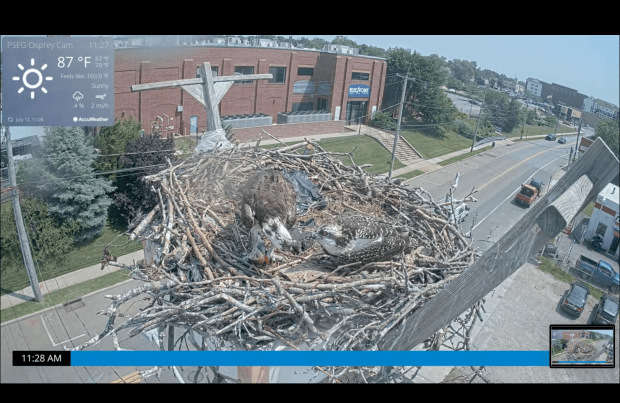
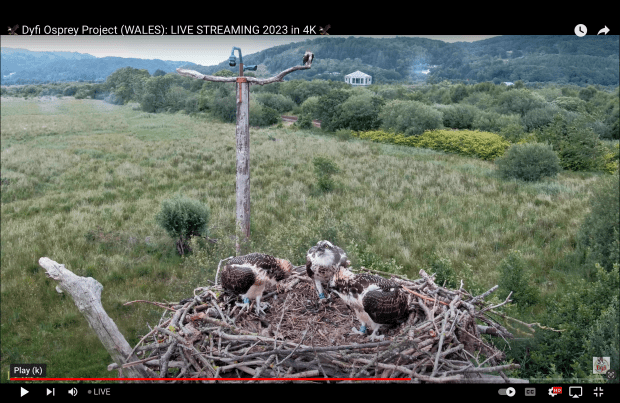
It’s hot. We were out early with Toby and now we are inside, drapes drawn and AC on. Cavaliers are susceptible to many ailments (I don’t care, I will take good care of Toby forever) so that Toby cannot be out in the heat of the day. He has a ‘chill’ coat that is soaked in cold water and a chill mat and I have made ice lollies for him with bone broth. Interestingly, Don has a medicine that restricts him from being out in the heat, too. So I guess summer is going to be interesting!
The first hatch has happened in the Glaslyn Valley and it is at the Pont Cresor nest of Z2 Aeron and Blue 014.
There are still two at the nest of CJ7 and Blue 022 at Poole Harbour although I almost caught myself thinking there were three.
There are three osplets at the Moraine Preservation Fund Osprey Platform. Little is so tiny! I hope they get lots of fish and this baby survives.
Clark PUD in Washington State has three babies and no shade!
Newport Bay Conservany has two osplets that are getting their juvenile feathers.
Three babies at Smallwood…
Beautiful babies with Mum at Brevard in Florida.
Incubation continues in the Usk Valley in Wales.
Two little scrappers at Port of Ridgefield in Washington.
Please send the Dewey Beach every ounce of energy you can. One little osplet. Please, please let them have enough fish to keep this baby to fledge. Two small fish have come to the nest. Dad is trying but the adults have to be so hungry. This whole lack of fish ‘thing’ that is human caused is simply driving me to the brink.
Incubation continues at Loch of the Lowes in Scotland.
First fish from Jack at the Achieva nest came at 0832. The family was waiting. Mum got it and fed everyone.
Chick 2 has hatched for Idris and Telyn at Dyfi.
There are still three chicks at Rutland’s Manton Bay nest of Blue 33 and Maya.
Three eggs being incubated at Lyn Brenig in Wales.
One beautiful baby so far for White YW and Blue 35 at Foulshaw Moss.
Frankie and Angel and their two darling osplets at Loch Doon.
Dylan loves delivering Brown Trout to his family at Lyn Clywedog in Wales.
Life in the osprey world appears to be going well at these nests. There are, of course, many others, and we must check in on Iris. Tomorrow is the first day to vote on the name for NewGuy2. Please take part.
These two are hilarious.
Rosie Shields brings us the latest news from Border Ospreys.
I am excited that Aran and his new mate will have chicks in a few days. He was the mate to Mrs G, then Elen (who is now with Teifi), and it is just great that there was a platform and a female for this dedicated dad.
Mary Kerr posted a YouTube video of Teifi and his brother Tywi in 2020. Teifi will be a dad in a few days when his and Elen’s eggs begin to hatch. Teifi is the son of Idris and Telyn. https://youtu.be/x1ewvCXqql8?
It appears that Richmond and Wendy’s first egg is not viable at 41 days.
Kielder Forest news – and there is a hatch at nest 1A.
The livestream has been turned off of the Falconshire Bald Eagle nest where Scout eats crumbs and picks at his injured wing. Will he survive? We will never know what happened because they chose to intervene to band the chicks but not to keep Scout in rehab. Banding is, in my mind, a good thing but it is an intervention on the nest. Why not help Scout? Instead of hiding what is happening just because they are overwhelmed by people who care? Caring people should motivate for good!!!!!!
The last screen:
Good night from Missey.
First egg of the 2026 Loon Preservation Society has been laid!
Bird flu has been detected in a pair of goshawks in the UK.
The heat on the Canadian Prairies has kept us inside. Don sleeps more as his disease progresses. Sometimes Toby ‘allows’ me to check on the bird nests. Toby is a bit like a toddler when their mother is on the telephone and they want attention!!!!!!! And how can I refuse?
If you are living in the UK, I know it is HOT, with temperatures of 35°C. Geemeff told me. Unbelievable. Mark Avery, head of RSPB for 25 years, has included paragraphs on a hotter Britain. I have included those thoughts in their entirety. “A hotter UK: a report published a couple of days ago – click here – by the Climate Change Committee contained the slightly chilling phrase ‘The UK was built for a climate that no longer exists today and will be increasingly distant in years to come.‘. That focuses our minds on what we need to do to adapt to the climate-mediated changes that are heading down the road anyway, such as increasing summer temperatures and increasing length of periods of what are currently abnormally high summer temperatures.
It won’t be me who is living in my current late-Victorian semi-detached brick-built, no cavity wall house in 25 years’ time but whoever does will need to do a bit more than know which curtains to shut, which doors to shut (and when to leave them wide open) to cope with high temperatures. Our house has quite a lot of roof that faces south (which is why solar panels work pretty well) but only one small window that faces south so the sun doesn’t beat down into rooms in the middle of the day. And the front door, and largest windows face west (whence the wind often comes) and the back door faces east, so it is possible to flush hot air from the house when temperatures drop in the evening. Even so, sitting quietly, reading a book, with one’s feet in a bowl of cold water is still an option applied even in these times.
There is much food for thought on flooding, the viability of farming, wildlife and infrastructure in this report. Read it and please never, ever, consider voting for Reform or the Conservatives whilst they have their current policies of scrapping net-zero measures. “
It is not just Britain that is hot. And the water that holds the fish for our beloved ospreys will be warming. Life will be difficult. How can we help? Remember: Put a bowl of water outside. There will be someone who needs it, and you might not know. It could be Mama Raccoon, the Sparrow, the homeless cat or dog, that comes in the middle of the night. Water is life.
It isn’t about raptors but if you happen to be near Mumbai, head over to see the art show and listen to a talk by my friend Pherozah Godrej.
Beautiful Big Red and her babies. The oldest is just becoming steady standing.
Ruth and Oren’s two hawklets are older at Syracuse University. Look at their juvenile feathers coming in and how good they are at standing.
Geemeff’s The calm routine of the previous days changed today when Louis was kept busy keeping intruders away from the nest – while Dorcha protected the eggs, Louis chased away first a crow and later in the day an intruder Osprey. Neither got close enough to be a threat and Louis still had plenty of time to deliver two fish, taking the nest tally to eighty six. No intruders troubled the occupants of Nest One, and Garry LV0’s tally rises to eighty one after he delivered two fish to Aurora 536. The Inver Mallie forecast for the nest area is dry overnight with light cloud and light winds and a low of 9°C, continuing tomorrow with sunny intervals and a high of 20°C. Today’s videos:
The Amersfoort Tower that has falcons in The Netherlands has another little one, Little Prince. He is doing so much better than Smallie that we worried so much about years ago!
Minnesota Landscape Arboretum – new couple? two eggs? three? hard to see. I did not see any fish brought on to the nest for the female. I hope I just missed the delivery. Looks like intruders about, too.
Remember. Names for NewGuy2 posted tomorrow!
Thank you for being with us. I expect many more osprey babies to enter the world over the next couple of days. It is marvellous. I don’t believe I have ever worried about fish coming on a nest, save for the year that Aran was injured. What a contrast to the concerns in the NE US. Send wishes to all those nests, please – if the eggs hatch we need fish!
I have just learned that California has passed a law that would protect endangered species. I will find out more and report in a day or two. If this is true, it is wonderful – a real change from what is happening in Florida.
Take care. Stay cool. Remember to drink lots of water! Stay hydrated. See you soon.
Thank you to all of today’s contributors, whether it be videos, FB announcements, newsletters, or invites. We are grateful for all the camera owners who allow us to watch the lives of the birds, and we would be very grateful to know what has happened to Scout.
Tuesday was a beautiful day in the Canadian prairies. Oh, you cannot know how grateful I am. We have been planning to take Anne to Bird’s Hill Park to hand-feed the Black-capped Chickadees. She has heard us talk about our walks there and how the wee songbirds land on your hands to take the Black oilseed. It is a pre-Thanksgiving ‘thank you’ to Anne. I could not survive without her help and support.
It was so warm that we had a wee picnic of sorts at Pineridge Hollow. Toby was so good, and I am certain that The Girls were happy to have a wee break from their brother for the afternoon. It was just a perfect day. Walking the trails among the tall pine trees was renewing!
The little birds did not disappoint!
It was a wonderful surprise Tuesday evening to see that the Dark-eyed Juncos have returned from the north and have stopped over in the garden to fatten up for migration! There were at least two dozen of them pecking away at the seed on the deck. I hope to get some decent images of them for the next blog. They are so cute!
Several have asked about Brock. He is still here despite Toby. Toby seems to know when Brock is around. So Brock and I have developed a method of getting his food to him without Toby knowing. Brock comes to the door and lets me know he is waiting for food. Once I see him, he goes under the deck and waits. I take out the food, sometimes with Toby, and then as I close the door and secure Toby inside, I call ‘kitty kitty’. Brock will come out to eat within five minutes.
Migration count is underway in West Africa, posted by Mary Cheadle:
Dyfi have posted a wonderful blog, and I urge each of you to read it. Mrs G is the ‘UK Iris’ equivalent who bred at Glaslyn. Her last mate was the adorable Aran, who was usurped this year by Teifi. Perhaps Aran will return and take his nest with Elen in 2026, as the nest failed this year due to all the drama. We will wait. Aran will need to return early and work to win Elen’s heart. Elen might be smart to breed with Aran again because his chicks (along with Mrs G’s great DNA) are returning!
Blue 497 -talk about a handsome bird!!!!!!!!! Just look at him. The first Glaslyn male known to be breeding in Wales. Two chicks this year, but one possibly fell out of the nest at 5 weeks, and the other disappeared at 7 weeks, possibly predated by a goshawk.
The cameras at Captiva’sWindow to Wildlife Bald Eagle and Osprey nests are going live today.
Ashley Wilson continues to find Newmann and Elaine at the scrape at Spirit Bluff. They will migrate soon.
The fledgling at the Selati Black Eagle nest has brought its first caught prey to the nest!
Meanwhile, like other Bald Eagles, Jackie and Shadow are returning to their nest to kick start the 2025-26 season at Big Bear Lake.
At the West End, the juvenile Bob returned to spend some time with Haku. https://youtu.be/Hlct5mJkthw? SK Hideaways caught it!
Gorgeous Haku on Tor:
Beau and Gabby are ready for a very successful season at the NE Florida Bald Eagle nest.
The Majestics are working on their Denton Homes nest.
Andor with his blue wing tag at the Fraser Point nest on the Channel Islands. Cruz flew in, too.
The IWS is having its annual fall fundraiser. You could be a winner! At least one of my readers has named one of the eaglets at the West End nest (Treasure), and I was selected to name one of the other eaglets – Phoenix – at one of the other nests without a streaming cam. Many have won beautiful photographs and kit. We are eternally grateful to Dr Sharpe and his team for all the work they did to restore the Bald Eagle population to the islands after the DDT debacle.
There is much discussion over the female (or perhaps both) eagles at the John Bunker Sands Wetlands nest. Is this Mum? Or is it a new female? Is this even Dad??? Without definitive markings (the mark on the head could be an injury, prey blood, etc), it is impossible to know without Darvic Rings.
Checking on the Australian nests –
The 367 Collins Street adults are doing an incredible job feeding and taking care of their triplets in Melbourne.
Dad took over incubation so Mum could have his breakfast. She returned with a really full crop. Oh, hatch is coming so soon – seriously, I cannot wait to see a baby osprey. It seems like forever.
There have been at least nine different species of prey delivered to the kiddos at the 367 Collins Street falcon scrape in Melbourne since they hatched. Nothing short of adorable with their pink beaks and feet but now their eyes appear to be open (normally after five days).
ABC Science discusses the life of urban birds in Melbourne. Have a watch and a listen. They even mention the falcons! https://youtu.be/0EA3VNP2vJM?
Oh, how I love the Sydney sea eaglets. Lady and Dad are doing a magnificent job bringing in prey. Their plumage is stunning. About this time in their development, my stomach gets a little queasy. The mobbing of the eaglets as they fledge, causing them to bolt out of the forest, on occasion, or to be injured and hanging around the Discovery Centre, sends me running for the Gaviscon.
Calico urges you to help her and her feathered friends. Educate those you know who might be opting to get their lawns ‘greener’. The toxins kill the ‘food chain’.
‘PB’ asked me when I plan to publish the results of this year’s Osprey data. I hope to have finished entering my data by the end of October. Heidi is finished! I have the following to enter: 35 nests in Nova Scotia, 18 nests in Italy, and 15 failed nests from Maryland. There are, of course, hundreds and hundreds, if not thousands, of failed nests in Virginia and the surrounding area that will not be in the forms, sadly. We do not have enough information other than that there were no Menhaden for the adults, and the nests failed, resulting in no eggs, eggs being abandoned, or chicks starving to death on the nest.
The report from William & Mary University is below and paints the stark picture that Heidi and I have seen and predicted for a couple of years. I am embarrassed that this is a Canadian Company that is killing the entire ecosystem. It makes me so angry.
If the waters of New Zealand are warming up faster than we can blink, when will the impact hit the various seabird colonies? This article in The Guardian discusses the warming seas.
There is other good news – not just for us but for the birds. I am forever an optimist that we can change the way we live and, in turn, create better spaces for wildlife, including our feathered friends. For the first time, considering the international scene, renewable energy is powering homes and industries instead of fossil fuels. PRC is leading this change. China is rapidly expanding its solar and wind energy capacity, surpassing the total of the rest of the world combined. India has turned to renewables and is lessening their need for coal. Solar power is gaining momentum in Pakistan and various African countries, including Nigeria, Algeria, and Zambia. In fact, solar power provides more than 80% of the new energy.
It’s migration season. Some tips on when to help a bird from Wild Birds Unlimited.
Thank you so much for being with us today! Please take care of yourself. We will see you next Monday if not before! Looking for a hatch at Port Lincoln. Wonder when it will come?
Thank you to the individuals and owners of streaming cams and individuals posting for various FB groups listed in Bold. You keep us informed. A particular shout-out to SK Hideaways for their videos. The Guardian and Bush Heritage Australia continue to publish great articles on wildlife and the environment. We are grateful.
First up. Calico has a question for you (answer at the bottom, don’t peek!)
What is this Blue Jay doing on our feeding table, and why is it doing this? If you are wondering about the weather, it is 31 degrees C, and this bird is in the direct line of the hot sun.
Just an update to start: FOBBV lost its bid to stop the fireworks in Big Bear Valley. I cannot imagine a more frivolous way to burn money and to harm wildlife and domestic pets. It is outrageous. And if anyone thinks Jackie and Shadow do not react, well, there is a video showing Jackie being frightened off the nest during fireworks at New Year’s (2025). The notes under the video read “Jackie and Shadow, two of the most famous bald eagles in the world, have returned to their nest in San Bernardino National Forest after a fireworks scare. The elegant eagles were startled during New Year’s celebrations. Jackie returned to the nest first, carrying a stick with her, calling out loudly to her mate to let him know where she was. “Even though eagles see very well in the day, they do not see well at night, so it can be dangerous for them to be flying around at night, especially in the panic of a crisis moment,” wrote the Friends of Big Bear Valley and Big Bear Eagle Nest Cam. “It’s great to have them back and know they are safe after they flew off their roost tree in the middle of New Year’s eve night.” Jackie and Shadow have become internet celebrities thanks to their ongoing love story and their fierce dedication to their eggs, especially through extreme weather, including intense snowstorms. 2022 was the parents’ most recent success story, with “Spirit” successfully leaving the nest in May of that year.”https://youtu.be/3cibe6R5IUA?
Loch Arkaig: Name the two male chicks. Go to the Woodland Trust Scotland FB page and put in your two selections. Be sure to give a reason for you choice!
Ventana Wildlife: Their film Condor Canyon is available for $20 US. Free shipping in the US. Visit the Ventana Wildlife Society website for more information.
Washington not on camera nest monitored by ‘PS’. Sadly, the third chick has not survived and passed sometime during the evening of 2 July and was removed from the nest by Mum. Two healthy chicks survive.
We will begin with Heidi’s Osprey notes. One of the nests will be a repeat- it is just too sad not to mention twice.
Dewey Beach: 6/26 was the last good day for this family with one surviving osplet. After that, Dad was not seen again for a few days, and we did not know if he was injured, or worse. Mom had already been fishing for several days to supplement Dad’s deliveries, but suddenly she was having difficulty catching fish. Mom was only able to bring in 1 fish on 6/27, 2 fish on 6/28 and 6/29. Mom arrived late on 6/30 with a fish, and she fed her baby. None of those fish had been very big, and since Mom was feeding the youngster, Mom ate some too. Then Mom stopped coming to the nest. Dad brought in 1 small fish on 7/1. The 48-day-old chick had very little self-feeding experience, and did not have any experience self-feeding from a whole fish, but by golly he got it done. He unzipped and ate that whole fish. Viewers had tears of joy. On 7/2 the chick was alone the entire day…neither parent came to the nest. On the morning of 7/3, the osplet died of starvation, at just under 50 days of age. That beautiful chick’s Dad and Mom had been having a hard time finding fish, even though the nest is situated between the ocean and a large bay. (note: Mom is okay, she has since been seen at the nest)
Cape Henlopen: Miles and Hennie have two chicks, that are 21 days old on 7/4. This nest has seen a few lean days recently. Hennie had been fishing and bringing in some fish. Miles was seen dealing with intruders at times so he had also been protecting the nest. The weather was generally very good. But, it did seem as though Miles and Hennie were having difficulty finding fish. There simply wasn’t enough fish to satisfy the oldest chick, so s/he became aggressive and made it very difficult for the youngest osplet to eat for a few days. On 7/3, Miles and Hennie brought 7 fish to the nest, and two of Miles’ fish were quite large. By the time the third fish arrived, Chick1 had already been stuffed, and didn’t even mind if Chick2 ate. Little2 had a full crop most of the day. Tears of Joy! There will be good days and bad days, for sure… but, we hope the good days far outweigh the bad ones.
Thank you, Heidi. It has been more than a rough year for the nests you are monitoring.
A sadness that is hard to bear will be here, and then we will proceed to the good news. I continue to call for everyone to tell anyone who will listen and can broadcast what is happening in Virginia, Maryland, Delaware, and New Jersey to their osplets. Parents abandoning eggs, or in this instance, abandoning a fully feathered, almost ready-to-fledge osplet on the nest to starve. It is not their fault. Sadly, they should have been forewarned and not even bothered to lay eggs or abandon their eggs like the ospreys on St George’s Island. This is a true tragedy, worse than what was seen in the era of DDT. Please take a moment to consider what that means. All species in the Chesapeake Bay and its surrounding areas are dying and could become extinct in this region.
Of course, Heidi will also cover this tragedy. This chick, near to fledge, needs to be the poster boy of the tragedy that is taking over all the osprey nests. I cannot tell you that you need your voice heard. Don’t just sit there and say it’s so sad and turn off the camera – get mad. Do something. Find a politician who might listen, or even a radio host, a newspaper that has the backbone to cover this killing off of the fish hawk.
We have had a busy week, but we managed to get some fun in the midst of a massive declutter! The weather was very hot, reaching to 30 C, and there were many walks with Toby in the cool of the morning and evening. In the late afternoon we found shade and worked in the garden while Toby sniffed about trying to find hidden treasures in the soil. There was Baby Hope’s birthday party on Tuesday – she turned two and I still get weepy whenever I think of Calico being dumped, living outside in the winter, and then having only one of her kittens survive. Thankfully they are both safe inside now.
You will not see Baby Hope anywhere. She came to the table, noticed Anne was there and took off. She will not come out if anyone else is in the house. Oh, maybe one day.
There were walks in the English Gardens to see the beautiful flowers and Toby had his first doggie ice cream complete with bone on Wednesday!
Oh, the shade was so refreshing in the 30 C+ heat. This is what you get if you are a puppy! Toby said it was delicious.
Inside his pram, a wee bit of a mess but he licked it all clean.
Our garden is thriving. It’s hot and humid, and I could be fooled into thinking I was in the Southeastern US. My Latvian Dry Soup Peas have blossoms – pink with the most gorgeous burgundy centre. Whenever I see them growing so well, I think of Sassa Bird, a friend from Latvia, who used to post on FB. She sent me their traditional/national recipe for a dish using these dried peas.
The Snow Peas have white blossoms and the tomatoes and peppers are thriving.
Of course, I have excellent help with watering, thanks to Toby. Toby loves water, and his big floppy ears should not get wet. The other day, he ran right into the shower with me before I could get the door closed. Found a child’s swimming cap today for him. He can come in the shower anytime he likes now!
Confirmation has come from all the observers in the Big Bear Valley that Sunny and Gizmo have now left their parents’ territory. I am glad they do not have to endure the fireworks.
Today we are reaching the conclusion that most likely Sunny and Gizmo have left the Big Bear area of this mountain. We could be wrong, yet our history of sighting eagles in Big Bear indicates to us that they are no longer in this area. With the amount of solid hours we’ve dedicated daily to areas around the entire lake and to the areas we were observing Sunny and Gizmo in, there have been no solid confirmations using our photos (which we enlarged) or our binoculars since 6/27. The history of when Jackie and Shadow’s only other fledglings left the area also coincides with the timing of what we believe is the departure of Sunny and Gizmo from Big Bear. From our observations – Simba the eaglet from 2019 and Spirit the eaglet from 2022 each took 26 days to leave the area after fledging. On 6/27/25 it would be 25 days since Sunny fledged and 20 days since Gizmo fledged. When Owen had asked me before the two fledged how long I thought they would stick around Big Bear after fledging, I responded that I thought they may leave a bit sooner as they may depart together and they have each other so I didn’t think they would stay longer than a solo fledgling. That might be what has happened and if the two have left we should be glad that they had the solid foundation Jackie and Shadow gave them. There are many locations not that far from Big Bear that have lakes where plenty of food can be found. There have been at least four visiting younger eagles in the area this past month. It’s possible that Sunny and Gizmo followed one or more out of the area or they may have just left on their own. On 6/27 we observed the pair in flight going up quite high, most likely an altitude of 9,000 feet or more. They did come back down yet I said to Owen that I thought they were reaching a point that they may leave soon. We got our last photos of them right after we saw them doing higher altitude flight. We will still be doing eagle observations as usual and will definitely report any sightings we may have of Sunny or Gizmo. We’re at great peace knowing we witnessed them doing so very well on their own with flight, landings, take offs and having some stretches of time alone. Jackie and Shadow seem to also be indicating by our recent observations that the kids have gone on their longer distance journeys. We believe Sunny and Gizmo will revisit Big Bear yet it will be hard to know if it’s them once they have molted. Remember that young eagles are nomadic and they like to roam and travel in their first four to five years of life. Tourists are already arriving and we’re looking forward to a wonderful 4th of July holiday week here in the eagles neighborhood by Big Bear Lake. – Trish
P.S. More observations of a visiting eagle as well as more observations of Shadow and Jackie coming soon!”
Dunorvin Ranch had another rescue on Tuesday. Chicks 1 and 2 went off the edge and got stuck in the sticks. Out came the cherry picker and two great individuals who placed some wire garden fencing and worked on the twigs so that, hopefully, the osplets will now stay put! The osplets were continually misted. Two frozen fish were left. Swoop came and took one and returned it, headless. Winnie stepped up and ate and fed the chicks. Now, I want you to remember this. Ospreys will eat frozen fish. It is not required that the fish provided be fresh!!!!!!!! Myth busted right before our eyes.
Frau Rauer Osprey Platform in Norway: Mum and the two chicks excited about the arrival of Herr Rauer and a fish dinner
Contented chicks with their juvenile feathers being civil during the meal. So well behaved.
Plenty of fish for Mum to have a nice before bed dinner, too.
News from ‘PS’ on the Washington nest (no camera):.
“Thank you for the notes below – great to know about dads feeding the young! Perhaps Harry here just didn’t feel like it on that particular day…and also, makes sense that as the young grow mom may fish more just given the caloric need.
An update for July 1 – some worrisome and perhaps unfortunate news today (will try to confirm tomorrow). When I arrived there was a feeding just getting started, with mom clutching a pretty nice sized Starry Flounder. The two largest osplets were arranged around her being fed but I noticed that #3 was in the foreground of the nest (relative to me) in the usual submissive pose I’ve seen it get bullied into before. However…it didn’t budge from this pose/position during my entire visit, and I never saw it move. I was there ~45 minutes or so. Osplets 1 and 2 had plenty of food from that flounder but I worry that #3 might no longer be with us. I wish I could have stayed longer – perhaps it moved once the feeding was over…I will try to visit again tomorrow to get a better idea of things. At any rate, 2 osplets still seem to be doing relatively well – sunny, warm, and not too windy weather due over the next week so fishing should be good. Few new pics up on Flickr.”
I love the nests in the UK and Europe and today, Dunrovin made gold by rescuing the oldest osplet of Winnie and Swoop who backed up and got caught in the twings of the crib rails (well, not much there). The quick rescue, a fix of the rails, and some fish saved the day. But, the US osprey population is in trouble and particularly those nests impacted by the commercial overfishing of Menhaden.
Latest post from Conserve Wildlife Foundation of NJ:
There are individuals angry at Ben Wurst for not supplying fish to a nest where the third hatch died. This is the issue – there is no food. He said he could supply fish every day, but he would have to, because there would be no food for them if they fledged. Adults are dying. I continue to mention that they laid eggs and abandoned them. I wish that had happened at these other nests. Is it better to die at a young age than a fledgling?
Rutland Water Manton Bay: The first hatch of Maya and Blue 33, 3R5, fledges on 2 July! https://youtu.be/kII5xhl2Gwc?
Three of Maya and Blue 33’s chicks have now fledged as of 3 July 3:14 CDT. They are 3R5, 3R6, and 3R7.
Alyth SS: The three osplets were ringed and the nest cleaned on the 2nd of July. Two females and a male. My nickel is on Oakley being the male. I’ll be sure to follow the details and let you know.
Birds of Poole Harbour (if you missed it): Chicks were ringed on the 29th.
5R3 – 1.75kg – female
5R4 – 1.44kg – male
5R5 – 1.45kg – male
5R6 – 1.35kg – male
Foulshaw Moss/Cumbria Wildlife Trust: The osplets of White YW and Blue 35 have been ringed. They are believed to be a female, the first hatch, 7K1. Two males, 7K2 and 7K0.
LS Finnish Nest: Three gorgeous osplets. Video captured by Mie shows Dad bringing in a huge stick. https://youtu.be/2V-5l0Yh8I4?s
Taipalsaaren sääkset: Two of the three eggs hatched. The osplets are approximately three and a half weeks old.
#1 Saaksilvie: A miserable wet day at the nest! Eura delivered a headless fish at 22:24:35.
#4 Saaksilvie, Satakunnan: It is a wet day for the three osplets. Nupu is trying to keep their little heads dry. It was nice earlier. Nemo brought a whole fish at 23:16:38. The camera was off, and a huge fish was delivered. N1 threw up at the last delivery but had a large crop from the previous meal. Hoping nothing is wrong with the eldest chick at this nest.
Paltamont Osprey Platform, Finnish Osprey Foundation: Two gorgeous chicks.
Juurusvesi Osprey Platform, Finland: Fish deliveries at this nest were: 05:18, 11:49, 13:15, 16:26, 19:11, and 23:07. That is a nice delivery pattern for these three osplets. Note that the two older have their juvenile feathers while the last hatch still has its wide white stripe along its back and thermal down. All seem to be doing well.
Geemeff’s Woodland Trust daily summary for Loch Arkaig Thursday 3rd July 2025 The day started with a celestial visitor which made its presence sufficiently felt that Dorcha noticed it from her high perch. A bright fireball made by a meteor entering Earth’s atmosphere caused the night sky to light up with bright flashes which the chicks slept through but the nest cams recorded. As did many people throughout Scotland, and the BBC featured the meteor on tonight’s Reporting Scotland and included clips of the event caught on the Osprey cam. Today we also received the information that both chicks have been assessed as male: chick1 Blue 7P0 weighed 1320g and chick2 Blue 7P7 weighed 1270g. Now the fun begins as George WTS has opened the naming contest, full details in the bonus section. Enter as many suggestions as you wish but get them in by noon on Sunday 6th. In other news, no intruders were seen today, and both males brought fish to their respective nests. Louis brought four fish for Dorcha taking his tally to two hundred and fifty seven, and Garry LV0 brought one fish for Aurora 536 taking his tally to one hundred and eleven. T
he weather was wet and windy but did perk up with some sunny intervals, however there aren’t any sunny spells forecast for tomorrow, just heavy rain and a moderate breeze with a high of 16°C following tonight’s heavy rain and a gentle breeze with a low of 12°C. Night cam switches on (day cam): Nest One 23.42.30 (02.30.21); Nest Two 23.34.25 (03.16.01) Today’s videos:
https://youtu.be/GoGJEamzmMw N2 Name those chicks! Contest now open, closes noon Sunday 6th Bonus opportunity – naming contest for the chicks now open, full details:
Geemeff’s Woodland Trust daily summary for Loch Arkaig Wednesday 2nd July 2025
Today was a significant one for the chicks – they were visited by the licensed raptor expert and ringed -their Darvic rings are Blue 7P0 and Blue 7P7, and in due course we’ll be given the rest of the information obtained today, including sex, weight, and measurements. Once that’s been received, George WTS will open the naming contest so if you’ve started thinking of names, please wait to post them until George gives the word. Unusually the chicks were removed from the nest and ringed on the ground as a safety measure due to the wind, then returned to the nest where they were seen pancaked when the nest cam was switched back on. Dorcha was perched nearby during the ringing process, Louis stayed away then turned up with a fish at 21.45 which the chicks were soon tucking into. Louis brought three fish to the nest, taking his tally to two hundred and fifty three, and the nest cam was zoomed out ready for watching the chicks swoop about once they’ve fledged, which could happen in as little as ten days time. Over on Nest One, Garry LV0 and Aurora 536 worked together to see off an intruder Osprey, after which he brought her three fish, and his tally now stands at one hundred and ten. The weather was settled today, and will continue overnight with light clouds, light winds and a low of 9°C, but changing tomorrow to light rain showers, with gentle breezes and a high of 15 °C. Night cam switches on (day cam): Nest One 00.39.16 (03.02.08); Nest Two 00.36.39 (04.05.36) Today’s videos:https://youtu.be/REZhgRkSfXI N2 Fish number one, whole trout, still twitching 04.38.19https://youtu.be/lMDRnL3mKTM N1 Garry delivers a mid morning fish for Aurora 10.46.26https://youtu.be/UYMSGpVUQhY N2 One chick feeds the other prefers to preen when the second fish arrives 12.16.37 https://youtu.be/NASlzrW9tKc N1Garry stays and feaks his beak after Aurora leaves with the second fish 13.55.35https://youtu.be/vHsHP9HmhrI N1 Garry brings a fish, leaves and returns when Aurora’s there 16.39.29
https://youtu.be/gyZNAG8kjew N2 Meet 7P0 and 7P7 – the chicks have been ringed! 19.31.10 (zoom)https://youtu.be/TKGg7C2awVI N2 Dorcha looks a little wary, and keeps looking round while dishing up fish three 21.44.35 https://youtu.be/UTNch0cOXAk N2 The cam changes to the expanded view, ready to enjoy seeing the chicks flying about 22.32.29 Bonus info – interested in becoming a ringer? British Trust for Ornithology give the facts:
Geemeff’s Woodland Trust daily summary for Loch Arkaig Tuesday 1st July 2025 Darkness falls to end a dramatic day, but different in fundamental ways from the very dramatic events which took place on this day last year when the chicks were removed from the nest to join the translocation programme, an event so unusual it made the STV evening news (see blast from the past section). Today’s dramas involved Osprey intrusions on both nests. On Nest One, Aurora 536 had three separate events first with an unringed male attempting to land, then an unexpected visit from Affric 152 who did manage to land but only for a few seconds before a furious Aurora got rid of her, and finally a third intruder who couldn’t be seen properly by the nest cam watchers although clearly Aurora thought they’d come too close for her liking. On Nest Two, Dorcha had several flybys by an unidentified intruder Osprey, which prompted chick1 to join her in defending the nest – instead of staying pancaked like chick2, chick1 actually stood up and alarm-called! The ringers are probably coming tomorrow due to the poor weather forecast for the end of the week, and chick1 seems to be demonstrating how grown up and ready for the next stage s/he is. Aurora received no fish on the nest today so Garry’s tally remains at one hundred and seven, but Louis delivered five fish, and that fifth fish is his two hundred and fiftieth for the season to date – well done Louis! Tonight’s forecast is misty and light winds with a low of 8
°C, changing to sunny intervals tomorrow morning then light rain showers and a gentle breeze in the afternoon and a high of 17°C. Night cam switches on (day cam): Nest One 00.21.55 (02.36.10); Nest Two 23.31.54 (03.40.36)
https://youtu.be/7fAZDt8DN2I N2 Dorcha returns in time to get fish number five from Louis: fish number 250 for the season! 21.47.03 Bonus action – Woodland Trust urges anyone with a garden to put out a bucket of muddy water:
Geemeff’s Woodland Trust daily summary for Loch Arkaig Monday 30th June 2025 On this day last year, the family were spending their final night together, although they didn’t know it – the following day the two chicks would be removed and placed on a translocation programme under the auspices of the Roy Dennis Wildlife Foundation and Fundación Migres in Spain. Woodland Trust Scotland’s statement on the translocation in the bonus section. Despite today’s wet weather, conditions are nothing like last year’s – Louis is healthy and providing plenty of fish, the chicks are developing on schedule, and all being well with both the weather and the ringers’ nest schedule, the chicks could be ringed on Friday 4th July. Despite the rain and the odd intruder alarm, Louis delivered four fish to Dorcha, taking his tally to two hundred and forty five, while over on Nest One Garry LV0 brought two fish for Aurora 536, smaller than she would have liked, and his tally now stands at one hundred and seven. Despite the overnight forecast stating partly cloudy and light winds with a low of 10°C, it is raining as I file this report (shortly after midnight) and Dorcha and the chicks are a huddle of damp plumage. Tomorrow’s forecast is for sunny intervals and light winds with a high of 19°C, fingers crossed it actually turns out that way. Night cam switches on (day cam): Nest One 23.31.31 (03.16.30); Nest Two 23.02.15 (03.45.04)
And to Dr Tess, who spent a wonderful year at Wildlife Haven in Manitoba, a fond goodbye. You experimented with various apparatus to save the animals under your care. We wish you well in your new position in Florida.
Golden Eagle, Latvia: Spilve and Grislis have been taking turns providing prey for Meldrs.
Blue Jays flatten down, or “flop,” on the ground as a form of sunbathing, also known as “anting” or “sunning”. This behaviour helps them maintain their feather health and remove parasites. They might also open their beaks to pant, which allows them regulate their body temperature in the heat.
Here’s a more detailed explanation:
Sunbathing/Sunning:Birds, including Blue Jays, spread their wings and body on the ground to expose their feathers and skin to the sun.
Anting:This is a specific type of sunbathing where birds use ants to help clean their feathers.They might lie on the ground where ants are present or even pick up ants and rub them on their feathers.
Feather Maintenance:The sun’s heat helps to remove parasites and spread preening oils throughout the feathers, promoting overall feather health.
Temperature Regulation:In hot weather, Blue Jays might pant with their beaks open to help cool down.
Other Possible Reasons:While sunbathing and anting are the most common reasons, some research suggests it might also be related to other behaviors, such as a bird feeling dizzy from flying or potentially even self-stimulation.
Thank you so much for being with us today. Take care. We will see you again on Monday! For those celebrating the 4th, have a lovely, safe, happy day.
Thank you, as always, to those darling individuals who consistently send me great news items: ‘Geemeff, Heidi, PB, PS’. I am grateful, as it is so difficult to keep up with all the news! To those individuals who posted news on FB or websites and whose names are highlighted in bold, thank you so much. To the streaming cams highlighted, we are all grateful that you allow us the privilege of watching the lives of these amazing birds as they raise their families in the most difficult of times. Thank you to all, as my post would be nothing without you.
I hope this posting finds all of you well and happy.
We are getting so excited. Solstice arrives on Sat, Dec 21, 2024, 3:19 a.m. on the Canadian Prairies. The animals will get all of their gifts. Our offerings to the Garden Animals will be finished Friday morning. So grateful that Brock’s heated food dishes have arrived! What a relief. Let us hope that it works in this dreadful cold. The Girls and Brock will have a roast chicken dinner to fill them to their whiskers.
Cookies and cakes are at hand. Food and snacks are ready for Saturday. Then on Sunday our granddaughter will be here with us. She is heading to Australia to see a lovely lad she met in Paris who has been to Winnipeg already. It must be serious.
Brock’s heated bowls.
Hugo Yugo has taken her last pain treatment, is eating well, resting, and playing. She did well thanks to all of your good wishes!
News is scant in Bird World with only one eagle nest with eaglets and all others either incubating or bare of eggs still. The North American Osprey season begins in Florida, but not yet and the European and UK birds are still wintering as are those from North America that do not migrate. The Australian osplets have fledged and it is not hawk and falcon season yet as winter hangs upon us still.
I continue to be completely dismayed that our beautiful raptors continue to be killed over Scotland when it is highly illegal to do so. Precisely why do the Legislators and Judges permit this to continue?
Liberty and Guardian love pre-dawn bonding. The collapse of their long time nest did not deter them from moving on. Lessons that we should learn. https://youtu.be/lIuiKfq-dkU?
Mum, Wilko, and Kasse on the nest at Port Lincoln waiting for fish.
Supplementary fish were delivered on Friday. Each chick had some food. Yes!
Kasse and Wilko on the nest on a blustery Saturday morning. Before the winds got up, Wilko tried catching a fish. Incredible. Wonder if both fledglings watched Mum fish successfully from the nest?
Fish fairy delivery came early on Saturday.
Requests continue to go out for any sighting of the female from the South Australian Coobowie Osprey nest.
The SW Florida nest is full of pieces of huge fish. These two little ones, E24 and E25 will never starve as long as M15 is around.
I love ‘A’s narratives: “F23 is not as diligent with E25 as M15 is, but dad is making sure the younger hatch is eating well. The little one is three and a half days younger than E24, which is a really significant gap for it to make up, but the size gap is not significant. Indeed, there are times when their egg teeth offer the easiest way to tell them apart! At other times, the development of thermal down is more evident on E24, while E25 is still covered in baby fluff. But the baby is feisty, starting some of the rumbles itself and standing up for itself during others. It does not seem to me that E25 is being prevented from eating by E24, though F23 does sometimes take the easier path and concentrates on the nearest beak, usually E24’s. Certainly, there are plenty of feedings (approximately 10 today) and both parents are involved in feeding duties (fortunately for E25). Our hero M15 is as always taking care of his younger hatch, and I continue to have confidence in him. “
Let us hope that Beau turns out to be as good at providing family meals as he is currently at incubating. That would be grand. Meanwhile, Gabby has had to protect her eggs against a squirrel.
‘A’ is thinking the same as I am: “At NEFL, Gabby has allowed Beau to incubate since soon after 3pm. At 3am, he is still on the nest, doing overnight incubation duties for the very first time. Gabby is sleeping soundly on Wallenda, very nearby of course but trusting Beau to care for the precious eggs. She is giving him increasing responsibility in that regard, presumably preparing him for the chicks to come. It is lovely to watch the bond growing between this pair, whose romance has been a slow-burning affair that is finally coming to fruition this season. We have such high hopes for this nest. “
Gorgeous female at John Bunker Sands has her two eggs to incubate. Thanks ‘MP’ for the screen capture.
The scene at the Midway Atoll where the Laysan Albatross are looking for their mate.
Have you ever seen a budgie have a shower? Did you know how much they loved it? Compliments of ‘J’.
Thank you so much for being with us today. Take care. See you soon!
Thank you to the following for their notes, posts, videos, articles, and streaming cams that helped me to write my post today: ‘A, J, MP’, Raptor Persecution UK, SK Hideaways, Port Lincoln Ospreys, Bart M and the PLO, Friends of Osprey Sth Aus, SW Florida Eagle Cam, NEFL-AEF, Friends of Midway Atoll Wildlife Refuge, John Bunker Sands Wetlands Eagle Cam, Robert Fuller, The Guardian
Every once in awhile there is a lull…a time when chicks are ready to fledge but haven’t quite yet. Others are eating fish and coming on and off the nest. It is a good thing. It has been a bittersweet year full of dramatic miracles like M15 raising the 2 Es, River getting a male partner to help with intruders and fish so that the only surviving eaglet at Dale Hollow could live, Mr O showing up right on time to help Louise at the Fortis Exshaw nest – and, of course, Little Mini living to fledge. She is a survivor.
At a time when many nests lots all their osplets, there is much to be thankful for – every time you look at an osplet surviving this year, smile. It has been a whirlwind of losses and tears due to weather, starvation, and predation. We must celebrate those that lived and continue to send positive energy to the nests that are struggling or that could potentially have issues with predation. The Osprey season is not over yet in the Northern Hemisphere until the last chick or adult has lifted its wings and started its long journey south. In Australia, the first osplet chicks are hatching! Soon we will turn our attention in that direction, but today, there is the pip in the first egg at the nest of Lady and Dad in the Sydney Olympic Forest, and everyone is cheering.
‘H’ and I are monitoring the life of 311 osprey eggs. So far 10.61% of those eggs did not hatch. 23.74% died meaning that 76.26% so far have lived. Starvation was the most common cause of death followed by predation by other raptors then siblicide.
Now, in the garden, because you have asked. The Little Blue Jay is doing well. I might have mentioned this – I meant to. The frightened Little Blue Jay lost its tail feathers so it would not die by cat predation. The month old fledgling met up with a tiny little Blue Jay who recently fledged from another nest who came to the garden. Its parents told it to sit and not move. The two were rather cute. Yesterday evening that little blue jay flew back with its parents to their nest at the corner of my street. Meanwhile, the older Blue Jay lacking a tail, joined its siblings, eating and flying around the garden. I am hopeful. It is sitting in the square feeder with a roof covering tonight.
Our weather has been nothing short of horrible. The clouds are holding the smoke from the wildfires in place. We had a thunderstorm that began Monday night around 2200 and lasted til the wee hours of the morning on Tuesday. Lightning and thunder kept me awake, along with Lewis and Missey, who hate the storms. Everything is humid and saturated, making it difficult to breathe. The plants and trees love it, though! The birds do not. Their seed was soaked and needed a thorough removal. Now, because of all the rain, seed will only be put out in small amounts and refilled…oh, does it ever get gross when it is wet and begins to ferment. Yuck!
So, let’s get checking on our nests:
Steelscape, Inc. This nest and Forsythe are right up there for continuing worries. There are intruders, and fish deliveries might not be plentiful. On Tuesday, keen-eyed fish bite counter ‘PB’ watched as the third hatch at Steelscape, Inc had two feedings before 1300 with 100 bites. That is fantastic. This osplet will not do much rushing around the nest, so don’t worry. It has to conserve its energy and make those bites of fish count. It is a survivor, and the Mum is fantastic, offering bites whenever that big sister allows. Another reader, ‘MP’ took a great screenshot of Third’s ‘ps’. It is good…a dehydrated chick would not be able to project its ps over the side of the nest like this… and then ‘PB’ watched Three was fed an entire fish. Life is good. Thanks, everyone! Our worries are not over but this fully feathered chick has not died and will definitely live to see another day.
Cowlitz: Fledgling continues to come to the nest! Excellent.
Clark PUD: Both surviving chicks are doing very well.
River Ospreys, Blackwater NWR: All three osplets have fledged and today a visiting juvenile came to the nest. This nest is located in Maryland and is one that survived the storms to raise three healthy birds.
Dunrovin: Pop fledges on Tuesday. Wasn’t interested in the fish, just flying!
Boulder County: The two oldest chicks fledged Wednesday morning! Way to go Boulder!
Patchogue: Little Mini got a great big fish for breakfast on Wednesday. All is well. Each of the four fledglings has been seen in the last 24 hours. Excellent news.
I did promise that we could check on the UK and European nests today and that is where we are heading.
Finnish Nest 1: Oh, my goodness. If I didn’t worry about goshawks I would smile every time I see this beautiful nest in the forest. The three osplets have been ringed – Yellow HKU a female named Usva, HXT a female named Tuomi, and HXR, a male named Roil. Usva is really flapping her wings and wanting to fly. Lots of nice fish coming to this nest. It is wonderful.
Finnish Nest 4: The is the nest of Nuppu and Nemo. They had three chicks. One died. Both survivors are females named Lumo, HWL and Apila, HXA.
Finnish Nest L-S5: Two surviving chicks of four eggs. The first egg was displaced by the male and never incubated and the fourth egg did not hatch. The two remaining osplets are Sade Yellow K1S a female and Slim K2S a little male. They were ringed on July 13. Both are doing very well.
Janakallan: Both osplets are doing well. I am looking for information regarding ringing and gender reveal.
Loch Arkaig: Louis and Dorcha’s fledgling, Ludo, is quite the pesky osplet!
Dyfi: Telyn watching over her chicks as they eat their fish.
Glaslyn: Aran makes sure that both of his boys have fish to eat as Elen looks on.
Loch of the Lowes: Laddie continues to deliver fish and this one is getting eaten in the rain. As far as I know there has been no sign of Blue NC0.
Rutland: Fussing over Fish Deliveries! Normal osprey behaviour after fledging. As long as they don’t kill one another.
Osprey House, Australia: Third egg hatched on Tuesday! Congratulations.
Time for ‘H’s reports:
Fortis Exshaw – This family had another nice day. The Stepdad, Mr. O, delivered one fish for the family and Louise brought 4 large fish. One of the fish caught by Louise was so big, it allowed for two meals. Mr. O also contributed a splendid stick, which Louise immediately took command of and deftly placed it exactly where she wanted it.
Forsythe – What a difference a day makes. Oscar and Opal delivered 8 fish to the nest for their two fledglings. After all the wrangling and stealing, it appeared that Owen and Ollie each had 4 fish. Fantastic!
Osoyoos – It was an atypical day, in that Olsen apparently had some difficulty fishing. There were only three fish brought to the nest where there are typically 6-9. At the last fish delivery of the day at 2029, there was some bonking of sib #2 by sib #1.
Kent Island – What a big surprise … Audrey and Tom’s 43 day old youngster was banded! And, there is currently a naming contest, so ‘Junior’ will soon have an official name.
Barnegat Light – The big news is that Dorsett managed to double the height of his/her brief hovers on 7/25. A day or two more until s/he fledges? Dorsett is 56 days old.
Severna Park – The two fledglings are often seen in the nest enjoying a fish. Oscar has been bringing them fish, and I’m not sure, but Olivia may be taking a break.
Audubon Boathouse – This is a photo of Dory on the nest at sunrise, a day after she lost her only baby to a predator. My heart breaks for Dory and Skiff.
South Cape May Meadows – Since the terrible 3-day storm in June resulted in the deaths of her three young nestlings, Hera can occasionally be seen at her nest, sometimes eating a fish. Her mate, Zeus, had not been seen since 6/20, and it was feared that he died in the storm. Well, Zeus was at the nest on 7/25 with Hera (confirmed by an ‘expert’). How wonderful that Zeus is still alive.
‘H’ also adds that the second osplet at Seaside, Naiku, fledged on Tuesday. Congratulations Seaside. Thank you, ‘H’! Your reports are always appreciated.
Dorset Hobby: My goodness, those little falcons are the cutest things and can they ever devour prey! They are seriously cute as Mum feeds them.
Lesser Spotted Eaglet, Zemgale, Latvia: Doing great. Should be branching in the nest week? Beautiful eaglet.
Eastern Imperial Eaglets, Tatarstan RU: Talk about beauties. These two – again defied the odds – and this nest will have two fledge. No Jainism here! These parents found lots of food for their two youngsters.
Thank you so much for being with me today. Take care! See you soon.
My special thanks to those that sent notes, screen captures, observed nests, made posts and who operated streaming cams that all helped me to write my blog today. Thanks to ‘H, MP, PB’, Se McGregor and Sydney Sea Eagle Cam, Steelscape Inc, Cowlitz PUD, Clark PUD, Dunrovin Ranch, River Ospreys, Finnish Osprey Foundation, Geemeff and the Woodland Trust, Dyfi Ospreys, Bywyd Gwylld Glaslyn, LOTL, LRWT, Fortis Exshaw, Osoyoos, Wildlife Conserve F of NJ, Severna Park, Forsythe Ospreys, Cape May Meadows, Audubon Boathouse, Kent Island, Boulder County Fair Grounds, PSEG, SK Hideaways and the Dorset Hobby Falcons, Osprey House, LDF, Sunnie Day and Shaw Local, and RU Imperial Eagles.
It was an exciting time in the garden today. The usual suspects were all here but there was a new addition! The European Starlings brought at least one of the juveniles to the garden. It ate in the square feeder, drank in the bird bath, and went into the lilacs to be fed by a parent. Warmed my heart because so many of the Avian families in my neighbourhood bring their babies to the garden to eat and to be safe.
It is very difficult to tell European Starling adults apart – the males and females – just like it is with Blue Jays. This juvenile Starling is gorgeous. The bird book says it is a ‘dull grey-brown’. Well, I don’t think there is anything ‘dull’ about this little beauty.
Just look at the plumage. Under the neck is a soft dark grey collar with a light dove grey trim. Think about the reticula lace ruffs of European royalty in the late 16th century! Not precisely, but think along those lines when you look at the plumage of birds.
So now look at that lovely collar.
Then skip over to the wings and the rump and you begin to get the darkest charcoal, nearly ebony in parts with thicker and more defined outlines on the feathers. This time they almost appear bronze. This is seriously a handsome juvenile.
You can see more of that golden bronze that breaks into a rust when the juvie leans over and the light hits those feathers.
My goodness – what an excellent combination for a fall wardrobe. I worked with a man once that collected all manner of natural objects – well, he collected lots, but he often told me that we have to look to nature for the colours and the patterns. He was right.
The adult trying to find the juvenile in all the thick lilac branches to feed it. This is why I fill those feeders up day in and day out…I could not be more happier to see the adults bringing their babies to the garden. It is a tough world in an urban environment for wildlife. I continue to say that and I hope you don’t get tone-deaf to hearing it. We have taken over their habitat and it is up to us to help them. On the hottest of days that means water – water is hopefully something everyone can spare. But the next time you are tossing food into the bin look and see what you are throwing away. Would a bird eat it?
How did you spend your Friday? I know that many were watching Little Mini to see if she would fledge. Let us hope that she is with us a few more days before flying but, she wants to. Remember. Mini was so tiny we could hardly find her in the nest amidst the big siblings. She appears to be a female which means she has 50% more growth to do than say Three who appears to be a male. Her wings are the span of the nest, she has her tail feathers, now for all of them just to be ‘perfect’ and then, her body will know when to fly. Unless someone knocks her out of the nest or she gets crazy listening to Three ‘fish cry’.
Mini had at least two nice fish and a glorious PS on Friday. The adults do not forget about the chicks on the nest.
Look out below!
As a result of Mini and doing a lot of clearing out, I did not watch the nests on Friday hardly at all. And that is sometimes a good thing. It was not a beautiful day – it was hot and very humid. I still need to get to the nature centre for my daily walk. Instead, I watched Little Red harass Dyson over peanuts. Red squirrels can be very aggressive. I was just screaming at that squirrel who was obviously stashing the peanuts in the wood pile while the others wanted to eat.
Many of you have written in to see what has happened with WBSE30 presumed to have died. Well, she is alive!
There is some nest news and let’s go and see what happened on Friday and early Saturday morning.
Glaslyn: OH2 has not yet fledged – at least not at the time I am writing but it is going to be soon. 0H1 has fledged – both are males.
It was a nasty day at Glaslyn and Saturday morning is even wetter. Happy that 0H2 decided to stay on the nest.
Dyfi: Home to Idris and Telyn. Everyone is soaking wet Saturday morning.
Llyn Clywedog: Every time I think of this nest, I tear up. Dylan and Seren had two beautiful healthy osplets. When I first saw the fish on the nest just there, no one about, my heart sank a bit. thankfully, our fledgling arrived to claim it.
Alyth: The weather is much better and there are three fledglings waiting for fish deliveries!
The last chick did not leave this nest until mid-September and It is confirmed that Dad remained there feeding it all the time. What a fantastic nest.
Loch of the Lowes: Blue NC0 has not been seen for a week. She has not started migration – it is just too early. There have been intruders all season at this nest. I do not believe she would leave two fledglings for this long. Something has sadly happened to her although I hope that she lands on the nest and makes a fool out of me. That would be brilliant and it would be welcoming. Laddie is trying to keep intruders away and be both Mum and Dad. The fledglings are both hungry——and I do mean hungry. Just like they were at Achieva or at Forsythe, currently. He is doing the best he can in circumstances he cannot control.
Blue NC0 and Laddie LM12.
Laddie delivering a fish and the male PF5 got it – he is so hungry having been pushed about by the sister PF4…Two fish so far today – I cannot completely confirm who got the second but I hope that each fledgling got a meal.
Poole Harbour: Food security is paramount for a civil nest. Just look at Poole Harbour!
It is now confirmed that Blue 5H4 did a two-part fledge at 17:13:13 on 21 July. Returned safely. All waiting for their breakfast fish with CJ7 looking on from the perch.
Fortis Exshaw had such a huge fish that I had to post it earlier than H’s report. This nest should simply put a smile on our faces – it and Little Mini and even the Third hatch at Boulder. They are survivors.
‘H’ writes: “Things seemed to have settled for this nest since Mr. O came along eight days ago to help Louise after the disappearance of her long-time mate, Jasper. Mr. O landed on the nest at 1205 to provide deterrence against an intruder, while Louise was out fishing. Louise brought four large fish to the nest, and Mr. O brought a few sticks throughout the day. At 1818 Louise assisted Mr. O with his stick placement. At least one of the chicks seems to be learning from his stepdad, and has been practicing moving sticks around.”
Forsythe: “Fishing must still be difficult for Oscar and Opal. There were only three fish delivered to the nest on 7/21, one by Opal, two by Oscar, and the fish were not very large. Owen, the oldest of the two fledglings, managed to acquire all three of the fish, with nothing left over for Ollie. Ollie last ate a small piece of fish at 0935 on 7/20. There has been an increase in aggression on the nest.”
Kent Island – “All is well for Audrey, Tom, and their 40 day old offspring. Some have been referring to the little one as ‘Junior’. Junior is simply cute as a button!”
Boathouse – “Life is good on Muscongus Bay for 42 day old Skipper. Skipper has been learning from his dad, and he is becoming quite adept at rearranging sticks.”
Dahlgren – “The fledglings D11 and D12 seem to be enjoying exploring their new world. They both return to the nest for meals, and to sleep. I am still amazed how peaceful this nest was all season, despite the siblings hatching four days apart.”
Thanks so much, ‘H’.
Tatarstan RU: Eastern Imperial Eagle nest of Altyn and Altnay. G osh those two little eaglets are growing and they are sporting some green bling!
Lesser Spotted Eagle nest of Anna and Andris in Zemgale, Latvia: What a gorgeous baby!
Karl II and Kaia Black Stork Nest, Karula National Forest, Estonia: Three gorgeous storklets waiting for fish in the morning sunlight. Thank you Urmas for ensuring this family has food in a year of drought and few fish or frogs.
News for Waba and Bonus, the two surviving fledglings from Karl and Kaia’s nest of 2022 (Bonus was a foster from the nest of Jan and Jannika):
Dorset Hobby Falcons: One is Self-feeding! That nest is getting smaller as these two fluff balls grow bigger and bigger.
There is growing concern over the kills by goshawks of ospreys. I am reposting a FB post so that you can see this fantastic image of an Osprey’s talons. Notice the curve and the reason for this – it is not for fighting. Ospreys cannot defend themselves with their talons like eagles and hawks can.
Puts a smile on your face. There are many kind people willing to drop everything and help our ospreys.
Sadly the osplets were lost. But like so many of you who saw this earlier and wrote to me – if it was such an iconic nest, why were these chicks not saved like the ones in Nova Scotia? Did the fire burn so quickly? Did no one not see the smoke and get help? Can you imagine those adult ospreys flying above the nest seeing their chicks burned alive? Will the power company put up a new safe platform on a pole nearby like in Nova Scotia?
I have been asked to spread the word about a beautiful white parrot that needs to be located. It belonged to an elderly woman who was ill and could no longer care for her beloved pet. She entrusted the bird to A Tropical Concept Exotic Bird Rescue, who then found an adoptive home. The individual who took the parrot was a ‘flipper’ – get the bird and resell. A Tropical Concept Exotic Bird Rescue wants to find Bella, the white Parrot. She is unusual in that the parrot will say, ‘Bella, Bella, Bella’. If you or someone you know might have seen or had contact with this parrot, there is a $3000 USD reward. It is believed the bird could be in Arizona but, as I know, birds are flown daily so she could be anywhere. They just want to know that she is well cared for. No questions asked. Here is the contact: https://www.facebook.com/atcbirdrescue
Thank you so much for being with me today. Please take care. See you soon.
Thank you to the following for their notes, posts, videos, and streaming cams that helped me to write my blog this morning: ‘A, Geemeff, H, J’, Wikipedia, the Spruce, PSEG, Linda McElroy and Raptors of the World, Bywyd Gwyllt Glaslyn, Dyfi Ospreys, CarnyXWild, Alyth, LOTL, Jannet King and Love for the Pool Harbour Ospreys, Poole Harbour Ospreys, Fortis Exshaw, Lisa Lavargna and Ospreys Only, Cherly Scott Trueblood and Birds of Prey, Forsythe, Kent Island, Dahlgren, Boathouse Ospreys, Tatarstan RU Eagle Cam, LDF, Eagle Club of Estonia, Looduskalender Forum, Dorset Hobby Falcons, and Sunnie Day.
It is the end of the week. It is almost the end of July. We are less than a month away from some of the females in Europe and the UK preparing for and possibly leaving for their migration. Indeed, migration is on my mind and I have a book recommendation (below) for those that want to learn more of the history of how scientists discovered where our feathered friends go in the winter or spring/summer for breeding. I am also including a study on the impact of Avian Flu and some suggestions on what must be done to curtail it before populations are decimated. There will be continuing news about fledges and, of course, our Little Mini – not so little anymore – who is hoping to take those beautiful wings of hers and hit the skies.
In the meantime, there was a Crow funeral this morning. At first, I did not know what was happening as a dozen or more Crows gathered and flew in circles over the back lane and in front of the house behind me. I thought the GHO had come into the neighbourhood, and I knew the adults would not have that with their fledglings being out of the nest for less than a fortnight. So I investigated, and sadly, one of the fledglings was dead on the side of the street. They had all come to mourn and say goodbye. Usually, I would pick up the carcass and place it on the boulevard, but a wise and knowledgeable Corvid person once told me that the Crows do not like humans to touch their dead. So, I left the lovely one there. How sad.
One of the fledglings on my fence – along with four of its siblings – waiting for its scrambled eggs and cheesy dogs. Sadly taken through a screen of the conservatory so the image is soft and this is as light as I could push it. They are so beautiful. Their beaks are like highly polished ebony and those dark piercing eyes. They know precisely when I am cooking those eggs and arrive and wait so they can get to them before the Blue Jays. I adore them.
That one little Blue Jay is so funny. He likes to take his naps here and he loves to be in the bird bath. He went to sleep eating and kept his lids closed for over fifteen minutes. He was only woken when another sibling flew in to gnab a peanut. Looking over my photographs, there are more than 600 digital images of this one fledgling. Don’t tell my children!
Did you know it is impossible to tell a male blue Jay from a female one unless you see them during courtship or laying eggs? Blue Jays bond for life just like our raptors.
This little one does not mind sharing the table feeder with the Sparrows.
Take the time to observe the birds around you. They are precious. Listen to their songs. Focus on their behaviour and their markings. Soon you will get to know them and they will become ‘family’.
Speaking of family. Mini will never know all the people who have sent positive energy to the nest so that it might survive but, today, this wee fourth hatch has survived and is ready to leave the nest and become a bird.
Three is on the Patchogue fish calling, and Mini just dreams of flying. She has had two good fish from Dad today – perhaps even more I missed. One was at 0920 and the other at 1523. Nice fish, so Mini is not hungry. Gosh, I am going to miss her when she fledges. What a survivor…I hope all she learned on the nest and her fortitude carry her well through life.
Oh, Mini wants to fly. She is getting some height. 1918 Thursday night. Stay home Mini until Friday.
Good night, Mini.
‘L writes that Mini got a fish at 0740 on Friday and that Three had a fish shortly after, too. That is fantastic news!
Mini got the fish and that darn black bin liner. It continues to stick to Mini’s talons. I hope when she fledges she does not take it with her!
There are lots of fledges and some hard to keep up with. All of the three osplets at Alyth have fledged with the last one flying on the 18th of July, 9 days after the first. They are being fed on the nest by the parents although, like all nests, there is a bit of a scramble.
At the Loch of the Lowes, the scramble between the two siblings for fish is intense. It reminds me of Achieva when Big knocked Middle off – these chicks are hungry! Here is the latest posting about conditions on the nest and why they are what they are from The Loch of the Lowes:
What we want to see is all the fledglings return to the nest for a good month to get fed well, fattened up for migration, and get their flying skills in order and those wings strong for that 5000 km journey most will make starting in August – in a month.
Everyone is home at Rutland! These three are keeping the adults busy catching fish…soon Blue 33 will be the sole provider of fish and I can’t think of a better Dad to fatten up these three for their migration.
Another of the Kielder nest 7 chicks has fledged. This time Blue 2B0 Gilsland.
At the Borders nest, Blue 733 Jed flew on the 20th, Thursday. Time 1600. He was airborne for 3 minutes! Well done. Thanks Rosie Shields for that great blog…congratulations, Jed!
Landing back at the nest.
There are still three chicks on the Boulder County nest but not for long.
Pitkin Open Spaces and Trails: One of the osplets is getting a lot of height and is really working its wings today. Fledge is going to be soon – just like Mini, this one wants to go!
Three beauties at Poole Harbour. I want everyone to send positive energy to the nest of CJ7 and Blue 22 that the goshawk does not return to the nest this year and snatch one or more of these beautiful babies.
At Loch Arkaig, there was a bit of an issue with one of Ludo’s flights. Geemeff says, “Ludo LY7 had a bit of a day today – made his second flight with no problems, but got divebombed by his mum Dorcha on his third flight, and missed his landing, tumbling over the edge of the nest and landing in the branches. Fortunately not hurt, took a few minutes in the tree with a few squeaks, then flew off, did a circuit, and landed properly. Relief!” Here it is on video – thanks, Geemeff.
The chick at Cowlitz has really grown and is hopping and flapping. The metal protective grids are not a bother.
Some information on the translocation project for Ireland that involves removing osplets from Norway and transporting them to their new home. Ireland has no breeding pairs of ospreys at this time.
Time for the reports form ‘H’:
Fortis Exshaw: “It was a peaceful day for this osprey family. There were four fish brought to the nest, including one by stepdad, Mr. O. A couple of the fish were very large, including a monster fish delivered by Louise at 0604, and there were at least 6 feedings. No one went hungry.”
Patuxent Nest 1 – The fledglings were both seen partaking of fish at the nest.
Osoyoos – Dad delivered at least 7 fish on 7/20. The kiddos are 24 and 25 days old, and are doing very well.
Barnegat Light – Thanks to the efforts of Duke and Daisy, there is no shortage of fish at this nest. Little Dorsett is 51 days old, and is not so little any more.
Patuxent Nest 2 – One of the fledglings was seen on the nest enjoying a meal.
Suzanne Arnold Horning is diligent in finding the Ms after they have fledged their nest on the Cornell Campus – she spots Big Red and Arthur too. SAH has ‘hawk eyes’ – for sure! All of the family are safe and sound today.
I wanted to check in on the nest of Bald Eagles in Juneau. Look at beautiful Hope who is now self-feeding rather well.
‘A’ gives us a report on the Royal Cam Albatross: “
Later on 19 July, after GLY came in for that short breakfast feed, have a look at the late afternoon feeding on the same day. Those chunks of octopus or squid of some variety are MASSIVE. Well done dad! And then we had a feeding from mum L around 08.23 yesterday morning (20 July): https://www.youtube.com/watch?v=LXxHaJngJXs (Notice L’s standing feeding position, different from GLY, who tends to get down really low, as he did when Manaaki was still a tiny chick. These little differences are what we rely on when it is impossible to discern leg bands, which is often the case in the half light or the long grass.) It’s a short feed and Manaaki continues to whee away as she leaves (‘Don’t go, mum!’), but then he did have two meals the previous day, including the giant chunks of squid the evening before this feed. He’s certainly not starving, our giant fluff ball. Manaaki was not weighed on Tuesday but we will see how his weight is going next Tuesday. With half the local cephalopod population being swallowed by Manaaki this week, there should be no problems in that department! What a gorgeous albie he really is. No wonder we all call him Prince Manaaki. He is just the most beautiful bird. So healthy and active and with such a curious personality. He loves to explore. We will all miss him a great deal when he does finally fledge. Day 240. It suddenly seems all too close – day 200 is looming.”
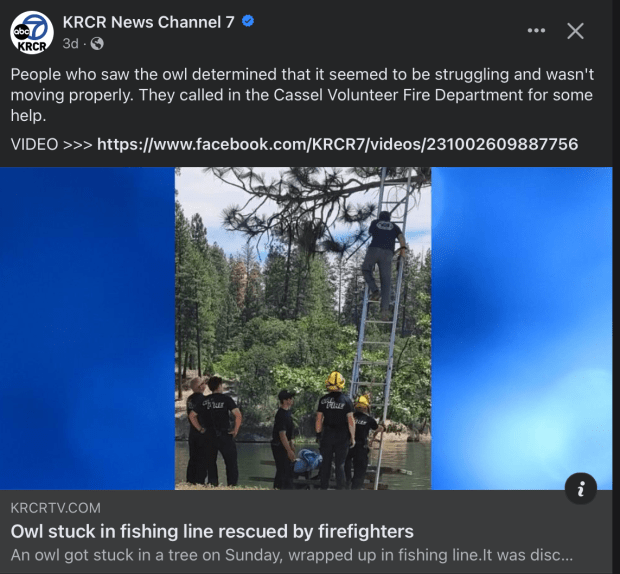
Worried about an animal in need that is not in a nest – phone the fire department! A feel-good moment.
Do you know about migration? There are several books on the subject, but Rebecca Heisman’s Flight Paths has been on my reading list. Migration is a topic that is coming up for almost all of our feathered friends. What I liked about the book is that it is full of science and what we have learned about migration through new methods using satellites, satellite tracking as well as boots on the ground, It is a page-turner—primarily black and white text with images in the middle. I didn’t miss seeing the images of birds. The writing is so good it draws you in. I was fascinated with the study of where birds go —so where precisely will the baby Blue Jays in my garden travel for winter? or the Rose-breasted Grosbeaks? What about the birds in the Himalayas that fly through really thin air to those tiny warblers that weigh no more than a ballpoint pin and travel three days over the ocean to get to their winter homes? This is exciting reading – well, to me it is – the history of migration, how humans discovered the amazing journeys our feathered friends take. This book will add much to your knowledge, deep appreciation, and respect for our feathered friends. It was $37 CDN for a hardback copy. Why not ask your local library to order a copy? Surely this is a subject that will interest many!
It isn’t about raptors but, it is about a natural solution to a problem – instead of using herbicides and pesticides. Just like raptors are the solution for rodents!
Canada is working to save the endangered Piping Plover- it is a good news story in amongst the bad – the BC Government allowed shooting and logging in the area of the endangered Spotted Owl – in fact, there is only one of them and there is shooting. Am I angry? You bet’cha. When will nature be a priority and not the economy? Without nature, there is no economy.
Lots to read today but Birdlife International has published a report on Avian Flu and some possible solutions that must be taken if our feathered friends are to survive this global catastrophe. The report states, “Bird Flu has evolved to spread more rapidly and easily in wild bird populations. Previously, this disease spread significantly in farmed bird populations and it was quite rare for wild birds to catch it – when outbreaks did occur, they usually impacted a limited number of species and only lasted a few months. This is no longer the case. With birds under greater threat than ever before, this virulent strain of Bird Flu cannot be categorised as a natural process and left to wreak havoc.”
Lots more nests with fledges to come today. Little Mini is just itching to fly – so keep an eye! But if you feel low, think of Fortis Exshaw and how wonderful this season has been with Mr O. He is our Osprey Super Hero! Thank you for being with me. Take care all.
Thank you to the following for their notes, photographs, posts, videos, and streaming cams that helped me to write my blog this morning: ‘A, Geemeff, H, L’, PSEG, Alyth, LOTL, LRWT, Rosie Shields, Boulder County FG, Pitkin County Open Trails and Spaces, Anne Ryc and Poole Harbour, Geemeff and the Woodland Trust, Cowlitz Pud, Gregarious Joris Toonen and Ospreys, Fortis Exshaw, Patient River Park, Osoyoos, Wildlife Conserve F of NJ, Suzanne Arnold Horning, Glacier Gardens, NZ DOC, KRCR News 7, Amazon, 27east, The Narwhal, and Birdlife International.
It has rained every day for ever so many days. The garden is emerald green. Without even looking at the forecast – the storm clouds roll in quickly – you can tell that something is going to happen by the frantic activity of everyone trying to eat!
One of Dyson’s kits got so excited and then lost its peanut over the edge of the feeder. Ahhhh….
The little sparrows lined up on the branch of Abigale’s tree hoping to get fed or get a turn at the feeder after the squirrel.
It was delightful to see Little Red at the feeders! He knew I was watching and thwarted my gaze.
Baby Blue Jay having a nap.
The little one only woke up when a sibling came to pester. There are five of the babies alive out of the original six…they were all in the garden on the feeders, having baths, and eating today. That is pretty good…they bring me such joy I cannot even describe it properly sometimes.
The baby on the left (above) is the one that slept with the little garden ornamental birds. Its crest finally has blue on it! But I can still tell which one this wee baby is from its behaviour. Adorable. Always loves a good long bath.
Lewis, of course, could care less. These days he is either sleeping or eating!
Oh, my goodness, the ospreys were fledging on Wednesday! I am going to lose count of all of them quickly! It took great effort to get all of the data in my forms along with the continued quest to find more French and German osprey nests.
And they were fledging on Thursday. OH1 just took off not long ago at the Glaslyn Nest! Congratulations! Time was 14:33.
‘D’ wrote and told me that it looks like it is possible all three on the Crooked Lake, Iowa osprey platform of parents Nobel and Whitley fledged on the 19th. Sunnie Day was going over to the footage to make sure that the first hatch CL16 also flew – and the verdict is ‘yes’ – all three flew today.
Take off and return for the first chick’s flight.
Siblings watching.
A great return.
‘H’ wrote and the second chick at Dahlgren flew!
Geemeff wrote that Ludo, the newly named osplet of Louis and Dorcha at Loch Arkaig, fledged before he got his official name. It was apparently the shortest trip ever from the nest take-off to the return landing.
Here is the video of that short flight:
Blue 5H3 took off at Poole Harbour at 1719 on the 19th.
These are exciting times for these young birds but, we have to remember that their journey is just beginning. Like many others less fortunate, these birds got to fly and we hope they will be safe.
The news coming out of the Chesapeake Bay Area that has been hit with storms and whose ospreys are starving to death underscores the coming challenges for the osprey population in the area.
“Williamsburg, VA – In 2023, The Center for Conservation Biology has documented the highest rate of osprey nest failure ever recorded within the lower Chesapeake Bay. Only 17 of 167 nests monitored during the season produced any young. The nesting population produced only 21 young resulting in a reproductive rate of 0.13 young per pair. This rate is below that recorded during the height of the DDT era. In order for the population to sustain itself, pairs should produce 1.15 young per pair.”
When a goshawk attacks a fledgling osplet on the nest while it is eating along with its sibling and Mum, my heart stops. Those are dangerous raptors and all of you know that predation by goshawks occurs throughout Europe and the UK. The loss of these chicks is personal to those who live and work around the nests – to whom the birds really are family. Have a read of John William’s poignant blog regarding the loss of the Llyn Clywedog fledgling on the 18th of July.
Instead of chopping down the Osprey platform for the demolition, it will be left standing long after the osplets fledge! We needed a good news story like this one. Thanks, Geemeff – it is “one for the good guys” as you say.
Rare bird spotted in the UK. Accident? Intentional? Black winged Kites are a “Small and distinctive falconlike kite. Light underneath, blue-gray above with conspicuous black shoulders formed by black wing coverts. Juveniles have a scaly back and brownish-washed breast. Found in open savannah, semi-desert, and agricultural lands with scattered woods; frequently seen on exposed perches. Varied flight style, hovering like a kestrel or gliding like a harrier with deep wingbeats and raised wings.. ” (eBird).
Time for a spin around some of the nests not covered above:
Boulder County Fair Grounds: A Fantastic news with diligent devoted adults and three very healthy nearly ready to fledge osplets.
MN Landscape Arboretum: It is all good. Lots of nice fish meals beginning very early. Our 21 year old Dad is doing fantastic.
Patchogue: Little Mini had a nice fish first thing as the sun was coming up.
The time was 0525 and Mini scrambled with that fish stuck on its foot!
Cowlitz PUD: All is well. Chick is eating, sleeping, and growing. And the metal grids are still holding out against the Bald Eagle predation. At the suggestion of ‘MB’, I wrote to Tweed Valley and Llyn Clywedog about the metal grids erected on the nest at Cowlitz to try and stop predation. It is something that the UK nests might have to consider if the goshawk threat to ospreys continues.
Oyster Bay: All present and accounted for.
Wolf Bay: Fledglings come to the nest hoping for a fish dinner.
Dunrovin: Everything is fantastic.
Poole Harbour: Getting lift and then gone. Blue 5H3 fledged at 1719 while its siblings watched.
Glaslyn: I thought it was the best screen capture I had seen of Aran’s new mate Elen and their two lads. Everything is fine. No fledges as yet. Soon.
‘H’ reports on the nests she is monitoring:
Fortis Exshaw: “Thankfully it was a mostly intruder-free day for this blended Osprey family. There were a couple of minor intruder issues, with Mr. O quickly flying to the nest at 0624 and 0651 to assist with defense. There were a total of 5 fish brought to the nest, one by Mr. O. At 1249 Mr. O landed on the nest and got an earful from Louise. She may have been telling him to go fishing, and even the two kids got involved and had a ‘talk’ with their stepdad, lol. This went on for about three minutes, with poor Mr. O just standing there and responding with soft chirps. It was comical. He showed up later with a headless fish. After Louise had brought the last fish of the day at 1951, Mr. O came to the nest and simply stood by for 27 minutes, while Louise fed the kids and enjoyed a meal for herself. Very cool, Mr. O.”
Dahlgren – At 1246 D12 became a fledgling at 58 days of age, although it was unclear if that was her intention at the time. She flew across the nest and may have intended to land on the other side, but miscalculated and tumbled over the edge. There was the sound of sticks hitting the water, but no splash or ripples were seen. Several seconds later, D12 was seen flying low past the nest toward a nearby dock. D12 landed safely back on the nest 4 1/2 hours later. Enjoy your new life as a flighted bird, D12!
Kent Island – All is well on the Chesapeake for Audrey, Tom, and their 38 day old youngster.
Severna Park – Olivia and Oscar continue to provide for their two fledglings at the nest.
Forsythe – At 57 days of age, Ollie jumped up, flapped three times and landed on the camera pole. Then 52 minutes later she jumped back down to the nest. Perhaps she will fly away from the nest and take a spin around the marsh today.
Boathouse – At 40 days of age, Skipper has been taking wingercising very seriously.
Thanks so very much, ‘H’!
Dorset Hobby: Oh, my goodness gracious. These little Hobbies are adorable.
Port Lincoln: Mum and Dad seem to be staying more and more on the barge nest as egg-laying approaches in August. ‘A’ reports some failed mating attempts, and you might recall that there was some concern for Dad last season.
Sydney Sea Eagles: ‘A’ reports that the 19th was “another quiet night, possums passing a few times. Lady left for a short break just before 7am and back straight away. Dad brought part of a fish shortly after, which she took away to eat. Both were then in and out during the day though Lady spend more than 2 hours longer than Dad on the eggs today. In the whole incubation period to date both have spent an almost equal time on the eggs. At dusk, Lady was settled as usual for the night.”
Durbe County, Latvia: Milda and Voldis’s male eaglet returns to the nest looking for a meal. Isn’t he gorgeous?
The female fledgling also visited the nest! both are safe and flying well.
Lesser Spotted Eaglet Nest in Zemgale Latvia of Anna and Andris. the eaglet enjoyed having a vole and a frog for a meal. I wonder how scarce food is in the forest?
Three beautiful storklets at the nest of Karl II and Kai in Estonia.
Four beautiful storklets of Bety and Bukacek are superb.
Lady Hawk captures a feeding at the Selati Verreaux Black Eagle Nest in South Africa.
Black Eagles are large raptors that live in various parts of Africa. The pair will lay two eggs four days apart. Incubation is 40-45 days. If two eggs and both hatch, the oldest chick will kill the second one. There will be only one chick to raise and fledge. They eat mammals such as monkeys, small antelope, squirrels, and rabbits.
Thank you so much for being with me today. P lease take care. Have a good end of the week. We look forward to seeing you soon.
Thank you to the following for their alerts, notes, videos, posts, and streaming cams that helped me to write my blog today: ‘A, D, Geemeff, H, MB’, Timothy Dygert Live Street, Pool Harbour Ospreys, Friends of Loch Arkaig and the Woodland Trust, Geemeff and The Woodland Trust, The Centre for Conservation Biology, John Williams Blog, Gregorious Joris Toonjen and Ospreys, CBS2, ITV News, BBC News, Boulder County Fair Grounds, MN Landscape Arboretum, Wolf Bay, Dunrovin Ranch, PSEG, Annie Roc and The Glaslyn Osprey Group, Bywyd Gwylld Glaslyn, Fortis Exshaw, Dahlgren Ospreys, Kent Island Ospreys, Severna Park, Forsythe Ospreys, Boathouse/Audubon, Dorset Hobby Nest, Pool Harbour Ospreys, Cowlitz PUD, Port Lincoln Ospreys, Sydney Sea Eagles, LizNM and the Latvian Fund for Nature, Latvian Fund for Nature, Eagle Club of Estonia, Mlade Buky Storks,Lady Hawk and Selati Verreaux Black Eagles.
It is humid and sultry (but not hot and sultry) on the Canadian Prairies. The skies feel like they could unload a whole lot of rain if they ever decided to open. My phone says they won’t. Let’s wait and see.
Today saw the arrival of some Japanese snacks and the kittens go crazy. What is it about White Peach Mochi and those crispy melon wafer cookies that cause them to turn into something besides kittens?
Later, look who is in his sister’s basket?
First up, I want to thank Gayle at Fortis Exshaw and Robyn at AIWC and the Alberta Birds of Prey for their immediate responses to the call for help if Louise at the Fortis Exshaw Nest should become injured or killed and the osplets left abandoned. Everyone was ready to help if help was needed. Thankfully, Louise is alright and is doing a splendid jog.
The fish deliveries for Wednesday, according to ‘H’ were: “Fish deliveries: 07:18:09, 12:28:02, 12:59:13, 13:36:54, 17:09:03”. All is well.——— Gosh, it is windy there. Louise is a fantastic fisher. Oh, gosh. Another large fish came in at 18:16.
‘H’ notes that Big intimidated Middle throughout the day but that Middle did wind up with some nice crops. Louise is fantastic even flushing out intruders from the nest.
This is wonderful news – Louise is amazing. Continue to send your positive energy to this incredible female.
‘B’ sent me the most fascinating article. I am so grateful as these ospreys have not given me a chance to read the papers. The birds are smart, they are taking things meant to keep them off buildings and using them to fortify and protect their own nests. Have a read – and thanks ‘B’.
Our dear Mini is starting to really spread its wings and is watching the older siblings intently on what to do when you get the itch to fly. Everyone keep an eye on Mini – s/he could fly at any time it seems. Let me know if I miss it!
Mum feeding Mini a private meal.
We just need Dad at Patchogue. All three fledglings and Mini are home wishing for fish.
Beautiful or handsome Mini.
Minnesota Landscape: The chick is getting its pin feathers. It was hot in Minnesota today. Mum is not always the most devoted mumbrella but she is much better at feeding.
First District Utility: The streaming cam continues to be frozen.
Moorings Park: I have never seen a fledgling spend so much time on a nest waiting for a fish delivery as Victor.
Boulder County Fair Grounds: This nest is fabulous.
Collins Marsh: A wet day but all is well. Mum and Dad on the nest with the two surviving osplets.
Poole Harbour: Family image. Watch the chicks and CJ7 as they see Blue 22 arriving.
CJ7 stays on the nest at night. Last year she lost a chick to a goshawk. Goshawks do not normally hunt at night but there could be Tawny owls or other predators in the area. She is not taking any chances.
Glaslyn: Elen and the two beautiful osplets waiting for a fish delivery. Everything is fine. Aran continues to impress with the fish deliveries.
Dyfi: Another family portrait and all is well with Idris, Telyn, Seiont and Cennen.
Llyn Clywedog: At 20:31, Seren Blue 5F brought in a huge Rainbow Trout to the nest. This is significant. It is the first fish she has caught and brought to the nest since April. Dylan has been supplying all the fish. Seren will begin to build up her strength for her trip to Africa. She goes to the exact tree in The Tango Marsh in The Gambia every winter and has done now for 7 or 8 years.
Alyth: All appears to be well at Alyth substation. The nice day turned into a very wet late evening.
Loch Arkaig: Geemeff caught the osplet picking up and moving a fish and self-feeding. Fantastic. Another milestone.
But, hey. Geemeff caught our chick – gosh, let’s get it a good name – playing football? Trying out for the Premier League?
Loch of the Lowes: She is gorgeous – Blue NC0. She will be dreaming of Africa and migration having laid the first eggs of the season along with Maya at Manton Bay. Chicks are gorgeous. All is well.
We must all hope that the situation concerning Avian Flu in West Africa has dissolved by the time these beautiful birds reach their winter homes. (I must check on that situation).
Loch Garten: I think this FB post says it all!
Foulshaw Moss: We have the first fledge of the 2023 season for White YW and Blue 35.
Tweed Valley: The two osplets were ringed, and their names are Sacha and Paul. Very appropriate for those great individuals behind Conservation Without Borders.
Finland #1. Everything is good.
Finland #4. It is often difficult to tell but it appears that things are alright on this nest.
‘H’s report on Patuxent 1: “Sibling ‘A’ that fledged on 7/11 at 0745, has not returned to the nest as yet. Nor has s/he been seen on the perch. The juvenile on the perch has always been identified as ‘Foster’. I hope all is well with the fledgling, sibling ‘A’. Sibling ‘B’ was very close to fledging on 7/12. You can just barely see its talons during a hover in one of the attached photos.”
Severna Park: “I’m pretty sure that Middle (chick #2) fledged at 0758 this morning at 65 days of age. Chick #1 flew off the nest at 0657.”
Dahlgren – The eldest chick (D11) fledged on 7/12 at 1148, at 55 days of age. S/he did not return to the nest on 7/12, but was seen resting on the nest owner’s boat with her dad, Jack. At 5 pm it was reported that D11’s mom, Harriet was seen feeding her on the boat!
Kent Island – It was another wonderful day for Audrey, Tom, and their little 31 day old chick. You will hardly ever find that youngster with a flat crop.
Osoyoos – After a couple days offline, the livestream resumed on 7/12. Ample fish were brought to the nest to feed the 15 and 16 day old osplets. Those kiddos are really looking good!
Why do ‘H’ and I make such a big deal about fledglings returning to the nest? Unless it is a case like Dahlgren where the chick is seen being fed by the parent nearby, fledglings return to the nest to be fed for about a month, sometimes much longer like Victor, while they learn to hunt and perfect their flying skills. If they do not return to the nest, something has happened to them.
Well, as ‘H’ watched, she is pleased to report, “Dahlgren D11 (chick #1) made a beautiful return landing on the nest this morning at 0744.”
At the nest of Big Red and Arthur: All of the Ms are fine and watching parents for prey deliveries!
Those Dorset Hobby Falcons are certainly cute! Who could resist watching them most of the day?
At the scrape of Xavier and Diamond – isn’t Xavier precious? Expect to see lots of bonding and Diamond trying to fatten up prior to egg laying next month.
‘A’ notes, “I need to mention sweet Xavier. He brought some breakfast to the nest box this morning at 07:37:38 and Diamond was into the box within seconds to claim it – but then realised it was a starling and jumped straight out of the box. Xavier looked a bit startled and somewhat nonplussed, and he hangs around for about four minutes, but then departs with his starling. An hour or so later (at 08:52:02) he tries again, and Diamond is more receptive to this offering. Well done, Xavier. This pair always seem to have crops – Madame Diamond is frequently too sleepy to take hers anywhere, so she rests on the ledge of her nest box for much of the afternoon. It’s a hard life for a peregrine at CSU in Orange!”
We are more than half way through incubation at the Sydney Sea Eagles nest of Lady and Dad. Dad came in to give Lady a break so she could go and have her morning meal and stretch her legs after a long night of incubation.
‘A’ writes, “Meanwhile, the dedicated incubation continues in Sydney. These two have a good rhythm. Let’s hope they do their usual excellent job of raising two fledglings this season. Both varieties of Australian possum are potential predators for both the eggs and the newly hatched chicks, though the brushtails are larger and more dangerous. The ringtails will eat those eggs just as fast as a brushtail, and although both species are primarily vegetarian, they will eat small chicks if they come across them. It is unusual for either type of possum to eat the chicks, but it has definitely been witnessed from both ringtails and brushtails. (I watched a little ringtail with a baby on her back crossing my street last night, like a tightrope walker above the road, clinging to the electricity cabling that crosses the road from one pole to another. They don’t seem to slip off, though I have occasionally seen one hanging from the wire and pulling itself across. Most walk along the wire with amazing speed and balance. The baby clings to mum’s back, or sometimes to her tummy. They are a protected native species, which is more than a little annoying for suburban dwellers with trees in their garden. The sound of possums thundering across the roof (or, worse yet, peeing inside the roof, staining the ceiling from above) is enough to wake the dead at 2am. And the sounds they make, especially during courting and mating season (now), are other-worldly in a very scary way!”
With all of the storklets killed and little Okrusezek fighting for his life as he lost it to the goshawk in Poland, I needed to check on a couple of the stork nests that we follow closely to make sure that all are home.
Mlade Buky: Everything is good with Bety and Bukacek’s beautiful storklets.
Karl II and Kaia, Karula National Forest: The storklets are losing the baby down and getting their feathers. They look good. Urmas continues to provide fish for the family in the fish baskets otherwise, we might not see these healthy ones. This is a man with a huge heart for storks just like Dmitri – and I checked. Dmitri was in the hospital awaiting his surgery Wednesday evening.
Tukums, Latvia: Everything appears to be good.
‘A’ loves the Royal Albatross. I do not report on them very often but as fledge is 6-8 weeks away, let us keep a closer check. ‘A’ reports: “In New Zealand, Prince Manaaki had a very busy day fixing up his nest, doing more excavations and heading off on some hill-climbing excursions. I can only suggest that you check today’s chat for some amazing pics of him (I particularly love the one where he is covered in nest material but the hill-climbing one is pretty cute too – let’s face it, he’s always adorable). https://www.doc.govt.nz/nature/native-animals/birds/birds-a-z/albatrosses/royal-albatross-toroa/royal-cam/royal-cam-discussion/ Don’t you just love a nest where we get to watch a loving couple reuniting and courting, doting parents incubating their egg for over two months, and then a safe hatch in a supervised incubator followed by no sibling rivalry, just one absolutely gorgeous fluff ball that we get to watch for a whole 240 days? And all the time knowing that they will be kept cool, given hydration and supplementary feedings, weighed and health-checked weekly, and generally treated in the manner they deserve. What an incredible treat that albatross colony really is.”
A quick check and Mini is still with us on the nest!
I want to thank ‘J’ for helping me extend my data to include some of the German Osprey nests. In doing so, she sent me links to valuable information, including a 1996 study on the ospreys in Germany. It is a good read and sheds some light on what is helping Ospreys to thrive or not in a limited area of Germany. That area is home to many of my ceramic friends who still run potteries with wood-burning kilns in the Mecklenburg area north of Berlin.
Thank you so very much for being with me today. Please take care. See you soon.
Thank you to the following for their notes, posts, videos, and streaming cams that helped me to write my blog today: ‘A, B, Geemeff, H, J’, Fortis Exshaw, PSEG, MN Landscape Arboretum, Moorings Park, Boulder County Fair Grounds, Collins Marsh, Poole Harbour Ospreys, Bywyd Gwylld Glaslyn, Dyfi Osprey Project, CarnyXWild, Alyth, Geemeff and The Woodland Trust, LOTL and the Scottish Wildlife Trust, Livia Armstrong and Friends of Loch Arkaig Ospreys, Polly turner and Friends of Loch Arkaig Ospreys, Jeff Kear and Ospreys, Severna Park, Kent Island, Osoyoos, Dahlgren Ospreys, Patuxent River Park, Finnish Osprey Foundation, Cornell Bird Lab, Dorset Hobby Falcons, Holly Parsons and Orange, Australia Peregrine Falcons, Sea Eagle Cam, Mlade Buky, Eagle Club of Estonia, Latvian Fund for Nature, NZ DOC, and Researchgate.
It has been a very rough two days. In the six years, I have been monitoring nests for siblicide – and the many before that where I was observing behaviour – I have never had a spate of osplet deaths as we have seen in the past couple of weeks. Chicks dying for unknown reasons and now dying of starvation because of a storm. More chicks will die before Saturday morning and everyone is going to sleep with a very heavy heart.
There are many things that my father taught me by his example. My earliest memory was always helping those that were unable to help themselves. It did not matter if it was the birds, the stray cats and the dogs that people knew to leave because he would care for them and find homes or people. So, no one got in a boat, or a car to place fish on those osprey nests is beyond me. My only alternative tonight was to ensure all the garden animals were overfed. It is essential to stop, take a breath, and care for those that are nearby and need your help. So, this weekend, in memory of all the little ones that were lost, put out a water bowl, fill up a feeder, clean up human debris. While we mourn the lost ones, we need to remember to focus on those that are living. Their lives are as precariously balanced on the thinnest of wires and your generosity could save their family!
Before we start with todays news, I want everyone to have a ‘feel-good’ story to stay with them during some of the tragedies. Enjoy! Who knew that a laundry basket could bring such happiness?
And, yes, we are going to need a lot more happiness today…look at these two beautiful fledglings from the new West End nest of Thunder and Akecheta….but, wait. They are at the old nest! No worries. An adult was over on Tor keeping an eye. Gorgeous. And both seem to have crops.
I want to give a shout out to Louis at Loch Arkaig. As Geemeff says, Every nest could use a Louis’. No mater the weather, nothing stops him from getting fish on that nest.
Louis does it again Saturday morning.
When we hear of Black Friday, it is now most often associated with a shopping frenzy but, for me, the 22-23 June will now be the day that so many osplets died in a climate situation in the NE of the United States. The true toll will not be known until Saturday or Sunday on the streaming cams. The females who have kept their chicks warm and dry and watched them die have not eaten either. We could also lose them! I do not understand why the businesses and the wildlife associations that run the cameras are not prepared to step in and provide fish. Are not the frequency and severity of these storms signalling something to do with human-induced climate change?
Conserve Wildlife Foundation of NJ offered this explanation of the weather system that has caused such a catastrophic loss on the nests in the region – and to them, this is catastrophic having their entire family wiped out.
At Barnegat Light, after more than 60 hours, a fish came on the nest at 14:31:39. It appears that Daisy went fishing…she is wet. Will they all survive? We must wait to see. Big ate and so did Daisy – she has to. Middle was shut out and he has now not eaten (as of this fish delivery) for 53 hours. Duke has not been seen since yesterday afternoon and it is thought that he might be trying to find fish elsewhere – I think he has been injured in the storm and is MIA.
The tears are pouring…sadly, the fish came too late for Little Bob. Hopefully, Daisy will get more fish – and she did. She brought in another at 15:23. She has brought in two fish Saturday morning but Middle is too ill to eat. Middle is dying. Daisy has done amazing work and it looks like she might be able to keep herself and Big alive. How said that Middle is unable to eat some of that fish because Big is full.
Oscar has been bringing small fish for Opal and the two osplets at Forsythe. Anything helps – and ‘H’ noted that Oscar had 7 fish on the nest on Friday in difficult fishing conditions. It appears, however, that we will lose chick 3, Little. Mini has already passed and 3 was just barely alive at 19:38 on Friday and was not seen eating. It now appears that three has died leaving Dad Oscar, Mum Opal, and Owen and Ollie. With some luck, the oldest two might survive.
‘H’ reports on Forsythe for Saturday morning: “Bless dear Oscar, how stressful the previous days of bad weather must have been for him, knowing that his family depended on him, and he was not able to provide. Seems like he is trying to make up for it now, 8 fish deliveries before 9 am!” After a bit both of the chicks ate…this is good. These two might survive.
Not particularly happy with what is happening at Patchogue. Mini ate well on Wednesday and had some fish Thursday morning but those huge crops of the previous weeks are gone. The three big siblings are now up and eating first thing in the morning and Mini is often shut out. Let us hope that the good fishing returns.
Mini appears to continue to be shut out of fish. Will Dad bring a late night one so our Mini can eat? He will desperately need fish on Saturday if this keeps up.
It is a miserable Saturday at Patchogue but Mini was fed by Mum at 0824. Tears like the rain.
Severna Park was really wet, also. All the nests are getting some residues of that storm. Both seem to have eaten but the fish do not appear to be coming as regularly today.
The fish are small and are few but, thankfully, there is only one chick and the Cowlitz PUD osprey nest might just have a fledge this year when other nests have none. That is almost shocking.
The two osplets at the Great Bay Osprey platform in Greenland, New Hampshire, are eating some nice fish and doing well.
The Outerbanks had a nice big flat fish come in!
Oyster Bay appears to be OK. There is some problem with submission but the fish seem to be coming in.
Boulder County Fair Grounds is alright, too. The little one had a nice big crop as the sun was going down.
Mum fed Dad some of the fish before the chicks were fed. This is a sweet nest.
The large female and male of Laddie and Blue NC0 were ringed a few days ago. The female is Blue PF4 and came in at a hefty 1.85 kg, while the little male weighed 1.2 kg and is Blue PF5.
Three healthy chicks on the Osprey nest in Spain at the Urdaibai Biosphere.
Good News is coming out of Minnesota-
The Peregrine falcon scrape at Topeka Kansas has proven to be a bit of a mystery. The older siblings fledged a week or a bit ago. The third hatch – which appears to be developmental slow in getting its feathers – and appeared to have a problem with its eyes is beginning to look more like a falcon. It is not clear how much prey is brought to it on a daily basis but I will continue to call for an intervention if the adults are not delivering several food items a day…
Lady Hawk caught M15 and his lady friend at the pond! Some good news…and also, there is news that E22 was also seen at the pond at 1620 Friday. Life is good at SW Florida on the Pritchett Property.
Soledad is one of the fiercest Peregrine Falcons I have seen! Here she defends the scrape and she can only have thought that Monty was an intruder!
M1 returned to the nest when prey was delivered. All is well at the Red-tail hawk nest of Big Red and Arthur – it is perfect that she is flying so well and going on and off to the trees and buildings building up her skills. M2 fledged Friday leaving M3 on the nest alone Friday night.
Flying is hard work.
M2s fledge:
Deyani has been returning to the nest of Tom and Angel to get prey items, too. She has been following the adults when she sees them from her behaviour.
Other heartbreaking news. A goshawk has taken 2 of the 4 storklets off the Black Stork nest of Noteka and Nutka in the Noteka Forest in Poland.
In a freak event, the eldest goshawk at RSPB Loch Garten goshawks attacked the youngest, Mini 4, when a large prey item was delivered and killed its sibling. I have never seen this happen at a hawk nest.
After a horrific year of deaths due to HPAI, Sunnie Day reports that Bald Eagles in Georgia are on the rebound.
The latest BTO News came in the post today. There are many great articles, one is an opinion piece by Nick Acheson. He is the author of The Meaning of Geese. In all that he does – and Acheson does a lot- it is because of climate change that he says he wants to know that he has a clear conscience and has done his utmost to mitigate the climate crisis. ” I will have tried. At least I will have tried”. He has been a Vegetarian since childhood; he has given up animal products altogether, doesn’t drive, takes the bus, or uses his bicycle. He never flies anymore, and this young man could earn lots of money on the lecture circuit. He lives in a small Flint house in Norfolk that he also refuses to heat. Check out Nick’s website at http://www.themarshtit.com
Acheson believes that our window for doing something is closing fast – after 40 years of warnings. What I like about him is that he is unwilling to give up!
Nick’s worries are borne out by an article in The Guardian today but, they also show us that with a major effort we can turn some things around.
Thank you so much for being with me today. When it all gets too much, take a deep breath. Spend time with your pet, sit outside, and listen to the birds. We all get overwhelmed, especially when we want to do something to help and can’t. Take care of yourself. Amid the mourning, there is much joy, and now it is time to also celebrate that! See you soon.
Thank you to the following for their notes, posts, videos, and streaming cams that helped to make up my blog today: ‘Geemeff, H, L, SP, and T’, Nick Beres NC5, IWS/Explore, Geemeff and the Woodland Trust, Conserve Wildlife Foundation of NJ, Forsythe Ospreys, PSEG, Severna Ospreys, Cowlitz PUD, Great Bay Ospreys, Outer Banks 24/7, Boulder County Fair Grounds Ospreys, LOTL and the Woodland Trust, Evergy Topeka, Lady Hawk and SW Florida Eagle Cam, SK Hideaways and San Jose City Hall Falcons, Cornell RTH, Window to Wildlife, Sunnie Day, The Guardian, BTO, and Twin Cities Metro Osprey Watch.