Good morning to everyone and the best of Thanksgiving to those celebrating in the US today.
It has been wonderfully warm on the Canadian Prairies. I do not know if it is atypical for this time of year but, it certainly feels like it. The birds in the garden had some of their feeders rearranged and thanks to a lovely friend I swopped out some old feeders for some she gave me yesterday. One of the visitors today was a beautiful Starling. It’s an immature non-breeder. Note all of the white spots on his breast and it has yet to get its oily black head. The males and the female Starlings look alike. Did you know that? One difference is that the beaks of the males are a deep blue while those of the female are a pink colour. This then looks like an immature non-breeding male.
Look closely and you can see their rose coloured legs. It is also a pair of non-breeding adults. They are really loving this soft suet.
The Starlings will not perch on the metal. I do not know why. They want to lean down from the branches to get to the suet. You can see this behaviour in the image above also. So the feeder below was moved so they could more easily reach it! Who says I am a softie?
Junior was grateful for a bowl of corn today.
One of many varieties of the Sparrow family that visit the garden. They are particularly enjoying the Butter Bark Balls on these damp days.
The kittens have had great fun watching the birds and the squirrels. They continue to find places in the house to get into mischief. And they do not always come when they are called setting in a panic that they have miraculously gotten outside in the cold. Of course, they are somewhere laughing (do cats laugh?) while I panic!
Missy has discovered a Rodney Mott sculpture that is just perfect for hiding in. Lewis is in the overturned basket not even showing a whisker.
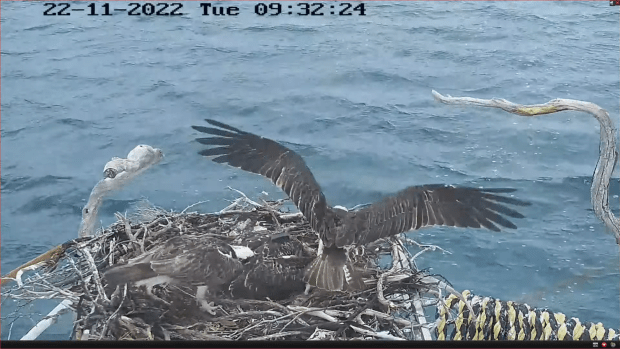
At the Australian nests, Zoe took off for her first flight of the day at 0901. It was an absolutely perfect take off and her landing at 0907 was spot on, too. She is a very strong osplet. I do hope she gets some nice fish. It has been 24 hours since she last had some food.
While the camera was down for a couple of yours, Dad brought in fish. We are only seeing the tail of the fish but I hope that Dad had some nice fish – the entire head – and that it was big enough for Mum and Zoe to also have a good feed. This family would really enjoy a day with several deliveries but, I am grateful to know that there was a delivery mid-afternoon.
Zoe had a nice crop.
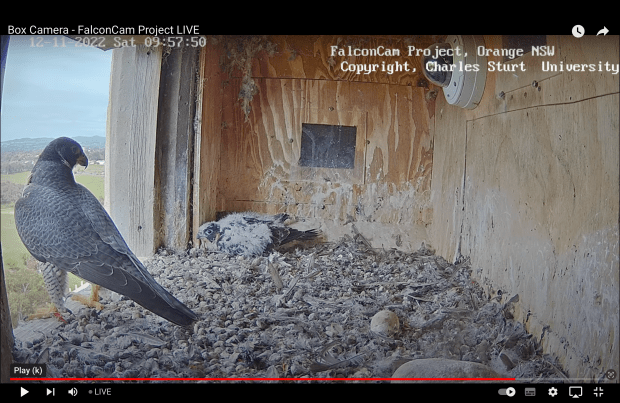
At the scrape in Orange, things were decidedly low key. Xavier and Diamond in and out of the scrape box and Diamond enjoying sleeping in the box all by herself at night. They have busy days chasing after Indigo and Rubus. Little Rubus is, apparently, doing more flying and getting much better.
This was the news from Orange: “Rubus and Indigo both seen within the last hour. Rubus is exploring the campus, going from building roofs to trees etc. He fledged on 20th November. Indigo is way ahead getting flight training from parents, visiting the box etc. He fledged on 11th November at 41 days.”
If you haven’t checked out the FalconCam site in a few days, I urge you to do so. Someone is really adding historical data and you can go back to 2007 to see earlier chicks and read about the big events at the scrape. Here is that link if you lost it.
Oh, it is stormy up near Jacksonville. Samson and Gabby have been on the nest today working despite the wind and the bad weather that looks like it is moving in.
I put this image in not so you could peer at the fluffy bottom of a big Bald Eagle but, rather, for you to see the colour of the legs and feet of Gabby. Then look at their beaks. This is a bright chrome-yellow. This is a very healthy bird.
Harriet and M15 are sleeping at the nest and so far no eggs, just like at NEFL.
At the E-3 nest in the Kistachie National Forest, they have their second egg today. Congratulations Andria and Alex.
There is also news coming out of the Midway Atoll about a very rare pair of Albatross.
As we give thanks for all the birds that bring our lives joy, remember that we are the cause of much of their suffering. Please spread the word to anyone you know – or where you work – that there are solutions other than using rodenticide to get rid of mice and rats. Also teach them about secondary poisoning. It could be their dog or cat but, it is often one of our beautiful raptors.
At small islands in New Zealand, Dr Digby and his team care for the rare non-flying parrot, the Kakapo. In 2016, they hand-raised more than a dozen of these precious little birds. Today they continue to do that work when it is required. The work that Digby and his team do to restore the health of these birds and to keep them safe and try and increase their numbers is remarkable. So thankful.
No 13. The Red List. The Marsh Tit
At first I thought these were out Black capped Chickadees. The Marsh Tit is small, it is mainly shades of a soft grey-brown or taupe with a shiny black cast, a black bib, and a pale ivory underbelly. The bill, eye, and legs are black. They are not plain by any means, look closely at the plumage patterns. Simply lovely.
The woodlands of the United Kingdom – and elsewhere – are changing and that it causing a huge decline in the number of this very small song bird, the Marsh Tit. The woods are more fragmented now, separated by grazing pastures, a growing number of introduced deer. Marsh Tits, according to Mike Toms, “favour woodlands with a complex understory and require surprisingly large patches of suitable habitat in order to breed successfully.” And they’re like their woodlands to be “wet”. Climate change has meant that they are now laying their eggs at least ten days earlier than they were 50 years ago. This change has had a decided impact on available or peak food supplies for the chicks which is also contributing to a decline in population numbers. The Marsh Tit is also known to visit older gardens, copses, and parks, and has sometimes been seen on feeders.
They feed mostly on insects, seeds and berries, and often cache food over winter if they find a good supply. They nest in existing tree holes, rather than excavating their own, and produce seven to nine eggs.
Their song sounds like a sneeze “pitchoot”.
Here is their range.
Thank you so much for being with me today. I hope that each of you had a wonderful day no matter where you are — or will have a great day if you are just waking up reading this. Take care. See you soon!
Thank you to the following for their posts and streaming cams where I took my screen captures: Port Lincoln Ospreys, Charles Sturt Falcon Cam and Cilla Kinross, NEFL-AEF, SWFL Eagles and D Pritchett, KNF, Friends of Midway Atoll National Wildlife Refuge, A Place Called Hope, Kakapo Recovery and Dr Digby Twitter, Openverse, and RSPB.
I hope that you are well. Tomorrow is Thanksgiving in the United States. In Canada, we have already had our harvest festival in October but, as one of the readers reminded me, it is a time to give thanks for all of those in our lives — so to all of you wherever you may be, ‘thank you for being part of this great community’. Your empathy, caring, understanding, and joy are remarkable and this year we have been so much together. And to all of our feathered friends, thank you for the joy and the tears and for reminding us that we are all in this world together, not separate.
Dyson sends greetings from all of us to all of you. She hopes that you have plenty of ‘nuts’ for your celebration while reminding all of us to share with the wildlife.
There is simply not a lot going on in Bird World. Only one thing seems to be on anyone’s mind now that Zoe has fledged. When will Rubus fly up to the scrape? Rubus has flown. Shines reports that Rubus was on the ground and observed to fly 200 m to his perch. Indigo has been up in the scrape box and so have the adults. And he flew some more later and picked up a prey delivery (see below). Life feels good right now. All are well.
Interesting to note that Xavier was in the scrape box ‘scraping’ – is he already thinking about next year? A scrape is a shallow indentation in the gravel or sand in which the eggs are laid.
It is extremely heart warming to know that all of the staff at Charles Sturt University keep an eye out for the falcons. Rubus was found on the ridge of the Printery Roof. Here is a video showing a prey delivery for Rubus from Xavier. So, we can all relax. Xavier and Diamond are taking good care of both Indigo and Rubus and there are all kinds of caring eyes looking out for them!
Thanks ‘A’ for sending me the link to the video and this comforting news!
If you missed Zoe’s fledge, here is my short video clip. She was really working her wings earlier and her first flight took her right down to Dad’s shed. Perhaps Ervie will come and join them for a good old ‘chin wag’. Zoe is 66 days old.
Mum is in the nest and Dad is on the ropes. Zoe is still down in the shed. She will figure out how to fly back up to the nest. If I recall, this is what Bazza did last year! Please correct me if I am wrong.
There should be no worries. Zoe flew up to the nest at 1451 and booted Mum off. She is now prey-calling and I presume that one of the adults will be out to get their girl a nice fish for her accomplishment!
Zoe later flew back and forth to the perch and around the barge. It appears from all the time tables that Zoe did not get a fish after fledgling. Thanks to ‘A’, here are the major events from the observation board for Port Lincoln for the day: Fish count: Dad: 2, Mum: 0Fish times: 08:37, 11:4908:37 dad with headless fish, mum takes it away 08:46 mum returns, Zoe self feeds 9:00:56 Zoe eats the tail.
11:49:45 Fish tail end by Dad. Zoe was in the mancave 11:55 Mum eats the tail. 14:51:55 Zoe returns to the nest, where mum was, who then leaves
18:40 Zoe from nest to close perch (and back and to the perch) and flying around the barge
‘H’ made a video clip that shows Zoe’s fledge and her subsequent flights which are not included in mine. Thanks so much ‘H’.
————————————————————————————-
Making News:
Dave Hancock of Hancock Wildlife is building shaded nests for the eagles to help them with the increasingly number of heat domes that are part of climate change in British Columbia. Here is an image of one of those nests with the Delta 2 Eagles.
The British Trust for Ornithology is watching with great concern as the migrant birds from parts of Europe arrive in the UK for their winter holidays.
BirdLife’s 2022 Photography Awards are in and there are some stunning images.
There are many categories and many birds that will be familiar that are in those winning shots including the Albatross, BooBook Owl, Wood Ducks, Petrels, Wrens, and Lyrebirds. Enjoy!
What you might not know is that you do not have to be Australian to enter. Maybe think about submitting some of your images next year. One section of the Birdlife website that fascinated me was the ‘tips and tricks’ to getting bird photos. Mine would never win any awards but I would love to be able to take better photos of our beautiful feathered friends. To check out on the regulations for the annual awards and to see the tips and tricks, please go to:
birdlifephotoaward.org.au
————————————————————————————
In Senegal, Jean-marie Dupart reports that he counted 331 Ospreys in a stretch of beach measuring 143 km. That is fantastic news!
———————————————————————————–
In the United States, the Osprey breeding season starts after the Bald Eagles. Jack and Diane at the Achieva Osprey nest in St Petersburg, Florida have been visiting their nest. I wonder if they even know where to start with all the weeds that have grown up!
I keep heading over to the West End nest of Thunder and Akecheta to see if I can catch them at the nest but, no luck today!
I didn’t find anyone at home at Fraser Point either and they are playing highlights on the Two Harbours cam.
Harriet and M15 have been on and off the nest today. Many thought that today might be the time for the first egg’s arrival but, it doesn’t appear to be the case. Perhaps tomorrow!
Gabby is looking particularly gorgeous these days. She is keeping her eyes out for any intruders near the nest she shares with Samson at Jacksonville, Florida.
In his description of this beautiful Blackbird with its white half moon torque on the male, Nick Baker says, “It’s the thinking person’s Blackbird, the connoisseur’s choice; a passerine, that keeps itself to itself and is somewhat exclusive, hiding away from the cheap (ing) twittering masses of other perching birds, other than the odd curved, Wheatear and pipit.”
Baker likes the stunning black birds because they are elusive one has to “invest some kind of effort to find one makes them all the more appealing…” Baker lives in Dartmoor, where a small population of these passerines “hangs on.” He says “the situation is about as delicate as the frosted feather edges on the bird’s breast.”
This lovely print shows the adults and the wee one. Notice the silvery wing panels on both the male and the female. You can see them easily in the photograph by Rainbirder above, also. The male’s crescent moon is pure white while the female’s is ivory barred with a rust brown. Instead of a black chin, the female has vertical barring, dark chocolate on white. Once again, I think that the female is just as stunningly beautiful as the male – her head, back and tail are not the pure deeply saturated black. In fact there is more variety to her plumage. The spots on the chest of the juvenile with its brown head, back and wings remind me of the work of Denmark’s most accomplished ceramic artists, Priscilla Mouritzen.
The ring ouzel is a member of the thrush family. It grows to approximately 24 cm or 18 inches in length. They are smaller than Blackbirds but are often misidentified as being a Blackbird unless you see that stunning half moon panel.
They breed in the drags and gullies of the steep valleys from mid-April through to mid-July normally having two clutches. Their nests are located close to the ground in dense heather or in a crevice. It would be very rate to see them nest in a tree. They feed their young earthworms and beetles and as adults they eat insects and berries.
The threats that these birds face are quite numerous. The predation of eggs is a start because of nesting close to the ground. They are disturbed by humans, their habitat has been destroyed due to deforestation in the areas where they winter in Spain and in Africa. Climate change has had a significant impact on the bird. The authors of the book noted below, possibly the very best study of these birds, notes that the landscape of the North York Moors might become completely unsuitable for them in the future.
One of the best books on this species is this volume, The Ring Ouzel. A New from the North York Moors. The retired duo hiked, observed, and gained considerable knowledge which they have passed on to us in a delightful little book. I keep thinking how wonderful they were to find this specific place now and provide us with insights into a bird that is most elusive.
————————————————————————————-
Migration News:
I am still following two of the four fledglings from Karl II’s Black Stork family from the Karula National Forest in Estonia. Those two are Waba and the foster chick, Bonus. The only surviving strolling from the last brood of Jan and Janikka.
Bonus remains in the area of Turkey (Konya Province) where he has been for what seems like forever. It is an area that can get cold in the winter with snow and everyone is hoping that he will decide to get moving!
Waba remains in the Sudan feeding on the Nile River. He travelled 242 km in the last few days (his tracker was not transmitting for some of that time).
Both of the Black Stork juveniles seem to have found water and lots of food and it appears that each is reluctant to leave their respective locations. It is always a relief to know that they are well but, like everyone else, I hope that Bonus will get an itch to fly and that he will head south to catch up with the remainder of his family in Africa.
Thank you so very much for being with me today. We will be keeping an eye on Zoe as she perfects her flying skills along with dear Rubus and Indigo at Orange. Take care everyone. See you soon!
Thank you to the following for their posts, videos, and streaming cams where I took my screen captures: ‘A’ and ‘H’ as always – so grateful, Charles Sturt Falcon Cam and Cilla Kinross and gang, Port Lincoln Ospreys, British Trust for Ornithology, ave Hancock and Hancock Wildlife, The Guardian, Achieva Ospreys with Jack and Diane, IWS, SWFlorida Bald Eagles and D Pritchett, NEFL-AEF, Openverse, and Looduskalender Forum.
It was 10:54:46 on the 23rd of November that Zoe, the eldest of three osplets hatched on the Port Lincoln nest, fledged. She landed in Dad’s shed!
I included Zoe’s preliminary flapping and hovering. You will also notice that Zoe did a ‘poop shot’.
If you watch raptors, you will begin to notice that before they are going to take off they will lower their heads, do a ps, and then depart. Check it out next time.
So all of the Australian raptors for the 2022 season on streaming cams have now all fledged!
Congratulations to Port Lincoln Ospreys and to Mum and Dad.
It has warmed up on the Canadian Prairies – and because of that the heating is not on as much and it is damp and cold. Believe me, we always grumble about the weather. It is to be 0 degrees C today! It will cause things to melt a bit and get all slushy – there is nothing worse than chills to the bone. It will be a good day to go to the pond and see if there are any of those Wood Ducks still hanging about. Images (sadly I do not have permission to share them – yet) have been coming in that are showing 50 or 60 Bald Eagles just south of our City in the trees alongside the Snowy Owls. It is quite incredible.
In the Mail:
There are times when we just need something to put a smile on our face. When I lived in Norman Oklahoma and went to the University of Oklahoma, it was impossible not to be an OU Sooners Football Fan. I can still smell the damp leaves in the fall covering the sidewalks on the way to the stadium. When ‘B’ found out about this, he sent me the most fabulous image. As we all remember – too well – there was a time in 2020 and 2021 when large gatherings of people were forbidden due to Covid. One of those was, of course, the popular football games in the US. So, the University of California at Berkeley, put up cardboard cut outs of viewers. Guess who got the prime seat? Look!
That is fabulous. Our own Grinnell. Alden is wonderful but there was just something about Grinnell that made him ever so special. It is hard to lose them.
Thank you ‘B’.
The other day Annie and Alden attended all the celebrations for the latest football game at Berkeley when the Cal Golden Bears beat the Stanford Cardinals 27-20. Our adorable Peregrine Falcon couple went up to the ledge, spent some time there recuperating (was it 3 hours?). ‘H’ sent me a link to the video of them sitting and leaving together that she made for us to enjoy. Thank you ‘H’.
Making News:
There is news coming in about the streaming cams and nests on Captiva Island -the Bald Eagle nest of Connie and Clive and the Osprey nest of Andy and Lena.
The Dfyi Osprey Project in Wales is reporting that there are two beautiful Red Kites on the Dyfi Osprey nest of Idris and Telyn. Aren’t they ever so beautiful? Just look at that plumage. I don’t know about you but I am simply mystified at how beautiful these raptors are – the falcons, the kites, the kestrels, the Merlins, and the Harriers. You can take the same colours and shake them up and each one is slightly different than the other. I have to admit that the Red Kites are quite stunning with those icy blue heads and amber eyes, bright chrome-yellow cere and short hooked beaks with its black tip. The terracotta or rusty sort of Corten Steel colour of the tails (reminiscent of the Red-tail Hawk) set against the dark chocolate trimmed with white is outstanding.
You can check on all the birds that use this nest by going to dyfiospreyproject.com
There is no rest for Dr Peter Sharpe of the Institute for Wildlife Studies. Those who watched the Channel Island’s Bald Eagle nests will remember Dr Sharpe climbing up to rescue Lancer at Two Harbours, getting a chick of the cliff at the West End, and going in and taking Victor to the Ojai Raptor Centre last season. He is now busy working on the cameras. Here is the announcement from the IWS.
Everyone is getting ready for the Bald Eagle breeding season. Speaking of that, Samson and Gabby were caught mating on the nest today just like Harriet and M15 were a week or so ago. Eggs should be coming shortly. Will there be holiday eaglets?
Philippe Josse reports that progress is certainly being made on the Notre Dame Eagles nest – the natal nest of dearest Little Bit ND17. Please join the FB group Notre Dame Eagles for up to date information on this family.
Terry Carman is keeping track of the Bald Eagle eggs on the streaming cam. Here is the latest report — and all bets are on Harriet and M15 having their first egg today at SWFlorida! If you are looking to track Bald Eagle laying, please head over to this great FB group. There you will always have the latest information.
Checking on the Australian Nests:
Zoe is 66 days old today. She could fledge at any time. She is doing some good hovering and has nailed stealing the fish when Dad brings it to the nest! And you know what? She is gorgeous. When the wind whips her crest up it accents those focused piercing eyes and that very sharp hooked black beak. The dark black eye line just makes her that more gorgeous.
The winds are at 26 kph right now. Gusty for our girl. I hope she does not get swept up when she is practising her hovering. Zoe is getting better each day at that hover but, still. We saw what wind gusts can do with Rufus. I prefer that they take off on their own!
In Orange, Xavier and Diamond seem to be having prey drops with Indigo. She is really doing well!
Look carefully over at the trees!
Yesterday Shines found Rubus on the ground next to the road and put the little fella back up in the Waddle Tree.
I have to admit that I am a wee bit worried about Rubus and that is only because there have been no reports of any feedings. That is not to say they have no occurred. Diamond and Xavier are cracker parents and I think they are decidedly trying to lure Rubus back up to the scrape. It is possible that he does not feel confident to fly. Has anyone seen Rubus flying since he fledged/fledged?
Some more photos of Rubus higher in the Wattle Tree.
Every once in awhile one of the parents goes up to the scrape. I think they are really trying to lure Rubus back into the box.
Xavier is keeping an eye over everything happening with his two fledglings from the ledge of the box.
At 1540 Indigo comes up to the scrape box prey calling, very loudly, and Xavier immediately takes off. Indigo stays in the scrape looking for prey amongst the feathers. Will Xavier return with something from the storage vault?
Indigo spent the night in the scrape box last evening.
I urge you to check out the wonderful website that has gone up at Orange. Cilla Kinross and her great team have put together cracker content and you can get up to date information on our falcon family there with their photographs.
Oh, it is hard to imagine that this lovely little raptor is on the vulnerable list in the UK. But, if it is happening there, it is possible that there are declining population numbers elsewhere. Ruth Tingay, writing in Red Sixty Seven, describes the birds as feisty and dashing with their “rapid fire kek, kek, kek, kek, kek” that demands everyone’s attention. Tingay first saw Merlins in the wilds of the Hebrides, those remote islands off the west coast of Scotland. She then saw them again in an urban setting in Idaho and said she was shocked because she always associated them with great open spaces.
Look at the colour of the plumage! They are smaller than a Peregrine Falcon measuring at most 30 cm or 12 inches in length or the Red Kits who grow to approximately twice their size. The male Merlin has dark steel blue grey upper wings, tail and top of the head. The underwing – the primaries and the secondaries are the same dark grey barred with a lighter grey. There is a fine white eye line, magnificent rusty-orange with dark chocolate barring on the underneath, on the legs and the upper part of the wing. The deepest dark 70% cocoa eyes, a white beard and throat. The beak has a black tip fading into that grey blue and a yellow cere. The legs are chrome-yellow with deep black talons.
Merlins are described as “our smallest falcon, male smaller than the female, not much bigger than a Blackbird.” They live on the moors and open fields where they breed but travel to the south and the coasts of the UK for their wintering grounds. Here is their map.
Seriously adorable but, in the sky and hunting, they are formidable for the smaller birds.
The Merlin was a popular hawk of Mary Queen of Scots and became known as the Queen’s Falcon or Lady’s Hawks. Royalty and women of the aristocracy would use them to hunt Sky Larks. They are a fierce hunter capturing their prey from the air, high up meaning that they have to have a very calculated effort. They normally hunt small to medium sized birds bit have been known to take pigeons, ducks, and even plover.
Sadly, they are quickly losing their habitat, pesticides and secondary poisoning, and of course the shooting by the keepers of the estates where Red Grouse hunting takes place. Other causes of death are collision and cat predation. There are many other threats. Corvids, such as Crows and Jays, will eat the eggs and the nestlings if they find them and, indeed, Merlins do not build their own nest but reuse the nests of others including Crows. Larger Raptors such as Peregrine Falcons, Great Horned Owls, and even Goshawks are a threat but all others tend to steer clear of this small falcon because of its aggressiveness.
Climate change will impact this small spirited hawk. Audubon has set up a programme to try and predict the changes to its breeding habitat. As you can see they will be pushed further north to where it is cooler. With the polar ice melting and the seas warming, I wonder how long it will be cooler in the north?
Some new books have arrived and I will be anxious to tell you about them as I work my way through. For now I am trying to scout out all the birding sites on the island of Grenada in the West Indies so that I can – hopefully – send you some images of birds that are either old friends or new ones. My son will probably never invite me again! He gets another location or two each day – . I was told tonight to bring my gum boots and lots of mosquito repellent. So for dear ‘L’ who was worried that the newsletter might stop while I am away, ‘no’ it will not. You are all going on my birding adventure with me!
Thank you so much for being here today. It is so nice to have you with us. Please take care of yourself – and I will see you soon!
Thank you to the following for their letters, their posts, their videos, and their streaming cams where I took my screen captures: ‘B’ so grateful for that image of Grinnell, ‘H’ for her great videos, Captiva Island Eagles and Ospreys FB, Dyfi Osprey Project FB, IWS, Notre Dame Eagles, Bald Eagles Live Nest Cams and News, Port Lincoln Ospreys, Charles Sturt Falcon Cam and Cilla Kinross, the Falcon Cam Blog, Open Verse, and Audubon.org.
Greetings from a wintery wonderland on the Canadian Prairies. We have snow – thankfully not like what has been landing in the Great Lakes area of the US. Just lovely snowy drifting down giving everything a crisp clean Hallmark card ‘look’.
Before I go any further, Rubus and his fludged-fledge has been located in a tree near to Indigo by Shines. Later Indigo flies up to the scrape but has difficulty due to the very strong winds getting the landing perfect. It was like Rubus who had little control with those winds as he exited the scrape but greater control near the ground. Both are safe and sound. We can all breathe a little lighter! Zoe remains on the nest as I write this. So everything is, so far, alright at both of the Australian nests we have been watching. Only one fledge to go, Zoe, the Port Lincoln osplet.
If you missed it, here is Rubus’s start to his great adventure:
Thanks to ‘B’, who sent me this link, we can see Rubus and Indigo perched in trees! Thank you so much ‘B’.
This is the feeding recap for Zoe at the Port Lincoln Osprey barge up until 1500. 06:14 Dad with partial fish. 06:14:12 Zoe steals fish from Mum.8:24:50 Partial by Dad. Zoe self feeds. 9:10:50 Zoe finishes the tail.
Making News:
Paith, the third hatch at the Dyfi nest of Idris and Telyn of 2022, has been spotted in another country. Emyr Evans needs permissions for all the details, etc. but this is fantastic news. Oh, tears. Need these third hatches to do well!!!!!!
The Melbourne Four make the news again and they are right. Who needs Netflix when we can have Nestflix?
There was also just an amazing season tribute to the Melbourne Four that included ‘Old Dad’ (M17). Thank you for this! It came on a day when we needed some really positive news with Rubus fledging/fludging.
The Black-naped Pheasant-Pigeon was thought to be extinct. It was last seen in 1887. It has been found in New Guinea.
The very first egg of the season at the Kistanchie National Forest nest has been laid on Nest E-3. Congratulations!
Big Red was spotted on the Cornell campus along with one of the juveniles. It is always great to see Big Red, the international star of all Red-tailed Hawks! She is all flooded up to keep warm. Big Red had been spotted earlier out hunting – and it was successful. There is great comfort in knowing that she is alright. It seems that L4 is also still around the campus. That is also wonderful news.
I have never heard of a Tree Pipit. As far as I know, we do not have them in Manitoba. Ed Douglas describes them this way, “Pipits are often regarded as dreary-looking birds, the avocado bathroom of the avian world. That only makes me love them more, but telling these flecked brown birds apart visually is a task of tooth-grinding attention to detail.” The Tree Pipit is a bit bigger than the other Pipets and its beak is thicker. “The Tree Pipit has a touch of swagger, strutting across the ground, tail pumping rhythmically, like a wagtail, as it hunts for insects.” The birds also breed on the ground laying a clutch of approximately six eggs in the grasses beneath the trees. Indeed, the birds like the woodlands and the fringes at the edges for raising their families. They flutter through the air in a way not dissimilar to a Black Capped Chickadee.
Personally, I do not think they are Avocado Bathroom at all. The colouring is marvellous. Stop for a second and examine the range from a soft silvery white to the creams, the darker ash blonde, moving into the very dark blond and on to that deep 70% chocolate. They are stunning! Notice the white eye ring and the very subtle eye line.Move on to the wing and the teardrop pattern with the dark espresso lined by the white. Incredible. Striations only on the upper breast. This melody of brown and its hues is all topped off by velvety light rose legs and beak. I expect this little one to be wearing a matching light rose velvet hat with feathers carrying a matching handbag!
There are parts of the world where the Tree Pipit is of least concern but in the UK, its song and it are in dramatic decline. They migrate annually to Africa and when in the UK, their diet consists of insects gleaned from the woodland floor and old rotting trees. Declines can also be attributed to the use of insecticides and herbicides both in the UK and in Africa – to kill the insects which are then eaten by these small birds causing them to die. Secondary poisoning.
Little Waba is still in the Sudan fishing at the Nile River near Nori. She is obviously doing very well. The temperature in the area today was 26 degrees C.
Bonus is also in the same area in Turkey in Konya Province. It is considerably cooler there at 13 degrees C. Bonus also landed on a transmission tower today and everyone was very, very concerned because of the deaths from electrocution. He left, thankfully!
Oh, the time just flies by. It is hard to believe that we have our first Bald Eagle eggs in Florida and in Louisiana now and that we have only one more raptor to fledge in Australia, Zoe. It is a good time of year to take a deep breath, to remember those lovely feathered friends we have lost, and to be ever so grateful for those that survived.
Thank you for being with me today. Please take care of yourselves. Looking forward to having you with me again soon.
Thank you to the following for their posts, their videos, and their streaming cams where I took my screen captures: ‘B’, Charles Sturt Falcon Cam and Cilla Kinross, 367 Collins Street by Mirvac, Looduskalender Forum, OpenVerse, Suzanne Arnold Horning, Cornell Bird Labs, US Forestry Service KNF Bald Eagle Nests, CTV News, 367 Collins Street by Mirvac, The Age, Ospreys. Ringed Birds and Sightings (UK), and 367 Collins Falcon Watchers.
I hope that you are well. So nice to have you with us this morning. It is a blue sky cold day, -14 C, on the Canadian Prairies. The kittens are up carrying toys and watching the Crows come for their morning feeding. The Grackles have already been to the suet feeder and the little Sparrows are all puffed up keeping warm in the lilac bushes.
It is a type of soft suet that the Starlings like. They can stand back and poke at it with their long sharp beaks.
The Blue Jays that fledged from the nest across the lane are still here. One was eating peanuts while these two were in the lilacs sunning themselves.
Nest News:
Yesterday Zoe got some really good height in her hovers. Thankfully she remained on the nest and did not fledge into those strong winds as that storm did roll in.
If you missed it, here are those beautiful early morning hovers.
Later, Mum is down in the nest with Zoe taking care of her only ‘baby’. Dad was not out fishing. If you remember, Zoe ate really well on Friday so did Mum. On Saturday morning, Mum took Dad’s fish and returned with the tail portion for Zoe. That has been the only meal so far and if the weather stays, it could be it for the day. Zoe will be fine. She is not going to starve.
Indigo continues to fly out of the scrape and return. This is excellent. Most of you watch the Bald Eagle nests as well as the Ospreys and it is ‘normal’ for fledglings to return to the nest for food, to fly and strengthen their wings being fed by the parents for a period of 4-6 weeks.
Rubus continues to do his wingers and the pair enthusiastically eat all that is brought into the scrape. There are still a few dandelions on Rubus but not many.
The brothers 9 days ago.
Just look at them all covered in down with Indigo revealing some lovely back and tail feathers.
Oh, little Rubus had to get to the front and jump in the beginning to get some prey. Hard to imagine now when both of them are screaming and running all over the scrape. Diamond and Xavier have raised two healthy feisty chicks.
‘A’ reports that it was raining so hard in Melbourne yesterday that the wipers had to be on full speed. Of course, all we can think of are the fledglings from 367 Collins Street. Positive wishes out to them to be safe and fed.
As the season in Australia winds down, everyone is on egg watch at the nest of Harriet and M15 in Fort Myers, Florida. The pair have been working diligently to rebuild their nest after Hurricane Ian. Sadly, that GHOW continues to plague our beloved eagle couple. Oh, I wish their nests were further apart!!!!
Harriet and M15 continue to work on their nest together. They are amazing.
Samson and Gabby have been at their nest, too, working away. They have had a three year old Eagle visiting the nest and I began to wonder if it could be Jules or Romey.
Mum and Dad have been rebuilding the nest in St Patrick’s Park in South Bend, Indiana. You will remember that this is the home nest of Little Bit ND17. They are making good progress and now, some snow has arrived. I sure wonder where Little Bit is! Gosh, we long for them to fledge and then we grieve to see them again hoping they survived that almost insurmountable first year.
Humane Wildlife Indiana sent out a clever fundraiser. They are asking for donations for the strays in their care to have a full fledged Christmas dinner. You can purchase one for one animal or more. I wonder why more animal sanctuaries do not do this? You might mention this to your local care group. It is a marvelous idea.
Making News:
Sadly, for the wrong reasons the adorable Melbourne Four make the news.
It is the song of the Nightingale that has attracted writers for thousands of years. Pliny the Elder described its song more than 2000 years ago when animals were denied artistic abilities. He wrote: “the sound is given out with modulations, and now is drawn out into a long note with one continuous breath, now made staccato . . .” Ellen Finkelpearl continues in her short article on Pliny and the Nightingale that he did believe, strongly, that the natural world including our feathered friends can be artistic!
If you are a lover of Shakespeare, you will know that the Nightingale shows up in more of the plays, not just when Juliet educates Romeo on the wonderful song of the Nightingale.
Wilt thou be gone? It is not yet near day. It was the nightingale, and not the lark, That pierced the fearful hollow of thine ear. Nightly she sings on yon pomegranate tree. Believe me, love, it was the nightingale.
Here is a fantastic blog that captures the portrayal of the Nightingale in all of Shakespeare’s works.
In his entry in Red Sixty Seven, writer Luke Massey says, “…We should be ashamed that in our quest to clean our landscape, in our acrimonious divorce from nature, we have forgotten this songster and let it suffer. Despite its song we have ignored it ; we have let it fall silent in our copses, our scrub and our hedgerows. We have failed it and with that we have failed nature. Will we really let this be the last song of the Nightingale?”
Changes in farming practices, the destruction of hedgerow and copses for more modern farming are all adding to end the life of this most beloved bird who nests are on the ground. There are fewer and fewer sites for this beloved bird to raise their young safely.
As I read more and more of what we have done to halt the lives of so many birds, it is readily apparent that the world needs to return to some of the ‘old ways’ and continue policies or re-wilding if we are to save our precious wildlife.
In the Mailbox:
‘EJ’ was wondering how these transmitters work – like the one put on Zoe at Port Lincoln. She found a great article and you might be wondering how these transmitters work, too. Thank you, ‘EJ’. Here is the link. You should be able just to click on it.
Thank you so much for being with me today. Take care everyone. As I look at the weather report there is a severe weather alert for wind in both Orange and Port Lincoln. Maybe Zoe and Rubus – as well as Indigo – will take care today. Send best wishes to them!
Thank you to the following for their posts and their streaming cams that make up my screen captures: RSPB, The Guardian, Osprey Research, Port Lincoln Ospreys, Charles Sturt Falcon Cam and Cilla Kinross, The Age, Lady Hawk and SWFlorida Eagles and D Pritchett, NEFL-AEF, and Notre Dame Eagle Cam.
The eyes are all on Port Lincoln where it is the morning of the 19th of November. Zoe is all wound up just like Indigo was before she fledged. Oh, she wants to fly and she is getting some really good wind under those wings. We are so close to that first flight – the fledge!
I took a video clip for you to enjoy.
The problem is the weather. I am seeing overcast skies, chopping water, wind, and 100% chance of rain starting in less than six hours. Not a good day for a fledge unless Zoe is going to fly and return to the nest. We have come this far. I would hate for anything to happen to this super osplet.
Take care everyone. See you tomorrow!
Thanks Port Lincoln for your streaming cam where I took my video clip.
Oh, goodness, Sunday was a day full of surprises! Two of them welcome and the other two, just shattering.
I had not anticipated sending out the newsletter this morning. The news coming out of NZ and Melbourne today would overwhelm this wonderful story of birds and emotions that I am working on. So tomorrow I will introduce you to Wolke so that you can enjoy reading about her incredible journey through grief to find love.
I don’t think anyone was shocked to discover that Big Bob at the Port Lincoln Osprey barge was a girl. I am not sure that anyone was surprised that she was the largest osprey ever hatched and ready to fledge either. Big is a BIG girl. The pink band is fantastic and what a super tribute to Janet Forster’s granddaughter to have the 2022 osplet named after her, Zoe. What was surprising was the determination of the local gulls to steal the fish right off the nest on the barge as Zoe was pancaked!
This really opened my eyes to what Dad might have to go through when he is fishing. We have seen the gulls steal a fish right out of his talons but, imagine them swarming him when he is fishing. That makes me sad.
Dad came in with a fish at 132824. He brought an earlier fish at 064935.
Mum prevailed and fed herself and her big Zoe.
It was a good fishing day for Dad who flew in with another fish at 1900. We have all been worried about Dad. Is the lack of fish due to weather? sediment so he could not see clearly? or him just feeling unwell? We probably will never know but, he did manage 3 fish and Mum and Zoe had the fish that were left after banding that the gulls did not get. (I think the gulls only took 1 of the 3 fish).
Zoe screaming loud with Mum as they see Dad approaching with the fish.
The shock of all shocks was Indigo being physically strong enough to fly into the scrape box and scare the wits end out of Rubus and Diamond who were enjoying a nice meal!
What great form! She landed in that scrape safely and took control of that prey. The in climate weather for the past day must have meant she had not had food and was famished.
Indigo stayed in the scrape with Rubus. He was there when they turned the IR off. (Cilla has done this to keep the numbers of mosquitoes down).
Dusk is coming.
Two specific incidents come to mind. One was Legacy, the 2021 fledgling of Samson and Gabby at NEFL. Legacy flew off the nest. I would have to check but, she was gone about a week. Everyone presumed she was being fed by the adults. She was seen flying into other eagle’s nests and it appeared to birders on the ground she was looking for her natal nest. She was caught on camera flying close by and then one day, she landed on the nest. She was famished and she did not fly off that nest for another month! Samson and Gabby were so glad to see her they provided so much fish! The second was WBSE 26. 26 was in the forest for about a week being harassed by the Currawongs and Magpies after fledging. She made it back to the natal nest, exhausted and hungry. Again the parents happily took care of 26 – you could almost see Lady’s delight that her baby was home. 26 stayed, ate, and got her strength up for about a week before being chased out of the forest. That was 2 years ago today that the Magpie helped 26 fight off the Currawongs.
I was also thinking about Izzy who returned to the scrape at Orange for so long. Diamond had to block the door finally for Izzy to get the message to move on. I suspect that Indigo is tired. Flying is a lot of work and the birds have to build up those muscles. Indeed, Indigo did go to sleep eating! Indigo might have been flying around the campus not connecting with the parents for a prey drop during the stormy weather the day prior. It will be interesting to see what happens when Rubus fledges. For now, isn’t it a delight to see Indigo safe and back in the scrape knowing he has had a meal?
The third surprising event was just a shattering. Four eggs from the Royal Albatross that are now breeding at Taiaroa Head have been stolen! There is no evidence to suggest that predators took the eggs and the NZ DOC is working with the police and going over footage to try and determine what has happened. Unbelievable.
Hearts are breaking.
Whenever something really terrible happens, I think of Ervie and today, thank you Friends of Osprey for posting more pictures of our beloved lad. Now notice Ernie’s lovely necklace. We know he is a male so, let this image guide us. Males do have necklaces. Blue 022 has a stunning one. It is not a foolproof method of determining gender in Ospreys.
Just look at Ernie’s nice crop. I wonder how his talon is coming along. I could not tell from the images but, he certainly is a most handsome osprey.
Speaking of Ervie, Friends of Osprey posted another image of Ervie with his satellite tracker and an explanation about trackers and why they are important.
Sad news is coming out of Melbourne. This is the fourth event – another shattering one. One of the fledglings has been found on a footpath near 367 Collins Street. Send all your positive wishes, please.
Just about the time we think things are going quiet, events that we might not have imagined take place. Our thoughts go out to the fledgling from Collins Street so that it will improve quickly and be able to be released. Life is very challenging for the urban birds. While there is generally a lot of prey – pigeons – there are also lots of buildings with glass that are difficult to manoeuvre when one is just learning to fly.
Thank you so much for joining me today. Take care all. If you get a chance stop in and check on Indigo, she might just stay at the scrape today. See you soon!
Thank you to the following for their posts and streaming cams that made up my screen captures: Friends of Osprey FB, Port Lincoln Ospreys, 367 Collins Falcon Watchers FB, Royal Cam Albatross Group NZ FB, Port Lincoln Ospreys and Charles Sturt Falcon Cam and Cilla Kinross.
I hope that everyone has had a wonderful start to their Saturday. It is -8 degrees in Winnipeg, heavily overcast with some flakes of snow drifting down. The Blue Jays have been scurrying back and forth for peanuts since dawn.
The following quote is from an article that ‘K’ sent me and I wanted to share it with you. I do so treasure these feathered friends of ours. They have brought me so much love and joy. I cannot imagine – for a single instant – life without them. When I park my car on the street and walk to my house, I can hear them. Singing. What happiness that brings!
“All is an Ocean. All flows and connects so powerfully that if, in this life, you manage to become more gracious by even a drop, it is better for every bird, child, and animal your life touches than you will ever know.” (Dostoyevsky’s, The Brothers Karamazov)
The pictures are from the day before the snow. Mr Crow is here, Junior and one of the three siblings, a White-breasted Nuthatch came to visit, too.
This is Junior. He is the Dad of the three fledglings this year. Junior normally stays all winter. How do I know it is Junior? His feathers are a little duller but it is the thin eye line that extends further back. You can compare them. Junior is sitting on the edge of the bird bath while one of the fledglings is down getting a peanut.
Black isn’t just Black but depending on the light it is a green black or an iridescent purple blue with green as in the second image. Mr Crow is beautiful. My heart warms every day that he comes as it does for all the others.
It was the first time ever I have seen a White-breasted Nuthatch at the feeders in a long time. The last was on the 13th of October in 2019. A little over three years. According to the recent bird surveys, the Nuthatch population is on the rise in Canada and the rest of North America. We normally recognise the Nuthatch because it moves along the tree branches with its head facing downwards.
The squirrels have all been here, too. They have not cooperated for photos! Most of the time they are trying to get as many nuts off the solid seed cylinders as they can!
Making News:
Oh, we all love those shy flightless parrots who are more than vulnerable. There is new research that might help in caring for these marvellous characters. Adorable. Simply adorable.
Halfway around the world, a much anticipated California Condor release took place a week ago. The Condor is as vulnerable as the Kakapo is. These releases are always great moments, full of emotion and excitement. I missed this event and am so grateful that the release of these four birds back into the wild has been archived so that we can see it at our leisure.
In the Mailbox:
‘N’ writes: Today this was posted by one of the moderators at one of the streaming cams: “We’ve been trying to discourage anthropomorphic stuff for years, I’m afraid. It’s a losing battle. people project human emotions on the birds all the time.” You have mentioned this subject several times. Is it possible for you to repeat what you have said?
I would be happy to, ‘N’. First I would like to introduce Dr Marc Bekoff who is the international authority on animal emotions. He is Professor Emeritus of Ecology and Evolutionary Biology at the University of Colorado in Boulder. I am extremely impressed with the work that Dr Bekoff and other Cognitive Ethologists are conducting. Cognitive Ethology is the comparative, evolutionary, and ecological study of animal minds. This includes their emotions, their beliefs, their reasoning and processing, their consciousness, and self-expression. The keen interest, ‘N’ in animal cognition is not new and it is extremely important for animal welfare and protection. Bekoff sees the field as all encompassing in terms of understanding the subjective, emotional, empathic, and moral lives of animals.
In his research, Dr Bekoff has consistently said that as humans the only language we have is our own and it is the only thing we have to describe animal emotions. If we do not look at them and use the words joyful, grieving, then what words would we use to describe what we are seeing? We have nothing more than what we have. Dr Bekoff continues in his book, The Emotional Lives of Animals, by saying that he knows no researcher who, when working with their animals, “DOES NOT FREELY ANTHROPOMORPHIZE. THIS ANTHROPOMORPHIZING IS NOTHING TO BE ASHAMED OF, BY THE WAY; AS ALEXANDRA HOROWITZ AND I HAVE ARGUED…THESE SCIENTISTS ARE SIMPLY DOING WHAT COMES NATURALLY. ANTHROPOMORPHIZING IS AN EVOLVED PERCEPTUAL STRATEGY…IT IS NOW LARGELY ACCEPTED AS FACT, THAT ANIMALS, SHARE THE PRIMARY EMOTIONS, THOSE INSTINCTUAL REACATIONS TO THE WORLD WE CALL FEAR, SURPRISE, SADNESS, DISGUST, AND JOY.” (10). The capital bold letters are mine.
I could continue on for pages ‘N’ but, it is upsetting when someone makes the statement that you have written. I am sorry but they are not informed by the current science. There are many who believe that animals do not feel pain or fear. It makes it easier to kill them! We know animals feel pain. I have seen eagles and other raptors grieving along with the Corvids in my own neighbourhood. I have seen Grackles celebrate the fledge of one of the chicks in my garden (they invite the extended family) and we have all heard and some have been blessed to witness the rituals associated with Crows when one of their group dies. I hope this answers your question and provides you with a beginning from someone expert in the field, Dr Bekoff, to rebuff those statements. I also urge everyone who is interested in this topic to get a copy of this amazing book. It is paperback and can be ordered through library loan as well. It will provide you with a clear foundation on this subject backed up by clear examples, not anecdotes.
In other mail, ‘K’ sent me a wonderful letter and an article, “Cherish This Ecstasy” by David James Duncan from The Sun written in July 2008. I want to share the topic of that article with you – bringing back the Peregrine Falcons from extinction. It seems so appropriate as we just watched Indigo and 2 or is it now 3 of the Melbourne Four fly and await Rubus’s triumphal departure.
Now do you know what the invention was that brought the Peregrine Falcons back from sure extinction? It was the Peregrine Mating Hat invented by one of Cornell’s Ornithologists. The ornithologist would put on the hat. He would sing Chee-up! while, at the same time, bowing Buddhist style. You have seen our falcons do this in their bonding rituals. The male falcon copulates with the hat. The scientists remove the sperm and inject it in the few females they had at the time. The hatchlings were raised in a DDT free environment – and that is how we now have Peregrine Falcons living almost everywhere.
Here is an example of the hat and the process. Turn your sound down a wee bit.
While we are talking and thinking about everything falcon, it is a good time to mention some of the really good books that are out there. They are in no particular order but each is loved and well worn and I pull them off the bookshelf often.
Falcon by Helen MacDonald. I love MacDonald’s books. That is not a secret. This little paperback volume is the social history of falcons from the gods of the Ancient Near East and Egypt to the hunting falcons of Europe and the Middle East. Everything you wanted to know about falcons and more including their use in the military. It really is a good read particularly if you want to known more about falcons than just scientific data – their entire cultural history of falcons in a wonderful narrative. My first pick always for a book on the subject of falcons (not just peregrines) other than a guidebook.
On the Wing. To the Edge of the Earth with the Peregrine Falcon by Alan Tennant. Ever wanted to fly? to understand how falcons migrate? This is the view from Tennant’s flying and tracking of the falcons as they migrate. Tennant narrates the voyages tracking the birds with the tiny little transmitters on their tails. I like it because the science is woven in with the narrative.
Queen of the Sky by Jackie Morris is a beautiful little book. It not only includes the stunning watercolours of Morris and gorgeous photographs of Hiss and her friend, Ffion Rees, who rescued this dying falcon from the sea and nurtured it back to health. This is a profoundly personal and moving book. There is a deep connection between Ffion Rees and Hiss that develops over time but which began the minute Rees looked into the eyes of that raptor. They looked into the souls of one another. Highly recommended for the art work alone but the story will certainly move you.
The Peregrine by JA Baker. Baker tracks a pair of peregrine falcons during their daily lives. He is transfixed by them. You get to know their habits – everything about them – through the eyes of Baker. Many consider this a ‘must have book’ for the shelf.
There are more but these would get you started – but, as I said, out of all the MacDonald is first. Since I love the paintings of Morris and the positive story of a falcon rescue and release the Morris is second.
And one last falcon bit. Dr Cilla Kinross (the researcher at Orange) went out looking for Indigo today. Xavier and Diamond saw her. I imagine they did not want her to get too close to their beautiful fledgling. The video will not win any awards but it does give you a fantastic idea of the sounds the adults can make if they are anxious about someone being near their offspring.
Before we check on any of the other nests, let’s see how Rubus is doing in the scrape alone. It would appear that some of those dandelions are shedding but there are lots to go. Rubus also appears to be only interested in the visits by parents if they have prey! My goodness Rubus is ferocious when there is prey about. Diamond has been flying up and checking on Rubus quite a bit this morning.
The beautiful golden glow of dawn falls over our dear little one, Rubus, who now looks out to the wide world of Indigo and the parents. Rubus, you will fly too but…it is going to be awhile. You need to get rid of most of that fluffy down. Flap those wings and shake, shake, shake.
Dare I say that Rubus is missing Indigo?
Rubus would love another prey delivery.
Diamond goes over to check on Rubus.
At 367 Collins Street, it is anyone’s guess as to how many of the eases are now fledglings. We know from a video clip from ‘Bathroom Guy’ that at least one has fledged. It is now believed that there are two. This morning very early there were three erases on the ledge waiting for a prey delivery – or at least hoping for a prey delivery! Did one return for breakfast? We know that the eyases can easily reach this height.
Here is a group of photos of the erases on camera this morning. Looking, listening, eating, and loafing.
Loafing has spread around the world…starting with Alden at UC-Berkeley. What an influencer he is!
It seems as if two have fledged and two remain to fledge – but, in truth, we have no idea! That is the nice thing about the scrape at Orange. You can be absolutely certain when the eyas flies for the first time!
The streaming cam remains off at Port Lincoln. This morning when it was back on there was a note that Big had two fish meals both of them brought in by Mum. Thank goodness Big is older and Mum is a good fisher. It is difficult to determine what is going on with Dad but, whatever it is could be linked to his two seizures seen on camera during the early incubation stage.
5 Red Listed Bird: The Mistle Thrush
Mistle Thrush (Turdus viscivorus) captured at Borit, Gojal, Gilgit-Baltistan, Pakistan with Canon EOS 7D Mark II
I first saw an image of this lovely bird after the ospreys had started their migration to Africa. For the life of me I cannot remember if it was the Glaslyn or the Dyfi nest in Wales but, on one of them was this stunning little bird, the Missile Thrush. The scientific name Turdus viscivorus means ‘devourer of Mistletoe’. It is a large songbird with a grey-brown head, back, and wings. Its breast is spotted with the same grey-brown on ivory. Piercing deep espresso eyes with an ever so slight eye ring. The pop of colour comes in the pinky-peach legs. One can only imagine that this combination in haute couture would land it on the Paris runways. In its behaviour, this Thrush is powerful and aggressive. It eats insects, invertebrates, and loves berries. They do love mistletoe but will also eat hawthorn or holly berries. The largest of the warblers in the UK, their son is loud and is carried for a distance from their perch high in trees. Actually, it isn’t a song but a rattle.
These lovely birds are globally threatened. Their numbers have declined dramatically, as much or more than 50%. The cause is a lack of habitat. Hedgerows where the find food and wet ditches because of the drainage of farmland has led to a lack of earthworms and other invertebrate that the Missile Thrush relies on for its food. Cow pastures and woodland have also been lost or degraded.
Research conducted by the RSPB suggests that ‘Farming measures likely to help song thrushes include sympathetic hedgerow management (with tall, thick hedges), planting new woodlands on farmland, and planting wild bird seed mixtures including leafy cover.’ In addition, the RSPB found that preventing the soil from drying out during the summer would be of great benefit to the thrushes. Hotter summers have brought more rain so perhaps, there is some hope here.
Migration News:
Bonus remains in close proximity to the area he has been in Turkey for the last little while. Waba is still in the Sudan feeding at the Nile but has moved slightly south.
It is so wonderful to have you with us. Thank you so much for being part of this marvellous international family of bird lovers. Take care of yourselves. See you soon!
Special thanks go to the following for their posts, videos, and streaming cams that make up my screen captures: Kakapo Recovery, Ventana Wildlife Society, Charles Sturt Falcon Cam and Cilla Kinross, and 367 Collins Street by Mirvac.
Thank you so much for joining me this morning. It is lovely to have you here. I want to say, right off the top, how inspiring each of you are to me. Osprey season, for me, begins in Australia and it has been a particularly devastating start after the great breeding year of 2021 that produced Bazza, Falky, and Ervie. Fortunately, I did not share that sadness alone and I thank you again for being such an empathetic and caring community.
As migratory season winds up in Manitoba, the wetlands and estuaries that were teeming with ducks, geese, swans are silent. There are no skeins of geese flying over my conservatory and already, I am missing their loud honks. Soon our time will ‘fall back’ and it will be dark by 1615. It appears, however, that the Blue Jays and Crows are staying on. Today, one of the Crows was able to tap hard enough on the bird bath to get some water. I must now find the water heater for them. It is very important to have water when you are giving seeds. Here, during the winter, the birds and squirrels will eat the snow but, they do not get the quantity needed so a heated source is very helpful.
It is 5 degrees. There are European Starlings in the trees in the back. Last year they came and ate and filled up before moving South. This year I wonder if they are intimidated by the Blue Jays. The weather report is for snow to arrive in three hours. It has been falling north of the City for hours.
Lewis and Missy are never apart. You would think they were litter mates. I just looked down and each was eating out of their hard food dish with Lewis straddling the water bowl so they could be parallel with one another. I have not seen kittens behave like this. It is literally like they are joined at the hip.
In the Mailbox:
‘C’ sent me a very long discussion with lots of good links from the Looduskalender English Forum about siblicide or cainism. I have skimmed some of the contents and have several parts thoroughly. The information provides good definitions and also alerts you to species that practice ‘obligatory’ siblicide. It is extremely stressful to watch a nest with two healthy chicks that have hatched knowing that the eldest will kill the youngest. If this troubles you, then please avoid those species or wait to start watching.
It is, perhaps, too early to read about this particular type of avian behaviour having lost Middle but, put the link aside and educate yourself.
This late summer, we were blessed with a Great White Egret in our City – indeed, eight or nine of them on a single tree at dusk. Here is a lovely story coming from the UK about walking in the marshes and discovering this amazing bird.
It is unclear if was fireworks that frightened F22 at the 367 Collins Street scrape last week but, something loud that sounded like fireworks echoing between the tall buildings of the CBD in Melbourne, scared this first time Mum off her perch.
Today, The Guardian is carrying an article demonstrating how fireworks causes geese to become stressed.
Many are choosing to use drones to light up the sky but, has anyone looked into the direct damage hundreds and hundreds of drones might have on birds? If you see anything, please let me know.
Sharon Dunne has posted some information about the new season at Taiaroa Head. It is getting off to a great start!
Pentobarbital Poisoning. There is at least one Bald Eagle in the US struggling for its life because it found a euthanized prey. It laid unresponsive but not dead and was taken to a rehabber who is posting information and working hard. How did this eagle get in contact with the euthanized animal?
So far, it has been a relative quiet day in Bird World. Every nest had prey deliveries in Australia and the last time I checked there were still four eyases on the Collins Street ledge.
At the Orange scrape of Xavier and Diamond, it appears that Cilla Kinross has changed her mind and believes Indigo to be a male. Is this size? legs? lack of aggression? I have not seen her statement and only noticed this latest information when one of the chat moderators included it today.
An unplucked Starling was dropped off inside the scrape box. Indigo began plucking it. It appears that Indigo’s very active plucking frightened little Rubus for a few seconds. Rubus ran and stood on the Cilla stones and then, watching and well, Rubus is always hungry, s/he begins to think about helping.
Rubus decides s/he will go and help.
The chicks made a good effort. Indigo was very good at plucking and little Rubus helped her by holding down a part of the Starling with the talons. But they did eventually give up despite their early morning hunger.
Rubus was really working on that Starling’s head.
Rubus twisted and turned and pulled getting some bites.
Looks like Diamond came and saved the day! Both chicks reasonably aggressive but, squealing Rubus slightly more so.
When I finished watching 367 Collins Street today, there were still four eyases on the ledge.
Oh, this one wants to fly so much!
They have been watching the adults fly. It is to lure them off that ledge. ‘Hey, look, you are a bird. Flap those wings and fly’ – Mum and Dad are telling them. ‘You can do it!’
It is 12:21 and all of the Melbourne Four are accounted for – there is one that is blending in well with the scrape box and one in the gutter looking like a piece of prey!
Sometimes Mum – who is now slim and trim – can look like one of the eyases. To tell the difference between an adult and a juvenile Peregrine Falcon, look at the bars on the chest. If they are vertical, the bird is a juvenile. If they are horizontal, they are an adult.
All present and accounted for at 1417. Just look at how much the youngest one has changed. You can easily see which one or ones are hungry. See the sunken crop of the one on the ledge and the full crop of the one in the gutter. Falcons do not need to eat every day and…of course, all of us want them to have banquets but, a day will not harm them. These four have learned how to pluck and are preparing for what they are meant to do – fly! So proud of these first time parents. They overcame so much to be able to fledge these four healthy eyases – and that fledging will be soon. I hope they all wait and fly off together.
Here is a very short video of a pigeon delivery to the Melbourne Four. They are sooooo loud. Once you know that sound you will never mistake it for anything else! Poor parent. Besieged.
Mum and Big have been eating. All of the nests have had food – at least one prey drop or more.
Big is big.
Big had a monster sized crop.
Big is very aware of her surroundings and around 1322 pancaked in the nest. A few minutes later she was looking around as if there was ‘something’ or ‘someone’ about.
Mum got a chance to eat some fish on her own — in the middle of the night while Big slept. Thank goodness. Big will eat everything unless the fish is huge. We are now within 5-7 days of banding.
Brief Eagle News:
If you are a Decorah North fan, Mr North and DNF were working on their nest this morning! There is hardly a Bald Eagle nest in the US that is not now going through nestorations.
Muhlady laid her second egg. Pepe was there at the Superbeaks nest in Central Florida giving support. Muhlady was the first Bald Eagle to lay an egg this breeding season. She will have the clutch finished before most even consider an egg!
Migration News:
Waba is still in the Sudan feeding at the Nile River while Bonus remains in Turkey. There will most likely not be any transmissions from Kaia or Karl II as they were already at their wintering grounds. This is typical. In past years there has been no transmission from Karl II until he began his return journey to Estonia. This is the first year that Kaia has a transmitter.
Thank you for joining us today. I hope that your weekend has been good. Please take care. See you soon!
Thank you to the following for their posts, videos, articles, and streaming cams that make up my screen captures today: Raptor Education, Royal Albatross Cam and Sharon Dunne, The Guardian, Looduskalender Forum, Port Lincoln Ospreys, 367 Collins Street by Mirvac, Charles Sturt Falcon Cam, Decorah North, and Superbeaks.