The Daisy Chronicles, Day 11-12

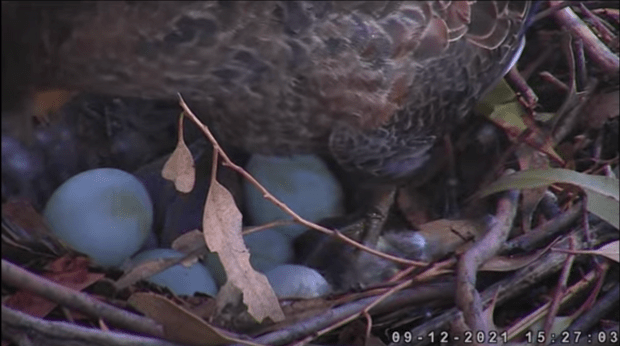
It is 17:01 nest time on Day 11 as I begin writing. It has been a relative quiet afternoon for Daisy, the Pacific Black Duck incubating 8 eggs on the large White-Bellied Sea Eagle Nest in the Sydney Olympic Forest. Daisy alerted once and within a minute was relaxed again. The camera operator zoomed in on Daisy nestled over her eggs with the sun filtering through the canopy, she glowed.

I took way too many screen captures but who doesn’t love to look at Daisy? And I included some larger versions that are easier to see!

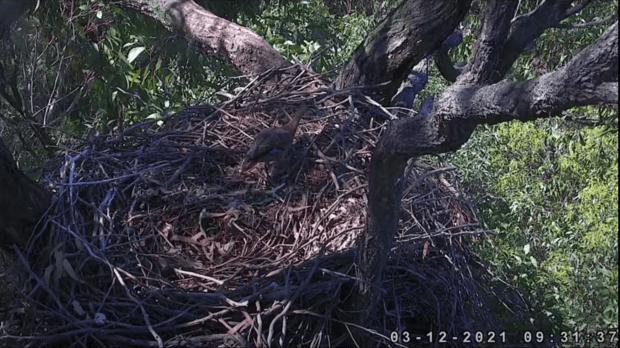
Sometimes, like in the bottom image, it is hard to make out where Daisy is. She is quite camouflaged at times. She spent much time rolling the eggs and plucking more down off her breast. She is a devoted little Mum.

If the pattern continues, Daisy will take her next break right after sunset returning in about two and a half hours. I wonder if she will do the same thing tomorrow morning? The noise in the forest will alert me to the arrival of predators but for now, it is past midnight on the Canadian Prairies, and I am blissfully tired. Oh, that the rest of Daisy’s day is simply uneventful.

Daisy left the nest at 19:48:59. There were no issues prior to her leaving to get a break and eat.

She carefully covered up her eggs with all that fluffy down and the few leaves she has.

There she is flying off to the right – a blur with that beautiful blue scapular showing.
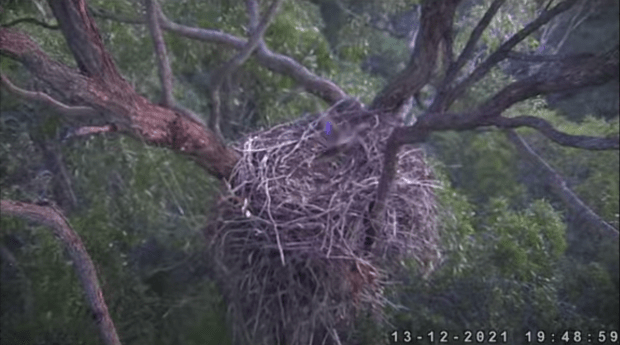
Daisy was gone less than normal. She returned to the nest of 8 eggs at 21:24:44.

It is now 03:46:45 on day 12 and Daisy has not left the nest. I tried to figure out what was keeping her – she needs to eat and there it was – our old friend Ring-tail Possum. Oh, I hope he goes away! Daisy needs to leave so she can have enough food to keep her til sunset.

Daisy doesn’t realize that her eggs are too big for the little possum to carry. They normally eat fruits and flowers. But this possum could steal that lovely down and that would be tragic for Daisy as there are not enough leaves to cover the eggs. Too bad they can strike a deal – the little possum could send leaves falling from the branches above to Daisy in exchange for some of that soft down for its nest.

The problem with the possum is that it is infringing on Daisy’s need to forage so in that way it is troublesome. We don’t want Daisy to need to leave during the day to eat.

It appears that Daisy has chosen not to leave the nest and get food and take a break. Oh, I so wish that possum had not come. Daisy had a very good pattern going – being away during the dark when the predators were sleeping. Will she have to leave during the day and risk her eggs? We have to wait and see.

Dawn is at 05:38. You can see that the forest is getting lighter.

There is some very good weather news. It is to go up to 25 C in the Sydney Olympic Park today with no rain forecast until Thursday.

I will continue to monitor Daisy during the day. She had a good afternoon and evening yesterday. We will all hope for the same today — and that she does not have to leave the eggs til sunset, not even for a comfort break. Send all your positive messages to our favourite brave little duck – Daisy!

Thank you so much for joining me. I will have a Daisy update in 6 or 7 hours unless something untoward happens. Take care everyone. Keep smiling. So far everything is good with Daisy. She is a great little Mum.

Thank you to the Sea Eagles@Birdlife Australia Discovery Centre for their streaming cam where I took my screen shots.

The Daisy Chronicles, Day 10 -11

Daisy has spent the day peacefully sleeping, pulling some down, and rolling eggs most of the day.

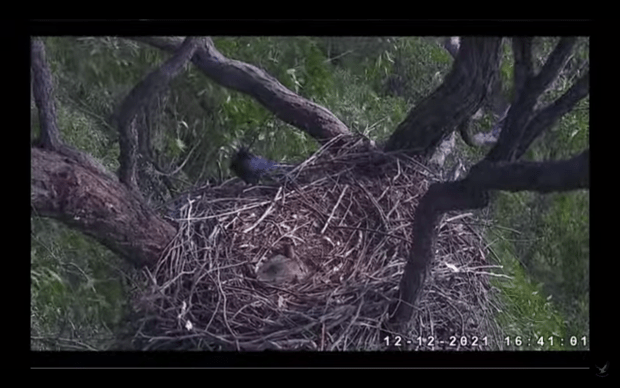
A Raven arrived on the nest at 16:40, cawed, and left by 16:41:43. Daisy did not seem agitated by its presence.

It is now 5 minutes since the Raven was at the nest, I heard it briefly further into the forest. Daisy continues to rest. She has been incubating the eggs since 21:55:42 last evening without a break. It is assumed that her strategy is to leave right after sunset, go to the river and forage. Last evening she covered her eggs well with the down but she needs more leaves. My eagle friend told me that the Ring-tail Possums were up in the tree getting leaves for their nest which is below Daisy’s. She wished they would drop some of their leaf load for Daisy. Wouldn’t that be splendid?!

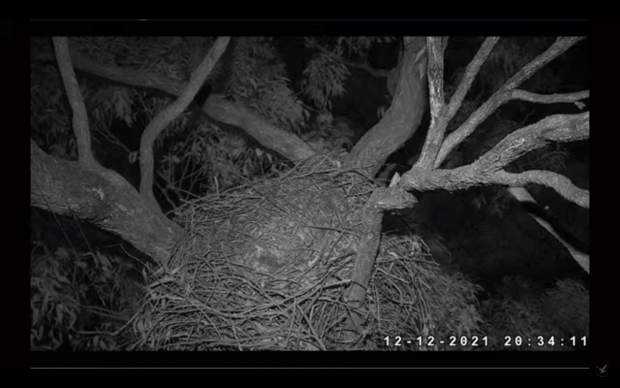
Daisy took her first break at 20:01:33. Six minutes earlier than the day prior. She returns at 22:32:40.

Daisy decided to take another break in the middle of the night. She flew off at 03:08. Great idea. She is currently still away but she will return before dawn! What an intelligent young duck. She’s pretty much got it. By going foraging right after sunset and right before sunrise not having to leave during the day but having had two feedings herself, she just might do this!

It is such a privilege and a blessing to be able to watch this amazing and brave little duck try to have ‘a family.’ She is working so hard – so many of you have written wanting a miracle for our darling Daisy. It would seem that everyone is both excited and frightened at the prospects. So for now, let us just revel in the fact that so far today, on Day 10, that all is well. It has been relatively quiet. The Raven came once but Daisy didn’t even flinch. So far Dad and Lady have not shown up so that Daisy has to scramble off her eggs. There is much to be thankful for today.

It is 03:36:45. I am expecting Daisy to return in about an hour. My next report will come late today. There were few close ups of Daisy yesterday. I included the 2 during the time the cam operator zoomed in on Daisy at the end of the evening. Isn’t she just beautiful?

Thank you so much for stopping by and checking in on our favourite duck. It is now Day 11. Take care everyone. See you soon.

Thank you to the Sea Eagles@Birdlife Australia Discovery Centre for their streaming cam where I took my screen captures.

The Daisy Chronicles Day 7-8

I have had some marvellous questions about duck breeding behaviour and questions about the ducklings. I hope that the following information is of good use. I am not an expert. But I have a stack of books on my desk by people who are! The comments are generalizations for all waterfowl and might vary a little with Daisy, our beautiful Pacific Black Duck.

In December of 2020, Daisy and her mate came to inspect the nest of the White-Bellied Sea Eagles. It is the only time – to the best of my knowledge – that he has been seen on the streaming cam. Daisy will have chosen her mate several months before breeding. The pair stay together and, when the time comes for breeding, they will have travelled to the female’s territory. The term for females returning to their home nesting area (as opposed to males) is called philopatric. Daisy will have picked the spot to nest. Daisy has laid one egg a day. When Daisy has laid her last egg, she will incubate the eggs day and night with no help from her mate. After several weeks the ducklings will begin peeping inside the shells and all will hatch at about the same time.

So what do these ducklings do once they hatch? They will remain in the nest with Daisy for approximately 24 hours. Daisy will stand on the rim of the nest and jump down. She will call to the ducklings who will each jump from the nest to the forest floor. They will then follow Daisy to the Parramatta River. They hatch with fluffy down and the ability to feed themselves. This is known as precocial – leaving the nest with the ability to take care of oneself soon after hatching. The ducklings are fully capable of feeding themselves. Daisy will stay with her brood until they are able to fly. At that time, they are on their own. While the ducklings are with her, they will gather around for protection and warmth.

It is now 16:19 in the Sydney Olympic Forest. The wind can be heard on the camera and the nest is moving about noticeably. There is thunder and it is getting closer. The time for the thunderstorm and high winds, according to the local weather in Sydney, is right now – and for the next hour. Yesterday Daisy stayed throughout the storm before leaving the nest at 18:04:04.

So far there are no predators today and several times the cam operator has checked to see if the WBSE were at the River Roost and they weren’t. That does not mean that Dad could not fly in at any moment.

Here are some images from the late afternoon of our beautiful Daisy.

Daisy continues to try and find down to line the nest both to cover the eggs and to make it easier on her body as she rolls and moves around the eggs with her feet.
No sign of the WBSE at the River Roost today.

At 17:37 a single Lorikeet arrives to see Daisy.

There is a forecast for a thunderstorm at 18:00 and rain for at least the next while.

At 18:22 a lone Noisy Miner comes to visit. Goodness.

It is only a few minutes after the Noisy Miner that thunder can be heard along with some big drops hitting the camera. By 19:15, Daisy is very wet as is the nest.

I thought maybe Daisy had laid all of her eggs and was now into hard incubation but she began preparing to leave.

You will see that Daisy is having trouble covering her 7 eggs.

Someone did a short video of Daisy trying to cover her eggs.

Daisy was lucky that the weather has kept the Ravens away. Her eggs are still there in the middle of the night.

We must hope that Daisy is not going to lay many more eggs — or that a large number of leaves are blown off that tree. Once she begins hard incubation she will have to leave to eat and take a break. That is when she had problems with Dad and Lady last time and then the Ravens saw the eggs because of not enough material, once it got wet, to cover them properly. They were close to hatching. An hour at a time. Daisy should be arriving for Day 8 before sunrise. She will get a chance to get on the eggs before any of the predators come around. I will bring an update on Day 8 later today. Send Daisy lots of good energy!

Thank you so much for joining me. It is nice to have you hear. Take care, see you soon.

Thank you to the Sea Eagle@BirdLife Australia Discovery Centre for their streaming cam where I took my screen shots.

WBSE 27 returns to care

For those of you who have been watching or following The Chronicles of Daisy, you will know that the White-Bellied Sea Eagles whose nest Daisy is borrowing, are not down at the River Roost by the Parramatta River but, rather, have been at Goat Island. My sources tell me that the pair left their River Roost the day prior to WBSE 27 being released from care.

WBSE 27 enroute to Toranga Zoo for care – first instance.

The absence of the parents means that WBSE 27 has not been cared for by them.

WBSE 27 has been taken into care again. The National Parks and Wildlife Services stated on Thursday, December 2 that a White-Bellied Sea eaglet, the same previous one in care, has now been taken back into care. It was found dehydrated and weak with no significant injuries.

WBSE 27 will be kept for a few days and sent to another facility for rehabilitation.

My only words are: Thank goodness! WBSE 27 has to be fed. It has to be trained to get its prey if it is to survive.

White Bellied Sea Eagles. 28 on the left and 27 on the right.

When Ventana Wildlife was releasing the three California Condors that had been in care on 4 December, one of the things that they said was that they wanted the birds to be slow and cautious about going into the freedom of the wild. They also complimented the Los Angeles Zoo and its staff for instilling ‘confidence’ into Iniko. It was Iniko that won the battle for the cow carcass shortly after her and Dian Fossey left the release cage.

This is the problem with the White-Bellied Sea Eagles. The Pied Currawongs rush them from the forest, they constantly attack them and have them flying hither and yon. They cannot imprint the way to the natal nest and they are stressed. There have been no sightings of WBSE 28 since she was rushed from the nest by the Currawongs. The likelihood that WBSE 28 is alive is slim. The parents do not know that their fledglings want food unless they are screaming for prey.

Stop for a moment and think of the three lads at the Port Lincoln Osprey nest. They have fledged. They have returned to the nest and the barge as they get their muscles for flying strong. They have even been taking baths over in the shore and watching fish. Soon – if they haven’t already – they will be attempting to fish.

Dad is delivering the breakfast fish to the Port Lincoln Osprey fledglings. Ervie gets it.

The best example of Eagles that you might remember are SW Florida’s Harriet and M15’s E17 and E18 who hatched last January.

E17 and E18 went into care at CROW for conjunctivitis. They became best buddies over the course of their time in the nest. They were like twins – although there was lots of competition in the early stages. CROW had to separate them with towels!

The two stayed on the nest for more than a month. Food was delivered to them. They learned how to protect their prey, they grew stronger. When the two of them finally left the nest to find their own way in the world there was not a doubt amongst anyone that both were equipped to be successful. In contrast, Legacy at the Northeast Florida bolted. She was a strong flyer but she left so quickly that she did not imprint the way back to the nest. She was missing in action for some days only to return to the nest, hungry and exhausted. She then stayed for that month for training. It is known amongst researchers who monitor and track the birds that if they bolt out of the nest and do not return, they are probably dead.

We want the fledglings to stay on the nest as long as possible. The longer they do the data reveals the more successful they are. So never, as you are watching, wish the birds to leave the nest quickly.

I am thrilled that WBSE 27 is in care and will go to rehabilitation. This might well mean that one of the fledglings from last year and this year has a chance at survival. Send all your best wishes to that amazing bird.

Thank you for joining me. I know that you are all wondering about the status of WBSE 27 since its release. This is actually good news. I hope that when they release WBSE 27 that it will be near a place where he can find food with the other juveniles.

Thank you to the following for their streaming cams or FB pages where I took my screen captures: Sea Eagles FB Page and Cathy Cook, SW Florida Bald Eagle nest and D Pritchett Family, SeaEagles @Birdlife Australia Discovery Centre, and CROW.

Daisy is back!

Daisy is a Pacific Black Duck. This past January Daisy laid her second clutch of eggs in the old Ironbark Tree used by the White-Bellied Sea Eagles for their nest. She has now returned to lay her first clutch for the 2021-22 season. She laid her first egg today!

Last year we held our breath watching Daisy pick the nest with her mate, lay her eggs, be frightened off by Dad and Lady only to find out their were curious – not harmful. WBSE do not like duck down! It sticks to their bills and must feel ‘fuzzy’. The Rainbow Lorikeets came to visit Daisy every morning. The culprits were the Ravens.

The female Black Pacific Duck normally lays their nest on the ground. Daisy might believe or know for certain that is unsafe. So she tried this high tree deep in the forest. I wrote blog after blog about this brave little Duck that outwitted the big sea eagles. Sadly, the WBSE scattered the down lining the nest cup that had come from Daisy’s chest. She was able to replace it once but then it rained. When she got up off the nest to get food for herself (her mate does not help her at all), the Ravens saw the eggs and ate them. They were within a couple of days of hatching. It appears that Daisy wants to take her chances again using the nest of Dad and Lady. My goodness. Welcome back, Daisy!

Can you see her?

There it is!

You will notice that Daisy has not lined the egg cup with the down from her breast. She will. It seems she was in a hurry to get into this big nest and lay that egg. I wonder if she laid eggs elsewhere and was frightened away? Isn’t she beautiful?

This is so exciting. Daisy renewed my love for ducks last year. The camera operator at the Sea Eagle nest is very good at getting close ups of the beautiful nest cup she will make. The image below is from day 13 of incubation. Daisy was half way to hatch. She is listening for the sea eagles. You can see the mess that Lady made with the duck down – that precious lining and covering, scattered.

Daisy’s beautiful lined nest in early 2021

Daisy was always very cautious when she returned to the nest. She would listen and look around for a long time. She did not want anyone to see where her clutch of precious eggs was.

Satisfied that no one is around, Daisy sits on her eggs.
A friendly Rainbow Lorikeet curious about the little duck in the big sea eagle nest.

This morning I wrote that there wasn’t much happening in the Australian nests and wow – Daisy, you just changed all of that. So everyone even if you think you do not like ducks you will want to watch The Chronicles of Daisy – the little duck that thwarted the great big sea eagles! Here is the link to the camera. Oh, I am so excited I can hardly sit still. Seriously, this is better than ice cream or your favourite mystery thriller.

Just a note. Daisy will not do hard incubation until all of the eggs are laid. There will be between 7-12 normally. The ducklings will all hatch at once and jump off the nest when they are 24 hours old. They will then follow Daisy quickly to the Parramatta River where she lives and where they will immediately forage for food.

Thank you to the Sea Eagles @ Bird Life Australia Discovery Centre for their streaming cam where I took these screen shots.

Oh, Bazza Baby

The Port Lincoln Lads seem to always be up to something. This morning Falky was flying about and Bazza and Ervie were on the nest. They had to have been full because there was a lovely fish tail on the nest and neither one of them were paying any attention to it.

It was very windy and Bazza entertained Ervie for about half an hour trying to land and stay on the perch. Have a look.

Are you finding that sometimes you could just use a little bit of ‘cute’ as we wait for new bobble heads in the raptor families to be born? What about a Korora?

They used to be called Little Blue Penguins. They are the smallest of the New Zealand penguins. This little one will weigh about 1 kg and be about 25 cm tall when it is fully grown. Their population is in decline due to dog, cat, stoat, and ferret kills. This group of predators has arisen because of the destruction of the penguin’s natural nesting sites for development. Sad.

And I want to give a shout out to ‘TAS’ for introducing me to this cute little non-raptor!

WBSE 27 has been observed being hounded by the Pied Currawong. This report comes from Cathy Cook on the ground:

As is usual in the Reserve, SE27 found herself being escorted & swooped by Noisy Miners, Magpies, Currawongs and Ravens, from the time she hopped out of the carrier. We saw her take 4 seperate flights, with her finally being observed (by credible people in the wharf cafe) to cross over the Parramatta River, just a little west of River Roost. The last picture shows SE27’s individual flights within the first 40 minutes after her release — at Newington Nature Reserve, Sydney Olympic Park.

Cathy posted pictures and a short video. I hope she does not mind my including one for you.

@ Cathy Cook

The saddest part about being a juvenile Sea Eagle is that for the rest of his life, 27 will be hounded by the smaller birds who, as you already know, are very effective in driving the juveniles out of the forest. I hope that Lady and Dad return to the River Roost on the Parramatta River to find 27 so they can feed her.

For all of you celebrating Thanksgiving with your friends, families and/or other loved ones in the USA, have a wonderful day. For those in Canada who celebrated in October, tomorrow is just another day. Take care. Always be thankful. See you soon.

Thank you to the Port Lincoln Osprey Project for its streaming cam where I video captured Bazza and to the Sea Eagles FB Page and Cathy Cook for the update on WBSE 27.

Great video on WBSE 27!

Have a great look. You will learn so much about the care 27 received at the Taronga Zoo and with the National Parks and Wildlife Service staff. You can also see how they treated the juvenile WBSE on its arrival and you will be able to see the area where the birds live and where 27 was released.

https://www.9news.com.au/videos/national/incredible-moment-sea-eagle-returns-to-wild/ckwd1mylj000n0go2tpq6dkcs?fbclid=IwAR0YE4qQ1CfVgmJYRytQbFlMTz9xR8LlBV-XSCckQsj7FJ2DFtkGkCWQdfU

Celebrate! It is a great moment. May she fly high, always have food and good health.

WBSE Release

Here is an image of WBSE 27 being released last week. It was determined by the scale lines in her toes that the bird was in fact, 27 not 28. So happy that ID was solved! The day the bird was released was the first day that the parents were not at their River Roost. I hope the three connect! There is a video of the release and it shows 27 as a really strong bird. I hope she thrives in the wild for eons. What a gorgeous bird.

The following was posted on the FB page of the Sea Eagles:

Here is a news report:

https://www.9news.com.au/videos/national/incredible-moment-sea-eagle-returns-to-wild/ckwd1mylj000n0go2tpq6dkcs?fbclid=IwAR1LEfr-N1vKUIgUAawVmy477RlTUb7sTU0yFDQwedhjs2gAW9t_FQQJva0

The Kakapo Recovery are doing their annual fundraiser. As many of you know, we started out the pandemic with 208 Kakapo in existence. There are now 202. Dedicated individuals do wellness check ups which mean they have to find these elusive non-flying parrots. The only way to do that is with a transmitter. The transmitters and batteries require check ups and replacements (batteries) on a regular basis. Medical treatment, etc. If urgent and life threatening, the bird is flown to Dunedin, NZ for veterinary care.

Many are considering doing one special gift on behalf of their family to help wildlife and the planet (as opposed to fast fashion that winds up stacked in the deserts of Africa). The Kakapo Recovery is hoping you might choose them.

Last year we adopted Rangi! He happily lives in the living room plants when he is not cuddling up with Pippa the Albatross or Big Red the Red-tailed Hawk!

It is something everyone needs to think about even if it is $5 to a streaming cam that you love. It can make all the difference. You can also adopt other types of birds. Last year there was a huge rush to help Aran and Mrs G at the Glaslyn Bywyd Gwyllt. You might recall that two horrific events came together in the perfect storm at Glaslyn. A heavy rain storm with cold temperatures hit the area when the chicks hatched and Aran got in a territorial fight and injured his wing and he could not fish. The community came together and provided a fish table for the family. Sadly the chicks did not survive but Mrs G and Aran did and Aran got his strength and migrated on time. To help that cause many went to the website and adopted Aran and his family.

You will have your own list as well. Other ways that you can help is to check with your local wildlife rehabilitation clinic. They often post a list of items that they need. You would be surprised but clean old towels are usually at the top of the list! So next time you are looking at a pile of towels and old sheets, think of your local clinic for wildlife! It doesn’t cost anything but getting the items there and often the clinics have volunteers that pick up for them.

Books for children and teens on how to help wildlife thrive are, of course, invaluable in building the next generation to care for our beloved birds.

Holly Parsons posted an update on Yurruga on the FB page for the Orange Australian Peregrine Falcon:

“Post from Cilla approx. 5pm 24 November:I haven’t seen Yurruga since I placed him in the tree, but I’m pretty sure he is still there as the parents have been coming and going with prey and giving me warning calls if I approach too close. I only check once a day and the foliage is really thick so hard to find him if he’s quiet.”

That is great news coming out of Orange! That is the kind of news I wish were coming out of Sydney with WBSE 27 – that the parents have been feeding it. Fingers crossed.

This is a short update. It is extremely quiet in Bird World now that the falcons and ospreys and WBSE in Australia have fledged. Eggs are happening in the Bald Eagles nests in the US and there will be lots of action around the holidays in December.

Take care everyone. Thank you for joining me.

Thank you to the following for their streaming cams or FB pages where I took my information: Orange Australian Peregrines FB, Kakapo Recovery FB, and Sydney Sea Eagle Cam.

Ervie defends his fish!

No doubt all of the Ospreys on the barge at Port Lincoln are hungry first in the morning. It could have been 10 or more hours since they had a fish, depending on who landed the last one/s of the day.

At 09:37, the three lads were snoozing duckling style on the nest. Was anyone thinking about breakfast?

Dad flew in with a nice fish at 09:38:15, just 20 seconds later, waking them all up in a start. My goodness, Ervie is quick. He is mantling that fish (on the far right in front of Dad).

Wings are starting to flap.

As the competition for the breakfast fish amps up, Dad is getting ready to take off.

There he goes just clearing Ervie’s left wing tip. It looks pretty crazy down there but this is what we want to see – these three really being able to grab the fish and defend it. Ervie is a bit like a magician when it comes to getting the fish, he is so fast.

Dad has lift off.

Bazza is on the far left. Falkey is in the middle. He would not mind challenging Ervie for that fish. Look at Falkey looking over. Bazza, meanwhile, is looking out over the water, unconcerned.

Falkey thinks he will try to get that fish by flapping his wings.

Ervie counters. They are looking at each other so intently – it is a wonder Bazza doesn’t slip through and take the fish. Just look at those two! Ervie is saying, “I dare you to try.”

Ervie flips Falkey’s wing back causing him to lose his balance.

There, it is all over and it only took 14 seconds. No feathers or wings injured in the process. Wow.

Ervie aka Little Bob has really become a force to reckon with since he hatched. He has never given in to his older siblings. Focused. A survivor. Every day he amazes me. I look forward to seeing his progress years from now.

Ervie was still eating at 10:10. He is up on the top left near the perch. It is not clear if there will be anything left for one or both of the others. Ervie looks pretty hungry!

There will be plenty of fish for all of the boys today. Dad will make sure of that. It is very interesting to see the competition between the two fledglings. It will help them in the real world and it was not a serious tussle. Ervie pretty much dominates the deliveries like he did when Mum was feeding everyone.

You might be interested in what it is like in the African desert for animals. I have become more and more keen on learning about the places where the UK and European Ospreys and Black Storks go for the winter. (More water there but this is enlightening). It is night in the Namib Desert but move the time line back. There are Wildebeests, Ostrich, Giraffes, Jackals, Hyeans, etc. depending on the time of day. Enjoy.

The Namib Desert is said to be the world’s oldest desert. It is in the southwestern part of Africa whereas the sites for the Ospreys are in the Northwest, south of the Atlas Mountains, in Senegal, The Gambia, etc. The Namib is home to iron rich soil creating red sand dunes and formations like those where I grew up in Oklahoma. It is also known for its nature reserves. The camera is at one of those.

There is Namibia northwest of South Africa.

Red iron oxide gives the soil its beautiful terracotta colour.

The lodge where the camera is located borders a really iron red rich area.

I have no new news on Grinnell other than he flew out of the rehabber’s box and was up on The Campanile. The UC-Berkley band started playing when he arrived! There is such an incredible amount of love for this beautiful falcon. Let us hope that it all ends well. Grinnell seems determined to take his territory and he is much healthier than when he was attacked 20 days ago. The image below is from the Instagram feed of Annie and Grinnell. Oh, he looks good. Nice deep yellow colouring on his beak, around his eyes, and legs. The vets indicated that his beak is growing and his wing is healing. They felt that it was much better to release him now. Thank you everyone at Lindsay Wildlife! Grinnell looks in great form.

Thank you for joining me. This has been a really great day with Grinnell’s release. It would only be better if he was sitting next to Annie on The Campanile. Maybe tomorrow. No news on the WBSE juvenile in care.

Thank you to the Port Lincoln Osprey Project for their streaming cam where I took my screen shots and to the Annie and Grinnell Instagram where I captured the image of Grinnell flying.

Bird World. 16 November

Viewers of the Port Lincoln Osprey Barge are starting to wonder if Bazza isn’t eating so much fish that he can’t get lift off the nest. He sure does love his fish.

At 08:00 Dad flies in with the first fish of the day. Falkey gets that one fighting off Bazza who would just love to have breakfast. At 8:50, Falky is full and he walks away leaving a beautiful fish tail on the nest. Ervie spied it immediately and finished that off quick.

They remain such a civil trio. There is Falkey getting to enjoy his breakfast.

Ervie turns around and probably doesn’t believe his luck – a nice fish tail just in front of him. He was there claiming it in the snap of a finger.

Ervie made quick work of the fish tail. Falky is full and Bazza really doesn’t seem interested.

At 09:36:53, Dad flies in with another fish, quite a large one this time. He puts it right at Bazza’s feet. Talk about luck. Bazza was still eating on that fish an hour and a half later. I don’t think he will be leaving too many scraps.

Just look at the size of that fish!

Bazza is still eating. My goodness. It could be true. Maybe he is too big for take off. Bazza certainly seems to be wider than the other two lads.

Do you follow the falcons at Orange? If so, then you probably know that this is the one year anniversary of last year’s chick, Izzi’s fludge. For those unfamiliar, Izzi was the only hatch of Diamond and Xavier in 2020. He dozed off on the ledge and literally fell out of the scrape box. Cilla had to find him and carry him back up the 170 steps to the box. When he did fledge, the first time, Izzi flew into a window and went into care. Cilla returned him to the scrape to do it properly the third time. Isn’t that what they say? The third time is a charm. It worked. In memory of the fludge, someone has put together a video clip of it and Izzi being returned to the scrape.

As for ‘Little’ Yurruga, Xavier delivered three prey items for his daughter before 06:45! Diamond will come in later and help Yurruga but she is doing a good job of the self-feeding. I love how she watches Diamond so intently when she is plucking and eating – memorizing / imprinting it all.

Rumours are circling that the WBSE Juvenile will be released from care into an area around the Newington Armoury by the Discovery Centre in the Sydney Olympic Park. The juvenile injured by the Curras is believed to be 27. (There are some that believe it is 28 and with no bands and no DNA who knows.)

There is really not a lot going on in Bird World. Waiting for Bazza to take the leap, waiting for some of the first Bald Eagles to lay their eggs, waiting to find out who is the Royal Cam Albatross family this year. Feels like a lot will happen at once!

Oh, I had to just go and check on the lads one more time to see if it is possible Bazza has flown. Nope. It is an hour later and Bazza is still eating!!!!!!!! Bazza has been eating for two hours. I kid you not. Did someone get Little Bob mixed up with Big Bob?

Flying uses up a lot of calories. Look at the difference in size between Falkey and Bazza. Gracious.

Thank you for joining me. Take care everyone. See you soon.

Thank you to the Port Lincoln Osprey Project and Charles Sturt Falcon Cam and Cilla Kinross for their streaming cams where I took my screen shots.