I haven’t checked to see if Cilla Kinross posted the total numbers for the names that people voted on. This morning I woke up in Canada to discover that the little one of Diamond and Xavier is to be called Yurruga. I am so glad. It means ‘sunny’. And we hope that this little one brings lots of light and happiness to all!
Here is a video that was posted of one of the feedings. You can hear how loud Yurruga is. She will rival Izzi (or he). Just adorable. Started to get pin feathers and is rather itchy. Notice how Yurruga tries to grab the pigeon when it comes in and watch her stand on her legs being fed. This is one strong and healthy chick.
If you noticed the Collins Street streaming cam was down, it is now back up. This seems to be happening more and more with cameras going off line in Australia (and elsewhere). I wonder if the weather plays a part????
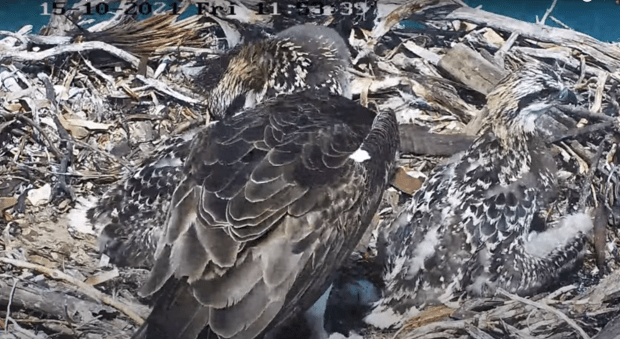
This is an image from the late feeding yesterday for the Port Lincoln Ospreys. Just look at them! The size of them. Now look at Mum. Incredible growth.
The following was posted on the Eagle Cam FB page. The 3:30 pm update is very promising. Mobile means they are flying. I was quite worried that 28 would have issues because of their first notice of it being on a low branch. Send positive energy to these two. I hope that they find the area of the river where their parents fish and the parents can feed them there til they are stronger fliers. Oh, it would be so wonderful. Beautiful birds. The situation with the Currawongs every year is just tragic. Hopefully these two will beat the odds!
If you are just reading this WBSE 28 fell off the nest trying to land on a branch by 27 yesterday at 07:22. WBSE 28 flew to the cam tree at 8:33:56 after being harrassed by Pied Currawong. This posting is good news. I hope that some of the locals will get some images of them with their parents near the water.
Take care everyone. This was meant to be a very quick notice telling you of Xavier and Diamond’s chick – whose name is Yurruga. I wonder how many will call it Sunny?
Thanks for joining in!
Thank you to the following for their streaming cams where I took my screen shots: the Collins Street Falcons by Mirvac, the Port Lincoln Osprey Project, and the Charles Sturt University Falcon Cam and Cilla Kinross.
It was not the way the morning should have started. When we think of fledging, most of the time we recall juveniles reaching a certain age and flying out from the nest on their own. Sometimes it does not go to plan. Many are actually forced out by intruders. We will never know, for example, what larger bird of prey forced Malin (the Osplet at Collins Marsh) to fledge causing its death. Other times the birds fludge like Izzi last year when he went to sleep on the ledge and fell out of the scrape box. Izzi was lucky. He had a guardian angel to get him back to safety. Malin did not.
Today, WBSE 27 and 28 got up and 28 seems to have snagged the morning breakfast delivery. I don’t know what it is with eating and early morning air but young raptors seem to become energized. That is precisely what happened to 28, the youngest. It started flapping its wings and jumping around the nest. Meanwhile, 27 was minding its own business on one of the parent branches. 28 decided to fly up to where 27 was. It was at that moment that I remembered Big and Little at Duke Farms last season. Both were on the branch and one of the birds wanted on the other side and they both fludged. Theirs was a happy ending but that wasn’t know for a few days. Both made their way back to the nest to be fed by the parents for some time. That is the way it is supposed to happen. Well, it is unclear about WBSE 28. He fell off the nest.
Here is a sequence of still images showing the build up to the fludge. In the first one, 27 is on the branch and 28 is still eating.
28 begins to flap and jump.
Look at those beautiful wings.
27 flies up to the branch.
At 07:22:02 WBSE 28 almost took both of the birds off the nest. He fell to the left. You can see his wings. WBSE 28 composes itself on the branch.
Meanwhile the cam operator searches the ground for WBSE 28.
Almost immediately the Pied Currawong begin their relentless attack on WBSE 27.
There were three Pied Currawong taking turns at WBSE 27. You see it is in their best interests to keep these sea eaglets out of the forest despite the fact that I have never seen a WBSE eat a Pied Currawong. They certainly might want to start doing that. This is not the first time these birds have rushed a sea eaglet to fledgling and flying out of the forest never to return. They did the same thing last year.
27 does well honking and spreading its wings in a defensive manner. It had to be frightened.
At one point 27 flew at the Currawong.
WBSE 27 off the nest at 8:33:56.
One of the Sydney Sea Eagle chatters caught WBSE 27’s fledge and made a video clip of it. 27 flew to the branch by the camera tree. You can see it in the clip. It was a beautiful first flight. You can also see 27 flying out of the forest to the left.
There are many types of fledges and the anxiousness of WBSE 27 being harassed by the Pied Currawongs – well, you can decide if he flew off the nest because he was frightened or not.
Many believe that when the nestlings fledge, it is a successful season and life goes on. I always wonder what happens to these fledglings. It pulls at my heart and mind to have the Currawong run them out of the forest.
When raptors fledge, many take short flights from the nest returning for up to a month to be fed by their parents until they are just strong enough to fly off on their own. One of the best examples of success in this way were E17 and E18, the two Bald Eaglets of Harriet and M15’s at the Southwest Florida Bald Eagle nest in Fort Myers this year. There on the Pritchett Property the little eaglets were watched – they played in the pond, flew out and returned. They did this for about a month and then, one morning they were gone. By doing short flights from the nest at their leisure, the eagle fledglings imprinted the map back to the nest in their mind. That is not what has happened at the Sea Eagle nest in the Sydney Olympic Forest. Will the eaglets return to the nest to be fed by Lady and Dad? Will Lady and Dad find them and feed them elsewhere? Is 28 tangled up in a tree in the forest? Will anyone rescue it? Where are the foxes? These are my questions. I hope that there is someone – many someones – actively looking for 28. If I hear anything, I will let you know.
The sea eaglets were right within the fledge range. I expected them to fledge any moment. It is unfortunate that 28 fell out of the tree. I do hope it recovered. No reason to think it would not. We will probably never know what happens to WBSE 27 and 28. Sadly, there is no programme for monitoring and tracking. I wish there were like with the Ospreys at Port Lincoln. It would be very interesting to see if they make it away from the nest and find a beach with carrion and other juveniles and survive and thrive.
UPDATE: Ranger Judy Harrington says that no one will be looking for 28 in the forest. It was heard on camera and they believe the Currawong will let them know where it is.
Thank you for joining me this evening. Take care all.
Thank you to the Sea Eagle Cam @Birdlife Australia Discovery Centre.
The WBSE are both in the 11th week after hatching. With the average of 75-80 days after hatch for fledgling, WBSE 27 and 28 are ready. Their feathers have developed, they have grown, and you can see them getting excited with all the wing flapping and catching air enabling them to rise above the nest.
What are they watching so intently from the nest? Is it a Pied Currawong?
Of course, the Pied Currawong are right there. The Pied Currawong is closely related to the Butcherbirds or the Magpies in Austrlia. They are a medium sized passerine. They have a large black beak with yellow eyes.
Here is a short video of the calls/songs the Pied Currawong make:
The Currawong become more of a menace around fledging time. Their attacks increase in number and they could injure the chicks, knock them off the branches, or chase them out of the forest before they can imprint the route back to the nest in their mind’s GPS system.
Lady was on the nest honking and flapping her wings at the Currawong so the eaglets could finish their lunch. At other times, the eaglets have to learn to defend themselves or hunker down really low in the nest. Because the WBSE are at the top of the ‘food chain’, they will always be followed and attacked by the smaller birds. What do the smaller birds want? They want the WBSE to pack up and leave!
Lady is honking really loud, warning the intruder to leave.
Lady was in the nest much earlier feeding both of her eaglets. Many of you have probably noticed that despite the fact that the nestlings are fully capable of self-feeding, she seems to enjoy feeding them.
The eaglets know to stay alert for intruders while flapping their wings and jumping to stretch their legs.
They honk at the Currawong just like the adults.
The Pied Currawong are very brave. Indeed, their attacks on the almost-fledglings is relentless. Ironically, I don’t believe the WBSE eat Currawong. Sometimes I think that they should rethink that!
Both of the nestlings have branched. They are standing on the parent branch looking around. Soon they will fledge.
It has been a wonderful season for Lady and Dad at their nest. Both of their eggs hatched and both of the nestlings thrived under their care. Both are healthy and fit and we hope that they both fledge successfully, returning to the nest or other areas so Lady and Dad can continue to feed them while they learn to fly better.
We wish them a long and successful life. It has been a remarkable year.
Lady and Dad are ‘honking’ their duet in June. It is a really special way to end another good day!
Thank you for joining me this evening. Take care everyone. See you soon.
Thank you to the Sea Eagle Cam @ Birdlife Australia Discovery Centre for their streaming cam where I took these screen and video captures.
One of the last feedings for the little eyas at the scrape box in Orange, Australia was around 18:19:00 yesterday.
This little one is eight days old. It has sure grown!
I took three video clips to cover the entire time Diamond was feeding the chick. Watching the movements and the interactions instead of seeing a still image can give you a more in-depth look at the size of the bites and the sheer cuteness of the moment.
The total number of fish delivered to the Port Lincoln Osprey nest was 7 yesterday. They were delivered at 7:11:22, 8:23:54,12:47:30, 13:52:18, 14:54:09, 16:37:00, and 18:08:37. This is a capture of Dad delivering the fish at 7:11 and Mum coming to the nest from the perch as well as a capture from the 14:54 feeding:
There appeared to be an adult on the Achieva Osprey Nest in St Petersburg, Florida yesterday. The marks on the crown of the bird seem to be that of the male, Jack. Today, another adult showed up at the same nest at 11:16:09.
Jack appears to be alarming.
This is the image of the adult from yesterday (right) and an image of Jack bringing Tiny Tot Tumbles a fish on the left. It seems likely that the adult visiting the nest is Jack. There is a lot of prep work to be done before Diane returns.
The White Bellied Sea Eagles 27 and 28 entered hatch watch the other day! That date range for fledging is 75-80 days from hatch. WBSE 28 was 77 days old on 16 October (yesterday) when it branched! Watch closely to see what 28 uses to make the leap.
Fledging is getting closer for these two. No doubt they will have contests to see who can get higher up on the tree!
Today is starting off as a fantastic day in Bird World. While there are little ones to feed or fledge in Australia, staff at many of the nature centres in the UK are refurbishing Osprey nests. A new pole and platform has been installed at Lyn Brenig and today the work was completed on Pont Cresor, the nest of Aeron, Z2 and Blue 014.
Thank you for joining me today. It is beautiful and sunny. All of the garden animals are having their lunch and the world is simply right with itself. Take care. See you soon!
Thank you to the following for their streaming cams where I took my video clips and screen captures: the Port Lincoln Osprey Project, Charles Sturt University Falcon Cam at Orange and Cilla Kinross, and Achieva Credit Union Osprey Nest in St. Petersburg.
For those of us who only have the Internet and not any television or cable stations, it might be a bit difficult to watch the documentary on the Ospreys, Season of the Osprey on Nature PBS. For those of you with cable television, this is a reminder to check your local station for when Season of the Osprey is showing. For the rest of us, I will be checking for the release of the DVD and, also, to see if the documentary will be streaming on the Internet. Will keep you posted! Do check your local stations. You do not want to miss this if you love ospreys!
I am including the URL for the company that is distributing this special. Why? Because, if you scroll down, you will see that there are a host of podcasts that you might be interested in.
Oh, what amazing birds. I am already getting excited about our local nests and the birds have only been away for two months! This year I will be checking on several nests and submitting information on arrivals, hatches, juveniles, fledges, and departures. It is an honour to add the Ospreys that consider Manitoba their summer home and breeding territory to the lists of nests from around the world.
Speaking of migration and raptors around the world, Jean-Marie Dupart reports that there were 50 birds this morning on the shores at Casamance, South Senegal. He has counted 432 arrivals so far this season and said he has 10 more locations to check. That is fantastic.
Many of you will be members of one or another of the many groups pressing for businesses and residents to stop using rodenticide. You might also be lobbying various levels of government to ban these designer poisons. It is well known that it is not only cheaper financially but also much more effective to use raptors. Raptors will clean up the critters – just don’t poison the mice and rats because, ultimately, they will also poison cats and birds that eat them. It is a horrific way for a raptor to die.
Today, in the Fall 2021 issue of Bay Nature magazine, the leading article is a vineyard that is employing Red-tail Hawks to keep the rodents out of the fields. They are turning away from using rodenticide. Oh, this could seriously be a start of a movement. Here is that article:
Xavier and Diamond’s only eyas is one week old today. Only Bob can see the world! And Xavier has had some time to spend with his wee one. Here he is brooding Only Bob. How precious.
I have not reported on the White-Bellied Sea Eaglets in their nest in the Sydney Olympic Forest for several days, if not a week. It is really interesting watching the two of them interact together. One will do something and the other will try to outdo the first. Here they are flapping their now very large wings.
I really hope that they do not knock one another off the nest. The more they flapped those wings the more energetic they got and the more air they stirred up. It was like the centre of the nest became a trampoline.
WBSE 27 and 28 will have a wing span of 1.8-2.2 metres or 6 to 7 feet. If I remember correctly, the nest in the old Ironbark Tree is 1.8 metres or 6 feet across to give you some idea of the wing size of the pair today.
WBSE 27 hatched on 29 July 2021 and WBSE 28 hatched on 31 July. This makes the little sea eaglets 78 days old (27) and 76 days old (28). The average fledge period for the nest is 75-85 days. We are now in that window. Ideally, the eaglets will do some branching, will make their first flight, and return safely to the nest where they will strengthen their flying and be furnished prey by the parents. In reality, the Pied Currawongs often chase the newly fledged chicks out of the forest. It is hoped that the parents are providing food off nest or the eaglets find a beach area full of carrion (what most juvenile sea eagles survive on til they hone their fishing skills).
This nest has produced two very healthy Sea Eaglets this season. Just look at them spreading their wings, one looking over the rim of the nest. That first flight could happen at any second. It has been a fantastic nest to watch this year and I do hope that these two strong eagles will survive and have very long lives. Lady and Dad have done an amazing job.
The Osplets at the Port Lincoln Barge nest are not ready to fledge – thank goodness! But they are growing like wild weeds in my garden. The juvenile feathers are now growing in thick and fast. They have had several fish deliveries today. I reported on two and there was a third at 11:28:54 and there will be more during the day.
Mum trying to get the fish off of Dad’s talons.
Little Bob is lined up waiting for some more fish. He is on the right. You can see the more circular mark on the top of his head and the white painted effect under his eye. It coats the lower lid a little like white eyeliner might do. From this angle you can also see some of the white on the cere. Little Bob has a rather large crop. It seems to be sagging from the weight.
Now when I write ‘Little’ Bob it seems a bit silly because he is definitely not little! It will be nice when they get their bands, satellite packs, and names in a few weeks. I wonder what they will name these three?
While we can only see two of the osplets, both of them have big crops. Little Bob is looking out from the nest on the right and another is preening, showing off its big ping pong crop, in the middle.
Look at how those lovely dark grey/black juvenile feathers tipped with white are. They are growing fast. Soon they will cover all of that dark grey wooly down. Much of the fish they are eating is helping them produce these beautiful feathers, feathers essential for their success as raptors. They cannot fledge without them.
Everything is looking good. I cannot wait for their measurements to be taken. Little Bob looks like he could be the biggest or close to it. Little Bob certainly does not take anything off Big Bob.
Thank you so very much for joining me. Take care everyone. Have a terrific Friday.
Thank you to the following for their streaming cams where I took my screen shots: the Port Lincoln Osprey Project, Sea Eagle Cam@Birdlife Australia Discovery Centre, Charles Sturt University at Orange Falcon Cam and Cilla Kinross.
At 8:56:34, Dad brought in a massive fish (despite having eaten his fair share) to the Port Lincoln Osprey Nest.
The image below shows the size of the fish a little better despite much of it hidden under mom. Imagine that the top part is up at her beak where she is feeding one of the chicks to get an idea. Little Bob is in the middle. You can see the white lace on his cere and the black circle on top of his head.
Dad returned at 9:11:33 to see if Mum was finished feeding the chicks. She wasn’t and she did not let him take the fish.
The trio lined up again. Big Bob, who had eaten first, is full and is moving away from the feeding line. She is letting the two younger siblings have their share.
Middle and Little are right in there. Their feathers are growing so quickly. Look along the edge of Little Bob’s wing. They are beginning to look like fringe.
Oh, goodness. Dad is rather anxious this morning. He returns a second time at 9: 28:20.
Mum is still feeding Middle and Little Bob. Oh, and look. Big Bob is waking up again. Is he ready for another round of fish?
You can see that there is still lots of fish left. The chicks have now been eating for 34 minutes and it looks like half the fish is left. Dad is really having a close look. Mum does not give the fish to him, again. She seems to have decided that he is not going to rush her today.
Ah, Big Bob is back up at the end of the line wanting some more. This is such a polite nest. Big Bob does not push his way to the front of the line, she waits.
By 9:29, Mum decides to move the fish around to the other side. Maybe she thought Dad was going to take it. She continues to feed the chicks and herself.
Despite the fact that the chicks have moved so that they can pass out in their respective food comas, Mum continues to feed Little Bob.
Little Bob is ‘stuffed’ and has turned away from any more bites of fish. Mom is doing a good job eating that nice fish near the tail. She needs to eat, too! Dad seems to have nodded off waiting! In the end, I do not think Dad even got a nibble of the tail. We have to remember that he did have a big chunk before he brought the fish to the nest.
The trio and Mum finished off that extra large fish in 47 minutes. Amazing.
Dad brings another fish to the nest at 13:29:38. Everyone is fed and it is not even the middle of the afternoon. This is a good example of how the feedings change. When the three were wee, they needed more feedings with less fish at each one. Now they will eat much more fish but, there will be less feedings. They are really, really growing. Little Bob is 24 days old today while Middle and Big are 26 days old.
Xavier watches from the ledge of the scrape box as Diamond feeds their wee babe. So far there appears to be no pip or crack on a second egg. It is unclear if there is even a pip.
It is the middle of the afternoon and Xavier is again resting on the ledge. He was seen limping and he is probably resting that leg. Instead of Starlings and Parrots, Xavier has been bringing in pigeon which is a much larger prey item. He might have strained his leg when he was hunting.
I also wonder if he can hear the second chick? or if he just wants to be there with Diamond in the scrape? or wants to brood the chick and incubate the eggs?
The waiting must be frustrating for these two. Big Bob (or Only Bob) is poking its head out from under Diamond to the right of the egg. Cute.
At the nest of the White-Bellied Sea Eagles in Sydney’s Olympic Park forest, a Pied Currawong will not leave WBSE 27 and 28 alone. It has been harassing them on and off all day. It is the Pied Currawongs who are intent on chasing the little sea eagle fledglings out of the forest. Normally, eagles fledge and return to the nest for the parents to feed them while they strengthen their flying skills. Many will return to the nest for feedings for up to a month. If they are rushed away, the ‘map’ or return to the nest might not be imprinted in their memory.
27 and 28 are smart. They can hunker down duckling style and watch but the Currawong cannot harm them. These birds can knock them off if they were standing on a branch or injure them if they were standing up.
These two will be branching so soon and then fledging. They can walk and stand and both are self-feeding. We are entering the 11th week. From hatch to fledge for the Australian White-Bellied Sea Eagles is 80-88 days. The median is 83.1.
Here is a video of WBSE 28 stealing the prey from 27. Fantastic!
At the 367 Collins Street Peregrine Falcon scrape, Mum has left the scrape box and is off for a break and to retrieve prey for the eyases. Look at how much room they take up today!
They look like a large white Persian cat if you squint.
Time for your mid-afternoon pigeon everyone!
Dad had it prepared and ready for Mum to bring and feed the youngsters.
Yummy.
The oldest two are getting more hawk like in their appearance.
Except for the Pied Currawong’s harassment, all of the nestlings are doing very well. It is, indeed, a pleasure to be able to watch them grow from hatch to fledge. How fortunate we are!
Thank you for joining me. Take care everyone. See you soon.
Thank you to the following for their streaming cams where I took my screen shots: the Port Lincoln Osprey Project, 365 Collins Street Falcons by Mirvac, Charles Sturt University Falcon Cam at Orange and Cilla Kinross, and Sea Eagle Cam @ Birdlife Australia Discovery Centre.
The Guardian is hosting its 2021 Australian Bird of the Year competition and the Peregrine Falcon has made it to the final 20. The voting started out with 50 birds with 5 eliminated each day. The falcons are down to the wire! Here is the link to cast your vote for your favourite bird but Xavier and Diamond really hope that you will vote for the Peregrine Falcon!
Oh, Mom, Dad, and the four eyases on Collins Street in Melbourne really hope that you will also vote for the Peregrine Falcon! No pressure. LOL.
It is not even dawn in Orange, Australia. Diamond has been restless all night. Is there a hatch? a pip? Most bets were for a hatch on 7 October and that is today!
Xavier always arrives around 06:00. Today it was 05:56. He approached Diamond cautiously. She is not going to budge. Something is happening! Diamond is sure not giving away any hints. Xavier is making sounds like a squeaky door. I wish I could speak falcon. Must be an eyas under there breaking out of its shell. Yippee..confirmation to come later.
Remember, you can watch the action here:
WBSE 27 and 28 are awake as dawn approaches. Both have been joining in the morning duet with their parents. Just precious. Both are healthy. WBSE 27 will be 10 weeks old on Thursday and WBSE 28 will be 10 weeks old on Saturday.
In the 10th week, the sea eaglets are fully feathered. There could be some downy feathers still developing under their wings. All of the feathers should be out of the blood quill and hard pinned now. The two will do much more wing flapping. Watch for them to stand more on one leg. The eaglets can self-feed but Lady does love to feed them, too. Flapping up to the branches is called branching and this can occur at any time as can fledging, the first flight.
I hope that the Pied Currawongs do not chase them out of the forest. They need to imprint the way back to the nest so they can get their flying better. Fingers crossed.
There appears to be a problem with the streaming cam of the Port Lincoln Ospreys. I can tell you that three fish had been delivered to the nest before I went to bed last night. The first was at 9:00:06, the second at 12:02, and the third was at 14:09:33. Everyone was really full with that last feeding. Based on the past history of fish deliveries that would have been at least two more fish deliveries if not three before the day was over. The nest is doing really well.
All three had big crops like these two. The third osplet has passed out behind the two still looking hopefully at mom to see if there is anything left.
Wonder what those brown things are in the nest?? What has Dad brought in?
Remember to vote for your favourite bird and also mark on your calendar 9 October for the Big Bird Count. I will remind you again how to participate the day prior.
Thank you for joining me. We are definitely in for a hatch or two or three today at Orange. Xavier is waiting anxiously! Take care. Stay safe!
Thank you to the following for their streaming cams where I took my screen shots: Port Lincoln Osprey Project, the 367 Falcons by Mirvac, the Falcon Cam by Charles Sturt University at Orange and Cilla Kinross, Sea Eagle Cam @ Birdlife Australia Discovery Centre.
Go and grab the tissue box or a handkerchief, you are going to need it. Lady Hawk has put out the season highlights for the Royal Cam family – LGL, LGK, and Tiaki! And while you are watching it, Tiaki is off being an albatross 95 km off the coast of Canterbury, New Zealand. She is going about her day, flying, landing on the water, and looking for squid!
Holly Parsons posted an article about Tiaki that appeared in a NZ paper. You might enjoy reading it. There are some interesting facts such as 2.3 million people watched the Royal Cam chick from 1 December til fledge which amounted to 400,000 hours of streaming cam time! Wow.
Clearly none of us knows what it is like to have to incubate four large peregrine falcon eggs for over a month but, early in the morning the Mom in the scrape box in Melbourne has been getting much more restless. Will all four hatch within six hours? Wow. That will just be crazy. I hope little Dad has been stashing pigeons somewhere close. If Mom refuses to give up her incubation duties, we will know that she is listening to the chicks and there could be a pip or a crack.
Thank goodness the earlier rains have stopped!
Here is the link to this streaming cam so you can watch the action when these sweeties hatch:
It will be about a week before there will be a hatch at the scrape box on the water tower at Charles Sturt University in Orange. Mom is trying to catch all the sleep she can before the trip join her and Xavier.
It would be wrong to put the link to the camera in Melbourne and not the one to Xavier and Diamond. This couple is such a sweet pair.
It is a little wet at Port Lincoln Osprey barge this morning. Mom is, no doubt, giving Dad some ‘Door Dash’ orders for breakfast.
The little one doesn’t seem to mind the few drops of rain. I just can’t get over how well these chicks blend in with the nest. Nature is the best designer!
If you have hesitated to watch this nest, I encourage all Osprey lovers to embrace it. The chicks are doing so very, very well. Here is that link:
The White Bellied Sea Eaglets are doing well this year, too. This nest has also experienced little aggression and both eaglets are thriving. Lady was in early to feed them.
They are beginning to explore the lower branches. It will be a blink before they are really branching. It has been a pleasure to watch the lives of these beautiful sea eagles this year.
I will update you on the feedings on the Port Lincoln Osprey nest later today and if there is any confirmation of pips or cracks at 367 Collins Street.
For now it is 31 degrees C or 87.8 F on 29 September on the Canadian Prairies. Unbelievable. It is a great evening to go and check on the ducks.
Take care everyone. Thank you for joining me. Be kind to all living things.
Thank you to the following for their streaming cams where I took my screenshots: the Port Lincoln Osprey Project, Sea Eagles @Birdlife Australia Discovery Centre, The Falcon Cam at Charles Sturt University at Orange, and 367 Collins Street by Mirvac. Thanks Lady Hawk for the video!
Yesterday I waited until the trio at the Port Lincoln Osprey nest had their morning feast before I headed off to read and sleep. There was a smile on my face. The chicks had a huge fish to share with mum at 8:57:45. They looked like they were going to pop those crops! I did one last check and goodness gracious, one of them was having some extra bites at 10:20:16. I hope Mum got some good fish! Where in the world are these osplets putting all this food?
Here is an image of that breakfast fish. It is a nice one and all of the chicks ate well and behaved themselves.
Nice crops.
It’s clown feet time! Just look at how full Little Bob is – and the size of those feet.
Mum offering a chick some more bites. Just in case they might still be hungry. What a great Mum she is!
Dad made another delivery at 13:32:17. The chicks still have some crop left from the morning ‘whale’ of a fish.
Bigger crops. These three should sleep for the rest of the afternoon.
There is another small fish delivery at 17:00:36.
That little fish was gone very quickly.
And another fish was delivered at 18:18:57.
No one went to bed hungry.
It has been raining in Orange and Melbourne. There is no indication that there is a pip in any of the eggs at the 367 Collins Street scrape. That said it is really hard to see because the couple chose to use the scrape at the far end of the ledge away from the camera.
You can see the rain gathering in the gutter area. Stay dry falcons!
It is supposed to rain for the next couple of days. Maybe the eyases will wait. What lousy weather to hatch if you do not have any protection from the rain like the scrape box of Xavier and Diamond in Orange. It is about 8 days for hatch there.
Xavier arrived with a full crop and soaking wet to see if Diamond wanted him to take a turn incubating. While Diamond made up her mind, Xavier caught a little sleep. Oh, what a sweetie. Look at his crop – wow.
But look at how dry it is for these two. I wonder if anyone in Melbourne would consider putting some kind of a cover over those two scrapes for next year? Can’t do it now as it would stress out and disturb the birds but, maybe next.
Lady Hawk recorded WBSE 27 and 28 doing the morning duet with their parents. Oh, I remember when WBSE 26 sang with its parents. That was such a delight. Now we have these two joining in the family tradition. As you can see they are both doing fabulous.
There nest is quite dry. Sleeping duckling style!
That is the morning check in with our Australian nests and scrapes. Let’s hope that the forecast for rain in Melbourne is wrong! Otherwise, every bird is doing great. No worries here.
Thank you for joining me. It is another blue sky sunny day on the Canadian Prairies. We are blessed. Take care everyone. Stay safe.
Thank you to the following for their streaming cams where I took my screen shots: the Port Lincoln Osprey Project, Sea Eagle Cam @ Birdlife Australia Discovery Centre, The Falcon Cam Charles Sturt University at Orange and Cilla Kinross, and 367 Collins Street Falcons by Mirvac.
It is almost Bald Eagle breeding season in some parts of the United States. as more and more people and governmental agencies focus on the environment, there are studies from around the world trying to make wind farms more safe for our beautiful raptors.
The University of Minnesota has been doing just that. They discovered some interesting things when trying to use sound —– Bald Eagles just have normal hearing, nothing special. So as many begin talking about floating platforms in the ocean to generate renewable power, what can help the birds?
The sun is just rising over the Northeast Florida Bald Eagle nest near Jacksonville, Florida. It is the home of Samson and Gabrielle (Gabby). This is their third season together. They have hatched Romy and Jules (2020) and Legacy (2021).
If you have forgotten, this is the nest that Samson hatched at. It belonged to his parents, Romeo and Juliet. Tragedy struck the pair in 2019. The story and video of it is here:
This is the beginning of the 2021-22 season. It is a new day with wonderful prospects for the fall and spring! I so look forward to their little ones. Legacy pulled at all my heart strings as she did thousands of others. What a grand juvenile she grew into. So, lots to look forward to.
Samson and Gabby had spent the night on the branches of the natal tree. It is just turning 07:00 and Samson is fishing. Gabby is down working on the walls of the nest getting it ready.
She looks all over trying to decide what to move and where the new branches should go. Typically, the male brings in the branches and the female positions them.
It will not be long til Gabby has this nest worked into her liking. It is high up on a pine tree and everything has to be perfect to protect the eggs and the eaglets.
She waits for Samson to arrive. You will notice that he has brought a big stick onto the nest. Now he has left again.
Now he is back! They are having a conversation about what to do during the day.
I have to admit that I really enjoy this Bald Eagle nest near Jacksonville. Legacy was just a joy last year as she navigated life with ‘Eggie’ and ‘Pinecone’ as an only child. Here is the link to their streaming cam 1 (they have 3):
There are two other streaming cams to watch and both couples have arrived. One of the most famous is the nest of Harriet and M15 on the land of the Pritchett Family in Fort Myers. Both eagles have returned to the nest and have been seen working on it.
The third is the Captiva Eagle Nest on Santibel Island. It is the home of Connie and her new mate, Martin. Both have arrived at the nest this afternoon. One was seen earlier in the day.
Last year, the two eaglets named Peace and Hope died of rodenticide poisoning. The male Joe – well, I would argue that he reacted the same way that Romeo did when he could not care for the eaglets in 2018-19 – and well, Joe is gone.
Let us hope that Connie and her new mate have a fabulous year and that the folks using these designer poisons have stopped and cleaned up the area for these beautiful birds.
There are so many Bald Eagle nests it is hard to keep up with them. At the same time, there are the beautiful White-tailed and Golden Eagles in Europe. The Latvian Fund for Nature runs a host of eagle cams and I will be bringing you information as it becomes relevant. I am hoping that Matilde will have a new mate and that this will be successful! Spring is going to be busy!
The female at the Port Lincoln Osprey Nest is yelling to Dad to get a fish on the deck for the osplets!
Last year he seemed to ignore her but this year Dad has been, for the most part, on the ball. Sometimes he has to come to the nest to get his earful orders but then he goes fishing. Let us keep our fingers crossed for a very large fish like the one delivered yesterday. These kids are growing and they need more bigger fish. Less feedings but a lot of fish.
It is now 08:30 at the White-Bellied Sea Eagle Nest in Sydney’s Olympic Forest and WBSE 27 and 28 are waiting for a breakfast delivery, too.
This pair have done well this year. WBSE 27 has the darker head at the back with 28 here at the front. Both are healthy and there are no obvious physical difficulties like 26 had last year.
The problem that they do have are feathers and the two are constantly preening.
Both can stand and walk well.
Here they are watching for the parents to make a delivery! Waiting must be very hard when you are hungry. How dependent these birds are on the good health of their parents, too.
Food deliveries will be coming. The nestlings wait at both Port Lincoln and Sydney.
Thanks for joining me. I will bring you an update on the PLO nest first thing tomorrow. Take care everyone.
Thank you to the following for their streaming cams where I took my screen shots: The NE Florida Cam and the AEF, Captiva and the AEF, Port Lincoln Osprey Project, Sea Eagles @ Birdlife Australia Discovery Centre.