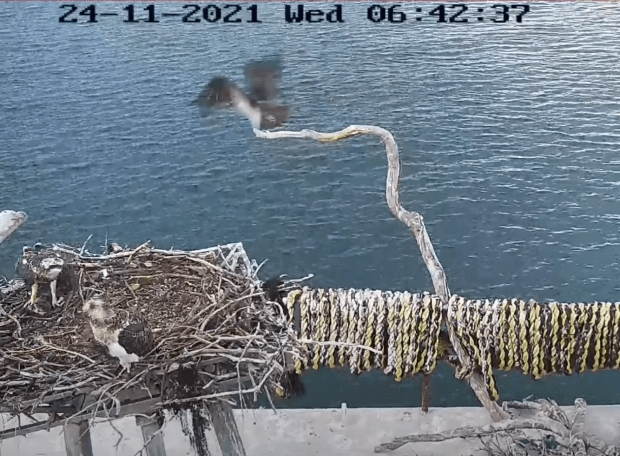
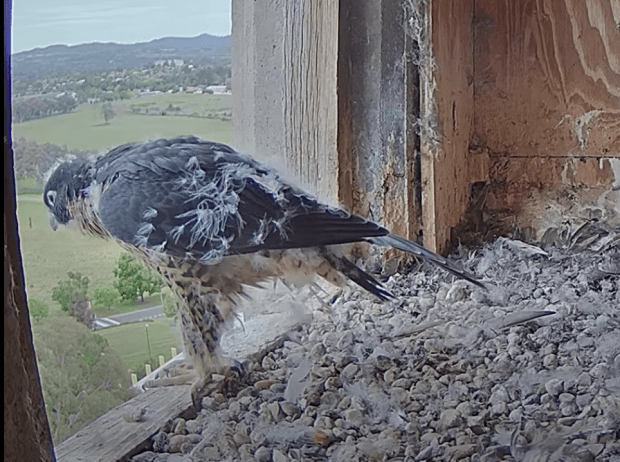
Daisy appears to have established a routine coming to and from the nest. I will check this today once it approaches dawn in Sydney.
Yesterday she arrived before dawn and checked on the one egg. She cautiously returned later and laid her 2nd egg. Once it was hard and she had warmed it for a short while, she began bringing leaves from all around the nest – stretching her little neck to its fullest. If she heard a predator, she would stop everything. Slink down into the nest cup as best she could and wait. Then she would begin gathering leaves again. Then she departed.
The images below are from the time Daisy arrived til she left on day 2.
Today is Day 3! Oh, our brave little duck. She arrived before dawn. Egg 3 was laid at 6:55:07. You can see that moment in the images below. Oh, this little duck from last year learned so much in a year. Many of you have written to me remembering that last year we felt that if Daisy had arrived a month earlier the eggs might have all hatched. Well, this smart duck did that this year. This would be her first clutch of the season. She can lay eggs twice. Last year Lady and Dad spent the month of December at Goat Island for the most part rarely checking on the nest. We will never know if Lady hadn’t tossed the down all over the place if those eggs could have remained hidden from the Ravens. But, if Dad and Lady are away from the nest ———— well, Daisy, we are all sending you the best energy that we can.
You could hear the Sulphur-Crested Cockatoos and the other birds in the forest. Daisy is extremely cautious – as she should be.
It looks like there are a few sprinkles on Daisy’s feathers. Our beautiful little duck is standing above thee eggs so the third will dry and the shell harden.
Daisy will do what she has done the other two days. Allow the shell to harden. She may stay on the three eggs a bit before covering all three and leaving the nest. She appears to not have removed any down from her breast yet for the eggs.
The egg is now dry enough to Daisy to lay down on all of the eggs.
I wish Daisy knew how many well wishes she has from around the world including her good friend ‘I’ from Poland.
Thank you so much for being here for Daisy today. Stop in tomorrow for Day 4 of The Daisy Chronicles. Stay safe!
I will continue to monitor the situation — and, of course, you can, too. Here is the link to the streaming cam!
Thank you to the Sea Eagles @Birdlife Australia Discovery Centre for their streaming cam where I took my screen captures.
We are going to start off with a check on what is happening in San Francisco – before moving on to Daisy.
An absolutely adorable 4 min 16 sec radio discussion on The Love Story in the Sky at The Campanile.
Did you know that Peregrine Falcons were virtually wiped out in California? In the late 1970 there were only two nesting pairs? This was the result of DDT. There is lots of literature but reading Rachel Carsons, Silent Spring, is a very good start.
DDT might have been banned after the revelations of Rachel Carson and others but it remains in the soil in various places. One of those is Big Bear California where DDT was sprayed on Big Bear Lake to kill the mosquitoes. It is still a contributing factor in thin egg shells which may be part of the problem with Jackie and Shadow, the Bald Eagles that have their nest at Big Bear.
Daisy the Duck did not spend the night on the White-Bellied Sea Eagle nest.
She arrived before sunrise to check on the nest. No one else was there. Daisy will be very cautious. She does not want to draw attention to the egg cup where her first egg was laid.
She goes over to where her egg is and checks. It is still there. Safe.
We can see where Daisy’s egg is because we know it is there but it is nicely covered with leaves and nest material so the predators cannot find it.
Daisy leaves right as the sun is rising and the forest is waking up.
Daisy carefully waits on a branch when she returns an hour and a half later. Can you see her?
She is checking and rolling her egg.
Daisy is very still. When she is in labour, her tail will move up and down.
There are now two eggs! Look you can see them both. Daisy is holding herself up so as not to break the second egg. When the eggs are laid they are soft. The air will dry off the surface and make them hard.
Daisy has settled on the eggs nicely. She is having a rest. Daisy will not do hard incubation until all of the eggs are laid. That is so they will hatch at the same time.
This last image of Daisy was taken a few minutes ago. It is nearly 08:30 in Sydney, Australia.
So far Daisy has been lucky. Lady and Dad did visit the nest tree a week ago and then on the day that WBSE 27 was released from care, they were not at the River Roost. They will often go to Goat Island if there are no eaglets to look after. Still, we know that they do come to check the nest.
Someone asked me why Daisy does not stay on the eggs now all the time. If she did they would not all hatch on the same day. Secondly, she is a very smart little duck. Her presence on the nest makes all of the other forest animals and birds curious. Last January they had never seen a duck on the big sea eagle nest — and neither had anyone else! I think Daisy will try and protect her eggs really well this year from the Ravens. She is almost a year older and she is ‘wiser’ now. Her breeding and the laying of eggs normally coincides with plenty of food and water. Her mate, who came to inspect the nest last year, only takes part in the mating ritual. The rest is up to Daisy. That is why she is so vulnerable. Only 20% of Pacific Black Ducks live to be 2 years old. Indeed, the average life span is only about two years. Oh, I so hope that she is successful this year! There are so many people hoping for Daisy!
You can join in and become a real Daisy fan. She needs all the love and positive energy we can all send her. Soon the name of the streaming cam will be changed from Sea-Eagle to Duck Cam! Here is the link to the streaming cam. Daisy arrives about 13:15 CDT or around 05:15 Australian Time. I am not expecting her to stay all day but she might surprise me.
Once Daisy lays all of her eggs (there could be 11), she will begin her hard incubation. Incubation will last for 29 days after the laying of the last egg. This is the difficult time. Daisy still has to eat and have some relaxing time. Last year she even went out during the night. It is then that the eggs are vulnerable. As long as she is incubating them, the Ravens seem not to bother. Our fears of the sea eagles proved to be nothing. They could behave differently this year but they were not a threat last save for the fact that scattering the down nesting material allowed the eggs to be seen. Fingers crossed.
Thanks for joining me. Take care everyone. See you soon!
Thank you to the Sydney Sea Eagle @ Birdlife Australia Discovery Centre for their streaming cam where I took my screen captures.
Holly Parsons, the administrator for the Orange Peregrine Falcon FB group, has posted the following from Cilla Kinross regarding Yurruga:
I took some images of beautiful Diamond throughout the day.
We would expect the parents to visibly be supplying prey to Yurruga. Many of you will have seen the adults at 367 Collins Street bringing in prey. You might recall how the Dad tried so hard to feed the little male when he was too sick and could not eat or swallow anything. Just pause and remember the healthy chicks at that nest and the noise they made even prior to fledging when food was around. Then remember Yurruga and how he behaved when prey came to the scrape. The falcons are loud in their food begging just like the four lads at Port Lincoln. The little ones simply cannot go without eating and while they are learning to fly they are also being taught how to hunt. It is unclear how instinctive hunting is. For example, the adult Ospreys do not teach their fledglings how to fish. They simply are hardwired to do it. Peregrine Falcon parents spend much time passing prey around, dropping it for the wee one to catch, etc. Certainly Yurruga had at least a days training because he was seen flying around with the parents prior to the big storm. There would be several prey drops during a day. No one has anything confirmed after last Thursday in Australia, 9 days ago now. I know that each of us wants this outcome to be different and I would like nothing better than for someone a mile away to phone Cilla and tell her that Yurruga is on their roof or in their garden. The long sessions in the scrape together may be Xavier and Diamond bonding in grief. There is also the additional issue of the absence of the eggs. Diamond has spent an inordinate amount of time scraping where the eggs were. My heart really goes out to her.
Sad news is also coming out of California. The California Condor chick #1075 died at the Los Angeles Zoo on 12 November. He had sustained injuries from adult male condor #247 during a territorial dispute. I know that many of you watched that streaming cam. Their lives are so very very fragile and to have a death of a promising chick due to fights is extremely difficult to process. There seems to be a lot of territorial disputes. You might remember that California Condor #1031 Iniko who survived the Dolan Fire was actually injured when an adult male came to the nest tree. —— Which reminds me! Iniko will be released back into the community of condors where he hatched on Saturday along with two others. This is great news coming on the heels of grief.
We really need some good news in Bird World. Iniko’s release is, of course, one of those. I really hope it is OK to cut and paste this amazing story from that Valerie Webber posted on the Loch Garten and Other Ospreys FB page. It is a marvellous tale of German Osprey Black 1FO seen in Portugal in Dec 2005/Jan 2006 and again in September 2021. So the question that is being asked is where has this bird been? It is more than 16 years old and this is truly remarkable – 3 sightings only in all those years. He really is a very handsome bird.
More good news come in the form of a Pacific Black Duck named Daisy who has now laid her first egg in the Sydney White-bellied Sea Eagle nest. An earlier blog today gave more images and some details. So nice to have her back! I am so excited about Daisy’s return that I can’t sleep! You can catch her on the Sydney Sea Eagle Cam. She laid her first egg today. She must have rushed to get to the nest OR she had made a nest elsewhere and predators came. We might not know. She will begin lining the nest with the down from her breast. That down will not only make it soft for her and the eggs but also will help cover the eggs when she has to go forage. She will also mix the down with leaves on the nest and cover the nest with those leaves. I hope there are lots of them!
Every one of the lads on the Port Lincoln Osprey Nest has had a fish today. Port Lincoln also says that the three have been seen at the shore going for a bit of a swim or a bath. Fantastic.
The three are over on the perches and ropes near Mum. What a beautiful image. I wish that Dad was there, too. The fledglings are gradually spending more time on the perches and ropes and flying around. They are growing up and shortly might be off on their own. I need to check and find out when Solly permanently left the barge. That might give us some clue.
I know that many of you are familiar with the Welsh Ospreys, Aran and Mrs G at the Glaslyn Nest. You might also know that one of Monty and Glesni’s sons, Aeron Z2, and his mate Blue 14 have their nest close by at Pont Croesor. Glaslyn has announced that the new hide is finished and visitors will be able to observe the nest of Z2 and Blue 14. That is great news.
That is it for me. I am sufficiently exhausted from the excitement of Daisy that I might be able to sleep. This is my Friday newsletter. I will bring updates later tomorrow (Friday the 3rd) evening.
Take care everyone. Thanks for joining me.
Thank you to the following for their streaming cams or FB pages where I took my screen captures: Loch Garten and Other Ospreys FB, Orange Peregrine Falcon FB, Port Lincoln Osprey Project, Sydney Sea Eagles @Birdlife Australia Discovery Centre, and Charles Sturt University and Cilla Kinross.
Oh, gosh. We really are going to miss these three boys when they finally leave the Port Lincoln barge. Ervie was wet this morning. He has been focusing very hard on finding a fish and catching it. We might never know, sadly, when that moment occurs – unless he brings it up to the ropes like Dad. Wouldn’t that be wonderful?!
Bazza seems to have landed the first fish this morning on the nest. Falky doesn’t seem bothered and Ervie had flown off earlier.
Port Lincoln gave us a nice image of Bazza over on the ropes. These three males are quite handsome.
When Ervie flew back to the barge he was really keen on preening those feathers.
You can really see that sharply hooked beak that helps to tear the fish so they are easier to eat. Unlike Peregrine falcons, Ospreys do not have a tomial tooth. In my images it is a bit difficult to see that valve which seals the Osprey’s nostrils when they dive for their fish but, it is there.
Looking at that beautiful image of Ervie below you will notice that the Ospreys lack that very heavy eyebrow of some of the other raptors. Instead, they have that incredible black line which passes from the eye down to the neck. That black line helps them with the glare.
Ervie missed the the 8:14:14 fish that Dad brought in. Falky claimed in.
Port Lincoln has reported that Ervie has been flying farther. They also note that he has been checking out the coast. Here is the latest map of Ervie’s movements from the barge.
Ervie and his siblings will get their adult plumage at their first moult which is fully completed by the time they are a year old. That change in plumage does not indicate Ervie’s sexual maturity. Osprey do not normally breed until they are three years of age. The 2019 fledgling from Port Lincoln, Calypso, has been spotted sitting on a branch with a male. Might there be chicks next year? That would be marvellous!
When Penny Olsen’s book on the raptors of Australia was published in 1995, the map of Australia indicated that the Eastern Ospreys were located only around the coast. Ironically, that map did not indicate any ospreys in the Eyre Peninsula. This is one of the things that has changed since its publication. We have to look no further than the Port Lincoln Opsrey Barge and Thistle Island. We also know from Solly being the first tracked Osprey that the birds do go inland. Not all that far but further inland than anyone had understood previously. We are fortunate that Solly was able to provide so much information to us in the 14 months that she was alive. Port Lincoln can now compare the dispersal of a female to that of a male with the tracking of Ervie.
There are many threats to Osprey. I imagine that everyone reading my blog can name at least four. I want to add warming seas and the decline in fish numbers as yet another.
As you know, I highly recommend Dr Marc Bekoff’s book, The Emotional Lives of Animals. He also wrote The Ten Truths with Jane Goodall. A very moving story is coming from the island of Kauai, Hawaii. Some of you might recognize the name of Hob Osterlund. She posted a very moving story that can be added to the cornucopia of evidence that Bekoff and Goodall have that support animals having emotions which they express. Once you have read those two reasonably priced books, you will never ever apologize again for anthropomorphizing animals again.
Here is that posting:
Tears.
One of my readers ‘B’ asked me if I had seen the snow at Glacier Gardens. I had not! So I went to check. Oh, my goodness, it is so beautiful. If you close your eyes you can see that beautiful Kindness using that nest and those branches like a trampoline. What a magnificent juvie Kindness was. She is off eating Salmon along the river.
On Taiaroa Head, 122 birds have been seen so far and there are 36 eggs laid. No mention yet on who the Royal cam stars for 2021-22 will be! Soon. And there has been no update on Grinnell. No further updates on WBSE 27 either.
Thank you so much for joining me today. Take care. See you soon.
Thank you to the following for their streaming cams where I took my screen shots: Glacier Gardens Bald Eagle Cam, Port Lincoln Osprey Project, and to Hob Osterlund and her FB page for that moving story. Much appreciated.
The Port Lincoln Lads seem to always be up to something. This morning Falky was flying about and Bazza and Ervie were on the nest. They had to have been full because there was a lovely fish tail on the nest and neither one of them were paying any attention to it.
It was very windy and Bazza entertained Ervie for about half an hour trying to land and stay on the perch. Have a look.
Are you finding that sometimes you could just use a little bit of ‘cute’ as we wait for new bobble heads in the raptor families to be born? What about a Korora?
They used to be called Little Blue Penguins. They are the smallest of the New Zealand penguins. This little one will weigh about 1 kg and be about 25 cm tall when it is fully grown. Their population is in decline due to dog, cat, stoat, and ferret kills. This group of predators has arisen because of the destruction of the penguin’s natural nesting sites for development. Sad.
And I want to give a shout out to ‘TAS’ for introducing me to this cute little non-raptor!
WBSE 27 has been observed being hounded by the Pied Currawong. This report comes from Cathy Cook on the ground:
As is usual in the Reserve, SE27 found herself being escorted & swooped by Noisy Miners, Magpies, Currawongs and Ravens, from the time she hopped out of the carrier. We saw her take 4 seperate flights, with her finally being observed (by credible people in the wharf cafe) to cross over the Parramatta River, just a little west of River Roost. The last picture shows SE27’s individual flights within the first 40 minutes after her release — at Newington Nature Reserve, Sydney Olympic Park.
Cathy posted pictures and a short video. I hope she does not mind my including one for you.
@ Cathy Cook
The saddest part about being a juvenile Sea Eagle is that for the rest of his life, 27 will be hounded by the smaller birds who, as you already know, are very effective in driving the juveniles out of the forest. I hope that Lady and Dad return to the River Roost on the Parramatta River to find 27 so they can feed her.
For all of you celebrating Thanksgiving with your friends, families and/or other loved ones in the USA, have a wonderful day. For those in Canada who celebrated in October, tomorrow is just another day. Take care. Always be thankful. See you soon.
Thank you to the Port Lincoln Osprey Project for its streaming cam where I video captured Bazza and to the Sea Eagles FB Page and Cathy Cook for the update on WBSE 27.
Here is an image of WBSE 27 being released last week. It was determined by the scale lines in her toes that the bird was in fact, 27 not 28. So happy that ID was solved! The day the bird was released was the first day that the parents were not at their River Roost. I hope the three connect! There is a video of the release and it shows 27 as a really strong bird. I hope she thrives in the wild for eons. What a gorgeous bird.
The following was posted on the FB page of the Sea Eagles:
The Kakapo Recovery are doing their annual fundraiser. As many of you know, we started out the pandemic with 208 Kakapo in existence. There are now 202. Dedicated individuals do wellness check ups which mean they have to find these elusive non-flying parrots. The only way to do that is with a transmitter. The transmitters and batteries require check ups and replacements (batteries) on a regular basis. Medical treatment, etc. If urgent and life threatening, the bird is flown to Dunedin, NZ for veterinary care.
Many are considering doing one special gift on behalf of their family to help wildlife and the planet (as opposed to fast fashion that winds up stacked in the deserts of Africa). The Kakapo Recovery is hoping you might choose them.
Last year we adopted Rangi! He happily lives in the living room plants when he is not cuddling up with Pippa the Albatross or Big Red the Red-tailed Hawk!
It is something everyone needs to think about even if it is $5 to a streaming cam that you love. It can make all the difference. You can also adopt other types of birds. Last year there was a huge rush to help Aran and Mrs G at the Glaslyn Bywyd Gwyllt. You might recall that two horrific events came together in the perfect storm at Glaslyn. A heavy rain storm with cold temperatures hit the area when the chicks hatched and Aran got in a territorial fight and injured his wing and he could not fish. The community came together and provided a fish table for the family. Sadly the chicks did not survive but Mrs G and Aran did and Aran got his strength and migrated on time. To help that cause many went to the website and adopted Aran and his family.
You will have your own list as well. Other ways that you can help is to check with your local wildlife rehabilitation clinic. They often post a list of items that they need. You would be surprised but clean old towels are usually at the top of the list! So next time you are looking at a pile of towels and old sheets, think of your local clinic for wildlife! It doesn’t cost anything but getting the items there and often the clinics have volunteers that pick up for them.
Books for children and teens on how to help wildlife thrive are, of course, invaluable in building the next generation to care for our beloved birds.
Holly Parsons posted an update on Yurruga on the FB page for the Orange Australian Peregrine Falcon:
“Post from Cilla approx. 5pm 24 November:I haven’t seen Yurruga since I placed him in the tree, but I’m pretty sure he is still there as the parents have been coming and going with prey and giving me warning calls if I approach too close. I only check once a day and the foliage is really thick so hard to find him if he’s quiet.”
That is great news coming out of Orange! That is the kind of news I wish were coming out of Sydney with WBSE 27 – that the parents have been feeding it. Fingers crossed.
This is a short update. It is extremely quiet in Bird World now that the falcons and ospreys and WBSE in Australia have fledged. Eggs are happening in the Bald Eagles nests in the US and there will be lots of action around the holidays in December.
Take care everyone. Thank you for joining me.
Thank you to the following for their streaming cams or FB pages where I took my information: Orange Australian Peregrines FB, Kakapo Recovery FB, and Sydney Sea Eagle Cam.
Holly Parsons posted an update from Dr Cilla Kinross on the FB page for the Orange Peregrine Falcons. Thank you Holly!
(Nov 23):”I had a look at the eggs. One was clearly unfertilised. The other was, I think fertilised, but there was no chick inside. It exploded (big POP) all over me and it was just yellow liquid. No chick remains. I’ll do updates later. I’ll also try to get some confirmation from the museum where there are candling experts (I am not).”
One great report that was featured by Sunnie Day on FB is this. Just look at those numbers. Now how do we take care of these amazing birds – our Osprey?
Osprey Report for 2021, USA
The entire report on the Ospreys for the 2021 season can be read here:
If you want to protect our Ospreys, The Observer focuses on them this week. They say:
“A growing cause of death for ospreys is entanglement: If adults incorporate monofilament or other discarded non-natural twine into their nests, these can end up wrapped around chicks’ feet, injuring or trapping them. And, as food specialists, with one main food source, a grave threat to our osprey populations is contamination of their aquatic ecosystems; our Sarasota waterways. As top predators, they’re exposed to the highest concentrations of toxins (such as mercury) in our environment.
To protect these beautiful birds, who are key members of our ecosystem, we can keep toxins out of our waterways, and plastic litter, including twine and fishing-line, out of our environment.”
White Bellied Sea Eagles. 28 on the left and 27 on the right.
Is this WBSE 28 and not 27?
And great news coming out of Sydney, Australia. Someone let the cat out of the bag. The juvenile WBSE that was grounded by the Pied Currawongs was released six days ago on 18 November. I am using the term ‘juvenile WBSE’. There is no proof that it is either 27 or 28. It is a juvenile WBSE.
Just like we compared the Peregrine Falcons on the ledge yesterday, I want you to look carefully at the two images above. Someone that I trust very much indicated to me that the juvenile taken into care was not WBSE 27 but, rather, it was WBSE 28.
Dr Christian Sasse is one of my favourite people. He is so dedicated to the wildlife of British Columbia and in particular the Bald Eagles. Have a look at this beauty!
It is 14:47 and Harriet and M15 appear to still have one egg in the nest at Fort Myers, Florida on the Pritchett Farm.
Falky scored the 06:37 breakfast fish. At that point, Ervie took off flying behind Dad. Maybe Ervie is gonna go and see if he can get a fish himself.
The Eastern Osprey in Australia do not migrate. Unlike the Northern fish eagles that do shift to warmer climates during the winter and catch their first fish when they migrate, the Eastern Osprey will fish before they leave the parent’s territory.
There goes Ervie off the perch. I sure hope he learns to fish. He can get his own breakfast and eat it somewhere away from the brothers!!!
I have seen no further news coming out of UC-Berkeley on Grinnell and Annie.
It is not late in the day but it feels like it. It will be totally dark in less than an hour and a half. So I am off to clear up things outside.
Thank you for joining me. Take care!
Thank you to the following for their streaming cams where I took my screen captures or for their FB Pages: Port Lincoln Osprey Project, Sea Eagles@ Birdlife Australia Discovery Centre and their FB Page, Sunnie Day and Holly Parsons.
It has been a bit of a day in the bird and wildlife world. Coming hot on the heels of the banning of trail hunting on Natural Resources Wales land and the National Trust properties in the UK, the State of Washington in the US has suspending bear hunting. It was well known that the adults were killed right when they came out of hibernation leaving cubs to fend for themselves, often dying. People, like you and me, called for these archaic practices to halt. The government listened. Remember that because every person can make a difference! You want hunting suspended in your state or province, phone and find out who to talk to. Write an informed letter. Demand change. Ask like-minded people to join you.
I am not going to start off with the streaming cams just yet. It was a grey damp day – with a little sunshine at times – on the Canadian prairies. The garden was full of birds, mostly sparrows and some Starlings. Mr Blue Jay came and went quickly. He does not seem to like the frozen corn cob. And, of course, there was Dyson & Company, along with Little Red.
All these years I have pondered the sheer amount of ‘bird’ seed that we go through in a week. It is true that there are normally 250-300 birds singing and eating daily but, how much can they eat? It appears that not all that new seed – seedless chipped sunflower and peanuts – is going to birds!
Dyson didn’t like the frozen corn either and didn’t bother to even take it for later. He has discovered how to vacuum out that new bird seed. I think I now know who broke my other feeder. Dyson has no shame. He lives to eat.
Dyson looks a little thinner in the image above but the one below is more of a likeness of this little one. Dyson brings us so much joy that we are thrilled he is healthy going into what might be a very bad winter.
With Dyson occupied on the sunflower/peanut feeder, it meant that Little Red could sneak on the tray feeder and eat all the cashews, fruit, Brazil nuts, and peanuts. If you are wondering, yes, the birds and animals possibly eat better than I do! Little Red is so cute.
Little Red lives in the penthouse. It is a ‘shed’ the size of a garage that is taxed like it is a new garage by our City. We haven’t had the heart to evict the little fellow even thought he fills everything up with Maple seeds and knocks everything off its hooks and generally makes a complete mess of the space.
There were a few European Starlings still in the garden. They will migrate returning next April but they are lingering just like some of the ducks and the Northern Cardinals. Who knows? Maybe they know what winter will be like better than anyone. They certainly have enjoyed eating the suet cylinder.
Others felt like Black Oil Seed today.
Isn’t she cute with her rosey legs and slightly pink tinted beak? Female house sparrows get short shift in the bird guides. It is a pity. They are quite lovely.
Last year I planted Scarlett Runner Beans and at the end of the summer the sparrows went wild shredding all of them and eating the greenery. What you are looking at below is a Flame Willow shrub. In winter the branches are red – super beautiful in a world of grey, white, and beige. There is some little vine or plant growing on that shrub. The sparrows have discovered it and they are doing the same thing – shredding and eating. Has anyone seen this behaviour?
And now back to the streaming cams for a quick update.
Port Lincoln Osprey Barge: By 09:30, three fish had been delivered to the nest. Bazza initially got the first fish when it arrived at 06:23. Ervie took it away from him. Bazza did nothing to try and get it back. Falkey got the 06:49:38 fish. The third fish arrived at 09:11:09 and Falkey got it, too. Ervie had a huge crop. He wasn’t bothered. Yesterday Cilla Kinross of the Orange Peregrine Falcons said that “Shrinking violets will not last long in the real world.” Bazza is hungry and he needs to challenge his brothers despite that he might be fearful of another incident like he had with Ervie.
Falkey has the fish. Bazza is crying to Mum and Ervie with his big crop is looking out to sea on the right. Will Mum take the fish and feed Bazza?
The White Tailed Eagle Nest in Durbe, Latvia. Milda and Mr L were at the nest working on more renovations. It was getting ready to rain and the image is a little ‘foggy’. Sorry about that. It is nice to see Milda. I hope that this will be a successful year for her after the tragedy of spring 2020.
The Minnesota DNR has turned on its Bald Eagle cam. Here is a video of that amazing couple – the sub-adult male who fathered his first chicks at the age of four last year – and the older female. This video was made on 18 November. It looks like Dad has his adult plumage this year! How wonderful. He will have turned 5.
Cornell Red Tail Hawk Cam at Ithaca. The camera has been frozen for awhile. I wrote to the Cornell Bird Lab to inform them and to also ask them if there have been any confirmed sightings of Big Red since the last one on 16 October. I will keep you informed.
Annie and Grinnell. I have not seen any updates. As well, nothing on the WBSE juvenile.
You might remember Tiny Little Bob from the Foulshaw Moss Osprey nest in Cumbria. That little one is a fine example of a third hatch so tiny everyone thought it would die and well, she became the dominant bird on the nest. Her number is Blue 463. I am watching all of the announcements for her arrival in warmer climates. Today, however, the 2016 hatch from Foulshaw Moss, male Blue V8, was spotted in Tanji Marsh in The Gambia. He was seen there in January 2021 and was in Cumbria during the summer of 2021. This is the good news you want to hear. Survival.
And on that wonderful sighting, I will close. Take care everyone. Enjoy the end of the week and the beginning of the weekend. Stay safe. Thank you so very much for joining me.
Thank you to the following for their streaming cams where I took my screen captures: Port Lincoln Osprey Project, The Latvian Fund for Nature, Charles Sturt University at Orange and Cilla Kinross, and to Lady Hawk for her video on the arrival of the two Bald Eagles to the MN DNR nest.
There has been a real leap forward against animal cruelty. You may recall that several months ago, the home of Chris Packham in the New Forest had its gate burnt and a car set on fire. Packham has been leading the call for a banning of ‘the hunt’ on the grounds of animal cruelty. Today, trail hunting has been banned on all the land owned by Natural Resources in Wales. The amount of land is 362,456 acres or 146,681 hectares.
Trail hunting is supposed to involve dogs and hounds following scent without actually harming, chasing, injuring, or killing a fox. It has been proven that this is not always the case and Wales said that they did not have the resources to police the land for those who do not follow the law so they are not outlawing the practice altogether. Recently, Packham demonstrated that one of the riders was unusually cruel to her horse – an incident filmed that went viral. In October, the National Trust in England outlawed trail hunting on its properties as well. This is a great move forward in outlawing any cruelty to animals.
Speaking of cruelty to animals, Animal Nation, has called for people to stop using doves and pigeons at memorial ceremonies. The birds are released and die or if they are lucky wind up in a wonderful centre to receive care. They are not bred to live in the wild. Please tell your friends. No wonder it was so easy for Dad to catch that dove and take it to try and feed his #4 chick at 367 Collins Street in Melbourne.
The text was too long so that I had to take two captures. If you know of anyone considering memorial doves or pigeons, please talk to them, respectfully, about the implications to the birds. This is tragic. Thank you.
Whenever it looks a little dark, there is always someone or a group of people doing a really good thing for the birds and animals. A Place Called Hope posted images of the new osprey platform going up in Branford, Connecticut. A pair of Osprey nicknamed the Pretzel Pair had a poor location for a nest and annual failures. The community hopes that this brand new platform on a telephone pole will attract the couple and that there will be fledglings next summer. How thoughtful!
Photos @ Deanna Broderick on A Place for Hope FB Page
Wow. A lot can be done when a few dedicated people get together to help our birds. The platform on the pole will be lifted into place tomorrow. Fingers crossed the osprey couple find this to their liking!
It is raining in Port Lincoln. The three lads are wet. This might calm their adrenalin. Falkey is eating the latest fish delivered after Mum retrieved an earlier fish that Bazza got from Dad and that Ervie managed to take later. (They both ate). It felt like a lesson that Mum was teaching them when she swooped in and grabbed that fish. Sadly, it is time to toughen them up for the real world – which I hope is not so full of ospreys that they do not thrive.
Little Yurruga is very interested in what is going on outside and below the scrape. She has given viewers today more than a little scare. It was only a year yesterday that her big brother, Izzi, fell out of the scrape!
For some time now, Cilla Kinross, the main researcher at this scrape box, believed Yurruga to be a female. Now with the fluffy down falling away, Kinross now believes Yurruga is a male. She showed images of Yurruga next to Diamond and said she would expect Yurruga to be much bigger at 41 days and she isn’t.
Do we really care? I think everyone wants a lively, beautiful, and successful falcon – male or female!
I have seen no news on Grinnell or on the release of the WBSE fledgling in Sydney.
Take care everyone. Enjoy the end of the week. Thank you for stopping by.
Thank you to the Port Lincoln Osprey Project and the Charles Sturt University Falcon Cam and Cilla Kinross for their streaming cams. That is where I took my screen shots. I would also like to thank A Place Called Hope for the posting and images of the new osprey platform at Branford. That is where I took my information and images.
No doubt all of the Ospreys on the barge at Port Lincoln are hungry first in the morning. It could have been 10 or more hours since they had a fish, depending on who landed the last one/s of the day.
At 09:37, the three lads were snoozing duckling style on the nest. Was anyone thinking about breakfast?
Dad flew in with a nice fish at 09:38:15, just 20 seconds later, waking them all up in a start. My goodness, Ervie is quick. He is mantling that fish (on the far right in front of Dad).
Wings are starting to flap.
As the competition for the breakfast fish amps up, Dad is getting ready to take off.
There he goes just clearing Ervie’s left wing tip. It looks pretty crazy down there but this is what we want to see – these three really being able to grab the fish and defend it. Ervie is a bit like a magician when it comes to getting the fish, he is so fast.
Dad has lift off.
Bazza is on the far left. Falkey is in the middle. He would not mind challenging Ervie for that fish. Look at Falkey looking over. Bazza, meanwhile, is looking out over the water, unconcerned.
Falkey thinks he will try to get that fish by flapping his wings.
Ervie counters. They are looking at each other so intently – it is a wonder Bazza doesn’t slip through and take the fish. Just look at those two! Ervie is saying, “I dare you to try.”
Ervie flips Falkey’s wing back causing him to lose his balance.
There, it is all over and it only took 14 seconds. No feathers or wings injured in the process. Wow.
Ervie aka Little Bob has really become a force to reckon with since he hatched. He has never given in to his older siblings. Focused. A survivor. Every day he amazes me. I look forward to seeing his progress years from now.
Ervie was still eating at 10:10. He is up on the top left near the perch. It is not clear if there will be anything left for one or both of the others. Ervie looks pretty hungry!
There will be plenty of fish for all of the boys today. Dad will make sure of that. It is very interesting to see the competition between the two fledglings. It will help them in the real world and it was not a serious tussle. Ervie pretty much dominates the deliveries like he did when Mum was feeding everyone.
You might be interested in what it is like in the African desert for animals. I have become more and more keen on learning about the places where the UK and European Ospreys and Black Storks go for the winter. (More water there but this is enlightening). It is night in the Namib Desert but move the time line back. There are Wildebeests, Ostrich, Giraffes, Jackals, Hyeans, etc. depending on the time of day. Enjoy.
The Namib Desert is said to be the world’s oldest desert. It is in the southwestern part of Africa whereas the sites for the Ospreys are in the Northwest, south of the Atlas Mountains, in Senegal, The Gambia, etc. The Namib is home to iron rich soil creating red sand dunes and formations like those where I grew up in Oklahoma. It is also known for its nature reserves. The camera is at one of those.
There is Namibia northwest of South Africa.
Red iron oxide gives the soil its beautiful terracotta colour.
The lodge where the camera is located borders a really iron red rich area.
I have no new news on Grinnell other than he flew out of the rehabber’s box and was up on The Campanile. The UC-Berkley band started playing when he arrived! There is such an incredible amount of love for this beautiful falcon. Let us hope that it all ends well. Grinnell seems determined to take his territory and he is much healthier than when he was attacked 20 days ago. The image below is from the Instagram feed of Annie and Grinnell. Oh, he looks good. Nice deep yellow colouring on his beak, around his eyes, and legs. The vets indicated that his beak is growing and his wing is healing. They felt that it was much better to release him now. Thank you everyone at Lindsay Wildlife! Grinnell looks in great form.
Thank you for joining me. This has been a really great day with Grinnell’s release. It would only be better if he was sitting next to Annie on The Campanile. Maybe tomorrow. No news on the WBSE juvenile in care.
Thank you to the Port Lincoln Osprey Project for their streaming cam where I took my screen shots and to the Annie and Grinnell Instagram where I captured the image of Grinnell flying.