22 March 2025
Good Morning Everyone,
There was quite the scare at Sauces Canyon Friday when a huge placenta was brought in that covered most of SC1. The wee one was shivering. The camera operator stayed and caught Audacity doing everything she could to save her little one. She was moving and shuffling and removing matter to free SC1. It took two hours. Everyone was holding their breath.
Meanwhile the nest is simply full of food including a dead seal pup and a lot of Mackerel.


SC1 standing up for a meal after its arduous ordeal. Another miracle. Poor little thing could use a bit of a wipe. But who cares – SC1 looks fine.


In other Eagle news, Bodie and the visitor at NE Florida are quite settled in with one another. Gabby even fed the other juvenile – and, of course, Bodie got fed as well. Many are hoping that the American Eagle Foundation will give the adopted eaglet a name.


Bodie did not go hungry! Look at this crop. It is a wonder she can stand upright.

The two at Big Bear Valley are doing so well. Look closely, the pin feathers are coming in. The little one is scampering around that egg cup wanting ‘out’. They are flapping their little wings and growing fast.


The eaglets at John Bunker Sands Wetlands are gorgeous.

The triplets at Duke Farms are doing well. Their mum was heroic in keeping them as dry as she could during the recent storm. They have their dark thermal down coming in which allows them to regulate their temperatures but, oh, what a lovely sight she was tucking them in as best she could. Just look today.


At the NCTC nest, Bella and Scout’s little one had its first feeding. It is fine. Scout was there to see it hatch and has brooded the wee one. This is good news. https://youtu.be/0aPqI9_OW5c?

Mr North and Mrs DNF have a hatch in progress or two at the Decorah North nest in Iowa.

Hancock Wildlife Foundation announced today that their Surrey nest of Brit and Rey has their second egg of the season.
We are keeping eyes on several other nests for pips that include Harvey and Ellie at the Kansas Eagle Cam on Farmer Derek’s land, the other egg for Bella and Scout at the NCTC nest, and US Steel.
Osprey News:
Dyfi Osprey Project: Idris has arrived home. They just turned the camera on and as if by magic, there he was. So happy to see him home. It is nine days earlier than his usual arrival date of March 30th. Now let’s get his mate Telyn home soon – and safe.
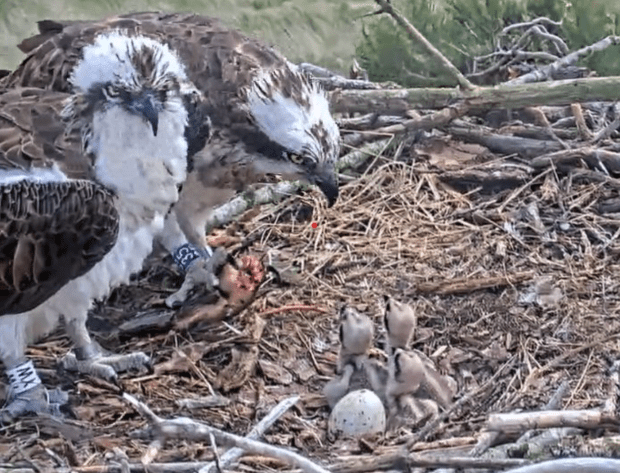
Known as ‘Daddy Longlegs’, Idris is an excellent fisher. He must have been hungry. Look at those whoppers at the nest.


Kielder Nest 7: Female KX7 arrives! This is the earliest arrival ever of an osprey back at Kielder Forest. Her mate is KM18, yet to arrive.

Threave Castle: Blue KC has arrived on the nest to join her mate Black 80 on the 20th of March.
Birds of Poole Harbour: Blue 022 that helped raise our fine osplets to fledge with its mate CJ7 has arrived home safely! He wasted no time in starting to work on their nest.
Glaslyn: Elen, Aran’s mate, arrived back on the Glaslyn nest this morning and then flew over to the PC nest which interestingly has a camera this year. Wonder who will get to watch it?

Meigs Point, Connecticut: The unringed male has returned on the 19th of March. He immediately began to work on the nest – cleaning out that egg cup.

Eschenbach: Hermine has not returned yet. The visiting female is getting more comfortable. Joan Castanyer writes: “Herbert follows the courtship rituals with the female, from gifts in the form of fish to displays of submission. In the video we can see him with his back to her, flapping his wings. Meanwhile, the female complains because he, instead of fish, has brought material for the nest. The candidacy of the new partner is strengthened, although there is still time for Hermine.”

Joan’s video of the couple on the nest: https://youtu.be/PvI5HHr2X7s?
Blue NC0 has been fishing and working hard on her nest at Loch of the Lowes.

Manton Bay’s Blue 33 and Maya are busy working on their nest.


Other Birds:
Trumpeter Swans arriving in British Columbia.

Knepp Farm White Storks: First eggs of the season confirmed laid.
A White-tailed Eagle visited the Seili Osprey nest in Finland! https://youtu.be/PetGCU1piEA?

Other news:
Geemeff sent news about osprey migration and species decline and the perils our darlings face.
https://www.culturednortheast.co.uk/p/osprey-wins-the-race-back-for-the
‘PB’ sent me an article from the Omaha News confirming the deaths of the geese from Bird Flu.
Mark Avery has an update on Bird Flu in his latest news blast. I am cutting and pasting here for all of you. This is going to be a potentially catastrophic year for our feathered friends.
Bird flu 1: there are currently many UK cases of bird flu and the list of affected bird species has reached 31 for 2025: Mute Swan, Whooper Swan, Bewick’s Swan, Greylag Goose, Canada Goose, Pink-footed Goose, Barnacle Goose, Shelduck, Mallard, White-tailed Eagle, Red Kite, Buzzard, Goshawk, Sparrowhawk, Peregrine, Kestrel, Curlew, Herring Gull, Black-headed Gull, Yellow-legged Gull, Great Black-backed Gull, Common Gull, Little Gull, Cormorant, Razorbill, Barn Owl, Long-eared Owl, Tawny Owl, Grey Heron, Pheasant and Starling. It might look as if gulls, wildfowl and raptors are particularly affected, and it’s possible that’s the case, but the flaws in the ‘surveillance’ scheme (negative tests not publicly reported, limited numbers tested, no systematic testing) mean that it is difficult to know what this species list means in terms of species affected – click here. An interesting gull list and just one passerine in the list!
Bird flu2: wintering Sandhill Cranes have been dying of bird flu in Indiana – 1500+ of them (click here). This link – click here – provides information from the USA on detections in wild birds but also in dairy cows (quite a lot) and there are some human cases including one death, it seems. Robert F. Kennedy, who was put in charge of health matters by Trump, has suggested letting the disease rip in order to find the resistant birds that could form the basis for building a resistant stock. Something similar was considered as a covid response in the UK. US scientists are quoted as opposing Kennedy’s suggestion because intensively-farmed chickens and turkeys are killed so quickly that they never (?) produce antibodies to the disease. I wonder what the death rate is in Wild Turkeys in the USA?
Bird flu3: a paper in British Birds (by Tim Birkhead and Ben Hatchwell) assesses the impacts of bird flu on the Guillemot colony on Skomer which has been studied for five decades. The 2023 outbreak of bird flu led to a higher-than-usual number of recoveries of (dead) ringed Guillemots that July and August and counts of ringed birds in 2024 suggested that about a quarter of the colony had been lost the year before. There were impacts on nesting success too which will take some years to work their way through. For a not very relevant comparison (perhaps), UK human covid deaths in 2020 numbered around 72,000, or 1 in 1000 of the population, or 0.1%.
In Manitoba, the Assembly of First Nations has issued a statement on Bird Flu. As you can see, the concern is world-wide. Please help by keeping your feeders and bird baths clean and follow any directives that you are given. So far no one is asking for songbird feeders to be taken down. The fear is for the migratory birds that are coming to their spring and summer breeding grounds.

‘PB’ loved Smallie like all of us. She sends news that there are three falcon eggs at Amersfoort. How grand!
At Robert Fuller’s kestrel nest, the couple, Apollo and Athena, are fighting to protect their eggs. https://youtu.be/qFeLnxjXT24?

The’ quiet’ was one of the best things about being on Hecla Island during the winter. (The hardest was being away from The Girls). Hardly anyone was there except for those ice fishing and the odd tourists. The snow was pure white – not dirty with salt and sand like the City. You could see the deer in the woods, the Crows and Eagles flying overhead, and some small birds murmuring. A few gulls were sitting on the top of the lighthouse and, of course, at least one very large grey wolf. Without the foliage, it was also easy to spot Crow nests, a few eagle nests and one osprey, one near Winnipeg Beach. It felt so good. As most of you know, I am not fond of the City. While I have dreamed of moving to ‘the middle of nowhere’, my heart is also with the animals that occupy our garden. So this summer, we must plant even more trees to enclose us; perhaps, it will be a buffer for noise and other humans. Yellow Warblers on the Galapagos Islands feel the same as I do about traffic noise!
Traffic noise triggers road rage among male Galápagos birdshttps://www.theguardian.com/science/2025/mar/20/traffic-noise-triggers-road-rage-among-male-galapagos-birds?CMP=share_btn_url
Closing on a really upbeat note – Cornell’s Red Tail Hawk Big Red has been working on that egg cup on Friday. We could have eggs soon!

Thank you so much for being with us today. Take care. We hope to have you with us again soon!
Thank you to the following for their notes, comments, images, articles, posts, and streaming cams that helped me to write my post today: ‘Geemeff, J, PB’, IWS/Explore, NEFL-AEF, FOBBV, John Bunker Sands Wetlands, Duke Farms, NCTC, Deb Stecyk, Raptor Resource Project/Explore, Dyfi Osprey Project, Kielder Forest Ospreys, Threave Castle, Meigs Point Ospreys, Eschenbach Ospreys, Joanna Castanyer, Woodland Trust (LOTL), Lynn Cracknell, Knepp Farm White Storks, Cultured Northeast, First Alert 6, Mark Avery, Robert Fuller, Town of Amersfoort Falcons, The Guardian, LRWT, Cornell Red Tail Hawk Cam, Hancock Wildlife Foundation, Manitoba Assembly of First Nations, Osp, Birds of Poole Harbour, Bywyd Gwylld Glaslyn