The sad and the glad…Sunday in Bird World

8 October 2023

Hello Everyone,

Good Morning. Thank you so much for the continued outpouring for Lewis. It is so appreciated. He had a reasonable Saturday. The inflammation medication that helps with his pain also causes him to be ravenous. Sadly he just ate so quickly at breakfast that he lost his meal but, after a few hours, I warmed up some of that very condensed chicken broth form the chicken bones and mushed it up with tin food and he had a really good meal and kept it down. So happy! Of course, the girls all had their share of warm broth, too!!!!!!!!

It was chilly at 6 C on Saturday and damp with some drizzle. The three Amur Maples from our City’s tree-planting programme will be lovely! They are so healthy. Today is planting day.

So far, the squirrels have not touched the pumpkin. There were a few Dark-eyed Juncos on the deck today, and they inspected it. Too funny. Dyson was out with her gang, Little Red was around, and the Blue Jays – all four of them – made an appearance. There are still Wood Ducks at the park and I plan to go and see them tomorrow. Soon, they will leave. I think I will cut bigger holes in that pumpkin to help them get started.

We are going to start with some fantastic news coming in from Geemeff. LY7, Ludo, the 2023 fledgling from Loch Arkaig, has been photographed in France!!!!!!!! Oh, what wonderful news. As Geemeff points out, these are now the fledglings from Loch Arkaig – Louis’s kids (with Lila and Dorcha) – that have been spotted after leaving the nest: “Doddie JJ6 twice! Somerset (2020) and Shetland (2022), Willow LW5 (France 2022), Rannoch JJ2 (Senegal 2022), and now Ludo LY7 (France 2023). Jump up and down. Tear up. Great news. That feisty kid is doing great.

My Saturday newsletter alerted us to concerns at the Collins Street scrape in Melbourne. The news continues to be sad – sad that the four eggs that were laid might not hatch, but as I wrote to ‘H’ when she sent me the news – I am glad there were not four little fluff balls waiting on the ledge for food and Mum being injured or unable to care for them.

The four eggs have been left since 0559 except for two brief periods shown below in screen captures when the male returns to incubate three – one of the eggs is off to the side (or so it appears).

There were at least two times that the eggs were incubated for a short time.

This is the latest news coming from the FB Admin.

The Melbourne Falcons are the most popular in terms of streaming cam numbers of all the Falcon cams internationally. Everyone has a very heavy heart today. The male has been incubating on and off. From experience with eagles, the eggs can, in cool temperatures, be left for more than five hours and still hatch. Such was the case with Milda the White-tail Eagle. It would be desperately hard for the Dad to provide all the duties – incubation, territorial defence, food, and feeding and protecting the hatchlings. The chicks cannot regulate their temperature, and food is required. We have seen falcon males take on full-time duties, such as Newmann at Great Spirit Bluff, this season, but those eyases were much older (at fledge).

It now appears that the female might have returned to the ledge and is incubating the eggs. It is not 100% certain. We are going to have to wait and see how this plays out.

This is Dad M22 rolling the eggs with his talons. Little Dad – what a guy – working hard to try and keep things going while Mum is healing.

‘H’ gives a very detailed communique on the happenings at the nest over the past few days. This is followed by the latest dispatch from Victor Hurley.

“Melbourne / Collins Street Falcons, October 8 –   F22 returned to incubate the eggs during the overnight of 10/8.  At 0619 she flew out, and then from 0648 to 0702 she hung out at the north end of the ledge (the opposite end from the nest).  F22 has obvious injuries to her head with several patches of missing feathers, but there is no evidence of blood-stained trauma.  Her right eye does appear slightly puffy and she sometimes attempts to hold it closed.  Her disposition was a little ‘off’, and she seemed to be in a slight daze.  Dr. Victor Hurley has stated: ”I wouldn’t be surprised if her injuries included some concussion.”

The eggs were left unattended for over 4.5 hours.  Finally, at 1039 M22 landed at the south ledge and immediately began to incubate the eggs.  He only stayed for 38 minutes, however.  He later returned at 1212, and this time he stayed on the eggs until 1324.

At 1341 F22 landed on the north ledge.  She seemed a little more alert, and she was doing a bit of squawking and rapidly looking around.  She left at 1358, without going to the eggs at all.  At 1359 M22 landed and began to incubate three eggs.  The fourth egg had been inadvertently cast aside at his last departure, but he did not make an effort to gather it at this time.  There were a few times when M22 rose to roll the three eggs.  This time M22 did a long incubation stint of 4.5 hours, and at some point, he did gather the fourth egg to join the other three. Curiously, while M22 was incubating the eggs, F22 landed on the north ledge at 1430, and there was some light chatter between them.  She did not approach the nest, and she flew off after 11 minutes.  

At 1827 F22 returned to the north ledge, and that’s when M22 ended his incubation stint and flew off from the south end.  F22 departed the north ledge at 1942, and once again, she had avoided the south ledge and the nest.  F22 has not been at the nest with the eggs since 0616.  At 2009 F22 landed on the north ledge and went straight to the perch.  The time is now 2200 and F22 remains on the north perch.  The four eggs at the opposite end of the ledge are looking so very cold and lonely.  The current temperature in Melbourne is 9C/48F, and predicted to be 6C/43F overnight.

The eggs have been left unattended for extended periods over the past few days.  Has F22 come to believe that her eggs are not viable causing her to abandon them?  We won’t ever know what happened to our beloved female, F22, but we are very glad that she is alive, and we wish her continued healing.  We need to remind ourselves every single day just how challenging and difficult the lives of all of our feathered friends are.  We must not take a single moment with them for granted.”


This is the latest dispatch from Victor Hurley on the situation on the ledge. Thanks so much ‘H’ for keeping tabs on the correspondence coming out of Melbourne!

Thankfully everything is absolutely perfect at the scrape of Diamond and Xavier at Orange.

The older chick is a little larger now (female probably) and she often gets the first of the food. ‘A’ notes a cute event yesterday, ” Xavier managed somehow to avoid Diamond’s watchful eye and sneak in to do a feeding today, which lasted for 13 minutes and included the younger chick in a big way (he was constantly checking to see if she was about to storm into the box, not at all happy with his ‘interference’). See from about 15:28 – after a bonding session with Diamond, Xavier returns to the box to brood the chicks but as he settles down, the chicks tell him they are hungry (especially the younger one), so Xavier retrieves some stashed prey from the front corner of the scrape and proceeds to feed the pair. His back is to the camera, obscuring the majority of the feeding, but based on what we can see (and hear), the younger chick is getting fed much more at this feeding than it normally does at a Diamond feeding. “

Dad taking one of his incubation times so Mum can have a break at Port Lincoln.

The observation board at Port Lincoln for the 7th of October.

Gorgeous Sea Eagles. Hoping that they’re going to get some more prey! Check out the interest in walking up the branch.

They are nothing short of gorgeous.

And now for some really good news! We can all use it after the worry for Melbourne and, of course, the shooting of the Condor in California recently.

A new ambassador Osprey.

The two surviving ospreys at Osprey House in Australia are doing very well. Gosh, I wish they had a streaming cam to bridge the gap between the end of the season in the US and the hatch at Port Lincoln! Miss those little grey fuzzy balls of energy! Soon….soon. The beaking will begin.

There is good news coming out of the E-1 nest at the Kisatchie National Forest. Anna is on the nest! No question. It is her.

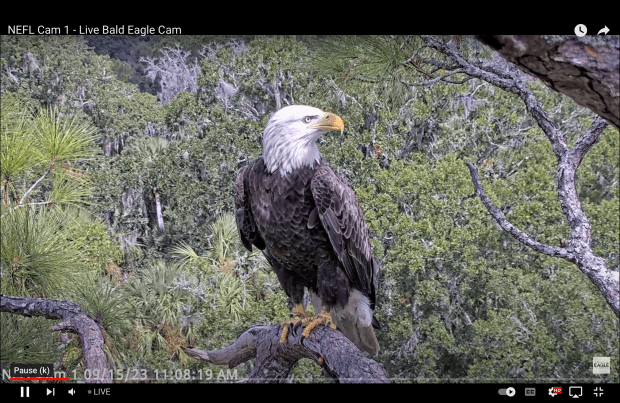
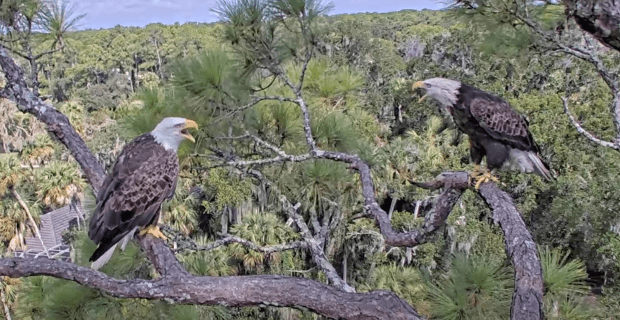
Everything appears to be alright at the NE Florida Bald Eagle Nest of Gabby and V3.

Gabby and V3 are quite loud…Gabby was biting V3’s bottom today! Affection Eagle Style.

What do you know about Bird Island? First, (don’t peek) do you know where Bird Island is located? Secondly, what are the major bird species that still populate Bird Island? And what are their challenges?

The more educated we are about the challenges that all our birds face the better equipped we are to advocate for their protection!

Thank you so much for being with me this morning. Take care! See you soon.

Thank you to the following for their notes, posts, articles, photographs, and streaming cams that helped me to compose my blog this morning: ‘A, Geemeff, H’, The Woodland Trust, 367 Collins Street by Mirvac, Leigh Stillard, Victor Hurley, Charles Sturt Falcon Cam, PLO, Sydney Sea Eagle Cam, The Peregrine Fund, Key News, Osprey House Environmental Centre, Tonya Irwin and KNF E-1, NEFL-AEF, Lady Haw, Google Maps, British Antarctic Survey, and the Albatross Task Force.

The menace that is Malta, Collins Street female injured?…Saturday in Bird World

7 October 2023

Good Morning Everyone!

Thank you so much for your comments and letters. I appreciate hearing about your pets and your experiences with feline teeth – thank you for sharing and caring. I am pleased to report that the pain medication has helped Lewis, and he is eating well again. At this very moment, Lewis and Missey are glued to the living room window. A Hairy Woodpecker is going after one of the corner cedar shakes!

Hope and Calico are oblivious to everything going on with Lewis. They are just happy – loving watching the birds, playing and having stories. We are certainly going through novels!

It is interesting to watch Calico get settled for ‘a story’. She now expects this and curls up on my lap. The little one watches carefully from the edge of the chair as she is doing below. It is certainly one way to plough through books that have been sitting waiting to be read! It is wonderful.

Calico is putting on weight. Talk about a gentle soul. You can see that the dining room table in the conservatory is still their ‘safe dark’ spot…with its duvets piled on the floor for warmth and layers and layers to cover the top and the sides. It is getting cooler at night now that we are into October and the girls get the heat turned on once the sun goes down.

We punched the holes in a small pumpkin and filled them with peanut butter. It sits on the log Little Red uses to jump to the table feeder. Let’s see if this pumpkin treat works! Clearly will not win any awards for beauty but we will wait to see if it is something that the squirrels will enjoy.

In Canada, this is Thanksgiving weekend. The celebration is on Monday and coincides with what was traditionally the end of harvest and giving thanks for the land’s bounty. (Quite different than the American Thanksgiving).

I am so grateful to the garden animals that they will get special treats on Monday.

We are going to Australia right away. It is hot and the wind is really blowing. ‘A’ has already pointed out an interesting problem. M15’s mate at SW Florida has been named F23. We have F22, a falcon, at Collins Street. We are both hoping that there will not be another F23 this year anywhere or it will get confusing.

‘A’ has been watching the Sea Eagles and reports, “SE32 won the fish Dad brought in late this morning (6 October) at WBSE. He held onto it, mantled it, protected it from SE31 and self-fed most of it, before allowing SE31 to take the final piece. The head and tail had been removed from what was originally a medium-large fish, so with the fish unzipped, SE32 was able to get in some wonderful practice, and by the end, he was doing really well. He did get the majority of the fish, finishing with a very nice crop. He was obviously hungry, as he was simply fearless in claiming and hanging onto that food. At one point, there was some serious fighting over the fish (lunging with beaks was involved, along with much flapping), but SE32 fought his sister with great determination while hanging on tightly to his fish. He was NOT letting go. I was so proud of him. After watching that self-feeding, and the consequent boost to SE32’s confidence, I am way less concerned now than I was yesterday. Even though the food supply at this nest has not been as good as I would have liked over recent days, at least SE32 is not now missing out on his share of what there is. Both are doing a lot of wingercising and are looking strong and steady on their feet, with excellent balance. SE32 is doing more hopping than his sister, bounding across the nest like a small wallaby. 

There has been little or no sound or sign of crows or currawongs this season, though I don’t remember seeing them much or at all in previous seasons either until fledge day arrived. I remain hopeful that these two, with their strong relationship, will return to the nest after fledging, if only to be together. I do wish Dad and Lady would spend more time over the next week or two imprinting this nest in the eaglets’ minds as a smorgasbord of delicacies to which they will definitely return once they take the plunge. I think back to last year – in particular, the way SE29, after fledging, came back to sleep at the nest with SE30 each night and what may have happened had SE29 not gone into care the day before SE30 fledged. These two have a very similar relationship to the one between SE29 and SE30 last year, so there is a chance their bond will again help them survive after fledging this year.”

Please keep the female at Collins Street, F22 in your warm thoughts. ‘H’ just sent me the latest posting by Victor Hurley that explains why we have seen M22 incubating the eggs so much!

What a delight it is to watch Diamond and Xavier with the two eyases. The closeness in time of the hatch has made all the difference. These two are developing well – each getting their portion of food. You can see a slight difference in size but this is not hampering the second hatch at all. Xavier is working hard to get prey to the scrape and is doing a fantastic job despite some high winds that have been in the area. The temperature remains around 18-20 C.

Diamond got upset. A Currawong flew past the scrape!!!!!!!!!!! She is not going to let that bird get near her precious babies.

If you missed Dr Victor Hurley’s talk on Peregrine Falcons in Victoria Australia, here is that link.

Gabby and V3 continue to make restorations at The Hamlet. V3 has certainly won the heats and minds of everyone for his staunch protection of the territory around the nest. We are all hoping for little eaglets this year!

Anna’s injury is really improved. You might recall she even had problems landing. Well, that wasn’t the case on Friday when the landed on the nest with a nice fish and began chortling. How wonderful! Nice to see this improvement.

Osprey Season is over in North America, the UK, and Europe. Jeff Kear has posted a very informative article by the Scottish Wildlife Trust about their feathers that you might still find useful as we prepare for hatch at Port Lincoln.

Please keep your positive thoughts going for the migrating ospreys. Things in West Africa are changing and the once pristine habitat is being altered – either by climate or by habitat loss due to human expansion.

This is tragic. As you will remember from yesterday’s blog, there are Ospreys who navigate a route from their spring/summer breeding area in the UK to the precise concrete pillar. Our dear Seren 5F is being impacted. So what happens to those birds when the water and fish dry up or are irreparably flooded?

Countries do listen especially if tourists decide not to travel. Let those that allow poaching – Malta and Cyprus – know how you feel by travelling elsewhere – to places that value nature and wildlife.

Malta has long been a place that is renowned for its illegal songbird poaching.

The fact that Malta lies on the flyway that links Europe with Africa and the winter home of these migrating birds is particularly problematic.

Owls. I have a love-hate relationship with them – and get bloody upset when they start knocking M15 off the perch or fly in and take our precious osprey babies. Did you know that there are 234 different species of owls living around the world, from the ice-cold Arctic to the tropics and the deserts? Their keen eyesight and hearing and specialist feathers help them hunt at night – they are the silent killers.

Thank you so much for being with me today! We will be planting trees later today. It is Re-Leaf day and there are three Azur Maples arriving to add some more colour to the garden. Take care all. See you soon!

Thank you to the following for their notes, posts, articles, videos, pictures, and streaming cams that helped me to write my newsletter this morning: ‘A, Geemeff, H’, Sydney Sea Eagle Cam, 367 Collins Street by Mirvac, Charles Sturt Falcon Cam, Liznm, Victor Hurley, NEFL-AEF, Tonya Irwin, Jeff Kear, The Scottish Wildlife Trust, Chris Wood, Geemeff, Conservation Science and Practice, Responsible Travel, Google Maps, Cambridge Core, and Cornell Bird Lab.

Friday in Bird World

6 October 2023

Good Morning Everyone!

Thank you so much for all your good wishes for Lewis. We are taking it all one day at a time. After many consultations with vets (5 this morning), Lewis is on anti-inflammatory pain relief and will be tested for feline FIV on Wednesday. This is a holiday weekend and this is the earliest booking we could get. All decisions will be made based on the results of that test. Feline FIV is like human AIDS. Many feral cats have FIV. Our Humane Society used to test for this at intake but the explosion of pets during Covid – and their subsequent dumping – meant they could not keep up and the lab cost of each test also soared. ‘Feline immunodeficiency virus, or cat FIV, is a retrovirus infection first discovered in cats in the U.S. The virus is often referred to as cat HIV or cat AIDS because it has a similar effect on felines. FIV-positive cats may have the virus in their system for years before showing signs of illness.’ One of the signs is the gums and teeth so we are waiting for testing with Lewis.

One reader’s grandmother advised her never to do anything but to wait…wait until you have all the answers. That is what I am doing. I have found all manner of mobile vet clinics that do specialised care. What a blessing as Lewis was simply overwhelmed with anxiety when he was at the clinic. He is such a sweet boy. To my knowledge, he is only a danger to Hope. Missey is FIV negative and has been vaccinated and so is Calico. Hope cannot have her vaccinations until she is spayed in three weeks. So they are separated and Calico remains separate, too. Lewis and Missey have always been together and she brings him a lot of comfort.

The vet advised that he only have soft food but, I decided, in the end, to put out his favourite hard food, some soft food from a tin, and a lovely bowl of roasted organic chicken for his supper. He ate a little from all the bowls. Poor fella. The girls had some as well. One day at a time. He also had some breakfast. Sadly there is no cure for this disease and sometimes you never see the cat’s activation of the disease til they are much older. Your warm wishes for him are much appreciated.

Lewis and Missey looking out the little window together this evening.

Lewis votes for ‘Wallander’ as one of the best TV shows on BritBox.

The winner of Australia’s Bird of the year for 2023 is –

Looking at the birds. Today brought a single story that just made me so joyful. Tearful.

There are many amazing Ospreys. This is about one amazing female Osprey. She flies more than 4500 km from her nest in Wales to Africa, landing on the same concrete post yearly. Those living in The Gambia wait to see her arrive. What a comfort to know that Llyn Clywedog’s Blue 5F Seren arrived at her winter home safely again this year. It does just bring tears to your eyes. Ten years. A decade.

Migration is the single most perilous event in the lives of the ospreys. Many never make it their first year to a winter abode where they will live, maturing for the next two years. This amazing female – the fantastic mate of Dylan – has been doing this repeatedly. What an amazing bird she is. Let us all hope that her winter home continues to exist amidst much habitat loss for the birds in the region. Send positive wishes that she avoids Avian Flu and returns in April to her nest to raise more amazing chicks. She lost one this year to the goshawk – taken while feeding them. Such a tragedy.

Here is an article form Natural Resources on Seren.

Some information on Osprey migration to remind you of the reasons and perils these magnificent birds (and all other migrating birds) undertake.

The migration map for all species for 5 October in North America.

Checking on the migration status of Karl II and his Black Stork family for 5 October.

Kaia is in Israel!

Last data from Karl II he was in Turkey.

Kalvi is in Bulgaria.

Little Waba is in Romania.

Bonus’s tracker quit transmitting some time ago. His status is unknown.

Please go and vote for names for the two falcons at Orange. This year the choice is from local mammals that live in the area.

Gabby and V3 are thinking about eggs. Moss came in to line the nest bowl today. Looking good in The Hamlet!

The Pritchetts have ended the wait and all the anxiety surround ‘a name’ for M15’s new female. Like him, she has a gender designation and the year she came to the nest. F23.

One of the pair flies away. You can see that in the images 2/3. Going to get more moss!

At Orange, ‘H’ caught Xavier delivering breakfast to his lovely family. These two chicks are doing so well. They are being fed equally, and there are no problems with their size, etc. It is wonderful to see!

At Port Lincoln, Dad has been delivering fish. Here is the daily observations from yesterday.

Imncubation continues at Collins Street.

The Sea Eagles are beautiful. They are growing up too fast, and we should be looking for branching shortly. Too soon they will fledge. Just look at those beauties.

The NZ DOC ranges had their best year ever. 33 chicks Royal Albatross chicks fledged off Taiaroa. Congratulations!

Here is the complete story:

The heating planet and seas will have a direct impact on the ability of our beloved Royal Albatross (and all other sea birds and those that rely on fish from the sea, rivers, and lakes) to survive. What are some scientists saying?

‘As Carbon Brief has pointed out, it makes three main points. The first is that some important clean energy tech – solar energy, electric cars and battery production – is now being rolled out at a record pace, in line with what is needed to reach global net zero emissions by 2050. Under the IEA’s pathway to zero, solar and EVs could provide one-third of the global emissions cuts needed by 2030. This tells us that rapid change is possible. In the case of solar, it suggests that it can leapfrog fossil fuels as a primary energy source in the developing world, if influential countries tailor their support in that direction.’

This could be one of the solutions for our birds – solar power is growing in many industries, including fishing boats. Now, if we could get them to limit their catch, set their lines at night – or even have a 5-year moratorium on any fishing – might the seas recover?

Feeding cats is a problem and I must be much more diligent to ensure that my family of felines only eats sustainable products. I will keep you informed as I work my way through this process of Dolphin Friendly, no bycatch brands. If you have been studying this, please let me know what you have discovered!

From ‘H’ this morning – a wonderful thought to share with all of you.

We know that leaving our gardens for the winter is the best thing we can do for the insects, the animals, and the birds. One of the elders in our province tells us, ‘We don’t cut into Mother Earth with metal blades; we cover her with a blanket and tuck her in for the long sleep.’ Wise words.

Thank you so much for being with me today. Please take care. See you soon.

Thank you to the following for their notes, posts, videos, photographs, articles, and streaming cams that helped me to write my blog today: ‘B, H, K’, Birdlife Australia, Jane Dell and UK Osprey Info, Natural Resources Wales, Birdfact, RSPB, SAVE, Roy Dennis Wildlife Foundation, Sunnie Day, Looduskalender Forum, Donatella Preston, Lady Hawk and SW Florida Eagle Cam, NEFL-AEF, Heidi M, PLO, NZ DOC, The Guardian, Holly Parsons, and Sydney Sea Eagle Cam.

Thursday in Bird World

5 October 2023

Dear Readers, Good Morning!

I hope that this newsletter finds each of you well and happy.

Thank you so much for your continued kind wishes. Your warm thoughts and notes are always appreciated.

Wednesday. It had been on my calendar for several weeks. It was the day that the three older kittens had to go in for their shots, and Missey and Lewis had to have their annual check. My vet is very busy and I so hoped that my Covid test would show negative and the clinic would allow me to come with the babies. They did. It all worked but it turned out quite differently than I anticipated. I am hoping that soon things will become ‘calm’ – boring. Gosh, boring would be so nice.

Off we went – three cats – one huge hard carrier for Lewis and two soft-sided ones for Missey and Calico. They were all darlings, thankfully, on the way in and out of the car and to the clinic.

Lewis peeking out.

Calico is in there!

Missey’s eyes are always so expressive. She was allowed to wander freely around the examination room.

Calico passed her check-up with flying colours. She has healed nicely and is the proper weight with nothing untoward. The vet said she can continue to nurse Hope as long as she wants -it wouldn’t hurt either. Eventually, Calico will have enough and stop it all but it could be some time. I do not care as long as they are healthy. Missey was a tad ‘pleasantly plump’ – the problem associated with her still eating kitten hard food, which is being corrected. Nothing major. Missey’s teeth were sparkling white with good, strong gums. She had her shots and explored the room – a confident, dominant female cat. Quiet, confident, secure. Lewis, on the other hand, is insecure and quite frightened. As it turns out, he was so stressed that the vet did little with him besides checking his teeth and giving him his shots.

But Lewis had a serious problem, and I did not even notice. Lewis’s gums are swollen and red. Lewis, poor dear darling Lewis, needs all his teeth, but the canines, pulled. Cats are able, I was told, to live fine eating soft food.

Lewis was not tested for AIDS when he was adopted. The Humane Society used to test for the disease but stopped when the costs skyrocketed. So, we do not know if he has AIDS, which could cause his body to respond this way. If he has AIDS, is there any point in agreeing to have the surgery – which, according to the vet – is major? So, all of these things begin to twirl through your head. Is Lewis in pain? How long? Why didn’t I notice? But he is still eating. So, is this an issue of over-treating? or good sound vet advice? Too many things to think about. Tomorrow, I will walk in the park and sit with the ducks. Perhaps an answer will rise to the surface.

It took the wind out of me and so, this newsletter is shorter.

Geemeff sent me the most amazing article on Godwits, weather, and migration. We know about the extreme distances that Godwits fly to get to their winter homes but this is the tale of the return trip due to weather. Incredible story!

All of the Royal Cam chicks have fledged at Taiaroa Head. We now wait to see which adults will return for the upcoming breeding season. I am particularly interested to see if there is any remote possibility that OGK might appear. He has not been seen since the 19th of May 2022.

The joy and love continue to radiate out of the scrape at Orange. Two beautiful eyases. Both are fed well, both are a good size to one another. It is all good.

‘A’ remarks, “Those eyases are just darling. When isn’t a scrape containing fluffy chicks the most wonderful thing? Those sweet little squeaks (before they become ear-splitting shrieks) are the cutest sound, and I love the noise they make when their squeak is suddenly cut off by a mouthful of meat). Not to mention mum’s adorable chups to get them to open their little beaks. So cute. One chup and the little mouths automatically spring open. Both the chicks appear to be healthy, strong and eating well. Today, they were fed seven times through the day, and Diamond appears to be feeding both of them at each feed. She is carefully making sure that each chick is getting fed and she is being very patient in doing so. This is helped by the lack of a significant size difference, although of course chick two is a little less stable than chick one in terms of knowing which direction is front. It can, however, hold its little head up very well and is pretty stable when it does so, meaning it is able to eat when it eventually works out how to face mum (which it usually does within a couple of minutes of the feeding beginning). Xavier is not getting nearly as much chick time as he would like (of course) though Diamond is very tolerant of him remaining on the ledge if he wants to, sometimes even when she is feeding the chicks. She is especially okay with him being there very early in the mornings, when he was coming for lengthy periods before the chicks came along (and he was there for a couple of hours before both hatches). This is new, as was Diamond actually allowing Xavier egg/chick time when chick two was only halfway out of its egg! Now that’s something I never thought I’d see. So these two lovebirds are very comfortable with each other now, in season seven or eight or whatever this is for them (Xavier arrived in 2016, I believe, but they weren’t his chicks that year, so although Xavier raised three chicks with Diamond in 2016, their first season breeding together would have been 2017).” 

Want to take part in the naming of the chicks? Holly Parsons tells us how.

There is a bit of excitement going on in Surrey at the Hancock Wildlife Foundation with the arrival of this Bald Eagle couple.

An owl attacked the juvenile at the Minnesota Landscape Arboretum nest Wednesday night. Thankfully the fledgling returned to the nest seemingly unharmed. Time: 1957.

Gabby and V3 were at the nest on Wednesday. We are all hopeful.

This gave me a chuckle!

Everything is good at SW Florida with M15 and F23. Lots of bonding!

Contentment at Collins Street. It is supposed to be very hot for these falcons because it is an El Nino year. So thankful they have a reprieve for a few days and wish that a shade would be put in place above them.

El Nino is heating the oceans, too, and our seabirds might be seeing some change to their ability to find food. In the Caribbean where my son lives, outside his office, the coral is bleaching because the ocean is so hot. “The symbiotic algae inside the coral can not take hot water for a long time and die. The algae provide energy for the coral and without it they will die also.”

The Sea Eaglets continue to get more beautiful each day but as ‘A’ remarks there is some concern about the level of prey deliveries, “

I am far more concerned about the food situation at WBSE. There was one day this week when I saw no food brought to the nest at all. I may have missed something small, but certainly nothing large enough to feed them both. (It is possible for example that I missed a small fish that was immediately claimed and horked down by SE31, but I don’t think so – I certainly scanned through the footage incredibly carefully). So I am a little concerned. The parents don’t seem to be worried about it, sitting in the nest tree and not heading off to hunt for most of the day. At 07:46 this morning, they were mating on the branch behind the nest (within full view of the children, too!). So their minds are perhaps on other things. The wind this morning was extremely strong and worsened as the morning went on. Around 09:28, it was blowing a gale when Dad flew in, The kids were very hopeful, lining up at the table, but although it appeared Dad had been fishing, as he was shaking water from his feathers, he had no food in his talons. Lady flew in around 09:33 and took up a submissive position, though Dad decided not to mount her. This is bonding behaviour, I presume, though I’m wondering why it’s being considered necessary at this point of the season. Fishing would be more useful, though in that wind, it would definitely be difficult. The whole tree was tossing wildly today. Shortly before 09:58 both parents flew off, first one then, a moment later, the other. At 10:03:45 Dad flies in with a smallish whole fish. SE32 immediately claims and mantles the prey be can he keep it? SE32 is not good at unzipping a whole fish but he is trying. SE31 watches for a chance to steal the fish. SE32 is not giving her one. At 10:07, he still has the fish. Whether he is getting any bites off it is another question (and impossible to answer, as the eaglets have their backs to the camera and we cannot see much of what is happening, only who is in possession of the fish, currently still SE32). SE32 is doing a great job of mantling the fish and seems to be getting some bites from it, but about a minute later, SE31 succeeds in stealing the fish, and we can see that SE32 has got very little from it at all. He waits for a chance to steal the fish back but gets no chance until about 10:20, when he makes a frantic grab for the last piece, realising he is about to miss out altogether. SE31 responds to this by horking the remaining food down in one go. She has had a very nice breakfast. SE32 has eaten nothing. During the self-feeding by SE31, SE32 twice backed up for a PS, on one occasion trying three times, and I saw nothing come out on any of these tries. So it appears likely that food is being brought very irregularly to the nest and what food there is largely gets eaten by SE31, as SE32’s self-feeding skills simply aren’t good enough and he is not getting a chance to practise them much! When those large eels are brought in, as happened two days ago, I think, there is probably enough food to keep them going for that day and the next, and I think there had been a late afternoon eel the day before the (probably) food-free day, but perhaps Lady and Dad are encouraging these two to fledge. Surely not. Perhaps it’s just the bad weather the whole southeast of Australia has been having, with lots of rain and quite heavy winds at times too.”

The pair made another milestone on their way to fledging. They did sleep standing up just like Lady and Dad.

At the same time incubation continues at Port Lincoln with an average of two fish coming in per day for Mum.

Thank you for being with me this morning. Please send your good wishes to our dear Lewis today. Take care all.

Thank you to the following for their notes, photographs, videos, articles, and streaming cams that helped me to write my blog this morning: ‘A, C, Geemeff, H’, BBC Royal Albatross Centre, Charles Sturt University, Holly Parsons, Hancock Wildlife Foundation, MN Landscape Arboretum, NEFL-AEF, Carol S Rifkin, SW Florida Eagle Cam, lady hawk, 367 Collins Street by Mirvac, Sydney Sea Eagle Cam, and PLO.

Pip Watch at Orange, camera on at SWFlorida…Saturday in Bird World

30 September 2023

Good Morning,

I hope you are all well – and, please, stay that way. New masking restrictions are coming into play in various provinces in Canada as this new Covid variant takes hold. I slept almost all Friday curled up with Calico in the conservatory. Oh, what a loving cat she is. I wouldn’t take a million dollars for her and Hope! Or Missey and Lewis. Several have written about wanting to adopt Hope. I could never separate her and Calico. Their story makes me believe that magical things can happen.

The pair of them continue to play like kittens, and we count the days until I am well and can manage the four to ensure their lives together, living in the open, are safe for all. They all deserve it. Hope watched the Blue Jays cracking open the Black Oil seeds at the table feeder and the leaves blowing across the garden and deck. We have started a new book – new to them anyway. The Meaning of Geese. I read it in the winter and came to love the Siberian geese in parts of the UK. As our geese fly in to fatten up and head South, it is a good reminder of how wonderful these birds are. I hope they like it!

We are heading to the 1st of October in Orange, and we are on ‘pip’ watch for Diamond and Xavier. Should the first laid egg be fertile and viable, we should be seeing some action soon. We are holding our breath.

I will raise many eyebrows, and some of you will yell at me, but I hope that Diamond and Xavier have one strong hatch. Let’s see another Izzi in this scrape – not a strong first hatch and a weaker second one with feather development issues.

Keep your eyes on Orange.

Elain did ‘Highlights of Prince Manaaki’ for all those missing that cute little bundle of fluff who turned into a Royal Albatross. Loved watching him garden!

Expecting to see one of the Sea Eaglets interested in that parent branch shortly.

‘A’ has been watching them but had missed the singing, “I found the sea eaglets ‘singing’ with their parents the most adorable thing. Thank you so much for drawing my attention to that. Of course, as it happened at 05:25 and was not something that I picked up while scrolling through the footage, I would have missed it otherwise. Aren’t they looking beautiful? As I have mentioned over the past fortnight, the world beyond their nest has been fascinating to them, especially SE32, and I am truly hoping this will make them less fearful of the currawongs and crows. They are both much larger birds than the blue jays that bothered Angel. 

It is hot in Melbourne, and it is not even 0900. Why didn’t someone do something about the sun on that scrape? or remove that scrape box altogether?

A noticed this, “Poor mum is doing the morning shift at Collins Street and she has been panting since before 9am. Tonight, our clocks go forward an hour, meaning the shadow will not hit the scrape until an hour later than it is currently doing, and this will gradually get worse as time progresses. Today, mum is absolutely baking. It is SO hot out there. I hate to think of what it will be like in three or four weeks time when those babies have natal down rather than thermal down and the parents are going to have to shade them for at least three hours each day. Not sure how dad is going to manage that when he is already having problems brooding the four eggs (though he is valiant in his efforts and always finds a way somehow).”

The sight of the eyases almost roasting last year still haunts many of us. 

It is going to be 30 degrees today, which means it will be a lot hotter on that ledge. Sending out positive thoughts to our lovely Melbourne Couple.

At Port Lincoln, the oldest egg is now 24 days old. We still have a ways to go before hatch!

Egg dates: 6, 9, and 12 September.

Looks who is back fishing at Delamere.

A rallying call to vote for the Peregrine Falcon as Australia’s 2023 bird of the year. Remember go to The Guardian to vote!

A really quick check at some of the Bald Eagle nests – almost without exception, the Bald Eagles are busy readying their nests for next season.

Pepe and Muhlady paid an early morning visit to Superbeaks.

Jackie and Shadow returned after 1800 to work on their nest at Big Bear Lake on Friday.

Baiba catches that first stick delivery by Shadow in video.

Life is still – seemingly – unsettled for Gabby at NE Florida. No confirmation of who came to the nest on Friday.

Raining hard at ‘The Hamlet’ and no one knows who is on or off the nest.

Anna is still having trouble with her injured leg at the KNF nest that she shares with her mate, Louis.

Connie and Clive are working on their nest at Captiva. Wishing them a good year.

Checking on our Black stork family from Estonia, Karl II and Kaia almost took the same flight path – like almost identical – to get to Bursa, Turkey.

Kalvi is in Bulgaria.

Waba continues to fish on the Danube River in Romania.

The RSPB’s State of Nature (in the UK) report is out and it makes for some very grim reading. The main threats to wildlife are: “The changes in the way we manage our land for farming, and climate change were the biggest causes of wildlife decline on our land, rivers and lakes. At sea, and around our coasts, it was as a result of unsustainable fishing, climate change and marine development.”

Do you have a garden? Do you have friends or relatives that do? Have they given away all the cucumbers and zucchini they can to their friends and still have more? What about that kale? Wildlife Rehab Centres always need fresh vegetables for their patients. Your local wildlife rehab clinic will be so grateful for the food gifts.

Thank you for being with me today. Cameras will be turned on Saturday at SWFlorida! Go and watch M15 and his new mate kick off a new season. Take care of yourself. See you soon!

Thank you to the following for their notes, videos, posts, photos, articles, and streaming cams that helped me: ‘A’, Charles Sturt FalconCam, Elain and NZ DOC, Sydney Sea Eagle Cam, 367 Collins Street by Mirvac, PLO, Pam Hewstone and Friends of Osprey Sth Australia, The Guardian, Superbeaks, FOBBV, Baiba and FOBBV, NEFL-AEF, Tonya Irvin and KNF E-1, Looduskalender, and the RSPB.

Thursday in Bird World

28 September 2023

Oh, goodness. Good Morning, Everyone.

Wednesday afternoon I was feeling so poorly that I wasn’t even certain I would make it to send off even a smidgen of a newsletter. Covid is making its way around the world. This new strain is everywhere. My tip is to make a little preparation kit – ensure you have a good working thermometer, cough drops (my throat was the first sign), whatever you use to bring down a fever, and pet food if you have pets or birds. Pick up those free Covid testing kits. Get in some easy-to-make comfort foods however you define them. I promise you that you will not feel like eating anything, so make sure you have some things that will spur you into eating. Put cold bottles (glass) of water in the fridge. Drink them, and drink lots of tea! With lemon and honey, I scraped some fresh ginger, which helped the throat. But most of all, sleep. Permit yourself to fall asleep at any time of the day.

Hope cannot get enough play time. She doesn’t understand why my energy is so low! Right now she would rather fly around the conservatory – over the table, under the chair, up to the top of the cat tree, down to the purple chair – she has a route. Oh, what energy! Our little butter ball kitten isn’t a butterball anymore.

The kittens have not liked this. There has not been the usual 5 or 6 story times during the day which also include little snacks and treats. But, I tell them that things will be back to normal soon!

One of the bright spots of the morning was looking out and seeing a beautiful sunflower, one of the last growing, a present from the birds and squirrels. This beautiful yellow flower could not have opened up more opportunely!

‘J’ sent a note saying that there are beautiful pictures of the Centreport Eagles on FB – better than on the live cam. Check them out. Schwartz was interviewed about the return of the Bald Eagles to Long Island.

Ervie continues to do some long flights during the day. Oh, Ervie. Boston Island was far enough!!!!!!!!

Ernie’s older sister, Calypso, is taking fish to a nest. Everyone is hopeful that this might signal that her and her mate will be thinking about breeding next season.

Hartley and Monty didn’t want to be left out of the bonding videos! This coming season will be their second together. Can’t wait.

Rosa has checked out the new Dulles-Greenway nest after the old nest collapsed at the end of the breeding season this year. It looks like one or all of the three juveniles from last season have been around the nest at one time or another.

It was raining on the Sydney Sea Eagles when they woke to a new day. Several hours later, everything was starting to dry. ‘A’ remarks, “In Sydney, the sea eaglets are miserable. Soaking wet and not enjoying it. They woke early, shortly after 5am, and SE32 began gnawing at nestovers (there appeared to be a leg bone involved). He was getting lots of small bites off the bone and was getting great practice at self-feeding, but not enough to challenge SE31 when the breakfish arrived around 06:15. She claimed the headless fish immediately, leaving SE32 to closely watch her as she self-fed.”

‘A’ continues, “Today was a learning day at WBSE. SE32 started the day shortly after 5am, self-feeding on what looked like a leg bone. He was pulling off lots of very small pieces but at least he was learning. Two part fish were then brought in by around 7am, and SE31 ate most of both. SE32 did manage to steal a fish from his sister a couple of times, but continually tried unsuccessfully to swallow it whole, so she always managed to steal it back. He did get a couple of bites in the process, at one point holding a part fish down really well and pulling several large bites off it, but his sister was more accomplished and is self-feeding like an adult. Then, at around 10am, mum brought in half a fish and tried to feed SE32, who proceeded to steal the fish from mum but then lost it to SE31. Eventually, around 15:12 a nice fish was brought in and SE32 was fed most of it. SE31 tried to push in about eight or nine minutes into the feeding but mum was very determined to feed SE32. I am convinced she was trying to ensure SE32 got fed (she had tried to do that with the part fish around 10am but he had been a little too ambitious, stealing and then quickly losing it). Poor little eaglets were absolutely soaked from before dawn today. It was miserably wet in Sydney.” 

Our first-time Mum at the MN Landscape Arboretum nest lost two osplets, and well, she could have had the one survivor die as well, but she figured it out, and Dad is making sure that their only baby is fit for migration. Six fish on Wednesday. Six. What a Dad. One beautiful survivor. It reminds me a bit of Hope. If Calico had only enough milk for one, Hope was the survivor – the Mini.

There has been a fledge and a return at Osprey House in Australia. Nine weeks and 2 days old. Two self-feeding, one fledge. Doing well.

At the Charles Sturt University Falcon scrape in Orange, Australia, ‘A’ notes, “At Orange, poor Xavier has just lost the argument over the eggs and has reluctantly got up and left at Diamond’s insistence. As is usually the case, Diamond has returned with a respectable crop. Oh Xavier is SUCH a handsome falcon. The moon is almost full tonight – 98.3% apparently. It will be 100% at three minutes to eight tomorrow evening (Friday 29 September) in eastern Australia. Diamond is silhouetted in the moonlight. We are within two days of pip watch. I cannot believe the time has gone so fast. Again, I hope no more than two of those eggs hatch. There is still a while to go at Port Lincoln (at least two and probably two and a half weeks). Collins Street is about a week ahead of Port Lincoln, so perhaps ten days till pip watch.”

Remember. Falcons and hawks develop much faster than eagles and ospreys. Here is an image chart for the development. You can compare the images to the eyases at Orange.

Here is a little more information, general information, on falcon breeding, scrapes and nest sites, and eyas’ development.

Falco is continuing to live around the area of Central Park where he escaped from his enclosure at the zoo. Bruce Yolton tracks the urban hawks of NYC in his blog. Here is his latest short video on this beautiful Eurasian Owl who has defied the odds and survived.

Some information on Eurasian Owls – maybe you have never heard of them!

The general rules of spotting an injured bird! Please don’t give water or food unless told to do so. Get a box with a blanket and air holes. Dark and safe. Keep warm. Get to the clinic asap.

Remember: If you can pick up a raptor, it is ill and/or injured. Get help.

‘H’ brings us up to date with what is going on at Captiva!

The Captiva Eagle Cam went live yesterday evening (if you don’t already know).

Captiva Eagle Cam – Connie and Clive

Also, the Captiva Osprey cam was struck by lightning, and may not be up until November.  This is a link to a short video from Conner explaining a few things about the Captiva nests cams.

Message from Connor Re Captiva cams

Looks like there is some action at the WRDC nest this morning. Thanks, ‘H’. Love watching them move around those big sticks for the rim!

Protecting nature. It isn’t being well cared for where I live. The public has to let its voice – no matter where you live – be heard. We are heading for a provincial election on the 2nd of October. Will anything change?

Would you happen to know what the American Flyways Initiative is? If not, educate yourself as to why these major migratory routes and all the land and water along them need protection (and improvement to habitat).

Think Mini. Think all of the ospreys, hawks, and other raptors and songbirds that you love. These flyways are the transport corridors from their winter to summer homes and we must protect them.

Tonya Irwin has issued a long correction on FB stating that the female who was injured on the E1 nest with Louis is not Anna. I hope that this is not a ‘bad’ sign for our beloved female.

Thank you for being with me today. Take care, everyone! Stay safe

Thank you to everyone for their notes, articles, videos, and streaming cams that helped me write my newsletter this morning: ‘A, H, JJ, J’, CBS NewYork, PLO, SK Hideaways and the San Jose CH Peregrine Falcons, Dulles-Greenway, Sydney Sea Eagle Cam, MN Landscape Arboretum, Osprey House Environmental Centre, Charles Sturt Falcon Cam, CDN Peregrine Foundation, RSPB, Bruce Yolton, The Peregrine Fund, The Global Bird Rescue, HeidiMc and the WRDC, The Free Press, and Birdlife International.

While I was away…

Hello Everyone,

I did not go anywhere exotic. I rarely left my home and garden, and it was a joyful week – full of time with Hope trying to socialise this bundle of joy, calming and reassuring Lewis, petting and reading to Calico and Missey, and writing two articles. There was also time to do what was intended – begin writing up the report on the 2023 Osprey breeding season data forms, focusing on the deaths and why they occurred. I needed the cats to balance off the sadness. Sometimes, you can see the birds waiting for their mate to return, and they don’t. Or the babies starving on the nests because society has yet to understand our need to care for them. If we are to survive, the birds, the animals, and the insects need to as well. As I mentioned before the break, the cats have taught me to live in the moment, enjoy, be thankful, and not dwell on the past or the future so that it wrecks ‘the now’. Still, there is an obligation to do what can be done to make the lives of those around me – the neighbourhood community cats, the garden animals, or the birds – as good as possible. Having travelled the world many times, missing what is right at one’s doorstep is easy. For me – now – ‘there is no place like Home’. I am as joyful watching the Blue Jays flit into the little covered feeder for peanuts as I would be walking along the waterfront in Kuching or Penang.

There was also another cat tree to put together. Poor Missey has been looking out a small window with bins full of birdseed stacked one on the other and a wicker basket with a blanket at the top. But this cat tree is nothing like the solid one I have had for two decades. It was obnoxious to assemble with the holes and screws not always lining up easily. Tip: If you have the funds and know someone handy with wood, get them to build you a solid one out of good plywood. You can take it to a local upholster to get it covered. At the end of the day, Missey prefers the wicker basket on the bins. Of course. My house looks like I have opened a cat daycare centre at times. Too funny, but it is driving me a little nuts, so there will be some consolidation this week!

Before checking what happened while I was away, Geemeff sent me a link to the BBC1 programme on Birds of Prey. Ospreys are about halfway through the 57 minutes, and the couple is Brodie and Asha from Loch Garten. But don’t just skip ahead because you will miss the most beautiful landscapes, and the images of the raptors are extraordinary. Enjoy.

Ranger Sharon confirms Manaaki fledged. Thanks, ‘R’.

Mum L came to feed Manaaki. She looked for him twice. Bittersweet moments for these dear parents.

Upcoming announcement:

Sunday: It seems that a nest of Ospreys is causing trouble for some organisers of a Green Man Festival in Wales. Let us hope that this does not result in any harm to the platform or any birds.

Ervie travelled and might have met his sister, Calypso.

Ron and Rose began making changes to their refurbished and refortified nest in Miami-Dade County.

PG&E put up a new pole and nest for ospreys in the SF Bay Area. We need more of this!

Many Ospreys are still in Canada and have not started their migration. Lucky is well known in the Newfoundland Virginia Lake area.

Sea Eaglets enjoyed another ‘eel meal’.

Monday:

Mini visited the nest again Sunday evening at 2018 (17 September). It was already dark. Her leg looked to be bothering her. I wonder if the water has been rough and fishing hard? Mini will be 4 months old, 123 days.

My Mini mug arrived. She and I will have morning coffee together. The screen capture images work well for digital printing on items. The company I used said it was not a high enough resolution, but I told them to print it anyway. The image turned out lovely.

This will be the last sighting of our dear girl. She has come to the nest to say goodbye. Soar high for decades, dear one. May your crop always be full, may your leg heal, and may you thrive. You gave us such joy and showed us what determination can do.

Thunder and Akecheta were together at the West End.

Gabby arrived at the NE-Florida Nest early. She looks out on her territory and its uncertain future. V3 was last seen on the 16th of September. He has been missing for two days now.

Tuesday: Black Storks flying over the Straits of Gibraltar.

Hope is growing and changing. She is no longer ’round’.

Calico loves her cuddles and still wants a story whenever I am with them. It is such a great way to get them used to your voice.

Cuddle time with Mamma and Baby Hope.

How did Avian Flu or HPAI impact the breeding season? News from the BTO gives us insight.

Has HPAI impacted breeding raptors?

Highly Pathogenic Avian Influenza (HPAI) has been in the news because of its all too obvious impacts on our breeding seabird colonies and wintering goose populations. However, the disease has affected a wide range of bird species, including birds of prey. Because raptors tend to be more dispersed and often inhabit remote locations, there has been concern that the impact of HPAI on these species could have been underestimated.

BTO Scotland staff Mark Wilson, Anthony Wetherhill and Chris Wernham were commissioned by NatureScot to examine Scottish Raptor Monitoring Scheme (SRMS) data for any evidence of an impact. The team compared SRMS data from the 2022 breeding season with equivalent data from previous years, assessing whether there had been significant changes in reported numbers or breeding success of raptor pairs, and whether any of the changes detected were likely to be caused by the HPAI outbreak.

The analyses provided strong evidence for declines in breeding success consistent with impacts of HPAI on the productivity of Golden Eagle and White-tailed Eagle in 2022. These impacts were evident in most of the Scottish regions where these eagles breed but, for both species, they appear to have been greater in areas where pairs had access to coastal and marine habitats, indicating a possible link to predation and scavenging of infected seabirds and waterfowl.

Other factors that could explain the differences observed between 2022 and other years, particularly in breeding success, include variation in weather, prey availability and survey effort. Of these, the weather recorded in 2022 may have contributed to the observed differences but seems unlikely to entirely account for all of them.

The work, which has been published as a NatureScot report, highlights the valuable role played by coordinated monitoring of our raptor populations.

BTO, e-mail of 19 September 2023

And in Melbourne…

At Patchogue, a local enthusiast and lover of Mini, Isac, said on Tuesday when he went checking, “just saw an osprey crossing from the creek to the lake and have a fish in her talons. I think this our lil 4”.

Do you live in Alabama?

M15 and F1 are getting serious. Androcat brings us the action.

It is a beautiful poem to the Welsh Ospreys…completely written by AI.

Black Storks on the move. No data from Bonus and no new data from Karl II.

One of Atlantic Canada’s favourite male Ospreys, Lucky, is still providing fish to his chicks.

The fledgling from the Minnesota Landscape Arboretum nest was still home.

CORRECTION TO INFORMATION I WAS GIVEN: The male at the Arboretum nest is not 21 years old. Here is the correct information: “This male is G/B MS….a five year old that was hatched in 2018 on a nest in Carver Park.”

RUTLAND WATER, home to many ospreys but my fav male Blue 33 and Maya fledged their 250th Osprey chick in 2023. Congratulations. The event is being celebrated widely and there is even a BBC Radio Programme on the 22nd of September.

Mini has not returned to the nest since Sunday the 17th. That was three days ago. A local believes they saw Mini fishing.

SE 31 and 32 are getting more steady on their feet.

It’s scandalously hot on F22 at the 367 Collins Street nest. Question: Last year, we witnessed the effects of the hot sun and heat on the eyases. So why was the scrape not taken down in that area or, instead, why wasn’t a shade put on it like at the other end?

Thursday: Mark Avery gives us a brief update on Bird Flu in the UK.

“In 2023, up until 17 September, 46 species have tested positive. The last month has seen just one addition – 4 Pheasants in Moray.  Here’s the list: Gannet, Cormorant, Shag, FulmarMute Swan, Whooper Swan, Pink-footed Goose, Greylag Goose, Barnacle Goose, Canada Goose, Mallard, Teal, Moorhen, Coot, Black-headed Gull, Mediterranean Gull, Herring Gull, Common Gull, Lesser Black-backed Gull, Great Black-backed Gull, Kittiwake, Roseate Tern, Common Tern, Arctic Tern, Sandwich Tern, Little Tern, Razorbill, Guillemot, Puffin, Curlew, Ringed Plover, unspecified heron (!), Grey Heron, dove/pigeon, Wood Pigeon, Pheasant, Red Grouse, Sparrowhawk, Goshawk, Buzzard, Kestrel, Peregrine, Tawny Owl, Barn Owl, Reed Warbler and Carrion Crow.” 

What is happening at the NEFlorida Bald Eagle nest of Gabby? V3 has not been seen in some days and I fear that the tragedy of Samson has beset a potential mate for Gabby. Will there be a clear partner before breeding season in 2023? or will all be lost due to territorial disputes?

Friday: New studies on migration with relation to Black-tailed Godwits and Red Knots reveals much about how young birds travel to their winter homes.

There has been chaos at the scrape of Diamond and Xavier due to the persistent presence of a young female falcon. Diamond has engaged with the female, and as of today, Friday, the nest is calm and back to normal. We need Diamond safe. She is not a youngster and she is incubating eggs.

Here is the video of that moment! This must be very unsettling for Diamond and Xavier.

Lotus and Mr President have been photographed together at the Washington Arboretum Bald Eagle nest.

Ervie is exploring more territory.

The Pritchetts are getting ready for a new season with M15 and his young and beautiful new mate. I hope that they have many successful years – even a decade – together raising little eaglets that spend time at the pond.

Saturday: Ervie is flying inland.

Gabby has been working on the nest with the new visitor. There has been no sightings of V3 and the AEF says they have not seen any fights on camera. There now could be two suitors. ‘As the Nest Turns’ has begun. Poor Gabby. The AEF is labelling them A1, A2, etc. Gabby prefers the smaller A1 and not A2. Hoping that V3 was just run out of the territory but, what a way to start the year.

Now Anna has been injured. She returned to the KNF E-1 nest – limping with a head injury. None of this is good…. but let us hope it is all minor with Anna.

Jackie and Shadow have been seen together in the tree on cam 2. I still love the diamonds that appear on the nest when the sun is just rising at Big Bear.

SE31 and 32 have changed significantly over the past week. Just look at that plumage. My friend, the late Toni Castelli-Rosen, loved the plumage of the White-Bellied Sea Eaglets. The two are much more steady on their feet and they are flapping their wings. Beautiful eaglets.

Dad has been working on the ND-LEEF nest. The new female has also been present. (Home of ND17, that wonderful third hatch survivor that went into care at Humane Wildlife Indiana – finally!).

Eagles at Duke Farms.

Calico has come out of her operation in fine form. She has been playing like a kitten for the past 3 days, and Hope loves it. They both seem to have springs on the pads of their feet. What joy it is to see Mamma and Hope play together. After, they can often be found sleeping side by side on the top of their makeshift tent where they can look out at the garden animals.

The bells will be ringing in New Zealand as the first two Royal Albatross have returned for the 2023-24 breeding season!

This short article explains this much-anticipated event.

‘A’ is very excited and provides more details and a video explanation of the ringing. ” Meanwhile, the official ringing of the bells in nearby Dunedin to welcome the returning toroa will occur this Monday, 25 September, at 13:00 local time (in the US on Sunday 24 September at 3pm Hawaii time/6pm PST/9pm EST). Here is a brief explanation of this beautiful tradition: https://www.youtube.com/watch?v=uanfnBN6OPI&t=36s. How adorable is the little girl?”

Sunday: Lady and Dad reinforce the side rails as SE31 and 32 become more active in the nest!

Ervie got home safely!

Speaking of getting home safely, V3 has returned to the NEFlorida Bald Eagle nest of Gabby. He is a little worse for wear in places. Will Gabby show up? Will V3 take the prize? We wait.

Pepe and Muhlady are working on their nest in Central Florida as are many other eagle couples throughout North America.

Akecheta was visiting the West End nest.

This is disgraceful! You can look no further than the driven grouse estates. This is precisely what Hamza was referring to when discussing the persecution of the Hen Harriers in Scotland!

Thank you so much for being with me this morning as I ate back into Bird World. I hope each of you had a good week and are enjoying the crisp autumn air. Take care. See you soon!

Thank you to the following for their notes, posts, videos, and streaming cams that helped me to write my newsletter over the past week: ‘A, H, Geemeff, L’, Geemeff and BBC1, PSEG, Sharyn Broni, Conservation Without Borders, The Sunday Times, PLO, WRDC Pam Kruse and SF Osprey Cam with Rosie and Richmond, Ian Winter and Ospreys of Newfoundland and Labrado, Sydney Sea Eagles, IWS/Explore.com, NEFL-AEF, Birdlife, BTO, Karen Lang and Orange, Australia Peregrine Falcon, 367 Collins Street by Mirvac Alabama Coastal Briefest. Androcat and SW Florida Eagle Cam, Dyfi Osprey Project, SK Hideaways, Looduskalendar, Twin Cities Metro Osprey Watch, Mark Avery, Inatra Veidemane and Bald Eagles in the USA, Hakai Magazine, MI McGreer, Karen Long, Gracie Shepherd and Raptors of the World, Katie Phillips Conners, Tonya Irwin and KNF-E1, FOBBV, ND-LEEF, Duke Farms, The Royal Albatross Centre, Superbeaks, Sharon Dunne and Royal Cam Albatross Group NZ, and Raptor Persecution UK.

Has Manaaki fledged? Saturday in Bird World

16 September 2023

Good Morning Everyone,

This is our last blog until we return on Monday 25 September. We hope that you have a great week while we are away!

Today it was cold and rainy. Not a great day for the annual open house at Wildlife Haven, our wildlife rescue hospital, in Ile des Chenes, Manitoba. Normally the grounds outside would be filled with people listening to speakers and visiting with the raptor ambassadors. Today, most huddled inside.

It was good to see so many parents with children aged 5 and up asking questions and being ever so curious about the animals.

One of the highlights of the tour was seeing the new home for Majestic. Majestic is a Bald Eagle that came to Wildlife Haven from Rainy River, Ontario ten years ago. She arrived as a juvenile and is believed to be between 10 and 12 years old. She was starving, dehydrated, and was suffering from an old fracture in her left wing at intake. She cannot live in the wild as she does not have control over her flight feathers but – now – she can fly about landing on various perches within her new enclosure safely.

Meet Una, a Great Horned Owl. Una had problems in the nest, according to the presenter. She was born with a missing right eye and a beak that was not aligned – he is small for the species. As a nestling, Una was neglected by her parents. Today, she is living the good life as an ambassador.

It felt ‘very odd’ holding the tail of an Osprey that was once very much alive.

Or a Red-tail Hawk.

There were tours throughout the surgical wing, the food preparation area, the big flight chambers, and special areas for clients such as otters and fox cubs.

Every wildlife rehab centre relies on donations and volunteers. It is amazing what they do with so little. You can normally find a ‘wish list’ at your local centre of items that are urgently needed and, of course, I will continually remind you about clean used towels and sheets, bleach, washing up liquid, laundry detergent, stainless steel bowls, small hand tools that work, pet food, vegetables from your garden, and items of enrichment such as toys. Clean kennels are particularly helpful in transporting animals or isolating them while they await intake or treatment. So before you bin it, think again. There is some wildlife rehab centre near you that might find those things useful – and they would be very grateful. Thank you!

Meanwhile – the kittens. I am guilty of taking way too many images of Hope. She is growing so fast and every day I can see subtle changes in her appearance.

Calico is getting very restless to get out of the conservatory and back into the house’s main part. The vet says ten days. Meanwhile, Hope is nothing short of energy in a small packet. She wants to play and runs from chair to table to tent and couch and then scurries under the covered area over the dining table and out again. Mamma is tired and, I think, growing weary of this big kid of hers. LOL.

Hope gets excited when anyone enters the conservatory – she wants to play with her favourite feather-dangling toy. She was introduced to healthy cat treats full of flax, cranberries, chicken, and other goodies. Her treats look healthy, like homemade human granola bars with extra protein. I made a line, and sure enough, she followed it to my lap. She is still very nervous, and I try not to breathe or move when this happens. She remains reluctant for me to hold her, so we are going every so slowly.

Lewis wants everyone to know that he is cuddly, adorable and a goof.

Lewis and Missey found a way to look out the window in the old office where Calico first stayed. Little birds were flitting about the apple tree. I am so glad that their closeness has not been jeopardised by the arrival of the two new siblings.

Looks like one of the things that we will be doing next week is building some insulated cat shelters. Winter will arrive on the Canadian Prairies before we know it. The Dark-eyed Juncos showed up in the garden today looking for Millet and Robins are passing through. There are still some hummingbirds being photographed along with Pine Siskins. Geese are everywhere, filling up on grass and grain left on the farmers’ fields before going south.

There is still concern over Hurricane Lee. There are reports that one beloved male Osprey adult, Swoop, is still near the nest at Hog Island in Maine. As I write this, the defined eye of the hurricane appears to have broken up, but this could still bring high winds and heavy rains to NE USA and Atlantic Canada.

Keep all of the wildlife in your thoughts as this system moves. We still have many fledglings and adult Ospreys in Atlantic Canada that have not left for migration.

Annie and Lou are bonding! How sweet. These are rare occurrences this time of year, but what is so good about this behaviour is that we can confirm that both are healthy and doing well.

In South Australia, Ervie is back fishing at Delamere, where he used to join Dad when he was just a youngster. Ervie is now two years old. Happy Birthday, Ervie!

It is always good to see Osprey platforms being replaced or installed for new couples. There are not enough old dead trees in situ for them near good fishing spots. This is a good solution and far superior to them building nests on power poles where they could be electrocuted.

Remember the two Royal Albatross chicks that failed in their first flight? Here is the story of their rescue. Thanks, Holly!

‘H’ brings us up to date on Barnegat Light and Date County:

Barnegat Light – “Duke is enjoying a few days of well-earned rest and relaxation since Dorsett left the area on 9/11.  Duke can often be seen in one of his trees at the north tree line, and Thursday he was wading at the shoreline with some gulls.  Friday Duke enjoyed a nice breakfish on his perch.  Later in the afternoon, he was seen on his perch shaking his tail and drying out his wings.  We love ya’, Duke.”

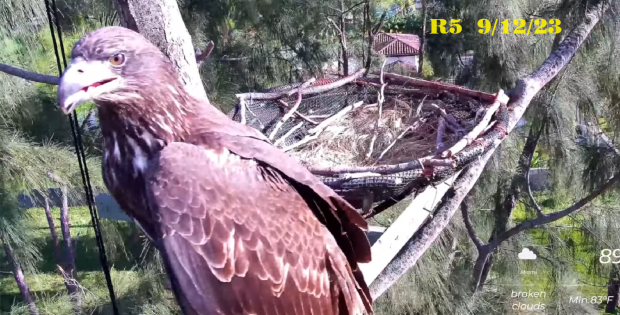
Dade County – “The juvie, R5, was back at the nest again on 9/15, and this time he was looking for food scraps.  Ah, he is so mature looking!  R5 has been at the nest 5 out of the last 6 days.  There is still some time before nesting season begins for Ron and Rose, but as much as we love R5, some of us are hoping that he will be bitten by the wanderlust bug soon, lol.  R5 is six months old on 9/16.  Happy Birthday, R5 !!”

Flaco, the Eurasian Owl that escaped the Central Park Zoo is doing well despite initial worries some months ago! You can check out more of Flake’s adventures by going to Bruce Yolton’s website urban hawks.com

‘A’ reports: “At Collins Street, F22 had a large crop today when she left the nest at 10:36, and little M22 arrived by 10:41 to take over the incubating until the shadow covered the scrape. He was panting a lot, and both parents this morning were using the technique of standing over the eggs with wings outstretched to shade them, rather than settling down on the clutch. Little dad looks so cute when he does it! He works so hard at enfluffling the eggs. It’s hard work for him to cover them all. He’s going to have major problems when it’s four eyases aged, say, a week to 10 days, without thermal down and exposed to the rain and the direct sunlight.—Yes, I’m going to say it again. WHY OH WHY could they not have strategically placed two small squares of wood to shelter from above and to extend the shelter of the building on the far side!??? What will happen on the first wet day?”

‘A’ continues: “I am genuinely concerned that there is the real possibility of a tragedy at Collins Street this season. Last year was the third consecutive La Nina year. That is not a normal Australian summer. We are about to get back to our usual summers, which include days reaching as high as 43C and I shudder to imagine what that scrape will look like by the time the chicks are, say, 10 days old. There is going to be a period of up to a month when the chicks are very vulnerable to that heat and are unable to escape it along that gutter. Not only that, but dehydration is going to be a potential problem even if they are getting enough food.”

SE31 and 32 were very hot on Friday, too. They were panting to help cool their bodies.

‘A’ reports about breakfast: “Breakfast was something that had been feathered (it looked young, but its feathers may just have been wet – it lacked a head so identifying it was not easy), which Lady brought in at 06:40:35. SE31 was in the right place at the right time, so was already in perfect position for food when it arrived, and shortly after 06:41 tried to help herself to the prey. Lady waited a while for some reason, and SE32 joined SE31 waiting for food. Because he came up on his big sister’s inside, SE32 was in primary position when mum did begin feeding, so was fed first rather than his sister. But Lady is relatively even-handed and is feeding both. The blood appears to be nearly gone from her head. so it must have come from her talons,. perhaps while scratching herself, and there is no apparent sign of what yesterday looked like a wound on her left foot. This is really lovely juicy nutritious red meat, and a decent-sized piece of prey as well. Both eaglets are eagerly grabbing bites, some of them very large. Their manners are impeccable. Neither is being at all aggressive and each is happy to watch the other eat. When they lose a competition for a bite, they just wait for the next one. It is lovely to watch. Lady is doing her best to feed both, and it seems they will end up having roughly equal amounts of this meal.”

‘J’ brings news that there is a new camera at the Centrepoint Bald Eagle Nest.

Gabby and V3 have been very alert at the NEFlorida Bald Eagle nest on Friday.

The cameras will return to SWFlorida on the 30th of September.

At the Royal Albatross colony, ‘A’ reports: “Manaaki is hovering so high, he is out of camera shot. Twice, I have thought he has fledged, but he has landed far down the hill and walked back up. He may well go today, but he shouldn’t. He is still not in control of his flying and he still has too much fluff. Another three days is my guess, as he is still not tucking his feet and legs up confidently and is unable to surf the thermals with any real control. Still, he is getting great height on his hovers and staying airborne for increasing lengths of time. He is very serious about his practising, and cast another bolus at 01:40 this morning. So he is preparing to leave and it could be at any moment now. Literally.”

‘A’ returns later with what is ‘sad’ news: “Manaaki has not returned to his nest. UQ is waiting for him, in his new spot near Manaaki’s nest. The general consensus on the chat is that Manaaki has fledged, although we need to wait until the rangers do their walkaround and head count tomorrow to know whether he is elsewhere on the headland. Unless of course he returns to his nest during the night. It is agreed that he was last seen on camera at 16:39:45 and has not been seen since. Other sightings thought to be of Manaaki were in fact of UQ chick (whose hovering skills are way better than Manaaki’s). I am still sceptical because he really did not seem to be sufficiently balanced in the air and still looked very uncertain. Not to mention the fluff he still had. If he has fledged and landed on the water in the bay, he will be spotted and if necessary rescued.  If he has fledged successfully, he has done so at 238 days of age. We wish him godspeed and all the luck in the world out there. We pray we (and he) will live long enough to see him return to his birthplace (some return as early as age three, others not until they are five or even older). One or probably both of his parents will visit the nest over the next few days to make sure their baby has fledged and is not hanging around nearby, needing to be fed. It is so bittersweet watching them wait. If their chick does not return to the nest to be fed, then all their devotion and hard work has paid off. They have done their job for the season, successfully raising a chick to fledge. But somehow, there is a pang as they wait. Sometimes, they come back more than once, just to be sure.  

So now, a year after we watched QT fledge, we are waiting for her parents to return for the new season. Mum YRK and dad OGK. Of course, our hope that OKG will return is very slim indeed, but it does remain a possibility. They ring the bells at the colony when the first returnees arrive home, and then the bells ring out all over the area. They love the toroa.” 

There is good news. While I do not know the number of butterflies in Canada this year, we have noticed a considerable number in the garden and the local parks. Others have mentioned this as well. In the UK, the record of butterflies has grown this summer – excellent news. This does not mean that there has been an increase in the number of insects – so vital to the lives of our songbirds.

Indeed, a group of residents at one of the condominiums in Winnipeg has noticed that the songbirds have disappeared from their property after the management had the grass treated by a firm claiming to be ‘Eco’. If it kills weeds, it will kill insects that the birds eat and often kills the birds. If you know of any well-researched articles on the issue of lawn treatments and songbirds, please send them to me. I hope to help some of my former students prepare a united front and argue against this practice in the future.

Do you know the Island of Mull on the west coast of Scotland? It is notorious for its wildlife, and the White-tail Eagles are no exception. There are also dolphins and whales to be seen.

While the Ospreys are away, want to watch a different table feeder in Scotland? Check out the one at RSPB Loch Garten. Here is the link. You might see some of those adorable red squirrels.

Thank you so much for being with us today. Please take care. We look forward to seeing you on the 25th of September when we return from a brief break.

Thank you to the following for their notes, posts, videos, articles, and streaming cams that helped me to compose my blog this morning: ‘A, H, J’, Geemeff’, Wildlife Haven, NOAA Hurricane Centre, SK Hideaways and Cal Falcons, PLO, Jeff Kear and UK Osprey Info, Holly Parsons and Albatross Lovers, Wildlife Conserve F of NJ, WRDC, Bruce Yolton, 367 Collins Street by Mirvac, Sydney sea Eagle Cam, NEFL-AEF, The Guardian, and Hakai Magazine.

Migration…Wednesday in Bird World

13 September 2023

Good Morning,

Tuesday was a very ‘difficult’ and, at the same time, rewarding and joyous day. Two beautiful Calico cats are off the streets and out of the cycle of producing feral kittens. Needless to say I did not sleep well Monday night. It is the ‘alarm clock syndrome’. Difficulty sleeping for fear of sleeping through the alarm.

Calico’s surgery went well. The vet phoned to say that Calico was ‘very strong’ and a gentle, sweet ‘kitten’. The staff spent much time with her when she was recovering – her story and that of Hope finding us -touched each and every one of them. It still makes me weep at all the things that had to ‘work’ for this to happen. I am indebted to those individuals that reached out to help me find ways to track Calico, who helped by providing the kitten trap for Hope, and to each and everyone whose experience with community cats helped us to have a successful ending to their story.

The biggest issue at the vet’s was the advice to keep Calico and Hope separated overnight. Of course, if Calico insisted, the stress being separated from Hope would be worse than Hope trying to suckle. The distance between the little office door and the one for the conservatory is approximately 65 feet. Calico made it very clear that she was not staying in that room. Lewis and Missey were contained in another room with the door to the conservatory open. Calico bolted the instance the office door opened. Hope came running! For a few seconds, there was a lovely little conversation between Mamma and baby. Thankfully, the only kitten that Calico will ever have is healthy and safe and with her Mamma tonight.

Calico is still in a bit of a haze, but Hope is so happy! Mamma is home. Just look at that round little belly on Hope. Poor Calico. She is just so wee…she weighs 2.3 kg or 5.03 lbs. Hope may weigh that much. Calico will start to put on weight and become healthy.

It is a secret. Hope spent the entire day playing with Missey!!!!!!!!!! They are super friends but don’t tell Mamma.

What fun it was to sit and watch these two with the new scratch post. They took turns with Hope watching every move that Missey made carefully and then imitating it.

Hope really loves this new scratch post with the feathered ball.

Before lights out, Hope got in some playtime while Calico rested. She forgot about where she was and wound up on my lap with the feather teaser. It was too funny – the startled look on her face when she realised that I had reached over and started petting her. Things are coming together. She is no longer 100% afraid of me scurrying off to hide in a corner. Humans mean food, cuddles, treats, and playtime!!!!!!!

What is happening in Bird World? One word: migration. Cornell Bird Lab and BirdCast are predicting that 348 million birds will be on the move as I am writing this Tuesday evening 12 September.

What needs to be done to protect migrating birds?

The National Wildlife Federation gives these ten tips for helping migrating birds – these are things we can initiate that can give instant success.

1.  Keep your cat indoors—this is best for your cat as well as the birds, as indoor cats live an average of three to seven times longer. Even well fed cats kill birds, and bells on cats don’t effectively warn birds of cat strikes.  For more information, go to http://www.abcbirds.org/cats.

2.  Prevent birds from hitting your windows by using a variety of treatments to the glass on your home—check out ABC’s tips at http://www.abcbirds.org/abcprograms/policy/collisions/glass.html

3.  Eliminate pesticides from your yard—even those pesticides that are not directly toxic to birds can pollute waterways and reduce insects that birds rely on for food.

4.  Create backyard habitat—if you have a larger yard, create a diverse landscape by planting native grasses, flowers, and shrubs that attract native birds. You will be rewarded by their beauty and song, and will have fewer insect pests as a result.

5.  Donate old birdwatching equipment such as binoculars or spotting scopes to local birdwatching groups—they can get them to schools or biologists in other countries who may not have the resources they need.

6.  Reduce your carbon footprint—use a hand-pushed or electric lawnmower, carpool, use low energy bulbs and Energy Star appliances. Contact your energy supplier and ask them about purchasing your energy from renewable sources.

7.  Buy organic food and drink shade-grown coffee—increasing the market for produce grown without the use of pesticides, which can be toxic to birds and other animals, will reduce the use of these hazardous chemicals in the U.S. and overseas. Shade coffee plantations maintain large trees that provide essential habitat for wintering songbirds.

8.  Keep feeders and bird baths clean to avoid disease and prevent mosquitoes from breeding.

9.  Support bird friendly legislation both locally and in the U.S. Congress.

10.  Join a bird conservation group—learn more about birds and support important conservation work.

According to ABC, birds need our help now more than ever.  In addition to the ongoing threat of loss of habitat that is becoming magnified by global warming, millions of birds are directly killed due to a number of different human-related causes.

Scientists estimate that 300 million to 1 billion birds die each year from collisions with buildings. Up to 50 million die from encounters with communication towers.  At least 11 million die from car strikes.  Another 1 million may die each day from attacks by cats left outdoors.

Some of these deaths occur year-round but many occur during the peak spring and fall migrations. Some studies suggest that perhaps as many as half of all migrating birds do not make it back to spring and summer grounds, succumbing to various threats on either end of the journey.

14 April 2010, NWF newsletter

There is great news coming out of Cal Falcons. Zephyr (2022) has been sighted more than once! Thanks, ‘B’ for the head’s up!

‘H’ brings us her report on Kent Island and Barnegat Light:


Kent Island –  “Audrey was seen a few times throughout the day.  In the morning, she was seen in ‘Joe’s tree’, and she was obviously scoping out the water below for fish.  Both Audrey and Tom have previously been seen diving from that tree.  The video went to ‘highlights’, and when the livestream returned, Audrey was seen on a dock eating her catch.  Later, Audrey was seen in the same tree in the afternoon.  There are times when the camera is focused on the nest, and an osprey can be heard nearby, but the cam does not pan in that direction.  Many bird nest cams online do not have PTZ capabilities or a dedicated camera operator.  No matter what nest we are watching online, we are always grateful for what we are able to observe.  We only know what we can see, and we learn what we can.”

Barnegat Light – “There were significant livestreaming issues once again on 9/12, especially during the afternoon and evening.  In the morning, Duke was seen in his tree at the north tree line for a while.  There were a few hours in the morning without livestream glitches, and during that time we did not see or hear Dorsett.  Because of that, it is thought that Dorsett may have left the area.  We will continue to follow today, and hopefully the livestream will behave.  Dorsett is the only chick to have survived the storm in late June.  I am sharing a photo from 6/8/23.”

Gabby and V3 were at the nest early on Tuesday. Later Gabby had to deal with the female intruder that has been showing up – she ushered her out of the territory (or so it seems). Wouldn’t it be nice if this nest could just be quiet and boring this year?

These two were chortling back and forth. A chortle is a form of communication between Bald Eagles. It is a series of short rapid chirps which might mean several things. You have to look at the context. In the image below it is a greeting between Gabby and V3. It could, at other times, signal that eagles are going to engage in a dispute.

At the nest of Anna and Louis in the Kistachie National Forest, Louis has brought Anna the first fish gift on camera of the season. This is the couple’s fourth year together. The nest that they use was vacated in 2013. They did not have any chicks for the 2019-20 season. In 2020-21, they fledged Kisatchie in 2021-22, a female, Kincaid. What a great moment it was when Kisatchie hatched – the first eaglet in the forest for 8 years.

M15 and his new mate are working hard on the Fort Myers nest on the Pritchett Property that M15 shared with Harriet for 8 years.

Checking on Australia:

367 Collins Street: It is hard to get those four big falcon eggs tucked. Gosh, this ledge in the CBD of Melbourne is going to be busy in about a month. The nice thing about incubation is it gives Mum time to rest up before caring for the four – and Dad will be able, nearing the time of hatch, to stock up the pantry.

Sydney Sea Eagles: Breakfast was served early – followed by some nice wingersizing. The eaglets are getting stronger and stronger, standing for longer, and walking with much more confidence.

‘A’ was watching adding, “The sea eaglets had a good early breakfast (around 06:07 I think). It was feathered, minus its head, and a really good size. It looked afterwards as though SE31 had the larger crop but both ate enough breakfast. It was a large piece of prey. SE32 was like a toddler teething this morning. He nibbled at mum’s face and beak when she was aerating the nest in front of where he was lying. He nibbled at her wings. He nibbled at her breast. He nibbled at her underfluffies. Then, he turned around and began nibbling SE31. I have no idea what he was doing, but it was too cute. No-one else objected – it was exploratory and perhaps some level of allopreening was involved, but certainly it was not aggressive. The parents continue to be obsessed by the need to bring in more big sticks (kiddie rails, not just sticks) and lots and lots of greenery, as well as dry leaf material to lay on top of the greenery. They are very diligent in their nest work……Oh those eaglets are GORGEOUS. They are starting to get that beautiful russett colouring on their breasts, shoulders and wings. Lunch came in at 14:21, and both eaglets were interested in the food, which looked like another of the large eels (Dad brought it in and Lady quickly came to manage it). SE32 was first at the table, and got the early part of the feeding, but there was plenty of meat on that eel and both eaglets ate well. They were, as is always the case these days, perfectly behaved at the table, patiently waiting when the other was eating, with no beaking or intimidation or acts of submission or fear. It was a lovely thing. These two are doing so well and they are rapidly beginning to look like juvenile sea eagles. Their colouring is just exquisite. The perfection of their camouflage is amazing. They are truly beautiful at this age are they not?” 

Port Lincoln: Dad2 brought in at least three fish before 1400. He took turns incubating so that Mum could eat. Ask me how much I am liking this new male.

‘A’ adds: “At Port Lincoln, dad brought three or four fish today and mum had some or all of two of them. She is doing the vast majority of the incubation time. Interestingly, the eggs were left unattended for just 1% of the 24 hours on Tuesday (and incubated for 99%) but on Wednesday were left alone for 19% of the time (incubated 89%). This may relate to the weather, but I found it interesting. “

Orange Peregrine Falcons: Xavier brought in a nice chunk of prepared prey for Diamond at 06:27. At the time I am writing (14:14 Australia time) no other prey items had been delivered that I could confirm.

What a little sweetie Xavier is…I love this gleeful way he rushes over to incubate those eggs in the morning.

Like so many, ‘A’ has been missing Manaaki, the Royal Cam chick since he began to get his juvenile feathers. Now..he is ready to fly she adds, “Here is the evidence that we are about to lose Manaaki to his destiny: https://www.youtube.com/watch?v=ghTGyX8-ADg. I know it is what he is born for and I know it represents a fabulously successful season for everyone at Royal Cam and for parents L and GLY. But oh how I am going to miss this gorgeous creature, with his adventurous mischievous personality and his obsession with gardening and excavating and exploring. 

Now he has cast his bolus (or boluses), he is pretty much ready to leave. There is little fluff left now, and the next windy spell should see him on his way. Treasure these last hours. We may never see him again. I am so sad, but happy too.”

One of those lovely happy endings – a successful rescue of an Osprey caught in fishing line posted on The Joy of Ospreys by D Lambertson.

Thank you so much for being with us today. Please take care. We hope to see you again soon!

Thank you to the following for their notes, posts, videos, and streaming cams that helped me to compose my blog this morning: ‘A, B, H’, BirdCast, NYTimes, Cal Falcons, Kent Island, Wildlife Conserve F of NJ, NEFL-AEF, Tonya Irwin and KNF E-1, Real Saunders Photography, 367 Collins Street by Mirvac Sydney Sea Eagles, PLO, Charles Sturt Falcon Cam, NZ DOC, and D Lambertson and the Joy of Ospreys.

Three for Melbourne…Saturday in Bird World

9 September 2023

Good Morning All,

Friday was a busy day for me and most of the time I was away from home. However, the moments that I did get to spend with my four four-legged furry friends was brilliant. Hope is now peeking around the corner at me and even came near to my foot when I placed a dish of organic roast chicken down for her! This kitten has so much energy. I cannot wait to get it with Lewis. He is going to enjoy having a playmate.

We are about a metre apart. Hope is curious and getting less afraid by the story!

If Mamma Calico moves her tail, Hope is right on it!

Everyone watches one another. The four of them enjoyed a nice roast chicken dinner – a treat to encourage Missey and Lewis to link ‘treats’ and goodies with their two new siblings.

Each of us hopes that you are well and looking forward to a nice weekend wherever you are. Let’s all try and get outside if the weather is nice! And speaking of outside…every time I go to the park there is litter. There are bins everywhere for litter so why don’t we use them? This post on FB seemed really appropriate.

‘H’ sent me the good news. PLO has its second egg of the season! Oh, I hope this young Dad is an excellent fisher and brings those fish into the nest one after another. Can I ‘hope’ that this couple might fledge all of them just like 2021 with Bazza, Falkey, and Ervie?

There is other good news coming out of Port Lincoln!

‘A’ is musing about the Royal Albatross chicks: “the rangers have confirmed that Miss NTF fledged on 7 September. She had been off exploring (or perhaps finding an ideal place from which to fledge), as the chicks often do for a few days before fledge, but they have confirmed her gone. She was last seen on the morning of 7 September so we think she fledged some time after 11am on Thursday. Godspeed sweet girl. Quarry, who has been out and about for the past couple of days, returned to her nest this morning and seemed to miss Miss NTF. The two girls had been hanging out a lot. UQ on the other hand is less pleased to see Quarry, who needs a restraining order whenever she is in his vicinity. Manaaki is less tolerant of her and clacks his bill at her if she gets too close. Poor little UQ is much more timid. The winds are not super strong today, though Quarry and Manaaki have been doing a lot of wingercising in the wind there is. It could be any time now for either of them. It looks as if Quarry will be next to go, then Manaaki and finally UQ. But we will see. I again emphasise that these are precious hours we are spending with Manaaki now. And once he launches, there is no guarantee we will ever see him again. Will we live that long? Will Manaaki? Will the climate permit a return? They fly into an uncertain future, but don’t we all?” Those worries of the state of the ocean, of long line fishing, of climate haunt all of us as well look at these long-lived seabirds.

Manaaki looking out to an uncertain future.

Lady Hawk caught Gabby and her new mate V3 in the pouring rain and has some super close ups for us.

I was contacted by several individuals today about Mini and was told that there was much anxiety about her condition. My day allowed me no time to go and observe Mini until she was at the nest after dark. At the bottom of everyone’s desires is for Mini to thrive – we care, we worry. We want her to be whole and live a long, prosperous life. The fact that Mini somehow injured her leg causes great anxiety to everyone. We will never know what caused that injury. No one saw what happened. Unless she goes into care, we may not even know what that injury is. There are many, many theories, but that is all they are – theories. Until a vet/a vet technician/or a rehabber has a bird in hand, a diagnosis cannot be made, and sometimes sophisticated tests and scans are needed to determine the problem and the possible treatment. The DEC does not normally give permits for a bird that is flying. There is a reason for this — it is extremely dangerous for the bird. No one wants to endanger Mini’s life further. Her injury is now old. She has been adapting. Life is not perfect but she is living it.

Life in the wild is extremely challenging for all raptors – for all wildlife. Each day is about survival. Some days there is a lot of fish and other days there are none. Whether or not Dad is delivering or Mini is fishing is not known. It could be both. On Thursday Mini had several nice poop shots. I am not clear about what happened on Friday and, of course, she is often not on the nest.

I urge everyone to enjoy the time we have left with Mini at the nest. To treasure her, to wait for her to come in at night to rest her leg – she is very smart to do that. In a couple of year’s time, I would very much like to see a two-year-old osprey land on this nest with a wonky leg. That would be marvellous so…with that in mind, I really hope that Mini is a male and not a female. Send her positive wishes. Treasure all that she taught us, for she did teach us much about endurance and determination.

Mini did seem to put her weight on both legs when she landed on the nest from the perch at 20:26.

Mom has been spotted landing on the nest so she has been here at least until today. That is good news because under normal conditions the males will not leave until the females do. With the climate changing we do not expect these fledgling ospreys to travel all the way to South America and they might well spend the winter in the Carolinas or Florida.

At the Minnesota National Arboretum nest, Dad brought in 7 fish – yes, you read that correctly – 7 fish on Friday!!!!!!! That is one well fed fledgling. One of those beauties was lost overboard. Hopefully some other hungry creature will discover that tasty meal.

‘H’ reports on Molly and Dorsett:

Kent Island –  Molly was last seen (so far) on 9/5.  Her dad, Tom, was seen almost every day up to 9/7, but we did not see him on 9/8.  That does not mean that Molly or Tom have formally begun their migration, they may simply not be on camera.  We shall see.  Audrey was seen in “Joe’s” tree, and for the second consecutive night, Audrey spent the night at her nest on 9/9.  It is surprising to see Audrey this late in the season, but we are thrilled to see her.

Barnegat Light – Dorsett and her dad, Duke, seemed to have a good day.  The camera operator managed to catch Duke taking a bath, and the highlight of Dorsett’s day was a live bunker that her dad delivered to her for supper.  Dorsett decided to eat the whole fish atop the 24th street pole.  Yum!

‘A’ reports on the breakfast for the Sea Eaglets: “a nice large fish was brought in at WBSE early this morning (around 06:40) and both eaglets had a good breakfast. SE31 got the early bites, then SE32 moved up beside his sister and ate without fear or intimidation. The two were perfectly behaved throughout the meal.”

So many love the Collins Street falcons and my inbox was bursting with news of the third egg! Do you think they will go for four?

Xavier just melts my heart. He is the cutest little male falcon and his mate Diamond often gives this poor guy such a rough time. So happy he got some egg time…it must actually feel nice to be able to do duckling style and rest for a bit…just thinking about Mini and how it helps her leg.

‘A’ reports: “Manaaki was fed by one of his parents at about 6pm this evening (9 September) – we don’t know which one because it was not within camera view but our little man gets so excited, wheeing away. I do love that sound. And we will miss it until this time next year. But I cannot wait to see whether YRK (and maybe even OGK) return over the next two or three months. He is the footage of Manaaki’s feeding. https://www.youtube.com/watch?v=tj35d68kQ6g&t=2s“.

News has come to me Friday night from ‘B’. We have wondered about the fishing at Cowlitz PUD. This is a new discovery. “The river where they fish has been full of silt and mud from a landslide up north awhile back which we never heard about…” ‘B’ continues by saying that a drive by a couple of weeks ago revealed sandbars in the river that were never there previously. This is so sad but let us hope the eagles and the ospreys have another source of food. Thanks so much ‘B’.

There is often a lot of confusion about feeding birds. Audubon has a short article to help us.

Speaking of feeding birds. Chiang Mai is north of Bangkok in the beautiful mountains. It is one of my most favourite places in the world. There is an historic walled city full of Buddhist temples. Just outside the walls is a small French area with some of the best coffee and lemon tarts to be found anywhere. Check out a feeding table in this northern Thai city!

Thank you so much for being with me today. Take care. See you soon.

Thank you to the following for their comments, alerts, posts, videos, and streaming cams: ‘A, B, H, L’, PLO, NZ DOC, Lady Hawk and NEFL-AEF, PSEG, MN Landscape Arboretum, Kent Island, Wildlife Conserve F of NJ, Sea Eagle Cam, 367 Collins Street by Mirvac, Karen Leng and Orange Australia Peregrine Falcons, and Audubon.