JBS20 returns to the nest…Whitetail eagle crosses the English Channel…Wednesday in Bird World

17 April 2024

Good Morning!

Oh, it has rained on and off all day. During the break some very beautiful birds came to the feeders.

Purple Finch, Adult Male, Eastern. He is a beauty. Look at that underbelly with that iridescent pink on white. Or that solid pink necklace and darker red head. He is pretty gorgeous. Tory Peterson described the Purple Finch as a “sparrow dipped in raspberry juice”. How fitting.

Male Hairy Woodpecker moulting.

Baby House Sparrow. They have been busy.

The Blue Jays were very busy getting peanuts while the rain stopped.

The Dark-eyed Juncos are everywhere searching for those tiny Millet seeds I toss on the deck for them.

This is a non-breeding European Starling.

The girls were busy. They spend a lot of time watching the garden now that so many birds are there – normally a couple of hundred at a time. There is something always moving! Today, the rain also fascinated them.

Hugo Yugo is fascinated by the outside.

Calico watching the Juncos hop around during the rain.

The rain pouring down.

Missey is the only one that enjoys her collar and tag. She is the sweetest most compliant cat never fussing for a second when her teeth are cleaned or her nails trimmed.

Baby Hope.

Hugo Yugo looking up at Baby Hope getting ready to pounce and knock her of the top of the cat tree.

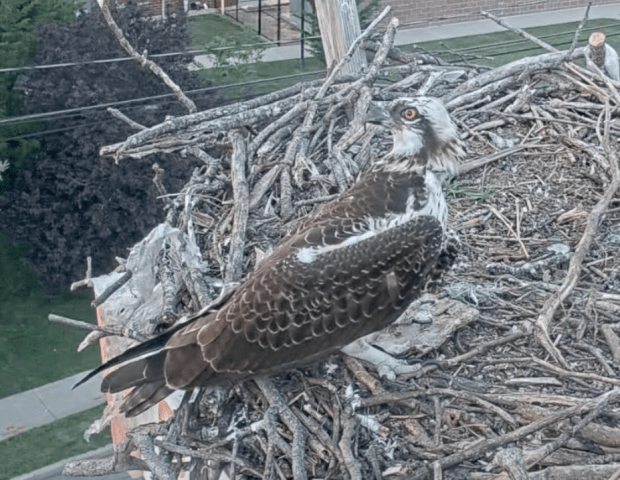
Some really good things happened on Tuesday marked by the expected, but still sad, passing of osplet three at Frenchman’s Creek. Eggs were laid, ospreys returned to their nests, and a fledgling was lured by Dad back at JB Sands Wetlands. The eaglet is safe, strong, and hungry. JBS 20 is now tired, too. Flying is hard work!

Louis and Dorcha have their second egg at Loch Arkaig! Oh, so happy.

The first egg for Laddie LM12 and Blue NCO at 10:49 on the 17th of April at Loch of the Lowes.

There is the first egg at Poole Harbour, too for CJ7 and Blue 022 at 15:40 on the 16th. We are going to be really, really busy right after the middle of May!

I would like to go back to Meadow or a moment. Many of us were confused by the statement of Audubon on the 8th of April that Meadow had no fractures in the X-Rays and then to read that s/he did, indeed, have fracture that caused the eaglet to be euthanised along with his other condition. A very knowledgeable individual who worked in veterinary medicine wrote to me. Meadow was diagnosed with Aspergillosis. “Aspergillosis is a noncontagious, opportunistic fungal infection—is caused by Aspergillus species. It is also known as a mycotic infection, which may cause a fungal pneumonia. Certain species have been reported to be more at risk for Aspergillus infection…Aspergillosis is a difficult disease to treat and cure, and treatment can take months. At the beginning of treatment, hospitalization is often required. Diagnostic testing for aspergillosis includes: blood work, fungal culture, serology, imaging, and endoscopy. Treatment includes: stabilization, stress reduction, fluid therapy with crystalloids, and correction of fluid deficiencies. Typically, birds present with vague and nonspecific signs (depression, inappetence, difficulty breathing, reluctance to fly/perch, drooped wings). Initial physical examination findings typically include weight loss, respiratory abnormalities (dyspnea, tachypnea, cyanosis), lethargy, polyuria/polydipsia, vocalizing, open-beak breathing, tail bobbing, and/or enlarged nares. Some affected birds can have biliverdinuria (biliverdinuria is a condition in birds that causes urine to turn green or yellow). It is associated normally with liver disease which results in poor feather quality.”

I understand that the diagnostics required are a complete blood count, radiographs that might show subtle lesions and later pneumonia or a breakdown of sections of bones, the thickening of the air acts. Serology or antibody tests are required along with DNA testing. Of course, on top of this, Meadow needed to be fed various types of food to get its strength up. We know our eaglet gained weight and then refused to eat, further complicating its progress. I was told that the disease causes great trauma to the patient. Add to that the physical trauma of falling out of the tree and having to survive on the branch for a period of 24 hours plus, without food and in the heat, makes the chances of surviving somewhat tenuous. With everything going on with Meadow, they could have easily missed the fractures and, this individual said, …”I don’t believe s/he would have survived the procedures to determine everything that was wrong (sic); or at the very least it would have been inhumane to put her/him through it all.”  I am very grateful for these insights and thank ‘MP’ for taking the time to write to me so that we can all understand the great difficulties that Meadow was experiencing that ultimately led to euthanasia.

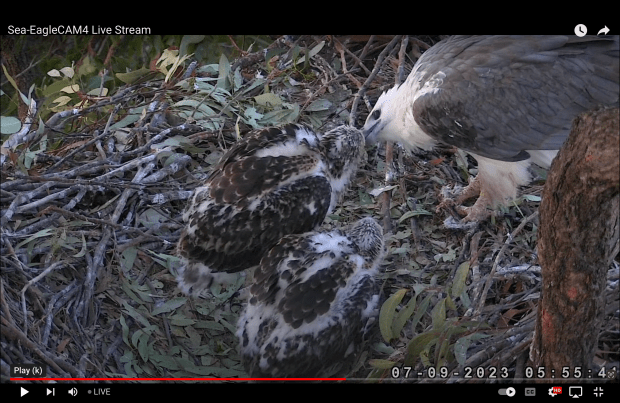
Wow. The second Isle of Wight White-tailed Eagle has crossed the English Channel. What an incredible distance!

‘H’ is so excited. Della laid the first egg of the Osprey season for 2024 at Mispillion Harbour Tuesday morning – and she got to see it when it happened on screen!

As you are aware, yesterday ‘H’ and I quit counting bites that Tuffy received at the meals in the afternoon. It was readily apparent that two events had happened. First, Harry is having great fishing and the fish that come to the nest are, by and large, very, very big. He delivered at least 5 a day, but often 7. The second event is the osplets have now exited the Reptilian Phase and have their feathers. The video that Heidi put together demonstrates precisely what Tuesday was like on the nest – best siblings, good buddies, sharing meals! It is wonderful! Smile and enjoy every minute.

BHA writes that the first egg was laid at the Port of Ridgefield Osprey nest in Washington State on April 16. This nest is new to the streaming cam community.

PB sent a message that the couple at the Omaha Public Power District nest at Fort Calhoun Station in Nebraska also have their first egg on the 16th of April. Gosh, we are going to be busy looking trying to keep up with all the hatches coming in May!

The two lads at the Duke Farms Eagle nest have been named by local school children. H44 is Cookie and H45 is Snickers! Cute.

There is a petition to change the speed limit and put up markers by the SW Florida nest of M15 and F23. This morning I was watching the Glacier Gardens new nest of Liberty and Freedom. You should see the fast traffic by that nest. In North America, many raptor nests are located near urban areas with high traffic. The first that comes to mind is Big Red and Arthur’s nest at Cornell. Thanks to a small group of dedicated locals, markers go up and the area is monitored when the hawklets fledge. I would like to see the traffic stopped at Cornell for those two months til the fledglings disperse from that area. All areas near raptor nests should be required to slow or stop, if at all possible, during fledging time including Glacier Gardens. Do you live near an active raptor nest near a busy highway or road? See what your Council says about traffic calming during this time! Smile and be persuasive.

Thank you to so many for caring and for all the messages about the situation at Frenchman’s Creek. . The third osplet passed after having a couple of seizures on Tuesday 16 April 2024. The nest was full of fish and the oldest sibling continued to beak it. We might never know what caused this turn of events. We will hope that Mum is able to continue feeding the new older siblings to fledge, but there could be something wrong with her. The older are trying to self-feed. The nest remains full of fish, and well, we wait to see how this nest sorts itself out. It is always difficult to lose a chick but one with its juvenile feathers is even more disturbing.

There is a new female Blue 500 at Border Ospreys to replace Samson’s Juno who did not return.

Blue 5F Seren has laid the second egg of the season on the nest she shares with Dylan at Llyn Clywedog. The time was 1318.

There are two beautiful White-tailed eaglets in a gorgeous tree in Poland!

We are on pip watch at the Captiva Osprey nest of Jack and Edie. Three out of four eggs remain.

There is no activity on the nest of Angel and Tom in Tennessee. ‘A’ brings us up to date as she impatiently waits for eggs: “I am SO impatient for Angel and Tom, but now that they have returned to their nest and are bringing bark to line the nest bowl daily, suddenly Tom disappears. It has been more than three days since he was last sighted at the nest, and the farmer says he has not spotted him anywhere around the property either (as I mentioned in my comment on your blog, he has not spotted a second nest either, or seen activity from Angel and Tom to suggest that there is one, which is one positive).I am seriously concerned at his non-appearance, as he had been a regular shadow for Angel, but I do try to reassure myself with two things.First, it is now up to Angel to lay. The nest is prepared – there is nothing further it needs or can fit really. And second, Tom’s plumage is the most perfect camouflage. These RTHs, as hawklets, as juveniles and as adults, are almost impossible to see amidst the dappled beams of sunlight and the various branches and leaves. So it would be quite possible for Tom to be perched quite near you and not see him at all. Okay, they’re not quite owl-like in that respect but they are good. Very good. Except of course for darling Angel, whose colouring probably makes her the preferred target she obviously is for those damned blue jays. In any event, there will be no eggs without Tom. So obviously, we are exceptionally worried and very much hoping these two have their own quiet private place where they have been canoodling and mating and generally doing their thing out of the way of prying human eyes. Talons crossed. “

Electra and her mate have returned to Cowlitz PUD in Washington State on Tuesday.

Ospreys are reported on the Exshaw platform near Canmore, Alberta. The streaming cam is not turned on as yet. ‘H’ reports that Soo and Olsen are at Osoyoos! The ospreys are coming north!

For those new to either Exshaw or Osoyoos, I would watch these with caution. There was a nest take over at Exshaw in 2023, the male was presumed killed, the intruders attacked the osplets. One osplet died on the nest and the other survived but no one knows how after she was repeatedly attacked and taken off the nest by the aggressive adult intruders. The Osoyoos nest suffers from the frequent heat domes that hit that area of British Columbia causing few fish to come to the nest and they are small. Chicks have been lost. One fledged last year.

*Caution*. Little Miami Conservancy. The little one LM7 did get some food but has been bonked by the older siblings that have kept it from eating at some meals.

Look where Swampy is! Having branched yesterday s/he is exploring higher.

The two eaglets at Redding are covered with thermal down. Aren’t they adorable?

They are fine at Kansas City also! Wichita and Cheyenne are growing nicely.

The two surviving eaglets at Fort St Vrain appear to be alright. One is an expert at getting out of the egg bowl!

Juvenile fledgling R6 of the WRDC nest visited home on Tuesday.

Decorah is getting rain! That thermal down is working like a great raincoat for the two eaglets of Mr and Mrs North.

We are anxiously awaiting for a pip at the Cornell Red-tail Hawk nest of Big Red and Arthur later this week.

*Caution*. The third osplet at VGCCO had a nice private feeding for about half an hour on Tuesday. Whew! It was intimidated by the older sibling most of the day.

Mamma Cruz takes good care of her two eaglets while Andor keeps that pantry filled.

Chandler was on and off the Port Tobacco nest multiple times on Tuesday. Some had been concerned that he was missing.

Dad and Gigi taking care of the two eaglets at the ND-LEEF nest in South Bend. They are getting their thermal down.

At the White-tail Eagle nest of Milda in Latvia, her new mate Hugo has been missing for a number of days. She is incubating two eggs and had not eaten for four days. On Tuesday she left the eggs a couple of times – and I hope she had some food. It will be impossible for her to raise these two eaglets on her own, sadly. She tried before. My heart goes out to her.

We know that there are areas that need more platforms for Ospreys, but as Port Lincoln points out, there is also a need for perches for our fish hawks.

Remember. If you know of an Osprey nest that I have not mentioned, please let me know the details. Happy to spread the word!

One of my favourite books next to Soaring with Fidel by David Gessner is being republished by Cornell!

Thank you so much for being with me today. Take care. See you soon!

Thank you to the following for their notes, posts, videos, streaming cams, and articles that helped me to write my post today: ‘A, AE, BHA, Geemeff, H, J, KR, MM, MP, PB, SB, TK’, JB Sands Wetlands, Geemeff, The Scottish Wildlife Trust (LOTL), Trudi Kron, Roy Dennis Foundation, Poole Harbour Ospreys, Heidi Mc, Moorings Park Ospreys, Port of Ridgefield Osprey Canm, OPPD, Duke Farms, Glacier Gardens, The Guardian, Frenchman’s Creek Osprey Cam, Border Ospreys, Sassa Bird, Window to Wildlife, Cowlitz PUD, Osoyoos Osprey Cam, Little Miami Conservancy, Eagle Country, FORE, FARMER DEREK, Fort St Vrain, WRDC, Raptor Resource Project, Cornell RTH, VGCCO, IWS/Explore, Port Tobacco, ND-LEEF, the LDF, Port Lincoln Ospreys, and David Gessner (Ospreys P).

Tuesday in Bird World

9 January 2024

Good Morning Everyone,

It is -21C on the Canadian Prairies. The cold weather has arrived. It was a good day to wake up to hot coffee and warm cardamon rolls out of the oven. LOL. The girls didn’t care! They wanted breakfast and story time before I started my day. Calico now ‘walks’ me out to the conservatory sofa to read. It is too funny. The cats have me fully trained. 

As you know, if you have read my blog over the summer of 2023, a large family of Crows lives in my neighbourhood. They bring their fledglings to the garden to get peanuts and for the bird bath, where they dunk their food and have baths. The numbers have decreased since the end of autumn, and I am worried about them. Today, I was happy, but simultaneously sad, to see a single crow at the corner waiting for another person who feeds birds. I know she specifically feeds the crows, but where are the others?

I have also been reading more about Crows, and if you are interested in the intelligence level of the members of the Corvid family include Crows, Ravens, Magpies, and Jays, I have a book for you! It is called Bird Brains, and it is by Candace Savage. This is the latest edition from 2018. 

I was impressed by the writing that drew me in and made the new findings on this amazing species’ intelligence level relatable. The photographs are top-notch. (Sorry about the glare from the light)

The introduction included mention of anthropomorphism. Put simply it is ascribing human traits to animals. if, however, you study the behaviour of animals, the apologies of individuals such as many on chat for doing just that will more than irk you. 

Savage discusses the ‘ascription of meaningful intelligence to nonhuman creatures’ as problematic. She notes that at a point, scientists and researchers into behaviourist psychology who looked into memory, insights and thoughts stopped looking at nonhumans. Some had been tricked, and she noted that no one wanted to be embarrassed. It paused the subject of knowledge and intelligence…She notes that anyone who dared to state that nonhumans were intelligent was accused of the dreaded anthropomorphism. Savage’s entire book bunks the notion of ‘dumb animals’, stating that humans ‘have a lot invested in keeping animals dumb’ (19). Think about it – humans can treat animals any way they want if they believe they do not feel pain, have feelings, share emotions, solve problems, etc. Savage points to the research of many, including Irene Pepperberg from the University of Arizona, who concludes that Corvids are superbly intelligent, capable of identifying items by name, able to distinguish similarities and differences in objects, as well as ‘capable of acquiring complex vocal and nonvocal behaviours that many scientists believe are co-or prerequisites for referential communications’. Pepperberg, in her research, discovered that Corvids have the same cognitive capacities as primates. Indeed, their superior powers might be higher than primates (18).

If you are interested in avian behaviour and love the Corvid family or want to learn more about the intelligence of our feathered friends, this is an excellent book. It is well-written, wonderfully illustrated, and at a good price point. 

One of my favourite Corvids, the baby Blue Jay from the summer, came to visit the feeder on Monday. Delighted to see it!

The girls are doing great. The plumbers were here again today – they will be finishing up tomorrow – and I could not ask for better behaviour. They all stayed out of the way of any danger!

Missey has a new sleeping spot. It is on top of one of the tallest cabinets – almost touching the ceiling – next to a carved cat on a skateboard that my late friend, Charlie Scott, made. Missey is very smart. What a safe place and out of the way of Calico. They do not always get along. I would say they tolerate one another.

Hugo Yugo and Calico slept on the cat tree together, ignoring the workers who dumped the vanity behind them piled with anything and everything.

I was so delighted when ‘AM’ sent me some beautiful images they had taken of Blake Kites near their home in Japan.

Nature Japan gives us some information on one of the country’s most beautiful raptors: ”The Black Kite or “Tobi” トビ as it is known in Japanese is a common sight in the skies throughout Japan. This raptor is thought to be the world’s most abundant bird of prey. Its numbers are healthy and is under no threat.

This bird can be mainly found in Eurasia, Australasia, Oceania and is a year-round resident here in Japan. You can see this powerful looking bird often soaring in the thermals high above coastal areas, rivers and lakes. I’ve also seen them in farming areas throughout the Kansai region of Japan. They are very graceful flyers that soar with ease and turn with precision.

Male and female Black Kites look very similar and are very opportunistic hunters. They prey upon fish, rodents, and other birds. They are also known to scavenge which is one of the reasons they are so successful a species. I have watched them dive towards the ocean plucking fish from the water and I have also seen them dive-bomb people at highway rest stops trying to steal their rice balls and bento box lunches.” Their only predator is the Eurasian Eagle-owl. “This powerful owl can easily pick off even adult Black Kites and can sometimes be found in northern parts of Hokkaido (common throughout Europe and other parts of Asia).”

Wilde Nature gives us the size variations for these birds of prey: “The Black-eared Kite is a medium-sized bird of prey, measuring about 45–55 centimetres in length with a wingspan of up to 150 centimetres. The distinguishing feature of this subspecies is the black patch of feathers on the sides of the head, located behind the eyes, which gives it its name. Its eyes are dark brown; its bill is short and hooked. The outer wing feathers are black, with dark crossbars and a mottled base. The underparts are pale brown and become lighter towards the chin. The body feathers have a dark shaft, giving it a striped appearance. The corner of the mouth is yellow, but the bill is black. Male and female birds look the same, but females are slightly longer with a larger wingspan.”

Black-eared Kites are opportunistic hunters and feed on various prey such as small mammals, birds, insects, and reptiles. They are often seen soaring high in the air on thermal updrafts, effortlessly gliding while searching for potential prey on the ground.

Thank you ‘AM’ for allowing us to share these beautiful images of the kites.

Look at this beautiful White-tailed Eagle that visited one of Finland’s Osprey (Selli Island) nests on Monday. Gorgeous.

Connie with C10 and C11 today. Note more dandelions are missing! There are pin feathers coming in along the wing tips.

‘A’ comments on these little eaglets: ”Speaking of having enormous appetites, so does CE10, who is absolutely massive in comparison to baby brother CE11. I am still not entirely sure that CE10 has the temperament of a female, but certainly she has the physical characteristics of one. Little CE11 seems to eat his fill most of the time, but she can eat SO much more. Today, both of them had very big crops mid-afternoon (of course CE10’s was larger), and then Connie came in and CE10 was fed the majority of a good-sized speckled trout! CE11 lifted his head from his afternoon nap and initially decided not to bother, but about 20 minutes later, he eventually got up and made his way to the table, by which stage you might have expected CE10 to have long since fallen into a food coma, but no, she was continuing to eat, so that CE11 still had to wait some time to get perhaps a dozen mouthfuls out of the entire fish. CE11 is definitely getting enough to eat, but CE10 is bottomless. She is making no specific effort to prevent CE11 from eating, and has not really done so at any point in their development. She eats and eats and eats, while CE11 is a confident eater but not a pushy eaglet at the table. Occasionally, when big sibling is asleep, CE11 gets a quiet private feeding, usually from Connie, but the size differential continues to grow between the two eaglets. Fortunately, there has been no real food shortage (except one day where there was an inkling of ‘hungry’ experienced on the nest). The bonking has been minimal throughout (and instigated often by CE11, who has been prepared to look his older sibling in the eye from an early age, despite the inevitable results). “

‘J’ has a reminder: Today is also Connick’s first birthday. Connie and Clive’s 2023 hatch will be the Ambassador at the Smithsonian. Maybe you will be able to travel to see him!

Changing before our eyes. Thanks for the close-ups, cam op.

Faxinating caught the whole fish drop to F23 for her and E23 today – we all cheer when the Dad doesn’t eat the head, but we also cringe when the fish flops everywhere. Not to cause alarm, but these live fish have killed eaglets and Osplets. (more on SW Florida below)

Tonya Irwin reports on the action at the Kistachie National Forest E1 nest that Louis shared with his late mate, Anna.

Not a lot of action at the nest of Beau and Gabby. I really hope Gabby is getting to eat enough. It looks like Beau is busy with the defence of their territory.

All is well with M15, F23, and E23 at the SW Florida Eagle nest after the earlier fish delivery. Dad stopped in before bedtime to feed the cutie pie some fish.

The Great Horned Owls are nesting at the Hilton Head nest it seems.

On their social media page, the Hilton Head Island Land Trust posted a short video of the male bringing prey and being in the nest with the female. You can see the two eggs.

Meanwhile at the nest of Bonnie and Clyde on Farmer Derek’s property in Kansas, it is snowing. No sign of the owls.

Just northeast of Kansas, in Iowa, the snow is coming down in Decorah, home to the Decorah North Bald Eagle family as well as the Hatchery Bald Eagle Family.

Snow was also coming down on the Denton Home Nest.

Baiba caught Blazer going after a squirrel coming up to the Eagle Country nest where he is incubating his and Abby’s eggs.

At Port Lincoln, Gil got himself a really nice fish off the nest. This is not just any fish – this is a delivery by the fish fairy at 0938.

The lads have been fighting for the fish and today Gil was the clear winner until…

Mum came in with a really large fish at 1344. The lads struggled. Gil had a nice crop – come on, Gil. Let Brad eat! Brad was hungry and got that fish and really enjoyed it. Well done, Brad.

‘A’ sends the report for the WBSE: “January 9: Early this morning, just one eagle was spotted at the river, moving between roosts. Just before 9am, SE31 was finally seen soaring high above the wetlands and the river. Then, at 9:15am, she was at River Roost with Lady, both flying back and forth a bit. At 9:20am, SE31 took flight, followed by Lady, up high, circling then off over Homebush Bay. Neither had returned at 10:15am. Just after 12 noon, SE31 was seen at River Roost, but no parents. But then we heard that at 11:06am, she had been seen catching a fish shortly after returning from her flight with Lady. At 4:30pm, one adult was seen at River Roost, and it then flew off to the west. Shortly after, at 5pm, both adults were spotted on the island, then SE31 was seen there as well.” 

BirdGuides review of the week for the UK, including some unusual finds.

Oak Hammock Marsh Interpretative Centre is closed for renovations, but they have some online events for people living in my province. Want to know where to go birding? Check this virtual information session on the 14th of January from 1300-1400.

Thank you so much for being with me. Please take care everyone. See you soon.

I would like to thank the following who also helped me with my blog today: ’A, AM, J’, Nature Japan, Wilde Nature, Finnish Osprey Foundation, Window to Wildlife, Faxinating, Tonya Irwin, Carol Shores Rifkin, Hilton Head Island Trust, Farmer Derek, Raptor Resource Project and Explore.org, Denton Homes, Baiba, PLO, Bart M, Eagle Cam, Bird Guides, and Oak Hammock Marsh Wetland Centre.

Beautiful Big Red…Sunday in Bird World

19 November 2023

Hi Everyone,

Saturday was a fantastic day on the Canadian Prairies. 6 degrees C. Snow melting. Blue sky. Bright sunshine. Happy people. I dropped off the pet food donations, picked up some Salmon Oil for Calico (and, of course, all the girls will get it along with the Cod Liver Oil and Lysine), and headed straight to the nature centre for a walk. My neighbour stopped me as I was leaving, wondering if we would get punished in January for all this nice weather…it made me think that we cannot wait to go outside on a nice day; it is a nice day. Go for it!

The girls and I are almost finished reading Margaret Renkl’s book, The Comfort of Crows. Every chapter reminds us to ‘live’. Renkl is just turning 60, and she understands that she has lived most of her life and ponders the shortness of time she has left. Renkl reminds us to slow down – to stop with the meaningless tasks we set before ourselves. To live a meaningful life not one full of just business.

Here is a quote from one of the chapters the girls and I read today: “During the funeral, when my friend spoke about her parents’ long marriage….In her eulogy, my friend reminded us of how much her father had loved to sail:  “He always said that he felt at peace when sailing, where it was serene and quiet”, she said.  “I now appreciate that he enjoyed those days on the boat because the family was together without being in a hurry.”  Instantly, I thought about those Post-it notes stuck all over my house.  How had I allowed myself to become so busy? How long had it been since I’d spent a day in the sun, eating sandwiches from a cooler and watching water ripple across the surface of a lake? Why do I so often behave as though there will be unlimited days to sit quietly with my own beloveds, listening to birdsong and wind in the pines? (129).

That is why I continued on to the nature centre today. To see the squirrels running around, to watch the one hanging on the bird feeder trying to pry out a peanut, to stop and listen to the chickadees. There is so much beauty that surrounds us. You just have to stop and listen. You can do this by simply standing outside your door or walking to the nearest green space. Sometimes, opening a window and letting the fresh air in brings contentment. Today, when I closed my eyes in the forest and took a deep breath, the smell of the damp leaves, some beginning to decompose, was so very lovely. For you see, it is impossible to smell those leaves beneath the snow!!!!!!

I am sure you do not think this looks like winter! One of the things about living on the prairies is the huge sky – the landscape is horizontal. Many modernist Canadian artists focused entirely on the tiny strip of land and the huge sky that is the hallmark of where we live.

There were three Canada Geese. The lake has only a thin sheet of ice in a couple of places. The smaller ponds are melting and there is plenty of food for geese and ducks available. There was the usual banditry of Black-capped chickadees so named as a group because they look like they have black bandanas or are wearing a mask, a single White-breasted Nuthatch, and numerous squirrels, both Red and Grey.

The chart below shows that we are above normal temperatures for this time of year.

Today I hope to get to another park where I am told the ducks are still paddling!

Thank you for your good wishes for Calico. She seems much improved and has been running around the house – something she has not done in a week!

The girls had their lunch and then it was time to ready for a nap. Calico and Missey were in the conservatory and Hope was in Missey’s basket in the sitting room. They love to curl up and stay warm – even with the temperatures outside, the oven has been on and the central heating hasn’t (the thermostat is right by the oven – bad design). Their heated beds arrive on Monday! Just in time for any dip in temperatures.

It is so peaceful. The Feliway continues to work, and there are no hissing or stalking behaviours that I have seen. Calico and Missey can sleep within a few feet of one another, and Calico is no longer concerned when Hope is playing with Missey. Smiling.

There are several videos of Diamond and Xavier feeding a fledgling on top of the tower. As at Sydney, it is not confirmed if both fledglings are being seen or if there is only one. Send positive wishes for both Marri and Barru as well as 31 and 32 – we hope that we are seeing both at each area.

The latest one, from SK Hideaways, is second..

‘A’s report for Orange: “The parents had a lengthy bonding session, which I believe was at about 16:11:05. (These two have had bonding sessions lasting up to four hours, though I think Xavier fell asleep during some of the longer ones!) But they are taking advantage of some adult time. Meanwhile, at least one of the juveniles has been spotted sitting on the roof of the water tower, where we saw at least one yesterday. I am unsure whether both juveniles have been positively ID’d or not. At least one of the fledglings is strong enough to fly to the top of the tower. Now, some landing control practice and we will see at least one of them in the scrape again. Talons crossed for them both.” 

At Port Lincoln, Mum, Giliath, and #2 wait to see who will be first in with the fish. They are hoping for Dad!

It is 10:38 and Mum is telling Dad that it is about that time he leaves the barge and goes out to fish…

It looks like Dad has not gone out fishing yet…it is nearing 0930. Mum and osplets are waiting patiently.

It is 12:30 and so far no fish from Dad. PLO says the fish fairy will be there in half an hour.

A 1.424 kg Trevally was delivered to the nest. It was taken to the ropes. PLO says that two fish were delivered. Mum is eating one on the ropes. Could you look at the size of it? It would feed everyone. I hope she doesn’t lose it overboard. Watchers think something smaller was under the larger fish the chicks nibbled on. It is a bit confusing. There is nothing on the observation board yet to clarify.

OK. Mum took the supplementary fish to the ropes and right after Dad landed on the nest with his own fish.\.

Hopefully Dad will have enough to eat and Mum will not lose the big one and feed herself and the kids for the rest of the day – with maybe some for Dad, too.

Note: Dad’s fish is nice, but that single fish would not be enough to feed 4 for the day. Again, I am thankful to the Fish Fairies.

Confusing. Is Dad feeding part of his fish to the osplets?

Dad is finished with the osplets and is on one of the perches. Mum is still prepping that huge fish. It has to be tough working through that head. She has been at this for more than an hour.

OK. Some clarification. It was a Trevally and a large cleaned squid. Dad fed some of the squid to one of the chicks (#2, I think) while Mum arrives on the nest with the huge lunch. Both will join her.

Mum is going to be exhausted when she finishes feeding this fish.

The chicks are getting quite full. Mum continues to feed them and herself. She has been working on this fish for two and a half hours.

Thank you to the crew of the Calypso Star and the young lad who donated the squid to the osplets. Kindness. Sometimes when the news gets too much, it is these small gestures that make us realise that there is goodness out there.

Today (Monday in Australia), the osplets are 34 and 32 days old. Unless they are females, they will normally peak in growth at 35 days Western Ospreys. Must check and see if this is the case with the Eastern.

The observation board for Port Lincoln. It is unfortunate that Dad lost the fish down on the barge.

The cam ops are not sure who is at the nest with Gabby. I just want Gabby to be able to raise a clutch in peace this season since she lost her fabulous mate, Samson.

I am going with V3 in the nest. Gabby was flirting and V3 was interested.

Handsome couple.

I think I missed this video of Jackie and Shadow!

Ferris Akel found Big Red on the Cornell Campus on his tour on Saturday. Oh, goodness, isn’t she beautiful. Look at that deep auburn Red plumage. She will be 21 years old in March. My goodness it is so good to see you Big Red.

There are two adults on the Achieva Credit Union nest. Jack and Diane?

Been missing Monty and Hartley? A pair of love birds. Don’t you wish you could talk falconsese?

18 Days until Hatch at Superbeaks!

This is the most recent report on sightings of Lady, Dad, and at least one juvie in Sydney:

‘A’ set this report for the 17th at Sydney and I missed it so I am including it here today: “November 17: an early report of a juvenile in the usual spot in the mangroves, then seen flying to River Roost, near both parents. In the afternoon there was a large drone flying over the wetlands –a new method of mosquito spraying, rather than by helicopter. Parents were away during the day – maybe even at Goat Island, closer to the City. Both returned to River Roost before 5pm, and then to the juvenile’s usual area. Shortly after, both parents were at River Roost, with a vocal greeting. Juvenile was seen at the water edge around 6pm, then went deeper into the mangroves. At 6:45pm, an adult was seen flying from the wetlands with a fish, taken to Mangrove Island. It is unclear if a juvenile ate today. Picture shows juvenile flying yesterday.” — Any report, regardless of the day, is good news when it is about the sea eaglets flying about and being fed!

This is the most recent report from ‘A’ for Sydney: “November 19: At 7.50am, 2 adults and a juvie were near each other. Juvie moved a couple of times like yesterday, before settling on another branch nearby, in the heraldic pose at one point. Heard a couple of duets, and sounded like juvie joined in. At 10am, the parents were in much the same spot, both facing more west. The juvie must have been there somewhere. At 11am, one parent flew to River Roost. Later in the afternoon, both parents were on River Roost, near the juvenile, in the usual spot, and then one circling over Ermington Bay. Numerous people using River Walk stopped to ask about the eagles, but the juvenile is still so hard to spot. I don’t believe a feeding was observed.” 

M15 and F23 were at the nest on Saturday. I do not see them there currently but they might return later in the night.

Lady Hawk posted this video.

This was earlier.

There has been some concern about the new female ‘F’ at ND-LEEF. ‘H’ reports that she was on the nest with Dad this morning. Fantastic news! ‘H reminds us: “‘F’ was last seen at the nest on 11/12.  This morning ‘F’ was back in the nest with Dad, starting about 073341, Dad in first.  They left around 0800.”

I love books and I get so excited when I hear that youngsters are learning about our feathered friends and the challenges that they face. Thank you to one of our readers, ‘R’ who introduced Chile Bird to her second graders! We must start with the youngsters so that their respect and empathy for wildlife will grow. Hakai Magazine always has a good list of children’s books this time of year – for all of the holidays celebrated by the various people around the world – and the gifts that they give BUT also because we should all be reading! This offering is called Ten Coastal Kid’s Books. Their summaries are excellent and very useful in helping to make choices for purchase.

There is another set of books that are meant specifically to inspire empathy and understanding in the young readers.

I recently included an article on how intelligent vultures are. BirdLife International explores the efforts to stop the poisoning of these captivating creatures in Kenya.

I read an article that you mind find interesting – it isn’t directly about raptors or wildlife but it certainly is about the quality of life of our neighbours. As many of you know, wealthier countries export their trash – whether it is plastic waste or donated clothes – to poorer countries, often in Africa. This creates untold harm to the people living there at many levels. I recall my granddaughter – who did her practicum for Social Work in Senegal – telling me never to donate clothes. They are sold cheaply and exported and then sold in the markets where they cause the local textile industry to die. We have all seen the piles of plastic garbage. Now the EU is passing legislation to ban the exporting of plastic. Thank goodness someone is tacking responsibility for their own mess. Now which other countries will follow suit?

Thank you so very much for being with me today. Please take care – keep sending your good wishes to our three Australian families on streaming cams. Their challenges are certainly not over, and we want all those fledglings to be safe and well fed. We hope to have you with us again soon!

Thank you to the following for their notes, videos, articles, tours, and streaming cams that helped me to write my blog today: ‘A, H, R, SP’, SK Hideaways, PLO, NEFL-AEF, Ferris Akel Tours, Achieva Credit Union, Superbeaks, Anna Laios, Lady Hawk, Hakai Magazine, BirdLife International, and The Guardian.

The osplets are ‘itchy’…Sunday in Bird World

5 November 2023

Good Morning Everyone,

Saturday was a day that fluctuated between blue skies and grey. It was also the day I learned all there is to know about making insulated homes for the feral cats that come to my feeder. Our winters are cold and can be wet with heavy snow. I often long for the dry snow that used to blow across the country roads, creating ‘whiteouts’ on the highway. Most often, I was told when I first arrived on the Canadian Prairies, people would go off the road and into the ditch but on the other side. Whiteouts are precisely that – solid white – opaque milk glass. You quickly get disoriented when you are driving, and the snow is blowing across the highway.

The insulated boxes mean ‘The Boyfriend’ and another friend (wonder who that will be?) will have warm and dry places to stay if they choose – under the deck. That horrid old carpet that needs to be replaced will remain til spring. It will keep the snow from falling between the decking onto the ground below. Hopefully, they will have a nicer winter.

Calico can watch them from inside, snug and warm. Gosh, I love how that cat finally came to trust me. The three girls are such wonderful gifts. They are creatures of ritual and the story reading one is very precious. It reminds me of the time when my children were small and cuddled in for their bedtime stories. Now they nestle on the scrap quilt my grandmother made beside me – Calico and Hope – with Missey either on the table or the cat tree. I am so lucky. If petting a cat removes stress, my life should be completely stress free!

Today I did put a little post in FB seeking out a very young male kitten, a little brother for them. I am looking for a little boy younger than Hope, perhaps 6-8 weeks. Fingers crossed.

Calico trying to catch a ‘cat nap’. Hope does sleep but rather than eat or sleep, she would much rather play!

In keeping to my promise to try and get out to the park for a walk at least 5 days out of 7, I headed off to check on the Wood Ducks, the Mallards, and the Canada Geese that were at Kildonan Park a week ago. There is an area by the ‘Witches Hut’ where people come to feed them seed.

There were no ducks in sight, but there were twenty-five Canada Geese.

Squirrels who are getting their thick winter coats were chasing one another all around the park, up and down the trees, and across the snow. Isn’t this one adorable with his paw across his chest? I bet he thought I might have a peanut. Sadly, I did not – which reminds me that I must get some peanuts for the feeders. They must be rationed because of Little Red, who will take them all and not share. Dyson and Gang, along with the Blue Jays generally eat the nuts this time of year.

‘H’ knows how much I love ducks and geese, and she checks on the Barnegat Light streaming cam regularly. Today, she sent me such a treat – a short video clip of the Brandt Geese. You should check out that streaming cam! Oh, I would love to be sitting in those dunes listening to them.

Wikipedia gives us the following information: “The brant is a small goose with a short, stubby bill. It measures 55–66 cm (22–26 in) long, 106–121 cm (42–48 in) across the wings and weighs 0.88–2.2 kg (1.9–4.9 lb).[4][5][6][7] The under-tail is pure white, and the tail black and very short (the shortest of any goose).The species is divided into three subspecies:[8]

  • Dark-bellied brant goose B. b. bernicla (Linnaeus, 1758)
  • Pale-bellied brant goose B. b. hrota (Müller, 1776) (also known as light-bellied brent goose in Europe, and Atlantic brant in North America)
  • Black brant goose B. b. nigricans (Lawrence, 1846) (sometimes also known as the Pacific brant in North America)”.

Audubon describes their migration. It is possible that ‘L’ spotted one in Mobile Bay today!

“Long-distance migrant, travelling in flocks. Birds from central Canadian Arctic move down east side of Hudson Bay, then may make nonstop flight overland from southern James Bay to central Atlantic Coast of USA. In Alaska, large numbers gather at Izembek Lagoon and then depart almost simultaneously for long overwater flight to wintering areas on Pacific Coast. Migrating flocks may fly very high. Wintering birds may linger later in spring than most geese, as coastal breeding areas in high Arctic remain unsuitable for nesting until summer.”

Brant Geese” by flythebirdpath > > > is licensed under CC BY-NC 2.0.

Brant Geese” by Andrew_N is licensed under CC BY-NC 2.0.

In her book, The Comfort of Crows, Margaret Renkl says, “The world will always be beautiful to those who look for beauty.”

In the garden, it was damp and grey today. The snow is melting and everything looks ugly. I’m not too fond of this time of year. When you leave your garden to be messy to help the birds and insects, there are some weeks when everything looks so dishevelled, so rotten, in such a mess. I must remind myself that all of this is for the greater good and hope that a large dump of snow will come and cover it with a winter blanket until spring!

The European Starlings flew in and out, and a Blue Jay has been searching through the Black oil Seed to see if the Sparrows left him anything. It is time to go and get some food just for the Blue Jay, but, of course, that will not work as the others will want to share in the goodies, too.

This is Junior, the Dad. He was at the feeder with the youngest of the fledglings the other day. Several appear to have moved on. Often Junior will stay for most of the winter.

It has been especially difficult to get a good image of the Starlings when they come in during the day. They are fond of the solid suet and have consumed many large cylinders this past week in their attempt to keep warm.

Now if I misspell names, tell me! Bazz not Bazza, Giliath. I put an ‘a’ in there. It is Barru and Marri. Apologies all around. My fingers sometimes go faster than my brain!!!!!!!

At the beginning of the season at Orange, my wish was for one healthy eyas. Instead, we have two. Double happiness for Diamond and Xavier this year. And that second hatch is quite the character. Barru and Marri have their ongoing tug-o-wars for prey and then, in a wink, sit there and pull off pieces, sharing their lunch. What great siblings!

It has been a glorious year at Orange.

Just look at how much soft white down is coming off the backs and wings of these two. Imagine if you will that it might well be all gone, flying about the scrape along with the feathers from the prey being plucked. Marri and Barru are turning into ‘falcons’.

‘A’ reports: “There was much wingercising, eating and screeching, along with zoomies around the scrape. THOSE EYES! Oh how gorgeous are those sidelong glances? So very cute. And we’re only a week from fledge watch!! Surely not. Already? Here are today’s time stamps: PREY 07.02 04, 08.16.37, 09.50.37, 17:10:18, 19.09.00, 19.18.35 FEED 07.02(M,D,B), 09.52(M,D,B), 11:57(X scrap from floor), 17:10 (M&B), 19.09(M&B), 19.19 (M,D). HIGHLIGHTS: 17:18 Barru takes the prey! 18:05:46 Marri shows off her giant wings but 18:07:18 Barru wins the winger competition. 18:08:23 they discuss it with beakies. 19:18:38 tug-o-war between Barru and Marri. Barru wins the tug-o-war at 19:18:49. We will miss this pair. What huge personalities they both are. As always, Diamond and Xavier do raise one male chick each year who is a very memorable eyas indeed. Izzi. Yurruga. Rubus. And this year, Barru. I do think this is their first female chick in many many years – Marri is definitely female IMO, as she is as big as her mum (bigger with all that fluff) and towers over poor little Xavier.” 

The water at Port Lincoln is choppy. Will Dad get a fish in? How will the boat ride be for Fran and Bazz as they head out to get fish for the nest on the barge?

Giliath and #2 are getting almost too big to fit under Mum comfortably. You will be able to notice the pin feathers coming in if you look carefully.

The kids are preening. Feathers are itchy!

It is 1244 and no fish has arrived at Port Lincoln yet – not from Dad or the fish fairy. Thinking they need a tank!

It is mid-afternoon. Dad appears on the ropes. Mum and kids in the nest waiting for fish. I hope the fish fairies are not having difficulty finding the catch of the day.

‘A’ reports: “At Port Lincoln, dad brought in only one small fish for the entire day (at 10:07:20), which fed both osplets a small snack. So it was indeed fortunate that the fish fairy delivered an extra large whole trevally (709 grams) at 14:51. This fed both kids to their gills (the feeding lasted 69 minutes), and there was another feeding from the same fish at 16:27 which was listed on the Obs Board as small but apparently lasted for 29 minutes. Either way, both osplets had full crops at bedtime.” 

It is raining in the Sydney Olympic Forest home to the Sea Eagles and the two fledglings SE31 and 32.

Several years ago, a dear ‘late’ friend, Phyllis Robbins, introduced me to Cathy Cook. Cathy lives near the Discovery Centre, and you might remember that she has helped spot the sea eagle fledglings when they are grounded. She has helped on more than one occasion to get help for them, even riding with them in the van to the rehab clinic. I so admire her dedication to these beautiful raptors. Today, Cathy has some news for us that will make you smile.

Then there is more great news!!!!!!!!!!!! Just tape that smile on your face. Look at this sea eaglet.

‘A’ sends the report from Sydney: “November 5: Rain and wind this morning. No action on the nest during the day, but great observations from our ground team again. One juvenile, we think SE32, was seen with the parents across the river in the mangroves, possibly eating as well. Both appear to be still in the area. The watching and listening continues.”

Gracie Shepherd caught Irv and Claire at the US Steel Bald Eagle nest in Pennsylvania. Bravo! I keep missing them. So glad they are both home safe and planning for a new season.

Gabby and V3 continue to work on their nest near Jacksonville. Have these two ever mated? ‘A’ has been sceptical for some time. Now, I am starting to wonder. Why would V3 be camera-shy?

And at Duke Farms…

There are beautiful eagles in the trees with their fall leaves at Decorah.

It was a stunning morning at Big Bear, but I did not see Jackie and/or Shadow at the nest (yet). Don’t you love the way the sun rising creates those beautiful diamonds?

Pepe and Muhlady are taking such good care of that precious egg. Look for another soon!

The situation at the SW Florida Bald Eagle nest of M15 and F23 – or is it the nest of the GHOs – is worrisome. Whose nest is it? M15 and F23 have not been sleeping at the nest. Do they know that the owls are staking it out as their own?

Some news from around the world:

A growing colony of terns! Oh, I do love terns. My friend ‘S’ has some terns living in her garden on the Hawaiian islands, and they are so pretty. We also have terns in Manitoba during the spring and summer breeding seasons.

Banana noses????

Short-tailed Albatross incubating eggs on Midway.

The Black Stork migration continues. Maria Marika reports that many are flying over Egypt. They are almost to their winter homes. I hope Kaia is with them and she is safe. It would be grand if Karl II was by her side – hard to imagine we lost him.

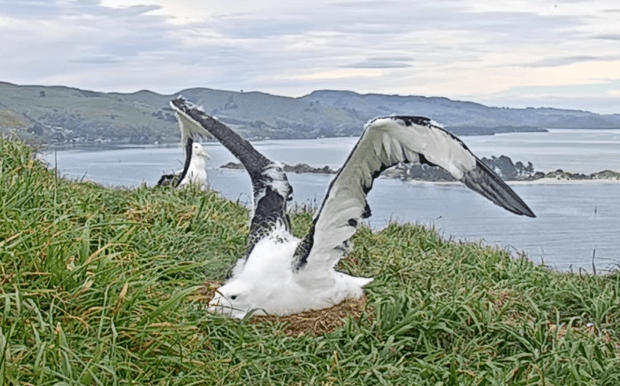
The Royal Albatross continue to return to Taiaroa Peninsula to find their mates and start the process of nest building and egg laying!

Do you know this nest cam with squirrels and songbirds in Nagano?

Please share. Once, when we were trying to protect some Cooper’s Hawk nests in my city, I was told repeatedly, that the hawks had been carrying away the local dogs! The gentleman who told me this was busy trying to locate all the nests in the area so he could destroy them. It took great effort and one of the local wildlife officers to deter his actions.

Thank you so much for being with us today in Bird World. Please stay safe. I hope to see you soon.

Thank you to the following for their notes, their posts, photographs, videos, graphics, articles, and streaming cams that helped me write my blog today: ‘A, B, H, L’, Wikipedia, Audubon, Openverse, Margaret Renkl, Charles Sturt Falcon Cam, PLO, Cathy Cook, Sydney Sea Eagle Cam, Gracie Shepherd, Rohan Geddes, NEFL-AEF, Duke Farms, Raptor Resource Project/Explore, FOBBV, Superbeaks, Androcat, Bird Guides, The Petrel Station and Seabird Tours and Research, Holly Parsons, Maria Marika, Lady Hawk, Nagano Songbird Cam, and The Medina Raptor Centre.

Marri self-feeds…Friday in Bird World

20 October 2023

Hello Everyone!

Friday was beautiful. 16 degrees C. No wind. It was the perfect day to go birding. Indeed, it was so perfect it was hard to remember that this is the third week in October. If you looked in one direction, the geese fed on green grass in the fields and on the other the farmers were harvesting the flax, everything brown, the Poplar trees in the distance a sunny yellow edged by a lovely bronze-brown. It was delightful to be outside. Calming to the mind – tranquil would be the correct word. Sitting and listening to the geese honking as they flew in at a distance, it took me back decades to when I first moved to Canada and discovered the geese. Then it was April and they were the harbinger of spring. They always arrived around the time of my first son’s birthday. We knew winter was on its way out. Their departure in the fall signals the opposite…I hate for the last ones to leave when the sky goes silent.

The first images are from one of our lovely City parks – Kildonan – on the way to Oak Hammock Marsh for me. The Marsh is closing the first week of November for extensive renovations to their Interpretative Centre. We will still be able to walk the trails. It will not reopen until the summer of 2024, and I will miss snooping around amongst the displays. The area around Oak Hammock is a haven for migrating geese and ducks. They are still flying in by the thousands. I had a giggle. The lady at reception said, “As long as geese are flying in, we know winter is not near.” She is right. When we see them high-tailing it out of the City, we know something ‘bad’ is coming. Sometimes, a few are still around when the first snow falls, but they quickly get in the mood for a winter holiday!

At Kildonan Park there is a little pond that is fed by a creek that runs through the park. There were at least 75 Mallards and another 35 Wood Ducks along with about 400 Canada Geese this morning.

The pond is by the Witches House and people come throughout the day and feed the geese and ducks. They are overly friendly if they think you have a bag of seeds.

Oak Hammock Marsh is a joint venture between the Province of Manitoba and Ducks Unlimited Canada (DUC). It is one of those partnerships that has created vast wetlands that benefit both the ducks and geese and sadly, those that like to hunt them. ‘R’ and I chatted about this and it appears that the way forward to saving our wildlife is to partner with groups that might have seemed unthinkable in the past. I do not like shooting ducks but if it is the duck hunters that are creating all of the wetlands throughout North America that benefit all manner of waterfowl – some hunted and some not – then I am going to sit down and be relatively quiet in the hope that someday there will be huge wetlands and people might be dissuaded against killing animals.

Snow Geese, Ross’s Geese, and Canada Geese in the fields feeding near to Oak Hammock Marsh.

These are rosehips. Many collect them and make rosehip jelly or syrup. It is delicious. Rosehips are the fruit of the rose plant.

A Northern Shrike. They are a large songbird. These birds unusually feed on small birds, all manner of rodents including mice and voles, as well as insects. They are also known to eat frogs. They live in my area during the winter.

The range for the Northern Shrike.

At Port Lincoln, ‘A’ was watching and left me this note, “Watch the feeding at Port Lincoln from around 18:13 to see how very carefully mum is working to ensure that the younger osplet gets fed. Her awareness of it and her efforts to ensure it gets fed really are very encouraging indeed. The eldest has been in the front position and getting all of the food to this point of the feeding, and has a large crop by now. So mum turns to the younger chick to ensure that it gets fed. She moves the fish over to the younger osplet, who is behind the older, but the older one turns around so the two chicks are facing each other. Mum moves again, so she can make sure she is directing each mouthful to the second hatch. She gives it some fairly decent-sized chunks, which it manages to swallow. It is a determined small person and is getting steadier by the hour. And dad did bring in another fish, albeit a late one. Both chicks will go to sleep with full tummies and mum has eaten well during the day. I suspect that mum’s dedication is going to be extremely important to the survival of this second chick. If the fish supply is low, then it will probably be the factor that determines whether or not two osplets survive.”

Heidi caught a good feeding, too.

The second chick is definitely getting stronger. The third egg is not hatching or cracking. It is nesting material stuck to the shell. You can really see the egg tooth clearly in the image below.

‘A’ gives us the run down on the feedings at PLO: “There were three fish brought in today, all large and all by dad. The first one was huge at 06:34, the second was large at 15:50 and the last at 19:50. There were at least nine feedings between 06:38 and about 20:00 and perhaps more after dark (I haven’t checked). The younger chick ate at all but two of those feedings, though it only had a small amount on each occasion (sometimes just a bite or two). But it is getting better at the whole eating thing (facing the right way, seeing well enough to correctly time the grab, managing to deal with larger pieces) and will be much better at all of those skills tomorrow. So far it is getting enough to eat, though not nearly as much as its sibling. At least mum is looking for it once the older chick is fed and is being relatively patient with it, offering the food two or three times if it misses on the initial grab. She is still giving pieces that are too large but the little one is struggling manfully with them and managing most. Such a sweetie. So far, dad has stepped up his game with the fishing to make sure mum and the kids are getting properly fed (today’s fish were all a good size and one was super-large) and mum is well aware that she has two osplets that both need to be fed. So that’s an excellent start. Talons crossed that these two actually decide to skip the bonking phase altogether. Is that even possible? I’m also interested in dad’s response to the offspring – he seems extremely interested and perhaps wants to get involved. Does this suggest/confirm that he is as we believe a new dad at this nest and learning the ropes as it were?”

Marri and Barry are ‘scooting’ around the scrape. They are adorable, interested in their surrounds, the feathers all over the floor of their home, and one another.

The soft fluffy down is going away. Look at how different Marri is – as she is changing. Notice the pink beak has given way to a soft dove grey. Pin feathers are appearing. The beak is much more raptor-like. They are still adorable and their individual personalities are beginning to show along with – the clown feet!

“Have some delicious feathers”.

Marri passed a major milestone – she is self-feeding. Thanks Heidi!

‘A’s observations: “Meanwhile, at Orange, that pair are little eating machines. (Why is it that falcon chicks are the most voracious eaters of all? Even hawklets and eaglets and osplets don’t attack the feeding process – as opposed to their siblings – with such incredible gusto and energy. Falcon eyases take it to a whole new level. As with their screeching to demand sustenance.) At today’s mid-afternoon feeding, Marri downed an entire grebe leg, complete with attached foot. Seriously grown-up now. They are climbing onto the Cilla Stones, exploring their expanding world as they start to get up off their tarsi and onto their feet. They compete for every bite, usually getting alternate mouthfuls most of the time so that the food ends up being relatively equally shared between them. They are beyond adorable, sleeping together in a pile and today getting into some allopreening (little Barru allopreened his older sister Marri). Both chicks PS’d on mum this afternoon (Marri at 12:03:39 and Barru at 13:24:36, so poor Diamond had a difficult lunch hour today). All in all, Xavier is keeping the prey coming as this little pair eat increasingly voraciously with every passing day. The feeds are getting bigger (they are consuming a lot of food in a relatively short time at each meal now) but less frequent (they are getting about four or five feeds a day compared to the six or seven they were getting for the week or two before that). They are also starting to attempt some self-feeding, with limited success, but they will learn quickly. “

As I write this, SE32 has still to fledge. Both have been bombarded by the little Boobook Owl at one time or another and parents are bringing in food. It feels like a good year. Still hoping.

The summary from WBSE: ” October 20: a quieter night, and both eaglets slept in the nest. Early morning at 5:33 a smaller owl swooped Lady, starting their early chorus. 31 was not disturbed though sitting beside Lady. Dad brought in a fish part at 7:35, snatched and eaten by 32. When Lady brought a fish later at 11:27, 31 was there first with 32 hanging about trying – nothing left for 32 though other than a few scraps. Then both stayed around the nest area, on a hot windy day, 31 below the nest camera and 32 in the nest. Both magpie and currawong were swooping Dad up high above the nest mid-afternoon. The eaglets finally moved after 4 and were jumping about and flapping – 31 slipped and nearly fell at 16:22, but recovered well. 32 was very quick to get to the nest to grab the juvenile gull that Lady brought at 17:36 – then was de-feathering it alone, with 31 watching on. Then 31 took over, Lady came closer, both ate a bit, Dad came in with a fish, a great scrabble on the nest, Dad left, Lady still there, 32 still defending the bird – where is the fish? Confusion. Then 32 was eating the fish on the edge – all ate in the end, except Dad. Both eaglets were on PB at dusk, back and forth a little close by.”

The Real Saunders Photography gives us some dynamic images of M15 and F23 flying!

These two are bonded and building a home for their babies. I cannot wait to see them as a couple together!

Last year was a very sad season for Ospreys breeding in some areas of NE United States. It is heart warming to read that the breeding season in Italy was so successful.

There is news on how well the re-location of the Kakapo back to mainland New Zealand is doing.

Hope would like everyone to leave the chipmunks and squirrels alone. They are her friends in the garden and she has been watching them for more than a month storing up their seeds and nuts. Her Mamma watched them before that and Lewis and Missey have enjoyed their garden buddies for a year. Don’t trap them and move them far away just because you don’t like them around. Hope will tell you why after she shows off her beautiful busy tail. Perhaps – with the exception of Missey – who has the most gorgeous and expected fan tail – I have never seen a cat with such an exaggerated tail as Hope. It looks like something pinned to her body that might have adorned an old children’s hat. When she decides to ‘puff’ it up, the crazy thing could dust all the furniture its diameter is so large, we could hang it on a pole and it could tell us which way the wind is blowing like a wind sock. Seriously this tail is enormous.

More rare sightings in Norway.

Thank you so very much for being with me today. Take care of yourself. See you soon!

Thank you so much to the following for their notes, posts, articles, photographs, videos, and streaming cams that helped me to compose my blog this morning: ‘A, H’, Vail Gail, PLO, Charles Sturt Falcon Cam, Heidi Mc, Sydney Sea Eagles, Real Saunders Photography, Gracie Shepherd, Gregorious Joris Toonen, Progetto Falco Pescatore, Sirocco Kakapo, NZ DOC, For Fox Sake Wildlife Rescue, and Bird Guides.

Bon Voyage Mini…Sunday in Bird World

10 September 2023

Hello Everyone!

Saturday was the most gorgeous fall day. It was about 16 degrees C with a beautiful blue sky and some soft puffy white clouds as I travelled north from the City. You could see the geese overhead flying in their standard ‘V’ formation swirling around the fields that have been recently harvested – wheat and flax, mainly. There is something so magical about the rhythm of their lives. They come in late March or April and being heading to their winter homes in September-October. At one of the local nature centres, they fly in by the thousands at dusk (on a good day). Their black silhouettes filling the horizon as the sun begins to slowly set in the West.

One of the best places to see the geese in the afternoon is at Oak Hammock Marsh.

A lone American White Pelican and a Trumpeter Swan with all the geese landing at a small pond by the road.

On the way home there was a beautiful Red-tail Hawk hunting in one of the fields. What a magnificent raptor. No photo…just watched it for a bit and left quietly — we must always remind ourselves that their lives are overtly challenging and any opportunity for a meal should be respected and we should ‘disappear’.

Oak Hammock Marsh is run by Ducks Unlimited and the Province of Manitoba and is an extensive wetland. Being there reminded me that ‘R’ had sent me an article several weeks ago and our discussion about how we need cooperation to protect the birds. What he sent me was about the Excise Tax in NJ – how that comes from the sale of hunting equipment, firearms, permits, etc. goes to help with the conservation of the birds, such as our beloved Ospreys, in the state of New Jersey. We talked about how this could be a blueprint for the future if we want our birds to thrive – and as much as I hate killing of anything, it makes sense. Ducks Unlimited is working across Canada with various groups including some in the province of Alberta to purchase huge tracts of land to protect and restore for wildlife. It is something to think about. In NJ it is called the Wildlife and Sport Fish Restoration Program. Does your state or province promote such a scheme? If not, it might be worth a good conversation!

All of the kittens behaved themselves. Missey and Lewis continue to be in the main house and Calico and Hope in the conservatory annex. Hope has been enjoying her new rich foods a little too much or it is that plus the stress of coming inside…but the poor little darling is now on kaolin probiotic granules for running poop shots. Hoping she is over this very quickly…she was fine when she arrived! A few images from today…Hope insists on doing everything that Mamma does. She resisted her own little dish of organic chicken and sauce to try and eat with Calico, was on the cat tree and it seems that Calico is an excellent pillow.

Giggles all around today – the cats are eating well and their rooms are disinfected and cleaned twice a day – everything. Gosh, the laundry in making those tents…Calico is off for her surgery on Tuesday and Hope will be, by then, surely she will, friendly!

Thank you Jeff Kear – I had not heard about Alyth putting in battery storage units right under the nose of Harry’s Osprey Nest! Does the need to constrict the use of fossil fuels mean that we should not consider the environmental impact and the location? Was any study done? It is not clear when it comes to the ospreys or other wildlife.

‘A’ reports on what is happening ‘down under’ – that is where most of the action is currently!

Sydney Sea Eagles: “Dad brought in a very nice fish at 08:33:22 this morning and Lady was quickly shimmying down the perch branch to take control of it. Lady and Dad have a little chat and seem excited by the fish but the eaglets (especially SE32) are more interested in what’s going on in the tree around them this morning. SE31 is first to the table, while SE32 is looking up and around at everything in his expanding world. The view is somehow different from up on his feet perhaps! At 08:39 he finally moves up to the table and his sister courteously moves aside so her brother can have some breakfast! This is so civil, it’s ridiculous. Someone remind these kids they are apex predators! Just before 08:40 Dad flies in with a stick (the parents have been busy building another level of cot railing over the past five or six days, as the two get up onto their feet and start moving around the nest a lot more – now SE32 has joined his sister up off his tarsi). Dad is very engaged in his stick placement and spends considerable time perfecting the front of the nest. So cute. Lady continues feeding SE32, though SE31 is momentarily fascinated by Dad’s manoeuvrings.” 

Royal Albatross: “In New Zealand, Manaaki is on his nest and there is very little wind today, so I am not anticipating a fledge this morning. The wind may pick up during the afternoon. We will see.” 

This video is from the NZ DOC. It shows our young prime hovering nicely! This was three days ago.

Melbourne Peregrine Falcons: “At Collins Street, F22 takes a break shortly after 9am (that time stamp is SO hard to read) and little M22 is soon in to take over incubation. He settles down in his customary jerky manner and then finds he has a spare egg he has failed to cover. So he has to start his enfluffling all over again. Such a sweetie. I love these falcon dads.” 

Port Lincoln: “No third egg at Port Lincoln and I certainly hope there won’t be, given the gap between the first two eggs is 74 hours. A third egg could therefore be as far away as Tuesday. I do hope there isn’t another one. I’m not looking forward to the huge gap between the first two. A third hatch would be so nerve-wracking. We really don’t need that sort of stress.”

There are still only 2 eggs at Port Lincoln.

I certainly agree with ‘A’. A third hatch at Port Lincoln does not need that kind of stress! But then again, we have a new Dad and a new season and anything is possible.

Thanks, ‘A’.

Let us go and check on Diamond and Xavier – Xavier flew in with a nice prey for Diamond’s breakfast, and he then worked hard rolling the three big eggs and trying to fit them under him. He was successful, but gosh, it is a good thing there are not four of them.

‘A’ writes about the intruder that has been bothering Xavier and Diamond: “That intruder is still worrying at Orange, although Diamond and Xavier have things sorted. This morning, the intruder was spotted. Diamond called Xavier to come and mind the eggs. He arrived and took over incubation. Diamond dealt with the intruder (visible from tower cam) and returned to the nest box. All is well. I am SO glad they have this routine. Diamond is twice Xavier’s size and makes short work of an intruder. Any injury to Xavier at this point would be a disaster for the clutch. They know this. We are grateful. But I do wish this intruder would move on. I do keep wondering whether it is Izzi, as the males do tend to move no more than 50 km from their natal nest, from what I have read, whereas the female fledglings spread much further away. It is so funny that Indigo, too, proved impossible to persuade it was time to leave home, so that Diamond and Xavier had to physically bar him entry to the scrape! At least they got rid of him before the eggs were laid, which was only just the case the year Izzi was there. He was persistent in the extreme. I think it was early August before they gently told him “grow up and find your own territory, son!” and moved him on.”

So do we think that this might be Izzi? That would be interesting. (Note that raptors normally engage other raptors of the same gender).

‘H’ sent me a quote today from one of David Gessner’s books on Ospreys. It is so appropriate and she believes it is form the Return of the Osprey but neither of us had the time to dig through the book to find the right page:

  “To love the Osprey is to be constantly open to loss.” 

Mini was not seen at the Patchogue nest after she flew off in the early morning. It is now 2100 nest time, and she has not flown in. Mini, you taught us to persevere, not give up hope, be smart, and figure things out. Safe travels – good winds, a full crop, a good life.

‘H’ brings us up to date on the last two nests she has observed for me. She officially monitored ten nests, but it was always more than that. Over the course of osprey season, the number of eggs grew to over 350 that were monitored. I am very grateful for her help and keen eye and instincts – thank you, ‘H’. You came to Ospreys, naturally.

Kent Island – It seems that Molly may have already started on her journey.  September 9th was the fourth full day without a sighting of our precious Molly.  Both Tom and Audrey were seen in ‘Joe’s tree’ during the day.  At 1800 Audrey came to the nest for a while to dry off after her bath.  And, Audrey flew to the nest at 2300 to spend her third straight night on the nest.

Barnegat Light – There were intermittent periods of live stream buffering throughout the day.  We did not observe Duke delivering a fish to Dorsett at the nest, but Dorsett was seen a few times at the nest and on Duke’s perch.

Louise and Banff are no longer at the Fortis Exshaw Nest. As the sun sets Saturday evening near Canmore, Alberta, not far away from Lake Louise, they have had snow on the 6th! By vehicle, it is 5 hours through the mountains, according to Google. The girls will happen to be sunning themselves in the south.

The two surviving chicks at Osprey House in Brisbane, Australia are doing well.

There is extremely sad news coming out of Big Bear Valley today – confirming losses from several years ago.

I am attaching the article.

How has the earthquake in Morocco impacted Ospreys migrating from Europe and the UK? Certainly transmissions might be garbled but what about the environment where they are fishing, living, or flying through?

A lovely Red-tail Hawk – juvenile – visited the WRDC nest of Rose and Ron yesterday. ‘H’ was the first to alert me and Pat Burke has posted an image.

That’s a wrap for Sunday, September 10. Thank you for being with us. Please take care. See you soon!

Thank you to the following for the notes, comments, videos, and streaming cams that helped me to write my blog this morning: ‘A, H, Jeff Kear’, Alyth, Sydney Sea Eagles, NZ DOC, 367 Collins Street by Mirvac, PLO, Charles Sturt Falcon Cam, Kent Island, Wildlife Conserve F of NJ, PSEG, Snow Seekers, Osprey House, Tonya Irwin and Raptors of the World, Pat Burke and Eagle Nest Watchers, Bloom Biological, and The Guardian.

Introducing Hope…Thursday in Bird World

7 September 2023

Good Morning Everyone!

Whew! What a day. ‘The yet-to-be-named kitten’ was let out of the kennel in the Conservatory, allowing her to run around with Mamma Calico. It brought tears to my eyes seeing Calico lick her kitten for the first time in 10-11 days. Of course, the kitten loved being with its Mamma and wanted to suckle immediately! Then, it wanted to play with Mamma’s tail. What a sheer delight to see the wee one following Calico around copying everything she did. It is like a Mini Calico – at first glance, it is hard to tell which is which. They are six months apart in age, but Calico took such good care of her single surviving kitten that it is plump and robust and Calico is still trying to put on some fat. Thanks also to the neighbours who have their feral feeding stations this one was in good health when I trapped her.

Calico loves the cat tree, and she quickly found Lewis’s favourite spot – the little house. The kitten could not stand it and kept jumping up and around, trying to get in with Mamma. I have, at times, wondered how happy Calico is to see her baby. Still, I made her a promise, and I am still tearful that I was able to follow through. To see the two of them on a chair together, cuddling and washing, brings so much joy. I still have to pinch myself to realise that everything worked out. The lesson for all of us is never to give up! To not lose ‘hope’.

Calico washing her kitten for the first time in 10 or 11 days.

Mamma is very protective. Lewis and Missey will be staying in the main part of the house while Calico and baby are in the Conservatory for the next week. Then we will try them in a few rooms. Thank you ‘Geemeff’ for all the tips. We appreciate them!

Promises should never be made. A friend in Berlin and I were talking about this. It caused such anxiety that promise. T he night when Calico wanted to come into the house and leave the dark deck where these two had been living, I promised her I would find her kitten if it was alive. No one had seen the kitten. Everyone believed that a white kitten that had been found in the area was Calico’s wasn’t. It was simply too young. So what did happen to Calico’s kitten? Flyers, walking the streets, putting food under the deck where the kitten was born, stopping people on the street, and postings to FB groups netted nothing. From now on, there will be no more promises. It will simply be that I will do my best to make something happen – but, no promises.

I almost was going to name the kitten ‘Promise’ but ‘J’ pointed out that the word has a negative connotation because of the anxiety it caused me. After many fantastic suggestions, the name finally just came when Calico and her kitten were having ‘story time’. Her name is Hope. Hope is something that each of us needs in our lives.

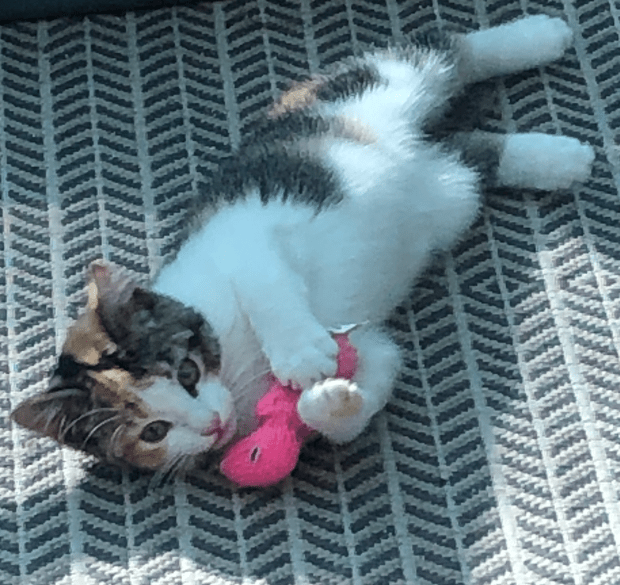
Hope loves to play with toys. The tiny little crochet ones with the catnip inside which cling to their ever so sharp nails appear to the favourite for the moment.

Meanwhile, Missey and Lewis are, as always, together. They seem to nap more since they are a year old. Missey has slowed down more, but Lewis still loves having someone to play with and run through the house. Perhaps Hope will join the midnight romp.

Trips to the park to check on the ducks and geese have been neglected lately. It was time for me to get moving before they are all gone. The afternoon was beautiful. The leaves are turning quickly. You can see the yellow kissing the tops of what was once emerald-clad trees.

The small garden at the park is still beautiful. There were lots of bees and butterflies feeding on the flowers and this Mallard leading the way.

Many of the gardens have been planted for bees and butterflies with a nod to plants that are more drought tolerant.

On the island where most of the ducks and geese were having their afternoon nap, the trees have really turned yellow.

This goose was not being very nice to the two female Wood Ducks.

Others were napping on the warm walkway.

There is something marvellous about being outside. It was a lovely walk and it felt so good to sit with the warm sun on my face enjoying the geese and the few ducks that were meandering around. The kittens were all having their ‘nap’ time while I was away. They didn’t even notice I was gone! Fresh air not ‘sardine’ air was most welcome.

Taking this lovely walk and spending much time with the four kittens did not allow me to spend the hours required to give you a good run down of the nests. Today’s report is, thus, a little thin.

Patchogue: Observing their crop is one way to know if a raptor has been eating. Some also look at the amount and force of the ‘poop shot’ or ‘ps’. The proper term is guano. “To most people, bird poop is just something they scrape off the windshield of their cars, but it’s more important than we may think. In fact, droppings were once a very important commodity in the United States. Buying and selling bird poop is not as featherbrained as it may seem either. This stinky substance, referred to as bird guano, was sailed around the world during the 19th century to be sold as the principal agricultural fertiliser in the United States. (Natural History Museum)

Mini has been eating. One of the chatters has been keeping track of Mini’s ‘ps’. Here is the times from ElizaG: “10:13pm, 11:17pm 1:10am, 3:13am.” Mini flew off to the lake and returned to the nest at 19:19 (thanks, L for the alert). She is resting that leg, thank goodness.

She put the weight on her right leg, not her left. It seems to be the typical pattern where the leg is giving her trouble at the end of the day.

Good Night Mini. SOD.

Wonderful news comes from John Williams at Llyn Clywedog. He had spotted an Osprey and thought it was Dylan (of Dylan and Seren at the Llyn Clywedog Nest) but it wasn’t. It was another unringed male and it turned out that this male had a nest with a female Blue Z5. Now she is rather special because she is the daughter of one of my favourite ospreys, Tegid Z1. Monty’s boy. Blue Z5 hatched in 2020. She is the granddaughter of Monty. Turns out the couple raised one female chick to fledge, ringed as Blue 7B9. She weighed 1670 grams. What a fantastic surprise and another osprey family for the forms. John tells us about it in his blog.

A family portrait of Dylan and Seren and the two fledglings this year. The one was sadly killed by the goshawk when there was a fish delivery and the hawk attacked the nest directly while Seren was feeding.

Mum is still home at the Boulder County Fair Grounds Osprey Nest in Colorado. So is Dad!

The fledgling at Minnesota Landscape Arboretum (the only one of three to survive) is being well fed.

Keo delivered at least three fish for Coco at the Sandpoint Nest on Wednesday. Mum Keke is still home and there was relief when she did not fight her osplet for the food. Keke should be out fishing! And preparing for migration.

The Cowlitz PUD cam was buffering so bad, but there is at least one osprey still home at that nest. The protective grids worked well! Spread the news.

For all the nests that are emptying out, good winds, safe travels and full crops. See you next year Idris and Telyn!

‘H’ brings her reports for us – looks like Molly might have started her migration!

Kent Island, 9/6 – “We had not seen Audrey since 8/29.  Today At 0645, Audrey landed on the nest with a large common carp.  Audrey must have had to dive deep for that one, because she was soaked to the bone!  Audrey nibbled on the fish, but she was waiting for Molly.  When Molly didn’t arrive, Audrey ate more fervently.  Soon, some crows started to harass Audrey, so Tom flew in to the rescue.  Tom stayed on the nest for about 25 minutes helping to ward off the unwelcome visitors, and he was later seen eating his own breakfast on the back of an Adirondack chair.  Audrey would eat some, then wait some, and by 0830 Audrey was still holding a large portion of the fish.  She was waiting for her girl to appear.  By 0910 Audrey had completely consumed the fish, but she still stood on the nest, seemingly waiting for Molly.  Molly never arrived to claim the fish her mom had brought for her.  Audrey flew away at 0953.  We have not seen Molly since she flew away from the boat lift at 0745 on 9/5.”

Barnegat Light, 9/6 – “Dorsett was a bit more of a homebody, staying at the nest or on Duke’s perch much of the day.  Duke delivered three fish to Dorsett.  She took the first fish (a whole black sea bass) to eat on top of a flag pole across the cove.  But, when she returned an hour later, she did not have as large a crop as one would expect, so she may have let part of the fish fall to the ground.  Dorsett chose to eat her next two fish at the nest.”

The Sea Eaglets had an early breakfast for a change! As I am writing no other food has come to the nest but ‘A’ spots another one of those great eels that Lady has been bringing to the nest. “After a nice breakfast of leftover eel, the eaglets went the rest of the day until Lady brought in another of her giant eels soon after 15:36. Immediately, SE32 is up to her beak and pecking at the eel. Lady immediately starts feeding him. SE31 waits next to SE32 but further from Lady’s beak for her turn to eat. There is no attempt to push in or intimidate SE32, who is eating fast and with great confidence. This eel means that there is now plenty of food here for everybody. These are nice big eels that Lady has been catching. She returns with them intact, panting a little but not particularly wet, and she is not gone long. Once again, it was as though she made a decision that food was required now and she went to get it, returning within 10 minutes or so with this eel. Perhaps this mid-afternoon feeding schedule is not so much teaching the eaglets about food availability in grown-up life as a wild sea eagle as it is Lady deciding she cannot wait any longer for Dad to bring home the bacon, as it were. She has definitely been doing extra hunting over the past few days, and it makes me wonder whether Dad’s advanced age is starting to tell, so that now the two eaglets’ appetites have increased dramatically, he is finding it difficult to hunt for four alone. Just a thought. It is an explanation that would fit the facts equally well.”

At Taiaroa Head, ‘A’ remarks: Manaaki is tucked and fast asleep on his nest. But our gorgeous little man is almost ready to leave us. Look at his hovers during flight practice this morning: https://www.youtube.com/watch?v=rBFx_GGakhM&t=5s. Look how strong his wings are getting, though he is still working on his balance. He is almost on his way, just as soon as he sorts out those face-plants! We need to enjoy every moment, because once he leaves, it will be at least four or five years (and up to eight years) before we might be lucky enough to see him again. If he comes home at all, Manaaki will return to that same headland. He will land, after all that time and up to a million miles, within 40 or 50 metres of the nest where he was born. He has been imprinting its location over recent days. I am not sure if he has cast his pre-fledge bolus but I know the rangers are picking them up all around the colony and Manaaki is one of the oldest couple of chicks there. I think he is within a week of leaving, but they can surprise us and fledge early if the winds are right, so the time is nigh. QT was 220 days when she fledged, remember, while Manaaki is 230 days old. On this headland, the two females (NTF and Quarry) are definitely ahead of the two males (UQ and Manaaki) in their flight skills.” 

Are you watching multiple eagle nests and wanting to keep up with what is happening? Elfruler has a calendar that spans decades with a space for this year.

We will be looking to see if there are further eggs at 367 Collins Street and Port Lincoln Osprey Barge today.

Thank you so much for being with us today. Missey, Lewis, Calico and Hope remind you to please put out water and to also turn off your lights at night for the migrating songbirds. Take care. See you soon!

Thank you to the following for their notes, posts, videos, and streaming cams that helped me to write my blog today: ‘A, Geemeff, H, L, PB’, PSEG, John Williams, George Green and the Clywedog Osprey Group, Boulder County, Pam Breci and The Joy of Ospreys, Sandpoint, Kent Island, Wildlife Conserve F of NJ, NZ DOC, Dyfi Osprey Project, and Sydney Sea Eagles.

Soo returns to the nest…Tuesday in Bird World

1 August 2023

Good Morning Everyone!

It is the first day of August and I am reminded that we have about 7 more weeks of summer. It cooled down in the garden today and the birds were noticeably happier. The lilacs have given them respite when it was really hot and the bird bath – remember to keep putting out water. Dehydration is a terrible problem. Many wildlife rehabbers say it is worse than not having regular meals. Clearly, the Blue Jays, now totalling more than 14, find the bird bath a source of pleasure!

Today it will go up to 31 degrees. It has been like a yo-yo – temperatures going up to the 30s and then dropping to the low teens.

Missey and Lewis continue to enjoy watching the birds and ‘talking to them’ – and as always, staying rather close to one another.

Once in a while, a bird will land on the glass ceiling, which fascinates the kittens.

On days when we lose an Osprey, it is always comforting to have the garden birds and the kittens.

I want to start with some amazing news coming out of Loch of the Lowes. The female fledgling, PF4, – a strong and determined and hungry fledgling – caught her first fish today. Why is this such a big deal? It is rare for a fledgling osprey to catch a fish before it has left for migration. This is still July! It was small but that does not matter. The skill and coordination required – well, it looks like this one is well equipped to face the world. Fantastic.

I am really hoping that LOTL will post a video of this special moment in PF4’s life.

Others have been wondering if anyone could remember another UK fledgling successfully catching a fish before migrating. The only one that has come to mind so far is Oswald who hatched in Naimshire in 2011. He did not migrate until October!

At Llyn Brenig, Mari tried over and over again to catch a fish. Maybe she will be successful like PF4 tomorrow. That would be fantastic.

We always need a feel good moment and here is the one to begin our day. Couple saves Osprey! Salmon Arm, BC.

And because we can all use good news about more generous and compassionate people, another osprey save.

Staying in British Columbia, the second hatch at Osoyoos died Monday 31 July.

The little one, the second hatch, is alive at 0531 when fish comes in before the attack by One. (I do not like the images of the chicks being brutalised or dead…one of the last looks when this one could hold its head up). It has been an incredibly difficult year for the Ospreys around the world this year.

Soo, the female has not been seen since Saturday. Olsen has been bringing in nice fish but this little one was too weak to eat Monday morning. Problems with starvation/siblicide were mitigated by the growing heat domes in the area and the wildfires and then the disappearance of Mum. Olsen has been doing splendidly under the circumstances. This evening, good news has come from ‘H’ who says that Soo is back on the nest at 1633. She adds, “After Soo returned to the nest at 1633, she fed #1 from a large fish that had been left on the nest.  Soo was on the nest with #1 when Olsen delivered a fish at 2008.”  Thank you, ‘H’. With two parents and a single osplet, let us hope that all goes well for this little one to fledge.

In order to highlight the threats to our feathered friends, NZ is adding some very interesting birds to its ‘Bird of the Century’ contest.

“This year five extinct species will be included among the 75 contenders, to bring attention to the pressures facing the natural world. In New Zealand, 82% of birds are threatened with extinction.”

Bruce Yolton continues to follow the Eurasian Owl that escaped from the Central Park Zoo as the owl continues to live and hunt in the wild.

At Steelscape, things continue to look good.

Patchogue: Mini enjoying a fish while another sibling is envious.

Mini enjoying another fish! Our girl is doing well.

Bridge Golf: Cam went down late on the 27th of July. Both osplets were fully feathered, healthy, and eating well. No reason to believe that they will not fledge.

MN Landscape: Even with lots of intruders around and Dad on the nest, this 21 year old father has made sure there is fish on the nest. The only surviving osplet is doing well – and there are many, many nests in this area that have suffered this season. A number of reports indicate that a number of males are missing and the females are having to provide protection and hunt. Lots of nests have lost osplets in the area because of this.

Collins Marsh: The first hatch has flown. I am not certain that 31 July was the first time because this bird flew like a pro! Congratulations.

Sydney Sea Eagles: SE31 and 32 are off to a very good start. They are about the same size and Lady is a pro at feeding them the tiniest bites of fish. Both are doing so well.

SK Hideaways gets us up close and personal with these little fluff balls:

The three little Osplets at Osprey House in Australia will melt your heart.

Dorsett Hobby Falcons: Cuteness overload. Gosh, it is easy to forget that the little hawks and falcons grow so much faster and fledge sooner than the ospreys and big eagles. I just love their little beaky kisses!

Finnish Osprey Nest 1: Roihu, the little male on the nest with two sisters, fledged today! Congratulations.

Finnish Nest at Muonio in Lapland: All three are doing super.

Alyth: The trio have all fledged. They did not spend the night on the nest but nearby and were there at dawn waiting for fish deliveries.

Poole Harbour: Lots of fish coming to the nest and every once in awhile you just wonder if CJ7 might like to have a long fish lunch. There has been at least one intruder in the area but so far everything is going smoothly at the nest.

RSPB Loch Garten: Five fish were delivered before the camera went down. It was a really good day at the nest.

Fish scuffle at Manton Bay: Blue 33 flies in with a fish with two of the fledglings on the nest. Another flies over after the delivery. There was a bit of a fight for the fish but nothing like we have seen on other nests. They all know there will be more fish — and look at the size of it. Can you imagine if a fish this size fell on the Osoyoos or Forsythe nest?

At Loch Arkaig, a Sparrowhawk visits the nest of Louis, Dorcha, and Ludo…it is no threat to them but what a lovely chance encounter.

Boulder County: All three safely flying and on the nest. Life continues to be good at Boulder.

Time for ‘H’s reports: Fortis Exshaw: Mr. O made a quick stop at the nest at 0612.  Louise had not yet arrived at the nest in the morning, so only the kids were there.  Mr.O stood there for ten seconds, looked around, checked the skies, then he left.  Mr.O was just checking up on things for the family.  Smile.  There were three fish delivered to the nest, including one by Mr.O.  Chick #1 is undergoing a bit of a personality change.  S/he is slightly aggressive toward #2 when a fish is delivered, and often grabs the fish, and self-feeds.  All perfectly normal at this stage in its development.  Chick #1 ate the first two fish that were brought to the nest.  When the third fish was delivered by Louise at 1221, #1 sent #2 to the sidelines, and then was fed by Louise.  After several minutes, #2 managed to get to the other side of Louise to be fed as well, but it was the only meal of the day for chick #2.  Chick #2 will learn to try to acquire fish as well, and s/he needs to improve its self-feeding skills.  But, a few more fish would help in this situation, I think.

Forsythe: “After two days of much cooler temperatures, it seemed that fish were easier for Oscar to catch.  Oscar started the day off like gangbusters, delivering fish at 0839, 0852, 0949, 1024, and 1052.  There were three fish for Owen, and two for Ollie.  But, then there were no more fish for the rest of the day.  Go figure.  So, as the fledglings became hungry later in the day, there were a couple of kerfuffles between them.  Five fish is not bad, though.  With easier fishing, perhaps it’s a good time for the juvies to try to catch their own fish.  They are 70 and 71 days old and fledged two weeks ago.”

Thank you, ‘H’!

I have often mentioned Urmas and his fish baskets. These baskets have saved the life of Karl II and his family. It is a beautiful intervention intent on saving these rare birds. Kindness. Compassion.

Emyr Evans (Dyfi Osprey Project) has posted a short article discussing inbreeding in Ospreys. you might find this interesting.

On the Cornell Campus in Ithaca, New York, Suzanne Arnold Horning was able to catch sight of some of the Ms. The three fledglings have done well…super well in fact. I won’t say another word because I do not want to jink this year.

Thank you so much for being with me today. Please take care of yourself. Looking forward to seeing you soon!

Thank you so very much for being with me today. Thank you to the following for their notes, videos, posts, and streaming cams that helped me to write my blog today: ‘AMW, Geemeff, H, MP’, LOTL, Carol White and Friends of Llyn Brenig Osprey Project, Sunnie Day, Linda McIlroy and Raptors of the World, APCH, Osoyoos, The Guardian, Bruce Yolton, Steelscape, Patchogue, Bridge Golf, MN Landscape Arboretum, Collins Marsh, Sydney Sea Eagles, Osprey House, SK Hideaways and Dorsett Hobby Falcons, Finnish Osprey Foundation, Alyth, Poole Harbour, RSPB Loch Garten, LRWT, Boulder County, Fortis Exshaw, Maria Marika, Emry Evans and Dyfi Ospreys, and Suzanne Arnold Horning.

Little Skipper predated by GHO…Monday in Bird World

24 July 2023

Good Morning Everyone,

Every day I am so grateful for the joy that the garden animals bring to my life and for the gifts, like these beautiful sunflowers, that they grew.

I hope that each of you checked in on Mini on Sunday. Oh, goodness. That bird has no idea what a fan base it has nor how loved it is but, Mini proved that with great parents, an area with enough fish (many do not), and the ‘will to live’, a tiny fourth hatch can survive. Sunday was, therefore, a day of celebration!

There are still issues at other nests with lack of fish – or lack of fish deliveries due to a single parent and intruders: Steelscape, Loch of the Lowes, Forsythe to name three. Keep sending them your best wishes. If you had asked me if we would lose so many fully feathered osplets this year so close to fledge or that we had the potential to lose some more I would have said ‘no’. It has been a challenging year everywhere but, particularly, on the US coasts (Washington and the Columbia River), Chesapeake Bay Area, and Florida.

But, for now, I just want to relish Mini’s day…

And that is just about all I did!!!!!!!!!!!! Sometimes it is good to just stop and rejoice. This was no small feat this tiny fourth hatch pulled off. Some of you might even think it was a miracle.

Mini took a couple of flights after that remarkable fledge. There is that empty nest at 1116. Mini is going to come flying over the brewery across the street and put her landing gear down. She has a little hiccup with the rim but otherwise, perfect.

Here comes Mini trying to line up with the runway!

Beautiful Mini around 1725. The lovely brown dots of her necklace look like little hearts. She has a solid dark eye line and her head is a little muddy. That head is the only thing that will not change so get lots of images of it. Too bad there is no distinctive type of image but memorize it and keep a file. You will be able to recognise her easily by her necklace now but, if she were to return to this nest in the future, you need to know that head because, sadly, banding is not common in the US. She will look different with her adult plumage. It is not often that females return to their natal nest – the males do but it does happen and wouldn’t we love to see her again in a couple of years?

At 1906, the four siblings are on the nest. A huge round of applause for these parents fledgling four this year, please. Many nests could hardly manage two. Many lost all their chicks. For whatever reason, the two PSEG nests did very well indeed.

At 2008, Mini does a really nice ‘ps’. It is all that fish she got today!

Thankfully we did not need a rescue at Patchogue. But I know from all of you that wrote or commented that the plight of Mini caused you to move into action to try and save her should something go amiss. It is those traits in all of you – generosity, compassion, caring – that take away the despair. When you see a chick on a nest that might be lost, you do not hesitate to move into action to try and get help. We cannot save them all and, indeed, the system is set up so that they fail. But today, we witnessed a chick that defied the odds because it wanted to live and a family that made sure that happened – including the siblings on this nest who were nothing short of amazing.

Good Night Mini!

My time today was otherwise occupied with that adorable little Blue Jay that once slept on the little birds and who often watches me from one of the perches. Today, it let me get too close and then….I noticed. Can you see what is missing?

It is called ‘fright moult’. One of the feral cats might have caught this little one, or was it a squirrel? Difficult to know, but my bet is on the cat. To survive, it moulted all its tail feathers. That means this sweet baby can fly with some difficulty but not for long distances. This means that migration is out of the question. In the past, we have had Blue Jays during the winter, so…I am trying to find where the incident occurred so that the feathers might be glued back. Wish us luck. Right now, this baby is in a safe place.

‘H’ has just sent me word that Little Skipper was predated by a GHO on 24 July at 00:20 (12:20 am). This much loved and only osplet of Dory and Skiff was 44 days old. Audubon Boathouse. A real little gem up on the coast that survived til now. You will note that Little Skipper was not so little. The GHOs wait til right before or right after fledge (mostly, it seems) when the chicks are nice and fat. We need protective guards placed on these osprey nests like Cowlitz PUD provided its couple.

What do you think of when you think of a duck pond? I bet it isn’t this! This just literally makes me ill.

The look of the ducks coming up to get their food so that they can be shot in cold blood in that dire forbidden muddy mess is beyond my imagination. Sorry, folks. But there needs to be an outright ban on this practice. There is no skill involved – it is like baiting the area for the fish around the boat or using ‘fish finders’. Or putting out tonnes of apples for bears…Of course, what I would like to see is an outright ban on killing all wild animals and all fishing. Put a moratorium in place for 8-10 years and see how well the oceans have recovered. (Fish can be farmed if humans insist on eating them).

What would happen if we stopped fishing?

There is another osplet caught up in fishing line. I do not know the nest but the information was posted on Nor-Cal Birding. In all instances do not give up if someone doesn’t respond or help. If you see an osplet tangled in fishing line (or any other wildlife) get pictures for proof, get the exact location, and find the nearest wildlife rehabber and the nearest USFWS office. Go to ahnow.org to search for the nearest help to the site. If you are not satisfied with that, then Google “nearest wildlife rehab to _________”. Do not wait. Remember how long it took to get help at Dale Hollow? Take action quickly once you see that something is clearly wrong.

A good example. We might not always win but we always need to go the distance for our feathered friends. They cannot advocate for themselves – and sometimes we win. It is those wins – and the fledges that seem impossible – like Little Mini – that really do brighten our day and give us the strength to carry on for others.

Another Osprey nest caught on fire and another set of babies were rescued. This was in Lavigne, Ontario.

We now know of at least 3 nests that have caught on fire in the past week. Two, in Canada, had the osplets saved. Recommendation: Every utility company undertakes to erect a new pole and platform for all nests on old hydro poles. Be caring, be generous, be compassionate power companies. Need funds? CrowdFunder can be started!

I am so proud to be part of the efforts to raise nesting platforms for the Ospreys in South Australia. Without these artificial nests on poles, the Ospreys have to lay their eggs on the rocks were the eggs and chicks are prone to predation.

Now for a spin around the nests:

Roundhouse Loch Noon: Both of the osplets have now fledged! Congratulations.

Loch of the Lowes: Laddie tries his best to fend off intruders and feed both fledglings. The first hatch, the female, PF4, got this one! She has gotten the last two. The lad, PF5, got a considerable fish earlier on Sunday.

Glaslyn: OH2 fledged on Sunday. Congratulations Aran and Elen – both chicks are now flying.

Here it is on video:

MN Landscape Arboretum: Everything is good.

Steelscape: Things are not good. ‘PB’ has monitored the nest and reports that the third hatch is getting weaker and weaker. It is kept from eating by the first hatch. It had no fish until 7:35pm today when the little one got a private feeding from Mum. There is a drought in the area dn the water is low. As a result there are problems getting enough fish to the nest for Mum and the trio. Please send warm wishes.

Mum reaches out to the little one and this time it eats! The others are quite full. Let us hope that there is a good portion of fish left. You can see where the big one has yanked the feathers from the back. It would be a shame to lose another chick so close to fledge. Thank goodness that fourth egg did not hatch!

I bet that fish never tasted so good as it did to this wee one today. It was quite weak earlier.

At Dunrovin, we are on fledge watch.

For those of you watching the Sydney Sea Eagles, it is pip watch. Can you believe it? There is a fish in the nest already waiting for Lady and any hatchlings.

The remainder of ‘H’s report. Little Skipper was one of her favourites and my heart goes out to my friend who helps me monitor a number of nests. It is so difficult – what a challenging year it has been. Our hearts are broken.

Kent Island –  “There were at least eight fish brought to the nest on 7/23, including one by Audrey.  At 42 days of age, ‘Junior’ has been learning how to perform nestorations under the tutelage of his Mom.”

Fortis Exshaw – “Breakfast consisted of a fish that Louise had brought to the nest very late the previous evening.  Throughout the day, Louise delivered three large fish to the nest, and Mr. O delivered one.  However, Louise was already feeding the kids at the time of Mr. O’s fish offering, so he flew away with his fish.  At 36 days of age, the youngsters are doing very well.”

Forsythe – “Between Opal and Oscar, six large fish were delivered to the nest.  Both Owen and Ollie had plenty to eat.  Ollie managed to grab the 10:10 fish from Opal but was pushed off the nest by Owen.  Ollie was seen flying off the nest with the fish in his beak, and a short while later she flew to the cam pole holding the fish in her talons!  At one point in the afternoon Owen and Ollie were each just standing on their fish, because they were too full to eat.  The temperatures were lower on 7/23, so perhaps fish were easier to catch.  Let’s hope the improved fishing conditions will continue.”

Thank you ‘H’.

I have a little Blue Jay to attend to and was hoping that today would be quiet. Already human debris is causing a disturbance. ‘L’ writes that one of the osplets at Patchogue has a mask attached to its leg this morning. Let us all hope that this mask comes off.

Remember that all manner of things require cutting before disposal. Loops in bags, rubber bands, those plastic tabs that come with bread need to be cut in half…and we need to be diligent and clean up – after ourselves and others. If you do go on a clean-up of parks and places where there are birds, you should wear gloves, clean your hands thoroughly, and use sanitiser afterwards.

Good Morning Mini!

There is an article about the SWFlorida nest – home to Harriet and M15 and the darling Es that you might enjoy.

Please keep all of the wildlife and our dear nests that are struggling without the help of the heat that is penetrating everything. ‘PB’ just sent me the forecast map for the US which has been hit so very hard this breeding season.

Thank you so much for being with me today. Please take care of yourself. See you soon!

Thank you to everyone who sent notes about Little Mini. Our entire Bird World family has been uplifted by her success. Relish this Sunday and her achievements. It does not often end with such success! Yeah, Mini!

Thank you to the following for their notes, posts, videos, articles, and streaming cams that helped me to write my blog today: ‘H, L, L, M, PB, SW’, PSEG, Raptor Persecution UK, BBC, BBC Radio Leicester, Municipality of West Nipissing, Newstalk 1010, Port Lincoln Osprey, Friends of Loch Arkaig, The Woodland Trust, Bywyd Gwylld Glaslyn, MN Landscape Arboretum, Steelscape, Inc, Days at Dunrovin, Sydney Sea Eagles, Audubon/Explore, Kent Island, Fortis Exshaw, NOAA, and Forsythe Ospreys.

OH1 at Glaslyn just took off…Thursday in Bird World

20 July 2023

Good Morning Everyone,

It has rained every day for ever so many days. The garden is emerald green. Without even looking at the forecast – the storm clouds roll in quickly – you can tell that something is going to happen by the frantic activity of everyone trying to eat!

One of Dyson’s kits got so excited and then lost its peanut over the edge of the feeder. Ahhhh….

The little sparrows lined up on the branch of Abigale’s tree hoping to get fed or get a turn at the feeder after the squirrel.

It was delightful to see Little Red at the feeders! He knew I was watching and thwarted my gaze.

Baby Blue Jay having a nap.

The little one only woke up when a sibling came to pester. There are five of the babies alive out of the original six…they were all in the garden on the feeders, having baths, and eating today. That is pretty good…they bring me such joy I cannot even describe it properly sometimes.

The baby on the left (above) is the one that slept with the little garden ornamental birds. Its crest finally has blue on it! But I can still tell which one this wee baby is from its behaviour. Adorable. Always loves a good long bath.

Lewis, of course, could care less. These days he is either sleeping or eating!

Oh, my goodness, the ospreys were fledging on Wednesday! I am going to lose count of all of them quickly! It took great effort to get all of the data in my forms along with the continued quest to find more French and German osprey nests.

And they were fledging on Thursday. OH1 just took off not long ago at the Glaslyn Nest! Congratulations! Time was 14:33.

‘D’ wrote and told me that it looks like it is possible all three on the Crooked Lake, Iowa osprey platform of parents Nobel and Whitley fledged on the 19th. Sunnie Day was going over to the footage to make sure that the first hatch CL16 also flew – and the verdict is ‘yes’ – all three flew today.

Take off and return for the first chick’s flight.

Siblings watching.

A great return.

‘H’ wrote and the second chick at Dahlgren flew!

Geemeff wrote that Ludo, the newly named osplet of Louis and Dorcha at Loch Arkaig, fledged before he got his official name. It was apparently the shortest trip ever from the nest take-off to the return landing.

Here is the video of that short flight:

Blue 5H3 took off at Poole Harbour at 1719 on the 19th.

These are exciting times for these young birds but, we have to remember that their journey is just beginning. Like many others less fortunate, these birds got to fly and we hope they will be safe.

The news coming out of the Chesapeake Bay Area that has been hit with storms and whose ospreys are starving to death underscores the coming challenges for the osprey population in the area.

“Williamsburg, VA – In 2023, The Center for Conservation Biology has documented the highest rate of osprey nest failure ever recorded within the lower Chesapeake Bay.  Only 17 of 167 nests monitored during the season produced any young.  The nesting population produced only 21 young resulting in a reproductive rate of 0.13 young per pair.  This rate is below that recorded during the height of the DDT era.  In order for the population to sustain itself, pairs should produce 1.15 young per pair.”

Here is the full report:

When a goshawk attacks a fledgling osplet on the nest while it is eating along with its sibling and Mum, my heart stops. Those are dangerous raptors and all of you know that predation by goshawks occurs throughout Europe and the UK. The loss of these chicks is personal to those who live and work around the nests – to whom the birds really are family. Have a read of John William’s poignant blog regarding the loss of the Llyn Clywedog fledgling on the 18th of July.

Translocation projects continue.

Instead of chopping down the Osprey platform for the demolition, it will be left standing long after the osplets fledge! We needed a good news story like this one. Thanks, Geemeff – it is “one for the good guys” as you say.

Rare bird spotted in the UK. Accident? Intentional? Black winged Kites are a “Small and distinctive falconlike kite. Light underneath, blue-gray above with conspicuous black shoulders formed by black wing coverts. Juveniles have a scaly back and brownish-washed breast. Found in open savannah, semi-desert, and agricultural lands with scattered woods; frequently seen on exposed perches. Varied flight style, hovering like a kestrel or gliding like a harrier with deep wingbeats and raised wings.. ” (eBird).

Time for a spin around some of the nests not covered above:

Boulder County Fair Grounds: A Fantastic news with diligent devoted adults and three very healthy nearly ready to fledge osplets.

MN Landscape Arboretum: It is all good. Lots of nice fish meals beginning very early. Our 21 year old Dad is doing fantastic.

Patchogue: Little Mini had a nice fish first thing as the sun was coming up.

The time was 0525 and Mini scrambled with that fish stuck on its foot!

Cowlitz PUD: All is well. Chick is eating, sleeping, and growing. And the metal grids are still holding out against the Bald Eagle predation. At the suggestion of ‘MB’, I wrote to Tweed Valley and Llyn Clywedog about the metal grids erected on the nest at Cowlitz to try and stop predation. It is something that the UK nests might have to consider if the goshawk threat to ospreys continues.

Oyster Bay: All present and accounted for.

Wolf Bay: Fledglings come to the nest hoping for a fish dinner.

Dunrovin: Everything is fantastic.

Poole Harbour: Getting lift and then gone. Blue 5H3 fledged at 1719 while its siblings watched.

Glaslyn: I thought it was the best screen capture I had seen of Aran’s new mate Elen and their two lads. Everything is fine. No fledges as yet. Soon.

‘H’ reports on the nests she is monitoring:

Fortis Exshaw: “Thankfully it was a mostly intruder-free day for this blended Osprey family.  There were a couple of minor intruder issues, with Mr. O quickly flying to the nest at 0624 and 0651 to assist with defense.  There were a total of 5 fish brought to the nest, one by Mr. O.  At 1249 Mr. O landed on the nest and got an earful from Louise.  She may have been telling him to go fishing, and even the two kids got involved and had a ‘talk’ with their stepdad, lol.  This went on for about three minutes, with poor Mr. O just standing there and responding with soft chirps.  It was comical.  He showed up later with a headless fish.  After Louise had brought the last fish of the day at 1951, Mr. O came to the nest and simply stood by for 27 minutes, while Louise fed the kids and enjoyed a meal for herself.  Very cool, Mr. O.”

Dahlgren – At 1246 D12 became a fledgling at 58 days of age, although it was unclear if that was her intention at the time.  She flew across the nest and may have intended to land on the other side, but miscalculated and tumbled over the edge.  There was the sound of sticks hitting the water, but no splash or ripples were seen.  Several seconds later, D12 was seen flying low past the nest toward a nearby dock.  D12 landed safely back on the nest 4 1/2 hours later.  Enjoy your new life as a flighted bird, D12! 

Kent Island – All is well on the Chesapeake for Audrey, Tom, and their 38 day old youngster.

Severna Park – Olivia and Oscar continue to provide for their two fledglings at the nest.

Forsythe –  At 57 days of age, Ollie jumped up, flapped three times and landed on the camera pole.  Then 52 minutes later she jumped back down to the nest.  Perhaps she will fly away from the nest and take a spin around the marsh today.

Boathouse –  At 40 days of age, Skipper has been taking wingercising very seriously.

Thanks so very much, ‘H’!

Dorset Hobby: Oh, my goodness gracious. These little Hobbies are adorable.

Port Lincoln: Mum and Dad seem to be staying more and more on the barge nest as egg-laying approaches in August. ‘A’ reports some failed mating attempts, and you might recall that there was some concern for Dad last season.

Sydney Sea Eagles: ‘A’ reports that the 19th was “another quiet night, possums passing a few times. Lady left for a short break just before 7am and back straight away. Dad brought part of a fish shortly after, which she took away to eat. Both were then in and out during the day though Lady spend more than 2 hours longer than Dad on the eggs today. In the whole incubation period to date both have spent an almost equal time on the eggs. At dusk, Lady was settled as usual for the night.”

Durbe County, Latvia: Milda and Voldis’s male eaglet returns to the nest looking for a meal. Isn’t he gorgeous?

The female fledgling also visited the nest! both are safe and flying well.

Lesser Spotted Eaglet Nest in Zemgale Latvia of Anna and Andris. the eaglet enjoyed having a vole and a frog for a meal. I wonder how scarce food is in the forest?

Three beautiful storklets at the nest of Karl II and Kai in Estonia.

Four beautiful storklets of Bety and Bukacek are superb.

Lady Hawk captures a feeding at the Selati Verreaux Black Eagle Nest in South Africa.

Black Eagles are large raptors that live in various parts of Africa. The pair will lay two eggs four days apart. Incubation is 40-45 days. If two eggs and both hatch, the oldest chick will kill the second one. There will be only one chick to raise and fledge. They eat mammals such as monkeys, small antelope, squirrels, and rabbits.

Thank you so much for being with me today. P lease take care. Have a good end of the week. We look forward to seeing you soon.

Thank you to the following for their alerts, notes, videos, posts, and streaming cams that helped me to write my blog today: ‘A, D, Geemeff, H, MB’, Timothy Dygert Live Street, Pool Harbour Ospreys, Friends of Loch Arkaig and the Woodland Trust, Geemeff and The Woodland Trust, The Centre for Conservation Biology, John Williams Blog, Gregorious Joris Toonjen and Ospreys, CBS2, ITV News, BBC News, Boulder County Fair Grounds, MN Landscape Arboretum, Wolf Bay, Dunrovin Ranch, PSEG, Annie Roc and The Glaslyn Osprey Group, Bywyd Gwylld Glaslyn, Fortis Exshaw, Dahlgren Ospreys, Kent Island Ospreys, Severna Park, Forsythe Ospreys, Boathouse/Audubon, Dorset Hobby Nest, Pool Harbour Ospreys, Cowlitz PUD, Port Lincoln Ospreys, Sydney Sea Eagles, LizNM and the Latvian Fund for Nature, Latvian Fund for Nature, Eagle Club of Estonia, Mlade Buky Storks,Lady Hawk and Selati Verreaux Black Eagles.