We are in the midst of an unexpected blizzard, while thousands of miles to our southeast, it is green, and geese are enjoying the grass on a golf course. Thank you, ‘L’, for letting me share this lovely image of spring! We love our geese, but there is no place for them here, and yet, many arrived several weeks ago! The ponds have frozen, but there remains some open water in the two rivers that wind their way through our City. It is supposed to warm up beginning tomorrow, but I will believe it when I see it. We were not expecting this much snow today!
It doesn’t look like much, but the snow is blowing and accumulating so quickly! The lad who shovels or us thought snow was finished – he is going to get a real surprise! It is more than 30 cm deep on the walkway he cleared a few days ago, and is within 45 cm of covering the large bird table feeder. Unbelievable.
Toby loves it. He bounces through the snow if there is even a whiff of a ‘cat’ in the garden. My plan is to have a tall wooden fence built to match the one constructed a few years ago. I had not planned to put a fence on that part of the property, but the theft of dogs in our City has become quite troubling. Of course, ‘the cats’ – distinguished from ‘The Girls’ – come in from that back corner, so it is important to close it in. Toby loves his sisters, ‘The Girls’. He plays with them, but those that make their way into his outdoor territory will be ousted unless they are Brock (who now still spends 99% of his time at the neighbour down the street)!!!!!!!!!
I hope, after all these years, that each of you knows that I love all animals, but there is a special place in my heart for Big Red and Arthur, the late Annie at The Campanile, and ospreys. I have posted this song before, but I want you to get in the mood. Osprey season is starting in the UK – and has already begun in the US. Here are those wonderful school children with the Osprey Song (2011): https://youtu.be/KoOQK6ejuXY?
At the Lake Murray Osprey platform, Lucy has laid her second egg with a new mate. Please, please put up the owl defences for this family Lake Murray!
Company for Brutus. Storms are tearing down eagle and osprey nests around the US including an osprey nest that Penny Albright monitored near Sanibel that lost two chicks when the nest collapsed. These eaglets made it through…
Blue 25 has made another visit to Blue 33 and Maya’s nest at Manton Bay – Blue 33 normally arrives a few days prior to Maya, and Blue 25 enjoys his company! Geemeff caught her time on the nest: https://youtu.be/HU_XGU3NTro?
We have an osprey at the MNSA Osprey nest in Oceanside’s Jay Cool platform.
“WYL greets his chick upon returning to the nest in New Zealand. The adult male arrives from a foraging trip over the Pacific to feed his growing chick at the Plateau nest site. As the chick gets bigger, the parents will take longer foraging trips to collect enough food for both themselves and their chick.” (Cornell Bird Lab)
Peanut defended the Winter Park Florida nest against a RTH! Nestflix Memories (Gracie Shepherd) caught it on video: https://youtu.be/cQksMDubVEc?
Tonight, Wink is taking now chances. She is right in the nest with Peanut if that GHO returns – and, of course, it will – they never give up! Wink is an incredible mother – I am truly amazed and thankful for her diligence.
Gabby with her babies, Kai and Eve, at the NE Florida Bald Eagle nest in Florida. Best keep a close eye on these two – they could fledge before you blink.
At the Johnson City nest of Boone and Jolene in Tennessee, snow arrived. Jolene kept those two babies warm and tried to feed them at the same time. Like Wink, she is an experiened and an exceptional Mum.
Huge crop on JBS 24. Mum and Dad are delivering food and leaving it for self-feeding on occasion.
Harry and Sally are up there in my list of osprey parents. Three babies, three little fat bottoms. Large fish coming in and Harry on guard as it appeared there could have been an intruder around today during a fish delivery. If you haven’t been watching Moorings Park, then check out this osprey family. It is a success story – and believe me when I tell you that there will be few such stories in the NE USA this season unless a miracle happens.
Rutlands Lagoon 4 nest is trying to keep the Egyptian Geese from laying eggs while everyone waits for the ospreys to arrive. This is a second nest with a camera amongst several nests at Rutland Water. AI says: “Based on 2025/2026 sightings, the Lagoon 4 nest at Rutland Water is often occupied by male 359 (a 2021 Rutland-born osprey) and female 3H9 (a 2023 Rutland-born osprey). They have been observed investigating the nest and strengthening bonds. Note: 359 and 3H9 are a distinct pair from the main Manton Bay pair, Maya and 33(11).”
I am getting impatient – and it is a tad early – for Maya and Blue 33 to arrive at Manton Bay.
At the Whitley Crane nest known as the Golden Gate Audubon Osprey nest, Richmond has worked and worked. There is a new female at the nest with him. I do not believe Rosie will make an appearance. Why do I say this? Well, when Aila did not return, Louis moved his nest to another location when he bonded with Dorcha. We often think animals and birds are not intelligent. If I have said it once, I will say it again million times, my teacher about raptor behaviour, the late Laura Culley, taught me that they are smarter and use higher levels of intelligence and communication that humans have lost.
I noticed in one of the chats – it was the Winter Park Florida chat – that someone noted that ‘animals have feelings’. Dr Mark Beckoff and Dr Jane Goodall taught us this. There are several good books out there. I urge you or anyone who is interested in the behaviour of non-humans to read any or all of the following.
Saddness at the Two Harbours as Chase & Cholyn lose their last egg. SK Hideaways has it on video: https://youtu.be/8vmMpnkNsh4?
Big Red and Arthur have snow on their nest at Cornell University.
Suzanne Arnold Horning caught Big Red relaxing on the lights!
Cameras are now live at the Poole Harbour nest of CJ7 and Blue 022.
We have an osprey at Threave. Is it Black 80?
At Achieva the third egg was laid on the 25th of January. Can someone who is watching this nest tell me if Jack is delivering enough fish to his mate? I did not see deliveries today, but I might have missed something.
In fact, start checking out all your favourite UK and European nests as the cameras are being turned on faster than I can keep a list.
The Pitkin County Osprey nest in Colorado is live.
I have such a soft spot for this White-tail eagle in Durbe County Latvia. Milda. Her current mate is Zorro. There was sorrow and now Zorro has proved to be a good mate and provider.
April 7. Hellgate Canyon. Iris’s favourite day to return to her nest in Missoula, Montana. Count the days – 20. Less than three weeks! The snow has melted.
There is evil in the world. I cannot imagine how anyone could harm an animal and yet, every day I find myself telling people not to give their kittens away to anyone. Russell Mason beat a Goshawk to death – how in the world can someone do this?
Large estates, with no eyes around in Scotland (and elsewhere), allow many horrific things to happen to our beautiful feathered friends. What can be done to stop this?
The Cornell Bird Lab gives us hope that people around the world are increasingly engaging with nature and birds. Yes, there are incredibly vicious people anywhere in the world that will harm birds and other animals, but there are more, I hope, that love and help them.
Thank you so much for being with me today and for your patience, as my posting is often irregular. I had hoped to keep to Fridays and Mondays til the UK osprey season began, but every day there is something new and exciting! I will continue to post at the oddest of times, sometimes two or three times a day as news comes in. As you can imagine, my life is anything but routine. We do have a schedule, but it all depends on my husband’s mood, which can vary. I am impatiently waiting for spring to arrive. What I miss most is reading. Yes, we have story time, but it isn’t the same as sitting quietly on a park bench with squirrels dashing around, the wind gently blowing, with a good book in my hand, reading in silence. So, no promises other than there will always be a Monday blog, often coming out late Sunday, until we have osprey chicks on the nests in the UK and Europe.
Thank you to everyone who created videos, wrote informative FB posts, to Raptor Persecution UK for keeping us informed, and to the Cornell Bird Lab for continuing to support education. I remain forever grateful to the owners of the streaming cams that allow us to venture into the challenging lives of our feathered friends. To all my readers who are now long-time friends, I appreciate your support. Your letters and comments mean the world to me.
It is a full moon night on the Canadian prairies with a temperature of -16 C. Tobby and Hugo Yugo are curled up beside me on the sofa along with a couple of ‘Little Lambs’, Toby’s favourite toy. Ann spent the morning with Toby while I went to the hospital to see how Don was doing.
I felt really ‘proud’ and happy when the nurse sat me down, hugged me, and told me how well I was taking care of Don. You don’t think it – or I didn’t – his clothes are always clean, and so he is. I feed him, for the most part, whole foods, giving in to a love of cookies that his mother created by her excellent (and constant) baking when he was younger. His bloodwork is good, and he is very healthy given his condition. I know that many have expressed concern about his discharge back into the home, but the root cause was not his dementia, but rather a serious problem with his bladder that the doctors have now repaired. He was very alert today, and after I had been there for about an hour, his oldest friend, Andrew, arrived, and you could hear them laughing several metres away. I slipped out quietly, knowing that his other friend from high school would be arriving shortly. Ann stayed home, monitoring Toby to make sure he didn’t start haemorrhaging again. Toby is getting stronger and more like himself. It was so nice having him snore in my ear last night – I will NEVER complain again about that! Sometimes he is so loud he could shake the roof off the rafters.
Thank you for all of your notes. I want to publicly pass on a big shout-out to Heidi and her video that was included on Day 11 – many of you have downloaded that blog so that you can watch her handiwork repeatedly. She is exceptionally talented, and I am so glad that our paths crossed in this lifetime.
The nurses have asked me to rest up for a few days, so my posts over the next 2-4 days will be shorter and less comprehensive. As most of you can tell, I have a real soft spot for Gabby and now for Beau after adoring Samson for so many years. Those two little scrappers in NE Florida are adorable. And like all of the other eaglets in the nests, they are adored by their parents. My goodness, I wish we could sprinkle this type of eagle love all over the planet.
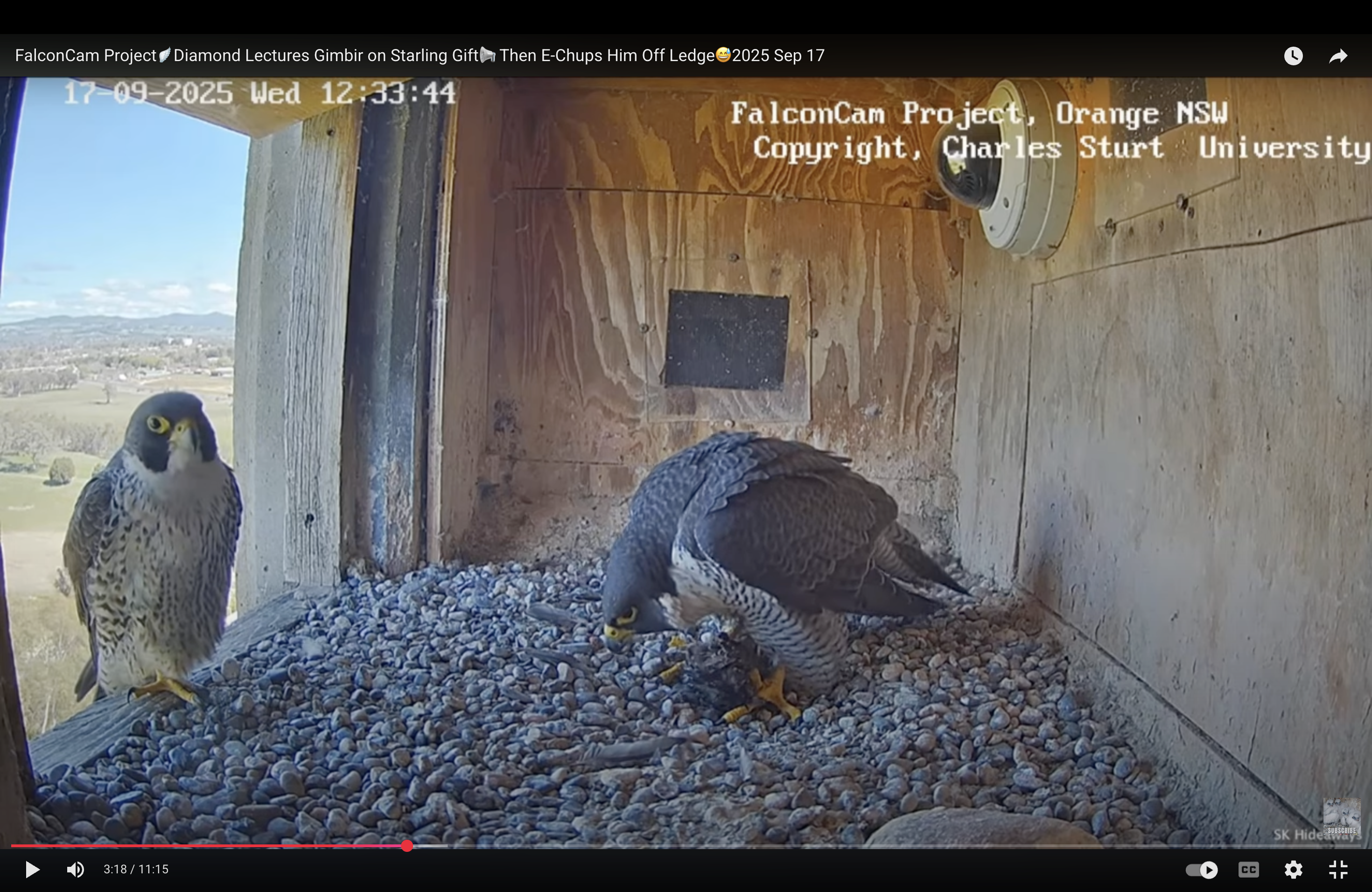
Girri is one of those great events from 2025. Having sobbed our eyes out with the loss of Xavier, we thought Diamond would not have any chicks. Then along came Gimbir, and well, everyone thought he was too young and inexperienced to be a Dad. Well, were we wrong? Diamond and Gimbir gave us one heck of a strong female falcon, and here she is flying above the trees near the tower! https://youtu.be/ECUH1DwWGao? It just doesn’t get much better than this at the Charles Sturt University Falcon Cam project.
It’s not a raptor… but this is a story everyone should know about. China has footage of a Wild Siberian Tigress with five cubs in Hunchun. Northwest Tiger and Leopard Park. This is thrilling news! They normally have 2-3 cubs so five is rare and is a great conservation success. Here is the link to the video: https://youtu.be/JaSsbkfC5N4?
The BBC reports, “Five Siberian tiger cubs have one very proud mum – she’s the first ever tiger known to have given birth to quintuplets in the wild in China.
The family have been spotted in Northeast China Tiger and Leopard National Park, which is one of China’s first five national parks and covers over 14,000 square kilometres – that’s around the same size as Northern Ireland!
It’s very rare for Siberian tigers to give birth to five healthy cubs, so it’s a big success story for the park, who say it’s likely that mum had the cubs back in June.” (27 December 2025)
It is all good for Beau and Gabby at NE Florida.
The AEF captured Gabby feeding Beau who then fed the eaglets with the food. How cute was that?
E26 is a massive eaglet. Want to bet we have a strong female here for M15 and F23 this year? Thermal down. Pin feathers. And quite enough food and more than enough love from Mum and Dad.
What a little cutie – the other only – at Captiva for Connie and Clive.
R9 and R10 are just adorable. Ron and Rose are doing a fantastic job at Dade County. Life is looking good!
One of my favourite all-time books about a human being changed by an encounter with wildlife was Raising Hare. Here is an incredible story about a Japanese island inhabited by Hares! Can I put it on my bucket list?
Time for Toby’s last medication. Oh, my dear darling little man. The sheer idea that I could have lost you is beyond my comprehension.
This week, I learned two significant things I would like to share with you, in the hope that one or both might help you in the future. If you know of anyone whose behaviour radically changes, from calm to agitated, please get them to the doctor to check for an infection. If you know or suspect they cannot pass urine, do not be shy about stating this. It is critical. Secondly, if you see any blood, watery or otherwise, in your pet’s vomit or diarrhoea, rush them to the vet. Do not sit around and twiddle your thumbs, I mean, rush. Toby’s life was saved because of quick action on my part and that of Dr Maryam.
Thank you so much for being with us today.
Thank you to the owners of the streaming cams that let us glimpse the breeding seasons of our wonderful raptors. Without them we would never see the joyful moments shared by these parents and their chicks! I would also like to thank The Guardian for their constant reporting on issues about wildlife. Thank you Holly Parsons or that great capture, to Cilla Kinross for her post and to the China Daily for its story on the Siberian Tiger.
Tuesday was a wonderful day to go to the zoo. While Don was walking and soaking in the fresh air, Toby and I were walking in the neighbourhood. Toby got soaked. The 4 °C temperatures melted the snow, creating lots of fun puddles. When we got home, I quickly warmed a couple of towels in the dryer and rubbed and rubbed, hoping Toby wouldn’t catch a cold. Almost as soon as we got in, it began to rain, and snow, and the wind picked up. Now they are saying a significant winter storm will hit us on Thursday. This year, the forecasts have been pretty accurate – a considerable change from past years. It lets us plan so we don’t have to go out for provisions at the last minute.
And here it is, Wednesday afternoon, with freezing rain, and, of course, a massive blizzard coming within the hour. We might get 20 cm of snow with up to 90 kph winds. It isn’t going to be much fun.
So many of you have asked what we are doing for Christmas. This year is a considerable change. First, I am NOT cooking. Our son is coming from the West Indies next summer and we will see our daughter and family after the holidays.
Over the holidays, we are babysitting my best friend’s huge dog, Nellie. I often say that Nellie is the size of a small Shetland pony. Toby adores her. They have been best friends since Toby came to us at 8 weeks old. It is hard to believe he was so tiny, and today, he is long and tall and is nearing the average weight of Miles & Mia’s puppies – 25 lbs! That is big for a Cavalier.
This is Toby wrapped in his favourite blanket after our long walk.
Toby’s friend, Nellie, who will be staying with us for Christmas.
Ellen will walk Toby and Nellie twice every day except for the 24th, the 25th, and the 26th. I have a very secure back garden and the two of them will be able to romp and play.
I have not decorated the house except for the Eucalyptus garlands over the French doors and the front door. Oh, there is a wreath on the exterior doors, front and back. Why? Toby eats anything in sight. The Girls won’t leave the ornaments on the tree and many have polyester stuffing – that would send a ravenous dog to the vet for surgery! We will have our usual roast chicken and, of course, one chicken will be roasted plain and shared with all the animals. The birds and squirrels as well as Brock will get special treats – and believe me, that will make my heart festive. I hope they enjoy the baskets we prepare for them.
‘L’ has reminded me of something that I have seen briefly. (I do not watch the news. I find it just too overwhelming.) This is the Barred Owl cull.
I asked Google and this was the response, “The barred owl cull is a controversial U.S. Fish and Wildlife Service (USFWS) plan to lethally remove hundreds of thousands of invasive barred owls in the Pacific Northwest to protect the endangered spotted owl, which they outcompete for food and territory.This strategy, approved for implementation starting in 2025, involves sharpshooters removing barred owls in designated zones to allow spotted owl populations to stabilize, though it faces ethical and practical opposition.”
Some of the story in The Guardian reads: “The US Senate rejected an effort on Wednesday to halt a contentious US Fish and Wildlife Service (USFWS) plan to kill nearly half a million barred owls in order to save their cousin, the northern spotted owl.
John Kennedy, the Republican senator from Louisiana, had hoped to block the proposal by bringing the matter to a vote with a joint resolution under the Congressional Review Act. The effort failed with 25 votes to 72 votes.
“The barred owls are not hurting anybody. They’re just doing what nature teaches them to do. We’re going to change nature?” Kennedy said in a speech before the Senate. “We’re going to control our environment to this extent? We’re going to pass DEI for owls?”
Barred owls have been expanding their habitat west, increasing competition for the spotted owl. The more aggressive barred owls come from eastern North America and are slightly larger and better able to adapt than the spotted owl. The spotted owl has been imperiled over the years, facing major habitat loss as logging and development destroyed old growth forests in the Pacific north-west.
The USFWS introduced the controversial plan to cull as many as 450,000 of the raptors in designated areas in the Pacific north-west during Joe Biden’s administration, arguing that barred owls pose a “significant threat” to the survival of the spotted owl. Under that management strategy, two trained individuals must positively identify barred owls and “removal specialists” will shoot the animals.”
Please learn more about these measures, and if you feel inclined, write to your political representatives, even if you think there is no hope. While I support intervention when our raptors need help, I do not support human intervention in managing species numbers. I find all of this quite disgusting, and it just underscores so many issues that are being mismanaged.
Raptor Persecution UK is reporting that three White-tail Eagles with satellite tags on them have disappeared in very suspicious circumstances in the UK.
The news of the day is that M15 and F23 have a pip in one of their eggs. I am over the moon eggcited.
It is day 35 for Ron and Rose’s first egg at Dade County. It looks like SW Florida might be the Winner.
Girri is still with us. Just. It feels like she is going to go today. She is a big strong falcon looking at the world that she will own. What a great joy to see a strong female chick hatch at this scrape.
Thank you for being with us today. Please take care. See you tomorrow!
Thank you to the authors of the FB posts, the owners of the streaming cams, and The Guardian. I am extremely grateful for the investigative work of Raptor Persecution UK. Bird World would not be the same without you!
I am sending this out Sunday evening as Monday morning is going to be a little hectic. Enjoy!
It is -17 C on the Canadian Prairies, and Brock is at the feeder for the fourth or fifth time today! It was much colder overnight, and he really needs a lot of food – like the birds – to survive.
Brock was the subject of our neighbourhood FB chat. It worried me because I am so afraid that someone is going to get him trapped and take him to our humane society. They would euthanise him as he is not ‘socialised’ with no hope for adoption, even though he has survived outdoors, alone for at least four years, and is much loved.
Several feed him, and we might have even found his bolt hole – a small house with an opening under the porch, either into a crawl space or the basement. No one lives in the house, and eventually it will be torn down, and one of the new ‘infill’ houses will go in. I hope this takes years.
Calico will not wear a parka, but she sure likes sleeping on something soft. She is looking out the window at Brock. Is she his mother? Or his friend, who was also dumped at the same time? I will always wonder.
There is news in Bird World – and that is what I am supposed to be writing about today!
Mum and Dad put in appearances at the barge in Port Lincoln, South Australia, on Sunday. Mum was in the nest, and Dad was in his cave. It is so lovely to see them after the nest failed this year, when Mum abandoned the eggs. There have been other visitors – Ervie has been at the barge nest along with Calypso and friends.
Mum and Dad are looking quite well. I wonder if they have returned to the nest to check and see what their kids have done while they were away?
Diamond and Gimbir’s daughter is getting huge. Girri has turned out to be quite the character.
The necroscopy on SE36 has been released.
Thank you to SK Hideaways for their great videos of the week:
SK Hideaways Videos, week of 30 November 2025
Channel Island Eagles Courtesy Institute for Wildlife Studies, explore.org Two Harbors: Supermoon 🌕Chase ❤️🔥Sunset 🌅 Life is Good explore.org 2025 Dec 5
Cam ops captured the last supermoon of 2025 as it set over the hills. Chase soon arrived with a nice, big stick to continue shoring up the nest rails. We got a nice close-up of the nose bling he’s sporting at the moment. Later, he was found on his and Cholyn’s sofa, while Cholyn remained incognito. Finally, a stunning sunset capped off a lovely Two Harbors Day. (2025 Dec 5, 6:17-16:40)
Girri Gets as Close to Diamond as Possible ~ Precious Mum-Daughter Time (2025 Dec 6)
Girri couldn’t get enough of Diamond during this long visit. She got as close as she possibly could, nibbled Di’s talons, her feathers, and took a little nap with her. A sweet scene between mother and daughter.
Girri Sleeps in Mock Yogi Pose ~ Then Gravity Takes Control (2025 Dec 5) There’s something incredibly addictive about watching birds sleep ~ especially big, fluffy falcon chicks. Girri took the captivating, adorable slumber fest to a new level. Bonus: dancing around the egg and huge wingers. Video: https://youtu.be/dC31StjFAxs
Girri Grabs Whole Prey from Diamond 🍗 Mantles, Tries to Self-Feed🍽️(2025 Dec 4) Diamond brought Girri a large breakfast, which Girri was eager to consume. The chick grabbed the prey, pulled it away from her mum, and attempted to self-feed. Her fluffy mantling of the prey was a little comical, but she persisted. Diamond patiently waited 12 minutes before taking over the feeding. Once Girri calmed down, she realized that this was a more efficient way to eat. In the end, Girri had another huge crop, stretched to show her magnificent height and wings, and ultimately gave us a selfie on the Cilla stones. Another milestone completed. Video: https://youtu.be/CbDNoL_XujU Courtesy FalconCam Project, Charles Sturt University NSW
Jackie & Shadow Begin & End Day in Song🎶➕Nest Bumps, Nibbles & Beakies🥰 (2025 Dec 1) As nesting season begins, there are more visits from Jackie and Shadow, and the most glorious serenades, filled with chortles and snortles galore. Today we got those gifts as well as body bumps, tail nipping, beaky kissing, and a sleepover in the Roost Tree. Welcome back, Jackie and Shadow! Video: https://youtu.be/Z9lSEHWL2yY
Jackie & Shadow Defend Nest 🪹 Juvenile Chooses Bad Time to Visit 😬 (2025 Nov 30) Jackie and Shadow were doing nestoration chores when a beautiful juvenile decided to stop by for an uninvited visit. Shadow karate kicked the young one away from the nest and Jackie delivered her one-two kick from a basement branch. She then appeared to follow the juvie, likely giving her one more piece of her mind before returning to perch on the Lookout Snag. Shadow remained in the nest a while longer. This defensive behavior is a good indication that nest restoration had begun in earnest. Video: https://youtu.be/0nMw_5DvSlk
At the Central Florida Bald Eagle nest of Pepe and Muhlady, there is a hatch. Congratulations! This nest has been the first to have hatches over the past few years. Next should be M15 and F23.
Raptor Persecution UK is following several stories including the shooting of a peregrine falcon in Derbyshire and a halt to international trade in falcons by downgrading their status.
Thank you so much for being with us today. Please take care of yourself. Looking forward to having you with us again tomorrow!
Thank you to SK Hideaways for their videos, to the authors of the FB posts and the owners of the streaming cams that allow us to witness the lives of these beautiful birds. Thank you also to ABC and their Bird of the Week highlights and The Guardian for their wildlife stories.
It says Monday, but it is actually late Sunday night.
I hope each of you had a lovely weekend. We had snow and ice, and it wasn’t all that wonderful, but it warmed up today to 1°C, so some of that treacherous ice has melted. Thank goodness! The garden animals have been very busy, and on Saturday, there were so many European Starlings that it was completely impossible to count them. Oh, they are lovely birds. Our friend Geemeff was here to see them, and they noticed that our Blue Jays are much brighter in colour than those in the UK.
Heidi has sent me the most informative presentation on the issue of the ospreys in the Chesapeake. It is worth sharing with everyone who cares about the destiny of our fish hawks in that region.
Heidi writes: “This was a very informative presentation about the decline of ospreys around the Chesapeake Bay region. It includes some general osprey educational information, then at around the 49 minute mark, they start to talk more about the decline of ospreys, and specifically as it relates to industrial fishing of menhaden. It is a long video (2 hours), but I watched it in 15-20 minute increments over a couple of days.”
SK Hideaways Videos for the Week of 2 November 2025
All my videos stem from my love of raptors. My mission is to inform, educate, and entertain viewers. I have never and will never monetize my videos. They are purely a labor of love that give me great joy to share with anyone kind enough to view them. Much gratitude to Mary Ann Steggles for bringing my videos to you.
367 Collins St. Falcons, Mum F24, Dad M24, and 3 chicks
Morning Shenanigans More Vigorous & Daring. NEW ~ Louvre Perching (2025 Nov 7)
As fledge nears, the chicks are more active and even a little twitchy, especially first thing in the morning. Their wing exercises are more vigorous, their gutter stomping louder and bouncier, and all of this happening more often on the ledge. Today, one sister made it to the louvre ~ another milestone.
Chicks Take Self-Feeding Seriously ~ Give Mum the Boot (or Beak) (2025 Nov 7)
The chicks were all over mum F24 when she delivered breakfast a little later than they would have liked. They needed no help devouring every last morsel and then gave mum the heave-ho when she stopped by for leftovers.
SE36 FLEDGES✈️ Follows SE35 to Dad’s Perch🌲 and Back Again🎉 (2025 Nov 7)
SE36 had a beautiful fledge, flying to Dad’s perch tree to meet SE35, who flew moments before. The eaglets were frisky and lively all afternoon ~ seemed like they were planning SE36’s fledge along. After an exhausting day, the siblings pancaked in the nest overnight.
SE35 Leaves Nest for 2-Hour Exploration ~ SE36 Remains on Sentry Duty (2025 Nov 6)
SE35 took to the forest for a 2-hour exploration of the habitat. SE36 was content to keep an eye on things and simply look stunning. When SE35 returned, all was well between the eaglets and they simply got on with their day.
Gimbir Watches Diamond Feed Chick #1 from Cilla Stones 🥰 (2025 Nov 7)
Gimbir continued his on-the-job training after delivering one of many meals. While he typically flees after deliveries, this time he perched himself on the Cilla stones and watched Diamond feed his first born. It was one of the most heartwarming displays I’ve ever seen.
Gimbir Brings 3 Starlings in 9 Minutes ~ Chicks Gets First Meal (2025 Nov 6, 6:01-6:29)
Gimbir showed his paternal chops, delivering a significant bounty to the nest for the 17-hour-old chick and Diamond. His 9-minute hunt reaped 3 starlings. Wonder if Diamond was impressed as we were.
Gimbir Meets His Very First Chick ~ Moments of Puzzlement Ensues (2025 Nov 5)
Gimbir seemed somewhat perplexed to see a fluff ball where there used to be an egg. While he hasn’t yet learned the subtleties of fatherhood – or even the not-so-subtleties, he will do so in time. Here we look at his first two visits with his very first chick.
FIRST HATCH for Diamond & Gimbir ~ From Pip to Hatch in 7 HOURS (2025 Nov 5)
Diamond increased moving and shaking of the eggs as she likely detected a pip and heard at least one chick. Chick #1 was motivated to see the world! The video shows progress from pip to hatch over 7 hours
Shadow then Jackie Make Pre-Season Nest Visits🪹Rendezvous on Roost Tree🌲 (2025 Nov 3)
Adult visits to the Lookout Snag and Basement were gifts enough. But then, Shadow and then Jackie each visited the nest. Shadow brought 2 sticks with Jackie following a bit later to inspect the still messy nest. It’s pre-season time, so every visit is an extra special gift. The cherry on top was Jackie and Shadow’s rendezvous on the Roost Tree.
Cholyn & Chase Do Major Nestorations with Massive Sticks (2025 Nov 3)
Cholyn and Chase continue shoring up the rails of the original nest, bringing in massive branch after massive branch plus soft material from the fluff factory. Typical disagreements about what furniture should go where are quickly resolved. They depart the nest at the end of the video, flying away to their secret hideaway. Listen for the beautiful chortles.
It continues to be possible that the falcons Gimbir and Diamond at the Charles Sturt Falcon scrape in Orange will only have one eyas to care for and what a lucky little fluffy white ball this one is if that is the case!
This little one is seriously adorable.
Cilla Kinross wants to name this little cutie pie. Here is the information – please vote noting that you can select up to three names but no more or your vote will be discarded!
While the little one at Orange has not even had its beak change colour, the trio at Melbourne’s CBD falcon scrape at 367 Collins Street are preparing to fly. Almost all of the dandelions have disappeared and they are enjoying watching their parents fly through the CBD luring them into a life away from the scrape. Soon! Too soon, of course.
Every year we wring our hands with worry around the fledging of the sea eaglets at Sydney. It is the Currawongs. Despite those pesky birds attacking our fledglings, Lady and Dad are persisting in feeding the eaglets on the nest and today on the branches of nest tree – Ranger Judy Harrington says this is a great milestone. In all the years I have watched this nest, the adults only fed at the nest or down by the River Roost. No doubt these feedings will keep the fledglings strong, strong enough to beat those pesky birds so that they can learn to hunt from Lady and Dad and live a marvellous independent life – both of them. No more starving sea eaglets on the pavement by the Discovery Centre taken into care — let’s hope! So happy.
‘A’ sends us their commentary from Melbourne: “Dear Mary Ann,
I presume you have seen this footage, but in case you hadn’t, I thought I’d send it to you:
It’s almost as if the two eaglets following each other and appearing to play together is giving the younger sibling confidence. It certainly looks like that (okay, I’m anthropomorphising but you have to admit, it does appear that way.)
Let’s hope this year will be different. Certainly, the pre- and post-fledge behaviours have been somewhat different this year, and the confidence of both eaglets may be greater when it comes to insisting on their right to exist in that forest. I have a lot of confidence that this is going to be the year that the eaglets manage to thrive despite the currawongs. If they work to some extent as a team, they will surely have a better chance. Let’s hope my completely irrational belief is based on something real.
The three at Collins Street are such a noisy and energetic rabble that the parents just dump food and flee. Meanwhile at Orange, Gimbir continues to observe and learn. He still has not done a feeding but I’m sure he will try soon. Meanwhile, I believe I was right about the egg that hatched being the last one laid. Certainly, it was the one with the least colour. But whether or not I am right about that, I don’t think either of the two remaining eggs is going to hatch. At this stage, I have enough confidence in Gimbir’s hunting to have stop fearing a second or third hatch, but I don’t think we’re going to have one.”
M15 is undoubtedly a handsome eagle, and he is working hard with F23 to prepare their SW Florida nest for eggs. Mulhady and Pepe already have three at Central Florida – they always seem to be the first!
I have a soft spot for the NE Florida Bald Eagle nest of Gabby. Like so many of you, I adored Samson, but it appears that Beau is rising to the occasion, and let us hope that they have another fledgling this year! They are sure working on that nest.
Eagles at the US Steel nest.
They are working on the Decorah North nest in Iowa!
And at many other nests including Fraser Point on the Channel Islands.
There are ospreys visiting the Captiva Osprey nest on Sanibel Island! They came and went before I checked on the nest. The chat is very informative and Window to Wildlife has a daily log – the link to it is in the chat. This is a new osprey couple it appears.
Jack and Jill have been at the Achieva Credit Union nest in St Petersburg, Florida. Concerns persist regarding the structure, with worry that eggs and/or chicksmay fall through.
The environment remains on all of our minds. As much as we try to avoid plastic, it is almost impossible to do so. What a mess we have made of things! The Guardian brings us up to date on just one of the major disasters brought on by plastic.
Our local wildlie rehabilitation centre, Wildlife Haven is really busy. Lumi the rare lynx cub is now doing much better after refusing to eat. Now they have a Bald Eagle in their care.
Anyone reading my blog is aware of the dangers posed by lead to our beloved raptors. We must continue our fight to halt the production of lead ammunition, as well as lead in all types of fishing gear. Please raise your voice to ban this deadly substance any time you can.
How much do you know about Great Grey Owls? There are some lovely close ups of nestlings in this documentary by Our World.https://youtu.be/OVE3UzyvEIc?
From everyone in my family to yours, we hope you have a truly wonderful week. We look forward to you being with us again next Monday. Here are some recent photos of Toby and his sisters and a few of the garden animals that add so much joy to my life. Indeed, I cannot imagine a day without them despite all the work they create.
Toby is modelling his new turtleneck sweater. Toby is going to need a miniature closet soon.
Hugo Yugo looking beautiful in the golden light of sunset.
Baby Hope – the sweetest and most shy of the bunch.
The mysterious Missey.
Lovable Calico.
Mr Crow waiting his turn in line to get a peanut.
Brock trying to hurry and eat his roast chicken and ham before Toby finds out he is outside! As everyone knows, Brock is a true survivor. He has lived for five years outside on his own. He won’t come in the house and is very weary of being ‘trapped’ in fancy heated houses for winter. So, we simply love him, respect what life has thrown at him and what he is used to, and make sure he gets at least three large tins of food and fresh water every day.
One of five grey squirrels.
Do you know what the national bird of Canada is? Have a good read and celebrate the American Bird Conservancy’s Bird of the Week!!
Thank you to A, Heidi and SK Hideaways, to all the owners of the streaming cams that give us a glimpse – a great privilege – into the lives of our favourite raptors, to the authors of Facebook posts that keep us up to date on the nest happenings, and to papers such as The Guardian that continue to carry the environmental story. My blog would never be the same without their contributions. I am very grateful!
It is Thanksgiving Day in Canada, and I have so much to be thankful for, including all of you. Over the years, I have appreciated your letters, your support, the stories about your pets and the wildlife that come to your gardens. You give me hope, and as Jane Goodall says, we need hope to do our part in making this planet better. We cannot rely on anything or anyone other than ourselves. Just imagine if every person on this planet cleaned up their own patch and took care of the wildlife in their surrounding area – well, imagine. We would have wetlands, no one would be shooting raptors, injured birds would be taken to get help, songbirds would be fed, and there would be large green spaces that could connect, providing the wildlife with a greater area. We would stop eating tuna and any fish caught by long lines that decapitate albatross! Plastic – gosh, darn it is so hard to get away from it – would not have a place in our lives. I know I am speaking to the choir – but we need to do everything we can to help from putting out water bowls, fixing windows so that birds do not collide with them in private homes and in high rise real estate, to collecting old towels and sheets, to making sure that unused pet carriers make their way to wildlife rehabilitation centres, and fundraising. Let’s get started!
We should start with a big smile – aren’t we all Birdwatchers? We are optimistic, joyful, passionate- all because of the birds. I certainly don’t mind being called eccentric, but is that the wrong picture? Let’s check this Guardian article.
SK Hideaways has been incredibly busy creating videos for us about our favourite nests! Please watch them. It takes hours to put these together, especially when commentary is added! If you click on the YouTube icon they will get credit for you watching and be sure to add a ‘like’!
SYDNEY WHITE-BELLIED SEA EAGLES
Sydney WB Sea Eagles: Lady, Dad, SE35 & SE36 (2025 Oct 13)
At just over 8 weeks old, SE35 and SE36 are active, curious, and hungry. They began their wingercise in the wee hours before Lady and Dad arrived to lead the family in not one, but two quartets. Dad brought two fish breakfasts in the span of two hours, which Lady doled out to the waiting beaks. They get more beautiful every day!
Courtesy Sea-EagleCAM@BirdLife Australia Discovery Centre, Sydney Olympic Park
367 COLLINS STREET FALCONS
367 Collins Street Falcons: Mum F24 and Dad M24 (2025 Oct 12)
At 10, 11, and 12 days old, the chicks are grabbing for food with more gusto and trying to do a little self-feeding. In 2 weeks time, F24 and M24 will be challenged to hold onto the prey long enough to feed them.
One chick snoozed a little too close to the edge of the nest and slipped into the gutter. While the chick didn’t mind its new location, Mum F24 certainly did upon her return. As she has done in previous years, she gently grabbed the wayward chick by the scruff of the neck and returned it to the nest, where she promptly brooded all three growing chicks (2025 Oct 9, 12:45).
FOBBVCAM Eagles: Jackie & Shadow Melodies and Visit Herald a Stunning Sunrise (2025 Oct 10)
Jackie and Shadow chortle-snortled the dawn away to greet a stunning sunrise, which they enjoyed from their Lookout Snag. During their first song, a mouse explored the nest, and in their finale, they invited a Steller’s Jay to join (though his tone wasn’t quite as melodic as Jackie and Shadows, in our opinion).
FOBBVCAM Eagles: Jackie & Shadow Visit 3 Favorite Perchesfor Date Night (2025 Oct 4)
Jackie and Shadow are enjoying their pre-season bonding activities. Tonight’s “date” took them to the Lookout Snag, the nest, and their Roost Tree. Lucky for us, they let us come along for the ride.
San Jose City Hall Peregrine Falcons: Hartley & Monty (2025 Oct 6)
Hartley and Monty met up for some early morning bonding, which included scraping in the nest box, a short bowing session, and preening their mid-molt feathers. Grateful they hang around all year long.
West End Eagles 🦅 Akecheta Visits Nest AND Night Perch ~ Haku Joins Him (2025 Oct 10)
We were grateful enough to witness Akecheta’s return to the West End territory on 24 September, having not seen him since the previous January after a vicious territorial dispute. But today, for the first time, he visited the nest he and Thunder tended and shared with their eaglets. He then retired to his old night perch – causing fans far and wide to reach for their tissue boxes. The bittersweet frosting on top was when Haku joined him on the night perch, though she did decide to take the lower bunk in the end. It was a heartwarming few hours here at West End.
Courtesy Institute for Wildlife Studies, explore.org
West End Eagles: Haku, Bob AND Akecheta Have Perch Party ~ Ravens Ride the Wind (2025 Oct 8)
Haku, Bob, AND Akecheta all gathered together to perch atop the West End overlook. They departed in order of age – Bob, then Haku, then Akecheta – but Haku and Akecheta met up later for a beautiful soaring display in the late afternoon. The ravens struggled with the wind gusts as they tried to land on the hilltop.
Courtesy Institute for Wildlife Studies, explore.org
West End Eagles ~ Haku and Bob (today anyway) ( 2025 Oct 7)
Bob really seems to want to be Haku’s BFF, so he performed showy aerial displays and perched as near to her as he dared ~ 3 times. She seemed to respect his efforts and let him sit nearby, except once when she wing slapped him away. Bob is too young to be looking for a mate, so it will be interesting to see how this friendship plays out.
The big story at the moment is the concern at Port Lincoln that there could be issues. Fran Solly reported that Mum was off the eggs for many periods of time in excess of 45 minutes. Dad had not brought in fish – and then he did. Are we worried about Dad? Yes, of course. He is not a youngster and he has had visual seizures on the nest. He is not always getting fish to the nest but it is unclear what the issues are – is he losing his catches to other raptors or gulls? Possibly. Are there other problems? We can thank Fran Solly, Bazz Halliday and Janet Forster for lobbying the South Australian government to get permission to supplement the fish brought to the nest, if necessary. This is the reason for the survival of the chicks over the past what? Three years? (or is it four – time flies too fast).
To put this in perspective, we are nearing hatch. The temperatures were around 17 degrees C. Mum should be hearing the chicks. A few years ago, Milda, the White-tailed Eagle whose nest is in Durbe County, Latvia, left her eggs to go and get food for more than five hours. The temperature was 7 degrees C. To everyone’s shock, the two eggs hatched. The chicks did not survive because the male failed to provide food for Milda and them. But they did hatch!
Mum is tight on the eggs.
Helen Matcham caught some great screen captures of the 367 Collins Street Melbourne trio, who are now getting lots of pin feathers! These triplets have the best Mum who actively keeps them safe.
‘A’ sends us her commentary on what is happening in the Australian nests: “There appears to be a female intruder at Orange – she is large (as tall as Diamond), with long legs and not much orange on her beak or feet. Gimbir and Diamond should be able to defend their territory, but we all know this is not what is needed at this scrape (although it is possible that this could bond Diamond and Gimbir tightly and quickly, as the ‘you and I against the world’ scenario can tend to do in humans and in animals/birds).
In good news at Orange, Gimbir is learning to deliver prey to Diamond. This of course is hugely important to the potential success of this scrape this season, as we all know. So today was an action-packed day for our falcons, despite their apparently idyllic surroundings. Some time stamps from today: 10 Oct BONDING 06.07.48, 09.06.24 Gimbir incubates 08.56.24, 09.51.46, 13.28.05, 17:06:03 PREY 09.51.26 G in, D takes, 13.20.06 G in, D takes WATCH 14.12.59 Intruder. Note that Gimbir brings prey to the scrape for Diamond TWICE today. This is a great improvement. We do know that he is trying to please her. And we also know she is not at all reticent about giving instruction. So we have to hope he listens, understands and obeys.
At Collins Street, there was a rumour yesterday after dad disappearing, but he brought in a very large prey item (?pigeon) late yesterday and mum fed the trio a huge dinner. I haven’t personally seen him today but then I didn’t watch the entire day so would not have heard any offscreen vocals from dad. Mum twice went to the pantry and brought back large chunks of food for the littles – the three are all eating well and appear to be getting plenty. No chick is missing out and all three crops are filled several times a day. But I cannot say I saw or heard dad on camera today.
The midday sun is starting to get really hot – yesterday, one of the chicks managed to scramble along the edge between the scrape and the window and then fall/slither into the gutter while mum was away, and when she returned, she was not pleased and tried to grab the little adventurer first by the crop (at which the chick protested loudly) and eventually by the back of the neck, hauling the escapee back into the scrape without incident.
As I suspected, she has an excellent technique for sheltering all three from the sun, when she is there. However, she has been leaving the trio in the noon sun quite a bit, though she presumably knows what she is doing. The breeze may be enough – temperatures are in the low 20s so far, so hopefully by the time things get really hot, they will be able to head off to the shaded end of the gutter under their own steam. Ah, how I miss the patter of tiny feet gutter-stomping at Collins Street.
At WBSE, the adults have resumed morning mating. Why, I wonder. Are they considering a second clutch? Feeling a bit of empty-nest syndrome as fledge approaches? Or just feeling friendly and frisky? (Do birds mate for enjoyment or for bonding or only when they’re fertile, so just for procreation?)
Here is today’s ranger summary, with Al’s edits and additions (look at how very grown-up the littles are in the photo- you can see what a glorious day it was today on the southeast coast of Australia, though down in Melbourne, that sun was a reminder that mum laid at the wrong end of that ledge – again):
October 10: The whole family welcomed the day with a morning chorus – adults mating and then heading off. Both eaglets were self-grooming and stretching after the night on the nest. Just after 8am, Lady brought in a very long stick, nearly knocking SE35 off the rim. She then struggled to place it just so. Mid-morning on a lovely day and Lady was sitting nearby – waiting. She brought leaves – then flew off. By 3pm, the eaglets were still waiting for food, with SE35 passing the time by flapping somewhat alarmingly on the front rail. At 3:15pm, a currawong was swooping the pair on the nest. They’re not even waiting for fledge this season and are beginning to attack the eaglets early. The wind increased in the mid-afternoon, but just before 5:30pm, one of the adults was seen down on the river. Lady came in at last with a bird – both eaglets were fed, then they both self-fed on scraps in the nest, including the bony bits. Lady took some off herself to feed on as well.
So it was a very lean day for the eaglets, with just one meal for the day, and that one piece of prey was also shared with mum. I was also disheartened by the boldness of those currawongs, who aren’t even waiting for the eaglets to fledge to attack them as they do every year. If you listen carefully to their vocals, it almost sounds like they are squawking “currawong, currawong” (or is that just me).
Tonight, they are snuggled on the nest, side by side, like a couple of loaves of bread. The wind has eased since this afternoon, and the nest seems almost still in the tree branches. I cannot see an adult on the perch branch but I’m sure one or both parents will be somewhere close by.
At Port Lincoln, dad brought mum a headless fish just before 1.30pm and a whole fish at 7:52pm (it’s daylight saving in Australia, so it’s not dark at that time even though it should be). The three eggs are being well cared for, and with 38 days the average incubation period for ospreys in South Australia, we have to be expecting a hatch in about two or three days, assuming the darkest-looking egg is fertile.
I am often surprised that people are unaware of how to tell which egg was laid first and which was last – as I’m sure you know, the colour is ‘added’ as the egg is laid, and there is less and less colouration with each subsequent egg. So the first egg laid will be the darkest or have the darkest patterns, the next egg progressively lighter colouration and the third egg the lightest of the three in colour. Meaning the darkest of the three eggs was the first one laid and, if fertile, should be the first egg to hatch. Exciting times. You must be thrilled to be so close to hatch watch – within a week, you could have three osplets learn how to bonk each other at Port Lincoln. Oh joy! “
Thanks, A.
We are falling in love with Gimbir. He is the cutest little falcon – and he is learning about his new mate, Diamond, who doesn’t like Starlings and who doesn’t give incubation time up freely!
At the WBSE nest in the Olympic Park in Sydney, SE35 and 36 are really winging it.
We love Akecheta. We worried he would get injured again, but it appears that he has consolidated his territorial reign and is back on the West End nest with Haku (sadly not Thunder) in the Channel Islands. SK Hideaways has it on video: https://youtu.be/IQ1oVrZMbXc?
Androcat caught F23 testing out the nest bowl at the Southwest Florida Bald eagle nest in Fort Myers.https://youtu.be/NQ8TErSndlE?
Beau and Gabby have been building up the rails at the NE Florida Bald Eagle nest south of Jacksonville. Just look at them working together so well.
It is the middle of October. Will we have eggs in a month at one of the nests? All of the eagles are returning and working on their nests including Ron and Rose at the WRDC in Dade County, Florida.
At least one osprey has been seen on the Captiva Osprey Platform on Sanibel Island, Florida. Window to Wildlife has both streaming cams up and running, so check in on Clive and Connie and the ospreys thinking about that nest. Perhaps this year we will have osprey chicks again.
The Trempeauleau Wisconsin Bald Eagle nest is streaming again after the magnificent year with Mum raising TE3 alone! Thank you Ai Ryn.
Raptors need our help – saving their habitat so they have food and much more, including rodenticides and window collisions. What can you do around your home and neighbourhood to make sure that birds are safe?
Ever heard of a Lava Gull? If not, check this out as it is the American Bird Conservancy Bird of the Week!
Smile. The 2024 fledgling, Marina, is still on the nest with Mum hope and her two siblings (now fledglings) from 2025. George is out fishing!
If you are asked if fledglings from a previous year can help their parents raise a clutch, the answer is yes, and the proof is the 2025 brood at Osprey House Environment Centre, Australia. This was a great educational experience and solidifies my belief that if raptors cooperate, everyone wins.
I am thankful for all of the animals in my life and all of the garden birds that come each and every day in search of food. It is no secret that my Dad was a huge influence on me. He loved animals – cats, dogs, and the birds that came to our garden to eat out of his hand when I was a child. We had a three-legged dog – Trixie did everything any other dog could do. My father believed that animals were capable of almost anything and they brought him great consolation as mine do for me. I had many ‘farm’ animals on my small holding but as far as pets it was always cats. The Girls, the four of them, were here long before Toby. I certainly never want to dismiss their presence and the gifts they give to me – sitting patiently during story time every evening with Calico ‘walking out’ if the book is boring. Yes, she still does that and much of the latest pile has been ‘boring’. Toby has a huge basket of toys. Many of them belonged to The Girls. He has ones that we play fetch, ones that squeak, and the ever present tug-o-war ones with long ropes. He barks with the dogs on the telly or in the neighbourhood and goes wild if he thinks Brock is anywhere in the garden! Many of you are pet owners and you might find this article interesting:
There is at least one reported Osprey in Nova Scotia, Canada. Not ready to migrate yet – .
It must be love – Hugo Yugo and Toby.
A typical evening with Toby and Hugo Yugo before they fall asleep.
Thank you so very, very much for being with us today. From The Girls, Toby, the garden animals and birds, Brock, Don and me – we wish you a lovely ‘Thanksgiving’ even if you are not Canadian! Take a pause, close your eyes, and think of all the joy and those you are thankful for – and tell them! Don’t wait. We will look forward to having you with us again either next Monday or when there is hatch at Port Lincoln!
I want to extend special thanks to SK Hideaways for their videos and to ‘A’ for their insightful commentary on the Australian birds they love so much. Thank you to the individuals and owners of streaming cams, as well as those posting for various FB groups listed in Bold. The Guardian continues to publish informed articles on wildlife and the environment.
Today is an excellent opportunity to give them a big round of applause for keeping us informed. It is impossible for me (or anyone) to keep on top of what is happening at each of the individual nests, and I know that my blog would not be the same without their incredible talents. The fact that they share these with me so I can pass them along to you warms my heart and tells me immediately that there are more ‘good’ and ‘caring’ people in the world than not. So, thank you.
The leaves on the trees in the garden are primarily on the ground. We can now see into the previously hidden back area that was obscured during the summer. Brock continues to sun himself on the farthest woodshed. He is cautious now to let me see him when he comes to the deck for food, preferring to grab my attention and hide under the highest decking, waiting to be sure that Toby is not about. Toby ‘guards’ the territory. It is unclear whether he believes he is a cat, like The Girls, but he decidedly does not like any other animals in the garden, including Mr Crow and Mr Blue Jay. Of course, they pay him no mind. Tonight, Hugo Yugo and Toby are curled up in the small dog bed with HY holding Toby’s head firm and washing and washing his neck. I do think they ‘love’ one another in only a way that they understand.
We have experienced torrential rain and storms, primarily characterised by heavy rain and strong winds. This summer, the province posted that we had only 1/3 the average rainfall – hence, all the wildfires. That has corrected itself. This is good news for all the trees and shrubs that require a lot of moisture before winter arrives. All of the trees and shrubs we planted this year are doing very well. The new Amur Cherry stands tall in the front garden while the Wisteria has wound itself around the stairs and is beginning to climb the side of the porch. I hope to post images of huge clumps of beautiful purple flowers one day. The debate is whether or not to bring the Jasmine plant inside. The problem lies with the aphids, and whether they will also infest the inside plants despite the cleansing and soil changes. The Coral Hibiscus (image near the bottom of the blog) is beautiful, but its flowers are toxic to pets. Although it will not be available for purchase, it can be given to someone who can care for it without harming any cats or dogs. Sometimes the first frost comes and surprises me, and that ends all the debate!
Next Monday is Canadian Thanksgiving. It is timed with the harvest and has nothing in common with the underlying motives for the American Thanksgiving in late November. Ours is more simple – a people grateful for the harvest. We will have guests that otherwise would not be with anyone that day. The Girls and Toby will be delighted for the attention.
We hope that you have been having marvellous times watching that terrific trio of fluff balls in Melbourne at the 367 Collins Street falcon scrape. What cuties they are. The female, F23, looks formidable. I would not want to mix it up with her.
Suzanne Arnold Horning caught Big Red on the Cornell Campus today, and it is always a pleasure and a relief.
The videos by SK Hideaways for the last few days with some new offerings:
Diamond & Gimbir Welcome Their Second Egg (1 Oct 2025)
Diamond laid her and Gimbir’s second egg 59-1/2 hours after the first. Her typical laying interval is between 50 and 60 hours. Congrats, Diamond and Gimbir!
Courtesy FalconCam Project, Charles Sturt University NSW
Gimbir Meets and Nibbles First Egg (2025 Sep 30)
In his first inspection of his and Diamond’s first egg, Gimbir did a good amount of nibbling of the shell during each of his 3-4 inspections. There was no obvious harm done, but Gimbir clearly needs a little daddy training, which is no surprise given his young age. He has performed well in all his other lessons, so we have high hopes for his paternal capabilities.
Courtesy FalconCam Project, Charles Sturt University NSW
Channel Island Eagles, California
West End Bald Eagles🦅Akecheta and Haku Sit Not Quite Side-by-Side on Tor (2025 Oct 2)
After Akecheta’s first visit a week earlier, it was unclear whether he was still in the area. Today’s visit left no doubt when he was positively ID’d sitting near Haku on the middle tor. While not behaving like good friends, Akecheta and Haku did seem comfortable in each other’s company. Only time will tell where this fascinating story goes from here.
Two Harbors Eagles🦅Cholyn & Chase Greet Day in Song🎶22 Years Wedded Bliss (2025 Sep 30)
Cholyn and Chase came together to watch the sunrise and greet the day with their melodious chortles. We never tire of watching this couple’s glorious splendor.
Dad Tries to Feed 5- and 2-Day Old Chicks Whole Prey (2025 Oct 5, 8:22:50)
When Dad M24 arrived with yet another meal for his family, Mum F24 was out. So he did what any super responsible dad would do ~ he tried to feed his chicks. Trouble is, the prey was bigger than the chicks. F24 returned and straightened him out, surely knowing he meant well. (2025 Oct 5, 8:22:50)
Chick #3 Peeks Out at Dusk ~ Makes Grand Appearance in Daylight (2025 Oct 2-3)
Chick #3 peeked out of its shell 2 days after its siblings, hatching in a fashionably late manner. Here we see its arrival at dusk and then its grand appearance the next morning.
Chick #2 Hatches ~ #1 Rolls Out of Nest with Excitement (1 Oct 2025)
Chick #2 snuck out in the dark of night, but dawn provided a grand entrance for the wee one. Chick #1 was so excited they rolled right out of the nest box. Mum F24 eventually rolled them back in. Another celebratory day for the Collins Street falcon family.
Mum F24 and Dad M24 Welcome 1st Chick! (2025 Sep 30)
Mum F24 was on incubation duty when chick #1 appeared from under her. Dad arrived 90 minutes later, seeming slightly perplexed about what to do now that one of his beloved eggs had become a squirming chick. After a bit of revelry, Mum and Dad got back to incubating #2 and #3.
“Forgot to send you this – it’s only about ten seconds but it is a fabulous illustration of (a) how these birds work as a team and (b) how incredible peregrine falcons really are – you must put it into the blog (I’m certain readers would be as impressed by it as I was): https://www.youtube.com/shorts/B8xQJaPB4tw.
Meanwhile, that pigeon Dad brought to the Collins Street ledge early this morning was humongous. Mum was already feeding the littles yesterday’s gigantic pigeon, which she had stashed in the pantry, so Dad dragged his new offering into the gutter and subsequently took it off, presumably to the pantry, which is on a floor (or the roof) above the scrape. Rain is forecast for this afternoon, which will bring Mum’s garage door technique into its own, as none of these chicks is yet able to thermoregulate (they have only natal down at this stage) I have zero concerns in that regard, as Mum is just magnificent at using her wings to shelter her chicks. The best I have ever seen in fact. I love this couple. Could you guess?
At 10.38, Dad brings in yet another pigeon (not as large as the last but definitely a decent piece of prey). This Dad is taking his new parental responsibilities extremely seriously. I don’t think these chicks are going to go hungry at this scrape. Ever. Good on you little Dad. What a partner he’s been for Mum this season.
At WBSE, SE35 is picking at leftovers while SE36 stretches its wings by practising this flapping business their parents seem to utilise to great effect. It’s being very energetic! Go SE36! Oh these two are growing up SO fast. The thought of losing them to their annual battle with the currawongs is worrying me more with every passing day. Lady and Dad have done their usual magnificent job of raising two gorgeous, healthy eaglets, only to have to abandon them to their fate and cross their talons, as it were. And yet they try again each season. I do wish we could get a GPS tracker on these fledglings to see whether any do disperse to an area where they can survive and hopefully breed. As it is, we can only guess (and hope).
At Orange, the ultimate cougar peregrine (Diamond) is incubating her two eggs. Gimbir has done some incubating this morning – he is learning by the day. Here is the summary of the falcons’ activities so far this morning (the time stamps refer to the box cam rather than the nest cam or the tower cam): 3 Oct BONDING 4.47.57, 05.29.55, 05.53.51 (Incubation G 5.05.19, 06:26:19, 7.19.40, 8.30.49)
I think Diamond will whip him into shape very quickly – it’s fascinating to see what instinct drives him to do. He seems to have a very good idea of what he needs to do with these strange things in his scrape but he understands their importance and may even be getting some idea of what’s inside them. But of course we can’t know that. Suffice it to say that Diamond is acting as a strict teacher and Gimbir seems to be an eager student and a quick learner. He is very sweet (like all male peregrines). It will be a real treat to watch him come into his own as a father in front of our eyes. By his second incubating effort of the day (at 06:26:19) he seems to have worked it all out. He knows that if he comes into the scrape and finds the eggs unattended, it is his job to keep them warm and safe. He has also perfected his enfluffling technique and does it perfectly. I am SO proud of our very precocious little man. It’s hard to believe that a year ago,.he was just leaving his own natal nest. And as I said the other day, he has taken on a real challenge in Madame Diamond! (I have to say – and this is NOT for the blog – that he reminds me of my husband when we first met. I was 37 and he had just turned 20 (literally the week before we met). I am a somewhat formidable female but he had no fear of taking that on. Enough said. We had a wonderful ten years. “
From the videos and ‘A’s’ commentary, you can see that all is going well in the Australian nests currently as I wait – rather impatiently – for the hatches at Port Lincoln!!!!!!!
There are still ospreys in the UK who have not left on their migration. This Tweed Valley fledgling is one of them! Thanks, Mary Cheadle!
Want to learn more about White-tail Eagles? You cannot go wrong by listening to this podcast by Dr Tim Mackrill sponsored by the Osprey Leadership Foundation.
At the West End nest (IWS/Explore), Haku has been having trouble with a juvenile coming to the nest! Nestflix Memories caught the battle for the fish on video: https://youtu.be/9rUwR30TjyI?
Do you know what Gabby and Beau are up to at the NE Florida nest? Wings of Whimsy checks up on what has happened during the last week. https://youtu.be/1eSGYv-KPrc?
Time to vote for the Australian Bird of the Year! Remember,New Zealand recently voted the Peregrine Falcon asits Bird of the Year. Maybe we can do this for Australia, too! The Guardian gives us more information.
The image below is the poster and here is the link that will tell you how to vote:
“It wasn’t until I was in my 20s that I realised birds could have a powerful significance even for people who weren’t bird-nerds like me….One day I got a lift with a friend who was really struggling. As she sped through inner city streets sobbing uncontrollably, things started resembling that scene from Vanilla Sky when Cameron Diaz drives Tom Cruise off a bridge. I persuaded her to pull over, and we parked beneath some trees. As I sat, clueless about how to ease her distress, a white-plumed honeyeater flitted down and started hopping around in front of us, searching for insects.
Watching that sweet little bird go about its business was the circuit-breaker we needed. Completely indifferent to our troubles, it connected us to something bigger, putting our issues into perspective and brought a magic sense of wonder at simply being alive. I’m not so woo-woo as to claim that the appearance of a single bird was an instant cure-all, but its presence brought a moment of peace and grace to what had been distraught hopelessness.
Recent studies have shown that this experience is not unique. Playing birdsong in hospital has been shown to reduce levels of both reported pain and anxiety in patients as well as reducing the average time spent before discharge from the ward. A 2020 European study showed that having 14 extra bird species in your neighbourhood raised general happiness levels equivalent to the same boost people would get if they started earning $150 a week more.”
I know that these articles and the importance of birds to our lives is ‘preaching to the choir’ as all os us understand fully the mystical quality that they have over our lives. Each week I get one or two letters from people, mostly strangers, who stop and send me a note telling me how much the birds on the streaming cams have done for their lives. Many have terminal illnesses and their love for the bird families has helped them through great trauma.
Today, I often advise people not to listen to the news, but to go outside instead. Alternatively, consider getting a small bird feeder and placing it so you can watch it from a window. Put out a bird bath and cheer along all the fun the birds have when they are bathing! I promise that even the most dismal moments — and I am certainly no stranger to those – will melt away.
Calico has a couple of book recommendations – not for the fun of reading aloud to four cats and a dog, but rather for those who might feel like they have lost control of their lives. It reminds us not to be so ‘goal-oriented’, making endless lists so that we are productive and feel good about ourselves. She speaks of restorative time – very important! Not just relaxing but restoring. Finding Focus has, on every other page, advice about putting your devices away and finding time to be outside. There is another chapter on eating well. In the past year, I have witnessed friends whose lives have been shattered by sudden deaths in their family and how that has impacted them. To be mentally alert, you must feed your body well. Not with cookies and processed cakes but whole foods. Every since Don was diagnosed with dementia, probably even before, we have practiced eating the ‘rainbow’ – making sure that our plate had all the colours as best we could. Now it is a game to ensure that we have that and are not eating food that has come from a factory. Dear Toby even eats eggs from hens that run free on a farm. We see them living life to the full every week when we pick up our eggs and vegetables. I want each of you to take care of yourself. Life is extremely stressful for many right now.
I mentioned not watching the news. We turned off the television component years ago and now only have a couple of streaming channels so that we can watch several British series. I do not miss not reading the news or listening to commentary that may or may not be informed. We try to focus on the local and take care and make better, if we can, the lives around us. It really does good for your mental health.
The other book is The Almanac. A Seasonal Guide to 2026 is a real gem for those living in the UK. It is a fantastic almanack focusing on the natural world month by month, featuring planting guides, moon cycles, and a genuine focus on the woods and trees. Beautifully presented along with folklore and even recipes!
Raptor Persecution UK researches the killing and disappearance of raptors in the Yorkshire Dales National Park.
Calico also wants to send you some images from the garden from the last few days when it was 27 °C. There are many more, but I am just learning about this camera and finally found a setting that works for me.
The coral Hibiscus continues to bloom.
One of Dyson’s kits from this past summer.
The European Starlings returned and really have been enjoying a great bath.
Baby Hope is feeling much better after her injury. She is watching one of the Crows cawing on the fence outside the conservatory.
Thank you so much for being with us today. This is going to be a busy week for me, as we had heavy rain for several days during the past week, and there is still much to do to ready the garden for winter. Although we experienced temperatures reaching 28 °C last week, the weather has become considerably cooler. It is now time for warmer coats and toques when we watch Toby – we learned that this evening! Soon, we will be pulling out the winter boots. My point is that all the nests are doing very well. We anxiously await the first hatch with some trepidation at Port Lincoln – we worry every year whether there will be enough fish to sustain the chicks until they fledge. I will post again on Monday, the 13th, our Canadian Thanksgiving, unless we have a hatch or something really significant happens in Bird World. Please take care of yourself. Go outside and enjoy the wonders that fall has to offer – the crunch of leaves beneath your feet and that distinctive autumn ‘aroma’.
Thank you to the individuals and owners of streaming cams and individuals posting for various FB groups listed in Bold. You keep us informed. A particular shout-out to SK Hideaways for their videos and to ‘A’ today for her keen observations on the Australian nests. The Guardian continues to publish great articles on wildlife and the environment, and Raptor Persecution UK keeps reminding us how unsafe it is for raptors in the UK and why. We are grateful.
She was one of my heroes. Her research on the emotions in animals, along with her publications and work with Marc Bekoff, had a profound influence on how I look at’ wildlife. This is a huge loss to the conservation community. Goodall was 91 years old.
Top Flat chick fledged from the Royal Albatross Centre on Taiaroa Head near Dunedin, New Zealand.
Diamond has laid her second egg at the Charles Sturt Falcon scrape in Orange, Australia. SK Hideaways caught it on video: https://youtu.be/_D6z7QcqpRE?
I am concerned that Gimbir is not bringing prey and Diamond is having to hunt for her food. She needs to be doing hard incubation – but will she lay a third egg? We wait to see.
Still two at the 367 Collins Street Falcon scrape in Melbourne.
The two little sea eaglets at the Olympic Park nest had a lovely fish breakfast.
At Port Lincoln Osprey barge, they are taking guesses on when hatch will occur on the chat. Why not join in?
Our darling Ervie is staying close to Port Lincoln. Ervie fledged in 2021. He is now four years old and should be looking for a mate! Do we need to translocate some females to the region of South Australia?
In other nests…
Gabby and Beau lost no time after the rain stopped in getting to work on their NE Florida/American Eagle Foundation nest south of Jacksonville.
The SW Florida Eagle cam is up and running with M15 and F23 bathing in the pond and working on their nest.
Thank you so much for being with us today. Please take care. If we have another hatch at Melbourne, I will be posting before Monday. If not, I will see you on Monday. The weather is tremendous and we are spending a lot of time outside, but also inside finishing up some painting and some much-needed decluttering in what was my walk-in closet and what soon became a kind of ‘junk’ room. It is now 3/4 of the way cleared and cleaned!
The Girls and Toby are all doing well. They are enjoying the frenzy of the Blue Jays and squirrels caching peanuts flying over the conservatory.
Hope is getting all the fur back from her injury. She is fine. What a relief.
The only thing you can say about Missey these days is that she is rather ‘wooly’.
Toby has been to the groomer and is sporting his new fall little tie.
It will be nice when the migration is over so that these windows can be cleaned! Hugo Yugo says she doesn’t care – the warmth of the sun makes her want to sleep. She is always on that cat tree! Or the other one if she is not sleeping or playing with Toby.
I want to thank our notable contributor, ‘SK Hideaways’ for their video highlighting the second egg for Diamond and Gimbir, the owners of the streaming cams of the other nests highlighted in bold, and The Guardian. My blog would not be what it is without your input into the world of birding.
It is the autumn equinox and here is everything you should know.
The Autumnal Solstice, or equinox, marks the first day of astronomical autumn in the Northern Hemisphere and occurs on September 22, 2025. At this precise moment, the sun is directly above Earth’s equator, resulting in days and nights of roughly equal length, though atmospheric effects make them not perfectly equal. This seasonal milestone also brings winter to the Southern Hemisphere and concludes summer in the Northern Hemisphere.
What is the Autumnal Equinox?
A Moment of Balance: The term “equinox” comes from Latin, meaning “equal night”. While day and night are close to equal in length, the Earth’s atmosphere bends sunlight, making days appear slightly longer than nights.
Orbital Position: The equinox occurs when Earth’s axis is tilted neither toward nor away from the sun, and the sun is positioned directly over the equator.
When is it?
Date: The autumnal equinox falls on September 22 each year.
Time: In 2025, it will occur on Monday, September 22, at 2:19 p.m. EDT.
What it means for the Hemispheres:
Northern Hemisphere: The autumnal equinox ushers in the start of fall and signals the end of summer.
Southern Hemisphere: For those in the Southern Hemisphere, this day marks the start of spring and the end of winter.
Additional Facts
Harvest Moon: The full moon closest to the autumnal equinox is known as the Harvest Moon, which historically allowed farmers to harvest crops for longer into the evening due to its earlier moonrise.
Cultural Significance: The autumnal equinox is a significant date in various cultures, such as the Mid-Autumn Festival in East Asia, which is often celebrated around this time.
Late updates:
Dyfi Osprey Project:
Little Buckaroo or Eeny at Dunrovin appears to have started its migration. Last seen eating breakfast on Thursday, the 18th of September.
Charlie is still at Charlo, Montana on the 21 September (Sunday). Gail Woodstock posted some lovely screen captures of this dedicated male.
At the Boulder County Fairgrounds, it appears the male is still present, too! Thank you for the screen capture and post – Barb and Bob Larsen. The ospreys are staying later. Does this mean a late and milder winter? I wonder. We still have ospreys in Canada, too.
SK Hideaways latest videos!
Two Harbors Eagles Cholyn and Chase (2025 Sep 19)
Chase brought a late lunch, having to dodge ravens during his meal. He managed to quickly finish his fish and then departed. Cholyn arrived later with a whopper fish, which she took her time to eat. She lingered into the late afternoon, chatting remotely with Chase, who we could hear off camera. It was a special treat to see them both.
367 Collins St. Falcons Dad M24 Boycotts Changeovers Till Mum F24 Sets Him Straight (2025 Sep 20)
After a typical morning of clockwork-like changeovers, Dad decided he wasn’t going to relinquish his egg time when Mum returned. She waited patiently for nearly 10 minutes before gently persuading him it was time to give up his boycott. He left without incident.
FalconCam Project, NSW Australia ~ home of Diamond and Gimbir (2025 Sep 17)
Gimbir was proud of his starling gift ~ the first time he’s brought one to Diamond, who historically has refused starling gifts except to feed growing chicks. She gave him quite an earful, about which he seemed somewhat confused. In the end she e-chupped him completely out of the nest box and proceeded to eat some of the starling. Maybe Di’s taste’s have changed.
After Lady and Dad woke the neighbourhood with a duet, SE35 and SE36 entertained themselves till breakfast arrived. Between beaky kisses, wingers, twig swapping, and napping, they were well occupied for the few hours till Lady returned with a nice, big breakfast.
What’s happening? SE35 Steps Aside as SE36 Eats a HUGE Breakfast! (22 Sep 2025, 9:47-10:29 a.m.)
When Lady arrived with a whopper fish for breakfast, SE36 stepped right up to receive the first bites. SE35, typically, the dominant eaglet sat back and watched SE36 eat…and eat…and eat. The meal lasted for more than 40 minutes with SE36 getting most of that big fish. There was no aggression between the eaglets, which was a welcome sight to see.
Ventana Wildlife will be releasing condors! You can go to their website and sign up for this live event. No costs. I always watch these events. You learn so much and it is so exciting to see the youngsters go out into the world.
I want to thank each of you for taking the time out of your busy lives to check on how our feathered friends in Bird World are doing. I would also like to welcome the more than 5,500 readers from China who have joined us recently. It is so lovely to have you with us in Bird World! Welcome.
To celebrate, here is a lovely article in 10,000 Birds on the Raptors of Nanhui, Shanghai, with some beautiful images. Please check it out and see how many of our feathered friends you knew were in China. I am particularly fond of the Chinese Sparrowhawk.
Albatrosses forage at sea for an extended period after fledging, typically remaining at sea for 3 to 7 years or more before returning to their natal colony to find a mate and eventually breed. During this time, young albatrosses, known as juveniles, learn to forage and socialise in groups called gams to develop their courtship rituals.
Post-Fledging Journey
Years at Sea: After leaving the nest, young albatrosses will spend several years at sea, some for as long as 5 to 8 years, continuously foraging and only returning to land for breeding.
Socialization: Young albatrosses gather in groups of potential mates, known as gams, to learn complex courtship dances and develop their unique “language” for finding each other later in life.
Maturation: This period allows them to mature, molt their juvenile plumage, and gain the energy and experience needed for their first breeding attempt.
Return to Breed
Colony Return: Eventually, the adolescent birds return to their natal colonies.
Finding a Mate: They then begin the lengthy process of finding a mate and developing a pair bond before their first breeding attempt.
Breeding Frequency: After a successful breeding attempt, many albatross species take a year or more off from breeding to regain their energy and condition before their next breeding season
All the information that you could ever want to know about Albatross by New Zealand’s Department of Conservation:
The latest post from Ranger Sharyn Broni posted by Sharon Dunne.
Holly Parsons has posted some additional information:
‘A’ now has the latest: “Since our baby girl fledged on 16 Sepember, she has been steadily making her way towards South America. The tracker tells us that she is about 200 kms from the headland, heading north. She has stopped off in an area where she probably found food and is progressing well. She is a strong girl. She’ll need to be – her journey is 9000 km long. Safe travels beautiful albie. “
Many of you have been fascinated by the great prey gifts that Gimbir has been bringing Diamond. None of them were Starlings – we know that Diamond does not like Starling. Well, our poor little lad made the mistake of presenting a Starling gift to Diamond and she rebuffed him. SK Hideaways has it on video: https://youtu.be/7Fibnk3qEt4?
Gosh, is there anything cuter in the adult raptor world than a male peregrine falcon? Gimbir has certainly been winning hearts and minds with his generosity and excellent hunting skills. Will there be any eggs? Maybe not this year, but we will wait.
Tuesday afternoon was also magical on the Canadian Prairies. I sat in my friend’s garden, surrounded by the yellow leaves from the trees falling gently around us. Fall is truly here. It is one of the most loved seasons, yet each of us knows what follows. Winter should be a time of relaxation, sitting by the fire, reading a book, sipping hot chocolate or the best leaf teas wrapped with a soft blanket.
We are looking forward to spending several hours in the nature centre on Wednesday, checking out the geese and ducks while Toby is being groomed. There are places where dogs cannot go (understandably), and this is one of them. We have not been there for several months, so I am really looking forward to spending time on those very familiar paths.
The geese are still fattening on the golf courses and at the nature centres. They were in an area of our City that had been abandoned when one of the military bases closed. Now it is a building site. Where will those geese, who have returned to this same place each year, go now? What are humans leaving our wildlife?
We are taking away habitat minute by minute. The City I live in is no exception. For over a hundred years, the population remained stable at approximately 600,000. Now our City is a construction site with the population soon set to reach one million. It sprawls, and many city planners have, for decades, criticised this practice as it is now taking away good agricultural land, along with woods that are perfect for wildlife and birds. It makes me quite angry – the City should be safe, built up, not out, with good public transport. As it stands, things are so spread out that cars are almost a necessity, and every morning, the traffic jams reveal automobiles with a single person in them! I’d best not get started on my soapbox, or we could be here all day.
Researchers at Cornell, along with colleagues worldwide, are searching for missing birds. Here is one of the webinars that was posted, so we can join in their discoveries as well. https://youtu.be/sri3ciYgCS4?
It was an extremely sad year for the Black Stork nests in Latvia as reported by Maria Marika. As we know, we must mourn but also celebrate the success. As we take over habitat, the planet and oceans warm, there will be fewer successes unless we radically change our human behaviour.
“It was another windy day at WBSE and the chicks were left alone on the nest for most of the day. They are really developing their juvenile plumage now, especially SE35, whose feather development is well ahead of its sibling’s. One reason for this is probably the lack of food SE36 gets in comparison to SE35. I saw only one food delivery today, a gull, and SE36 was fed four or five bites of this (beause it happened to be in the right place at the right time) before SE35 intimdated it into a cowering defensive position, which it maintained until the food was gone. There were no late food deliveries as there have been on previous evenings and little SE36 went to bed with an empty crop. SE35 did relatively well, although would have preferred another two feedings. It is fortunate indeed that both eaglets were well fed on the previous two days. Here are the three reports, from today, yesterday and Sunday:
September 14: another fine day. Last night Lady slept on the rim of the nest, or just by them – disturbed at one stage by the possum passing. Early duets and she was off, returning after 6am and trying to settle in the bowl with the nestlings – but off again a after a short time. When Dad brought in a gull carcass at 7:50 she grabbed it and fed them both –for an hour. Dad came in and took off some of the scraps, with Lady very protective. He fed 36 a couple of bites, then Lady came in again and fed them a little more – protecting the food from him. Then Dad returned and fed them a little himself – and more when Lady took over and fed 35, then 36 – a massive feeding session. As the nest warmed up, chicks were panting – full crops too. They rested, sprawled out in the nest at times, moving into the shade when they could. Dad came in a couple of times and took off a scrap of bone. Late afternoon, Dad came with a whiting, claimed and fed by Lady, to SE35 first. Both ate – full and peaceful at end of day.
September 15: Lady spent most of the night on the nest rim, coming in very early to the bowl, then away. She returned as Dad brought in a Red Rock Cod at 6:15am, claimed by Lady and fed it to both chicks. Both chicks are calling now as the food comes in. A very warm day then, with both of the eaglets moving into the shade when they could. The parents were in and out a few times, with leaves – or nearby – but the chicks were mainly left alone on the nest. Lady came in at last light, but there was no more prey until just after 6pm, when Dad brought a fish. Lady then fed both nestlings before settling for the night.
September 16: Lady slept on the rim last night. She was off very early, then duets, with the nestlings joining in. Dad came and started feeding SE35 a fish scrap early, offered a bit to Lady, then she took over – though there was not much left. The eaglets then waited all morning until Dad brought a gull chick just after 2pm, on a windy afternoon. Lady claimed it and fed both, with SE35 getting most. SE36 has been venturing right to the nest rim, then returning safely to the nest bowl. Both chicks are calling on the nest now – begging for food or parental attention. They were waiting for more food all afternoon. Lady came to the nest just before 6pm, but with no food, then left again, flying to the perch branch. She returned to the nest bowl, settling on the nest next to the chicks. Will there be a late prey delivery again? (Spoiler alert: No, there wasn’t, and poor SE36 went to bed with an empty crop and a hungry tummy.)
At Collins Street, the three eggs are being carefully tended by both falcons, though mum is doing most of the shifts.
At Taiaroa Head, we are told, Miss SS Trig is further down the hill. However, I am not convinced she has not already fledged today because there is an albatross sleeping on her nest and according to Ranger Sharyn Broni, that albatross is her father, who is waiting to feed his girl. (I wondered why, if it is him, he has not called for her at all, though he has looked around and he is sleeping on her nest – also I believe Ranger Sharyn has actually confirmed his identity on her recent travels.So we will have to take her word for the fact that Miss SS Trig has not yet fledged and that there is a goodbye breakfast with dad awaiting her if she decides to head up the hill early tomorrow morning (17 September). The wind will determine her schedule, in all likelihood, but we are hoping she will stay at least another week, until her tummy mohawk (it really is most distinctive) has been shed.
I thank you so much for reminding me that the birds in our own gardens are the interface between ourselves and the natural world. We don’t need to filter these experiences through streaming cams from the other side of the world, although the chance to share the experiences of birds like the red-tailed hawks is something extra special (and a bird like Angel is something too precious for words).
Meanwhile, all appears well at Port Lincoln, where the night herons are doing well with the fish light it seems. They caught two fish in rapid succession the other evening. With three healthy-looking eggs, I do have some fears about the upcoming season – there is an aggressive quality to ospreys.”
“Wednesday: The littles were up and stretching at 6am and the breakfast fish arrived at around 06:08 courtesy of ever-reliable Dad. Lady was quickly in to take control of the feeding, with SE36 finding itself in prime position at the table. It was too intimidated though by its older sibling and went into submission pose, allowing SE35 to push past and take the front spot and the first of the food. But SE36 was still closest to the fish, and had the courage to turn its head and take occasional bites when Lady offered them. It was a good-sized fish and eventually, both nestlings ate a large breakfast.
When I checked back at lunchtime, SE35 was in a food coma and SE36, despite sporting the most gigantic of crops, was still eating like a small feathered machine as Lady fed him still more fish. Oh my goodness those eaglets were full. After yesterday’s lean pickings, I’m sure they both enjoyed the food overload they got today. They have become very vocal in recent days, chittering away to each other on the nest and vocalising to their parents whenever food approacheth. Oh they are the cutest small people. SE35 is starting to show caramel colours on its breast and head feathers and will soon begin to resemble a juvenile sea eagle. SE36 is still a huge ball of fluff with some feathertips on its wings – at least two or perhaps three days behind its older sibling.
At Collins Street, dad brought in such a large pigeon (I think) at 15:24:20, he could hardly get it up onto the ledge. It was as big as he was. Mum was less than impressed, after all his hard work, and stayed on the eggs, so he dived off the ledge again with his prey, at which mum looked rather surprised but still didn’t move. I presume he ate it himself, or stashed it on a floor above the nest (he glanced up there before diving off the ledge). At least there appear to be enough workers back in the Melbourne CBD to feed a good crop of pigeons for the falcons to feed their chicks once those eggs hatch. Dad is obviously a good hunter – that really was a very large catch.
Dad returned with empty talons soon after 16:28, and the pair had an animated conversation before mum dived off the ledge and presumably headed off to the pantry for the pigeon remains. Finally! Egg time for dad. He is such a cutie. A very neat little falcon. And his sweet little voice is adorable. Mum is back at 17:27:30. Another changeover at 18:02:30. “
The cam operator gave us some great closeups of the little sea eaglets and their gorgeous juvenile plumage coming in.
“Here is yesterday;s ranger report:
The eaglets both ate a large breakfast at around 10am this morning, with SE36 doing particularly well at this feeding. Both chicks finished the meal with huge crops, and spent the rest of the afternoon resting in the sunlit nest. The weather has improved, with the winds dying down and no rain today, so things are drying out and the fishing is easier.
September 21: A lovely sunny day. Last evening, Dad brought in a last prey offering, another young gull, and Lady fed them, though SE35 ate most. SE36 found a last scrap itself. Lady spent most of the night beside them on the nest rim. A quiet morning until Lady herself brought in a young gull. SE36 did quite well at this feeding. Both are picking at things in the nest. Then, in the late afternoon, Dad brought part of a fish, having already eaten himself. He fed them a little first, then Lady took over until all was gone. As the eagles called, the youngsters joined in too at the end of the day. Both adults settled nearby.
And today (22 September), the eaglets both ate a large breakfast at around 10am, with SE36 doing particularly well at this feeding. Both chicks finished the meal with huge crops, and spent the rest of the afternoon resting in the sunlit nest. The weather has improved, with the winds dying down and no rain today, so things are drying out and the fishing is easier.
These two are starting to look so grown up (especially SE35). It is scary to think that they are nearing the time when their privileged life on the nest will be exchanged for their annual losing battle with the currawongs.It seems so futile – all the hard work the parents have put in and yet it is destined to be fruitless, with the fledglings unlikely to survive without human intervention (and even with that assistance, their futures are very uncertain).
At Collins Street, the incubation continues, with the three eggs looking good and being well looked after by both parents. Mum headed off at 06:14 this morning to get herself some breakfast, and little Dad quickly arrived to take over, making his tiny chirping noises. The way he talks to the eggs is so adorable. He loves these chicks before they’ve even hatched.
At Port Lincoln, mum is still waiting for food – nothing has been brought in so far today. There are usually two fish (or one huge fish) brought in per day, but I am not confident that this is going to increase sufficiently to feed a family of five when these eggs hatch. I do hope the Fish Fairy is ready for action because I fear she is going to be needed on this nest this season. I do wish they would stick to two eggs.
Mum is doing the vast majority of the incubating at Port Lincoln – some days, dad spends less than an hour in total on the eggs, with mum taking care of the rest. She is doing a great job, but as I said, I’m hoping the fish supply will step up when the eggs hatch – as things stand, mum isn’t getting enough for her own needs. “
Pat Burke got the cutest screen capture of the little sea eaglets, who are a month old now.
TE3 is still hanging around the natal nest in Tempeauleau Wisconsin. This gorgeous juvenile was raised by her Mum basically single-handedly. Many thought the eaglet would not survive, but she did and what an amazing eagle she is going to be. Thank you Bud Whillock for these great images that you shared on FB.
The American Bird Conservancy announces a huge win:
ABC is celebrating a much-needed win for seabirds with the announcement that the U.S. Department of the Air Force (DAF) has suspended its proposal to use Johnston Atoll National Wildlife Refuge as a site for commercial rocket landing pads. ABC was among the first organizations to raise concerns about the plan and request further study on the potential impacts on the more than one million seabirds that nest on the tiny Pacific Ocean atoll each year. The DAF’s pause on their plans gives seabirds like the Brown Noddy and Red-tailed Tropicbird breathing room and keeps this important site a safe refuge for birds, for now.
As our population grows, the impact on wildlife is enormous.
The ospreys are almost all gone on their journeys to their winter quarters. Iris is no longer at Hellgate Canyon, and Charlie is no longer at Charlo, Montana. A few linger in Nova Scotia, and one of CJ7 and Blue 022’s fledglings was photographed in Poole Harbour.
It appears that the male at the Boulder County Fair Grounds osprey nest is still at home, too.
Swoop continues to deliver to the fourth hatch, known fondly as Eenie or Little Buckaroo, at Dunrovin Ranch. Lin Lawson did a physique comparison between the father and the juvenile.
Connie Dennis reminds us that this is the number of days we have until they return in Nova Scotia:
Each of us will be sitting on pins and needles waiting for Iris to return to Montana next spring! Lovely montage Lucille Powell, thank you.
There are still some ospreys in Manitoba! Marlene Mitchell caught this one where we go to see the Pelicans.
At the Golden Gate Audubon nest site – lamp and crane – one fledgling and the parents that remain are Beacon, Rosie, and Richmond. “At 128 days old, Beacon has now lingered the longest of any of Rosie and Richmond’s offspring. And apparently her calls for more fish are working, as she received two separate deliveries today, after visiting the Whirley Crane several times. Rosie also visited the crane. http://www.sfbayospreys.org”. https://youtu.be/sT1WdpdP4-Q?
Rosie is still there on Thursday. Thanks, Lucille Powell.
Cumbria Wildlife Trust gives us the remarkable story of White YW and Blue 35 at Foulshaw Moss, who raised three chicks, with White YW now 17 years old and Blue 35 fourteen years old. And then, White YW feeds and cares for another’s fledgling. A good read. White YW and Blue 35 are two of my favourite osprey couples in the UK, often overlooked.
It is that time of season when there are summaries and highlights. Cornell Bird Lab takes us through the life of the Barred Owls. “Relive five unforgettable moments from our 2025 Barred Owl Cam, sponsored by Wild Birds Unlimited! This season was full of fun and heartwarming memories as this feathered family raised their two adorable owlets, Moss and Maple, in a nest box nestled in the backyard of WBU Founder and CEO Jim Carpenter. Here is the link: https://youtu.be/HfW9vYw2HSY?
It is also cam maintenance time for both the ospreys and the eagles.
Gabby and Beau continue to work hard on their nest in NE Florida, with Gabby even trying out the egg bowl. Will we have eggs early this year? We wait to see.
Duke Farms nest is waiting for its eagles.
There was an eagle at the ND-LEEF in South Bend, Indiana, on Tuesday.
The Maori, along with North American Native Tribes, along with many other cultural groups, believe that birds carry messages, especially when someone dies. A lovely short read from The Guardian:
Toby wants to know how many people remember Murphy the Bald Eagle who incubated the rock and then got to raise an eaglet? Thanks National Geographic!
Thank you so much for being with us today! Take care of yourself. We look forward to having you with us again next Monday.
I want to thank our notable contributor, ‘SK Hideaways’ for their videos highlighting the nests we are following as well as the owners of the streaming cams listed in bold, other individuals and institutions who create videos and the authors of posts such as Jeff Kear at UK Osprey Information, and all others, often too many to name but whom I have tried to cite in bold. I am very grateful to you and to the newspapers and journals that still cover environmental issues as they relate to our precious feathered friends. A special thank you to Raptor Persecution UK for keeping us well informed about what is happening to the raptors in the UK. My blog would not be what it is without your input into the world of birding.
Calico wants me to add an essay, “The Thin White Line,” from Emergence Magazine. She thinks it is thought-provoking.
Thank you so much for being with us today! Take care. See you next Monday.
I want to thank our notable contributor, ‘SK Hideaways’ for their videos highlighting the nests we are following, ‘A’ for their Australian commentary, the owners of the streaming cams listed in bold, the individuals who take the time to create videos and the authors of posts such as Jeff Kear at UK Osprey Information, and all others, often too many to name but whom I have tried to cite in bold. I am very grateful to you and to the newspapers and journals that still cover environmental issues as they relate to our precious feathered friends. My blog would not be what it is without your input into the world of birding.
It has been rainy and grey for most of Wednesday and all day Thursday. I am so tired of rain. Please let the sun and warm weather return for a bit!
Toby spent the afternoon with his friend Nellie while I took Don to a doctor’s appointment. Toby and Nellie are besties.
Don has Hemachromatosis, and we have been working hard to get those Iron levels in his body down, along with ‘phlebotomies’—such a funny name. Well, we went from the high 160s to 13 Iron. He doesn’t even have to have any blood taken out until 2026. We are pleased, and his doctor is a ‘sweetie’. She lives in our neighbourhood and also feeds all the wildlife, including four baby raccoons. She kissed Toby’s picture on my phone, and she has eight rescue cats while driving a Mojito Lime coloured Jeep. I adore her!
The overwhelming response to Gabby’s arrival filled my inbox – it lit up with over 300 emails. Has it been such a sad year for the ospreys that the safe arrival of this iconic Bald Eagle has given us hope? She is gorgeous, looks fit, and Beau was undoubtedly happy to see her!!!!!!!
I will keep you informed as this has always been one of my favourite nests.
SK Hideaways video offerings on some of our favourite nests!
While Jackie & Shadow are Away, the Critters Do Play ~ 24-Hours in Their Habitat (2-3 Sept 2025)
It’s a veritable menagerie in Jackie and Shadow’s paradise habitat. Over a 24-hour period here are just a few of the critters we saw:
Diamond’s new suitor, Gimbir, has been very keen to impress and getting very familiar with the nest box over the past 3 days. This morning, they bonded three times before 6:00 a.m. and even shared a beaky kiss. They then met on the tower for one decent mating attempt and one miss. It’s fascinating to watch this new relationship unfold, while we humans still struggle with the loss of Xavier. We do believe that falcons have emotions, but they are certainly nothing like the human variety, which bodes well for their survivability.
Courtesy FalconCam Project, Charles Sturt University NSW
Revolving Changeovers with Dad’s Lullaby and Mum’s Melbourne Shuffle (2 Sep 2025, 5:15-9:16 a.m.)
Dad arrived early for the first changeover. The next four came in relatively quick succession. Dad sang his chirping lullabies and Mum did her magnificent Melbourne Shuffle atop the eggs. These chicks will know who’s who when they hatch.
Geemeff’s Woodland Trust daily summary for Loch Arkaig Thursday 4th September 2025 Not much activity today, a few songbirds visited and an RAF Atlas transporter was seen on both nest cams but the most interesting event today is a post from George with some season wrap up statistics. The Osprey cam page is the most visited of the entire Woodland Trust website – of course! – with over 100,000 visitors clocking up 1,000,000 web sessions, and along with the Friends of Loch Arkaig and Morag Hughes’ big swim, has generated £25,000 in donations. Let’s give ourselves a pat on the back, and big thanks to George for moderating this forum which along with the nest cams is the best entertainment around. Thanks to Postcode Lottery for sponsoring the cams. Link to George’s post:
‘A’ brings us the latest commentary on the Australian nests- and I do love this personal take on nests in the country where she lives:
“Breakfast was early at WBSE this morning, with Lady feeding some leftover fish to the littles before 6am. Little SE36 woke up in the prime position so was offered the first couple of bites and was brave enough to take them, despite the looming of SE35 from behind. It decided not to push things, however, and allowed its larger sibling to eat then, until it had taken the edge off its early morning appetite. Both are getting enough to eat and are looking good. Preening is the order of the day today, with both obviously feeling very itchy as they learn about feathers. They are just too adorable for words. And so sweet.
Meanwhile, in the course of comparing last season to this, I notice that this year’s chicks are being called by the same numbers as last year’s (SE35 and SE36). Is this an oversight? I am confused (though it is worth noting that this is an almost constant state and it is particularly easy to confuse me, so that’s not exactly a measure of anything whatsoever). Why are this year’s chicks not SE37 and SE38? Surely they should be.
We will probably not see SSTrig chick fledge and her absence from the hilltop will be our only hint that she is no longer on the headland. The rangers do a daily sweep of the area and the nests in an attempt to pinpoint the departures, but they cannot be sure whether an individual chick has left the building or whether it is just exploring potential take-off points (as SSTrig has been doing of late). They do a regular head count and estimates are based on that (and of course on the rescue of birds who ditch in the bay and have to be given a second attempt at fledging). What a wonderful thing it is to know that these rangers devote their lives to helping these exquisite birds and that they are being given every bit of help they can possibly need. Supplementary feedings, hydration, sprinkler systems in the heat of January and February, weekly weighings to monitor their weight gain and vet checks where needed, not to mention the incubators that allow these eggs to hatch in a perfect environment, untouched by flies or other pests. It truly is a beautiful thing, and the closest thing to a worry-free live stream you’re ever likely to find. The fact that these birds are the stuff of seafaring legends and can live (and breed) into the seventies (thinking of Wisdom of course, although she is a Laysan albatross rather than a royal northern albatross, but the distinction is largely irrelevant from the perspective of adoring the albatross) is just awe-inspiring before you even consider their amazing endurance and their incredible inbuilt GPS allowing them to negotiate journeys covering thousands of kms with such precision that they return to within 50 metres of their natal nest. Just beyond belief. No wonder they are perhaps the most fascinating of birds. Certainly they are one of the most loveable, with their gentle nature, their grace and their beauty. Their dedication to raising their one chick per season is awe-inspiring, sitting for days and days, even weeks, as they await the return of a mate to take over incubation. But there is no need to go on. You know exactly why I adore the albatross so much. Such a very special bird.
SSTrig chick is either becoming better acquainted with the camera or attempting to eat it. Whatever she is doing, she is making a racket and is in such exxtreme close-up that it is difficult to tell which bit of her we are seeing. She really has been a very adventurous albie, building herself a new nest and constructing several play nests during her months on the headland. Obviously, curiosity is a big feature of this chick – she has been fascinating to watch as she has explored her surroundings. She has even reconoitred some of the take-offs her parents use when they leave after feedings, as if she is planning her departure and plotting her path to the skies. Seriously. Why else would she be exploring those particular pathways down the headland? Whether it’s intelligence or some inner GPS, these birds circumnavigate the globe, and the fact that they return to within 50 metres of the nest in which they hatched after a journey of several thousand kms is absolutely mind-blowing. This little one’s big day is rapidly approaching. In fact, she could leave pretty much at any point now. September has arrived and with it two important things: football finals and the first flight of the Taiaroa Head albatross chicks. Both are events filled with equal parts joy and fear. Anticipation and trepidation. Godspeed, gorgeous birds. Return safely.
Just an update on Taiaroa Head. The beginning of the end has arrived, with the most recent sweep of the nests revealing that when the winds came up on Monday (1 September), we saw the departure of the first of this year’s chicks. She was 223 days old. Usefully, she happens to be one of the chicks to be given GPS tags this season, so we can track her progress as she heads towards South America. It appears obvious that SS Trig’s parents are aware that their offspring is on the verge of her own great journey, coming in very frequently over the past week or so to feed her. She has had two feedings today (4 September) and was also fed twice yesterday I believe. There are obviously a couple of other chicks on the headland who are readying themselves for departure, with rangers finding three boluses so far, two of which contained plastic. SS Trig chick has been practising her hovering and getting some good air under her wings, but she has been lighter than average pretty much throughout her life so far, and I hope she is strong enough for her big adventure. It seems strange that they empty their stomachs before leaving when their next meal will also have to be their first catch. Yes, I know they are trying to remove any excess weight, but if they are using wind currents rather than wing flapping for most of their flight, then surely having the caloric buffer would be the wiser choice. It just goes to show how little we humans know, eh?
And a reminder that it was on 3 September 2022 that Royal Cam chick Lillibet fledged, the first of that season’s chicks to do so. I cried and cried that day. I still believe it was a fludge – the winds associated with that storm were so strong, and she had been practising her hovering and slipped on the ultra-slippery headland and up she went. And headed off into the storm. I was watching it live at the time, and could hardly believe my eyes. She lost her footing, ended up in the air and decided to keep going. At least that’s what I saw. Little Lillibet. Named after the Queen, a great lady who will be tremendously missed.
As I type, the open tab from Orange is suddenly a burst of e-chups as a bonding session begins between Gimbir and Diamond. Gimbir is becoming more confident around her, though making sure his exit from the box is secured at all times. This is a lengthy bonding session. Both birds have gigantic crops – Gimbir’s is particularly huge. He certainly is a good hunter but so far has not been observed sharing his bounty. Certainly, they are very interested in each other, and their bonding sessions are frequent (at least a dozen a day). This one is continuing, having lasted several minutes already. I am so glad Diamond is not alone. ”
And more from A: “I’m sure you’re aware that we have the first egg at Port Lincoln. Dad is proving a good provider and brought in a niced celebratory fish for mum. He also took over incubating while she ate her fish.
He’s also brought in some nesting material, which she approved of and has incorporated into the nest structure. These two seem to chat a lot and appear to have a very convivial relationship. I’m never certain that the birds we are seeing are the same two as last year – I can never tell, despite the fact that the pattern on their heads is apparently as distinctive as a fingerprint so some of the viewers have surely done a computer comparison of photos from last year’s stream with those from this year. But certainly, the behaviours of the birds (both individually and in their interactions with each other) appear different year to year, and certainly this year’s pair seem much more relaxed and much more closely bonded than last year’s. So make of that what you will.
At WBSE, little SE36 (or is it SE38 and if not, why not) is so much smaller than its sibling. It simply has to be a male with a big sister, surely, given their identical sizes 24 hours after the second hatch. And again, I wonder what research has been done on the relationship between gender and hatch order, because it certainly seems as though the first hatches are more often female and the second hatches male. There could be many very good reasons for this in terms of species survival, and I could definitely speculate along those lines. But it could be purely illusory – we are more aware of those nests because we become attached to the smaller male eaglet and therefore we tend to remember the female first hatches with little brothers. I would like to know though. I’m sure work has been done on it.
Spring has sprung here in Melbourne – the sun is out and the trees are beginning to blossom, while the birds are flirting and nest building – a lovely time of the year and my personal favourite.”
Do you live near St. Louis? Why not travel to the World Bird Sanctuary for International Vulture Awareness Day this weekend?
There is an army of women in India protecting the General Adjutant. They are known as the Hargila Army. The Hargila Army is an all-women grassroots conservation movement in Assam, India, founded by Dr. Purnima Devi Barman to save the threatened Greater Adjutant Stork (Hargila). This group of thousands of women educates their communities, installs protective nets for nests, and plants trees to restore the storks’ habitat. Through weaving stork designs into traditional clothing and other cultural activities, they have successfully changed the negative perception of the bird, increased local pride, empowered women, and even helped move the stork from endangered to “near threatened” status.
Community Engagement:The army, named after the stork, consists of thousands of women who go village to village to raise awareness and educate others about the storks.
Habitat Protection:They plant trees to create better nesting sites and install nets to protect chicks from falling from their nests.
Rescue Efforts:Members also care for injured chicks at wildlife centers and work to free rescued birds back into their natural habitats.
Cultural Integration:The women weave the Greater Adjutant into their traditional clothing and create folk songs and celebrations featuring the bird, transforming it from a disliked bird to a symbol of pride and a source of income.
Pioneering Conservation:Dr. Purnima Devi Barman’s community-led approach, which incorporates traditional practices and empowers local women, has been crucial to the program’s success.
Impact of the Hargila Army
Population Growth:Thanks to the efforts of the Hargila Army, the population of Greater Adjutant Storks in Assam has significantly increased.
Status Improvement:The bird’s population growth has led to its reassessment by the IUCN from “endangered” to “near threatened”.
Women’s Empowerment:The movement has provided thousands of women with a new identity, a sense of pride, and an opportunity for economic empowerment through weaving and garment sales.
Global Recognition:The conservation model has been shared and is being replicated in other regions, including Cambodia.
Protection for the General Adjutant (Greater Adjutant) involves community-led conservation efforts, including nesting site support, raising awareness, and cultural integration, especially in areas like Assam, India, where local groups like the Hargila Army have significantly increased nest numbers.The species is listed as Near Threatened by the IUCN Red List with a recovery trend but remains dependent on continued efforts to prevent population decline.
Key Conservation Measures
Community Engagement:Local communities, particularly women in Assam, have become active participants in conservation through initiatives like the Hargila Army, which involves cultural programming, educational programs, and local pride in the birds.
Nest Protection:Conservationists have implemented strategies to protect young birds, including placing nets below nests to prevent injuries from falls and raising fallen chicks for several months before their release.
Habitat Improvement:Conservation efforts focus on protecting the nesting trees and surrounding habitat, a key factor in the species’ recovery.
Cultural Integration:The importance of the Greater Adjutant has been integrated into local culture through songs, art, and even prayers, shifting public perception from seeing the birds as pests to valued residents.
Challenges and Current Status
IUCN Status:The Greater Adjutant’s conservation status has improved from Endangered to Near Threatened due to dedicated conservation work, though it remains a species dependent on ongoing support.
Population Size:The global population of mature Greater Adjutants is still moderately small (around 1,360-1,510 individuals), making it vulnerable to declines if conservation efforts weaken.
Examples of Success
In Kamrup district, Assam, the number of Greater Adjutant nests has grown from 27 to over 210 in just thirteen years, a significant increase attributed to the community’s involvement.
A scholarship program for children whose families host nests has been established, and a Hargila Learning Centre and museum have been created, further empowering local communities to protect the birds.
My friend Michael St. John cannot stop seeing birds in the wrong place. Today, he was off to try and spot some raptors, including the elusive Blue KW0, a UK osprey that wound up in Barbados two years ago. Michael saw him first and caused an international discussion! Today, he spotted a Eurasian Spoonbill casually standing in the water. Michael is very humble. His e-bird list is long and he has only been watching birds for a few years. I think he is inspirational to all of us to get out and look! Congratulations, Michael, on this and the Hen Harrier sighting a few weeks ago! You deserve a medal. And now confirmed, it is the first sighting of a Hen Harrier in the Americas! Michael got this note confirming:
Not just for Barbados, but for the Americas! This is amazing news. I know Richard Porter very well and I have met Mark Avery. I wouldn’t argue with any of the raptor experts, especially Richard and Dick Fosman. I think you should amend your eBird record.
I’ll amend my seasonal report to NAB immediately. Are you able to send me your best photos? It might even knock the Pallid Harrier off the front page. About time you had a Northern Harrier to complete the set!
Best wishes
Andrew
‘The Girls’ are doing very well! Toby loves them and has learned to play gently with Missey. Hugo Yugo and Toby are real circus performers leaping, running, tumbling, and playing hide and seek. Hope sits and watches. Calico can be pretty cranky and she will push Toby back. I was told Calicos are different. These two are but I adore them. As of today, Baby Hope has been with us for two years. It was two years ago that she came to the feral feeder and we were able to trap her almost immediately. If you have forgotten the story of Calico and Hope or are new to my blog, here is their story:
In an effort to make more ‘higher’ spaces for The Girls, instead of rushing off to buy another cat tree, we moved this old Asian dresser to the garden window when we moved the large cat tree for Hope to the sitting room. Each of the cats has decided it is pretty nice on that quilt. This time it was Hugo Yugo’s turn.
Missey wanted to be on that soft quilt but Hugo Yugo wasn’t prepared to move. She has just jumped on the island and is in a bit of a snit.
Baby Hope is feeling so much better.
Calico took over the top of the little cat tree and isn’t moving either. Calico is very sweet. I cannot imagine not having her and her only surviving baby in our lives. It has been just over two years since Calico decided to step into that cat carrier and join our menagerie.
The deer near my friend on the way to drop off Toby.
I am enclosing this posting from Wildlife Haven today, not for your to donate, but for you to see one of the rare animals they are caring for – a baby lynx. This is my local rescue and they do amazing work – remember the turtle with the soft shell and the invention of the device by Dr Tess to raise the shell off the back and get it hard again. That turtle was released after a year of care. If you live in Manitoba, Wildlife Haven has its Open House on September 20 and 21 this year. Go to their website to purchase tickets. You will have the opportunity to meet all the ambassadors and see the surgeries, the new flight wing, and more. It will be $10 well spent as it goes directly to the care of the wildlife they rescue.
Just some notes. Idris is still feeding Brianne at the Dyfi Osprey Platform breaking all manner of records.
At Rutland, 8, Maya, and Blue 33 are still home. 9K5 is still on the Gilestone nest in the Usk Valley in Wales along with dad. Ron is back at the Dade County nest and has been for a few days. Nova Scotia Ospreys are still home. O2 was spotted on the Cornell Campus along with Big Red. – Will catch up with all of them on Monday.
We can make a difference. Wild Justice is happy to announce that an adventure playground is illegal in Wales.
Thank you so much for being with us today. We will check on our favourite raptors again on Monday! Take care. Enjoy the weekend – get out and look for birds migrating through your area and remember to ask people to turn off their lights and if you can pursuade the powers in your community who control lighting, tell them why it is important for migrating birds to have the skies dark. Plus it saves money with high energy costs. We will look forward to having you with us!
I want to thank our notable contributors, ‘A, Geemeff, and SK Hideaways’, Michael St John for sharing his birding adventures, the owners of the streaming cams whose information and images we used, the individuals who take the time to create videos ande post them on YouTube, and the administrators of FB groups such as Jeff Kear at UK Osprey Information, and all others, often too many to name. I am very grateful to you and to the newspapers that still cover environmental issues as well as the rescues such as Wildlife Haven who give our friends a second chance. My blog would not be what it is without your input into the world of birding.