Wow! Everyone loves Gabby and Beau…Friday in Bird World

5 September 2025

Good Morning Everyone!

It has been rainy and grey for most of Wednesday and all day Thursday. I am so tired of rain. Please let the sun and warm weather return for a bit!

Toby spent the afternoon with his friend Nellie while I took Don to a doctor’s appointment. Toby and Nellie are besties.

Don has Hemachromatosis, and we have been working hard to get those Iron levels in his body down, along with ‘phlebotomies’—such a funny name. Well, we went from the high 160s to 13 Iron. He doesn’t even have to have any blood taken out until 2026. We are pleased, and his doctor is a ‘sweetie’. She lives in our neighbourhood and also feeds all the wildlife, including four baby raccoons. She kissed Toby’s picture on my phone, and she has eight rescue cats while driving a Mojito Lime coloured Jeep. I adore her!

The overwhelming response to Gabby’s arrival filled my inbox – it lit up with over 300 emails. Has it been such a sad year for the ospreys that the safe arrival of this iconic Bald Eagle has given us hope? She is gorgeous, looks fit, and Beau was undoubtedly happy to see her!!!!!!!

I will keep you informed as this has always been one of my favourite nests.

SK Hideaways video offerings on some of our favourite nests!

While Jackie & Shadow are Away, the Critters Do Play ~ 24-Hours in Their Habitat (2-3 Sept 2025)

It’s a veritable menagerie in Jackie and Shadow’s paradise habitat. Over a 24-hour period here are just a few of the critters we saw:

~ Band-tailed Pigeons

~ Lodgepole Chipmunk

~ Mountain Chickadee

~ San Bernardino Squirrels Fiona & Fast Freddie

~ Cooper’s Hawk

~ Common Raven

~ Juvenile Red-tailed Hawk

~ Stellar’s Jay

Courtesy FOBBVCAM, Friends of Big Bear Valley

Diamond and Gimbir ~ 3 Bonding Sessions + 2 (Sort of) Mating Attempts (4 Sept 2025)

Diamond’s new suitor, Gimbir, has been very keen to impress and getting very familiar with the nest box over the past 3 days. This morning, they bonded three times before 6:00 a.m. and even shared a beaky kiss. They then met on the tower for one decent mating attempt and one miss. It’s fascinating to watch this new relationship unfold, while we humans still struggle with the loss of Xavier. We do believe that falcons have emotions, but they are certainly nothing like the human variety, which bodes well for their survivability.

Courtesy FalconCam Project, Charles Sturt University NSW

Revolving Changeovers with Dad’s Lullaby and Mum’s Melbourne Shuffle (2 Sep 2025, 5:15-9:16 a.m.)

Dad arrived early for the first changeover. The next four came in relatively quick succession. Dad sang his chirping lullabies and Mum did her magnificent Melbourne Shuffle atop the eggs. These chicks will know who’s who when they hatch.

Courtesy 367 Collins St. Falcon Cam 

South Facing: https://www.youtube.com/watch?v=oibsohQ14cY

North Facing: https://www.youtube.com/watch?v=dNKk0ivuWe4

Geemeff’s Woodland Trust daily summary for Loch Arkaig Thursday 4th September 2025
Not much activity today, a few songbirds visited and an RAF Atlas transporter was seen on both nest cams but the most interesting event today is a post from George with some season wrap up statistics. The Osprey cam page is the most visited of the entire Woodland Trust website –  of course! – with over 100,000 visitors clocking up 1,000,000 web sessions, and along with the Friends of Loch Arkaig and Morag Hughes’ big swim, has generated £25,000 in donations. Let’s give ourselves a pat on the back, and big thanks to George for moderating this forum which along with the nest cams is the best entertainment around. Thanks to Postcode Lottery for sponsoring the cams. Link to George’s post: 

https://www.woodlandtrust.org.uk/trees-woods-and-wildlife/osprey-cam/?ht-comment-id=27858631
Night cam switches on (day cam): Nest One 21.03.53 (

05.41.38); Nest Two 20.57.38 (05.50.52)
Today’s videos: noneBonus retail opportunity – 

Woodland Trust tree calendar 2026 includes a stunning photo of Loch Arkaig:05.26.28

https://shop.woodlandtrust.org.uk/woodland-trust-tree-calendar-2026Blast from the past, this day in previous years:
https://youtu.be/f9xGkReEs2o  N1 Three fish one after another for Lachlan 2017 (thanks Scylla)
https://youtu.be/TjCNVR0D0dA N1 Rannoch gets a fresh flapping flounder 2019 (thanks Scylla)https://youtu.be/ghdrU4ka5_U N1 Good grief – more fish! Number five arrives 2020
https://youtu.be/K03sHXEtezg N2 Ouch! Louis gets his leg pulled 2022
https://youtu.be/XusFfpEKwHA  N2 Sarafina leaves as the Hoodies move in 2022
https://youtu.be/3sGLsMZX-Yk  N2 Fish number four causes a bit of a fankle 2022

https://youtu.be/tQhK-KB1690 N2 Little bird looks tiny on Dorcha’s perch 2023

‘A’ brings us the latest commentary on the Australian nests- and I do love this personal take on nests in the country where she lives:

“Breakfast was early at WBSE this morning, with Lady feeding some leftover fish to the littles before 6am. Little SE36 woke up in the prime position so was offered the first couple of bites and was brave enough to take them, despite the looming of SE35 from behind. It decided not to push things, however, and allowed its larger sibling to eat then, until it had taken the edge off its early morning appetite. Both are getting enough to eat and are looking good. Preening is the order of the day today, with both obviously feeling very itchy as they learn about feathers. They are just too adorable for words. And so sweet. 

Meanwhile, in the course of comparing last season to this, I notice that this year’s chicks are being called by the same numbers as last year’s (SE35 and SE36). Is this an oversight? I am confused (though it is worth noting that this is an almost constant state and it is particularly easy to confuse me, so that’s not exactly a measure of anything whatsoever). Why are this year’s chicks not SE37 and SE38? Surely they should be. 

We will probably not see SSTrig chick fledge and her absence from the hilltop will be our only hint that she is no longer on the headland. The rangers do a daily sweep of the area and the nests in an attempt to pinpoint the departures, but they cannot be sure whether an individual chick has left the building or whether it is just exploring potential take-off points (as SSTrig has been doing of late). They do a regular head count and estimates are based on that (and of course on the rescue of birds who ditch in the bay and have to be given a second attempt at fledging). What a wonderful thing it is to know that these rangers devote their lives to helping these exquisite birds and that they are being given every bit of help they can possibly need. Supplementary feedings, hydration, sprinkler systems in the heat of January and February, weekly weighings to monitor their weight gain and vet checks where needed, not to mention the incubators that allow these eggs to hatch in a perfect environment, untouched by flies or other pests. It truly is a beautiful thing, and the closest thing to a worry-free live stream you’re ever likely to find. The fact that these birds are the stuff of seafaring legends and can live (and breed) into the seventies (thinking of Wisdom of course, although she is a Laysan albatross rather than a royal northern albatross, but the distinction is largely irrelevant from the perspective of adoring the albatross) is just awe-inspiring before you even consider their amazing endurance and their incredible inbuilt GPS allowing them to negotiate journeys covering thousands of kms with such precision that they return to within 50 metres of their natal nest. Just beyond belief. No wonder they are perhaps the most fascinating of birds. Certainly they are one of the most loveable, with their gentle nature, their grace and their beauty. Their dedication to raising their one chick per season is awe-inspiring, sitting for days and days, even weeks, as they await the return of a mate to take over incubation. But there is no need to go on. You know exactly why I adore the albatross so much. Such a very special bird.

SSTrig chick is either becoming better acquainted with the camera or attempting to eat it. Whatever she is doing, she is making a racket and is in such exxtreme close-up that it is difficult to tell which bit of her we are seeing. She really has been a very adventurous albie, building herself a new nest and constructing several play nests during her months on the headland. Obviously, curiosity is a big feature of this chick – she has been fascinating to watch as she has explored her surroundings. She has even reconoitred some of the take-offs her parents use when they leave after feedings, as if she is planning her departure and plotting her path to the skies. Seriously. Why else would she be exploring those particular pathways down the headland? Whether it’s intelligence or some inner GPS, these birds circumnavigate the globe, and the fact that they return to within 50 metres of the nest in which they hatched after a journey of several thousand kms is absolutely mind-blowing. This little one’s big day is rapidly approaching. In fact, she could leave pretty much at any point now. September has arrived and with it two important things: football finals and the first flight of the Taiaroa Head albatross chicks. Both are events filled with equal parts joy and fear. Anticipation and trepidation. Godspeed, gorgeous birds. Return safely. 

Just an update on Taiaroa Head. The beginning of the end has arrived, with the most recent sweep of the nests revealing that when the winds came up on Monday (1 September), we saw the departure of the first of this year’s chicks. She was 223 days old. Usefully, she happens to be one of the chicks to be given GPS tags this season, so we can track her progress as she heads towards South America. It appears obvious that SS Trig’s parents are aware that their offspring is on the verge of her own great journey, coming in very frequently over the past week or so to feed her. She has had two feedings today (4 September) and was also fed twice yesterday I believe. There are obviously a couple of other chicks on the headland who are  readying  themselves for departure, with rangers finding three boluses so far, two of which contained plastic. SS Trig chick has been practising her hovering and getting some good air under her wings, but she has been lighter than average pretty much throughout her life so far, and I hope she is strong enough for her big adventure. It seems strange that they empty their stomachs before leaving when their next meal will also have to be their first catch. Yes, I know they are trying to remove any excess weight, but if they are using wind currents rather than wing flapping for most of their flight, then surely having the caloric buffer would be the wiser choice. It just goes to show how little we humans know, eh? 

And a reminder that it was on 3 September 2022 that Royal Cam chick Lillibet fledged, the first of that season’s chicks to do so. I cried and cried that day. I still believe it was a fludge – the winds associated with that storm were so strong, and she had been practising her hovering and slipped on the ultra-slippery headland and up she went. And headed off into the storm. I was watching it live at the time, and could hardly believe my eyes. She lost her footing, ended up in the air and decided to keep going. At least that’s what I saw. Little Lillibet. Named after the Queen, a great lady who will be tremendously missed.

As I type, the open tab from Orange is suddenly a burst of e-chups as a bonding session begins between Gimbir and Diamond. Gimbir is becoming more confident around her, though making sure his exit from the box is secured at all times. This is a lengthy bonding session. Both birds have gigantic crops – Gimbir’s is particularly huge. He certainly is a good hunter but so far has not been observed sharing his bounty. Certainly, they are very interested in each other, and their bonding sessions are frequent (at least a dozen a day). This one is continuing, having lasted several minutes already. I am so glad Diamond is not alone. ” 

And more from A: “I’m sure you’re aware that we have the first egg at Port Lincoln. Dad is proving a good provider and brought in a niced celebratory fish for mum. He also took over incubating while she ate her fish. 

He’s also brought in some nesting material, which she approved of and has incorporated into the nest structure. These two seem to chat a lot and appear to have a very convivial relationship. I’m never certain that the birds we are seeing are the same two as last year – I can never tell, despite the fact that the pattern on their heads is apparently as distinctive as a fingerprint so some of the viewers have surely done a computer comparison of photos from last year’s stream with those from this year. But certainly, the behaviours of the birds (both individually and in their interactions with each other) appear different year to year, and certainly this year’s pair seem much more relaxed and much more closely bonded than last year’s. So make of that what you will. 

At WBSE, little SE36 (or is it SE38 and if not, why not) is so much smaller than its sibling. It simply has to be a male with a big sister, surely, given their identical sizes 24 hours after the second hatch. And again, I wonder what research has been done on the relationship between gender and hatch order, because it certainly seems as though the first hatches are more often female and the second hatches male. There could be many very good reasons for this in terms of species survival, and I could definitely speculate along those lines. But it could be purely illusory – we are more aware of those nests because we become attached to the smaller male eaglet and therefore we tend to remember the female first hatches with little brothers. I would like to know though. I’m sure work has been done on it. 

Spring has sprung here in Melbourne – the sun is out and the trees are beginning to blossom, while the birds are flirting and nest building – a lovely time of the year and my personal favourite.”

Do you live near St. Louis? Why not travel to the World Bird Sanctuary for International Vulture Awareness Day this weekend?

What are vultures and why are they important?

For the kid in all of us: https://youtu.be/P0si5myKEfA?

Why are vultures important? https://youtu.be/kwZKP3idR70?

And a longer one from Audubon – Vultures, the Unloved Bird: https://youtu.be/Tmzla2KarFk?

Look at this amazing King Vulture!

King Vulture” by Me in ME is licensed under CC BY 2.0.

Another beauty you might know: the Maltese White Backed Vulture

In search of the Maltese Falcon #13 – White Backed Vulture, Malta Falconry Centre” by foxypar4 is licensed under CC BY 2.0.

There is an army of women in India protecting the General Adjutant. They are known as the Hargila Army. The Hargila Army is an all-women grassroots conservation movement in Assam, India, founded by Dr. Purnima Devi Barman to save the threatened Greater Adjutant Stork (Hargila). This group of thousands of women educates their communities, installs protective nets for nests, and plants trees to restore the storks’ habitat. Through weaving stork designs into traditional clothing and other cultural activities, they have successfully changed the negative perception of the bird, increased local pride, empowered women, and even helped move the stork from endangered to “near threatened” status.
 

  • Community Engagement:The army, named after the stork, consists of thousands of women who go village to village to raise awareness and educate others about the storks. 
  • Habitat Protection:They plant trees to create better nesting sites and install nets to protect chicks from falling from their nests. 
  • Rescue Efforts:Members also care for injured chicks at wildlife centers and work to free rescued birds back into their natural habitats. 
  • Cultural Integration:The women weave the Greater Adjutant into their traditional clothing and create folk songs and celebrations featuring the bird, transforming it from a disliked bird to a symbol of pride and a source of income. 
  • Pioneering Conservation:Dr. Purnima Devi Barman’s community-led approach, which incorporates traditional practices and empowers local women, has been crucial to the program’s success. 

Impact of the Hargila Army

  • Population Growth:Thanks to the efforts of the Hargila Army, the population of Greater Adjutant Storks in Assam has significantly increased. 
  • Status Improvement:The bird’s population growth has led to its reassessment by the IUCN from “endangered” to “near threatened”. 
  • Women’s Empowerment:The movement has provided thousands of women with a new identity, a sense of pride, and an opportunity for economic empowerment through weaving and garment sales. 
  • Global Recognition:The conservation model has been shared and is being replicated in other regions, including Cambodia. 

Protection for the General Adjutant (Greater Adjutant) involves community-led conservation efforts, including nesting site support, raising awareness, and cultural integration, especially in areas like Assam, India, where local groups like the Hargila Army have significantly increased nest numbers.The species is listed as Near Threatened by the IUCN Red List with a recovery trend but remains dependent on continued efforts to prevent population decline.
 

Key Conservation Measures 

  • Community Engagement:Local communities, particularly women in Assam, have become active participants in conservation through initiatives like the Hargila Army, which involves cultural programming, educational programs, and local pride in the birds.
  • Nest Protection:Conservationists have implemented strategies to protect young birds, including placing nets below nests to prevent injuries from falls and raising fallen chicks for several months before their release.
  • Habitat Improvement:Conservation efforts focus on protecting the nesting trees and surrounding habitat, a key factor in the species’ recovery.
  • Cultural Integration:The importance of the Greater Adjutant has been integrated into local culture through songs, art, and even prayers, shifting public perception from seeing the birds as pests to valued residents.

Challenges and Current Status 

  • IUCN Status:The Greater Adjutant’s conservation status has improved from Endangered to Near Threatened due to dedicated conservation work, though it remains a species dependent on ongoing support.
  • Population Size:The global population of mature Greater Adjutants is still moderately small (around 1,360-1,510 individuals), making it vulnerable to declines if conservation efforts weaken.

Examples of Success 

  • In Kamrup district, Assam, the number of Greater Adjutant nests has grown from 27 to over 210 in just thirteen years, a significant increase attributed to the community’s involvement.
  • A scholarship program for children whose families host nests has been established, and a Hargila Learning Centre and museum have been created, further empowering local communities to protect the birds.

My friend Michael St. John cannot stop seeing birds in the wrong place. Today, he was off to try and spot some raptors, including the elusive Blue KW0, a UK osprey that wound up in Barbados two years ago. Michael saw him first and caused an international discussion! Today, he spotted a Eurasian Spoonbill casually standing in the water. Michael is very humble. His e-bird list is long and he has only been watching birds for a few years. I think he is inspirational to all of us to get out and look! Congratulations, Michael, on this and the Hen Harrier sighting a few weeks ago! You deserve a medal. And now confirmed, it is the first sighting of a Hen Harrier in the Americas! Michael got this note confirming:

From: Andrew Dobson <andrewdobs@gmail.com>

Subject: Re: First Hen Harrier for Barbados?

Date: 5 September 2025 at 2:38:11 AM GMT-4

To: Michael St John <mstjohn@glacialpure.com>

Dear Michael

Not just for Barbados, but for the Americas! This is amazing news. I know Richard Porter very well and I have met Mark Avery. I wouldn’t argue with any of the raptor experts, especially Richard and Dick Fosman. I think you should amend your eBird record.

I’ll amend my seasonal report to NAB immediately. Are you able to send me your best photos? It might even knock the Pallid Harrier off the front page. About time you had a Northern Harrier to complete the set!

Best wishes

Andrew

‘The Girls’ are doing very well! Toby loves them and has learned to play gently with Missey. Hugo Yugo and Toby are real circus performers leaping, running, tumbling, and playing hide and seek. Hope sits and watches. Calico can be pretty cranky and she will push Toby back. I was told Calicos are different. These two are but I adore them. As of today, Baby Hope has been with us for two years. It was two years ago that she came to the feral feeder and we were able to trap her almost immediately. If you have forgotten the story of Calico and Hope or are new to my blog, here is their story:

In an effort to make more ‘higher’ spaces for The Girls, instead of rushing off to buy another cat tree, we moved this old Asian dresser to the garden window when we moved the large cat tree for Hope to the sitting room. Each of the cats has decided it is pretty nice on that quilt. This time it was Hugo Yugo’s turn.

Missey wanted to be on that soft quilt but Hugo Yugo wasn’t prepared to move. She has just jumped on the island and is in a bit of a snit.

Baby Hope is feeling so much better.

Calico took over the top of the little cat tree and isn’t moving either. Calico is very sweet. I cannot imagine not having her and her only surviving baby in our lives. It has been just over two years since Calico decided to step into that cat carrier and join our menagerie.

The deer near my friend on the way to drop off Toby.

I am enclosing this posting from Wildlife Haven today, not for your to donate, but for you to see one of the rare animals they are caring for – a baby lynx. This is my local rescue and they do amazing work – remember the turtle with the soft shell and the invention of the device by Dr Tess to raise the shell off the back and get it hard again. That turtle was released after a year of care. If you live in Manitoba, Wildlife Haven has its Open House on September 20 and 21 this year. Go to their website to purchase tickets. You will have the opportunity to meet all the ambassadors and see the surgeries, the new flight wing, and more. It will be $10 well spent as it goes directly to the care of the wildlife they rescue.

Toby is attaching the latest post from the blog, Walking with Daddy. Beautiful images of a Sparrowhawk encountering a Magpie. Enjoy!

Just some notes. Idris is still feeding Brianne at the Dyfi Osprey Platform breaking all manner of records.

At Rutland, 8, Maya, and Blue 33 are still home. 9K5 is still on the Gilestone nest in the Usk Valley in Wales along with dad. Ron is back at the Dade County nest and has been for a few days. Nova Scotia Ospreys are still home. O2 was spotted on the Cornell Campus along with Big Red. – Will catch up with all of them on Monday.

We can make a difference. Wild Justice is happy to announce that an adventure playground is illegal in Wales.

Thank you so much for being with us today. We will check on our favourite raptors again on Monday! Take care. Enjoy the weekend – get out and look for birds migrating through your area and remember to ask people to turn off their lights and if you can pursuade the powers in your community who control lighting, tell them why it is important for migrating birds to have the skies dark. Plus it saves money with high energy costs. We will look forward to having you with us!

I want to thank our notable contributors, ‘A, Geemeff, and SK Hideaways’, Michael St John for sharing his birding adventures, the owners of the streaming cams whose information and images we used, the individuals who take the time to create videos ande post them on YouTube, and the administrators of FB groups such as Jeff Kear at UK Osprey Information, and all others, often too many to name. I am very grateful to you and to the newspapers that still cover environmental issues as well as the rescues such as Wildlife Haven who give our friends a second chance. My blog would not be what it is without your input into the world of birding.

TE3 added beauty to our year…Bird World on Monday August 18

18 August 2025

Good Morning Everyone,

Oh, my goodness. The weather has turned. We have had some nice rain, much needed. Not enough to quell the fires raging in the north of our province, sadly. As we look out to the garden with the golden rays of dusk settling on the tops of the lilac bushes, we can see the leaves beginning to change colour in the large trees about a block away. While I welcome the cooler temperatures which are much nicer for walking and sleeping – and much easier on the wildlife – it only reminds me that in a few months winter will be setting in. I have already said that I am dreading this season this year.

The rhythmn in our lives has changed for the good. I told my husband’s doctor that ‘knock on wood’, life is boring. Boring is good. It is calm, routine, life is anticipated. We had a big hiccup around a trip that turned out to be rather hilarious. We went to Pelican Lake. It was gorgeous. Don associated ‘pelican’ with the pelicans we see at Hecla Island and things began to unravel. Ever since those revelations came ‘out’, something changed. This coming week, in an effort to check on the pelicans and see some amazing Golden Eagles migrating through, this coming week we will be at Hecla Island. That was where Don thought we were going when we went to Pelican Lake – so again, something familiar is best! We will stick with Hecla Island for now!

The Guardian reports that the UK is set to reintroduce Golden Eagles into the landscape:

Golden eagles poised for reintroduction in Englandhttps://www.theguardian.com/environment/2025/aug/17/golden-eagles-poised-reintroduction-england?CMP=share_btn_url

I want to start off with something that is beyond sad and if you live near Virginia, I want you to reach and help if you can. There are wildlife rehabbers who have rescued starving osplets but cannot get any fish to feed them! Debbie Campbell posted the link in the FB group Menhaden – Little Fish, Big Deal: https://www.facebook.com/groups/765772041406313/permalink/1484585112858332/?mibextid=W9rl1R

I have corresponded with the rehabber, who is not the only one in Virginia struggling to feed these babies. In the comments of several posts, Ben Wurtz, who you will know from the Wildlife Conserve of New Jersey, has said that they are also having difficulty. Maybe Omega Protein – who is taking all of the Menhaden they can find in the region should step up and provide some fish!!!!!!!!

Or maybe someone to organize a ‘fish train’ to Virginia to feed the ospreys in care that might draw national attention to their plight that would embarrass those individuals who could help but aren’t. Oh, how I wish I lived closer and could take this on. Anyone reading this want to help?

Ospreys are being photographed taking needlefish – not a great substitute but when you are starving, you have no choice.

In other areas, the ospreys that are surviving are dying due to human garbage. Unbelievable. In each instance, the deaths of these amazing fish hawks is at the hands of humans.

Are we truly the only animal that destroys its own home? APCA reminds us about the tragedies associated with fishing.

That one didn’t make it but, there is one at Christine’s Critters that will survive fishing line! Thanks, ‘J’. I really need some good news. Please check out the video in the link below.

Christine’s has a young osprey at the moment that was hurt by fishing line.

https://www.facebook.com/reel/763677599586928

S/he is beautiful.

When the cam went off at the Tremealeau Eagles Live Stream and highlights came back on, I am certain that more than half of you shed a tear. What a year it has been – the most bittersweet I remember. TE3 was certainly one of the highlights. A single mum, Mrs T, raising such a beautiful eaglet to fledge. How many doubted this miracle would happen? I sure did at times!

We will never know the fate of this much-loved fledgling. There is no Darvic Ring. If several things could change on these streaming cams, it would be the will to try and band every raptor – eagles, ospreys, falcons, etc., so that the thousands of watchers (and those studying the birds) could track their migration and their longevity and breeding. We are only lucky that Iris is so distinctive, or we might never know that she is getting close to being 30 years old and still much in love with her new man.

SK Hideaways sends us some great videos!

Southern UK Hobby Falcons ~ banded female, unbanded male 

In their short, 30-day life, CT and CV captured our attention and our hearts. The adorable hobby falcons were vibrant, energetic, adorable chicks, whose fans cheered them on to thrive. Tragically, their lives were cut short when a goshawk took them both from their nest. 

This tribute attempts to help us remember the good times with CT and CV with scenes from each week of their lives. Fly high and rest in peace (16 July – 15 August 2025).

With gratitude to and courtesy of Dorset Raptor Study Group (https://drsg.co.uk/),

SK Hideaway’s second video showing our beloved Eagle family from the Big Bear Valley:

Big Bear Valley, CA, home of Jackie & Shadow

A juvenile eagle roosted on Twin Pine until a Great Horned Owl struck in the wee hours. It’s possible that it could be Sunny or Gizmo, but a positive ID cannot be made. Jackie and Shadow settled on their roost tree overnight. They gifted us with long and loud chortles and snortles before traversing separately to the lookout snag at dawn. After they departed, cam ops found a beautiful red-tailed hawk first on the cactus snag and then on the headless tree. It was a busy morning in the habitat.

Sunny is 165 days old, Gizmo is 161 days old. 

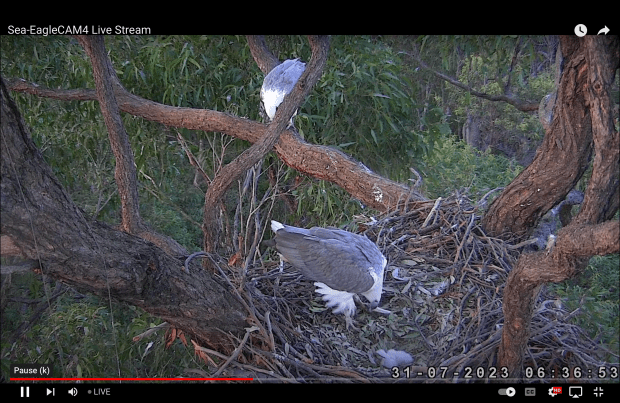
WBSE 35 and 36 have had fish and bird prey in their feedings. We also have a video installment from SK Hideaways about these two adorable fluffly little snow people…seriously, watching these two, even with the expected bonking, makes you smile. So far prey deliveries have been good.

E35 & SE36 Feedings and Fluff ~ Parents Deflect Marauding Magpies

Sydney White-Bellied Sea Eagles, Lady & Dad (17 Aug 2025)

In this video, SE35 is 3 days old, SE36 is 2 days old. Their jobs are to eat, sleep, and try to stay upright at this point. They’re both doing a brilliant job, as are Lady and Dad. In addition to caring for their chicks, the parents are dealing with swooping magpies ~ a common nuisance at this nest. 

Courtesy Sea-EagleCAM@BirdLife Australia Discovery Centre, Sydney Olympic Park (https://www.sea-eaglecam.org/video.html)

Nest cam also at https://www.youtube.com/@SeaEagleCAM4/streams

Beautiful family portrait at the Olympic Park nest.

‘A’ catches up with the Australian nesting season: “These two are just so cute. They are eating strongly and the bonking has begun. Fortunately, they are very close together in size and ability – both can hold their heads up and both are keen to get to the table. Lady is such an experienced parent – she is so skilled at putting small pieces of fish into tiny swaying beaks, although these two are better than most hatchlings at keeping their heads still. Once they can see properly, they will be all over this feeding business. 

Dad is a wonderful provider, although his diligence has not really bought him much in the way of chick time or even glimpses of his offspring. Lady is very protective indeed, and so very gentle with those sharp talons around the littles when she is positioning herself and enfluffeling. (I did love your blog mentioning that this is a real word. It’s long been a personal favourite of mine.) 

So far, so good. I do worry that there is bonking on day three for SE35, but there is no real size discrepancy and SE36 does not appear intimidated, plus Lady leans across SE35 to feed SE36, who is in the safer position when it’s behind its sibling! They have no strength to hurt each other yet nor the eyesight to aim with any precision, so hopefully, they will be sweet with each other. Neither will go hungry if Lady is brought enough fish to feed them with. She really is so good at feeding newly hatched chicks. Such a vital but difficult task. 

We are nearing egg time for the ospreys at Port Lincoln AND the falcons at Orange – it is just 10 days until 27 August, which is the date Diamond laid egg number one last year, and nine days until 26 August, when the first egg was laid at Port Lincoln Ospreys last season. 

It’s still about six weeks until we can expect to see the breeding birds beginning to return to Taiaroa Head. Eggs are laid from about mid-November, with a 77-day incubation period and hatches around Australia Day (26 January), which means that courting should be getting underway by early October. 

So within a fortnight, we should be watching eggs at two Australian nests as well as the adorable pair of sea eaglets, and waiting for a New Zealand fledge (our precious princess at Taiaroa Head, SSTrig chick). Of course any progress in the 2025 breeding season of the Collins Street falcons will not be revealed to us until a second egg is laid, assuming the falcons return to their scrape on an upper ledge of the Mirvac building in Melbourne’s CBD. “

Rutland is looking at their connection with Poole Harbour.

Knowing who is returning and breeding is so important! Cannot be done without those Darvic Rings.

While the owner of this camera had great luck seeing CJ7 with her fish, our dynamic Mum, who has now raised several clutches of four, including another this season, lost her fish en route to feeding those babes. It will not be long til she has departed for her migration, but, being the great female she is, it might mean she remains til September to help Blue 022 get their four on their way in good health.

It isn’t wildlife stealing from wildlife in Canada but the wild fires that rage from one end of my country to the other that are causing serious issues.

A Dyfi Osprey Project fledgling who appears to be drying off after trying his luck at fishing.

Poole Harbour: 5R3 had three fish on Sunday!

Harry was sky dancing and delivering flounder to the nest at Alyth SS hoping that Flora might show up. She has not been seen and it is believed she has left for migration.

All of the Danish ospreys have left for migration.

J Castnyer catches Zeus working on the nest at Goitzsche Wildnis, but it appears that Fjona has started her migration.

At Escherbach, J Castnyer catches Hermine. She writes, “Hermine is still in the nest territory, although she doesn’t show much. Today she came perhaps because she saw that there was no one there and that Herbert had just taken a fish out of the water. She gave us a few minutes, but she left as soon as one of the young ones arrived. The teak for the boys, she must think. She can fish by herself, although it’s beautiful when your partner does it for you.”

Runi, 13L, continues to get some nice fish at the Fru Rauer nest in Norway.

Beau continues to wait for Gabby at the NE Florida Bald Eagle nest (in fact he is more than a week early on his arrival). It wasn’t Gabby but there was a visitor – a Black Vulture!

There are two Turkey Vultures! Wonder what Beau thinks.

Charlo, Montana: Lola and Charlie are still at the nest with C19 and C20 getting fish at the nest.

Dunrovin: The 4th hatch, commonly known as Little Buckaroo, is getting some height and should be fledging soon.

Hellgate Canyon: Iris and the NM continue to visit the nest.

Boulder County: Osprey fledglings continue to get fed well at the nest.

Golden Gate Audubon Ospreys with Richmond and Rosie: Fledglings fly about! https://youtu.be/z0HKZsf1bbA?

Dyfi Osprey Project:

Not Ospreys. These are Black Eagles at the Selati Wilderness Nest: https://www.youtube.com/live/AW4oNVgjYb4?

Black Eagles or (Verreaux’s eagles) practice siblicide. This behaviour, where one sibling kills another, is particularly prevalent in nests with multiple chicks and is often driven by competition for limited food resources. This gorgeous youngster is already jumping about the nest and will hover like we see in the osprey nests as there is no place on the side of this cliff for it to branch.

An article on siblicide in Black Eagles:

Geemeff’s Woodland Trust daily summary for Loch Arkaig Sunday 17th August 2025

Louis only brought one fish to the nest today, taking the nest tally to four hundred and thirty, and Darach 7P0 was there to get it. No sign of Breac 7P7, last seen 15th, nor any of the other Arkaig Ospreys, and no visitors to Nest One other than a Great Tit. Darach entertained us with a barrel roll as he left the nest, but his manoeuvre, lovely as it was, was nothing compared to the heroics of Morag Hughes who completed her epic swim down the eleven miles of Loch Arkaig in 10 hours, 6 minutes and 37 seconds. Congratulations Morag! She even got to see an Osprey during her swim, and was seen by the nest cam watchers as she swam through the nest view, albeit as a tiny white dot, you can see it in today’s videos. Link to photos on Woodland Trust’s blue sky social media (you don’t need an account to view them) in the bonus section along with the fundraiser link. So far she’s raised nearly £5,000 for Woodland Trust, and her just giving fundraiser is still open for contributions. The weather cooperated – it was sunny and the loch was calm, and after some overnight mist, tomorrow’s forecast is for more of the same.

Night cam switches on (day cam): Nest One 22.07.34 (04.36.51); Nest Two 22.22.38 (04.57.06)  

Today’s videos:

https://youtu.be/z3xqSXc15mY N2 Aerial antics: Darach does a barrel roll 06.05.33 (zoom)

https://youtu.be/jGdaIym_CQM N2 Darach gets a mackerel from Louis 14.02.49

https://youtu.be/82sO7EuH77Q N2 Morag Hughes seen on Osprey Cam during her Big Swim 17.07-17.17 (zoom)

Bonus read and / or action – photos of Morag on her epic swim, and donation link:

She has done it!Massive thanks and congratulations to Morag Hughes of Fort William who swam 11 miles along the length of #LochArkaig today, raising funds for our restoration of the forest. Morag completed her big swim in 10 hours, 6 minutes and 37 seconds.🧵 1/2

Woodland Trust Scotland (@wtscotsocial.bsky.social) 2025-08-17T20:33:59.913Z

https://www.justgiving.com/page/mary-cheadle-3

Blast from the past, this day in previous years:

https://youtu.be/u6uN8ZibHro  N1 Aila gives her fish to Lachlan (2017)

https://youtu.be/-_FoOMH8mkc N1 Finally! Vociferous Vera gets a fish (2020)

https://youtu.be/3_bmzl48f7I  N1 Go away, this is mine: Vera pushes Captain off the nest (2020)

https://youtu.be/jlBKU00ODG8 N2 Sarafina crash lands and makes Willow depart (2022 slo-mo)

https://youtu.be/lmkgO09bCrg N2 Willow’s turn to crash land! (2022)

https://youtu.be/x73ZF4gTIHo N2 Would-be thief Willow gets what for (2022)

https://youtu.be/6Vlp-KsbJLo N2 Dorcha waits in vain for fish 2023

https://youtu.be/RPwIVtERtIk N1 Little birds and a Tree Creeper visit 2023 (zoom)

https://youtu.be/bVpNB4iHLPY N2 Handsome pair – father and son 2023 (zoom)

https://youtu.be/K86m0Q234Sc N1 Something scares Garry and Affric off the nest 2024

https://youtu.be/_qwTc6b2sdY N1 Affric wants to see Garry’s fishing skills, not nest-building ones 2024

Geemeff’s Woodland Trust daily summary for Loch Arkaig Saturday 16th August 2025
It was a three fish day and all for Darach 7P0 as there was no sign of younger brother Breac 7P7, last seen leaving the nest at 

09.11.28 yesterday. Has he headed south, or is he still in the area, either attempting to fish for himself, or being fed off-nest, or both? As always, the answer is wait and see. Darach didn’t appear very grateful for the fish, he launched a sustained attack on poor old Louis, grabbing him firmly by the leg and then lunging at him with open beak when Louis didn’t leave the nest after delivering the fish. Darach probably didn’t realise that Louis was unable to leave due to being firmly held in his talons. It made for uncomfortable viewing, but experienced adult that he is, Louis just tried to duck away from the worst of the attack and didn’t retaliate. He returned later with two more fish, taking the nest tally to four hundred and twenty nine. Darach was harassed by marauding Hoodies and stood up to one persistent individual, forcing the crow off the nest and away from his fish which he’d left unattended, luckily it was too big for the crow to carry off and Darach was able to rescue it. Garry LV0 brought a stick to Nest One and did a bit of tidying during his brief visit but there was no sign of Affric 152 today. The weather was sunny and the loch was mirror calm today and forecast to remain the same tomorrow, which will aid Morag Hughes in her epic fundraising swim. Link to the details and her just giving page in the bonus section. With luck, we might be able to make out her escort of kayaks as she passes through the nest view.
Night cam switches on (day cam): Nest One 22.14.47 (04.48.40); Nest Two 22.28.33 (04.52.56)

Today’s videos:https://youtu.be/Sd4KB7rZLmU N1 Spring Sonata sunrise 04.50.39 (Classic Ospreys – Beethoven time lapse)https://youtu.be/uLFmU8IPOag N2 Poor Louis suffers a sustained attack by Darach 07.18.51 (zoom)https://youtu.be/HLhGx6GKPyk N2 Darach gets rid of a Hooded Crow who’s after his fish 08.05.11

https://youtu.be/45pZ-bgAsDE N2 Louis brings a second fish and gets away unscathed this time 10.07.35https://youtu.be/UQAvIJ9oiAE N1 Garry LV0 flies in with a long thin stick and does a bit of tidying 10.40.39  https://youtu.be/mzaHv6MUFtY N2 Darach rescues his fish from a marauding Hoodie 17.59.51

https://youtu.be/IrYYqCnBBDc N2 Louis brings a third fish and waits patiently for Darach 19.27.46 
Bonus action – you can still support Morag who’ll be swimming Loch Arkaig tomorrow to raise funds for Woodland Trust:

https://www.woodlandtrust.org.uk/trees-woods-and-wildlife/osprey-cam/?ht-comment-id=27390542

https://www.justgiving.com/page/mary-cheadle-3

Blast from the past, this day in previous years:

https://youtu.be/plpQ3BYG-Rc  N1 All grown up: Rannoch defends her fish 2019

https://youtu.be/K4Kbj7NQ0q8  N1 Aila brings fish but looks like she needs it most 2020

https://youtu.be/qcBatA6qgTY N1 Size matters! Split screen 2020

https://youtu.be/hiFrQx0H8TQ  N1 Captain steals Vera’s fish 2020

https://youtu.be/XaxM2NwNUCg N2 Dorcha stays on the nest until Sarafina gives her a nip! 2022

https://youtu.be/5hvJRi33SFM N2 Sarafina practises flying with fish but isn’t quite there yet 2022

https://youtu.be/F0ys6FiFeeM N2 Cleaning crew arrive too early 2022

https://youtu.be/7XYT94gy-Ig  N2 Louis and Dorcha do a rapid fish handover 2023

https://youtu.be/bLzUfkvwasE  N1 & N2 USAF flypast 2023 (zoom)

https://youtu.be/rW3CJVJqZLU  N2 Ludo waits ready to grab the fish 2023

https://youtu.be/RnY54XNtci8 Spain: more photos and tweets of 1JW and the other ten translocatees

https://youtu.be/rQYUcsjAKB0 N1 Affric joins Garry but he brings sticks not fish 10.51.20

https://youtu.be/lD-oLI2NjpA N1 Garry and Affric return later but there’s still no fish 16.20.59

Geemeff’s Woodland Trust daily summary for Loch Arkaig Friday 15th August 2025

Fish deliveries were the main event today – Affric 152 turned up on Nest One and received a nice sized trout from Garry LV0, whose tally, after stagnating since 4th August, finally moves up a notch to one hundred and forty one. Louis delivered three fish today, all mackerel, and the nest tally now stands at four hundred and twenty six including two deliveries by Dorcha, who was last seen a full week ago on 7th August. The three fish were all taken by Darach 7P0 as apart from a brief visit lasting 26 seconds this morning, Breac 7P7 hasn’t been seen on nest cam today. In his eagerness to get the second fish, Darach locked talons with Louis and got pulled off the nest! But returned unharmed a few moments later and claimed the fish before the Hoodies showed up. The weather was settled and sunny today, the overnight forecast is for mist and light winds with a low of 12°C changing to sunny with a high of 24°C tomorrow.Night cam switches on (day cam): Nest One 22.13.44 (05.04.19); Nest Two 22.34.20 (05.13.40)
Today’s videos: 

https://youtu.be/LTj4hQvEr7Q N2 Both Breac 7P7 and Darach 7P0 visit the nest, fish calling 09.11.02

https://youtu.be/KBRLr1auvUQ N2 Darach gets the first fish, a whole mackerel 15.07.58

https://youtu.be/xPi3XmjMIZ0 N1 Fish for Affric! Garry brings a whole trout 15.22.35

https://youtu.be/SXP2ua3CrHA N1 Affric & Garry spend time together, leave in opposite directions 15.40.14

https://youtu.be/S2U6mrELCwg N2 Darach locks talons with Louis and gets pulled off the nest! 16.45.28 (zoom)

https://youtu.be/AOvludmDLRM N2 A third mackerel arrives and again it’s Darach who’s there to get it 18.18.10 
Bonus action – support Morag Hughes who’ll be swimming Loch Arkaig this weekend to raise funds for Woodland Trust:

https://www.woodlandtrust.org.uk/trees-woods-and-wildlife/osprey-cam/?ht-comment-id=27390542

https://www.justgiving.com/page/mary-cheadle-3

Blast from the past, this day in previous years:

https://youtu.be/2EqB8ZLlLNQ  N1 Get a grip, Mallie! (2019)

https://youtu.be/q4v0VblhLDE  N1 Confirmed: final sighting of Doddie on the nest (2020)

https://youtu.be/JNjzfsGJMd0  N1 Stramash over the first fish (2020)

https://youtu.be/Btn2GxS_waQ  N1 Fish delivery from Aila (2020)

https://youtu.be/41z2mZ9rRNI  N2 Dorcha chases crows but they return to plague Willow (2022)

https://youtu.be/N-Z7Z-WV_1U  N2 The Mystery Fish makes its appearance! (2022)

https://youtu.be/GOsbIENNolA  N2 Spotted Flycatchers visit (2022)

https://youtu.be/_KZr32ZVd74  N2 Dorcha’s fish calls get no response 2023

https://youtu.be/3ReQ1_Bhj0I N2 Ludo does a faceplant 2023

https://youtu.be/mwUhXluhRss N2 Great Tit catches Ludo’s attention 2023

https://youtu.be/pL-09gIw4A8 N1 Garry LV0 brings moss, tidies, and has a preen 2024 

https://youtu.be/1mt2ZZZhteM N1 Affric 152 arrives followed shortly after by Garry LV0 2024

https://youtu.be/U9CxLSmhoTM N1 Noisy RAF flypast doesn’t faze Affric & Garry 2024

https://youtu.be/-c3lZKY7Blc  N1 Garry brings Affric a teeny tiny fish 2024 

J’ sends us a good news story about a Black Vulture release from the World Bird Sanctury:

https://www.facebook.com/WorldBirdSanctuary 

“Released after over a year in care!

Turkey Vulture 24-380 originally came to our hospital on July 7th, 2024 as a fledgling that had either been orphaned or abandoned due to his numerous health issues. Even with the July heat, 380 was hypothermic. His feather condition was poor, with several flight feathers having broken and the rest covered in heavy stress bars that made them weak and prone to breakage. Despite being nearly full grown, 380 was severely emaciated and weighed less than half of what he should. 

He had recently gotten into some feed corn and bird seed and stuffed himself full with it despite these items not being something that he could digest and get nutrition from. We used tongs to manually remove as much of the corn and seed from his crop as possible and got to work rehydrating 380 and giving him some easily digestible liquid diet. Emaciated juveniles are usually able to process solid food relatively quickly compared to adults, but when we tried to introduce some, it just sat in 380’s crop and ended up having to be manually removed.

It took 3 weeks of tube feeding liquid diet before we were finally able to transition 380 to solid food. In that time, 380 battled other illnesses including an infection with a protozoan parasite called trichomoniasis (which causes thick lesions in the mouth), intestinal parasites, mild lead toxicity, and a West Nile Virus infection that started causing his feathers to pinch off and fall out.

Between the West Nile Virus and 380’s initially poor quality feathers, he ended up with no intact flight feathers and had to remain with us until it was time to molt. He’s spent the last year with our foster dad, Volo, whose presence has been essential in keeping 380 from imprinting or becoming too comfortable around humans. 380 started his molt in April, but it took 3 months for him to grow a full new set of flight feathers. Thanks to a year of quality nutrition, this round of feathers came in healthy and structurally sound.

380 was released in late July. He wasted no time before spreading his wings to soak up the sun from a high tree branch. When he realized that he was partially shaded, he moved to a higher branch above the canopy to maximize his sun exposure. Turkey Vultures are known for their love of sunning and can be regularly seen exhibiting this pose.”

How many times do you happen to be heading to an appointment early in the morning and you see cars – so many cars – with only one person in them? or homes that could benefit from grants to help insulate them to save energy costs? Our use of fossily fuels and the growing decisions internationally to open coal mines are putting wildlife in further jeopardy.

Plan to extend Queensland coalmine would bulldoze ‘critical’ koala habitat https://www.theguardian.com/australia-news/2025/aug/15/plan-to-extend-queensland-coalmine-would-bulldoze-critical-koala-habitat?CMP=share_btn_url

Spilve and Grislis’s Golden Eaglet, Melders, has fledged but returns to the nest for prey. What a beautiful season it has been.

Speaking of Golden Eagles, they are arriving in the area of Hecla Island. We will be there this week and hope to see some of the migrants! That would be unbelievable.

Hurricanes and tropical storms are beginning to form for the Atlantic season which will run until the end of November. This is Erin.

The eye Saturday afternoon by Storm Chaser. Thankfully, our raptors and other migrating birds can sense the weather and will be able to take shelter. Erin went from a tropical storm to a Category 5 in a mere 24 hours. The storm has now settled down and as of the time of writing, Sunday afternoon, it has been downgraded to a cat 3.

Wind Turbines. There are a number west of where I live in the hills that provide the thermals for the migrating birds coming in the spring and departing in the late summer. They do not have to die. There is a simple solution. If you live in an area considering wind farms, please enter the conversation about how to make them safe for our raptors.

Lots of waterfowl rescues. Wildlife Haven, near to where I live, have just cleaned some Canada Geese that got into a ‘substance’ in the northern part of our City. They will be released just like these mallard ducks at another Canadian rescue.

Please put out water and/or food for the migrating birds, volunteer if you can, donate if you can, but please leave out water!

Thank you for being with us today. The osprey season is winding down. The Bald Eagles will begin to arrive slowly, with eggs expected in the US in November-ish. Focus will switch to the raptors in Australia, and we wish every raptor on their way to their winter home good winds and a bursting crop.

I will not be posting on Friday as we will be on our break at Hecla Island but I will be back on Monday the 25th of August. Please take care. We look forward to having you with us in a week.

Toby hopes that everyone has a great week and something wonderful to chew on like his Blueberry-Yak Milk Bully stick!

I want to thank our notable contributors, ‘A, Geemeff, J, SK Hideaways, PB’, the owners of the streaming cams listed in bold, the individuals who take the time to create videos and the authors of posts such as Jeff Kear at UK Osprey Information, Debbie Campbell at Menhaden-Little Fish, Big Deal and all others, often too many to name. I am very grateful to you and to the newspapers that still cover environmental issues as they relate to our precious feathered friends including The Guardian. My blog would not be what it is without your input into the world of birding.

Monday in Bird World

8 January 2023

Hello Everyone,

We hope you had a wonderful weekend, could breathe in fresh air, and maybe hear birds. I was at the nature centre on Friday and Sunday – the air was crisp, and there were Nuthatches, Chickadees, Woodpeckers, and a few Sparrows. And, of course, lots of squirrels – Red and Grey – running everywhere. Temperatures went down to -14 C Saturday afternoon.

The girls kept me on my toes at all other times!

Hope listens to the story about Red-tails in Love (about Pale Male in Central Park) from the top of the chair.

Missey was listening to story time from the top of the tansu or Japanese step chest.

Hugo Yugo and Hope were playing in the twinkle tree.

Afterwards, someone got a good washing from their Mamma! Hope follows Mamma Calico around and copies everything she does, including stretching out her back right leg when she gets up. It makes my heart skip a beat seeing them together and not worrying about them being out in the cold snow.

The news from Bird World is rather thin this Monday. There’s not a lot of drama as compared to December. Maybe this is a good thing!

‘A’s continued news of WBSE31 brings us all great joy: ”

It’s watching her soaring high in the sky that brings tears to my eyes. She seems to be doing so very well, and hearing of her first observed fish catch last week was just brilliant. I cannot imagine how Lady and Dad feel about all this – I suppose it’s just natural for them, but it’s a new experience, and they seem to be continuing to take good care of their girl. That, too, makes me so very happy, though of course we cannot know what it does mean to them. 

Here is today’s report – there’s been a lot of rain in southeastern Australia over the past week or ten days, so most birds are keeping dry and the fishing would have been difficult I suspect. 

January 8: Our early watcher reported one adult and the juvenile nearby on River Roost at 7:30am – then again later. A quiet morning. Both moved a little between roosts, but there was no hunting or feeding seen. Some light rain. Around 3:30pm, SE31 was on Mangrove Island but there were no adults in sight. A quiet day. The picture of SE31 in flight is from yesterday . A gull is “yelling” at her in protest as she passes.

Isn’t she just glorious? Look at that wingspan. And look at that gull – so close to her, harassing her. Whether it’s crows, currawongs or sea gulls, there are always smaller birds accompanying her when she flies, and she has simply learned to ignore the irritating little buggers. That’s a huge relief, knowing that she is above it all and can handle their presence.” 

Deb Stecyk, a fellow Canadian that used to work with the Dave Hancock Wildlife Foundation, wrote a summary of the events at the NCTC nest of Bella and Smitty.

“The post season was going well for Bella and Smitty, both looked well rested after a busy nesting season. Jefferson had been gone for a couple of months and the adults were spending time on restorations and getting the nest ready for winter. Things were good at the NCTC nest. 

Unfortunately, on Sept 22 Smitty went missing for an extended period of time, which brought various young males to the nest. There was fierce competition for this nest, which was common at this nest. The NCTC eagles have a long history of defending the nest from intruders. The area is rich in resources with the nearby Potomac River and forested area, attracting lots of attention from other eagles. The first floater/intruder male showed up on September 23. The intruder was the first of many that showed up at the nest. Bella and Smitty did their best to defend their territory but Smitty’s extended absence created an opening for other males. Smitty did return for brief periods in October and November and on one occasion he returned with what looked like blood stains on the left side of his face. It looked like Smitty had been in a fight with another eagle. There were four or five different males that visited during the fall all demonstrating interest in Bella and this nest. Sadly, Smitty was absent for weeks and/or days at a time providing the opportunity for displacement. We do not know what happened to Smitty it is a question that will stay with us for a long time. We assume he was injured and that is why he could not return to his Lady Bella.

After a few months one male stood out and his persistence paid off with Bella accepting him as her new mate. The new young male was later named Scout. Scout is recognized and identified by a patch of dark feathers at the back of his head. Based on plumage we think he is about 5 years old. The patch of dark feathers blends in with his mostly white head feathers. Eventually those dark feathers will be “flushed” out and replaced with white feathers. 

Our hearts continue to miss Smitty, we watched him grow and mature over 13 seasons. There were many firsts at this nest as Smitty grew and matured into a handsome mate. A loving and devoted partner to Belle (2011 to 2018) and Bella (2018 to 2023), and an amazing loving Dad to his eaglets. Smitty you are forever etched in our hearts 💔 Thanks for the memories Smitty you are missed!

As the nesting season approaches we keep our fingers crossed that Bella and Scout will have a successful nesting season. Many firsts are once again underway for this new young male, which rings so many bells for those cherished past seasons with Smitty. It truly is bittersweet …. it’s the life cycle after all  💔❤️😢

+ many photos

https://www.facebook.com/groups/1690426617860075/?mibextid=HsNCOg

Thanks, Deb, for that great report. Smitty is seriously missed, but we hope that Bella thrives with her new mate.

Some do not think that the eaglets are so cute when they have their Mohawks, when only a few dandelions are left on top of the grey thermal down, and when their feet and beaks seem to be disproportionately large – but, gosh, aren’t they gorgeous?

Jackie and Shadow are working in earnest on their nest in the Big Bear Valley. I wonder if we might be expecting eggs later this month?

Beautiful Gabby. Looking for Beau. Needs a Break. She has, save for a period of less than three hours, single-handedly incubated her precious second egg. How much has she eaten? How could she hunt in the short time she is off the nest? Is Beau stashing prey for her? If the egg hatches, will he help her? Too many questions.

Seriously. Too cute.

The egg tooth that E23 chipped out of the shell is still there. Soon – as the fuzzy natal down gives way to the thermal down – it will disappear.

A post showing the change in E23. How quickly we forget. Happy one week birthday.

An eagle in the trees at the Decorah Hatchery nest. Is snow on its way to Iowa?

At Port Lincoln, Dad came in with a fish at 0718. Brad took that one. Gil took the fish from Mum at 0948. Those were the only fish delivered to the nest up to 1400. The pair are on the nest at 1414 wishing and hoping.

At Orange, beautiful Diamond has been in the scrape sleeping on the Cilla Stones and looking out at her domain.

‘A’ adds: “At Orange, there has also been a lot of rain – Diamond came into the scrape today absolutely sodden and headed for her Cilla Stones. Marri was seen flying past the scrape this afternoon at 15:51:32 and was heard, squeeing very loudly, seconds beforehand, and again for several minutes from 20:37:39. There was also a gorgeous bonding session between Xavier and Diamond at 06:32 this morning. So all appears to be well for our girl at Orange and her wonderful parents. “

“Finally, at Taiaroa Head, the first hatch is approaching and ranger Sharyn Broni has given a little blurb on what to expect. 

‘We are now 10 days away from visual checks of LGK and LGL’s egg at Top Flat. When hatching begins, the developing embryo moves into the air cell of the egg. Sometimes, sounds like scrunching can be heard as the membranes are broken through. There may even be a chick call. When the shell has a crack or pip in it for the beginning of hatching, we will remove it to the incubator. We hold the parents on the nest with a dummy egg until the chick has hatched. The nest will be sprayed with Avian Insect Liquidator* to ensure that flies are not living in the nest when the chick is returned.’

The live streaming camera for Milda, the White-tailed Eagle from Durbe County in Latvia is now operational. There could be eggs the end of March! Fingers crossed. Milda and her mate Voldis fledged two eaglets in 2023.

The decline of birds of prey, including vultures, in Africa could lead to human deaths. Why? Have a read.

Introducing the Gray Partridge and their winter feeding habits.

Do you travel to Aruba? Here is a reintroduction story and a reminder to be mindful when seeing birds in the wild.

Thank you so much for being with us today. Please take care. We look forward to having you with us again soon.

Thank you to the following for their posts, videos, streaming cams, and articles that helped me to write my blog this morning: ’A, J’, Deb Stecyk, NEFL-AEF, Window to Wildlife, BaiBai, SW Florida Eagle Cam, Laura Davis Nelson, Explore, PLO, Charles Sturt Falcon Cam, Biruta Lap, Aruba National Park Foundation, NZ DOC, The Guardian, and Audubon.

V3 is home…Wednesday in Bird World

15 November 2023

Hello Everyone,

Right now it is 16:20 Tuesday afternoon in the NEFlorida Eagle Cam and V3 is in the nest on full alert! I have heard such speculation about him ‘not being up to the job’ (maybe he isn’t), but Gabby and him sure make a good tea and he risks his life to protect their territory like any bonded mate would. Welcome home. Tears flowing.

V3 and Gabby were at the nest tree and on high alert Wednesday morning.

Now for other news. Tuesday was the glorious day that was promised. The wind was a little nippy, but to be outside in the fresh air, to turn the heating off, and to clear the deck by pushing and not lifting the shovel is a blessing.

I went to the zoo. The purpose was to see the Snowy Owls and the Stellar’s Eagle. I will not tell you what I said quietly in my head after I paid the entrance fee. All I will say is I wonder how families can afford to go to the zoo! But never mind…the Snowy Owls were ‘somewhere’ not to be seen. The road to the Stellar’s Eagle enclosure was blocked for tree trimming. I won’t give it 5 stars for a great day, but I sure did get that long walk in.

The birds in the Toucan Building were lovely. The Roseate Spoonbills were high on the ledges preening. The Toucan had posed for a group of school children and was ready for a break…some of the ducks were bothering one another.

Eurasian Reindeer – the kind that are found in Lapland.

There were several Emu. Australian Birds. They are the second largest bird after the Ostrich. They cannot fly. They have two sets of eyelids – one for blinking and the other for keeping dust and other particles out of their eyes.

A beautiful Reeve Pheasant.

This is an Inukshuk. “The word “inukshuk” means “in the likeness of a human.” For generations, Inuit have been creating these impressive stone markers on the vast Arctic landscape. Inukshuks serve several functions, including guiding travellers, warning of danger, assisting hunters and marking places of reverence.”

At home, Hope and Missey have been playing on the large cat tree.

I am a little worried about Calico. She is on the waiting list to get in to see the vet. She is just not herself.

At Port Lincoln, Mum was doing the toe dance in anticipation of the arrival of Dad with a fish and he did not disappoint. There was a nice headless fish brought in around 08:40.

Giliath is 29 days old and #2 is 27. They are doing so well.

Everyone ate. Notice how quick that fish disappears!!!!!!! We have two hungry youngsters in a big growth spurt.

Huge crops. Thanks so much, Dad!

Fish fairy arrives at 13:15.

Mum removes the fish from the nest to eat the head on the ropes, ensuring that Mum gets some fish. She ate for more than half an hour.

The ops report at Port Lincoln:

Diamond showed up at the scrape at Orange. No word on either Marri or Barru yet but I will keep checking.

Later Diamond and Xavier were bonding in the scrape. Hope should give them a ‘High Five’ for the great job they did raising Marri and Barru.

Cilla Kinross stated that she saw Marri flying about on her way into work and that the fledgling was doing well. She did not have time to grab her camera.

‘H’ sent a note that Cilla had more recent news on the Orange Australia FB page:

Here is Cilla’s video:

M15 defending the nest against the GHO Monday night – if you missed it.

M15 has had to defend the nest again on Tuesday night. Please send all your positive energy. This is a very tense situation and bald eagles and GHOs fighting for territory can result in a tragic end. Stay safe M15!

M15 stayed in the nest last night.

A lot of disinformation is coming out about the SWFlorida and NEFlorida Bald Eagle nests. We wait for things to settle down at both. V3 is still defending the territory near The Hamlet nest against other eagles, and M15 has his hands full with the GHOs.

Looks a little stormy at Captiva. Connie is keeping that precious egg nice and dry.

The second egg was laid Tuesday evening early. Clive was nearby.

I love Martin and Rosa at the Dulles-Greenway Bald Eagle nest. They can raise more eaglets easier than you can blink your eyes. If you do not have them on your watch list, I highly recommend you put them there.

Looks like someone is interested in the Captiva Osprey cam!

A lesson raptor ID.

The New York Times has a great story on how intelligent Vultures are! Thank you to my good friend, ‘N’, for spotting this and sending the link to me so I could share it with you.

Hawk Mountain Migration Count til 13 November.

USFWS declares ten birds extinct – eight of them from the Hawaiian Islands. Feeling sad.

Want to know more about hummingbirds? I love seeing them in the garden but the speed with which they move is so incredible making it nearly impossible for an amateur like me to catch their likeness with my camera. Those beautiful little bullet shapes with the most amazing wings and iridescent colours to rival any eye shadow pallet this season – read on.

Love Albatross? Looking for an excellent children’s book? Chile Bird. The true story of a Royal Albatross is a wonderful choice, beautifully illustrated – touches the hardships that our Royal Albatross face in their daily lives and the heroic efforts of people to save them. I ordered my copy from the Royal Albatross Visitor’s Centre on Taiaroa Head. (Apologies for the glare).

Thank you so much for being with me today. Please take care. Looking forward to seeing you again soon.

Thank you to the following for their notes, videos, articles, and streaming cams that helped me to write my blog today: ‘A, H, N’, PLO, Charles Sturt Falcon Cam, Cilla Kinross, Gracie Shepherd, Androcat, Window to Wildlife, Dulles-Greenway Eagle Cam, Phil Hayne, The New York Times, Hawk Mountain, Bird Guides, The Guardian, and Diane Miller.

Eagles are busy…Thursday in Bird World

9 November 2023

Good Morning Everyone,

Hope ‘hopes’ that everyone has a wonderful day! This morning she decided to be contrary and not pose!!!!!!! Go figure.

Oh, the temperatures climbed to a balmy +2 C on Wednesday and all the snow melted. Sunset happens at 1630. It is dark. Did I say that I hate winter? And now as 2300 approaches, it is snowing rain. The feral feeder is filled and I have attempted to make it a little weather proof. Those poor cats that live outside. Let’s see if we have a resident in the shelter tonight.

The girls had a lazy day. Hope and Missey continue to watch their favourite cat/bird video. And, yes. It is true. Miss Hope, the Queen of the ‘High Five’ taps on the screen until I come and turn her video on. I am well trained. Missey went to sleep on the wicker only to look up and see a male Northern Cardinal, and she immediately bolted right back with Hope. In other news, Hope got caught in ‘the act’ when I went to find Calico. She is certainly a robust young kitten! I do not know how Calico managed to keep this kitten so safe and well-fed out in the wild.

Hope is a perfect example of why you try to socialise the kittens of community cats. She is simply lovely. Thankful every day that Calico trusted me and wanted to come inside and that Hope has joined us.

Missey’s eyes look like they will pop out when the Cardinal is on the screen…she is getting ready to leap!

Hope’s ‘guilty’ look. Calico still produces so much milk…she waddles around the house!

Will these three have a little brother after all? Wait and see! We certainly could use a male influence here in Cat World. :))).

At Port Lincoln, Dad is in the shed and Mum and the kids are wishing he would go fishing.

Waiting.

Mum and chicks are still waiting for breakfast and Dad is still perched in the shed.

Dad left and Mum took a break…still no fish. It is nearing 1300.

Dad came through with a fish, and a man and his three-year-old son provided four supplementary fish for the family! Thank you. You are helping to keep this family alive.

Meanwhile….Xavier has delivered two breakfasts to Marri and Barru.

Check out this video of the storm a few days ago!

Remember. We are getting so close to fledge that you might as well go and purchase the tissues and have them ready. What a great year it has been at Orange. How delighted for Xavier and Diamond. Now…there are bushfires in some areas of Australia along with a drought. I just do not want it to pour down rain in Orange for the entire fortnight following their fledge. Cross your fingers and toes with me, please.

So what is happening at the Parramatta River in Sydney? I am not seeing any updates for two days now. All was well then. Let us hope it stays that way.

Now to the US and the Bald Eagles readying for the 2023 season.

At NE Florida, Gabby and V3 continue to be hopeful and work on their nest near Jacksonville, Florida.

Lady Hawk catches two mating attempts.

Near Fulton, Illinois on the Mississippi River, there is concern for Valor 2 – once part of the infamous Lover’s Trio Bald Eagle family. Dennis Becht has gone out to try and find Valor 2 and get him help.

Here is the latest update on Valor 2 from Dennis Becht.

Connie and Clive are working diligently on their Captiva nest – parents of Connick. No word on Connick’s release from the Audubon Centre for Birds of Prey at Maitland. He could not have better care. They were waiting til all of his feathers grew in to release him. What a great facility!

Eagles at Decorah.

New nest building at Decorah Hatchery?

Alex flew in to the KNF-E3 nest to do some nestorations.

Checking out the nest bowl at the E-1 nest of Louis and Anna in the Kisatchie National Forest.

Eagles were working at Dulles-Greenway.

It is always a beautiful view at Big Bear Valley – but it is always better when Jackie and/or Shadow are there!

Franklin and Frances have been busy at Bluff City.

D3 was at Centreport today.

29 Days to hatch watch at Superbeaks!

Black Vultures checking and cleaning the NCTC nest of Bella and ________.

Audubon’s report on the 2023 Eagle breeding season in Florida is here.

Check out the size difference between genders in these raptors.

It is that time of year when all that lead that went into the animals that were hunted and killed gets eaten when the eagles and other carrion eaters find the innards left in the field. That lead is toxic just like all of the fishing equipment that continues to be used that is lead. Time to switch!

For those of you that still have fall, remind everyone –

Please tell everyone you know not to celebrate with balloons. There are beautiful alternatives. Use safe biodegradable paper. OR let’s ditch the decorations altogether and celebrate by donating to shelters for animals or humans! Just imagine.

All of our wildlife have emotions.

John Love is responsible for reintroducing the White-tail Eagle in the UK. He dedicated his entire life to these magnificent feathered creatures. Go to roydennis.org to see the video tribute.

The Ventana Society announces that the quarantine pens for HPAI – to save the California Condors – are now on their way!

Because things are at the end does not mean they are any less important than those at the beginning. Indeed, it is often the reverse. Humans cannot survive without insects. So every time someone puts chemicals on their lawn to make it look beautiful, the insects get poisoned and then the birds that eat them. Let us all begin to re-think our attitudes before it is too late. This is a grim report.

From ‘H’ for all of us – thank you! We do what we can with what we have.

Thank you so much for being with me today. Please take care of yourself. See you soon!

Thank you to the following for their notes, comments, posts, articles, images, videos, and streaming cams that helped me to write my blog this morning: ‘A, H, Sassa Bird’, PLO, Charles Sturt Falcon Cam, Sharon Pollock, NEFL-AEF, Lady Hawk, Dennis Becht, Window to Wildlife, Raptor Resource Project/Explore, KNF-E3, KNF-E1, Dulles-Greenway Eagle Cam, FOBBV, Baiba, Sara A, Centreport Live Cam, Superbeaks, NCTC, Audubon Eaglewatch, Elite Falconry, Science of the Total Environment, Northern Beaches Clean Up Crew, Sassa Bird, Roy Dennis Wildlife Foundation, Ventana Wildlife, The Guardian, and Emily Dickinson.

Fish Battles and more…Monday in Bird World

31 July 2023

My goodness. It is the end of July. Where did the summer go? and the Osprey season? It seems it was only a couple of weeks ago that we were wondering if Blue NC0 would lay the first egg of the UK season or would it be Maya?

I woke up to a note from a friend living on a farm in southern Manitoba with a pond. She wanted to know what is up. The geese typically are not on her pond until the middle of October, and at least 65 landed on Sunday. Is migration starting this early?

‘PB’ sent us a smile for the day. After Louise feeds the osplets twice from the big fish she brought to the nest, look at those crops.

‘H’ adds: “Mr.O was not seen on 7/29, and we were worried that he may have been injured while fighting an intruder the day before.  We were so relieved when Mr.O flew to the nest with a fish on 7/30 at 0911.  I’m sure many viewers were jumping for joy.  Louise flew to the nest a few seconds later to greet him.  They immediately had an intruder issue and Louise and Mr.O spent the next few minutes sending the intruder packing.  Louise brought three more fish to the nest throughout the day, including a couple of her signature ‘whoppers’.  The chicks had bursting crops.  All is well.”

Now for a break through….a simple coat of paint! We have known this for years but there was no action. Now there is no excuse.

How a pool ring helped a little vulture.

More fishing hooks…

Swinging through the Nests:

We are going to start with Australia and ‘A’ has some news to add:

Lady has had a busy morning, organising the three half-fish on the nest and ensuring Dad didn’t remove a single flake of it. She is very jealous about guarding the food once it is on the nest. Dad very rarely gets away with removing any food from the nest. There were cot rails to replace this morning after the first breakfast sitting. Both eaglets ate well. They are beyond adorable. Dad is bringing fish after fish for his family and Lady is absolutely devoted to her chicks. Such a sweet family. Those little faces are just darling. 

In Orange, Xavier arrived for the early morning bonding session but he has not had a good morning, with two starlings rejected by Diamond. I’m not sure why he keeps bringing them. Surely he must know by now that they are not a popular offering. He is on the ledge as I type, surveying his world. It’s an idyllic place for them to raise their family, Ah, something has caught his attention. He e-chups a few times, then flies out of the box. No idea what he’s spotted but something below the nest box certainly interested him. Such a handsome wee falcon. Gorgeous. I love little Xavier. There is regular mating on the tower and much digging of deep indentations in the nest box. 

In New Zealand, Manaaki is looking especially gorgeous this morning. It is a lovely sunny day at the colony and our beautiful albie chick has had a quiet morning, relaxing on his nest. For once, he has not been gardening or exploring, just enjoying a quiet rest. He is gradually losing his fluff and is starting to look increasingly like his parents. Our giant fluff ball is nearly an albatross. What a beautiful boy he really is, Darvic bling and all. We’ll miss him terribly when he fledges. It’s such a very long time before there is any chance of seeing them again – several years in most cases – so their fledge is particularly bittersweet. We still wonder and worry about little QT, who fludged early in a storm. Lilibet was only 220 days old when she became the first fledge of the season last year. That look on her face ….. 

At Collins Street, it is a cold but sunny morning. There is still some time to wait before we can expect eggs to be laid. Last year’s first hatch was on 30 September, so it should be up to four weeks before the first egg is laid. The last week of August probably, although as I keep saying, who knows what climate change will do to the birds’ inner clocks. I have been rewatching some of last year’s videos from Collins Street in an attempt to discern enough identifying features to determine whether or not this is the same couple we saw in the second part of last year’s season. 

Thanks ‘A’.

Moving back to the nests we have been following:

Collins Marsh: Two beautiful, fully feathered chicks standing in the blowing wind on the nest. This couple looks like they will fledge a pair of osplets this year! It is fantastic. Last year the nest was abandoned, and the year prior, the chick Malik had a forced fledge and was found dead below the nest. This is a new couple in 2023 who diligently cared for their young. Fingers crossed for safe flying.

Boulder County: Two fledglings, one to fly and Mum on one of the successful US nests this year. This beautiful couple that fed one another and did tandem feedings in the beginning so that little third had a chance did it! Success.

Finnish Nest 1:

Fish brings both fledglings in – Mum has a full house. There was still one to fledge at the time of my writing.

Finnish Nest 4: It was a little wet and the three were huddled together for warmth and some fresh fish. Notice the difference in plumage in the two nests. The little ones at nest 4 still have the white stripe. We are a ways from fledgling here! Indeed, they can still, for the most part, fit under Mum to stay dry.

Ilomantsi Finland: This nest is the most eastern of all the Finnish nests and is right on the Russian border. It is the home of parents Manta and Manu who have raised three beautiful osplets. Two females and a male. All have been ringed and at least one has fledged.

The ringing of the chicks took place on 11 July.

Patchogue: Watching for a fish delivery! Our Mini (top) is magnificent. Look at those ‘snake eyes’. Just like Iris! Not nearly the fish deliveries coming to the nest that we saw a few days ago. Dad is feeding off nest. Oh, we need a GoPro on Mini!!!!

Steelscape: Three got some fish and had a nice crop for a bit. Oldest sibling is doing a good job self-feeding. Keep sending good wishes to this little one.

Sandpoint: Wishing for fish for Coco who has not had a lot of fish over the last 24 hours. Keke is very hungry as well and has eaten fish and then tried to feed Coco. Wish for lots of fish!

MN Landscape Arboretum: All is good! The first image is from Sunday and the second Monday morning when Mum and chick are waiting for a delivery. Gosh this nest looks better than it did at the beginning of the season and this new female has really turned into a good Mum.

Alyth: Everyone appears to be doing well after the big tumble out of the nest on Saturday.

Dyfi: Nothing deters Indris – not even a bit of Welsh wind and damp – from getting fish to his kids.

Glaslyn: Looks like there is more rain at Glaslyn and wind. Elen hunkered down on the perch.

One of our Manitoba Osprey nests:

‘H’ has her reports – thanks ‘H’.

Forsythe – There were three fish brought to the nest by Oscar.  Ollie was the beneficiary of all three fish.  But at 0612, two minutes after the first fish was delivered, Owen flew to the nest and a battle ensued with both fledglings going overboard in a mass of wings and talons.  Ollie was seen flying away and Owen returned to claim the fish lying on the nest.  There were a few more brutal battles between those two juvies throughout the day.  Someone is going to get hurt.  More fish is needed at this nest.

Barnegat Light – Dorsett had the pleasure of experiencing several flights on her fledge day.  In these photos, the new fledgling is hanging out with Mom and Dad, and later she is shown enjoying a well earned dinner fish.  

Osoyoos: I’m not quite sure how many fish were delivered to the nest . . many were delivered by Dad, but then some were removed from the nest.  It was a confusing day, and a sad day.At 0542 Dad dropped off a partial fish.  Over the course of the next 2 1/2 hours both chicks tried to self feed from the fish.  #2 was more interested than #1, as #2 was literally starving, but at 33 days of age, did not have the skills to self-feed.  Most of the time that #2 was attempting to eat, s/he was attacked by #1.  There were a few times when #2 held the fish with its talon he did seem to pull off some bites.  Eventually at 0811 that fish either went over the east side of the nest or became lodged in some sticks.  Chick #2 had been facing away from the camera, but when #2 turned around, his crop was still flat.At 0724 Dad arrived with a partial fish and fed chick #1.  Whenever #2 attempted to approach, s/he was attacked by #1.At 1321 Dad was feeding, with a chick to either side.  #2 actually ate 8 bites of fish, before #1 lunged in front of Dad to reach #2, and attacked.  The incident seemed to be disturbing to Dad.  He stopped the feeding and flew away.  The remainder of the fish was left in the nest.  Chick #1 picked up the fish and did a pretty good job of self-feeding.  #2 managed to grab a large tail piece and tried to eat, but unfortunately he dropped the fish over the side.There were other feedings by Dad at 1415, 1529, 1959, and 2014.  Chick #2 did not receive any bites of fish at those meals.I’m not sure if Mom was seen at the nest on 7/30.”

McKeun ParK:
I took this pic yesterday afternoon.  Looks like they all fledged!

Thanks so much ‘H’.

A note has just come in from Kielder Forest that Grasslees is the first osplet to fledge from nest 2. That happened on Saturday, the 29th. Return to nest safely.

Glacier Gardens. The eaglet has been named Serak and is beautiful in that dark chocolate plumage.

Eastern Imperial Eagles: At the Tatarstan nest of Altyn and Altynan, the two eaglets have branched!

Karl II and Kaia: The three surviving storklets have been ringed. One has a transmitter. Karl II has been providing all of the feedings. Kaia was last seen on the nest on 23 July at 16:19. I asked my friend ‘T’ what is happening at this nest and she went and consulted the Forum to check for theories. We know that food appears to have been very limited due to the drought in the area and that Urmas has had to supply fish baskets so this family could survive. For the first time in the history of the nest Karl II did a brood reduction. So this is what ‘T’ sent to me, “She finds good food for herself further away. But she would probably have to find three times as much to give it to the chicks.” As was noticed by some observers, Kaia often stole food from Karl II and did not provide all the food she found for the chicks. Karl II has often sent her away from the nest so that he could take care of the storklets. Is Kaia off finding food for migration? Has she abandoned her nest? We do not know this answer and we wait – perhaps until next year.

The storklets are hungry. Karl II has brought in some fish that were not provided in Urmas’s fish basket and we should thank this generous man who kept this family alive and all who donated to purchase fish for them.

Karl II feeding. Kaia has left early. Is it because of a lack of food and she must build up her strength for migration?

Here is the latest news on Waba and Bonus.

Before we close, it looks like Mini might have gotten a fish on the nest from Dad Monday morning. She was up on the perch when Dad delivered at 0821. Smart girl!

Thank you so much for being with me today. Please send the struggling nests your most positive energy – Osoyoos and Forsythe could use many more fish. Please take care! See you soon.

Thank you to the following for their notes, posts, videos, and streaming cams that helped me to write my blog today: ” ‘A, H, J, PB, T’, Fortis Exshaw, Ars Technics, Alis Jasko and Nor Cal Birding, Tonya Irving, Raptors of the World and VulPro, Sea Eagle Cam, Charles Sturt Falcon Cam, NZ DOC, Collins Marsh, Boulder County, Finnish Osprey Foundation, Ilomantsi Finland, PSEG, Steelscape, MN Landscape Arboretum, SSEN Alyth, Dyfi Osprey Project, Bywyd Gwylld Glaslyn, MB Birding, Forsythe Ospreys, Wildlife Conserve F of NJ, McKuen Park, Osoyoos, Kielder Forest, Glacier Gardens, Eastern Imperial Eagles, Eagle Club of Estonia, and Looduskalender.