Indigo flies out and in…plus more news in Bird World for Thursday Nov 17

17 November 2022

Oh, good morning to all of you. Thank you so very much for being with me today. I am so very, very happy to be with you! Thank you for all of the wonderful stories that you have sent. I will be working my way through them slowly. Much appreciated. We woke up to more snow. Everything is beautiful and white!

The kidlets, Missy and Lewis, had their first vet visit. I am a glowing proud parent. They were soooooo well behaved. They are not litter mates and the adoption person told us that they might not get along with one another. I have not had more than one kitten since I was a child and did not know what to expect.

I remember one stray that someone left at our gate. when I was a child. Oh, I loved that cat. To me the drab brown tabby was the most beautiful cat in the world. My grandmother was very diplomatic and said, ‘He sure is sweet’. I begged to keep this one particular cat. My dad agreed since it was a ‘boy’. Well, he apparently didn’t check very good…a few weeks later we had a pack of kittens. That tabby lived for more than 10 years. She was incredibly sweet. It is very different, having kittens outside with their mother and kittens in the house – in a conservatory, with very large plant pots and tall vines with flowers, or trees…yes, trees.

But, back to the topic at hand. Lewis and Missy are the best of mates. They do everything together including eating out of the same dish at the same time, drinking out of the same dish at the same time, having to have their paws touch when they are sleeping or sleeping in the same tent. Always together. So off they went in the same pet carrier, not separate, together. Not a single peep. At the vet they were so content. Proud Mum here!

I got a tip from the technician at the vet. One of the biggest culprits for cats will be their teeth. I hope if you have cats and dogs are brushing their teeth or giving them things to facilitate good gum health and clean teeth. If you have tried brushing their teeth and it didn’t work, get a nice flavoured tooth paste. Lewis and Missy like the chicken. Take clean nylon stockings or panty hose. Cut a square. Wrap it around your finger, put a dab of the toothpaste on it and away you go. Be sure to do the back ones and those sharp canines in the front. You can get them used to what you are going to do by rubbing on the outside of their cheek for a couple of days. Small toothbrushes or those prickly things you put on your finger did not – at least not for these two. Panty hose do! And I swore I would never wear the darn things again after I retired. So glad there is some use for them!

Missy is the ‘alpha’ You might recall she had Lewis well aware that she is the boss immediately. The vet saw it too! Indeed, the vet smiled and said, “Always the female!” Anyone watching a raptor on a streaming cam knows this. I said nothing. The odd thing is Lewis is so solid and looks ‘so tough’ and Missey appears to be ‘so fragile’. So funny. Missy is half Maine Coon – but both, at the end of the day, are literally ‘alley cats’. Found new borns taken to the shelter from different parts of my city. We are so lucky to have in our lives.

Missey likes to get inside plant pots – with or without soil. This is the tiny artificial tree that has been put up. The soft felted birds have had to be removed. LOL.

Looking so innocent! “We didn’t do it!”

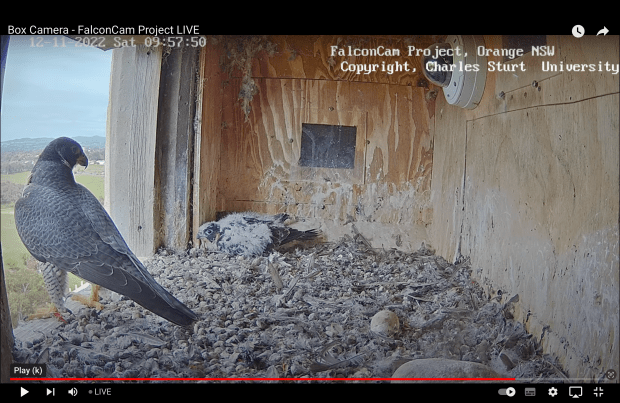
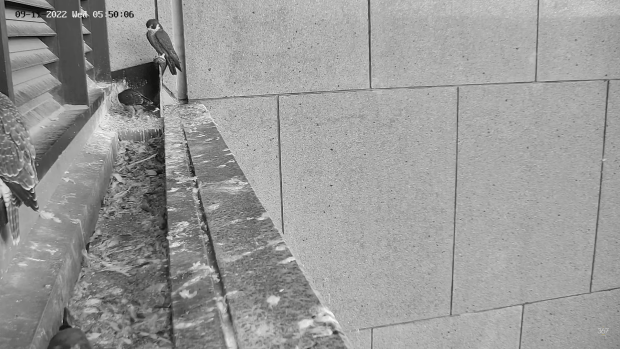
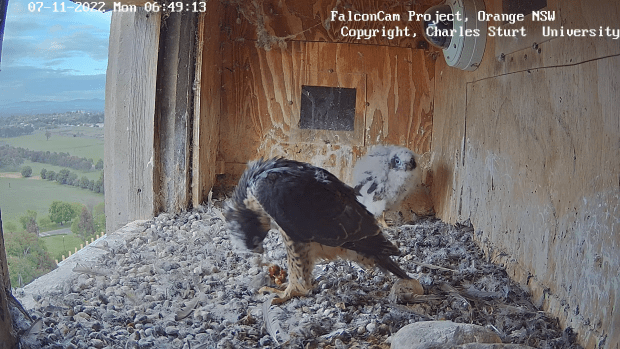
Today’s action was still at the scrape box of Diamond and Xavier. Those parents are really making sure that both Rubus and Indigo are well fed. What a fantastic couple they are. The moderator put some history in the chat today and for those of you that do not know – we now have at least three male peregrine falcons that we know of that have started out as step-fathers.

The last sighting of Diamond’s mate, Bull, was on 30 September 2016. Their erases hatched on the 4th and 5th of October. The first sighting of Xavier in the scrape box at Orange was on the 7th of October. He brought prey to Diamond and the babies on the 8th of October. The rest is history as it is with Alden at UC-Berkeley and M2022 at 367 Collins Street.

Aren’t they adorable? Every day Rubus looses more and more dandelions.

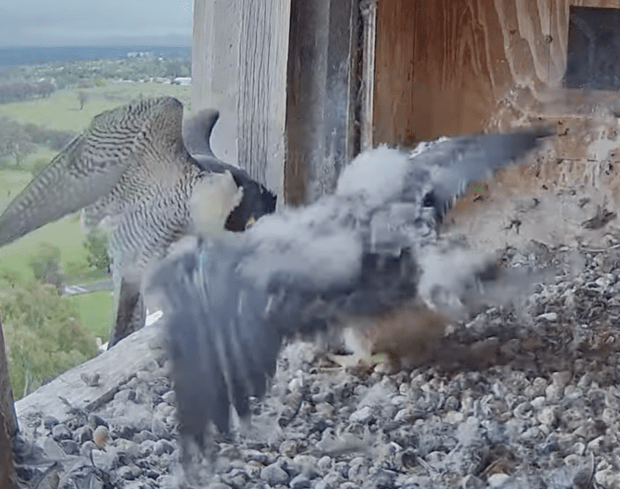
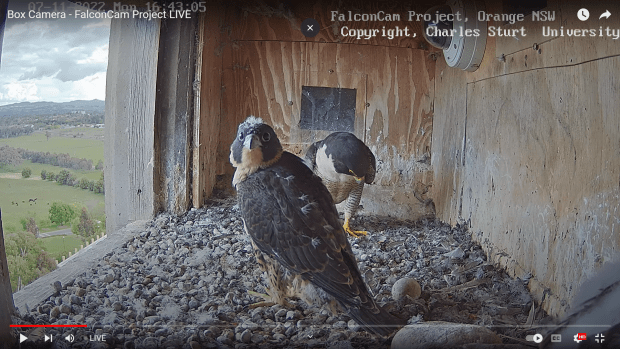
Everyone has been wanting to know when Indigo would fly again. He certainly has been eating well and enjoying being back home. Today, right before 14:38 Indigo got a little frantic, running around the scrape just like he did the day before he fledged. At 143802, Indigo flew out of the scrape box. He returned 35 seconds later! I caught it on video for you.

​RECAP of feedings at Orange: 05:29:41 X/quail; 05 32 39 X/St.Quail Indigo Grabs; 06:05 38 X/juv star; 8 39 04 D/prey 8 47 58 D takes leftover quail; 15 41 31 D/pigeon; 18 32 52 X/red-browed Finch; 19 06 55 D/Live Star

‘H’ sent this link to me. It is a split screen video that Cilla Kinross made of a feeding. Disregard the word ‘kestrels’. It is definitely Rubus and Indigo. Thanks, ‘H’. Delightful.

Indigo and Rubus both in the scrape as the IR lights are turning off.

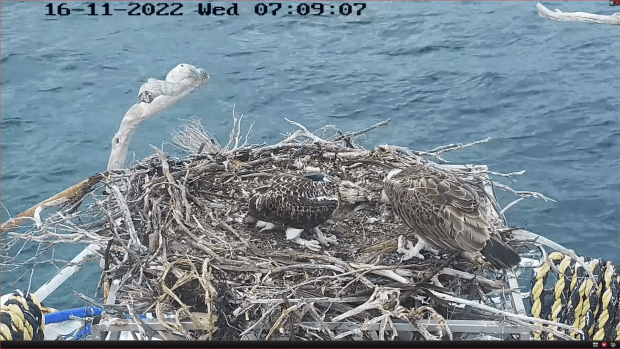
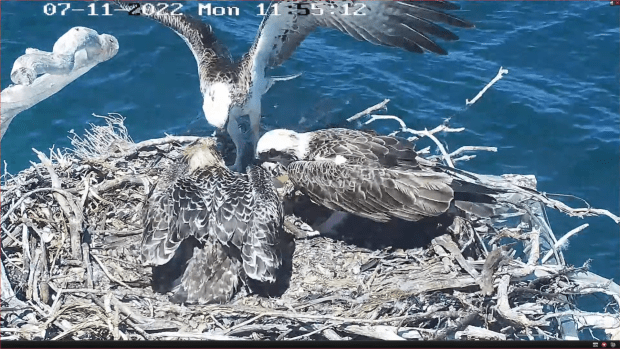
The wind was really blowing and there were lots of white caps at Port Lincoln. It made everyone wonder whether or not there would be any fish today but – alas, it turned out good.

At Port Lincoln, Zoe can surely scream for the fish! I have jokingly said that I hope she lives a long and healthy life with many osplets screaming their heads off to her…their poor Dad. Just imagine.

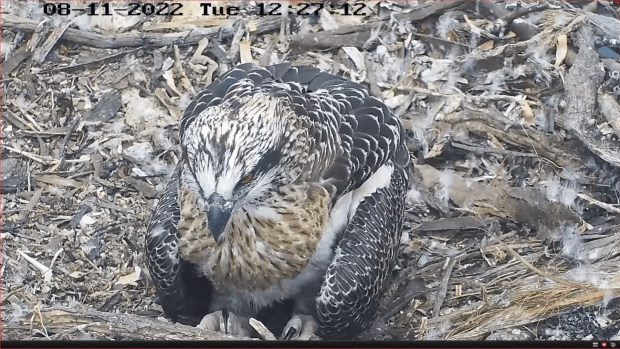
There have been at least 2 fish deliveries today. Mum was on the ropes eating a fish around 1400. Zoe took absolutely no notice. She was not hungry. Isn’t that grand? No one on this nest hungry. The fish are ever so unstable. But – we will take it. Today is a good day. Mum ate her bit and flew to the nest at 141408 and fed her large daughter.

Zoe doesn’t even seem to know or care if Mum is over on the ropes eating a fish. Normally she would be screaming her head off. Not today. It is a good fish day.

When the feeding was over, Zoe had an enormous crop.

All of the family together. Mum has a very nice crop from the earlier feedings.

Lots of food at Port Lincoln. These are the late time stamps from Gtr Kitarr:  19:16 headless fish by Dad, Mum off w the fish, back at 19:29 to feed Zoe. 20:24 Zoe wing flapping & 20:24:14 standing on one leg. 21:10 headless fish by Dad, Mum feeds Zoe in the dark.

Making News:

The investigation of the theft of four precious Albatross eggs continues.

https://www.stuff.co.nz/national/crime/130488815/was-a-boat-used-to-steal-four-rare-albatross-eggs-in-daring-heist

How many of us love Iris? The oldest Osprey in the world whose nest is on the lot of Riverside Health Care Center in Missoula, Montana. A request has come in from lovers of Iris. Here it is:

Here is a very short report on the current status of Sea Eaglets 29 and 30. I also want to mention that my contact tells me that the sea eaglets are at different clinics. The specific names are not being mentioned as is the case with other popular birds to keep the phone lines open for injured wildlife.

The Red List 8. The Yellow Wagtail

Yellow wagtail” by hedera.baltica is licensed under CC BY-SA 2.0.

There are many birds that I do not know. This bird is one of the first to be spotted when it returns from its winter migration in Africa to the fields in the UK. In Africa, they feed on the insects that the elephants kick up from under their feet so if you ever get to go to Africa on a safari and see a herd of elephants look for these dramatic sulphur yellow birds with their grey heads. In the UK, they follow the farm tractors kicking up the soil to reveal their next meal. They need a good supply of insects and spiders to survive. Besides fields, manure heaps and wet lands are good places for them to forage.

Yellow Wagtails raise two clutches a year if there is suitable nesting spaces and food. Their nests are low on the ground adjacent to wet lands, salt marshes, hay meadows, and some fields of vegetable crops.

Yellow wagtail” by hedera.baltica is licensed under CC BY-SA 2.0.

Changes to agriculture and crops grown put the Yellow Wagtail under threat. The RSPB has made some recommendations to farmers in the UK which would help stabilise and grow the numbers of these beautiful birds. This includes returning to having some manure heaps for them to forage through. They are beautiful songbirds. Let us hope that those who can do something to encourage their population growth will keep this in mind when they are planning their crops and how they do their farming in the upcoming years before it is too late.

We are waiting for both Zoe and Rubus to fledge. Rubus is not quite ready but is getting more and more interested as Zoe spends time in the scrape and now, that she has flown in and out again. Zoe is doing a lot of wingers. I am a bit old fashioned. The longer they stay on the nest or at the scrape and the stronger they are when they fledge, the more chance they will have of success. Weak tired birds do not do well in the field.

Thank you so very much for being with me today. Send your best wishes to our beautiful sea eaglets as they recover. Take care of yourselves, too. Looking forward to seeing you soon.

Thank you to the following for their posts, their videos, and their streaming cams which make up my screen captures: OpenVerse, Port Lincoln Ospreys, Sea Eagles FB, Montana Ospreys at Hellgate, Charles Sturt Falcon Cam and Cilla Kinross, Royal Albatross FB.

Prey fights between siblings and more…it’s Wednesday in Bird World

16 November 2022

Oh, good morning to everyone! I hope that you are all well. If you have not been watching the scrape of Diamond and Xavier you are really missing something. First, there is the adorable Indigo and Rubus. They are ‘not sweet’ when it comes to prey items as the following two videos will demonstrate! But, they will be ‘out there’ defending their own prey and these little dust ups help them prepare for that. In the first video Rubus really does a good job at snatching that small prey item. He doesn’t prevail in the end but watch closely what he does. Quite the character.

Rest assured that at the end of the day, both eyases had quite enough to eat and at times were even sharing prey items.

So this is the first prey delivery, a small piece.

The second is a much more substantial bird, a Galah (pink and grey). There was more than enough for both eyases.

The fish deliveries continue to be rather scarce at Port Lincoln. It is difficult to determine if there has been an actual drop in the prey delivered or a slow down due to the imminent fledgling of Zoe and not three rapidly growing osplets. There are too many factors – the weight of the fish delivery, the portions that each family member ate, etc. It appears that at the current delivery rate, Mum, Dad, and Zoe are each getting the equivalent to one small fish per day. Is this enough?

Hoping for another fish but nothing has arrived. Mum appears to be reluctant to get too far away from the nest. Did the intrusion of the humans to band and put the sat pak on Zoe cause her stress? Is she afraid to leave Zoe? Quite possibly. Perhaps she will go fishing tomorrow but, for now it seems that she is relying on Dad.

The ospreys are not moving about much, not exerting much energy. Today, however, Zoe is doing a lot of wingersizing. Her wings are gorgeous. Just look at how big they are! It will be those big wings that will pull Zoe up out of the water when she catches her fish.

This shows what those strong wings will be doing. Just imagine. Zoe will have to catch her own fish until such time as she has a mate and has eggs in the nest.

AND THEN…a whopper of a fish arrived. Mum ate her fill and then took the fish to Zoe. Everyone will go to bed with a full crop at Port Lincoln. Relief.

Mum did not part with the fish when Dad arrived more than an hour later to see if there was any left. This whopper should take care of the hunger that she was experiencing – and Zoe. (I do hope that Dad had a fish, too).

Making News:

Even in Manitoba we are experiencing some birds that are late to migrate or who have decided to check it out and see what it is like in the winter for food. Some of those are Cardinals. This is an osprey in Idaho though! They need water and fish as we all know. Why so late?

Project Eagle will be the new home of the American Eagle Foundation The facility is located in Kodak, Tennessee and is set on 57 acres. Challenger the Eagle will be in residence there.

https://www.wate.com/news/positively-tennessee/project-eagle-in-the-home-stretch-of-building-new-facility/?fbclid=IwAR2P8t-e9ZiNLkwKCky0dQZJZokdILCmXE1HOdfooe2hb1hYt2wlr4QuYzs

In the Mailbox:

‘M’ introduced me to an Australian photographer, Georgina Steeler. All of this relates again to how we perceive our wonderful feathered friends and other wildlife. We have been having this discussion about anthropomorphising birds. We need people to care, to help all of us, to add to the numbers so that we build a huge network. At the same time, we need to recognise and educate ourselves about the emotions that wildlife have so we can try and have an intelligent conversation with the non-believers.

I urge you to Goggle Georgina Steytler and go and see her website, read her blog, look at her photographs, and ponder all the ways that you can make a difference. Oh, I like this woman and the way she thinks!

Here is one of the quotes on her site today from one of my heroines, Jane Goodall who knows that wildlife have and show emotion, pain, anger, fear, grief, and joy.

‘D’ sent me the link to this story to share with all of you. After reading about Wolke, this is another story of how much our feathered friends enrich our lives as told through budgies:

https://www.theglobeandmail.com/life/first-person/article-feathered-friends-are-the-best-friends-of-all/

When I wrote about the Red Listed Bird, The European Starling, I had no idea Starlings were so intelligent and could mimic anything including Mozart’s concerto. Birds and their intelligence fascinate me more and more. ‘F and M’ sent me a note telling me about an incident at the Taronga Zoo in Sydney. They wrote, “A week or so ago Tooronga Zoo in Sydney Australia had a breakout from the lion’s enclosure causing an alarm and the instruction “EVACUATE NOW” to sound. The lyrebird is now mimicking this alarm and instruction. It is causing quite a problem at the zoo. !!” Enjoy!

https://www.adelaidenow.com.au/news/victoria/a-lyrebird-mimicking-the-evacuate-now-alarm-at-taronga-zoo/video/47d9e5b56f9139880f0dfc5b302eaaed

No 7 The Red List: The Dotterel

The top image is of the male Dotterel. Notice that beautiful white eye line and belly with the grey brown and espresso feathers mingled with white on the head, wings and back.

Northern NZ dotterel.” by Bernard Spragg is marked with CC0 1.0.

This is the female. In this instance the female Dotterel has the brighter plumage than the male. The female has the same grey-brown plumage on the back of the head, wings, and back but look at that magnificent chestnut apron! With the espresso necklace and line between the eyes forming a brown and the espresso line running from the beak under the eye. What a beauty.

Banded dotterel” by Andrej Chudy is licensed under CC BY-NC-SA 2.0.

The Dotterel is a medium sized member of the Plover family measuring approximately 20-22 cm in length. The birds are unusual in that it is the female that has the brighter plumage rather than the male. They live on insects and worms. Their eggs take 28-32 days to incubate and during this entire time the female does not leave the nest to feed. She is fed by her mate.

Dotterel face a number of threats from predators that have been introduced into their environment particularly during the nesting and breeding season. These include dogs, hedgehogs, cats, rats, stoats as well as other larger birds, and humans.

Thank you so very much for being with me today. Do stop in and watch Indigo and Rubus. You will not be disappointed! Take care. See you soon.

Thank you to the following for their postings and streaming cams where I took my screen shots: Port Lincoln Ospreys, Openverse, Charles Sturt Falcon Cam and Cilla Kinross, American Eagle Foundation, Montana Ospreys at Hellgate, Georgina Steytler. I would also like to thank those that sent in news items today: ‘M, D, F and M’. Much appreciated! It is always lovely to get mail to share with everyone.

Stolen eggs, fledgling in care, Ervie and more in Bird World on Monday

14 November 2022

Good Morning Everyone!

Oh, goodness, Sunday was a day full of surprises! Two of them welcome and the other two, just shattering.

I had not anticipated sending out the newsletter this morning. The news coming out of NZ and Melbourne today would overwhelm this wonderful story of birds and emotions that I am working on. So tomorrow I will introduce you to Wolke so that you can enjoy reading about her incredible journey through grief to find love.

I don’t think anyone was shocked to discover that Big Bob at the Port Lincoln Osprey barge was a girl. I am not sure that anyone was surprised that she was the largest osprey ever hatched and ready to fledge either. Big is a BIG girl. The pink band is fantastic and what a super tribute to Janet Forster’s granddaughter to have the 2022 osplet named after her, Zoe. What was surprising was the determination of the local gulls to steal the fish right off the nest on the barge as Zoe was pancaked!

This really opened my eyes to what Dad might have to go through when he is fishing. We have seen the gulls steal a fish right out of his talons but, imagine them swarming him when he is fishing. That makes me sad.

Dad came in with a fish at 132824. He brought an earlier fish at 064935.

Mum prevailed and fed herself and her big Zoe.

It was a good fishing day for Dad who flew in with another fish at 1900. We have all been worried about Dad. Is the lack of fish due to weather? sediment so he could not see clearly? or him just feeling unwell? We probably will never know but, he did manage 3 fish and Mum and Zoe had the fish that were left after banding that the gulls did not get. (I think the gulls only took 1 of the 3 fish).

Zoe screaming loud with Mum as they see Dad approaching with the fish.

The shock of all shocks was Indigo being physically strong enough to fly into the scrape box and scare the wits end out of Rubus and Diamond who were enjoying a nice meal!

What great form! She landed in that scrape safely and took control of that prey. The in climate weather for the past day must have meant she had not had food and was famished.

Indigo stayed in the scrape with Rubus. He was there when they turned the IR off. (Cilla has done this to keep the numbers of mosquitoes down).

Dusk is coming.

Two specific incidents come to mind. One was Legacy, the 2021 fledgling of Samson and Gabby at NEFL. Legacy flew off the nest. I would have to check but, she was gone about a week. Everyone presumed she was being fed by the adults. She was seen flying into other eagle’s nests and it appeared to birders on the ground she was looking for her natal nest. She was caught on camera flying close by and then one day, she landed on the nest. She was famished and she did not fly off that nest for another month! Samson and Gabby were so glad to see her they provided so much fish! The second was WBSE 26. 26 was in the forest for about a week being harassed by the Currawongs and Magpies after fledging. She made it back to the natal nest, exhausted and hungry. Again the parents happily took care of 26 – you could almost see Lady’s delight that her baby was home. 26 stayed, ate, and got her strength up for about a week before being chased out of the forest. That was 2 years ago today that the Magpie helped 26 fight off the Currawongs.

I was also thinking about Izzy who returned to the scrape at Orange for so long. Diamond had to block the door finally for Izzy to get the message to move on. I suspect that Indigo is tired. Flying is a lot of work and the birds have to build up those muscles. Indeed, Indigo did go to sleep eating! Indigo might have been flying around the campus not connecting with the parents for a prey drop during the stormy weather the day prior. It will be interesting to see what happens when Rubus fledges. For now, isn’t it a delight to see Indigo safe and back in the scrape knowing he has had a meal?

The third surprising event was just a shattering. Four eggs from the Royal Albatross that are now breeding at Taiaroa Head have been stolen! There is no evidence to suggest that predators took the eggs and the NZ DOC is working with the police and going over footage to try and determine what has happened. Unbelievable.

Hearts are breaking.

Whenever something really terrible happens, I think of Ervie and today, thank you Friends of Osprey for posting more pictures of our beloved lad. Now notice Ernie’s lovely necklace. We know he is a male so, let this image guide us. Males do have necklaces. Blue 022 has a stunning one. It is not a foolproof method of determining gender in Ospreys.

Just look at Ernie’s nice crop. I wonder how his talon is coming along. I could not tell from the images but, he certainly is a most handsome osprey.

Speaking of Ervie, Friends of Osprey posted another image of Ervie with his satellite tracker and an explanation about trackers and why they are important.

Sad news is coming out of Melbourne. This is the fourth event – another shattering one. One of the fledglings has been found on a footpath near 367 Collins Street. Send all your positive wishes, please.

Just about the time we think things are going quiet, events that we might not have imagined take place. Our thoughts go out to the fledgling from Collins Street so that it will improve quickly and be able to be released. Life is very challenging for the urban birds. While there is generally a lot of prey – pigeons – there are also lots of buildings with glass that are difficult to manoeuvre when one is just learning to fly.

Thank you so much for joining me today. Take care all. If you get a chance stop in and check on Indigo, she might just stay at the scrape today. See you soon!

Thank you to the following for their posts and streaming cams that made up my screen captures: Friends of Osprey FB, Port Lincoln Ospreys, 367 Collins Falcon Watchers FB, Royal Cam Albatross Group NZ FB, Port Lincoln Ospreys and Charles Sturt Falcon Cam and Cilla Kinross.

Big is……a BIG girl named Zoe!

13 November 2022

It is the 14th of November in Australia.

Port Lincoln Ospreys says that a decision about banding and putting a satellite tracker on Big will be made at 0900 Port Lincoln time. That is about two hours away from now and it is 1442 on the Canadian Prairies. The forecast that I am seeing for Port Lincoln is calling for wind but no rain. Fingers crossed that Ian Falkenberg can get the job done! I wonder what Big’s name will be???

An early chunk of fish came on the nest at Port Lincoln. Mum is so hungry. She did not give Big all of the food! Thankfully. It was either one bite for you and one for me or two bites for Mum and one for Big. She was just ‘wolfing’ down that fish, she was so hungry.

Mum and daughter.

What a welcome sight. Dad arrives with a fish first thing in the morning.

Mum is famished. I have not seen her so hungry. We all worry about the chicks having enough food but the adults have to eat too in order for them to fish and care for the young.

At the end of the day, it appears that there simply was not enough food to feed a family of 5 this year. I don’t even like saying that but, right now, we have a seemingly healthy chick who is hungry and a Mum who is hungry and I suspect a Dad that is hungry. They are doing the best they can with what they have. We need to send the most positive wishes this family’s way. We might not ever know the reason but, it would be very informative if someone was doing a study on fish stocks in the area along with toxins, the impact of weather on the fishing capabilities of osprey, weather system changes, etc. Maybe someone is!

The banding began around 0900 or a little earlier. Mum stayed on the barge and watched everything that was going on inside the boat.

Big – you aren’t surprised are you? Has a pink band and is a girl. What we didn’t know is that she is the biggest girl yet at 1700 grams or 3.75 lbs. Incredible. We also all knew she was a fish eating machine.

One healthy girl named Zoe after Janet Forster’s granddaughter.

Thank you Port Lincoln.

NOTE: The newsletter for 14th of November will be posted around 1600 Canadian time.

Ervie, Indigo…and more news in Bird World on Sunday

13 November 2022

Good Morning Everyone.

Saturday was one of those quiet stay-at-home days. It gave me a chance to think of the ways that those of us who live in wintery climates cope with the weather. As it is, the sow is dancing down right now. The European Starlings are eating suet and Butter Bark and Mr Crow cawed so much that I gave him high protein kitten kibble. Oops. The Starlings have found the kibble!

Inside the house, the candle holders have been cleaned and given new candles. An apple crisp is in the oven. So, instead of starting out birds today, we will begin with something simple to make your house cosy on a crisp day. Put 1 sliced orange and 1 sliced lemon in a 2 litre (qt) pot. Leave the peel on – that is where the lovely oils are. Add a few bay leaves, 2 or 3 cinnamon sticks, a good tablespoon of cloves, and cover the whole with water. Bring to a boil then lower the heat and let it simmer. You can add water as needed. I used to add tea bags to the brew. It is a lovely spiced tea but needs some straining. The other thing you can do is to take the peels of your oranges and lemons and use them. I always have bags in the freezer! It is part of a strategy to have zero waste.

Making News:

Our darling Ernie. Poster child of handsome beginning to do some moulting.

For the very first time successful fledges at Maine’s Hog Island Boathouse Osprey platform. Dory and Skiff are making the news! Congratulations to this Osprey couple who successfully fledged three osplets from the Hog Island Osprey platform this year. What an amazing family this was to watch.

Oh, so very grateful to Cilla Kinross for finding Indigo and showing us how this handsome lad is doing after fledging. Isn’t he a stunner?

Tweed Valley fledged three ospreys this year. Two of them have perished. The other, Glen, found himself on a couple of container ships before finally making it to Spain! Here is the latest on this youngster.

https://www.bbc.com/news/uk-scotland-south-scotland-63584969?fbclid=IwAR1vsE2ErGcB71e711Z9k01Xt4GWUC4PDPCn03KH3yCzRLdl3MECQnPSDz8

In the Mailbox:

‘EJ’ sent me some grand news. It is amazing what we can do when we get together to help benefit the environment and wildlife. A community joined together and raised 2.2 Million GPB to purchase a tract of land to enlarge a nature reserve. Just think – this could be a way of halting development in areas that are needed by the wildlife. Is there land where you live that is adjacent to a nature reserve that could benefit from such an endeavour? Keep this positive action in mind if ever you get a chance to work with your community.

File:The Ewes Water Valley – geograph.org.uk – 1538379.jpg” by James T M Towill is licensed under CC BY-SA 2.0.

You can read about this successful project here:

https://www.scotsman.com/heritage-and-retro/heritage/langholm-moor-ps22-million-raised-to-complete-community-buyout-3793764

Australian Nests:

All eyes are on Port Lincoln. Ian Falkenberg was up at midnight finishing up the permit forms – that myriad of red tape that Port Lincoln has to do in order to ring the osplets on the nests. Fran and Bazza said that he was up again at 0600 getting ready. So, today, Big, whether you like it or not you will be weighed, measured, hopefully a sample of your blood is taken for DNA, and you will be given a sat pak. Big, we all know that you are one big cranky girl that won’t let any bird get in your way. You are now the only hope of Port Lincoln for 2022 – you carry a heavy responsibility. Please do not ever land on a hydro pole no matter how much you might want to.

Ian Falkenberg has made the call to postpone putting the tracker and ringing until later today or tomorrow. This cannot be done in wet weather. In addition, it really is now or never. In the UK, birds are not banded after 45 days because of the great fear of scaring them off the platforms and fledging early.

Mum and her ‘Big’ Girl crying out to Dad.

Dad brought a fish in around 0815. Big kind of rushed Mum once she had the fish. Mum got the catch anchored to her talon and flew around the nest arriving on the other side where she had control of the fish. It was headless so Dad has his share, too. Mum and Big had a nice chunk.

A small headless fish arrived around 1515.

The rain began. Mum and Dad had been perched together. Mum flew over to the nest to Big and Dad joined them at 19:44.

It appears that three of the Melbourne Four have now fledged. One remains at night and some of the others show up on the ledge for prey deliveries.

At Orange, Rubus is shedding many of the dandelions and is watching for Xavier and Diamond to deliver prey. They do not disappoint. Here was yesterdays recap from the moderators: RECAP 10 41 15 D w/ prey, Rubus takes; 11 25 12 X w/prey, D arrives/feeds: 13:31:22 X w/juv star, feeds, X takes: 16:30:10 X w/prey, feeds 18 53 31 Xw/prey, Rubus takes, D arrives , tug o war, D feeds.

There was a tug o war and lots of excitement. Just look at how much of the baby fluff is now gone.

Other Bird News:

One of the things that changes for me – during the winter – is that I do not travel on the roads as much nor do I go to the nature centre 5 days a week for a walk. Saturdays become very quiet and one of the joys is having Ferris Akel in the background doing his live stream around Wildlife Drive, Montezuma, Sapsucker Woods, and Ithaca, New York. We have a few ducks still in the City and a few geese were flying overhead this evening. Someone even has a Baltimore Oriole in their garden today – with the snow! I am, however, having duck withdrawal and Ferris does seem to find them this time of year! I really recommend Ferris Akel’s tours on Saturdays beginning about noon Eastern time. Ferris is humble always saying he doesn’t know this or that but, he does. I have learned so much for him. In fact his tour is often on in the background to whatever else I am doing. You can also check out some of the archived tours of Ferris by going to YouTube and entering Ferris Akel Live.

‘A’ said that she had learned to embrace ‘brown’ never realising that there are so many shades and hues. Fantastic! That brings me great joy. Most of the female birds are considered dull compared to the flamboyant colours of some of the male species. Here is a female Ruddy Duck. Just look at all those wonderful browns and tans, there is a touch of caramel and espresso, and that lovely sort of grey-brown.

All of the birds are at a great distance from where Ferris is streaming. The images are then quite soft. Nonetheless, I hope that you enjoy the few that I am including.

Just a slightly different angle.

A female Shoveler. You can never mistake a Shoveler for a Mallard. Just look at that bill. It is massive in comparison to the size of the head.

There were American Coots and I know that none of us will ever make the mistake of saying a Coot is a duck. It isn’t.

Oh, how I love Sandhill Cranes. They glean the farmer’s fields just after the seed crops have been harvested. There are many in Southern Manitoba in October doing this exact same thing. Gorgeous.

I don’t blame the Canada Geese getting out of Canada. Gosh, golly, it looks like much more fun in the pond at Sapsucker Woods than it is walking around in the snow in Canada and not finding any food.

What shocked me is precisely how much smaller the geese are when compared to the swans.

Just look at that. It makes the Canada Geese look like miniature ducks. Seriously. And I have always thought of them as large.

There was a juvenile Bald Eagle lurking about at Sapsucker Woods also.

Looking for some lunch?

No 6 The Red List: The Hawfinch

Ah, this is another one to pull out those shades and hues of brown. With its head the colour of rust or Corten Steel, its black bib and black eye surround, and heavy beak, this beautiful little bird, the Hawfinch, has a jaw and beak so strong that it can exert pressure of more than 50 kilograms on a seed! The strong triangular beak is black in the winter changing to a blue-black in the summer. Notice the rusty head in comparison to the grey-brown back and that intensive brick-brown eye. Both males and females are similar in appearance.

Hawfinch bill

Hawfinches like to live in woodland where they will feed off various hard seeds. Some, if you are lucky, can be found around gardens eating cherries. The male builds the nest out of dry twigs and grasses lining it with lichen. The female will take over in roughly a fortnight.

Today there are less than 1000 breeding pairs of Hawfinch in the UK. There are a number of causes. Nest predation by Jays and Grey Squirrels is one of these. In Wales, the culprit has been trichomonosis. Trichomonosis is an infectious disease caused by the parasite Trichomonas gallinae. The parasite attacks the upper digestive tract, mainly the crop and esophagus making it difficult for the bird to eat. It can also impact the liver, lungs, and air sacs. The fourth hatch at Melbourne last year died of trichomonosis as did the Mum at the Janakkalan Osprey nest in Finland this past summer.

That’s it for today. I hope that each of you have a wonderful weekend. It looks like it could be dry at Port Lincoln so maybe, at the age of 57 days, Big will be ringed and get that sat pak. We wait to see.

Thank you for being with me. See you soon!

Thank you to the following for their posts and streaming cams which make up my screen captures: Friends of Osprey, Audubon, Cilla Kinross and the Orange, Australia Peregrine Falcon FB, BBC, Tweed Valley Ospreys, Port Lincoln Ospreys, 367 Collins Street by Mirvac, Charles Sturt Falcon Cam and Cilla Kinross, and Ferris Akel Tours.

Sex hats for Birds?…and other stories from Bird World

12 November 2022

Good Morning!

I hope that everyone has had a wonderful start to their Saturday. It is -8 degrees in Winnipeg, heavily overcast with some flakes of snow drifting down. The Blue Jays have been scurrying back and forth for peanuts since dawn.

The following quote is from an article that ‘K’ sent me and I wanted to share it with you. I do so treasure these feathered friends of ours. They have brought me so much love and joy. I cannot imagine – for a single instant – life without them. When I park my car on the street and walk to my house, I can hear them. Singing. What happiness that brings!

“All is an Ocean. All flows and connects so powerfully that if, in this life, you manage to become more gracious by even a drop, it is better for every bird, child, and animal your life touches than you will ever know.” (Dostoyevsky’s, The Brothers Karamazov)

The pictures are from the day before the snow. Mr Crow is here, Junior and one of the three siblings, a White-breasted Nuthatch came to visit, too.

This is Junior. He is the Dad of the three fledglings this year. Junior normally stays all winter. How do I know it is Junior? His feathers are a little duller but it is the thin eye line that extends further back. You can compare them. Junior is sitting on the edge of the bird bath while one of the fledglings is down getting a peanut.

Black isn’t just Black but depending on the light it is a green black or an iridescent purple blue with green as in the second image. Mr Crow is beautiful. My heart warms every day that he comes as it does for all the others.

It was the first time ever I have seen a White-breasted Nuthatch at the feeders in a long time. The last was on the 13th of October in 2019. A little over three years. According to the recent bird surveys, the Nuthatch population is on the rise in Canada and the rest of North America. We normally recognise the Nuthatch because it moves along the tree branches with its head facing downwards.

The squirrels have all been here, too. They have not cooperated for photos! Most of the time they are trying to get as many nuts off the solid seed cylinders as they can!

Making News:

Oh, we all love those shy flightless parrots who are more than vulnerable. There is new research that might help in caring for these marvellous characters. Adorable. Simply adorable.

Halfway around the world, a much anticipated California Condor release took place a week ago. The Condor is as vulnerable as the Kakapo is. These releases are always great moments, full of emotion and excitement. I missed this event and am so grateful that the release of these four birds back into the wild has been archived so that we can see it at our leisure.

In the Mailbox:

‘N’ writes: Today this was posted by one of the moderators at one of the streaming cams: “We’ve been trying to discourage anthropomorphic stuff for years, I’m afraid. It’s a losing battle. people project human emotions on the birds all the time.” You have mentioned this subject several times. Is it possible for you to repeat what you have said?

I would be happy to, ‘N’. First I would like to introduce Dr Marc Bekoff who is the international authority on animal emotions. He is Professor Emeritus of Ecology and Evolutionary Biology at the University of Colorado in Boulder. I am extremely impressed with the work that Dr Bekoff and other Cognitive Ethologists are conducting. Cognitive Ethology is the comparative, evolutionary, and ecological study of animal minds. This includes their emotions, their beliefs, their reasoning and processing, their consciousness, and self-expression. The keen interest, ‘N’ in animal cognition is not new and it is extremely important for animal welfare and protection. Bekoff sees the field as all encompassing in terms of understanding the subjective, emotional, empathic, and moral lives of animals.

In his research, Dr Bekoff has consistently said that as humans the only language we have is our own and it is the only thing we have to describe animal emotions. If we do not look at them and use the words joyful, grieving, then what words would we use to describe what we are seeing? We have nothing more than what we have. Dr Bekoff continues in his book, The Emotional Lives of Animals, by saying that he knows no researcher who, when working with their animals, “DOES NOT FREELY ANTHROPOMORPHIZE. THIS ANTHROPOMORPHIZING IS NOTHING TO BE ASHAMED OF, BY THE WAY; AS ALEXANDRA HOROWITZ AND I HAVE ARGUED…THESE SCIENTISTS ARE SIMPLY DOING WHAT COMES NATURALLY. ANTHROPOMORPHIZING IS AN EVOLVED PERCEPTUAL STRATEGY…IT IS NOW LARGELY ACCEPTED AS FACT, THAT ANIMALS, SHARE THE PRIMARY EMOTIONS, THOSE INSTINCTUAL REACATIONS TO THE WORLD WE CALL FEAR, SURPRISE, SADNESS, DISGUST, AND JOY.” (10). The capital bold letters are mine.

I could continue on for pages ‘N’ but, it is upsetting when someone makes the statement that you have written. I am sorry but they are not informed by the current science. There are many who believe that animals do not feel pain or fear. It makes it easier to kill them! We know animals feel pain. I have seen eagles and other raptors grieving along with the Corvids in my own neighbourhood. I have seen Grackles celebrate the fledge of one of the chicks in my garden (they invite the extended family) and we have all heard and some have been blessed to witness the rituals associated with Crows when one of their group dies. I hope this answers your question and provides you with a beginning from someone expert in the field, Dr Bekoff, to rebuff those statements. I also urge everyone who is interested in this topic to get a copy of this amazing book. It is paperback and can be ordered through library loan as well. It will provide you with a clear foundation on this subject backed up by clear examples, not anecdotes.

In other mail, ‘K’ sent me a wonderful letter and an article, “Cherish This Ecstasy” by David James Duncan from The Sun written in July 2008. I want to share the topic of that article with you – bringing back the Peregrine Falcons from extinction. It seems so appropriate as we just watched Indigo and 2 or is it now 3 of the Melbourne Four fly and await Rubus’s triumphal departure.

Now do you know what the invention was that brought the Peregrine Falcons back from sure extinction? It was the Peregrine Mating Hat invented by one of Cornell’s Ornithologists. The ornithologist would put on the hat. He would sing Chee-up! while, at the same time, bowing Buddhist style. You have seen our falcons do this in their bonding rituals. The male falcon copulates with the hat. The scientists remove the sperm and inject it in the few females they had at the time. The hatchlings were raised in a DDT free environment – and that is how we now have Peregrine Falcons living almost everywhere.

Here is an example of the hat and the process. Turn your sound down a wee bit.

While we are talking and thinking about everything falcon, it is a good time to mention some of the really good books that are out there. They are in no particular order but each is loved and well worn and I pull them off the bookshelf often.

Falcon by Helen MacDonald. I love MacDonald’s books. That is not a secret. This little paperback volume is the social history of falcons from the gods of the Ancient Near East and Egypt to the hunting falcons of Europe and the Middle East. Everything you wanted to know about falcons and more including their use in the military. It really is a good read particularly if you want to known more about falcons than just scientific data – their entire cultural history of falcons in a wonderful narrative. My first pick always for a book on the subject of falcons (not just peregrines) other than a guidebook.

On the Wing. To the Edge of the Earth with the Peregrine Falcon by Alan Tennant. Ever wanted to fly? to understand how falcons migrate? This is the view from Tennant’s flying and tracking of the falcons as they migrate. Tennant narrates the voyages tracking the birds with the tiny little transmitters on their tails. I like it because the science is woven in with the narrative.

Queen of the Sky by Jackie Morris is a beautiful little book. It not only includes the stunning watercolours of Morris and gorgeous photographs of Hiss and her friend, Ffion Rees, who rescued this dying falcon from the sea and nurtured it back to health. This is a profoundly personal and moving book. There is a deep connection between Ffion Rees and Hiss that develops over time but which began the minute Rees looked into the eyes of that raptor. They looked into the souls of one another. Highly recommended for the art work alone but the story will certainly move you.

The Peregrine by JA Baker. Baker tracks a pair of peregrine falcons during their daily lives. He is transfixed by them. You get to know their habits – everything about them – through the eyes of Baker. Many consider this a ‘must have book’ for the shelf.

There are more but these would get you started – but, as I said, out of all the MacDonald is first. Since I love the paintings of Morris and the positive story of a falcon rescue and release the Morris is second.

And one last falcon bit. Dr Cilla Kinross (the researcher at Orange) went out looking for Indigo today. Xavier and Diamond saw her. I imagine they did not want her to get too close to their beautiful fledgling. The video will not win any awards but it does give you a fantastic idea of the sounds the adults can make if they are anxious about someone being near their offspring.

Before we check on any of the other nests, let’s see how Rubus is doing in the scrape alone. It would appear that some of those dandelions are shedding but there are lots to go. Rubus also appears to be only interested in the visits by parents if they have prey! My goodness Rubus is ferocious when there is prey about. Diamond has been flying up and checking on Rubus quite a bit this morning.

The beautiful golden glow of dawn falls over our dear little one, Rubus, who now looks out to the wide world of Indigo and the parents. Rubus, you will fly too but…it is going to be awhile. You need to get rid of most of that fluffy down. Flap those wings and shake, shake, shake.

Dare I say that Rubus is missing Indigo?

Rubus would love another prey delivery.

Diamond goes over to check on Rubus.

At 367 Collins Street, it is anyone’s guess as to how many of the eases are now fledglings. We know from a video clip from ‘Bathroom Guy’ that at least one has fledged. It is now believed that there are two. This morning very early there were three erases on the ledge waiting for a prey delivery – or at least hoping for a prey delivery! Did one return for breakfast? We know that the eyases can easily reach this height.

Here is a group of photos of the erases on camera this morning. Looking, listening, eating, and loafing.

Loafing has spread around the world…starting with Alden at UC-Berkeley. What an influencer he is!

It seems as if two have fledged and two remain to fledge – but, in truth, we have no idea! That is the nice thing about the scrape at Orange. You can be absolutely certain when the eyas flies for the first time!

The streaming cam remains off at Port Lincoln. This morning when it was back on there was a note that Big had two fish meals both of them brought in by Mum. Thank goodness Big is older and Mum is a good fisher. It is difficult to determine what is going on with Dad but, whatever it is could be linked to his two seizures seen on camera during the early incubation stage.

5 Red Listed Bird: The Mistle Thrush

Mistle Thrush (Turdus viscivorus) captured at Borit, Gojal, Gilgit-Baltistan, Pakistan with Canon EOS 7D Mark II

I first saw an image of this lovely bird after the ospreys had started their migration to Africa. For the life of me I cannot remember if it was the Glaslyn or the Dyfi nest in Wales but, on one of them was this stunning little bird, the Missile Thrush. The scientific name Turdus viscivorus means ‘devourer of Mistletoe’. It is a large songbird with a grey-brown head, back, and wings. Its breast is spotted with the same grey-brown on ivory. Piercing deep espresso eyes with an ever so slight eye ring. The pop of colour comes in the pinky-peach legs. One can only imagine that this combination in haute couture would land it on the Paris runways. In its behaviour, this Thrush is powerful and aggressive. It eats insects, invertebrates, and loves berries. They do love mistletoe but will also eat hawthorn or holly berries. The largest of the warblers in the UK, their son is loud and is carried for a distance from their perch high in trees. Actually, it isn’t a song but a rattle.

These lovely birds are globally threatened. Their numbers have declined dramatically, as much or more than 50%. The cause is a lack of habitat. Hedgerows where the find food and wet ditches because of the drainage of farmland has led to a lack of earthworms and other invertebrate that the Missile Thrush relies on for its food. Cow pastures and woodland have also been lost or degraded.

Research conducted by the RSPB suggests that ‘Farming measures likely to help song thrushes include sympathetic hedgerow management (with tall, thick hedges), planting new woodlands on farmland, and planting wild bird seed mixtures including leafy cover.’ In addition, the RSPB found that preventing the soil from drying out during the summer would be of great benefit to the thrushes. Hotter summers have brought more rain so perhaps, there is some hope here.

Migration News:

Bonus remains in close proximity to the area he has been in Turkey for the last little while. Waba is still in the Sudan feeding at the Nile but has moved slightly south.

It is so wonderful to have you with us. Thank you so much for being part of this marvellous international family of bird lovers. Take care of yourselves. See you soon!

Special thanks go to the following for their posts, videos, and streaming cams that make up my screen captures: Kakapo Recovery, Ventana Wildlife Society, Charles Sturt Falcon Cam and Cilla Kinross, and 367 Collins Street by Mirvac.

Harriet and M15 weather Nicole together…and other news in Bird World

10 November 2022

Good Morning Everyone,

I hope that this finds you well. The kittens are very active this morning. The Starlings have discovered the Butter Bark! And the Blue Jays are eating peanuts and what better entertainment for the kittens than watching birds safely behind glass!

Lewis is a charmer.

Oops. Turn your head! Missy is sideways smelling the orchids and moved quickly to see the Blue Jays.

They are adorable and are tied at the hip to one another. It doesn’t matter what they are doing, they must be together – eating, sleeping, and being a poopinator.

Late Wednesday, Nicole was upgraded to a Hurricane. As she went over Florida last night, Nicole was again down graded to a Tropical Storm. These are the latest images.

I will be posting my blog when it is approximately 1000 Thursday the 10th of November. This system will not be moving out of the region of Samson and Gabby’s next until much, much later in the day. Harriet and M15 got a right soaking. Continue to send your good wishes to all in this region.

_________________________________________________________________

The real news of the day is ‘waiting’. Waiting for fledging in Australia and waiting for Hurricane Nicole to pass in Florida. Yes, Nicole is now upgraded to a hurricane from the previous tropical storm. Winds and rain are increasing across the state of Florida.

Before I go any further, we all love Harriet and M15. They are weathering Hurricane Nicole together – in the nest! Talk about love and devotion. They have rebuilt after Hurricane Ian and they are staying together Wednesday night as Nicole approaches. Send them all the love you have! These two are amazing.

It is starting – the winds are swaying the nest. Harriet and M15 are both still in the nest together. Oh, my heart just goes out to them. They need that nest to hold. It will not be long until Harriet is laying eggs.

Early Thursday morning. Together and wet. Oh, did I tell you? Harriet is 28 years old!

In the News:

I am so happy. The wildlife rehabbers who cared for the Pitkin County Osplet did not have staff to deal with messages after the osplet came into care. Pitkin County gave me their name and I wrote to them a couple of days ago and now they have posted the information for the public. This is really important. I want each of you to remember because pre-fledge osplets really do well in care! They survive and they have a second chance at life. The image of the beautiful osplet below is the evidence.

Birds of Prey in Colorado has two waiting for release in the spring. Let us all debunk this urban myth.

Last June, the female at the Pitkin Open Spaces and Trails pulled her two osplets off the nest accidentially. One died, this one went into care and is waiting to be released in the spring.

I have been slowly gathering up evidence of successful treatments for pre-fledge Ospreys or any Osprey that has been taken into care. If you are aware of any ospreys in care or that were in care and released, would you please contact me with any details that you know. It will really help make my case to Port Lincoln that there is good evidence – hard evidence not anecdotal – that pre-fledge ospreys do well in care. By poking a hole right in the middle of the rumour that has spread and established itself as fact, it is possible that ospreys like Middle can survive. For Little and Middle, let’s work to change this to: Pre-fledge Ospreys do as well in care as do Post-fledge Ospreys!

Let’s take another look at Coots. Do you have Coots in the ponds or wetlands where you live? Sometimes called the ‘black duck’, the author of this article fell in love with them when he was a wee child.

https://www.theguardian.com/environment/2022/nov/09/birdwatch-coots-gadwall

Why is Bird Flu so important and, what happens if it mutates causing another pandemic?

https://www.theguardian.com/commentisfree/2022/nov/09/bird-flu-mutation-h5n1-virus-strains-pandemic

The Melbourne Four, those precious babies, made the news!

3 Red List Bird:

Roseate Terns” by MyFWC Florida Fish and Wildlife is licensed under CC BY-ND 2.0.

The Roseate Tern is the most rare of all the sea birds that breed in the UK. There has been a lot of interest in the migration of the Roseate Terns from the UK and from Ireland. Satellite trackers have discovered that they migrate to the West African coast and spend their winter in the Gulf of Guinea. Those Roseate Terns from North America also have an impressive migration. They travel to the eastern part of Brazil. These journeys are more than 15,000 km return made across the open seas.

They are such beautiful sea birds. They are called Roseate because of the pink tint to their gorgeous plumage. Their beak is slender they have a long forked tail, a white cap with grey wings and white under belly. Their legs are longer than other Terns. This means that they can walk through higher and thicker undergrowth and this is where they make their nests so they are not in competition with other terns.

The Roseate Tern is globally threatened. One of the greatest challenges these beautiful birds face is the human disturbance of their nesting sites and the collecting of their eggs. Climate change, flooding, and frequent storms are also major contributing factors in the decline of the species.

The following contains information on the threats to these amazing sea birds.

https://wildlifepreservation.ca/roseate-tern/

http://roseatetern.org/threats.html

Australian Birds:

The camera turned and all of the Melbourne Four were still home! Gosh, if you didn’t know it, at a glance, these look like fine full grown Peregrines.

Hot in Melbourne. Some are looking for shade!

It is raining in Melbourne and ‘A’ tells me that it is not a good day to fledge now and won’t be for a few days more. Hopefully the Melbourne Four will stay put!

According to my eagle-eyed and ears friend ‘A’, the Melbourne Four were on the ledge when Mum brought a prey item in at 181203. They ran down to the other end where the 4th eyas was.

A small fish came on the Port Lincoln Opsrey barge. Mum took control and then gave it over to Big. I think Mum was hoping for the tail but Big took it, too.

Big is as big as Mum now. Look at those legs. Here the pair of them are prey calling Dad who is on his way with breakfast.

Big is not going without food. Dad brought in the small fish this morning and then, seeing Dad over on the ropes, Mum decided she best get out there and bring in the afternoon meal. Big might have thought she would get the whole thing to herself but Mum had other ideas and started out feeding her girl. She managed to get some bites. Big will take the fish and would take all fish if left to her own now.

Dad will bring in another fish. There were three delivered on Thursday in Port Lincoln. Those times were 09:33, 15:01, 19:22.

If the weather is good, Big will be banded, measured, and named sometime between the 12-14th. That is a few days away. I hope to find an announcement with the specific day for you.

Lots of Starlings and other prey coming into the scrape. Both Indigo and Rubus are excellent self-feeders. It is wonderful to see. Indigo continues to look out at the world beyond and poor Rubus, he still has so much flu that it will be a bit of a wait. Don’t worry Rubus, Mum and Dad will feed you – they won’t forget!

Indigo is adorable.

It is just after midnight on Thursday and this is the recap of Thursday up until late afternoon at Orange: RECAP 6 02 26 D w/grebe, Rubus takes; 08 45 13 X w/juv starl, leaves; 10:17:16 X w ER, Indigo takes; 10:24:23 D in, feeds Rubus; 14:50:29 X w/prey, Indigo takes.

At one point, Indigo was running around the scrape flapping her wings and chasing Rubus. Remember. Indigo does not have the room that the Melbourne Four have to run off some of the energy and to really get the wings and legs going.

Rubus had no idea what on earth was going on with Indigo. There was a piece of prey stuck between her talons. Was that the cause of all the restlessness? or is it that Indigo will be fledging soon?

Indigo was able to get the piece of prey out from her talons and she settled. Look at Rubus watching everything that she is doing. He will miss her when she flies. If she does what the others have done, she will fly down to the trees where she sees the parents. They will also lure her with prey items and begin teaching her how to hunt. They will do this for 4-6 weeks until Indigo leaves their territory. Now that I say that we must not forget that Izzi did not leave home until Diamond would no longer let him in the scrape many, many months after she should have left.

Indigo will not fly back to the scrape box. She is not strong enough to undertake that steep upward flight yet but, she will get those muscles really going once she is down chasing after Diamond and Xavier.

Rubus will either love having the prey all to himself or miss Indigo or both.

In other news:

Continue to send your best and most positive wishes to the nests in Florida. Ron and Rita’s human designed nest on the grounds of the Miami Zoo is really beginning to rock and sway. You can see the movement of the palm trees caught in the image below. There are so many, many nests in Florida and it is the wintering grounds for some of the birds from the north.

Gabby and Samson’s nest near Jacksonville is really blowing and rocking. It is in one of the areas that is expecting the highest winds.

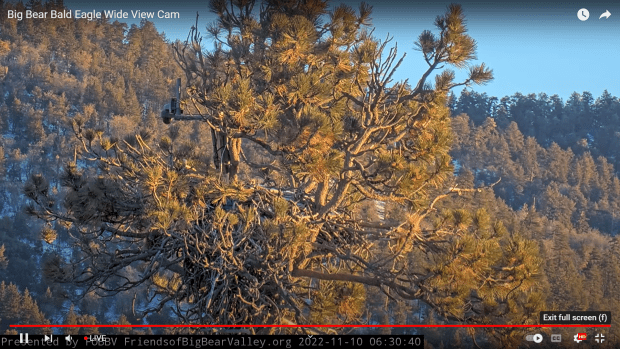
The record snow and wind has caused power outages at Big Bear Valley. The cameras for Jackie and Shadow are offline at the moment. We will wait and see if they are up tomorrow. Thursday. The camera is up over the valley but the nest camera remains offline. The storm has passed. Yippee.

Thank you so very much for joining me today. Please take care of yourselves. See you soon.

Thank you to the following for their posts, videos, and streaming cams where I took my screen captures ‘A’ and ‘H’ for their eyes and ears on Collins Street, National Hurricane Centre, SWFlorida Bald Eagles and D Pritchett, Pitkin County Open Spaces and Trails, ABC News, Port Lincoln Ospreys, 367 Collins Street by Mirvac, Charles Sturt Falcon Cam and Cilla Kinross, WRDC, and NEFlorida-AEF.

Puffin…Puffin…and other tales from Bird World

9 November 2022

Good Morning!

I hope that everyone is well.

Oh, it is the gloomiest of days. Wet and cold. The snow was forecast to turn to rain. And it did. The garden birds do not like the damp. They do sooooo much better if it is a dry snow.

Is it possible to lure any of the European Starlings into the lilacs to feed? There are 57 of them roosting in the back trees. The owner of the bird seed shop mentioned that maybe there is still enough food out in the fields for them. I paused and then realised that their big feeding frenzy began in January. Perhaps she is right.

Mr Crow and Junior were very happy when a new bag of peanuts arrived. Did I mention they sort through the peanuts for the heaviest ones? No sense carrying off a shell with nothing in it! So smart. So gorgeous.

The hanging light makes Junior’s feathers look more intense.

Even with their favourite suet they are not budging. The squirrels are happy, the Blue Jays have come for peanuts and corn, and the Crow has been in for peanuts and to yell at me because the water is frozen in the bird bath! He gets right on top of the conservatory glass roof and caws as loud as he can – like he used to do when the cats were in the garden. Speaking of cats, it seems once the weather turned bad their owners are keeping them inside. Of course, it does appear that all of the Hedwigs have met their demise because of the cats according to the neighbour. I am certain that he is right. I have not seen the rabbits since the summer and it is unlike them – all three of them – to be away for so long. With everything at Port Lincoln, I have convinced myself not to think about it.

Day 2. The UK Red List: The Puffin.

Puffin with his catch.” by ohefin is licensed under CC BY-SA 2.0.

Their name means ‘Little Brother of the North’ and they are, by far, one of the most beloved sea birds around the world. Did you know that they can dive up to 60 m in depth? This really helps when they are feeding their young 24 times a day! Yes, seriously, 24 times a day. Think twice an hour if you take 12 hours off to sleep. Do Puffins sleep? But, there is a problem. Changing sea temperatures and pressures from yes, you guessed it – those big trawling fishing boats – is causing a food shortage for the Puffins. As Beccy Speight says in her article on the Puffins in Into the Red, “If the food shortages don’t get them, pollution events and ground predators (Rats, Mink, Cats) will. If we want our Puffins to be more than jolly pencil case illustrations, then sustainable fishing, protection of feeding grounds, considerate placing of offshore wind farms, a reduction in marine pollution and preventing ground predators from reaching nesting colonies are what’s needed” (90).

Saltee Puffins” by JohnFinn is licensed under CC BY-NC-ND 2.0.

How cute and yet, how tragic that these beautiful sea birds are so vulnerable. Here are a couple of articles discussing the challenges that the Puffins face and it is not just in the UK.

This is an article from an academic press discussing the Puffin chicks dying of starvation.

https://besjournals.onlinelibrary.wiley.com/doi/10.1111/1365-2656.13442

Many of the issues facing Puffins can be mitigated. Two serious ones that need immediate attention are over fishing (because if we have the will we can do something about this) and nest predation. It is not too late to help in these areas.

Do you remember this poem about Puffins? Here it is with sound!

In what seems like another life now, I wrote about the work of Montana ceramic artist, Julia Galloway. Ms Galloway made a series of porcelain ginger jars. Each had a motif of an endangered species on it from the New England area of the US. One of those was the Atlantic Puffin. She notes, “The Atlantic Puffin has been listed as globally endangered due to climate change, pollution, overhunting, invasive predators, and gill nets, among other factors. Climate change has caused sea temperatures to rise, and this causes a decrease in the puffin’s abundance of prey and habitat.” Of course a lack of sufficient prey causes all manner of problems with breeding and the sufficient raising of offspring. What I did not know is that motorists are asked to check under their cars during the mating season and young puffins take shelter under the vehicles because they become disoriented by the lights. Galloway does acknowledge some of the efforts in the NE US including hunting bans and conservation efforts to cut back invasive plant species that are harming the Puffin’s nesting area. Decoys have also been placed on good nesting islands to lure these quite social birds to other areas to establish new colonies.

Like so many others, Galloway believes that art and literature might be the most effective means of encouraging people to stop, look at the natural world, and then, get mad and do something to help make our planet a better more biodiverse place for the wildlife.

In the Mailbox:

I have been sent quite a few links to videos on YouTube the past couple of days. I will spread them out. Today, ‘A’ sent me a compilation of events from Middle’s life at the Port Lincoln nest. She warned me to get a tissue and suggested that I turn off the music – which I did. You can also save it and watch later!

Australian Nests:

The scrape box located on the old water tower on the grounds of Charles Sturt University in Orange was full of prey this morning. It looked like the remains of a Starling plus two other birds. At one point, there was even a live bird in that box! Seriously. Apparently Xavier delivered it. Thankfully, Indigo lunged at the poor little thing and it took the opportunity to fly out the window.

Dad brought an early fish to the nest on the barge at Port Lincoln. Mom gave Big bites and took some good sized ones for herself, too.

Mum had a spa moment. I am so glad she is taking some time for herself. It has been a difficult season for this family.

I want you to have the link to the Friends of Osprey website. It is here that you can track our favourite South Australian male Osprey, Ervie! Here is the link and here is a good photo of Ervie with his tracker and some of his latest tracking.

Handsome Ervie.

Is it possible that Ervie is one of the best known Ospreys in the world? It sure seems so!

Is Dad safe from the eyases on the perch?

Off he goes!

Eagle Nests:

Note: Tropical Storm Nicole is set to make landfall in Florida. From the map below you can see that the nest of Samson and Gabby in the NE area near Jacksonville is going to get hit hard as this storm increases in intensity. SW Florida the home of Harriet and M15 will get a lot of rain and, of course all of the other nests such as Super Beaks in central Florida will be impacted (Superbeaks is a private nest). It could get really bad. Please send all our feathered families your most positive wishes as they ride out this storm system.

Samson and Gabby continue to work on their nest near Jacksonville, Florida. What a gorgeous couple! You can tell by their size and also their white head. Gabby is always slightly ruffled while Samson’s is normally slicked down as if he had been to the stylist before arriving on camera.

The winds and some precipitation have started at Samson and Gabby’s nest this morning. It will intensify as Tropical Storm Nicole gets closer. The nest is rocking although you cannot tell it from the still image and the rain has begun.

Thunder was perched over on the cliffs near the West End nest she shares with her mate, Akecheta.

It was raining at the nest site where the couple raised The Three Amigos last breeding season – Kana’kini, Sky, and Ahote -on Tuesday.

This morning it is simply beautiful there. Oh, it would be so nice to see the Three Amigos again. If you need a ‘Three Amigo Fix’ check out the highlights that play often on the West End Bald Eagle nest.

This still does not give you any impression of the wind and the freezing rain pelting down on the nest of Shadow and Jackie in Big Bear Valley, California.

This was the scene at Big Bear last night. The camera seems to be offline now. You still cannot get good sense of the snow coming down.

The Decorah North Eagles are around the nest. Gosh do they ever blend in with the fall look of the Iowa landscape.

Louis and Anna have been working on their nest in the Kisatchie National Forest in Louisiana. There have also been some intruders coming around the nest! If only they would find the vacant E-2 nest. There is another couple Alex and Andria on the E-3 nest. It also has a camera and great sound system.

Ron and Rita have been working on their next in the Miami Zoo and – were having a meal there the last time I checked. It is safe to say that if you go to an eagle streaming cam and rewind you might be able to see the raptors there at some point during the day.

Migration News:

Waba has been feeding on the Sudanese side of the Nile River while Bonus has been feeding in Turkey. Neither have made any effort to leave their area to go further south into the center of Africa. There must be enough food and they must feel safe. We will check back in with them in a few days but, they might have found their winter homes. No news from Karl II or Kaia as is expected. Send good positive wishes for the four members of this family.

Thank you so very much for being with me today. It is so nice to have you with us! Take care everyone. We hope to see you soon.

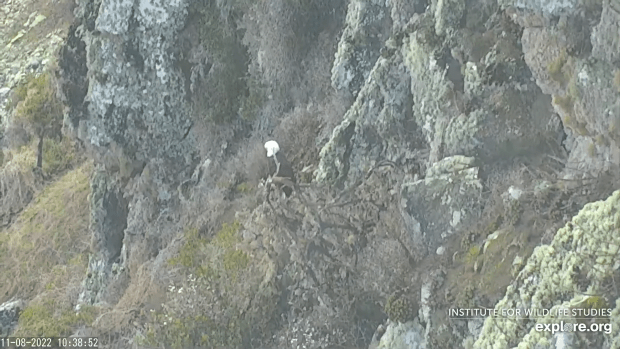
Special thanks to the following for their posts, videos, and streaming cams that make up my screen captures: earth.org, There Once Was a Puffin YT, Julia Galloway, Port Lincoln Ospreys, Charles Sturt Falcon Cam and Cilla Kinross, Friends of Osprey, 367 Collins Street by Mirvac, NOAA, NEFL-AEF, IWS and Explore.org, FOBBV, Raptor Research Project and Explore.org, KNF Bald Eagle E1 Nest, WRDC, and Looduskalender Forum.

Let’s Talk, Darling Starling

8 November 2022

Good Morning Everyone,

I was a little ahead of myself. The banding at Port Lincoln does not take place until the 12-14th (Australian time).

I have been trying to lure the European Starlings back into the garden. Last January there were 58 eating snow and hard seed cylinders along with butter bark and meal works. Nothing seems to bring them to the garden currently and this is troubling me.

The pictures below were taken in my garden on the 26th of January 2022.

This evening I was thumbing through and reading different entries in the two books – collaborations between writers and artists – that form the fundraiser on the Red Series by the British Trust for Ornithology. How disgusted was I when I found the Starling. So my plan is to introduce you to a different bird every day between now and the end of the year that is vulnerable. Today we are talking Starlings.

“Nowadays you can count them, when at one time they were literally countless.” Scientists think the causes of the decline involve farming practices that have poisoned insect prey with pesticides and chopped down grassland habitat. Other farmland bird populations too are reeling from the impacts.”

This report on the decline of Old World House Sparrows and European Starlings is excellent. It is long and it is thorough, some 244 plus pages divided into sections dealing with each species. It is not for bedtime reading but, even skimming through some sections and pausing to read bits and bobs will underscore the challenges that these two species face. These are two birds that I often hear people complain about at their feeders – there are so many of them. And yet, there aren’t. It is a delusion. If we cannot protect the Sparrows and the Starlings, what birds can we help?

Diamond doesn’t like them but they must be easy prey for the Peregrine Falcons in the rural areas of NSW Australia. Indigo is frightened by them and Rubus just gets down to business and eats them.

Some of you might have seen the recent YouTube video of the Starling that has learned to talk and sing but, did you know that this was common knowledge during the time of Shakespeare? In his entry for the Starling in Into the Red, M.G. Leonard begins with Henry IV and the entry where Hotspur declares that he will teach a Starling to repeat the name ‘Moritimer’ over and over again to drive the King mad since he declared his brother-in-law a traitor. Leonard is fascinated that a Starling would be a proper gift for a King, and that over 400 years ago it was well known how intelligent they were and how they could be taught to speak.

Leonard continues with Mozart who purchased a pet Starling in 1784 and taught it to sing. Mozart trained his pet Starling to sing his concertos. It was well-known that he loved his Starling more than anything in the world. The bird is said to have died a week before Mozart’s father. Mozart did not attend his father’s funeral. Instead he staged an elaborate memorial for his beloved bird.

In order to create a European landscape full of birds and plants, a German brought and released 60 Starlings- along with every other species mentioned by Shakespeare- in New York City in March 1890.

We think of murmurations and we think of Starlings.

Leonard ends blasting humans — “What monsters must we be, that we have reduced it to sit on the Red List.”

I agree. My heart is broken.


Australian Nests:

I have been thinking about the Melbourne Four. Risking getting egg on my face, I am going to come out and say that I think that the ‘Four’ will fledge within close proximity of one another on the same day. They have been very busy today watching the flying demonstrations that Mum and Dad have been doing. And one of them is ‘loafing’ like Alden. ‘A’ says Alden’s stance has gotten all the way to Australia!

Loafing.

Loafing and flapping. There are hardly any dandelions left on these beauties. They have the great DNA of old Dad and the new Mum and the love and care of new Dad. How fortunate.

That must be some aerial display – like 2 Stealth Bombers at an Air Show but for the private viewing of their kids…it is hard to imagine these four a month ago!

‘A’ has alerted me to a storm hitting the Melbourne area causing thunder and steady rain. It is not a good day for the eyases to fledge – and also. Look at the one on the ledge. The size of that crop dictates that bird will probably want to stay put and go into a food coma any moment!

At the nest of Cornell University’s Red-tail Hawk Big Red, she will always fill the eyases up to the brim if she doesn’t want them to fledge.

My goodness, I don’t know how that one eyas can stand she is so full. Gracious. It looks like she swallowed a small beach ball instead of a pigeon. Now, I wonder. Did she eat all of the pigeon leaving only scraps for her siblings??? Sure looks like it!

‘H’ reports that 5 prey items were brought to the Melbourne Four by both Mum and Dad. One of those was eaten almost entirely by Mum who took away the scraps. Thanks, ‘H’.

A super nice fish was delivered to Mum and Big by Dad around 1034. The winds will be gusting up to 30 mph and well, Dad is a great fisher but, he, too, can have difficulties. This is a lot of fish and should keep Big til later in the day. In the real world, a fish this size might be the only prey of the day.

‘A’ sent the observation board from Port Lincoln also. To recap, Big is 52 days old today. Mum and Dad brought in fish – Dad brought in 2 and Mum brought in 1. Those times were: 10:34, 13:15, 19:23. Thanks ‘A’.

I wonder how many more mornings we will wake up to Indigo looking off the ledge to the world beyond? She can fly. Rubus can’t.

Indigo is doing the same exercises that Diamond did in the morning – great stretches.

What a beautiful falcon Indigo is. She is watching carefully as the adults fly around the tower. They will begin to lure her with prey. Many on the chat do not realise that Xavier and Diamond will provide prey for about 4-6 weeks while they teach Indigo to hunt and be independent. Cilla Kinross says she does not monitor them after they fledge but she sees them in the trees about 400 m from the tower.

Rubus is not nearly ready to fledge.

‘A’ sent the days feeding recap for us at Orange: RECAP: 06 56 59 prey, left for chicks; 7:25:02 prey, Rubus takes; 9:17:05 X w/juv starl, leaves with chicks; 9:22:42 D w/GST, feeds; 13:25:17 X w/juv star, leaves with chicks; 16:48:25 pigeon, D feeds. In other notes, one of the prey had a blue leg band and Diamond ate it! Oh, goodness.

Other Nest News:

A major storm, one of the worst to hit the Big Bear Valley, is arriving today. Jackie and Shadow are getting prepared. Please send your positive and warm wishes to them.

Everyone has their favourite species of bird and within that species, most of us have one or two favourite bird families on the streaming cams. I have my own favourites and then I have the nests that I recommend to others to follow. Those nests are steady as you go and reliable and they include Harriet and M15 at SWFlorida, Samson and Gabby at NEFlorida, and Liberty and Guardian at Redding. The Channel Islands Bald Eagle nests have their challenges. The parents are incredibly amazing but, eaglets found themselves clinging to the sides of cliffs last year. It can literally put a hole in your heart while you wait to see if Dr Peter Sharpe will arrive in time to save the baby. So that is why West End and Two Harbour are not in those top 3. Fraser Point is a great nest, only about 2 metres off the ground, and is the home of Mama Cruz and Andor. I do not and will not recommend Dale Hollow which is on the border between Kentucky and Tennessee. The male is currently injured and last year there was siblicide at this nest. There is also a strict no intervention policy by the people that run the cams and that includes if fishing line is on the nest. The Captiva Bald Eagle nest has had its issues and it remains unclear if Connie and Clive will have a successful clutch this year. The last two eaglets to hatch on the nest, Peace and Hope, died from rodenticide poisoning. Glacier Gardens is a great nest but the visibility of the nest is not good. So, if you are starting to make a list and have limited time and want colourful characters and steady as you go then Harriet and M15 along with Samson and Gabby and Liberty and Guardian are your nests. I personally love Shadow and Jackie at Big Bear – talk about characters – and so do about 6000 other people. They did successfully raise one chick last year -Spirit – and that eaglet was amazing. I will be watching them again. Another good nest is the KNF nest 1 of Anna and Louis at the Kisatchie National Forest in Louisiana. Louis is an incredible fisher. One year he had 20 fish on the nest – 20 – for a recently hatched eaglet. They have fledged 1 eaglet for each year of the past two years. There are many, many others but if you want safe and secure for beginning eagle watching head to those three mentioned above.

That storm has hit Big Bear Valley. The winds are horrific and you can hear the rain and/or ice pellets alongside the howling wind. I will continue to check on this nest for today and the next couple of days. The eagles at Big Bear are used to harsh winter weather and, as we saw in Florida, they survived a hurricane. Looking forward to seeing Jackie and Shadow back on the nest when this is over.

Samson and Gabby are making their nest very comfy. Look at the reeds and moss that are coming in for lining. Fantastic. For those of you who do not know this nest, Samson hatched on this very nest. It belonged to his parents Romeo and Juliet. Samson and Gabby have fledged Jules and Romey, Legacy, and last year, Jasper and Rocket – success for the three years they ahve been together. Let’s see what year 4 brings.

Of course, after mentioning Harriet and M15, it would not have been fair to not have included some images. This couple, whose nest was entirely destroyed by Hurricane Ian, have rebuilt and has many of you note and ‘A’ reminds me, Harriet is now giving M15 ‘the foot’ to remind him it is time to fertilise some eggs.

Thank you so much for being with me today. Please take care wherever you are. Looking forward to seeing you soon!

Thank you to the following for their posts, their videos, and their streaming cams and for their notes: ‘A’, ‘H’, BTO, SWFlorida, D Pritchett and Lady Hawk, Port Lincoln Ospreys, 367 Collins Street by Mirvac, Charles Sturt Falcon Cam and Cilla Kinross, NEFL-AEF, and FOBBV.

Will the Melbourne Four fledge? …and other news in Bird World

7 November 2022

Good Morning Everyone!

I am so sorry that the link I published to the story of WBSE26 did not work. The one under question 1 below works! Thank you ‘J’ and ‘H’ for alerting me to this issue!

___________________________________________________________________

It is actually 2030 on the Canadian Prairies, Sunday evening, and the snow that was forecast, arrived. The precipitation goes back and forth between snow and freezing rain so it is like a slushy drink outside. The garden birds will not be happy. Watching them during the torrential rains last spring, it is readily apparent that they prefer the snow (dry snow not heavy wet) to the rain. Their food does not ruin and they can fly easier. So many prefer to eat directly off the deck than from the feeders that I worry about them when it is so wet. Will this snow be here in the morning?

It stayed. The squirrels have run all over the place. Dyson was here early with her two kits.

The miniature weeping Caragana and Japanese lantern look lonely this time of year.

One of Dyson’s kits. The other is in the lilac bushes.

Dyson under the bird bath eating Black Oil seed and peanuts she found under the snow.

On the Bookshelf:

One of my biggest complaints about bird guides is the images. We have a locally published book on Manitoba Birds. It has drawings instead of photographs and they are lovely but, they are only helpful to an extent. Sometimes there is only the image of the adult male. There are never immatures! And definitely not an immature female bird. How are we supposed to learn which is which in the garden? Merlin ID has driven me crazy. My best book for sparrow ID has been the hefty Crosley’s Sparrows. But, what if you want to identify other species? Some have pictures or drawings the size of postage stamps and the layout designer used the size 8 font so that anyone over the age of 30 or someone with poor eyesight cannot read the text.

There is a new book out that will help those living in Europe. You might still need a magnifier to read the text or probe the maps, though. The book is Europe’s Birds. An Identification Guide. It is a weighty volume. You will not be hauling it around with you in the field but, it should be a much used reference for home. The images are far superior to any I have seen in other volumes. In Canada, the hard copy is $36…well below the average of some of the other guides that take up space but do not help one bit with IDing a bird!

In the Mailbox:

Oh, I love getting questions! There were 3 today and all of you might be wondering about one or more of them.

1. ‘J’ wrote about having difficulty opening the link to the former blog about WBSE26. I am so very sorry if this happened to all of you. Here is a link that works. 26 is inspirational and needs to be remembered for all the joy and encouragement she gave to all of us in her short life.

https://maryannsteggles.com/tag/wbse26/
January 5 is National Bird Day!

2. ‘K’ wrote: ‘Will the parents continue to feed the chicks on the ledge in Melbourne after they fledge?’

‘K’, that is a difficult question to answer. Normally, the adults would begin teaching the eyases how to hunt when they fledge. They would deliver prey to them in mid-air transfers and would be finding other places to feed their fledglings. The previous couple did not feed the fledgling falcons on the ledge. Mirvac turned the camera off at that time. These are first time parents and we will have to wait and see but I assume the answer is ‘no’, they will not bring prey to the ledge for the falcons if they have fledged. Prey would be taken to those that have yet to fly. You might also have noticed that the adults have begun to reduce the amount of prey that is being delivered. Food is a great motivator!

3. Several asked, ‘Will the Collins Street eyases fledge one by one or will they fledge together?

Like question 2, this is difficult to answer for several reasons. Males tend to fledge before females. The reason is simple. It takes females longer to produce all the feathers for their larger size than the males. At the present time, we do not know the gender of these chicks and it is likely we never will as they are not ringed nor has any blood been taken to determine gender. We should, however, expect the male to fly first. Victor Hurley has said he believes that there are 3 females and 1 male. But is the male the 4th hatch or the 1st? or the 3rd? Hatch order and gender could impact the timing of fledge. So if the male is the 4th hatch he might fly the same time as the 1st if that bird is a female because of the difference in their ages.

I have seen many nests where the eyases get so excited seeing one of their clutch fly that they all fly off within an hour. It has happened at this ledge. Now that the youngest has made it to the window ledge, I am wondering if the eyases might not all fledge within an hour or one another. We should know the answer to this question soon! I know that this does not answer your question. It might even confuse it more and my apologies. We just don’t know! They will keep us guessing until they take off…and then we will wish them safe skies, long lives, and full crops.

Fledglings depend on the parents from 4-6 weeks to help and teach them how to hunt and obtain prey. They will then leave the parent’s territory.

One of the most difficult things about getting close to the birds is not knowing what happens to them. Some people prefer to not know while others like myself, want to know every detail of their life. I think that is why satellite tracking is so interesting to me or a book such as Bowland Beth.

Australian Nests:

You might well have noticed. Mum and Dad at the Port Lincoln Osprey barge don’t seem to be in such a big hurry in the morning to get up and off and find fish. Dad appeared to have a leisurely morning and Mum went and had a spa break. Good for her. She must eat and take care of herself.

Mum and Dad are also spending a lot of time with one another. Mum has fed Dad – a tender thank you for the food he brought when she was so desperately hungry -, they have sat together in the shed, and now they are spending time on the perch. If someone believes that they are not mourning, they need to consider the behaviour of these two beautiful ospreys who have lost two chicks. The loss of Middle had to be particularly difficult, a fully feathered osplet.

Dad flew in with a large whole fish. It looked like Big wanted that fish for itself but Mum prevailed and kept control. She remains in charge of the feeding. Is this on purpose? Big is now the age that she should be self-feeding. Big hatched on the 18th of September. If we count hatch date, Big is 51 days old. She will be ringed anytime between today and Thursday. We should be able then to confirm the gender, the weight, a name, and see Big with her tracker.

I had to laugh. One of the chatters said that, ‘Big is just an eating machine’. That is possibly why Mum still controls the reigns of the fish so that she gets fed properly, too, when an extra nice fish like the one that came in this morning is delivered.

Look at that fish. Wow!

Watchers of 367 Collins Street are having a hard time deciding if any of the eyases have fledged. They are such beautiful eyases. At 1400 all four were on the ledge.

‘H’ did a great compilation of the 4th hatch, ‘little Peanut’ branching up to the window ledge. Watch as the others come down and do a ‘cheer’ for the wee one.

Indigo and Rubus are changing every day. Like Big, Rubus is a bit of an ‘eating machine’. When Rubus hatched and was so absolutely tiny and couldn’t get up to eat – do you remember? -, I felt so sorry for Rubus. Indigo was just tall, stoic, and elegant. At one point it seemed like Diamond didn’t want to bend down to feed Rubus. And then…Rubus started jumping and stretching that neck. What a long neck and well, that is all history. Rubus practically knocks the parent over if there is food. Indigo appears to want to look out to the world beyond and feed herself. Rubus gets fed but is doing quite well at self-feeding, too.

‘Hello Everyone!’

Rubus was very happy that Indigo left some prey.

Rubus is doing a great mantling of the second prey delivery. Indigo is not interested. She ate most of the earlier delivery and is looking out to the world where she will be flying with her parents – the fastest bird on the planet!

Look at Rubus’s wing feathers. Lovely. We will wake up one morning and Rubus will look like Indigo. What a shock that will be!

At 1642 prey was delivered. Indigo expected to get it but, Rubus was quicker grabbing the item and carrying off into the corner by the Cilla Stones.

Indigo is telling Xavier and Diamond about how naughty Rubus was taking her prey!

The adults leave the kids to it…Rubus takes the prey to eat it in the back of the scrape while Indigo comes over and wants the food. Rubus turns quickly to protect his meal and heads back to the Cilla stones. Rubus has had some good fast bites.

Indigo will eventually get the prey from Rubus through the great ‘stare down’.

Need a refresher on falcons? This is a good resource on Peregrine Falcons that includes many helpful links that you might find interesting.

https://www.hww.ca/en/wildlife/birds/peregrine-falcon.html

What’s Up with the Eagles?

Harriet and M15 have been working really hard rebuilding their nest that was completely destroyed by Hurricane Ian. Lady Hawk has posted a video of their progress. And guess what? Harriet is sleeping on the nest tonight. Eggs might be coming soon!

Philippe Josse posted some super screen captures of Mum and Dad at the Notre Dame Eagles nest in St Patrick’s Park in South Bend, Indiana. This is the home of our beloved Little Bit ND17 – the little eaglet that could. Their nest completely collapsed and many wondered if they would rebuild in the same place. They did and both have been walking around testing the nest to make certain it is sturdy. Thank you, Philippe!

Jackie and Shadow continue to work on their nest in the light snow in Big Bear.

And last but, never least, some great news. I have been tracking down information on ospreys that went into care before they fledged. There is an urban myth that they do not do well in care and, in particular, before fledging. You might remember the two osplets that had not fledged at Pitkin County Open Spaces and Trails. Their mum pulled them off the nest by accident. One died while the other went into care. It is doing great and is being over wintered and will be released in the spring. Urban myth proved wrong. (I have been asked not to publish the name of the wildlife centre as they do not have the staff to answer queries). This is good news and details will be sent to Port Lincoln.

Banding will take place anytime between today and Thursday at Port Lincoln. I have seen no specific time or day indicated yet.

Thank you so much for being with me this morning. Please take care. See you soon!

Thank you to the following for their posts, videos, and streaming cams where I took my screen captures: ‘H’ and 367 Collins Street by Mirvac, Amazon.ca, Port Lincoln Ospreys, 367 Collins Street by Mirvac, Charles Sturt Falcon Cam and Cilla Kinross, FOBBV, ND-LEEF and P Josse, SWFL and D Pritchett plus Lady Hawk.