Friday in Bird World

15 September 2023

Good Morning Everyone!

Hope, Calico, Missey and Lewis – along with all the garden animals hope that you are well, that the weather is grand, and that you will get outside and enjoy the sound of birds and the smell of autumn which is upon us.

Calico’s incision looks really good. What a sweet cat she is. She sees the antibiotic cream tube and will go and lay down on the striped quilt and let me apply it. She is simply a marvel.

I have had animals all my life. When I was born my father had a three-legged dog that stood guard by my basket. She lived quite a long life – and it is because of her that I recognise that animals can adapt to many situations and live a full life. Trixie certainly did. In all those decades, I have marvelled at how smart these animals are, but I have never had a companion like Calico. She is quiet, affectionate, and sweet, and seems to simply understand that the cream is to help her. She has never – and this is apparently rare for a community cat – ever scratched or fought me. It has been the opposite. What a blessing she and that little bundle of energy, Hope, are.

Tonight, on my walk, I came across a woman who helped look for the kitten. She teared up at the sight of Calico and Hope together in the photos. We all need happy endings. At the same time, I was a wee bit saddened to see that the deck where Calico had her kittens had been enclosed with wire mesh. It was a good place for the community cats to be warm and dry in the winter. No one knew they were there – and while it is none of my business, it is an example of how quickly animals can lose a ‘home’. These cats have served an important role in our little neighbourhood. There are no mice that I am aware of. Numerous people feed birds, including myself. I attribute the lack of mice directly to these cats.

Calico and I have been reading an edited volume Not Too Late. Changing the Climate Story from Despair to Possibility. One of the most moving and inspiring chapters is by Jacquelyn Gill, a Palaeontologist. The chapter is called “The Asteroid and the Fern”. Gill writes about her visit to a cave in Siberia and the Great Dying that took place 251.9 million years ago when “roughly 90 per cent of life on Earth was lost” (126). Gill adds that the “heat wave that triggered the Great Dying took around seven hundred thousand years to unfold”. She compares this to now where in a lifetime we have created disaster which “barely spanned the breadth of a human life” (127). Gill looks at what happens after adding that the stories of extinction in the past are as inspiring as they are sobering (126).

I look at the four animals in my direct care and those that live in the garden and realise that we must live in the present and not fall into depressing despair. We must work cooperatively to find solutions while living ‘in the moment’. If not, we will miss those beautiful lives standing right in front of us. Isn’t that what this is all about? The wonder of the seasons, the animals, the people we love. To ponder in despair what might come and to miss the now would be a heavy loss.

The beauty of the world does not have to be in an exotic location halfway around the world. Most often it is right before our eyes.

Bird World is going to take a wee vacation starting on 17. September. ‘A’ and ‘H’ and I will return on Monday the 25th. We urge you to keep your eye on Manaaki if he has not fledged by Sunday and to also watch for the start of the cams at Sw Florida.

First up – do you live in Maine? If so, please read the following notice carefully.

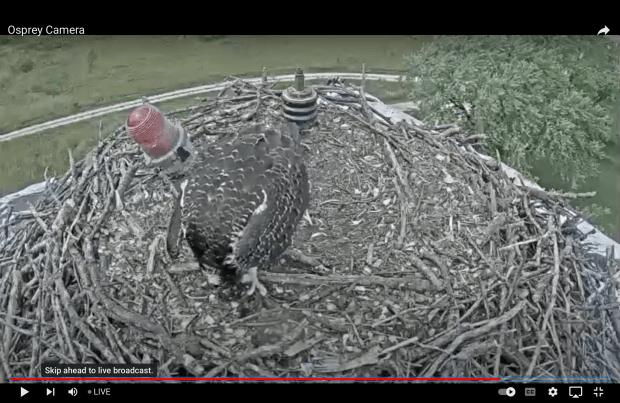
Geemeff gives us a year of highlights from nest 1 at Loch Arkaig – Louis and Vila’s old nest. Now it is ‘as the osprey soap opera turns’ – we wait to see who pairs up next year. Thanks, Geemeff. It is a beautiful nest that needs to be occupied with fish screaming osplets!

M15 and F1 at the SWFlorida Eagle Nest.

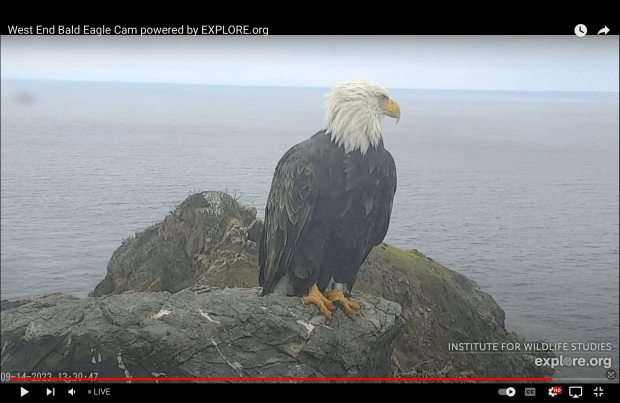
Thunder, the daughter of Chase & Cholyn from Two Harbours, visits the old nesting area she shares with her mate, Akecheta on Thursday.

Oh, we would give anything to see Mini on the Patchogue nest – have her just fly in like Thunder and recognise her. Mini was last on the nest on September 11. Locals noted that Dad was also seen that day but Mum has not been to the nest since Sunday the 10th. No one has seen them in the area since then and it is possible that they are elsewhere on the water or after left the area.

One of the Webster Texas eagles is back working on the nest!
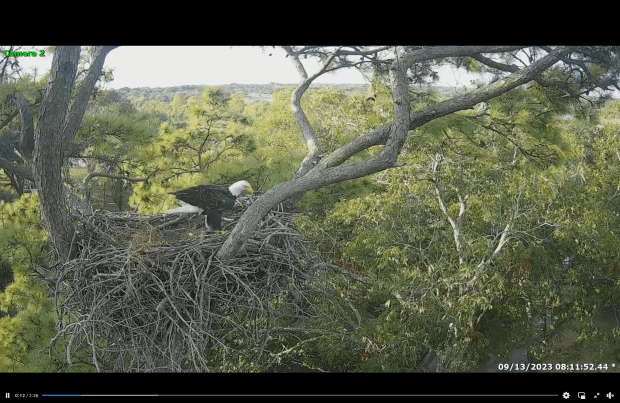
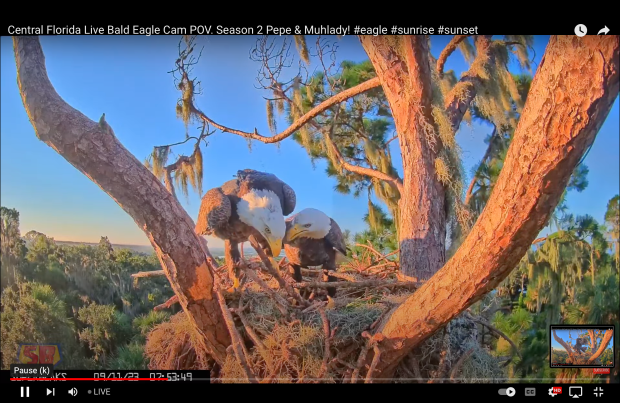
Pepe was working on the Superbeaks Nest – gosh, Osprey season ended and the eagles are now starting work! How exciting is this?

The posting of the loss of Stormy and Simba touched so many. I have received numerous letters. Please don’t stop watching Jackie and Shadow – we won’t probably ever know what happened to those two gorgeous fledglings but, we can, each day, in our way, do something to hopefully make the lives of our wildlife better.

Sadly, a large number – the precise % each year is unknown – do not survive their first year. We must also celebrate those who do and cheer on those who live into their 20s. It has not been easy for them.

‘Down Under’-

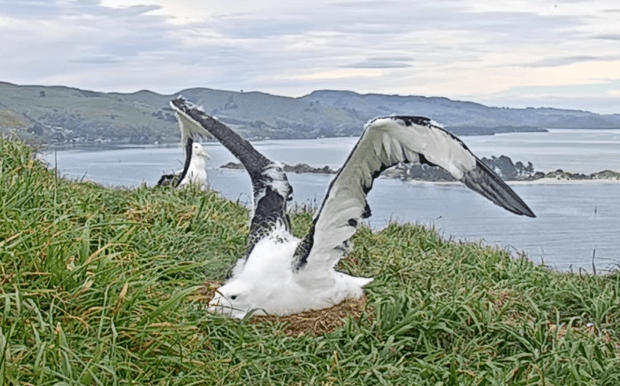
Sharon Dunne updates us on the status of fledging at the Royal Albatross colony.

‘A’ was able to confirm: “Quarry is confirmed to have fledged so it is just UQ and Manaaki now. Both the girls have left. UQ is far better at hovering than Manaaki is, so I do hope our boy does not try to leave before he is ready (which he really isn’t yet).” ‘A’ also adds: “At 18:35 at Taiaroa Head, the last of the light is fading and we can just make out Manaaki on his nest and UQ on his new ‘ nest’. (We can’t see whether he has actually constructed a new nest or whether he has simply relocated to the grass area next to Manaaki and a long downhill from him.) He seemed to move there permanently after Quarry left the area several days ago but has always been friendly with Manaaki. The girls (Quarry and Miss NTF) were constantly visiting UQ, displaying to him and generally being precocious and a little aggressive, which disconcerted UQ, who in turn sought refuge around Manaaki. The girls also tried similar approaches with Manaaki, but being not nearly as shy as UQ, he was always prepared to stand up to the girls and clack his bill at them, driving them away from his nest. He took no nonsense from either! Although UQ is the fluffiest and least adventurous of the four, his flying skills (well, at least his hovering) are way ahead of Manaaki’s, and over the past two days, UQ has been hovering so high he has been out of sight of the camera. He has also flown a long way across the downhill grassy area, towards the water, and has sometimes had to walk back up, although on other occasions, he has been able to glide backwards (I finally understand what the chatters meant about backward flying, which these albie chicks do all the time). The chicks try to ride the wind currents by simply stretching out their winds and allowing the wind to lift and carry them. If they get high enough, and are sufficiently balanced, they can tuck up their trailing legs and feet and actually glide quite a distance. It looked on more than one occasion as though UQ was off and gone this afternoon. Manaaki, on the other hand, is still not getting the same lift as UQ yet and is not yet balanced enough to control his movements in the air or to tuck up his legs and feet. Both of the boys still have too much fluff to fledge, in my opinion, and I am hoping UQ will wait another few days to lose his fluff and that Manaaki will wait at least another five days to a week to perfect his skills in the air. But as I said the other day, the wind will usually decide for them. And hopefully, the ones who are not strong or skilled enough will ditch in the bay, allowing their rescue, as we saw today. So it is only after they leave the waters near Taiaroa Head that they begin the exhilarating beauty and deadly risk that is their life as wild birds.”

At Collins Street, ‘A’ writes: “Little dad at Collins Street is a trooper. He did several lengthy incubation spells today, and not just the nearly two hours in the centre of the day but another couple of hours in the middle of the afternoon. He is a very dedicated dad, and as I mentioned, I’m sure he is providing food for F22, though she may be hunting for herself as well. Certainly, she has left the nest several times and then, very shortly afterwards, we have seen feathers floating down from a higher level while M22 looks upwards with that sweet sidelong glance he has, so I’m sure she has had no time to catch her own food in that time. Who knows what she does in that late morning/lunchtime period (90 minutes to two hours), which she used to take as down time last season as well, until that day when the chicks nearly baked (honey, I fried the kids). From memory, I seem to recall her being more diligent following that incident, although of course it was only a week or two after the baking incident that last year’s eyases started to make their own decisions on which end they wanted to inhabit, heading along the gutter at will. She takes her final break of the day at 18:07, with M22 taking over at 18:10 and remaining until F22 returns to the ledge at 18:16. As always, she is screeching (is that her normal mode of communication?) on arrival and dad leaves the nest and dives off the ledge. Fast. Mum settles down for the night shift.”

The Sydney sea Eagles have eaten well. There is some concern about Lady’s foot. ‘A’ observed this closely and adds, “At 10:11:06, and again from 10:11:22 to 10:11:24, have a look at the surface of Lady’s left foot. It appears to be a very raw wound or nasty scrape, not blood from a piece of prey. See what you think. At 10:13:02, as she walks to the back of the nest, it looks as though there may be some inflammation or mark on the back of the left ‘ankle’ area. Lady also has some blood on her head, at the top/back on the left side of the crown. I thought little of it earlier in the morning, but now, noticing the apparent wound on her left foot, I am wondering about the blood on her head. It is possible she scratched her head with the foot when it was bleeding and I suppose it is also possible it is from a prey item, as she has a piece of fluff or a feather stuck to her forehead at the top of her beak, between her eyes. She does not appear hindered by any injury nor does she exhibit any signs of discomfort. So perhaps I am worrying about nothing. There’s another close up at 11:14:18. It doesn’t look quite as bad as in the earlier shots but perhaps that is the light.”  

On Thursday, Lady was bringing in new twigs for the railings to try and keep the sea eagles in. One of the cutest things is when these adorable eaglets start pitching in and helping being little Mini Mums.

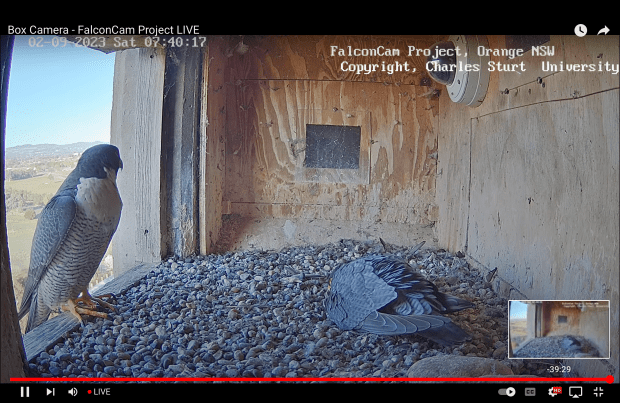
At Orange, Diamond is impressed when Xavier arrives with a Rosella at 0908!

Eastern Rosellas are brightly coloured birds – blue and yellow along with some green, with a bright red head and white cheeks – that live in New South Wales and Queensland Australia. They live in flocks – usually of about 20 birds – and eat seeds, berries, fruits, nuts, and even leaves.

Eastern Rosella” by zosterops is licensed under CC BY-NC 2.0.

I saw no fish deliveries while watching or rewinding the Port Lincoln Osprey cam. Hopefully, since it appears to be a calm day, Dad2 will get on and haul in a big fish for Mum.

It is that time of year and the Osprey nests that ‘H’ has been observing are getting really quiet. She notes that the Osoyoos camera is once again down but she will continue to check for us to see if anything is happening. Audrey was not seen at Kent Island on Thursday and is believed to have migrated. “Duke at BL was seen a couple of times yesterday, and he has been documented to stay around as long as eight days after the last juvie left the area.” ‘H’ is also checking to see if the IR light will be turned on at Collins Street. Thank you ‘H’.

Birdlife International brings us a short but gripping story about birdwatching, yacht racing, the Southern Ocean and the decline in wildlife.

Before we go, another great image of Ervie finishing up the innards of his fish dinner. Always lovely to see you Ervie!

And more Ervie!

Thank you so much for being with me today. Please take care. See you soon!

Thank you to the following for their notes, posts, videos, articles, and streaming cams that helped me to write my blog today: ‘A, B, Geemeff, H’, Kshanti Green and Maine Birds, Geemeff and the Woodland Trust, SW Florida Eagle Cam, IWS/Explore, SL Security Pros, Paul Williams and Webster Texas Eagles, Superbeaks, Terri Ashmore and FOBBV, Sharon Dunne and Royal Cam Albatross Group of NZ, Sydney Sea Eagle Cam, Charles Sturt Falcon Cam, 367 Collins Street by Mirvac, Julie Lovegrove and Friends of Sth Aus, Bazz Hockaday and Friends of Sth Aus, and BirdLife International.

Guess who’s still home…Thursday in Bird World

14 September 2023

Good Morning Everyone,

The happenings in Bird World – in terms of our beloved Ospreys – are getting thin. Most have left their nests and are returning to their winter destinations. It has been a privilege to watch these amazing families struggle in some very challenging conditions to survive. The joy that even a single survivor on a nest brought to us – seeing Dorsett catch a fish and hang out by the beach after fears that the entire clutch would be lost. Witnessing the loss of the Lake Murray osplets to a GHO or others die for mysterious reasons like those at Marder’s. And then seeing a survivor like Mini – . It was like being on a roller coaster – the 2023 Osprey breeding season.

Thank you for your really good wishes for Calico. She is healing nicely. We have not resorted to the Victorian Collar – well, I tried it when I saw her licking but she was not having that and in the end the stress and her trying to tear it off might have caused more damage. I learned from Geemeff that Olive Oil will keep skin around the incision from drying out which is the root cause of the licking -when that skin dries it pulls. I also picked up some antibiotic cream. Calico is such a lovely girl – she rolled on her back and let me apply those as if she completely understood that I was trying to help her. I cannot tell you how much I adore this cat.

Hope is a live wire and wants only to play. Missey wants to play with her but Calico is not so happy to share so we are going to wait. Hope is also beginning to lose that ‘fat’ little face of a kitten. She is 74 days old – nearly 11 weeks. She has such big legs! She is cute, quick, and fun and is less and less afraid of people every day.

Hope loves this feathery teaser that her Auntie in Scotland got for her. It brings her out of her hiding spots in an instant!

Hope is a whirlwind. She must just make Calico tired. You might be able to tell that the conservatory has been turned into a cat play room complete with the table being turned into a hiding spot with thick comforters on the floor and heavy quilts and Rajasthani block prints as cover. It is hopefully a happy safe plade for these two as they acquaint themselves to life indoors. I got a giggle this morning. Geemeff sent me a saying, “Dogs have owners, cats have staff.” Isn’t that the truth? I am getting ready to go and do ‘maid duty’ after having already done ‘room service’. I would not change anything.

Calico has discovered that from the little house on the cat tree she can control Hope having access to that tummy tum.

This old cattier has been fun for more than a dozen cats since a couple of local men – a carpenter and an upholsterer – made a few of these around 2006. They are heavy duty – 3/4″ plywood construction and the carpeting can easily be replaced in the bits that get the. most use.

Missey and Lewis grew too big to run and play in the lime green tunnel. Hope loves it and the crinkle sound the fabric makes.

‘H’ has a surprise in her three reports this morning…a wonderful surprise.

Osoyoos – What a surprise … After the livestream was down for 14 days, it went live on 9/13 … for 4.5 hours, then the feed went down again. So, what did we learn?  The fledgling is still there.  She was on and off the nest several times.  And, she looks fabulous!  She is quite plump and healthy looking.  That is just wonderful.  We did not see either of her parents. 

Kent Island – Audrey made an appearance early in the morning when she landed on a pole at a nearby dock.  She stayed perched there for some time, but we are not sure how long, as the camera panned back to the nest.  We did not see her the rest of the day, which was somewhat unusual of late.  The past several days, Audrey had been seen a few times in Joe’s tree or on the dock.  We will monitor, but it is possible that we may have seen Audrey for the last time this season.  

Barnegat Light – Duke was seen in a couple of different trees throughout the day.  Dorsett was not seen or heard.  There were no significant live streaming issues on 9/13, so technical difficulties cannot be blamed for the lack of Dorsett sightings.  The last time we saw Dorsett was the morning of 9/11.  There was a beautiful sunset over Barnegat Bay … a poignant moment in time … missing Dorsett.  “You be safe out there, girl.”

Visitor at Loch Arkaig! Not an Osprey. Beautiful.

More visitors to Louis and Dorcha’s nest at the midnight hour.

A fledgling having a wonderful fish meal on the Kallavesi Osprey nest in Finland! These sightings are getting rare as the urge to leave the natal nest and breeding grounds grows stronger.

Keo brought Coco three fish today at Sandpoint. T here was no sign of Keke and she might have begun her migration.

Mum was eating a nice fish on the perch at Boulder County Fair Grands Osprey nest. No sign of the fledglings while I was checking.

The Patchogue Nest is empty. Locals have seen ospreys but they have not come to the nest and there is no confirmation that they are Mini or members of her family as there are other nests in the area. I did find this short video clip showing Mini having dinner with her siblings. A nice memory.

The Osprey platform at Seaside is quiet.

Caught Swoop on the nest at Dunrovin.

Now that Pat has been released from being in rehab, is it possible that all three fledglings from the Dulles-Greenway Nest were home?

Is there anyone that isn’t excited about what is going to happen on the Sw Florida or the NE Florida Bald Eagle nest this year?

M15 has his new beautiful lady.

Gabby and V3 are going to try and raise a family together this season. It is exciting – new beginnings for two of our favourite eaglets who lost their mates last year.

The most beautiful sunsets come from the Superbeaks Bald Eagle nest in Central Florida.

Checking in NZ and Australia:

Royal Albatross Colony, Taiaroa Head, NZ: ‘A’ notes: “In New Zealand, there are strong onshore winds currently and the chicks are taking this perfect opportunity to practise their flying. UQ is doing wonderfully well but Manaaki really does have some way to go when it comes to technique. He is currently down the hill, out of sight, having hovered out over the edge and down a bit. He really has little control over his skills yet, unlike UQ who looks very close to departure. And as I said, Quarry has not been seen on the hilltop for several days. We will get another report tomorrow on who has left the colony. There are currently two fledged chicks who have landed on the water in the bay. The rangers are keeping a close eye on these two, as if they become waterlogged they will be unable to take off again and will eventually drown. The rangers will rescue them for a second take-off attempt if this becomes necessary.” She continues, “Manaaki is still there, as is UQ, though it appears Quarry has left. We are not sure whether she was at the chick count yesterday so she may be elsewhere on the headland but we suspect she has fledged. Heart in my mouth every time I turn that tab on. It won’t be long now for Manaaki. He is 236 days old today (average age at fledge 240 days). I presume you are aware that this is the only mainland northern royal albatross breeding colony in the world, so it is a very special privilege to be able to watch them and to know the rangers are doing everything possible to protect this magnificent species. I will be interested to see the contents of the boluses this season, especially Manaaki’s of course. I suspect they will be largely the same, though it could vary based on where the parents have been foraging.” 

‘A’ brings another update: “They have rescued the two fledged chicks who landed in the bay. They picked them up from a boat and took them back to their nest areas, from which they can make another attempt at fledging.’ 

Alison

367 Collins Street: ‘A’ knows someone who works near the Falcon’s scrape and she writes: “They can hear the Collins Street falcons all day at work, and the screeching noise is becoming very familiar. Any city dwellers would have been woken early this morning, as F22 was up and calling loudly for food before 05:55, leaving the ledge and presumably heading for the food stash. She has a large feather stuck to her face, on the right side of her beak, which looks so funny. The falcon version of bed head I think. The eggs were left unattended for just over 62 minutes before M22 arrives to incubate. He hardly has time to settle before mum is back, still with the facial feather and still shrieking. Dad does a classic GCW dive off the ledge and mum settles down. It’s 08:40 and M22 is back on the eggs at the moment. He has been for nearly an hour now, and he is breathing through his mouth already in the morning sun. Remember that in a couple of weeks’ time, it will be only 07:40, with daylight saving starting on 1 October (clocks will go forward one hour at 2am on the Sunday morning). It is currently 17 degrees and I can hear F22 arriving back on the ledge. She is noisy. Dad dives off the ledge, probably to get away from the ear-splitting screeching.” 

“After leaving M22 to look after the eggs from around 10:30, F22 did not return until nearly 12.20. During that nearly two-hour period, little dad took a very short break of perhaps two or three minutes but that was well after the shade had completely covered the scrape. There were times when he was panting so fast, his little body looked like it was vibrating. If the parents are suffering like this at this time, what will it be like in six weeks, when the temperatures will be up to 8C higher and the shade won’t cover that scrape until well after midday. (Remember daylight savings puts the clocks forward an hour, so what is now 11am will become 12 noon, which is the last thing that scrape needs.) And of course the sun is moving further south, meaning the shade will take longer and longer each day to reach that scrape. It is worrying me a month before the eggs hatch….”

Like ‘A’, so many wish that a sun shade was placed over the end of the ledge where the eggs are like the other side because of the escalating heat in Melbourne at this time of year.

Orange Peregrine Falcons: Cilla Kinross has published the prey deliveries and a comparison to earlier times so that we can see that the drop off in deliveries this time of year is natural.

In New Zealand, the mainland colony of Kakapo is growing. These are historic moments -. Let us hope that the Kakapo will once again thrive – as in both numbers and quality of life – on the main island of New Zealand where they once lived. For those who do not know the history of the Kakapo and their extinction, here is a brief article to acquaint you with that sadness.

I have included this before but, let’s all remember! Don’t let those pumpkins go to waste. Tell your family and friends. All those pumpkins turned into Jack-O-Lanterns are great food sources for wildlife. It can make a difference in their lives – food. Life saving food.

You can do something to help lots of wildlife with your pumpkins, old apples, etc -.

I checked on Karl II’s family – all are still travelling, but there is no transmission yet from Karl II, and there is also no transmission from Tweed Valley’s Poul. Keep them in your most positive thoughts.

Thank you so much for being with me today. Take care!

Thank you to the following for their notes, videos, postings, and streaming cams that helped me to write my blog this morning: ‘A, Geemeff, H’, Osoyoos, Kent Island, Wildlife Conserve F of NJ, Geemeff and the Woodland Trust, Finnish Osprey Foundation, Sandpoint Ospreys, Boulder County Fair Grounds, D Lambertson and PSEG, Seaside Ospreys, Dunrovin Ranch, Sassa Bird and Bald Eagles I the USA, Ana Boone and SWFL Eagle Ca, NEFL-AEF, Superbeaks, NZ DOC, Holly Parsons and Albatross Lovers, 367 Collins Street by Mirvac, Cilla Kinross and Orange Peregrine Falcons, and Kakapo Recovery.

Migration…Wednesday in Bird World

13 September 2023

Good Morning,

Tuesday was a very ‘difficult’ and, at the same time, rewarding and joyous day. Two beautiful Calico cats are off the streets and out of the cycle of producing feral kittens. Needless to say I did not sleep well Monday night. It is the ‘alarm clock syndrome’. Difficulty sleeping for fear of sleeping through the alarm.

Calico’s surgery went well. The vet phoned to say that Calico was ‘very strong’ and a gentle, sweet ‘kitten’. The staff spent much time with her when she was recovering – her story and that of Hope finding us -touched each and every one of them. It still makes me weep at all the things that had to ‘work’ for this to happen. I am indebted to those individuals that reached out to help me find ways to track Calico, who helped by providing the kitten trap for Hope, and to each and everyone whose experience with community cats helped us to have a successful ending to their story.

The biggest issue at the vet’s was the advice to keep Calico and Hope separated overnight. Of course, if Calico insisted, the stress being separated from Hope would be worse than Hope trying to suckle. The distance between the little office door and the one for the conservatory is approximately 65 feet. Calico made it very clear that she was not staying in that room. Lewis and Missey were contained in another room with the door to the conservatory open. Calico bolted the instance the office door opened. Hope came running! For a few seconds, there was a lovely little conversation between Mamma and baby. Thankfully, the only kitten that Calico will ever have is healthy and safe and with her Mamma tonight.

Calico is still in a bit of a haze, but Hope is so happy! Mamma is home. Just look at that round little belly on Hope. Poor Calico. She is just so wee…she weighs 2.3 kg or 5.03 lbs. Hope may weigh that much. Calico will start to put on weight and become healthy.

It is a secret. Hope spent the entire day playing with Missey!!!!!!!!!! They are super friends but don’t tell Mamma.

What fun it was to sit and watch these two with the new scratch post. They took turns with Hope watching every move that Missey made carefully and then imitating it.

Hope really loves this new scratch post with the feathered ball.

Before lights out, Hope got in some playtime while Calico rested. She forgot about where she was and wound up on my lap with the feather teaser. It was too funny – the startled look on her face when she realised that I had reached over and started petting her. Things are coming together. She is no longer 100% afraid of me scurrying off to hide in a corner. Humans mean food, cuddles, treats, and playtime!!!!!!!

What is happening in Bird World? One word: migration. Cornell Bird Lab and BirdCast are predicting that 348 million birds will be on the move as I am writing this Tuesday evening 12 September.

What needs to be done to protect migrating birds?

The National Wildlife Federation gives these ten tips for helping migrating birds – these are things we can initiate that can give instant success.

1.  Keep your cat indoors—this is best for your cat as well as the birds, as indoor cats live an average of three to seven times longer. Even well fed cats kill birds, and bells on cats don’t effectively warn birds of cat strikes.  For more information, go to http://www.abcbirds.org/cats.

2.  Prevent birds from hitting your windows by using a variety of treatments to the glass on your home—check out ABC’s tips at http://www.abcbirds.org/abcprograms/policy/collisions/glass.html

3.  Eliminate pesticides from your yard—even those pesticides that are not directly toxic to birds can pollute waterways and reduce insects that birds rely on for food.

4.  Create backyard habitat—if you have a larger yard, create a diverse landscape by planting native grasses, flowers, and shrubs that attract native birds. You will be rewarded by their beauty and song, and will have fewer insect pests as a result.

5.  Donate old birdwatching equipment such as binoculars or spotting scopes to local birdwatching groups—they can get them to schools or biologists in other countries who may not have the resources they need.

6.  Reduce your carbon footprint—use a hand-pushed or electric lawnmower, carpool, use low energy bulbs and Energy Star appliances. Contact your energy supplier and ask them about purchasing your energy from renewable sources.

7.  Buy organic food and drink shade-grown coffee—increasing the market for produce grown without the use of pesticides, which can be toxic to birds and other animals, will reduce the use of these hazardous chemicals in the U.S. and overseas. Shade coffee plantations maintain large trees that provide essential habitat for wintering songbirds.

8.  Keep feeders and bird baths clean to avoid disease and prevent mosquitoes from breeding.

9.  Support bird friendly legislation both locally and in the U.S. Congress.

10.  Join a bird conservation group—learn more about birds and support important conservation work.

According to ABC, birds need our help now more than ever.  In addition to the ongoing threat of loss of habitat that is becoming magnified by global warming, millions of birds are directly killed due to a number of different human-related causes.

Scientists estimate that 300 million to 1 billion birds die each year from collisions with buildings. Up to 50 million die from encounters with communication towers.  At least 11 million die from car strikes.  Another 1 million may die each day from attacks by cats left outdoors.

Some of these deaths occur year-round but many occur during the peak spring and fall migrations. Some studies suggest that perhaps as many as half of all migrating birds do not make it back to spring and summer grounds, succumbing to various threats on either end of the journey.

14 April 2010, NWF newsletter

There is great news coming out of Cal Falcons. Zephyr (2022) has been sighted more than once! Thanks, ‘B’ for the head’s up!

‘H’ brings us her report on Kent Island and Barnegat Light:


Kent Island –  “Audrey was seen a few times throughout the day.  In the morning, she was seen in ‘Joe’s tree’, and she was obviously scoping out the water below for fish.  Both Audrey and Tom have previously been seen diving from that tree.  The video went to ‘highlights’, and when the livestream returned, Audrey was seen on a dock eating her catch.  Later, Audrey was seen in the same tree in the afternoon.  There are times when the camera is focused on the nest, and an osprey can be heard nearby, but the cam does not pan in that direction.  Many bird nest cams online do not have PTZ capabilities or a dedicated camera operator.  No matter what nest we are watching online, we are always grateful for what we are able to observe.  We only know what we can see, and we learn what we can.”

Barnegat Light – “There were significant livestreaming issues once again on 9/12, especially during the afternoon and evening.  In the morning, Duke was seen in his tree at the north tree line for a while.  There were a few hours in the morning without livestream glitches, and during that time we did not see or hear Dorsett.  Because of that, it is thought that Dorsett may have left the area.  We will continue to follow today, and hopefully the livestream will behave.  Dorsett is the only chick to have survived the storm in late June.  I am sharing a photo from 6/8/23.”

Gabby and V3 were at the nest early on Tuesday. Later Gabby had to deal with the female intruder that has been showing up – she ushered her out of the territory (or so it seems). Wouldn’t it be nice if this nest could just be quiet and boring this year?

These two were chortling back and forth. A chortle is a form of communication between Bald Eagles. It is a series of short rapid chirps which might mean several things. You have to look at the context. In the image below it is a greeting between Gabby and V3. It could, at other times, signal that eagles are going to engage in a dispute.

At the nest of Anna and Louis in the Kistachie National Forest, Louis has brought Anna the first fish gift on camera of the season. This is the couple’s fourth year together. The nest that they use was vacated in 2013. They did not have any chicks for the 2019-20 season. In 2020-21, they fledged Kisatchie in 2021-22, a female, Kincaid. What a great moment it was when Kisatchie hatched – the first eaglet in the forest for 8 years.

M15 and his new mate are working hard on the Fort Myers nest on the Pritchett Property that M15 shared with Harriet for 8 years.

Checking on Australia:

367 Collins Street: It is hard to get those four big falcon eggs tucked. Gosh, this ledge in the CBD of Melbourne is going to be busy in about a month. The nice thing about incubation is it gives Mum time to rest up before caring for the four – and Dad will be able, nearing the time of hatch, to stock up the pantry.

Sydney Sea Eagles: Breakfast was served early – followed by some nice wingersizing. The eaglets are getting stronger and stronger, standing for longer, and walking with much more confidence.

‘A’ was watching adding, “The sea eaglets had a good early breakfast (around 06:07 I think). It was feathered, minus its head, and a really good size. It looked afterwards as though SE31 had the larger crop but both ate enough breakfast. It was a large piece of prey. SE32 was like a toddler teething this morning. He nibbled at mum’s face and beak when she was aerating the nest in front of where he was lying. He nibbled at her wings. He nibbled at her breast. He nibbled at her underfluffies. Then, he turned around and began nibbling SE31. I have no idea what he was doing, but it was too cute. No-one else objected – it was exploratory and perhaps some level of allopreening was involved, but certainly it was not aggressive. The parents continue to be obsessed by the need to bring in more big sticks (kiddie rails, not just sticks) and lots and lots of greenery, as well as dry leaf material to lay on top of the greenery. They are very diligent in their nest work……Oh those eaglets are GORGEOUS. They are starting to get that beautiful russett colouring on their breasts, shoulders and wings. Lunch came in at 14:21, and both eaglets were interested in the food, which looked like another of the large eels (Dad brought it in and Lady quickly came to manage it). SE32 was first at the table, and got the early part of the feeding, but there was plenty of meat on that eel and both eaglets ate well. They were, as is always the case these days, perfectly behaved at the table, patiently waiting when the other was eating, with no beaking or intimidation or acts of submission or fear. It was a lovely thing. These two are doing so well and they are rapidly beginning to look like juvenile sea eagles. Their colouring is just exquisite. The perfection of their camouflage is amazing. They are truly beautiful at this age are they not?” 

Port Lincoln: Dad2 brought in at least three fish before 1400. He took turns incubating so that Mum could eat. Ask me how much I am liking this new male.

‘A’ adds: “At Port Lincoln, dad brought three or four fish today and mum had some or all of two of them. She is doing the vast majority of the incubation time. Interestingly, the eggs were left unattended for just 1% of the 24 hours on Tuesday (and incubated for 99%) but on Wednesday were left alone for 19% of the time (incubated 89%). This may relate to the weather, but I found it interesting. “

Orange Peregrine Falcons: Xavier brought in a nice chunk of prepared prey for Diamond at 06:27. At the time I am writing (14:14 Australia time) no other prey items had been delivered that I could confirm.

What a little sweetie Xavier is…I love this gleeful way he rushes over to incubate those eggs in the morning.

Like so many, ‘A’ has been missing Manaaki, the Royal Cam chick since he began to get his juvenile feathers. Now..he is ready to fly she adds, “Here is the evidence that we are about to lose Manaaki to his destiny: https://www.youtube.com/watch?v=ghTGyX8-ADg. I know it is what he is born for and I know it represents a fabulously successful season for everyone at Royal Cam and for parents L and GLY. But oh how I am going to miss this gorgeous creature, with his adventurous mischievous personality and his obsession with gardening and excavating and exploring. 

Now he has cast his bolus (or boluses), he is pretty much ready to leave. There is little fluff left now, and the next windy spell should see him on his way. Treasure these last hours. We may never see him again. I am so sad, but happy too.”

One of those lovely happy endings – a successful rescue of an Osprey caught in fishing line posted on The Joy of Ospreys by D Lambertson.

Thank you so much for being with us today. Please take care. We hope to see you again soon!

Thank you to the following for their notes, posts, videos, and streaming cams that helped me to compose my blog this morning: ‘A, B, H’, BirdCast, NYTimes, Cal Falcons, Kent Island, Wildlife Conserve F of NJ, NEFL-AEF, Tonya Irwin and KNF E-1, Real Saunders Photography, 367 Collins Street by Mirvac Sydney Sea Eagles, PLO, Charles Sturt Falcon Cam, NZ DOC, and D Lambertson and the Joy of Ospreys.

Mini is home…Tuesday in Bird World

12 September 2023

Good Morning,

First up. My e-mail and FB Messenger ‘lit up’. The messages were mostly ‘Mini is Alive’…’We knew Mini was a survivor’..’Mini wanted to show us that she is alive and doing well’. Gosh, she is a survivor and it is fitting that our dear fourth hatch came to the nest to show everyone who loves her that she is well and living her life and eating fish!

After being MIA for two days, Mini flew to the nest in Patchogue and spent a couple of hours showing us how good she had done since we last saw her. She stood well on her left leg, she played with her cardboard, and before she flew off, she did what all raptors do – a ‘ps’. This was a grand one – at 1929. She has been eating well. Mini is living the life of an osprey off the nest. Is this our last sighting? or will she come again? Whichever it is, treasure those images. She is well! She is beautiful! And she is eating.

Saying goodbye to ‘cardboard’?

That is a great ‘ps’ – one of the best I have seen. This girl has eaten fish!

Mini went from perch to perch but, at the time I am writing, has not settled on the nest to rest her leg.

Thank you for all your good wishes for Calico. We so appreciate them! She is, indeed, a very special presence and I am so happy she is part of my life.

Calico has her surgery today. She will be home around 1830 or 1900. Everyone is hoping that the lump that appeared on her side, which turned out to be mastitis, is gone (seems like it) and if that is the case, the surgery will be simpler with a much smaller incision. Tattooed, microchipped – hopefully never to be lost outside again – ever. While Calico is away having her luxury spa day (the vet gives them heated blankets), Hope will go through an intensive get-to-know-me routine that will ‘hopefully’ include more petting. She is soooooo fast and alert. The slightest movement in the wrong direction, and she bolts. A good nickname might be ‘Usain’ after Usain Bolt, the Jamaican 8-time Olympic Gold Medalist! She might challenge him for some of those 100 m times!!!!!!!!!! Hope has no idea how determined I am that she will not be ‘wild’. In fact, ‘wild’ is not an option. Do you hear that Hope?

Hope and Calico are so much alike. The tiny little black tears on their left eye, the liners of dark fur on their left sides, kohl-like eyeliner around their eyes. Hope does have a couple of differences. She is white in the front, her legs, chest, and throat. She has a tiny, white, almost graph-like line right between her eyes. She has a single white dot of fur on her back, and her head is a slightly different shape. Calico is ‘fine boned’ as my grandmother would say. Hope isn’t.

Hope often waits for Mamma to finish eating before she begins even though there are always two dishes.

The laundry has been going over time and the conservatory is going to have to be ‘aired’. It smells like sardines. Did I ever tell you that I dislike fish so much? Hope loves sardines. T hey got her into the little kitten trap and they are good for her. (There is little chance that she is a he – from all appearances – but when I get close enough to fully confirm will let you know).

Lewis continues to be slightly insecure and in his own Lewis way gets himself in trouble. Calico protects the space that Hope is in and she is not going to let anyone harm her kitten. While Calico is away, Lewis and Missey will get time in Hope’s company to ease the transition. They are all lovely kittens and each has their own story of being found under a deck with 5 siblings and a feral mother (Lewis) or Missey being found alone under a truck. They have much in common!

But look at Missey. Missey decided that she was going to try and open the door to the Conservatory! She seriously almost made it. I am going to have to lock that door. Cats are super intelligent.

Hope and Calico will be glad when the integration process is complete. Calico looks sad to me – wanting out but not wanting anyone to harm her baby she chooses to stay in the conservatory with Hope – their ‘safe’ place together.

Two days ago Hope was afraid to look through the glass of the Conservatory into the kitchen. Now she copies her Mamma only she gets closer! Soon, little sweetie. Not sure what it is about her but Hope just melts my heart like the first time I got to stroke her Mamma.

Photographs of our favourite Port Lincoln fledgling, Ervie, fishing. Remember when he lost a talon? When we thought he would have to survive on Puffers? Just look – great technique. Ervie, we adore you! This is why I support banding and satellite trackers. It is the joy when they survive. Like Mini, Ervie was a survivor.

It is bachelor days for Richmond – of Richmond and Rosie – at the Richmond Shipping Yards in California. Rosie appears to have departed for warmer climates on the 4th of September. Richmond prefers to spend the winters in the Bay Area.

‘H’ brings us up to date on Kent Island and Barnegat Light:


Kent Island – “Audrey had spent the night at the nest on 9/11 and she flew off the nest at 0625.  It was thought to be Audrey preening on a pole at a nearby dock at 0905.  There were no more sightings of ospreys until 1820, when an osprey landed in a tree. Some thought it was an adult osprey, but others thought they saw juvenile plumage.  It was difficult to say.  Unlike the previous four nights, Audrey did not spend the night at the nest on 9/12.  Molly was last seen on 9/5, and Tom last seen on 9/9.”

Barnegat Light – “As with the previous couple of days, the camera feed omitted several hours of time throughout the day due to buffering issues.  The technical issues are making it very difficult to chronicle Dorsett’s last few days before she leaves her natal area to begin her first long journey.  Dorsett was seen on the 24th Street pole with a fish tail at 0614.  At 0750 it was thought to be Dorsett on a boat mast.  That was the last time we were able to observe her on 9/11.  Dorsett is 104 days old, and she fledged six weeks ago.”

Pa Berry is home and starting to work on that nest at Berry College in Georgia.

KNF-E3: Alex and Andria working away.

Superbeaks: Pepe and Muhlady remind me so much of Jackie and Shadow. Big sticks come to the nest and the two have a lovely disagreement over placement!

Someone is supposed to be on holidays! It is incredible how these peregrine falcon families can draw you in…and don’t you love those Dads that try to feed their eggies?!

It looks like there are three eggs at Port Lincoln. Hiding in the midst of some moss, Mum laid another egg. The last. Hard incubation will begin now in earnest. Oh, please pinch me and tell me that this really is Dad2. No offence Dad1 but we worried about your health and we only want the chicks to thrive!

The Sea Eaglets are particularly beautiful…notice the ‘in style’ brick brown-rust colour and peach that is beginning to colour their plumage. Lady slept on the nest and at 0524 she found a piece of leftover fish (?). After the two got up for their morning stretch – hopefully more prey will arrive shortly.

‘A’ brings us up to date: “The day began at WBSE with an early (pre-6am) breakfast from the leftovers of the eel brought in late yesterday afternoon. SE32 had the better of the first breakfast, so when the next food was brought in around lunchtime, SE31 claimed the small-medium headless fish and ate most of it by herself. SE32 watched those last few mouthfuls carefully, and made a grab for the last bit of flesh and the tail. He had to grab four times to pull it out from under SE31 and the eaglets then had a tug-of-fish. SE32 eventually won the battle and horked down that tail piece in short order, flesh attached. Brave and determined. 

The next food item was another fish, and this one was fed to the eaglets and shared out fairly evenly between the two. It wasn’t long before another food item came in, this one feathered. SE32 got the majority of this rather large prey item and by the time he was finished, his crop was enormous. So when another chunk of prey (it looked like a part of the previous piece) arrived shortly afterwards, SE32 could not even be bothered getting out of the nest and allowed SE31 to sit and be fed 

Both eaglets went to bed with full crops, and the parents both ate well too. It was a good day at WBSE. “

At the Royal Albatross colony, Manaaki gives us a beautiful skycall while a beautiful Albie comes to visit.

‘A’ adds: “In New Zealand, nine of the 33 chicks are confirmed to have fledged. More may have left this afternoon and are yet to be confirmed. Manaaki is still on his nest. He was weighed around 11:30 this morning and weighed 9.2 kgs. He is readying for departure and has probably cast his pre-fledge bolus. UQ is still there, as we think is Quarry.”

At the WRDC nest in Miami, recent fledgling R5 returned for a quick visit around 0659 Monday. Wonder what he thought of the reinforced nest and its paint?

Quess what? There are eagles back on Farmer Derek’s land in Kansas!!!!!!!! You might recall that there was a young Bald Eagle pair on Farmer Derek’s property. Their nest got taken over by a pair of GHOs who raised a couple of clothes of cute little owls. This might be interesting.

Migration makes me nervous especially when it involves crossing through countries or resting. We anxiously await news of Karl II, the Super Dad from the Karula National Forest Black Stork Nest in Estonia.

I feel sick. At the same time I am hoping that this is only the same issue with cell coverage in some areas of Ukraine where Karl II likes to rest. Last year we held our breath also. I forget how many days it was.

Kaia:

Kalvi:

Bonus:

Waba:

Another reason to get rid of leaf blowers (besides the noise and the pollution) and allow the leaves to stay overwinter (until after May):

I am so happy to receive my Friends of Loch Arkaig Ospreys 2024 calendar! Thank you to Mary Cheadle for all the fundraising she does for the Woodland Trust so the streaming cam continues to operate at Loch Arkaig!

If you live in Winnipeg or Southern Manitoba, why not take in Wildlife Haven’s Annual Open House? Tickets are $10 for adults. You get to tour the facilities and meet the ambassadors and learn why they would love to have you grow some vegetables in your garden for their patients or what else is needed in terms of care such as clean old towels, sheets, hand tools, bleach, pet food. — So many of you live elsewhere – we are an international family – but, please check out your local wildlife rehabilitation centre and find out when they have their open house. It is always a day for learning and admiring the work these dedicated individuals undertake.

I will being you highlights of the tour on Sunday!

Thank you so very much for being with me today. Take care. See you soon!

Thank you to everyone who sent good wishes to Calico and to all who wrote to tell me Mini was on the nest! Thanks also to the following for their comments, notes, posts, videos, and streaming cams that helped me to write my blog today” ‘A, H’, PSEG, Julie Lovegrove and Friends of Osprey Sth Aus, Bay Ospreys by Golden Gate Audubon, Wildlife Conservation F of NJ, Kent Island, Gracie Shepherd and Raptors of the World, Superbeaks, 367 Collins Street by Mirvac, PLO, Sea Eagles, Lady Hawk and NZ DOC, WRDC, Trudi Kron and KNF-E3, Trudi Kron and Farmer Derek, Looduskalender, and Wildlife Haven.

It’s Melbourne 4 – Port Lincoln 2…Monday in Bird World

11 September 2023

Good Morning to all of you,

Sunday started off cool, and it warmed up but the day was mostly cloudy. So, to me, it felt cooler looking out than it actually was. Small raindrops have just started falling late in the evening. The Blue Jays are still coming to the garden for water and seeds as are the Sparrows. Migration is in full swing, and only time will tell if the Blue Jay family is staying for the winter or will leave for part or all of it. The six Crows in the Crow family are still here- they will probably remain all winter just like the Chickadees. Canada Geese continue to fly overhead as are the Pelicans – all of them leaving for parts warmer and in the South.

Audubon has a wonderful tool to learn about migration. Migration is remarkable and now that the birds are leaving I am already longing for their return next spring. Nature continues on despite all that is thrown at it.

Today was the day Hope came out of her shell. Geemeff suggested a feather teaser toy. Little Hope loves to play and right away she was in the middle of everything. I got a small stroke on her head! This kitten has the sweetest face. One miracle for the day. Next play time I will try to grab her with Geemeff’s instructions firmly in mind to let her loose so she isn’t frightened – and knows she can get away. Fingers crossed. Calico goes in for her surgery on Tuesday and I hope to have this little one all friendly by then.

Calico is very protective of Hope. While she weants to return to the main part of the house I have left the door open and Calico will not leave without the baby who remains, at this time, hesitant.

Little Mini-me. I continue to marvel at the miracle – the moment is so clear – when I looked out and saw this wee kitten eating at the feeding station. It was beyond my hope that these two would be reunited. No wonder Calico doesn’t want her out of her sight.

Lewis and Missey are much more used to the ‘smell of Calico and the presence of Hope – through glass. They are all fed at the same time and there has been lots of tasty meals to cement the idea that Calico and Hope bring ‘good things’ not bad ones! Constant companions. Constant washing and playing. Lewis and Missey are both now a year old.

Let’s start off with something fun – the season highlights from Loch Arkaig! Louis, Dorcha, Ludo and various visitors delighted us day in and day out throughout the 2023 breeding season in Scotland.

News has just come in from ‘H’ that there are now four eggs at Melbourne! Oh, little M22 has going to have his work cut out getting those big eggs under for incubation! Egg #4 laid at 07:48:52.

‘A’ gives us a prey update: “At about 09:09:48 M22 lands on the ledge with a small bird, calling F22 as he arrives. For a couple of minutes prior to this, we have watched small feathers floating up, from where M22 is obviously preparing the prey at a lower level. He chups and waits. When F22 does not appear, he plucks the bird a little more, then heads with it, still chupping, up to the scrape. He seems to want to feed his eggs! He plucks the bird a little more, and at 09:11:30 flies off with the prey, presumably to leave it in one of their stash spots for mum to retrieve. Dad returns to incubate at 09:13:39. He has a little difficulty settling down on four eggs but he manages. This pair is adorable.”

I went to check and Mum is home. No fear! After last year I worry all the time about this nest.

Liznm caught that fourth egg being laid at Melbourne for us.

Mini has not been seen at the nest since the morning of Saturday 9 September. Mum has appeared a few times (or it is believed to be Mum). I have an inbox full of concerned letters wanting help for Mini but, in truth, we do not know if Mini needs help. Wildlife rehab clinics do not have the resources to search Patchogue for Mini. Indeed, every clinic that I know relies heavily on volunteers. If someone were to find Mini and get her to a clinic – if that clinic knows her story and any in the area should – they would recognise her. But, for now, we only know that Mini is not coming to the nest. Dad has been seen on the antennae by the lake where he fishes and Mum might or might not have come to the nest once or twice. That would be typical osprey behaviour before departing for migration. The fact that Mini has not come to the nest does not mean she is grounded, nor is she dying and starving. The absence of evidence is not evidence.

The only thing that could be done at this point is for a local search party to comb the area for Mini. That is a huge task but it would be worth it just to check and for everyone to know that she is not grounded.

Five fish were delivered to the Sandpoint Osprey Platform today. Coco was deliriously full of fish dinners!

‘H’ sends her report on Kent Island and Barnegat Light:

Kent Island – The fledgling, Molly, has not been seen for almost six days.  Audrey spent the night of 9/10 on the nest, and she flew off at 0630.  She was not seen on camera for the rest of the day, until she landed on the nest just before 10 pm.  Audrey spent the night of 9/11 at the nest.  Tom was not seen on camera on 9/10.

Barnegat Light – There was frequent and prolonged buffering of the live stream on 9/10.  But, we were able to observe a fish delivery from Duke to Dorsett at 0725, and we saw Dorsett on the nest with a partial fish at 1828.

Thanks, H’!

‘A’ sends her down under report from down under – thanks A:

Sydney Sea Eagles: “It is now nearly 12:30 and Lady and Dad have spent this morning bringing in more and more nesting material .Check out how much fresh greenery there is on that nest. And that’s not counting the two gigantic branches (one at the front, one at the back) that have been brought in and carefully arranged so far this morning. It is phenomenal. They are doing a total spruce-up and a little renovating – it is a DIY fest up there this morning. The eaglets, of course, would prefer some breakfast, but I think the parents are bringing in the extra cot rails for the reason discussed yesterday (two much more mobile chicks now up off their tarsi and motoring around that nest) and all the fresh greenery and talonfuls of dry leaf material are being brought in because of the day of rain they had there over the weekend (or was it Friday). Anyway, they’re freshening up and drying out the nest. They have both been aerating today and yesterday. So I’m pretty sure that’s the reason for this sudden obsession with bringing in nest materials. 

Hopefully, there will be some food soon, though I have reached a level of confidence about this nest that leaves me unconcerned about major problems even if food is late and/or short today. Obviously, we would prefer them to get two good meals a day but they do need to learn that life in the wild is not all home-delivered meals at the drop of a twig. So either way, I am sure all will work out fine and lunch will come soon.”

Xavier and Diamond: The intruder is still causing issues for the couple. Diamond had to leave the scrape to defend the territory. This is not a good thing.

Port Lincoln: Dad was on the nest with Mum. Oh, I hope these two only have two eggs!!!!!!!

Dad2 doing incubation duties. The chat group notes that the eggs were not incubated for 41 minutes which should not be an issue.

But ‘H’ has just sent me a giggle: Is this Dad 1 or is it Dad2? Fran Solly and Bazza are starting to think it is Dad1?!

‘A’ is missing our little prince and he isn’t gone yet! She writes, “

Omigod, talk about heart in my mouth. I checked the albatross cam and not only was Manaaki’s nest empty but the camera was giving us the view of the bay from his nest. For a moment there, I thought he had fledged. Then, I saw a little flash of white far down on the hillside and sure enough, up he came. He had had a practice flight down the hill and had to walk a lolng way back up. The wind has really picked up this afternoon (it is now nearly 4pm) and it is hovering and flapping time. Scary. Every time I watch this, I wonder if it is going to be the last time, as it was that day I watched QT in the storm. Sudden. And possibly permanent. Stay with us just a little longer sweet boy. Another week to get rid of that remaining fluff. Just one more week. 

Manaaki was fed about three hours ago (13:23). We think the parent had come in earlier and that this was the second feeding today. The weather really changed three or four hours ago. The rain started teeming down and the wind really picked up. It sounds like a gale on the tab now. We believe that in all the excitement this has caused, it is possible that Quarry has fledged. UQ has been hovering a lot this afternoon, and although he is still obviously carrying too much down and has not yet perfected his flying technique (paddles are still hanging down and he hasn’t worked out how to hold them up yet), there is a fear among chatters that he will leave today. If he does, there is the danger he will ditch in the bay and become waterlogged. I’m sure they keep a close eye out for chicks that do that – I have heard talk of them being rescued for a second fledge attempt. So we watch, we wait. The wind is encouraging all the chicks, but hopefully, Manaaki’s feedings today will keep him at home a little longer. As I type, both Manaaki and UQ are still at home, Manaaki on his nest and UQ a little downhill from Manaaki (where he has been for most of the day, rather than on his nest higher up the hill – he likes Manaaki).”

At SWFlorida, home to M15 and his new mate, bonding is happening! We have a fish offering.

In the letterbox: A few letters have arrived since the posting of the death of two of the fledglings – Stormy and Simba – from Big Bear Valley in previous years. It is hoped that FOBBV might be able to find out what happened to the two siblings. Readers have expressed concern over the deaths of the eaglets and the many non viable years for our beloved Jackie and Shadow. Every year we struggle with them and, of course, it was such a delight when Spirit fledged. The difficulties that Jackie and Shadow face in terms of eggshell hardness and viability of offspring in the nest might be directly related to the historical DDT that was intensely sprayed on Big Bear Lake. Of course we are aware of the issues in the Channel Islands.

The heartache that we feel for these two Bald Eagles and they are much loved by thousands and thousands, is directly due to human causes.

From a previous blog ‘Why Do Some Eagles Have Wing Bands’: “

It all goes back to DDT and the near extinction of the Ospreys, Bald Eagles, and other birds from the United States. Sea life has been impacted and so have humans. After World War II DDT was used to eradicate for mosquitoes in the US. Various areas received high amounts of this toxin. It wasn’t just the spraying but also the illegal dumping of hundreds of thousands of tonnes that has caused harm. Indeed, the waters off Catalina Island, for one, became a dumping ground for DDT. 

In 2020, an article appeared in the Los Angeles Times about the finding of the rusting barrels of toxins leaking near Catalina Island. (The scientists were looking for methane). The author says, “As many as half a million of these barrels could still be underwater right now, according to interviews and a Times review of historical records, manifests and undigitized research. From 1947 to 1982, the nation’s largest manufacturer of DDT — a pesticide so powerful that it poisoned birds and fish — was based in Los Angeles.”

“DDT is so stable it can take generations to break down. It doesn’t really dissolve in water but stores easily in fat. Compounding these problems is what scientists today call “biomagnification”: the toxin accumulating in the tissues of animals in greater and greater concentrations as it moves up the food chain.” The birds at the top of the food chain, often referred to as the canaries in the coal mine are the Ospreys who eat the fish and the Bald Eagles.

This is a fantastic read. I urge you to take the time so that when you hear about the impacts of DDT you will understand the history and the harm.

https://www.latimes.com/projects/la-coast-ddt-dumping-ground/

In 1980, there was a reintroduction programme of Bald Eagles into the Santa Catalina and San Clemente Islands. Even until 2001, the eggs were removed and fostered and the chicks banded. Between 1980-86, 33 Bald Eagles were released on Santa Catalina. These birds grew to adulthood even breeding but due to the DDE levels, the eggshell thickness was still compromised. You might recall that Jackie and Shadow at Big Bear have problems with thin eggshells today. Big Bear Lake was heavily sprayed with DDT and it is residual in the soil. The tagging program can be seen with the tags on Thunder and Akacheta. Their chicks, should they hatch and survive, will be banded as part of the continuing study. 

https://www.tapatalk.com/groups/chil_eaglecam/wing-bling-reference-chart-santa-catalina-and-san–t11469.html

From the findings of scientists now, the number of barrels of DDT in the waters of this area rusting and leaking are growing. In April of 2021, more were found.

https://www.theguardian.com/environment/2021/apr/29/californias-legacy-of-ddt-waste-underwater-dump-site-uncovers-a-toxic-history

For those who would like to go back to the 1970s when the alarms were being sounded by various individuals including Rachel Carson, a good read is The Silent Spring. I would hope that most local libraries would have copies. As you can see, the storage and long life of DDT and the fact that it does not break down in water, is a continuing concern for all the wildlife and humans around the Santa Catalina Island which is now controlled by the US Navy.

There continue to be warnings about humans eating the fish from Big Bear Lake:

A long report by the US Department of the Interior on DDT and its impact on fish and wildlife.

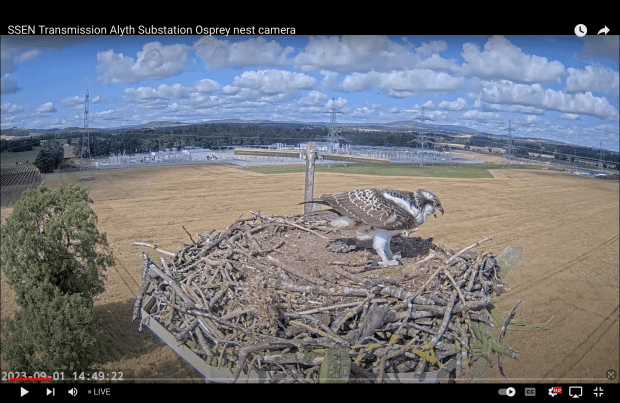
A group of concerned individuals is working towards a united presentation to see what can be done about the proposed battery storage facility at SSEN Alyth where Ospreys Harry and Flora have their nest. This is one of the revised plans for the site that shows the battery storage right up to the nest.

This is very discouraging. Flora has left the nest on previous occasions when there were disturbances.

Sue Wallbanks posted this article. It is a good read for anyone who wants to understand how disturbances can cause issues at raptor nests.

The beautiful Black Eaglet had breakfast compliments of Dad. Lady Hawk comments: “The Selati eaglet has another good day of eating compliments of Dad bring in a Rock Hyrax! The eaglet is enjoying the morning sunlight and spreads out its wings as it lies on the nest sunning itself (and keeping cool) 🙂 Mom flies in right after Dad but the eaglet claims the prey and mantles it and will self feed on it for quite some time. Finally Mom takes over and finishes up the feeding and the eaglet gets to swallow the pelt down. i did edit out a lot of the feeding since it went on for so long. Great job! Mom will then fly off leaving a very contented chick.”

These Black Eagles live in the Slate Game Reserve which is part of the Greater Kruger National Park in South Africa. Their proper name is the Verreaux Eagle. Only one of two eggs hatched at this nest in 2023. This is the time line, and we expect this eaglet to hatch in less than 3 weeks.

  • First egg laid on 15 May 2023 🥚
  • Second egg laid on 19 May 2023 🥚🥚
  • Egg cracked by parent on 6 June 2023 ✖️
  • Chick hatched 29/30 June 2023 🐣
  • Fledgling flight expected from around end September 2023

Verreaux’s eagle is one of the larger eagles of Africa. It measures 75 to 96 cm (30 to 38 in) long with an average weight of 4.19 kg or 9.2 lb. Its wingspan is 1.81 to 2.3 m (5 ft 11 in to 7 ft 7 in). The Verreaux Eagles like others has reverse bisexual morphism – the female is larger than the male. The adults are the most gorgeous slate grey but some are the deepest ebony. Their cere is a remarkable yellow when they are healthy. There is also white plumage which is a great contrast and causes the birds in flight to stand out. That white is on their back, their rump and the upper-tail coverts as well as part of the scapular. The white can only be seen looking up when the birds are flying, not when they are perched. The legs are covered with deep black feathers. The juveniles appear as in the image above.

Verreaux’s Eagle female” by Rainbirder is licensed under CC BY-NC-SA 2.0.

In the Kistachie National Forest near Alexandria, Louisiana, Louis and Anna from the E-1 nest are busy making nestorations!

Thank you so very much for being with me today. Take care everyone. See you soon!

I am very grateful to the following for their notes, comments, questions, letters, videos, posts, and streaming cams that help me to write my blog today: ‘A, Geemeff, H, L’, Audubon, Geemeff and the Woodland Trust, 367 Collins Street by Mirvac, Liznm and 367 Collins Street by Mirvac, PSEG, Sandpoint Ospreys, Kent Island, Wildlife Conserve F of NJ, Sydney Sea Eagles, Charles Sturt Falcon Cam, PLO, NZ DOC, Real Saunders Photo, LA Times, Tapa Talk, The Guardian, Office of the EHHA, US Dept of the Interior, SSEN Alyth, Livia Armstrong and BESS Battery Storage, NatureScot, Lady Hawk and Selati Eagles, Open Verse, and the KNF Eagle Cam E-1.

Bon Voyage Mini…Sunday in Bird World

10 September 2023

Hello Everyone!

Saturday was the most gorgeous fall day. It was about 16 degrees C with a beautiful blue sky and some soft puffy white clouds as I travelled north from the City. You could see the geese overhead flying in their standard ‘V’ formation swirling around the fields that have been recently harvested – wheat and flax, mainly. There is something so magical about the rhythm of their lives. They come in late March or April and being heading to their winter homes in September-October. At one of the local nature centres, they fly in by the thousands at dusk (on a good day). Their black silhouettes filling the horizon as the sun begins to slowly set in the West.

One of the best places to see the geese in the afternoon is at Oak Hammock Marsh.

A lone American White Pelican and a Trumpeter Swan with all the geese landing at a small pond by the road.

On the way home there was a beautiful Red-tail Hawk hunting in one of the fields. What a magnificent raptor. No photo…just watched it for a bit and left quietly — we must always remind ourselves that their lives are overtly challenging and any opportunity for a meal should be respected and we should ‘disappear’.

Oak Hammock Marsh is run by Ducks Unlimited and the Province of Manitoba and is an extensive wetland. Being there reminded me that ‘R’ had sent me an article several weeks ago and our discussion about how we need cooperation to protect the birds. What he sent me was about the Excise Tax in NJ – how that comes from the sale of hunting equipment, firearms, permits, etc. goes to help with the conservation of the birds, such as our beloved Ospreys, in the state of New Jersey. We talked about how this could be a blueprint for the future if we want our birds to thrive – and as much as I hate killing of anything, it makes sense. Ducks Unlimited is working across Canada with various groups including some in the province of Alberta to purchase huge tracts of land to protect and restore for wildlife. It is something to think about. In NJ it is called the Wildlife and Sport Fish Restoration Program. Does your state or province promote such a scheme? If not, it might be worth a good conversation!

All of the kittens behaved themselves. Missey and Lewis continue to be in the main house and Calico and Hope in the conservatory annex. Hope has been enjoying her new rich foods a little too much or it is that plus the stress of coming inside…but the poor little darling is now on kaolin probiotic granules for running poop shots. Hoping she is over this very quickly…she was fine when she arrived! A few images from today…Hope insists on doing everything that Mamma does. She resisted her own little dish of organic chicken and sauce to try and eat with Calico, was on the cat tree and it seems that Calico is an excellent pillow.

Giggles all around today – the cats are eating well and their rooms are disinfected and cleaned twice a day – everything. Gosh, the laundry in making those tents…Calico is off for her surgery on Tuesday and Hope will be, by then, surely she will, friendly!

Thank you Jeff Kear – I had not heard about Alyth putting in battery storage units right under the nose of Harry’s Osprey Nest! Does the need to constrict the use of fossil fuels mean that we should not consider the environmental impact and the location? Was any study done? It is not clear when it comes to the ospreys or other wildlife.

‘A’ reports on what is happening ‘down under’ – that is where most of the action is currently!

Sydney Sea Eagles: “Dad brought in a very nice fish at 08:33:22 this morning and Lady was quickly shimmying down the perch branch to take control of it. Lady and Dad have a little chat and seem excited by the fish but the eaglets (especially SE32) are more interested in what’s going on in the tree around them this morning. SE31 is first to the table, while SE32 is looking up and around at everything in his expanding world. The view is somehow different from up on his feet perhaps! At 08:39 he finally moves up to the table and his sister courteously moves aside so her brother can have some breakfast! This is so civil, it’s ridiculous. Someone remind these kids they are apex predators! Just before 08:40 Dad flies in with a stick (the parents have been busy building another level of cot railing over the past five or six days, as the two get up onto their feet and start moving around the nest a lot more – now SE32 has joined his sister up off his tarsi). Dad is very engaged in his stick placement and spends considerable time perfecting the front of the nest. So cute. Lady continues feeding SE32, though SE31 is momentarily fascinated by Dad’s manoeuvrings.” 

Royal Albatross: “In New Zealand, Manaaki is on his nest and there is very little wind today, so I am not anticipating a fledge this morning. The wind may pick up during the afternoon. We will see.” 

This video is from the NZ DOC. It shows our young prime hovering nicely! This was three days ago.

Melbourne Peregrine Falcons: “At Collins Street, F22 takes a break shortly after 9am (that time stamp is SO hard to read) and little M22 is soon in to take over incubation. He settles down in his customary jerky manner and then finds he has a spare egg he has failed to cover. So he has to start his enfluffling all over again. Such a sweetie. I love these falcon dads.” 

Port Lincoln: “No third egg at Port Lincoln and I certainly hope there won’t be, given the gap between the first two eggs is 74 hours. A third egg could therefore be as far away as Tuesday. I do hope there isn’t another one. I’m not looking forward to the huge gap between the first two. A third hatch would be so nerve-wracking. We really don’t need that sort of stress.”

There are still only 2 eggs at Port Lincoln.

I certainly agree with ‘A’. A third hatch at Port Lincoln does not need that kind of stress! But then again, we have a new Dad and a new season and anything is possible.

Thanks, ‘A’.

Let us go and check on Diamond and Xavier – Xavier flew in with a nice prey for Diamond’s breakfast, and he then worked hard rolling the three big eggs and trying to fit them under him. He was successful, but gosh, it is a good thing there are not four of them.

‘A’ writes about the intruder that has been bothering Xavier and Diamond: “That intruder is still worrying at Orange, although Diamond and Xavier have things sorted. This morning, the intruder was spotted. Diamond called Xavier to come and mind the eggs. He arrived and took over incubation. Diamond dealt with the intruder (visible from tower cam) and returned to the nest box. All is well. I am SO glad they have this routine. Diamond is twice Xavier’s size and makes short work of an intruder. Any injury to Xavier at this point would be a disaster for the clutch. They know this. We are grateful. But I do wish this intruder would move on. I do keep wondering whether it is Izzi, as the males do tend to move no more than 50 km from their natal nest, from what I have read, whereas the female fledglings spread much further away. It is so funny that Indigo, too, proved impossible to persuade it was time to leave home, so that Diamond and Xavier had to physically bar him entry to the scrape! At least they got rid of him before the eggs were laid, which was only just the case the year Izzi was there. He was persistent in the extreme. I think it was early August before they gently told him “grow up and find your own territory, son!” and moved him on.”

So do we think that this might be Izzi? That would be interesting. (Note that raptors normally engage other raptors of the same gender).

‘H’ sent me a quote today from one of David Gessner’s books on Ospreys. It is so appropriate and she believes it is form the Return of the Osprey but neither of us had the time to dig through the book to find the right page:

  “To love the Osprey is to be constantly open to loss.” 

Mini was not seen at the Patchogue nest after she flew off in the early morning. It is now 2100 nest time, and she has not flown in. Mini, you taught us to persevere, not give up hope, be smart, and figure things out. Safe travels – good winds, a full crop, a good life.

‘H’ brings us up to date on the last two nests she has observed for me. She officially monitored ten nests, but it was always more than that. Over the course of osprey season, the number of eggs grew to over 350 that were monitored. I am very grateful for her help and keen eye and instincts – thank you, ‘H’. You came to Ospreys, naturally.

Kent Island – It seems that Molly may have already started on her journey.  September 9th was the fourth full day without a sighting of our precious Molly.  Both Tom and Audrey were seen in ‘Joe’s tree’ during the day.  At 1800 Audrey came to the nest for a while to dry off after her bath.  And, Audrey flew to the nest at 2300 to spend her third straight night on the nest.

Barnegat Light – There were intermittent periods of live stream buffering throughout the day.  We did not observe Duke delivering a fish to Dorsett at the nest, but Dorsett was seen a few times at the nest and on Duke’s perch.

Louise and Banff are no longer at the Fortis Exshaw Nest. As the sun sets Saturday evening near Canmore, Alberta, not far away from Lake Louise, they have had snow on the 6th! By vehicle, it is 5 hours through the mountains, according to Google. The girls will happen to be sunning themselves in the south.

The two surviving chicks at Osprey House in Brisbane, Australia are doing well.

There is extremely sad news coming out of Big Bear Valley today – confirming losses from several years ago.

I am attaching the article.

How has the earthquake in Morocco impacted Ospreys migrating from Europe and the UK? Certainly transmissions might be garbled but what about the environment where they are fishing, living, or flying through?

A lovely Red-tail Hawk – juvenile – visited the WRDC nest of Rose and Ron yesterday. ‘H’ was the first to alert me and Pat Burke has posted an image.

That’s a wrap for Sunday, September 10. Thank you for being with us. Please take care. See you soon!

Thank you to the following for the notes, comments, videos, and streaming cams that helped me to write my blog this morning: ‘A, H, Jeff Kear’, Alyth, Sydney Sea Eagles, NZ DOC, 367 Collins Street by Mirvac, PLO, Charles Sturt Falcon Cam, Kent Island, Wildlife Conserve F of NJ, PSEG, Snow Seekers, Osprey House, Tonya Irwin and Raptors of the World, Pat Burke and Eagle Nest Watchers, Bloom Biological, and The Guardian.

Three for Melbourne…Saturday in Bird World

9 September 2023

Good Morning All,

Friday was a busy day for me and most of the time I was away from home. However, the moments that I did get to spend with my four four-legged furry friends was brilliant. Hope is now peeking around the corner at me and even came near to my foot when I placed a dish of organic roast chicken down for her! This kitten has so much energy. I cannot wait to get it with Lewis. He is going to enjoy having a playmate.

We are about a metre apart. Hope is curious and getting less afraid by the story!

If Mamma Calico moves her tail, Hope is right on it!

Everyone watches one another. The four of them enjoyed a nice roast chicken dinner – a treat to encourage Missey and Lewis to link ‘treats’ and goodies with their two new siblings.

Each of us hopes that you are well and looking forward to a nice weekend wherever you are. Let’s all try and get outside if the weather is nice! And speaking of outside…every time I go to the park there is litter. There are bins everywhere for litter so why don’t we use them? This post on FB seemed really appropriate.

‘H’ sent me the good news. PLO has its second egg of the season! Oh, I hope this young Dad is an excellent fisher and brings those fish into the nest one after another. Can I ‘hope’ that this couple might fledge all of them just like 2021 with Bazza, Falkey, and Ervie?

There is other good news coming out of Port Lincoln!

‘A’ is musing about the Royal Albatross chicks: “the rangers have confirmed that Miss NTF fledged on 7 September. She had been off exploring (or perhaps finding an ideal place from which to fledge), as the chicks often do for a few days before fledge, but they have confirmed her gone. She was last seen on the morning of 7 September so we think she fledged some time after 11am on Thursday. Godspeed sweet girl. Quarry, who has been out and about for the past couple of days, returned to her nest this morning and seemed to miss Miss NTF. The two girls had been hanging out a lot. UQ on the other hand is less pleased to see Quarry, who needs a restraining order whenever she is in his vicinity. Manaaki is less tolerant of her and clacks his bill at her if she gets too close. Poor little UQ is much more timid. The winds are not super strong today, though Quarry and Manaaki have been doing a lot of wingercising in the wind there is. It could be any time now for either of them. It looks as if Quarry will be next to go, then Manaaki and finally UQ. But we will see. I again emphasise that these are precious hours we are spending with Manaaki now. And once he launches, there is no guarantee we will ever see him again. Will we live that long? Will Manaaki? Will the climate permit a return? They fly into an uncertain future, but don’t we all?” Those worries of the state of the ocean, of long line fishing, of climate haunt all of us as well look at these long-lived seabirds.

Manaaki looking out to an uncertain future.

Lady Hawk caught Gabby and her new mate V3 in the pouring rain and has some super close ups for us.

I was contacted by several individuals today about Mini and was told that there was much anxiety about her condition. My day allowed me no time to go and observe Mini until she was at the nest after dark. At the bottom of everyone’s desires is for Mini to thrive – we care, we worry. We want her to be whole and live a long, prosperous life. The fact that Mini somehow injured her leg causes great anxiety to everyone. We will never know what caused that injury. No one saw what happened. Unless she goes into care, we may not even know what that injury is. There are many, many theories, but that is all they are – theories. Until a vet/a vet technician/or a rehabber has a bird in hand, a diagnosis cannot be made, and sometimes sophisticated tests and scans are needed to determine the problem and the possible treatment. The DEC does not normally give permits for a bird that is flying. There is a reason for this — it is extremely dangerous for the bird. No one wants to endanger Mini’s life further. Her injury is now old. She has been adapting. Life is not perfect but she is living it.

Life in the wild is extremely challenging for all raptors – for all wildlife. Each day is about survival. Some days there is a lot of fish and other days there are none. Whether or not Dad is delivering or Mini is fishing is not known. It could be both. On Thursday Mini had several nice poop shots. I am not clear about what happened on Friday and, of course, she is often not on the nest.

I urge everyone to enjoy the time we have left with Mini at the nest. To treasure her, to wait for her to come in at night to rest her leg – she is very smart to do that. In a couple of year’s time, I would very much like to see a two-year-old osprey land on this nest with a wonky leg. That would be marvellous so…with that in mind, I really hope that Mini is a male and not a female. Send her positive wishes. Treasure all that she taught us, for she did teach us much about endurance and determination.

Mini did seem to put her weight on both legs when she landed on the nest from the perch at 20:26.

Mom has been spotted landing on the nest so she has been here at least until today. That is good news because under normal conditions the males will not leave until the females do. With the climate changing we do not expect these fledgling ospreys to travel all the way to South America and they might well spend the winter in the Carolinas or Florida.

At the Minnesota National Arboretum nest, Dad brought in 7 fish – yes, you read that correctly – 7 fish on Friday!!!!!!! That is one well fed fledgling. One of those beauties was lost overboard. Hopefully some other hungry creature will discover that tasty meal.

‘H’ reports on Molly and Dorsett:

Kent Island –  Molly was last seen (so far) on 9/5.  Her dad, Tom, was seen almost every day up to 9/7, but we did not see him on 9/8.  That does not mean that Molly or Tom have formally begun their migration, they may simply not be on camera.  We shall see.  Audrey was seen in “Joe’s” tree, and for the second consecutive night, Audrey spent the night at her nest on 9/9.  It is surprising to see Audrey this late in the season, but we are thrilled to see her.

Barnegat Light – Dorsett and her dad, Duke, seemed to have a good day.  The camera operator managed to catch Duke taking a bath, and the highlight of Dorsett’s day was a live bunker that her dad delivered to her for supper.  Dorsett decided to eat the whole fish atop the 24th street pole.  Yum!

‘A’ reports on the breakfast for the Sea Eaglets: “a nice large fish was brought in at WBSE early this morning (around 06:40) and both eaglets had a good breakfast. SE31 got the early bites, then SE32 moved up beside his sister and ate without fear or intimidation. The two were perfectly behaved throughout the meal.”

So many love the Collins Street falcons and my inbox was bursting with news of the third egg! Do you think they will go for four?

Xavier just melts my heart. He is the cutest little male falcon and his mate Diamond often gives this poor guy such a rough time. So happy he got some egg time…it must actually feel nice to be able to do duckling style and rest for a bit…just thinking about Mini and how it helps her leg.

‘A’ reports: “Manaaki was fed by one of his parents at about 6pm this evening (9 September) – we don’t know which one because it was not within camera view but our little man gets so excited, wheeing away. I do love that sound. And we will miss it until this time next year. But I cannot wait to see whether YRK (and maybe even OGK) return over the next two or three months. He is the footage of Manaaki’s feeding. https://www.youtube.com/watch?v=tj35d68kQ6g&t=2s“.

News has come to me Friday night from ‘B’. We have wondered about the fishing at Cowlitz PUD. This is a new discovery. “The river where they fish has been full of silt and mud from a landslide up north awhile back which we never heard about…” ‘B’ continues by saying that a drive by a couple of weeks ago revealed sandbars in the river that were never there previously. This is so sad but let us hope the eagles and the ospreys have another source of food. Thanks so much ‘B’.

There is often a lot of confusion about feeding birds. Audubon has a short article to help us.

Speaking of feeding birds. Chiang Mai is north of Bangkok in the beautiful mountains. It is one of my most favourite places in the world. There is an historic walled city full of Buddhist temples. Just outside the walls is a small French area with some of the best coffee and lemon tarts to be found anywhere. Check out a feeding table in this northern Thai city!

Thank you so much for being with me today. Take care. See you soon.

Thank you to the following for their comments, alerts, posts, videos, and streaming cams: ‘A, B, H, L’, PLO, NZ DOC, Lady Hawk and NEFL-AEF, PSEG, MN Landscape Arboretum, Kent Island, Wildlife Conserve F of NJ, Sea Eagle Cam, 367 Collins Street by Mirvac, Karen Leng and Orange Australia Peregrine Falcons, and Audubon.

Three for Diamond and Xavier…Friday in Bird World

8 September 2023

Gosh, another week has flown by. Honestly, I do not notice unless I have an appointment. All of the days blur together, and that is perfectly fine. It was nice to put up the watch and not have the calendar overflowing with appointments once I retired. As one former student says, ‘My days are busier and fuller,’ but my choice is what they are busy or full with. Garden animals, birds, and kittens…

When my grandmother could no longer make the elaborate patterned quilts of her youth -because her arthritis in her fingers was so bad in her 90s- she started making strip quilts. [The woman could not sit still for long. S he was gardening, raising chickens, doing embroidery or quilting til the day she died. She was an incredible role model.] That is what she called them – long strips of material pieced together. Sometimes, she would tie the layers together with bright embroidery thread that ‘tickled’ my children. They became known as ‘tickles’. Calico was sleeping on one of those today – a tired Mamma!

To see this little kitten follow its Mamma or to peek around the corner and see them sleeping together still brings tears to my eyes. Honestly, I did not think this would happen.

Both Calico and her daughter have a black tear on their left tear duct.

The sunlight is so crazy often the pair are bleached out in the images and no adjusting will help! Calico spends a lot of time washing her little one. There are so many kittens in the lost kitten postings and Hope is so healthy compared to them. S he has no eye problems, her fur is in incredible condition and she is ‘fat’.

Missey and Lewis are doing brilliantly. Today Calico wanted out of the conservatory, and when she was in the main part of the house, Lewis was friendly! I almost fell over. In fact, Lewis and Missey are back to their old selves – confident that there is lots of food and love – enough to go around to four. It reminds me of Ospreys and little eaglets in the nestHoping to have the kitten integrated by the end of the weekend as Mamma goes in for her surgery on Tuesday.

I was away for part of the day, and when I got home, the first nest I checked was Mini, and there she was. Mini arrived at 18:47. The left leg is still held – and may always be – out at an odd angle. It does not look any worse in my humble and non-wildlife rehabber/vet/vet technician-trained eye. Her crop was not as full as it often is, but it was still a gift to see her, and I hope she gets an evening fish or one first thing in the morning.

Mini was on the nest in the evening. It was good to see her resting her leg.

At 22:59 she raised herself up – it made me ache a bit to see her with that left leg still causing issues but, she did quite a normal looking ps. Thick and well projected over the edge. She is eating. Who is getting the fish is unknown.

At Alyth, Harry has been busy feeding Chirpy some really nice Flounder and other fish every single day, sometimes several times a day. Today Harry arrived with a fish and no Chirpy. Has Chirpy migrated? We wait to see but it certainly looks like it. That third hatch never wanted to miss a meal!

Swoop is still delivering to Crackle at Dunrovin.

‘H’ tells us what is going on with Molly and Dorsett – they are still home!


Kent Island, 9/7 – For the second straight day, we did not see the fledgling, Molly.  Some believe that Molly may be exploring a wider area, perhaps catching her own fish, and that we may see her again.  In the meantime, Tom was seen dining on a nearby dock, and we saw either Tom or Audrey perched in a tree.  The most pleasant surprise was when Audrey arrived at the nest around 9 pm, and spent the night on the nest.  It has been a very long time since she did that.

Barnegat Light, 9/7 – There were at least two fish brought to the nest by Duke for Dorsett.  Dorsett was a little conflicted as to where to eat her breakfish at 0645.  She first took the fish to the 22nd street pole and ate a bit, then she flew to the 24th street pole and ate some more, and then she changed her mind once again … back to the 22nd street pole with the fish, lol.

Tweed Valley’s Poul is now in central Algeria. Ah, he didn’t stay in Morocco like Glen. Curious path. We wait to see where he goes next.

Xavier and Diamond were right on schedule with their third egg on Thursday. I am going to say something that will be wildly unpopular and then I will forever hold my peace – I actually hope that only one egg hatches. Diamond does better with a single chick that grows to be big and strong like Izzi than she does when there are two. I can’t even begin to imagine three ——and I adore Diamond. Just my own personal observation which, in the world of nature, doesn’t mean a heck of a lot!

SE 31 and 32 are growing like crazy! 31 has become an expert self-feeder.

‘A’ reports: “SE31 is really getting serious about self-feeding, which is so funny, because we thought SE32 would master this skill first and of course during that week or so when he was being intimidated, he did make some early attempts but did not have the weight to hold down prey. Now, it is SE31 who is waiting for food while SE32 gets fed, and she is getting impatient enough to start self-feeding while she waits. This eel is perfect for the purpose, long enough for Lady to feed SE32 from one end while SE31 self-feeds from the other. She starts off having some problems opening the eel but soon works it out and is doing a great job of using her right foot to hold down the food. The eels can be difficult, and Lady sometimes has to work really hard to separate the flesh from the skin, so I am really impressed by SE31’s effort on this one. It has only been opened at one end, the end from which Lady is feeding SE32, so SE31 is doing great work. Check her out from around 15:40! Quite the professional. Well done SE31! SE31 is much more balanced on her feet than SE32 and is practising her walking and her wingercising with vigour. She is really starting to look more like a juvenile than a nestling, with her beautiful feathers growing in by the day. Two absolutely exquisite sea eaglets. How lovely it is to see them getting along so nicely again. This nest really does have something special, as according to my reading, many authors consider this an obligate siblicide species. Fledging two happy eaglets who get along well season after season is quite an achievement if that is the case, and one can only assume it has something to do with the parenting on the nest. It is not because we have single-gender clutches here (especially two males). As far as I can recall, the last three seasons have seen a female first hatch with a younger brother. So unless there’s something genetic that makes the offspring of this couple particularly laid-back, it seems to be more nurture than nature as it were.”

There should be another egg arrival at Port Lincoln.

At Collins Street, Dad brought in a Black-faced Cuckoo Shrike for Mum. Wow. Way to go Dad!

These Shrikes range in size from 32-34 cm and mostly feed on insects, seeds, and some fruits. They are stunning birds in terms of their plumage. The body is a soft pearl pale gray often paler on the belly. Their face has a very distinctive ebony black mask and throat. If you look carefully there may be some white edges at the wing and feather tips. The eye is black blending in with the mask while the sharp bill is a deep charcoal. The bird is really a study in greys -. Gorgeous. They live in wooded areas as well as urban habitats and farmland in a large area that reaches from Indonesia to Australia.

Black-faced Cuckoo-shrike” by jeans_Photos is licensed under CC BY 2.0.

So are there two or three? We wait for the reveal at Collins Street.

At the Royal Albatross Colony, Manaaki is losing all of that fluffy baby down and starting to look like a juvenile who will soon embark on a journey so long and for so many years that it is hard for this human to fathom it.

Oh, wow. Good news from SWFlorida coming from ‘A’: “We have lovely news from SWFL, with M15 and his new lady love  having been observed bonding. https://www.youtube.com/watch?v=dHlwSU3y4uA&list=TLPQMDgwOTIwMjPQFEwHlsRyRQ&index=3 Does this not gladden your heart? What a loss it would be if the best eagle dad of all time did not get the chance to be a dad again.”

Checking on Karl II and his family:

Kaia is in the Ukraine near some fish ponds. Nice.

Waba is also in the Ukraine.

Bonus is alive, but the transmitter is only sending out an alive signal not a location.

Kalvi is in Bulgaria.

There has been no data available for Karl II, the patriarch of the clan. I have not but am hoping to find an update somewhere for today.

Pharmaceuticals kill birds that forage. India, one of the largest manufacturers of pharmaceuticals for humans and non-humans, is banning two veterinary drugs that have proven to kill vultures – Ketoprofen and Aceclofenac- can no longer be manufactured, sold and distributed throughout India. Are these being used in your country?

BirdLife International has launched a Seabird Conservation Handbook for West Africa. Have a look at what is being done in the latest press release.

Thank you so much for being with me today. Please take care of yourself. Hoping to see you soon!

Thank you to the following for their notes, comments, videos, posts, and streaming cams that helped me to write my blog today: ‘A, H’, PSEG, Sue Wallbanks and Friends of Loch Arkaig Osprey Cam, Kent Island, Wildlife Conserve of NJ, Tweed Valley Osprey Project, Charles Sturt Falcon Cam, Sydney Sea Eagles, Deborah Victoriana and Sydney Sea Eagle Cam, PLO, 367 Collins Street by Mirvac, NZ DOC, Maria Marika, Looduskalender Forum, and BirdLife International.

PLO has their first egg…Wednesday in Bird World

6 September 2023

Good Morning and what a grand morning it is!

I finished reading to the kittens – yes, did you know that reading aloud to your pets is also soothing for them? Calico’s kitten is now learning about ways to save our vanishing birds by listening to A Wing and a Prayer. The Race to Save our Vanishing Birds by Anders and Beverly Gyllenhaal. You can find time to squeeze in a good book by sharing with your pets!

The book is well written and insightful. I am learning so much. Did you know that more than 8,000 species of plants and flowers in the Americas depend on hummingbirds for pollination? Or that productivity in apple orchards goes up 66% if there are insects? The book is about finding ways to keep the birds alive because human life depends on that. In Kauai, there are only a few hundred Puaiohi Thrushes. These birds spread seeds around the island, creating the rainforest. “Without forests, we have no flood control. We have no drinking water.” (219) Baby Cal is learning what we all need to – first, how important our wildlife area to our existence, what problems we have created for them, what a lack of balance means to our existence and theirs, and how some talented individuals are figuring out ways to save some of these fragile creatures. So how will they save the Puaiohi Thrush? By releasing lab-bred mosquitoes. AI is being used in the Sierra Nevada to track and protect the Spotted Owl.
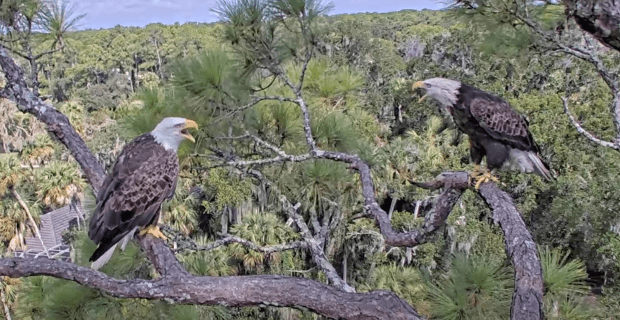
I had just finished a chapter when I noticed a note from ‘H’. Was I surprised? Then another note about Collins Street. Thanks so much, ‘H’

Port Lincoln has their first egg!!!!!!!! I am overjoyed and I am hopeful that we might see a big change in the behaviour of this nest unless, of course, the fish supply is limited. From Ernie’s recent catches that does not appear to be the case.

I am so happy for Mum. Nesting material had been brought in so this new couple had some idea that yesterday was the big day.

Dad was there by her side. I am going to like this guy if he is a good provider and there is no siblicide.

We are expecting an egg at 367 Collins Street and guess what? It arrives. We have lift-off in Australia!!!!!!!!!!!!

Spotting Ospreys: Blue 550 hatched at Llyn Clywedog in 2020 was seen and is believed to have a nest in mid-Wales. Fantastic.

Migration continues in the US. These are the latest numbers from Hawk Mountain.

Checking on some of the Osprey nests – who is home and who is not.

Patchogue: Mini is home and Dad has been seen down by the lake. Someone mentioned that Mom might still be around as several Ospreys were seen flying. Mini continues to adapt as she struggles with that left leg – often late in the day. She certainly does better after having a long rest on the nest! She is flying, she is eating – whether or not it is dad feeding her, Mini catching fish or both – she is eating. She is not lethargic. Mini is doing what this spunky independent determined fourth hatch always does – she gets on with it. She is living her life as a fledgling osprey the best she can with the issues that she has.

Mini landing at 1909.

Beautiful Iris is still home at her nest in Missoula Montana. Iris maintains one of the most splendid Osprey nests I have ever seen. Just like some of the others she is adding a few sticks to continue to lay claim to the nest. Soon, she will fly south – thought to be the oldest osprey in the world – we live in the hope that she will return in late March or early April and maybe, just maybe, have one of those young men waiting for her that she met this summer.

Iris demonstrated her great fishing skills even when there were flood waters. What marvellous fish she brought to the owl pole. The result, if you look carefully, is a fat little bottom. Eat up, Iris! We want you to make it to your winter home in southern Texas (??) safely and in good shape.

Of course, Iris is not ringed and no one knows for sure where she over winters but it is believed it could be the southern part of Texas and not further afield in Central America or Mexico.

Glaslyn: Aran is still home and so is 0H1 as of the time of this writing. OH1 is 98 days old. OH2 has not been seen since 4 September when he was 95 days old. That nest looks rather empty! Waiting to see if OH1 is still home on the 6th of September.

Harry is still delivering to Chirpy as of Tuesday. Chirpy was 103 days old. Both siblings and Mum have left on migration from Alyth.

Here comes Harry!

That amazing Dad is bringing fish to Mum on the nest at Boulder County Fairgrounds. What a loving couple and what better way to help your mate with a safe migration than to help her eat well after raising three strong osplets this season to fledge.

Snap and Crackle are both eating fish at the Dunrovin Osprey nest. T hanks, Swoop!

Fledgling fish calling at Collins Marsh – and still being fed! It was a really windy day in Wisconsin. You can’t tell the trees are blowing but look at the feathers of the juvenile. Fantastic.

‘H’ brings us up to date on Molly and Dorsett:

Kent Island 9/5 – Molly flew to the nest at 0625, fish-called a bit, then she flew away 20 minutes later.  That was the last time she was seen at the nest.  She was soon spotted on a nearby boat lift.  In the evening, the cam focused for a long time on an osprey in the distance on a pole, but it was unclear if it was Molly.

Barnegat Light 9/5 – At 0735 Duke delivered a fish to Dorsett at the nest, and she flew to Duke’s perch to eat her breakfast.  Dorsett did return to the nest a couple of times, but sightings of her were scant throughout the day.  Dorsett arrived back at the nest early to wait for her much anticipated 7 p.m. dinner fish, but her dinner never arrived.  As the sun was setting over the bay, Dorsett resigned herself to going to sleep hungry, and she spent the night perched on one of the camera braces.

Do you live near Cornell University at Ithaca NY? Have children aged 8-18? Check this out! What an amazing opportunity for young people. In the book, Lead! Finding your Voice a Chaotic World by Barry Dore, Tim Mackrill, talks about the opportunities he had as a young person to volunteer and learn about raptors. It changed his life and led him to create opportunities for young people through his charity Osprey Leadership Foundation.

This event at Cornell is another super opportunity to get young people involved who might become our future conservationists.

The seat eaglets were up for an early morning walk about and then back to the duckling resting position waiting for breakfast.

‘A’ comments on part of the day including the self-feeding of 31: “

At 15:38, as Lady is looking around in a very agitated manner at something near the nest tree, at about the same height as the nest, SE32 starts eating the food she has in her talons. He is giving this self-feeding thing a try, having closely watched his sister eating prey that looked the same as this (he was just TOO TOO funny – ducking down with his head under her tail to peer between her legs and watch her doing very well indeed at her first self-feeding). 

SE32 pecks at the food a few times but all he can reach is a leg, and no matter how many times he picks it up, he cannot work out how to eat it. So he moves closer. SE31 is paying close attention to this – she has reached out for the food once or twice herself but is not in as good a position now as SE32 is. Lady is very upset by something and paying no attention to the food or the chicks. SE32 has moved further forward. He is up on his feet now, self-feeding on the meaty bit. Lady resuming feeding him, even though she continues to be distracted by something. SE32 remains right up on his feet while he takes the bites. 

Shortly before 15:40 Lady resumes feeding SE31. SE32 turns and moves away from SE31 a little but then turns back to face the table and Lady. He just wanted space between himself and his sister. But he gets offered no bites. At 15:41:24 he tries unsuccessfully to steal a big bite, but overbalances and falls forward, correcting himself with his outstretched wings. Lady still feeds SE31. At 15:41:30, he tries to steal another bite. Again, he fails. The next bite, he grabs incredibly fast. No-one else had a chance. He got given the one after that, then his sister gets a bite. The one after that is a big piece and destined for SE32. He grabs it and works hard to swallow it. 

Lady is still very distracted. Periodically, she gives SE32 a bite. Both eaglets have good crops now. At 15:42:34, SE32 grabs a really big piece. He swallows it with relative ease, as Lady doesn’t even bother trying to retrieve it from him. There is still an amazing amount of meat on this carcass. The two have eaten well. Both have good crops but both are still keen to keep eating. SE32 is very brave, diving for every bite and winning most of them, especially all of the really big pieces. Lady occasionally gives a bite to SE31, but she is not competing with SE32 and is largely just watching him grab and swallow. 

At 15:44, SE32 grabs a large piece of meaty flesh with a longish leg and a foot attached!! He horked the lot with no trouble at all. By 15:44:30 he is back competing for and winning bites. Lady is feeding both eaglets plenty of food but overall, SE32 is getting the better of the feeding at this point. He is winning most of the bites that are competed for and Lady is offering him way more bites than she is SE31, who is sitting back a bit by now. 

At 15:46, SE32 swallows the second leg and foot, also with flesh attached, though not as much as was attached to the first leg. Still, he swallows it without difficulty. Within 10 seconds, he is taking the last few bites from Lady and cleaning the table of leftovers. The feeding is over by 15:48. Both chicks have very large crops, and SE32 has already done a couple of small crop drops during the feeding to fit in extra food. That second piece of prey had a really large amount of flesh on it. The head was gone, but the body provided a great deal of food. Both eaglets have had plenty to eat today. 

There may be more food – I will check. But they did well for the day – eventually – and both will go to bed with full crops. “

‘A’ reports on the Royal Albatross Chick, Manaaki: “GLY may have been in today to feed Manaaki off camera but we’re not sure. We know GLY has fed Manaaki behind the camera at least once recently. The chicks are a lot more mobile now and are doing a lot of exploring as they prepare to fledge. It is starting to get scary when Manaaki is off camera for six hours or more on occasion – we think he might have fledged and we missed it! He still has about a fortnight to go until he reaches 240 days, but of course at least four chicks have already fledged from the 33 at the colony and Manaaki is one of the oldest (and though he does have a lot of fluff remaining, QT did too). He has not done enough wingercising, in my opinion, and still needs to be doing a lot more practising. We need to see much better hovering, and face-planting is an undignified landing for an albatross. I think he has quite a lot of work to do before he is ready to fledge. Let’s hope he doesn’t leave before he is good and ready, but often, it is the winds that determine the timing. As with Lilibet (QT). “

Beautiful Gabby. What a lovely couple – I miss Samson. But life moves on and we have the most amazing memories of him. Gabby mourned last year and took her time selecting a new mate out of the many contenders. Let us hope that V3 is up to the task. He has big talons to fill.

Lady Hawk caught Gabby bringing in her breakfast.

No one is home. Louis, Dorcha, and Ludo are on their way with only Sparrowhawks visiting the nest. Look at this beautiful capture over the nest as the sun rises. Stunning.

Visiting Sparrowhawk.

We always need to be reminded, especially with there still being hot days in many parts of the world, of how we can help wildlife. Please read and keep them in mind. Water is essential. Water and some shade.

Let’s see how much you know about Condor numbers! (Answers below)

  1. How many California Condors were alive on 6 September 2023? a) 208; b) 91; c) 214; d) 345; or e) 559?
  2. How many California Condors live in the wild? a) 76; b) 345; c) 214; d) 93; or e) 54?
  3. How many California Condors live wild in Central California? a) 93; b) 65; c) 214; d) 23; or e) 75.

Do you want to know more about the efforts to protect and grow the California Condor community? In 2022, the Ventana Wildlife Society commissioned a documentary to be made to introduce people to the Condors of the Big Sur. They are working on another film in 2023 called Condor Canyon. It isn’t finished but, for now, why not check, out Part 1 of the 2022 film. You can find the other segments on YT by doing a search or checking on the side panel.

Thank you so much for being with me today. Please take care. See you soon!

Thank you to the following for their notes, posts, videos, and streaming cams that helped me to write my blog today: “A, Geemeff, H’, PLO, 367 Collins Street by Mirvac, John Williams and Clywedog Osprey Group, Hawk Mountain, PSEG, Bywyd Gwylld Glaslyn, Alyth, Boulder County Fair Grounds, Dunrovin Ranch, Collins Marsh, Kent Island, Conserve Wildlife F of NJ, Cornell University Bird Lab Raptor Program, Sydney Sea Eagles, NEFL-AEF, Lady Hawk and NEFL-AEF, Geemeff and The Woodland Trust, Ventana Wildlife Society, and Durham Wildlife Trust.

Answers to the three question Condor number quiz: 1. The answer is e. 559 total number of Condors. 2. The answer is b. 345 live in the wild. 3. The answer is a. 93 live in the wild in central California.

Gabby is home…Saturday in Bird World

2 September 2023

Good Morning Everyone,

It is the ‘long weekend’ in Canada. It is the last weekend before the schools reopen, and the children return from their summer holidays. Despite being almost three weeks until the official beginning of fall, it is the marker for the end of summer. The weather stations tell us it will now be 35 degrees DC today. Even so, it will not be long until everyone thinks about tidying their lawn and garden for winter. This year, please constrain yourselves. Leave the Leaves!

The insects need the leaves, and the following article that ‘R’ sent tells what we should be doing to increase the number of insects in our environment. Want fewer bugs biting you? Then you need more insects!

Many years ago, my tutor, Dr Klaus Klostermaier, and I had a long conversation. I had been to Germany, where he grew up, and returned amazed at the lack of insects. No screens on the windows. Meanwhile, on the Canadian Prairies we were being eaten up by mosquitoes. Dr Klostermaier (one of the most brilliant individuals I have ever met with a surprising biography) told me how said my statement was. Industry in Germany had killed off the insects. Yes, of course, I had been to the area around Duisburg and Dusseldorf…and that area worked hard to clean up its rivers since that time and stop some of the pollution from industry. That conversation always stuck with me.

The author says in summing up the following article, “In other words, the problem isn’t that we have too many bugs in cities and suburbs; the problem is that we don’t have nearly enough. We’ve been so successful at vanquishing the little critters that the entire insect world is in big trouble — and so are we if we don’t help them to recover.” Thanks, ‘R’.

Please talk to your friends, your family, your neighbours. That pristine chemically kept perfect law should not exist! Don’t bag the leaves. Please leave them til May. It will help the entire food chain and our songbirds will thank you in the spring!

Cornell Bird Lab explains how the Royal Albatross chicks are getting ready to take their maiden voyage which will last 5-6 years before they set foot on land again. I wish we could guarantee them a sea full of fish and no bycatch.

The RSPB explains what can be done to prevent bycatch. It is a good read and if you adore Manaaki and all the other little Royal Albatross chicks then you should read this and educate yourself. You might boycott fish!

Getting over to the nests, I can hardly contain myself. V3 flew in to the NEFlorida Bald Eagle nest yesterday and Gabby is home Friday evening. They even gave one another beaky kisses. Relief. Elation. I cannot wait to see these two raise some eaglets in this nest after the sadness of last year when Samson went missing.

The pair went right to work assessing the needs of the nest signalling their determination to have a family together this year. Get the tissues out! Joyful tears.

Mini flew to the nest much to the delight of everyone. What a relief it was to see her flying and landing with both legs extended. She is strong. Mini has shown us since the day she hatched that she adjusts, thinks, solves problems well. No, we do not like seeing her look at her leg as if she is in pain – is she? is she not? I do not know. She has won all of her hearts because she was so tiny and persevered on a nest when it seemed impossible that she would. We must remember that going forward.

The DEC is hanging up on anyone that phones them. They are the ones that issue permits under the Migratory Bird Act. It is clear no permits are going to be given. Locally, Mini’s situation is know and one of the locals on the chat checks for her. Boots on the ground is essential. That said, she is flying strong and eating. Dad is still feeding her but maybe someone will also see her fishing. She is dearly loved.

I also want to add something here, in case you are wondering. I strongly believe in intervention if the bird or animal can be helped. The Mini is not grounded. She is flying. She is not 100%. But this is what worries me. While we do not know her injury, she is injured in a way, unlike WBSE26. When WBSE flew to the balcony of the condo and was ‘rescued’, it was determined that 26 would not have a quality of life and was euthanised. It broke the hearts of thousands of people. I do not want that to happen to Mini. For however long or short her life is, I hope she lives it free. She has proven she can adapt to anything thrown at her – at least from what we see on cam – and I think she can then adjust to almost anything, including picking up and eating fish off a beach.

Mini flies in both feet extended from her legs.

While she still favours that left leg, she landed fine.

Gosh, she is gorgeous. Her eyes are bright.

Off she goes eleven minutes later.

In Australia, the main cam for Sydney Sea Eagles came back to life and the joy that came with that could not be measured. It seemed that the little sea eaglets had grown twice as big in a single day. It wasn’t true, of course, but there they were, SE32 with a huge crop! They are both thriving and it will be interesting to see which is the largest as they develop between now and fledge.

Gracie Shepherd caught one of the sea eaglets peeking over the nest when the camera was down. T hey are so big.

‘A’ has been watching the sea eaglets closely and she is a tad concerned stating, “Breakfast never arrived at WBSE this morning. Smart little SE32 has taken to spending much of his waiting time sleeping on the table, right there in prime position for any food that arrives on the nest. The eaglets were not at all pleased when Dad arrived shortly after 12:11 with a large spray of gum leaves! As I type, it is nearly 12.40 and they are now waiting for lunch! I have been worried this morning because while SE32 got up this morning and did a small, thinnish PS, when SE31 got up a few minutes later, she appeared to make three definite attempts over about two minutes to have a PS and produced nothing. On each occasion, she wiggled her little tail as if she had just done her PS but nothing had emerged. I have not watched their every minute this morning, but I have been over the footage relatively closely, and I have not seen her do a PS (one of them did stand up a while ago – it may or may not have been for a PS – but I am keeping a close eye on things in that regard right at the moment, especially since your vision of the eel feeding just as the storm began. I am starting to get concerned that SE32’s newfound confidence is resulting in SE31 not getting enough food. SE32 has had a larger crop than his sister for the best part of a week now. Is this causing a problem? Or did SE31 have a problem to begin with that allowed SE32 to become dominant..So it is possible that there is some reason she is not pushing for food…I could be worrying about nothing, but until I see a healthy PS from SE31, I will continue to be concerned. I don’t like to see a chick trying and failing to manage a PS, especially first thing in the morning.” 

Food finally did arrive and A has the report: “The food took until around 15:30 to arrive. We saw Dad on a branch in the nest tree spot something and fly off with a purposeful look, and I thought he had finally decided it was time to feed the kids (I’m sure these occasions are deliberate lessons for the eaglets – sometimes, food doesn’t arrive like clockwork). Sure enough, it wasn’t long before he was back with a fish, panting slightly. 

He waited a couple of minutes for Lady to appear, but when she didn’t, he rather reluctantly set about doing the feeding duties himself. First to the table was SE31, who ate for the first two minutes before SE32 approached the table beside her. He was soon given a bite (around 15:37:30) but then Dad resumed feeling SE31. So not being in the favourable position (side by side but with SE31 between him and Dad), SE32 moved himself several inches forward. Dad then proceeded to feed SE32 while SE31 watched patiently and waited for her next bite. 

Soon, Dad started feeding them even-handedly, a bite for one, a bite or two for the other. Both ate well, with the feeding lasting for well over half an hour. If anything, SE31 may have done slightly better than SE32 but it was a close-run thing. The prey itself was hard to identify but appeared to be red meat rather than fish, though I could not see feet. (You know how bad I am at prey IDs but I am trying to learn). 

The main news, though, is that they have both been well fed. It was a VERY late brunch, however. “

Xavier and Diamond are taking turns with the incubation and Diamond is, sometimes unhappily, accepting the Starling meal – prepared or not.

They are adorable. Xavier never wants to give up his ‘egg’ time. We all wonder how he fits those three big eggs under him. Will there be one hatch? Two? possibly three? Personally, I do not want the third one to hatch. For the past years, in my humble opinion, Diamond has struggled at times if the chicks vary too much in size. One healthy fledgling with all its feathers fully developed is a priority for this writer.

“Oh, please, Diamond, just a few more minutes.”

‘A’ loves them, too – like we all do, adding, “At Orange, Diamond had pigeon for breakfast and rejected a starling just before noon. There has been a half-hour sleepy early morning bonding session and several changeovers, giving Xavier some egg time (not enough in his opinion, but of course it’s not his decision (although the other day, when he protested “just another five minutes dear”, Diamond stood on the ledge for 47 minutes – a very rare occurrence indeed). We thought Xavier was going to try and feed the eggs again! (It’s not the first time.) I just adore the way he talks to them every time he settles down to brood. Just how incredibly adorable are these tiny falcon dads?” I totally agree – Peregrine Falcon dads are the best! 

They are an adorable couple at Port Lincoln.

Ervie was photographed at Delamere where he used to fish with Dad. So wonderful to see you!

Calypso, Ervie’s full sister, might have found herself a platform. Will Mum become a grandmother this year? or next?

‘A’ reports that the Royal Albatross had a busy day. “All four of our headland albie chicks were fed today. The boys (UQ and Manaaki) had their mums come in, while the girls (NTF chick and Quarry chick) were fed by their dads. At one stage, there were three parents coming and going around noon. It was chaos. At this moment, Manaaki is on his nest practising his cute sky calls. He has a full tummy after mum’s visit and he is a happy albie today. The wind has been very light the past couple of days and it seems all the parents have chosen today to come in and feed their offspring.”

Lady Hawk has it all in a 49-minute video! Oh, I love the wheeing when the chicks smell and see their parent arriving to feed them.

Flipping through a few of the other nests:

Dad is still delivering to at least one juvenile at the Alyth Osprey platform. Just look at that crop. I think this is three.

It is entirely possible that Maya and Blue 33 are still at Rutland and Blue 022 is still at Poole Harbour. I did not catch the Poole Harbour male on the streaming cam but others have or he was sighted locally.

These are the dates for Poole Harbour as posted under their streaming cam:

5H3 fledged – 19th July ———–5H4 fledged – 21st July ——–5H5 fledged – 22nd July CJ7 migrated —— 27th August 5H4 migrated —– 27th August 5H5 migrated —– 27th August 5H3 migrated – 29th August

OH1 had a fish on the nest and it or OH2 was eating a fish on a nearby tree branch on Friday at Glaslyn.

Idris is taking catching fish at Dyfi, too. Lots of activity there on Friday, including the clean-up crew finding all those wonderful morsels of fish left behind.

Seiont you are truly handsome.

I did not see anyone at Llyn Brenig – others might have.

Viewers counted 7 fish being delivered to Coco at Sandpoint today and that was only until late afternoon!

The nest at Steelscape has really taken a beating. his season! The fledglings flying to the nest look good.

At least one fledgling still at Collins Marsh and fish are still being delivered.

The fledglings are now doing what ospreys do – fight over fish deliveries. This was Snap and Crackle at Dunrovin Ranch today.

Have you seen the new nest for Ron and Rose at the WRDC in Miami?

I did not catch Iris at the Owl Pole on 1 September but Lucille Powell and Marlene Harris both did on the 31st. The Queen of North American Ospreys has not left Missoula yet. Each sighting is a blessing.

Heading to ‘H’s reports on three Osprey nests:

Fortis Exshaw – The intruders were back at the nest several times on 9/1.  We had not seen the male for a day and a half, and we thought he may have started his migration, but he is still around.  We still call them the ‘intruders’, but they did successfully complete a nest takeover, against a single mom and her kid.  To the osprey pair, other ospreys are the intruders.  They alerted and defended the nest when they felt threatened.  At 1442 the female flew up from the nest toward an approaching osprey and chased it away.  The other osprey was carrying a fish, but we could only see the legs and a bit of the wings at a distance.  It was impossible to say if it was Banff or Louise, and there may be other ospreys in the area.  It would be cool to think it was Banff, and that she had caught her own fish.  But, Banff is already used to eating at locations other than the nest, and she probably has a favorite spot to dine.  It would be unlikely that Banff would try to bring a fish to the nest, especially while both of the ‘angry birds’ were standing on the nest.  Later there was an incomplete mating between the pair.  And, at one point the male landed on the empty nest with a fish, chirped a while, then flew off with his fish.  We won’t know until next year, but these two adult ospreys may be the new residents.  Many of us hope that Louise will arrive back in the area early next spring, find a new mate, and win the nest back.  Well, one can only hope.”


Kent Island – Molly finally got her wish. Her dad brought a lovely whole fish to her at the nest.

Barnegat Light –  Dorsett is looking lovely in the evening sunlight as she finishes her dinner fish.

Thank you, ‘H’ – things are winding down!

For all the stork lovers, this is excellent news.

Our smile for the day comes from Brusse TTirzah and those fantastic eagles, Jackie and Shadow:

Thank you so much for being with me today. Take care of yourself – stay safe this long holiday weekend. See you soon!

Thank you to the following for their notes, articles, videos, posts, and streaming cams that helped me to write my blog today: ‘A, H, R’, The Washington Post, Cornell Bird Lab, RSPB, PSEG, Sydney Sea Eagles, Gracie Shepherd and Raptors of the World, Charles Sturt Falcon Cam, PLO, Lady Hawk and NZ DOC, Alyth Ospreys, Poole Harbour Ospreys, Bywyd Gwylld Glaslyn, Dyfi Osprey Project, llyn Brenig, Sandpoint Ospreys, Steelscape Inc, Collins Marsh, Dunmrovin Ranch, Lolita Ozolina and Bald Eagles in USA, Lucille Powell and Montana Ospreys at Hellgate, Marlene Harris and Cornell Hawk Cam Chatters, Fortis Exshaw, Wildlife Conserve Foundation of NJ, Kent Island, Birdguides.com, and Brusse TTirzah and FOBBV.