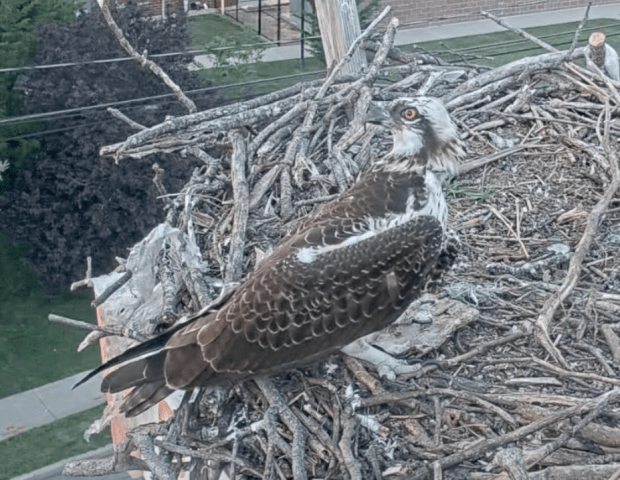
PLO has their first egg…Wednesday in Bird World

6 September 2023

Good Morning and what a grand morning it is!

I finished reading to the kittens – yes, did you know that reading aloud to your pets is also soothing for them? Calico’s kitten is now learning about ways to save our vanishing birds by listening to A Wing and a Prayer. The Race to Save our Vanishing Birds by Anders and Beverly Gyllenhaal. You can find time to squeeze in a good book by sharing with your pets!

The book is well written and insightful. I am learning so much. Did you know that more than 8,000 species of plants and flowers in the Americas depend on hummingbirds for pollination? Or that productivity in apple orchards goes up 66% if there are insects? The book is about finding ways to keep the birds alive because human life depends on that. In Kauai, there are only a few hundred Puaiohi Thrushes. These birds spread seeds around the island, creating the rainforest. “Without forests, we have no flood control. We have no drinking water.” (219) Baby Cal is learning what we all need to – first, how important our wildlife area to our existence, what problems we have created for them, what a lack of balance means to our existence and theirs, and how some talented individuals are figuring out ways to save some of these fragile creatures. So how will they save the Puaiohi Thrush? By releasing lab-bred mosquitoes. AI is being used in the Sierra Nevada to track and protect the Spotted Owl.

I had just finished a chapter when I noticed a note from ‘H’. Was I surprised? Then another note about Collins Street. Thanks so much, ‘H’

Port Lincoln has their first egg!!!!!!!! I am overjoyed and I am hopeful that we might see a big change in the behaviour of this nest unless, of course, the fish supply is limited. From Ernie’s recent catches that does not appear to be the case.

I am so happy for Mum. Nesting material had been brought in so this new couple had some idea that yesterday was the big day.

Dad was there by her side. I am going to like this guy if he is a good provider and there is no siblicide.

We are expecting an egg at 367 Collins Street and guess what? It arrives. We have lift-off in Australia!!!!!!!!!!!!

Spotting Ospreys: Blue 550 hatched at Llyn Clywedog in 2020 was seen and is believed to have a nest in mid-Wales. Fantastic.

Migration continues in the US. These are the latest numbers from Hawk Mountain.

Checking on some of the Osprey nests – who is home and who is not.

Patchogue: Mini is home and Dad has been seen down by the lake. Someone mentioned that Mom might still be around as several Ospreys were seen flying. Mini continues to adapt as she struggles with that left leg – often late in the day. She certainly does better after having a long rest on the nest! She is flying, she is eating – whether or not it is dad feeding her, Mini catching fish or both – she is eating. She is not lethargic. Mini is doing what this spunky independent determined fourth hatch always does – she gets on with it. She is living her life as a fledgling osprey the best she can with the issues that she has.

Mini landing at 1909.

Beautiful Iris is still home at her nest in Missoula Montana. Iris maintains one of the most splendid Osprey nests I have ever seen. Just like some of the others she is adding a few sticks to continue to lay claim to the nest. Soon, she will fly south – thought to be the oldest osprey in the world – we live in the hope that she will return in late March or early April and maybe, just maybe, have one of those young men waiting for her that she met this summer.

Iris demonstrated her great fishing skills even when there were flood waters. What marvellous fish she brought to the owl pole. The result, if you look carefully, is a fat little bottom. Eat up, Iris! We want you to make it to your winter home in southern Texas (??) safely and in good shape.

Of course, Iris is not ringed and no one knows for sure where she over winters but it is believed it could be the southern part of Texas and not further afield in Central America or Mexico.

Glaslyn: Aran is still home and so is 0H1 as of the time of this writing. OH1 is 98 days old. OH2 has not been seen since 4 September when he was 95 days old. That nest looks rather empty! Waiting to see if OH1 is still home on the 6th of September.

Harry is still delivering to Chirpy as of Tuesday. Chirpy was 103 days old. Both siblings and Mum have left on migration from Alyth.

Here comes Harry!

That amazing Dad is bringing fish to Mum on the nest at Boulder County Fairgrounds. What a loving couple and what better way to help your mate with a safe migration than to help her eat well after raising three strong osplets this season to fledge.

Snap and Crackle are both eating fish at the Dunrovin Osprey nest. T hanks, Swoop!

Fledgling fish calling at Collins Marsh – and still being fed! It was a really windy day in Wisconsin. You can’t tell the trees are blowing but look at the feathers of the juvenile. Fantastic.

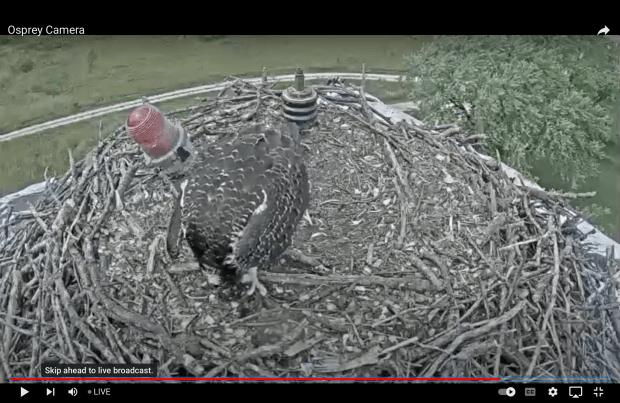
‘H’ brings us up to date on Molly and Dorsett:

Kent Island 9/5 – Molly flew to the nest at 0625, fish-called a bit, then she flew away 20 minutes later.  That was the last time she was seen at the nest.  She was soon spotted on a nearby boat lift.  In the evening, the cam focused for a long time on an osprey in the distance on a pole, but it was unclear if it was Molly.

Barnegat Light 9/5 – At 0735 Duke delivered a fish to Dorsett at the nest, and she flew to Duke’s perch to eat her breakfast.  Dorsett did return to the nest a couple of times, but sightings of her were scant throughout the day.  Dorsett arrived back at the nest early to wait for her much anticipated 7 p.m. dinner fish, but her dinner never arrived.  As the sun was setting over the bay, Dorsett resigned herself to going to sleep hungry, and she spent the night perched on one of the camera braces.

Do you live near Cornell University at Ithaca NY? Have children aged 8-18? Check this out! What an amazing opportunity for young people. In the book, Lead! Finding your Voice a Chaotic World by Barry Dore, Tim Mackrill, talks about the opportunities he had as a young person to volunteer and learn about raptors. It changed his life and led him to create opportunities for young people through his charity Osprey Leadership Foundation.

This event at Cornell is another super opportunity to get young people involved who might become our future conservationists.

The seat eaglets were up for an early morning walk about and then back to the duckling resting position waiting for breakfast.

‘A’ comments on part of the day including the self-feeding of 31: “

At 15:38, as Lady is looking around in a very agitated manner at something near the nest tree, at about the same height as the nest, SE32 starts eating the food she has in her talons. He is giving this self-feeding thing a try, having closely watched his sister eating prey that looked the same as this (he was just TOO TOO funny – ducking down with his head under her tail to peer between her legs and watch her doing very well indeed at her first self-feeding). 

SE32 pecks at the food a few times but all he can reach is a leg, and no matter how many times he picks it up, he cannot work out how to eat it. So he moves closer. SE31 is paying close attention to this – she has reached out for the food once or twice herself but is not in as good a position now as SE32 is. Lady is very upset by something and paying no attention to the food or the chicks. SE32 has moved further forward. He is up on his feet now, self-feeding on the meaty bit. Lady resuming feeding him, even though she continues to be distracted by something. SE32 remains right up on his feet while he takes the bites. 

Shortly before 15:40 Lady resumes feeding SE31. SE32 turns and moves away from SE31 a little but then turns back to face the table and Lady. He just wanted space between himself and his sister. But he gets offered no bites. At 15:41:24 he tries unsuccessfully to steal a big bite, but overbalances and falls forward, correcting himself with his outstretched wings. Lady still feeds SE31. At 15:41:30, he tries to steal another bite. Again, he fails. The next bite, he grabs incredibly fast. No-one else had a chance. He got given the one after that, then his sister gets a bite. The one after that is a big piece and destined for SE32. He grabs it and works hard to swallow it. 

Lady is still very distracted. Periodically, she gives SE32 a bite. Both eaglets have good crops now. At 15:42:34, SE32 grabs a really big piece. He swallows it with relative ease, as Lady doesn’t even bother trying to retrieve it from him. There is still an amazing amount of meat on this carcass. The two have eaten well. Both have good crops but both are still keen to keep eating. SE32 is very brave, diving for every bite and winning most of them, especially all of the really big pieces. Lady occasionally gives a bite to SE31, but she is not competing with SE32 and is largely just watching him grab and swallow. 

At 15:44, SE32 grabs a large piece of meaty flesh with a longish leg and a foot attached!! He horked the lot with no trouble at all. By 15:44:30 he is back competing for and winning bites. Lady is feeding both eaglets plenty of food but overall, SE32 is getting the better of the feeding at this point. He is winning most of the bites that are competed for and Lady is offering him way more bites than she is SE31, who is sitting back a bit by now. 

At 15:46, SE32 swallows the second leg and foot, also with flesh attached, though not as much as was attached to the first leg. Still, he swallows it without difficulty. Within 10 seconds, he is taking the last few bites from Lady and cleaning the table of leftovers. The feeding is over by 15:48. Both chicks have very large crops, and SE32 has already done a couple of small crop drops during the feeding to fit in extra food. That second piece of prey had a really large amount of flesh on it. The head was gone, but the body provided a great deal of food. Both eaglets have had plenty to eat today. 

There may be more food – I will check. But they did well for the day – eventually – and both will go to bed with full crops. “

‘A’ reports on the Royal Albatross Chick, Manaaki: “GLY may have been in today to feed Manaaki off camera but we’re not sure. We know GLY has fed Manaaki behind the camera at least once recently. The chicks are a lot more mobile now and are doing a lot of exploring as they prepare to fledge. It is starting to get scary when Manaaki is off camera for six hours or more on occasion – we think he might have fledged and we missed it! He still has about a fortnight to go until he reaches 240 days, but of course at least four chicks have already fledged from the 33 at the colony and Manaaki is one of the oldest (and though he does have a lot of fluff remaining, QT did too). He has not done enough wingercising, in my opinion, and still needs to be doing a lot more practising. We need to see much better hovering, and face-planting is an undignified landing for an albatross. I think he has quite a lot of work to do before he is ready to fledge. Let’s hope he doesn’t leave before he is good and ready, but often, it is the winds that determine the timing. As with Lilibet (QT). “

Beautiful Gabby. What a lovely couple – I miss Samson. But life moves on and we have the most amazing memories of him. Gabby mourned last year and took her time selecting a new mate out of the many contenders. Let us hope that V3 is up to the task. He has big talons to fill.

Lady Hawk caught Gabby bringing in her breakfast.

No one is home. Louis, Dorcha, and Ludo are on their way with only Sparrowhawks visiting the nest. Look at this beautiful capture over the nest as the sun rises. Stunning.

Visiting Sparrowhawk.

We always need to be reminded, especially with there still being hot days in many parts of the world, of how we can help wildlife. Please read and keep them in mind. Water is essential. Water and some shade.

Let’s see how much you know about Condor numbers! (Answers below)

  1. How many California Condors were alive on 6 September 2023? a) 208; b) 91; c) 214; d) 345; or e) 559?
  2. How many California Condors live in the wild? a) 76; b) 345; c) 214; d) 93; or e) 54?
  3. How many California Condors live wild in Central California? a) 93; b) 65; c) 214; d) 23; or e) 75.

Do you want to know more about the efforts to protect and grow the California Condor community? In 2022, the Ventana Wildlife Society commissioned a documentary to be made to introduce people to the Condors of the Big Sur. They are working on another film in 2023 called Condor Canyon. It isn’t finished but, for now, why not check, out Part 1 of the 2022 film. You can find the other segments on YT by doing a search or checking on the side panel.

Thank you so much for being with me today. Please take care. See you soon!

Thank you to the following for their notes, posts, videos, and streaming cams that helped me to write my blog today: “A, Geemeff, H’, PLO, 367 Collins Street by Mirvac, John Williams and Clywedog Osprey Group, Hawk Mountain, PSEG, Bywyd Gwylld Glaslyn, Alyth, Boulder County Fair Grounds, Dunrovin Ranch, Collins Marsh, Kent Island, Conserve Wildlife F of NJ, Cornell University Bird Lab Raptor Program, Sydney Sea Eagles, NEFL-AEF, Lady Hawk and NEFL-AEF, Geemeff and The Woodland Trust, Ventana Wildlife Society, and Durham Wildlife Trust.

Answers to the three question Condor number quiz: 1. The answer is e. 559 total number of Condors. 2. The answer is b. 345 live in the wild. 3. The answer is a. 93 live in the wild in central California.

Mini Picks Fights, M3 fledges…Friday in Bird World

30 June 2023

Good Morning Everyone!

I got up early – it was cool for a change and not so humid and headed to Fort Whyte Alive. It has been a few days since I walked around that trail checking on the little ones and oh, was it good, to get out and get some exercise. What is that phrase? “Use it or lose it!” I remember a surgeon telling my mother that after she had broken her hip and it was all pinned…she did not want to get up. Well, she did when she realised that laying there might mean spending her entire life like that. Thank goodness.

The cutest Little Red wasn’t afraid of anyone walking by.

There were little ones around. Here are some images of them..and their proud parents. There are not many families and it was such a delight to turn a corner and encounter a family out foraging.

Hooded Merganser chicks! There were 18 of them at the final count.

The Canada Goose family with four chicks is doing fine. The males always follow behind, keeping the little ones in line! The rain has provided much-wanted new grass for everyone! And no worries, that chick is wet from the recent rain – is not ill!

The giggle for your morning continues to come from the Loch Arkaig nest. Gosh that chick is a character. Thanks, Geemeff.

Mini missed out on breakfast which must have caused her to be a little grumpy. Then she had a nice feed of fish around 11:42 before the Bigs came over and Mini moved away…she would definitely have linked more fish. Our girl is so skinny. She really needs to bulk up with the weight but it is difficult with the three Bigs. Well, Mini started staring at Three after puffing herself up…and then…

Despite having some fish, Mini’s crop is hollow and it is very hungry. This chick – as I will keep saying – needs fish to ‘bulk up’ for migration. Note the ‘thick’ legs and toes.

‘R’ reports that Mini picked another fight in the afternoon. Mini is hungry! Watch the video again and see how she puffs herself up to look bigger—perhaps sizing out the siblings. She needs to eat…and today, like other days, has been slim pickings. At 20:32, Mini finally – in desperation – grabs a bite meant for a larger chick. That bite was all Mini got. The fish was gone. This nest desperately needs more fish so that Mini can get a nice big crop…she is so thin.

When Ferris Akel was on the Cornell Campus Thursday evening, M3, the third hatch of Big Red and Arthur for the 2023 season fledged from the light tower to Rice to join the two other siblings who had previously fledged. Congratulations. Stay safe, sweetie.

The little one at the MN Landscape Arboretum nest had a few feedings on Thursday. Not much fish and adult female eating often and not offering, often off the nest for long periods not protecting the chick from the weather…makes me ache.

A nice fish came on the Collins Marsh nest and both chicks and Mum ate well. Nice.

Only Bob at Cowlitz PUD had a nice fish feed before tuck in Thursday night! In fact, this little one had several nice fish dinners on Thursday…and just look at it grow.

Oyster Bay continues to flourish.

The camera pixellation is not so defined as others but it is easy to see that both of the chicks – Kewok and Naika -on the Seaside osprey nest in Oregon are thriving this year.

It has been a good day at the Boulder County Fairgrounds Osprey platform and oh, Little is getting a private feed right before dinner. I so wish this was Little Mini eating…

Massive chicks – three of them at Carova Beach North in the Outerbanks.

The trio at Wolf Bay in Alabama are bigger than Mum…

In Finland, you will remember that the female went missing on nest #3. The father continued to bring fish filling the nest but the chicks were too young to self feed. One died and two were taken into care. There is now good news on two fronts. The two chicks taken into care are doing so well that they will be placed as fosters in other nests. And the Dad did a 30 minute sky dance for a new female and has even delivered fish to her. She could not find a better mate than Tuulos.

There are two chicks for Beau and Hope at Newfoundland Power – Snow Lane Platform.

Several fish for the duo at the Clark PUD nest in Washington.

Blue 022 comes in and checks out the supplies at Poole Harbour and returns with a nice fish and then another one so the chicks have a big tea before bed.

The ringing of the two osplets of Idris and Telyn is available on YouTube: (414) RINGING 2023-YouTube. For some reason it will not allow me to embed it for you. Those chicks were a female weighting 1920 with Darvic ring 7B3 and a male at 1515 arms with ring 7B4.

Everything is fine at the Llyn Brenig.

Laddie makes sure everyone is fed before they are tucked in for the night – and now, they are waiting for the breakfast fish!

One of the Great Spirit Bluff fledgling Peregrine Falcons was killed by an owl on the 22 June. That was Alice P58. All of the others, Thomas B59, Kami P59, and Jaycee P60 are still alive (do not believe the rumours they have all died).

‘H’ found some worrisome news about WBSE 30.

There are now three chicks at the Patuxent nest..if you go your eyes do not need to go to the doctor! There is a foster placement at the nest.

‘H’ checked on two other nests on Thursday – Fosythe and Kent Island.

Forsythe had already had three fish in the afternoon, with a feeding at 1412.  “I decided to observe their behavior to determine how well the chicks had been fed throughout the day.  They both waddled up to Opal, and ate peacefully side by side.  No sign of aggression.  Verdict: they had plenty of fish throughout the day.  ‘Big’ obviously had that feeling of ‘food security’, as you say.”

Kent Island: “I am aware of at least 4 large fish brought to the nest by Tom.  The fourth delivery was at 1522.  The chick was well fed.”

‘H’ also recommends a season tribute to the SW Florida Eagle Cam by LizM- again I am getting blocked but the title is (414) A Season to Remember Season 11-You Tube. It sure was a bittersweet year at SW Florida!

Mini is not the only one wanting fish. Soledad has been waiting for a prey delivery for over a day!

I need to go and check on Mini before I post this. I am so worried about Mini. She needs fish – a really good feed. My concern is that the big ones just take the fish now and leave nothing.

Well. Mini is being brilliant and staying close to the right side of Mum so that whenever a fish comes in, she is at the ‘good eating spot’. The others appear to be more interested in wing-flapping this morning, which is good. Mini ate from 0625-0636, then pulled at the leftovers on a bone at 0757. She eats again from 0853-0906. There appears to be not a lot of fish on those bones – Mum and Mini cleaned them up quickly. Hopefully, Mum is also feeding Mini faster, so it gets more before the others come around. Please wish for fish for Mini today!

Telling Mum she wants fish!

Eating.

Pulling on that bone.

Thank you so much for being with me today. Wish for fish! And take care of yourself if you are out in the heat. See you soon.

Thank you to the following for their notes, videos, and postings that helped me to create my blog today: ‘H, Geemeff, R, T’, Geemeff and the Woodland Trust, Ferris Akel, MN Landscape Arboretum, Collins Marsh, Cowlitz PUD, Seaside, Boulder County FG, Outerbanks, Wolf Island, Finnish Osprey Foundation, Newfoundland Power, Clark PUD, Poole Harbour, Dyfi Ospreys, Llyn Brenig, LOTL and The Wildlife Trust, Australian Raptor Care and Conservation Inc, Patuxent, Forsythe, Kent Island and Explore, SK Hideaways and SJCH Falcons.

Too much news…Thursday in Bird World

15 June 2023

Good Morning Everyone!

The inbox was bulging with happiness as each of you watched Little Mini at Patchogue eat its heart out Wednesday morning. My goodness, that little one even went back for seconds! More on Mini, later, but suffice it to say it made my day on Wednesday just a wee bit better.

The wildfire smoke is somewhat gone, the air outside is a little cleaner, and the skies are clear in southern Manitoba. There is no sign of the Blue Jay fledgling in the garden Tuesday evening, but I will check again as it gets late. Maybe. What a joy that little one was to observe! And the parents, too, keep a close watch. Overhead, at least 150 Canada Geese headed north to find space, food, and cooler temperatures. They might find some of this smoke from the burning fires. These are the ones without families to care for – so many, and this is not the first chevron of geese going over in the last week. So many without families this year. It is worrisome.

On Monday the 16th, I will be travelling north to do a Bald Eagle nest count. I hope to have some good images of wildlife for you on Tuesday. Today I am going to Delta Marsh on the southern tip of Lake Manitoba to see if I can find some shorebirds! Wish me luck. I will be out all day so hopefully, Little Mini will be persistent and get some nice fish.

Lewis was growling at the rain at couple of days ago.

Today he decided to play with his piece of Honeysuckle branch.

Missey just wants to remind everyone that she is ‘sweet’.

Both kittens remind everyone that planting a tree to remember someone or some pet is good for the environment!

Lewis and Missey also remind us that if you are doing some late spring cleaning, see if there is anything you have and don’t need that your local wildlife rehab clinic could use. It is incredible the things they need – check their wish lists and then also think of power tools to help build and repair buildings and fences. Anyone die recently leaving a lot of tools? Find out if the rehab can use them. What a lovely way to remember a loved one by donating to a good cause.

Wednesday turned out to be a mixed blessing day. We might as well start with the ‘good’ before I throw in a little of the sadness.

‘H’ reports that the Dahlgren Osprey platform and its osplets are doing fantastic. You can see the age difference in the plumage…this is good news.

It is day 41 for the second egg at Kent Island. I wonder if that one is unviable as well.

The other nests that ‘H’ has been monitoring are all doing well and she hopes that there are no turn arounds on them! Me, too.

Severna Park: Oh, we worried about Middle after we lost Little to siblicide but, things continue to go well. Middle is older and bigger and the pair are eating side by side. ‘H’ reports that fish are plentiful.

‘H’ reports that the Barnegat Light feeding 0944 to 1006:  The feeding was peaceful eating side by side until, at 0955 Big beaked and bit Little.  Little was able to return at 1001 and ate beside Big.  Total bites for Little = 60. (I hope this nest won’t go sour now, like so many others that started out peacefully).” We wait and see. Send good wishes..that Big one is rather vicious. Let them make it out of the reptile stage!

At the Cape May Osprey nest, it is day 38 for egg one and ‘H’ says we are on pip watch.

I spent the day checking on some nests that I monitor but do not often report on – or a few even that have fallen through the cracks for one reason or another. At the Collins Marsh nest in Wisconsin, there are three osplets for what I believe to be new adults at the osprey platform near the local nature centre. This nest is very difficult to watch as fish are not always plentiful – at all! Malin, the only surviving osplet, force fledged in 2021. I criticised the local caretaker consistently because help was not at hand and the little one died on the ground. There is a new person at the nature centre. I hope if there are issues they will get out and look for those babies on the ground! The nest is on top of a fire tower that was moved. There is no perch and access to the desk would be difficult (or so I was told by the last caretaker – I don’t believe it!).

No chicks yet at Fortis Exshaw near Canmore, Alberta. You can see the fires burning in the distance. It was raining when I checked in. That is good…no chicks! Bad for little ones.

What you are seeing below is the Marsh Meadows osprey platform in Jamestown, Rhode Island. It is one of several nests on Conanicut Island. The three eggs hatched on May 29, 29, and 1 June. By the 7th of June, all three chicks were dead. Was it starvation by parental neglect? or was it starvation through mitigating circumstances – male was missing?

Both adults were on the nest this morning so, since the male is not missing (so he did not die of Avian Flu as suggested on 7 June), did the chicks die of starvation from inexperienced parents?

Bay and Beau’s two little osplets at Island Beach are doing well.

The three at Wolf Bay, Alabama are thriving. Gosh, look at those three big osplets!

The three at Oyster Bay should be getting along but, there is often beaking.

Dad delivering a fish to the Oceanside, NY, Osprey platform.

Two chicks at Seaside. So far so good.

‘H’ reports that both of the Patuxent River Park Osprey nests have osplets that are full and civil!

I just caught the Dad at Patuxent II bringing in a monster of a fish at 2002. Wow.

Oh, just sit down and cry – joyful tears. It really is OK. Newmann is feeding his peregrine falcon babies. Their Mum, Savanna was killed protecting her nest from a GHO. Newmann has called Savanna and called her and is now taking full responsibility for their last chicks together.

Dale Hollow DH17 has been caught on cam and appears to be doing quite well. River has a new mate (or so it appears). Only time will tell if she rebuilds at the original nest she shared with her partner, Obey, who disappeared this spring.

Bonus and Waba are on the move (slightly).

Now, let’s take a look at Little Mini at Patchogue. Is the saying ‘The Early Bird gets the fish’ applicable? Mini did well for when the Big ones were sleeping. That early fish that landed on the nest at 0536 was a bonus. Little Mini ate, then the Bigs woke up, and by 0639 Little Mini decided he would go back to the table for seconds. He finished eating at 0652. Mini got some from the 0846 delivery between 0908 and 0912. He had nothing from the 1526 delivery. He was in submission. At 1537 two of the Big siblings are having a tug o war with the fish. Then it rains. During some of this time Little Mini seems to be shoved down and around. Parents are trying to encourage self-feeding amongst the big siblings. This may or may not be an issue for Mini. If he can get those early feeds, he is OK.

According to someone on the chat there are three lakes nearby and 2 creeks connected to the bay. Should be lots of good fishing.

0540

0639 Up for seconds.

0652. Full. Leaving the table for the second time.

0912. Enjoying a meal. How does it feel to go hungry and see all the other siblings fed. I hope Little Mini feels full and alive this morning!

Later…after ‘they’ wake up. LOL.

1536. Mini shut out.

1537. Tug o war for the fish.

Fish – teasers and big fish – land at the Patchogue nest after the rain and all the time that big chunk of fish is still on the nest. Mini is quick to take opportunities when the Big ones show no interest. Mum feeds a small live fish at 1723 and then moves to the big chunk left at 1736. Mini rushes and is at the beak at 1737 . He ate until 1751ish. Then another big fish comes on the nest at 1800. Mini is right there – two big pieces of fish. He starts getting fed at 1802 and is moved out of the way at 1830. We should really see some growth in Mini by Friday with all this fish.

Smart Mini. He is filling his crop and then dropping it so he can hold more fish. I hope Mum has a good look at this persistent third hatch. It reminds me of Tiny Tot Tumbles from Achieva or Blue 464 from Foulshaw Moss. A Survivor.

Mini had a really good day and he is going to sleep well tonight. Happy Osplet dreams, Mini.

Mini was up and had an enormous crop Thursday morning…way to go Mini! Dad came through at Patchogue with three large fish by 0959.

Speaking of the Foulshaw Moss nest, White YW and Blue 35 have three osplets again this year.

At the Boulder County Fairgrounds, a team feeding by the adults really helped the third hatch, Little, who has been beaked and shut out from most feedings. This nest is still problematic…and each pulls at our heart.

After…this little guy is really struggling. Send your best wishes that they team up to feed the chicks until Little is old enough to hold its own.

At the SWFlorida Eagle nest, M15 visits. Unclear if E22 is still around. Not seen at the nest for a couple of days. M15 will not leave the area until E22 is known to be gone. M15 has taken his parental duties very seriously since Harriet went missing in early February. Thanks Vijay!

The Ms are well…growing up on Big Red and Arthur’s nest. Fledge watch is what? a week away? They may be big but, when the rain came they all wanted under Mum! Oak leaves. Across Tower Road there are Oak Trees. Big Red likes her chicks, when they fledge, to fly to those trees. The eyases have imprinted everything from the type of prey that is safe to eat to now these leaves. (The pine is for insects).

Big Red’s E3 was out doing an educational visit today.

Murphy is enjoying the life of a single foster dad now…it is quiet and no one takes his food!

There is now only one eaglet in the Estonia hybrid eagle nest. ‘T’ explains: “Good news in Estonia is that the baby hatched in the nest of Greater and Lesser Spotted eagles. There are not enough Greater Spotted eagles, and many of them are lost during their massive European-African migration. They create mixed couples. This nest, in Harju County, Estonia, was the nest of male Tõnn, who used this nest since 2016. Sadly, Tõnn, did not return from Spain in 2020. We don’t know what happened to him.”

Here the chick is taking a mouse form one of the adults.

‘T’ writes that the Russian Ornithologist “Michail Korepov went to the National Park “Sengileevskiye Gory” to check the breeding situation of large raptors. So this year, they found 12 white tail eaglets, 6 owlets and 2 Imperial eaglets – they are growing up in the national park! And the number is not including 2 chicks of Altyn and Altynay.” Very good news on trying to increase the population of these critically endangered raptors for the area.

‘A’ has been keeping an eye on Deyani and writes, “Meanwhile, there are either storms on the way or Angel is having a sudden burst of empty nest syndrome at the thought of Deyani fledging, because at 7.30pm, Deyani has an OBSCENE crop and the nest is FULL of prey. A rabbit, a vole and something unrecognisable are literally filling the nest bowl. I have NEVER seen this on this nest. Any food that arrives is dealt with in seconds by Deyani and nestovers are non-existent. But not tonight. Angel is attempting to tempt Deyani, who is taking the occasional small mouthful from her, but essentially, mum and daughter are standing side by side at the back of the nest, surveying the smorgasbord spread out at their feet. Deyani is going to have to find an appetite if she is to sleep on that nest tonight. It is just after 9.30am here in Melbourne, and it is another cold day. Sunny thus far, but that will change apparently.”

Baby bunnies. They seem to have cleared out an entire nest! Oh, dear.

‘H’ reports that Mini at the Forsythe Nest had only 30 bites on Wednesday. It is, as she says ‘feast or famine’ for this little one.

The third hatch at the Evergy Topeka Falcon scrape still has feather issues. The feathers have grown but have not broken the shaft and it is having difficulty jumping up to the ledge of the scrape to get food.

Will be sending a note to Evergy. The little one tried to jump up to the perch so it could have prey but failed…

Everything about Peregrine Falcons in a nutshell:

Just look who has returned to the Cal Falcons scrape!

Doug Gillard reports on the little Red-tail hawk, Tuffy, let that has survived in the Bald Eagle Nest with his foster sibling, Lola.

Kathryn reports that one of the goshawks in Estonia has branched. She adds, “I have somehow watched this nest since the eggs were laid and I thought none of them would hatch since they were left out in the cold so often! But look at them now!” Beautiful hawks.

At the Black Kite nest in the Kurzeme Forest, the only chick of Gold and Griegis is doing well.

Dulles-Greenway gives us an update on Pat, the eaglet of Rosa and Martin, that is in care.

Meanwhile, Pi and Flora are being fed by the adults in the wetlands.

Each of us needs to know that what we do matters. We can change the lives of our raptors, but we have to take action. Sometimes it is simply ‘baby steps’ towards our goal, but each success will lead to another. We must realise and inform others that the fate of our wildlife, our beloved raptors depends on us because most of their challenges are human-caused.

Thank you to everyone for being with me today. Please take care. See you soon.

Thank you to the following for their notes, videos, posts, and streaming cams that helped me to write my blog today: ‘A, Geemeff, H, Kathryn, T’, Dahlgren Ospreys, Severna Park Ospreys, Conserve Wildlife Foundation of NJ, Collins Marsh Ospreys, Fortis Exshaw, Marsh Meadows, island Beach Ospreys, Wolf Bay Ospreys, PSEG, Oceanside Ospreys, Seaside ospreys, Patuxent River Part Ospreys, Lachelle Koestert and Peregrine Falcons at Great Spirit Bluff, Aliengirl and Bale Eagle Live Nests and Cams, Maria Marika FB, Cumbria Wildlife Trust, Boulder County Fairgrounds Ospreys, SW Florida Eagle Cam, Vijay and SW Florida Eagle Cam, Cornell RTH, Cornell Cam Chatters, World Bird Sanctuary, Eagle Club of Estonia, Looduskalender Forum, Window to Wildlife, Evergy Topeka Falcon Cam, SK Hideaways and Cal Falcons, Canadian Peregrine Falcon Foundation, Doug Gillard and Nor Cal Birding, Latvian Fund for Nature, Dulles-Greenaway and Forstythe Ospreys.

Mom returns to Collins Marsh and a Pip Watch in Australia

The female Osprey with a chick on the Collins Marsh Reservoir nest in Wisconsin was away from the nest for 21 hours. This is most unusual. At this time, no one is clear about what happened to her or where she was. She remained on the nest all Sunday, without leaving once and Sunday night. She returned Sunday morning around 9:40 and began feeding the chick. She has already fed the chick this morning. There remain concerns for the condition/growth of the chick’s feathers, particularly those on the wings.

Update: I have just heard from Stephen Easterly, the DNR Biologist for the area, and he feels that the chick is progressing fine. It is walking, self-feeding and we will all now look towards a successful fledge. Thanks to everyone in Collins Marsh for their concern for this chick and their quick response to viewer’s calls.

Sadly, it is going to be another scorcher in Wisconsin today.

Did you watch the Barlineck Osprey Nest in Poland? That nest is on top of a 35-meter pine tree with an artificial platform. There were four eggs laid, but only two hatched – the first on 25 May and the second on 31 May. There was a huge size difference (of course) between the two. Despite that, I received word from Michael Zygmunt of the Polish Eagle Committee in Poland this morning that both chicks fledged successfully. Their camera is out of operation. They replaced the router but discovered that the cable connecting the camera and box is damaged. They will not repair it while the nest is active. So please don’t forget about this wonderful Osprey nest next year. And so happy that both of those babies are flying.

Everyone loved Aila, Louis’s mate at Loch Arkaig, that did not, sadly, return this year from her migration. Louis has a new mate on a nest that has no camera. Today, a short video clip of the two chicks was put on YouTube when they were ringed. Both chicks are believed to be males, and their ring numbers are Blue LW3 and Blue LW4.

And, as the Osprey season dies down in the Northern Hemisphere with the chicks honing their flying skills and staying off-camera, things are about to pick up in Australia. The pip watch for the White-bellied Sea Eagles, Lady, and Dad, begins today, 27 July, in Australia.

The White-bellied or White-breasted Sea Eagle is the second largest bird of prey in Australia. They have a wingspan of 1.8-2.2 meters or 6-7 feet. There is the same reverse size-sex ratio in these birds as in other raptors meaning that the female is larger than the male. Sea-eagles, or Fish Hawks as they are called in some places, live along the coasts of Australia, Southeast Asia, and India. You can also see them in New Guinea, and there is quite a number around Singapore.

The adults have a white head and belly, underwing coverts, and tail. The upperparts are the most beautiful slate blue-grey. The juveniles change from a white fuzzy bobblehead to a bird with a light brown head and breast with underwing coverts of rust, a ginger red and dark brown mixed with white. Their tails are white with dark tips (only present in the first year). After several annual molts, the juveniles will change to adult plumage.

The breeding season is from June to January. A clutch of two off-white eggs is laid two to three days apart in a huge stick nest.

There is a nest cup in the middle. Both parents will incubate the eggs. As of 23 July, Lady has incubated the eggs for 215 hours, and Dad has incubated the eggs for 131 hours since the first egg was laid. Both parents feed the chicks, but, in general, the male brings in the prey, and the female at this nest feeds. The chicks will fledge at around 75-85 days. If all goes well, they will remain in the nest area for several months, being fed by the adults as they gain their flying skills.

Lady and Dad have their nest in an old Ironbark Tree in the forest of the Sydney Olympic Park. There is restricted access around the nest during the breeding season.

It isn’t just the Sea Eagles, though. Mom and Dad have been busy refurbishing the nest on the Port Lincoln Osprey Barge. In fact, Dad has been cleaning up the coastline, bringing several plastic bags lately to the nest. Hopefully, someone will remove them. Why do Osprey males like to bring non-bird items into the nest? I wonder if Mom likes the softness of the bags compared to the sticks?

Last year’s fledglings from this nest, Solly and DEW, made the news on Sunday in Australia. The picture is of

Solly has a satellite tracker, and it has really helped with our understanding of Osprey.

The lead researcher, Ian Falkenberg, commented: “Solly has so far traveled about 520km from Port Lincoln. We didn’t expect her to travel that distance because ospreys in Australia are non-migratory,” he said. “The second thing that surprised us was the distance flown inland. They live predominantly on fish so why she would spend time out there in those areas we’re not sure, other than taking exploratory trips.”

Solly has spent most of her time around Streaky Bay and Eba Anchorage. A few days ago, she moved to Smoky Bay, where the fishing is supposed to be very good.

The last check on Tiny Little at the Foulshaw Moss Nest revealed no one is on the nest in the late afternoon in Cumbria! Apparently, Tiny Little no only held off its big sibling from getting its fish yesterday but got upset with Blue 464 and pecked at its head rather hard! Now that is a first, too.

Thanks, everyone, for joining me on a partly cloudy morning on the Canadian prairies. See you soon! Take care.

Thank you to the following for their streaming cams where I take my screenshots: WBSE Cam, Birdlife Australia, and the Sydney Discovery Center, Cumbrian Wildlife Trust and the Foulshaw Moss Nest, Port Lincoln Osprey Project, and the Collins Marsh Osprey Cam.